




Abstract
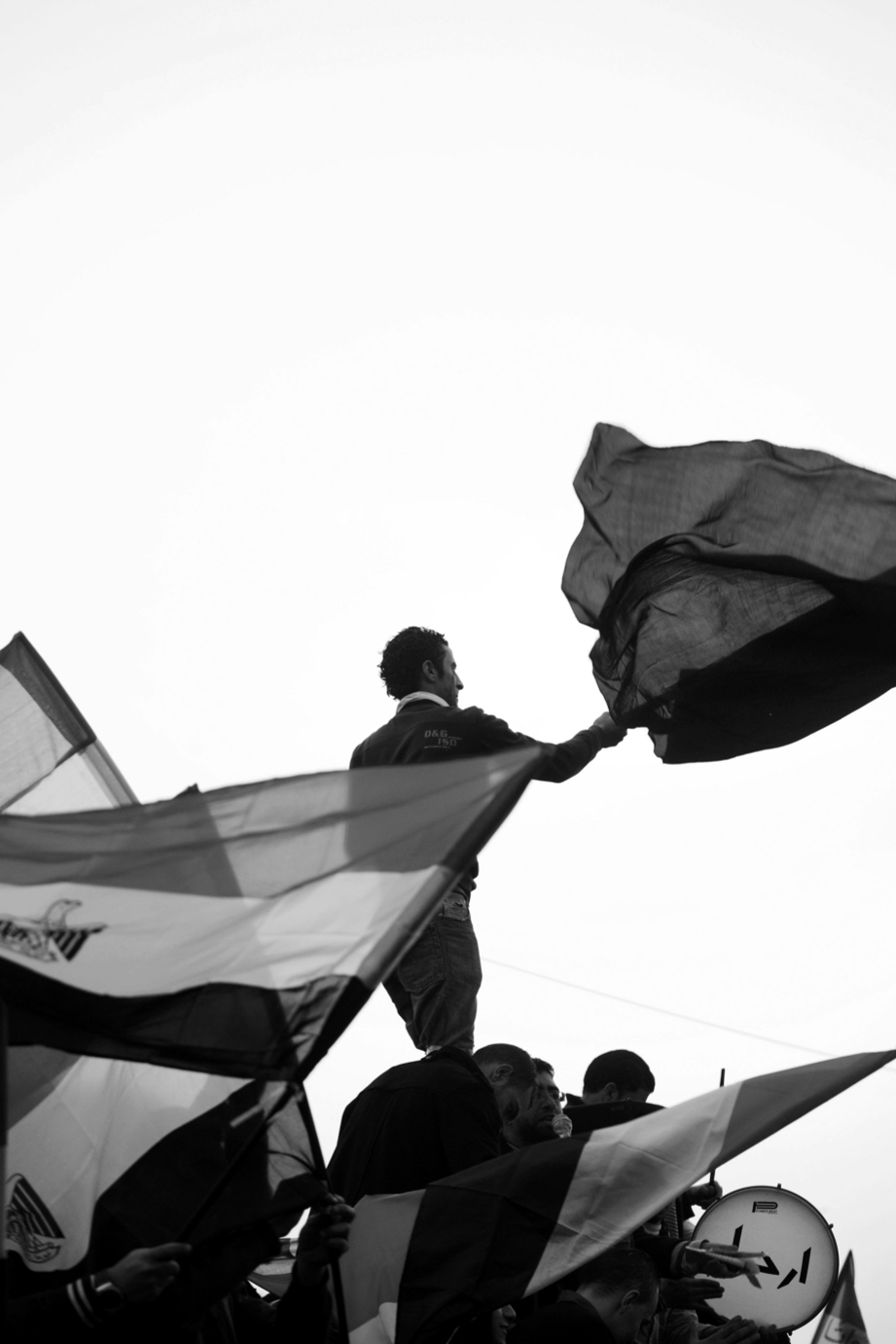
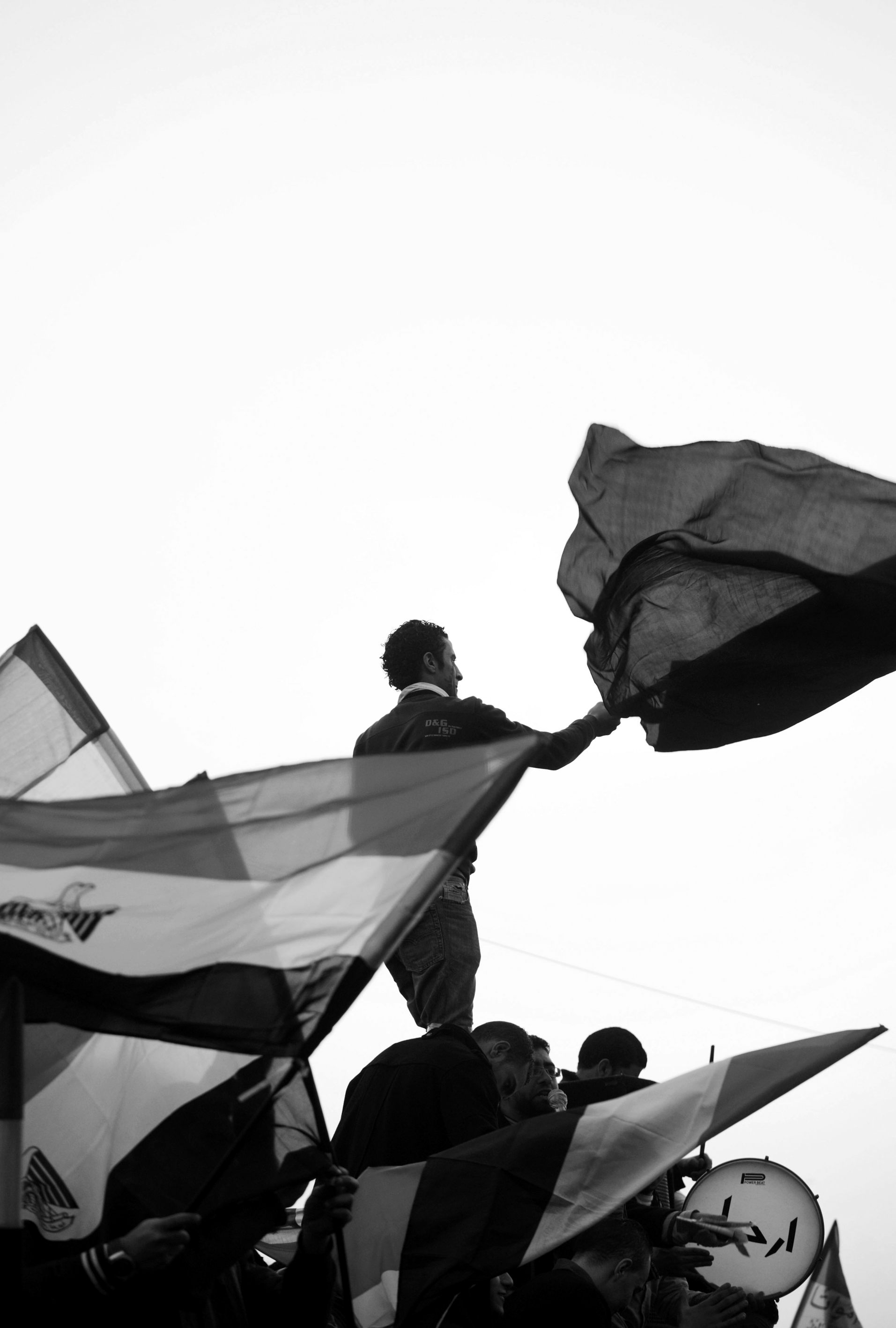
A protester waves the Egyptian flag hours before President Mubarak steps down from office, Tahrir Square, Cairo, Egypt, 11 February 2011
Credit: James May/Alamy
Novelist and journalist
I visited Tunis in the mid-noughties, responding to an invitation from the Dutch embassy to engage with Tunisian authors and their students. We gathered at a hotel in Habib Bourguiba Avenue, in the centre of the city. The venue was imposing, and so were the authors’ positions – a bit too imposing in fact for such a small country as Tunisia. The title of the seminar, ‘The role of the writer in contemporary society’, sounded even more pompous in French, the language of discourse. It was an unforgettable trip, but for the wrong reasons. There did not seem much to discuss, except the obligatory l’art pour l’art, art for art’s sake, positions. Nobody really seemed to distinguish which society we had to address, let alone define the adjective ‘contemporary’.
Most of the Tunisian writers spoke from their papers, something prepared between a heavy dinner and a nightmare. Their voices sounded shallow, timid, eloquently void of any meaning and brutally grey – they talked like bureaucrats of the police state, not like writers, betraying all they should stand for. But I felt that I could not attack them, taking into consideration that their colleagues in Morocco, Algeria and Iraq were doing the same thing; the ones who spoke up and broke the discourse of taboo and censorship would be picked up by the secret service for a deflowerment of the mind. They would be thrown in jail, their families’ lives would be turned into hell and not a single NGO or western government would have the power to win them amnesty.
The American war on terror was broadened by the Arab regimes into a shameless war on everything that went against the status quo. Wandering through a semi-totalitarian state has its moments of wonder and moments of infantilism. Managing a dictatorship means preserving an absurdist system that turns the citizen, and visitor, into an absurdist personalty. When you train people not to see the problem, it’s not the problem that disappears, but the ability to see.There was one female writer who just whispered her position. And some of the writers would clasp their hands on the table in a futile attempt to bring rhythm to their ramshackle clichés. Hundreds of young female students looked on in silence without moving a finger or raising an eyebrow. The writers of the Union des Ecrivains whom I met just thanked me for coming without detailing what I was to be thanked for. My family name is Benali, the same name as the Tunisian dictator, and it would take people by surprise.
After my speech and talk with literature students (99 per cent women, no headscarves to be seen) I was approached by state television, Channel 7, for a short interview. The interviewer rattled off questions in Arabic and I felt that I had to explain to her that my Arabic wasn’t up to doing an interview. She did not look amused, as if I had just told her that Tunisia was a misspelling of amnesia. ‘But we could speak French,’ I suggested. No reply and an awkward silence.
‘I am sorry,’ she said after some helpless pondering, ‘but we can only interview somebody whose surname is Benali in Arabic.’ It didn’t help when I wanted to talk about the effects of the channel Al Jazeera on the region at dinner with the writers. They fell still, looking sullen and shocked and downright scared; one of them raised his finger to the ceiling, his gesture meaning this was not the place to talk about these things. ‘Let’s talk in a café,’ he said afterwards and disappeared, never to be seen again, café or no café. These were troubling events: I was invited by the Dutch embassy but hardly found an environment for a free exchange of ideas and opinions.
The Arab revolts are an undeniable fact: they happened. It was 100 per cent manmade – non-violent and almost pedestrian in its demands. Men, women and children stood side by side in a successful attempt to silence the machine guns of the system. People sacrificed their lives to make the unimaginable imaginable, the unthinkable real. The consequences of what happened in several North African and Middle Eastern countries will be felt for years to come. Maybe when another generation is ready to sum up the hope and pitfalls of our time, they will single out this year for two facts only: the death of Steve Jobs and the people of Tahrir Square, both capable of stirring the emotions and imagination of people, both birthgivers to a new era. The uprisings dealt a blow to conspiracy theories because this time the news didn’t come from outside to infiltrate people’s minds, it came from inside, homemade and exported to the rest of the world.
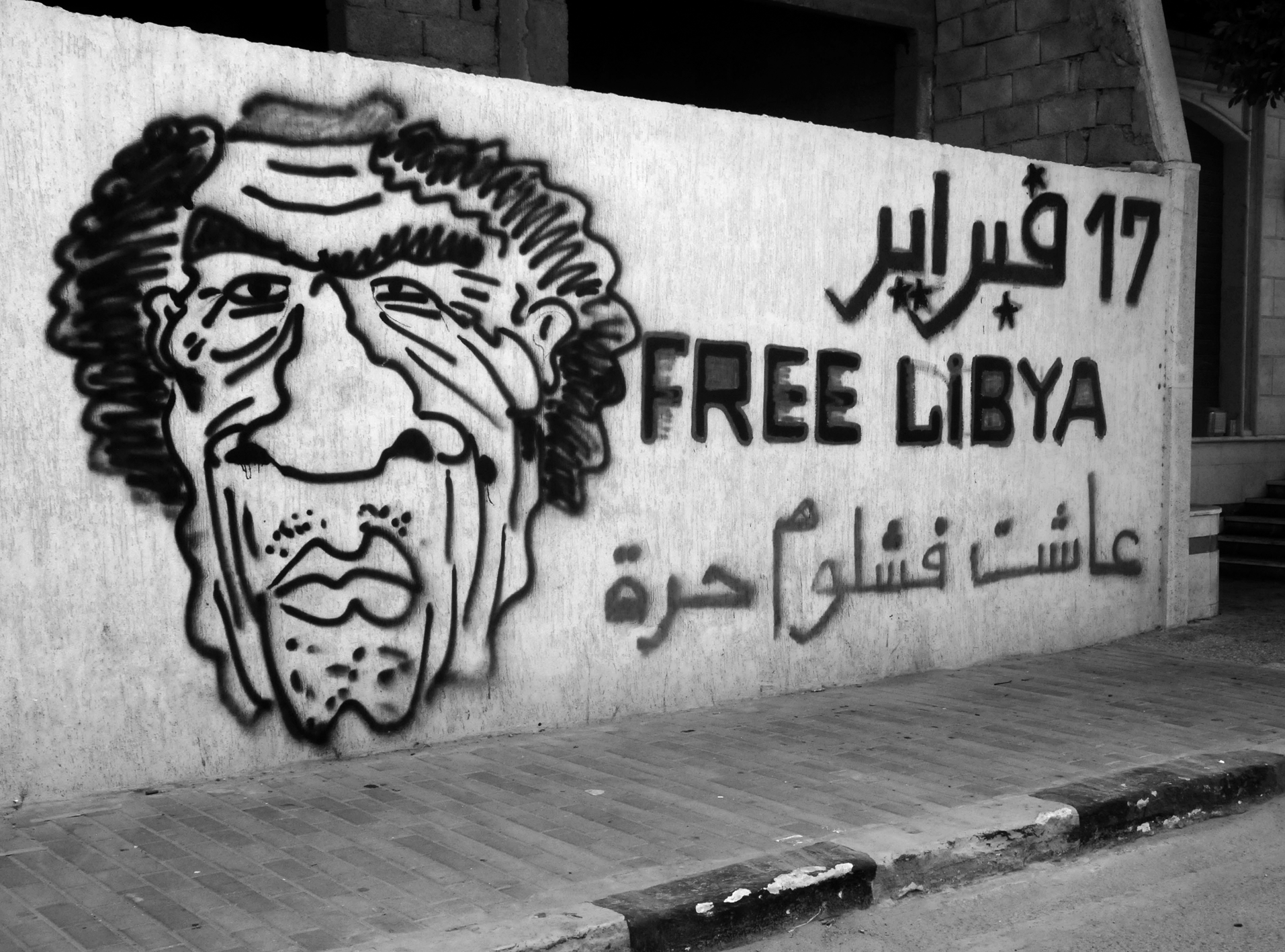
Caricature of Colonel Gaddafi, Tripoli, Libya, 27 August 2011
Credit: Teun Voeten/Panos
It’s the start of a new epoch in citizen journalism: using their mobiles, Al Jazeera Arabic and English, their Skype and their YouTube, protesters sent messages of anguish, anxiety, despair, heroism and single-mindedness to the world. It’s the beginning and it’s the continuing of the democratic experiment in the Arab world. It’s the women’s revolution, highly educated, fluent in languages, fluent in giving language to anger. They were more fearless in the crowd than anybody else. They managed to engage a new audience as witnesses to liberation, not seen since the war in Nicaragua or the struggle against apartheid in South Africa.
The Arab revolts are a conspiracy of action. No place for silence, which is deeply significant: growing up in the cultural environment of an Arab police state means living with silence, learning a strange language of messages in code in which everything is concealed, everything is told. Speaking spontaneously without holding back is almost seen as an act of blasphemy. For this reason, so many young men turned in their flocks to the protecting walls of the mosques where everything was encrypted in religious language. Before you learn anything, you learn that silence is the start and end of every conversation. Things not said cannot be used against you. Walls have ears, streets have ears, shops have ears, the newspaper has no mouth.
From Rabat to Baghdad, the vow of silence has been broken. Until recently the square was the place where one had to be silent, it was an open place but devoid of action and agitation. Before the mass demonstrations of the 14 March generation in 2005 in Lebanon, with more than 100,000 people filling the Square of Martyrs in downtown Beirut, the Arab square seemed nothing more than a place where children, women and the old would gather. The square became the defining place of Arab youth, coming from all corners of society, flooding the space with a myriad of meaning and content. The square was a place where censorship fails; it’s too crowded. This cannot be taken away: the people of Tunis and Tahrir and Aden liberated the square with their voices.
A young population, empowered by social media and supported by a plethora of mass media, managed to address the needs and rights of all the people in a grassroots idiom – that’s the Arab spring in a nutshell. And we, in the West, stand amazed at the speed dating with history. Not surprisingly, their call for freedom and human dignity managed to engage the West rather than their own governments, which were cautious and behaved roughly towards the people of the Arab world. Citizens in the West associated what they saw with the historic images of East Germans tearing down the wall, while their governments responded erratically: though not insensitive to the lethargy of the Arab world, they were initially willing to help the Arab puppet masters sustain the status quo.
The brutal bargain is no more, where Arab rulers agreed to protect the southern borders of Europe in exchange for their western counterparts’ blindness towards human rights violations. Over the past ten years, the Arab world has been viewed through the windows of terrorism, fundamentalism and stagnation. New windows have been added, called freedom, conflict and liberty. And there was something spontaneous and creative in this peaceful uprising. ‘President Mubarak, come back, we were joking,’ was the quip after his abdication. As the tension grew in Tahrir Square the density of jokes increased with it.
The influence of Al Jazeera as a non-political partisan operator was deeply instrumental in making the revolutions a success. Even before the attacks of 9/11 many young people, urban and non-urban, secular and non-secular, saw in Al Jazeera a new form of guerilla journalism that represented their fight against the lies and taboos of the regimes. Al Jazeera won new respect with the man in the street – the one who waits for his bus for hours and hours, waits for a company to give him 15 minutes to beg for a job and waits in the coffee house for something to turn up. He was looking for a media outlet that would scandalise the regimes, using language and images to commemorate the sufferings of anonymous people on a daily basis: in the Arab world the idea was widespread that the loss of an Arab’s life didn’t count anymore, that he had no name, no identity. The Arab victim was not reflected in the mirror of the world. Al Jazeera understood this by personalising the anonymous victim – 24 hours a day, seven days a week. Repetition was its success.
But something still seemed lacking, a story of triumph, a defining story of the dead coming back to haunt the living, to haunt the powerful. It was Sidi Bouzid who became the Frankenstein of Tunisia, of the Arab world, whose death sparked the first protests. Al Jazeera was quick to bring social media into play, using the voice of the man in the street and images captured on mobile phones to create the all-encompassing narrative of millions of Frankensteins haunting the regimes.
The generation of Tunis, Cairo, Benghazi and Damascus speaks truth to power. The protesters, as a Syrian freedom fighter commented, were not afraid, because they understood what they were fighting for. Simply to understand what you are willing to give up your life for is devoutly to be wished. Simply having this focus, a non-material focus, but one that encompasses the need to give life to what was considered death: freedom, dignity and the coming together of these two values. Dignity, karam in Arabic, is deeply felt in the body, as a necessary organ that preserves some idea of humanness; without it, the ability to truly communicate is lost. And dignity became the opposite of corrupt, something that cannot be contaminated by corruption.
What binds the uprisings, or awakenings, is a collective revolt against the organised crimes of the Arab regimes that was long in the making. The cancer in the marrow is called corruption. What democracy is for Europe, corruption is for the Arab world. There is too much of it. Before you learn anything about the sociological framework of your society, of your kinship, of your connection to the world, everybody makes you understand that the X-ray of it will reveal corruption. The winners are corrupted, the losers are corrupted. The child who grows up aware of his immense talents, finds out sooner or later that the only thing that stands between him and the fulfilment of his family’s promise is corruption. It’s an undefined line, a rhizome that gnaws and bends through all layers of Arab society, public space, media. The presence of corruption.
Silence is the start and end of every conversation
The uprisings did not come out of the blue; historical movements that shake the ground never occur accidentally. Between 2006 and 2011 Egypt – the country that holds the biggest hope for the region – saw a chain of worker protests. Strikes every week in the little villages at the shores of the Nile. There was economic growth in Egypt, which even managed to keep its head above the waters of the economic 2008 meltdown, but the same could not be said of the poor and the young middle class.
Long before the intellectual anguish the psychological anguish had set in and given hordes of people reason to flee. Over the past 20 years (long years!), North African countries saw the flight of young males towards Europe, a different kind of revolt. From the shores of Morocco, Algeria, Tunisia, Libya and Egypt, thousands of young men left their country in pursuit of an immigrant happiness. With them, many young artists, writers, musicians and thinkers left for fear of persecution, fake trials and discrimination. They found refuge and hope in the welcoming arms of the western intelligentsia who considered them the new exile elite, ready to fill the space left by the former writers of Eastern Europe after the fall of the wall.
Though there were misunderstandings, the West was celebrating the end of history, and trying to find a new antidote to the postmodernist hangover. The economy would not be the garden of Eden. Arab intellectuals were seen as victims but not the prime victim; the real victims were the western intellectuals in the European metropolis trying to stay ahead of the scene. When meeting an Arab poet or painter in Amsterdam there was sadness in their eyes, the sadness of somebody who was allowed in, but forgotten, an orphan of history, neither here nor there and not permitted by the intellectual status quo to find a way out. Most of them gave into this brutal bargain: I give you permission to stay, in exchange you will tell me sad songs of your mother country.
There was something immensely attractive about these meetings. When the East met the West, the Arab painter wanted to talk about the politics surrounding his work, while the spectator wanted something exotic, perhaps to hear the painter recite a poem about the painting in a strange language. Yes, there was dialogue, but a hasty one, full of misunderstanding. And the ones who understood this, they became numb. Meanwhile in Brussels, capital of the European Union, meetings were being held to discuss creative ideas about closing the border to the south. The big project was to tap the influx of immigrant workers from the new EU members in the East, while stimulating a slow but steady amnesia about the neighbouring countries in the Mediterranean. The sea could be used as a new wall. Lampedusa the new Berlin.
Intellectuals had nothing more to lose in the West
But 9/11 changed all this. The West became a chilly place for the Arab intellectual: not willing to give up his complex position on the involvement of the West in the Middle East, or his views on terrorism and the Arab regimes, he became a pariah, somebody who was going to be neglected in a new world order that was heralded by the slogans ‘Smoking them out of their holes’ and ‘You are either with us or against us’. So many intellectuals, in deep shock at what happened in New York, saw events in the broader context of the West’s involvement in the East and vice-versa. The terrorist attacks didn’t happen out of the blue – though I remember that 9/11 as a clear blue day – but had their roots in the way the West had been wheeling and dealing with the regimes of the Middle East and the Arab world.
Now, with bigotry and anti-Muslim sentiments on the rise, many of them, young and angry, deep thinking and unfulfilled, decided they had nothing more to lose in the West and returned to Cairo, Casablanca, Beirut and Damascus, Jerusalem too. They brought with them what they had understood and seen in the metropolis of London and New York, their networks and deep knowledge of the ironies of history, and worked their way into their own world. There, though dictatorships and censorship ruled, these intellectuals at least were not seen as terrorists or dirty Arabs. Their hometown became their West, their East was the East, a place where they, for the time being, did not exist. I deeply believe one of the aftereffects of 9/11 was the focus of young urban intellectuals on the ills and sicknesses of their own society. Their governments, brutal and cynical, nonetheless decided to turn a blind eye, because they were too busy working with the West chasing fundamentalists, handing them over to the kindergartens of Guantanamo Bay.
Cruel as it may seem, it will be a long time before the fruits of the revolution can be picked. There is just too much instability in the air, instability that the power-that-replaced-the-power will use to halt the sudden influx of progress in the region. They will do everything they can to maintain the status quo, through military power, through seeking new alliances with old enemies, through money and oil to quench the thirst for change. The demographic tide is not in favour of the old regime; the demands of the people and their method of challenging power are too complex. But in the meantime, the brutal and the cynical, the old and the power hungry, the general and the spy will do their best to create confusion.
To use the historical momentum as a pretext for a new security policy is an old strategy. But for us, observers and participants, it’s advisable to keep an eye on what is coming, to keep an eye on the great moment that has been created. They say that after the spring came a chilly winter, but after winter will come spring, and maybe that will be chilly too. After an absence of any season, just the cold and freeze of totalitarian rule and contempt for human rights, we have something of a season after all. I do not want to sound like Leibniz, the German philosopher who argued that we were living in the best of worlds, a free pass for often groundless optimism, nor do I want to echo the comical warning of Candide who satirises the easygoing nativism of that viewpoint.
My travels through the Arab world, my incredible, inspiring and fruitful encounters with intellectuals, writers, grocery sellers, taxi drivers, mothers, painters, dissidents, comedians, filmmakers, sound engineers, peasants, doctors, architects, politicians, volunteers and ice-vendors, gave me a deep feeling that this great complex mosaic of identities is definitely on the move towards fulfilling its destiny. Maybe we should find something in between optimism and pessimism, a new springtime that takes into account that times are changing. Count me in.