



Abstract
University engineering capstone projects involve sustained interaction among students, faculty, and industry sponsors whose objectives are only partially aligned. While capstones are widely used in engineering education, existing analyses typically treat stakeholder behavior informally or descriptively, leaving incentive conflicts, information asymmetries, and strategic dependencies underexplored. This paper develops a formal game-theoretic framework that models capstone projects as a sequential Bayesian game involving three players: (1) The university, (2) the industry sponsor, and (3) the student team. The framework is intended as an analytical and explanatory tool for understanding how institutional policy choices, such as grading structures, intellectual property rules, and sponsor engagement expectations, shape stakeholder behavior and project outcomes, rather than as a calibrated or predictive model. The university acts as a constrained Stackelberg leader by committing to course policies and assessment structures, anticipating strategic responses by sponsors and students under incomplete information. Reduced-form outcome functions capture technical quality, documentation quality, timeliness, alignment with sponsor needs, and publishability, while payoff functions reflect stakeholder-specific objectives and costs. Under standard assumptions, the model admits stable equilibrium regimes that correspond to empirically recognizable capstone dynamics observed in practice. These include cooperative engagement, sponsor-dominated exploitation, and student grade gaming. Rather than claiming precise prediction, the framework is intended as an analytical tool for reasoning about incentive design, policy tradeoffs, and structural failure modes in project-based learning environments. The results provide a rigorous foundation for comparative analysis of capstone structures and for future extensions incorporating richer dynamics, repeated interaction, and empirical calibration.
Keywords
Introduction
University engineering capstone projects occupy a unique position at the intersection of education, applied engineering practice, and industry collaboration.1–3 They are designed to function simultaneously as culminating academic experiences, structured learning environments, and authentic opportunities for students to engage with real stakeholders. However, these projects exist within a complex ecosystem of incentives that shape the behavior of the three primary actors involved: 4 The student team, the sponsoring company and the university that organizes and supervises the course.4–6 Although often assumed to be cooperative and mutually beneficial, these relationships frequently involve misaligned interests, conflicting priorities, and asymmetric expectations. Understanding these tensions is essential for designing sustainable, equitable, and educationally effective capstone programs. In practice, each player enters the capstone ecosystem with its own goals.6,7 Students seek to maximize learning, earn strong grades, build interesting work portfolios, and cultivate professional connections, while managing the workload imposed by competing courses and limited time. Universities, meanwhile, are responsible for ensuring that capstone work satisfies accreditation requirements, provides measurable learning outcomes, upholds academic standards, and maintains ethical, legal, and safety compliance.7,8 A positive reputation with both students and industry partners depends on delivering a high-quality educational experience while maintaining long-term, credible relationships with sponsors. Sponsors, on the other hand, may hope to gain usable prototypes, exploratory analysis, or innovative concepts at minimal cost. Some sponsors view capstones primarily as educational outreach and recruiting pipelines, whereas others treat them implicitly as opportunities for low-cost engineering labor.
These divergent objectives create predictable conflict points. Students tend to prefer novel or resume-enhancing project directions that may not align with a sponsor’s practical needs. Sponsors may have business timelines or expectations that do not fit academic calendars. Universities must enforce the documentation, reflection, and assessment requirements that students and sponsors may perceive as overhead. Intellectual property (IP) restrictions can limit students’ ability to showcase their work, while unclear mentorship expectations can leave sponsors over- or under-involved. In some cases, each player can “win” only by disadvantaging another.9–11 For example, when students minimize effort to satisfy only the grading rubric, or when a sponsor extracts value without providing adequate mentorship, or when universities prioritize assessment structures that burden students and diminish sponsor value. This inherent multi-agent tension makes capstone projects well suited for game-theoretic interpretation. The capstone ecosystem can be modeled as a three-player strategic interaction in which the university sets the rules and constraints, the sponsor chooses a stance ranging from supportive to exploitative, and students allocate effort toward academic outcomes or sponsor-driven deliverables. Each player operates with incomplete information about the true priorities of the others, and interactions repeat over semesters, creating reputational and relational feedback loops. Such a model enables systematic exploration of equilibrium behaviors, incentive misalignments, and the conditions under which cooperative or exploitative outcomes emerge.
This paper proposes a conceptual game-theoretic framework for analyzing capstone stakeholder dynamics, highlighting how educational goals, industry expectations, and student motivations intersect. The contribution of this work lies in making the structure of incentives and decision sequencing in capstone projects explicit, rather than in proposing specific functional forms or calibrated parameter values. The framework is designed to explain how stable patterns of behavior can emerge from rational stakeholder responses to institutional policies and engagement expectations. Unlike prior capstone frameworks that emphasize best practices, stakeholder surveys, or qualitative program design guidance, this work formalizes capstone incentives as a sequential game with incomplete information. By modeling the university as a first mover that commits to observable course policies, and by characterizing how sponsors and students respond under incomplete information, the analysis provides a structured way to reason about incentive dominance, policy tradeoffs, and recurring capstone dynamics. The goal is not to forecast outcomes for a particular program, but to offer a diagnostic lens for interpreting why certain capstone regimes repeatedly arise across institutions. By examining the incentives, strategies, and potential equilibria between the three players, this framework offers a structured lens to understand both the successes and the recurring dysfunctions of university–industry capstone collaborations. Section 2 explores some related work that has already been done, helping to motivate the framework development in Section 3. Three illustrative case studies are presented in Section 4, the lessons from which are discussed in detail in Section 5. Finally, Section 6 offers some concluding remarks on the work in general.
Related work
Industry-sponsored capstone projects have been widely studied in engineering education as a mechanism for integrating design, professional practice, and experiential learning. 9 Early surveys and reviews document the prevalence of capstone courses, their structural diversity, and persistent challenges associated with the balance of educational objectives and sponsor expectations.12–16 Despite this extensive descriptive literature, 8 most previous work treats stakeholder behavior informally, focusing on course organization, assessment practices, or reported outcomes rather than on the strategic interactions that lead to recurring success and failure modes. 17 A parallel body of work in higher education research emphasizes the role of assessment structures in shaping student behavior. Studies on constructive alignment and assessment-driven learning show that students respond rationally to grading incentives, often prioritizing rubric-visible outputs over deeper conceptual understanding when assessment signals are strong.10,11 This literature provides an important context for grade-gaming behavior observed in capstone environments, but typically lacks a formal framework to analyze how such behavior emerges from interactions among multiple stakeholders. 18 Formal models of strategic interaction, including Stackelberg games and principal-agent frameworks, offer tools for analyzing systems in which an actor commits to policies anticipating rational responses by others.19,20 Although these approaches are well developed in economics and organizational theory, their application to engineering education and capstone design has been limited. Existing educational models rarely incorporate incomplete information, strategic response, or equilibrium reasoning among institutional, industrial, and student actors. More broadly, systems-oriented perspectives on education highlight the importance of incentive alignment and institutional structure in shaping behavior.21,22 These perspectives motivate the present work, which treats capstone projects as strategic systems rather than isolated pedagogical interventions. By integrating insights from engineering education, assessment theory, and game theory, the framework developed here complements existing descriptive studies while providing a formal lens for reasoning about incentive dominance, policy tradeoffs, and persistent capstone pathologies.
Game theory framework for stakeholder incentives
This work develops a formal game-theoretic model of the interactions among the three primary stakeholders in a university capstone project: (1) The university, (2) the industry sponsor, and (3) the student team completing the project. The framework is designed to capture the incentive structures, conflicting objectives, incomplete information, and sequential dependencies that naturally arise during capstone projects. By formulating the system as a dynamic Bayesian game, the model enables an examination of how policy choices, sponsor behavior, and student effort allocation jointly shape educational and technical outcomes.
Players and order of moves
Capstone projects have a hierarchical decision structure. For the purposes of this model, it will be assumed that the university first specifies course policies, grading rubrics, and IP rules. In this baseline model, the university represents the program-level institutional actor that sets course policies and assessment structures. The sponsor then selects a project stance and a level of oversight consistent with these constraints. Finally, the student team allocates its limited effort in response to both university policies and sponsor expectations. This assumed sequence of events is best modeled as a sequential extensive-form game. In this game, there are three players: (1) The university

Type spaces (nature of incomplete information)
Each player possesses private characteristics (types) that influence strategic behavior, but are not directly observable by the other players. Universities vary in pedagogical orientation and academic priorities; sponsors differ in their willingness to support student learning and dissemination; and students vary in their intrinsic cost of exerting effort. Explicitly modeling these types allows beliefs and signaling to influence equilibrium play. The university type is



Action spaces
Each stakeholder selects actions consistent with its role in the capstone ecosystem which benefit themselves. The university determines formal policies and expectations for the academic project requirements, the sponsor sets technical expectations and provides oversight, and the students choose the intensity and strategic focus of the effort. The actions of each player are as follows.



Outcome functions
.The joint actions of all players determine the observable outcomes of the project. For notational simplicity, each outcome is modeled as an expected value conditioned on the relevant actions and, where appropriate, stakeholder types. These outcomes include technical quality, documentation quality, timeliness, alignment with sponsor expectations, and publishability. In this model, publishability refers to the probability that project outcomes lead to academic publications that primarily benefit the university. These outcome functions formalize how incentives translate into actual performance in the capstone project. Here, “project performance” refers to the quality results realized from the final project, not to the utility of the stakeholders or the intermediate behavior during the project. All outcome functions are modeled as linear (affine) mappings of the relevant actions and types. This choice provides transparent sensitivity analyses, monotonicity of effects, and interpretability of coefficients, and is standard in reduced-form representations of complex educational or organizational interactions. The model is not intended to capture detailed production-function nonlinearities but instead to encode the directional effects of actions on observable project outcomes. In this formulation, let the outcome functions be
For Equations 8, 9, 11, and 12,





Stakeholder payoff functions
Each stakeholder evaluates the project through a payoff function derived from the observable outcomes. These payoffs determine strategic incentives and are used in the equilibrium analysis.



Information structure, strategies, and beliefs
Because each player observes only part of the environment, beliefs about the types of the other players shape strategic behavior. The game proceeds sequentially. The university moves first, the sponsor moves second after observing the university’s policy, and the student team moves last after observing the actions of both the university and the sponsor. The information structure for the game is:
The university observes only its own type The sponsor observes its type The student team observes its type
These information structures feed into the strategy functions. A pure strategy for each player maps its information set to an action



On the equilibrium path, beliefs are updated using Bayes’ rule


In the illustrative case studies presented in Section 4, beliefs are held fixed at representative values to emphasize equilibrium structure rather than belief dynamics. Bayesian updating enters the model by shaping expected utilities and therefore strategy selection, not by altering the reduced-form outcome functions themselves. In particular, posterior beliefs affect which sponsor postures and student orientations are rational responses to observed actions, but once a representative equilibrium configuration is specified, the outcome calculations condition on those strategies directly. The role of Bayesian updating is therefore to justify why particular strategic regimes arise under incomplete information, rather than to generate within-case numerical belief trajectories.
Equilibrium concept
The appropriate solution concept for this sequential game with incomplete information is PBE. Each player’s strategy must maximize its expected payoff given its beliefs about the types of the others. Explicitly:
The university chooses The sponsor chooses The student team chooses Each player’s strategy is sequentially rational at every information set. On-path beliefs satisfy Bayes’ rule based on the equilibrium strategies. Off-path beliefs are specified in a way consistent with the structure of the game.
On the equilibrium path, beliefs are updated according to Bayes’ rule
This equilibrium concept ensures internal consistency between strategies, beliefs, and the information structure of the capstone project environment.






Representative equilibrium regimes
Depending on parameter configurations, the game can have several qualitatively distinct representative equilibrium regimes. These regimes summarize stable patterns of behavior in which the actions of each player constitute a best response to the expected actions of the others. These regimes should be interpreted as empirically recognizable equilibrium patterns rather than claims of uniqueness under all parameterizations. The three most obvious ones are:
Mechanism design problem for the university
Because the university moves first in the sequential structure of the game, it effectively acts as a Stackelberg leader. By choosing observable policy variables









Justification for reduced-form outcome functions
The outcome functions used in this model are specified in reduced-form affine representations. This choice follows standard practice in mechanism design and applied Bayesian games, 20 where the objective is to capture directional incentive effects rather than estimate structural production technologies. Linear representations ensure that marginal effects are transparent, parameters remain interpretable, and comparative statics can be derived without introducing inessential functional complexity. More elaborate nonlinear specifications could be introduced without changing the qualitative insights of the model but would obscure the connection between policy choices and stakeholder incentives. The reduced-form approach therefore provides a tractable and analytically clear mapping from strategic choices to project outcomes while preserving the salient behavioral relationships observed in capstone collaborations. The purpose of these reduced-form specifications is to make incentive effects and decision dependencies transparent, rather than to represent calibrated production relationships or to enable outcome prediction for specific programs.
Although the case studies presented later rely on representative parameter values, the qualitative result that sponsors possess limited unilateral leverage is structurally robust. Sponsor influence operates primarily through mentoring intensity and scope strictness, both of which enter outcome functions with diminishing or offsetting returns due to effort responses and cost terms. Varying payoff weights or outcome coefficients changes the magnitude of sponsor utility but does not eliminate the trade-off between extraction and educational quality. In this sense, the observed sponsor limitations reflect the structure of the incentive system rather than a particular parameter choice.
Existence of equilibria
Because each player’s action space is either finite (for posture, orientation, and mentoring-tier choices) or a compact interval of real numbers (for effort, rubric strictness, and scope strictness), and because all payoff and outcome functions are continuous in the players’ actions and types, at least one PBE (possibly in mixed or behavioral strategies) exists for this game. This follows from standard existence results for sequential games with incomplete information and compact strategy sets.23–25 The analysis in the remainder of the paper focuses on characterizing representative equilibrium regimes under different parameterizations of the reduced-form model.
Summary of the formal model
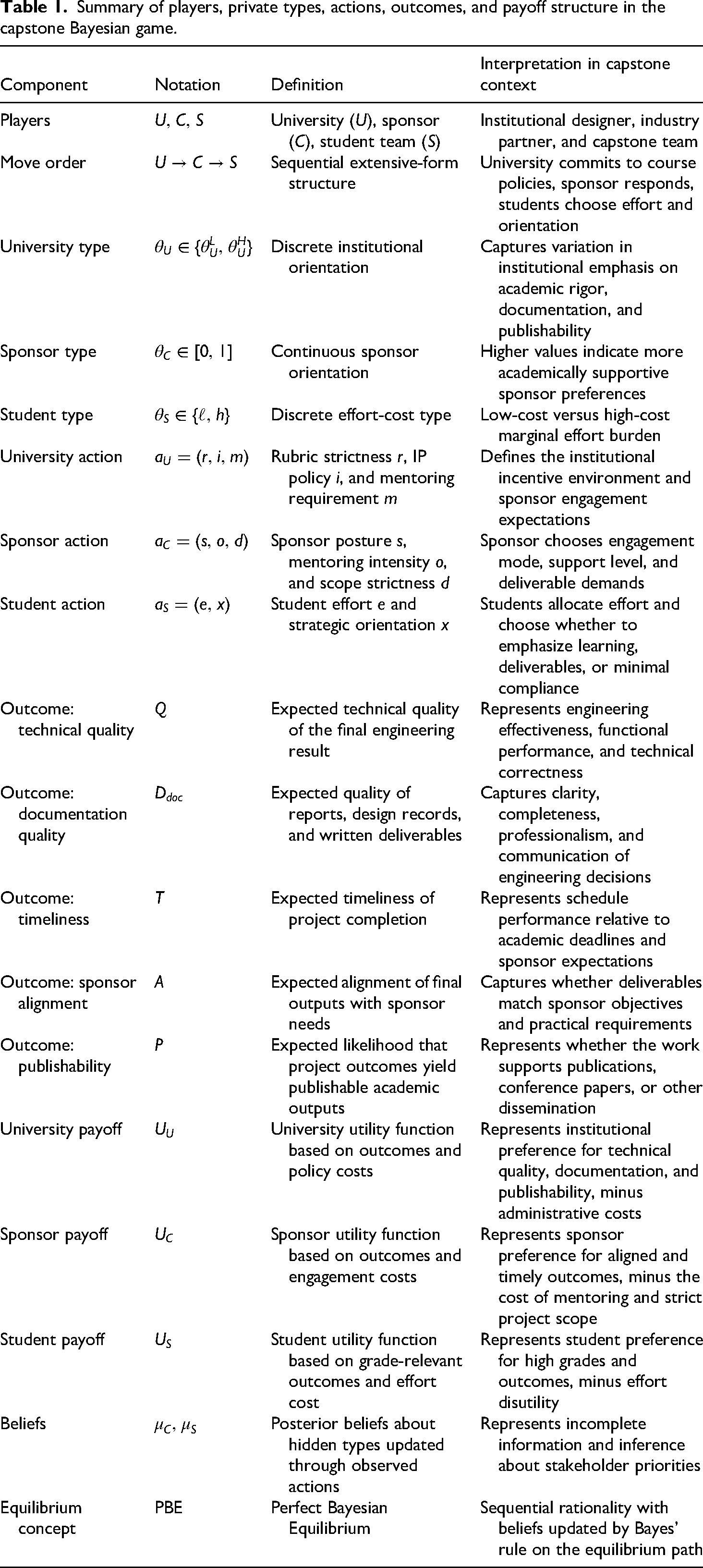
The model integrates type uncertainty, sequential decision-making, and policy-dependent incentives in a capstone project environment that involves a university, an industry sponsor, and a student team. Each stakeholder possesses a privately known type that influences its incentives, observes a subset of the preceding actions, and forms beliefs using the Bayes’ rule where possible. The university first moves by choosing the strictness of the rubric, the IP policy, and the minimum mentoring requirements. The sponsor then chooses its behavior posture, the intensity of the mentoring, and the strictness of the scope after observing the university’s policy. Finally, the student team selects the effort and orientation of the project after observing both previous stages. Reduced-form outcome functions translate these choices into technical quality, documentation quality, timeliness, sponsor alignment, and publishability. Payoff functions combine these outcomes with effort costs and behavioral penalties, and the resulting strategic interaction is analyzed under the PBE refinement. The model provides a coherent foundation for exploring how policy, sponsor behavior, and student effort interact to shape the outcomes of the capstone project. To improve readability and provide a compact reference for the remainder of the paper, Table 1 summarizes the players, types, actions, outcomes, and payoff functions used in the model. Figure 1 provides a corresponding flow diagram illustrating the order of moves and information structure of the sequential game.
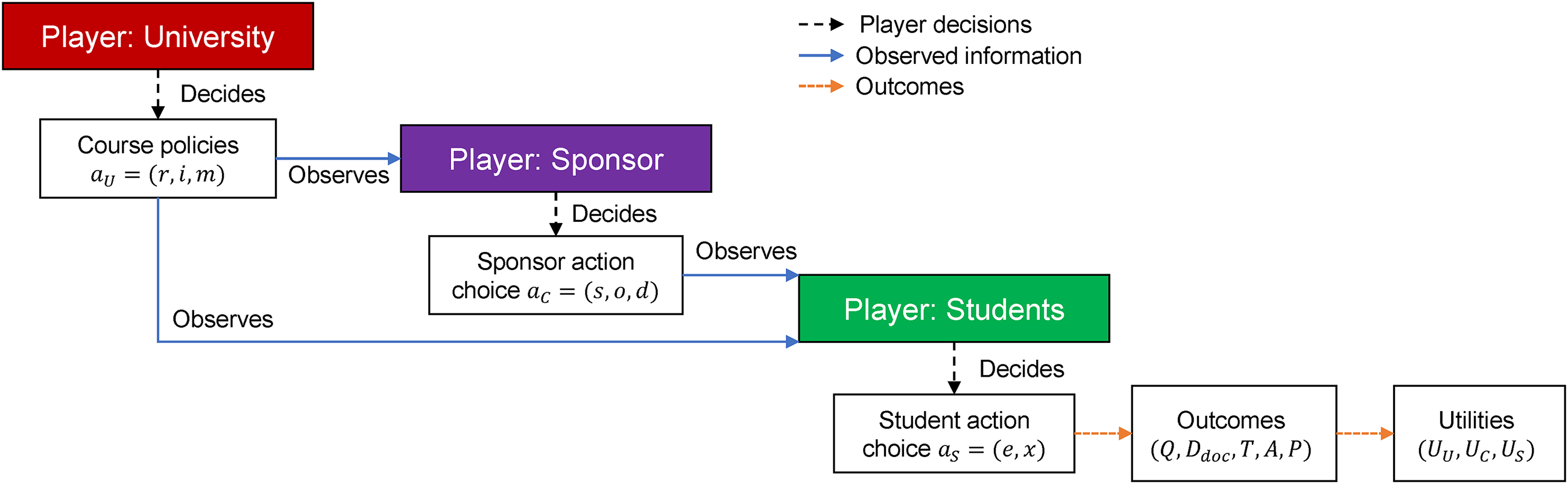
Information structure and move sequence of the capstone Bayesian game, showing university policy selection
Summary of players, private types, actions, outcomes, and payoff structure in the capstone Bayesian game.
Case studies
Section 4 presents three representative case studies corresponding to the equilibrium regimes described in Section 3.8. These case studies are intended to demonstrate how different incentive configurations generate empirically recognizable capstone dynamics. A final subsection provides a cross-case synthesis to facilitate comparison of outcomes and stakeholder utilities across regimes.
Case study 1: Highly collaborative capstone partnership
Case Study 1 describes a capstone project in which the incentives are reasonably well aligned across the university, sponsor, and student team, less as an idealized best case than as a useful reference point for what has to go right for a project to run as intended. A sponsor approaches the capstone course with a genuinely supportive posture, checks in regularly, and provides meaningful technical guidance. In the model, this corresponds to a supportive stance with moderate mentoring intensity (
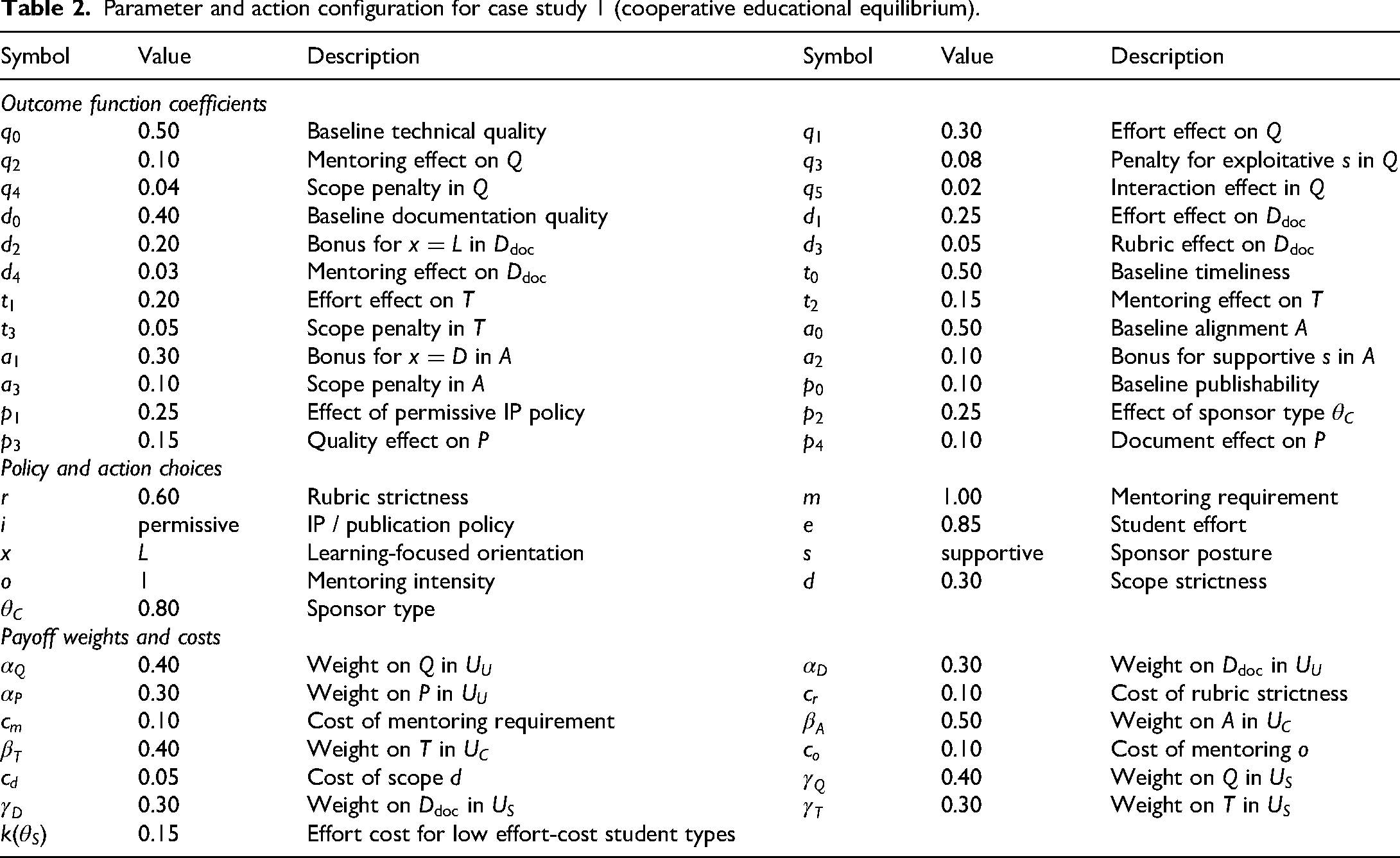
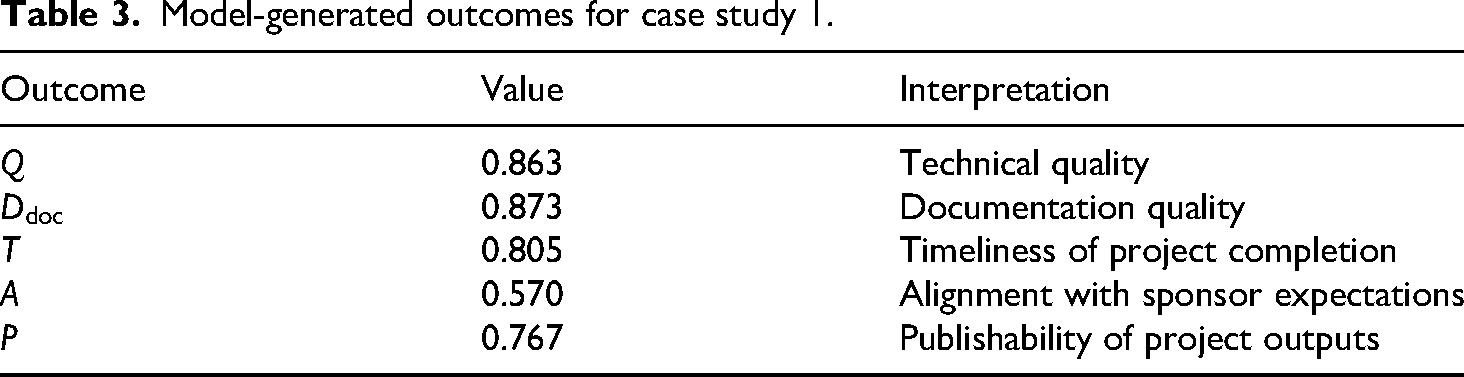
Table 2 summarizes the parameter and action configuration used for this scenario, while Table 3 reports the resulting project outcomes generated by the model. Technical quality is high (
Parameter and action configuration for case study 1 (cooperative educational equilibrium).
Model-generated outcomes for case study 1.
Stakeholder utilities for case study 1.

Case study 2: Exploitative sponsor equilibrium
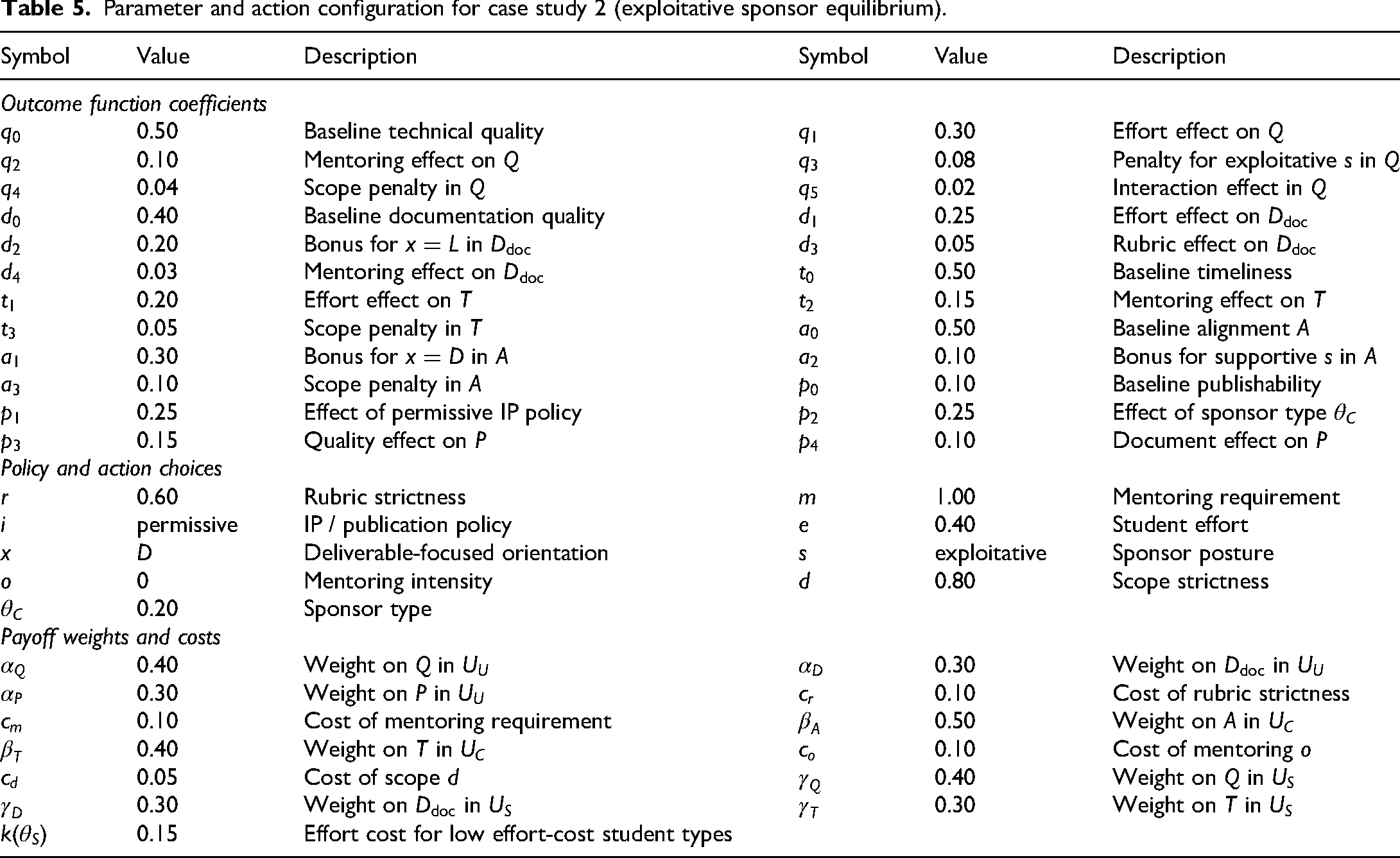
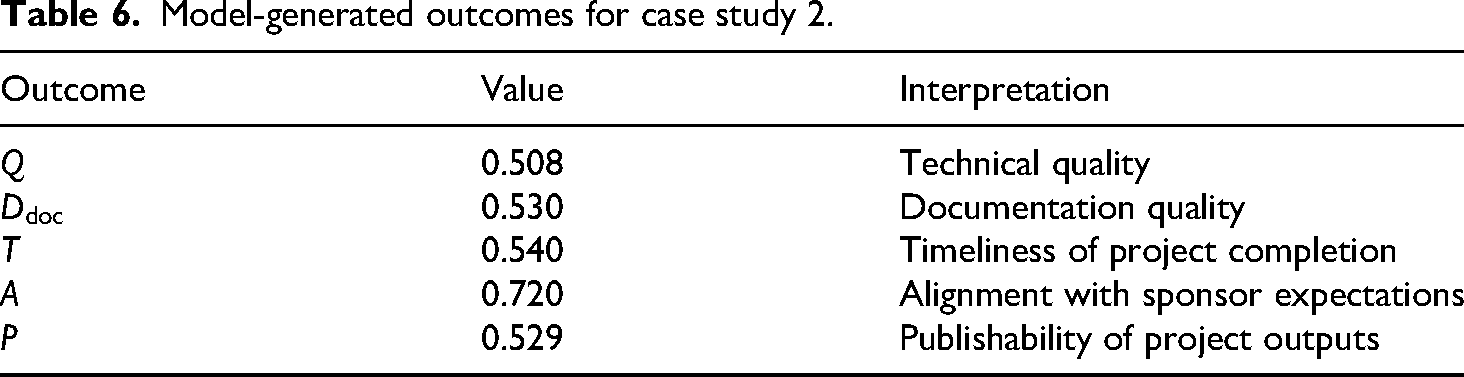
Case Study 2 examines a capstone project dominated by sponsor incentives, reflecting the familiar situation in which an external partner treats the project primarily as a mechanism for extracting deliverables rather than as an educational collaboration. In the model, this corresponds to a sponsor that adopts an explicitly exploitative posture (
In response to high expectations, limited feedback, and tight timelines, the students adjust their strategy in a manner consistent with rational effort allocation. In the model, the team reduces overall effort to a moderate level (
Parameter and action configuration for case study 2 (exploitative sponsor equilibrium).
Model-generated outcomes for case study 2.
Stakeholder utilities for case study 2.

Case study 3: Grade-gaming equilibrium
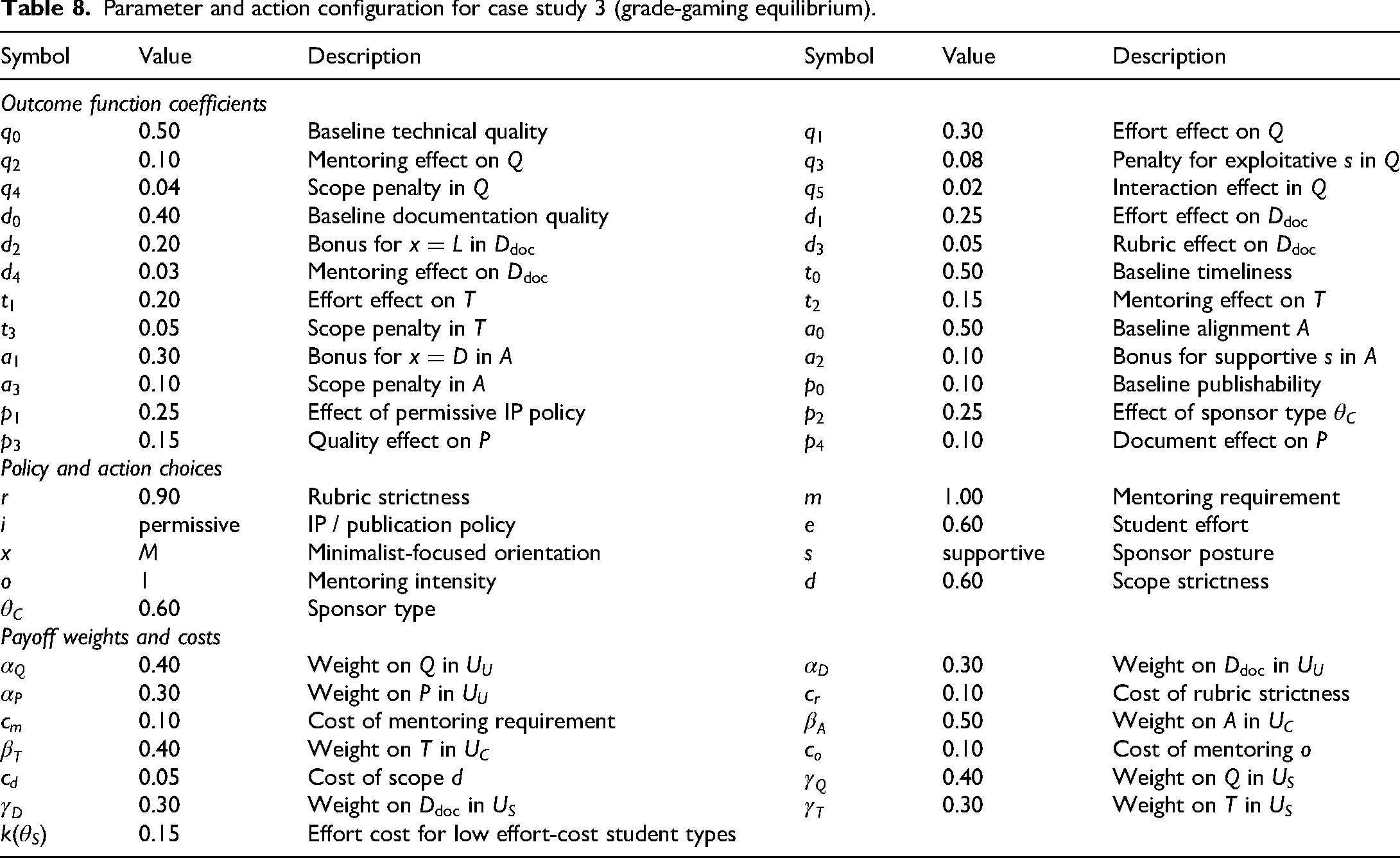
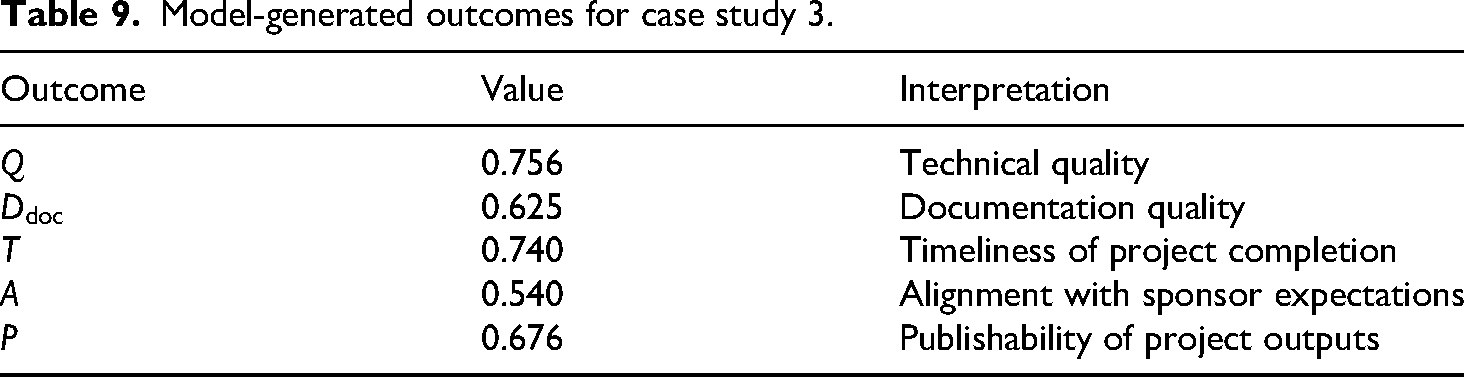
Case Study 3 considers a capstone project shaped largely by assessment incentives, capturing a common pattern in which students respond rationally to grading structures by optimizing for rubric compliance and assignment grades rather than for technical depth or exploration. Such scenarios are common when grading rubrics place heavy emphasis on documentation, formal deliverables, and compliance with prescribed requirements, thereby signaling to students that grades depend more on rubric-visible outputs than on substantive technical depth or exploratory learning. In the model, this corresponds to a university that adopts a highly stringent grading rubric (
In response to these assessment signals, students adjust their behavior to prioritize activities that are most directly rewarded by the grading rubric. In the model, the team allocates a moderate level of overall effort (
Parameter and action configuration for case study 3 (grade-gaming equilibrium).
Model-generated outcomes for case study 3.
Stakeholder utilities for case study 3.

Cross-Case Synthesis of Outcomes and Utilities
To facilitate comparison between the three representative equilibrium regimes, Figures 2 summarize the outcomes achieved and the utilities of stakeholders, respectively. The purpose of this synthesis is not to introduce new results, but to highlight cross-case patterns that are difficult to infer directly from the individual case tables. Figure 2 illustrates how different incentive structures produce qualitatively different outcome profiles despite fixed model coefficients. In the cooperative regime (CS1), all outcome metrics achieve relatively high values, reflecting balanced incentives and mutual engagement among stakeholders. In contrast, the exploitative sponsor regime (CS2) exhibits reduced technical quality and documentation quality despite strong sponsor alignment, indicating that deliverable extraction can coexist with degraded learning and communication outcomes. The grade-gaming regime (CS3) shows a complementary pattern: Documentation quality remains high under strict assessment, while technical quality and publishability decline, reflecting compliance with grading incentives rather than deep technical engagement. Figure 2 further clarifies the incentive dominance underlying these regimes. In CS1, stakeholder utilities are comparatively well aligned, supporting sustained cooperation. In CS2, the sponsor utility dominates, while the student and university utilities are comparatively lower, capturing a regime in which value extraction is prioritized over educational outcomes. In CS3, student utility is comparatively strong despite reduced sponsor and university returns, consistent with rational grade-maximizing behavior under stringent evaluation criteria. Taken together, these visual summaries reinforce a central insight of the model: Capstone outcomes are governed less by individual goodwill than by the incentives of the stakeholders that dominate the strategic environment. Therefore, similar institutional policies can give rise to markedly different educational and technical outcomes, depending on how grading structures, mentoring behavior, and sponsor engagement interact to shape equilibrium behavior. This synthesis motivates the broader discussion in Section 5 on incentive dominance, policy tradeoffs, and structural failure modes in industry-sponsored capstone design.
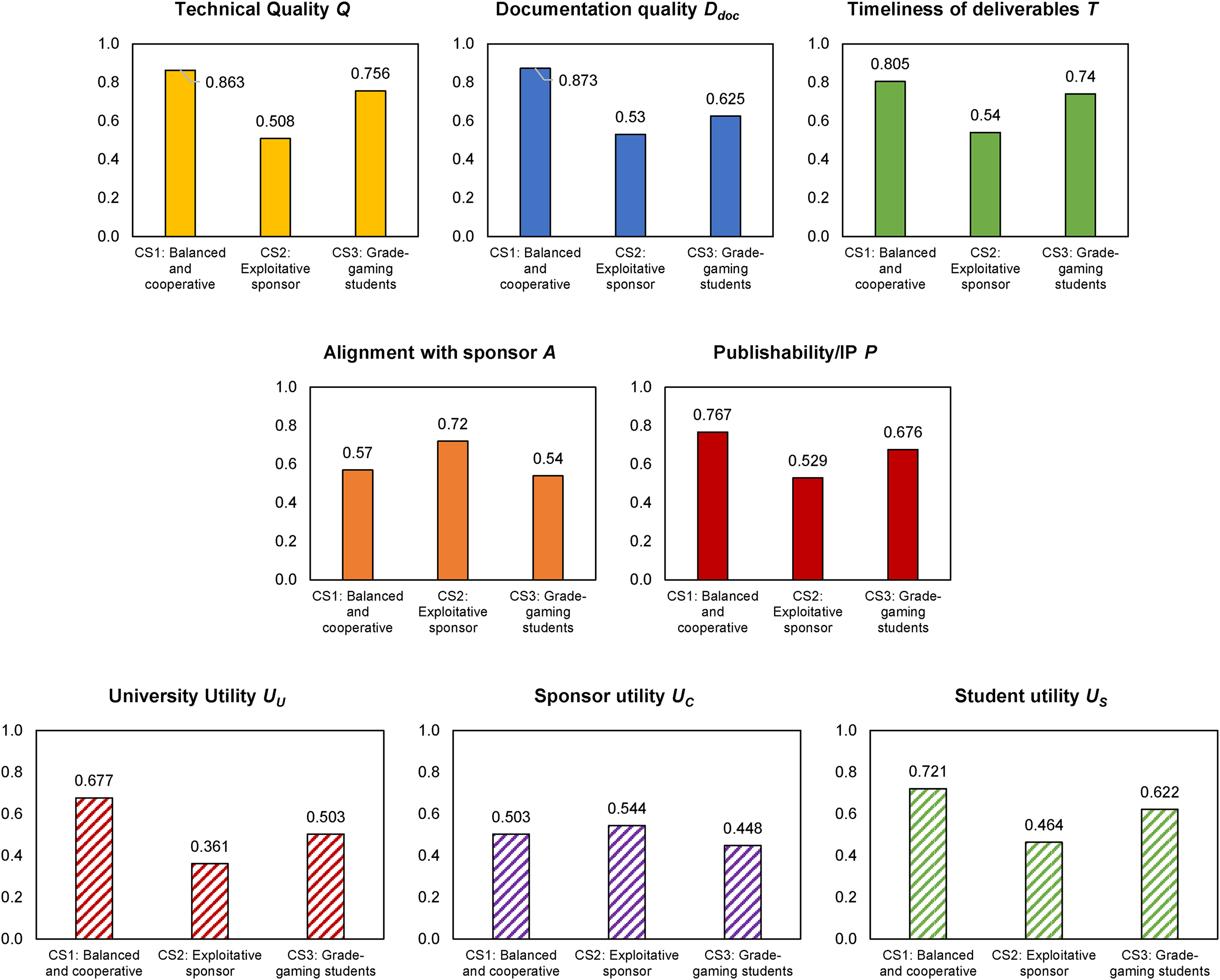
Model outcomes and stakeholder utilities across equilibrium regimes, illustrating incentive dominance. Sponsor utility is maximized in CS2, student utility in CS3, and balanced returns emerge only under cooperative incentives (CS1).
Discussion and analysis
This paper develops a reduced-form game-theoretic framework for analyzing industry-sponsored capstone projects as strategic systems governed by interacting incentives rather than as isolated educational experiences. By explicitly modeling the university, sponsor, and student team as rational agents with distinct (and perhaps conflicting) objectives, the framework explains how stable outcome patterns emerge from within stakeholder interactions and team structure, even when all stakeholders act in good faith. The resulting equilibria closely correspond to well-documented capstone project regimes and provide insight into why certain pathologies persist despite careful program design.
Rationality and equilibrium: Persistent problems
A central contribution of the model is to demonstrate that undesirable capstone outcomes need not arise from negligence, miscommunication, or lack of commitment by any individual stakeholder. In all three case studies, the university, the sponsor, and the student team behave in a locally rational manner, selecting strategies that maximize the expected utility given the actions of the others. Importantly, the exploitative sponsor regime and the grade-gaming regime are not transient failures but stable equilibrium configurations in which no stakeholder can unilaterally improve outcomes through small deviations. This equilibrium perspective re-frames common capstone challenges. Rather than attributing low learning outcomes to unmotivated students or disengaged sponsors, the model shows that such behaviors are often optimal responses to the incentive environment. Once an equilibrium regime is established under a fixed policy and monitoring structure, appeals to professionalism, goodwill, or educational mission are unlikely to be effective unless the underlying incentives or information structure are altered. This insight helps explain why repeated attempts to correct capstone dysfunction through incremental policy adjustments often yield limited improvement.
This formulation intentionally abstracts away from mid-course policy revision and adaptive monitoring by the university. In practice, faculty advisors and program administrators may intervene by adjusting scope, increasing oversight, or renegotiating expectations in response to emerging issues. Such interventions can be interpreted as shifts in the information structure or as partial re-commitments to revised policies. Incorporating these dynamics would require a repeated-game or adaptive control formulation, which lies beyond the scope of the present analysis but represents a natural direction for future work.
Dominant-incentive regimes and stakeholder control of outcomes
In all three case studies, the results are governed by the incentives of the stakeholders that dominate the strategic environment. In the cooperative regime, the objectives of no one actor overwhelm the others, allowing learning-oriented behavior to emerge naturally from within the stakeholder team. In contrast, the exploitative sponsor regime and the grade-gaming regime illustrate how dominance by a single stakeholder collapses the system into a single-objective optimization problem. When sponsor incentives dominate, as in Case Study 2, student behavior shifts toward deliverable compliance and scope containment, while learning and exploration are crowded out. In contrast, when university assessment incentives dominate, as in the Case Study 3, students rationally prioritize rubric-visible outputs (related to grades) at the expense of technical exploration on the project itself. In particular, these regimes arise even when other stakeholders behave reasonably: A supportive sponsor cannot fully counteract a grading structure that strongly rewards compliance, and well-designed university policies cannot overcome sponsor disengagement when mentoring is unenforceable. This dominant-incentive perspective provides a unifying explanation for a wide range of observed capstone outcomes and highlights the fragility of balanced incentive structures. Small changes in sponsor behavior or assessment emphasis can shift the system into a qualitatively different equilibrium, suggesting that successful capstone programs operate near the boundary between regimes rather than deep within a stable optimum.
Limits of policy-centric approaches to capstone design
An important implication of the analysis is that strong institutional policies alone are insufficient to guarantee desirable educational outcomes. Across the case studies, university grading and IP policies are held constant, yet outcomes vary dramatically as sponsor behavior and student strategies change. This shows that policy quality is a necessary but not sufficient condition for success. The model further suggests that certain policy levers have diminishing returns when deployed in isolation. Increasing rubric strictness may improve documentation quality but can inadvertently encourage grade gaming. Similarly, nominal mentoring requirements are ineffective when they cannot be enforced or when sponsors lack intrinsic motivation to engage. These findings challenge the assumption that capstone outcomes can be optimized through isolated policy refinement and instead point to the need for coordinated incentive alignment between stakeholders.
Interpretation of outcome metrics and apparent success
The case studies also reveal that commonly used performance metrics can be misleading indicators of educational success. High sponsor alignment, timely completion of the deliverable, or strong documentation quality can coexist with shallow learning and limited technical development. In the exploitative sponsor regime, alignment appears relatively high precisely because students prioritize sponsor-defined deliverables, even as technical quality and publishability decline. In the grade-gaming regime, documentation quality remains strong while exploratory learning is suppressed. These results underscore the importance of interpreting the outcomes of the capstone in light of the incentive structures that produce them. Metrics that are valuable for accountability or assessment may not reliably reflect educational depth unless they are embedded within a balanced incentive system. The framework therefore provides a lens for diagnosing when apparent success masks deeper structural issues.
Equilibrium regimes as explanatory, not predictive, tools
Each equilibrium regime should be interpreted as a diagnostic representation of which stakeholder incentives dominate the strategic environment, rather than as a retrospective label of success or failure. The equilibrium regimes presented in this work are also not intended as unique predictions of capstone outcomes under specific parameter values. Rather, they should be interpreted as representative configurations that capture empirically recognizable patterns of behavior. The reduced-form structure of the model enables a clear identification of incentive-driven dynamics, but it necessarily abstracts away from contextual variation between institutions, disciplines, and project types. This distinction is important in avoiding over-interpretation. The value of the framework lies in its explanatory power, it clarifies why certain patterns recur across diverse settings and why interventions that ignore strategic interactions often fail. By focusing on equilibrium behavior, the model provides insight into structural forces that shape capstone experiences beyond any single implementation.
Design implications and leverage points
Although the paper does not prescribe specific program designs, the analysis suggests several leverage points to improve capstone outcomes. First, enforceability matters: Mentoring expectations and engagement requirements must be coupled to mechanisms that make deviation costly or visible. Second, assessment structures send powerful signals; grading rubrics that overemphasize compliance can unintentionally suppress learning even when other supports are present. Third, sponsor selection and screening may be more effective than downstream policy adjustments in preventing exploitative regimes. More broadly, the results indicate that capstone design should be approached as a mechanism design problem under institutional constraints. Effective interventions are those that shift the system away from dominant-incentive regimes and toward balanced configurations where learning-oriented behavior is individually rational for all stakeholders.
Limitations and opportunities for extension
The model intentionally adopts a reduced-form, single period structure to isolate incentive interactions. It does not capture repeated interactions across cohorts, reputation effects between sponsors and institutions, spillovers across simultaneous project teams, or within team heterogeneity, all of which are important features of real capstone programs. Faculty advisors are treated implicitly as part of the institutional mechanism rather than as independent strategic actors with distinct incentives and constraints. These omissions are deliberate and allow the analysis to focus on equilibrium structure rather than on dynamic or program specific complexity. Future work could extend the framework to repeated game settings in which sponsors and universities learn from prior outcomes, or to models with heterogeneous student types and internal team dynamics. Incorporating sponsor screening, signaling, or contract mechanisms would further enrich the analysis and connect the framework to broader literature in mechanism design and organizational economics. A natural extension of this framework is Monte Carlo simulation over distributions of model parameters and stakeholder types. Such an approach could quantify the robustness of equilibrium regimes to incentive weights, scope strictness, and mentoring costs, and could identify regime boundaries where small parameter changes shift the system from cooperative to exploitative or grade-gaming behavior. Monte Carlo sampling could also support empirical calibration using survey or institutional data, enabling future work to connect the reduced-form framework to specific program structures.
Broader significance
The central insight of this work is that capstone project outcomes are governed less by individual goodwill than by which stakeholder’s incentives dominate the strategic environment. By modeling capstone projects as strategic systems, the framework provides a principled explanation for persistent educational challenges and a foundation for more effective design interventions. Recognizing and managing incentive dominance is therefore a necessary condition for creating capstone experiences that reliably support deep learning, meaningful industry engagement, and institutional objectives.
Closing remarks
This paper presents a formal game-theoretic framework for analyzing industry-sponsored engineering capstone projects as strategic systems shaped by interacting incentives rather than as isolated educational experiences. By modeling the university, sponsor, and student team as rational actors operating under incomplete information, the framework explains how familiar capstone outcomes emerge endogenously, including productive collaborations and persistent failure modes. Importantly, the analysis demonstrates that these outcomes can arise even when all stakeholders act in good faith and institutional policies remain unchanged. Case studies highlight that capstone success is not determined solely by policy quality, sponsor intent, or student motivation in isolation, but by which incentives dominate the strategic environment. When incentives are balanced, learning-oriented behavior can naturally emerge. When dominance shifts toward sponsor extraction or assessment compliance, rational responses from students and sponsors can crowd out deeper educational objectives. These dynamics help explain why incremental policy adjustments often fail to correct persistent capstone challenges. The framework is not intended to predict specific project outcomes or prescribe universal design solutions. Rather, it provides a principled lens for reasoning about incentive alignment, policy tradeoffs, and structural vulnerabilities in project-based learning environments. By making incentive interactions explicit, the model supports a more informed discussion among educators and program designers about where and why capstone systems succeed or fail. More broadly, this work positions the design of the capstone project as a problem of constrained mechanism design within engineering education. Future extensions incorporating repeated interactions, sponsor screening, or empirical calibration may further enrich the analysis. The central takeaway remains that long-term improvement in capstone outcomes requires attention not only to individual behavior but also to the strategic structures that govern how stakeholders interact.
Footnotes
Acknowledgments
No external funding was used to complete this work. ChatGPT 5.1/5.2 (OpenAI) and Grammarly were used for early brainstorming and as an editorial assistant related to organization, wording, clarity, and grammar in the text. These tools were not used to contribute to the core technical work, analyze the literature, or perform core technical analysis of the results. The authors have carefully reviewed and assume full responsibility for the final manuscript. All opinions and conclusions are solely those of the named authors and do not necessarily represent the positions or views of their institutions or the publisher of this work.

Funding
The authors received no financial support for the research, authorship, and/or publication of this article.
Declaration of conflicting interests
The author(s) declared no potential conflicts of interest with respect to the research, authorship, and/or publication of this article.
Data availability statement
Data sharing not applicable to this article as no datasets were generated or analyzed during the current study.