



Abstract
Visual representations are ubiquitous in undergraduate mechanics education, shaping how students interpret and interact with disciplinary knowledge. Despite their central role, our understanding of how students learn from these visuals remains limited and fragmented. To date, no review has mapped the existing literature at the intersection of visualization, mechanics, and undergraduate engineering education. To address this gap, we conducted a scoping review and thematic analysis of 32 scholarly works, drawn from over 9,000 articles across four databases. In addition to a descriptive summary of the results, we present four key themes that highlight recurring patterns, perspectives, and insights within the included literature: (1) representational competence in mechanics problem-solving, (2) the link between visual features, conceptual understanding, and problem-solving abilities, (3) domain knowledge and visual representation in mechanics, and (4) the impact of visualization modalities on mechanics instruction. We also identify a range of design strategies and instructional considerations that support effective visualization use. Most importantly, this review outlines key directions for future inquiry, with implications for educators, researchers, and media developers seeking to enhance teaching and learning through visualizations in undergraduate mechanics education.
Introduction
In mechanics education, where concepts often pertain to phenomena that are not directly visible or readily perceivable, educators rely heavily on visual representations to convey information.1–4 This reliance spans the statics and dynamics content that structure most introductory mechanics courses (Figure 1). Imparting key concepts to undergraduate students effectively, faithfully, and efficiently is therefore a grand challenge in the design, development, and evaluation of didactic visualizations for mechanics instruction. Visualizations (i.e., illustrations, animations, interactives, simulations, etc.) serve as a critical medium for encoding, interpreting, synthesizing and conveying information, enabling engineers to analyze/solve problems, design solutions, and communicate effectively.5–10 However, a visualization's success hinges on critical design considerations; the crafting of a visualization demands an understanding of the complex interplay and mutual influences of scientific accuracy, visualization modality, design strategy, graphical treatment (i.e., visual features), and pedagogical objectives, all of which must be in alignment with the needs of the intended audience and context-of-use.10–12 Throughout this paper, we use terms such as visualization, external/visual representation, graphical display, visual media etc. interchangeably to refer to externally presented instructional visuals, and visual features/properties to denote their constituent graphical elements (e.g., arrows, labels, color, motion cues, etc.).
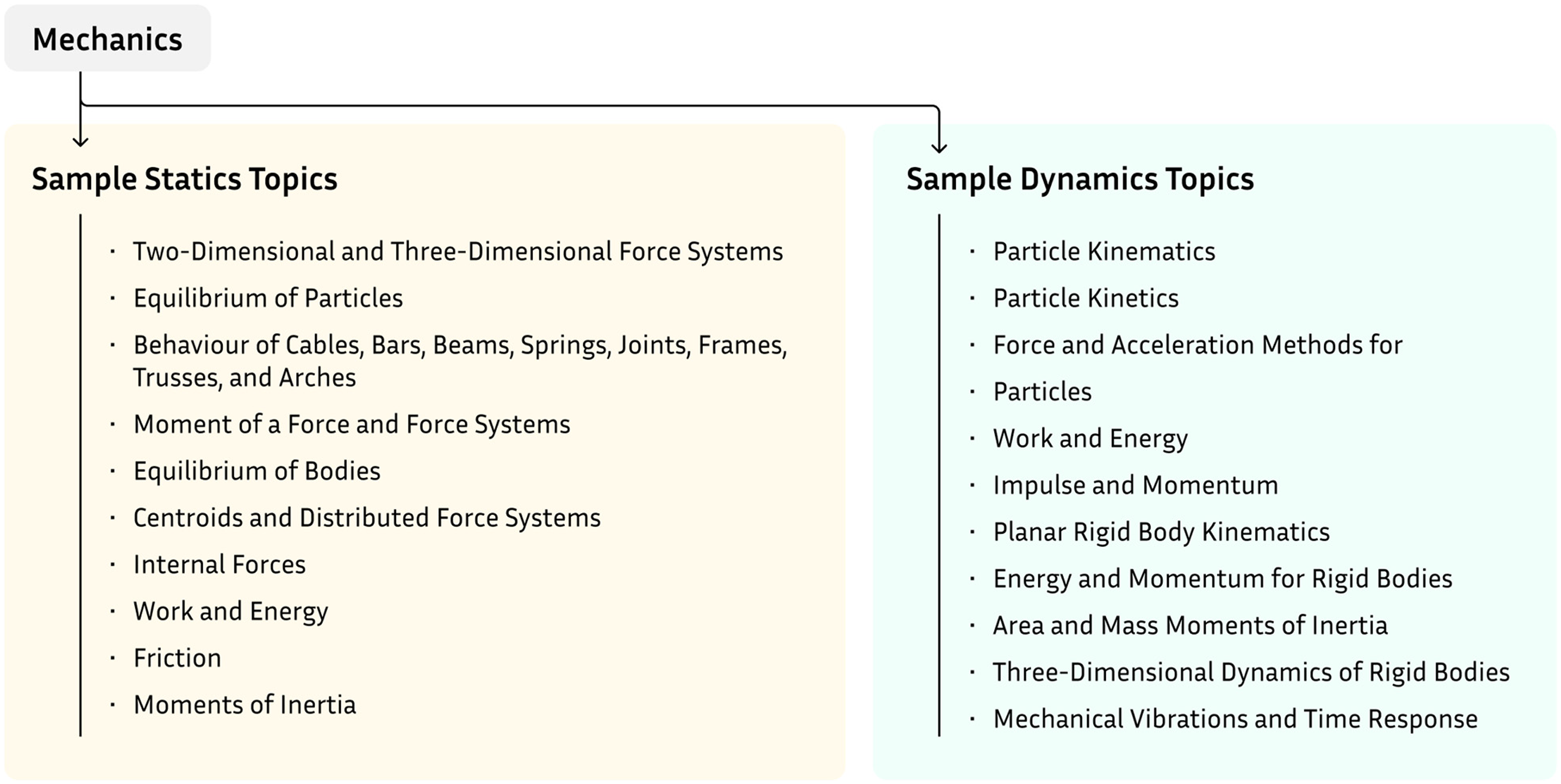
Statics and dynamics topics.
It is crucial to recognize that the use of visual representations, while beneficial, can also introduce certain inefficiencies and misunderstandings in the learning process. Effectively comprehending a visualization necessitates that a viewer can interact with its features and faithfully interpret the intended information. 13 This interpretive skill relies on visual perception as well as familiarity with the domain’s visual language. (i.e., a set of semiotic conventions and representational norms that subject matter experts use to encode and convey meaning). When working with domain-specific visualizations (that are often designed to highlight underlying subject matter rather than its physical attributes) the process of building understanding extends beyond simply observing visual characteristics for exact meaning 14 ; interpreting such representations requires the observer to go beyond surface-level visuals and engage with the underlying conceptual framework they aim to represent. 15 Learning from visuals therefore involves building a coherent internal representation from the external one through a sequence of perceptual, interpretive, and inferential processes; importantly, this involves recognizing what is important/relevant, filter what is incidental, and infer conceptual relationships that are implied rather than explicitly drawn.3,5 Naturally, a mismatch between a learner's capacity to accurately decipher the information presented through a visualization and the intended objective of the visualization may result in incomplete interpretations.3,16,17 A significant concern is the possibility that these representations may inadvertently foster or reinforce erroneous beliefs or misconceptions in the domain of mechanics. In mechanics courses, students actively use diagrams to make sense of the situation, plan their next steps, and coordinate multiple representations, so difficulties in interpreting visualizations can significantly shape how they work through a solution. Despite the ubiquity of visuals in mechanics education, our grasp of how students engage with and learn from/with these representations remains limited.
To our knowledge, no comprehensive scoping or systematic record exists to understand the role of visualization in mechanics undergraduate engineering education. However, the role of visualization and representations has been synthesized in prior reviews within physics education research, engineering education, and the learning sciences broadly. 18–21 These reviews typically span multiple domains, learner populations, or theoretical perspectives and do not focus explicitly on mechanics within undergraduate engineering contexts. The rationale to fill this gap is twofold. First, we are motivated to synthesize and thematically map the existing body of literature to better support engineering educators, researchers, and media developers in the design and use of educational visualizations and corresponding research within undergraduate mechanics. Second, this effort aims to offer foundational insights that can inform much needed scholarly inquiry and the creation of pedagogically beneficial media. To this end, we conducted a scoping review and thematic analysis of 32 studies selected from a pool of over 9,000 articles across four academic databases. Our objective was to map, report, and identify dominant themes within this limited but growing body of work. Ultimately, this study contributes a clearer understanding of the current state of research and lays the groundwork for future directions in the field.
Methods
In this investigation, we examined the current state of research on the design, evaluation, and pedagogical effectiveness of visualizations in undergraduate mechanics education, while identifying existing gaps and opportunities for future research. A scoping review was selected as our methodological approach, a well-established framework that facilitates the mapping, synthesis, and analysis of existing knowledge to guide research, policy, and practice. 22 Following Arksey and O’Malley's framework, 22 this scoping review serves multiple purposes: it seeks to map a broad range of literature, summarize and disseminate findings, pinpoint under-researched areas, and consequently uncover opportunities for further worthwhile investigation. This scoping review was conducted following the five-stage framework originally outlined by Arksey and O’Malley 22 and further expanded by Levac et al. 23 Additionally, the review was conducted in alignment with the PRISMA-ScR (Preferred Reporting Items for Systematic Reviews and Meta-Analyses Extension for Scoping Reviews) guidelines. 24 The five stages include: (1) identifying the research question, (2) identifying relevant studies, (3) study selection, (4) charting the data, and (5) collating, summarizing, and reporting results.22–24 For stage 5, a descriptive summary and inductive thematic analysis was used to present the information and identify recurring patterns, concepts, and insights within the data. Thematic analysis was particularly critical for this review as it enabled a deeper, more nuanced synthesis of the qualitative patterns and conceptual insights emerging from a diverse body of literature, which would not have been fully captured through descriptive summary alone. To ensure the rigour and credibility of the thematic analysis, multiple strategies were used: dual coding of records, iterative consensus meetings, independent verification of clusters, and an audit trail (see OSF link and Appendix B). Consistent with best practices, all entries from the review process (including the final set of included records, the list of studies excluded after full-text review, and those excluded during title/abstract screening) are publicly available on OSF. Throughout the review process, we were aware of how our own professional backgrounds and disciplinary perspectives shape our framing and interpretations; a positionality statement outlining these influences is provided in Appendix A. An overview of the methodological approach is presented in Figure 2.
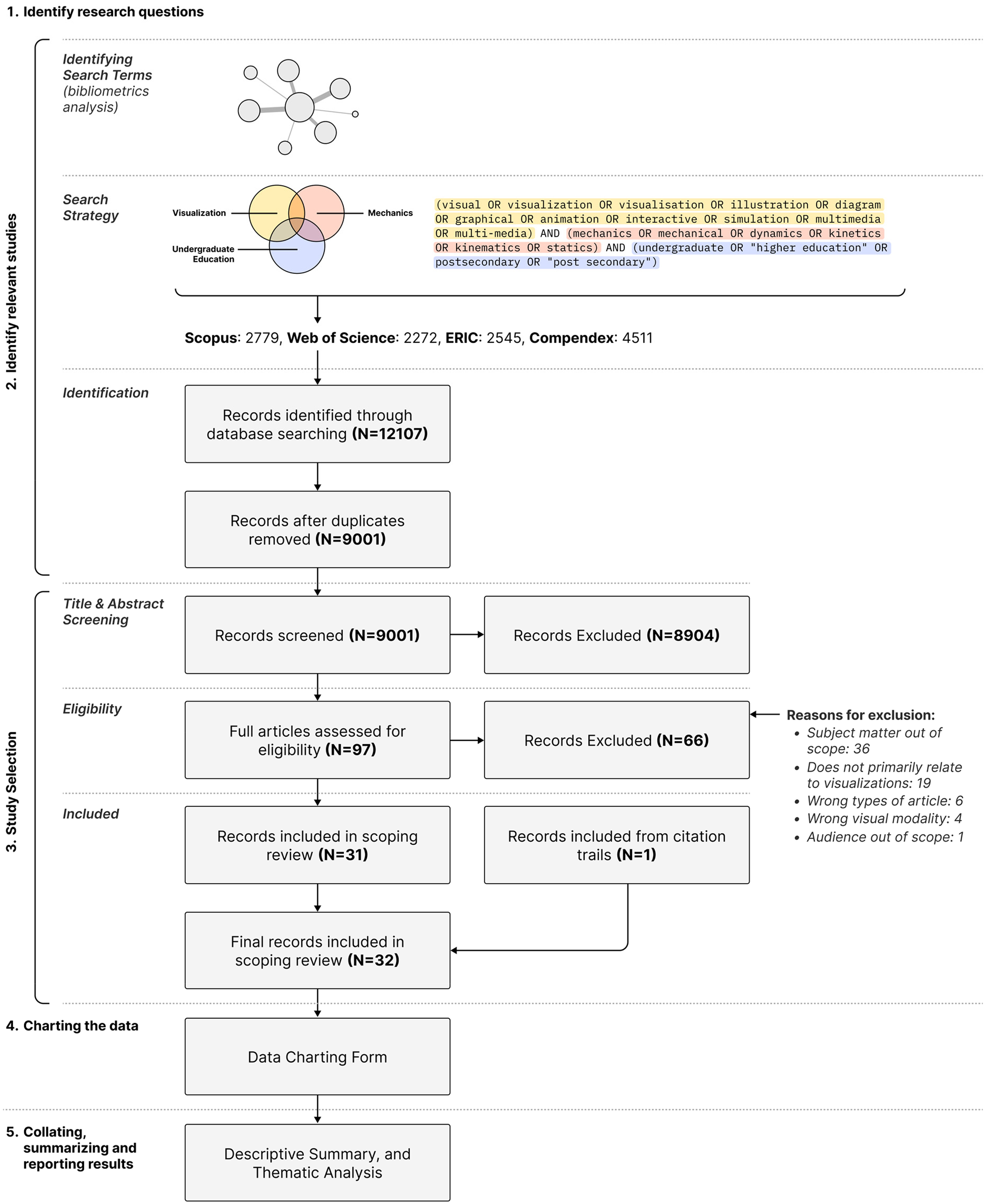
Overview of methodological approach.
Identifying the research questions
In this stage, an overarching research question was formed: RQ1: What are the key characteristics of the existing literature on visualizations in undergraduate mechanics education including trends in publication year, subject focus, visualization modalities, study objectives, and study populations? RQ2: What are the dominant themes and recurring findings in the literature related to the design, evaluation, and pedagogical effectiveness of visualizations in undergraduate mechanics education? RQ3: What design considerations and instructional strategies are outlined in the literature for developing and implementing visualizations in undergraduate mechanics courses? RQ4: What research gaps and future opportunities are documented in the literature concerning visualizations for undergraduate mechanics education?
These research questions are intentionally broad, aligning with the exploratory nature of scoping reviews as outlined by Arksey and O'Malley. 22
Identifying relevant studies
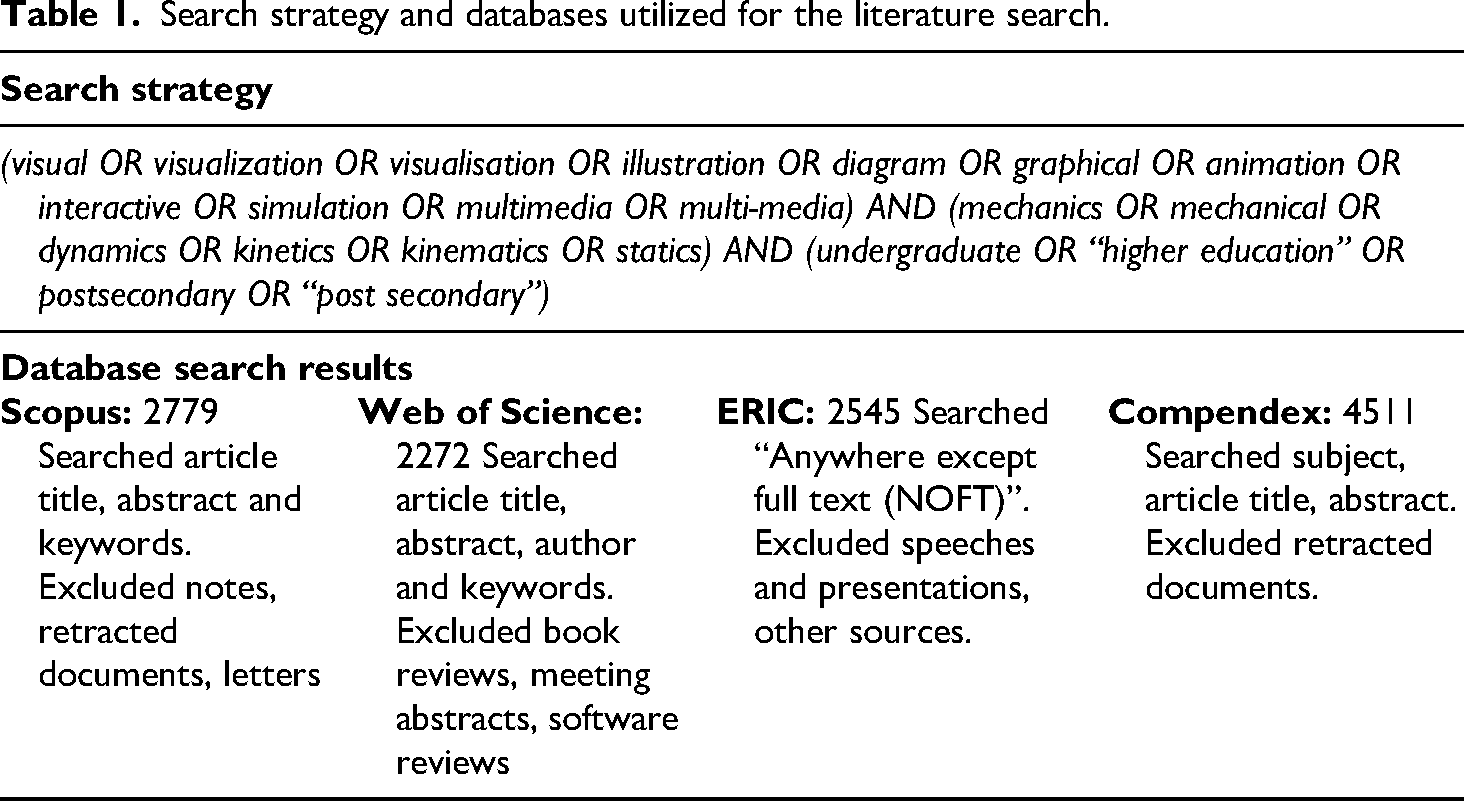
We used a wide range of keywords to ensure comprehensive coverage of the relevant literature. A pilot test of the initial search strategy was conducted across multiple databases including Scopus, Web of Science, ERIC, and Engineering Village (Compendex). A bibliometric analysis conducted during the pilot test revealed missing terms to describe the same or similar concepts; this analysis expanded the list of search terms to ensure a more comprehensive and accurate scan of the literature. During this process, the assistance of two librarians from different institutions was used to refine the development of a comprehensive search protocol. The databases utilized for this scoping review were selected to ensure comprehensive coverage across a wide range of disciplines, maximizing the likelihood of identifying all publications relevant to the primary research question. This broad capture was essential: it ensured that studies using different vocabularies, such as “simulation,” “diagram,” “multimedia,” “animation,” “graphical display,” etc. were not inadvertently missed. Casting such a wide net also meant that the review team had to navigate a substantial volume of heterogeneous and ultimately non-relevant material (see OSF) making the screening process significantly more intensive but ultimately strengthening the comprehensiveness and inclusivity of the final evidence base. The final search strategy, along with the database search results are outlined in Table 1. All searches were conducted on January 5, 2024, and a total of 12,107 entries were identified, which were later reduced to 9,001 after the removal of duplicate entries.
Search strategy and databases utilized for the literature search.
Study selection
To maintain focus and ensure the relevance of included studies, inclusion and exclusion criteria were applied, and refined iteratively through group discussions before, during and after screening. The inclusion criteria, exclusion criteria and corresponding implementation strategy used during screening are summarized in Table 2. As noted in the previous section, the time frame for the studies includes all publications up to January 5, 2024. The study selection process was carried out by two independent reviewers in Covidence
25
to ensure rigor, transparency, and reduce potential bias. This process involved two key stages: (1) title and abstract screening and (2) full-text screening. During the first stage, the reviewers independently screened the titles and abstracts of all identified studies to assess their relevance based on the predefined inclusion and exclusion criteria. Ninety-seven articles that passed this initial stage were then subjected to a detailed full-text review to confirm their eligibility for inclusion in the study. To maintain consistency and address challenges, the reviewers met at the beginning, midpoint, and final stages of the screening process. At the beginning, the reviewers aligned their understanding of the inclusion and exclusion criteria and resolved any initial ambiguities. At the midpoint, they reconvened to discuss emerging challenges, clarify uncertainties, and ensure consistency in decision-making. During the final stage, they reviewed overall progress and addressed any lingering questions or disagreements. Any disagreements regarding the inclusion or exclusion of studies were flagged during the screening process and revisited at the end of each round. Final decisions were made through consensus, with screening considered complete only when full agreement was achieved between the reviewers; 31 records were included in this review. An additional search was conducted based on citation trails (of the selected papers) which produced 1 new article for review.
Inclusion and exclusion Criteria.
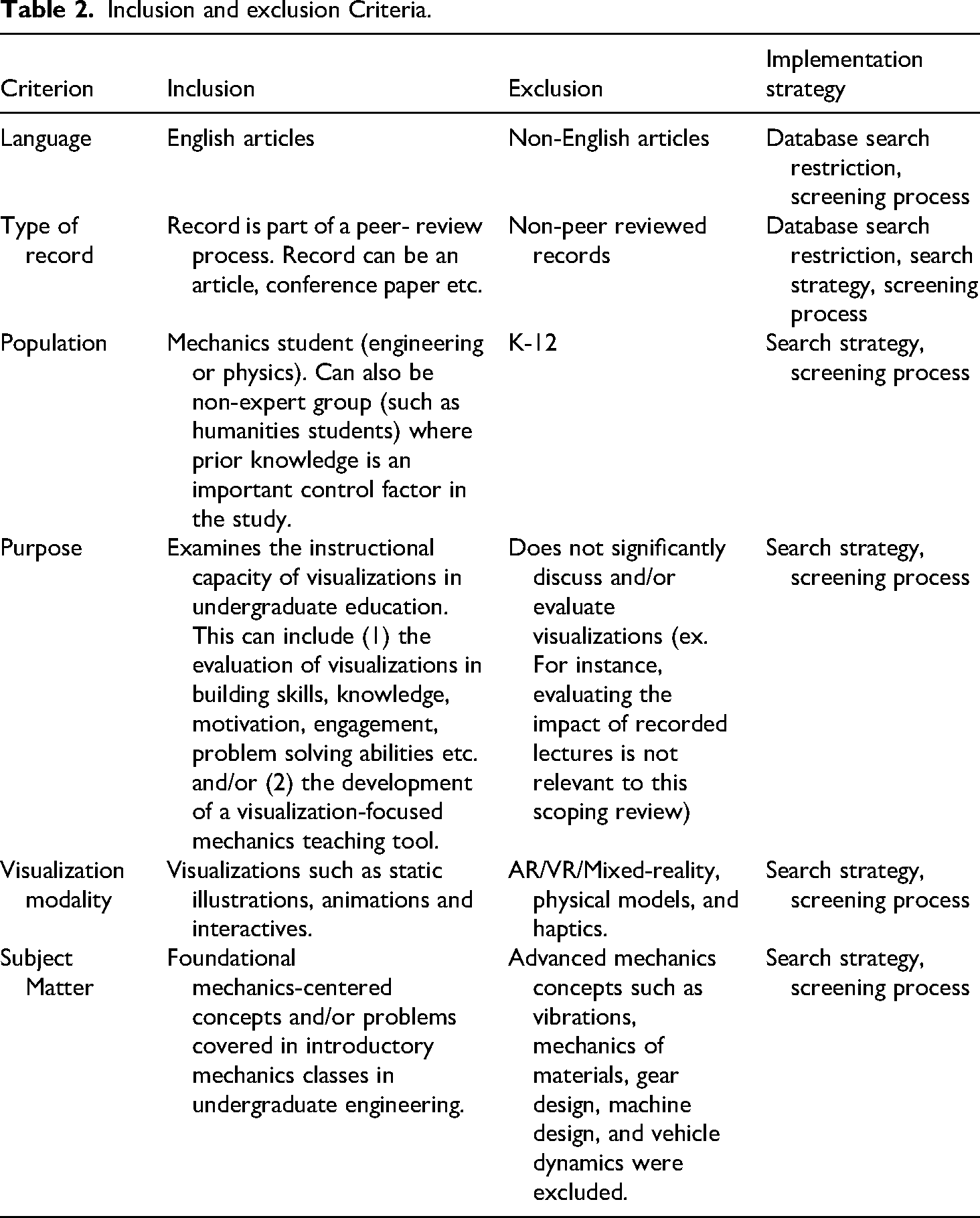
Our initial inclusion and exclusion criteria for study selection focused on undergraduate mechanics and physics students, as they best align with the intended scope of this review. However, during the selection process, we identified a subset of studies that explored the impact of visualizations on learning mechanics concepts while controlling for prior knowledge or domain expertise. To achieve this, these studies deliberately recruited participants from non-STEM fields, such as the humanities or arts, who had minimal to no baseline knowledge of mechanics. Given their relevance to our objectives, these studies were included in the review.
Additionally, we limited the scope of visualization modalities to static illustrations, 26 animations, 27 and interactive digital tools. 28 This decision was made to ensure a focused and manageable analysis while maintaining methodological clarity. Immersive technologies such as virtual reality (VR) and augmented reality (AR) often introduce additional layers of complexity, including distinct design considerations, technological requirements and learning outcomes that differ substantially from other modalities. For instance, immersive systems rely heavily on embodied interaction, spatial presence, and sensorimotor engagement, placing greater emphasis on experiential navigation, proprioception, and physical interaction than on the visually mediated representational processes emphasized in the modalities considered here. While we recognize the growing importance of immersive technologies, we intentionally excluded them to provide a more focused analysis of foundational visualization approaches. As a result, the inclusion of immersive technologies falls outside the scope of this review and warrants a separate investigation. Notably, prior research has provided valuable insights into the use of AR (e.g., Takrouri et al. 29 ) and VR (e.g., Soliman et al. 30 ) visualization technologies in engineering education.
Although a final sample of 32 studies may appear modest relative to the initial pool of more than 9,000 records, this reflects the genuinely limited body of published research that directly evaluates the instructional role of visualizations in undergraduate mechanics. Numerous visualization strategies and tool (such as instructor-created diagrams, interactive simulations, textbook figures, etc.) have been employed in practice but have not been subjected to rigorous empirical study or disseminated as peer-reviewed research. This is an important feature of the field itself; the small sample highlights the need for more sustained research and contributes to the motivation for conducting this scoping review. While formal quality appraisal is not required for scoping reviews, we remained attentive to each study's methodological clarity, sample description, data collection approach, and reported limitations to contextualize the strength and diversity of evidence across the set. This informal examination helped surface broader patterns within the literature (for instance, a tendency toward quantitative investigations or a bias toward interactive visualization tools) further highlighting structural gaps in the evidence base, some of which are illustrated in Figure 3.
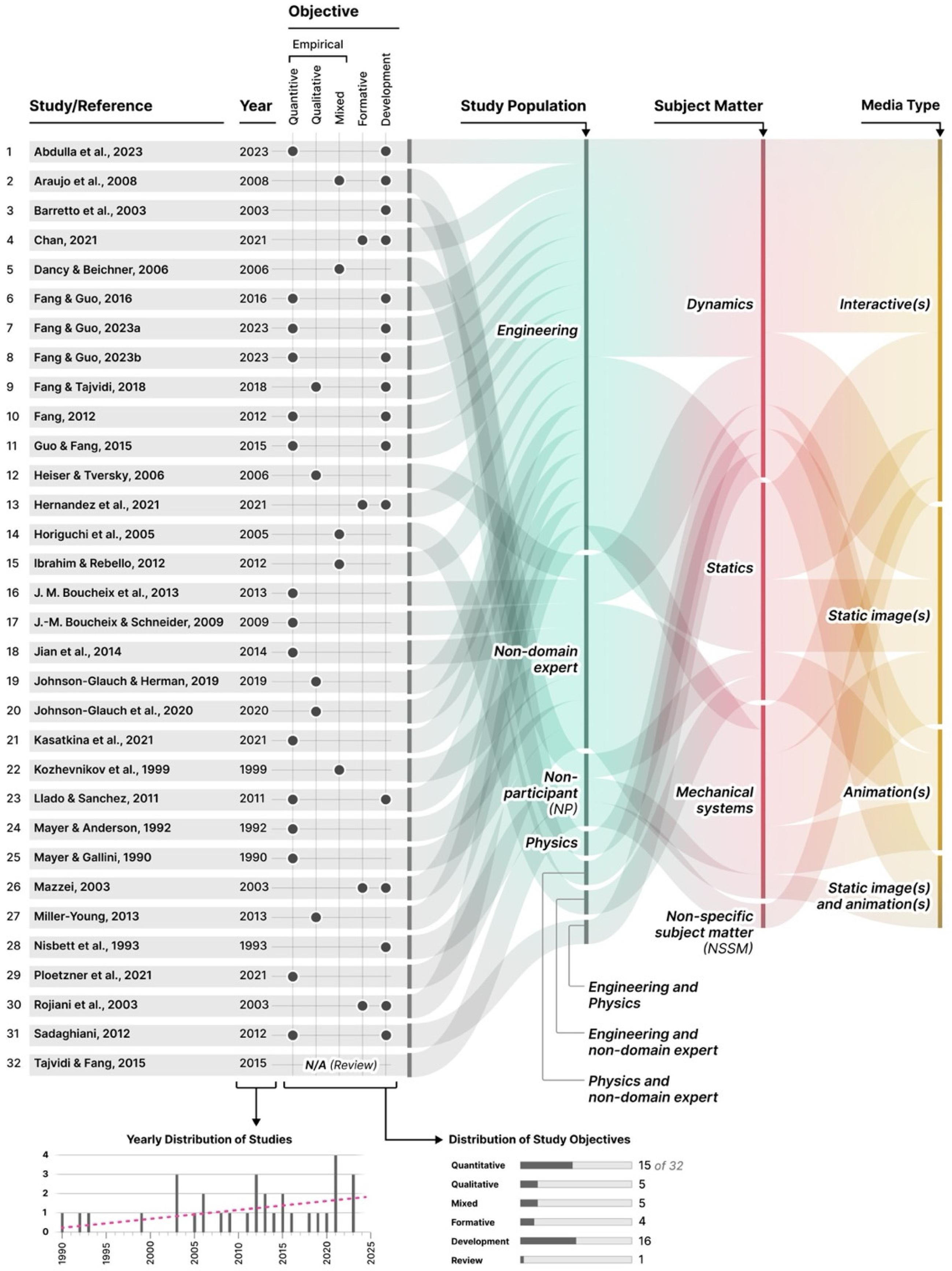
Overview of charting, including study number, year of publication, study objective, study population, subject matter focus, and media type. The main diagram highlights high-level patterns, while two supplementary visuals show the temporal distribution of publications and study objectives. Collectively, the figure highlights several overarching trends: a gradual increase in publications over time (though the overall volume remains modest), a predominance of empirical studies (primarily quantitative) and development-focused work, a primary focus on engineering student populations, an emphasis on dynamics-related content, and a strong representation of interactive visualization modalities.
Charting the data
In this stage, data were systematically extracted and organized to capture key information from the included studies. A standardized data-charting form was developed to ensure consistency and comprehensiveness in the data collection process. The form included fields relevant to the research objectives, such as study characteristics (e.g., author, year of publication), participant population, and the type of visualization modality. The data-charting process was conducted in two phases. As recommended by Levac et al., 23 one reviewer independently charted the data for approximately half of all included studies, while a second reviewer verified the entries for accuracy and completeness. Any discrepancies or ambiguities were resolved at this stage through discussion until consensus was achieved. This two-stage verification process was implemented to enhance dependability and reduce subjective drift during coding. The first reviewer then completed charting the remaining entries. To facilitate analysis, the extracted data were organized into a master spreadsheet.
Collating, summarizing and reporting results
Following Levac et al.'s 23 recommendations, we divided the final phase into three interconnected steps: analyzing the data, reporting the results, and applying meaning to the findings. The first step began with a descriptive summary of the included studies to provide an overview of the characteristics of the evidence base (see Results). We then conducted a thematic analysis using an inductive approach to identify recurring patterns, concepts, and insights within the data. Following qualitative analytical techniques, the extracted data were reviewed line by line and coded in Dovetail 31 to allow themes to emerge naturally using affinity clustering. Themes were identified based on relevance and relationship to the research question. To ensure rigor and consistency, the thematic analysis was conducted collaboratively, with discussions held to resolve discrepancies and refine the emerging themes (see Appendix B, Figure B1 for a work-in-progress screenshot illustrating the affinity clustering process used to identify the main thematic areas). Two team members met on a regular basis to discuss results and emerging themes in the final selection of records. These findings were presented to the entire author team during wider group discussions. This approach allowed us to distill complex findings into meaningful, coherent themes that reflect the core trends, challenges, and opportunities within the literature. The results of the qualitative analysis are presented as key themes in the Discussion Section.
Results
A total of 32 studies met the inclusion criteria and were incorporated into this review (see Table C1 and C2 in Appendix C). The key data from these studies were systematically charted, summarized, and visualized in Figure 3 to highlight patterns, trends, and gaps in the existing research, and to supplement the more granular details provided in the Appendix C.
The included studies were published over a span of more than three decades, from 1990 to 2023, reflecting a small, yet growing body of research in this specific area. Notably, there has been a steady increase in the number of publications over time; the peak of publication activity occurred in 2021.
The studies analyzed in this review encompass a broad range of objectives, including empirical, formative, developmental, and, in one instance, a review; each study was assigned one or more of these attributes based on its focus. Studies tagged with a study objective of ‘formative’ did not involve a formalized investigation but instead provided informal insights, such as the perceived usefulness of a tool as reported by the author, without conducting a comprehensive empirical analysis. Developmental studies focused, either partially or entirely, on the creation of an educational tool, such as an interactive module designed for a specific course. Overall, 25 studies were categorized as empirical - 15 using quantitative approaches, 5 employing qualitative methods, and 5 utilizing a mixed-methods design. Additionally, 4 studies were categorized as formative, 16 as developmental, and 1 as a review paper.
The study population was categorized into four groups: engineering, physics, non-domain expert, and non-participant (NP). Engineering refers to undergraduate students enrolled in engineering programs, while physics includes those in physics programs. Non-domain experts are students from non-STEM fields, such as the humanities or arts, who have little to no baseline knowledge of mechanics - an important distinction for studies controlling for prior knowledge or domain expertise. The NP category was used for studies that did not involve participants. In total, 17 studies included only engineering students, 8 involved only non-domain experts, 1 study involved only physics students, 3 were categorized as NP, one study included both engineering and physics students, another included both engineering and non-domain experts, and one included both physics and non-domain experts.
The subject matter was categorized into four groups: statics, dynamics, mechanical systems, and non-specific subject matter (NSSM). Statics topics included free-body diagrams, shear and bending moment diagrams, beam analysis, equilibrium problems, and principle of moments. Dynamics topics encompassed kinematics and dynamics of particles and rigid bodies, interpretation of kinematics graphs, projectile motion, impulse and momentum in particle dynamics, and work and energy principles. Mechanical systems topics included structural and functional diagrammatic representations, kinematics of linkages, multi-bar linkage mechanisms, and dynamic mechanical systems. Lastly, the NSSM category was used for studies that did not focus on a specific subject matter, such as literature reviews. In total, 14 studies were categorized under dynamics, 9 under statics, 8 under mechanical systems, and 1 under NSSM.
Lastly, the media type of the visualization content was categorized as static image(s), animation(s), and interactive(s). Static images included diagrams, graphs, or illustrations presented in a non-moving format. Animations referred to visual representations that depicted motion or change over time without user interaction. Interactives encompassed media that allowed users to engage with or manipulate the visualization, such as simulations, or interactive graphs. In total, 15 studies utilized interactive visualizations, 9 employed static images, 5 used animations, and 3 included both static images and animations.
Discussion
Addressing Research Question 2, we present four key themes that highlight recurring patterns, perspectives, and insights across the included records: (1) Representational Competence in Mechanics Problem-Solving, (2) The Link between Visual Features, Conceptual Understanding, and Problem-Solving Abilities, (3) Domain Knowledge and Visual Representation in Mechanics, and (4) The Impact of Visualization Modalities on Mechanics Instruction.
Representational competence in mechanics problem-solving
A central theme of the included studies is the role of representational competence as a foundational skill in mechanics education, particularly in problem-solving contexts. 32 Representational competence refers to a learner's ability to interpret, translate between, and effectively use various forms of representations (e.g., diagrams, equations, graphs, etc.) to solve problems. 33 Although traditional quantitative strategies, such as the manipulation of equations to solve statics and dynamics problems, are commonly used to assess understanding and problem solving, numerical proficiency alone does not guarantee conceptual mastery. Several studies indicate that students may perform these procedures successfully without developing a deep conceptual mastery of the underlying principles.34–36 Taken together, these findings suggest that representational competence is not merely an accessory skill but a central determinant of whether students can move beyond procedural execution toward genuine conceptual reasoning of mechanics.
In Miller-Young's 37 study involving think-aloud exercises, participants predominantly relied on recalling formulas and attempting to solve problems purely through quantitative methods, even when the task did not explicitly require such approaches (and when the provided information was insufficient for a full quantitative solution). While students may appear to solve problems correctly (by identifying certain repeating patterns), their solutions often lack the depth of conceptual insight that characterizes expert performance. 37 Domain experts, by contrast, tend to integrate visual cues with underlying physical principles, allowing them to reason qualitatively before engaging in quantitative analysis. For instance, where experts frequently use the provided information to reason about the directionality and line of action of forces, novices tend to focus on recalling equations without validating whether their assumed force system is physically plausible. This distinction is particularly consequential in mechanics contexts such as free-body diagram construction, equilibrium analysis, and moment calculations, where incomplete or incorrect conceptual understanding can fundamentally undermine subsequent mathematical work. This contrast highlights a recurring pattern across studies: novices gravitate toward familiar symbolic procedures, whereas experts flexibly shift among representations depending on task demands. The discrepancy between novices and experts is a persistent challenge for instructors in developing representational competence within their classrooms.
Further evidence from experimental tasks presented in linguistic, graphical, and symbolic formats reinforces the notion that engineering and physics students show a marked preference for manipulating symbolic and mathematical representations. Ibrahim and Rebello 32 observed that even when visual representations were available, students frequently overlooked opportunities to integrate these visuals with the mathematical aspects of the problems. While some students demonstrated awareness of qualitative problem-solving strategies, they often defaulted to using equations due to their greater familiarity with algebraic manipulation; this preference suggests a need for explicit instruction that emphasizes representational flexibility. Ibrahim and Rebello's 32 study revealed that participants typically relied on quantitative approaches, even when qualitative reasoning could have provided a more straightforward or conceptually meaningful solution. In mechanics, this often manifests as students attempting to compute unknown forces or accelerations without first establishing correct system boundaries, motion states, or constraint conditions. Such a tendency not only limits the depth of their understanding but also results in inconsistencies when similar representational forms are encountered across different topical areas. The observed variations in strategy appear to be influenced by both the representational format and the students’ preexisting knowledge of the subject. 32 When considered alongside Miller-Young's findings, a consistent pattern emerges across instructional contexts: students’ representational choices seem to be driven more by habit and comfort rather than by the demands of the task. These results point toward a need to explicitly develop students’ representational competence (e.g., instructional opportunities for students to justify how a visualization encodes the constraints of a mechanical system, such as support reactions, motion states, or internal force distributions, prior to algebraic manipulation).
The way in which standard mechanics representations are introduced, employed, and designed in undergraduate classrooms may further contribute to these patterns. Research, such as that by Miller-Young, 37 highlights the prevalence of visual misinterpretations in mechanics education. Miller-Young 37 observed that students often struggle to visualize points that lie behind the plane of the page or vectors directed into it; more specifically, in an investigation involving vector visualization, five out of ten students had difficulty in correctly perceiving vectors oriented into or out of the plane of the page. This observation raises an important question: to what extent are students’ difficulties rooted in the inherent visual features of conventional mechanics representations? Several studies have suggested that subtle changes in visual representations can significantly influence problem-solving approaches in mechanics (see Theme 2), indicating that the design and representational format of visual media warrant careful and deliberate consideration.
Another key consideration is whether these challenges stem from a lack of targeted, explicit training in representational competence. Johnson-Glauch and Herman 13 argue that assignments requiring students to identify task-relevant information, before engaging in numerical calculation, may help cultivate more effective problem-solving habits. This instructional approach aligns closely with expert mechanics practice, where equilibrium conditions, constraint identification, qualitative motion analysis etc., precede equation formulation. Explicitly focusing on the interpretation of visual data and its integration with symbolic reasoning may help students build a more robust “representational toolkit” that extends and integrates formulaic manipulation with depth of conceptual understanding. Miller-Young 37 also found that students often miss important contextual clues; for example, when analyzing a structural problem, some students failed to recognize that a support wire must extend behind the page for proper mechanical stability. Such oversights point to a conceptual detachment from the physical meaning of the problem space (i.e., students may be “solving” the problem without truly understanding it). Again, this suggests that students may be primarily focused on abstract mathematical manipulations and overlooking the fundamental physical plausibility of their interpretation of the problem. In many cases, this overreliance likely reflects rudimentary and incomplete representational competence. A student who lacks the ability to interpret, translate between, and strategically apply various forms of representation will naturally fall back on familiar methods, a pattern consistently documented across numerous studies in this review.
These findings suggest that building representational competence requires more than simply exposing students to multiple representations; it may require explicit instructional strategies aimed at enhancing visual literacy. Instructors play a crucial role in this regard by helping students identify and understand the key visual features relevant to specific contexts. The challenge for educators, particularly in engineering disciplines like mechanics, lies in deconstructing their own expert knowledge, and translating it into explicit learning opportunities for novices. Strategies such as the systematic use of multiple representations and the encouragement of comparison and contrast between different forms can foster a more flexible and integrated approach to mechanics problem-solving. The findings further point to opportunities to leverage both instructional design and teaching expertise to create visualizations and learning materials that directly support the development of representational competence.
The link between visual features, conceptual understanding and problem-solving abilities
In mechanics, representations drive interpretation and the problem-solving process by channeling attention, supporting the encoding of essential information, and guiding the construction of accurate mental models. A static diagram, for example, can simultaneously depict the structural arrangement of components and functional interactions, integrating multiple layers of information into a single frame. Theme 2 examines how specific visual features (e.g., arrows, labels/annotations, motion cues, etc.) can influence students’ interpretation, encoding, and application of information. Even when students have a strong grasp of fundamental concepts, the presentation of visual information can greatly impact/redirect their reasoning, reinforce productive inferences, or, at times, introduce ambiguities that make problem-solving more difficult. This suggests that errors in mechanics problem solving may arise not only from conceptual gaps but also from how visual information interacts with students’ existing knowledge and heuristics.
A particularly compelling finding in this area is the tendency of students to conflate distinct concepts when those concepts are represented using visually similar features. In their study, Johnson-Glauch et al. 3 demonstrate how contextual cues, and intrinsic visual features can modulate cognitive processing in mechanics problem solving. Johnson-Glauch et al. 3 found that when distinct concepts are represented with similar visual elements, such as analogous symbolic notations, students are prone to conflating these concepts. This phenomenon is particularly problematic in mechanics, where multiple quantities (e.g., shear force, external force, bending moment, reaction moment) may be symbolized with arrows or curved indicators that appear superficially similar but carry fundamentally different meanings. For instance, Johnson-Glauch et al. 3 found that learners frequently conflated shear forces with external forces, and bending moments with induced moments, largely because these representations share similar symbolic notations. A similar trend was observed regarding the intrinsic perceptual salience of visual features that encode mechanics concepts. Johnson-Glauch et al. 3 observed that students can more readily access concepts and apply their knowledge when the visual feature is intrinsically perceptually salient. For instance, they observed that pin and roller joints (represented by distinct and recognizable symbols) directed student attention, facilitated the encoding process, and supported the construction of more accurate interpretations. On the other hand, fixed joints, which lack a similarly explicit symbol, were more frequently missed, especially by novices. This contrast across symbol types demonstrates an interesting relationship between perceptual salience and problem-solving: salient features have the capacity to reduce cognitive search demands, whereas ambiguous features increase interpretation errors.
While this Johnson-Glauch et al. 3 emphasizes how visual similarity and perceptual salience affect concept differentiation, other research focuses on how explicit visual cues can structure students’ processing strategies. In their study, Jian et al. 38 examined how the presence of numbered arrows influenced students’ construction of mechanical kinematic representations using static diagrams. Participants were divided into two groups: one that received diagrams with numbered arrows and one that did not. Using eye-tracking, the researchers were able to analyze participants’ visual attention and processing strategies in real time. The results revealed distinct differences in how the two groups processed information. Participants who viewed diagrams with numbered arrows adopted a more sequential and focused approach, as evidenced by shorter saccades and closer alignment with the intended operational sequence. In contrast, those who viewed diagrams without such cues tended to engage in broader, more comparative analyses. These findings suggest that numbered arrows function dually as perceptual cues and as scaffolds for effective cognitive processing, leading to more accurate construction of kinematic mental models. From an instructional standpoint, this kind of visual scaffolding can be particularly helpful when students are reasoning about ordered motion, causal force transmission, or other kinematic relationships that unfold over time. At the same time, there may be trade-offs: highly structured cues may limit opportunities for flexible reasoning or transfer, especially in tasks where multiple interpretations or solution paths are possible.
Similarly, Heiser and Tversky's study 26 investigated how arrows influence both the comprehension and depiction of mechanical systems. Across two experiments, the researchers investigated whether arrows in diagrams promote functional interpretations and whether functional descriptions of mechanical systems prompt the inclusion of arrows in diagrammatic representations. In the first experiment, participants were presented with diagrams of mechanical systems with or without arrows and were asked to describe the system depicted. The results revealed an interesting difference in how participants engaged with the diagrams; when diagrams included arrows, participants’ descriptions contained significantly more functional information, including details about movement, causality, and operational sequences. In contrast, when diagrams lacked arrows, participants focused more on structural aspects, describing spatial configurations and relationships between system components. This effect was further supported by differences in verb usage; those describing diagrams with arrows employed more transitive verbs and action-oriented language (e.g., “push,” “move,” “exert”), whereas those interpreting diagrams without arrows relied more heavily on static expressions (e.g., “is,” “has,” “contains”). These findings suggest that arrows act as perceptual cues that direct attention to dynamic aspects of a system, thereby scaffolding cognitive processing towards functional understanding. The second experiment explored the inverse relationship by examining whether participants spontaneously included arrows when sketching mechanical systems from structural or functional descriptions. Participants who were given functional descriptions (i.e., text focusing on the sequence of operations, forces, and causal effects) were significantly more likely to incorporate arrows into their diagrams compared to those who received structural descriptions. This finding reinforces the idea that arrows serve a powerful communicative function in diagrammatic representations, allowing individuals to visually encode dynamic and causal relationships in mechanical systems. Taken together, Heiser and Tversky's 26 experiments provide strong evidence that small, yet iconic diagrammatic conventions such as arrows can serve a critical cognitive function in facilitating the comprehension and communication of mechanical processes. Arrows can aid in directing attention, structure interpretation, and support the integration of sequential/causal relationships into mental models.
The integration of dynamic visual cues within animations introduces an additional encoding variable afforded to animated media. J. M. Boucheix et al. 39 provide interesting insights, investigating the effectiveness of two novel forms of dynamic relational event unit cueing techniques (designed to help learners by signaling not just individual objects but also the relationships and interactions between objects over time and space), called progressive path cues (that involve dynamic movement of color or visual elements that trace along an entire causal pathway in the animation) and local coordinated cues (that focus on specific, localized interactions or events within the system, rather than an entire causal chain), in supporting learning from an animation depicting a complex mechanical system. Eye-tracking data revealed that learners exposed to these relational event unit cueing techniques allocated greater attention to low-salience, yet highly pertinent, components compared to learners in both the entity-cued and uncued conditions. These findings are particularly relevant for mechanics topics involving distributed interactions, such as force transmission through linkages or energy transfer across components, where relationships may otherwise be overlooked. Over time, these learners exhibited greater cue loyalty compared to those in conventional entity-based cueing or uncued conditions, and their comprehension performance was significantly enhanced. These results substantiate the utility of dynamic visual cueing in promoting deeper cognitive processing and enhanced conceptual understanding.
Complementing these findings, Johnson-Glauch and Herman 13 examined the application of object translation heuristics among students (i.e., object translation is a heuristic where students map visual features one-to-one between representations based on surface cues rather than underlying concepts 13 ). They found that micro-level features, such as arrows, can trigger specific heuristics, even in individuals with a strong foundational understanding of the material. This dependence on heuristics is illustrative of the dual-process models of cognition, which differentiates between the fast, intuitive System 1 and the slower, more deliberative System 2.40,41 Heuristics, which are thought to function predominantly within System 1 cognition, can dominate initial problem-solving approaches, highlighting the need to design visual representations that align heuristic-based responses with intended interpretation. From an instructional standpoint, these findings raise broader questions about the extent to which educational materials should be designed to either accommodate or counteract heuristic-driven cognition. If certain heuristics are nearly unavoidable due to their deep entrenchment in System 1 processes, it may be more effective to design visual representations that work with, rather than against, these intuitive tendencies.
Collectively, these findings provide compelling evidence that the visual salience of task-relevant details plays a central role in shaping both conceptual understanding and problem-solving behaviors. The interplay between perceptual cues and cognitive processing is multifaceted; while salient features can guide attention and facilitate the encoding of information, they may also inadvertently lead to conceptual conflation if not carefully designed. For novice learners (who are still developing effective strategies for filtering relevant information from irrelevant information), explicit visual cues such as numbered arrows or dynamic relational cueing can significantly enhance understanding and performance. However, the strength of this effect varies across study designs and task contexts, suggesting that visual cueing is most effective when it is tightly aligned with the underlying mechanics concepts and instructional goals rather than applied generically.
Domain knowledge and visual representation in mechanics
This theme explores the interplay between visual representations in mechanics and level of domain knowledge or expertise. Across the reviewed studies, visual features continue to matter across levels of expertise, though they are interpreted and integrated differently as students’ understanding of mechanics develops. Research suggests that learners with deeper conceptual understanding engage more meaningfully with representations, while novices tend to rely on surface-level cues.
As described by Johnson-Glauch and Herman, 13 advanced novices, for instance, can discern the presence of a fixed joint, a feature that lacks a distinct schematic symbol and intrinsic perceptual salience. As the authors note, 13 a student's domain knowledge “guides their search for information when completing a task”. When domain knowledge is limited, students are less likely to actively seek out non-salient but conceptually relevant features, increasing the likelihood of missing key elements during problem solving. Even when explicitly directed to calculate the reaction moment, novices with weaker domain knowledge struggled to translate the fixed joint into both a reaction force and moment. When sketching shear force and bending moment diagrams, weak novices tended to rely solely on surface-level features of the problem, applying the object translation heuristic without deeper engagement. Their problem-solving processes remained largely superficial as they overlooked the critical step of applying key underlying mechanics concepts. Conversely, novices with stronger understanding - and particularly advanced novices - demonstrate a more integrated approach. While they still draw upon surface features and utilize the object translation heuristic, they coordinate this heuristic with concept-based strategies. This dual reliance signals a progression in their conceptual understanding, as they begin to synthesize surface-level cues with the fundamental principles of equilibrium, ultimately enabling the construction of more accurate and theoretically sound representations. 13 Another important observation is related to the management of heuristic conflicts; novices often did not notice when their heuristics were in conflict and, as a result, did not engage in behavior to prioritize or reconcile these inconsistencies. Some students, however, were aware of conflicting heuristics but tended to favor one over the other rather than resolving the contradiction. In contrast, advanced novices typically resolved these conflicts by applying equilibrium-based problem-solving approaches. They used verbal reasoning to identify and correct areas where they had misapplied a specific piece of knowledge or heuristic, reflecting a more mature integration of domain-specific strategies. 13
A recurring strategy observed across participants was object translation or the mapping of features from one visual representation to another. 13 Students at varying levels of expertise often mentioned that a particular feature in one visual representation corresponded to a visual feature in a different representation. For many novices, this feature mapping became the primary basis for problem-solving decisions, rather than a focus on the underlying fundamental concept. While this heuristic approach allowed for the approximation of solutions that were often nearly correct, it sometimes led to small but significant errors due to the implicit or nuanced aspects tied to these objects (e.g., an incorrect sign assignment in a bending moment diagram can affect subsequent equilibrium equations, downstream analyses and interpretation). Although these heuristic shortcuts can be efficient, they may limit a deeper understanding and impede the accurate application of concepts to more complex or unfamiliar problems. Encouraging students to move beyond surface-level feature mapping by exploring and integrating underlying principles could, therefore, lead to a more robust and flexible problem-solving skill set.
Kasatkina et al. 42 reported interesting results regarding the influence of representational format on problem-solving across the expertise continuum. Initially, the researchers hypothesized that the advantages provided by color coding and three-dimensional representations for understanding kinematic diagrams would diminish as expertise increased (based on the idea that experts utilize a domain-specific, monosemic approach to engage with content without reliance on specific format details). 43 Contrary to this hypothesis, the impact of the format, particularly related to color coding, appeared to be less significant for undergraduate students. Because these undergraduates had recently received instruction and practice with kinematic diagrams, they effectively functioned as context-specific experts within the scope of the task. In contrast, for graduate students, the representational format retained a higher significance, with color acting as an essential support for kinematic diagram comprehension. This suggests that the degree to which students rely on visual features may vary with their training recency in a particular topic. Similarly, Ibrahim and Rebello 32 found that representations themselves play a crucial role in problem-solving behavior and that domain knowledge significantly shapes how students engage with different representational formats. Specifically, students with stronger prior knowledge were better able to extract meaningful information from representations and apply appropriate problem-solving strategies. Collectively, these findings underscore the interplay of domain knowledge, representational format, and training recency on students’ ability to engage meaningfully with problem-solving tasks.
Kozhevnikov et al. 44 offer an alternative perspective by grouping participants as either visual-type learners or spatial-type learners, rather than strictly by domain expertise. Visual-type learners were found to focus on creating pictorial images that capture the physical appearance of objects - constructing representations that depict tangible items when solving kinematics problems. In contrast, spatial-type learners developed schematized representations that eliminated extraneous details and emphasized core relationships. Although the practice of categorizing learners into thesegroups is contentious, 45 this distinction provides insight into how students may naturally approach representations during problem solving. Some individuals may naturally gravitate toward a more literal, pictorially rich mental model, whereas others with higher spatial abilities may prefer abstract, schematic representations that prioritize spatial relationships and transformations. 46 Importantly, these preferences interact with mechanics learning demands: pictorial approaches may support initial engagement with motion scenarios, whereas schematic representations are often better aligned with abstract reasoning about forces, constraints, and equilibrium. This differentiation supports broader discussions on the role of visual heuristics in mechanics problem solving, suggesting that students’ engagement with visual representations is shaped not only by their level of expertise but also by cognitive preferences.
Together, these findings caution against treating representational effects as uniform across learner populations and highlight the importance of contextualizing results by expertise, topic familiarity, and task demands. Learners with greater domain knowledge tend to be better equipped to move beyond surface-level cues, engaging more deeply with representations and integrating core conceptual principles. In contrast, novices are more likely to rely on perceptual or heuristic-based features. Despite the coherence of these findings, the empirical base supporting this theme remains relatively narrow. Much of the existing evidence is drawn from a limited number of tightly scoped studies, often focused on specific mechanics subdomains or constrained instructional contexts. As a result, the extent to which these patterns generalize across topics, populations, and instructional settings remains uncertain. These limitations point to important opportunities for future research, particularly studies that systematically examine how domain knowledge interacts with representational design across a broader range of mechanics concepts. These limitations - and the opportunities they reveal - are addressed in a later section (Implications for future research).
Impact of visualization modalities on mechanics instruction
This theme synthesizes findings from key studies examining the educational impact of different visualization modalities within mechanics instruction. The included studies primarily focus on static images, animations, interactive simulations, and computational modeling environments and their influence on learners’ comprehension and performance in tasks related to mechanical processes and motion. Rather than zooming into micro-level visual features of visualizations (as discussed earlier), this set of research compares broader categories of visual media and the contexts under which each most effectively supports learning outcomes.
Boucheix and Schneider 27 investigated whether different types of static and animated representations could improve learners’ mental representations of a three-pulley system. Their study builds on previous research questioning whether animations offer significant cognitive benefits over static visuals in scientific learning contexts. In the first experiment, learners who were presented with either animations or integrated sequential static frames performed better in comprehension tasks compared to those who viewed a single static image or independent sequential static frames. This suggests that breaking down dynamic processes into clear, incremental steps (that allow for comparison of different stages) - whether through animation or integrated sequential static visuals - can enhance understanding and improve mental simulation of movement. In contrast, when static images were presented independently and sequentially, learners had to retain previous steps while processing new ones. In a second experiment, the researchers examined whether giving learners control over animations (e.g., the ability to pause, rewind, or advance the animation) would improve comprehension. Interestingly, user control had little effect overall, except for learners with low spatial and mechanical reasoning abilities, who showed some improvement when they could manipulate the animation.
In a similar investigation, Dancy and Beichner 47 examined how replacing static visuals (and descriptions of motion) with animations affects the assessment of students’ conceptual understanding as demonstrated by the Force Concept Inventory (FCI), a widely used conceptual test. 48 The researchers found that animation can improve test validity under specific conditions, particularly when the animation conveys essential motion-related information not easily inferred from static images. In this experiment, animations often helped students better interpret the intent of a question and select answers that more accurately reflected their actual understanding. Notably, they found that while verbal ability positively influenced performance on the static test, this correlation vanished with the animated version, suggesting that animation can reduce the confounding effect of reading skill on conceptual assessment. However, the benefits of animation were not universal; it only enhanced assessment when depicting motion was integral to the question. In contrast, for questions where animations were merely decorative or redundant, no significant advantage was observed. Animations also appeared to reduce reliance on memorized answers and helped clarify vague or easily misinterpreted static items. Dancy and Beichner 47 did not advocate for use of animation in all assessment contexts; instead, they supported its use under certain contexts, such as in problems involving temporal change or where conventional static representations may obscure students’ understanding. This conditional effect aligns with findings from Dancy and Beichner 47 : the cognitive benefit of animation depends on whether temporal dynamics are central to the concept being assessed. When motion is peripheral, animation does not improve (and may even distract from) conceptual reasoning.
Similarly, Ploetzner et al. 49 examined the educational effectiveness of animations compared to static pictures, particularly when learning the specifics of dynamic change. While previous research suggested that animations offer only a small learning advantage over static visuals, more recent analyses indicate that this advantage becomes substantial when the learning task involves understanding continuous spatial and temporal transformations. Their findings support the latter; Ploetzner et al. 49 found that animations were most effective for learning how specific components of a mechanical system moved over time. Learners who viewed animations outperformed those who viewed single or sequential static images in recognizing motion dynamics – a difference likely attributable to the explicit visualization of temporal changes, an affordance of animated visual media. Despite these advantages, Ploetzner et al. 49 found that static images were more effective when the learning task involved identifying spatial arrangements rather than motion sequences. Learners who viewed static images performed better at recognizing the relative positioning of mechanical components. The analysis also revealed that neither mechanical ability nor spatial ability significantly influenced performance across conditions, suggesting that animations provide a perceptual advantage in learning dynamic processes, regardless of a learner's pre-existing ability to mentally animate static visuals. However, for learning spatial configurations, static images alone provided sufficient information, making animations not only unnecessary but potentially overwhelming for learning.
Mayer and Anderson 50 investigated how the temporal alignment of narration and animation affects students’ ability to retain and transfer knowledge. The study tested the contiguity principle (i.e., the idea that learning is enhanced when words and pictures are presented simultaneously rather than separately). Across two experiments, participants studied mechanical systems through various instructional modes: concurrent animation and narration, successive (non-simultaneous) presentations in various sequences, animation or narration alone, or no instruction. While all instructional conditions (except the control group) led to comparable performance on retention tasks, only the group that received concurrent animation and narration demonstrated significantly higher scores on problem-solving assessments. This pattern held across instructional topics, suggesting that the temporal alignment of verbal and visual input supports the formation of referential connections, and ultimately, transferrable understanding of mechanical systems. In contrast, when animation and narration were temporally separated, learners struggled to integrate the information, despite being exposed to the same content.
The following studies investigate interactive, dynamic, and responsive visualization modalities, such as simulations and computational modeling environments. For instance, Horiguchi et al. 51 investigated the role of Error-Based Simulation (EBS) in fostering conceptual change in mechanics learning. The researchers argue that errors serve as critical learning opportunities, yet students often struggle to recognize and correct their misconceptions independently. As part of their study, EBSs were designed to literally visualize the consequences of students’ incorrect assumptions, with the hypothesis that students would reflect on, and adjust their understanding and address misconceptions. Horiguchi et al. 51 found that novice students benefited significantly from the simulations, while expert students showed little to no improvement. The authors suggest that this may be due to the simplicity of the problems used in the study, which were not challenging enough to induce conceptual change among more advanced learners. While students using EBS could identify when their answers were incorrect (i.e., self-evaluation), they often struggled to determine how to fix them (i.e., self-regulation). While error-based learning can foster awareness in mechanics, additional instructional support is likely needed to scaffold correction strategies (i.e., guided intervention beyond visual feedback).
Araujo et al. 52 investigated the use of computational modeling activities to support students’ understanding of kinematics graphs. The researchers designed tasks that allowed students to investigate “what if” scenarios by altering parameters and observing real-time graphical and animated feedback to encourage deeper connections between mathematical representations and physical motion. The study employed a quasi-experimental design with control and experimental groups, administering pre- and post-tests adapted from Beichner's Test of Understanding Graphs in Kinematics (TUG-K). While both groups improved over time, the experimental group demonstrated significantly greater gains, particularly in areas involving interpretation of slope, area, and variable relationships.
Fang and Guo 53 presented a case for the integration of computer simulation and animation (CSA) in engineering education, particularly in teaching particle kinetics within undergraduate dynamics courses. The researchers designed and developed a CSA application that allowed students to observe physical phenomena, manipulate parameters and review the corresponding changes in mathematical representations. Through a quasi-experimental design comparing traditional instruction to CSA-enhanced instruction, the researchers demonstrated statistically significant gains in both conceptual understanding and procedural skills among students who used the CSA module. Despite these gains, the authors acknowledged limitations in the module's ability to correct misconceptions, suggesting that while CSA-based visualizations can support learning, they may not be sufficient for promoting robust conceptual change when used in isolation or within the bounds of the CSA's instructional design. This study is part of a larger research program,54–58 principally led by the first author (Ning Fang), that explores the development and application of CSA modules, tackling fundamental topics in mechanics; collectively, the findings of this body of work support the use of CSA in strengthening conceptual and procedural skills in mechanics instruction.
Taken together, the literature shows that the effectiveness of a visualization modality is not inherent to the medium itself but emerges from the fit between what the modality affords and what the learning task requires. Animations tend to succeed when the target concept hinges on temporal change; static images may excel when spatial clarity is the primary goal; and interactive simulations can help learners map mathematical relationships to physical behavior. These distinctions clarify why findings across studies sometimes appear inconsistent: what seems like a modality effect is more accurately understood as a task-modality interaction. In other words, the question is not whether animations or static images are “better,” but rather under what conditions each medium supports or constrains conceptual understanding. This framing offers a coherent explanation for the mixed results reported in the literature and underscores the importance of aligning visualization choices with both the cognitive demands of the content and the needs of learners.
Design considerations and instructional implications
This section summarizes the findings related to Research Question 3, highlighting the key design considerations and instructional strategies explicitly outlined in the literature. The results are summarized in Figure 4, with a detailed breakdown provided as supplementary materials. However, it is important to note that many of the recommendations offered by the authors (of the included studies) are based primarily on their personal experiences or professional judgments rather than on systematic empirical evaluation. While these insights offer practical value for instructional design, they also highlight a significant gap in empirical backing, pointing to a clear opportunity for further scholarly work.
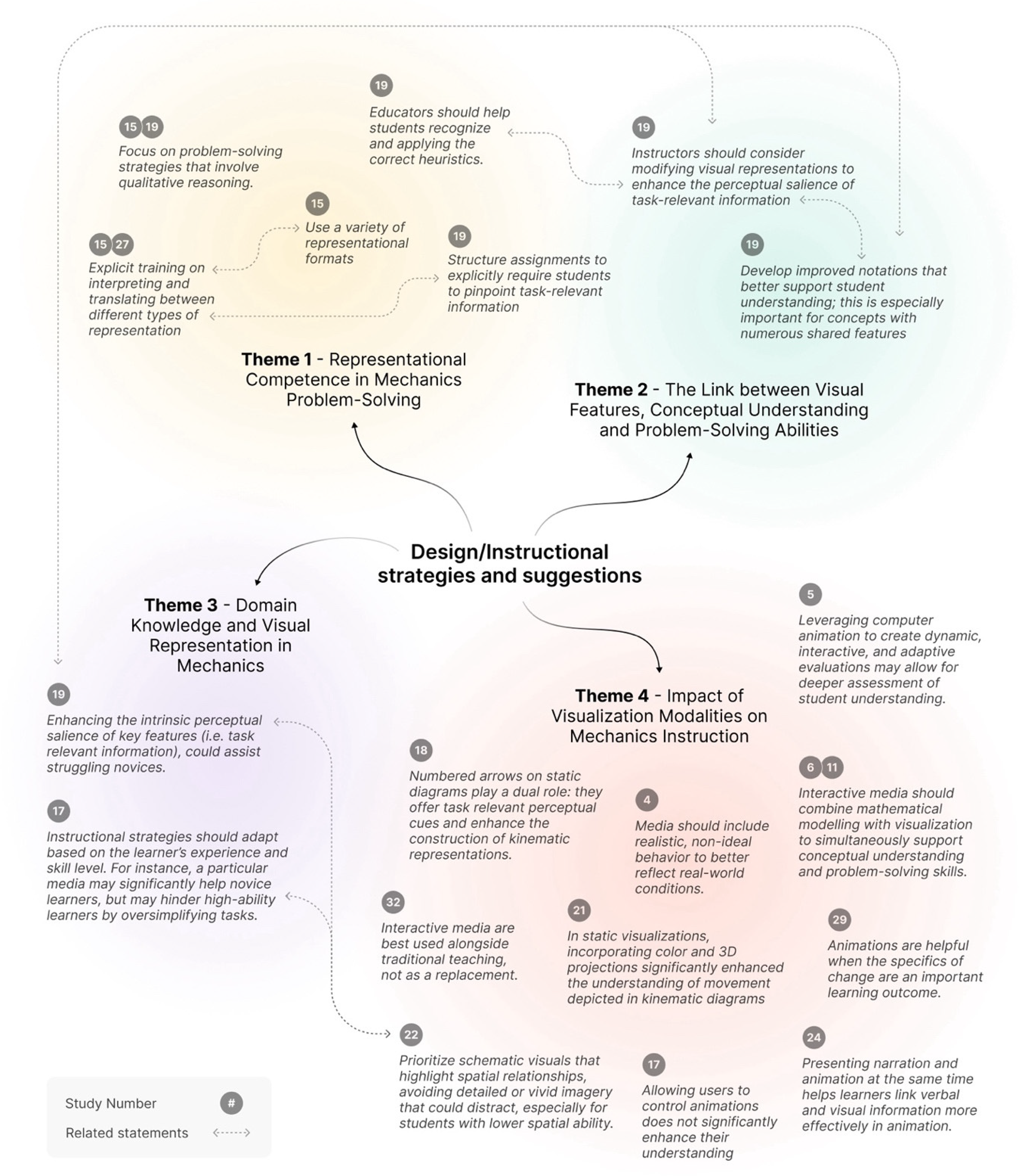
Visual mapping of design and instructional strategies identified in the scoping review, organized into four thematic areas as described in the Discussion section. Each excerpt is linked to its corresponding study number. Related statements across studies are connected using dotted lines to highlight conceptual relationships.
Taken together, the literature points to several recurring design considerations and instructional implications for supporting students’ learning with visualizations in mechanics. First, the consistent use of multiple representational formats (e.g., static diagrams, dynamic sequences, symbolic/mathematical representations, interactive tools, etc.,) appears essential for supporting learners in building representational fluency that mirrors expert practice. Effective instruction therefore involves making representational relationships explicit through training: guiding students in translating between representations and structuring instructional tasks that require learners to distinguish task-relevant features from incidental or situational detail. For example, brief “representation-translation” checkpoints can be embedded before quantitative solution steps (e.g., asking students to identify all the relevant and irrelevant information in a particular problem) so representational interpretation precedes computation. These patterns underscore a clear opportunity for designers to develop scaffolds that render these correspondences (i.e., relationships among representations) more intelligible, particularly for novices still acquiring the “visual grammar of mechanics”. In practice, targeted scaffolds may include intentionally sequencing static diagrams before animations to clarify spatial configuration prior to motion, prompting students to justify why a particular representation (e.g., moment diagram vs. kinematic sketch) is most appropriate for a given problem type, or pairing interactive tools with prediction questions that require students to anticipate system behavior before manipulating parameters.
The included records of this review also illustrate that the visual canon of introductory mechanics is neither fixed nor self-explanatory for novices. Many of the challenges students experience can be traced to micro-level visual features, such as the design of disciplinary notations or motion cues, that shape how information is perceived and interpreted. Designers must therefore attend carefully to perceptual salience while remaining sensitive to learners’ developmental trajectories; supports that benefit beginners may impede more advanced learners, reflecting well-documented expert-reversal effects.
A more detailed synthesis of these design considerations and instructional implications is presented in Figure 4, which organizes the recommendations into thematic categories and illustrates the range of strategies discussed across the literature.
Implications for future research
This section briefly summarizes findings relevant to Research Question 4, emphasizing the key research gaps and implications explicitly identified in the literature. These insights are illustrated in Figure 5, with a detailed breakdown provided as supplementary materials. Collectively, this synthesis serves as a useful springboard for deeper inquiry.
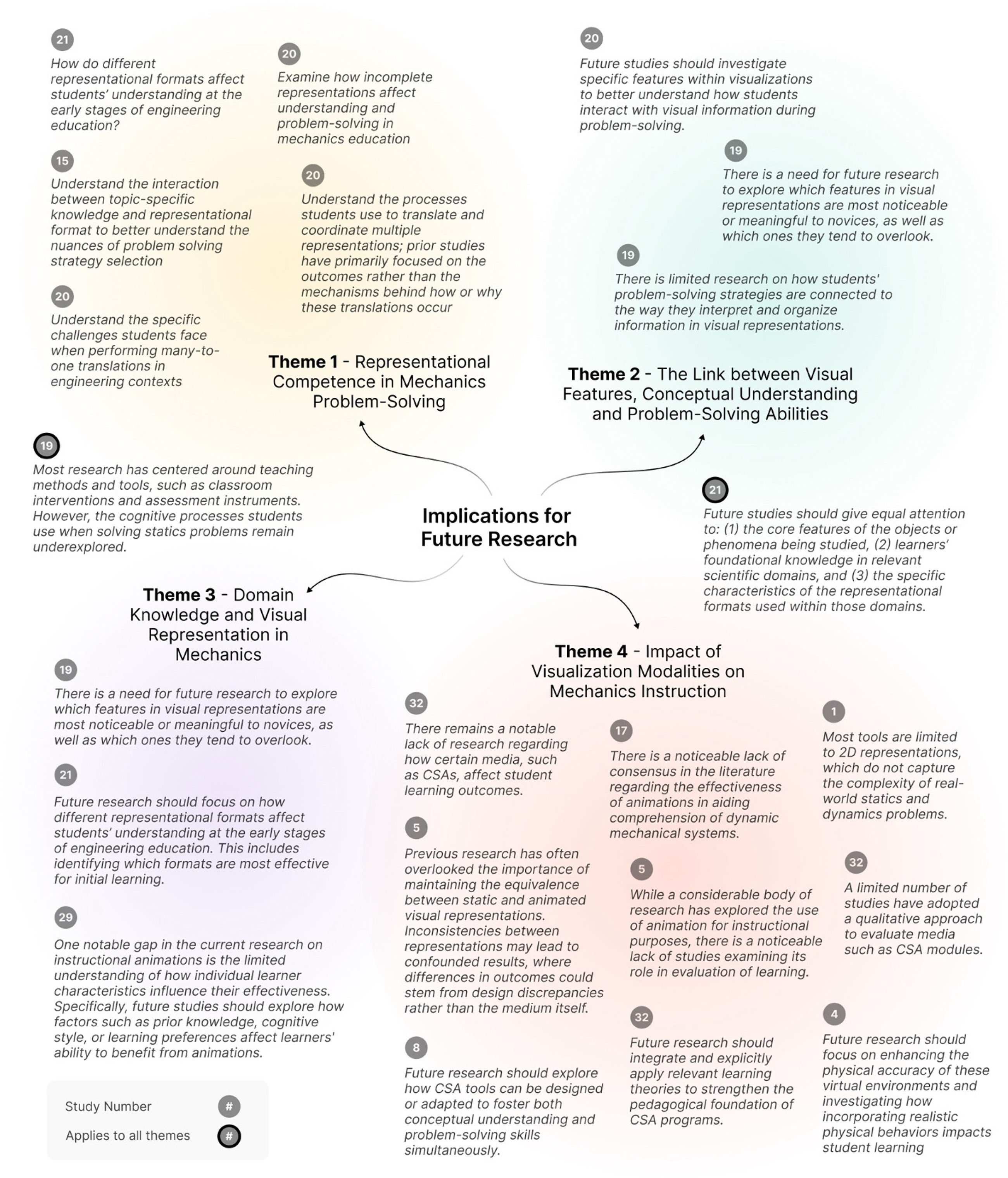
Visual mapping of implications for future research identified in the scoping review, organized into four thematic areas as described in the Discussion section. Each excerpt is linked to its corresponding study number.
Across the corpus, there are substantial opportunities to develop a more robust account of representational competence in mechanics problem-solving. Prior work has focused largely on performance outcomes, leaving open fundamental questions about how students translate among representations, which features they rely on when performing many-to-one or one-to-many transformations, and the role of multiple representations in the problem-solving process. The literature also calls for closer examination of which aspects of visualizations novices tend to overlook, how perceptual salience guides (or misguides) attention, and how students integrate visual information into their unfolding solution strategies. A third cluster of research opportunities concerns domain knowledge and its influence on visual interpretation, particularly the uneven ways in which different representational approaches/formats support learners at varying levels of prior knowledge. Finally, notable gaps persist in understanding the impact of visualization modalities. Many studies treat modality as a surface feature rather than examining the conceptual or perceptual mechanisms through which different media support learning. Future areas of inquiry include investigating/evaluating different design approaches for animations depicting dynamic mechanical systems and examining the role of interactive simulations in supporting conceptual reasoning and problem-solving. A critical reappraisal of existing studies is also warranted, particularly with respect to the experimental visual stimuli that undergird much of the field's evidence; in several cases, assumptions about representational equivalence (e.g., between static and animated formats) remain untested. Together, these themes underscore a field that is rich with opportunity: one that requires more theoretically informed, empirically rigorous investigations into how learners perceive, interpret, and use visualizations within the introductory mechanics curriculum.
A more detailed synthesis of these research gaps and future directions is presented in Figure 5, which organizes the opportunities into thematic categories and illustrates the breadth of unanswered questions identified across the included literature.
Limitations
The scope of the literature review was limited to peer-reviewed sources and four major databases, which may have restricted the breadth of findings and excluded relevant insights from grey literature, such as institutional reports, dissertations, or unpublished studies. Additionally, the potential for publication bias must be considered. Studies with positive findings are more likely to be published, which may result in an overrepresentation of successful implementations while underrepresenting challenges or unsuccessful cases. Lastly, due to the limited number of studies included in this review, it was not possible to conduct in-depth subgroup analyses based on specific variables, such as demographic factors, institutional settings, or regional differences. Despite these limitations, this study contributes valuable insights into the role of visualization in undergraduate mechanics and lays the groundwork for further exploration in this area.
Conclusion
This scoping review provides the first comprehensive synthesis of research at the intersection of visualization, undergraduate mechanics education, and engineering instruction. By analyzing 32 studies spanning over three decades, we have identified a small but growing body of work that underscores the critical role visual representations play in shaping students’ understanding of mechanics. Our findings include a descriptive summary and four dominant themes: (1) representational competence in mechanics problem-solving, (2) the link between visual features, conceptual understanding, and problem-solving abilities, (3) domain knowledge and visual representation in mechanics, and (4) the impact of visualization modalities on mechanics instruction. We also highlight a range of design strategies and instructional considerations that support effective visualization use. Most importantly, this review outlines several opportunities for future investigation. Ultimately, this scoping review serves as a starting point for deeper, more coordinated inquiry into the design, evaluation, and pedagogical impact of visualizations in undergraduate mechanics education. Moving the field forward will require not only the development of novel media, but also rigorous empirical and theoretical inquiry that reveals how students engage with and learn from visual representations - and how those insights can be translated into more effective, evidence-based practices in undergraduate mechanics instruction.
Supplemental Material
sj-docx-1-ijj-10.1177_03064190261420267 - Supplemental material for Trends & opportunities in visualization for undergraduate mechanics education: A scoping review & thematic analysis
Supplemental material, sj-docx-1-ijj-10.1177_03064190261420267 for Trends & opportunities in visualization for undergraduate mechanics education: A scoping review & thematic analysis by Shehryar Saharan, Gaël McGill, Jodie Jenkinson, Karen Gordon and Michele Oliver in International Journal of Mechanical Engineering Education
Footnotes

Author contributions
Funding
The authors received no financial support for the research, authorship, and/or publication of this article.
Declaration of conflicting interests
The authors declared no potential conflicts of interest with respect to the research, authorship, and/or publication of this article.
Availability of data and materials
All data generated or analysed during this scoping review are included in this published article and its supplementary information files. Additional datasets or materials used in the review are available from the corresponding author upon reasonable request.
Supplemental material
Supplemental material for this article is available online.
Author biographies
Appendix A. Positionality statement
Our positionality is rooted in our experiences at research-intensive institutions, and our interdisciplinary expertise in engineering research/instruction, visualization research/practice, and/or learning sciences, which informed the development of this review's scope, research questions, and methodological decisions. We acknowledge that our focus on undergraduate mechanics education and core visualization modalities (static illustrations, animations, and interactive tools) reflects our intent to address widely adopted teaching practices while maintaining methodological clarity. Recognizing the influence of our collective identities, experiences, and research orientations, we actively adopted strategies to maintain a high degree of rigor and transparency in this review. These strategies included consulting external individuals (e.g., librarians to refine our search process), conducting independent screening, and maintaining open discussions during data extraction and synthesis.