



Abstract
Laboratory experiments form a vital part of any engineering course and consequently, students can spend a lot of their time on them. Most laboratory experiences are run independently of their associated lectures and tend to be free-standing. This is due to the way that students typically circulate through a limited number of sets of equipment over the duration of the course. There has been little work done on the organisation of labs and how the spaces might better support the learning experience. This article describes a novel approach using large laboratories with multiples of equipment which are shared between several departments to get both good equipment usage and the positioning of labs in the timetable to coincide with the associated topics being introduced to the students. This is reinforced with a few equations to allow the design of laboratories to take place. Example numbers using the Sheffield University Lab size (quantum) of 80 are used to show the power of this approach. Finally, the author uses his experience of operating this approach at the University of Sheffield for the past 7 years to show that this system has worked well. He also discusses some of the difficulties of this system so others can follow this method or a variation of it.
Keywords
Introduction
In the author's view, laboratory experiments for engineering students have historically been a cottage industry. For at least the past 50 years, a lecturer organised, maybe, a couple of experiments to support their course. These might be delivered as part of the course, or as a series of experiments delivered to the whole cohort over a year. Typically, these were delivered by the lecturer or one of their researchers, but occasionally, someone was in charge of organising (and even less often, delivering) the experiments to the students. This model tends to persist to the current day. In this traditional approach, there are a number of experiments each with a limited number of sets of equipment (often only one). However, the increase in student numbers and the pressures on space and staff time have meant that valuable experimental activity has become squeezed and the size of groups using the equipment has often increased. These experiments are often delivered to whole cohorts using only one or two sets of equipment. There are exceptions to this, electrical engineering labs and design spaces have often been built and operated at large scale, but even then, the idea of ‘round robin’ or ‘carousel’ teaching where all the students in the class will rotate through a series of experiments during the module is often the norm.
This naturally means that a student could do any experiment at any time during the year, and students are timetabled to do the experiment at some point during the period of study. Each piece of equipment is heavily used, which is good, but each experience must be designed to be stand-alone. Students may well not have studied the topic, or the experiment may be a long time after they have been introduced to the background theory. This means that some of the (valuable) time spent in the laboratory is spent by the student engaging (or re-engaging) with both the background material and the use of the equipment. It is also often the case that the students do the post-lab analysis in the laboratory as they need to be closely supported in this because the laboratory sheets tend to be either sketchy or overly didactic.
This article introduces what the author believes to be a better approach to laboratory teaching and provides a framework for students to do the lab experiment at the same time as they learn about the topic. It involves the use of large laboratories with multiple of equipment, which are shared across many departments.
Literature review
There is very limited literature on the design of teaching laboratories and spaces. 1 This is probably due to the lack of much innovation in the sector. A number of buildings and spaces have been constructed around the world. Notable are the Central Teaching Labs at the University of Liverpool 2 which opened in 2012. These are very good physical spaces, in that they are large, nominally shared, and have multiples of equipment, but the teaching that occurs in them is not, in general, different to many other similar establishments. Also, the inherent flexibility of the space is not often effectively exploited by the staff and students.
The Superlabs at the Institute of Technology Sydney 3 , and the university of Curtin 4 have been operating since about 2016 and support large group teaching across a number of Science disciplines. They are designed to let many of different labs run at the same time in a very flexible space.
Another innovative space with ostensibly shared facilities is the ‘Superlab’ at London Metropolitan University. 5 This combined Biology and Chemistry laboratory facility has 280 student spaces. However, on a recent visit, the author noted that over the years, this has been divided up among the departments that tend to use dedicated benches for their own students. This shows that the approach to large labs with multiples of equipment is much more prevalent in science courses, where practical work has been integrated into the curriculum for many years. 6 The author has previously written an article on the advantages of shared labs, but this was produced soon after the building was first opened in 2016. 7 This early work concentrates on the learning advantages of sharing equipment and teaching materials rather than any efficiency and operational issues of running large, shared labs with multiples of equipment. However, a literature search has not uncovered any outputs related to the organisation of science or engineering laboratories. Searches for ‘practical teaching spaces design’, for example, led to outputs ways of using spaces in a practical way. ‘Laboratory teaching spaces design’ found thousands of articles about teaching design. A search for ‘Large’ spaces or ‘Superlab’ likewise did not turn up any publications on their design or operation.
J.B.S. Haldane, a biologist in his 1926 essay on scales of animals ‘On being the right size’ famously stated that You can drop a mouse down a thousand-yard mine shaft and, on arriving at the bottom, it gets a slight shock and walks away. A rat is killed, a man is broken, a horse splashes.
8
Some equations for laboratory equipment use and immediacy
We can define the number of weeks (W) it takes to get a cohort through a given experiment in terms of the number of lab sessions per week (L), the number of students in the cohort (S), the number of students per experimental rig (G), and the number of sets of matching kit in the lab (N). This is shown in equation (1).

Under these circumstances, for the experiment to be comprehensible, the laboratory session itself must include sufficient background information and theory to allow the students to engage in a reasonably effective manner with the equipment. This tends to mean that the first half hour or so of the laboratory session will be spent by the students reading the theory. An alternative is to have a lecturer or graduate teaching assistant (GTA) deliver the introduction to the single laboratory group. Online introductions10,11 can ensure that students arrive well-prepared for the activity without using up valuable laboratory time.
The lack of multiples of equipment also means that there needs to be one leader (lecturer, teaching assistant, or technician) for each experiment, which is inefficient and expensive. So if we want to ensure that the subject matter and the experiments are delivered close to the topic, we need more sets of equipment. Figure 1 shows that as we get more equipment, the time taken to get the students through reduces. In this case, 5 sets of equipment will get the class through in
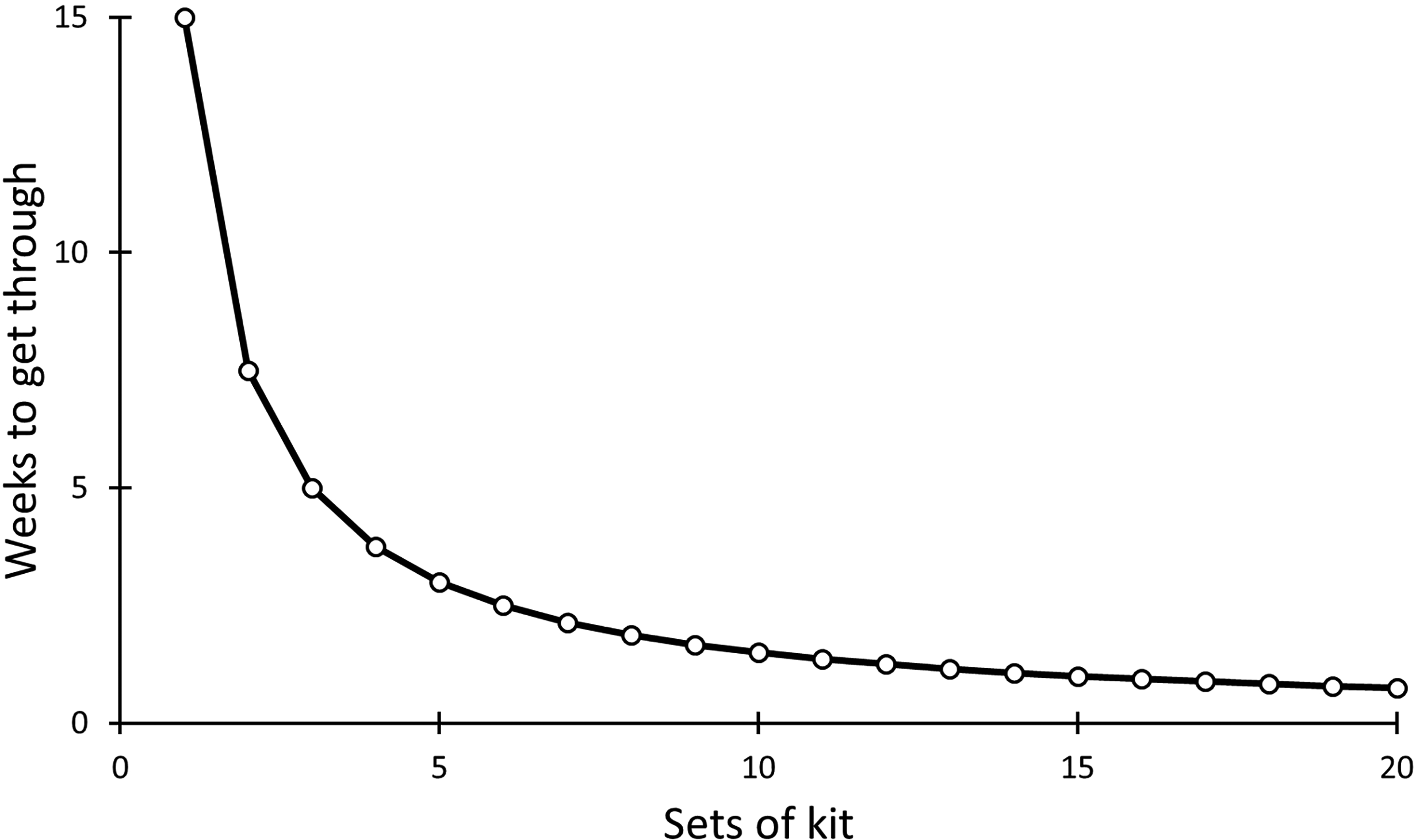
Weeks needed to get students through an experiment with different numbers of sets of kit.
A simple rearrangement of equation (1) will let us calculate how many sets of kits are required to get students through an experiment.

This now brings us to the issue of kit utilisation. This is how many times a piece of equipment will be used each year. The following equation assumes that each student will use the equipment once during their course,

Figure 2 shows the linear relationship between the time needed to get the cohort through a given lab and the times that the kit is used per year. Implied within this is that the number of sets of kits required changes too, as given by equation (3).
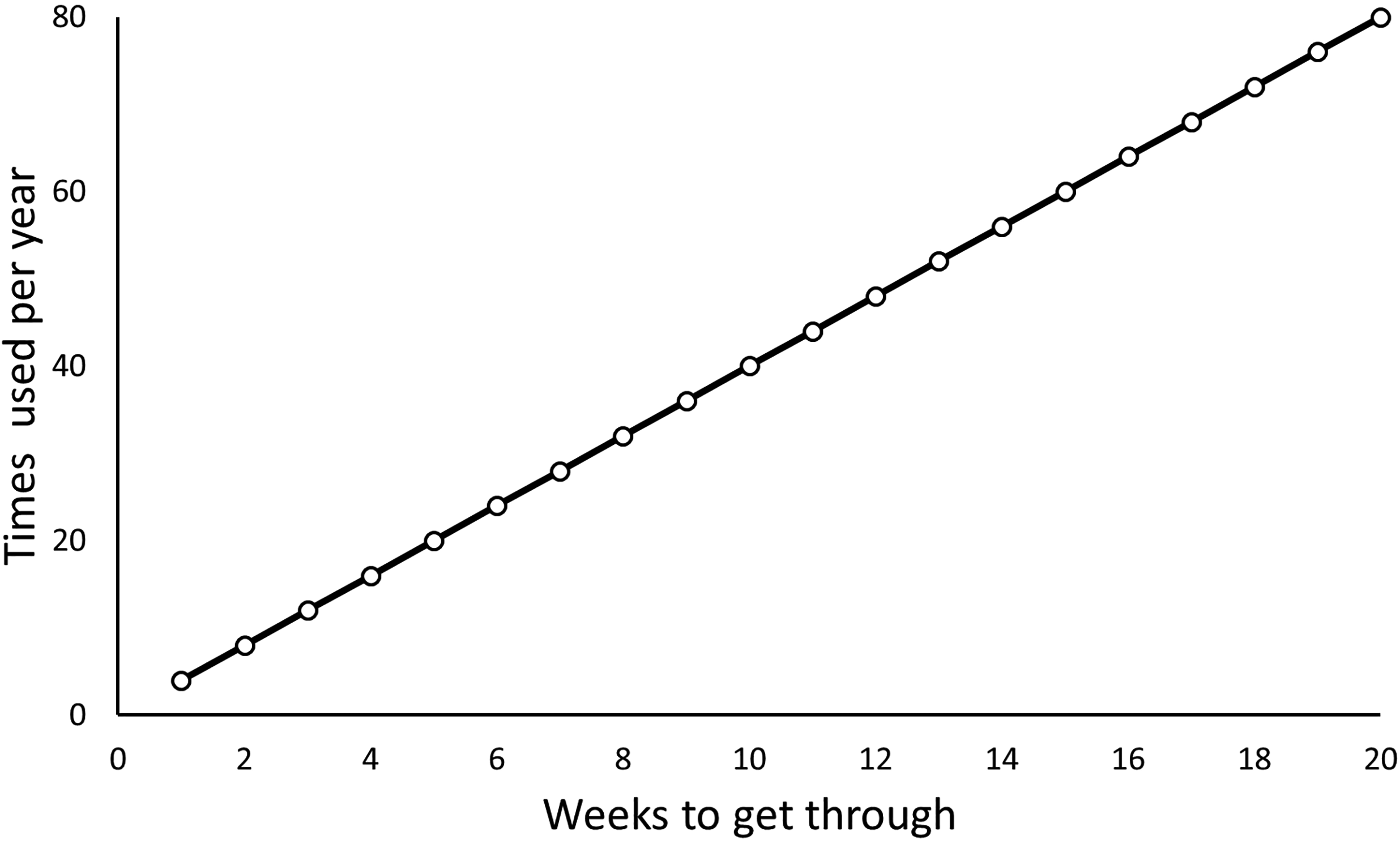
Time needed to get the cohort through a given lab and the times that the kit is used per year.
We can substitute equation (1) into equation (2) to get equation (4), which also describes how many times (T) a piece of equipment is used during a year by a cohort of students but in terms of student numbers, group size, and time to get the students through a given experiment.

The author has already shown that having less sets is poor for the student experience as it tends to move the labs further temporally from the teaching, meaning that the immediacy is lost and the context is less clear. Smaller groups are better for the student experience, but it has also been demonstrated that this means that more sessions are needed, which can be impossible due to timetable issues. Optimum group sizes are between 2 and 5 depending on the experiment. Larger groups mean that students can be excluded or carried and yet there should be a large enough number to do all of the required tasks. When the Author surveyed the students at Sheffield (as part of some work in progress), it turned out that they like working in smaller groups of between 2 and 4, preferably pairs. So the only way utilisation can be increased while preserving immediacy is to have more sessions per week. This is normally difficult as timetabled slots for laboratories tend to be limited. So one solution is to share the equipment across additional departments. When one actually scratches below the surface of the practical experience across the disciplines there are more commonalities between the experimental requirements than appear on first glance. Indeed, our experience at Sheffield has shown that there are many more commonalities than differences.
Take, for example, the experiment of ‘Pressure loss down pipes’. This was used as the pilot experiment for the sharing of teaching equipment and material. 12 In this 2007 project (sponsored by The University of Sheffield), the teaching equipment and teaching material were created and shared by three Engineering departments, Chemical, Mechanical, and Civil. It was noted that there were some changes needed in nomenclature and the different learning outcomes, but the basic outcome of this work was that equipment could be shared across different disciplines even if the teaching, course level, and learning outcomes were different. These differences were accounted for by minor changes and emphasis in the laboratory handouts.
In its latest form, at the University of Sheffield, this basic fluids experiment is now conducted by students on six courses: Chemical Engineering, Civil Engineering, Mechanical Engineering, Bio Engineering, Aerospace Engineering, and General Engineering. Instead of 120 or 240 students who could share the equipment, suddenly we have 1000! Furthermore, because each cohort does not occupy the same time slots in the timetable for the use of the equipment, the immediacy remains high for each of the courses, while the utilisation is increased. This is indicated in Figure 3.
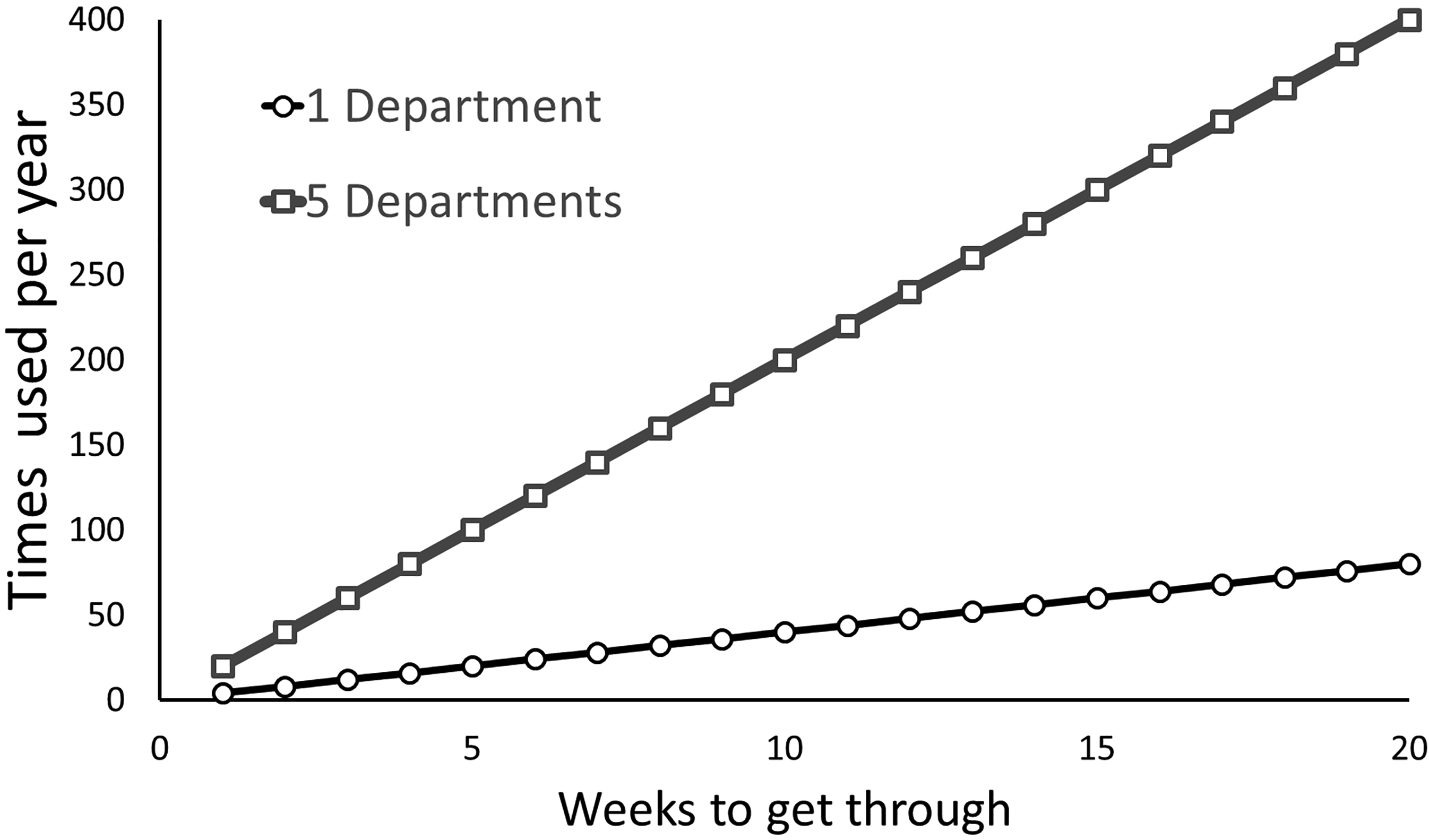
Effect of multiple departments on equipment use.
So if we put each of the cohorts of students through the experiment in a fortnight, each of the 8 pieces of equipment is used about 40 times over the year. This utilisation is comparable to the use when using the conventional model. However, now each experiment is timed to coincide with the lectures on the topic. In The Diamond, there are 20 sets of equipment in many labs (used by groups of 4), 10 sets in others, and the Electrical and Electronics lab has 72 matching sets of kit for use by pairs of students.
Additional advantages of this approach are that it is possible, as well as sharing equipment to share many other aspects of the teaching panoply: teaching material, teaching staff, and infrastructure.
80 is a magic number!
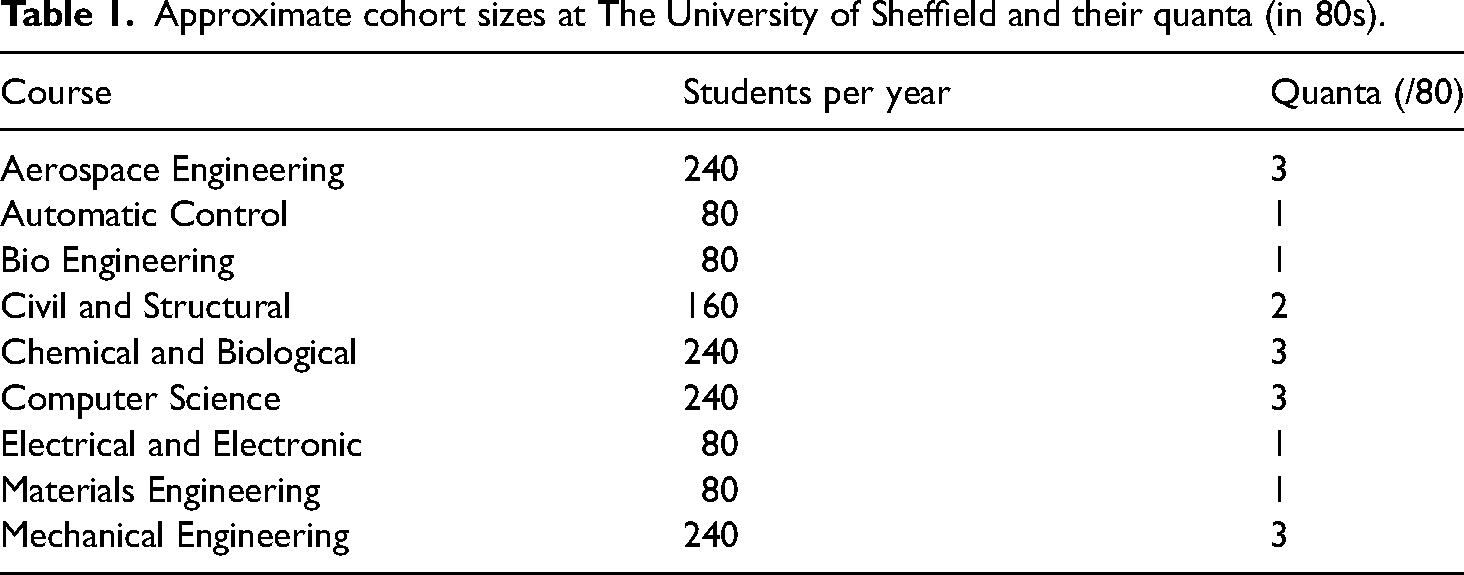
In the Faculty of Engineering at Sheffield, we have roughly the number of students in each cohort as shown in Table 1. It will be seen that these will each fit into a neat multiple of 80 students. The author will call this number the ‘quantum’ going forward. It should be noted that for different years and different establishments, this quantum will be different, but it is built into the model and will dictate the design of the spaces and influence the timetable in perpetuity.
Approximate cohort sizes at The University of Sheffield and their quanta (in 80s).
Based on this and approximate cohort usage for the various topics, the naming and thus utilisation of the required labs were conceived (Table 2). There are a handful of smaller labs which are far more specialised and thus omitted. Note that labs are designed and designated in terms of their usage, and are not ascribed to any particular course or module. They, and the equipment in them, are available to all of the engineering lecturers and students in the faculty to use as required or desired.
Laboratory sizes at The University of Sheffield and their quanta (in 80s).
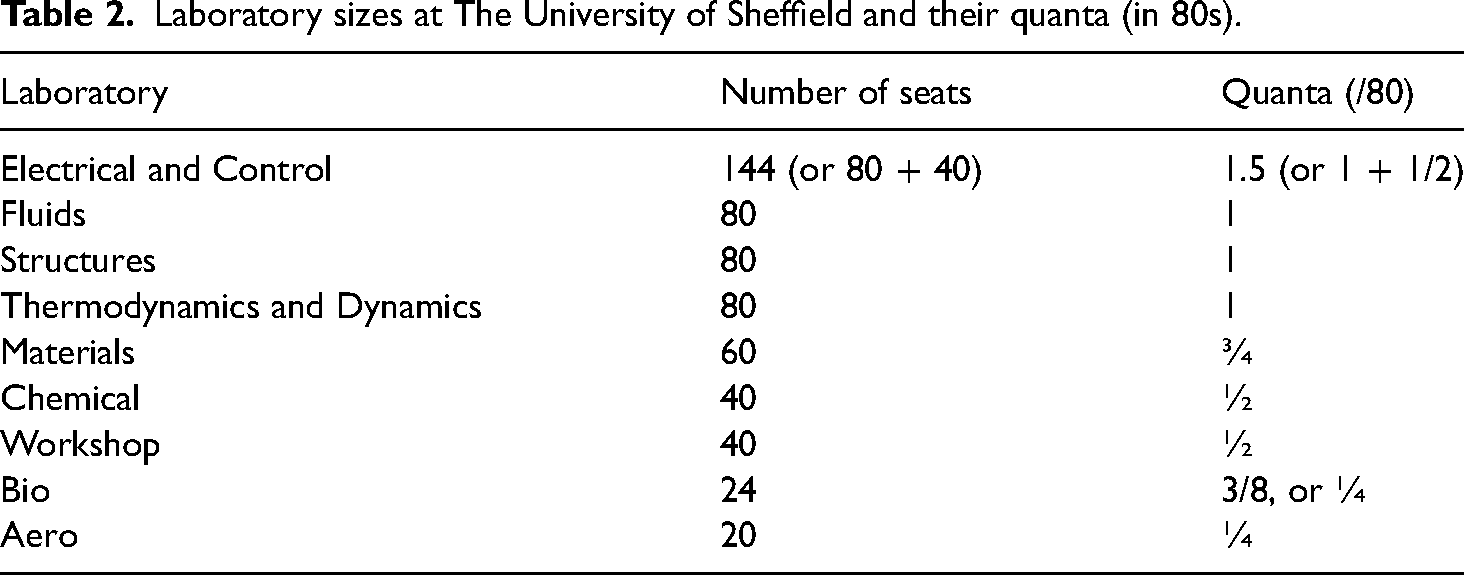
Figure 4 shows the fluids laboratory in action. The students are all doing the same experiment at the same time. The actual experiment is ‘Weirs big and small’ and is described in the work. 11 Here Mechanical Engineers use equipment originally requested by the Civil Engineering department (1 large and 20 small flumes). All of the equipment in any of our laboratories is available for use by any cohort of students. In this case, the equipment which normally would only be seen by Civil Engineering students is now used by second Mechanical Engineering students who are studying dimensional analysis; another facet of the author's interest in scale and scaling.
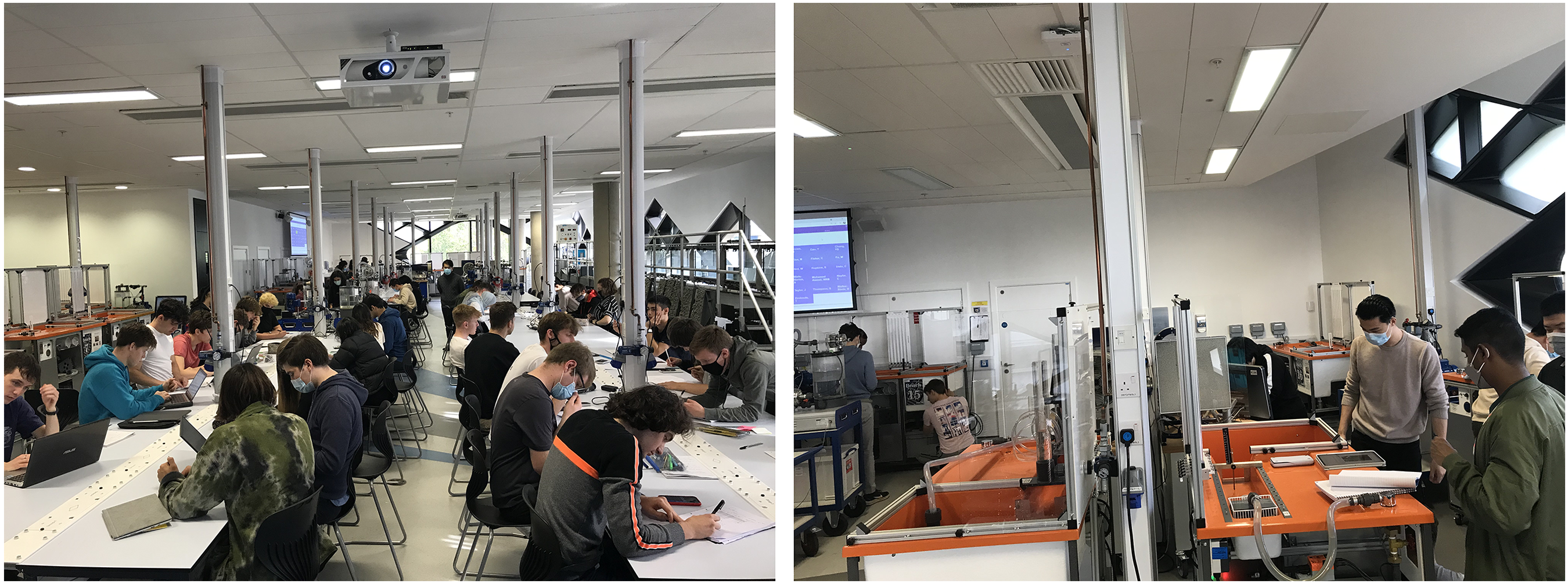
Students working in large fluids laboratory on the same experiment.
So students are timetabled in multiples of 80s for labs and, if that group will fit into one lab, they will fit into any of the others. Table 3 shows an indicative timetable for a hypothetical laboratory space. It will be noted that the bigger cohorts get more slots in the timetable. It should also be appreciated that this is for a single laboratory. A large cohort might be divided into groups and any student in it could all be doing any one of a number experiments at the same time; all 240 Aero students can be doing experiments in 3 labs simultaneously!
Indicative timetable showing bulk teaching approach to cohort-based laboratories.

As the author was involved in the design of the other teaching spaces in the building, he was able to size and specify these as well. He noted that since the laboratory sizes were fixed in quanta of 80, it made sense to also size the other student teaching rooms (workrooms, computer rooms, and lecture theatres) in The Diamond using this same quantum. Table 4 shows the capacities of these rooms.
Workroom, computer room, and lecture theatre sizes and their quanta (in 80s).
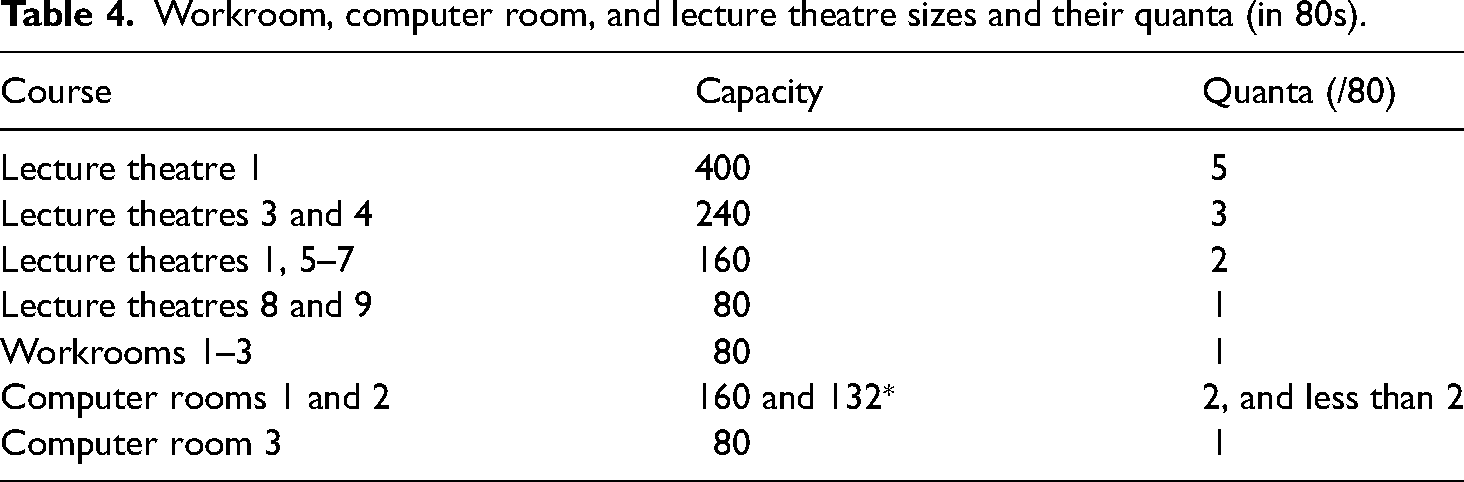
This, therefore allows for a teaching model whereby students are given information in a lecture theatre, go into a laboratory to engage with the material in a real way, and finally move into a workroom to analyse and contextualise the material. All of this can be conducted in spaces of the same capacity (or multiples of a capacity). It will be noted that for other establishments to implement this type of scheme, a different quantum could be better. Examination of timetables, the actual experiments, and the courses taught will dictate what each building's ‘magic number’ is.
In order to drive up the use of the facilities, departments pay in proportion to the number of students in their cohort. This provides an incentive to get more activity. Up to now, the teaching team and administrative staff have been able to accommodate the extra sessions through increased efficiency, shorter turnaround times, and more flexible use of the spaces. Once it is full, the plan is to use additional requests to even out the student experience across the cohorts by optimising activity for the busiest cohorts.
Discussion
Naturally, there are a number of issues that have been shown to arise from this change to a large-scale, shared model. Some of these are just those surrounding the nature of change, but others are inherent in the move to a more industrialised system of laboratory provision. The spaces that have been created allow for many different approaches to teaching. It is this flexibility that is also very important in allowing high use and innovation.
One issue is the fact that small groups can make the use of the large labs very inefficient. If a single group of four students is booked into a lab sized for 80, this is not a good use of the space. It is possible to temporarily divide a laboratory up to cater for multiple groups, but this can give problems in terms of staffing and possible use of equipment. There are also the issues of noise and groups getting distracted if a lecturer is talking to a different set of students.
Another issue is the use of graduate teaching assistants (GTAs) to support the experiments. In the traditional way of delivering labs, a GTA might be expected to deliver a lab to a single group in a session every week for up to a whole year. They will get good at delivering it and have plenty of opportunities to learn from their mistakes in understanding or teaching that one laboratory. In the approach described here, each experiment may be only done a handful of times (or possibly only once) with a larger cohort of GTAs. This means that each GTA may not be able to reflect upon and improve their practice in that experiment. This means that the entire training and use of GTAs need to be moved to a higher level to provide them with generic skills that can be improved between one experiment and a subsequent, different one. Work on developing GTA skills has been reported by the author recently in the literature. 13
Because this mode of laboratory teaching is more of a systems approach, there is naturally more infrastructure required to support both student and GTA learning. This, in turn, means that lower numbers of GTAs are needed for each student. In the laboratory shown in Figure 4, a class of 80 students can be effectively supported by one staff member and a couple of (well-trained) GTAs. This is because the students come into the lab well-prepared for the experiment and can be taking data within a few minutes of arriving.
It is worth noting that this approach was very useful during Covid. Firstly, having a group of professional teachers meant that the pivot to online labs was possible at scale.
14
Also, having the large spaces with multiples of equipment meant that socially separated experiments with groups of 1 (a single student per experiment) could be run. Though lab capacities were reduced (the Electrical lab was reduced to 28 students working alone from its nominal 144 working in pairs!) this still gives a number of weeks to get 100 students through as
The cost of running this approach is therefore different to the conventional one. More time, effort, and expenses are used in training the GTAs, and less is used on provisioning the labs. This is good both for students who are supported, but more autonomous. The GTAs get better training and a more varied experience which adds to their satisfaction and employability.
There is also, as alluded to above, the difficulties of getting departments that have previously been responsible for their own labs to hand them over to a, possibly untested, group of people. This requires careful negotiation and in our case, the carrot of a shiny new building filled with £11 M of new equipment. There needs to be very careful delivery of the teaching in order to reinforce to departments that this change has been for the better. Also, in order to ensure that the laboratories and other teaching are correctly timed, effective communication with each of the departments is needed. In Sheffield, this is done via named liaisons; one member of the MEE department for each department (or major course) in the faculty. These liaisons are responsible for communicating between their nominated department and the team in The Diamond. The success of the teaching operation is due to the diligence and responsibility of each one of these staff.
The experiences of running laboratories in this way have been mostly positive. Students really appreciate the timing of laboratories with their lectures. They get high-quality teaching material in excellent, well-equipped laboratories. They are able to improve their practical skills as a curated learning process. They are continuously being supported to be more autonomous and enquiring, independent of which lab they are in. For the staff, it is a good process. Most of the academic staff in the department are teaching specialists and all are able to develop their practice, create novel and exciting student experiences and thus obtain the experience and profile to be promoted or find more senior roles in other institutions or departments.
The author and others are currently running surveys to find out what students appreciate in their labs which will form a further publication. Initial results show that in general, our students prefer laboratories that are interesting and they like them to be timed to support the relevant lectures.
Concluding remarks
So, I believe that the correct approach for teaching facilities are for them to be You can teach students with a single piece of equipment and they will do the experiment. With more sets, you can integrate the teaching and experiment. If you also share the equipment, you can also save time, money and effort.
The department of Multidisciplinary Engineering Education at Sheffield has been running on these principles for over half a decade and our experiences have shown that this is an excellent approach for high-quality, efficient laboratory delivery that is generally enjoyable for both staff and students.
Footnotes
Acknowledgements
Thanks to the students who agreed to be photographed for the pictures in Figure 4. Also, a great thanks to Professor Emeritus Mike Hounslow who helped to conceive and drive through the creation of the ‘The Diamond’ and its large-shared laboratories.
Declaration of conflicting interests
The author declared no potential conflicts of interest with respect to the research, authorship, and/or publication of this article.
Funding
The author received no financial support for the research, authorship, and/or publication of this article.
