



Abstract
This paper focuses on the development, delivery and preliminary impact analysis of an engineering Work Experience Week (WEW) programme for KS4 students in the School of Civil, Aerospace and Mechanical Engineering (CAME) at the University of Bristol, UK. Key stage 4, is the legal term for the two years of school education which incorporate GCSEs in England, age 15–16. The programme aims to promote the engineering profession among secondary school pupils. During the WEW, participants worked as engineering researchers: working in teams, they had to tackle a challenging engineering design problem. The experience included hands-on activities and the use of state-of-the-art rapid prototyping and advanced testing equipment. The students were supervised by a group of team leaders, a diverse group of undergraduate and postgraduate engineering students, technical staff, and academics at the School of CAME. The vision of the WEW programme is to transmit the message that everybody can be an engineer, that there are plenty of different routes into engineering that can be taken depending on pupils’ strengths and interests and that there are a vast amount of different engineering careers and challenges to be tackled by the engineers of the future. Feedback from the participants in the scheme has been overwhelmingly positive.
Keywords
Introduction
There is clear evidence that the demand for graduate engineers exceeds the supply 1 and since engineering is largely invisible in the British education system, 2 there is a need for the engineering sector, including Higher Education providers, to deliver school-level inspiration activities.
This lack of interest in engineering and other STEM careers has been a matter of concern for decades, and although the numbers have recently recovered, most European countries face a shortage of STEM professionals particularly in engineering. 3 In the last few years, universities have started to take more responsibility in their so-called third mission: engage with society. Note the first and second missions are education and the production of new knowledge (research) respectively. As part of this third mission, many Faculties at the University of Bristol have formed their own outreach teams, organising activities at different levels to increase interest in their field. Some of these activities target secondary school students, intending to attract young people into the engineering profession, as several studies have concluded that introducing students to engineering and demonstrating that it can be fun and exciting, is an effective strategy of engineering outreach.4,5
There are many examples of activities targeting secondary school pupils, such as Engineering Workshops,6,7 where students learn and use engineering technologies for one particular engineering discipline and design/explore their own products or University Summer Schools where students spend a few days at the University having a taste of the undergraduate student’s life and are exposed to different engineering disciplines. 8
The Summer Schools and Engineering Workshops have a similar structure: during several days, normally 3 to 5, participants are exposed to one or more engineering activities organised as workshops, where they learn and apply engineering concepts.
In September 2016, a dedicated outreach team for the School of Civil, Aerospace and Mechanical Engineering (CAME) was formed. The team decided to offer a Work Experience Week (WEW) with a more realistic workplace scenario than the experience supplied by summer schools. This WEW was going to target underrepresented groups in the engineering community and was designed to actively engage the participants in an engineering project where they learn engineering tools, acquire useful skills and complete an engineering project to be proud of. Past research9,10 has shown the strong connection between undertaking work experience and subsequently joining a profession.
The programme presented in this paper is an attempt to bring together the benefits of the traditional work experience in an engineering company and a university summer school, where several secondary school students take part in the programme at the same time. 11 During our WEW, the participants work as engineering researchers and, as researchers, they learn and explore new techniques, including how to communicate effectively their findings to a diverse audience. They also gain a better understanding of a specific job role and also benefit from sharing the experience with their peers. To develop the different activities during the week a constructive alignment approach was followed. Constructive alignment is a principle used to develop activities such that they directly address predefined Intended Learning Outcomes (ILOs). 12 The main activity was a research project, that was designed following the project-based learning (PBL) philosophy. In PBL students are involved in a project for a period of time and learn through the project itself. Normally, students engage in real, meaningful problems that are similar to what scientists or mathematicians do, 13 making it ideal for a ‘work as a researcher for a week’ program. PBL has been successfully applied in recent outreach programmes, see Tauro et al. 7 and references therein. PBL has the potential to encourage innovative and critical thinking and contributed to a positive perception of engineering and enriched the participant’s ideas of what engineers do when used as guideline for outreach activities. 7
The programme was developed and delivered by a group of academics, technicians, and undergraduate and postgraduate engineering students in CAME. Academics and technicians focused on the development of the programme while students focused on the delivery: research has found that university students and recent graduates are excellent role models, playing a vital role in engaging younger students. 14 The university students in charge of the delivery can also benefit greatly from the experience, providing them with training in science outreach and education. 15
Participant recruitment was open to all on-line, through the CAME School Outreach webpage, http://www.bristol.ac.uk/engineering/outreach/. The program was extensively marketed to local schools and the general public during all outreach activities the University of Bristol organised through the year, such as science festivals and other events that focus on low performing schools, such as careers days. The program was also advertised in the Outreach Newsletter that is sent every term to all local schools.
The number of participants increased from 9 in 2017 to 30 in 2018 and 33 in 2019. On average, 3 times more applications were received than places available. The final candidates were chosen giving priority to female and state school students from low performing areas in Bristol, as these were the groups identified as being least represented in our engineering community. This paper focuses on the development and delivery of the 2019 programme where 40% of the participants were female and 94% were from state schools.
The structure of the paper is as follows: the next section presents the methodology followed to develop the activities that were going to be part of the WEW and how they linked with the intended learning outcomes of the program. Section 3 includes an evaluation of the programme, using feedback from the participants and also from the CAME School mentors in the programme (a mixture of staff, under and postgraduate engineering students). The paper finishes with a conclusion section including recommendations for future events.
Methodology
Two ideas formed the starting point for developing the WEW: participants should be immersed in a project-based research activity and they should be working in teams. Project-based learning (PBL) can be categorised as inductive teaching, with students taking ownership of their own learning and it is ideal for teamwork, collaborative, and cooperative experiences, 16 which are all very important in the engineering workplace. 17
The first step taken to start developing the core of the WEW programme was to define the intended learning outcomes (ILOs) of the experience for the participants. ILOs are statements used to express what students are expected to achieve after completion of a process of learning. 18 ILOs are developed in an attempt to unify practice, consistency, and precision and are routinely used to define units and programs in the UK higher education sector. 19
The second step was to choose the teaching/learning activities likely to lead to the ILOs, and the third was to assess the participant actual outcomes to see how well they match what it was intended, following a Constructive Alignment strategy as articulated by Biggs. 12
For defining ILOs, Bloom’s Taxonomy of Educational Objectives is widely used. 20 In Bloom’s taxonomy, cognitive skills used in learning activities are categorised in six levels. This taxonomy is not simply a classification scheme, each level depends on the student’s ability to perform at the levels or levels below it. For example, ILO3 in Table 1: to “create solutions to the proposed research problem” the student has to be able to know and comprehend the theory behind the problem under study, apply it experimentally to the test case, analyse the results and evaluate how to create a better solution.
WEW intended learning outcomes.
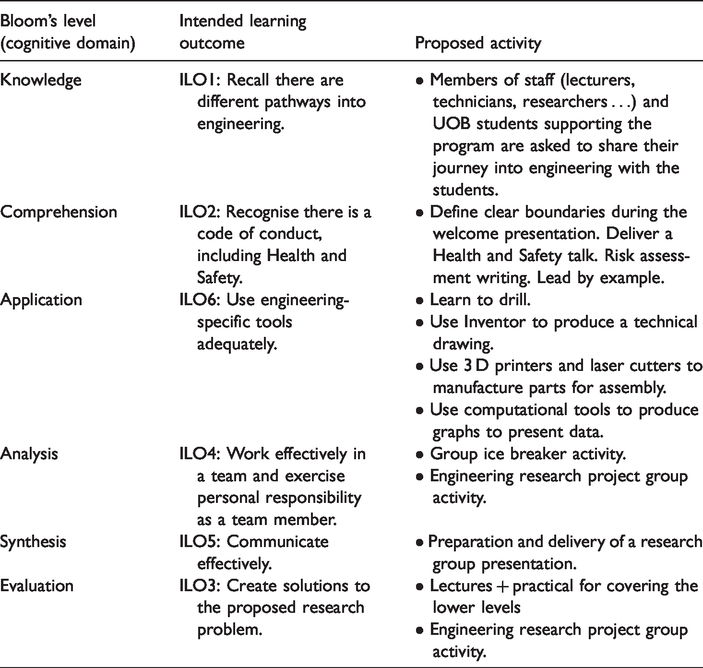
To develop the appropriate learning outcomes, the focus was on gaining skills that employers find fundamental, 9 together with planting the idea that engineering is a very diverse and ‘open for all’ career. Table 1 gathers the final 6 ILOs defined to underpin the WEW.
Once defined, the ILOs were mapped into a series of learning activities that are likely to result in achieving them. The proposed activities were very diverse in nature: didactical, active, exploratory, manual, using technology, using traditional tools, collaborative, and so on. They were also facilitated by members of staff from different backgrounds, with very different job roles (all related to engineering) and who followed different paths into engineering. Members of staff were encouraged to explain their day to day job to participants, their journey into engineering and their current role. The proposed activities are gathered in Table 1 and were used to construct the timetable for the WEW.
Table 2 shows the final timetable with the intended learning outcomes mapped for each session. In the table, white cells represent an “all together” activites light/dark grey cells represent parallel activities since the participants were divided into two groups.
Timetable for the WEW with ILOs mapping.
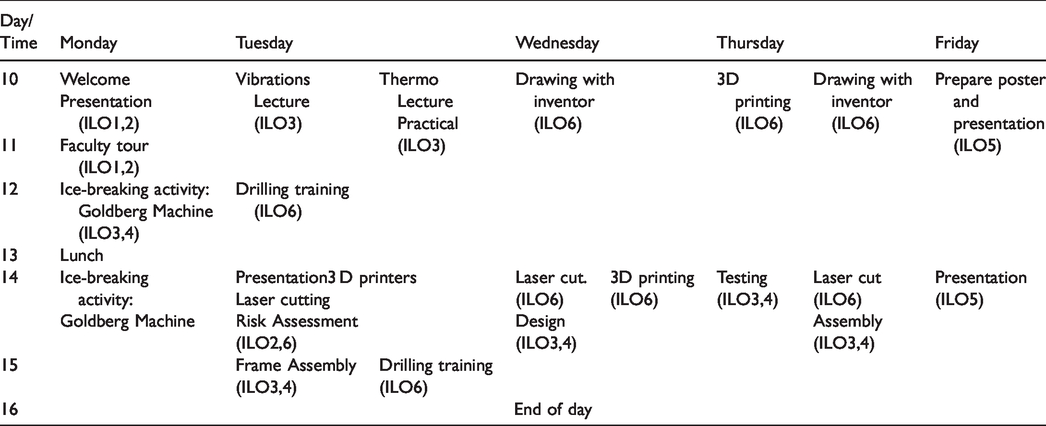
On Monday, after a welcome presentation and a tour of the CAME School facilities, the students spend their day immersed in an ice breaking activity: the Goldberg machine. Rube Goldberg, a 20th-century engineer, is most famous for his drawings of ridiculously complex machines performing a very simple task. A Goldberg machine is a complex, weird, and wacky machine that accomplishes a trivial task. 21 The WEW Goldberg machine was a device covering the length of 8 tables where a small ball had to travel for the whole length and finish knocking down a domino piece. All materials were recyclable scrap materials. The students were working in groups of 4, each group was allocated a table, with all tables joined forming a U-shape. Only the starting point on the first table and the endpoint on the last one were specified. Each group had to interact with adjacent groups to discuss how to connect their machine segments. This activity was aimed at encouraging students to communicate and be creative, see ILO4,5.
During this first day, all pupils were given a workbook that they were asked to fill in at the end of every day. This was a space for them to reflect on their experiences and learning and used in our impact analysis
It was found the ice breaking was an excellent welcome for the students and they warmed up to conversation and interaction. This year it was the first time this was introduced as part of the WEW and it was a definite success, the participants voted this activity as the most ‘liked activity’ in their workbooks. This was also noted by facilitators, students displayed a strong motivation and engagement working collaboratively towards a common goal using a trial and error method.
From Tuesday on, students were divided into two strands, each of them developing a PBL activity relating to two mechanical engineering fields: vibrations and thermofluids. The projects were chosen according to the expertise of the members of staff in charge of organising and delivering the WEW and relate to current research and engineering practice. In the timetable shown in Table 2, light/dark grey corresponds to activities taken by the vibrations/thermofluids groups respectively.
Using a PBL approach, it is expected that students will achieve the highest level of the Bloom’s taxonomy. In addition to this, the project encourages participants to integrate knowledge and skills from different areas, develop team-work and self-evaluate.
In traditional teaching, the information is transmitted before the problem is presented and the solved. The main feature of a PBL activity is to start with a relevant and industrial problem-situation and to put students in an engineer’s position. PBL is a student-centred approach, which presents students with a real-world, open-ended problem, and requires them to find the engineering solution. With this constructivist approach, learners are encouraged to discover meaning and understanding. Students are motivated by the practical and industrial relevance and excited to tackle real problems.
The structure of the projects was inspired by PBL theory by following its basic principles: (i) activities centered around a real-world problem, (ii) solutions require multidisplinary and critical thinking, (iii) staff play the role of a facilitator providing guidance when required (iv) oral presentations take place and teams are expected to share their approaches to solve the problem.
The engineering project description covered four areas: principles of vibrations/thermofluids, design of a small-scale prototype, manufacturing and construction of the prototype and optimisation of the design based on experimental testing. This integrates STEM (Science, Technology, Engineering and Mathematics) concepts to solve a real-world problem. 22
The set of activities that were designed are gathered in Table 3.
Set of activities for the research projects covering all levels of Bloom’s taxonomy.
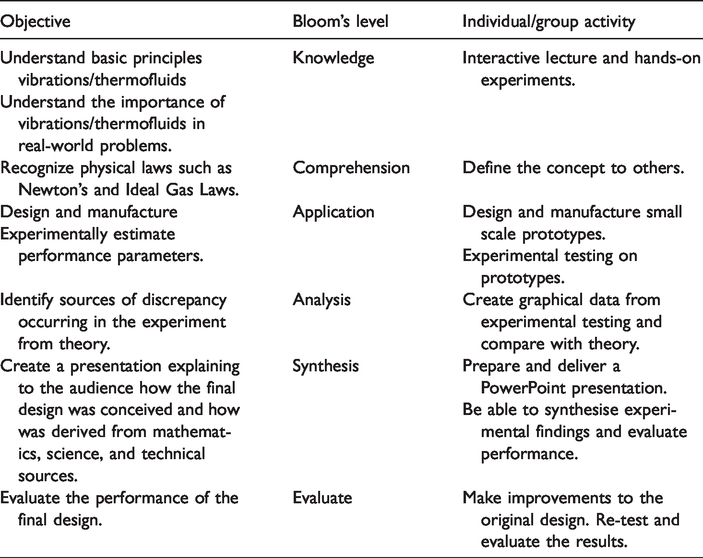
On Tuesday morning, the students were given lectures delivered by postgraduate students and academics. The lectures covered the context of the engineering field and included interactive hands-on demonstrations. Students were encouraged to ask questions and actively participate.
The morning session finished with the introduction to the project for the week: for the vibrations strand, in teams of 4, the students had to design and manufacture a small-scale prototype of a building frame such that its natural frequency had a specific value (2 Hz). For the thermofluids strand, students worked in pairs to design and build a Stirling engine, the challenge being to power it with a tea light candle.
Students spent Tuesday afternoon in the laboratory. Firstly, they were given a short introduction to risks and safety at work by technical staff and they had to write their own risk assessment forms and think of strategies to minimise risk, getting familiar with health and safety technical vocabulary. They also received training on drilling, using 3 D printers, and laser cutting machines.
On Wednesday morning, students were given an introductory session on how to use Inventor, a technical drawing and design software. Using Inventor, technical drawings can be put together and sent directly to a laser cutting machine or 3 D printers for rapid manufacturing. Figure 1(a) and (b) show pictures of the students working in the laboratory, assembling and testing their prototypes.
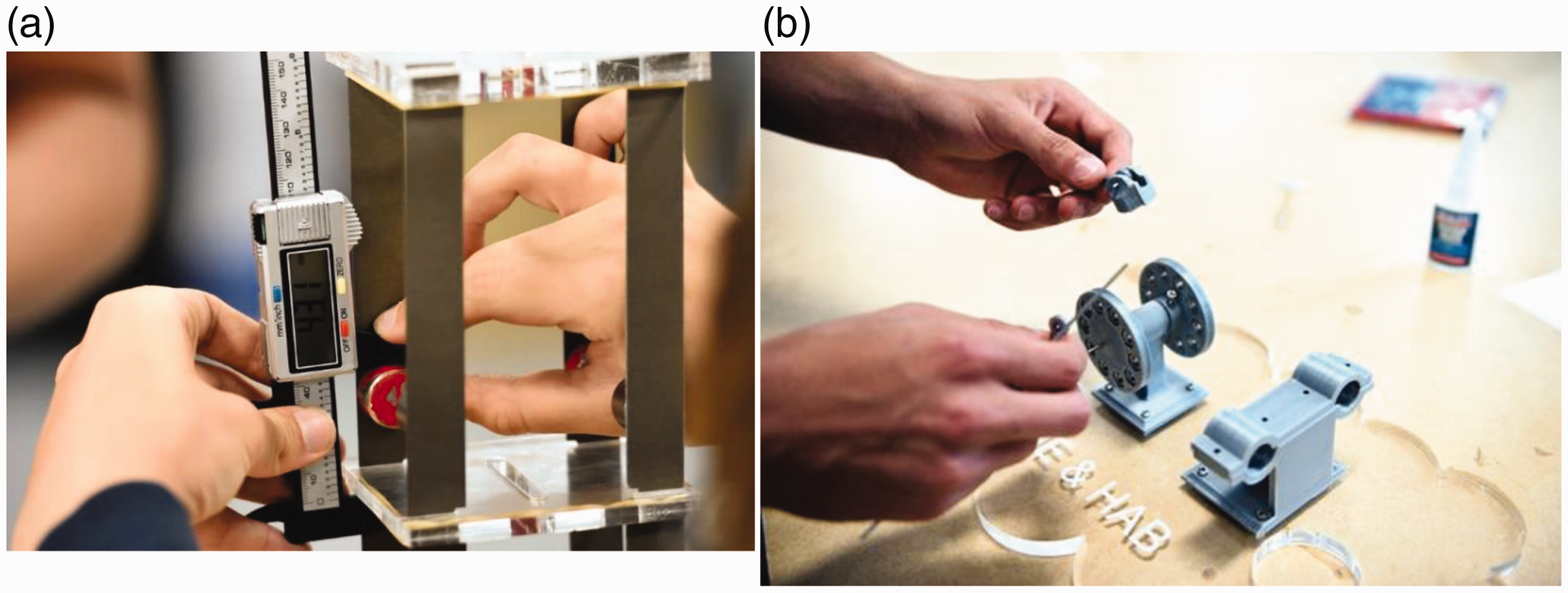
Students assembling (a) Vibrations frame (b) Thermofluids Stirling engine.
The iterative design workflow the students were encouraged to follow is summarised in Figure 2. Following a project-based learning approach, the participants were asked to drive questions to allow for exploration. For example, in the vibrations group, they were asked to identify which physical parameters of their small-scale model they could modify to alter its natural frequency. A free vibration test was introduced as a way of measuring the natural frequency of a structure without needing any equipment (just a stopwatch). After explorations once they found the parameters (mass and stiffness) they were introduced to sensitivity analysis and let to explore different ways of representing their results graphically. Once results were gathered and analysed, they have to create a modified design to achieve the target natural frequency.
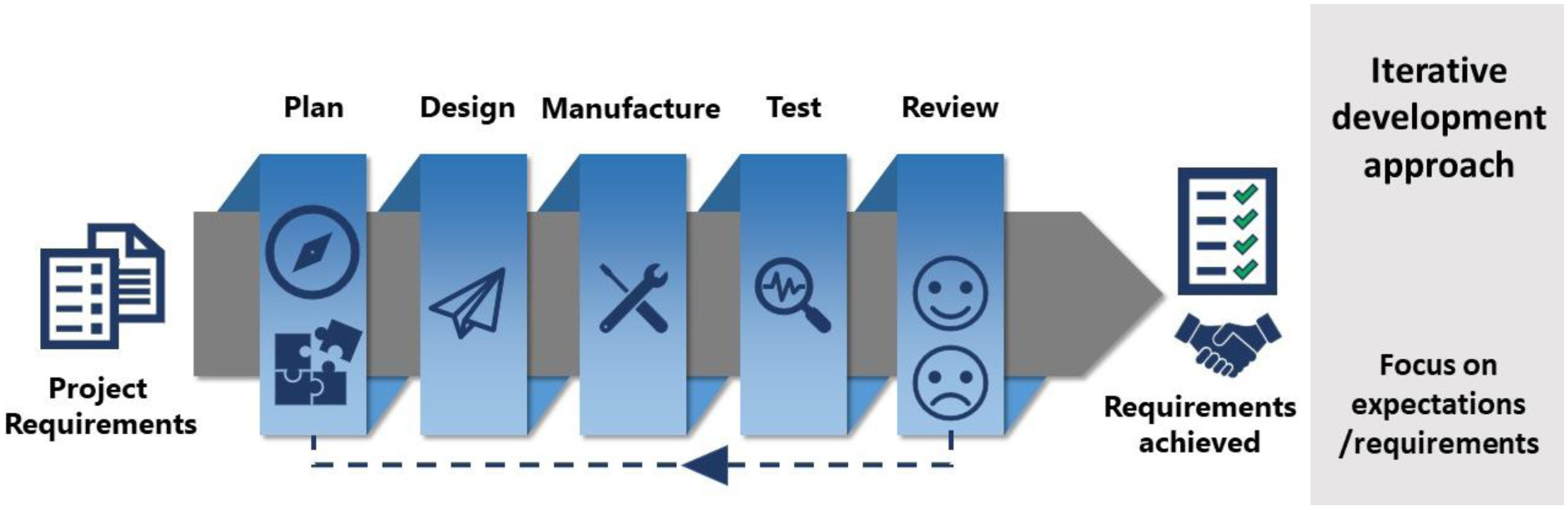
Iterative design workflow.
All groups were given the same components to start with: a 1-storey frame with no bracing.
The final designs were all different and successful in meeting the requirements: all groups produced models within 10% of the required natural frequency.
Once a final design was built, students spent Thursday afternoon doing experimental testing on their prototypes to gather more experimental results to present. They were able to use equipment in the laboratory such as sensors and a shaking table simulating earthquakes. They also learned how to use a software package called MATLAB, widely used in engineering research, to produce high-quality graphs from experimental data.
Figure 3(a) shows some of the final designs for the vibrating frames and posters. In Figure 3(b) shows a Stirling engine built by of the groups in the thermofluids strand.
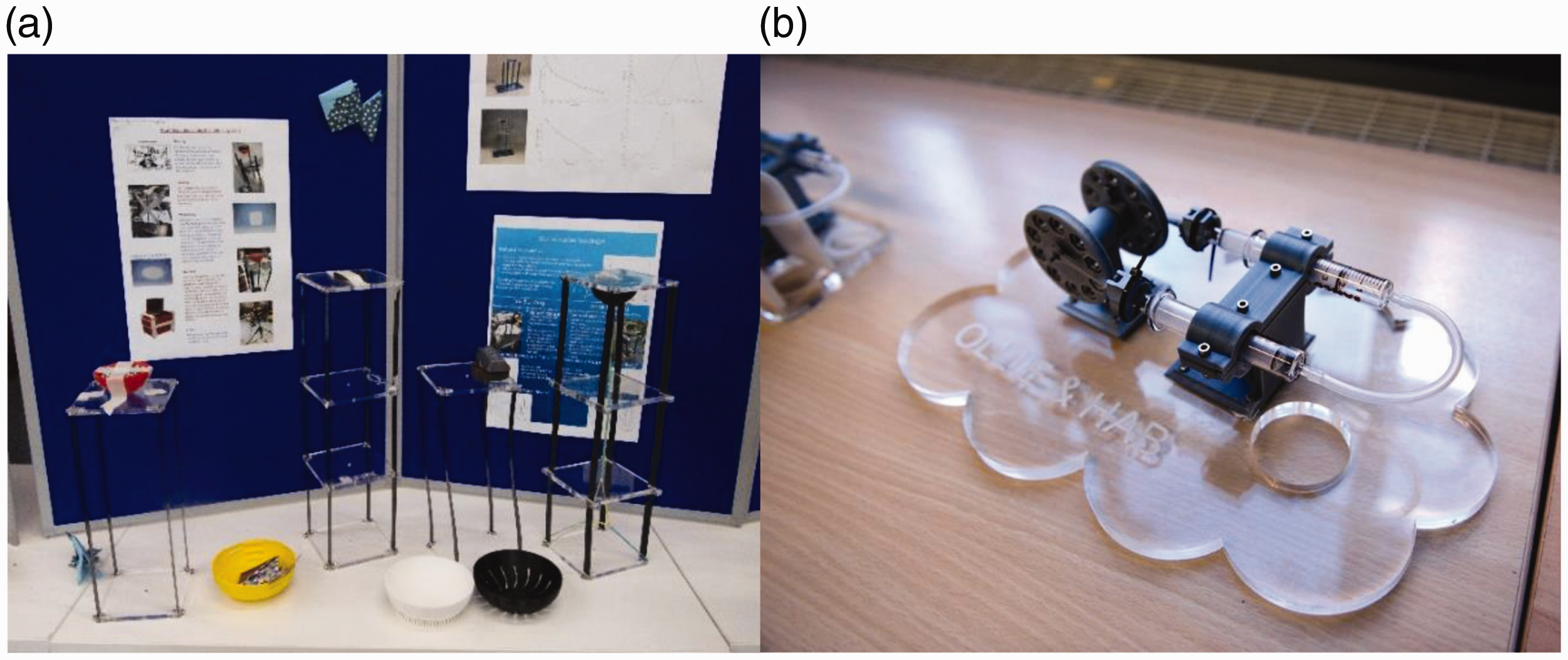
(a) Posters and designed frames (b) Stirling engine.
Finally, on Friday, participants had to prepare a poster and a presentation in the morning and deliver the presentation in the afternoon to a group of parents and members of staff. The presentation session mimics the periodic research group presentations that are run in CAME, where researchers from a group present their last results to their peers. All participants contributed to the preparation and delivery of the presentation. They found the presentations challenging and difficult, but very rewarding.
Impact of the work experience programme
Participants perspectives
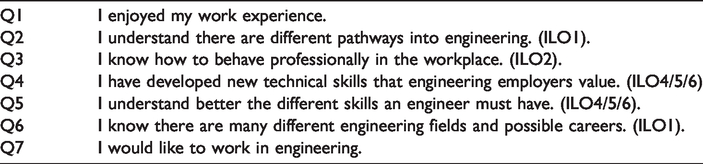
For the participants in the scheme, the impact was measured by a feedback questionnaire. Of the 33 pupils participating in the work experience, 25 completed the student feedback questionnaire. In the questionnaire, they had to rate 7 statements using 4 options: ‘strongly agree’, ‘agree’, ‘disagree’, ‘strongly disagree’. The questions, and their relation to the learning outcomes, are listed in Table 4, with the results shown in Figure 4.
Student feedback questionnaire.
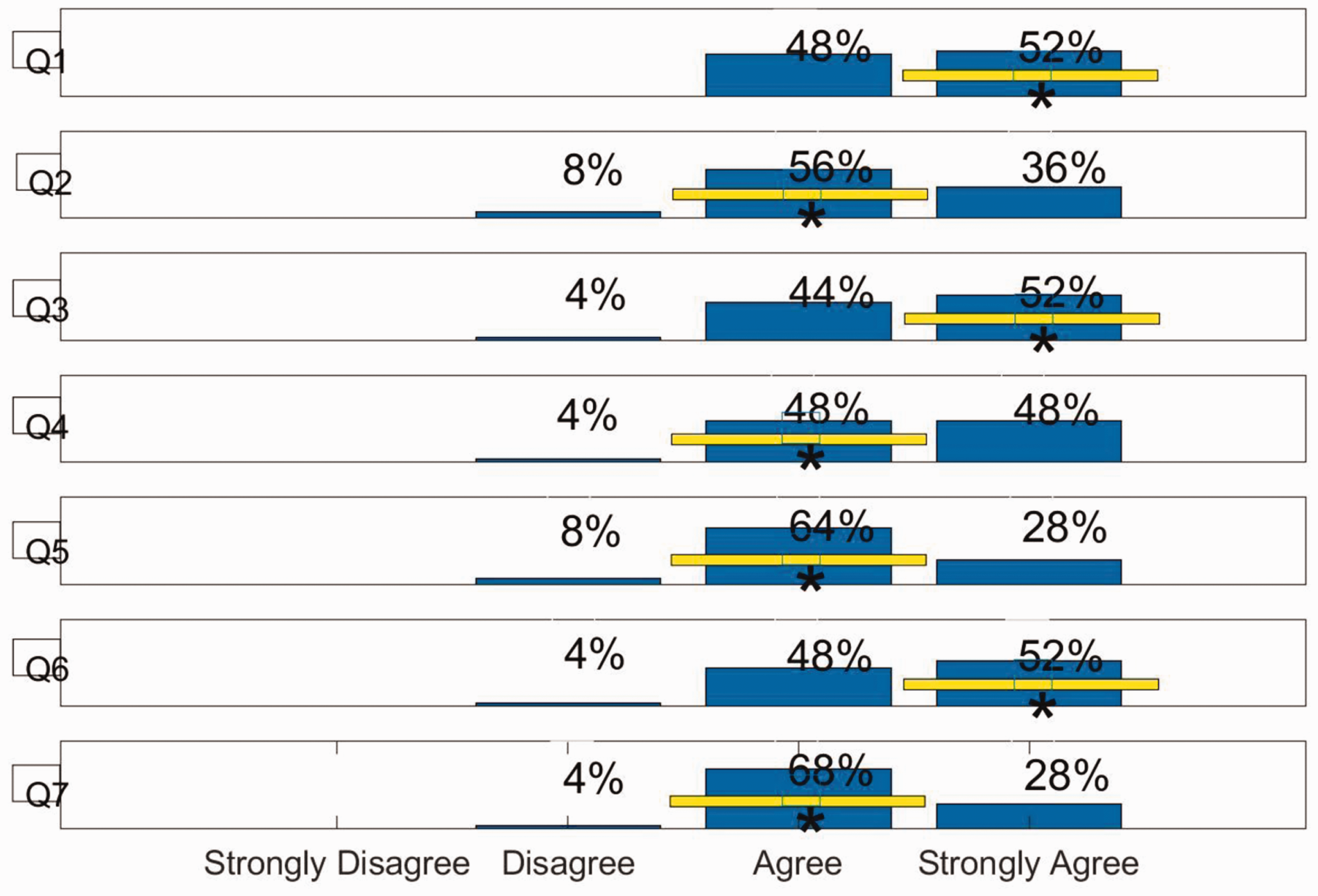
Student feedback questionnaire results. The asterisk gives the location of the median, the yellow rectangle the IQR.
The median and the Inter-Quartile Range (IQR) were calculated for each question, instead of mean and standard deviation, due to the ordinal nature of the Likert scales and the difficulty to assign values to interval between values. 23 For the calculations, the intervals were assumed to be equal and of values 1,2,3,4 (with ‘strongly disagree’ value 1 and ‘strongly agree’ value 4). The asterisk points out the position of the median located in the middle of the IQR. The median was of all questions either ‘3’ or ‘4’ while the IQR was equal to 1 for all of them. Low values of IQR, as the one obtained, are a sign of consensus: all respondents but two, answered ‘strongly agree’ and ‘agree’ for all the questions.
The achievement of ILO3, “apply the acquired concepts creatively to the proposed research problem and create a solution”, was followed throughout the week by the organisers, making sure all participants engaged actively with the learning and were able to apply engineering concepts into their prototypes.
Two questions in the feedback questionnaire (Q1 and Q7) do not relate directly to learning outcomes but to the overall vision of the program: ultimately the work experience week has to be an enjoyable experience that leaves participants with the desire of becoming the engineers of the future.
The responses in the workbooks given to the students were also used as a tool to measure the impact of the activities as the week progressed. Students were asked about what activities were more interesting, more challenging, etc.
From their responses in the workbook, we could extract that students were very proud with their progress from day 1, writing sentences in their workbooks such as: ‘I can improve a design’, ‘I am proud I am able to finish tasks successfully’, ‘I feel very proud of my final design’, ‘I have learnt a lot about group working, patience and time management’ ‘I managed to work efficiently under pressure’ ‘Today I achieved teamwork and resilience’. Parents attending the presentation session gave very uplifting feedback and were amazed by the achievement of their children, their confidence talking to a large audience and their learning over the week’s programme.
The programme also received very positive response from teachers received via email: ‘I wanted to pass on my personal thanks to everyone who accommodated one of our Year 10 students on work experience from our school. They came back to school really energised and learnt so many new skills’ and from participants: ‘Thank you, for giving me this wonderful opportunity to come and have an insight to engineering from the University of Bristol. I have thoroughly enjoyed this past week and I have particularly gained considerable knowledge about engineering’.
Coordinators and assistants’ perspectives
Collaborating in outreach activities also has potential benefits for the CAME School students and staff in charge of the programme, this has been reported widely in the literature.14,15,24
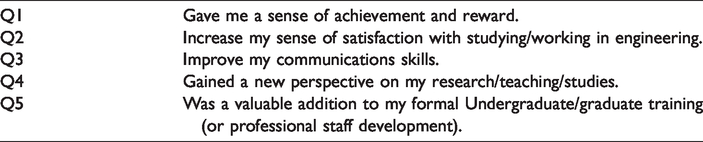
Staff and students from the CAME School collaborating during the WEW were asked to fill in a feedback questionnaire to evaluate the impact of participating on this project for them, the questions are gathered in Table 5, with results shown in Figure 5.
Staff feedback questionnaire.
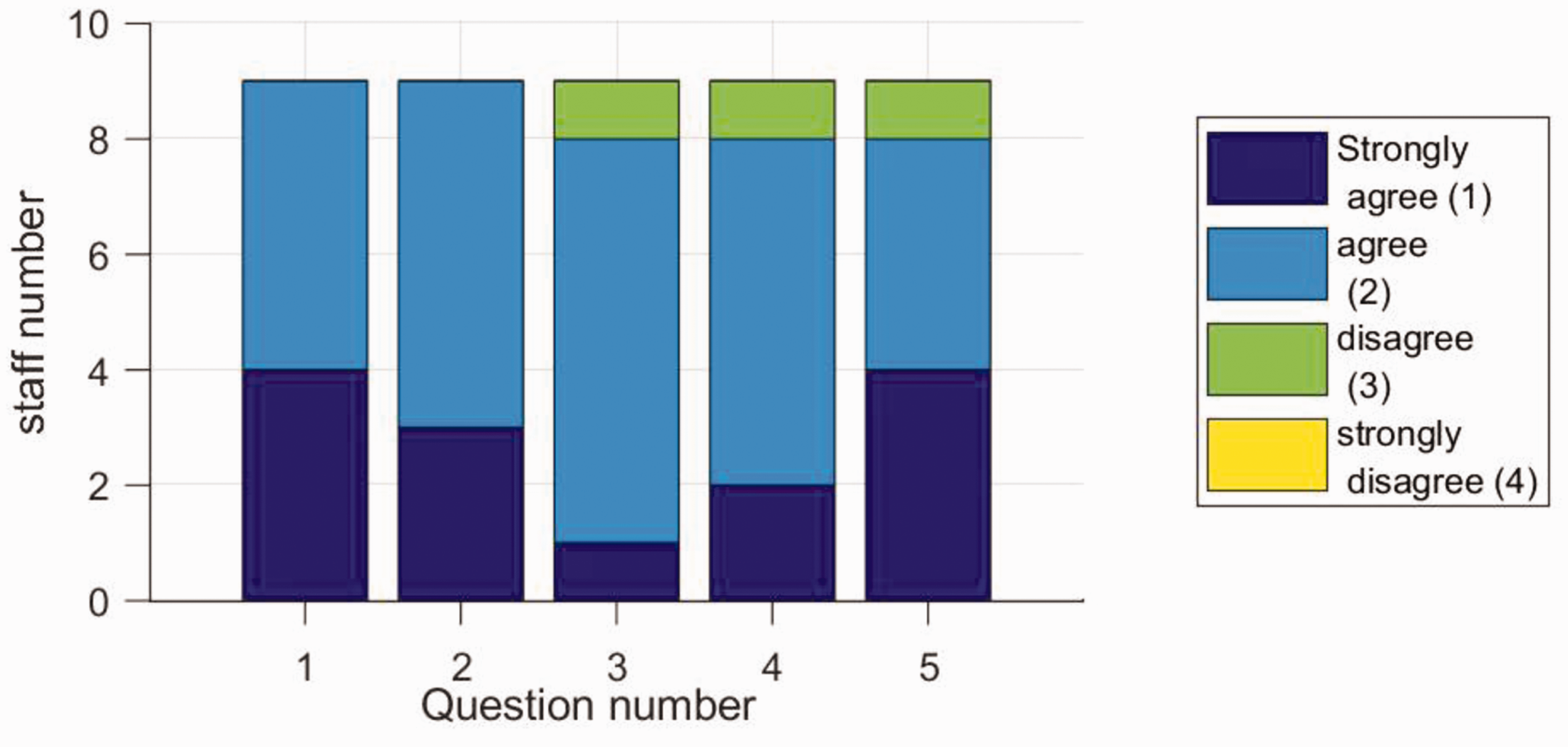
Coordinators feedback questionnaire results.
It can be seen in Figure 5 that the feedback was very positive, with all members of staff agreeing that the experience gave them a sense of achievement and reward and satisfaction for working in engineering. The median for all questions was ‘3’ and the IQR was equal to 1 for Q1, Q2, and Q4, 0 for Q3, and 0.25 for Q4, indicating a very strong consensus. Only one person (the same one) ‘disagree’ to three of the questions and observed that this was because it was the second time participating in the WEW programme and it felt it did not add anything new from previous times. In contrast, some other collaborators that have been involved in the WEW in previous years agreed they always learn something new and pointed out that by the end of the week they always have new ideas to make it better for the following year.
Looking back: What is the 2017 cohort doing?
As previously said, we have been organising the WEW for the past 3 years. The participants in 2017 should have already finished their secondary school education.
After contacting the 9 participants, we have received feedback from 7. All are pursuing further education in STEM with 4 out of 7 doing engineering-related studies. Three students are pursuing BTEC qualifications at college (BTEC stand for Business and Technology Education Council) and other 4 are starting a STEM university degree. Of the 4 students starting university, two are at the University of Bristol, one at Leeds, and one at Oxford. In particular, they are studying: BTEC Science + IT, BTEC Aeronautical Engineering, Mechanical and Electrical Engineering, Engineering Science, Physics and Aerospace Engineering.
Recommendations for future work experience week schemes
Based on our experience during the last 3 years, we can suggest the following recommendations for future work experience schemes:
Include ice breakers to start the week, students engaged with it well and it helps in building collaboration for the rest of the duration of the WEW. Develop the week around a case-based learning project incorporating all different levels in Bloom’s taxonomy to ensure participants have a holistic experience. Use a different range of tools to develop different levels of skills and engage different types of learning: manual, computer-based, interpersonal, professional. Encourage new members of staff and students from CAME to collaborate each year, such that as many people as possible benefit from the experience and share their expertise.
Conclusions
In this paper, we presented the design and delivery of our Engineering Work Experience Week. We can conclude the WEW was a success and we recommend that our school continues to organise it in the future. The participants achieved all the intended learning outcomes, enjoyed the experience and by the end of the week most of them were thinking about a career in engineering.
We also have data from 78% of the participants in the first WEW cohort in 2017, with all of them pursuing further education and qualifications in STEM-related subjects.
Members of staff and UoB students had also a very enriching experience and reported benefits such as renewed interest in the engineering profession and development of new skills.
Excellent feedback was received from both parents and schools.
These positive outcomes and feedback have encouraged us to pursue with this scheme and disseminate the programme structure.
Footnotes
Acknowledgements
We would like to thank our other Faculty staff and our student assistants.
Declaration of conflicting interests
The author(s) declared no potential conflicts of interest with respect to the research, authorship, and/or publication of this article.
Funding
The author(s) disclosed receipt of the following financial support for the research, authorship, and/or publication of this article: The authors would like to acknowledge the financial support of the CAME School.
