



Abstract
This article provides an ethnographic account of the Lathrop Preservation Campaign, a grassroots effort to prevent the demolition of Lathrop Homes, one of the most diverse public housing developments in Chicago, Illinois. In 2000, the Chicago Housing Association implemented a Plan for Transformation to redevelop public housing throughout the city, based on a nationwide effort to deconcentrate poverty in subsidised housing and create mixed-income communities. The Lathrop Preservation Campaign, which consisted of residents, organisers and allies, worked to stop the demolition of Lathrop Homes, minimise the loss of public housing units and to prevent the displacement of residents. Through participant observation and interviews, the authors trace how the community came together to challenge the use of poverty deconcentration programmes and to mobilise around issues of historic preservation and racial discrimination.
Keywords
Introduction
Research exploring poverty deconcentration initiatives in the United States is increasingly critical of policy efforts to move the poor to neighbourhoods with lower levels of poverty. 1 Poverty deconcentration initiatives focus on the development of mixed-income communities and the allocation of Housing Choice Vouchers (HCVs) to low-income households, which provide a subsidy to rent in the private market. The goal is for HCVs to then be used in lower-poverty neighbourhoods. 2 Mixed-income developments aim to deconcentrate poverty by creating communities of people with a range of incomes, usually in redeveloped public housing sites. Empirical work studying the results of poverty deconcentration initiatives finds that the programmes are limited in their effectiveness. For instance, interaction between people of different incomes is a desired outcome of mixed-income communities; however, research finds that relationships cutting across varying economic groups are minimal. 3 The ability for low-income individuals to benefit from mixed-income communities is also limited because of their low rates of return to the redeveloped sites. 4 Mixed-income communities contain public, affordable and market-rate units, which contributes to the low-return rates for the original residents. HCVs also come with challenges for low-income individuals hoping to use the subsidy. Many private landlords regularly refuse to rent to voucher holders and people who use the subsidy are still likely to move to segregated and impoverished areas when they secure a unit. 5 The restricted movement of voucher holders limits their access to better employment opportunities, which is a major purpose of the programme. 6 Other issues include the difficulty voucher holders have finding units that are large enough to accommodate their families, and landlords increasing rents or not properly maintaining their properties. 7
Despite these outcomes, public housing authorities continue to implement poverty deconcentration programmes with funds provided by the federal government. Public housing residents and organisers across the US have engaged in grassroots mobilisations in response to poverty deconcentration initiatives. 8 These groups argue that poverty deconcentration initiatives have led to a significant decrease in public housing units and the displacement of people in need of accommodation. We detail one such case, the Lathrop Preservation Campaign (LPC), which was a grassroots effort to prevent the demolition of the Lathrop Homes public housing development in Chicago, Illinois. The campaign consisted of current and former Lathrop residents, organisers, preservationists, religious leaders and some people living in nearby market-rate housing. We explore how the LPC came together around a common cause of historic preservation, and then addressed other issues later in the campaign that were important to the diverse group of participants, such as the role of racism in housing in Chicago.
The LPC offers an ideal case to examine how grassroots groups challenge the use of poverty deconcentration programmes to reshape neighbourhoods. Lathrop’s case is timely because although most large-scale redevelopment of public housing in Chicago happened between 2000 and 2010, the first phase of Lathrop’s redevelopment began in 2017 and was completed in 2019, with a mix of 414 public, affordable and market-rate units. The second phase of the Lathrop redevelopment is currently under construction. In 2022, renewed efforts began to get the Chicago Housing Authority (CHA) and developers to complete the remaining unfinished 1,200 units and to provide replacement housing for those displaced from the community. 9
Urban redevelopment initiatives post-1950
The Lathrop Homes redevelopment is influenced by recurring partnerships between private and public groups over the years seeking to revitalise urban communities perceived as substandard and in decline. 10 The US federal government enforced a massive urban renewal plan nationwide in the 1950s and 1960s to make better use of land designated as blighted and under-utilised by local governments, real-estate interests and the business community. 11 Under the Housing Act of 1949, the federal government provided funds to cities to help them improve infrastructure and downtown areas. The business community and real-estate companies took advantage of the opportunity to obtain land and to build at a low cost, enabling them to secure hefty profits on the completion of development projects. Most of these improvements happened in divested and segregated areas of cities, causing the massive displacement of low-income Black people. 12
In the 1970s, local governments and private developers renewed the push for growth in poor areas of inner cities to help revitalise these communities. Coalitions of politicians, developers, banks and entrepreneurs promoted increases in urban land use based on the idea that growth helps disinvested parts of cities. 13 These entities encouraged the building of universities, stadiums, transit routes, highways and cultural institutions along with residential spaces to attract higher-income individuals. Proponents of these redevelopment projects stated that the increased tax revenue improves schools and public services and provides more employment opportunities for the poor. Today, local officials and developers continue to claim that public housing residents benefit in similar ways from redevelopment projects. 14
In the 1980s and 1990s, an emphasis on concentrated poverty emerged, where researchers focused on the consequences of living in poor inner-city areas. 15 Deindustrialisation during this time contributed to a decline in decent paying unionised jobs in urban areas. As a result, these already fragile communities experienced significant increases in concentrated poverty because of a lack of viable work opportunities for people living in them. More recent research about neighbourhood effects argues that people living in chronically impoverished communities are subject to crime, a scarcity of educational resources and a lack of adequate employment opportunities. 16 Policymakers stated that public housing had extreme levels of these problems because of the large number of very poor families living in the developments. 17 Chicago’s public housing communities have received a lot of negative attention nationwide because some high-rise developments in the city were in dismal condition due to neglect by the CHA over the years. 18
The United States Department of Housing and Urban Development (HUD) began efforts to deconcentrate poverty in public housing in the early 1990s. HOPE VI is one programme that HUD implemented to deconcentrate poverty. The programme strove to improve public housing and the surrounding areas by creating mixed-income communities. 19 HOPE VI was developed in 1992, after a report produced by the National Commission on Severely Distressed Public Housing found poor conditions in some developments. The report found that about 6 per cent of the 1.3 million units nationwide were in a severely distressed condition. Despite this small percentage of units in poor condition, the 1991 recently Republican-controlled United States Congress criticised this social programme and wanted to end HUD to save money. 20
HUD formed the HOPE VI programme to create a new image of public housing and to build confidence that the agency could properly implement and manage a subsidised housing programme. Henry Cisneros, HUD secretary at the time, and others involved in the development of HOPE VI, claimed that public housing policy had failed up to that point because of too much regulation and an inability to coordinate with private companies to build and to maintain public housing. 21 Policymakers argued that more control for local governments and housing authorities through deregulation allows subsidised housing programmes to run more efficiently. After proposing a plan that appealed to market-based principles, Congress agreed to fund the HOPE VI programme. Between 1993 and 2011, 100,000 mixed-income units were developed across the nation. The federally funded Choice Neighbourhoods Implementation Grants now continue in place of HOPE VI, with the goal of revitalising distressed urban neighbourhoods through the development of mixed-income communities. 22
Case information and methodology
The Lathrop Homes development was built in 1938, under President Franklin D. Roosevelt’s Public Works administration, along with the Jane Addams Houses and the Trumbull Park Homes public housing communities. Prior to the start of redevelopment, the community consisted of 925 units within twenty-nine brick buildings containing a mix of three storey walk-ups (buildings with no elevator) and two-storey rowhouses (multiple attached houses in a row) with 108 units (see Figure 1). In 1959, the CHA completed a nine-storey building for senior citizens with ninety-two units in the development. Residents often refer to a ‘north side’ of the development, which is within the borders of North Clybourn Avenue, West Diversey Parkway and North Leavitt Street. The ‘south side’ of the development is within North Damen, West Diversey Parkway and North Leavitt Street. Lathrop sits on thirty-seven acres of land and the Chicago River runs along the development contributing to an open and airy feel (see Figure 2). Lathrop contains numerous courtyards, playgrounds, a basketball court, walking and bike paths and a Boys and Girls Club (see Figure 3).
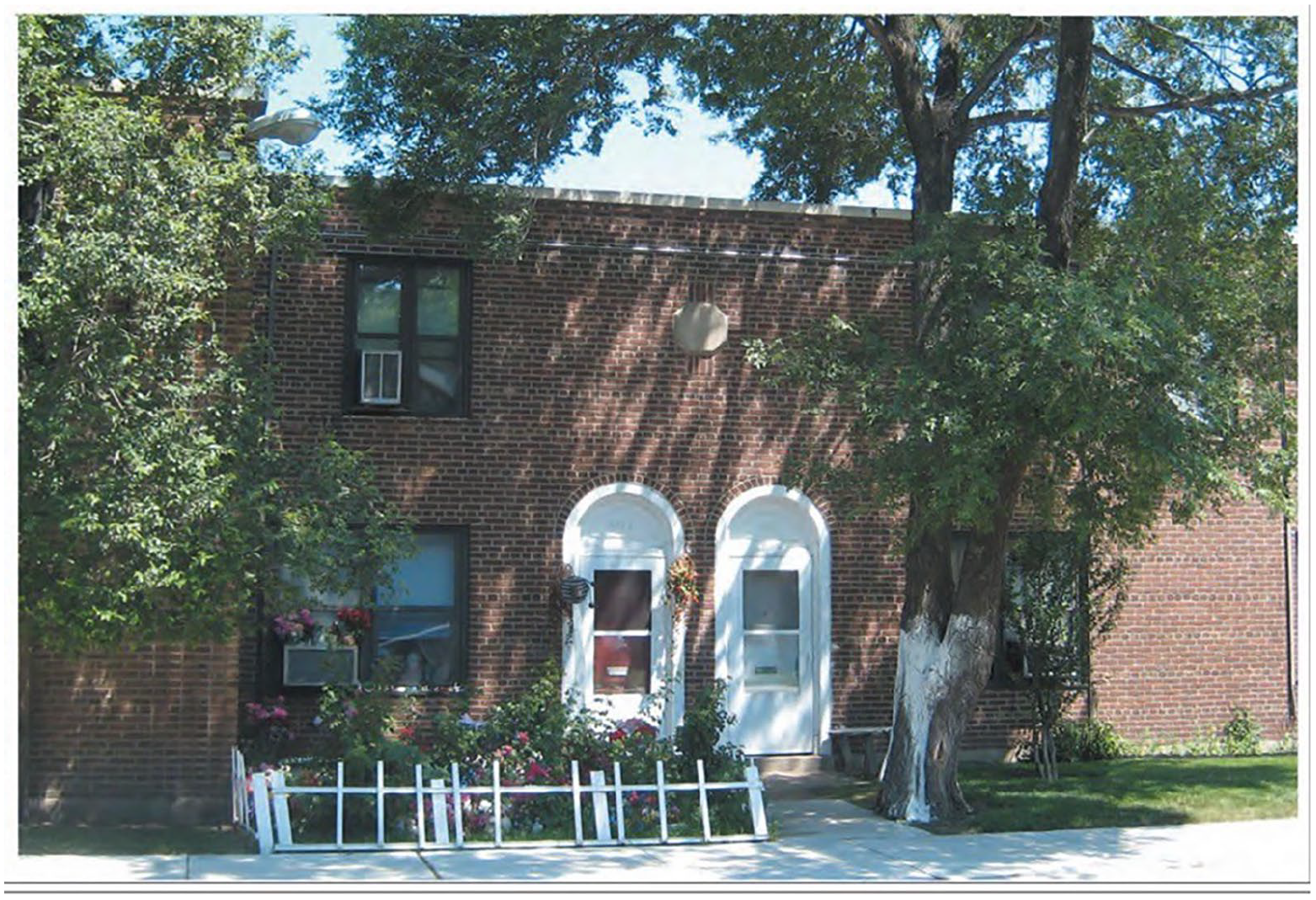
Photograph of rowhouses in Lathrop before the redevelopment. © Cameron Williams.
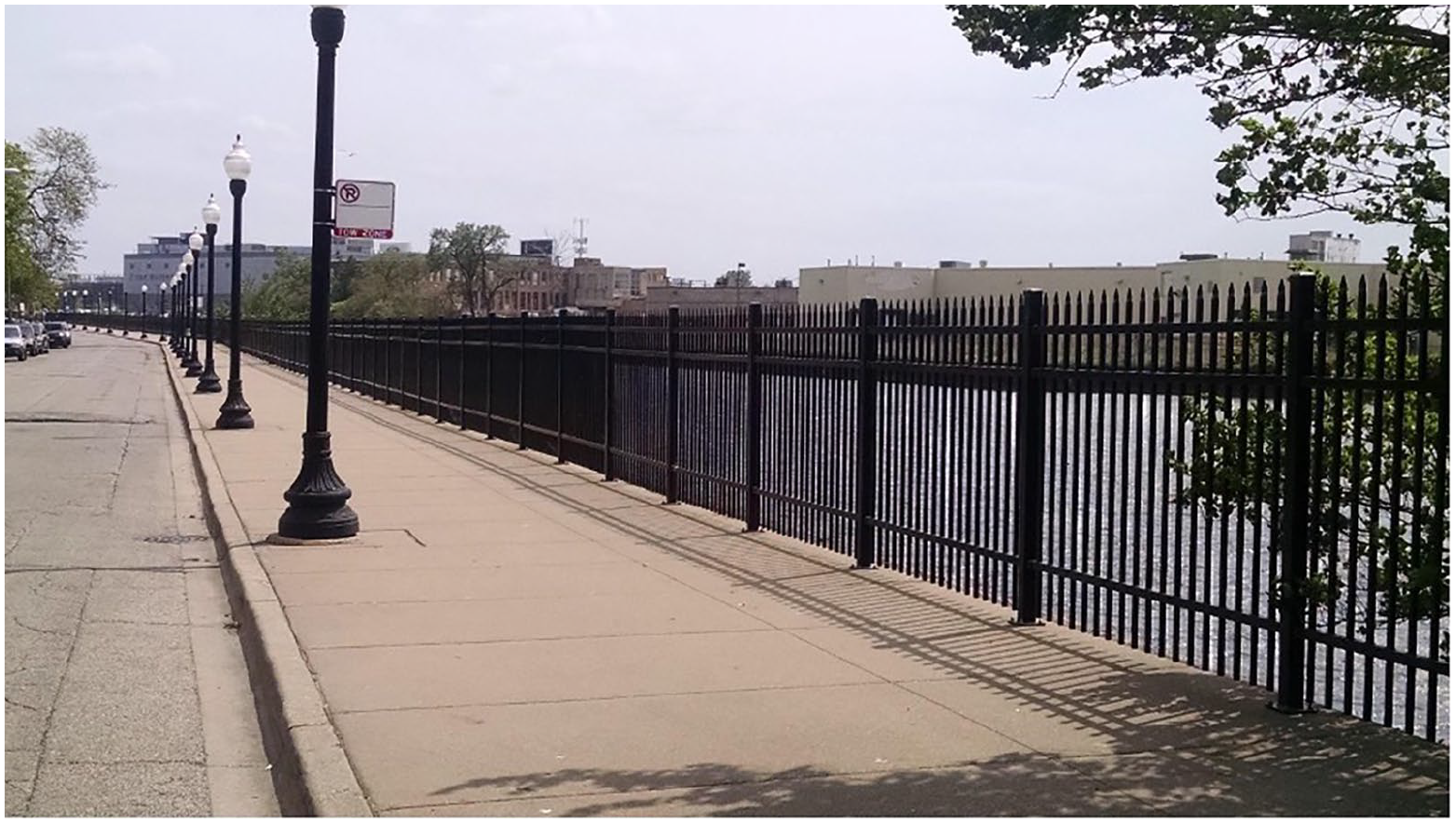
Photograph showing the Chicago River running along Lathrop. © Cameron Williams.
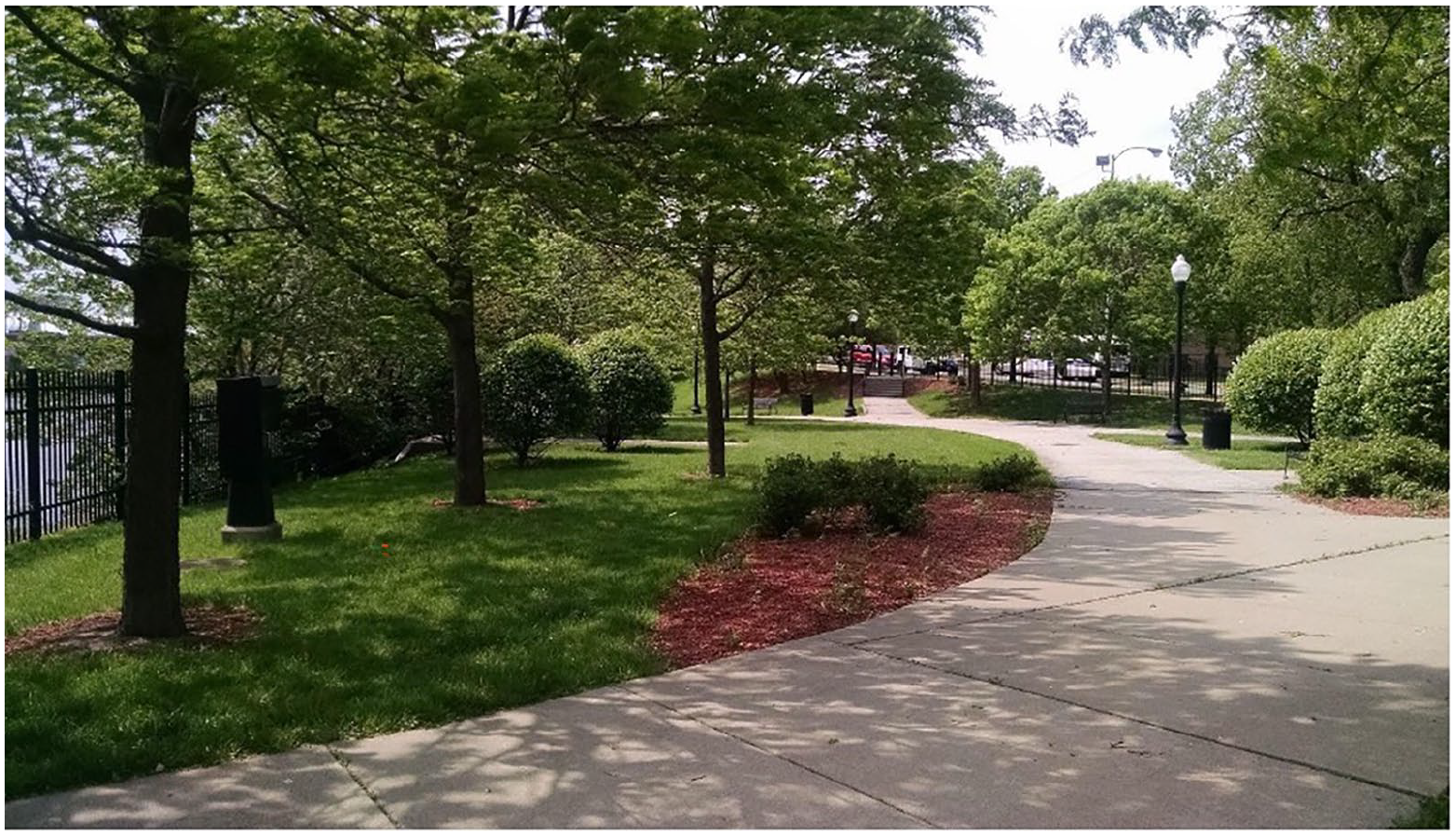
Photograph showing the walking path in Lathrop. © Cameron Williams.
Black people are the largest demographic group living in public housing developments across the United States. 23 During the Great Migration of Black people to northern cities, public housing was one of limited places for them to live. 24 Today, public housing still mirrors general housing patterns in the United States, where most communities are segregated by race. 25 Lathrop is unique demographically in that residents living in the community are Black, Latino and White. Around 60 per cent of Lathrop residents are Black, 25 per cent are Hispanic and 15 per cent are White, making Lathrop the most diverse public housing development in Chicago. This diversity is the result of the Lathrop development starting as war-time housing in 1938 for White families, and later opening to the first Black family in 1956. Even then, the community was predominantly White for many years, which shielded the development from some of the negative stigma that communities with people of colour receive. 26 Lathrop’s placement on the north side of Chicago, near Logan Square, which has a high Latino population, is another explanation for this diversity. Other diverse developments do exist in the United States; however, they largely consist of refugee populations and are mostly located in the Pacific Northwest. 27
The socioeconomic characteristics of people living in Lathrop are broad apart from race and ethnicity, as well. For instance, several LPC participants were former Lathrop residents, who had gone on to college and to work as educators, social workers and in other professional occupations. In addition, several current residents were educated and volunteered at organisations and churches throughout the local community. One long-time Lathrop resident spent many years working with the state of Illinois to secure funds for activities for children living in the Lathrop community. As a result, the organisers were able to utilise a lot of people with personal connections to the development who had various skills and expertise to help with the mobilisation efforts. Lathrop also has an older population, with about 60 per cent of residents in the development over the age of 50. The LPC was able to draw on current and former residents who were retired and so able to help with a time-consuming campaign.
Data for this project is based on ethnographic participant-observations of the LPC collected from 2013 to 2018. Using such observations is a good way to gain detailed information about a case, social phenomenon or process happening over time. 28 Ethnographic participant-observations were used to learn more about Lathrop Homes and the surrounding communities, the LPC planning meetings, rallies and actions held by the group. As a participant observer, I [Williams] actively engaged in meetings, actions and planning efforts related to the LPC. I spent time with residents attending Lathrop community events, eating meals at their homes, going to restaurants with them individually and in groups and chatting with them in front of their homes. Authors Miller and Jimenez aided with the development of the project and with the analysis of the findings.
The analysis in our research is also based on semi-structured interviews with LPC participants. Three main groups participated in the LPC, which were current and former residents, organisers and allies, like neighbours, preservationists, lawyers and Lathrop staff. Interview questions sought to understand how LPC participants framed issues related to the redevelopment process, race and racial discrimination, and perceptions about poverty deconcentration and mixed-income communities and the CHA. The interviews provided more insight into the personal stances that participants have about these issues. 29 Interview data for the analysis consists of sixty interviews with LPC participants, ranging from thirty to ninety minutes. A purposive, non-probability sample is used for this project, which enables a researcher to recruit participants who meet certain criteria. 30 The use of this sampling strategy ensured that only LPC participants and current and former Lathrop residents were involved in the interviews. The names of participants have been changed to protect their identity. Primary documents related to the LPC and the redevelopment of subsidised housing in Chicago were also analysed to provide context.
The evolution of the Lathrop Preservation Campaign
In the mid-1980s, the Logan Square Neighbourhood Association (LSNA) started working with the Lathrop Homes community. The LSNA is a non-profit organisation working with people in the Logan Square, Avondale and Lathrop Homes communities in Chicago, Illinois. The LSNA provides programming, organising support and leadership in the areas of housing, education, health, open space preservation, immigration, youth prevention and safety for people living in these communities. 31 The LSNA began working with people living in Logan Square and Lathrop Homes around the issue of housing because of rising gentrification in these communities. Logan Square has a diverse composition of housing stock, composed of larger courtyard buildings with thirty units and smaller two- and four-unit flats, and a small number of project-based subsidised housing. The community consists primarily of immigrant, Latino and some Black families, although their respective populations have declined because of gentrification. Lorna Smith, one of the lead organisers working on the LPC, moved to Logan Square in 1995 with her two young children and lived there until she was priced out because of gentrification.
Lathrop is located two and a half miles west of Logan Square. The LSNA serves Lathrop because of the gentrification happening around the development and the small immigrant population living in the community. Lathrop is in Chicago’s North Branch Industrial Corridor, and the areas around the development had numerous businesses and industries employing people from the community until the 1980s. Since then, the conversion of large commercial building space into condos has contributed to a significant decline in decent wage employment opportunities for residents. Over the years, the areas surrounding Lathrop Homes have experienced a notable decrease in affordable and subsidised housing as well.
Residents and organisers often referred to Hannah Jakes, the pastor of the Church of Good News, as I talked with them about their organising efforts. Residents spoke highly of Hannah and credited her with helping them with their first mobilisation effort. Before the LPC started, in 1994 Hannah worked with residents and the LSNA to prevent the conversion of the Cotter and Company site, which was a large wholesaler of hardware, into 600 condos and townhouses. Another proposal was made to bring in a private storage facility, which Lathrop residents opposed because the business would not provide decent paying jobs. In 1994, residents and organisers created a list of demands and worked with the mayor at the time, Richard Daley, and local aldermen to secure a community benefits agreement with Costco, a large warehouse selling groceries, electronics and other household items. Through this six-year organising effort from 1994 to 2000, Lathrop was able to replace Cotter and Company with a major employer providing decent wage employment with benefits to residents in the community. Several current and former Lathrop residents work at Costco, which is less than a ten-minute walk from Lathrop. Organising for the Costco was the first time that Lathrop residents engaged in a major grassroots effort to protect their interests. This foundation would later become important when organisers and Lathrop residents decided to launch the LPC.
Hidden plans and historic preservation
In 2000, the CHA announced that it would redevelop Lathrop Homes without detailing any specific plans for the community. After this announcement was made, the LSNA provided Lathrop residents with a housing organiser, Jeffrey Hines, in 2002. Before the LPC began, Jeffrey created a Lathrop Leadership Team (LLT) with residents living in the community and allies to informally mobilise around any potential issues that might develop because of the CHA’s redevelopment plans. The LSNA provided support to Lathrop residents through leadership training to help them build relationships with allies and to ensure they were included in the planning process. Jeffrey worked with other organisers to get the CHA to share its plans with the Lathrop community during this period of waiting. Below, organiser Jared Adams shares his efforts to learn about vacancy rates at Lathrop and other public housing developments in Chicago: At Lathrop there was this problem with vacancies and at Lake Park Place. I think people at Lathrop were surprised that there were vacancies at the developments that were not in the limbo that they were in. It was my job to pore through the CHA’s official documents on their website and submit it to HUD to see how many vacancies there were in family housing. I spent like twelve hours a day just staring at these reports. It was interesting to think that this vacancy problem had existed for quite a while in public housing for different reasons and at different times. (Jared Adams, housing organiser)
Jared found increasing vacancies across developments in Chicago when he completed work for the LPC. Organisers found that millions of dollars provided to the CHA for the upkeep of units and to fund HCVs remained unused, and were kept in the CHA’s cash reserve. Documents for the LPC frequently highlighted the issue of unit vacancies increasing at Lathrop over time. Lathrop was at 80 per cent occupancy before the CHA announced plans to redevelop the community. The number of occupied units in Lathrop declined to 535 out of 925 units in 2003. In 2010, about 250 units in the development were occupied. By 2015, the number of occupied units dwindled to fewer than 150. The CHA claimed that any vacant units in Lathrop were unfit for occupancy. However, engineers concluded that most of the buildings and apartments were safe for residents to live in after a thorough inspection of Lathrop.
In an interview, Jeffrey talked about how from 2000 to 2006, the plans for Lathrop were ‘to be determined’. During that period, the CHA vacated the entire north section of the Lathrop development, causing a lot of uncertainty for residents. Jeffrey worked with the LLT to develop relationships with people in the historic preservation community during this period of waiting. He was concerned that Lathrop might be demolished based on the CHA’s plans to do so at other developments in the city and the increasing unit vacancies. Residents and other organisers shared their view in interviews that the CHA intentionally emptied out units over the years by giving them HCVs. Jeffrey states the following about the announcement to demolish Lathrop: In 2006, the CHA announced the redevelopment plans were no longer ‘to be determined’ and that Lathrop will be a mixed-income redevelopment, including market rate. ‘And by the way, we’ll entirely tear Lathrop down’. We had had fears of that because up until that point, they were neglecting maintenance, horribly. I don’t know if you remember the steam leaks, but the heating system had huge leaks in it and several of them were along Hoyne and on Diversey. The public face of Lathrop for a lot of people driving down Diversey was, ‘Man, that place is falling apart! There’s steam coming out of the ground, you know, clearly, it’s falling apart’. The CHA seemed to like that perception because they wanted to tear it all down. When the headline went out that Lathrop could be torn down, the leadership team, the LSNA, Lorna and I had established some visibility and some awareness. The historic preservation community reached out to us really fast. (Jeffrey Hines, LSNA housing organiser)
In 2006, after emptying out part of the development and leaving residents uncertain for years, the CHA announced that it would demolish Lathrop and turn it into a mixed-income community. Mobilisation to save the Lathrop community by residents and organisers officially began after this announcement. Sarah Owens, Director of Advocacy at Landmarks Illinois, a non-profit historic preservation organisation, discusses why her organisation got involved in the effort to protect Lathrop: Lathrop Homes specifically is something that we’ve been engaged in for many years, since about 2006, I believe, when the CHA first announced it wanted to demolish the site for redevelopment. We subsequently, understanding its architectural importance as well as its social history and its place in the history of public housing in the city, placed it on our annual endangered historic places list, which is a list that we put out annually of important places that are threatened throughout the entire state. It was one of ten for us to highlight as a place that is worth saving, essentially. (Sarah Owens, Director of Advocacy at Landmarks Illinois)
After hearing the concerns of residents and organisers, the historic preservation community, such as the Treehouse Foundation, Preservation Chicago and Landmarks Illinois reached out to Lathrop to offer support for the residents’ efforts to save their homes. Various organisations saw the value in Lathrop because of the architecture of the buildings, the abundant greenspace throughout the development and the Chicago River running alongside the community. The LPC worked with the historic preservation community to communicate the positive attributes of Lathrop to the public. Sarah worked with the LPC to register Lathrop as a historic site and to advocate for the rehabilitation of the development, rather than the demolition of the buildings. Her organisation conducted a reuse study and found that most of the buildings were structurally sound and could be rehabilitated into larger housing units. With the help of preservationists, the LPC was able to protect Lathrop from demolition based on Section 106 of the National Historic Preservation Act of 1966.
Jeffrey felt that historic preservation was one of a few strategies to possibly prevent the CHA from demolishing Lathrop. The other lead organiser for the LSNA, Lorna Smith, was not as keen on the historic preservation approach because she was not aware of the process, and she was not sure that residents would rally around the subject. She states, Lathrop is on the historical registry and that happened because of the LSNA and Jeffrey Hines. I didn’t know anything about historic preservation, but Jeffrey kept pushing it until I got totally abreast to it. (Lorna Smith, LSNA housing organiser)
Lorna grew up in a Black segregated area of Chicago in the 1960s and 1970s. Lorna and many residents were more aware of strategies such as protests and civil disobedience to enact social change, based on personal or familial connections to the civil rights movement. In meetings, Jeffrey spent a lot of time working with the LPC to ensure that participants understood the historic preservation process. He also included LPC participants in meetings with the agencies handling the historic preservation aspect of the campaign.
People in the LPC acknowledged that their campaign benefited from the history of Lathrop and the location of the development in the city. Public housing has a negative stigma, yet Lathrop was deemed as a community worth saving by various community-based organisations because of its physical characteristics. The development was designed by a famous group of architects that people in the preservation community respected. The buildings were designed by Thomas Tallmadge, who specialised in prairie style architecture. 32 Thomas worked on the Lathrop project with his colleague Vernon Watson, who designed over thirty churches, including the First Methodist Church in Evanston, Illinois. The greenspace at Lathrop was designed by Jens Jensen, a famous landscape architect, who felt that people in densely populated urban areas lacked access to green space. 33 Jens designed outdoor areas to promote social interaction and to encourage community gardening. Lathrop’s physical characteristics, like having distinct architectural details, being low-scale and having low-rise buildings made the development unique. Many other developments that were torn down in other parts of the city did not have the support of the historic preservation community.
The contested community
Historic preservation provided a counterpoint to narratives that Lathrop Homes was a blighted community in need of redevelopment. Securing historic designation for Lathrop was also important because the negotiations with the CHA and the Lathrop Community Partners, the development team of the project, were difficult according to residents and organisers. Sarah Owens shares her experience with getting the CHA to negotiate with the LPC in protecting Lathrop: It’s been a learning curve for everyone. When we first started this effort, we obviously were in an adversary situation, where we were challenging that decision to tear down this complex, and we were very much in opposing positions with the CHA. We were here to say, ‘Look, we’re trying to help you find a solution’. I think professionally they appreciated that. Then, of course it came to the point where legally they had to engage with us because [of] Section 106. Our organisation became a consulting party, Preservation Chicago became a consulting party, the Logan Square Neighbourhood Association became a consulting party, any other group who wants to be, or individual, can be a consulting party. (Sarah Owens, Director of Advocacy at Landmarks Illinois)
Before Section 106, the CHA was moving ahead with the demolition of Lathrop Homes, despite opposition from residents and community organisers. As the housing authority managing Lathrop, the CHA had complete autonomy to decide the future of Lathrop because the Department of Housing and Urban Development deregulated the agency in 1999. LPC participants regularly commented that they were completely left out of the planning process prior to the implementation of Section 106.
Even with historic designation under Section 106, residents found it difficult to be involved in the planning process as much as they desired. In June 2013, I attended a community meeting at the New Life Community Church in the Lakeview neighbourhood of Chicago. At this event, the CHA and the Lathrop Community Partners, which consists of the three development groups involved in the project, held a public forum for Lathrop residents and people living in market-rate housing in the surrounding neighbourhoods. The city and developers wanted to receive comments about their recently unveiled redevelopment plans for Lathrop. In the basement of the church, the developers displayed 3D models of the future mixed-income community featuring upscale retail spaces, a new River Edge Park with bike paths and kayaking, a dog park and a plaza with access to a riverboat to float tourists along the Chicago River. People living in market-rate housing voiced their concerns about the negative impact Lathrop has on their property values and about the project being delayed far longer than they anticipated. LPC participants discussed the possible loss of green space, the environmental utility of restoring the buildings, and the need for more public housing in Chicago. Public housing residents also shared their disappointment at being excluded from the plans and the possible destruction of their community. Lathrop resident Tristian Rogers shares his views about being excluded from the process that led to these plans: About seven years ago, I got involved in the efforts against the CHA and the city, who are trying to systematically, I will say, vacate Lathrop to the best of their ability. They claim that their planning involves residents, alumni and other concerned agencies and ironically that is not true. They came down here and what they did was, what I call an ‘informational session’, and they told us what they were going to do. They said ‘we are going to bring this plan to you. What we will do is bring you three plans and you will choose two that you will most like, then from there we will choose from the two that you like’. That never happened. What they did was disappear for eleven months and came back and said, ‘This is the plan that we have’, which of course we don’t like. (Tristian Rogers, Lathrop resident)
Tristian expressed his disappointment in the plans revealed at the meeting because they included market-rate housing, retail and recreational amenities that would reduce units for Lathrop residents. He believed that the CHA just needed to remodel Lathrop as all public housing.
Like Tristian, numerous residents interviewed for this research joined the LLT because of their concerns about the impending redevelopment. Throughout interviews, residents spoke of their perception that poverty deconcentration efforts at other developments did not work as planned. Residents often referred to other people who were displaced at other developments or regretted taking HCVs. Two former residents of Cabrini-Green, another development in Chicago that was torn down and redeveloped into a mixed-income community, were also interviewed. One of them currently lives in Lathrop and the other is an employee for a summer programme for Lathrop children. Both stated that they could not return to the mixed-income community that replaced Cabrini-Green once it was torn down and that the redevelopment process was unfair to residents. Below, two Lathrop residents discuss their views about the proposed plans and leaving their homes: It is just one big run-around. We have been waiting for the Plan for Transformation for fifteen years. We had a class on where you want to go if you could get a voucher. I said Lathrop and I just said north side . . . I would say, I will go east, and I want to stay north because east and north you have more stores all over here and even down by Division now, they are putting Mariano’s and they are even putting up a mall. I want to stay where there are stores, and there is business and diversity. When you are going further west and south you are losing the diversity and you are getting liquor stores. (Linda Wallace, age 53, Lathrop resident of thirty years). We don’t need retail over here because on that side we got all the retail. Then, on this side we got Marshalls, TJ Maxx, Jewels and Old Navy. On Western, we got Mariano’s, Walgreens and CVS [pharmacy]. We can walk back and forth to it, so there’s no need for retail. I just want to make sure I have somewhere to stay because the people in LeClaire Courts were told they didn’t have to move, then all the sudden they gave them thirty days in which to move and that’s not right. (Ben Hampton, age 60, Lathrop resident of twenty years)
Both Linda and Ben were members of the LLT and organised for years to remain in their community. Their comments are representative of those made by many residents who were interviewed. Linda talked about how the CHA tried to give her a voucher to leave Lathrop several times, but she refused to leave her community. Other residents shared how they were offered HCVs as well. Throughout interviews, people involved in the LPC highlighted that Lathrop was not like other developments in Chicago. The development does not have high-rises but consists of rowhouses – terraces – and low-density apartment buildings. Lathrop is also surrounded by some of the wealthiest neighbourhoods in Chicago, providing residents with access to good schools, stores and public transportation.
Lathrop residents expressed apprehension about moving because they could lose access to the amenities that living in their community provides. For instance, an Aldi grocery store is located a half mile away from Lathrop, which is about a ten-minute walk. In a plaza near Aldi, there is a Jewel-Osco grocery store. The Costco that borders Lathrop Homes is just 0.4 miles away and an eight-minute walk from Lathrop. Several places to shop, like Dollar Tree and Target are within walking distance as well. Recreational spaces, like gyms, a movie theatre, a bowling alley and restaurants are within walking distance of Lathrop. In addition to providing residents with daily necessities, these community businesses also provide economic security. For instance, Linda’s daughter who grew up in Lathrop works at the nearby Costco, and now lives in market-rate housing because of the decent pay and benefits the job provides. Lathrop residents can work in other parts of the city because of easy access to public transit, which is not typical for many low-income people in Chicago.
A central goal and organising focus of the LPC was to keep Lathrop as exclusively public housing, rather than the development becoming a mixed-income community. Lathrop residents disagreed with the idea that people with a higher income living in their development would benefit them. Residents shared these concerns in CHA and city council meetings, but the developers and local officials appeared apathetic to their comments. The CHA and developers often responded that redevelopment would help to end their social isolation from the surrounding communities and provide them with better livelihoods. Despite the concerns of residents, the CHA and the developers pushed forward the mixed-income development and retail plans. Non-profit developer Lena Todd highlights why mixed-income housing was so important to the development team: I think the market-rate term sounds misleading because it sounds like luxury housing or something. The CHA and the city will never allow us to build luxury housing. When we first came out with the plan, we proposed 1,600 units and I believe we were pushing for a stronger percentage of the market-rate rental because we felt like in order to really create a successful mixed-income community there has to be this higher percentage. (Lena Todd, non-profit developer)
The development team stated that the project needed a higher percentage of market-rate units for a mixed-income community to be successful. The final unit count for the new mixed-income community is 400 public units, 292 affordable units, 494 market-rate units, resulting in a net loss of 525 units for public housing residents. Lathrop residents believed that the developers pushed for more market-rate units in the final count because higher-income people were not moving into other mixed-income developments in Chicago. After the plans were announced in June 2013, Lathrop residents and organisers heightened their mobilisation efforts by holding press conferences at Lathrop, city hall and churches to spread information about the redevelopment proposal. Although the LPC continued to press for the full remodelling of the community as 100 per cent public housing, its members acknowledged that it was time to shift their mobilisation to protecting residents who might not be able to return to the redeveloped mixed-income community.
Beyond historic preservation: race and the LPC
People in the campaign came from various racial, ethnic, economic and educational backgrounds. At times, these differences caused tensions between people in the LPC as they organised to save the Lathrop community. The subject of race was one area of concern and contention within the campaign. In 2013, organisers Jeffrey Hines and Lorna Smith discussed how they struggled with navigating some of the conflicts around race that existed between residents living in Lathrop and other people in the campaign. The organisers began actively working to deal with these tensions because they slowed the momentum of the campaign. Jeffrey, Lorna and the director of the LSNA applied for a grant in 2013 to address issues around race in the campaign. The grant was not funded, but the organisers said that the process made them more sensitive to the concerns of different people working together to save Lathrop. As Jeffrey explains: There are a lot of people who have relationships across racial and ethnic lines and that is really positive. But one thing that I learned is that just that fact did not mean that some of those same people didn’t harbour generalisations and stereotypes. There were still some very difficult moments talking about race. For example, for some folks, the LSNA was perceived as a Latino-led organisation and an organisation that was predominantly Latino, which is true, and therefore it must be interested in turning Lathrop into predominantly Latino housing. That was really difficult and really challenging. (Jeffrey Hines, housing organiser)
The LSNA has a long history of working with Lathrop Homes. Jeffrey and Lorna had known some Lathrop residents for over a decade by the time I started observations. They both talked about how interpersonal conflicts between residents prevented some people from participating in the campaign and slowed the momentum of the group. Conflicts between Black, White and Hispanic residents also stemmed from claims that the allocation of units and split transfers were unfairly distributed based on race and ethnicity. Split transfers enable the children of a leaseholder, once they became adults, to get their own unit to prevent apartments from getting overcrowded. Some White and Latino residents believed that Black residents received split transfers more than them. The CHA also moved some people from Puerto Rico into Lathrop after Hurricane Maria. A resident leader stated that this action prevented some Black families who had been waiting for a long time from moving into the community. Some residents distrusted Jeffrey and Lorna based on how resources were distributed in the development, even though they did not work for the CHA or manage the allocation of those resources. Several Lathrop residents also felt that some of their neighbours participated for power or monetary gain, rather than to help the community. The organisers had to consistently reiterate that they did not work for the CHA or the developers, and that resident leaders in the LPC were unpaid participants.
Tensions also surfaced in the campaign around organising strategies used. An organising action by the LPC that took place for multiple years at Lathrop was Las Posadas rallies. The rallies used the imagery of Mary and Joseph being turned away from lodging in Bethlehem to represent people being turned away from vacant units at Lathrop. Las Posadas are primarily celebrated in Mexico and some places in Latin America. Some Black residents pointed to the emphasis on Las Posadas in organising as an example of the LSNA favouring Latinos living in Lathrop Homes in the LPC’s efforts. Lorna discusses this below: At the LSNA, we do more grassroots organising which means that we start where people are and take little bites at a time to get to our goals. But then there is more direct organising and conflict organising. We use a mixture of all of them to try to get what we need. And we are really good at some parts, and we are a little short in others. For instance, as an organising campaign we get stuck on whether we really want to take it to that next level. Sometimes relationships get in the way and that hinders the campaign a lot. (Lorna, LSNA housing organiser)
Lorna points out that some people in the LPC wanted to take a more measured approach, while others wanted to engage in direct organising. One resident interviewed stated that she stopped participating because the LPC repeatedly engaged in the same actions. Based on observations, organisers did steer residents to focus on what they viewed as more practical and non-confrontational approaches. In interviews, residents discussed their frustrations with this pragmatic approach because of years of failed attempts to get local politicians to maintain and to build public housing. Lorna also talked about how some people did not participate because the conversations were too technical, so they were unable to connect with the campaign effort. In meetings, Lorna frequently checked to make sure residents understood the points being discussed and asked people to ‘explain in layman terms’ if someone did not understand.
Throughout 2014 and 2015, the LPC spent most of the time working as part of a coalition of housing groups to pass a ‘Keeping the promise’ ordinance in Chicago to protect subsidised housing. The goal of the ordinance was to require the CHA to report on a quarterly basis to the city about unit vacancies, to require the one-for-one replacement of standing units and to fund HCVs. Working on this initiative entailed getting the support of local aldermen throughout Chicago, along with the approval of the mayor. Observations of the groups’ time together planning the ordinance revealed that conversations about race were avoided as much as possible. On numerous occasions, when the subject of race was brought up in meetings, it was quickly acknowledged with a nod or brief pause, and then the meeting simply continued.
However, a lot of private conversations centred on racial discrimination as the driving force of the changes happening in communities as people chatted informally during breaks and at the conclusion of meetings. Participants believed that the developers and the city targeted low-income communities of colour for their development projects because many of these areas are now more desirable to higher-income people. When asked about discussions of race in meetings, organiser Parker Wilson made the following comment: In our campaign, we frame public housing in a way that it can work and remind people everybody didn’t always have money. There were a lot of times when a lot of us had to live two to three families in a household just to make it. Just because some of us have [housing] now does not mean that other folks don’t need the [public] housing. Most Black folks are in low-income poverty conditions across the country. Most people do not realise that because we think we are in a post-racial America. Because you have this structural racism that is taking place and this internal racism that we have on ourselves, and that is across the board. Nowadays, people do not feel as comfortable talking about Black, so they use low-income; they use urban; they use all these other little phrases to insinuate but not talk about it. Public housing is a Black issue. You are using tax dollars to displace poor Black people out of the city of Chicago. (Parker Wilson, organiser)
Organiser Jared Adams states: Parker and I from the Hope Center have talked about this a lot. There is reluctance in the coalition to address race head on, and I think that’s because, if we say it, everyone is going to lose it, which is strange because it is so obviously playing out. White groups, I think, tend to be less radical and will often sort of be kind of stuck in the mud in terms of taking action. And I think that dynamic perpetuates itself, so that a lot of the south-side groups, the Black groups, will take out more radical action than they might want otherwise, so that the north-side groups will oppose them. They can have north-side/south-side fights, which always happens. I think that there is a certain amount of optimism in White groups that the government will work for them and do things that are right. There is a lot of cynicism from Black groups about the experience of the government doing the wrong thing without their consultation, and that also plays into how decisions are made. (Jared Adams, organiser)
Parker and Jared worked closely with Jeffrey and Lorna on housing issues. They both highlight some of the tensions that exist around race in organising to save public housing in Chicago. The people in the campaign did not avoid conversations about race because of colourblind viewpoints. Respondents shared their keen awareness of segregation and racism in housing locally and nationally in interviews. I learned in interviews with the organisers and other LPC participants that many of them were drawn to the issue of housing based on their personal experiences of dealing with racism or because of things they learned about this issue in college or volunteering for community-based organisations. The group decided against using civil disobedience or making direct claims of racism and discrimination to avoid antagonising any potential political supporters of their efforts.
New opportunities in organising
In the final part of the campaign, the LPC used race-conscious organising practices. The LPC shifted their focus to the negative racial implications of the CHA redeveloping Lathrop Homes. Although people in the LPC talked extensively about racism in Chicago in their interviews and in informal settings, I did not observe conversations about race in planning meetings until the later stages of the campaign. The group decided that it was time to openly discuss issues of racism and discrimination because of unsuccessful attempts to get the mayor of Chicago to pass the ordinance to protect subsidised housing. In addition, the CHA announced that construction of the first phase of the Lathrop redevelopment would begin in 2017. The LPC started to focus more on preventing the displacement of residents in planning meetings as the start of the first phase of redevelopment approached. In one planning meeting, the LPC talked about creating a community benefits agreement, like the one completed to get a Costco instead of luxury condos near Lathrop in 1994. The agreement would focus on ensuring that former residents displaced from Lathrop over the years would have the right to return to the redeveloped site. The group also wanted to ensure that current residents could remain on site during the redevelopment process. The LPC feared that some residents would take an HCV because of the stress of making multiple moves if they were required to move out of Lathrop during the redevelopment process.
In 2016, the LPC commissioned the Sargent Shriver National Center on Poverty Law to help it develop a Racial Impact Statement, instead of a community benefits agreement. Jeffrey Hines and a former resident worked closely with the organisation on this. The purpose was to gain broader support in preserving the 525 public housing units that were lost because of redevelopment and to show how the CHA’s handling of Lathrop increases racial segregation in the city. The statement details how Lathrop and the surrounding communities changed over the years. Additionally, a major emphasis is made on the resources and amenities available in the community, running counter to claims that Lathrop is isolated and concentrated in poverty, as the CHA and some politicians publicly suggested on numerous occasions. The statement is race conscious and highlights the impact the redevelopment of Lathrop could have on people of colour. It asks the CHA to consider race when deciding where to replace the lost Lathrop units. The statement also argues that HCVs are not the answer to replace Lathrop units because most of the recipients end up moving to racially segregated neighbourhoods.
The Racial Impact Statement aided the LPC in its final effort, which was to legally bind the CHA to replace all units lost because of the redevelopment of Lathrop. Residents expressed fears about being displaced to predominantly Black and Latino areas of Chicago, like the south and west sides of the city, which are poor and lack resources. The LPC created a ‘525 Task Force’ to work with allied organisations and the CHA to prevent this from happening. The LPC achieved this requirement, which is based on the 22 December 2016 federal court order mandating the CHA to replace the 525 units. The attorneys working with the LPC utilised a previous 1976 legal ruling called Gautreaux in their efforts to get the judge to enforce the court order on the 525 units.
The 1976 Gautreaux decision is a ruling arguing that the CHA and HUD discriminated against Black people by systematically placing public housing in poor and segregated areas of Chicago. 34 Under the order, Lathrop replacement housing must be relocated on the north and north-west sides of Chicago, preventing the units from going to segregated areas of the city.
Closer to the start of the redevelopment, the LPC engaged in new mobilisation tactics including its first major act of civil disobedience on 21 March 2016. During this action, subsidised housing residents, religious leaders and organisers occupied a vacant Lathrop unit for twenty-four hours. People also camped outside of the occupied unit and a rally was held with live music and food for the people participating in and supporting the action. The purpose of the action was to put pressure on Chicago Mayor Rahm Emanuel and the CHA to support affordable initiatives that housing advocates wanted to implement. Flyers and signs explicitly referred to the racial segregation resulting from Chicago’s housing policies as a problem. For instance, one sign read, ‘Mayor Emanuel stop displacing Black and Brown families’. One of the points on a flyer from February 2016 states: This is a plan for segregation. By reducing the number of public housing units at Lathrop, low-income and moderate-income families will be excluded from Lincoln Park and North Centre. That means that fewer Hispanic and African American families will be part of our thriving community.
The LPC helped to make the following statement that was placed on the website of a housing coalition it was part of: There is a housing crisis everyone is feeling, and no one can ignore. With more than 240,000 Black residents forced out of Chicago and 10,000 Hispanic residents pushed out of Pilsen since 2000, and over half of Cook County renters of all races paying more than they can afford.
These excerpts provide insight into how public discourse around the campaign went beyond talking about vacant units, historic preservation and fiscal responsibility. In meetings, the participants often talked about Black and Hispanic people being pushed out of Chicago because of the high cost of living and the historical nature of racism in public housing. Race-conscious conversations about how to safely engage in civil disobedience happened prior to this action as well. 35
Conclusion
People who participated believe that their efforts were a success. The group not only prevented the Lathrop community from being demolished through the historic preservation argument, but also found a way to organise using race-conscious language and strategies. The group did this by developing relationships with different allies across the city and state who focus on historic preservation and racial discrimination in housing. Research has found that campaigns often focus on race-neutral strategies, such as historic preservation. 36 This is done to avoid antagonising allies and to ensure that mobilisations are not seen as something that only benefits people of colour. Initially, there were some barriers to talking about race, but with time, people involved in the LPC were able to openly discuss the subject. Additionally, the LPC strategically began to focus on race in their organising efforts closer to the start of the redevelopment. This occurred because of difficult conversations among residents and organisers surrounding interpersonal tensions within the LPC. The diversity in the development and the long-term relationships between residents and organisers most likely aided in this effort to focus on the racialised consequences of redeveloping Lathrop Homes.
The Lathrop Preservation Campaign offers a glimpse of hope that grassroots groups have the power to combat poverty deconcentration initiatives. Public housing residents realise that higher-income people usually benefit the most from these programmes. The threat of displacement to segregated and poorer areas also makes residents apprehensive about these programmes. As the development of mixed-income communities has become the norm, it is important for groups fighting for public housing under threat of redevelopment to be open to various organising strategies, including race-conscious and race-neutral legal mechanisms.
Footnotes
Cameron Williams is an assistant professor of Sociology at Columbus State University. He studies issues of housing, inequality, race and ethnicity.
Madison Miller received her bachelor’s degree in political science from Columbus State University. She currently works as a Legal Secretary for the State of Georgia, US.
Ramiro Jimenez received his bachelor’s degree in sociology from Loyola University Chicago and his master’s degree in Sociology from Purdue University. He is interested in issues of immigration, education, race and ethnicity.