




Abstract
This article explores the overturning of the ‘colour bar’ in a Manchester pub in 1953. Led by Black boxer and Communist Len Johnson, the resistance and ultimate success in breaking the ‘colour bar’ tells much about Black agency, the relationship between anti-racism and the Communist Party, and the making and unmaking of race in modern Britain. The article outlines Johnson’s life up until 1953 and the history of the ‘colour bar’ in Britain that shaped Johnson’s career trajectory. In Britain, formal ‘colour bars’ existed, like that in boxing, but it was far more common for informal ones to operate that were only revealed through resistance to individual impositions. In the post-war years, Johnson spent much of his time challenging these unwritten ‘colour bars’ in Manchester as well as creating a new and explicitly anti-racist space, the ‘New International Club’. Such actions were part of a vibrant and dynamic politics led by Black activists in 1940s and 1950s Manchester. This piece shows how Johnson’s Communist Party membership was both central to Johnson’s activism, which included hosting Paul Robeson in Manchester to the consternation of the Pan-Africanists, as well as how the Party itself held back on its commitment to fighting for racial equality.
Keywords
Well-known sportsman and ex-middleweight Empire boxing champion, Len Johnson, was turned out of a Manchester public-house here last night because of his colour. The licensee refused to serve him with a drink, saying he did not serve coloured people. When Mr Johnson objected to this treatment, the police were brought in, and on their advice he left the premises.
1
On 1 October 1953 the Daily Worker reported on the imposition of the ‘colour bar’ in the Old Abbey pub in the Greenheys estate of Manchester. The story was not unusual in post-war Britain. What was unusual was the response by Johnson and his comrades in returning to the pub with crowds of protestors. Four nights later the ‘colour bar’ was officially revoked and Johnson was invited back for a drink with the licensee. 2 Two Daily Worker articles of just a few lines each reported on first the exclusion of Johnson and then the breaking of the pub’s ‘colour bar’. Contemporarily, the story was discussed in no mainstream national newspaper, nor was it publicly remembered for decades afterwards.
Johnson, as the organiser of the protest, spent his later years all but forgotten. He was a famous boxer during the interwar years, but because he was Black, he had been prevented from competing for an official title. Instead, he evolved into a different sort of fighter and joined the Communist Party in the post-war years, organising against racism in Manchester. A ‘Where are they now?’ newspaper column in 1951 focused on Johnson, explaining to readers the boxer was now working as a long-distance lorry driver and driving with the ‘precision that made him a champion’. 3 Johnson suffered his last years in poverty and ill health and he died on 28 September 1974 at Oldham General Hospital. 4
The memory of Johnson was kept alive by only a handful of individuals in the years following his death. In the boxing world, Johnson’s fights were recorded and respected by many. 5 One lightweight boxer from Manchester, Frank, when turning professional, adopted the surname of Johnson in honour of his local hero. 6 Meanwhile at the Working Class Movement Library in Salford, Len Johnson’s collection was preserved including a scrapbook of newspaper cuttings which documented his boxing life (see Figure 1).
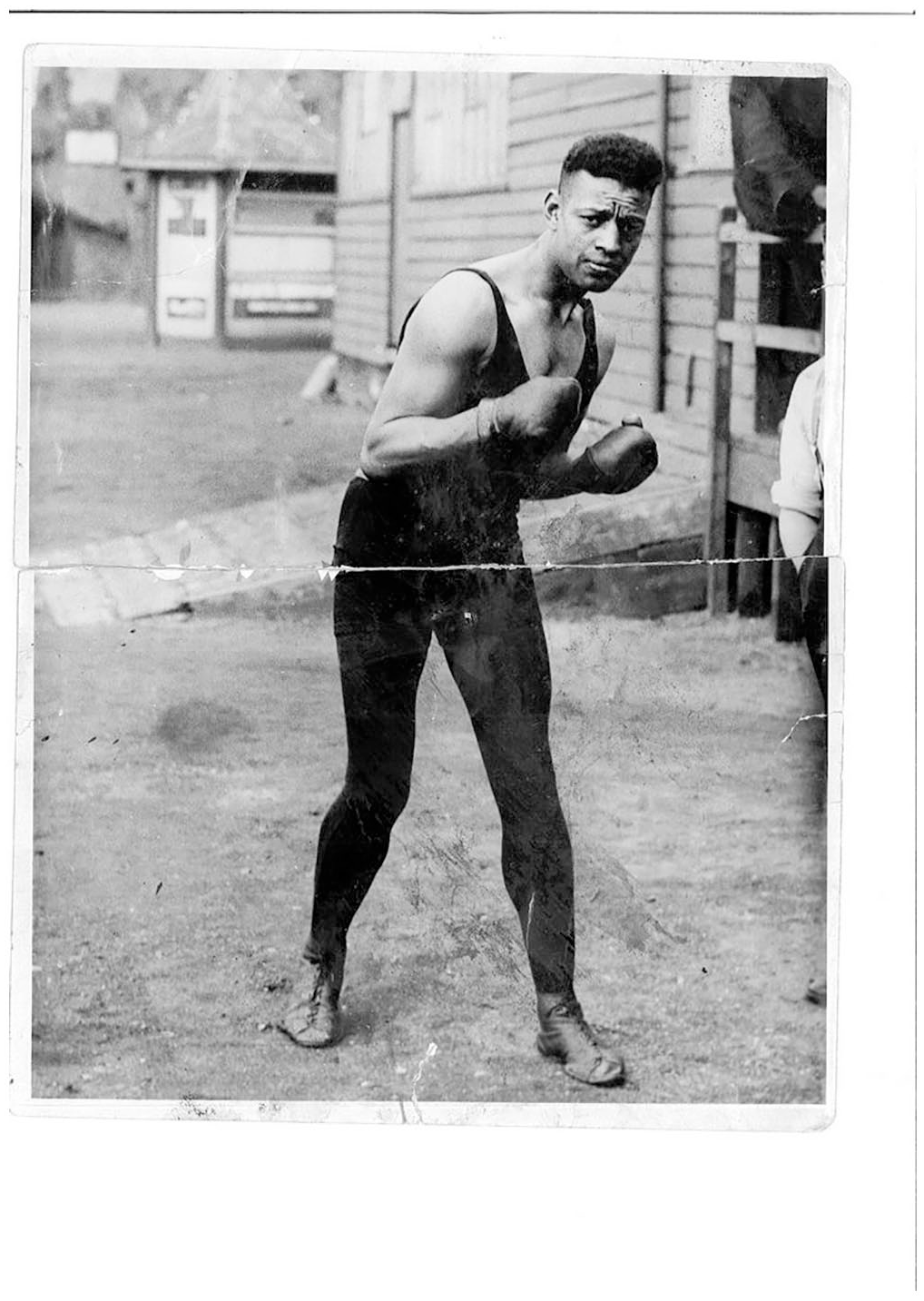
A photograph of Len Johnson. Courtesy of the Working Class Movement Library.
Building on this collection, in 1992 a short but significant book on Johnson was written and self-published by Michael Herbert, although this is unfortunately now out of print. 7 Rob Howard wrote his book on Johnson with a focus on his boxing career, self-published in 2009 and again now out of print. 8 In the theatre world, in 1997 a musical based on Johnson’s life was performed by young people from Rochdale schools and in 2014 another play on Johnson debuted at a Manchester festival. 9
Through these works the traces of Johnson’s life survived. But more broadly the name of Len Johnson was little known in Manchester or across the country. Similarly, scholarly work has for the most part ignored Len Johnson in histories of British Communism or in work on race and Britain. 10 This mirrors a wider absence of research on Black history in Manchester, certainly in comparison with port cities like Liverpool and Bristol. 11 There has, however, been a long and rich Black presence in Manchester which has shaped the city. A new wave of studies on Black British history, attuned to the relationship between race and place, is important in framing this work. 12 This article argues that Len Johnson was a significant figure in the remoulding of the city in the post-war years and in contributing to varied cultures of anti-racism. In exploring Johnson’s resistance we might reconsider how we conceptualise ‘place’ and Manchester’s recent past. As Massey has argued, places are always constructed out of articulations of social relations, forged through unequal and global framings of the local. 13
The article focuses on the resistance and ultimate success in breaking the ‘colour bar’ in a small pub in Manchester in 1953. Situating the protest within a wider history might tell us something about Black agency, the relationship between anti-racism and the Communist Party, and the making and unmaking of race in Manchester’s history. The article first outlines Johnson’s life up until 1953 and the history of the ‘colour bar’ in Britain that shaped Johnson’s career trajectory. In Britain, formal ‘colour bars’ existed, like that in boxing, but it was far more common for informal ‘colour bars’ to operate that were only revealed through resistance to individual impositions. In the post-war years Johnson spent much of his time challenging these unwritten ‘colour bars’ in Manchester as well as creating a new and explicitly anti-racist space, the ‘New International Club’. Such actions were part of a vibrant and dynamic politics led by Black activists in 1940s and 1950s Manchester. Johnson was both part of these networks that overlapped as well as competing for space and political leadership. Alongside the importance of Manchester as a vibrant hub of Black politics, this article argues that Johnson’s Communist Party membership was both central to Johnson’s activism as well as limiting in pushing the action further.
Len Johnson and the boxing world
Leonard Benker Johnson was born in Clayton, East Manchester in 1902. His father, William Benker Johnson, had migrated from Sierra Leone as a merchant seaman on the Elder Dempster Line and, like a small but growing number of Black seamen, settled in Manchester. 14 William entered the boxing booth life, where he met and married Margaret Maher, a Mancunian, ‘Irish and proud of it’ as her son recalled, who worked as a pinafore machinist. 15 The interracial marriage meant the family experienced real racism, and Margaret was once attacked in the street because she was the wife of a Black man, suffering permanent disfigurement. Margaret was disowned by her own family but the couple found lodgings with the Connell family, a bricklayer, Sal and his wife, and, as Len Johnson wrote, the lengths to which they went to welcome the ‘young man from Africa is almost unbelievable’. ‘They became Mother’s self-appointed parents and later on my grandparents’ as Len Johnson recalled. 16 Len was born into this family as the eldest of four children. Growing up he was trained by his father as a boxer in the booths and by 1920 was fighting professionally as a middleweight boxer. 17 In their study on Black boxers in Britain, Johnes and Taylor argue that boxing had always been a realm in Britain where migrants and their descendants made an impact. For people on the economic margins, the sport offered an opportunity to make a good living and find some agency in a society that often looked down upon them. 18 That was certainly the case for Len Johnson, whose successful career rose rapidly.
In 1928 the national newspapers were describing Johnson as Britain’s ‘uncrowned champion’. So far as the British title went, it was ‘tolerably certain’ that Len Johnson would have been champion if only he had been given the chance, had he not been debarred by his ‘colour’ from fighting for a Lonsdale belt. 19 The British Boxing Board of Control would not sanction a championship bout with Johnson, due to its Rule 24 stating that British contestants ‘must have two white parents’. In British boxing the ‘colour bar’ was directly written into its constitution in 1911 following a proposed fight for the heavyweight title between the champion, the Black American Jack Johnson and the British white contender, Bombardier Billy Wells. Opposition to the fight came most prominently from the Church, with lobbying from the Archbishop of Canterbury. Winston Churchill, as Home Secretary at the time, declared in September 1911 the proposed fight illegal and this decision came to act as a precedent in banning any high profile fight between white and Black boxers in Britain. 20 Lord Lonsdale, president of the National Sporting Club, wrote that: ‘So strong was the stand taken by the Home Office that the legality of all boxing was made conditional upon the non-arrangement of inter-coloured contests.’ 21 This official British boxing ‘colour bar’ was only repealed in 1947. 22 Black boxers like Johnson in Britain were still common in this period and yet, as the Black American poet Claude McKay noted on his time in London, ‘in the land of cricket’ regulations blocking Black people from a boxing championship meant that perhaps ‘the Black poet has more potential scope than the pugilist’. 23
Indeed, the boxing world was one of the few arenas in Britain where the ‘colour bar’ was so formally written into the constitution. In contrast, in the post-war years the ‘colour bar’ in British society was, for the most part, more informal and hidden. As one national report put it in 1949, the first key fact to know about the ‘colour bar’ was that officially it did not exist; for the purpose of the law and administration of Britain ‘there is no distinction whatsoever made between white and coloured British subjects – they are all just British subjects’. The British ‘colour bar’ was ‘invisible’, although like Well’s invisible man it was also ‘hard and real to touch’. 24
For Johnson and Black boxers across Britain, the ‘colour bar’ in the interwar years had been both visible as well as hard and real to touch, and it had a dramatic and detrimental impact in halting Johnson’s boxing successes. By 1930 Johnson had announced his retirement from the ring, although he was to continue intermittently for a couple of years afterwards. He explained:
I am fed up with the whole business. I am barred from the Albert Hall, from the National Sporting club and from all fights where this is big money. The prejudice against colour has prevented me from getting a championship bout, although I consider I am well worthy of one . . . I maintain that if a public vote were taken on the question of whether I should be allowed to take part in a championship bout there would be an overwhelming majority in my favour. I know in my heart that I shall never achieve those ambitions, so I am getting out of the game.
25
Meanwhile Lord Lonsdale stated that while he held the greatest admiration for Johnson, the ‘colour question’ still debarred him from a fight for the Lonsdale belt.
26
Discussing the reasoning behind the ‘colour bar’ in British boxing, the Daily Mail in 1932 asked: why were ‘coloured boxers’ banned from important fights that were ‘cabled to the ends of the earth’ from the Albert Hall? The report was frank in its explanation:
It has nothing to do with coloured boxers misbehaving themselves. The real question is one that affects such a big part of our far-flung Empire. In places where the subject races outnumber the whites to a tremendous extent the effect of a coloured boxer beating a white man is disastrous.
27
A powerful Black fighter broadcast to the world had dangerous implications for the stability of the Empire. Indeed, the ideology of white supremacy through which Empire was justified could be directly challenged with the image of a victorious Black boxer. In this sense, the logic of colonialism was not separate to the workings of British boxing but woven through it.
The transparency of the ‘colour bar’ in British boxing meant that when other experiences of the ‘colour bar’ were discussed in the British press, and often their validity questioned, it was often compared to boxing. A prominent case occurred in 1929 with Paul Robeson, the Black American singer and actor, who had an enormous following across Britain. Robeson had spent much time in London and often frequented the elite Savoy hotel. Yet on this occasion in 1929 he and his wife Essie were turned away from the Savoy grill room, the manager informing Robeson that he was a ‘Negro and the management did not permit Negroes to enter the rooms anymore. We all had to leave.’ Robeson explained in his press statement that the experience had made him wonder whether things may become almost as bad as they were in the United States. An official of the Savoy Hotel, however, claimed they had ‘no recollection’ of the incident. 28
Robeson’s statement on the ‘colour bar’ was reported on widely. One newspaper commented that Robeson had not been the ‘only victim of this false sense of superiority’ and that there were a number of Black boxers, Jack Johnson, Tiger Flowers, Joe Gans, Sam Langford, whose careers had flourished in America whereas they would have been prevented from such success by the degrading ‘colour bar’ that dominated British boxing. In Britain today, the article went on, there was an ‘excellent middle-weight boxer’, Len Johnson of Manchester, ‘British born and British to the core, yet simply because his skin is Black, he is denied a fight for the Lonsdale Belt or even an encounter in the National Sporting Club, the headquarters of British boxing.’ 29
Perhaps it was these connections drawn by the press that introduced Len Johnson to Paul Robeson in September 1930. In early 1933 Len Johnson wrote in Topical Times on his friendship with the ‘great man’ Paul Robeson, reflecting that Robeson had been forced to fight against the ‘colour bar’ in America where it went much further than in Britain yet ‘in America, peculiarly enough, almost every branch of society is closed to the coloured man – except boxing. In this country almost every branch of society will accept the coloured man – except boxing.’ The meeting of Robeson had ‘put new life’ into Johnson and with a few words Robeson had explained to Johnson that:
my job was fighting, and that if I could fight in the ring I ought to be able to fight outside it. I took his words to heart and made every effort to show the British public that the colour bar is just so much nonsense. I am hoping that someday the boxing world in this country will recognise the same thing. So I must thank Paul Robeson for helping me over a tough fit of the blues.
30
Robeson in 1929 was perhaps the most famous Black man in Britain. As an actor and singer, he had found the liberation of London a stark contrast to his experiences in America of racism and often commented on the differences. In 1929 his experience of the ‘colour bar’ in the prestigious Savoy restaurant was something of a watershed moment. 31 Rather than resolving the issue on an individual basis, Robeson decided to speak out with a press release on the experience. 32 It was one step towards a more political direction that his life would take, in the 1930s pushed further into leftwing politics by the Spanish Civil War and his repulsion against fascism and colonialism. By the start of the second world war Robeson returned to America and was being closely monitored by both the British and American state as a Communist subversive. 33
Johnson joined the Civil Defence Rescue Squad in Manchester during the second world war. The war brought mixed experiences for Black Britons. In the military the ‘colour bar’ was significantly challenged. Previously the Air Ministry had rejected recruits not of ‘pure European descent’ and there were similar restrictions placed on the British army and Royal Navy in the interwar period. The fight against fascism, alongside the expediency in needing colonial troops, meant that many of these ‘colour bar’ restrictions were overturned during the second world war. 34 Even so, the British military were also insistent on supporting the American military’s Jim Crow segregation for Black GIs stationed in Britain, and this racism necessarily spread out towards Black Britons. 35
By the end of the war Johnson had joined the Communist Party. As well as the momentous events of war, Johnson’s friendship with Robeson and their joint experiences of the ‘colour bar’ would certainly have influenced Johnson in his joining of the organisation.
Black politics in Manchester
In the post-war years Johnson threw himself into organising in Moss Side where a sizeable Black community existed, as well as vibrant Black activist networks across Manchester. One of the more active political tendencies was the Pan-Africanists, most notably T. Ras Makonnen and Peter Milliard and the International African Service Bureau, which then became the Pan-African Federation in 1944. In London, Makonnen had worked closely with other Pan-Africanists like George Padmore, but they began to spread out during the war since, without the promise of self-government of the colonies, they had decided to avoid conscription and retaliation by the state. 36 Makonnen moved to Manchester, enrolling at Manchester University to study history and choosing the city as his new destination because Dr Peter Milliard, another important Pan-Africanist, was already in Manchester and he was able to ‘room with him for a time’. The pair worked hard to build up a Pan-Africanist network in Manchester. By the middle of the war, MI5 saw Manchester as the centre of the International African Service Bureau. 37
Makonnen, unlike many of his comrades on the Left, was a skilled businessman and realised that there was a business opportunity in Manchester. The ‘colour bar’ was preventing many from entering venues and Makonnen saw the need to provide spaces free of ‘colour bars’ for Manchester’s Black communities, setting up a chain of restaurants along the top of Oxford Road. These included the Ethiopian Teashop, the Cosmopolitan, the Orient, a club called the Forum and a place called Belle Etoile. He went on to open a bookshop and founded a publishing house producing a stream of pamphlets and the excellent monthly magazine Pan-Africa. For a time Jomo Kenyatta, future president of Kenya, managed the Cosmopolitan, and Kath Locke, Moss Side community activist and co-founder in the 1970s of the Black women’s Abasindi Co-operative, worked there. 38 The restaurants were hugely successful, attracting Black seafarers, West Indian servicemen and African workers based in Greater Manchester. 39 The venues were also popular with Black American GIs from the giant US airbase at Burtonwood near Warrington which, like all US armed forces at the time, was segregated. In Warrington, the American military, supported by the British military, insisted that pubs and clubs enforced a ‘colour bar’ for Black American GIs. 40 It was ‘of course fortunate’ that Manchester became a base for many of these Black troops once America had entered the war because, as Makonnen put it, ‘when these Black boys heard they came like wild men’ to Makonnen’s multiracial venues. 41
Through the profits Makonnen made he was able to help finance the hosting of the fifth Pan-African Congress in Manchester in October 1945. At a time of the ‘colour bar’ when accommodation was difficult, Makonnen could also provide spaces for Black delegates. His links to the Lord Mayor of Manchester and the Labour Party, which had political control of the city at the time, also meant the securing of the large Chorlton-on-Medlock Town Hall as the venue for the Congress. Manchester was decided on as location partly because Paris had already fallen through. Even so, as Makonnen made clear in his memoir, this was not an accidental choice of city:
Looking at our conference and residence in Manchester you could say that we coloured people had a right there, because of the age-old connections between cotton, slavery and the building up of cities in England. We also felt that in a way we were remaking history by coming to stir up that other side of Manchester, its fierce anti-slavery streak. So Manchester gave us an important opportunity to express and expose the contradictions, the fallacies and the pretensions that were at the very centre of the empire.
42
Johnson was not a passive bystander within this politics of Black self-organisation in Manchester. At the fifth Pan-African Congress he attended as the Manchester Communist Party observer. He did not write about his experiences at the Congress, but we can assume he would have been aware of and intervened within the questions discussed on colonialism and self-determination. The Congress opened with a session on ‘The Colour Problem in Britain’ which explicitly discussed Black people in Britain and the racism experienced. 43 Within the discussions a Mr A. Richardson from Barbados delivered a bitter attack against ‘colour bar’ practices in England. He said he had lived here for forty-five years and intended to remain in England ‘to help civilise the English people, because they are not civilised’. 44 The focus of the session and the debates within it would most certainly have impacted on Johnson as an attendee, building his confidence to seriously respond to racism as a Black activist in Manchester.
Many of those who had organised the fifth Pan-African Congress had, by the post-war period, moved away from their Communist Party pasts. 45 There was also hostility from the Communist Party towards the Pan-Africanists with the Daily Worker all but ignoring the Congress and with just two very short reports printed only in their Northern editions. 46 Johnson, however, was a loyal member of the Communist Party and he had attended the Congress as one of the party’s observers, along with Wilf Charles as secretary of the Moss Side Communist Party branch and Pat Devine, District Secretary for Lancashire and Cheshire Communist Party branch (Charles notes that Kwame Nkrumah, later Prime Minister of Ghana, stayed with him during the Congress). 47 Johnson’s continuation of activities in the post-war period were undertaken explicitly as a Communist Party member and he would stand in council elections as the Communist Party’s Moss Side candidate on six occasions between 1947 and 1962 (see Figure 2). 48
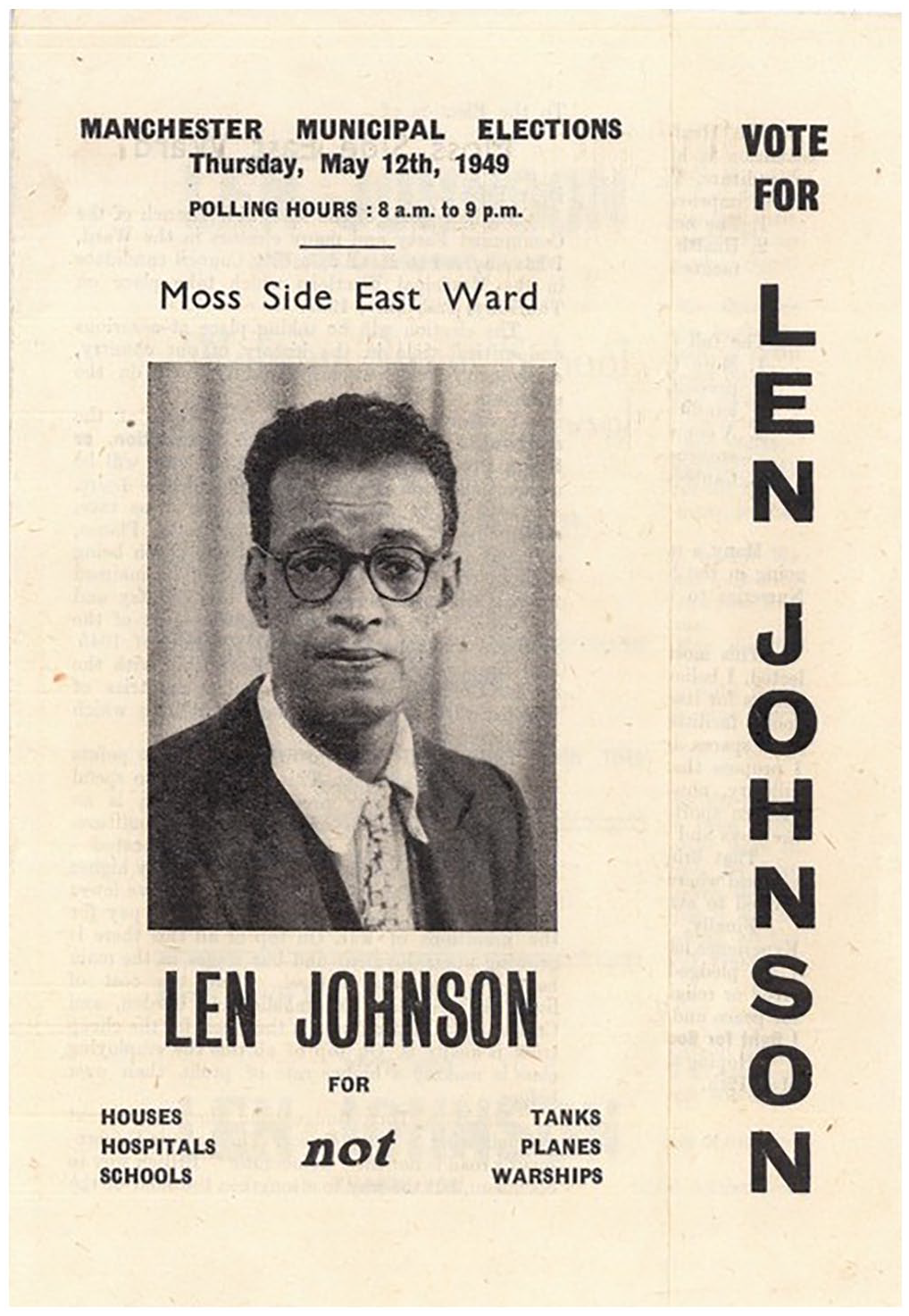
A flyer from Len Johnson’s campaign to stand in Manchester’s council elections in 1949 as the Communist Party’s Moss Side candidate. Courtesy of the Working Class Movement Library.
This party membership did not mean, however, a lack of independent or creative thinking. The clearest example of this was the founding in 1946 of the New International Society in Moss Side. The Society was initiated by Johnson with his two close comrades, Communists and working-class radicals in Manchester: Wilf Charles, a ‘young Moss Side steelworker’ and Syd Booth, a railway worker and ‘a wounded ex International Brigadier’. 49 All three of the men put their own money, £100 each, as a loan to pay for the running of a club, on Ducie Street in Moss Side, Manchester. The society’s aims were described by Johnson as ‘true internationalism, colonial liberation, peace and the ending of race discrimination’. 50 Moss Side, according to Johnson, ‘with its separate racial groups of Africans, Indians, Irish and English, and the absence of regular interaction’ constituted a breeding ground for fascist propaganda. ‘It was on this background we decided that club premises were necessary to provide a place where people of all lands could meet fraternally, thus helping materially to create greater understanding between them.’ 51 The Society organised campaigns in defence of victims of racism, like the Trenton Six in America, as well as organising and fundraising for support of ‘coloured’ children in Manchester and campaigning against separate racial lines at the Labour Exchange with a queue for ‘coloured men’ opposed by the Society. 52 In the seamen communities, the Society were also active, in 1946, organising against Manchester Liners Ltd, which had indicated its intentions to rid its liners of all ‘coloured seamen’ some of whom had served the company through two world wars. The work of the New International Society forced vociferous denials of racial discrimination and a reversal of policy. 53 Within this flurry of activity, the Society became a ‘hotbed’ for progressive people, with Black people elected to the leadership of the Club.
Paul Robeson’s visit, organised by the New International Club, was certainly its high point. As Wilf Charles remembers: ‘The culminating point of that was that Paul Robeson . . . had met Len as a boxer and promised that if he ever came to England he would appear for us and he duly did that . . . a very, very wonderful experience. . .’ 54 Yet it was also contested within the Black community in Manchester. Robeson’s huge reputation within Britain meant that many vied for his attention, and Makonnen had already written to Robeson, asking that he and the Pan-African Federation organise his visit to Manchester. When instead Makonnen was told that Robeson’s visit would be organised by Len Johnson and the Communist Party, Makonnen and his network were incensed. Makonnen wrote back and stated that Johnson in no way represented the African community in Manchester and that it was the Pan-Africanists who had the right to make arrangements for ‘our own communities’. 55 Wilf Charles remembers there was ‘a problem of some of the active Black leaders who had different political viewpoints, and with us being well know[n] Communists – a person round the corner called Makonnen who had a big café who was quite active.’ There was a picket outside the club for a short time in protest at the fact that white Communists like Wilf were part of the leadership and organisation of Robeson’s visit. Milliard wrote to Robeson’s pianist, Laurence Brown, opposing Robeson’s performance being organised by the Communist Party, a party Milliard and the Pan-Africanists by 1949 saw as being run by and acting on behalf of ‘Anglo-Saxon whites’. 56
Robeson’s association with the New International Club was a huge affront to Milliard, Makonnen and the Pan-Africanists, but it was also a huge success for the Club itself. After Robeson’s attendance at the New International Club, his big event later that evening was at King’s Hall, Belle Vue Manchester where thousands turned out to hear him sing, in what Milliard angrily called ‘a howling success as a Communist song’. 57 But as Wilf Charles remembers: ‘I can tell you of the very very exciting night when Robeson came. There were some 15,000 people there.’ 58 It was surely the Club’s biggest success, with the Society explaining at their general meeting that the visit had helped to underline their important work and had laid the basis for tremendous development of this work in the near future. 59
In the 1949 Society minutes it is noted that a new policy would be developed, moving away from the ‘narrow limits of racial discrimination campaigns to the broader aims of peace and national liberation’. 60 This new policy reflected the emerging Cold War and the national strategy of the Communist Party tied as it was to the interests of the Soviet Union. The ‘narrow limits’ of anti-racism was not viewed as a key priority for the party nationally. Moreover, with a general tightening of discipline as the Cold War intensified, the New International Club wasn’t sufficiently under party control. 61
Within this strategy, and despite all of the successes of the Society, the Club did not survive for much longer. The initiation of the Club had been undertaken by three Communist Party members, drawing on their own individual finances. Yet it was not seriously supported by the official organisation, with a report by the Society written in 1948 commenting:
The lack of Party financial liability has led to a casualness on the part of the Party leadership, which, in view of the observations of Palme Dutt on Imperialism, is a highly un-political attitude. We believe that the Party’s attitude towards the Society is one of uncertainty which should be replaced by political support, leadership and financial assistance. There is still a feeling of ‘distance’ amongst a number of comrades re Colonial affairs. We believe that it is the duty of the Party to overcome this.
62
The Party did not overcome this distancing. Without financial and more serious organisational support, the New International Society and its Club closed at the end of 1950. Johnson, however, remained politically active. The Club had been about creating and running anti-racist spaces, but Johnson continued to challenge existing ‘colour bars’ in Manchester alongside his closest comrades.
A ‘test case’
Manchester city centre was scarred by the traumatic 1940 ‘Christmas Blitz’, with nearly 700 killed in two nights of bombing. Immediately after the war most working-class Mancunians lived in overcrowded, dilapidated, infested, insanitary slum housing surrounding the centre. The areas of Hulme and Moss Side in the South of Manchester were such working-class areas where Johnson was politically active and where the New International Club had been based. 63 They were also areas where Black communities had already settled and made a sizeable presence. By 1951 there were some 2,500 Afro-Caribbeans in Moss Side, just under half of a population of 6,000 in the two Moss Side wards but still less than 1 per cent of the city’s population. 64 As Kath Locke recalls of this period in Manchester, ‘there were places you just didn’t go because you knew you wouldn’t be accepted, so to stop yourself being hurt and humiliated you just didn’t go to these places. You went to what you felt were safe areas.’ Moss Side, with its larger Black community, was safer and there were a large number of pubs here. However, Locke also added that ‘even right in Moss Side’ there were ‘colour bars’ and she recalls her father, a seaman from Nigeria, could only enter a certain section of the Denmark pub in Moss Side. 65
The Old Abbey Taphouse was another pub near the Denmark in the Greenheys estate, a small area between Hulme and Moss Side. On 1 October 1953 the Communist paper the Daily Worker headlined a brief story ‘Len Johnson turned out’, explaining that well-known sportsman and ex-middleweight Empire boxing champion Len Johnson had been turned out of a Manchester public-house, the Old Abbey Taphouse, because of his ‘colour’. The licensee had refused to serve him with a drink, saying he did not serve ‘coloured people’. When Johnson had objected to his treatment, the police were brought in and ‘on their advice he left the premises’. Wilf Charles recalled the event in an oral history testimony undertaken by the Roots Oral History project in the late 1970s:
Len . . . ordered two pints and they said we don’t serve Black men . . . I insisted they would serve him or no-one else would get served. So they brought in the police and they asked us to go – we created a tremendous problem inside the pub.
66
The actions of both the landlord and the police were not surprising here. Although pub landowners were legally prohibited from withholding entry to individuals whom they disliked personally, there was nothing in the law to stop them from excluding entire racial groups because they disliked their assumed racial characteristics. Moreover, in Britain the police force itself operated a clear ‘colour bar’, recruiting their first Black police officer in the twentieth century only in 1967 and with a culture of racism rife within the profession. 67 Manchester was no different to this national picture and a Communist Party report on Moss Side just two years before the pub incident had noted: ‘the police, having had trouble with a few gangs of spivs, are now taking to beating up and arresting coloured men’. 68
Johnson told the Communist paper afterwards that he was ‘most embarrassed . . . I have spent the greater part of my life in Manchester and this is the first time I have ever been refused a drink’ he explained. Considering Len Johnson’s political activities in this period, the focus on this pub had probably been a more political strategic focus than Johnson was to acknowledge in his quote to the paper. For one thing, Johnson himself was tee-total. The licensee said he had refused the custom of ‘coloured people’ since some of them caused disturbance a little while ago. Perhaps Johnson had been aware of this incident and the existence of the ‘colour bar’ and had selected it for this reason. The report stated widespread indignation in the Moss Side area in this attempt at creating a ‘colour bar’. The journalist noted there was ‘some 5,000 coloured people’ in Manchester, and was told ‘by one of them’, ‘It is not the only pub in Manchester which has a colour bar.’ 69 On the same page of the newspaper was a report focusing on the killing of thirty-nine Africans by British troops in Nairobi. 70 The connections between domestic forms of oppression and those being exercised abroad were not explicitly drawn, but the proximity of the articles was telling. 71
Two days later in the Daily Worker another brief article headlined ‘Pub Colour Bar is Removed – Len Johnson wins another fight’. The report explained that since Johnson had been refused a drink, he had been campaigning to overturn the ‘colour bar’. The Lord Mayor of Manchester, Alderman Moss, had sent word that he was opposed to any form of racial discrimination as had the Bishop of Manchester. Wilf Charles remembered how ‘we put on a mass picket of blacks and whites from the Communist Party and progressives − some 200 people’. 72 Four nights after the colour bar imposition and following the protests, Len Johnson returned to the pub accompanied by Councillor Collins of Moss Side West. They talked to the licensee and finally had a drink together. The report concluded: ‘The colour bar, as far as that licensee is concerned, no longer operates.’ 73 Wilf Charles remembers: ‘We campaigned then in the pubs for the freedom of people to be able to go in without discrimination and we had a big campaign against the Abbey pub in Park Street, Moss Side, who refused to serve coloured, Blacks and we forced a test case and got that lifted and that had a big effect.’ 74
The protests organised by Johnson were therefore a clear success. The action, carefully planned, could have served as a model through which the Communist Party encouraged its branches to replicate across the country. Surprisingly, however, there was no further comment on this action after the short summary in the paper. Wilf Charles, in his testimony, explained the conscious organisation that went into the campaign to overturn the ‘colour bar’. It is unlikely that Johnson stumbled upon the pub, as reported upon, and instead we might guess that the ordering of the drinks was a conscious and calculated act. But a ‘test case’, as Wilf Charles described it, implies that others will then replicate the success.
In Manchester, the next media report on the ‘colour bar’ is found in the Manchester Guardian four months later. In a substantial article, the case of two ‘colour bars’ in the Whitworth Hotel in Moss Side (what later became the Whitworth pub and is, since the pandemic, empty) and the Paragon Inn on Oxford Road in Chorlton-on-Medlock. In both places, drinks were refused to Mr Edoo, a graduate of Manchester University originally from the Gold Coast. The licensee of the Whitworth was recounted as saying: ‘We don’t serve coloured people here’, explaining afterwards, with echoes of the Old Abbey pub’s excuses, that she had ‘had quite enough trouble’. Both cases were brought to Manchester City Licensing Justices by Mr Edoo, with the support of Manchester and District Council for African Affairs and the Manchester branch of the Council for Civil Liberties. The Licensing Justices stated in response to the opposition in attendance that they ‘strongly deprecated racial discrimination in licensed houses’ yet despite listening to clear evidence that such discrimination existed in both houses, both licenses were renewed. 75
The objections made, through the official channels, clearly did not have the same successes as Len Johnson’s actions. Appealing to stop the renewal of licenses, in this case argued with elegant precision by a solid and well organised team in Manchester, produced meaningless anti-racist statements from the official institutions but no real action to stop the ‘colour bar’ from continuing. What was surprising, however, was that the Communist Party was nowhere to be seen. This was a public case on a ‘colour bar’ in a pub ten minutes’ walk away from the Old Abbey pub that Johnson and his comrades had protested outside just four months earlier. Where were the protests outside this new case, when such stark evidence of racism was being given? While the organisation was publishing written attacks on the ‘colour bar’ they failed to mobilise a sustained action against it and build on the work of individual party members in Manchester.
The Communist Party had a fraught relationship with anti-racism in practice. The national party was strongly opposed to racism in Britain in a rhetorical sense. 76 Yet, as the New International Society report sharply noted on its own organisation, the Communist Party, in 1948: ‘The major political point which is escaping many comrades at present is that the fate of the colonial peoples will decide the fate of the British workers. Abstract expressions of sympathy are useless; so are a few words at the end of the District Committee agenda.’ 77
Such ‘abstract expressions’ were found in many of the Communist Party publications. For example, in the 1954 pamphlet ‘A man’s a man – a study of colour bar in Birmingham’ the conclusion outlined what readers could do to help, with a vague statement that people should ‘take a stand against the colour-bar and the spreading of racial prejudice’. There were no strategies laid out on how to take this stand, nor were specific examples of resistance highlighted, like that of Len Johnson’s activity just a year earlier. 78 Similarly, a 1955 party pamphlet on the ‘colour bar’ again argued strongly against discrimination and welcoming colonial immigrants to Britain. Yet again, within the publication there was no direct movement calling to protest the ‘colour bar’, and Johnson’s concrete example was never cited. 79
By 1957, the party had developed a ‘Charter of Rights for coloured workers in Britain’. Yet as Marika Sherwood notes, despite the positive steps made by the Party with publications, the propositions made by the Party were vague and ‘while advocating action, sadly did not indicate what form that action might take’. 80 While rhetorically opposed to racism and with some of the best Black anti-racist fighters in the organisation, it did nothing to shift its activity in a serious way to concrete anti-racist practice. Len Johnson and other important Black activists like Claudia Jones were Communist Party members in Britain, but their actions were not always supported nationally by the organisation.
There was then a sharp contradiction in the Communist Party’s position in Britain. While their members in Manchester were some of the best anti-racist activists, their national strategy lagged behind. As Evan Smith argues, the Communist Party in this period still viewed the Black presence in Britain solely through the context of colonialism, unwilling to seriously respond to new struggles against racism within Britain itself. 81 Satnam Virdee explains this neglect through an understanding of the Popular Front policy in the 1930s, through which the party’s politics were increasingly within a national mould, a ‘British road to Socialism’ so to speak. Yet in marrying its socialist project to British nationalism it ignored the danger that in the popular imagination the nation had been comprehensively racialised since the mid-Victorian period. Consequently, when it came to challenging such racism, the Communist Party found itself in a bind of its own making since it located its socialist project on the same ideological terrain of the nation and the ‘British people’ as the racists. 82
Forgetting and remembering
By the 1960s a new wave of protests had emerged in response to the ‘colour bar’ in Britain. In Leicester this movement was sparked off by opposition to a ‘colour bar’ policy in a new coffee bar in 1959, with a concerted protest movement developing out of this and led by the students in the city. These protests against different ‘colour bars’ in Leicester would continue into the 1960s. 83 In London, too, the 1960s saw a wave of protests against the ‘colour bar’ of which the most famous was based around the Dartmouth Arms in Forest Hill. Waters’ work explores these sites of exclusion as well as the corresponding Black-led staffed pubs which began to emerge in early 1960s London. 84 The most famous resistance against the ‘colour bar’ was in Bristol with the Bristol Bus Boycott of 1963, following the refusal of the Bristol Omnibus Company to employ Black or Asian workers. 85 The resistance was given a temporary organisational framework through the Campaign Against Racial Discrimination, which between 1964 and 1967 lobbied for race relations legislation and published material for local groups with concrete advice on how to expose ‘colour bars’ in different sectors. 86 A student CARD conference, held in Hulme Hall in Manchester, 1966, called for a ‘National Testing Project’ to expose the ‘colour bar’ further. 87
Meanwhile in British law there was no reference to racial discrimination and the only attempts to outlaw such discrimination came from individual MPs, most persistently from Fenner Brockway, in the form of Private Members’ Bills in the 1950s. In 1954 Prime Minister Churchill was asked what measures he intended to introduce to combat the ‘colour bar’. His response was typical of the parliamentary discussions over race in this period, stressing British superiority as well as a ‘colour blind’ approach. ‘The laws and customs of this country upon this subject are well known’, Churchill replied. ‘I am advised there is no need for new instruction.’ 88 Perhaps Churchill had forgotten his own intervention into boxing a few decades earlier. 89
All of these cumulative actions opposing the ‘colour bar’ were important in forcing the government to push through legislative change in the form of successive Race Relations Acts from 1965 onward. 90 Regardless of the limitations of this legislation, there is a huge one sidedness in research focusing on the legislation and policy changes, with far less written on the politics of resistance by ordinary people in opposing discrimination prior to this legislation. In recovering a small part of this anti-racism in Manchester, the article has attempted to show the significance of these struggles and the transformative implications for British politics. Far more research is needed on the interconnections between different local centres and the organisation networks that shaped these varied forms of resistance undertaken against the ‘colour bar’.
In Manchester, the actions Johnson had led were still rooted in an ‘old guard’ of political activists in Manchester and had not sufficiently engaged with the new wave of Black migrants in what is now referred to as the Windrush generation. As a Communist Party note observed when writing on the New International Society, Len Johnson as Secretary was widely popular and had quite a considerable influence due to his fight for the ‘coloured people’ especially against ‘coloured’ discrimination at the local Labour Exchange. Yet he had been asked by the Party to do more than he was able to do, the document noted, adding: ‘He is the natural leader of the Manchester born coloured people, but those who have come to Britain fairly recently and expect to go home again look for leaders among themselves.’ 91
For the most part, those recent arrivals did not return to the Caribbean but instead made Manchester their home. They had been officially welcomed by the British government when labour shortages made this position expedient. Yet by the 1960s new forms of racism were being articulated from above. A new generation of Black activists would take up the fight that Johnson and others had laid the foundations for in Manchester. The struggles moved in different directions, with focuses on education, housing and police racism. Yet key Black activists in Manchester acknowledged the work of earlier Black people in informing their own resistance. Kath Locke, for example, a significant Black activist in Manchester from the 1960s onward, in her writings on Black people in Manchester, stressed the longer roots of Black activism as central to the struggles she and others were part of in Moss Side, Manchester. A network of people who had ‘faith in Black people’, as she put it, were central to developing a pride and confidence in Locke and others in Manchester. 92
Those memories of Black activism and Len Johnson were kept alive through traditions of resistance in Manchester. But they were, and still are, histories removed from the official education system and public heritage within the city. 93 In 2019, the authors of this article, on reading the two reports covering the pub protest, contacted the Old Abbey pub. The Old Abbey was situated within Greenheys, a now lost estate near Hulme. It was a working-class, slum area in the 1950s and much of the area was cleared with the demolition of Hulme under Manchester City Council’s slum clearance programme. 94 The Old Abbey pub is now one of the only pubs that still remain from the area, although the management of the pub has completely changed. We shared the history of the ‘colour bar’ and the resistance to it with the pub management, of which the owners had no prior knowledge. They were excited about this history and wanted to acknowledge the darker history of exclusion as well as celebrating Len Johnson and anti-racist struggle. In collaboration with the pub, we organised history workshops within the pub to share this history and learn from each other. Some of Johnson’s relatives attended the event, as did Jarreau Benjamin, the actor who had played Len Johnson previously. Inside the pub we stuck up images of Johnson and newspaper cuttings, to form a mini exhibition so people could learn about this history. 95
In 2020 George Floyd, an African American man, was murdered by the police in Minneapolis. Major protests responded to the injustice and a global movement grew around the slogan of Black Lives Matter. In Britain, there were huge protests in anger at the murder of George Floyd but also in opposition to the racism endemic to this country. Many of the placards read: ‘Britain is not innocent’. With the fall of the Colston statue in Bristol and a more public focus on statues of slave traders, people also began to ask: where are the public histories of Black Britons?
Within this context, Johnson’s story found a new audience. A petition was launched in 2020 calling for a new statue to celebrate Johnson’s life in Manchester. 96 The Moss Side Fire Station Boxing Club in 2021 awarded their first Len Johnson Community cup. 97 The Old Abbey pub commissioned a mural to remember Johnson’s legacy and the breaking of the ‘colour bar’ there. A regular music night was launched in 2021 ‘Breaking Barz’ which celebrates Len Johnson’s resistance and promotes local Black music acts. An annual ‘drink for Len’ is now organised every October in the pub. Through a new anti-racist social movement, Len Johnson has been rediscovered in Manchester.
Lamin Touray is a young Black Mancunian, an activist and member of Moss Side Fire Station Boxing Club, who took up the campaign to remember Len Johnson and now runs the regular music nights ‘Breaking Barz’. Touray explained to the press: ‘He’s relatively unknown in Manchester and relatively unknown in the UK. He should be a national treasure. He’s had nearly 130 fights, winning 93. He is essentially the British Muhammad Ali − so the fact that we don’t know who he is, it’s shocking. He was a fighter in and out of the ring and I think that’s what’s really important to remember.’ 98 At the pub event to remember Johnson, Touray explained that as a mixed-race child with a love of boxing, growing up learning about Johnson would have changed his relationship to the city. Instead, Johnson’s history has only recently been publicly acknowledged and Touray is leading the way in this remembrance work, challenging what histories the city tells of itself and amplifying a different past to reframe the identity of Manchester.
In writing this brief history, we have attempted to contribute to this work, piecing together what we could find from diverse sources. The research has demonstrated both the activity of Black activists in post-war Manchester as well as the traditions of resistance which informed and shaped anti-racist action and the city itself then and now. But, as Sheila Rowbotham wrote on the socialist feminist history she published in the now classic ‘Hidden from History’, we are aware we are only turning up the top soil, in the hope that others will dig deeper. 99 The Black Lives Matter movement has made many of us ask different questions of our past. The results of this questioning, the radical Black histories within Manchester and across Britain, are only just beginning to appear.
Footnotes
Shirin Hirsch is a historian at the People’s History Museum and lecturer at Manchester Metropolitan University. She is author of In the Shadow of Enoch Powell (Manchester University Press, 2018) and has recently written on photography and the Moss Side riots. Geoff Brown, based in Manchester, is working on a history ‘from below’ of the Anti-Nazi League 1977-1981. He recently co-wrote (with Christian Hogsbjerg) Apartheid is Not a Game: remembering the Stop the Seventy Tour Campaign.