




Abstract
This article details the extensive security regimes deployed against Black Power in the Caribbean that were operated by regional governments and the (neo)colonial British state. These regimes of securitisation targeted radical Black political groups and actors whose Black Power ideology placed them in an antagonistic relation to independent West Indian states and Britain. The author argues that the British state’s involvement in the suppression of Black Power in the Caribbean is inseparable from the domestic repression of the British Black Power movement. But also, shared opposition to British (neo)imperialism and the personal ties of West Indian migrants to Britain connected Black Power resistance on both sides of the Atlantic. By drawing on British Foreign & Commonwealth Office, Ministry of Defence and Cabinet Office files, as well as political newspapers and publications produced at the time, the author traces the British state’s involvement in the transnational repression of Black Power in the late 1960s and early 1970s.
Keywords
Introduction
In August 1962, the epoch of West Indian self-government began after Jamaica and Trinidad and Tobago declared independence from Britain. By 1970, Guyana and Barbados would also be independent, with many of the smaller island territories of the Eastern Caribbean set on a trajectory towards formal decolonisation. However, by the end of the 1960s nationalist enthusiasm was on the wane. In significant sections of the West Indies’ population, nationalist optimism was replaced by frustration with nationalist regimes that had failed to fully break with the coloniality 1 of pre-independence life and governance. 2 It was in this context that Black Power emerged in the West Indies as a serious political challenge to the region’s nationalist regimes.
Black Power, as expressed in the West Indies, erupted into the region’s popular consciousness in October 1968 following the ‘Rodney Riots’ in Kingston, Jamaica. This urban insurrection began as a protest march instigated by University of the West Indies (UWI) students following the banning of Guyanese intellectual, Black Power theorist and African historian Walter Rodney from Jamaica. Violence and rioting broke out after the protestors were subject to police attacks. Following the unrest, the Jamaican Labour Party government deployed army units to place the UWI Mona campus under a ten-day siege. 3 The Rodney Riots heightened political consciousness around Black Power in Jamaica and the wider Caribbean. From this political ferment, the Jamaican publication Abeng 4 emerged in 1969, which attempted to direct popular energies towards a social and political movement around Black Power ideals. 1969 also saw the hosting of the First Regional International Black Power Conference (First BPC) in Bermuda, popularised largely by Pauulu Kamarakafego, a Black Bermudian politician, Black Power activist and international anti-colonial campaigner. 5 The Conference attracted Black Power and aligned attendees from across the globe, inspiring a flowering of Black Power activity across the West Indies.
In this context of an ascendant Caribbean Black Power movement, events in Trinidad in the early 1970s took centre stage. From late February to May 1970, increasingly large protests gripped Trinidad’s capital Port of Spain, which became known as the Black Power Revolution 6 as tens of thousands of protestors became allied with radical unions. By mid-April, the Trinidadian government declared a state of emergency with strike action threatening to cripple strategic sectors of the economy. Events came to a head on 25 April when an army mutiny led by radical young officers threatened to bring down the government. Eventually, order was restored as US warships and marines stood off the coast and the Black Power Revolution collapsed in the face of the re-assertion of state power.
Britain too was implicated in the repression of Black Power in the Caribbean. And this has to be understood in relation to domestic UK policing and intelligence operations. By drawing on Foreign & Commonwealth Office (FCO), Ministry of Defence (MoD), and Cabinet Office files, I examine how security regimes were operationalised in the repression of Black Power by the British state in the Caribbean during the late 1960s and early 1970s, in order to draw out the transnational dynamics of state repression deployed against Black Power groups.
While I mostly examine the Anglophone islands which had gained independence from the ‘Mother Country’, I include Bermuda (still an Overseas Territory) since it was a locus for the organisation and coordination of Black Power in the Caribbean and North America more widely. This was most clearly demonstrated in the hosting of an International Black Power Conference on the island in 1969 that drew attendees from across the West Indies, USA and Canada – seen as directly inspiring increased Black Power activity in the West Indies by British security services. 7 Whilst the empirical work in this article remains confined to the Anglophone Caribbean, that does not mean that Black Power had no impact in the non-Anglophone Caribbean. On 30 May 1969 a riot broke out in Willemstad, capital of Curaçao in the Dutch Antilles, led by striking Shell oil-workers and unemployed youth. Gert Oostindie’s study of these events notes that the radicalism of West Indian Black Power added to the ferment in Curaçao. 8 Black Power seemingly had little impact on the Francophone Caribbean, although Black French Antillean thinkers such as Aimé Césaire and Frantz Fanon were intellectual progenitors of Black Power thought in the region.
The ideological basis for the repression of Black Power
Relations between post-colonial regimes and Black Power protagonists
A core grievance running throughout West Indian Black Power thought and action was an assessment that independence from Britain had been wasted by the region’s new national governments. In Walter Rodney’s highly influential text The Groundings with my Brothers, he provides a three-point definition of what Black Power meant in the West Indian context:
Black Power in the West Indies means three closely related things: (1) the break with imperialism which is historically white racist; (ii) the assumption of power by the Black masses in the islands; (iii) the cultural reconstruction of society in the image of the Blacks.
9
Rodney – writing in 1969, seven years after the first states of the West Indies became independent – offers Black Power as the solution to the failures of establishment West Indian nationalist politics. Independence had failed to sever transnational ties of White racist imperialism; had failed to hand meaningful political or economic power over to the racialised mass population of the region; and had failed to bring about a re-evaluation of societal and cultural norms which denigrated Blackness and valorised Whiteness.
The exploitation of Black labour
Rodney’s critiques were reproduced in the publications and political-economic analyses of Black Power groups in both the West Indies and Britain. Another central grievance was the exploitation of Black labour and the role of Metropolitan capital, which was seen most clearly in the foreign ownership of land and resources in the West Indies. In Jamaica, the Black Power publication Abeng drew attention to the domination of the Bauxite mining industry 10 by four North American companies and the 200,000 acres of good agricultural land owned by predominantly British sugar companies. 11 These examples demonstrated how ‘real power is still in the hands of foreign white people who own our [Jamaican] basic resources’, 12 resulting in the super-exploitation of Black labour in Jamaica and the reduction of the politics of constitutional independence to being ‘purely decorative and [having] no real function’. 13
This analysis of the capitalist-imperialist exploitation of Black labour in the Caribbean found a corollary in Britain. The Black Liberator, a magazine instigated by, amongst others, the Black Unity and Freedom Party’s Ricky Cambridge,
14
featured an analysis of the super-exploitation of Black labour in Britain by White capital:
‘In a survey conducted in the Lambeth area it was found that on average a black worker gets £2.50 per week less than a white worker doing the same type of job.’
15
[emphasis original] When this is extrapolated out nationally: ‘the extra exploitation of black workers amounts to £130 millions each year! This is the internal super-profit made by the British imperialist ruling class at the expense of the black workers in Britain’.
16
[emphasis original]
Black Power groups in the West Indies and Britain shared opposition towards the exploitation of Black labour by British capital, with the oppression of Black workers in Britain and the Caribbean linked by the imperialist character of the British ruling class. A ruling class that, as in the case of British-based Tate & Lyle (the leading sugar refining company), could give orders to the Jamaican ‘slave government’ 17 that reproduced conditions of Black dispossession in Jamaica ‘as [had] happened since the first white man forced himself on this island’. 18
Foreign policy and anti-imperialism
Foreign policy and international alignment were also consistent points of antagonism between the West Indian Black Power movement and post-independence governments, as exemplified in Trinidad and the relationship with the Oilfield Workers’ Trade Union (OWTU). The OWTU was the largest and most powerful union in Trinidad and, under the radical leadership of George Weekes, was at the forefront of anti-government protests throughout the 1960s culminating in the union’s participation in the 1970 Black Power Revolution. The union’s official organ The Vanguard regularly published articles supporting Black Power and Darcus Howe, who was later a prominent Black activist figure in the UK, was the paper’s deputy editor in 1969. 19 The OWTU and The Vanguard reported on and condemned the British invasion of Anguilla in 1969. Following a unilateral secession on the part of the Anguillan people, British marines were sent in to ‘restore order’. This was backed by regional governments, as reported in The Vanguard: ‘[Britain] obtained the support of the premier of St. Kitts, of other Associated States, and of the independent Commonwealth Governments for taking the necessary steps to restore constitutional rule.’ 20 West Indian nationalist governments sided with British imperialism in the repression of Black political expression and self-determination, demonstrating the reliance of regional governments on British imperial military power and security forces in quelling internal dissent. Black Power groups in Britain responded to the British intervention in Anguilla, as shown in an ironic cartoon suggesting future Caribbean ‘holidays’ for would-be British police officers (see Figure 1).
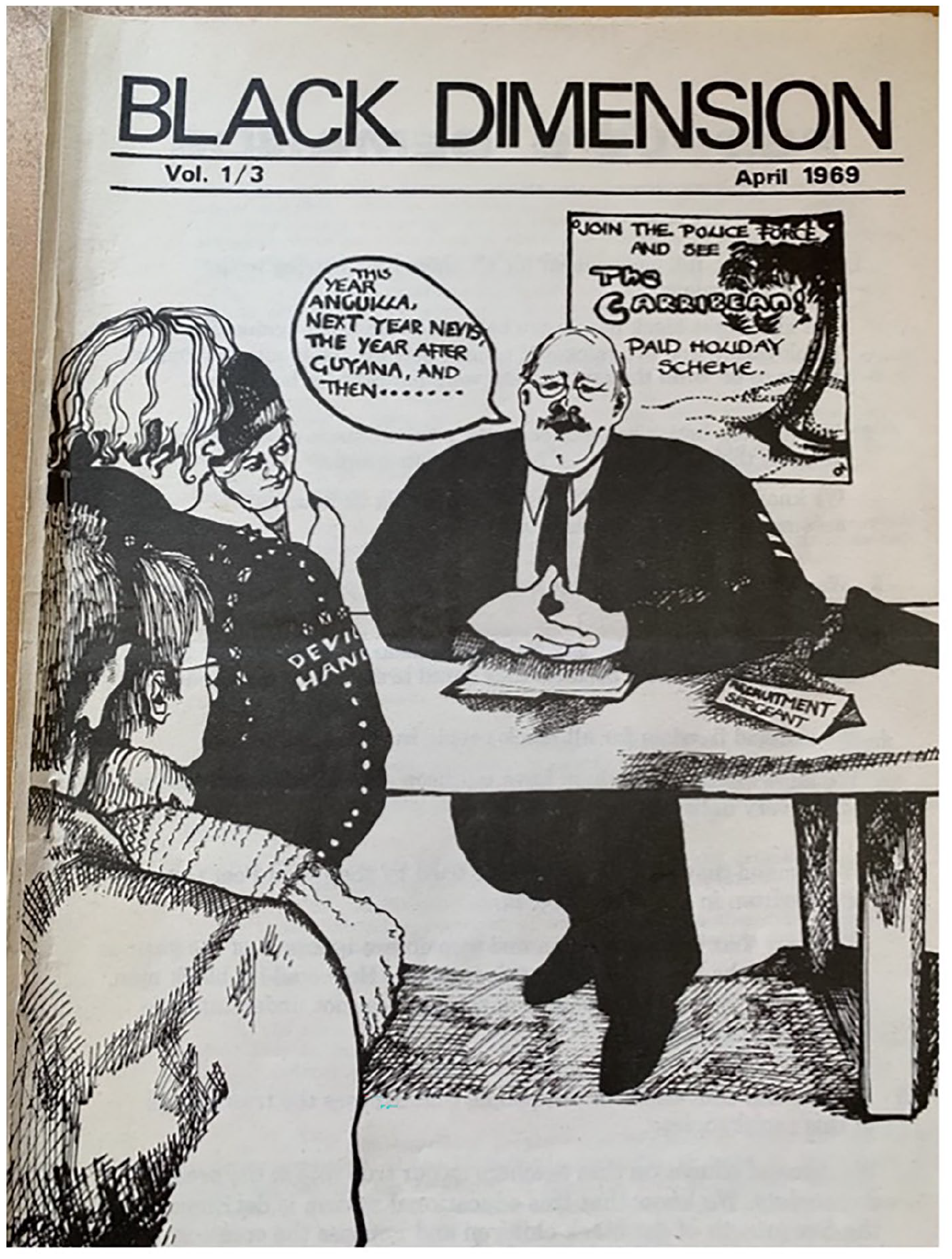
A political cartoon in Black Dimension. 21
The politics of Black Power in the West Indies and Britain outlined above was the basis for the transnational state repression of the movement. Black Power actors in the West Indies saw the continued dominance of Metropolitan capital in the region post-independence as undermining national sovereignty and perpetuating relations of colonial class and racial exploitation. Such a position was clearly antagonistic to the region’s nationalist regimes and national bourgeoise who agreed to the independence settlements and directed national policy that maintained such relations of dependence. 22 Black Power organisations such as Abeng clearly understood the role of Metropolitan imperialist powers, such as Britain, and saw the capitalist-imperialist interests of the British state in the region as oppositional to those of West Indian Black Power. Indeed, this transnational race-class analysis was shared with British Black Power groups who saw that structural racism and police repression of Black communities in Britain rested on the super-exploitation of Black labour in Britain. 23
The anti-imperialism of Black Power in the West Indies and Britain produced sharp antagonisms with British policy and with local Caribbean state actors who were aligned with imperialist powers such as Britain. A willingness to confront the state and state security forces directly marked out Black Power groups as threats to internal security – clearly demonstrated during Trinidad’s Black Power Revolution. In Britain too, Black communities regularly engaged in acts of self-defence such as mobilisations in support of the Mangrove Nine and the Metro Four, and adopted a militant stance of direct action as exemplified in the Spaghetti House siege of 1975. 24 In response to such radical politics, Black Power movements in Britain and the Caribbean were repressed, as explored below.
Britain’s strategic role in countering Black Power
In 1969, the Defence and Overseas Policy Committee of the British Ministry of Defence (MoD) produced a report entitled ‘British Policy in the Commonwealth Caribbean’, which discusses Britain’s security responsibilities in the West Indies.
25
In an analysis of ‘ideological dangers’, it notes that ‘Black Power is beginning to make an impact’ and that the Commonwealth Caribbean required ‘external help and influence’ in combatting security threats such as Black Power.
26
The report recommended:
The most effective means of countering existing threats to internal security lies in strengthening local Police forces and Special Branches, and improving co-ordination of security intelligence within the region.
27
This report gives an overview of the strategic place of the Caribbean. Discussing the smaller islands of the Eastern Caribbean, that at this time largely remained Associated Territories or Dependencies, the report states:
Particularly in the smaller territories the Police Forces have been unequal to the task of ensuring security, and of providing early warning of disorders. The Islands themselves have been unwilling to devote sufficient resources to expenditure on Police.
28
This situation was partly remedied:
the security intelligence organisation is being improved; more efficient arrangements have been made for the collection of secret intelligence; and a Special Branch Adviser and a Police Adviser have been attached to the Associated States.
29
The continued development of this security intelligence programme was estimated to cost ‘£1 million over at the most three to five years’. 30 The extent of British involvement is no surprise as the UK retained responsibility for the defence and external affairs of Associated Territories and the defence and internal security of Dependencies. The presence of British security infrastructure and personnel across these islands would be essential in countering Black Power in the Caribbean.
Regarding the four independent states of the West Indies in 1969 (Jamaica, Trinidad and Tobago, Guyana, Barbados) the MoD report notes that whilst there were no formal defence commitments to these states, British aid and influence was necessary to maintain regional stability; ‘the real danger is that without external help and influence, the Commonwealth Caribbean will be unable to develop its economies and institutions and will become increasingly ramshackle, thus inviting discontent and exploitation’. 31 Britain would have less of a direct role in intervening in the internal affairs of the independent states and would instead help oppose Black Power through coordinating and sharing information, offering advice and providing training and materiel.
Circulating information and ‘advising’ foreign governments
The Foreign & Commonwealth Office (FCO), and in particular its Information Research Department (IRD),
32
was essential for the gathering and circulating of intelligence on the activities of Black Power groups and activists in the Caribbean. The IRD often produced anti-Black Power propaganda aimed at repressing the movement, as discussed in a 1971 telegram:
We first became responsible in the FCO for collating, assessing and where necessary countering by publicity and other means the growth of Black Power in the area during the run-up to the First Regional Black Power Conference.
33
The IRD was reliant on British diplomatic and security personnel in the region for these efforts. The IRD produced an annual report on Black Power in the Caribbean that was ‘distributed to posts for background information and for use in briefing trusted journalists’. 34
An example of such intelligence work can be seen following the collapse of the Black Power Revolution in Trinidad, when an exchange of telegrams between the British High Commission in Port of Spain and the FCO in London reflected on events. In discussing how British involvement could have better averted the mass mobilisations around Black Power, the High Commission gave the FCO ‘advance notice that we are giving thought to the ways in which we ourselves could use IRD services to help prick the local Black Power balloon’. 35 It was believed that the IRD’s services could be of use because ‘in the seven weeks . . . between the first big Black Power demonstration on the 26 February and the declaration of a state of emergency on 20 April, it was evident that no co-ordinated attempt was being made by the Government to use the media against the movement’. 36 These reflections were instigated by a suggestion from a G. F. N. Reddaway at the FCO that an Information Advisor should be sent to Trinidad to use the media to ‘expose and frustrate the subversive plans of the dissidents’. 37 The man suggested for the job was A. C. Ashworth, who had previously been an Information Advisor in Aden and was at that time a Research Information Officer in Hong Kong. 38 This trans-imperial circulation of British security officers is indicative of the ways colonial policing efforts were replicated across the empire and would ultimately feed into domestic policing of racialised subjects. 39
Ultimately, neither Ashworth nor any other Information Advisor was despatched to Trinidad as it was thought the presence of a white, British ‘counter-subversion’ expert might inflame tensions. The IRD was still willing to help, however. The first suggestion was the establishment of a ‘very small group of “experts”’ 40 on Black Power in the IRD offices in London, based on the knowledge the department had gathered on Black Power. From here, ‘it would be perfectly possible for one or other of these “experts” to visit our posts, for whatever length of time is appropriate, as and when the need arises’. 41 It was also suggested that the IRD provide information to Trinidadian Special Branch in their efforts to produce counter-subversive propaganda materials. The Trinidadians ‘had been circulating anonymous pamphlets against Black Power, one of which was attributed to “the Death Court”’. 42 These suggested actions came at a time when the FCO Security Liaison Officer in Port of Spain had ‘received a request from the Prime Minister [of Trinidad and Tobago] for certain documentation about subversive movements in the Caribbean and that is now being made available to him’. 43 The documentation provided to Prime Minister Eric Williams would come from FCO security personnel in the Caribbean and collated by the IRD in London.
Transnational surveillance
However, the involvement of the British state in the repression of Black Power in the Caribbean extended beyond advising foreign governments. A key strategy was the tracking of individuals in their travels around the region and beyond.
For example, the transnational travels and meetings of Pauulu Kamarakafego, a lead organiser of the 1969 First Regional International Black Power Conference (First BPC) held in Bermuda, were tracked extensively by security services in Britain and the Caribbean. An FCO report on Kamarakafego’s activities in the run-up to the First BPC stated that ‘it was thought wise to identify his contacts in the various places he visited’ where he sought support and delegations in the run up to the conference. 44 This surveillance work was conducted by the Special Branches of independent West Indian states, as well as Territories and Dependencies, before being collated and distributed by the FCO. As the FCO report ‘Proposed Regional Black Power Conference’ explains; ‘Owing to the full coverage provided by the Special Branches in the area much information has been received about his [Kamarakafego’s] activities and contacts’. 45 These Special Branches would infiltrate Black Power meetings to report back on discussions to British authorities and, as in the case of Jamaican Special Branch, 46 pass on Kamarakafego’s passport information to the FCO to track his travels.
During his travels ahead of the conference, Kamarakafego toured Mexico, Cuba and Canada, but it is Kamarakafego’s travels in the West Indies that are documented most extensively. Kamarakafego’s activities were tracked meticulously by the various Special Branches of the islands he visited, with particular interest paid to the Black Power contacts he made. This surveillance was intense – even Kamarakafego’s visit to a schoolmaster in Basseterre, St. Kitts whilst he was visiting relatives was reported on. His time in Dominica garnered particular interest from the security services, especially his meetings with a Hakim Gordon and a Michael Pollydor who set up a Black Power campaign on the island after Kamarakafego’s visit. Revealing the depth of information that West Indian Special Branches and the FCO were gathering, the report notes that both men had previously travelled to Africa – Pollydor’s previous address in New York was provided as well as his passport number, and the fact both men wore ‘African dress’ was also recorded. 47 Dominican Special Branch also infiltrated a meeting held by Gordon and Polydor at the Dominica Grammar School on 7 March 1969 at which Pollydor was said to have claimed he would lead a ‘Mau Mau type revolution in these parts’ after he had returned from the First BPC. 48 Information was further gathered on: Kamarakafego’s time in Cuba and FCO’s concerns of Cuban financing for the conference; Kamarakafego’s meetings with Black Muslims in Guyana; and a range of Black Power groups and movements formed across the Eastern Caribbean in the wake of Kamarakafego’s visits. 49
The report which contains the above information laid out a specific security strategy to be deployed in an effort to contain the First BPC. The FCO desired that ‘as much information as possible’ should be gathered on potential conference delegates and that this information should be systematically circulated around Eastern Caribbean police and security forces and FCO commissions. This information would include:
[Delegate] names, and those of the organisations (if any) which they represent . . . whether foreign money is being used to finance them . . . [and] confirmation of the reports that disturbances are planned after the conference
50
The FCO provided a strategic communications service for the local security services and state authorities in the Eastern Caribbean by circulating information and, in many senses, ‘connecting up’ the reports from the police services of the various islands together into a broader regional strategy. This pooling of intelligence on potential Conference delegates extended beyond the Caribbean too. Papers from the British government’s Cabinet Joint Intelligence Committee (JIC) on the topic of the First BPC reveal that ‘the FBI, CIA and Canadian Intelligence Service have been consulted’ 51 in efforts to produce the names and background information on potential attendees.
Restricting transnational travel
The meticulous tracking of Kamarakafego’s movements in the run-up to the First BPC was used to restrict his transnational travels. During his tour of the Caribbean and North America in Spring 1969 he was barred from entering the Cayman Islands in March – undoubtedly to prevent the networking and publicising ahead of the First BPC he would go on to do in other Caribbean islands. 52 It wasn’t just Kamarakafego who was subject to restrictions on his movements and political activities. The attendance of many non-Bermudians at the First BPC was actively blocked by local colonial and British security forces who produced a ‘stop-list’ that prevented known ‘militant extremists’ 53 from entering the territory. Names on this list were gathered through the collaboration of the Bermudian government, CIA, MI5, MI6 and Interpol. 54 In April 1970, Geddes Granger and Clive Nunez, leaders of Trinidad’s Black Power Revolution, were also barred from entry into Barbados. 55 The pair were seeking regional support for their efforts in Trinidad but the Barbadian government at that time was about to revoke its backing for a Second Regional International Black Power Conference, organised by Kamarakafego following the first Conference in 1969, due to the explosive events in Trinidad and fear of destabilisation in Barbados. These restrictions placed on the travels of ‘subversive’ Black Power figures rested on the coordinated intelligence gathering and sharing discussed in the previous section in which British state involvement was essential.
Anti-Black Power propaganda
The FCO and MoD also developed a psychological operations programme in Bermuda in co-operation with the colonial government on the island. Such an operation was suggested before the First BPC in 1969 but would only really come into effect in 1970. In the MoD’s planning for the policing of the First BPC, which involved the deployment of British troops to Bermuda for the duration of the conference, a report was produced entitled, ‘Some Past Recommendations on Psychological Operations Support’. The report details previous psychological operations in various mid-twentieth century colonial and imperial conflicts; from the Kenyan ‘emergency’ through to US and Australian experiences in Vietnam. An extract of a British general’s assessment of the joint British and French intervention in Suez in 1956 on the purpose of psychological warfare concluded; ‘it must . . . put into effect broadcasting, leaflet printing, insertion of articles in newspapers and every “medium” which will be required in war.’ 56 These activities were put into effect in Bermuda and employed more widely across the Caribbean, as seen in Trinidad post-Black Power Revolution when the island’s Special Branch circulated anti-Black Power pamphlets. In Bermuda following the First BPC, a militant Black Power group emerged on the island named the Black Beret Cadre which was to be the target of psychological operations. 57 In May 1970, an IRD officer arrived on the island to conduct the campaign. This involved feeding positive news stories on the island’s colonial government to the amenable white-owned television channels and major newspapers, as well as the IRD officer placing anti-Black Power letters in the press using various pennames. Through these means, the Bermudian populace was subject to a barrage of anti-Black Power propaganda that painted the movement’s adherents as violent, ignorant and lazy.
Policing Black Power in Britain
The considerable outlay of time, resources and manpower that went into policing Black Power in the Caribbean was mirrored in Britain. There were numerous links between the British and West Indian Black Power movements. Trinidadians in Britain such as Darcus Howe and Althea Jones-LeCointe were active in Black Power politics in both Britain and the West Indies – their political agitation was continuous across spatial and territorial boundaries as was its repression. Howe returned to Trinidad in April 1969
58
and participated in the original protest in February that sparked the revolution – a protest in solidarity with West Indian students in Montreal facing trial for property damage after they had occupied university buildings in the city.
59
Leader of the British Black Panther Movement Jones-LeCointe also connected Black Power politics on both sides of the Atlantic. Her younger sisters Beverley and Jennifer were members of the National Union of Freedom Fighters (NUFF), a Focoist guerrilla group that emerged from the 1970 Black Power Revolution in Trinidad and sought to wage a revolutionary guerrilla war.
60
In 1973, Beverley was killed in a firefight with soldiers whilst Jennifer was captured alive. In the UK Freedom News covered the killing of Beverley Jones and the arrest of her sister Jennifer in September 1973, claiming that Jennifer’s life was in danger whilst in police custody due to the violent ways in which the Trinidadian police and Defence Force pursued the NUFF, and called on:
Black people in Britain . . . [to] campaign for the release of all political prisoners of the Caribbean regimes and organise to fight, and to bring to public attention at all levels what is happening in the West Indies.
61
Personal ties to the Caribbean and experiences of state oppression in both the Caribbean and Britain spurred Black Power activism that was internationalist in outlook, beyond leadership figures such as Howe and LeCointe-Jones. The newsletter of the Black Radical Action Movement (BRAM) reported on the response in Britain to Walter Rodney’s banning from Jamaica in October 1968. On Monday 21 October a demonstration was held outside the Jamaican High Commission in London with protestors occupying the building. From here, the protestors moved to the Jamaican Tourist Board and again occupied the site until being evicted by the police. After being evicted, protestors were ‘placed on the sidewalk, some for less than a second, and were then arrested and charged for obstructing the pathway. 13 brothers and sisters were arrested’, providing an insight into the policing of Black protests. 62 A further protest on Saturday 26 October targeted the Jamaican High Commissioner’s home in London.
Resistance and repression of Black communities in Britain
Black Power groups in Britain also confronted the police and state power in a more direct fashion. In August 1970, Jones-LeCointe and Howe led protests against police harassment at the Mangrove restaurant in Notting Hill, London. The restaurant itself was owned by Trinidadian Frank Crichlow, and by the late 1960s, had become a centre for Black radicals to meet. The protest drew an interracial crowd of around 150 people who marched to local police stations to protest and demonstrate anti-racist solidarity in the face of police oppression. Some 705 Metropolitan police officers were made available on the day to police the march alongside Special Branch officers who were ordered to follow the demonstration. 63 Chris Johnson notes that plain-clothes officers infiltrated and trailed the march with unmarked vans and surveillance cameras. 64 After reports of police provocation, violence between police and protestors broke out leading to the arrest and subsequent trial of the ‘Mangrove Nine’, including Jones-LeCointe and Howe. The considerable manpower, intelligence efforts and resources devoted to policing this incident is reminiscent of the deployment of British troops to Bermuda for the First BPC and, as demonstrated above, Special Branches in the Caribbean and British security services frequently infiltrated Black Power groups and meetings.
The Mangrove protests did not stand in isolation – Black militancy in Britain was often met with intense police and state repression. The Metro 4 saga is illustrative here. On 24 May 1971 two policemen attempted to arrest two Black boys whom they claimed were assaulting each other with sticks – the boys and the wider Black community would later say they were simply playing. The two boys ran into the West London Metro Youth Club to avoid arrest and the police were barred entry by the predominantly Black club-goers. The Metro Club was a scene of persistent police harassment and this blocking of the doors represented community resistance and self-defence. An enormous police siege of the club then ensued, which Tony Mohipp of the Black People’s Information Centre described in an interview published in The Black Liberator in 1972:
The superintendent [in charge of the siege] radioed for assistance from other parts of London. And these heavy squads – the Special Patrol Groups, the strong arm boys from all over – came from as far afield as Leytonstone. Hundreds of policemen were outside of the Club. There were dog handlers as well.
65
The siege ended when the club-goers were persuaded to leave peacefully and one boy was arrested for the original charge of assault. A few days later, four young men, known as the ‘Metro 4’, were arrested and charged with serious crimes ranging from assault to affray. Affray is a crime against the state and thus a very serious charge that was often levelled against Black people at this time in Britain. As Mohipp explained,
This . . . is the charge on which they tried to get the Mangrove 9. They seem to be using it quite a lot for us. Someone in the Public Prosecutor’s office must be either very much in love with his law books or with the black community. Every bloody thing is an affray. Why not treason? He should try that next time.
66
The targeted racism of the British court system supported and saw through the violent policing of Black communities in Britain. The ‘Metro 4’ would ultimately be acquitted of all charges following a trial at the Old Bailey. Freedom News, the organ of the Black Panther Movement, highlighted that despite the national press’ earlier reporting on alleged stories of violent clashes between Black youth and police, not one national paper reported on the acquittals. 67
Another example of the incredibly punitive use of the law was the case of Tony Soares, a member of the Black Liberation Front (BLF). In 1972 he was picked up by Special Branch in connection with an article published in Grass Roots that explained how to make a Molotov cocktail and improvised explosives. Upon arrest, he was charged with inciting readers to contravene the Firearms and Explosives Acts and later in court would face indictments of attempting to encourage readers to murder persons unknown and incite arson. 68 Soares was not the editor of Grass Roots and furthermore, the article in question was a reprint of information from a publicly available book, For the Liberation of Brazil. Alongside Soares’ arrest, the police raided the BLF offices: ‘they took £250 in cash, smashed a £35 camera, took away exercise books, textbooks and posters’. 69 Soares and the BLF were subject to intense police and Special Branch interest, with Soares previously imprisoned in 1969 for distributing ‘inciting’ leaflets at an anti-Vietnam war march. Further, the Special Branch officers on the Grass Roots case, Detective/Inspector Hovell and Detective/Sergeant Westcott, ‘belonged to a special section of the Branch created last July [1971] (after the Metro incident?) to keep black organisations under surveillance.’ 70 The case against Soares and Grass Roots relied on trumped up and excessive charges to silence radical Black activism and publication. The Metropolitan Police created special taskforces to this end and would turn the power of the British justice system on Black Power groups and actors. However, the trials of the Mangrove 9, Metro 4 and Tony Soares would not deter Black activism and solidarity. As a Black Community Newspaper Information Leaflet on the case surmised, ‘Today, it is brother Tony, tomorrow it could happen to you. Register your protest by whatever actions that you think will be appropriate and effective in the circumstances.’ 71 Despite the repressive apparatus of the state being directed against Black radicals, the fight for justice would of course continue.
Conclusion
The British state was engaged in an intensive transnational campaign of repression against Black Power groups and actors on both sides of the Atlantic. British security services aided and were aided by the administrations and governments of the Caribbean, as well as the security services of other imperialist powers such as the US and Canada. The race and class analysis articulated by Black Power groups in both Britain and the Caribbean placed such groups at odds with West Indian governments and the imperialist British state. The exploitation of Black labour by White, Metropolitan capital was an antagonism shared by Black Power organisations in both Britain and the Caribbean, and the imperialist character of British capital unified the experience of this exploitation in both locales. Independence in the West Indies was seen to have altered these essentially colonial relations very little. The determination on the part of Black Power groups to remedy this situation and to oppose Metropolitan imperialism, the cultural denigration of Blackness and police repression brought them into conflict with security states in Britain and the Caribbean.
This article has only scratched the surface of the scope and scale of the security regimes arrayed against Black Power. The FCO and its IRD were involved in intelligence gathering and sharing operations beyond those discussed in relation to Trinidad and the anti-Black Power propaganda efforts there. The IRD’s annual reports on Black Power in the Caribbean contain minute details on the smallest groups across the region. The FCO’s ability to collate and coordinate disparate intelligence reports was crucial to producing a consistent oppositional posture to Black Power politics and to aid Caribbean governments in their own repressive campaigns. Connected to this was the surveillance of suspect individuals such as Pauulu Kamarakafego. (There is in fact a treasure trove of information on his meetings, contacts and activities that were infiltrated, observed and documented meticulously.) These operations reveal the tight cooperation between Special Branches and police forces in the Caribbean with the British FCO, which was essential in articulating a coordinated transnational regime of oppression against Black Power. Ultimately, these intelligence operations would be used in the active suppression of Black Power actors and groups by police and security forces. Bannings from Caribbean territories, British troop deployments and psychological operations campaigns were all made possible by preliminary intelligence work. Being subject to this transnational security apparatus and sharing Black Power ideological commitments, as well as the personal ties of figures such as Darcus Howe and Althea Jones-LeCointe, connected activities in Britain and the Caribbean. Black militancy was dealt with similarly harshly on the domestic front, through racist policing and the criminalisation of minority communities. But just as the cases of the Mangrove Nine, Metro Four and Tony Soares reveal the structural racism and police violence that confronted Black Power organising and Black community solidarity in Britain, these stories simultaneously demonstrate a community cohesion and a will for justice that animated and maintained radical Black politics on both sides of the Atlantic.
Footnotes
Acknowledgements
This work was supported by the Geographical Club Award, administered by the Royal Geographical Society (with IBG). I would like to thank the reviewers for their insightful comments which significantly improved the article, and Jenny Bourne for her help in redrafting the article and gathering materials from the IRR’s Black History Collection.
Ben Gowland is a post-doctoral researcher at the University of Glasgow examining Black Power and the role of trade unions and democratisation in the West Indies. He has previously written on the repression of Black Power in Bermuda.