




Abstract
This article challenges the notion that populist rhetoric in Latin America primarily and consistently arose in response to recent social dislocations and involves, from the onset, a Manichean struggle of the good people against an evil enemy. Instead, this work seeks the origins of polarisation, so often associated with populism, deep in history: in colonial conquest, in highly unequal economic, social and political relations in the post-independence period, and in nation-building myths that denied the existence of exclusions involving race/culture. Through an analysis of speeches given by former president of Argentina Juan Perón and former president of Venezuela Hugo Chávez, the author demonstrates a strong early conciliatory strain in populist rhetoric that calls for the respect and inclusion of racially and culturally distinct lower-class populist followers and acceptance of their importance to the nation. Initially, this rhetoric does not exclude the opposition in the populist leader’s concept of the nation. The Manichean aspect of populist rhetoric emerges later, when populist leaders come to believe that their pleas for material and cultural/racial inclusion have been and will always be rejected by anti-populists. In this interpretation, populism is a symptom of long-standing exclusion and latent pre-existing polarisation, not its cause.
Introduction
Mid-twentieth century Peronism and twenty-first century Chavismo are widely regarded as two of the most polarising cases of populism. Through an analysis of the speeches of Juan Domingo Perón (president of Argentina, 1946−1955) and Hugo Chávez (president of Venezuela, 1998−2012), this work argues that pre-existing exclusionary nation building projects, material deprivation and associated vilification of lower-class, racial/ethnic and cultural identities, were instrumental in shaping the evolution of populist rhetoric and appeal. Hence, Peronism and Chavismo were symptoms, not primary causes, of the social and political polarisation so often associated with these forms of populism.
Populism’s increasing prevalence in various parts of the world has prompted a burgeoning literature debating its causes, meaning and impact. Those concerned with its causes have linked populism to economic and social dislocations. Early work on populism in Latin America, for example, identified populism with mid-twentieth century import substitution industrialisation and the rise of a new working class ripe for mobilisation. 1 Recent work on late twentieth/early twenty-first century populism has associated the phenomenon with social dislocations arising from neoliberal economic globalisation – both in Europe and in the Global South. 2 Such changes produce representational crises, involving a decline in support for traditional political parties because of their failure to address popular claims. This context paves the way for a populist outsider to enter the political fray. 3
Recognising that populism across the globe has distinct demands and support bases, scholars have nevertheless sought to identify common features of the phenomenon. Some have characterised populism as a political strategy to gain popular support through the top-down, even manipulative, mobilisation of supporters, arguing that the populist leader gains support through attacks on an ‘enemy’ responsible for the political exclusion of populist followers. 4 Another approach sees populism as a repertoire of elements (language, gestures, dress) that generate emotional attachment to the leader, going beyond discursive content. 5 The most widely accepted approach to populism, with claims of applicability across the globe (Europe, Latin America, the US) has identified populism by its adherence to a few interrelated core ideas involving a Manichean struggle of good versus evil in which there are two polarised camps: the pure, good people who hold the truth, and an evil, corrupt and conspiring elite. 6 Given these minimal rhetorical requirements, populism varies widely in its specific popular claims. Hence, the term is used to refer to left populisms with redistributive (inclusionary) aims, as in Latin America left populism, and to right-wing populism, found predominately in Europe, which focuses on identity issues, demanding the exclusion of those who are not native. 7 Regardless of whether populism is left or right, the vitriolic nature of populist rhetoric is held responsible for damaging democracy, because it buttresses anti-elitism, widening the chasm between the two opposing camps by using rhetoric to disempower and delegitimise the opposition and democratic institutions. In short, there is a general consensus, even among those scholars showing sympathy for populism’s inclusionary possibilities, that populism mobilises through very general, often emotional appeals, most commonly through positing a Manichean struggle involving the good and wise ‘people’ against a hated and evil ‘enemy’. 8
While such an interpretation highlights some important aspects of populist rhetoric, it obfuscates deeper historical processes shaping populism’s rhetoric and appeal in Latin America. In both Peronism and Chavismo, populist rhetoric was initially inclusionary – pleading for the full incorporation of poor culturally/ethnically and racially distinct supporters into the nation. It did not initially call for the exclusion of a hated enemy. Manichean rhetoric emerged later, driven by the anti-populist vilification of lower-class racial/cultural identities and a disinterest in policies to address their material deprivation.
The Latin American elites at the helm of newly independent Latin American states excluded Afro, Indigenous and mixed-blood populations from citizenship – they were denied political rights and ruling elites rejected these populations as capable of contributing to national progress. While ensuing nation-building myths denied the existence of these exclusions, the realities of everyday life involved racial vilification and consignment of racialised groups to social disadvantage. As this article will show, while populist leaders’ rhetoric focused more attention on issues of material deprivation, they also challenged elite and middle-class racial/cultural exclusions. However, since these populisms had to operate within contexts of intense oppositional vilification and confounding national myths, they found it more difficult to address the racial/cultural aspect of exclusion directly and tended to focus instead on material exclusions (perhaps because such concerns were seen as more legitimate and potentially fixable). The tendency to avoid the race question was particularly marked in the case of Peronism, but was also present to some extent in Chavismo insofar as much greater weight was accorded to issues of material deprivation. The interpretation presented here questions the overwhelming importance so often attributed to the Manichean aspect of populisms as the cause of political polarisation. It suggests that attention be directed to the historical roots of the polarising process (rather than just to the triggering impact of economic instability generated by import substitution or neoliberal reforms); a process that began with colonialism and the elite projects that arose in the wake of independence and continued with racially inspired nation-building myths and vilifying twentieth and twenty-first century anti-populisms. The analysis begins by sketching the historical context within which Peronism and Chavismo arose.
Oligarchical elites, race, class and nation
Argentina
Argentina’s and Venezuela’s deeply polarising populist politics have long historical roots, with origins in colonial conquest and racially inspired nation-building myths. Both countries’ colonial experiences produced mixed-blood populations and a fusion of cultures. In Argentina, there emerged a significant mixed-blood population (largely European and Indigenous) in the interior of the country with a distinct culture. 9 In Venezuela, with a larger surviving population of Afro descendants, racial intermingling produced new racial categories of mixed European and Indigenous ancestry (pardos) and mixed African and Indigenous ancestry (zambos), and a popular culture that was a blend of African, Indigenous and European. 10 In both cases, oligarchies regarded their non-white populations as obstacles to national progress who were unqualified for full citizenship because of their irrationality, as reflected in a predisposition to become politically manipulated by strong-man (predator caudillo) leaders. 11 The elites of both countries saw the process of ‘whitening’ their population through European immigration as necessary for successful national progress. 12
The decline in Argentina’s Black population as an identifiable group due to war and disease, the country’s ability to attract some six million European immigrants between the end of the nineteenth century and the early 1900s, along with the significant reduction of its Indigenous population through wars of annihilation, facilitated widespread acceptance of the myth of the country as a white European society. 13 In addition, the heterogeneous nature of Argentine workers produced the need to build a unifying identity, one which ignored, if not denied, racial differences. Hence, the Peronist movement rarely made any overt reference to race. Indeed, it is only fairly recently that scholarly attention, focusing on race in Argentina, has challenged this mythical understanding of the country’s historical racial experience. 14 In both countries, as elsewhere in the region, poverty/lower socioeconomic status became closely associated with pigmentation and phenotype.
With political control in Argentina exercised by an oligarchy of big ranchers, industrial food processors and commercial interests in the early years of the twentieth century, the government did little to address the low wages, abysmal working conditions and desperate lack of housing faced by the country’s expanding urban working class. Despite economic growth, income inequality increased substantially between 1870 and 1920 and continued to climb until about 1943. 15 Ongoing labour unrest and mounting political turmoil precipitated a military coup in 1930, backed by the country’s landed and commercial interests, thereby initiating a period of electoral fraud and repression that blocked demands from the country’s workers. Unemployment increased, wages declined and labour conditions deteriorated.
The combination of political repression, the refusal of governments to address substantial material deprivation faced by the urban working class, and growing disillusionment with the corrupt nature of politics, prompted a military coup in 1943. The coup brought Juan Domingo Perón to the position of Secretary of Labor (and later minister of war and vice president), where he encouraged unionisation and launched a wide range of material improvements that elicited strong worker support: collective bargaining, expanded pensions, severance pay, accident insurance, paid vacation, improvements for the rural poor and funds for worker housing.
This new political situation fostered growing apprehension among Argentina’s ruling elite and urban middle class, already anxious due to the rapid expansion of the urban working class that had occurred through the 1930s with the sharp rise of migration from the interior to the cities. The often darker-skinned, urban working class, was culturally distinct from the urban middle class that identified closely with white European culture. 16 This middle class joined the country’s elite in an increasingly vehement anti-Peronist mobilisation. Business along with the middle and upper classes, and the opposition political parties, staged a national protest march in September 1945 during which protesters characterised Perón as a demagogue and referred to his supporters as ‘violent hordes’. 17 In the midst of this growing political turmoil, the army forced Perón to resign – a move that led to a spontaneous gathering of thousands of workers on 17 October 1945 in the country’s central square (Plaza de Mayo) demanding (and achieving) Perón’s reinstatement. This event had a profound impact on the opposition and on the country’s middle classes; they reacted with fear and indignation and anti-Peronism increased in intensity.
In 1946, Perón won the presidency with 52.8 per cent of the popular vote against the Democratic Union, an electoral alliance of the Radical Party, the Conservatives, the Socialist and Communist parties. Regarding the Peronist win as a consequence of pre-election manipulation and demagoguery, 18 opposition-supported publications pursued a relentless campaign against the government. The regime responded by closing their publications. Once installed as president, Perón continued to expand social welfare provisioning and improve wages.
From the 1940s, particularly as Perón’s popularity increased, middle and upper classes propounded racialised stereotypes to vilify Peronist supporters who they characterised as violent, uneducated and vulgar, a viewpoint also generally shared by the Socialist and Communist parties. Racist/cultural aggressions against lower classes were reflected in terminologies that identified dark skin and non-European phenotypes with poverty, vulgarity and inferiority. The term of disparagement with the most explicit racial association was cabecitas negras, a label meant to indicate Indigenous ancestry and uncivilised behaviour. This term pre-dated Peronism, having been used by the elite to refer to supporters of president Hipólito Yrigoyen (1916−1922 and 1928−1930). 19 It was followed by the use of the term negro to refer to similar characteristics. The term descamisados, a reference to the fact that Perón’s followers were poor and poorly dressed (did not wear jackets), was first used by the Socialist Party publication, La Vanguardia in October 1945 to indicate the inferior, uncultured nature of Peronist supporters. 20 This term, with its social class rather than racial connotations, was converted into a term of endearment by both Perón and his wife Eva Perón. Through the 1940s, class, cultural and racial disparagement of Peronist supporters were repeatedly echoed in publications supported by intellectuals and politicians, also preoccupied with the rise of fascism in Europe. These publications often equated Juan Manuel Rosas, Argentina’s nineteenth-century leader of the Black and mixed-blood poor of the interior of the country, with Perón and with Nazism – all examples, these publications claimed, of demagoguery and manipulation of the ignorant and uncultured masses. 21
A rapid rise in the intensity of anti-Peronist rhetoric and activity occurred from 1949, triggered by Perón’s new constitution, which strengthened executive power, allowing for the re-election of the president, extending presidential veto powers, and making it easier to suspend constitutional guarantees and confer emergency powers on the president. Perceived as signifying a rise in tyranny, the document resulted in a sharp rise in oppositional mobilisation, including a rise in violent demonstrations and the opening of opposition talks with the military to end the regime. The 1949 constitution, however, elicited strong support from Peronists for its entrenchment of labour and social rights. The opposition now plotted the regime’s overthrow, supporting an attempted military coup in September of 1951 and another military coup conspiracy in 1952. In June 1954, Perón faced yet another failed coup, and in June 1955 Plaza de Mayo was bombed. He was overthrown by military coup in September 1955. As we will see, Perón’s rhetoric, conciliatory and comparatively inclusive, would become increasingly hostile with this sharp rise in opposition mobilisation combined with the latter’s cultural/racially tinged vilification of his followers.
Venezuela
In Venezuela, the discovery of oil and its exploitation by foreign oil companies beginning in 1918, brought about the decline of the traditional coffee oligarchy, a group, which, like its Argentine counterpart, had also maintained its power through limited franchise and political repression. It was replaced by a new oligarchy closely allied to the oil industry and foreign oil companies. 22 A political opening for broader participation emerged with the establishment of the Popular Action Party (AD) in 1941. Of mixed blood (pardo) themselves, the middle-class leaders of the AD mobilised the country’s mixed-race, Black and Indigenous poor. While the AD pursued a strongly redistributive agenda when it seized power in 1945 (including land redistribution), the stiff resistance from traditional elites to its programme and a following period of brutal military dictatorship, convinced the AD and the other main parties at the time, the Social Christian Party (COPEI) and the Republican Democratic Union (URD), to agree to a political pact, whose terms provided for alternating access to power and the elimination of radical redistributive policies opposed by traditional elites.
The Punto Fijo Pact, established in 1958, involved adherence to an elaborate spoils system, whose main beneficiaries were the political parties, the middle classes, the unionised working class and the private sector. 23 Meanwhile, an oil economy that had damaged agriculture, fostered rural/urban migration and created insufficient employment opportunities had produced a mass of unorganised urban poor, whose demands for employment, improved services and repair of aging infrastructure were often ignored or met with repression. 24 The urban poor, student, Afro and Indigenous organisations, along with often-repressed left political organisations, would later provide backing for Chávez. 25
By the mid-twentieth century, Venezuela’s rulers had moved from a position maintaining the inherent inferiority of non-white races toward a conception of nation building that involved an expressed belief in the emergence of a homogeneous national cultural identity due to racial mixing. Known as the ideology of mestizaje, the concept maintained that growing homogenisation had produced social and cultural integration and that the emergence of this new mixed race meant that racism was not possible. Venezuela was, according to mestizaje, a racial democracy, one in which social mobility was available to all non-whites. 26
The economic deterioration initiated by the debt crisis of the early 1980s and the ensuing market liberalising reforms of the 1984 to 1997 years triggered a sharp rise in material deprivation, a decline in support for the traditional parties, increasing manifestations of overt racism and the subsequent rise of Chavismo. Beginning in 1984, the cost of necessities including bus fares and medicines rose sharply. Poverty, which had stood at 22 per cent of households in 1981, increased to 42 per cent of the population by 1994, and would reach 49 per cent by 1999. 27 Inequality also rose sharply. In 1989, an urban protest and looting frenzy known as the Caracazo, which resulted in an officially estimated 300 dead, was followed by two attempted military coups led by Chávez in 1992. By 1983, as the economic crisis worsened, the long-standing fear and antipathy of the country’s white middle and upper class towards the darker-skinned masses became apparent in increasingly overt forms of racism in the media, with the media blaming Blacks and Indigenous people for the economic crisis. By 2002, walls in wealthy neighbourhoods became littered with racist epithets such as ‘death to the monkey Chávez’. 28 Racial/cultural slurs also became a feature of media criticism of Chávez and his policies. 29
Chávez’s 1998 electoral campaign demanded a definitive end to the Punto Fijo system and promised an end to poverty – in fact, he was the only candidate to give voice to the poor and excluded. The opposition parties characterised Chávez as authoritarian, fascist, anti-democratic, violent and likely to create a climate of terror that would lead to civil war. 30 Venezuelans elected him president with 58 per cent of the popular vote, in 2000 with 60 per cent of the popular vote, in 2006 with 63 per cent, and in 2012 with 55 per cent – with only this latter presidential election showing some evidence of electoral fraud. 31 Chávez’s support came disproportionately from lower socioeconomic groups, particularly from the urban poor.
Almost immediately upon taking power, Chávez faced relentless opposition – from organised labour, the major business organisation and the opposition political parties, all bent upon removing him from power. Following two general strikes, an opposition-supported military coup in April 2002 removed Chávez from power for 48 hours. Mass mobilisation brought Chávez back to power. This event was followed by a major general economic shutdown (known as the ‘oil strike’) from December 2002 to February 2003, which sought to force a new presidential election. Anti-Chávez opposition ‘good versus evil’ rhetoric arose very early in the opposition media and was particularly antagonistic and emotional between February 2002 and July 2006. 32
Three weeks after taking office, Chávez launched his Plan Bolivar 2000, an anti-poverty programme that included road building, housing construction and mass vaccination. He followed this up with a massive expansion of social programming which was derided as ‘populist’ by the opposition. 33 With the 1999 constitutional reform approved, in 2000 the new National Assembly granted the president emergency powers to rule by decree, resulting in a land redistribution law (to provide idle land to poor farmers) and enhanced control over the state oil company to increase revenue for social programmes. All of this resulted in intensified anger among the opposition, which charged him with centralisation, totalitarianism and excessive state intervention. 34 However, as we will see, Chavista rhetoric remained comparatively conciliatory until 2003, even in the face of the opposition’s continued vilification of his policies and his followers.
Peronism: deprivation and racism in ‘white’ Argentina
Perón’s rhetoric between 1943 and 1949 does not fit the widely accepted characterisation of populist rhetoric as exclusionary and polarising. 35 During this period, he did not advance an exclusionary notion of ‘the people’, instead he declared himself to be ‘the president of all Argentines’. 36 While he was critical of the opposition (see Figure 1), he seldom characterised it as an evil enemy. Perón’s objective, as he so often declared, was national unity, conciliation and social peace. As shown in Figure 1, over 30 per cent of all speeches called for conciliation between 1943 and 1949; only one speech suggested that cooperation with the opposition might not be worthwhile.
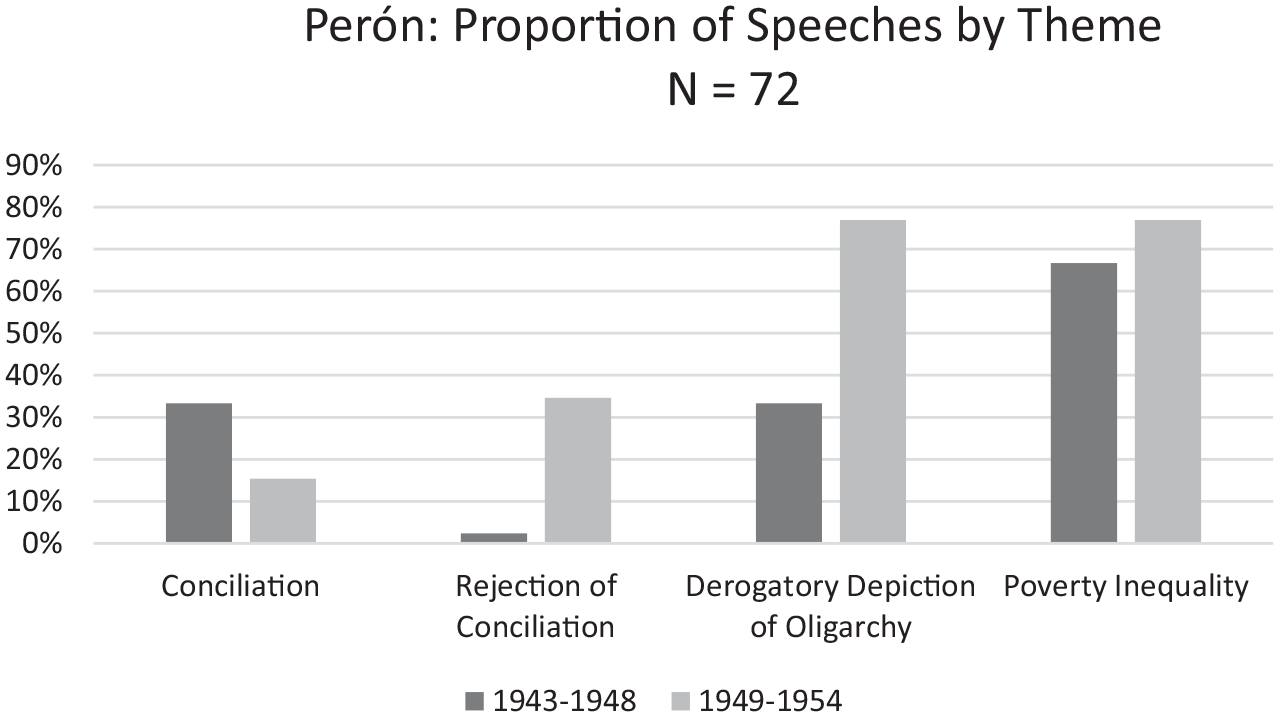
A chart showing the proportion of Perón’s speeches by theme, from 1943–1948 and 1949–1954. 37
Within the context of a national mythology that claimed the absence of racial divisions (and therefore of discrimination) and of a heterogenous lower class composed of rural migrants and recent European immigrants, Perón addressed the issue of exclusion primarily and ostensibly through claims for workers’ rights. The establishment of workers’ rights would not only bring social peace through reducing worker militancy and ending the conflict between capital and labour but would also create conditions in which ‘all individuals can exercise the right to learn and improve themselves’. 38 This process of raising workers’ ‘social cultural level’, would, in turn, facilitate the participation of his followers in national life and politics in ways that would be acceptable to the ruling class. While these improvements were taking effect, Perón repeatedly expressed concern about the opposition’s negative portrayal of his followers. Most often, he directly confronted anti-Peronist social vilification of the lower classes due to their poverty by assuring supporters that humble Argentines were a vital and essential part of the nation. Even the lowliest worker, he declared, is important because ‘in this country there is not a single useless man, however low he may be in the hierarchy’. 39 ‘The miracle of our greatness’, he declared, ‘will not occur until the last and most humble has the honor of being [Argentine] and does not feel dispensable to the future of the country.’ 40 Poverty did not mean one was irrelevant to the nation: ‘even the most humble is an essential human factor in our country’. 41
Although aware of the racialised vilification of his followers, Perón avoided addressing the problem head on. He never used the term ‘cabezas negras’ and the term ‘el negro’ only appears in one of his speeches. On only one occasion, in a speech transmitted nationally, does he refer to the racial identity of his followers, when he says,
If we want to be faithful to our parents and ourselves, we cannot ignore that in our blood and in our spirit is the ancestral voice of the aboriginals who for millennium populated our land, nor the legacy of Spain and Christianity. The fusion of two cultures has given our people a human sentiment.
42
He also avoided any discussion of the colonial origins of Argentina’s deep social divisions – the conquest of the Indigenous people and the importation of African slaves – as doing so would have involved some discussion of race. Instead, inequality and exclusion, in the Peronist narrative, arose in the post-independence period when a new aristocracy with inherited wealth came to power. Served by unscrupulous politicians and electoral fraud, it exploited the people and reduced the inhabitants of Argentina ‘to the conditions of outcasts, obliging them to form a poor social class, miserable and deprived of all their rights’. 43
Unable to directly address race as an attribute of exclusion, Perón used the coded term of ‘authentic criollo identity’ to refer to the identity that was being vilified by the anti-Peronist opposition. In ten speeches, he demanded recognition of ‘an authentic criollo Argentine culture’. The term criollo, normally used to refer to Spanish born in the Americas, implied a European identity and hence its use allowed Perón to stay within the white mythology of Argentine nationhood. However, he refashioned the term so that it would become apparent to his followers that he was speaking about the distinct identity of the racially mixed lower classes: he linked the notion of an ‘authentic’ Argentine identity to the gaucho culture of the interior of the country, characteristic, he claimed, of an honourable people who act in defence of the homeland. He refers to ‘criollo spirit’ as being present ‘among factory workers, the peon of the countryside’ whose injustices, he says, must be addressed. 44 Perón, however, usually used the more class-based term of ‘descamisados’ to address his followers – in fact he uses the term in virtually every speech. However, the link of the term with the notion of a distinct cultural identity would have been clear to his followers. He says on 17 October 1946, on the first anniversary of his return to power: ‘October 17 will always be the day of the descamisados . . . the day of the citizens, and the people of Argentina . . . the day of all the authentically criollo people.’ In the same speech, he pleads for the opposition to recognise and grant inclusion to his followers. 45
Peron’s plea for unity among Argentines, for recognition of the criollo identity, for the improved social welfare of workers, and his repeated use of the term descamisados, should be understood as a claim for national inclusion – as an attempt to persuade the opposition that his followers were worthy of respect and that their role in the nation was an essential one. On the 1946 anniversary of his 1945 return to power, he calls for the teaching of popular culture (folklore, dances, poetry), pointing out that government support for popular culture has been ignored. Notably, these demands for recognition and respect for his followers were in speeches delivered nationally – not simply rhetorical appeals to devoted followers. In one of his most compelling statements, made before Congress in 1947, Peron makes a case for inclusion of his criollo descamisados, but not for the exclusion of the opposition, in the Argentine nation. He says,
The nation is not the property of the learned nor of the wealthy, but everyone is included: the rich and the poor, the cultured and the ignorant, those who constitute daily life. It is true that without science and intelligence we have a primitive existence. But it is also certain that [without] physical exertion, without manual skill, science and intelligence would have their activities very limited. The culture of the modest workers may be deficient, but they know better than anyone the necessities and problems of the weakest.
46
In this speech, he goes on to reject the opposition characterisation of his followers as a ‘despicable mob’.
After 1949, however, Peron’s rhetoric reflects increasing despair at being able to overcome his society’s deep social and political fragmentation through social welfare achievements and rhetorical pleas that his followers be accorded more respect. Although one can still find statements pleading for national unity and inclusion of his followers after 1949, generally speaking from that year his derogatory statements about the opposition rise dramatically and statements calling for conciliation diminish (Figure 1). In addition, he vilifies the opposition in much more negative terms: as ‘traitorous’, as ‘venom’, as ‘evil’, and as ‘the enemy’. His speeches now juxtapose the good people, his followers, against an evil opposition.
After 1949, Perón is fiercely critical of the disparagement levied against his followers and he no longer presents himself as the president of all Argentines. In his messages to Congress in 1950, and again in 1952, he expresses outrage at the opposition’s characterisation of his congressional win as representing a ‘beastly flood’, claiming that his descamisados are better defenders of the homeland (and by implication entitled as citizens) than the opposition politicians or the old oligarchy. He observes that in doing what the people want, the cost has been ‘hate and subversive action, almost permanent and insidious on the part of those lackies [of imperialism] here in Argentina’. 47 In his 1954 speech to Congress, he again expresses despair at the ‘tempest of hate’ against his descamisados, ‘who only ask to earn a living and be free of patronal oppression’ that has not diminished since he came to power in 1946. 48 He claims that his government’s success at improving the lives of workers has resulted in ever more evil actions on the part of the opposition against the ‘marvelous people’. 49 Perón makes increasing use of religious references that pit his divinely inspired movement against an evil enemy: it is necessary, Perón declares, to end ‘the evil’ and to recognise that the people are, ‘the voice of God . . . [and that God] never leaves the people’. 50
While initially Perón appeared to believe that improvements in wages, social benefits and in access to education would heal the deep fractures in his society by mitigating the conflict between capital and labour and by rendering the poor more acceptable to the middle and upper classes, by the early 1950s, he recognised that the fissures in Argentine society were deeper than ever. The level of oppositional rhetoric and mobilisation against this regime coincide with the emergence of a Peronist Manichean rhetorical view of the world that did not create, but rather reflected, the country’s deep social polarisation involving social class and racial/cultural divisions that pre-existed Peronism.
Chavismo: tackling exclusion in a ‘racial democracy’
Chavismo, like Peronism, was initially conciliatory. 51 While acknowledging the deep divisions in Venezuelan society, and depicting the opposition in negative ways before 2003, Chávez’s rhetoric often also sought to mitigate conflict and encourage national integration. As shown in Figure 2, half of his speeches before 2003 called for conciliation/collaboration with the opposition. Like Perón, Chávez claimed to be concerned about national unity and social peace. Following his 1998 electoral win, he called on business and opposition parties to collaborate with the government, claimed that he was searching for consensus, called on everyone for goodwill and unity, assured the public that ‘Venezuela belongs to everyone’ and claimed that his government had ‘no enemies’. 52
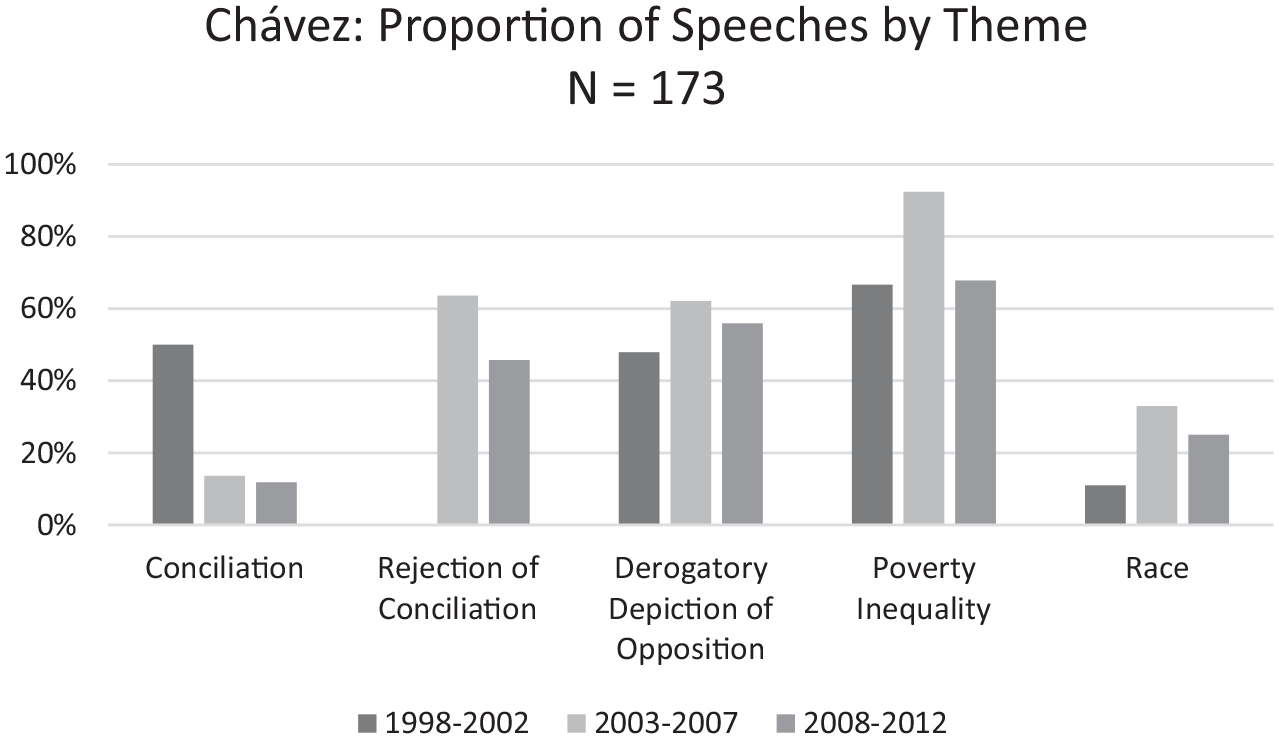
A chart showing the proportion of Chávez’s speeches by theme. 53
As illustrated in Figure 2, the vast majority of Chávez’s speeches dealt with poverty and inequality issues, including a wide spectrum of social policy concerns (health care, housing, improved wages, social security, land redistribution, support for rural producers and expanded access to education). Like Perón, Chávez regarded material deprivation as responsible for civil unrest: deprivation had caused the 1989 riots, which led to political repression and prompted, according to this narrative, the 1992 attempted military coups. Usually, Chávez characterised the primary division in Venezuelan society as between the rich and the poor. The country’s petroleum wealth, generalised misery and poverty constituted for him a ‘moral and ethical crisis’ that was a source of ‘humiliation for millions of Venezuelans’. 54 While Chávez acknowledged racism as a pressing issue of exclusion, the proportion of speeches devoted to the topic was considerably less than those dealing with social issues related to material deprivation.
Chávez, like Perón, appeared to believe that improved social welfare would ultimately produce the inclusion and acceptance of those who had been excluded, creating conditions in which all would live with dignity. For Chávez, creating equitable access to education for the poor was especially important:
Public universities are spending huge amounts, but the poor do not attend them. You can see the injustice here . . . Education has to be public and compulsory and everyone has to have the same rights . . . children of the rich, the poor, of the blacks, the whites, the indios. We are not equal, but we should be.
55
According to the Chavista narrative, the main source of social misery was capitalism, particularly ‘savage’ neoliberal capitalism that had contributed substantially to the rise in poverty, inequality and declining access to education and health care. While before 2003, Chávez maintained that capitalism could be reformed (‘humanised’), by 2005, he took the position that capitalism was by its very nature exclusionary – that its continued existence was responsible for the suffering of his followers. The only way to achieve social justice, therefore, was through socialism, a point he would reiterate repeatedly in the following years.
However, Chávez’s utopian vision of how the eradication of capitalism and the achievement of social justice could mend the deep divisions of Venezuelan society existed alongside an acute awareness of the racist contempt in which the opposition held himself and his followers. The fact that half of the speeches dealing with race were delivered to the general public and to Congress reflects the fact that this rhetorical concern was not simply an attempt to stir up dissatisfaction among his followers. He identified the origins of the opposition’s disdain for the masses in the country’s colonial history, a history in which imperialists had brought ‘blood and death’ through genocide of the Indigenous population and the slavery of Blacks brought from Africa. 56 Colonial conquest, according to Chávez’s narrative, was responsible for Venezuela’s twentieth-century ‘false democracy’ because the valiant struggle for independence from Spain, fought for by the mixed blood, Blacks and Indigenous peoples, was betrayed by an immoral oligarchical class that took power and enriched itself and impoverished the people throughout the twentieth century through the corrupt misuse of the country’s petroleum wealth and the subsequent pursuit of neoliberalism.
At the same time, Chávez’s rhetoric reflected a wish for conciliation and inclusion. He called on all races and social classes to ‘go forward together’ and for justice ‘without distinction of race or social class’.
57
The current struggle has, Chávez claimed, had the same objective as the struggle for independence: ‘for the equality of all, for the whites, Blacks and Indios . . . we are all equal before God’.
58
Even after the attempted 2002 coup and the 2002/2003 economic shutdown that attempted to remove him from power, Chávez continued to plead for inclusion. In a speech before the National Assembly, he declared his belief that national integration and acceptance of all was possible:
I believe the union of all Venezuelans is possible. Here there are people who live in different neighborhoods, here there are Blacks, there are whites, here there are ‘indios’, here we have the representation of a good part of the national soul. But we want that if a part of the national soul . . . if some part of the national body does not feel represented . . . let us embrace them.
59
He went on to say that his government was the government ‘of everyone . . . from the most rich to the most poor, from the most black to the most light haired’.
Chávez encouraged his followers to take pride in their heritage as representing ‘a new type of human being’ even though ‘on some occasions . . . it has given us shame to recognize that we are a mixed race of Black, Indian and white’.
60
However, he was just as concerned that the opposition cease the negative portrayal of his followers and that it recognise their contributions to the nation. He protested against media characterisation of his followers as ‘hordes’, demanding that the opposition media ‘respect the people’.
61
He directly challenged the negative racialised portrayal of his followers and of himself in the opposition’s mass media – portrayals that used animal terms to represent the Indigenous/Afro phenotype as undesirable, reflected in such phrases as ‘with a paw on the floor’.
62
In a speech to the National Assembly, Chávez is especially explicit:
I say to you who have come to believe the mass media propaganda: we might be ugly, we might have warts, we might be uncouth, but we are as Venezuelan as you are . . . we are not barbarians, we fulfill the mandate of God. We are compatriots like you . . . We also love you as compatriots; we love our children and land . . . We want that we all live as brothers and there is no rich elite of great wealth and a majority of poor and excluded. We want a patria of equality and justice.
63
As the opposition persisted in its effort to remove him from power, particularly with the petroleum strike of 2002/2003, Chávez ‘s attitude toward the opposition hardened and we see the emergence of a more standard (we versus them) populist rhetoric. There is a drop in the proportion of speeches calling for conciliation and a rise in speeches opposing conciliation, as shown by Figure 2. Chávez now calls for his supporters to go on the attack. While the rise in the derogatory depiction of the opposition is not dramatic, Chávez now characterised the opposition in much more negative ways, as ‘traitors’, ‘fascists’ and as ‘terrorists’. Our mistake, he declares, ‘was the illusion that we could have the respect or at least recognition of the opposition’. Hence the opposition is the ‘enemy’. 64 While Chávez concludes that his government has made important strides in social improvements, his rhetoric reveals an acute awareness of the opposition’s continued vilification of his followers – and therefore continued challenges to the achievement of a dignified life.
Chávez’s rhetorical concern about the opposition’s attitude toward his followers was especially evident from 2008 when he emphasised the visceral hatred he believed the opposition held for them in three speeches that year. In 2009, five speeches dwell on the topic of the opposition’s hatred. The intensity and disregard for popular suffering was, according to Chávez, illustrated by the opposition’s allegation that social policies were making the people stupid and lazy and the claim that the government was making the people irresponsible by helping them build houses. He declares that the opposition ‘hates the people’ and that ‘their suffering is not important to them’. 65
Chávez’s plea for the opposition to abandon its contempt for his followers, the failure of the opposition to do so, and its sustained criticism of Chávez’s social welfare measures, nourished a Manichean rhetoric in which Chávez associated himself with love of the poor and concern for their dignity and welfare, in a God/Christ-like struggle against an evil, immoral enemy that did not care for the dignity and suffering of the poor. He claimed that his social justice project was ‘a project of God’ because Christ taught that we should live as ‘brothers, in conditions of equality and social justice’. 66 The people’s cause was Christ-like, characterised by love and forgiveness, whereas the opposition was driven by hate, greed and the evils of exploitive capitalism. Chávez associated inequality with the devil and described Judas as ‘the great capitalist’. 67 The notion of the good and wise people is now juxtaposed against an evil opposition that must be conquered.
Like Perón, Chávez initially believed that improvements in social welfare would bring about national integration. After 2003, and especially after 2008, the extent of oppositional activity combined with its heavily racialised portrayal of Chavistas, appears to have persuaded him otherwise. The Manichean evolution of Chavista populist rhetoric was, in considerable part, a response to the opposition’s rejection of the national recognition and incorporation of Chavista supporters, both in socioeconomic terms and racially.
Conclusion
This analysis argues that the starting point for understanding the deep political polarisation associated with Peronism and Chavismo is colonisation, a process that generated a hierarchy of social categories in which race, culture and social class became closely linked. The nation-building projects that arose in the postcolonial period involved political and social exclusion of Afro, Indigenous and darker-skinned populations. Europeanised ruling elites regarded these populations as inherently inferior and, as such, incapable of contributing to national progress – attitudes that became absorbed by the middle classes as they emerged. National mythologies facilitated elite and middle-class denial of racism; the role of racial/cultural identity in the disadvantaged status of Blacks, Indigenous and darker skinned populations could be ignored.
These conditions shaped the way populist leaders would address the social and economic exclusion of their followers. In Venezuela, when the myth of a racial democracy was shattered following the 1983 economic crisis, Chávez tackled the issue of racism directly, although the weight of his concern was still placed on addressing issues of material disadvantage through social policy. In Argentina, on the other hand, the populist assault on social injustice focused almost entirely on issues of social class (the working class) – necessary due to the culturally/racially heterogenous nature the country’s working class (composed of both European migrants and rural migrants) and the public refusal, including among some Peronists, to accept that Argentina was anything other than a white European society. However, Perón did address racialised exclusion in a coded form that was likely understood by his followers. Hence, in both cases, the predominant emphasis in speeches was on addressing material deprivation of the masses, a strategy that populist leaders, at least in rhetoric, believed would produce national integration and elite and middle-class acceptance of their followers.
Initially (before 1949 in the case of Perón and before 2003 in the case of Chávez) populist rhetoric did not fit the widely held perception of such rhetoric as involving a Manichean struggle of the good people versus an evil enemy. Both leaders made pleas for inclusion and respect for their followers (economically, socially, culturally, and in the case of Chávez, racially) urging the opposition to consider their followers important and essential members of the nation. Neither made a case for the exclusion of the opposition at this point. This would change, however, in response to oppositional activity and rhetoric. In both cases, we see rising anger at the contempt with which leaders felt their followers were held: the opposition becomes the evil enemy that must be defeated. In this way, anti-populist contempt appears to have been integral to the emergence of the intense Manichean populist rhetoric that would develop in later years. Given its long historical origins, the resilience and intensity of Peronism and Chavismo might be better understood as arising from their attempts to give voice to deeply rooted popular resentment against the racialised/cultural and social class exclusions that were denied by post-independence mythologies.
Footnotes
Judith Teichman is Professor of Global Development Studies and Political Science at the University of Toronto. She is the author of books and articles on the politics of Latin America.