



Abstract
Despite perfunctory characterisation of Canada’s Seasonal Agricultural Worker Program (SAWP) as a ‘triple win’, scholars and activists have long admonished its lack of government oversight, disrespect for migrant rights and indentureship of foreign workers. This article contends that the SAWP is predicated upon naturalised, deeply engrained and degrading beliefs that devalue Black lives and labour. Based on twenty months’ ethnographic fieldwork in the Okanagan Valley, British Columbia, Canada, it reveals the extent to which anti-Black racism permeates, organises and frustrates workers’ lives on farms and in local communities. It situates such experiences, which workers characterise as ‘prison life’, in the context of anti-Black immigration policy and the workings of racial capitalism. This ethnography of Caribbean migrants not only adds perspective to scholarship hitherto focused on the experiences of Latino workers, but it also reinforces critical work on anti-Black racism in contemporary Canada.
Keywords
Introduction
The question of what to do about Canada’s Seasonal Agricultural Worker Program (SAWP) and the farmworkers who toil under its auspices is one of increasing urgency. First introduced in 1966, the SAWP constitutes one of the oldest temporary foreign worker programmes (TFWP) of its kind still in use today. 1 It facilitates circular labour migration, employing workers in Canada for six weeks to eight months before they return to their countries of origin. Work permits are tied to the agricultural sector and to pre-approved SAWP employers. While this expedites employers’ transfers of workers between farms, worker-initiated transfers are not regarded favourably. Providing accommodations falls within the purview of employers who become de facto landlords, typically housing workers on-farm, frequently on or near the property where they themselves reside. Workers’ return to Canada depends on employers requesting them by name and number, and their receipt of a positive review by consular or liaison officers stationed in Canada. 2 The tying of work permits, provision of on-farm housing and the persistent threat of deportation, with no recourse to appeal, all function as disciplining mechanisms, keeping workers tight-lipped and compliant. 3
Despite perfunctory characterisation of the programme as a ‘triple win’ – for the sending country, the Canadian economy and the workers themselves – interest in the SAWP has produced a robust body of cross-disciplinary literature united in its scalding critique. 4 This covers the SAWP’s controversial introduction 5 and the government’s hesitance to recruit Caribbean workers 6 as well as its lack of oversight and poor enforcement of worker protections. 7 The SAWP has also come under fire for isolating workers geographically and culturally, 8 rendering them vulnerable to exploitation 9 and failing to respect their human rights. 10 Researchers have decried employer-provided housing for its overcrowding and poor upkeep, as well as the surveillance and control it enables 11 – concerns which the Covid-19 pandemic has amplified. Several studies situate the SAWP as part of a project of racial state formation, challenging Canada’s professed commitment to multiculturalism. 12 For decades, scholars and activists have argued that migrant farmworkers constitute a bonded labour force, 13 and citing their lack of personal freedoms in Canada, many workers consider the programme ‘slavery without the whip’. 14
This piece situates the exploitation of Caribbean SAWP workers against a backdrop of long-standing anti-Black immigration policy and the workings of racial capitalism. Based on twenty months’ ethnographic fieldwork in the Okanagan Valley, British Columbia (BC), it reveals the extent to which anti-Black racism permeates, organises and frustrates workers’ lives both on farms and in local communities. In so doing, it shows how anti-Black racism constitutes the SAWP: it could not exist – indeed, could never have existed – were it not for naturalised, deeply engrained and degrading beliefs which devalue Black lives and labour. This should come as no surprise to those familiar with the Canadian context: liberal appeals to multiculturalism serve to scapegoat and perpetuate racial capitalism’s continued structuring of Canada’s agrarian economy and the country’s reliance on TFWPs. 15
Very few studies foreground the experiences of Caribbean workers. 16 Their exclusion from research on the SAWP follows the marginalisation of Black labour and the invisibility of Black geographies in Canada, reproducing notions that the country is ‘non-Black’ or that ‘Black in/and Canada’ is somehow ‘surprising’. 17 As an ethnography of Jamaican workers in BC, this study contributes to scholarship hitherto centred on the experiences of the SAWP’s majority-Mexican workers in the more populated province of Ontario. 18 Moreover, by placing racial capitalism, anti-Black immigration policy and the SAWP in a single frame, it develops a historically-situated, anti-racist rejoinder to Canada’s TFWP and comparable migrant labour regimes. In casting a light on the lived realities of Jamaican farmworkers and the devaluation of their personhood and labour via the disciplining of their time, mobility and social relationships, this study hopes to reinforce critical work on anti-Black racism in Canada. 19
Racial capitalism and Black migrant labour
‘Race’ as a concept is not static, nor is the history of racism linear. 20 In Canada, racism amplifies white voices over those of racialised Others; it intersects with gender, class, sexuality and nationality to justify the production and maintenance of hierarchies, exclusions and exploitation. As a modern determinant in the social organisation of space and people, racism is implicated in the segregation and exclusion as well as in the differential treatment and liminal inclusion of those identified as racial Others.
Racism is also implicated in, and integral to, the capitalist system. In his writings, Cedric Robinson exposes the origins and centrality of naturalised racial hierarchies and inequalities to global production. 21 Such hierarchies engender a system of racial capitalism itself predicated upon the domination and exploitation of racialised outsiders, be they Irish, Germanic or otherwise. 22 In short, racialised im/migrant labour, contends Robinson, has always played an important role in European economies. 23 Moreover, with time, the distinctly racial character of domination became evident, for ‘Race was its epistemology, its ordering principle, its moral authority, its economy of justice, commerce, and power.’ 24
Blackness occupies a distinct position in these economies. Robinson shows how Black Africans were marked as ‘an exploitable source of energy, both mindless to the organizational requirements of production and insensitive to the subhuman conditions of work’. 25 Matlon suggests that in the global South as much as the North, Blackness has come to ‘sign[ify] exploitation and the undervalued body’. 26 In his work on Canada, Allahar draws a link between slavery, indentureship and ‘racial legacies of empire’. 27 He argues that discriminatory stereotypes pertaining to race and nation inherited from slavery continue to mark the bodies of Caribbean immigrants as ‘cheap, pliable and expendable labor’. 28
Racial capitalism and the exploitation of Black labour depend on the maintenance of an exclusionary international order vis-à-vis the national border. According to N. Sharma, in the colonial period, people and space were reorganised to maintain hierarchies of empire and, within them, the domination and exploitation of formerly enslaved and indentured groups. 29 While immigration controls were initially designed to keep ‘undesirables’ from entering sovereign state territory, she shows how such regimes later facilitated the entrance and exploitation of certain groups through the creation of the ‘migrant’ category. Like ‘race’, the category of ‘migrant’ is neither natural nor without history.
Yet, within Canada’s agricultural sector, essentialising references about migrants’ formidable work ethic, general hardiness and dependability are commonplace. 30 Such qualities are fixed to migrant identities in nationalist and cultural terms, as though Canadians have ‘forgotten’ what it means to put in a hard day’s work, whilst global Others have preserved their robust labour tradition. Distinctions are frequently cast between groups of workers of different nationalities based on racial stereotypes, suggesting that while Mexican workers are ‘docile and malleable’, Caribbean workers are ‘resistant’. 31 It is certainly true that most Canadians are unwilling to do the arduous labour for the minimum wage that agriculture requires, especially in today’s orchard industry where much is still done by hand. Yet praise for migrants’ work ethic conveniently overlooks SAWP participants’ precariousness as non-citizen workers: their disposability, deportability and dependence on their employer, who chooses whether to recall them for a subsequent season.
Such a workforce is not created in a vacuum. Applying Walia’s border imperialism framework reveals how the dispossession and displacement of racialised peoples in the global South produce the precarious migrant labour force on which Northern economies depend. 32 Aguiar, Tomic and Trumper point to Canada’s complicity in the creation of the labour force that it needs to maintain its own agricultural economy, through its collusion in the economic restructuring of the global South and promotion of free trade. 33 Similarly, Smith characterises the SAWP as an expression of what he terms Canada’s ‘racism-imperialism nexus’. 34 He connects Canada’s exclusionary immigration regimes and foreign policy to a larger project, whereby ‘racism explains the differential incorporation of Caribbean foreign labour; the geopolitical alliance of transnational whiteness privileges Canada over the Caribbean, and white rules supreme in a system of global apartheid’. 35
Canada’s exclusionary immigration policy and white nation-building
Canada is discursively constructed as the quintessential ‘nation of immigrants’. 36 As the first state to adopt a federal policy of multiculturalism in 1971, its international political profile is one of tolerance, benevolence and hospitality. 37 Popular mythologies integral to Canada’s historical memory include distorted narratives surrounding peaceful relations with Indigenous communities, its rejection of slavery and its warm embrace of diverse immigrants. Wiped clean from such memory is Canada’s role in the displacement and exploitation of Black, Brown, Asian and Indigenous folks, beginning with the Indigenous peoples on whose territories the state was founded in 1867. 38 Choice mention of Canada’s involvement in the underground railway conceals its historical profiteering from the slave trade and importation of Black slave labour, particularly in the provinces of Québec and Nova Scotia. 39 In contrast to popular narratives, then, settler colonialism, racial capitalism and the structural violence integral to their logics are as inherently ‘Canadian’ as hockey or maple syrup, and just as contemporary.
Exclusionary immigration controls played a key role in Canada’s racial formation, imagined as white and European. Consistent with immigration regimes across the Commonwealth, early policies were crafted to ‘keep Canada British’, 40 and the Immigration Acts of both 1910 and 1953 explicitly distinguished between ‘preferred’ and ‘non-preferred’ races. 41 In BC, where this project takes place, settler communities declared themselves ‘All White’ and Chinese workers were recruited only to also find themselves labouring in dire conditions in a hinterland openly hostile to ‘the yellow races’. 42 As M. A. Beach of the Vancouver Trades and Labour Council proclaimed in 1907, ‘We in British Columbia have existing conditions that are very dangerous to white wage-earners of this country, namely the Japanese, Chinese, and Hindoo . . . They are people totally unfit for the conditions of this country.’ 43 Efforts to preclude the immigration of diverse communities and promote European settlement took place alongside the genocide of Indigenous peoples on whose unceded lands white communities were constructed.
Free Black immigration was obstructed by any means necessary 44 and was prohibited as early as 1818. 45 The decades that followed saw widespread anti-Black lobbying by media, municipal governments and federal officials on both sides of the Canada-US border in an effort to dissuade northbound Black migration. 46 Whereas white American immigrants were actively recruited, Black Americans were labelled ‘economic and social liabilities’. 47 Many were denied tickets or physically removed from trains travelling North. 48 When anti-Black immigration policy became untenable, educational and financial requirements were implemented to curtail the entrance of Black families. 49 When these also failed, doctors were paid to rig examinations, turning Black people away at the border for bogus medical reasons. 50
Anti-Black immigration policies and a preference for white immigrants is part of a global trend, amounting to what Bashi calls a ‘global blockade to black migration and mobility’ dating back to the 1800s. 51 In a foreshadowing of border controls and externalisation programmes in place today, Bashi shows how states closely monitored one another’s policies with the aim of diverting Black immigration flows from their borders. 52 Black people, and particularly those from the Caribbean, are anchored ‘to the bottom of the racial and “world systematic” hierarchies’. 53
Emancipated Black people who succeeded in crossing into pre-confederation Canada found themselves in inhospitable colonies. In her corrective history of Canada’s social welfare regime, O’Connell examines the evolution of social services for the poor in Upper Canada between 1791 and 1867. 54 Her work exposes a striking paradox: the institutional achievements of social welfare programmes for poor white settlers took place alongside the violent exclusion of Indigenous and Black peoples from the same programmes. Coupled with unequal access to land grants and jobs, brazen racial hostilities from white Canadians and the government’s refusal to protect fugitive former slaves, coordinated efforts to render Black Canadians unwelcome led many of them to head or return South after 1850. Differentiating between those deserving and undeserving of social welfare, writes O’Connell, ‘brought into being a political modernity with only certain bodies and freedoms in mind.’ 55
Such histories inform the anti-Black racism that continues in a context of entrenched white supremacy and neoliberal colour blindness. Affecting education, economic supports, career prospects, health, experiences with policing and access to justice, anti-Black racism remains pervasive in Canada. 56 Black Canadians face significantly higher rates of incarceration than other groups – while Canada’s prison population rose by 17.5 per cent between 2005 and 2014, the number of Black men and women in prisons increased by a staggering 75 per cent. 57 Despite 83 per cent of Black people in Canada reporting experiences of racism, almost half of Canadians believe that anti-Black racism is no longer an issue. 58 That the history of Black Canadians and Black would-be Canadians is altogether unknown to the majority of the population is itself significant. As Goldberg reminds us, ‘If you are not memorable, if you have no worthy history, then you are deemed to have no claim not simply on national remembrance but on the nation-state itself, because you are seen to have no place in it’. 59
The emergence of the SAWP
Of the many countries across Latin America and the Caribbean that participate in the SAWP today, Jamaica boasts the longest involvement. 60 The programme’s first year saw 264 Jamaican workers employed on a tobacco farm in Ontario. By 2005, numbers had skyrocketed, with 20,274 participating workers, 5,916 of these Jamaican. The SAWP was introduced to BC in 2004 and Jamaican workers began to arrive in 2007. In 2018, Jamaicans filled 18 per cent of agricultural migrant farmworker positions Canada-wide, surpassed by workers from Mexico (51 per cent) and Guatemala (20 per cent). 61 Most participants are men. With estimates suggesting that remittances from Jamaican migrant farmworkers employed in Canada totalled 20 million Canadian dollars in 2015, 62 it is little wonder that the Jamaican government has sought to extend its participation. 63
The SAWP’s emergence in 1966 as a response to white supremacist anxieties surrounding the ‘purity’ of Canadian nationhood is well-established in the literature.
64
Although, publicly, the government deliberated the severity of Canada’s labour shortage and industry needs, ‘race relations’ dominated internal debates.
65
Government documents reveal perceptions of Caribbean Black people as biologically and culturally incompatible with Canada’s predominantly European immigrant population and climate. According to an interdepartmental memo from 1947: The admission to Canada of natives of the West Indies has always been a problem with this Service and we are continually being asked to make provision for the admission of these people. They are, of course not assimilable and, generally speaking, the climatic conditions of Canada are not favourable to them.
66
Such narratives do more than underscore the anti-Black racism present within the Canadian government at that time; they also reveal its direct line to immigration policy. As late as 1958, the Minister of Citizenship and Immigration expressed concern that, given Jamaica’s membership in the Commonwealth, Canada might be unable to legally force Jamaican workers to leave the country at the end of their contracts. Clarkson surmises that restricting workers’ access to permanent residency meant that labour shortages could be addressed ‘without leading to the then perceived dangers of widespread Black immigration to Canada’, but only if workers returned home at the season’s close. 67 Thus, without using explicitly racist language, Canadian authorities nevertheless moved to indenture Black workers and block their permanent immigration − with serious implications still being felt today by Jamaican farmworkers in the Okanagan Valley.
Ethnographic fieldwork in the Okanagan Valley
A dry yet fertile region in the interior of Canada’s western-most province, the Okanagan comprises the traditional ancestral territories of the Syilx people on whose unceded lands British ‘gentlemen farmers’ began to settle in the late nineteenth century. 68 Replete with cultural boundaries, the Okanagan Valley also traverses the Canada-United States border, extending well into the state of Washington. Today, 96 per cent of the province’s soft fruits are grown in its central valley, 69 known as the ‘Napa of the North’. The hospitality extended to tourists and other residents, with billboards and marketing campaigns promising rest, relaxation and play, contrasts starkly with the hostility experienced by the region’s farmworkers. Whether Japanese, Quebecois or Jamaican, racialised agricultural workers have long been rendered peripheral and excluded from community life in the valley. 70 Indeed, much is erased in romantic representations of farm life that stands in the way of realising justice for those who cultivate the fresh fruit and vegetables that Okanagan residents, proud ‘locavores’, count on each summer.
This article is informed by nearly twenty months of ethnographic fieldwork between 2013 and 2015 with Jamaican migrant farmworkers and activists involved with Radical Action with Migrants in Agriculture (RAMA), a migrant justice group in the Okanagan region. 71 The study included informal encounters, participant observation and deep hanging out 72 with approximately forty Jamaican farmworkers. This involved meeting with the same workers many times, whether to accompany them to access social services, share meals together, provide transportation or attend community events. Six key informants in this project participated in a series of semi-structured interviews (several were interviewed more than once), which were recorded and transcribed. 73 The number of workers formally interviewed was kept to a minimum to mitigate well-documented risks to their employment in Canada were their participation in a research project to be discovered. 74
The Jamaican migrant farmworkers who participated in the project were all orchard workers, who plant, prune, thin, pick, sort and pack tree fruit – primarily cherries and apples. The work is gendered: for the most part, men are selected to toil in the orchards and women to work in sorting rooms (what they call ‘factories’), with some exceptions. Men often come for longer periods of six to eight months, also working with apples into the autumn season, whereas most Jamaican women arrive just in time for peak cherry season, working six to eight weeks sorting cherries in the Okanagan. The sorting rooms are cold and the hours are long and unpredictable, dependent as they are upon that day’s harvest. The extreme Okanagan heat requires those in the orchards to begin their days between midnight and 5am, often working during the night and finishing their shifts before noon.
The difference that difference makes was often uncomfortably apparent as workers and I traversed various spaces together, geographically in the Okanagan and discursively in our conversations. As a white woman from a working-class family – an identity which in the settler-colonial geography of the Okanagan is perceived as static and largely taken for granted – from the standpoint of the ‘average’ resident, I belonged in the Okanagan. By contrast, the Jamaican migrant workers who participated in the study were perceived as ‘out of place’ by locals. While my privileged position elicited amiability and trust, workers were frequently met with suspicion and discomfort. Incidents of racist abuse, segregation and surveillance are often experienced by SAWP workers in the Okanagan – a continuation of former labour regimes governing Chinese and Japanese workers in BC. 75 The construction of migrant farmworkers as inherently ‘foreign’ (regardless of how long they have worked in Canada) reflects conflations of ‘Canadianness with whiteness’. 76 The power of such tropes and their impact on workers’ lives are evident in the empirical material explored below.
Devaluing Black lives and labour
‘You hardly find people kind to you’, Georgia replied, when I asked her to identify the hardest aspect of living and working in Canada. Sitting across from her, Georgia’s friend and co-worker Tanisha offered up a possible explanation: ‘Maybe they’re wondering, “where are these Black people from?”’ she suggested. ‘Because it’s just recently that Jamaicans start to come here. So maybe that is it.’ At the time of our conversation, Tanisha had worked in Canada for five seasons – first in Nova Scotia and then in BC. Georgia was in her second season in the Okanagan Valley. Both women are mothers and leave their children behind in Jamaica each year to travel to Canada. As Georgia continued, It’s not really a choice [to come to Canada], because you have your family, and you need better for your family. So, you [gather] all this strength, come, work, to help them back home. That is the main thing, helping your family. What I went through in life, I don’t want my kids to go through. I want them to get a better education, [so] that they can be a better man for tomorrow. So that is why I am here. Not because I want to, but . . . because I need a better life for my family.
This perspective, one of suffering through the season in Canada in order to improve their families’ lives in Jamaica, encapsulates the circumstances of many of the participants.
Restricted time, mobility and socialising
Amplified surveillance and disciplinary power were deployed to control workers’ time, mobility and social relationships via the imposition of extra-legal rules that also assured workers’ availability to their employers around the clock. The participants in this study worked and lived on farms with rules that prohibited them from leaving the farm/bunkhouse premises without permission from their employer, receiving visitors or forming relationships with locals. Many Caribbean farmworkers felt obligated to remain on-farm and to say ‘yes’ anytime their boss needed ‘help’, regardless of the task, day, time, or whether or not their shift was over. The expectation of workers’ constant availability was facilitated by many of them living together on-farm in employer-provided housing in isolated, rural locations with limited or no access to public transport.
Random roll calls, a routine occurrence on some farms, assured such rules were followed. The participants recounted how, in these instances, a supervisor would appear at workers’ dormitories unannounced and insist on seeing the entire group at once, calling each worker by name to ensure all were present. On one such occasion, a boss became agitated when a worker was recorded absent, only to realise later that he was in the bathroom having a shower. I frequently observed Jamaican workers reject invitations to leave the farm premises on their afternoons off, to participate in soccer games or shared meals, telling us that their employers could arrive at any moment and they had best be on-farm when he or she came looking for them. Carl, a Jamaican worker in his first season in Canada, explained: Your privilege going out after work is a no-no. Totally no-no. Anyways, you wouldn’t get a chance to have free time. You work hard during the day. After work, you just have enough time to go home, rest, cook, prepare whatever you need for tomorrow, and sleep. It’s more like – you’re not on vacation. You’re on a work programme. And it’s not wise to be like, I don’t want to use the word ‘loose cannon’, but it’s not wise to be up-and-up being that you’re on the programme and you are being watched. Yeah, there are opportunities [to go out], but it’s not advisable really. If it’s personal, fine. If you’re going to get a few things at the store. Yeah, I would go have a beer, but as I said – it’s not advisable. (Interview with Carl)
Carl’s characterisation of going out as a privilege is noteworthy, as is his description of the surveillance to which he and his co-workers are subject. Expectations surrounding workers’ use of their so-called ‘free’ time either strongly discouraged or expressly prohibited their engagement in most leisure activities, such as drinking a beer, meeting a friend, attending church or playing soccer. In a random encounter, the nephew of a farm owner told me explicitly that the Jamaican farmworkers they employed needed permission to leave the farm for any reason. He also stated that they were not allowed to play soccer because an injury could prevent them from continuing to work. In her recent book, Walia underscores the link between slavery’s conflation of idleness with vagrancy and the emergence of exploitative labour contracts which criminalise Black peoples’ freedom of movement. 77 It is worthwhile to note here that SAWP contracts do not stipulate that workers require permission to leave the farm premises, nor do they constrain how workers use their free time – both would most certainly violate their rights under Canadian law. And yet, most SAWP workers feel obligated to comply with such rules due to fear of dismissal or early repatriation.
While rules between farm sites varied, most Jamaican workers had experienced living on a farm with a curfew. After being invited by a group of Jamaican workers to visit their dormitories, I encountered a notice taped to the wall of the living room (see Figure 1). Upon reading the first point, ‘No member of the opposite sex is allowed on the farm except in cases where permission is given by the employer’, I turned to the Jamaican men in the room and asked if I should leave. They responded with a shrug and a smile and told me not to worry about it – their season was over and the boss was not around. But despite these workers’ nonchalance, rules designed to control migrants’ relationships and personal space – with whom, when and where they can interact with women or other members of the predominantly white local community – are generally taken seriously, as Carl’s comment above illustrates.
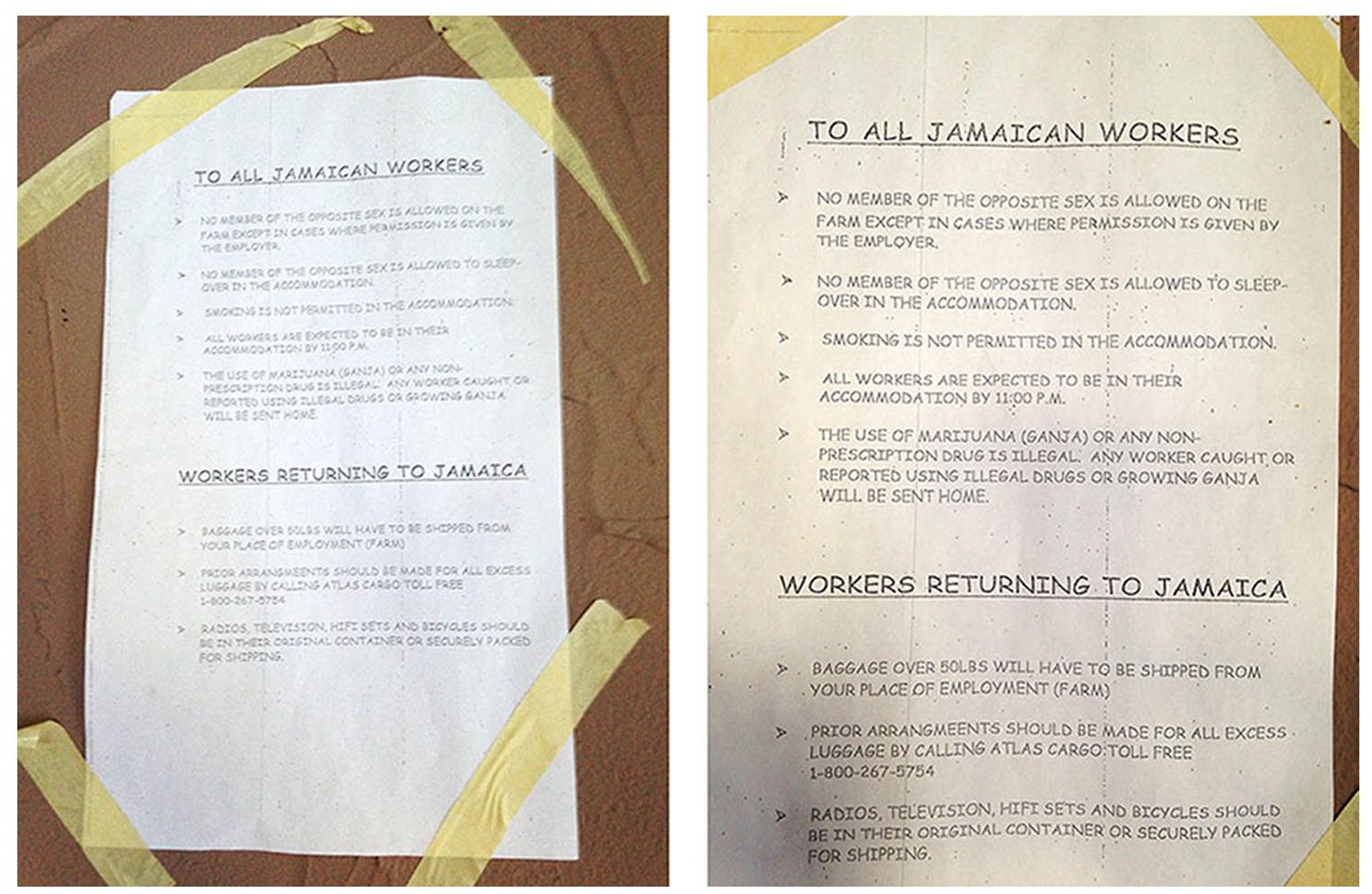
Rules for Jamaican farmworkers posted on the wall of farm dormitory in the Okanagan Valley © Elise Hjalmarson.
Participants frequently expressed frustration at neither being able to extend hospitality to people they met by inviting them into their ‘homes’ in Canada, nor to engage in social activities. Georgia recounted that when a local Jamaican man had invited her to church for dinner, her employer became aggravated: He invite us to church. Our boss doesn’t want us to go. She doesn’t want him to come there. And I’m like, ‘He is one of us! He is from the same country we are from! So should we pass him like we don’t know him?’ No, I can’t do that. That is not me. So, I was upset over that. (Interview with Georgia)
Farm life as ‘prison life’
The extremity of the restrictions led several of the participants to draw links between life on-farm and incarceration. As Tanisha explained: Prison life is like a bootcamp. Going to a bootcamp. You know, you have to get up, do your chores, you can’t move from where you are, you have to stay where you are, you have somebody over you to say, ‘Do this, do that’. You get no time for yourself. That is prison life for me. (Interview with Tanisha)
Central to Tanisha’s description of ‘prison life’ on Okanagan farms was the degree of control exercised by her employer over her time and mobility. While in Canada, her life was strictly monitored and many quotidian activities were restricted. Accommodation, as Perry suggests, is designed to capture migrant labour, shape workers’ lives, identities and relationships in profound ways, facilitating the creation of a ‘hyper-productive workforce’. 78 So long as they live, work and socialise on-farm, workers are ‘rarely free from the institutional power relations inherent to Canada’s TFWP’. 79
Jacob’s experience in the Okanagan echoed Tanisha’s. In an interview, he commented: If someone was to tell me that I was going to live a life like this, I would have told them, ‘It’s a lie’. It’s like I’m a kid, needing to ask permission to go or do wherever or whatever I would like to do. If you want to go somewhere, you should be able to go freely, as long as you go to work and perform the same as you always do. (Interview with Jacob)
Lamont, a Jamaican grandfather with six years of experience in Canada including three in the Okanagan, described his life in similar terms: The day my boss tells me we can’t have visitors, it’s worse than prison! [In prison] you can get visitors at certain times. And if you working for a boss then, and you can’t get a visitor, it’s worse than prison. For nothing should go like that. If you have the time, you [should be able to] have a coffee with a friend and sit and talk. For your work is over, you know?
In a follow-up conversation, Lamont expanded: Work [finishes] like five, six o’clock. And if the boss come at eight o’clock in the night, we [have] to help him to do something, and if he’s an hour, even a half hour, we get no pay for that. It’s just a ‘help’. And we always – we always be there to help him. We just do it for him. (Interview with Lamont)
The additional tasks that Jamaican migrant farmworkers are expected to perform, often during their time off, are demonstrative of their weakened bargaining power, precarious legal status and devalued labour. As we shopped together one day, Tanisha recounted that she had recently ‘helped’ her boss clean the dog pen on her day off. Although she knew that she would not be compensated and that it was not in her job description, when asked, she felt obligated to say yes because ‘if you say no and you are not available, they will send you home’. 80 The same employer also asked her to clean the floor of a new rental property that they were preparing to show. Instead of providing her with a mop, she was given a towel. Indignant, she told me that she would never clean the floor this way in Jamaica. ‘But here’, she lamented, ‘they expect me to get down and clean the floor on my hands and knees.’ 81
Tanisha’s humiliating experiences with her Okanagan employer are examples of the ‘helping’ tasks that workers are expected to carry out at their bosses’ bidding. Like many of the participants, Tanisha felt that refusing or negotiating the terms of the task would put her job, future employment and right to remain in Canada at risk.
In many instances, workers performed subordination only to find subtle, creative ways to undermine their employer, whether by falsifying hours, work pacing or reappropriating farm produce.
82
Sometimes, they confronted their employers directly. Jacob recounted an altercation he had with his boss in the Fraser Valley, BC: I remember he called me a n*gger and I said, ‘Go fuck yourself’. Excuse my language. And he got like, so upset at me. [He said,] ‘You’re not coming back next year!’ I said, ‘Oh, sure. Go and report it. I don’t care. I’m not your kid. I’m not a slave’. (Interview with Jacob)
Over the three seasons of ethnographic work, I often heard Jamaican men and women wish aloud that their employers would treat them with more respect. ‘They don’t call us ladies. They call us girls. That’s not nice. We’re adults’, Georgia once concluded. Then, mimicking her employer’s patronising tone, she said, ‘“You girls”’. Supervisors’ casual use of infantilising language is exemplary of the hierarchical and patriarchal social relations on SAWP farms. Cohen notes that such treatment extends beyond paternalism to heteronormativity, with work crews and dormitories segregated by gender. 83 In many cases, migrants were discouraged from forming friendships, relationships or even interacting with co-workers of the opposite sex. 84
Disapproval was reinforced by surveillance. The cameras installed on Georgia and Tanisha’s farm were used to monitor workers’ activities both on and off the job, their comings and goings from farm premises, and any visitors they received. Georgia and Tanisha both described how ‘uncomfortable’
85
they felt under its gaze. Georgia explains: The camera sees everything. If a vehicle comes, they know . . . So if a vehicle come in, they at home, [and they] call one of the workers and say, ‘What is that vehicle doing on the compound?’. If he comes on the property, they are going to call the police. (Interview with Georgia)
There are arguably many reasons for an agricultural producer to install cameras, including workers’ safety and the protection of valuable equipment from theft or vandalism. Workers themselves, however, are less than enthusiastic about such technologies. While I was sometimes invited to park in the driveway, at other times I was advised to park on the street, well out of sight of the cameras in order to avoid alerting the farm owners. Although Georgia and Tanisha’s employers lived an hour and a half drive away, the use of cameras compressed the time and space that might otherwise have afforded them privacy.
Activists supporting migrant farmworkers also navigate this surveillance and, at times, it created challenges for this study. In an interview with a local Jamaican-Canadian advocate, they insisted that the Jamaican liaison had been keeping an eye on their social media pages, monitoring their posts for photos of SAWP workers that might be ‘trouble makers’. 86 One afternoon, whilst driving a group of Jamaican workers back to their on-farm dormitories, a truck pulled out of the driveway and turned towards us. The workers quickly ducked out of sight in the back seat and shouted ‘Drive! Drive!’. As I continued past the farm, they laughed nervously, explaining that it was their boss’s truck, and they would surely be in trouble if they were seen with me. 87 Arriving at a different farm to pick up several Jamaican workers for a soccer game, another RAMA organiser was chased off the property by a member of the employer’s family with a pipe.
Anti-Black racism in Okanagan communities
Once off farm, everyday racism complicated the accomplishment of otherwise ordinary tasks for Jamaican farmworkers who were frequently singled out, poorly treated and denied services during routine errands. Their experiences varied greatly: from being flashed exaggerated ‘fake’ smiles and given too much space on the sidewalk by locals, to being stopped by police on the street. Several of the participants re-enacted local (white) residents’ surprise that they were working in Canada into the winter, as though they were biologically unequipped to withstand the colder months. 88 While shopping for her son in Kelowna, the Okanagan’s urban centre, Georgia was told by a clerk that the merchandise in her hand was ‘too expensive for you’. In response, she promptly left the store. 89 Others, including Lamont, reported struggling to exchange or return faulty items they had purchased from local pawn shops or gas stations, only to have the returns accepted when a white person handled the transaction for them. In all instances, workers felt that anti-Black racism played a decisive role. Their experiences coincide with Aguiar, Mckinnon and Dixon’s findings that to be Jamaican in the Okanagan is to be ‘a marked and suspect body “threatening” or “menacing” the local white population’. 90
Jamaican workers from numerous farms experienced segregated service provision. Georgia recounted: We went to the bank, about six or eight of us that day at the front of the line, and you have some white folks came in behind us, and they call them [ahead] . . . And so I was like, ‘You guys don’t see us? And we standin’ in the line?’ And they don’t say nothing. And there’s this lady, I can point her out every time we go, and her face was like, angry. You know? Her face is angry like she doesn’t want to see us there. (Interview with Georgia)
After listening attentively to Georgia, Tanisha summarised: ‘When they see you’re Black, they take [advantage] of you. Some of them.’ Lamont also remembered a bank teller explaining to him that keeping them in a separate line would allow the bank to ‘serve us Jamaicans better and faster’. 91 The second time that this occurred, he protested loudly, and he and his co-workers were quickly integrated into a line with locals.
Irrespective of bank tellers’ intentions and beyond the unsavoury optics, the practice of segregating access to services is discriminatory. Inviting white account holders to cut the queue in front of a group of Black farmworkers whilst ignoring their protests was experienced by Georgia and Tanisha, in addition to other study participants, as a negative reaction to their Blackness. For how else could they be distinguished from local account holders? With a few precious hours of ‘free’ time and employer-provided transportation to accomplish essential tasks such as buying food, depositing pay cheques and sending money home, being singled-out and made to stand in longer queues was an affront not quickly forgotten.
Indignities such as these served as constant reminders not only of the participants’ foreignness, but also of their heightened visibility and vulnerability in the Okanagan. In response, some adapted their behaviour. Jamaican workers in the Kelowna area spoke of splitting into smaller groups on the few evenings that they walked around downtown to avoid attracting the attention of police. A different group of Jamaicans reported being stopped and questioned by a police officer one afternoon as they left their farm on foot. Entering a local nightclub together in 2014, I observed the doorman demand to see identification from each of my Jamaican migrant friends, most of whom were parents or grandparents. 92
Conclusion
Akin to scholarly predictions of the state’s inevitable decline under globalised capitalism, pronouncements of the relegation of TFWPs to the past have proven resolutely premature. In the nearly six decades since the creation of the SAWP, Canada has grown increasingly dependent on permanent access to racialised foreign workers. 93 The SAWP’s continued expansion, coupled with its consistent exemption from reforms to the federal TFWP, such as those legislated in 2014, are further evidence of the programme’s perceived ‘success’. 94 In the agricultural sector, where unpredictable harvests present challenges for many producers, migrant labour constitutes a transnational reserve army of labour – a flexible, ‘just in time’ workforce that takes up the dirty, difficult and dangerous jobs now rejected by most Canadians. 95 The SAWP’s measurable economic benefits for migrant farmworkers, their families and home economies, as well as for Canadian employers and the agricultural sector, have diverted public attention from its many troubling drawbacks.
But placing the SAWP, anti-Black immigration policy and racial capitalism in dialogue reveals an irrefutable conflation of Black bodies with undesirable national subjects and hyper-exploitable labour. Conjuring up Goffman’s ‘total institution’ and testimonies of plantation life under slavery, workers’ experiences of ‘prison life’ betray an overarching disregard for their lives, personhood and agency. Demands to recognise migrants’ contributions to local economies – while also made by migrants themselves – valorise their labour, sacrifice and work ethic as precursors to their inclusion. They fall short, however, of confronting the racism underlying Canada’s agrarian capitalist system.
Just as theory begets methodology, so too must our definition of the problem precipitate the solutions we pursue. Only an explicitly anti-racist solution which valorises not only the labour, but also the lives, personhood and belonging of the Caribbean men and women who toil on Canadian farms, can move us closer to the goal of dismantling racial capitalism and the exclusionary border regimes that facilitate the SAWP. Such a move would not prevent Caribbean or other racialised groups from working in Canada. Rather, it would uphold their rights to freedom of movement and association; to dignity, justice and family reunification as full members of Canadian society. These aims can only be achieved by removing the threat of deportation and extending full and permanent immigration status upon arrival to migrants and their families.
Footnotes
Acknowledgements
I would like to thank James Rochlin, Patricia Tomic and Ricardo Trumper, as well as Amy Cohen and Robyn Bunn, for their indispensable support throughout and beyond this project. This article is dedicated to the study’s courageous participants.
Elise Hjalmarson is a PhD candidate in Anthropology and Sociology at the Graduate Institute, Geneva. She is the co-founder of Radical Action with Migrants in Agriculture (RAMA), a migrant justice group based in the Okanagan Valley, British Columbia, Canada.