




Abstract
The burgeoning ‘pre-crime’ industry reveals a deep overlap between national security and mental health. The UK’s counter-radicalisation policy, PREVENT, is exemplary in this regard. PREVENT mandates a duty for public bodies, such as healthcare staff, to identify and report ‘at risk’ individuals in the ‘war on terror’. Research has shown how racialised Muslims embody ‘threat’ in public consciousness, though the UK government denies institutionalising racism. This article explores how British nationalism in a ‘post-racial era’ necessitates psychologisation to evade the charge of racism in the management of Muslim political agency. By unpacking PREVENT policy documents and training, this article will explore how the counter-radicalisation industry of the ‘war on terror’ reveals the triangular relationship between 1) racialisation of Muslims under nationalism, 2) psychologisation of the political and its associated colourblindness, and 3) the nation-state’s management of dissent. The various performative dimensions of psychologisation will be discussed, as they relate to universalising, detecting and managing the threat of radicalisation. This article will conclude with a proposition: psychologisation is necessary in conceptualising state repression and institutional racism in the modern age.
Keywords
Introduction
While Frantz Fanon is celebrated for inspiring a decolonial movement, his brilliance was also evident in his ability to reveal how power is exercised through psychological knowledge and language. 1 This article explores how psychologisation allows nation-states to evade the charge of racism in their management of Muslim political agency. To do so, it will explore how the counter-radicalisation industry of the ‘war on terror’ reveals the triangular relationship between 1) racialisation of Muslims under nationalism, 2) psychologisation of the political and its associated colourblindness, and 3) the nation-state’s management of political protest. In this respect D. L. Cloud questions, ‘what are the consequences of a therapeutic rhetoric for politics, activism and social change?’ 2 This article will attempt an answer for Muslims in twenty-first century Britain. It will explain how the psy-disciplines continue to play an integral role in the maintenance of minority political subjectivity, and therefore the marginalisation of Muslims across the global North. This is not to argue that the ‘war on terror’ has psychologised political violence, but rather that public counter-radicalisation policies presume an a priori psychologised society. This is integral for a contemporary understanding of institutional racism and post-racial state violence.
The psychologised ‘war on terror’: introducing the PREVENT strategy
The last twenty years have seen a growth in the relationship between national security and mental health. Though a ‘pre-crime’ industry seeking to identify ‘at risk’ individuals in the global ‘war on terror’ has grown, its emergence is not unprecedented. Rather, both the US and UK share a long history of seeking the identification of ‘presymptomatic individuals’ to prevent future threats to the social order. 3 The difference today is in the consolidation of all the various ‘human factors’ which make up abnormality, not least in psychologising terms – anxiety, depression, conduct disorder and the like. Thus, in a risk-averse era, it is therapeutic rhetoric which underlies the search for an archetypal ‘presymptomatic’ psychological profile. Presumably, only then can we avert impending calamities, especially those sensationalised by politicians and the media. The ‘epidemic’ of extremism follows along the lines of previous moral panics surrounding anti-social and aggressive conduct – a mainstay in governmental policies. Rose summarises two strategies which take shape to control ‘anticitizens’, speaking in relation to biopolitics and crime prevention: first, understand the conditions which impel individuals down this ill-chosen path so as to improve their identification, and second, protect the public from the threat these ‘anticitizens’ represent. 3
The United Kingdom’s PREVENT counter-radicalisation policy, a strand of its counter-terrorism strategy, has been particularly controversial in its attempt to identify pre-criminals. PREVENT’s raison d’être is to identify individuals susceptible to developing an intent to commit political violence in the future. As such, it explicitly operates in the pre-criminal space. 4 What distinguishes PREVENT from other counter-radicalisation policies across the global North is its statutory nature. Public bodies across the UK – such as schools, nurseries and hospitals – all have a duty to ensure their staff have received adequate PREVENT training, to remain compliant with governmental regulations. 5 A recent example of this is a nursery which lost its educational rating as outstanding (the highest regulatory rating achievable) for failure to demonstrate that its staff are capable of identifying and reporting signs of extremism among children and their families. 6
PREVENT has been widely criticised by a large number of Muslim groups, unions and human rights organisations, and most recently a UN Special Rapporteur, 7 for its propensity to discriminate against Muslims and its infringement of human rights, especially as these relate to freedom of speech. 8 Despite these criticisms, the PREVENT strategy’s logic continues to expand: teachers must also refer individuals they deem vulnerable to engaging in knife/gang violence as well. 9 Normally a PREVENT referral would follow these procedures: a doctor is suspicious their patient may be vulnerable to radicalisation; she refers them to their institution’s PREVENT lead, who then forwards the patient’s case file to the police, if necessary; the police store the patient’s file in a special database for seven years – even if rejected – and, following an assessment, 10 forward the file onwards to Channel, a local committee that evaluates and develops a counter/de-radicalisation intervention plan. The patient is then informed of Channel’s proposed intervention plan (e.g. mental health intervention) and failure to comply may warrant further police investigation, though PREVENT advertises itself as voluntary. 11 Channel mentors (those providing ideological reprogramming) themselves admit that referrals are often founded on banal behaviours among individuals who pose no risk to others – raising the question of their inclusion in a police database, let alone the purpose of the entire procedure. 12
Scholars across disciplines have documented how and why Muslims are marginalised through counter-terrorism across the global North, as it relates to the wider web of Islamophobia. 13 The psy-disciplines (psychology and psychiatry) have received less attention, however, let alone psychologisation. Psychologisation relates to the phenomenon by which psychology is used as an explanatory model outside the purview of traditional psychology – ‘it transforms social problems into individual problems’. 14 Concepts such as ‘exhibiting anger’ or ‘impact of mental health issues’, for example, are readily found in PREVENT’s counter-radicalisation criteria, whereby mental well-being is conceived as a panacea for national security. 15 PREVENT’s concurrent introduction of ‘fundamental British values’ in schools primarily address racialised Muslims, whose national and religious identities are perceived to be in perpetual state of integration and disintegration. 16
The UK government’s tenuous realignment of the PREVENT strategy towards mental health has been discussed. 17 This article elaborates upon Knudsen’s description of PREVENT’s pivot towards mental health, as it blurs the line between ‘risk’ and ‘vulnerability’. 18 Knudsen divides PREVENT’s turn to mental health in policy and practice into three categories: the re-designation of radicalisation as a safeguarding issue for vulnerable individuals; the creation of mental health hubs which establishes an unprecedented association between counter-terrorism and the NHS; and the inclusion of the elusive ‘mental health’ criteria in extremism risk assessment frameworks. While Knudsen’s overview is invaluable, it does not capture how the state has long drawn upon ‘therapeutic rhetoric’ to govern subjectivity. Poststructuralists have naturally been at the centre of tracing mental health practices – which delineate normal from abnormal – according to historical power-knowledge relations. In using ‘therapeutic rhetoric’, I draw upon Cloud who views it ‘as a set of politically motivated instrumental discourses that can described, explained in their political contexts, and evaluated’. 19 This also reflects Nolan Jr.’s usage of ‘therapeutic ethos’, which is not simply the state’s employment of psychology, but rather how the language of vulnerability reflects a system of meaning upon which the state enacts the political. 20 How is political outrage translated into a question of individual vulnerability?
Scholars have attempted to differentiate between general and specific vulnerabilities associated with political violence. 21 As we will see below, however, the distinction is arguably moot in practice; PREVENT reveals how therapeutic rhetoric encompasses all human vulnerability. In doing so, everything – from behaviours to social relations – is reduced to risk; the future forever embodying a catastrophe needing to be averted. 22 Psychologisation is integral in this regard. Thus, rather than further elucidate the government’s pivot towards mental health, this article will explain how the psychologisation of threat and the management of political subjectivity inevitably underpin the practice of counter-radicalisation. This will then lead into a discussion of psychologisation and racism, given that ‘threats to social order’ have always been racialised. This article finally outlines how an understanding of psychologisation is necessary to grasp how Muslim subjectivity is managed by the ‘war on terror’. To begin, however, I will first summarise how Muslims are racialised in the first place.
Racialised in the ‘war on terror’
When discussing Islamophobia, the concept of racialisation is most significant. 23 As Omi and Winant argue, race is a social construct, ‘a concept that signifies and symbolizes social conflict and interests by referring to different types of human bodies’. 24 Racialisation thus serves to move beyond the biological essentialism of racism, and to ‘focus not on religious bigotry or prejudice per se, but on people, groups and minorities who are the sites of racial inscriptions’. 25 Racialisation of Muslims thus denotes a conflict by which appearance as well as expressions attributed to Muslim bodies and Islam are framed within a social order which sees these as backward, foreign and threatening.
There is a need to understand how Islamophobia operates towards Muslims outside overt expressions of racial hostility – beyond hate crime. The ‘war on terror’ has especially marshalled and institutionalised the securitisation of racialised Muslims, for the threat of terrorism is associated with Islam and racialised Muslims in public consciousness. 26 Valluvan explains the centrality of race in the political construction of the nation-state. 27 Nationalism necessarily requires an Other to reify its political boundaries. As Muslims have embodied this Other in the western liberal historical trajectory of the ‘West vs the Rest’, the post-9/11 ‘war on terror’ has securitised an indefinite ‘insider/outsider’ status of Muslim citizens. The onus then is on Muslim citizens to continuously prove their belonging to the nation-state – otherwise their presence poses a threat. The purpose of domestic counter-terrorism policies, then, is to differentiate between what Sayyid labels the Double Muslim, the irrational fanatic and the pacifist Musulman – two opposites on a political spectrum of western Muslim ontology. 28
Many racialised policies and practices do not identify certain groups outright (e.g. Black, Muslim, etc.) by maintaining a veneer of colourblindness. Colourblindness is a position which lessens or extinguishes the centrality of race in an interaction, by dismissing the potential of racism in social structures. 29 Fundamentally, and irrespective of intent, colourblindness serves to sustain racist structures and those in power from the charge of racism. 30 Those tasked with carrying out the PREVENT duty, for example, in attempting to distance themselves from an abominable history which has seen the explicit targeting of Muslim communities, are trying to revamp their image as the foremost industry in countering the rising threat of the far Right. 31 But this rhetorical shift does little to placate how the terrorist threat remains associated with racialised Muslims in nationalist discourse, nor explain how a counter-terrorism strategy developed for Muslims can address the normalisation of (ethno)nationalist rhetoric.
The language of the psy-disciplines is necessary for colourblind strategies such as PREVENT. To explain this, this article will weave three disparate threads together: the psychologisation of dissent under the PREVENT strategy; the racialisation of Muslims under the auspices of nationalism; and the colourblindness of the psy-disciplines. Together, these threads form an intricate lace in which the psy-disciplines become part and parcel of the same apparatus which reifies racialised Muslims as the ‘Other’.
The psychologisation of PREVENT
To begin, PREVENT’s dominant frame of psychologisation may be gleaned by an image commissioned by the UK government from the external consultancy firm, Victvs, which produces PREVENT training material (see Figure 1). The ‘pill’ in the image exemplifies the government’s biomedical framing of radicalisation, which sees psychological resilience as a deterrence to ideological viruses. In this analogy, prototypical psychologisation sees political violence as an additional ‘illness’ essentialised within vulnerable individuals. Unsurprisingly, such framing also underpins novel attempts to ‘map’ radicalisation using neuroscientific imagery. 32 The hope of such research is to triangulate the locations of brain activity associated (directly and indirectly) with political violence, which may then underpin strategies of (neuro)prevention in the future. Though such technologies are hampered by methodological limitations, such research finds traction in a particular zeitgeist which sees the mind as the primary site of intervention. Nowhere is this more obvious than in PREVENT training itself.
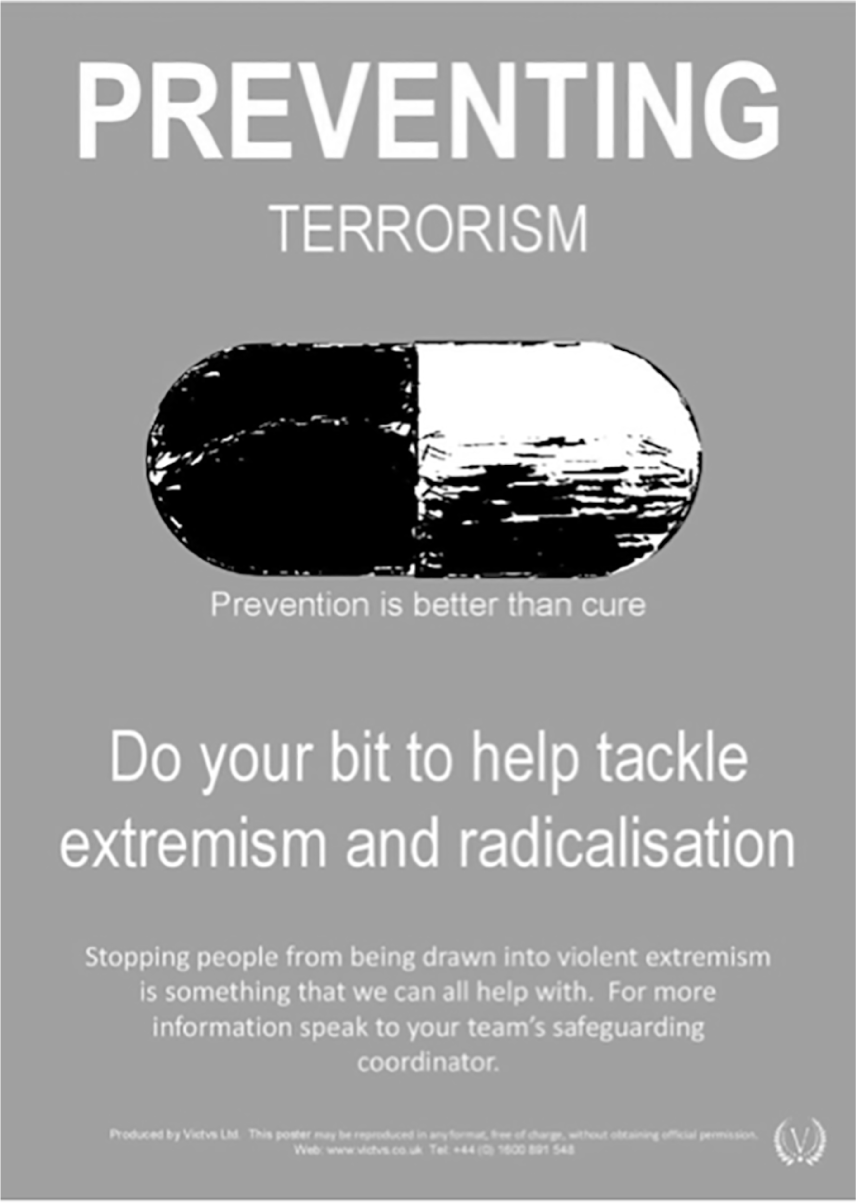
PREVENT poster by Victvs, commissioned by UK Home Office. This poster is in the public domain via creative commons, https://www.tes.com/teaching-resource/tackling-radicalisation-posters-11029730.
PREVENT training is known to employ a ubiquitous amount of ‘psychology talk’, as its counter-radicalisation framework depends largely on the Extremism Risk Guidance Framework (ERG22+). 33 The study underlying the ERG22+ is unavailable to the public (due to its security status). We know, however, it was conducted by forensic psychologists with ‘al-Qaeda inspired extremist offenders’ who ‘fell short of extremist violence’. 34 Thus, the psychologisation of PREVENT training is unsurprising given its origins. Since 2017 however, the UK government has especially emphasised the role and training of mental health professionals in counter-radicalisation, outside the professional skill-set of forensic psychologists. To unpack the framing of how radicalisation is ‘made sense of’, the following section will provide a series of screenshots taken from the online PREVENT training resource, as found in the PREVENT e-learning package accessible to everyone on the UK government website. 35 The training begins by first asking you to consider what behaviours are a cause of concern
and lists ten ‘concerning behaviours’; trainees must choose three which may cause concern (Figure 2). Immediately the list is distinctive in two ways. The first is its inclusion of ubiquitous behaviours such as crying and change in appearance, but also elusive behaviours such as signs of distress. The slide’s second, less pronounced, distinction is its counter-valent subscript of what it deems ‘normal’ – an elusive standard of emotional self-control, conformity and agreeable appearance – while dismissing how the measure of deviation from this ‘norm’ is inherently a racialised practice. 36 Thus, even singular behaviours are subject to racialisation. This slide sets the frame of therapeutic rhetoric; counter-radicalisation necessitates and gives primacy to the individual qua a constellation of psychological features, which immediately take this ethnocentric valence. Seeing this slide, the professional assumes a psychologised stance as well. Political violence is immediately understood as an individual failing produced in the peripheries of civilisation and reason – not instituted or normalised by the state – and embodied by subjects whose distress will be noticeable to the average person (who, assumed to be devoid of their own distress, thus embodies the potential to be a psychologist themselves).
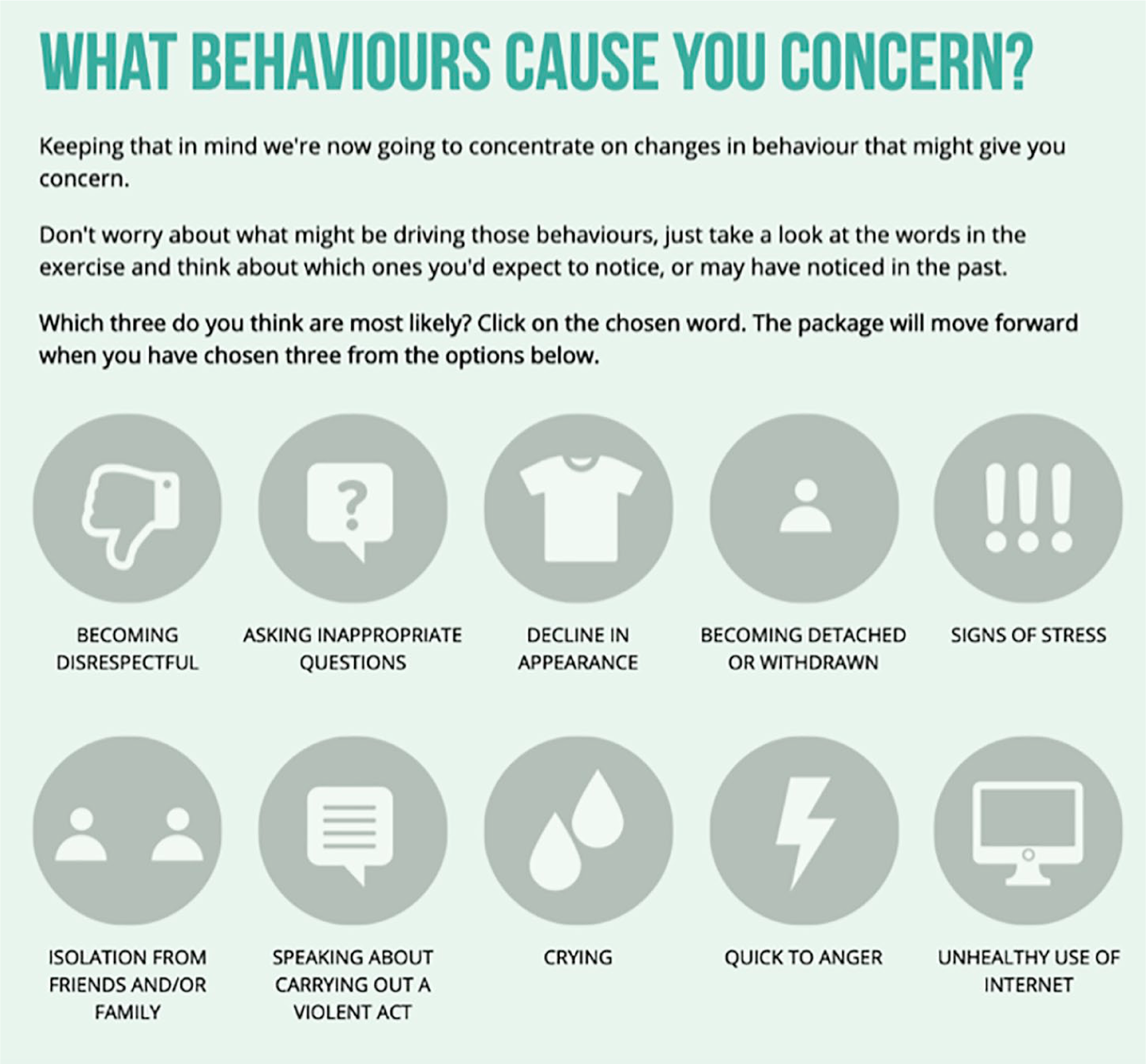
Screenshot from E-Learning training on PREVENT, HM Government, 2020, www.elearning.prevent.homeoffice.gov.uk.
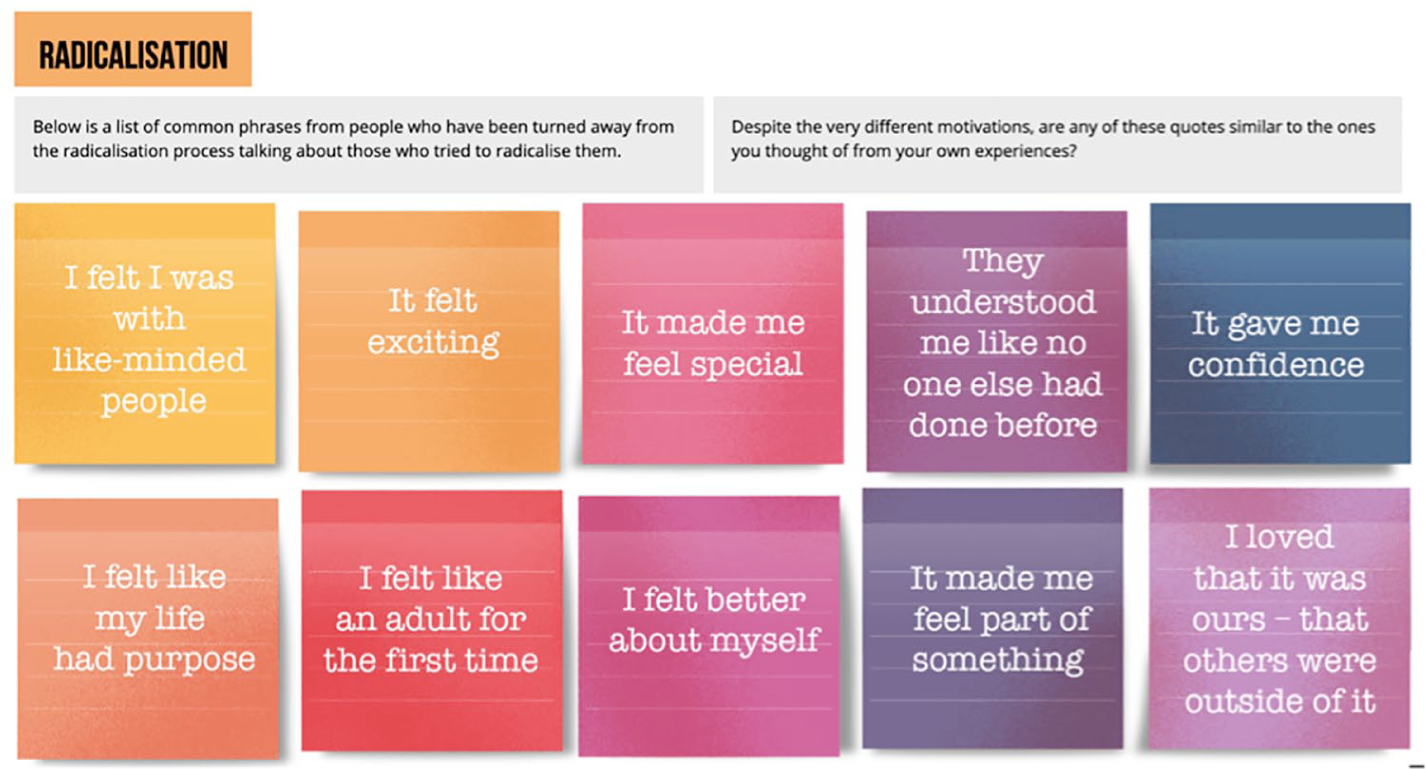
In the spirit of everyone-is-a-psychologist, the module then requests the trainee to reflect on the reasons why people display concerning behaviours at all (Figure 3). I chose the two ubiquitous reasons from the list – low self-esteem and loss. The next slide then reminds the participants that mental health and radicalisation are also causes of behavioural change, though they may not be as prevalent as others, such as loss, for example (Figure 4). The message is clear: there are many causes for behavioural change including – but not limited to – radicalisation. The training thus achieves three things up until this point. First, it frames the boundaries of ‘abnormal’ behaviours, drawing from a wide range of everyday experiences (Figure 2). Then, in an exercise of aetiology, it frames the underlying causes of radicalisation as inextricable from our human condition, attributed to the most generic of risk factors. These risk factors naturally belong to particular neoliberal understandings of ‘well-being’, begging the question in whose ‘being well’ are we investing – the individual’s or society’s? 37 In its broad framing, PREVENT thus ensures that healthcare staff, as quoted directly from Figure 4, never ‘ignore the possibility [of radicalisation] – no matter how remote it is’. This is key and the central performative function of PREVENT’s counter-radicalisation training: staff are responsibilised in remaining ever vigilant, rather than following a particular guideline relevant to a syndrome. Finally, the training professes that health professionals should trust their intuition when the thought of radicalisation arises. This last point is where racism is normalised under the auspices of mental health, leading the trainee to Figure 5.
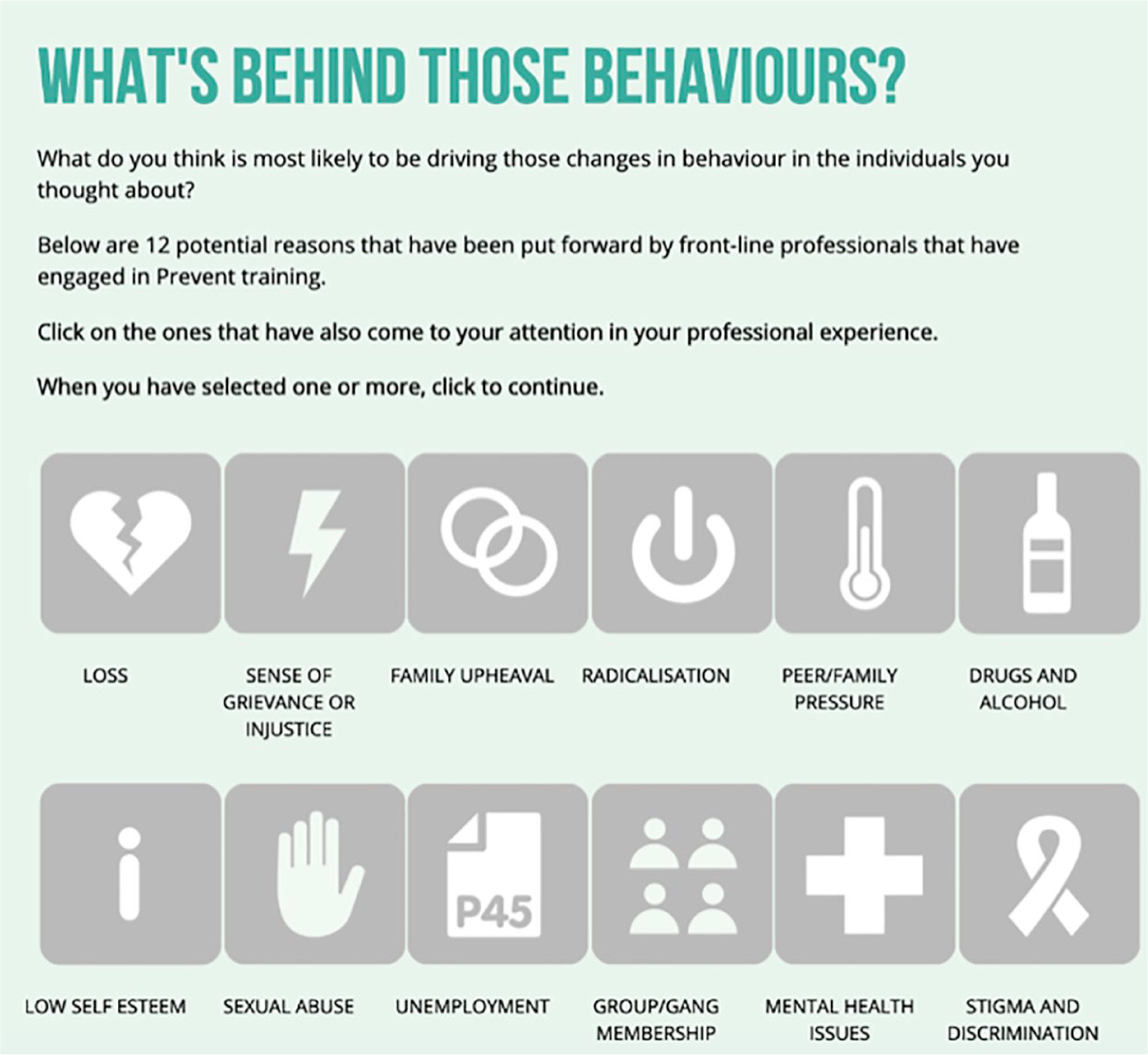
Screenshot from E-Learning training on PREVENT, HM Government, 2020, www.elearning.prevent.homeoffice.gov.uk.
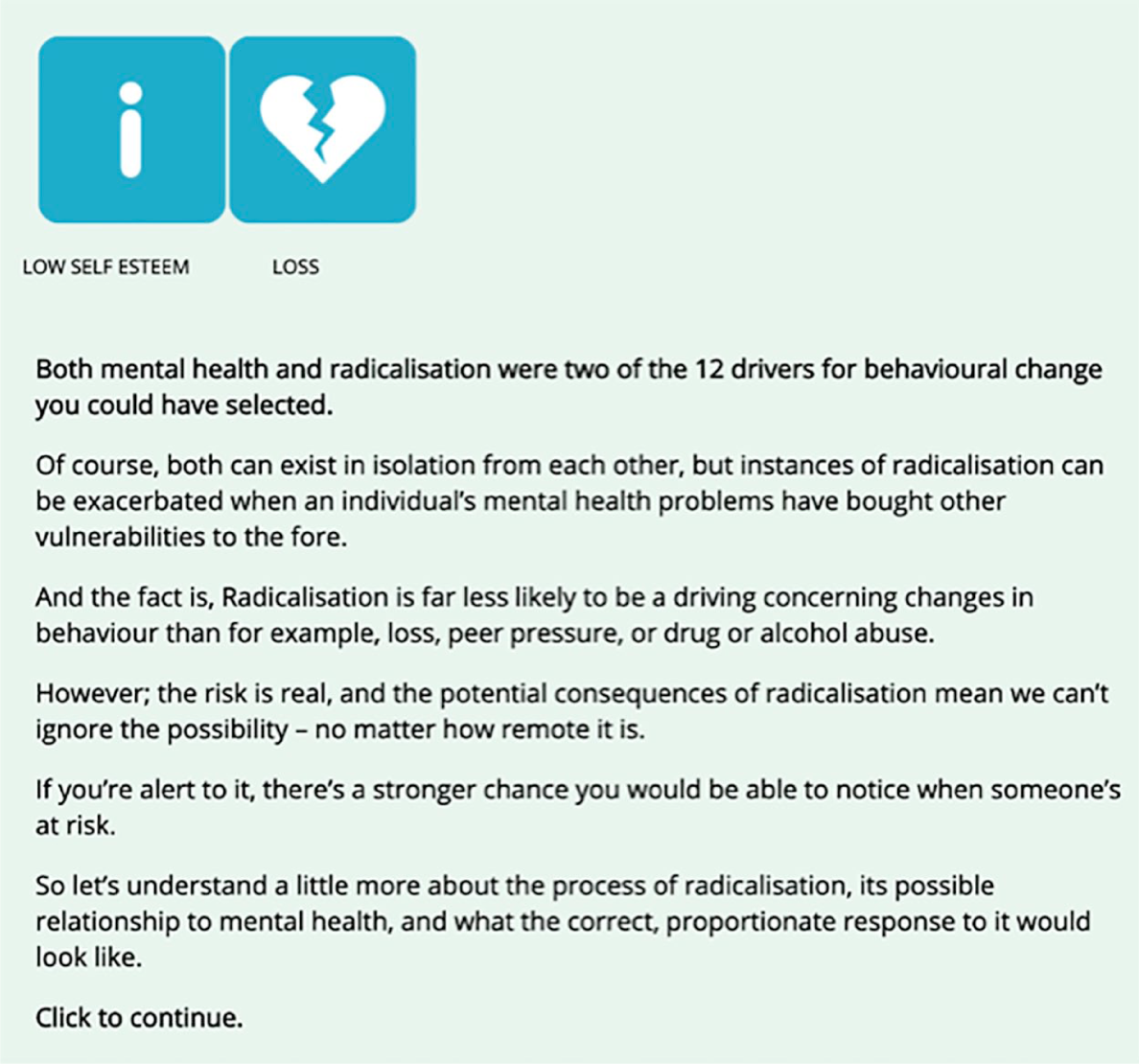
Screenshot from E-Learning training on PREVENT, HM Government, 2020, www.elearning.prevent.homeoffice.gov.uk.
Screenshot from E-Learning training on PREVENT, HM Government, 2020, www.elearning.prevent.homeoffice.gov.uk.
The securitisation of normality – or rather the normalisation of security – is made explicit in Figure 5. All ten notes are potentially associated with vulnerability towards radicalisation, drawing upon widespread psy-concepts such as confidence, belonging and identity. The themes of this slide are reiterated a few slides later during training, where an embedded video of forensic psychologist Christopher Dean explains the process of radicalisation. In doing so, the training gives the impression its script is grounded in ‘scientific research’ while overlooking the fact that Christopher Dean is in fact one of the architects of the Extremism Risk Guidance Framework (ERG22+) from which PREVENT draws its inspiration. 38
The phrases in Figure 5 are elusive but the purpose of PREVENT training is not to develop a cohesive profile of a pre-criminal. Rather, the training seeks to responsibilise staff to trust and react immediately upon their intuition. 39 Indeed, this reliance on ‘gut feelings’ is best encapsulated by the refrain heard on the UK’s public transportation network, attributed to its national surveillance strategy: ‘see it, say it, sorted’. In doing so, PREVENT institutionalises ‘gut feelings’ – upon a bedrock of mental health – to develop a large-scale proliferation of pseudo-experts tasked to trust their intuition in the psychological evaluations of others. Intuition, however, is subjective and indeed established upon the racial order found within society, and healthcare staff are just as susceptible to racialised logics as anyone else. 40
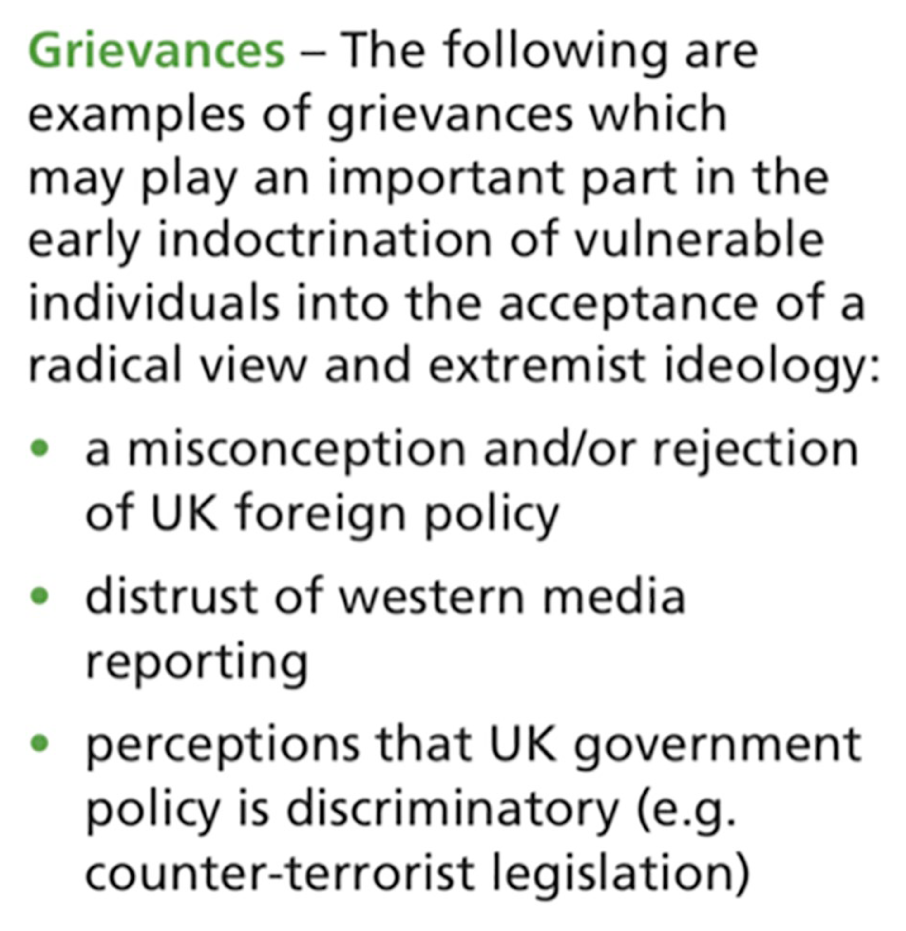
If intuition is central to PREVENT, then it is obvious that public policy is susceptible to the prevailing ideologies of British society. In this respect, one of key logics of the entire counter-terrorism strategy hinges upon nationalism (as is obvious in its insistence on Fundamental British Values). A segment within an NHS safeguarding guide – readily accessible across the UK – is instructive of how nationalism underpins radicalisation’s framing. In the PREVENT section of a 2017 guide for health care staff (see Figure 6) some examples of ‘grievances’ are listed under the question, ‘What factors might make people vulnerable to exploitation?’.
Screenshot from NHS England, Safeguarding Adults: a guide for health care staff, 2017, May 2017, https://www.england.nhs.uk/wp-content/uploads/2017/02/adult-pocket-guide.pdf.
The inclusion of these grievances – ‘known to contribute to the vulnerability of individuals and could put them at risk of exploitation by radicalisers’ – is revelatory. An ethnonationalist pivot underpins each of its racialised points. First, a ‘misconception and/or rejection of UK foreign policy’ directly addresses Muslim populations and their concerns with British foreign military interventions across Muslim-majority countries. The fact that ‘misconception’ is employed is particularly insidious. It suggests that there is only one ‘truth’ in the ‘war on terror’, of which the British State is the sole arbiter – deviation from this is a risk factor. Second, the distrust of western media addresses the racialised Muslim Other in so far as it uses ‘western’ as its pivot, harkening to the ‘West vs Rest’ trope. Had the point mentioned ‘British media reporting’ instead, this would have potentially encompassed various alt-right, anti-establishment factions as well.
Finally, and most pertinently to this article, is the point concerning the perception that UK government policy is discriminatory, alluding to counter-terrorism legislation as an example. This risk factor creates a dangerous tautology for which even this article would stand accused: to be critical of counter-terrorism is itself a risk factor towards terrorism. Again, this point also underpins a particular racialised logic, for it is the Muslim Other who is the primary target – in surveillance and human rights abuses – of national counter-terrorism strategies. Taken together, these three examples of grievances, inserted under safeguarding, offer an acute insight into how nationalism underpins the psychologisation of political violence. Moreover, they highlight how ‘protest’ continues to be suppressed under the purview of the psy-disciplines, especially as it relates to the du jour marginalised Other.
Psychologisation: a paradigm for a post-racial society
The PREVENT policy no longer explicitly targets British Muslims, especially given a revived spirit to curtail the threat of the far Right. However racialised Muslims remain common-sensically associated with threat and backwardness, which threads from a long history of racialised logic which sees the West as the liberal and rational epicentre of the world. 41 This racial order is constantly reconfigured according to the dominant social conflict, such as the ‘war on terror’, securitising the long-standing debate on Muslim integration. 42 How does the UK government reconcile this dissonance: a counter-radicalisation policy for the whole population in theory, but which discriminates against racialised groups in practice? Not unlike the War on Drugs, as I argued elsewhere, PREVENT’s counter-radicalisation training must actively engage in performative colourblindness, which takes the following two forms. 43 The first is to raise examples of terrorism, then follow this with a declaration not to associate terrorism with Muslims – raising and erasing the centrality of race. In PREVENT training, this takes the form of asking attendees if they believe that the growth of a beard is indicative of radicalisation, and subsequently informing them that it is not. The second is to deny the role of race altogether, by affirming that anyone can be vulnerable to radicalisation, just as anyone is susceptible to mental illness. It is this second form which establishes the basis of this discussion on psychologisation.
As a concept, psychologisation denotes modernity’s trend to locate all experiences within the mind. As such, psychologisation is hardly a novel phenomenon. Some have argued that psychologisation has increased over the years, 44 but the inverse of this appears to be a stronger argument: modernity itself is psychologised. 45 Thus, it is not that fields such as political science or counter-terrorism are becoming psychologised, but rather these fields inevitably see all human behaviour within a psychological frame. Through psychologisation, our internal psychological configuration becomes the foremost frame with which to understand social situations, with tremendous explanatory power maintained at the convenient expense of other explanatory models – materiality, for example.
The teaching of counter-radicalisation is just one of many policies which take the form of psychoeducation. ‘Look at yourself as we psychologists do’ is the sentiment De Vos relates to workplace depression awareness training, but it quite aptly summarises the language of PREVENT training as well. 46 Psychological concepts, employed and reframed through the ‘war on terror’, serve to make state practices colourblind and evade allegations of institutional racism. While the racism of counter-radicalisation practices is increasingly documented, this article purports to go further to explains how psychologisation obscures the racialisation of western Muslims and deflects the charge of racism in counter-radicalisation practices. PREVENT training takes for granted that everyone is able to observe and evaluate the behaviours of others through the lens of the psy-disciplines. Psychologisation in counter-radicalisation achieves three interdependent objectives beyond just colourblindness.
Universalising the radical
First, as is evident in the PREVENT training slides above, the UK’s strategy explicitly advocates a positivist approach to radicalisation, broadly outlining a universal and colourblind series of psychological vulnerabilities and risk factors – for Muslims and the far Right alike. Sian traces the positivism inherent in PREVENT within the legacy of racial profiling associated with the criminal atavism of Cesare Lombroso. 47 But positivism is an inherent feature of the psy-disciplines as well. 48 Joining mental health and political violence, Silke refers to the enduring search for a universal, psychopathological profile of terrorists as Cheshire-Cat logic: there must be some psychological abnormality at play, otherwise how could a normal, rational person commit a violent act? 49 Significantly, it cannot be overstated that PREVENT’s universal outline of psychological vulnerabilities is without empirical foundations. What makes PREVENT interesting then is not its lack of theory or evidence, but that it can be instituted on the presumption that the psychologised public will readily understand there must be some universal, psychological profile of pre-criminality identified and managed by the state.
The categorisation and management of ‘normalcy’ is significant in this regard. Psychologisation is invoked in a medico-political frame to make radicalisation knowable – and therefore subject to governance – within the entire population. As seen in Figure 1 with the image of the pill, this psychologising framework sees political ideologies as viruses which afflict particularly vulnerable individuals. The theory of social contagion in particular reflects a modern, neoliberal vision of personhood, which sees ideologies floating around liberally and equally in a ‘free market of ideas’, to which vulnerable individuals may be susceptible. 50 In practice, the social contagion theory achieves two goals. First, it sets the primary site of intervention within individuals. The ideal then is to focus on social projects which augment individual ‘mental resilience’ to ‘bad’ ideas. Second, it overlooks state responsibility for creating the conditions of radicalisation and, more generally, dismisses the centrality of power in the unequal dissemination of information. Zuboff summarises the relationship between power and information in the modern age: ‘Who knows? Who decides? Who decides who decides?’ 51 It is this last point where the psychological foundations of radicalisation unveil the nation-state’s collusion in the counter-terrorism apparatus. As expressed by Fekete, ‘we need to question the ways that we have been trained to understand fascism not as the convergence of affinities and affiliations at the periphery and centre of society, but as just another ideology for sale in the “marketplace of extremisms”’. 52 Thus, fascist ideas that connote ethnocentric or xenophobic views are not readily associated with ‘ideological viruses’. Instead, they disseminate as politically acceptable views, protected by the sanctity of free speech, which might even see politicians win elections (e.g. Rasmus Paluden, who publicly burns Qurans, recently received enough votes to stand in Danish elections 53 ). The framework then, of cognitive distortions, and indeed the bedrock of mental health, reveals its political orientations, favouring certain ‘ideas’ over others.
The universalisation inherent in PREVENT’s positivism is integral to its colourblindness –which some officials call its ‘threat agnosticism’ – as is evident in its desire to tackle all pre-criminalities on the same training platform. But if psychologisation professes an unbiased, unselfish and apolitical framework, so too can PREVENT trainers ‘claim the unselfish and professional position of being the mere servant of a body of knowledge, dealing with the universals of humankind’. 54 The racialisation of Muslims takes place in this de-politicised position, for it is only in the de-politicisation of a construct (such as mental health) that racialisation can itself be erased. Radicalisation as a type of vulnerability, then, is made equal across ‘bodies’ without accounting for race. PREVENT presents itself as a science par excellence; it is beyond politics, neutrally and objectively pleading for the well-being of the population. But looking closer at the underlying rhetoric and consequences of PREVENT, the problems associated with responsibilising public bodies to identify and report potential radicals becomes readily apparent.
Detecting the radical
The second result of psychologisation is surveillance writ large. The ‘behavioural signs’ PREVENT lists are elusive enough to potentially capture an extraordinary range of everyday, and all too human, experiences. This corroborates the UK’s government-stated justification for why counter-radicalisation should be made mandatory across health bodies; not because there is an evidence-base associating health with terrorism, but simply because millions of individuals depend on health services. 55 This goal also explains PREVENT’s wholesale reliance on intuition when watching for odd behaviours. Even if a behaviour is not entirely odd, PREVENT trainers profess, it is better to make a referral regardless. This form of large-scale data gathering, legitimised through the frame of elusive psychological categories, is what Heath-Kelly calls algorithmic autoimmunity. 56 This data gathering evolution would not have been possible without the global North’s venture into a ‘third modernity’.
The industrial purview of psychologisation is on the cusp of unprecedented growth, and Zuboff gives a cutting analysis of what she calls the ‘third modernity’ ushered in by the digital age. 57 She describes how the advent of ‘surveillance capitalists’ such as Google, Facebook and Microsoft have re-shifted modernity’s conventional capitalist contract between producers and consumers towards a social contract whereby all our thoughts and behaviours are to be harvested, packaged and sold back to us, other companies or governments. In other words, the third modernity sees human behaviour as an endless supply of digital information which can be used to inform and control populations. All human behaviour – online and off – is ‘data’, endlessly available for extraction, repackaging and resale. This is the foundation of Cambridge Analytica’s involvement in the Brexit referendum, but the relationship between governments and surveillance capitalists can also be traced into predictable formations of the military-industrial complex, such as the cross-filtration of staff between the ‘information warfare unit’ 77th Brigade and Twitter. 58
More pressingly, it is precisely the ‘war on terror’ which made way for the unregulated expansion of the psychologised extraction and analytics of everyday behaviours. 59 I have previously discussed this in relation to the totalising overlap between racialisation and spatialisation of mental health settings in the UK, whereby staff are mandated to fill in a counter-radicalisation assessment for all patients. 60 Such developments also reflect the large-scale expansion of the security sector in the UK. The security industry is booming, worth £13.3 billion of the UK’s economy while its global value is expected to reach £150 billion by 2022. 61 Moonshot CVE, for example, now operating in over twenty-eight countries, purchases Google analytics which it processes with algorithms to detect online activity it suspects to be extremist. It subsequently ‘intervenes’ by deceptively guiding individuals forward in ‘non-radical’ directions, either through strategic advertising or covert social media mediations (e.g. someone may contact you on Facebook). In order for this process to work, our digital footprint must necessarily be psychologised, figuring in the calculation of personal thoughts and behaviours. We now know that digitisation is far from the panacea for racism it was thought to be. 62 Rather, racial signifiers are coded into algorithms which are then obfuscated through the presentation of ‘objective’ numbers. The intersection of digitisation and psychologisation leads then to a further layer of colourblindness in a post-racial society.
Managing the radical
The third goal is management. Counter-radicalisation is a strategy of managing subjectivity through psychoeducation, under a neoliberal logic that sees systems comprised of a collection of self-disciplining individuals. Jarvis describes how a critical understanding of terrorism is secondary to policy-relevant, problem-solving research. 63 By providing the psy-signifiers – that anger precedes violence, for example – counter-extremism designates the boundaries of what ‘normal and healthy models’ of political subjectivity ought to be. If, as Vitale describes it, the shift from military troops to civilian police marked an evolution in social control, then a population-wide pre-crime policy marks the next stage in this process. 64 The administration of PREVENT training normalises these politicised models of subjectivity on a population-wide scale, delivered with a purported scientific stamp of approval through psychological discourse. But this focus on management is not exclusive to counter-terrorism – it’s symptomatic of a wider, neoliberal logic of pre-emption and management through ever-increasing behavioural categorisations. Frances, the editor-in-chief of the DSM-IV (the clinical diagnostics manual for mental health professions) has written about the need to ‘save normal’ given the unregulated inflation of ‘psychopathologies’ which have appeared in the DSM-V. 65 He argues that the trajectory of the mental health industry has seen an inflation of clinical disorders which increasingly pathologise everyday behaviour, with an equally questionable increase in purported interventions. De-radicalisation and its hyper-individualised focus is exemplary in this regard.
The psychologisation of counter-terrorism is a well-known and hotly debated subject, though an overwhelming desire to ‘psychologically profile’ the threat persists. 66 As of 2014, there were fifty-eight de-radicalisation ‘mentors’ employed by the UK, fifty-five of whom focused on Muslims. 67 While a large-scale review by the Behavioural Insights Team only found two of the thirty-three available de-radicalisation programmes to be effective, 68 access to de-radicalisation mentors is notoriously difficult, as their work is shrouded behind a veil of national security. In a report written for the Financial Times, Warrell interviewed a de-radicalisation mentor going by the pseudonym of Anjum Khan. 69 Khan professes to have worked with over 100 individuals. His background of expertise is unknown, though the article mentions ‘Khan uses his own religious knowledge – gleaned from a decade of reading the Koran while minding his shop – to push back against misinterpretations’. Crucially, Khan admits working to address vulnerabilities clients ‘don’t see . . . but professionals have picked up’. Such (ethically dubious) language unveils the uncertain line between theological misunderstandings and cognitive distortions.
Khan reveals how politically incorrect ideology overlaps with the more traditional language of psy-disciplines, which sees clients then in need of an intervention – even if they are unaware of this fact. Pettinger’s research demonstrates how PREVENT practitioners navigate the highly subjective space of non-violent pre-criminality ‘based on the subject’s presumed opinions and beliefs’. 70 Of note for this discussion, however, is the centrality of its pseudo-psychoanalytical framework. This was especially pronounced in Khan’s attitude described above; he admits being able to ‘pick up’ on vulnerabilities clients are unable to see, much like a psychoanalyst might draw inferences from a client’s unconscious. Here the necessarily psychologised framework of PREVENT sees political violence as primarily the purview of ‘subjectivity management’, susceptible then to the logic and intervention of ‘experts’ who can ‘detect’ vulnerabilities outside their client’s awareness. None of this has proven useful in preventing attacks. Like Vitale’s evaluation of modern policing, if strategies like PREVENT were judged by actual management of violence, the results are questionable at best – especially without an independent review. PREVENT however has proven to be remarkably successful by other metrics: increasing social control; exhausting public resources; and consolidating a private counter-extremism industry. All this while fanning the racist moral panics surrounding British Muslims.
Consolidating nationalism, managing protest and overseeing the Other
Psychologisation is inevitable for the reasons discussed above, and more. For example, Sageman deconstructs accounts of radicalisation emphasising psychological predispositions and observes the following: in practice, governments presume individuals join some ‘class of political protest’ movement before they commit to a path of violence. 71 Presciently, Sageman predicted a PREVENT training guide, issued by Counter Terrorism Policing South East. 72 The guide illustrates a wide range of signs and symbols associated with protest movements, including anti-fascism, while also listing Extinction Rebellion as having an extremist ideology for its ‘anti-establishment philosophy’. Thus, it is this ‘class of political protest’ that has always been viewed as problematic to the social order, which it is then incumbent on the state to essentialise, identify and manage through therapeutic rhetoric. As Cloud maintains, ‘the therapeutic provides a frame for complaints against the system but ultimately recuperates and neutralises political opposition by rendering protest private’. 73
Within neoliberal frameworks, to render protest private is to locate the plainest site of ‘intervention’ within the individual, even if presented as one among several options (i.e. military intervention abroad). But the ubiquity of psychologisation does not fully explain its practice in counter-terrorism. Two discrepant points have been thoroughly argued in previous research: 1) the ‘war on terror’ serves a means of consolidating the interests of the nation-state; and 2) the psy-disciplines have historically been implicated in the management and suppression of civil disobedience. Connecting these two points explains a significant feature of the PREVENT policy: its psychologisation serves the colourblind (racialised) management of a nationalist subjectivity in the modern age. This is especially relevant to dissent. Thus, while Knudsen provides a valuable overview of how PREVENT employs mental health as a strategy, 74 it must be said that vulnerability has long been viewed within the prism of governance. The state’s usage of therapeutic rhetoric becomes racialised when employed to manage social conflicts, insofar as social conflicts – like the War on Terror – are racialised to particular bodies.
The liberal nation-state’s contemporary understanding of resistance suggests that grievances should be democratised in a free market of ideas. Under the purview of free speech, ideas are thought to ‘battle’ until those with greatest democratic clout win. But there are several known issues with this conceptualisation. First, this notion of the ‘free market’ disregards the centrality of power. Fekete discusses this at length in her seminal examination of the far Right, where she notes that far-right ideas are not just free-flowing in society but have been increasingly normalised and institutionalised for many years now. 75 In other words, the free market is not free at all; rather, the flow of information is subservient to those in power. This is further conceptualised by Zuboff in her discussion of surveillance capitalism, as explained above. Zuboff explains how the flow of information today is invisibly tailored by surveillance capitalists (such as Google, etc.) who profit immensely on the resale of our behavioural analytics to third parties, such as governments. As such, populations are increasingly presented a vertical slice of information that is presented as neutral and unbiased – not manufactured. Second, there is an inherent paradox between liberalism and democracy. While liberalism theoretically assures fundamental human rights for all, nation-state democracies necessarily leave the Other at the civil mercy of the ethnocentric majority, which then explains how marginalised groups turn towards political violence. 76
As one can see from the PREVENT training slides, many of the ‘symptoms’ associated with radicalisation innately orbit around the nation-state. Here an overview of nationalism, as it relates to race and Othering, is necessary. Politics is a formulation of boundary-making, necessarily defining those within in contrast to those without. 77 Following her analysis of the second world war, Hannah Arendt famously observed the consequences of nationalism and its threat to a politics of plurality. 78 As Valluvan unpacks it, the political project of nationalism is one which inherently essentialises an ethnocentric vision of belonging which, by its own logic, immediately reifies a racialised Other outside its boundaries. 79 In the case of Nazi Germany, the racialised Other of the nation-state invoked the ‘Jewish question’ in its boundary-making, much as the ‘Muslim question’ is invoked today. 80 Valluvan details how the British nation-state in particular has consistently reified a racialised Other who poses the necessary counter-valence to Britishness. The clearest evidence for this in PREVENT’s enterprise is the self-styled induction of Fundamental British Values (FBV) into school curriculums. The logic is clear: if Muslims – and it must be Muslims, for FBV explicitly privileges white innocence – endorsed the British nation-state project, they would never act out towards it in aggression. 81
Times may change but the racialised boundary-making of the nation-state project remains consistent. While the liberal sensibilities of the modern age reject overt displays of racism, racialised Othering persists in either colourblind or culturally racist formulations. 82 Thus, while PREVENT’s message towards the far Right might be, ‘this is Britishness taken too far’, the message towards Muslim ‘extremists’ remains, ‘this does not belong to Britain’. Such an attitude is best exemplified by the increase in citizenship deprivation and the deportations of Muslims accused of terrorism. 83 In this case, Shamima Begum’s citizenship deprivation for having joined ISIS displays a quintessential irony: prior to this, Shamima was used as a case example in PREVENT training to demonstrate the significance of counter- and de-radicalisation. 84
But such acts should not be seen in isolation, for it is precisely the perceived rejection of Britishness which is viewed as the primordial resistance of the racialised Other towards the nation-state (and therefore unforgivable in the eyes of many). White conversion to Islam – and its particular injury towards ethnonationalism – may be seen as another example of this, whereby converts are then rendered especially subject to suspicion. 85 Thus, there is a particular centrality of protest in the PREVENT strategy. However, as protest of the nationalist project is necessarily racialised, and we live now in self-declared liberal epoch where explicit racial apartheid systems are to be resisted, the psy-disciplines take on a greater role than before. History is rich in examples of the psy-disciplines contributing to the dismissal and suppression of political dissent.
Already in nineteenth-century America, slaves who ‘irrationally’ fled from their ‘benign’ masters were thought to suffer from a particular psychological condition: drapetomania.
86
A century later during Jim Crow, schizophrenia transferred from a diagnosis afforded to ‘disobedient housewives’ towards Black liberation movements. Metzl gives a history of this transformation, explaining the utility of psychiatric diagnosis in curtailing the ability for Black leaders to arm themselves in self-defence. Discussing an article which appeared in Archives of General Psychiatry in 1968, Metzl summarises the thoughts of psychiatrists Walter Bromberg and Frank Simon who argued: . . . black men developed ‘hostile and aggressive feelings’ and ‘delusional anti-whiteness’ after listening to the words of Malcolm X, joining the Black Muslims, or aligning with groups that preached militant resistance to white society. According to the authors, the men required psychiatric treatment because their symptoms threatened not only their own sanity, but the social order of white America.
87
In the twenty-first century, Alison Howell explains how suicide attempts in Guantánamo Bay are construed as individual psychological failings – not acts of resistance. In doing so, ‘the psy disciplines are invoked in ways that cast the actions of the detainees not as political, but as a result of their poor mental health. This positioned the detainees merely as victims, not as political agents.’ 88 Aggarwal elaborates on the complicated medico-legal role of mental health assessments in Guantánamo Bay, ‘to ascertain not the detainee’s well-being but his claims’. This is notwithstanding the role mental health professionals played in the ‘enhanced interrogation’ (torture) of detainees. 89
Every nationalist project necessarily includes a psychological component. What’s changed, however, is nationalism’s ability to proliferate in a ‘post-racial’ context. Here the psy-disciplines play an even more central role in racialised policies, by evading the charge of racism through ever more complicated preventative models of risk factors. But as we have seen above, PREVENT diminishes this complexity into a simple mandate of trusting one’s intuition concerning all thoughts and behaviours deemed ‘abnormal’. In doing so, the positivism inherent in contemporary ‘psychology talk’ serves as a key component in avoiding the question of institutional racism and reduces all forms of racial discrimination into aberrations of individual prejudice. In the great neoliberal tradition, it is the individual, then, who is held ultimately responsible – the system remains irreproachable.
The ‘war on terror’ posits that we view every ‘odd’ behaviour with suspicion, but this demand does not exist in a vacuum. Indeed, one-third of Britons see Islam as irreconcilable with a British way of life, and this is precisely the definite danger PREVENT poses as a public policy. 90 If a racialised Muslim child appears reclusive, this is not just a natural reaction to distress to be addressed with pastoral support by responsible adults (parents and teachers). Nor is it a behavioural response in need of empowering interventions by psychologists. Now, it is distinctly a risk factor for potential pre-criminality vis-à-vis the nation-state, which frames the responsibility of adults as well as psychologists, who now treat the child’s suffering on this pre-tence. Thus, the frames of war – using Butler’s terminology 91 – work backwards and inwardly, reconditioning all experiences as needing to be understood in light of the state’s objectives. But the state could not do so without a hegemonic corps which psychologises the existential and uncertain threat of political violence within noticeable, highly individualised phenomenological experiences. This is the role of the academy then: to furnish the psychologising framework with endless studies of deconstructed subjectivity. And the potential for psychologising research is truly endless, for as I have argued earlier, all human events can be reduced to categories of individual subjectivities – not least as they relate to the individual experience of religion or ideology.
Conclusion: the psy-disciplines as the logic of twenty-first century repression
Anti-racism in the psy-disciplines cannot proceed without serious consideration of psychologisation as we enter a third modernity. The persistence and violence of the ‘post-racial society’ myth is most evident in colourblind, psychologised policies. Such neoliberal policies have the uncanny ability to deflect the charge of institutional racism by claiming that they are not targeting any single community. As I have argued, PREVENT’s psychologisation, which both codifies political ills on the individual and casts the general population as pseudo-psychologists is central to the performance of colourblindness. This is not to say there is no room for individual intervention, but that individual intervention is the ideal recourse of the neoliberal state and a burgeoning surveillance capitalist society. Under these conditions, it is not surprising that Muslims across the global North have their political agency diminished in addressing the threat of violence on their own terms. Quite the opposite: as we have seen, PREVENT has institutionalised a system whereby any deviation from nationalism whatsoever is seen as suspect and worthy of intervention.
As such, individual interventions should be community-led and guarded from state involvement (in framing and funding). Psychologisation is especially lucrative in its colourblindness as it establishes a positivist attitude towards the human condition; just as everyone is susceptible to cognitive distortions, so, too, is everyone susceptible to radicalisation. Counter-radicalisation thus represents a particular form of psycho-politics which both racialises and dismisses the racialisation of Muslims by associating colourblind psychological vulnerabilities with the politicised threat to national security. Thus, in its ability to racialise Muslims as security threats and place the central locus of concern within the individual, psychologisation deflects all charges of racism. Moreover, it is likely Muslims inadvertently reproduce the therapeutic rhetoric of their own vulnerability, further depoliticising their capacity to speak out against political structures. The objective then should be to reverse this trend: unshackle mental health from its nationalist bedrock and de-pathologise political subjectivities which do not correspond to the ideals of the nation-state.
Footnotes
Acknowledgements
I would like to thank the British Academy and the Royal Society for the support and funding of this research through the Newton International Fellowship, as well as my co-applicant Sushrut Jadhav. I would also like to thank University College London for hosting the project, as well as all of my participants for their courage and time in speaking with me.
Tarek Younis is a lecturer in psychology at Middlesex University researching Islamophobia, the securitisation and racism of mental health, and how counter-radicalisation enters into clinical logic.