




Abstract
Global histories of technology tend to tell one-sided stories of transfer and exploitation, and they usually analyze the activities of large corporations, nation states or the military. By focusing on missionary societies in the colonial era, this article tells a different story. On the basis of primary sources from German missionaries in the Dutch East Indies, it shows how the application of various techniques at missionary stations was the outcome of transcultural interaction. Although missionaries brought with them tools and materials from home, they remained dependent on the knowledge and skills of local artisans, as well as the material and goods the locals provided. Missionaries’ wives tried to uphold a Western lifestyle but found themselves using local household technologies. The missionary station was a trading zone: Although the abilities of Europeans and Asians to communicate were socially and linguistically limited, they proved able to exchange information and skills in a successful manner. By revisiting the anthropological background to Galison’s trading zone, the authors re-appropriate this concept to improve our understanding of cross-cultural exchange in non-scientific settings.
The ultimate movers of globally implemented technologies are usually said to have been trade houses, imperial states or capitalist corporations – at times seconded by natural historians or other scientists (Headrick, 2010; MacLeod, 2000; Prestholdt, 2008). One group of actors conspicuously absent in works written by historians of technology are Christian missionaries. This omission is astounding, since missionary societies played a vanguard role in the early phases of colonial expansion. In addition to proselytizing and teaching their converts to read and write, missionaries erected churches, brought with them Western consumer goods, and instructed members of local populations how to use sewing machines and other Western tools (Comaroff and Comaroff, 1991; Ruether, 2002).
With this article we make a case for the study of missionaries and missionary societies in the history of technology. Unlike historians of science and historians of medicine (Hsia, 2009; Wall, 2015), historians of technology have rarely investigated missionary activities. Focusing on Christian missionary stations in Southeast Asia, we show the potential of missionary history to contribute to the global history of technology. On the basis of sources from German missionaries in the Dutch East Indies (today’s Indonesia), we examine how Europeans and Asians learned to apply tools and materials in a reciprocal manner. The mutual exchange of skills and knowledge comes out particularly strongly in the area of construction. Missionary stations on the islands of Sumatra and Nias were not simple copies of German buildings but the outcome of elaborate information exchange across cultural boundaries.
The story we tell is neither about the one-sided diffusion of Western technologies nor about the globalizing power of European consumer products. In accordance with what Arnold, in a book on India, calls Everyday Technology (2015), we investigate the application of tools and practices on a micro level. Informed by studies of ‘sites of local exchange’ in the history of science (Roberts, 2009: 23), we highlight instances in which techniques and knowledge from Europe and the Dutch East Indies entered into fruitful combinations.
Our article follows recent writings on global history by investigating what Osterhammel in his monumental book The Transformation of the World (2014: 891) calls the ‘symmetrical interaction’ between Christian missionaries and the peoples they tried to convert. Although missionaries often received protection from colonial powers, everyday life at missionary stations was to a large extent formed by ‘local conditions’ (p. 893; also van der Veer, 2001). Like Osterhammel (2014: 893), we show that this encounter gave ‘local individuals’ the possibility to grasp ‘new opportunities’. In particular, we investigate the opportunities that missionary stations offered to local artisans, traders and farmers. In doing so, we follow those global historians who argue that we cannot do without local investigations, or even ‘micro-histories’ (Conrad, 2016: 129; Drayton and Motadel, 2018; Gänger, 2014).
Following Epple’s (2018: 390) argument that global history has to include analyses of events on ‘the micro level’, we apply a bottom-up perspective. The view from below teaches us that missionaries were highly dependent on the knowledge and technical skills of the indigenous population, and that they relied heavily on locally available building material, foodstuffs and other goods. We agree with Sill’s (2010: 379) conclusion that, at least in the early phase, the relationship between missionaries and the local population was ‘not so much dichotomous as dialectic’. Our story is meant to complement the lopsided, almost technologically deterministic views that many global historians tend to perpetuate. For example, in his much-acclaimed Birth of the Modern World, historian Bayly analyzes the technological foundations of what he calls the ‘Empires of Religion’. Like the colonial powers, these religious empires ‘also benefited from the massive step forward in the technology, the density of communications, and the human race’s control over its natural environment’ (Bayly, 2004: 351). True enough, missionary societies took advantage of steamships, telegraph lines and guns, but they also relied on local tools, techniques and products. The story we tell, then, is one in which adzes, kapok-cleansing techniques and coconut grinders play center stage.
To analyze this history, we interpret missionary stations as trading zones where people of different background interacted (Galison, 1997; Gorman, 2010; Long, 2015). When missionaries and local inhabitants approached each other, they not only traded certain goods, but they also exchanged information, knowledge, skills and tools. The handling of material objects was central in these encounters – both during the construction of missionary stations and in daily life at the station and the surrounding village. Although communication between Europeans and Asians had its obvious limits, successful and meaningful practices emerged out of these interactions. Local carpenters were taught how to apply European tools, and European women learned indigenous food-processing techniques. The global history of technology is much more than the simple diffusion of machinery, to paraphrase Hall (1992), from the West to the rest.
Our application of the concept of trading zone takes Galison’s analysis of microphysics laboratories as its point of departure. A trading zone is a ‘hybrid’ site where different actors collaborate, although they do not fully understand each other and do not interpret the world in the same manner (Galison, 1997: 781). In his Image and Logic (1997), Galison asks how instrument makers, experimentalists and theoretical physicists were able to design highly complex experimental set-ups – despite the fact that they had been socialized into different paradigms and applied different professional languages. How was it possible for them to coordinate their actions locally although ‘broader meanings clashed’ (Galison, 1997: 46)?
To understand how various groups were able to work together effectively ‘in the absence of a full-blown translation’, Galison (1997: 833) draws on studies in anthropological linguistics – especially on works on the emergence and use of so-called pidgin speech. What Galison adopts from linguists like Dutton (1985) and Romaine (1988) is that the formation of ‘hybrid pidgin’ enables ethnic groups to communicate even in cases where their native languages substantially differ (Galison, 2010). Just as members of one ethnic group are able to exchange goods with members of other groups at a local grocery market without having to share more than the simplest forms of language, high energy physicists and technicians were able to find common ground on which to cooperate. When Galison developed the concept of trading zone, he had trade markets and similar sites of encounter in mind. To quote Foley (1988: 163), one of the linguists whose work inspired Galison: ‘Pidgins grow out of economic necessity. Because of economic relations of trade or enforced labor, it becomes imperative for groups in these contact situations to find a common language.’
By applying a concept that has its roots in anthropological linguistics to understand the ‘exchange’ between ‘unlike cultures’ in non-European settings (Galison, 1997: 783), we re-appropriate the trading zone concept to explain why missionaries and villagers were able to collaborate in the building of houses and in the processing of foodstuffs – despite diverse social roots and restricted linguistic commonalities. We feel encouraged in this endeavor by the fact that Dutton (1985: 46) emphasizes the early importance of pidgin communication to serve not only traders’ but also missionaries’ needs. Just as Galison (1997: 783) asks how, despite the existence of allegedly universally valid paradigms, ‘local coordination’ was possible, our knowledge interest concerns the role of local cooperation against the background of increasingly globalizing forces.
Scope and sources
This article analyzes encounters between individuals, commodities and techniques during the colonial period in Southeast Asia. Our micro-history brings to life activities at and around missionary stations in Sumatra and on the small island of Nias, situated 130 km west of Sumatra. The case study focuses on the Rhenish Missionary Society (Die Rheinische Missionsgesellschaft, hereafter: RMG). This German, Protestant society had been founded in 1828, and by the middle of the nineteenth century it was active in various areas of Africa, Asia and the Pacific (Menzel, 1978). It established its first Asian station in 1836 in Kalimantan on Borneo and gradually extended its activities in the region.
In 1860, the RMG began proselytization in Sumatra, and five years later the Society dispatched its first missionaries to Nias. In Sumatra, the RMG targeted the northern highland region, which was inhabited by the Batak people. The beginnings, when the missionaries aimed at building up trust with the locals, provide insights into the extensive negotiations that accompanied the missionary endeavor, including transcultural solutions to problems and the mutual adaption of life practices. The period of reciprocity and the attempts to uphold common trading zones ended abruptly in 1940 with the deportation of all German citizens from the area.
Useful material produced by RMG members include reports written by missionaries and minutes of local missionary meetings. Such reports and minutes were sent to the board of the Rhenish Mission in Germany, and they were often published in booklets and magazines. Some of them were distributed in the form of printed circular letters (Rundbriefe), to which hundreds of readers in Germany subscribed. For this article we have consulted the circulars written by Eduard Fries (1877–1923) between the years 1905 and 1920. 1 The purpose of these publications was to arouse sympathy with the evangelist crusade, thus generating financial support. In addition, the RMG Archive in Wuppertal has provided us with an array of unpublished sources: correspondence, notes, drawings and photographs. Images proved to yield a wealth of relevant information about the material culture in the area.
Previous experience has made us aware of the limitations and pitfalls involved in the use of missionary and anthropological sources (Tjoa-Bonatz, 2003a, 2003b, 2009). Invariably, the authors are all Europeans, and their view of their surroundings and the indigenous population can in no way be said to be objective. Unsurprisingly, missionaries’ accounts of ‘heathen’ religious beliefs and practices are particularly biased. Their analyses of the local material culture also exhibit an evolutionary, demeaning and at times outright racist worldview. Following historians and anthropologists like Reid (2015) and Waterson (1998, 2014), we believe it is still possible to draw relevant conclusions from such sources – if the historian adopts a critical and reflective stance.
Diaries and autobiographies written by missionaries’ wives turned out to be especially exciting for an insight into everyday life at missionary stations (Warneck, 1929, 1995; Winkler-Metzler, 1950). Published sources also gave us insights into women’s daily chores in the Dutch East Indies, the living environment and building activities at the missionary stations, opinions of the locals, family controversies and hardships (Zimmer, 1893). We found intimate descriptions of everyday life and the domestic environment at the missionary stations in private letters. As diaries and personal manuscripts in the RMG Archives and elsewhere testify, women’s role as housewives made it necessary for them to develop an interest in the material aspects of daily life.
Literature and lacunae
Missionary historiography is an immense field. As already mentioned, historians of science and medicine have also investigated missionaries’ work. Still, comparatively few studies discuss the material culture and everyday life at missionary stations, and most of them only occasionally mention issues related to the use of technology. Hardly explored is the outcome of the material transformation processes which accompanied the encounter between Europeans and Asians. What happened when the missionaries transplanted their style of architecture, building techniques and domestic environment to Sumatran and Nias settings? To what extent did the design and use of missionary stations reflect local traditions and regional circumstances? What modifications, variations and alterations resulted from the negotiations that took place in the trading zones we usually call missionary stations?
One reason for us to pay attention to the role of material goods in everyday life is the need to correct the diffusionist narrative we still find in some areas of history writing. As Adas (1989) and Moon (2007) have convincingly shown, technology was always a core issue in the ‘civilizing mission’. Not surprisingly, then, Christian missionaries reproduced the ‘grand narratives’ of Enlightenment, technological development and modernization, and they regarded themselves as paramount champions of these processes. Missionaries promoted ideas of modernity and progress by envisioning a better and brighter future for converts, also in the domestic realm. When supporting his argument that Christianity would bring peace, prosperity and wisdom, missionary Ludwig Nommensen (1834–1918) referred to the improvement of material culture: better houses, more efficient household and craft tools (Nommensen, 1886: 7). Mirroring this worldview, members of the indigenous population often strived to adopt Western lifestyles and commodities (Houben and Schrempf, 2008). Shortly after she had converted, a Nias woman is said to have stated that she now saw the glory of God, toys, rooms, beds and other paraphernalia in her dreams (Wegner, 1917: 29). The centrality of domestic commodities in this and similar accounts supports our argument that material culture has a key role to play for our understanding of colonial encounters in missionary settings.
Christian missionaries hurried in a period of sustained cross-colonial interaction between Westerners and members of the local population. We argue that missionary stations were important trading zones, where the boundaries between ‘civilized’ and ‘primitive’, and ‘Christian’ and ‘heathen’ were constantly being negotiated. Missionary stations were not simple gateways channeling Western education and knowledge. They were zones where Europeans and colonized people defined and redefined the borders between what is usually described as European and Asian, modern and traditional. We do not limit our concerns to the missionaries themselves, nor to the reproduction of a Western-styled domestic environment. By focusing on different agents – locals, skilled specialists, missionaries’ wives – we try to illuminate the emergence of hybrid styles and skills (Bhabha, 1994). Our focus is on transcultural encounters, including various forms of tinkering, interim solutions and interconnections. The outcome represents utmost creativity and innovativeness, while at the same time revealing points of convergence and constraint.
We consider missionary wives to be a key group when it comes to improving our understanding of ‘everyday technology’. 2 In contrast to Catholic missionary societies, Protestants did not enroll professional women missionaries. Most European women at Protestant missionary stations were missionaries’ wives. Only after 1891 were women commissioned to Sumatra to work in the educational or health sector, while preaching and sermonizing remained in the hands of male missionaries (Adam, 1994; Van Bemmelen, 2018). The RMG deemed missionary wives essential to the missionary’s success. The wife was to support her husband’s work by taking care of housekeeping, the education of the couple’s children and informal evangelization through the interaction with local women, girls and domestic servants.
House-centered work – ‘women’s work’, as the Europeans defined it – partly converged and partly contrasted with indigenous models of womanhood. Housekeeping was an essential task both for missionary wives and Batak women. In contrast to European women, however, rural indigenous women spent large parts of their time in the fields, and they also acted as petty traders on local markets (Van Bemmelen, 2018: 375−378). They did heavy agricultural labor, carried loads of water and firewood, dyed textiles and wove cloth (Smith Kipp, 1990: 74). Diaries and autobiographies give us insights into these processes.
Preparations and practicalities
Before departing for distant lands, missionaries prepared themselves in various ways. The RMG offered both theoretical and practical courses to teach aspiring missionaries how to act in foreign countries and regions. Often recruited from the lower middle-class, the early missionaries rarely had a complete theological or university training. Of paramount importance was a zealous religious calling, some knowledge of the local language and a certain degree of practical skills (Hummel and Telambanua, 2007: 83−87).
Well before the RMG had begun to settle in the Dutch East Indies, the American Baptist missionary Henry Lyman (1809–1834) had undertaken an exploratory trip to the Batak regions in Sumatra and on Nias. In his diary, published more than twenty years after his death, he notes that the setting-up of a missionary station required minute preparations:
If a missionary wishes to reside in the island, he would do well … to bring with him his household furniture, iron work for building, and stores, such as sugar, coffee, tea, etc., etc., and goods for purchasing the necessaries of life, and making some few presents. Goods should consist of tobacco, iron and steel, and coarse cloths particularly. (Lyman, 1995/1856: 198)
Once the missionary had assembled this toolkit and survived the long journey across the seas, he would have to negotiate with local chiefs (raja) about a suitable piece of land on which to erect his station. Local circumstances framed the missionary endeavor. The Dutch government and its administration controlled the area, and Dutch military forces would repeatedly crush uprisings in a brutal manner, but local chiefs retained a certain degree of power, and it lay in their hands to allow missionaries to acquire land. Of course, the ‘iron work’ the missionary had brought with him would not be enough to erect a house: ‘His timber he will purchase cheap. Laborers he will obtain, who will make his house after a fashion, if he can have patience to give them an exact plan, and show them all the parts’ (p. 198).
What Lyman advised in the 1830s was still valid at the end of the nineteenth century. In 1893, for instance, missionary Jan Wijngaaden (1865–1894) asked the board of the Dutch Missionary Society to ship carpenter’s tools to Sumatra, as they would simplify his work among the Karo people, one of the Batak ethnic groups (Smith Kipp, 1990: 111). The exchange of Western tools, Wijngaaden argued, helped him acquire land for the erection of a station. Similarly, in Telukdalam, South Nias, the missionary Wilhelm Thomas (1843–1900) exchanged a field forge for a piece of land with the local chief.
The missionary had to learn to navigate the trading zone between various worldly powers and systems of techniques, skills and knowledge. Economic matters also played an immediate role: Lyman advises the missionary ‘to do well to raise his own vegetables, fruits, fowls, hogs, sheep, and to keep a horse, with a saddle and bridle. Rice and potatoes he could always purchase cheap’ (Lyman, 1995/1856: 198). Although the missionary ought to develop a certain degree of economic sustainability, his station would always remain dependent on the constant provision of produce – as well as personnel. To negotiate this economic trading zone would be the task of the missionary’s wife.
Houses and homeliness
If a missionary society had assigned a new site to one of its messengers, this person faced the tedious work of designing and constructing a station. Although the RMG made sure that its missionaries had some command of the local language before they left Europe, these, often young, men must have been subject to a culture shock. Before they could start negotiating with the local chiefs about a suitable piece of land for a residence, one or two outbuildings and a small church, they had to make do with temporary quarters.
Although the missionaries initially had no choice but to rent small vernacular houses, they continuously lamented their uncomfortable character (Freytag, 1994: 116). When the freshly dispatched missionary Nommensen in 1862 visited Ludwig Denninger’s (1815–1876) family in Padang, Sumatra, the guest was upset by the poor living conditions that their bamboo house offered (BMG, 1862: 129). Other missionaries criticized what they found to be unstable constructions, the use of natural instead of processed building materials, and the low hygienic standards:
A whole house had been prepared and cleaned for us. Still, it was so dirty that we made ourselves black everywhere, and the ceiling was so low that we bumped our heads all the time. But the worst were the uncountable number of bugs that visited us at nighttime … (Berichte der Rheinischen Missionsgesellschaft [hereafter: BMG], 1882: 213)
3
Especially disturbing was the absence of sanitary facilities. The presence of pig stables directly under some houses built on stilts did not contribute to a sense of wellbeing (Fries E (1904–1920) Rundbriefe. The smoky hearths and the lack of chimneys made missionaries’ eyes watery, although the they soon realized that the smoke was a good insect repellent.
The external walls of Batak houses were made of tree bark; plaited panels were made of bamboo or a kind of grass (arong). Floors and doors consisted of bamboo, wooden planks or boards (BMG, 1907: 95). Since there were always small gaps between the planks, the whole house was permeable. This design solution was probably well adapted to the tropical climate, but it caused a certain anxiety among Europeans. Not only were they worried that the houses might not withstand the next monsoon, they also had the feeling of being watched and listened to all the time (Winkler-Metzler, 1950: 47).
Not all Westerners were critical toward local building techniques. Sources from early travelers and missionaries in the regions of the Karo Batak and on South Nias testify to their admiration of the Batak buildings: ‘The houses were constructed generally of excellent materials, exhibiting marks of superior workmanship.’ 4 Europeans praised their massive construction and the artful decorations (Fries, 32/1907: 43). Hendrik Kruyt (1862–1892) of the Dutch Missionary Society in 1890 even envisioned building a house with a roof in traditional Karo Batak style, but even larger and with more light inside. In the end, however, Kruyt realized that such an extraordinary construction would not only clash with the Protestant missionaries’ ideal of self-sacrifice but also threaten the notion of cultural hierarchies: ‘Bataks must remain Bataks, and missionaries, when living among the people, must deny themselves many conveniences’. As we show below, many missionaries were much more pragmatic, such as by combining European and local building methods (quoted from Smith Kipp, 1990: 67).
Construction and collaboration
Once the missionary had been assigned a piece of land, he could start to plan the layout of the buildings and to organize the construction itself. The RMG granted a fix allowance for the missionary station. If the actual costs exceeded this amount, the balance was the missionary’s private expense. Since their salaries were not particularly high and they seldom had a large fortune, missionaries were hard pressed for money. Only in 1908, after years of discussions in Barmen, did the RMG Building Commission agree to calculate the allowance on the basis of specific regional conditions and individual needs (Wegner, 1908: 177−178). For historians, this new regulation has the side benefit that detailed building plans and cost estimates made their way into the internal correspondence. In the archive we find substantial information about the construction process, especially for the years 1905–1919. The sources do not only show us the expenses for various budget items, they also nicely illustrate how Europeans and indigenous craftspersons constructed the missionary stations together.
We take the 1919 cost estimate for the station at Gunung Sitoli, Nias, as an example (Momeyer, 1919). Lumber and wood made up the lion’s share of the estimated costs. In accordance with local practice, the buildings were to be erected on as many as 200 stilts. For the wooden frame, a total of 340 meters of square joints (buatö) of two different sizes had to be made by local lumbermen and carpenters, and more than 1,700 wooden planks were needed for walls, floors and roof. The largest single budget item (1,000 Dutch guilders or 20% of the total costs) was for a roof covering. Rather than expensive corrugated iron, cheaper wooden shingles were proposed. In addition, we record a few smaller items concerning water provision and metalwork. A cost estimate of Denninger’s house built in 1852 in Bintang on Borneo presents a similar picture. Almost two-thirds of the building costs were for lumber and woodworking, including delivery and labor. The second largest item was the roofing, with as many as 13,000 wooden shingles and 500 shingles for drainage. Further costs involved bamboo work for the flooring, walls and interior fittings (Töpperwien, 2004: 147).
These cost estimates reveal the extent to which missionaries depended on local knowledge, skills and materials. Missionaries sketched floor plans and made simple architectural drawings which also included a number of local design elements. They brought with them various tools and provided iron materials such as nails and locks, but by and large they had to rely on the local supply of lumber, as well as skilled carpenters and blacksmiths (BMG, 1890: 50). The stations’ architecture incorporated vernacular solutions, such as climate control, the use of local building material and various indigenous design elements. Once construction had gotten under way, missionaries managed and supervised the process, and most of them also took active part in the building process. On an intermediary level, the daily work was supervised by a master carpenter or joiner, the Ober’toeka. Combining the German word for ‘superior’ and the local term for ‘specialist’ or ‘craftsman’, this creole concept nicely symbolizes the close collaboration between Europeans and members of the indigenous population. An Ober’toeka typically supervised between thirty and fifty carpenters and plank makers (Fries, 16/1905: 13; 17/1905: 21; 18/1905: 25).
While local craftspersons undertook construction work in accordance with their own skills, they were, at the same time, eager to learn from the missionaries (BMG, 1882: 209). When missionary Nommensen, himself a skilled carpenter and boat builder, labored at his workbench, the Batak are said to have observed his techniques and tools attentively (BMG, 1863: 133). As Figure 1 illustrates, indigenous craftsmen used Western tools to create creole buildings, employing saws, planes and axes to make houses with local and European design elements. The pejorative character of the narratives produced by the early missionaries makes it difficult to determine exactly how far the appropriation process went. Despite the Europeans’ ignorant attitude, mistakes taught them that they relied on local knowledge and had to accommodate to local conditions.
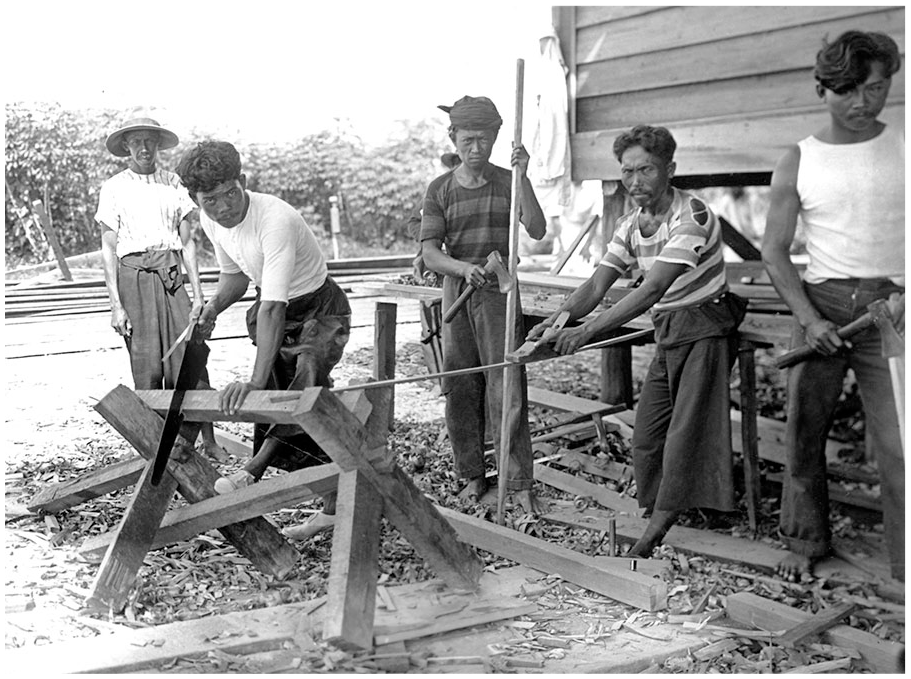
Carpenters at work in Central Java using a saw for cutting, a plane and an axe for trimming wood, tools probably of European origin. Wooden planks are used as wall material, as seen on the wall of a stilted house in the background, 1937–1938 (Courtesy: Karl Helbig Collection, Roemer- und Pelizaeus-Museum Hildesheim GmbH).
Construction work was a mutual learning process. We argue that this form of collaboration bears definitive similarities with the way various groups of practitioners worked together in the microphysics laboratories described by Galison. Just like scientists, engineers and technicians labored to establish an experimental setup, missionaries and crafts-persons cooperated toward a common goal – the erecting of a building. Although the communication between Europeans and Asians was never perfect, they were still able to reach a certain level of understanding. This process clearly resembles the linguistic translation processes that those anthropologists analyze on whose works Galison’s concept of trading zone is based.
At the building site of Lolowa’u, South Nias, missionaries, local carpenters and road builders worked side by side (Krumm, 1900: 351−352). The application of wooden shingles rather than reed for a church roof was the outcome of mutual agreement. The Batak favored wooden shingles due to their durability, and missionary August Mohri (1835–1897) recommended them because of their better fire resistance (BMG, 1886: 109; Bonn, 1890: 39). In comparison, roof thatching with palm leaves or grass needed constant maintenance in the face of storm and heavy rains (see Figure 2). Such roofing would typically only last some two to five years (BMG, 1887: 179, 207; Fries, 2/1909: 16). Following local traditions, stilts were raised on stones, but tar was also introduced to make the posts water resistant (Fries, 18/1905: 26). Some of the early stations were surrounded by a ‘living fence’ according to the ‘Indian way’, planted with kapok, nutmeg and fruit trees.
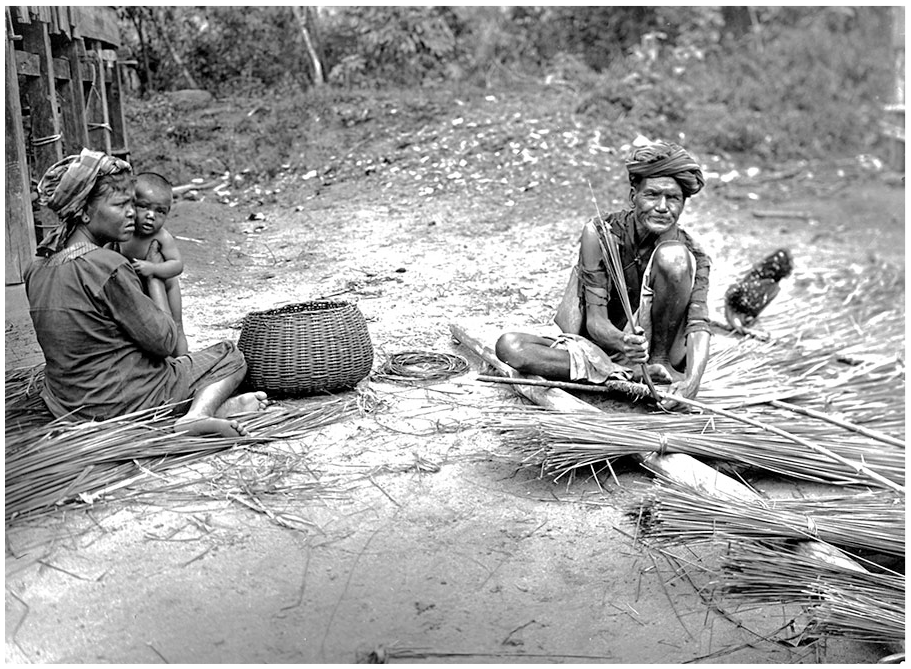
The making of roof thatching from grass in Habinsaran, North Sumatra in the 1930s (Courtesy: Karl Helbig Collection, Roemer- und Pelizaeus-Museum Hildesheim GmbH).
Missionaries commented with pleasure on the interest that the local craftspersons developed in the Europeans’ techniques and tools. Eduard Fries was one of the few who reflected on the dangers that accompanied this fascination with Western technology. During the building process of his missionary station in Sifaroasi in Nias in 1907, he notes:
It is interesting to observe how the indigenous long to adopt our cultural achievements. Unfortunately, they do not realize that we tend to prefer the freely available and often more durable indigenous products. And, as a result, they forget their own, often more practical techniques. (Fries, 31/1907: 37)
Such laments were rare. Generally, missionaries reproduced the evolutionary notion, according to which European technology represented the peak of development (Adas, 1989). Few of them reflected critically on the possibly negative impact of the cultural encounters they themselves were fostering.
Collaboration proved efficient. At Sa’ua on South Nias, the erecting of a wooden dwelling (8 x 10 m) for Heinrich Rabeneck’s (1875–1939) family took only four weeks. According to Batak and Nias techniques, wooden planks and square beams were not sawn to shape, but hewed and trimmed with an adze, not with an axe. Wilhelm Steinsieck (1855–1924) made the comment that the indigenous carpenters and lumbermen regarded sawing as ‘heavy’ work that was to be avoided (BMG, 1888: 244). In 1899, the missionary Julius Sporek (1868–1955) observed how the locals made planks. After having chosen a suitable tree in the forest, they would fell it, remove branches, and split the wood with wedges (Töpperwien, 2002: 43−44). Adzes were used by Nias lumbermen instead of saws (Schröder, 1917: 218). As we have seen, this did not prevent them from manufacturing planks and beams in high numbers.
Local customs simplified collaborative work. Communal building had been established practice in pre-colonial Sumatra and Nias. In the off-harvest season, village chiefs organized collective efforts, and this model continued under the colonial regime (BMG, 1892: 49). Even non-converted chiefs contributed manpower, wood and other material for the erection of churches, school buildings and dwellings for local Christian teachers (Bonn, 1890: 38−39; Smith Kipp, 1990: 186). For example, for the building of the Sifaroasi station thirty to forty workers were involved over a four-week period, including one week for the groundwork digging (Töpperwien, 2002: 43). When Fries had the roof thatching of his missionary house made, roughly one hundred workers were involved (Fries, 18/1905: 31).
Some missionary stations developed into large building complexes. Construction became more extensive and diverse. This process in fact made missionaries even more dependent on local ingenuity. As in the case of Galison’s laboratory science, ‘strength and stability’ could only be achieved if participants overcame customary hierarchies and accepted solutions that other peer groups suggested (Galison, 1997: 781). At Simorangkir in the South Tapanuli Regency of Sumatra, the foundation work for the station took nearly two years. Due to the absence of suitable filling material to raise the ground for the planned buildings, a specific method was developed by the villagers. A river was channeled through a hollow trunk and redirected onto a dammed-up rice paddy. The river brought with it sand and earth, and this material stayed behind after the water had been drained off or trickled away. The remaining soil served as the foundation of both a school building and a teacher’s dwelling (BMG, 1907: 238). Much labor was also needed to design technical infrastructures of sorts: water pipes, sewage, paving and enclosures. Reports from Sumatra tell us that deep ditches were sometimes dug behind fences to prevent attacks from tigers (Winkler-Metzler, 1950: 49). Further works included the construction of open water drainage systems made by stones, closed drainage using sugar palm stems, the erection of a washhouse or bathroom made of concrete and the digging of a well (Fries, 11/12 22.3.1904: n.p.; 18/1905: 26; Winkler-Metzler, 1950: 36, 49). To motivate chiefs and villagers to invest labor in such infrastructures, the local population was often allowed to use the water from commonly dug wells (BMG, 1912: 169−170).
Missionary societies realized their dependence on local laborers and their skills. To guarantee a steady supply of trained workers and to make sure their knowledge squared with Western conceptions, the RMG in 1899 decided to found an ‘Industry and Crafts School’ (Zeendings-Werkplaatsen) on Sumatra. Applying Western educational standards, the school offered four-year courses with three different foci: carpentry and cabinetmaking, including skills in timber joints and roof girders, wood turnery, chair and basket braiding, polishing and veneering; blacksmith work, including plumbing, repair work on engines and machines, goldsmithing and watchmaking; printing and book binding, including design and cutting (BMG, 1905: 226−228). The number of pupils reached a peak of 66 in 1930 (Horn, 1930). Under the supervision of a German missionary craftsman and director and four local master teachers, the pupils went through a highly practice-oriented program, and they also received their own tools. On the basis of drawings and scale models, they built, for example, various dwellings and pavilions, a girl’s school and a dining hall (von Eigen, 1922: 241−242). The blacksmiths produced iron beds, gates, crosses, water drainage and architectural accessories. We interpret this undertaking as an effort to reduce the relatively high degree of symmetry between Western and Asian knowledge and skill that characterized the earlier years. At the same time, it gave Batak students a considerable advantage to other local craftsmen in the region – for example, of Malay or Chinese origin (Pieper, 1929: 231).
Design and domesticity
As in the area of construction, floorplans and architectural solutions were outcomes of negotiations in the trading zone. Missionaries were relatively free when it came to the details of design, although after the turn of the century they had to discuss outlay and structure with the RMG building committee. In addition, they adjusted their ideas and wishes to local circumstances and conditions.
The steep roofs we find on most images of local missionary stations, as in Figure 3, is perhaps the most visible outcome of this acculturation process. One of the first RMG dwellings in the Batak region was built on an elevated and fenced-in piece of land at Sipirok in the South Tapanuli Regency on Sumatra. It had a rectangular floorplan and a high saddle roof. Like the station at Sigompulon Pahae, but unlike most other buildings in this area, it was not raised on high stilts – presumably because drainage was not a serious issue at the site. The steep roof with grass thatching (alang-alang) supported by short pillars recalls the bungalow, a colonial building type originating in Bengal, India (King, 1974). At Sipirok the exterior walls were made of bark, the interior ones of bamboo (BMG, 1862: 79). It provided six rooms, including a couple of sleeping or guest rooms, a drawing room and a dining room. Only the drawing room had a ceiling. To allow for constant air ventilation, the other rooms were directly open to the roof and divided by interior walls. In other words, the missionary traded audio privacy for climate control.
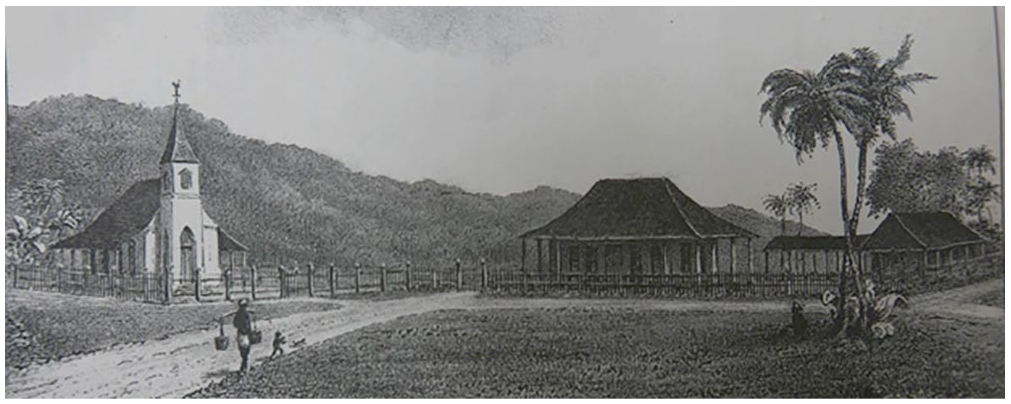
Missionary station at Sipirok, Sumatra, ca. 1862. The high and thatched roof of the missionary dwelling behind the church follows the colonial building tradition of a bungalow surrounded by posts and provided with an annex for the kitchen, stable and one chamber for the horseman (BMG, 1869: 321; Courtesy: Archives and Museum Foundation of the Vereinte Evangelische Mission (VEM) in Wuppertal-Barmen, Germany).
In contrast to the Sipirok station, missionary Wilhelm Thomas’s house in Ombolata, North Nias, was raised on stilts, though only four steps high, considerably shorter than the vernacular buildings on the island. The building had been finished in 1874, and it measured 13 x 6 meters in size (Töpperwien, 2002: 47−48). Adapted to the local building style, the house had a veranda. Adjacent to the central living room on one side were two rooms of equal size: a study and a guest room. The latter was furnished with two camp beds. On the other side, we find the sleeping room and a small storage cabin. Transmitting qualities of cleanliness, tidiness and neatness, all rooms were painted and the house was white-washed. It supposedly fulfilled the Western taste of a ‘beautiful, large building with many airy rooms’ (Engelbert, 2003: 67).
The architectural feature of the veranda (emper) is adopted from the bungalow. Verandas had played a marginal role in Europe, and the emper was a true outcome of the acculturation process the missionaries and their families went through. Because of the climate, the outer gallery was the most frequently used domestic space in the missionary dwelling. This covered porch was a multi-functional area of semi-private character, offering a pleasant breeze and a view. Here, the missionary family took their meals and entertained guests. Meetings, lessons and Christian services were held on the veranda, as were other leisure activities such as reading and sewing (Engelbert, 2003: 118; Winkler-Metzler, 1950: 79). The ember provided space for talks and courses, and a place for missionaries to receive villagers visiting the station. On Nias, missionaries’ wives offered sewing and Bible courses on their own verandas. As a physical center of intercultural exchange, the veranda served as a particularly intensively used trading zone within the spatial arrangement of the missionary station (Tjoa-Bonatz, 2003b: Fig. 4).
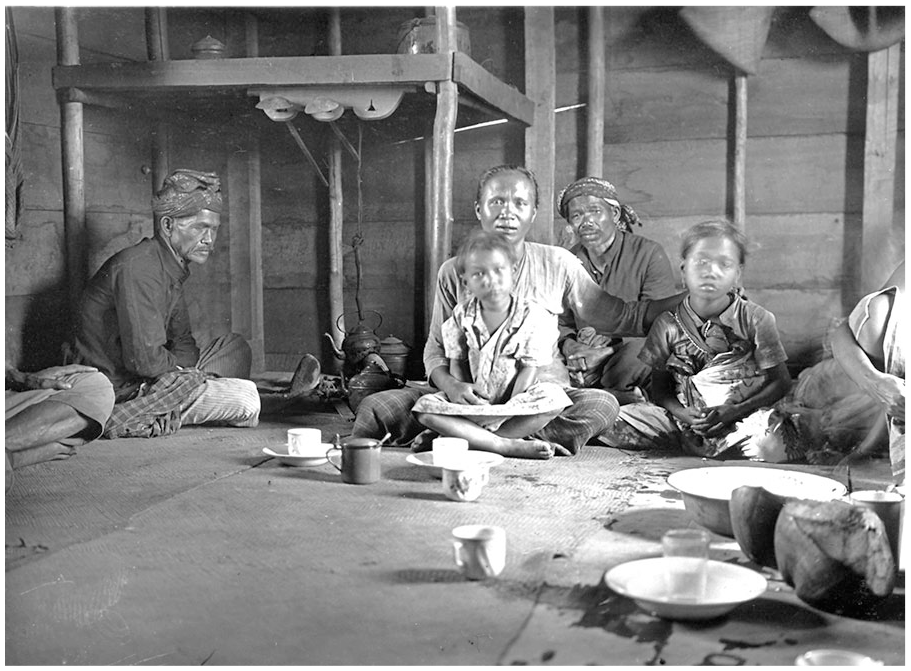
Interior of a Batak house in South Habinsaran, North Sumatra, in 1930/31. The family gathers for meals and sits on hand-woven mats around the hearth. They use imported porcelain, enamel vessels and brass teapots together with coconuts as drinking vessels but no cutlery (apart from a spoon) (Courtesy: Karl Helbig Collection, Roemer- und Pelizaeus-Museum Hildesheim GmbH).
Typically, the veranda was floored with hand-plaited mats, made from bamboo, rice straw or other canes. Mats were omnipresent in the vernacular culture, and missionaries also adopted them – at least for their ember. The Batak carried out all kinds of domestic activities on mats: communication, seating, household work, sleeping and eating. The missionaries realized that sitting down with a Batak on the same mat had a similar social function as dining in Western culture (Staudte, 1878: 84). Sibolakhon amak is the host, literary ‘the person who unfolds the mat’ (Angeler, 2009: 428). The mat helped bridge the gulf between members of various cultures and was thus an important object in the trading zone. This everyday item also occurred in ritual contexts: Among Karo Batak, food offerings are presented on mats, and in death rituals the mat of the deceased is turned upside-down as a symbolic expression of the separation of the living and the dead spheres (Angerler, 2009: 212; Sibeth, 1990: 69). In rice rituals on Nias, mats underlie certain taboos. Shortly before the first rice harvest on a newly cleared piece of land, one ought to avoid turning mats, otherwise the rice ear might become flat (BMG, 1878: 333, 335).
Despite the architectural similarities between missionary and Batak dwellings, the interiors differed substantially. Most dissimilar were the layout and the functional differentiation of the buildings. Whereas indigenous houses usually had only one large, multi-functional space, rooms in missionary houses were assigned specific functions: rooms for sleeping, guest rooms, a family room for leisure, studying, reading and teaching, an ironing and sewing room (Engelbert, 2003: 100, 107, 126). To minimize the impact of possible fires, kitchens and washrooms were often placed in separate, adjacent buildings (Fries, 32/1907: 46). This solution was a consequence of the adjustment to local conditions: Sparks from the chimney would much more easily set a thatched roof on fire than one made of tiles or corrugated iron.
The 1919 floorplans of the missionary station in Gunung Sitoli give us detailed insights into the division of the interior space (Momeyer, 1919). A preliminary plan depicts a T-shaped building with an impressive front veranda and eleven rooms of various size. The finally realized, ‘most practical’ plan, however, was L-shaped and included even more rooms. The building was surrounded by somewhat narrower verandas on nearly all sides. On the one hand, we find private quarters: a sleeping room for the missionary and his wife, two children’s rooms, one office and one medicine chamber. On the other hand, we record several rooms to which other people – including maids and cooks – had access: a workroom, a dining room, two ‘galleries’ facing the porch, two guest rooms, one pantry and a fairly small kitchen. In addition to the main building, plans included an annex with as many as ten rooms: a henhouse, chambers for firewood and tools, a bathroom, a washroom, two horse stables, one garage and two toilets.
At times, villagers were also entertained inside to play games, attend story-telling sessions, listen to conversations or take part in meals (Smith Kipp, 1990: 136). Christian fathers, local teachers and village elders were invited to the missionary station at celebrations or for regular meetings (BMG, 1880: 24, 26). Missionary Adam Fehr’s (1851-1932) home was compared to a beehive where people moved in and out (Töpperwien, 2002: 73). Following Batak custom, Dina Wijngaarden-Guittard offered betel (areca) nuts to her guests, although the chewing of such nuts was usually dismissed by the missionaries as an unhygienic habit (Smith Kipp, 1990: 107). Even tobacco was presented (BMG, 1875: 99). On certain Christian feasts, the missionaries hosted guests with coffee and home-made pastry or bread (BMG, 1886: 118). Housewarming parties drew big crowds to any mission. By offering guests freshly cooked pork, these Christian parties drew on and appropriated rituals from the Batak or Nias. Opened by several rounds of gunfire, music was played and dances were performed (BMG, 1909: 30).
As long as the RMG’s dispatched representatives rented vernacular houses in a village, the gap between missionaries’ and villagers’ lives was comparatively small. With the foundation and growth of missionary stations, asymmetries increased. When the missionary Ludwig Borutta (1879-1959) moved from Teluk Dalam to Hilismaetanö in South Nias in 1911, he needed one hundred porters for the transportation of goods, not including his personal household items (Töpperwien, 2002: 135). Although missionaries did not regard themselves as rich, the indigenous population viewed them in a different light, as reported of missionary Kruyt (Smith Kipp, 1990: 71). The missionaries’ material wealth caught the attention of the Batak. Villagers examined furniture, pictures, decorative objects and artifacts like clocks, harmoniums and looking-glasses (Smith Kipp, 1990: 71, 107; Warneck, 1929: 4). The kitchen area attracted fascinated visitors: stoves with chimneys, cooking utensils such as an oil-burning stove, aluminum pots and sterilizers. Tools and other technical equipment interested not only craftspersons (BMG, 1899: 152). Reportedly, musical instruments, telescopes and watches also received attention (Clifton, 1991/1927: 94−95; Engelbert, 2003: 35).
Missionaries employed these material riches to demonstrate their social status. The lavish decorations and furnishing were also meant to create a homely and familiar atmosphere. On her visit to Paul von Erlen’s (1877-1914) mission house on South Nias in 1912, British traveler Violet Clifton remarked ‘how eminently comfortable, how “gemütlich” was everything here after the unhomely ways of the Dutch colonists’ (Clifton, 1991/1927: 65). Since many missionaries were practical men, some of them made their own furniture (BMG, 1863: 132; 1875: 109). Still, comfort and a homely atmosphere did not necessarily mean that the missionaries surrounded themselves only with German products. They bought furniture at local auctions or ordered it from local carpenters or from, for example, Singapore (Fries, 11/12 22.3.1904: n.p.; Engelbert, 2003: 63). In letters home, missionaries described Nias carpenters as highly skilled, also according to Western standards (Fries, 22/1906: 12).
As we have seen, house designs were modified to fit local conditions. The same goes for furniture and other household items. The legs of the pantry cupboard were raised and put on bowls filled with water to keep ants from feeding on the supplies. Beds were covered with net-laced curtains to keep mosquitos out (Winkler-Metzler, 1950: 57, 77). Material was also recycled: Pauline Sartor (1913–1928 on Nias) recalls how a wooden box was turned into a baby bed, complete with a klambu, a mosquito net. A Batak servant made a garden table out of re-used box lids and timber pegs, which were partly sunk into the ground so that it could not tip over (Engelbert, 2003: 126; Töpperwien, 2002: 90).
Housekeeping and housewives
Missionaries’ wives were responsible for the domestic realm (Smith Kipp, 1990: 150−151; Warneck, 1995: e−g). Their task was to organize the household chores at the missionary station. Published diaries testify to the hardships these women faced. Although they usually employed a number of servants, daily life was a constant struggle: They had to buy supplies, plan meals, host guests and manage their staff. In addition, missionaries’ wives taught interested Batak girls and women how to cook, sew, iron, clean and wash in accordance with Western standards. In 1891, the RMG included home economics into the curriculum of their girls’ schools (Van Bemmelen, 2018: 337). In Pea Raja, the West Tapanuli Regency of Sumatra, a three-month ‘brides’ course was offered to future wives of indigenous priests (BMG, 1907: 239). By attending such courses, the converted wives were presumed to embody values of cleanliness and tidiness (Van Bemmelen, 2018: 324, 337, 342; Zimmer, 1893: 23).
Like European middle-class women at the time, missionary wives understood themselves as household managers (Heßler, 2001). In our sources we encounter repeated complaints about the difficulties of finding appropriate servants. It was common practice among the Europeans to complain about the servants’ allegedly sloppy work (Töpperwien, 2002: 135; 2004: 151). It thus comes as no surprise that the turnover of the servants was very high. Whereas the cook and the stable boy were given specific tasks, others had to carry out various duties: keeping the house clean, washing clothes, fetching water, splitting wood, maintaining the hearth fire, tending chicken and pigs, and sweeping the veranda and yard (Engelbert, 2003: Ch. 11; Winkler-Metzger, 1950: 36−37). Although she saw herself forced to undertake several tasks herself – such as sewing, mending, and budgeting – the missionary’s wife constantly required assistance when it came to washing and ironing, getting ahold of foodstuffs, gardening, repairing and painting. Johanna Diehl, a missionary wife in German New Guinea, even had a washing-machine that her ‘boys’ had to operate (Klein, 2005: 70).
Missionaries and their wives went out of their way to uphold a European lifestyle. Their cooks had to learn how to bake cakes and make typical, German dishes. One woman missionary, stationed in China, reports how she taught her Chinese cook to make Spätzle and Klöße (Konrad, 2001: 294). As in other trading zones, however, life at missionary stations was characterized by a certain reciprocity. While their goal was to pursue a life similar to what they knew from home, missionary wives soon found themselves adopting local produce, material and techniques. Although their knowledge of the local language was limited, they had to learn how to negotiate with local traders, farmers and servants. European women not only acquired a taste for local fruits and vegetables, they also learned how to operate indigenous coconut grinders and chili mortars (Töpperwien, 2002: 91−92). They agreed that in some instances it took years before they had mastered the new skills. The processing of many crops required a number of steps: from winnowing to pounding rice, from harvesting to grinding coffee, from separating kapok from its capsules to the making of cushions and mattresses (Engelbert, 2003: 108, 110; Töpperwien, 2002: 33, 91; Winkler-Metzler, 1950: 37−38). Each of these steps called for manual dexterity and technical aids. For example, missionary wives learned to hull rice by knocking or threshing the grain from the straw with their feet; this was followed by winnowing, cleaning, drying and pounding. A meal with one liter of rice required at least one hour of cleaning and pounding (Möller, ca. 1924: 16). The powder made from sweet potatoes also required intense labor, including washing, pounding and soaking the tubers in a wooden or stone basin called a losung, before the cleaned mash was squeezed out and strained off through a piece of cloth. For baking, sap from palm trees turned out to be a handy substitute for yeast (Smith Kipp, 1990: 149). It would therefore be a mistake to talk about missionary stations only in terms of one-sided transfer of knowledge and skills. What we observe is, rather, a form of transcultural exchange, where information passed in several directions.
To pursue what was considered a civilized life on Nias turned out to be a constant struggle. Missionary wife Adelheid Meis remarks how time-consuming it is to uphold high sanitary standards: Huge amounts of time are spent just walking back and forth to the water basin (Engelbert, 2003: 89). Meis adopted the local habit of using sand to remove dirt from bottles instead of brushes (p. 87). To cook Western food in an Asian surrounding required that almost all processing and cooking had to be done at the station: roasting and grinding coffee or maize, baking bread and cake, making sausages, bacon and butter, sterilizing meat and preserving fruits. On Nias, the only shop where one could buy Western products and processed foods was situated in Gunung Sitoli, a two-day strenuous walk from the station in Sifaroasi.
Echoing Fries’s criticism of some years earlier, missionary Johannes Warneck (1867–1944) lamented in 1914 that the ‘sudden irruption of civilization with its goods and poisons’ caused the Batak to give up their traditional crafts and depreciate ‘the golden land of farmers’ crafts’. Warneck estimated that every third Batak household owned a sewing machine and, as a result, ‘nobody’ knew how to sew, mend or darn anymore (Warneck, ca. 1914: 14−15). He did not reflect upon the fact that the missionaries themselves contributed to these rapid changes. Archival sources repeatedly emphasize the villagers’ interest in sewing lessons offered by missionary wives. In 1914, one course at Laguboti attracted around eighty girls, and in Gunung Sitoli roughly 150 participants were counted (Adam, 1994: 100; BMG, 1914: 22). Three years earlier, practical training in the crafts was proposed to be included in the girls’ school curriculum on Nias. These lessons, to prepare girls for their roles as housewives, were to be taught by the wives of the local teachers or unmarried women under the supervision of the missionary wife (Kayer, 1976: 190). This training not only provided girls and women with practical skills; for the missionaries, it was a splendid opportunity to proliferate Christian ideas of family life, discipline and hygiene (Metzler-Winkler, 1950: 44, 71; Pieper, 1929: 213).
Local trading zones had global connections. Not only did colonial subjects adopt consumer products from the West; Europeans also keenly acquired material objects made in the colonies (Corbey, 2000). Some of those were souvenirs or household gad-gets. On his return home to Germany, Fries brought with him a few small sculptures, weapons and items for daily use. Johannes Noll (1869-1954) turned a precious ritual idol into a simple toy for his son (RMG 441: 4). More importantly, Fries and other missionaries assumed central roles as collectors for European museums, research institutes and private collectors. Fries explicitly asked his colleagues to assist the Prins Hendrik Maritime Museum in Rotterdam in collecting objects of ritual and anthropological interest (RMG 1.408: 18). RMG missionaries also laid the foundation of a Nias collection of artefacts at the Ethnological Museum in Berlin. Shortly before World War One, the RMG Missionary Museum in Barmen boasted an impressive collection of ancestral figures, arms, music instruments and clothes (Tjoa-Bonatz, 2009). The transfer of these objects from the Global South to the Global North went hand in hand with a redefinition of their meaning. Most often, ritual figures and objects of daily use became heathen idols and primitive goods.
Conclusions and openings
We have investigated encounters between Christian missionaries and indigenous people in Nias and Sumatra in the period 1860–1940, arguing that missionary stations can be analyzed as trading zones in Galison’s (1997) sense. Without underestimating the power divide between Europeans and locals, the concept helps us better understand what Sill (2010: 379) calls the ‘dialectic’ relationship between Europeans and Asians in colonial settings. The techniques and tools that the actors traded went through complicated translation processes. The stations served as intersections, where Westerners and Asians met and negotiated. Members of the indigenous population eagerly observed Western building techniques and tried out various construction tools. Missionary women learned how to use local devices in an effective manner. The trading zone was a site where representatives of different cultures learned to communicate, to trade information, to exchange knowledge and skills. The successful construction of a missionary station required a common communicative basis. Just as in Foley’s analysis of the emergence of pidgin languages and Galison’s discussion of interdisciplinary communication in the physical sciences, this communicative basis was characterized by a certain degree of ‘restriction and simplification’ (Foley, 1988: 162). To be able to exchange information in everyday practice, actors reduced complexity.
For reasons of clarity we have in this article also reduced the level of complexity in that we have limited our discussion to the transcultural interaction between Europeans and Asians. We would like to point out that our trading zones had more dimensions, and future studies will have to show if the proposed concept is helpful also when analyzing these global dimensions. Not only Germans, Nias and Batak met there. In fact, Nias and Sumatran society had been in close contact with and had traded information and goods with other peoples for centuries. These connections manifested themselves in the local material culture. Nias chiefs used umbrellas that had been imported from China as parasols. One chief from a village close to Sifaroasi even had his umbrella plated with gold to enhance the cultural value of this status symbol (Fries 3/1918: 22). Prestigious chiefs’ houses in Southern Nias were decorated with various imported household items, antiquities and commodities of precious material: silver spoons, copper cooking pots, and large painted plates – probably of Chinese origin (Rosenberg, 1878: 152). In another house, furniture was decorated with thick Chinese cushions of silk, and ceiling and walls were covered by colorful cloth (Fries, 8/1904).
We conclude that missionary stations were important cross-cultural trading zones in Sumatra and on Nias. They complemented other zones of more directly economic character. Much like rural and urban marketplaces, where people bought and sold various objects and products, missionary stations provided a scene for cross-cultural communication and information exchange. At the stations, people from various groups traded technical knowledge and skills, along with experience and judgment. Such exchange took place constantly: in the construction phase, while cooking, and during training and teaching sessions. A common outcome was innovative technical solutions, like the emergence of pidgin speech, an act of what anthropological linguist Peter Mühlhäusler (1986: 276) called ‘rule-changing creativity’. The cross-cultural creativity we find at missionary stations reminds us of the interdisciplinary creativity Galison analyzes in different settings in microphysics. For historians of technology, missionary stations are of importance if we want to better understand the material cultures that developed in colonial settings. By applying a micro approach to analyze local encounters in colonial settings, we contribute to a global history of technology that brushes against the grain of traditional diffusionist views.
Footnotes
Acknowledgements
We thank archivist Wolfgang Apelt at the Archive of the Rhenish Mission in Wuppertal-Barmen, Germany, for his invaluable support. We also thank the curator of the Roemer- und Pelizaeus-Museum Hildesheim GmbH, Dr Andrea Niklisch, for making the photo collection of the explorer and geographer Helbig available to us.
Funding
European Commission Horizon 2020 Research and Innovation Programme: European Research Council, Advanced Grant No. 742631.
