




Abstract
Using self-determination theory, this study investigated the impact of employees’ self-related constructs (i.e., self-esteem, self-efficacy, and work ethics) on their perspective-taking intention in the workplace, using customer incivility as a moderator. The partial least squares method was used to analyze data collected in a survey of 412 employees from diverse industries in Australia. Findings showed the strong impact of self-esteem, self-efficacy, and work ethics on job satisfaction and perspective-taking intention. Customer incivility was found to be a significant moderator of the relationships of self-esteem with self-efficacy and with work ethics, but not of the self-esteem—employee job satisfaction link. Thus, employees with a higher internal locus of control, when exposed to emotional turmoil as a consequence of customer incivility, were found to have a greater level of control.
Introduction
In a report by the World Health Organization (WHO), it was noted that organizations would lose around US$1 trillion dollars annually due to their lower level of productivity caused by employee mental health issues (n.d., cited by <blisspot.com>, nd). In addressing these issues, perspective-taking intention can play a vital role in making the work environment more cooperative and engaging and a place of shared feelings. The term “perspective taking” refers to the intention of the individual to understand another individual’s point of view. This intention is generally directed toward an out-group member (Lee et al., 2020) and brings a shared sense of identity, enhances or creates a more positive mindset, and reduces the individual’s own critical judgments about out-group members (Bhardwaja et al., 2018). As the work environment involves interactions of employees and customers (Yu et al., 2021) with different socio-cultural backgrounds, it often demands higher levels of perspective-taking intention. Service employees often face incivility or mistreatment from customers, which may have adverse consequences on their work performance and seriously harm their self-related feelings, such as self-esteem, work ethics, or perceived self-efficacy. Numerous prior studies have provided evidence of the negative impact of incivility on employees, such as mental exhaustion and reduced intrinsic motivation, creativity, and service quality (Hur et al., 2016; Lin and Lai, 2020). These impacts hamper employees’ performance and, thereby, their level of job satisfaction. However, knowledge of how customer incivility affects employees’ job satisfaction through their self-perceived work ethics, self-efficacy, and self-esteem is limited in the current literature. Therefore, by considering the self-determination theory (SDT) (Ryan and Deci, 2000) as a platform, this study attempted to contribute to this limited area of research.
Furthermore, employee job satisfaction has been widely examined as an outcome variable rather than as an antecedent (Aftab et al., 2023). However, employees with various levels of job satisfaction may have different levels of perspective-taking intention. While studies in the management literature have shown that employee job satisfaction plays a crucial role (Dhir et al., 2020; Parray et al., 2023), its influence on employees’ perspective-taking intention after facing customer incivility has received less attention in the literature, thus warranting further investigation. The current study therefore aimed to explore the impact of employees’ self-related constructs on job satisfaction, as well as the effect of job satisfaction on perspective-taking intention, under the moderating influence of customer incivility in these relationships.
Theoretical background
The study employed self-determination theory (SDT) (Ryan and Deci, 2000) as its theoretical background, with this theory highlighting a framework for human motivation involving work and life (Aftab et al., 2023). The theory focuses on three basic psychological needs: autonomy (i.e., feeling unforced); competence: (i.e., feeling effective); and relatedness (i.e., feeling connected) (Ryan and Deci, 2000). Through the SDT lens, past research has claimed that individuals are motivated more by the perception of a stronger internal locus of control than by an external locus of causality, leading them to contribute greater efforts and to have a sense of more control over the consequences, thus resulting in a higher level of job satisfaction (Lee et al., 2020). Thus, internalized motivation and self-direction are the key criteria for job performance and personal fulfillment (Aftab et al., 2023; Gagné and Deci, 2005).
As SDT is a macro theory, it focuses on psychological needs, motivation, and job satisfaction (Roy et al., 2023; Ryan and Deci, 2000). Thus, most previous studies, like this study, with self-related constructs (e.g., self-efficacy or job satisfaction) have integrated SDT with their constructs (Aftab et al., 2023). In fact, SDT explains why individuals often hold their positive self-evaluation and repair their own “self” if it is threatened by surrounding events (Crocker and Wolfe, 2001).
While SDT has been applied in a wide range of studies in the management literature (Aftab et al., 2023; Gagné and Deci, 2005; Lee et al., 2020), the current study draws attention to a relatively less researched area, namely, employees’ perspective-taking intention in the face of customer incivility. Employees are frequently mistreated by customers, with mistreatment including verbal abuse, anger, and rude attitudes for service failure or for not meeting product-related expectations (Choi et al., 2014; Lee et al., 2020). In these instances, it is crucial to examine how SDT can help employees to protect their self-esteem and self-efficacy and to persist with work ethics so they can receive higher job satisfaction and increase their perspective-taking intention. While it is difficult to boost self-related emotions in the workplace after receiving uncivil treatment from customers, SDT can serve as an effective theoretical platform supporting employees to regain their self-motivation.
Literature review
Employee job satisfaction and perspective-taking intention
In the literature, employees’ job satisfaction is generally referred to as a pleasurable feeling, resulting from emotional assessment by the individual employee that he/she likes his/her job (Dhir et al., 2020). Numerous benefits, including job performance, loyalty, long-term commitment, etc., have been reported as outcomes of an employee’s job satisfaction within his/her organization (Dhir et al., 2020). Furthermore, perspective-taking intention is a cognitive process through which the individual sees the world from others’ points of view by sensing their needs or thoughts and by imagining their position (Lee et al., 2020; Yu et al., 2021). It brings a range of positive outcomes for organizations, including increased cooperative behavior (Parker and Axtell, 2001), empathy, and helping behavior (Yu et al., 2021), as well as decreased negative effects (Lee et al., 2020).
It is generally assumed that perspective-taking intention directly contributes to a higher level of job performance by helping employees to better understand the organization’s purposes (Al-Ajlouni, 2021; Kim et al., 2019). The increased level of job performance would then result in a higher level of job satisfaction. However, the current study claimed that job satisfaction may also increase employees’ perspective-taking intention as they will be more forgiving, patient, and keen to understand other employees’ situation. Social psychology theorists, Hsee and Abelson (1991) have revealed that individuals’ own level of job satisfaction is often related to their judgmental process (Wolter et al., 2019). The current study, therefore, posited that satisfied employees would become more tolerant and show more perspective-taking intention, compared to employees with a lower level of job satisfaction. The following hypothesis was formulated:
Employees’ job satisfaction positively impacts their perspective-taking intention.
Employee self-esteem, self-efficacy, and work ethics
Self-esteem, in the organizational context, refers to the degree to which an employee believes that he/she, as an organizational member, is significant, worthy, and capable (Pierce and Gardner, 2004). As self-esteem provides employees with the self-belief that they are valued, trusted, and well-contributing individuals in their organization (McAllister and Bigley, 2002), it helps them to improve their work ethics. Often, individuals with positive self-esteem also experience higher self-efficacy as self-esteem is a way of feeling self-appreciation and self-approval (Kondratowicz et al., 2022) which play crucial roles in increasing self-efficacy. Individuals with higher self-esteem can exercise better job performance, resulting in greater job satisfaction (Gordon and Hood, 2021). Therefore, the current study posited that:
Employees’ self-esteem positively impacts their work ethics.
Employees’ self-esteem positively impacts their self-efficacy.
Employees’ self-esteem positively impacts their job satisfaction.
As self-efficacy is known to be an individual’s belief in his/her mastery and capability of doing a task and to be a source of his/her work motivation (Al-Eisa et al., 2009), it has an immediate influence on employees’ job performance (Hur et al., 2022) and work ethics. Earlier studies examined the association between self-efficacy and ethical behavior and considered that self-efficacy encourages an ethical climate in which unethical organizational order is resisted and unethical behavior is avoided (Fida et al., 2018; Stenmark et al., 2021). Thus, it is assumed that employees with higher self-efficacy would have a high level of work ethics, with the following hypothesis posited:
Employees’ self-efficacy positively impacts their work ethics.
Several factors contribute to a higher level of job satisfaction if employees have greater self-efficacy. For instance, employees believe in their own ability to do their job better, demonstrating increased performance and productivity owing to their positive thinking and self-confidence (Aftab et al., 2023; De Clercq et al., 2018). Therefore, the following hypothesis was formulated:
Employees’ self-efficacy positively impacts their job satisfaction.
As work ethics are a moral feeling of duty or obligation toward the workplace (Grabowski et al., 2021), work ethics contribute to a higher level of productivity (Noe et al., 2006) and to lower levels of employee turnover and absenteeism (Mohammad et al., 2018). These increased work ethics result in higher performance leading to increased job satisfaction. The relationship between work ethics and job satisfaction is an area warranting further exploration, as called for in earlier research (Mohammad et al., 2018). Therefore, the current study hypothesized that (Figure 1): Conceptual model.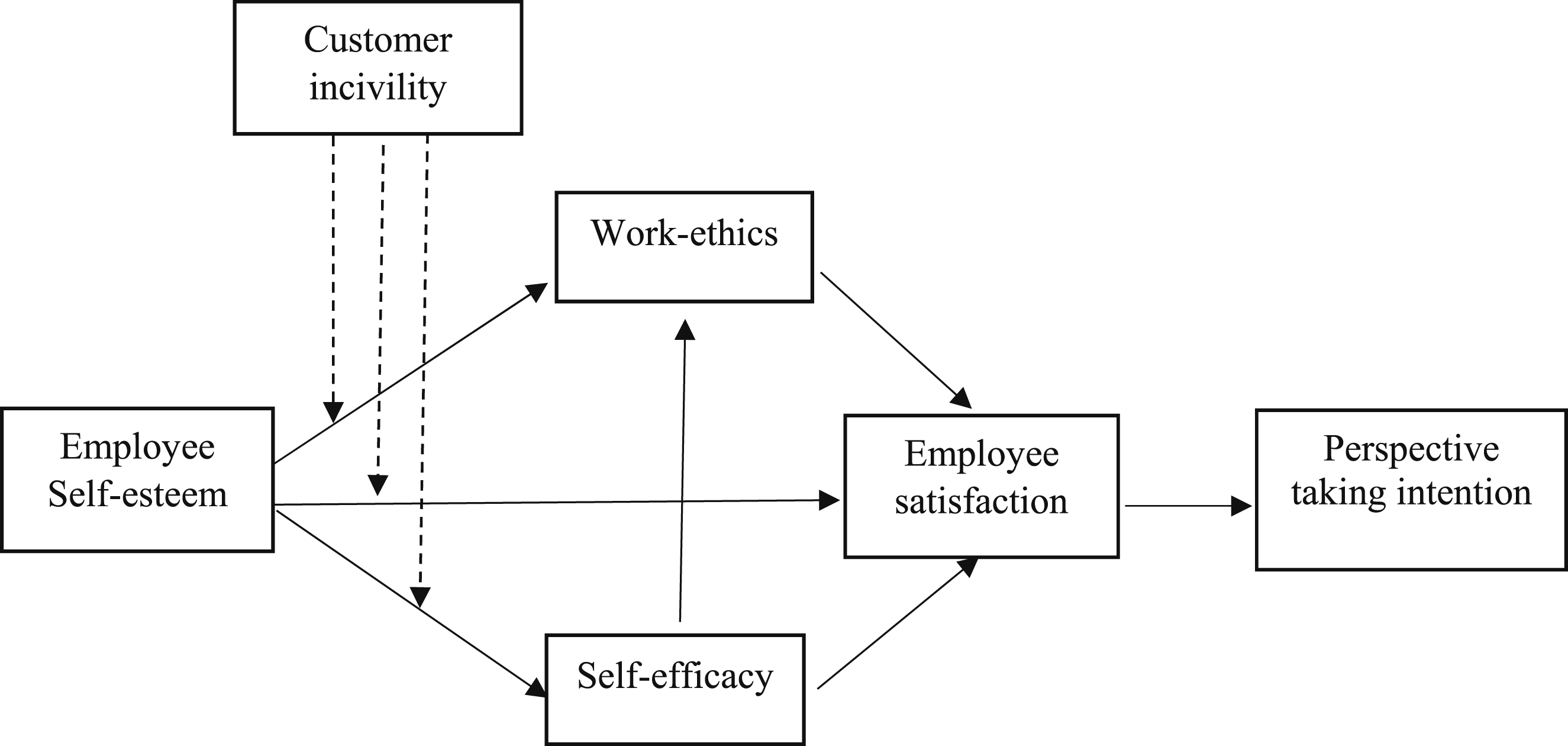
Employees’ work ethics positively impact their job satisfaction.
Analyses of customer incivility as a moderator
Customer incivility may range from a low level of rudeness, anger or verbal abuse through to a very intense level, such as physical assault (Chen et al., 2021). When employees are exposed to customer incivility, they experience deterioration in their physical and mental resources and in their capability to mentally retrieve information, increasing their vulnerability to work-related errors (Chen et al., 2021; Hur et al., 2022). This condition often continues into an after-work rumination process, thereby dampening their self-efficacy. Thus, considering the adverse influence of customer incivility on self-esteem and self-efficacy in the workplace, the study posited the following hypothesis:
Customer incivility moderates the relationship between employees’ self-esteem and self-efficacy in such a way that a lower level of incivility will lead to a higher level of self-efficacy.
When employees face customer incivility, it negatively impacts their affective responses and willingness to put in effort in the workplace (Thompson et al., 2018); thus, it adversely influences their work ethics. Also, the negative consequences of customer incivility often result in fundamental and long-term damage to work-related emotional and cognitive responses (Baranik et al., 2017; Hur et al., 2022). The current study assumed this would include negative consequences for employees’ self-esteem and work ethics and, thus, the following hypothesis was proposed:
Customer incivility moderates the relationship between employees’ self-esteem and work ethics in such a way that a lower level of incivility will lead to a higher level of work ethics.
With employees facing increased levels of customer incivility, prior studies’ findings have indicated that employees feel their employment conditions are exhausting (Al-Hawari et al., 2020; De Clercq and Belausteguigoitia, 2024) and experience a lowered level of self-esteem. As a result of this psychological distress and emotional exhaustion, employees often show depleted job performance, which also results in a low level of job satisfaction (Baranik et al., 2017). With this relationship between customer incivility and job satisfaction assumed to be negative, this study hypothesized that:
Customer incivility moderates the relationship between employees’ self-esteem and job satisfaction in such a way that a lower level of incivility will lead to a higher level of job satisfaction.
Method
Data collection
This study’s data collection involved a survey distributed to 600 targeted employees who worked in different services industries in Australia; from this targeted sample, 412 questionnaires were finally usable for the study. The survey questionnaire used 5-point Likert-type scales for responses, as well as asking several demographic questions. The sample comprised 42% female participants, with 48% of participants aged between 18 and 30 years and 39% of participants aged between 31 and 45 years.
Measures
Self-esteem
This study considered self-esteem to refer to employees’ self-perceived idea about their own significance or worth in an organization. It was measured using three items (On the whole, I am satisfied with myself; I feel I have several good qualities; and I can do things as well as most other people) (Rosenberg, 1965), with an alpha value of 0.758.
Employee self-efficacy
This study referred to employee self-efficacy as employees’ self-perceived assessment of their own capability to do any workplace-related tasks. Three items were used to measure self-efficacy (I can always manage to solve difficult problems if I try hard enough; it is easy for me to stick to my aims and accomplish my goals; and I am confident that I can deal efficiently with unexpected events) (Liu and Koirala, 2009), with an alpha value of 0.727.
Work ethics
This study considered work ethics to mean employees’ perceived thoughts about their moral obligations toward their work. Three items were used to measure work ethics (I like hard work; I like participating in leisure activities; and I appreciate the centrality of work) (Miller et al., 2002), with an alpha value of 0.801.
Employee job satisfaction
Employee job satisfaction was measured using three items (Most of my interactions at work are positive; my values fit with the organizational values; and my manager cares about me as a person) (Gremler and Gwinner, 2000), with an alpha value of 0.826.
Perspective-taking intention
This study considered perspective-taking intention to refer to the employee’s intention to understand others’ points of view in the workplace. It was measured by three items (When I am upset at someone, I usually try to put myself in his/her shoes for a while; I try to consider other perspectives before I decide; and before criticizing somebody, I try to imagine how I would feel if I were in that person’s shoes) (Davis, 1980), with an alpha value of 0.763.
Data analysis
Reliability and validity measures.
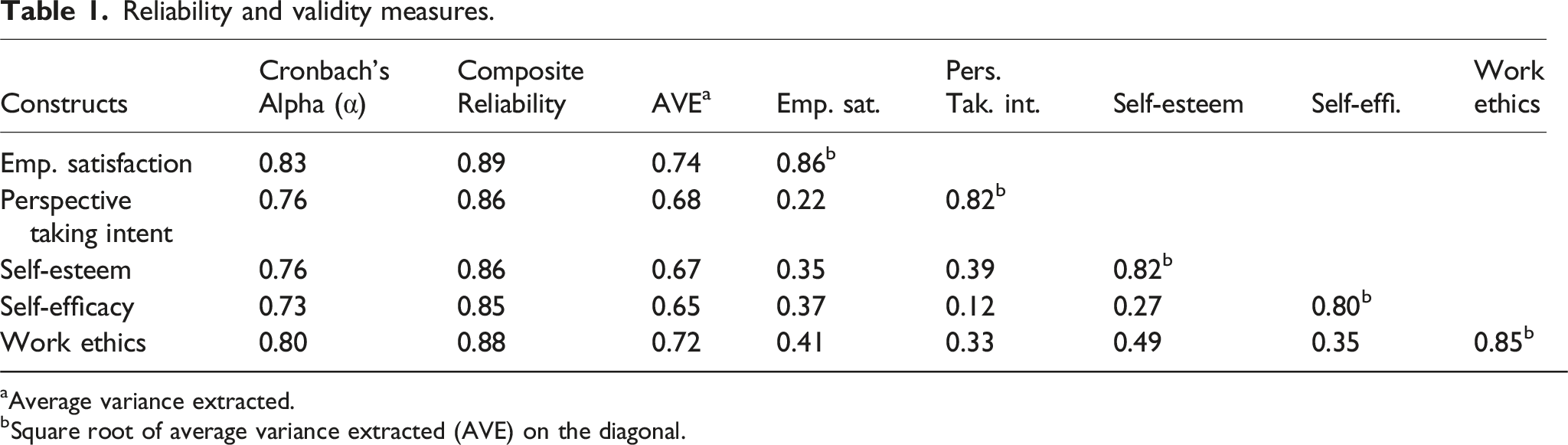
aAverage variance extracted.
bSquare root of average variance extracted (AVE) on the diagonal.
Hypotheses testing: Direct effects (H1–H4)
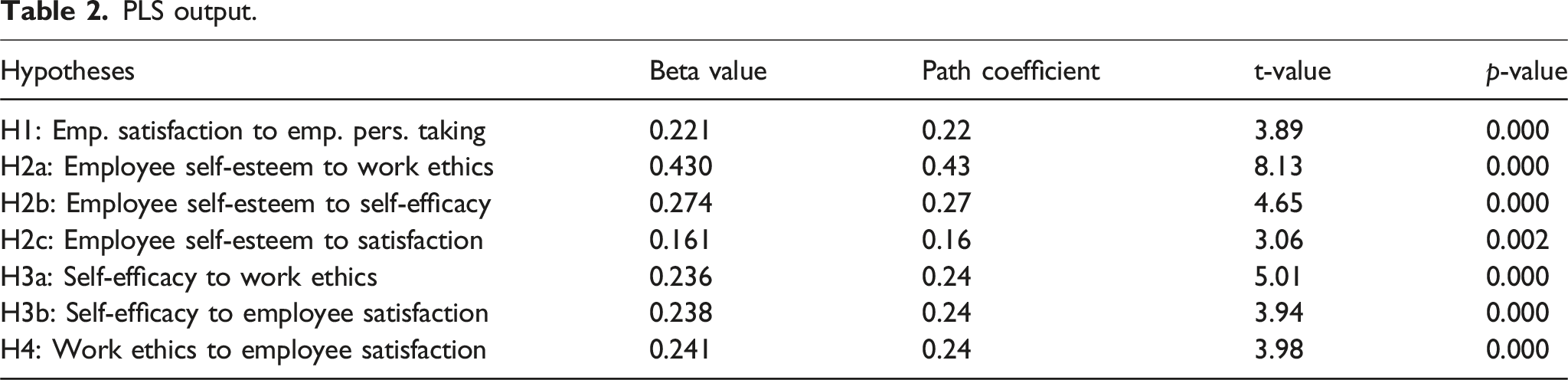
PLS output.
Moderating effect (H5)
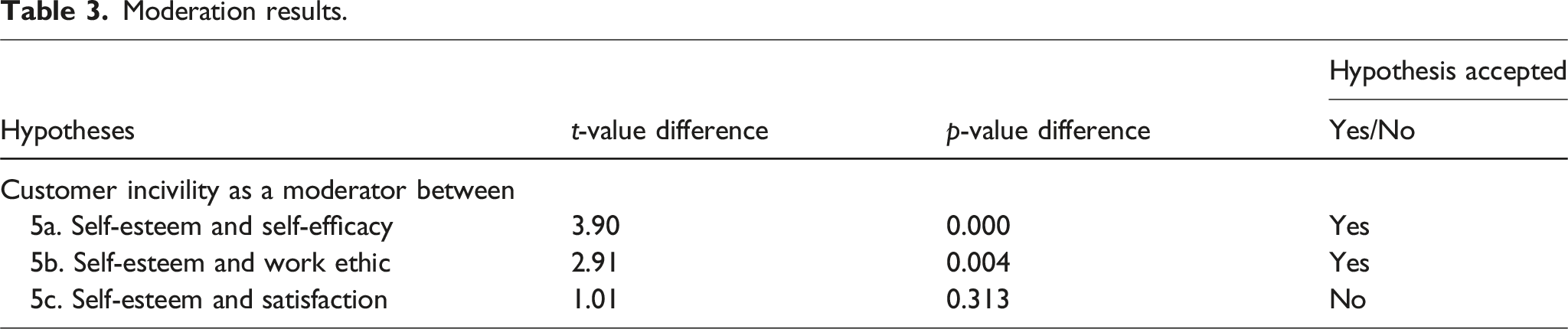
Moderation results.
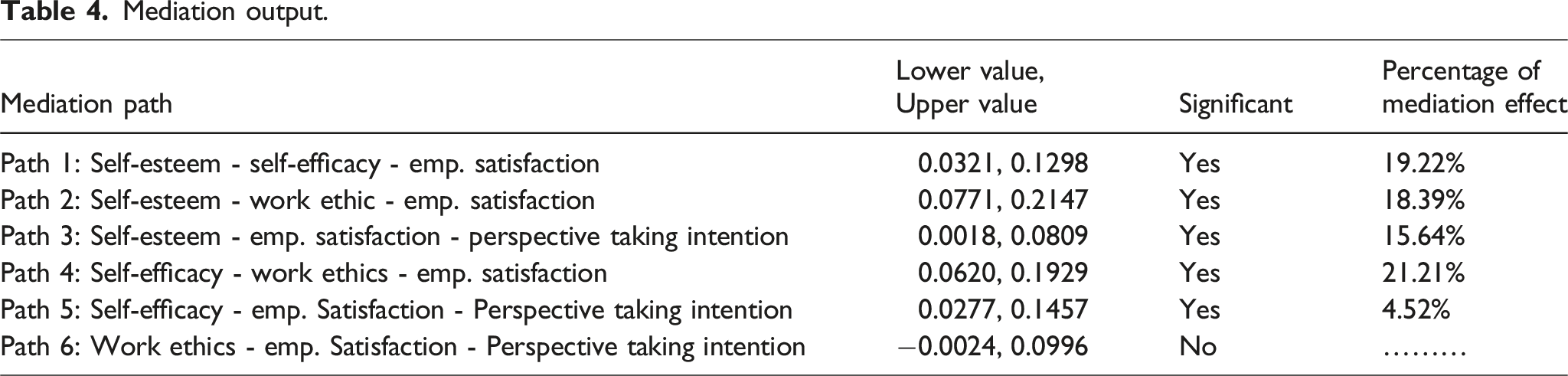
Additional analysis: mediation effects
Mediation output.
Discussion and conclusion
Discussion
The study aimed to investigate the impact of self-related constructs, such as self-esteem, work ethics, and self-efficacy on employees’ level of job satisfaction and perspective-taking intention if faced with customer incivility. In support of previous arguments in the literature, findings confirmed that employees’ self-esteem had a significant impact on their self-efficacy, work ethics, and their level of job satisfaction (Gordon and Hood, 2021; Kondratowicz et al., 2022). Interestingly, the current study found that self-esteem had the strongest impact on work ethics. This finding was consistent with Hackman’s argument (1977) that an individual’s internal respect increases with learning to do a task that he/she does well (Raharjo et al., 2018).
The study’s findings also provided evidence that employees’ self-efficacy significantly increased their work ethics and job satisfaction, with this in support of previous arguments that self-efficacy boosts employees’ job performance resulting in a higher level of job satisfaction (Aftab et al., 2023; De Clercq et al., 2018; Hur et al., 2022). Interestingly, the findings provided evidence that employees’ self-efficacy had a much greater effect on their work ethics than on their level of job satisfaction. This finding further supported the prior argument on the crucial influence of self-efficacy (Rozkwitalska et al., 2022), which stated that it injects confidence, enhances skills, motivates individual employees to achieve challenging goals, and builds resilience in individual employees to recover from problematic situations. Finally, confirming the notion of social psychology theorists (Hsee and Abelson, 1991) that individual employees’ job satisfaction often influences their judgments (Wolter et al., 2019), the study provided evidence of a significant link between employees’ job satisfaction and their perspective-taking intention.
In terms of the moderating effect of customer incivility, the current study’s results were consistent with earlier claims that incivility leads to the devaluing of oneself (Selamat and Irsan, 2019), making him/her vulnerable to making workplace mistakes (Chen et al., 2021; Hur et al., 2022). Customer incivility affects employees’ own perception of their work ethics, efficacy, and job satisfaction by reducing their self-esteem. The study’s findings further emphasized the negative influence of customer incivility on employees’ workplace mental health, with good mental health necessary for ensuring high quality performance.
Theoretical contributions
The study provides key contributions to the existing literature by focusing on employees’ self-related constructs and perspective-taking intention when considering customer incivility in the workplace. Supporting self-determination theory (SDT)’s implications for human motivation through the internal locus of control (Lee et al., 2020), the study’s findings offer grounds for considering employees’ self-esteem and self-efficacy as crucial antecedents for their job satisfaction. By affirming the previous notion of the effect of the internal locus of control on a perceived higher level of control of consequences (Lee et al., 2020), the study also extends the literature by highlighting that employees’ self-efficacy plays a significant role in increasing their work ethics and job satisfaction towards enhanced perspective-taking intention. Thus, self-efficacy works as a valuable resource for effective organizational change and is helpful during more demanding and challenging situations (Bayraktar and Jimenez, 2020).
Additionally, this study contributes to the work ethics literature by revealing the strong mediation effect of work ethics on the self-efficacy—job satisfaction link. In referring to work ethics as the obligation felt by an employee towards his/her work (Grabowski et al., 2021), this study takes the primary step of connecting work ethics to employees’ self-related constructs, such as self-efficacy. Similarly, the study extends the frontline employee-related literature (Di Mascio and Fatima, 2018) by investigating the moderation impact of customer incivility on employees’ self-related constructs (i.e., self-esteem, self-efficacy, and work ethics) and job-related outcomes, such as job satisfaction. With frontline employees more frequently the victims of exposure to customer incivility (Arnold and Walsh, 2015), this study’s findings provide valuable insights into its impact on employees’ psycho-cognitive self-perception and resultant outcomes in the workplace. Finally, the existing body of literature has confirmed the inherent significance of perspective-taking intention by highlighting its positive outcomes for organizations (Lee et al., 2020; Lee and Madera, 2021). This study now provides pathways for employees to reach perspective-taking intention by considering a range of antecedent, mediator, and moderator factors.
Note for practitioners
For today’s organizations, providing only the necessities does not ensure success (Khan, 2008), as additional care of employees’ psychological well-being is essential. Motivating employees by boosting their self-esteem and self-efficacy and strengthening their work ethics will ultimately help them to overcome customer incivility. As individual employees’ self-perception of their value to their organization often influences their attitude towards taking external action (Wako et al., 2025), it is essential to focus on employees’ work ethics to help them improve their perception of their value to their organization.
Perspective-taking intention also brings positive outcomes for organizations, such as positive emotions, helping intentions, lower level of stereotyping, etc. (Lee and Madera, 2021). Appropriate training programs need to be established to encourage employees to increase their engagement with their organization (Asif et al., 2022) as well as developing an inclusive decision-making style. A higher perspective-taking intention will be positive, leading to greater productivity and to a more inclusive workplace environment.
Frontline employees play a key role in customer satisfaction (Di Mascio and Fatima, 2018; Fatima and Razzaque, 2010); therefore, managerial care should be provided to increase their psychological well-being, commitment, and self-motivation. This will help them to achieve their individual goals, ultimately helping organizations to achieve success in the long run by reducing employees’ task-related stress. Organizations need to understand the influence of contextual factors (Khan et al., 2019) as this also has a profound impact on employees’ skill development. Finally, given that customers’ incivility has a negative impact on employees’ job satisfaction and increases their emotional exhaustion (Parray et al., 2023), organizations need to be aware that these issues are directly related to organization-level management. Therefore, organizations need to take steps to resolve these issues by enhancing respect, group cohesiveness, and social interactions (Fatima, 2023; Fatima et al., 2017), as well as increasing perspective-taking intention among employees.
Limitations
This study has a few limitations, one of which is that it considers only a few of the self-related antecedents (i.e., self-esteem, self-efficacy, and work ethics). Broadening the research to other psychological aspects of employees, such as emotional labor, personal flexibility, creativity, etc. would provide more rigorous findings. Similarly, only customer-related incivility was considered in this study, whereas other sources of incivility are frequent in the workplace, such as supervisor incivility, co-worker incivility, and email incivility, all of which may generate workplace bullying or further instances of incivility. Also, data analysis may be further improved by using multi-method approach such as incorporating qualitative interviews etc. Finally, a methodology-related limitation is that a cross-sectional survey was used, with data collected from only one country (Australia). The inclusion of more countries using a longitudinal study would help to produce more generalizable results.
Footnotes
Declaration of conflicting interests
The author(s) declared no potential conflicts of interest with respect to the research, authorship, and/or publication of this article.
Funding
The author(s) received no financial support for the research, authorship, and/or publication of this article.
