




Abstract
This study adds to extant management research by addressing hitherto unexplored but highly relevant questions related to how and when employees’ experience of work interference with family translates into a reduced propensity to develop new ideas for organizational improvement, with a particular focus on the mediating role of their intentions to leave and the moderating role of their work self-efficacy in this chain of effects. On the basis of quantitative survey data collected among employees who work in the pharmaceutical retail sector, the empirical findings show that a critical conduit, through which frustrations that work demands spill over into the family sphere lead to dampened creative work efforts, is that employees develop quitting intentions. Yet this explanatory role is less powerful when employees feel confident about their work-related competencies. Notably and somewhat paradoxically, employees’ experience of incompatible work and family demands steers them away from creative work efforts that otherwise could reveal novel solutions. This counterproductive dynamic can be mitigated if employees have greater trust in their own work skills.
Keywords
Introduction
Employees can add to the success of their employers by engaging in creative work activities—defined for the purposes of this research as employees’ efforts to develop novel ideas to enhance the organizational status quo (Do et al., 2018; Janssen, 2001; Li et al., 2022). Despite the potentially beneficial outcomes for organizations, such creative efforts can create challenges for employees, because novel ideas likely require changes to internal, existing practices. Other organizational members, who have embraced or grown accustomed to such practices, might resist any changes, prompting them to criticize or reject the novel ideas (Hultman and Hultman, 2018; Yuan and Woodman, 2010). Considering this intrinsic challenge to creative efforts, it seems reasonable to predict that employees would be less likely to undertake them when they already are struggling with adverse, resource-depleting work circumstances. For example, employees’ creative work efforts diminish when they experience workplace challenges like ostracism (Zhang et al., 2023), psychological disempowerment (Arshad et al., 2021), unfair information provision (De Clercq and Pereira, 2021), supervisor narcissism (Jahanzeb and Raja, 2024), and abusive supervision (Cai et al., 2024).
To complement such research that focuses on creativity inhibitors that reside in the work realm, this study investigates the potential harmful role of employees’ experience of work interference with family, which pertains to the extent to which they sense that their work obligations compromise the quality of their family lives (Halbesleben et al., 2009; Walumbwa et al., 2022). Extant research pinpoints various negative outcomes of such work-to-family conflict, including job strain (Park et al., 2023), burnout (Robinson et al., 2016), and organizational deviance (Morgan et al., 2018), as well as diminished career satisfaction (Lau et al., 2013), work engagement (Yucel et al., 2023), and organizational citizenship behavior (Lin et al., 2022). This study adds the consideration that work interference with family also might steer employees away from devoting their dedicated efforts to generating original ideas for organizational improvement because avoiding such undertakings gives them a means to express their frustrations with the interference.
The focus on this specific outcome (creativity) of work interference with family reflects a central goal of this research, namely, to shed new light on a dysfunctional, somewhat counterintuitive, and therefore theoretically interesting dynamic for employees. They could benefit (as could the organization and their colleagues) if they were to develop and propose novel ideas to help mitigate the negative spillovers from work into the family sphere (Anwar et al., 2022; Montiel-Campos, 2018). But if employees maintain negative sentiments about how work demands enter their family lives, they may feel discouraged from undertaking such potentially helpful discretionary work efforts. The specific research questions underlying this study thus ask (1) why employees’ experience of work interference with family might translate into diminished creative work efforts and (2) when this translation is more likely to take place, depending on employees’ personal resources.
The answers to these questions set the stage for different contributions to extant management research. First, this study theorizes and empirically demonstrates how employees’ intentions to leave (Peltokorpi, 2022) may serve as a conduit through which their frustrations with work-to-family conflict lead them to reduce their creative work activities. In particular, it explicates a hitherto overlooked deterrent of creativity that operates at the work–family interface (i.e., not confined to the work realm), and it specifies creativity as an unexplored outcome of work interference with family, by introducing a critical factor that connects these phenomena: the extent to which employees consider quitting their jobs (Bozeman and Perrewé, 2001; De Clercq and Pereira, 2023b). 1 This mediator is worth examining from a theoretical perspective, because it helps clarify a relatively covert mechanism (i.e., plans to quit) that generally is not evident to or controllable by organizational decision-makers (Nuhn et al., 2019). As another conceptually compelling angle, the proposed mediation also might trigger counterproductive cascades, in which employees are complicit but not aware: Frustrations about conflicting demands between work and family may compromise their professional situation to such an extent that they fail to see any future for themselves in the company and become unwilling to add to its success with their productive, creative activities—which paradoxically might prevent them from finding innovative solutions to the problem (Cerne et al., 2018; Liu et al., 2013).
Second, this study proposes that employees’ work self-efficacy—defined as the extent to which they “feel confident about their work-related abilities” (De Clercq and Pereira, 2023a: 1654)—is a critical contingency factor that buffers this dysfunctional process, through a dual mitigating role. This personal resource mitigates the translation of work interference with family into intentions to leave and the translation of any remaining such intentions into diminished creative behavior. By including this aspect, this study addresses calls for greater considerations of the contingent effects of resource-draining work interference with family (Park et al., 2023; Wang and Wang, 2024). Prior research recognizes that work-to-family conflict is less detrimental for employees’ professional functioning to the extent that they can draw from contextual resources, such as nurturant task leadership (Panda et al., 2022), family-supportive supervisors (Gull et al., 2023), general supervisor support (Yucel et al., 2023), perceived organizational support (Wang and Wang, 2024), or organizational identification (Park et al., 2023). This study complements such insights by proposing a moderated mediation dynamic that explicates how a key personal resource, employees’ confidence in their work-related competencies, might counter the counterproductive spiral by which work interference with family escalates into complacent behavioral responses (i.e., tarnished creativity) through intentions to leave. In so doing, it also extends prior research that pinpoints a buffering role of self-efficacy in helping employees cope with challenges in the work realm specifically, such as abusive supervision (Hsu et al., 2021), ostracism (De Clercq et al., 2019), or politicized organizational decision-making (Rasyid and Marta, 2020). But this personal resource also could mitigate hardships at the interface of work and family.
Theoretical background and hypotheses
According to prior management research, employees can derive benefits from undertaking creative activities because such activities stimulate entrepreneurial alertness (Montiel-Campos, 2018), learning capabilities (Parboteeah et al., 2015), job performance (Ismail et al., 2019), customer service performance (Liu et al., 2013), and job satisfaction (Mishra and Shukla, 2012). However, creative work efforts also generate difficulties for employees, especially when confronted with skepticism expressed by organizational colleagues who interpret any novel ideas stemming from creative efforts as threats to their existing rights and privileges (Hon et al., 2014; Krogh, 2018). Some colleagues even might sabotage the proposed ideas, if the creative suggestions shine light on flaws or shortcomings for which they could be held responsible (Ouedraogo and Tiemtore, 2021; Van Dijk and Van Dick, 2009). Negative responses to creative efforts hence are clearly possible, which makes it pressing to understand how employees deal with them, particularly when they already face other adverse work situations (Cai et al., 2024; Jahanzeb and Raja, 2024).
As indicated previously, this study focuses on the potential constraint imposed by employees’ experience of work interference with family, a notable source of adversity that evokes frustrations with regard to how work demands spill over into the family sphere (Chen et al., 2023). Work interference with family contrasts with family interference with work, which captures negative spillovers of family demands into the work domain. Both types of interference—also referred to as work-to-family conflict and family-to-work conflict, respectively (Li et al., 2021)—may undermine employees’ professional functioning, but according to the matching principle, employees who suffer conflicting demands between work and family tend to assign the hardships primarily to the domain that they designate as the origin of the suffering (Nohe and Sonntag, 2014). For this study, the matching principle suggests that employees’ experience of negative interference of work with family likely leads them to develop negative beliefs about their work functioning, which is the source domain (Peltokorpi, 2022; Yu et al., 2018). Rephrasing the research questions with more specific terms then, this study seeks to detail how (1) employees’ perceptions of work-to-family conflict tarnish their creative work efforts through their intentions to quit and (2) this detrimental process may be buffered by their work-related self-efficacy.
Conservation of resources (COR) theory
The theoretical logic for the proposed mediating effect of intentions to leave and moderating effect of work self-efficacy in the link between work interference with family and creative work behavior is anchored in conservation of resources (COR) theory (Hobfoll, 1989; Hobfoll et al., 2018). This theory prescribes that employees’ work-related intentions and actions are largely influenced by their experience of resource-draining circumstances (Hobfoll and Shirom, 2000), which informs two key premises. The first premise is that the resource drainage that comes with frustrating work conditions directs employees toward coping responses that enable them to vent their irritation (Hobfoll and Shirom, 2000; Nath et al., 2024). For example, Pandey and colleagues (2021) leverage COR theory to illustrate how employees’ exposure to destructive leadership steers them toward voice withdrawal behaviors, as a coping response that helps them convey their disappointment. The second premise is that employees’ access to valuable personal resources can lower their motivation to exhibit such coping responses, to the extent that the personal resources decrease the perceived necessity to react in a self-preserving manner (Deen et al., 2021; Hobfoll and Shirom, 2000). For example, De Clercq and colleagues (2023) note that employees who feel troubled by resource-depleting psychological contract breaches are less likely to react with convictions that their employer is accountable for the associated work-related difficulties, to the extent they can draw from their religiosity resources.
By conceptualizing the notion of “resources” in rather general terms, COR theory includes any “objects, personal characteristics, conditions, or energies that are valued in their own right, or that are valued because they act as conduits to the achievement or protection of valued resources” (Hobfoll, 2001: 339). But a critical resource that employees particularly cherish—according to both Hobfoll’s (2001) overview of key COR resources and subsequent COR-based studies (Kao et al., 2022; Lin and Chen, 2021)—is a sense of being able to achieve professional or career goals. For instance, Lin and Chen (2021) leverage COR theory to determine that employees who sense that their career has reached a plateau express disappointment by limiting their future career commitment, which otherwise could benefit their employer. Moreover, and specifically relevant to this study, meta-analytic studies have applied COR theory to pinpoint how employees’ experiences of work–family conflict undermine their perceived ability to meet career objectives (Hoobler et al., 2010; Liao et al., 2019).
Consistent with the first COR premise, this study proposes that employees’ intentions to leave and subsequent curtailing of their creative efforts are likely reactions to their beliefs about the difficulty of combining work with family because these responses enable them to express frustration with the compromised quality of their professional functioning (Liao et al., 2019; Williams and McCombs, 2023). To be clear, the study does not assess employees’ diminished professional or career goal achievement directly, but it theorizes that the career-related frustrations that arise with incompatible work and family demands (Hoobler et al., 2010) elicit coping responses in the form of quitting intentions and a reluctance to undertake productive creative activities. Through these responses, employees can channel their frustrations about the difficulties that they encounter at the work–family interface in ways that assuage their frustration with their professional situation.
In line with the second COR premise, the forcefulness of employees’ coping responses can be mitigated if they can leverage relevant resources that protect them against work-induced difficulties (Hobfoll and Shirom, 2000; Zhang et al., 2018). This study postulates specifically that when employees can rely on their work self-efficacy, which implies a sense of confidence in having adequate competencies to perform their jobs (Amah, 2018; Hsu et al., 2021), it reduces the probabilities that (1) they seek to cope with work-induced family hardships by developing intentions to leave their organization and (2) any such intentions translate into work-related passivity, such as reduced creative behavior. As explicated hereafter, the proposed buffering role of work self-efficacy reflects employees’ enhanced ability to avoid perceptions of compromised professional or career goal achievement in the presence of work interference with family and subsequent intentions to quit, such that the likelihood that they exhibit negative coping responses (i.e., quitting intentions and then thwarted creativity) diminishes. Prior applications of COR theory indicate a similar dual moderating role of another personal resource, resilience, in buffering the escalation of experienced customer incivility into a diminished propensity to satisfy customers through beliefs that their employment situation is exhausting (Al-Hawari et al., 2020).
Figure 1 summarizes the proposed theoretical framework. Employees who perceive that their work duties negatively interfere with their family lives are more likely to consider leaving the company, which then diminishes their interest in supporting it with creative, original ideas for organizational enhancement. Their quitting intentions are core channels through which work-to-family conflict leads to indifference about creativity at work. But their work self-efficacy counterbalances this effect, such that the translation of work interference with family into diminished creative behavior through intentions to leave is less pronounced among employees who are confident about their work-related competencies. Notably, the combined consideration of a mediating role of intentions to leave and moderating role of work self-efficacy in the link between work interference with family and creative behavior enables the integration and extension of two parallel research strands, focused on how (1) turnover intentions underpin the escalation of adversity restricted to the work sphere into negative behavioral responses (e.g., De Clercq, 2023; Hattab et al., 2022) and (2) work self-efficacy protects employees against the hardships that come with such work-restricted adversity (e.g., Rasyid and Marta, 2020; Hsu et al., 2021). Conceptual model.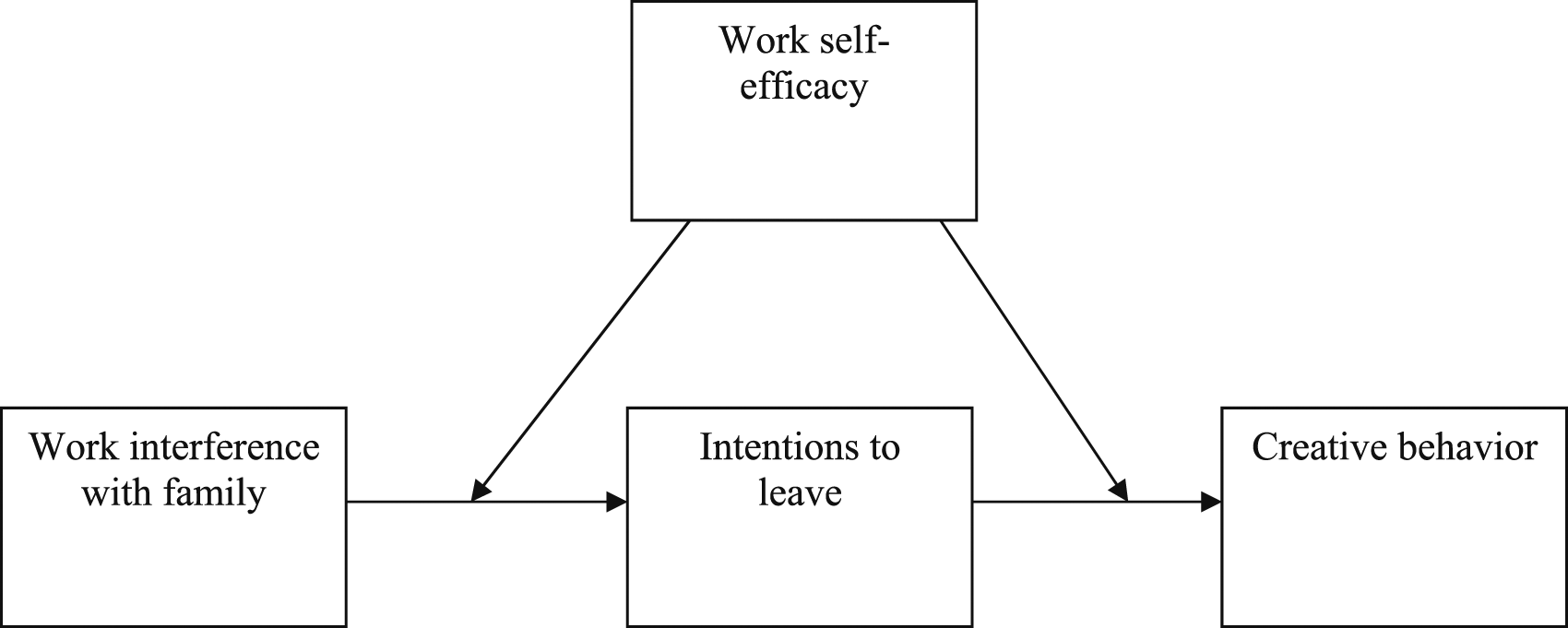
Work interference with family and intentions to leave
This study proposes a positive relationship between employees’ experience of work interference with family and their intentions to quit. Consistent with COR theory—and the matching principle, according to which the consequences of work–family conflict manifest in the sending domain, which is the source of the conflict (De Clercq et al., 2022; Shockley and Singla, 2011)—employees’ beliefs that their work duties undermine the quality of their family lives should trigger their desire to express frustrations about a suboptimal career situation (Hobfoll and Shirom, 2000; Liao et al., 2019). Although this study does not formally capture the connection between work interference with family and the difficulty of meeting professional goals, it accounts for it indirectly by theorizing about the repercussions of such difficulty for how employees consider their future in the company (Park et al., 2023). In particular, if employees sense that their family life is hampered by work demands, they likely form beliefs that their employer does not care about whether they can combine a successful career with family commitments (Lau et al., 2013; Williams and McCombs, 2023), so they start wondering whether their current employment situation could be improved through alternative employment (Wang et al., 2017). In a related vein, employees may contemplate the possibility of quitting in response to their experience; work interference with family prompts a conviction that their organization is not deserving of their valuable contributions (Park et al., 2023; Yucel et al., 2023). Formally,
There is a positive relationship between employees’ experience of work interference with family and their intentions to leave.
Intentions to leave and creative behavior
Employees’ intentions to leave may diminish the probability that they are willing to devote significant energy to the development of new ideas for organizational improvement. When employees contemplate the possibility of quitting, even if they do so under their own control, they may perceive this situation as a professional failure because it conveys that their current employment does not allow them meet their career goals (Verbruggen and Van Emmerik, 2020). In turn, complacent reactions—such as signaling a reluctance to generate new ideas that otherwise could contribute to organizational effectiveness—provide a chance to express their disappointment with the organization and its failure to satisfy their professional aspirations (Singh, 2021). In line with COR theory, halting productive, creative activities represents a reasonable behavioral response through which employees who think about leaving can cope by unleashing their frustration with a professional situation that they perceive as negative (De Clercq, 2023; Hobfoll et al., 2018). Moreover, employees who plan to leave may derive secret satisfaction from depriving their organization of their productive contributions (Nuhn et al., 2019). In particular, and again consistent with COR theory, employees’ intentions to leave may decrease the probability that they allocate significant energy to generating novel ideas, as a means to generate resource gains in the form of a sense of personal deservedness (Halbesleben et al., 2014).
There is a negative relationship between employees’ intentions to leave and their engagement in creative behavior.
Mediating role of quitting intentions
As a relevant elaboration of these two main-effect hypotheses, this study combines their logic to postulate a mediation dynamic. Intentions to leave might explain why employees’ frustrations with work-to-family conflict halt their creative work activities. When employees feel upset with an organization that makes it difficult to combine their professional goals with family demands, they grow unwilling to go out of their way to generate original ideas for organizational enhancement because they are considering quitting (Liao et al., 2019; Park et al., 2023). Prior research similarly finds evidence of a mediating role of employees’ quitting intentions in the translation of other adverse situations—such as perceived person–organization misfit (De Clercq, 2023), verbally abusive supervisors (Singh, 2021), or toxic leadership (Hattab et al., 2022)—into negative behavioral outcomes. As a useful extension, this study predicts that employees’ intentions to leave mediate the escalation of experienced work interference with family into diminished creative work behavior.
Employees’ intentions to leave mediate the relationship between their experience of work interference with family and their engagement in creative behavior.
Buffering role of work self-efficacy
This study further leverages COR theory to postulate a beneficial role of a pertinent moderator in this harmful process. The challenges that employees encounter in the presence of work interference with family and subsequent quitting intentions should be subdued if they can rely on personal resources that help them deal with the experienced hardships (Hobfoll et al., 2018). Specifically, the personal resource of self-efficacy (Hsu et al., 2021) might mitigate the relationship between the experience of work interference with family and intentions to leave (Hypothesis 1), as well as the relationship between these intentions and thwarted creative behavior (Hypothesis 2).
According to COR theory, the resource-depleting effect of difficult situations is subdued when employees can counter experienced adversity with useful personal resources (De Clercq and Pereira, 2023c; Hobfoll et al., 2018). This study maintains that work self-efficacy is one such useful resource that enhances employees’ ability to cope with difficulties at the work–family interface in ways that diminish turnover intentions (Chan et al., 2017). As indicated, the matching principle prescribes that employees who experience work interference with family develop frustrations about the quality of their professional functioning because they blame the originating domain for the experienced problems (Nohe and Sonntag, 2014). But even if employees suffer from work-to-family conflict, as long as they are equipped with work-related self-efficacy and thus are highly knowledgeable about work matters, they likely have a good understanding of how devoting significant time to quitting plans might make it more difficult to achieve professional goals (Karatepe, 2015; Lewin and Sager, 2010). In line with COR theory, these employees accordingly should exhibit a lower propensity to develop quitting intentions, as a coping tactic to express their frustrations about compromised professional goal achievement due to work-to-family conflict (Liao et al., 2019). In addition, when employees feel confident about their work-related competencies, they tend to have more positive perceptions of their work environment, as a setting that allows them to leverage their personal skills in an effective manner (De Clercq et al., 2018). Endowed with these positive views, employees likely consider experienced work interference with family as less threatening to their professional situation (Chan et al., 2017), with beneficial repercussions for the probability that they want to stay with the company, instead of using this interference as a justification to make quitting plans.
The positive relationship between employees’ experience of work interference with family and their intentions to leave is moderated by their work self-efficacy, such that this relationship is subdued at higher levels of work self-efficacy. The probability that employees’ intentions to leave escalate into a diminished propensity to undertake creative behavior similarly should be subdued if employees can rely on their work self-efficacy. In line with COR theory, the resource-depleting effect of disappointing employment situations, including those that make them consider leaving, is attenuated to the extent that employees have access to valuable resources that help them deal with the disappointments (Hobfoll and Shirom, 2000). For example, De Clercq and Pereira (2024b) apply COR theory to show how employees’ resilience levels help them cope with the professional hardships that come with a sense of being disengaged from work—which other research identifies as a direct precursor of intentions to quit (Azeem et al., 2020)—such that their interest in undertaking discretionary change-oriented work activities diminishes. This study similarly proposes that employees’ confidence about their work-related competencies increases the chances that they remain positive about their ability to meet professional goals, even if they cannot rule out the possibility that they may leave at some point, so they feel less desire to halt their creative work efforts in an effort to express frustrations with their suboptimal employment situation (Rego et al., 2012). In addition, work self-efficacy increases employees’ confidence that they can find novel solutions to adverse situations that make them feel anxious about their employment situation (De Clercq and Pereira, 2023a). Efficacious employees, even if they consider quitting, therefore might maintain a certain level of creative work behavior, reflecting their enhanced motivation (and ability) to find original ways to revamp their career and diminish career-related ruminations that come with quitting considerations (Verbruggen and Van Emmerik, 2020). This study posits:
The negative relationship between employees’ intentions to leave and their engagement in creative behavior is moderated by their work self-efficacy, such that this relationship is subdued at higher levels of work self-efficacy. Finally, by integrating this entire set of arguments, this study proposes a moderated mediation process (Hayes and Rockwood, 2020). Employees’ work self-efficacy operates as a critical personal contingency of the negative indirect connection between their experience of work-to-family conflict and creative behavior, through their intentions to leave. If employees can rely on their personal resource of work self-efficacy (Bayraktar and Jiménez, 2020), their quitting intentions become less forceful conduits through which negative interferences of work with family escalate into diminished creative activities. In contrast, if employees feel insecure about their work-related abilities, their desire to leave is a more prominent reason that incompatible work and family demands escalate into work-related complacency in the form of thwarted creativity. The study hypothesizes:
The indirect negative relationship between employees’ experience of work interference with family and their engagement in creative behavior, through their intentions to leave, is moderated by their work self-efficacy, such that this indirect relationship is subdued at higher levels of work self-efficacy.
Research method
Sample and data collection
The hypotheses were empirically assessed with survey data collected among employees who work in a large pharmaceutical retail chain in Mexico’s capital district. This focus on one organization is intentional; it helps avoid the potential impacts of pertinent, unobserved differences in organizations’ internal functioning—such as human resource systems (Do and Shipton, 2019) or leadership approaches (De Clercq and Mustafa, 2024)—that influence employees’ creative work efforts but do not compromise the statistical findings in the scenario of a single-organization investigation (Hair et al., 2019). Moreover, examining one organization in a specific industry sector excludes the risk of unobserved differences in the external competitive market that could shape employees’ perceptions of the need to allocate effort to new idea development (Dayan and Di Benedetto, 2011). The retail pharmacy sector in Mexico, as in many Latin American countries, is marked by significant external rivalry (Cavazzani and Rajagopal, 2010; Merino and Ramirez-Nafarrate, 2016; Sanchez-Bayardo et al., 2018), so employees may feel strongly compelled to improve current organizational practices with novel ideas, to protect the employer’s competitive standing. Furthermore, the specific company under study was in the process of considering possible internal changes, in terms of reorganizing the job responsibilities within retail stores and enhancing coordination efforts across stores. In particular, the company’s senior management sought to gain greater insights into how to encourage employees to pose creative alternatives to improve current organizational practices, such as suggesting new ideas to address inefficiencies within and across stores. In this empirical setting, studying how challenges at the work–family interface might undermine employees’ propensities to develop original ideas, and the beneficial buffering role of work self-efficacy in this process, is highly relevant.
This study relied on the well-established translation and back-translation procedure to develop the survey instrument. An initial English version was translated into Spanish by a bilingual translator, and then translated back into English by another bilingual colleague. After addressing some minor issues, the final survey version was administered in Spanish. Explicit efforts protected the privacy and other rights of the research participants. Specifically, they were promised complete confidentiality, that the organization would have no knowledge about who participated, and that no individual-level information would be included in any reports. Furthermore, their participation was entirely voluntary. Finally, the instructions explicitly noted that there were no good or bad responses and asked participants to complete the survey as truthfully as possible, which helps limit social desirability and acquiescence biases (Malhotra, 2010). The sample frame spanned 800 employees, selected from an employee list provided by the organization’s senior management by a random digit generator. From these 800 contacted prospects, 489 returned a completed survey, for a response rate of 61%. The final sample consisted of 42% men and 58% women, and 71% of the respondents had worked for their organization for more than 3 years.
Measures
Constructs and measurement items (confirmatory factor analysis).
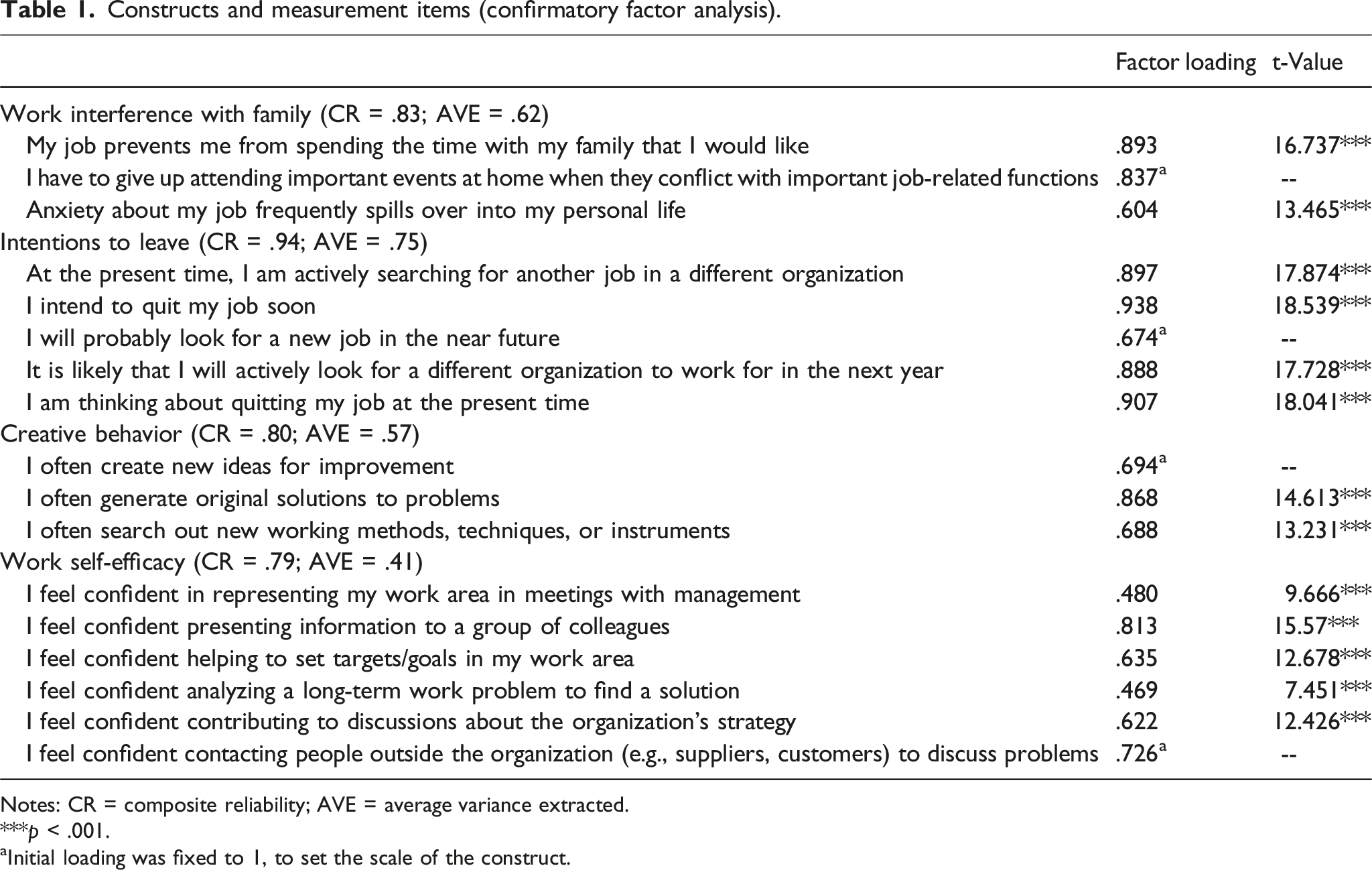
Notes: CR = composite reliability; AVE = average variance extracted.
***p < .001.
aInitial loading was fixed to 1, to set the scale of the construct.
Work interference with family
The extent to which employees feel that their family lives are compromised by work was measured with a three-item measure of work-to-family conflict (De Clercq and Belausteguigoitia, 2017). Participants rated for example, whether “My job prevents me from spending the time with my family that I would like” and “I have to give up attending important events at home when they conflict with important job-related functions” (Cronbach’s alpha = .82).
Intentions to leave
To measure the extent to which employees consider leaving their current employment, a five-item scale of turnover intentions was used (Bozeman and Perrewé, 2001). As indicated in Footnote 1, this measure comprises an important behavioral aspect, capturing employees’ active searches for alternative employment, even if it does not assess real quitting behavior. Participants indicated their agreement with statements such as “At the present time, I am actively searching for another job in a different organization” and “I intend to quit my job soon” (Cronbach’s alpha = .93).
Creative behavior
The extent to which employees develop new ideas for organizational improvement was measured with a three-item scale of creative behavior (Janssen, 2001). Two sample items were: “I often create new ideas for improvement” and “I often generate original solutions to problems” (Cronbach’s alpha = .78). This study’s reliance on self-ratings is consistent with previous studies of creative work behaviors (Opoku et al., 2023; Yang and Bentein, 2023) and with the recognition that other assessors, such as supervisors or peers, have a relatively narrow perspective of the total range of change-invoking behaviors that employees undertake, especially if employees avoid sharing their ideas with others who might reject the associated challenges to the status quo (Hon et al., 2014; Janssen, 2000).
Work self-efficacy
To measure the extent to which employees feel confident about their work-related competencies, the study used a six-item scale of self-efficacy in relation to work (Luthans et al., 2007). Two example statement were: “I feel confident in representing my work area in meetings with management” and “I feel confident presenting information to a group of colleagues” (Cronbach’s alpha = .76).
Control variables
The statistical models accounted for the effects of two features: gender (0 = male; 1 = female) and organizational tenure (1 = 1 year or less, 2 = two or 3 years, 3 = four or 5 years, 4 = six or seven years, 5 = between eight or 10 years, and 6 = more than 10 years). Compared with their male counterparts, female employees may be more reluctant to pursue work activities that disrupt existing organizational practices (Baer and Kaufman, 2008). In turn, employees who have worked for their company for a longer time may reciprocate with creative work efforts that add to organizational effectiveness (Carmeli et al., 2006).
Construct validity
A four-factor measurement model, estimated through CFA, provided a test of the validity of the study’s central constructs. In support of convergent validity, the model fit was very good: χ2(113) = 285.53, normed fit index = 0.94, incremental fit index = 0.96, Tucker-Lewis index = 0.95, comparative fit index = 0.96, root mean square error of approximation = .06, and standardized root mean square residual = 0.05. In addition, the factor loadings of each of the items on their respective constructs were strongly significant (p < .001), and the AVE values were higher than the benchmark value of 0.50 (ranging between 0.57 and 0.84), except for work self-efficacy, for which the value was slightly lower and equaled 0.41. 2 As evidence of discriminant validity, the AVE values were higher than the squared correlation values of the corresponding construct pairs, and the fit of the six possible models that included constrained construct pairs, in which the correlation between two constructs was forced to equal 1, was significantly worse (Δχ2(1) > 3.84, p < .05) than that of their unconstrained counterparts, in which the correlation between constructs could vary freely (Hair et al., 2019).
Common source bias
Two well-recognized tests helped assess whether relying on a common respondent might be a concern. First, an exploratory factor analysis, performed on a model in which the measurement items were forced to load on one factor, accounted for only 29.9% of the total data variance, which reduces the likelihood of bias due to a common respondent (Huang et al., 2020; Sadiq, 2022). Second, a comparative CFA revealed that the fit of the four-factor measurement model was superior to that of a one-factor model (χ2(6) = 1745.51, p < .001)—further evidence that common source bias was not an issue (Hair et al., 2019). The probability of such bias also is substantially lower if the conceptual framework includes one or more moderating effects, such as an a fortiori complex moderated mediation framework, because participants would be hard pressed to figure out the framework’s constitutive hypotheses and adjust their responses to match those predictions (Hayes and Rockwood, 2020; Simons and Peterson, 2000).
Statistical analysis
This study applied the Process macro approach to test the research hypotheses statistically, inspired by its capacity to estimate the direct, mediation, and moderated mediation effects that underpin the proposed conceptual framework simultaneously (Hayes, 2018). It also features a bootstrapping technique, with the additional benefit that the estimates remain valid even if distributions of the indirect or conditional indirect effects deviate from normality (MacKinnon et al., 2004). The Process macro approach has been extensively adopted in previous research studies that theorize and empirically test conceptual models that include moderated mediation dynamics (e.g., Azeem et al., 2024; Haq et al., 2023; Sofyan et al., 2023).
The test for the presence of mediation refers to the indirect relationship between work interference with family and creative behavior through intentions to leave, together with its corresponding confidence interval (CI), in Process macro Model 4 (Hayes, 2018). In this first step, the sign and significance levels of the direct paths between work inference with family and intentions to leave and between intentions to leave and creativity were also assessed. In a second step, Process macro Model 58 estimated the moderating effect of work self-efficacy on the relationships between work interference with family and intentions to leave and between intentions to leave and creative behavior. As established in the Process macro (Hayes, 2018), the conditional indirect effects were assessed at three specific levels of the moderator: one standard deviation below its mean (-1SD), at its mean, and one SD above its mean (+1SD). This procedure—estimate the proposed mediation effect with Process macro Model 4, then conduct an estimation of the moderated mediation effect of work self-efficacy on the two paths that constitute the mediation link by applying Process macro Model 58—is in line with prior studies that predict dual moderation dynamics in mediated relationships (e.g., De Clercq and Mustafa, 2024; De Clercq and Pereira, 2024c; Haq et al., 2024). 3
Results
Focal analysis
Correlation table and descriptive statistics.
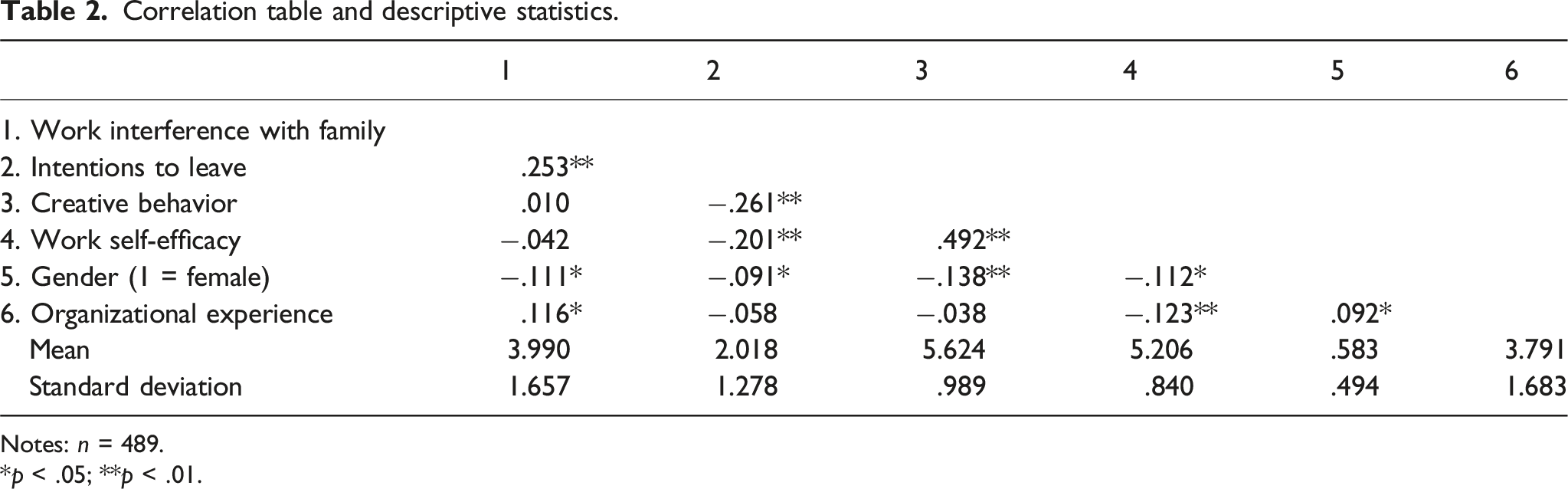
Notes: n = 489.
*p < .05; **p < .01.
Mediation results (process macro).
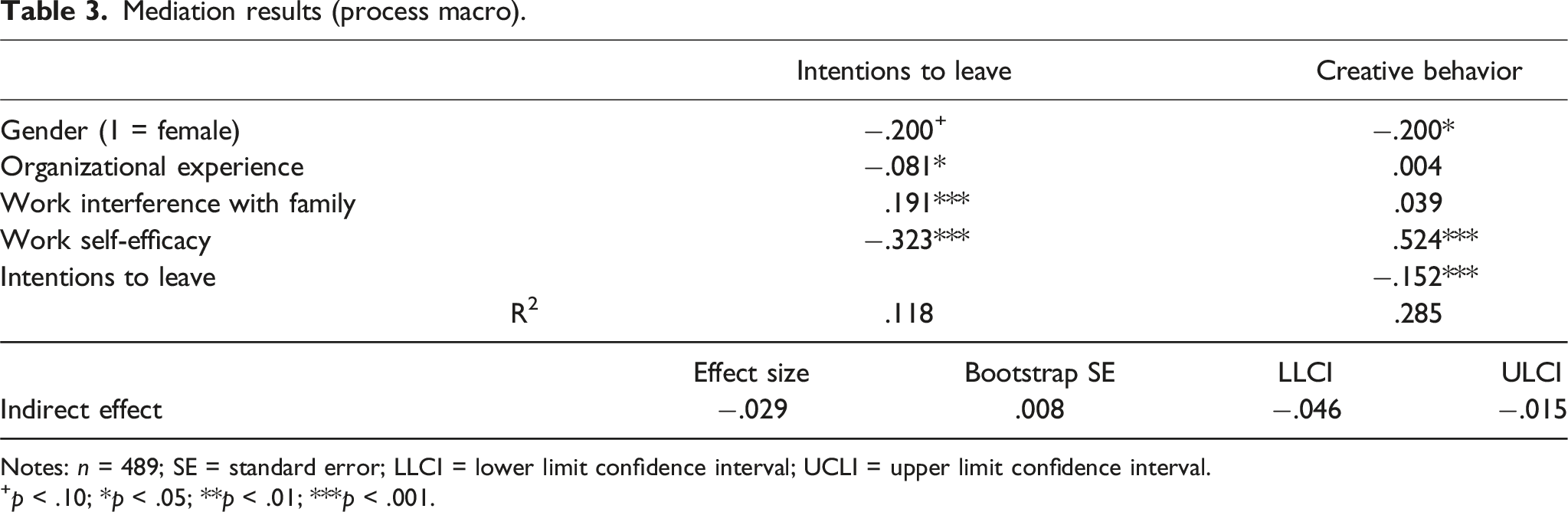
Notes: n = 489; SE = standard error; LLCI = lower limit confidence interval; UCLI = upper limit confidence interval.
+p < .10; *p < .05; **p < .01; ***p < .001.
Turning to the hypotheses, the results in Table 3 indicate that work interference with family related positively to intentions to leave (b = 0.191, p < .001, consistent with Hypothesis 1), which in turn related negatively to creative behavior (b = −0.152, p < .001, consistent with Hypothesis 2). The test of mediation revealed an effect size of −0.029 for the indirect negative relationship between work interference with family and creative behavior through intentions to leave. The corresponding CI did not span 0 [−0.046, −0.015], which offers evidence of the presence of a mediation effect of employees’ quitting intentions, as stipulated in Hypothesis 3.
Moderated mediation results (process macro).
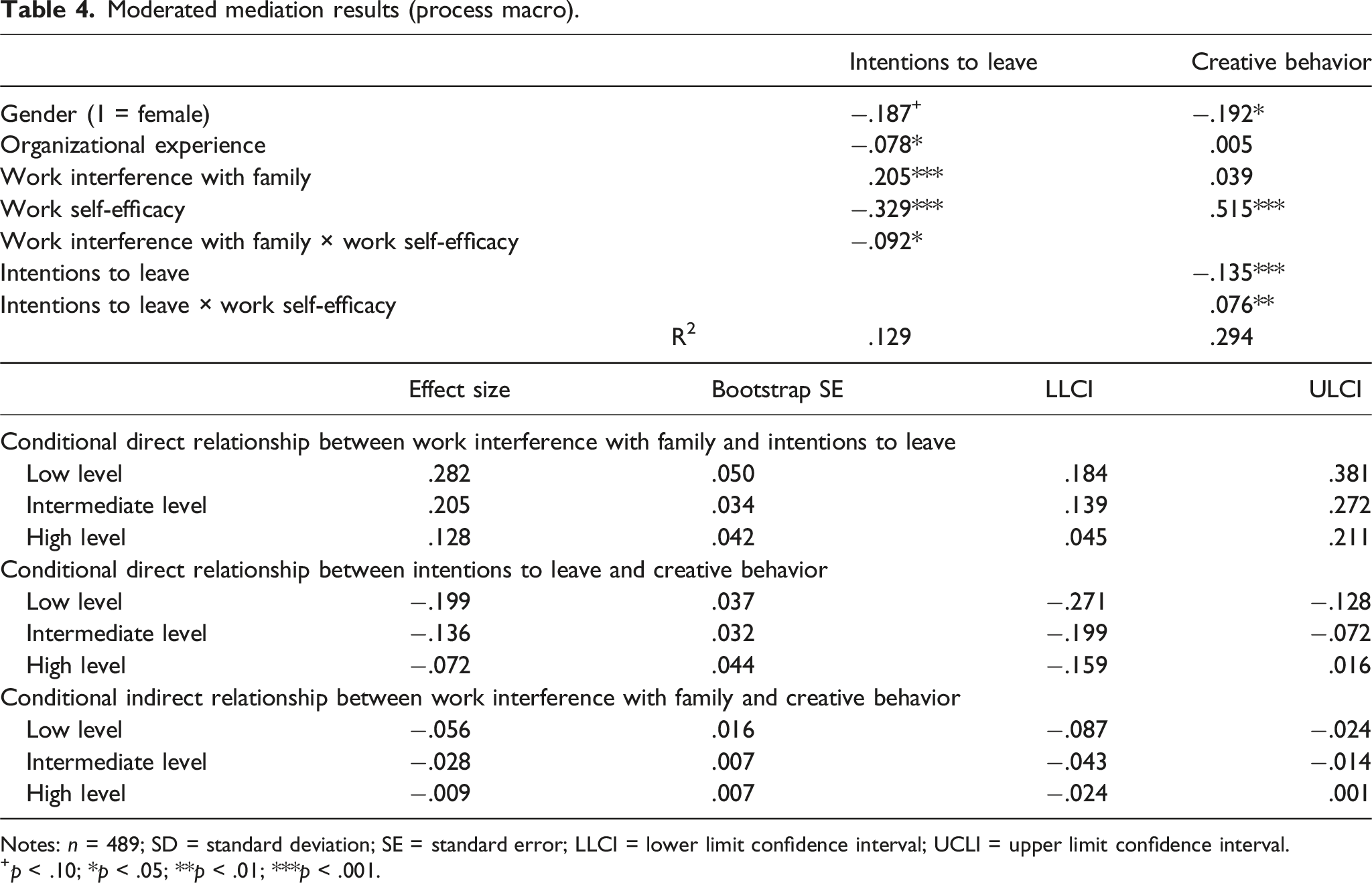
Notes: n = 489; SD = standard deviation; SE = standard error; LLCI = lower limit confidence interval; UCLI = upper limit confidence interval.
+p < .10; *p < .05; **p < .01; ***p < .001.
For the explicit assessment of the proposed moderated mediation dynamic (Hypothesis 6), the strength of the conditional indirect relationship between work interference with family and creative behavior through intentions to leave was estimated at distinct levels of work self-efficacy. As Table 3 explicates, the indirect relationship was weaker at higher levels of work self-efficacy, ranging from −.056 (–1SD) to −0.028 (mean) to −0.009 (+1SD). Notably, the CIs did not include 0 at the two lowest levels of work self-efficacy ([−0.087; −0.024] and [−0.043; −0.014], respectively), but the CI did include 0 at its highest level ([−0.024; 0.001]). Therefore, work self-efficacy mitigates the negative indirect relationship between work interference with family and creative behavior, through enhanced intentions to leave, in support of Hypothesis 6 and the overall conceptual framework.
Post hoc analysis
This study’s reliance on the Process macro approach (Hayes, 2018) does not signify a claim that this approach is inherently superior to other methods, such as traditional structural equation modeling (SEM), which recognizes the presence of measurement error in the focal constructs in a way that the Process macro does not. Instead, using the Process macro reflects the reasoning provided by Hayes and colleagues (2017: 80), who explicate that “the task of estimating latent variable interactions [is] so daunting that the unknown effects that can result from ignoring measurement error would seem an acceptable price to pay in exchange for the ease of the analysis and interpretation when using an observed-variable modeling tool like Process.” Nevertheless, to assess the robustness of the Process-based findings, a post hoc analysis with AMOS 28.0 software involved a path analysis, a specific type of SEM that relies on the composite scores of multi-item constructs (Hair et al., 2019).
Traditional SEM calculates the loadings of each item on its corresponding construct, such that nonlinearity problems can arise when estimating moderating effects (Ping, 1996). For example, the loadings of 18 items would need to be calculated for the work interference with family × work self-efficacy product term (i.e., three items for work interference with family and six items for work self-efficacy). As Ping (1996) advises, aggregating the individual measurement items of each central construct into a single score to test the hypotheses—including the theorized moderating effect of work self-efficacy—averts estimation difficulties due to nonlinearity (Lattin et al., 2003).
The path analysis results were completely consistent with those generated with the Process macro. 4 In particular, matching the results in Table 3, the path analysis revealed a positive relationship between work interference with family and intentions to leave (b = .191, p < .001) and a negative relationship between intentions to leave and creative behavior (b = −.152, p < .001). Aligned with the findings in Table 4, it also indicated a negative relationship between the work interference with family × work self-efficacy interaction term and intentions to leave (b = −.092, p < .05) and a positive relationship between the intentions to leave × work self-efficacy interaction term and creative behavior (b = .076, p < .01). The close alignment of the Process-based findings and path analysis results affirm the validity of the former (Hair et al., 2019).
Discussion
Theoretical implications
This study contributes to prior research by investigating the connection between frustrations about work demands that spill over into the family sphere on the one hand and creative work efforts on the other hand, in an attempt to unpack this connection and pinpoint factors that underpin or influence it. According to extant research, employees’ motivation to generate novel ideas for organizational improvement diminishes when they confront difficult situations in the work realm (e.g., Cai et al., 2024; Zhang et al., 2023). A parallel research stream, on work-to-family conflict, concurs that such conflict can generate negative work experiences and attitudes, in the form of job stress (Park et al., 2023) or work disengagement (Yucel et al., 2023), as well as behavioral complacency (e.g., thwarted organizational citizenship, Lin et al., 2022). The current study bridges these distinct research streams by explicating why the experience of work inference with family may escalate into diminished creative work efforts, as well as the personal boundary conditions in which this escalation is more or less likely to materialize. In particular, it applies COR theory (Hobfoll et al., 2018) to predict that the probability that employees abstain from creative work behavior, in response to work-to-family conflict, can be explained by a desire to quit their jobs, and their work self-efficacy can subdue this influence. The findings offer empirical evidence for both these theoretical predictions.
A first key theoretical insight of this research therefore is that employees’ disappointments with negative interferences of work with family undermine their interest in undertaking constructive creative behaviors, due to their enhanced desire to “jump ship” and find other employment opportunities (Park et al., 2023). This result represents a valuable theoretical contribution, in light of research evidence that employees’ determination to stay loyal to their organization may help them cope with work-induced challenges (De Clercq and Belausteguigoitia, 2019). But consistent with both COR theory (Hobfoll, 2001) and the matching principle, which highlights that the negative outcomes of work-to-family conflict manifest in the source domain (Nohe and Sonntag, 2014), this study reveals that employees become less determined to stay with their company in response to work inference with family, and then exhibit behavioral complacency as a way to express their dismay with their compromised professional functioning (Liao et al., 2019). This sequence of relationships is noteworthy from a theoretical angle because it points to the risk of a negative spiral, in which one difficult situation (being unable to combine work with family demands) escalates into another (work-related indifference toward new idea generation for organizational improvement). To the extent that such indifference leaves negative impressions on organizational authorities (Do et al., 2018), employees who experience work interference with family might aggravate their own adversity, perhaps without realizing it, by losing their chance to rely on organizational support to eliminate the interference.
A second relevant theoretical implication is that this harmful dynamic can be curbed if employees can rely on their work self-efficacy resources (Bayraktar and Jiménez, 2020). Consistent with COR theory (Hobfoll et al., 2018), employees who feel more confident about their work-related competencies are better placed to (1) retain some motivation to stay with the company, even if they face resource-depleting work interference with family, and (2) continue engaging in some creative behavior, even if they cannot avoid thinking about the possibility of leaving. The theoretical relevance of these findings stems from the complementary insights they provide, relative to previous findings related to how efficacious employees deal with challenges specific to the work realm, such as negative leader treatment (Hsu et al., 2021) or exposure to work overload (Delpechitre et al., 2019). Employees’ confidence in their own professional skills serves as a sort of protective shield against the risk that convictions about spillover work demands, spreading beyond the professional realm, start to boomerang by generating negative beliefs about their employment situation and then compromising creative work efforts. This shielding role of work self-efficacy, as identified herein, also offers additional insights, beyond related research that focuses on the direct beneficial impact of this personal resource on employees’ creativity levels (Rego et al., 2012). As the current study reveals, employees’ beliefs in their work-related skills buffer the counterproductive effect of their quitting intentions in converting work interference with family into thwarted creative efforts, which ultimately might diminish the chance that employees exacerbate their own hardships by not searching for creative solutions to them.
Managerial implications
The study results have great relevance for managerial practice. First, organizations interested in spurring creative work efforts within their ranks should recognize that a critical inhibitor of such efforts might be the extent to which employees are frustrated with their inability to combine work with family (Park et al., 2023). Such frustrations may seem “distant” to the company, with no direct repercussions for employees’ creative work, but as this study shows, the experience of work interference with family appears to damage both employees and their organization, to the extent that this situation undermines employees’ willingness to develop original ideas, which otherwise could enhance the organizational status quo (Qu et al., 2023). A related challenge is that employees who suffer a negative interference of work with family may be reluctant to complain about it, for fear of being perceived as weak and unable to separate work from their private lives (Fan and Lin, 2023). Senior managers who want to promote creativity accordingly should foster internal climates in which employees feel safe to voice their worries, including about how work pressures are spilling over into their family realm. Human resources (HR) staff members or dedicated ombudspersons also could be proactive in identifying employees who might be susceptible to conflicting work and family demands, then giving them opportunities to talk about these hardships in a confidential manner (Myers and Witzler, 2014).
Yet in some scenarios, and in spite of dedicated efforts by HR staff members, the hardships of incompatible work and family demands may be so intense that they continue to compromise employees’ professional functioning (Liao et al., 2019). In that case, employees and senior managers must reach a common understanding of the substantial risk of allowing work interference with family to translate into curtailed creative work efforts. To stop this detrimental process, both parties should find ways to leverage valuable personal resources, such as employees’ own work self-efficacy (Appu and Sia, 2017). Senior managers might want to recruit and retain employees who have particularly high confidence in their work-related capacities, as well as enhance such confidence through training initiatives that help employees do their jobs successfully (Arciniega et al., 2021). This recommendation is not meant to ignore the risk of employees who have too much confidence in their own competencies, which can lead to suboptimal decision-making (Moores and Chang, 2009). But to the extent that organizations assist employees who suffer from work-to-family conflict in developing a healthy dose of self-confidence, they likely remain more motivated to stay with the company and support it with dedicated creative work efforts, which can add to both their own success and their employer’s.
The study’s research context—involving one organization that operates in the pharmaceutical retail sector in Mexico—also offers relevant insights for management practice, while at the same time suggesting the value of continued research efforts. Studying a single organization avoids the challenges created by the presence of unobserved, firm-level drivers of employees’ creative work efforts, as can occur in multi-firm investigations (Hair et al., 2019). In addition, and as mentioned in the Research method section, the focal company was contemplating changes to its internal functioning, which might have (1) increased the perceived need for employees to suggest novel ideas for organizational improvement and (2) imposed additional demands on their daily work, with possibly adverse impacts on their family lives. From this perspective, finding a negative link between employees’ perceptions of work-to-family conflict and creative behavior, through intentions to leave, pinpoints a potential concern for the studied organization. Building on these insights, additional research with multi-organization designs could detail the effects of specific firm-level factors on this negative link, such as an organizational climate that embraces change (De Clercq and Pereira, 2022b) or company policies that help employees balance work and family demands (Bradley et al., 2023). The arguments that underpin the proposed relationships are not company-specific, so the nature (i.e., signs) of these relationships is unlikely to change across different organizations, though their strength might.
Similarly, the research arguments are not industry-specific, but it would be valuable for managers to understand the potential impact of pertinent industry characteristics, such as the presence of external employment opportunities (De Cuyper et al., 2012) or external market rivalry (De Clercq et al., 2014). When job opportunities are abundant—as is true in the focal Mexican retail sector—employees might be even more inclined to leave if they have to endure negative interference of work with family. When market rivalry is intense—as also is true in the Latin American retail pharmacy sector (Sanchez-Bayardo et al., 2018)—employees might be motivated to allocate some of their energy to creative work activities to support their employer’s competitive positioning, even if their work demands spill over into the family realm, as well as to leverage their work self-efficacy as a way to remain creative in such situations (Lahiri et al., 2008). An important premise of this study was that the signs of the theorized relationships should not differ across industry sectors, but again, their strength might vary according to relevant industry factors. Managers accordingly could benefit from continued examinations that test the proposed theoretical framework empirically across a variety of industries.
Finally, the specific country context also has practical value. In a family-oriented culture such as Mexico (Lloyd-Sherlock et al., 2018), employees may feel particularly upset when they experience the intrusion of work demands into their family lives and therefore respond vigorously, by making plans to quit and refusing to help their organization with dedicated creative efforts. The influence of collectivism, another cultural dimension on which Mexico scores high (Hofstede et al., 2010), may be relevant too, if less straightforward: A strong desire to maintain group harmony may diminish employees’ propensities to upset the organizational status quo with novel ideas, or it might encourage them to develop novel ideas that can benefit the organizational collective. Comparative studies could specify the relative importance of employees’ experience of work-to-family conflict in diminishing their creative behavior through intentions to leave, as well as the prominence of distinct moderators (e.g., work self-efficacy) in this process, across diverse cultural settings. In addition, it might be useful to examine the roles of relevant individual-level preferences, such as employees’ personal family (Liu et al., 2023) and collectivistic (De Clercq and Pereira, 2022a) orientations.
Limitations and further research
In addition to the need for further research related to these contextual elements, this study reveals opportunities for continued investigations, some of which reflect limitations in its research design and scope. First, its cross-sectional nature means that the possibility of reverse causality cannot be entirely excluded, even if the theoretical rationale that underpins the proposed relationships is anchored in the robust COR framework, which prescribes that adverse experiences at the work–family interface prompt a desire in employees to adopt negative plans or behaviors as means to vent their disappointment (Park et al., 2023). Yet it is possible that successful creative work behaviors infuse employees with positive impressions about their professional functioning (Mishra and Shukla, 2012), which might prompt favorable perceptions about both their organizational membership and their abilities to combine work with family demands. Further research could use longitudinal, instead of cross-sectional, empirical designs that assess each construct in the proposed mediation link at various points in time, which would enable an explicit assessment of causality (Antonakis et al., 2010). It similarly would be useful to test sequential mediation models that explicitly account for employees’ frustrations about compromised professional goal achievement in response to work-to-family conflict and subsequent quitting intentions (Hobfoll, 2001; Hoobler et al., 2010).
Second, continued examinations could assess the relative prominence of the proposed mediating role of intentions to leave with those of other negative employment-related sentiments, such as perceptions of organizational injustice (Khattak et al., 2021) or organizational disidentification (Rani et al., 2018). Similarly, personal resources other than work self-efficacy could have beneficial mitigating roles, including employees’ benevolence (Jahanzeb et al., 2021) or passion for work (Yukhymenko-Lescroart and Sharma, 2022). Pertinent organizational resources may attenuate the investigated mediated link too, such as a supportive work–family culture (Agarwala et al., 2020) or job autonomy (Zhang et al., 2017). It would be valuable to evaluate the incremental effects of each potential moderator and demonstrate how the benefits of the focal buffer (work self-efficacy) compare with those of alternative factors.
Conclusion
This study pinpoints pertinent roles of employees’ intentions to leave and work self-efficacy in converting their experience of work interference with family into tarnished creative behavior. Intentions to “jump ship” reflect core channels through which frustrations about incompatible work and family responsibilities make employees reluctant to extend themselves by generating novel ideas for organizational enhancement. The study also details how this potentially damaging process can be mitigated, to the extent that employees are endowed with strong beliefs about their work-related capabilities. These insights ideally will function as stepping stones for continued investigations into how the detrimental role of work–family hardships, in causing work-related sluggishness, can be contained through valuable personal resources that enable employees to mitigate and address the associated challenges.
Footnotes
Declaration of conflicting interests
The author(s) declared no potential conflicts of interest with respect to the research, authorship, and/or publication of this article.
Funding
The author(s) received no financial support for the research, authorship, and/or publication of this article.
