




Abstract
The current study aims to understand the mechanisms underlying the predictive relationship between mindfulness and organizational citizenship behaviors especially targeted for other individuals inside the organizations. As part of this relationship model, oneness behaviors were suggested as an actor of mediation. A sample of 281 blue collar employees participated for the study with employing a multi-source data gathering method. In line with the self-regulation and Buddhist based conceptualizations, and previous related research, statistical analyses revealed significant effects of mindfulness on organizational citizenship behavior towards individuals (OCBI) after controlling demographic variables, and showed fully mediated roles of one and other sub dimensions in mindfulness-OCBI interaction. The current study brings a novel approach to mindfulness and organizational citizenship relationship by including oneness behaviors inside the research model while stressing the importance of interconnectedness and how it could be practiced inside the organizations.
Keywords
In a world which is more globally connected but also more globally challenged compared to the past, business organizations today are faced with problems which may not be solved through the traditional understanding of individual remedies for separated entities. As each organizational entity is also connected to the surrounding businesses, communities, nations, it should now be more evident that the problems faced by one entity also affect the surrounding entities. In response to this awareness, personal factors in the workplace promises solutions to more complicated problems arising from changes in organizational processes and structures.
Personal factors in the workplace have been defined in relation to the experience of interconnectedness by all organizational entities (Giacalone and Jurkiewicz, 2003; Marques et al., 2007; Tejeda, 2015). In their extensive analysis involving how workplace spirituality might play out in producing positive and healthy workplace outcomes, Gupta et al. (2014) stated that spirituality is not only about being positive towards our own selves, but also towards other living beings. Tejeda (2015) who explored the supportive effects of spiritual well-being on job satisfaction in adverse work conditions, concluded that spirituality, apart from helping employees to overcome stressful events through enhanced well-being, might also serve to promote other mechanisms such as mindfulness.
Looking at available literature related to healthy workplace outcomes that might intersect with interconnectedness, those healthy contributions by individual employees have been studied under the name of Organizational Citizenship Behavior (OCB). Tepper (2003) hypothesized that experience of connectedness increases employee sensitivity to the needs of the others and thus produces helping behaviors. In addition, he said that citizenship behaviors would be performed by spiritual employees as they would find greater meaning and purpose of their work experiences.
Given the rising importance of employee well-being and personal resources both for business research and practice, the current study aims to understand certain personal capacities and mechanisms that might play a significant role in the demonstration of citizenship behavior as a healthy and positive workplace outcome. As humans are composed of both inner and outer beings (Gupta et al., 2014), the way those inner mechanisms work to produce healthy relationships with the outer world could be a valuable area of study. The inner mechanism in this study is represented by mindfulness concept that might help to produce citizenship through the interconnectedness principle which is currently treated as oneness behaviors.
Organizational citizenship behavior and theoretical approaches: The missing personal ingredient
Organizational Citizenship Behavior was defined as a discretionary individual behavior, not being recognized by the formal reward systems, but which eventually leads to the efficient and effective functioning of the organization (Organ et al., 2006). Organ et al. followed Barnard (1938)’s conception of an organization is a “cooperative system” which is composed of those willing individuals without whose efforts the organization cannot exist or evolve. More importantly, Barnard (1938) had contended that the collective effort requires those individuals’ commitment which reflected a sense of being connected with the larger whole. In more specific terms, those persons needed to have a tendency to think with an interdependent consciousness that represented an interconnectedness which they truly believed to reflect the eventual benefit for the whole organization. Although it held many organizational benefits, Barnard (1938) had strongly claimed that this “willingness to cooperate” varied within and among different individuals including the “we thinking” that was argued to be a necessary ingredient of a performing organization.
Apart from Barnard (1938)’s approach which can be said to stem more from a holistic view of the organization, Organ et al. (2006) list the following theoretical approaches to OCB which to them, have explanatory power in trying to locate this construct in terms of its antecedents, consequences and organizational correlates.
`Blau’s social exchange theory
This theory takes into account the social exchange that happens at every social living entity where each party gives the other something which is valuable, and eventually, the party on the receiving end is expected to feel some obligation to reciprocate or pay something in return.
Leader-member exchange theory
This theory takes into account the different approaches of the leader to a workgroup composed of individuals having different abilities and attitudes. Depending on those different subordinate characteristics, the leader rewards and reinforces certain behaviors, which might result in more OCBs or might originate from OCBs at the first place.
Approaches of Katz and Kahn
This approach takes into account “what is necessary” for an effective organization to perform. Among those requirements, there has to be three different contributions: 1. Attracting and holding people within the organizational system; 2. Making sure that organizational members demonstrate role performance which is expected to be met and also to be exceeded beyond minimal levels; 3. Innovative and spontaneous behavior which need to be evoked, performance that goes beyond role requirements. The third of these requirements remind the necessity of some form of OCBs which are seen as crucial to be able to achieve a cooperative and therefore highly performing organization.
Williamson and transaction cost economics model
In an economically blurred environment where the transaction costs cannot be foreseen, the relationship and relevant exchanges between the employer and the employee becomes something of a contractual attempt where there is a wage paid based on some level of agreed but ambiguous duties. In terms of exchange, the employee understands this ambiguity and does whatever he/she needs to do which may or may not include OCB behaviors. This theory also takes into consideration of an exchange nature of relationships albeit in an ambiguous economic environment where there are costs and payments.
Ouchi
Extending Williamson’s work, William Ouchi (1980) puts hierarchies and bureaucracies as central for the market to function efficiently. In the conditions where the formal hierarchies would not be sufficient for an effective transaction, the idea of “clan” is said to serve a viable function. Here the OCB is said to serve this community by the individuals who think and see the collective whole as not separate from their own interests.
Mainly the common theme arising from each approach to OCB relies on a certain exchange between the individual and the larger whole, an organization, a community, a group of people or a leader. Without such an exchange, it seems that OCB cannot exist or be cultivated. Whatever the nature of those exchanges might be, OCB, from those theoretical perspectives, seems to serve an individual interest such as in a form of job security, decreased role conflict and ambiguity (Chen et al., 2009), job rewards, personal recognition or professional promotion. As long as there is a social environment of exchange (Ma and Qu, 2011), there seems to be a chance for OCB to grow. But what if OCB, at least some parts of OCB, especially those which are targeted for the other individuals do not depend on such an exchange, but rather, is an outcome of more of a dispositional characteristic such as personality or an individual attribute?
Barnard (1938)’s view of organizations requires those individuals who are holding consciousness of interdependence, and who hold a holistic view of the organization. Following his suggestion, this type of “we thinking” might be representing a very individual and thus a very intimately personal approach which may not be so sensitive to environmental constraints or resources, in other words, could be free from certain organizational give and takes. One of those personal attributes that could have both intra and interpersonal quality and characteristics could be mindfulness.
Mindfulness as an individual-level capacity
Mindfulness was defined as a receptive attention to and awareness of present events and experience, where the mind simply remains in a nonjudgmental state (Brown and Ryan, 2003; Brown et al., 2007). In terms of individual capacity and resource, mindfulness is said to represent self-regulation (Brown and Ryan, 2003) while the detailed description of mindfulness and its nature is still rooted in the Buddhist scholarly literature (Brown et al., 2007).
Brown et al. (2007) argued strongly for the necessity of a sufficient degree of attention for an effective self-regulation. To be able to reach desirable goals, people need to be attentive to their inner states and also behaviors. Here the important key element is willingness to look inside to be able to carry regulated actions. Going beyond this key attentive element, Brown et al. (2007) also included a cognitive element to their theoretical approach to mindfulness which is concentrated more on how an individual makes sense of his/her environment in a mindful manner.
Research on mindfulness and organizational citizenship behavior relationship
Over the recent course of research history, there have been ample studies carried out about the relationship between mindfulness and organizational citizenship behavior as a positive outcome. Although some of those studies go back as early as 2010s, remarkably larger number of studies were carried out especially in the 2020s.
One of the early studies exploring the relationship between mindfulness and OCB found a positive relationship between two constructs with their managerial sample in New Zealand (Roche and Haar, 2013). Similar results were obtained with an Indian employee and managerial sample (Subramaniam and Panchanatham, 2015), with Vietnamese employees (Nguyen et al., 2019) and with Turkish nurses (Şahin et al., 2020).
An interesting finding about the strong predictive relationship between these two constructs was obtained especially when mindfulness served as an influential variable over OCB in a workplace sample from the United States. In her doctorate thesis where she explored the effects of mindful practices on counterproductive workplace behaviors (CWB) and organizational citizenship behaviors, Patel (2017) has come up with the finding that mindfulness became a significant predictor of OCBs no matter what role the demographic variables played.
Coming to more recent studies where mindfulness still acted as an influential variable over positive organizational outcomes, Zheng et al. (2020) have found the buffering effects of mindfulness over the Covid-19 stressors on work engagement. Another significant effect was found in a study carried out with public sector employees from Pakistan. Mindfulness moderated the positive impact of emotional intelligence over organizational citizenship behavior in a significant way (Chughtai et al., 2020). Similar positive effects were observed with Pakistani university employees (Amen and Raziq, 2020). Finally, in an experimental study that investigated the predictive relationship of mindfulness and employee helping behavior amongst US employee sample, Sawyer et al. (2021) found significant results.
In her theoretical article where she discussed the role of integrity and mindfulness over corporate citizenship, Waddock (2001) strongly emphasized that the leading corporate citizens need new levels of mindfulness and integrity at the individual and also organizational levels to be able to develop constructive relationships with key stakeholders. Following Waddock (2001)’s proposition about citizenship and the extant research findings, mindfulness could be a valuable construct to study as a possible antecedent of OCB.
Regarding the types of citizenship behaviors, Williams and Anderson (1991) talked about the clear distinction made between the OCB towards organization (OCBO) and OCB towards individuals (OCBI). Therefore, investigating OCBI behaviors that are directly targeted for the other individuals instead of OCBO (such as civic virtue, sportsmanship) would make more sense as the latter might also be related with impression management motives (Bolino and Turnley, 2003).
Therefore, locating mindfulness as a personal capacity and resource within a self-regulation framework, the first hypothesis of the study follows:
People who perceive themselves more mindful show more citizenship behaviors directed towards other individuals (OCBI) In a narrative outline of mindfulness described as a lived experience of existential-phenomenological nature, Nanda (2009) has drawn a picture related to the key points in mindfulness practice. The first and the most important point she makes is about the relational stance where there seems to be no separation between the subject and the object during the practice. Referencing the Buddhist teacher and mindfulness practitioner Hanh (2006), she talked about consciousness having three aspects: subject, object and, wholeness which is the base of the former two. This understanding implies inseparability and an interrelated nature of the subject and the object. Nanda (2009), in relation to this understanding, further said that our beliefs, values, or attitudes are not separated from the world around us even when we are alone by ourselves. In Hanh (2006)’s terms, this is inter-being which is said to extend to the interconnectedness aspect of the universe while also important for us to be able to see all of our connectedness with all dimensions of our own personal being (social, cultural, personal, and so on). In other words, this meant an ongoing relationship between the collective and the individual which are basically inseparable. In accordance with the Buddhist ideology and literature, Western researchers studying mindfulness have also theorized its strong relation with connectedness (Amel et al., 2009; Welwood, 1996) while Brown and Ryan (2003) originally put forward its strong relation with relatedness. Regarding how mindfulness relates strongly to connectedness, Aspy and Proeve (2017) contended that mindfulness meditation leads to connectedness through increased awareness of whatever is around us while leaves us being less preoccupied with automatic thoughts which usually create disconnection from our environment, be it social or physical. As a result of their experimental study carried out with undergraduate students, those student participants who were put into mindful meditation practice reported being more socially connected at the post-test measures (Aspy and Proeve, 2017). While being so intertwined with the inside and the outside world, living mindful, according to Kostanski and Hassed (2008) meant being in the moment, connected with our senses, while confronting situations with an attitude of acceptance and yet acting when one needs to act. Therefore, mindfulness is not totally equated with simple silence and stillness, but it involves acting if/when the present moment situation calls for it. The actions that are carried out can be different in nature, ranging from being self-protective to orientations of serving others which might as well include citizenship behaviors that especially might involve helping and behaving nicely towards others.
Mindfulness in action: Buddhist-based conceptualization and model
In an extensive outline of a new and a more encompassing understanding of mindfulness, Purser and Milillo (2015), by taking the concept back to its Buddhist roots, argued that mindfulness should not be a passive and a nonjudgmental attentiveness to the present moment, but by involving a more enhanced cognitive process through memory, should cover past, present and the future altogether. Calling it “right mindfulness”, the authors suggest that it should include knowing at all spheres of existence, in other words, in the mind, body and the soul. While involving a healthy state of mind and body, in Buddhist notion, wholesome mind and body, this type of mindfulness is said to have a universal and a transcendent purpose that includes virtuous behavior and an altruistic concern for all beings (Flanagan, 2011; Forbes, 2012).
According to their new conceptualization of mindfulness, Purser and Milillo (2015) suggest a triadic mindfulness model where mindfulness is said to lead to skillful and wholesome behaviors. The opposite becomes true if the right mindfulness is not established, leading to less favorable outcomes like unskillful states and behaviors. They also refer to this as wholesome versus unwholesome actions being classified into three categories: Bodily actions, verbal actions, and mental actions. Some examples for the unwholesome bodily actions would be: Destroying life, taking what is not given (stealing), lying, harsh speech, and so on.
Those actions that might be directly influenced by mindfulness practices could also remind us of other but related attitude/action dimensions. Those dimensions can include empathic thinking and approach (Hülsheger et al., 2013), perspective taking (for reperceiving see Shapiro et al., 2006), active listening, demonstrating respect for the other person, engaging in fruitful dialogues, consideration of the others in a relationship, effective communication practices (Burgoon et al., 2000), appreciative inquiry (Krahnke and Cooperrider, 2008), behaving ethically and responsibly in social environments…and so on. Those practices were listed very much under the possible outcomes of mindfulness elsewhere.
How does the mindfulness mechanism work to produce organizational citizenship behavior: experiencing and acting of oneness
As a concept, oneness is rooted in many theoretical perspectives and approaches especially from the East Asian traditions of Buddhism, Daoism, and Confucianism (Aşkun, 2019). Here oneness reflects a view of the world that surrounds us including relationships between ourselves and others, human and non-human. Following those family of views, Ivanhoe (2015) proposed a ‘Oneness Hypothesis’ that entailed a more expansive conceptualization of self with an inherent relational nature and having a compassionate and caring approach to all.
Humans could be considered systems, composed of feelings, thoughts and behaviors as processes of the structures which sometimes are named as mind-body and soul. While separate entities, each structure has relationships with one another, evidenced in the form of thoughts influencing feelings and behaviors or vice versa. Similarly, organizations are also systems surrounded by several other systems (economy, ecology, politics, culture… and so on.). And humans are parts of those organizational systems which are also parts of other systems (Aşkun, 2019). The healthier those parts would become, the more positive would be the consequences for the larger whole. And if humans are composed of thoughts, feelings and behaviors in all of their existence, the wholeness of those parts would be important for the healthiness of the whole. Following earlier discussion by Purser and Milillo (2015), wholesome behaviors could yield very positive outcomes for both inside and outside the organizations.
Oneness behaviors
Originally proposed by Aşkun and Çetin (2017), oneness behaviors represent acting in accordance with “wholeness perspective” meaning that acting in oneness almost always considers other beings and environments while demonstrating respect, such as respecting people in the line, in a theatre where they are silently watching a movie, not carrying out any kind of social loafing, accepting responsibility for one’s actions and decisions, coming to meetings on time, listening to the others’ opinions while making a common decision, helping an elderly crossing the street, understanding others’ emotions, considering other person’s perspective during a communication… and so on.
Oneness behaviors (Aşkun and Çetin, 2017) are made up of two behavioral dimensions: Focus on one’s self versus Consideration of the other. Focus on one’s self obviously demonstrates an egocentric, solely self-oriented approach when one is behaving especially in different social environments including the organizations. In contrast, consideration of the other entails taking into consideration other people in one’s social/organizational environment before one behaves with regard to a certain situation. Oneness behaviors have been shown to positively associate with emotional intelligence, self-esteem and also altruism (Aşkun and Çetin, 2017).
While the concept is novel and open to exploration, because the available literature on mindfulness has demonstrated a lot of concentrated thinking and discussion on the wholeness idea and related praxis, it might be reasonable and thus possible that mindfulness might be influencing behaviors of oneness which also might lead to organizational citizenship behaviors. Therefore, the second hypothesis is as follows:
Mindfulness influences organizational citizenship behavior through oneness behaviors. Given all the literature reviews, theoretical approaches and rationale for the hypotheses, the main aim in this study is to understand the type of contribution that mindfulness makes for organizational citizenship behaviors targeted for other individuals in an organization. The second aim is to further understand a possible underlying mechanism (oneness behavior) through which mindfulness might be exerting that influence.
Method
Participants
Data for this study were collected from a manufacturing company which is one of the Turkey’s largest renowned producers of gearboxes while being also a member of Istanbul Chamber of Industry. After getting permissions from top management and assured confidentiality of personal information, our sample consisted of volunteered blue-collar employees working in the production department. The two different forms of self-rated questionnaires were prepared for gathering data. The first self-rated one was for employees asking their mindfulness along with their demographic information. The second self-rated one was for employees asking their colleagues’ oneness and citizenship behaviors. The questionnaires included numerical codes which were previously generated for identification to allow matching of each participant’s rating with his or her corresponding coworker’s rating. After generating a private numerical code for each participant, we have paired it with all participants by making a list. In the first application, participants filled the self-questionnaire with writing their private codes, and in the second application they filled the questionnaire for their close friend by writing their close friend’s code from the list previously prepared. The second application was applied to participants individually for controlling possible selection coincidences.
The multi-source data were collected in a week apart. A total of 325 employees and their coworkers provided data, resulting in 281 matched surveys (86.4% response rate). In collecting multi-source data, it is important to select relevant individuals to give information of the measured construct. Since the purpose is to reach information about oneness and citizenship behaviors, participants’ close coworkers are determined and selected for collecting data with thoughts that they have more chance to observe these behaviors in the workplace. On average, the participants were 32.5 years old (SD = 6.66) ranging in age from 22 to 55 years. Almost all of the participants were male (92.9%) and were working in the same company for more than 1-year (99.1%) with the average tenure of 7.56 (SD = 5.77) years. With respect to level of education, 0.4% held a master’s degree, 17.2% held bachelor’s degree, 35.5% high-school degree, 30.5% a secondary school degree and 16.5% an elementary school degree. Approximately 74.1% of the participants were married.
Instruments
Mindfulness
We used Brown and Ryan’s (2003) Mindful Attention Awareness Scale (MAAS) to measure employees’ mindfulness. With its single-factor structure the scale consisted of 15 items. The items indicated how frequently participants have the experienced mindfulness described in each statement using a 6-point Likert scale from 1 (almost always) to 6 (almost never). Higher scores reflected more mindfulness (sample item: ‘I find it difficult to stay focused on what’s happening in the present’). Internal consistency, as measured by Cronbach’s alpha, was 0.86.
Oneness behavior
We used Aşkun and Çetin’s (2017) Oneness Behavior Scale to measure employees’ oneness behaviors reported by their peers. The scale consisted of two sub-dimensions: one (focus on one’s self) and other (consideration of the other). The subscale of one demonstrated focus on one’s self while acting based on one’s own needs and interests. The subscale of other indicated behaving by taking into consideration who is also present in one’s environment. With its two-factor structure the scale consisted of 27 items, indicating how much the person demonstrated one or other behaviors described in each statement using a 6-point Likert scale from 1 (not like) to 6 (completely like). Higher scores reflected more focusing on one’s self (sample item of one sub dimension: ‘Tries to figure out how s(he) can cut in line to become the first in line’) or consideration of the other (sample item of other sub dimension: ‘Pays attention to how his/her style of expression affects another’). The calculated Cronbach’s alpha coefficient of the whole scale was 0.71, for the sub-dimension of one was 0.91, and for the sub-dimension of the other was 0.90.
Organizational citizenship behavior
We used an adapted scale (Basım and Şeşen, 2006) to measure employees’ OCBs. The scale consisted of five sub-dimensions: altruism, courtesy, conscientiousness, civic virtue and sportsmanship. While the sub dimensions of altruism and courtesy represented individual-oriented (OCBI, sample item: ‘Willingly giving time to help others who have work-related problems’), the sub dimensions of conscientiousness, civic virtue and sportsmanship reflected organizational-oriented (OCBO, sample item: ‘He keeps abreast of changes in the organization’). The scale consisted of 19 items indicating how much the person demonstrated citizenship behaviors described in each statement using a 6-point Likert scale from 1 (never) to 6 (always). Higher scores indicated more citizenship behaviors directed towards both for individuals and organization. Internal consistencies of the whole scale, sub-dimension of OCBI, and sub-dimension of OCBO, as measured by Cronbach’s alpha, were 0.85, 0.80, and 0.83 respectively.
Demographic variables
We controlled demographic variables of gender, age, tenure, education and marital status in the analysis, as some previous studies found association between OCB and demographics.
Procedure
Measures of model fit for confirmatory factor analyzes.

Note: χ2: Chi square; d.f.: degrees of freedom; CFI: comparative fit index, TLI: tucker-lewis index; RMSEA::root mean square error of approximation.
To test the mediational effect, we focused on the model of using bootstrapping procedure to compute SEs and 95% confidence intervals around the indirect effect (the impact of mindfulness on OCBI through both one and other oneness behaviors). We used 5000 bootstrapping samples to estimate the bias-corrected and accelerated confidence intervals. Indirect effects were referred significant when the confidence intervals did not include zero. The SPSS macros (PROCESS v2.16) were used for this procedure (Hayes, 2017). To test hypotheses we firstly controlled gender, age, tenure, education and marital status in the analysis and then examined the indirect effects of mindfulness on OBCI through one and other sub dimension of oneness (see Figure 1). Conceptual model of the study.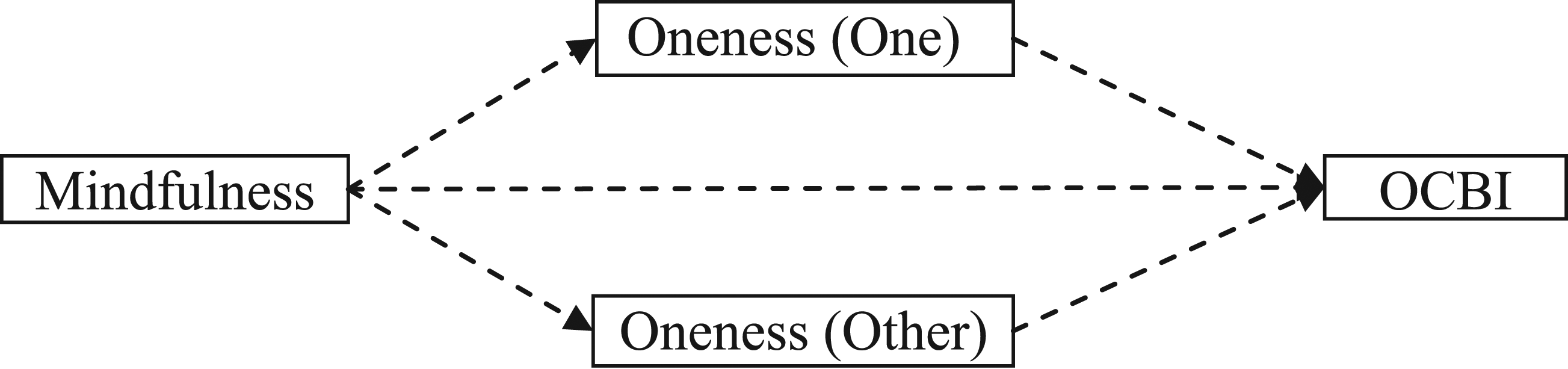
Results
Means, standard deviations and correlations of study variables (N = 281).
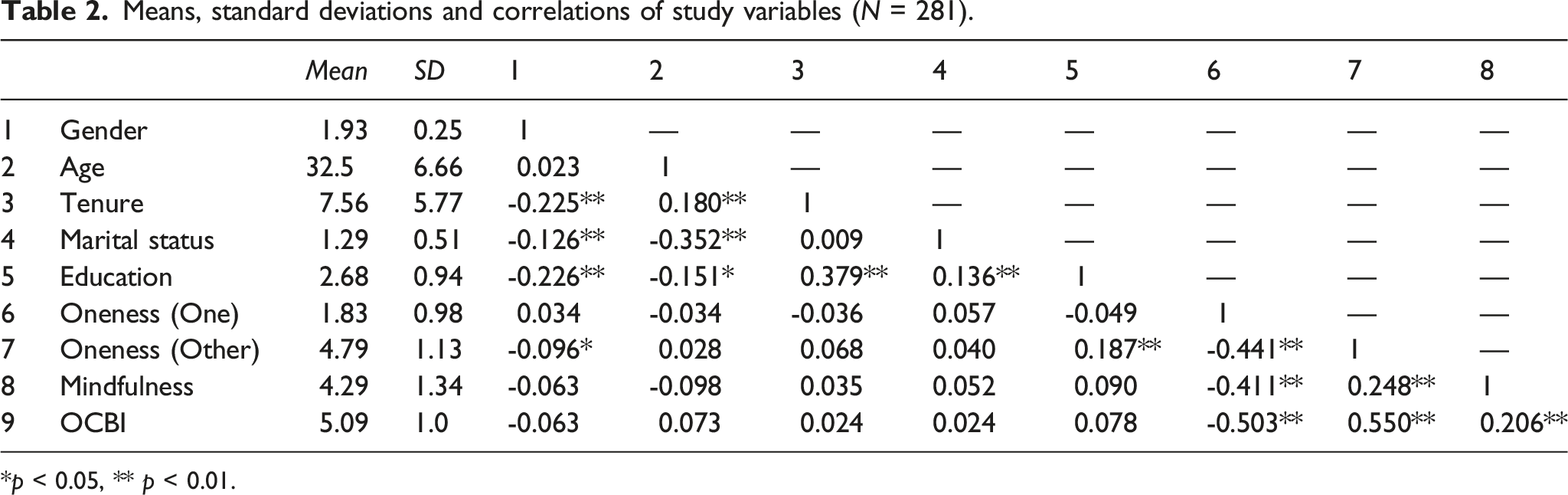
*p < 0.05, ** p < 0.01.
Regression results of the study.
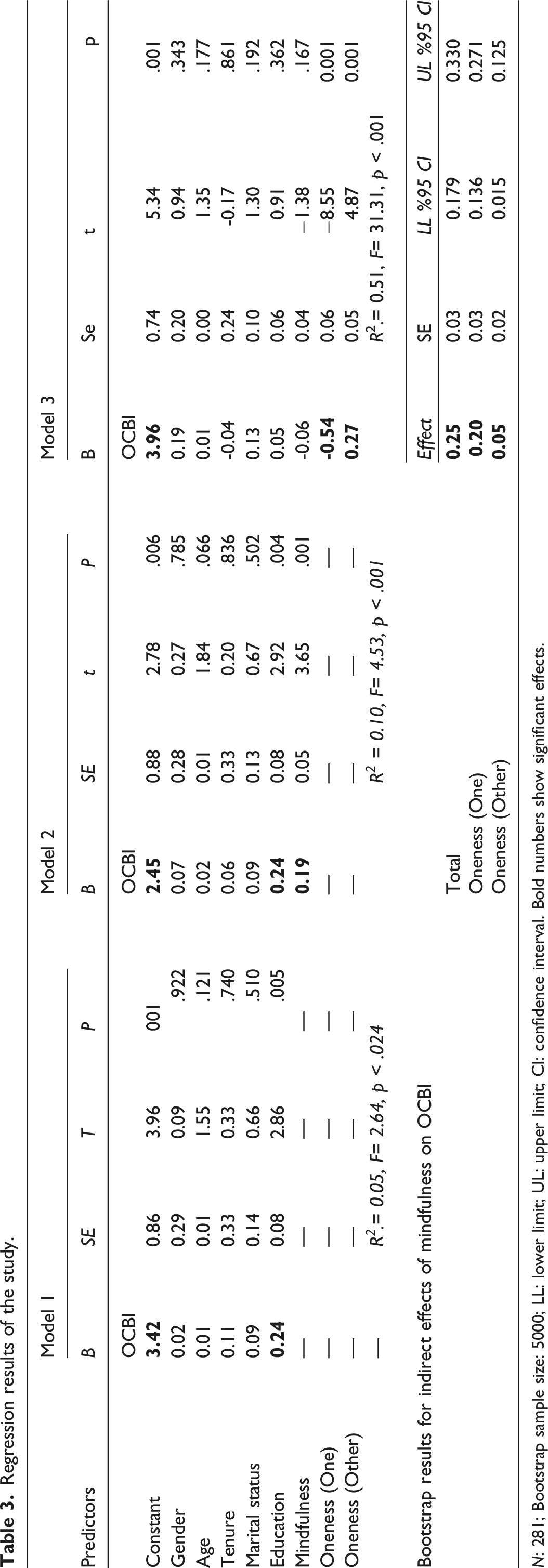
N: 281; Bootstrap sample size: 5000; LL: lower limit; UL: upper limit; CI: confidence interval. Bold numbers show significant effects.
Hypothesis 2 predicted that the effect of mindfulness on organizational citizenship behavior is mediated by oneness behaviors. The direct effect of mindfulness on OCBI became not significant (in Model 3, B = -.06, p < .167) when both sub dimensions of oneness were added to the model. The indirect effect of mindfulness on OCBI through the both one (indirect effect = 0.20) and other (indirect effect = 0.05) sub dimension of oneness was significant, because confidence interval didn’t contain zero (through one: LL 95% CI = 0.136, UL 95% CI = 0.271; through other: LL 95% CI = 0.015, UL 95% CI = 0.125). Thus, one and other sub dimensions played full mediation role in between mindfulness and OCBI. Thus Hypothesis 2 was accepted (Figure 2). Mediation by oneness of mindfulness and organizational citizenship behavior towards individuals relationship.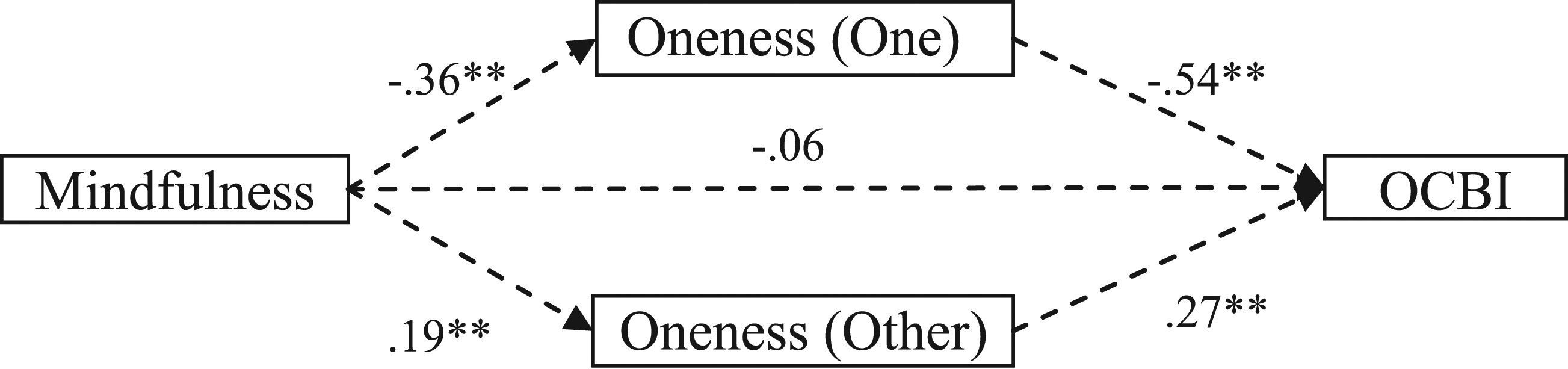
In addition to these findings, education played role in predicting both in OCBI. In the mindfulness-OCBI relation (Model 2), people whose education level was higher significantly showed more OCBI (B = 0.24, p < .004). It could be concluded that education level is the main significant factor in predicting OCBI within these individual variables.
Discussion
According to analysis of the study results, both of the hypotheses are supported. Mindfulness scores were in direct positive relationship with OCBI scores and Oneness behaviors acted as a mediator variable in the current research model.
The regression analyses revealed a significant predictive influence from mindfulness towards OCBI. As self-regulation theory proposes, mindfulness is related to one’s self-regulation by enabling a positive approach to what one experiences, thinks and feels especially in a nonjudgmental way. As the definition of mindfulness implies, it is an objective experiential awareness and is believed to be a psychological property which can be both cultivated or depleted (Brown and Ryan, 2003). Regarding measure of mindfulness in studies using MAAS, there were indications of strong associations also with psychological well-being which is in line with what self-regulation theory holds (MacKillop and Anderson, 2007). In addition, mindfulness having this type of positive effect on the self is also in congruence with the self-determination theory which describes mindfulness as a foundation for healthy self-regulation (Ryan and Deci, 2004).
For mindfulness to take this type of positive effect over positive outcomes such as organizational citizenship behavior, Shapiro et al. (2006) talk about a mechanism called reperceiving which means developing the capacity to observe inner states such as anxiety, fear or stress without any judgment. Reperceiving disables automatic behavioral patterns, and instead leads us to attend to our emotional states, while choosing to self-regulate that leads to further health and well-being (Shapiro et al., 2006). In terms of the choice of healthy behaviors, a person practicing mindfulness can act in ways which are consistent and very much in line with his/her personal values and interests (Brown and Ryan, 2003). Organizational citizenship behaviors in this sense reflect a form of ethical behavior at the workplace. As an example, a subordinate who is new to the organization with probably less skills might hold a positive attitude and still might contribute by initiating OCBs (Borman, 2004) . In support, Weick and Sutcliffe (2006), in their conceptual analysis of mindfulness and the organizational attention quality, discussed that, because of mindfulness, people become more aware of the mind’s contents and differently, begin to see that content as resources for collective action. This way, they happen to be in a better position to initiate wise action.
However, this predictive relationship between mindfulness and citizenship also connotes a bit of a western-individualistic-self oriented approach where the autonomous individual having the ability or the capacity to self-regulate produces beneficial organizational outcomes (Brown et al., 2007). As a response to this self-focus, Brown et al. (2007) argued that the studies of the mindfulness effects over social relationships are very new and that available research seems mostly to have concentrated on the romantic aspects of those relationships. While the original Brown and Ryan (2003) mindfulness research had found important correlations between mindfulness and emotional intelligence, later studies found additional links with better social skills, perspective taking, cooperative response patterns…and so on.(Schutte et al., 2001). As a result, Brown et al. (2007) called for further research especially in the area where mindfulness relates to social connectedness as it very much relates to the inherent need of relatedness (Deci and Ryan, 1991).
In terms of the direct relationship between mindfulness and OCB, as mentioned in the introduction section of this paper, there were some very recent studies conducted. As an example, Asthana (2021) in her study with a group of MBA students has found that the mindfulness is a significant predictor of OCB and also of the student grades as a measure of performance. In a quasi-experimental study that involved mindful and positive leadership interventions, there were significant increases in terms of civic virtue and procedural justice perceptions amongst French employee and managers from a pharmaceutical industry (Giraud et al., 2021). In another experimental study with a group of employees from a telecommunications service provider in Indonesia, it was found that mindfulness-based stress reduction intervention significantly increased the participants’ service commitment-a variable that is measured as a subset of the OCB (Puswiartika2021).
In terms of specific relations between mindfulness, altruism and courtesy, there are also related research findings. As an example, in an experimental study where they explored the effects of Buddhist meditation intervention over altruistic orientation, Wallmark et al. (2013) have found that altruistic orientations were increased in the meditation intervention group. Similarly, Frost (2016), in another experimental study where he explored the effect of a short calming meditation practice over altruism, found significant increases in altruism as a result of this intervention. As there are no specific studies carried out especially regarding the relationship between mindfulness and courtesy, the above studies related to altruism research should also be approached with caution as organizational type of altruism has different criteria of measurement albeit related.
Findings related to oneness behavior having a mediating role
Study results have proven a significant mediating role of Oneness behaviors in the relationship between mindfulness and organizational citizenship behaviors. Mindfulness lost its significant predictive power when behaviors of oneness were entered into the equation. As described briefly in the introduction section of this paper, oneness behaviors (Aşkun and Çetin, 2017) are made up of two behavioral dimensions: Focus on one’s self versus Consideration of the other. Both approaches involve paying attention and that attention has a focus, one’s own self versus the other person. Therefore, it should be no surprise that mindfulness would be in a positive relationship also with oneness behaviors.
In terms of the mediating role, oneness behaviors might be evidencing a sort of expanded mindfulness concept as discussed by Purser and Milillo (2015). Borrowing an expanded version of mindfulness concept from Buddhism, the authors had argued for a more encompassing understanding of mindfulness as it relates to positive outcomes. Regarding its current use, Purser and Milillo (2015) have criticized the mindfulness conception adopted by many organizations today. Purser and Milillo (2015) argued for a better conceptualization that involves more than just a free instrumental technique. For them, mindfulness should reflect a form of consciousness that involves wholesome and unwholesome mental, emotional and physical states. In the current study, a new dimension to mindfulness was added including its effect on organizational outcomes which are especially positive, ethical and healthy. This actually means adopting a triadic model of mindfulness where the right effort, right view and the right mindfulness hold the power to influence prosocial and ethical behaviors such as citizenship behaviors.
By linking mindfulness to OCB in this way, it is also possible to bring together eastern and western approaches to mindfulness. As an example, eastern thought promotes paying attention to the inner workings of the mind, whereas the western thought promotes attending to the external events and to the mind content (Weick and Putnam, 2006). Here in the current study sample, mindfulness predicted organizational citizenship behaviors especially targeted for other individuals thru oneness behaviors. The findings are consistent with the eastern views in a way that they reflect a positive and nonjudgmental attitude of mindfulness as a process, whereas they are also consistent with especially western organizational literature which mostly focuses on the content of mindfulness (Weick and Putnam, 2006) which all lead to positive organizational outcomes such as improved coordination, reduced organizational accidents in addition to citizenship behaviors in the current case (Weick et al., 1999).
One final finding from the results analyses is about differences that one’s education level makes with regard to the demonstration of OCBI. The regression analyses revealed that people whose education level is higher show more citizenship behaviors towards individuals. This result might be important for the difference education level makes in one’s expanded understanding of his/her surrounding social environment.
Managerial and practical implications
The current study has several managerial and practical implications. First of all, mindfulness as a practice once again proves its important benefits for positive organizational outcomes. From individuals to departments and towards the organization as a whole, mindfulness is a valuable practice to cultivate and develop inside organizations. As an example, for its beneficial impact for the organization as a whole, Hales and Chakravorty (2016), in their case study with a healthcare organization, have demonstrated evidence for creating high reliability organizations through mindfulness training. The techniques that were used included quiet meditation, mindful reflection and communication.
In her theoretical analysis of integrity and mindfulness discussed to be foundations of corporate citizenship, Waddock (2001) concluded that mindfulness, through providing the opportunity and time for reflection, for dialogue, for mutual problem solving(Argyris, 1993; Schön, 1983) helps towards the formation of a learning organization (Senge, 1990). And she suggested that learning could be the necessary foundation for the mindfulness and integrity which are important for corporate citizenship.
As mindfulness and oneness implies processes at both intra and interpersonal levels, it is important to mention the integration of mind, body and soul as an implication of oneness and the healthy state that could be reached through mindfulness practices. Following the understanding of the ‘whole individuals’ (Aşkun, 2019), to be able to reach that state and capacity inside the organizations, one can talk about ‘competency development’ at the most practical level. Here the role of individual consciousness and its level should be specifically stressed. As Aşkun (2019) states, individual consciousness tells us a lot about the healthiness of the humans as systems (Sadhguru, 2016) and could be understood as one’s own personal experience related to one’s own rather than to the others’ (Marques, 2012).
At the interpersonal realm, we can definitely talk about consciousness expressed in relationships in the form of relational consciousness (Hay and Nye, 1998) while also outward behaviors. As Aşkun (2019) states, behaviors are visible and observable parts of humans and thus can lend themselves more easily also for measurement in the scientific arena. And when we talk about the healthiness of the humans and their practices, we could be expecting positive outcomes in return.
Coming back to the competency development, Aşkun (2019) lists those which could be highly relevant for cultivation in today’s organizations. At the intra-personal level she talks about consciousness, mindfulness, work motivation, resilience, organizational identification and commitment. At the interpersonal level, relational consciousness, organizational citizenship behaviors, emotional intelligence, organizational communication, and effective leadership practices were listed. As we think of organizations as systems surrounding and surrounded by systems, the development of these competencies could have far reaching consequences in terms of organizational performance and beyond.
Particularly in terms of the industry specifics and the blue-collar workforce characteristics, most of the interventions carried out in the form of training for these types of workers are informative and very conventional (Miroshin et al., 2018). And the motivation of these employees could be sometimes low (Arnolds et al., 2010). And due to the nature of their work, sometimes those workers’ mental health thus work performance might be at stake (Tsutsumi et al., 2009). In fact, in a study that explored the antecedents of job satisfaction and OCB among agency-hired blue-collar contractual workers in the Philippines, especially job characteristics and job satisfaction scores predicted their OCB. As the job itself could be demotivating and repeating, the motivation and satisfaction of these workers could be understandably low. Relatedly, there are studies that showed promising results in terms of reduced depression levels after a stress-reduction program carried out (Kawakami et al., 1997).
In terms of motivation sources of white versus blue-collar workers, there are stark differences outlined by Furnham (2005) who stated that white-collar workers cite their sources of satisfaction as work which is intrinsically interesting, opportunities for skill development, and opportunity to see the work results. And pay is one of the items listed latest. For the blue-collar workers, those sources of satisfaction are reversed in the list where pay comes first followed by support and job security. However, given the demanding conditions for their daily jobs, stress management thus performance and related positive outcomes such as OCB could still be considered significant amongst these worker groups. As there are ample studies that demonstrated the positive influence of mindfulness-based interventions over stress at the workplace, the current study results could be instrumental in increasing those efforts to promote mindfulness practice both by managers and employees.
For seeing the larger picture inside the organizations, Furnham (2005) also discussed that it would be difficult or almost irrelevant for the blue-collar workers to see the link between their day-to-day job and the mission-values-strategy of the organization. As the nature of their daily work is very routine and repetitive, very much unlike those of the white-collar workers, mindfulness and related practices could provide opportunities especially for these workers to connect to a larger whole therefore see the bigger picture. This might not only help with increased motivation and performance, but also create a sense of meaning they could derive from their work.
Relatedly, maybe the most important practical implication of the study could be about mindfulness combined with oneness behaviors to produce healthy workplace outcomes such as citizenship behaviors. As oneness behaviors represent those behaviors which are clearly distinct from a self-focused concern in social relationships (Aşkun and Çetin, 2017), enabling and encouraging those behaviors especially targeted for the other individuals would nurture the interconnectedness principle. In essence, every type of organization be it social, professional, or physical, works in a system of interconnected relationships. To be able to co-create interconnectedness in an organization, mindfulness practices, as well as oneness behaviors would work as a practical and behavioral guide for all employees, including managers, top managers and all stakeholders. For an organization to function and perform and eventually evolve in an ever-changing society, world and the universe, endorsement of these types of practices and behaviors would trigger a strong and vibrant ripple effect in a constant evolving sea of consciousness.
Limitations of the study and directions for future research
Although having very important findings for the future of mindfulness related research in the context of organizations, the current study also has some obvious limitations which are useful to mention. First of all, using MAAS for the measure of mindfulness might also bring its own setbacks. Although having important associations with positive outcomes, MAAS also has been criticized on several grounds regarding original operational definition (Shapiro, 2009), scope, being too narrow in terms of its content and also some possible unfavorable outcomes (Hülsheger et al., 2013). One of the most important criticisms is by Shapiro (2009) who contended that the one-dimensional definition of mindfulness may not truly capture the richness of the construct. The other and a very important criticism comes from Purser and Milillo (2015) who argued very strongly that mindfulness should not be equated simply with nonjudgmental awareness as mindfulness should be covering past, present and the future states altogether. In addition, Purser and Milillo (2015) argue that the definition put forward by the original MAAS, does not truly capture the real essence of mindfulness which actually has to reflect more of its original Buddhist conceptualization. Therefore, the usage of MAAS, albeit practical for the current research aims, actually is a shortcoming for the research model. In the future, multi-dimensional mindfulness measures or more qualitative methods (see Purser and Milillo, 2015) could be more helpful to be able to understand these relationships better.
Regarding measuring OCB as two separate dimensions, Podsakoff et al. (2009), in their meta-analysis of individual and organizational level consequences of OCB, found little support for the differential relationships between OCBO and OCBIs and individual-level outcomes. While the authors mention that the number of studies that were conducted to test the differences between two types of OCBs is quite small, this is noteworthy to mention for future research to be conducted concerning OCBI or OCBO.
About oneness behaviors it could be easily said that it is a novel and an unexplored behavioral domain, therefore our results concerning its influential role should be approached with that in mind. As a new concept, oneness behaviors need to be tested with different cultures and also with normative studies which should be carried out for a further understanding of the construct validity.
In terms of methodology, while the strength of the current study would be using a multi-source method, the sample size for the managers was quite small therefore only peer ratings could be included in the analysis. Even the multi-source data gathering method has some advantages over the single-source method there is also a possible limitation. We have used the data collected from coworkers as observers of participants’ oneness and citizenship behaviors. Since the data are coming from situation-specific observations there may be situations in where some behaviors are not being observed by coworkers, for instance, some citizenship behaviors towards organizations. Increasing the number of sources such as supervisors or customers and exploring the source agreement among them may produce more informative and objective results in the future. In addition, this type of data was obtained only from a single company, which limits the generalizability of the research results.
Future research would benefit from a better measure of mindfulness may be by using more qualitative approaches (Purser and Milillo, 2015), using different organization types, and also samples that render cross-cultural comparisons possible.
Concluding remarks
The current study is important firstly because it brings a novel approach to mindfulness and organizational citizenship relationship by including oneness behaviors inside the research model. Firstly, any research effort to better explain organizational citizenship behavior is important since studies of dispositional factors in OCB research are still scarce (Organ et al., 2006) compared to contextual factors such as organizational/managerial support, attitudinal factors such as satisfaction, commitment, and so on. The importance of exploring the role of individual factors in OCB lies in the fact that no matter what type of organizational/professional environment one is working in, some individuals may just be more likely or predisposed to demonstrate OCB compared to others (Bolino and Turnley, 2003). Among those individual factors, personality dimensions, cultural dimensions (individualistic vs collectivistic), being emphatic and altruistic and some others were the focus of previous research. In terms of mindfulness, the current study would be among the very few (Allred, 2012) that tried to explore its influential role in OCB.
By bringing oneness into the picture in an effort to further understand the determinants of positive organizational outcomes, the importance of interconnectedness and how it could be practiced inside the organizations are especially stressed. Following from Barnard (1938)’s original conception of “we thinking” in organizations, today, as management of diversity and inclusion of other cultures, values and individuals to our organizational systems is more of a rule rather than an exception, the performance and further growth of the healthy organizations depend on being in a constant learning state enabled through our practices that welcome and accept others. As Kawalilak (2006) beautifully puts, otherness is an opportunity that leads us to harmonious pathways where we welcome otherness by exploring each other beyond our cultural differences in a never-ending discovery of our connectedness.
Footnotes
Authors’ Note
An earlier version of this paper was published in the Academy of Management Annual Meeting Proceedings (2019).
Declaration of conflicting interests
The author(s) declared no potential conflicts of interest with respect to the research, authorship, and/or publication of this article.
Funding
The author(s) received no financial support for the research, authorship, and/or publication of this article.
