



Abstract
Despite the social pressure to cut pay instead of people when payroll cost (i.e., cost of salaries and wages) needs to be reduced, only a limited effort has been made to identify “when” cutting pay can be a feasible alternative to downsizing in terms of maintaining work attitudes of remaining employees. Utilizing both a within-subject design experiment and secondary data analysis, the current research identifies high trust in management as one necessary condition. Results demonstrate that when the level of trust in management is low, employees who had their pay cut exhibit lower levels of work attitudes than employees who survived downsizing. When the level of trust in management is high, in contrast, employees who had their pay cut did not exhibit lower levels of work attitudes than employees who survived downsizing. Moreover, when the level of trust in management is high, feelings of job security are strengthened among pay-reduced employees (compared to employees who survived downsizing). The results demonstrate that, in terms of maintaining work attitudes of remaining employees, high levels of trust in management are necessary for pay cuts to be a feasible alternative to downsizing.
Keywords
Introduction
With many developed societies transitioning into labor-intensive-structured economies (e.g., growth in the service sector: Soubbotina and Sheram, 2000), payroll cost (i.e., cost of wages and salaries) has become one of the largest operating costs for today’s organizations (Bureau of Labor Statistics, 2015; Gerhart et al., 2009). Due to the pressure to reduce costs while maximizing productivity to survive in today’s competitive environment, organizations are often forced to reduce their payroll costs while maximizing favorable employee work attitudes. With the increased interest in inequality in today’s world, however, organizations are also often confronted with the pressure from society to cut the pay of employees and share the pain as a group rather than to downsize the organization (e.g., lay off employees) when payroll costs need to be reduced (e.g., Hobson, 2009; Kelly, 2020; Lewin, 2009; Omer, 2008; Rampell, 2008; Smith, 2020). As a result, the question of whether cutting pay is a feasible alternative to downsizing for maintaining the work attitudes of remaining employees is a critical question for management.
Despite the importance of the question, studies that directly compare the effects of cutting pay and downsizing on work attitudes are extremely limited. Past studies of payroll cost reduction tend to investigate the effect of cutting pay (e.g., Greenberg, 1990; Lovett et al., 2008; Smith, 2002) or downsizing (e.g., Allen et al., 2001; Brockner et al., 2004; Luthans and Sommer, 1999; Travaglione and Cross, 2006) in isolation. For example, research on pay cuts often compares their effects on work attitudes with non-pay cut condition and not the downsizing condition.
There are, however, a few studies that include both pay cut and downsizing cases with work attitude variables as the outcome (Eilam-Shamir and Yaakobi, 2014; Fiorito et al., 2007; Snorradottir et al., 2013) and thus can be used to “infer” answers to the question of interest. Nevertheless, the literature lacks a theoretical framework that predicts for whom and when one method is more or less effective than the other method for maintaining work attitudes.
The current research tries to address these concerns in the field by incorporating trust in management as a moderator when comparing the effects of cutting pay and downsizing on work attitudes. By taking a relative reward perspective and incorporating the instrumentality factor from expectancy theory (Vroom, 1964), the research meaningfully extends the literature by establishing a framework that predicts the relative effectiveness of payroll cost reduction methods (i.e., cutting pay vs. downsizing) under different levels of trust in management. Moreover, the framework provides management with a research-based strategic guide to consider the level of employee trust in management when deciding which method to implement when payroll costs need to be reduced.
This emphasis on the moderating effects of “trust” is in alignment with the growing recognition amongst academics and practitioners that trust plays a key role in creating conditions that enable firms to remain competitive in the face of economic pressures to cut costs (Heavey et al., 2011). It is widely acknowledged that trust in organizations is more important now than it has ever been before (Heavey et al., 2011; Johnson et al., 2005). Stephen Lehane, the Group HR and Corporate Affairs Director of Alliance Boots, echoes this growing sentiment by saying, “The big human resource (HR) challenge is to develop trust” (Smedley, 2009). The effect of employee trust, however, is not limited to enhancing the efficacy of HR management. Studies demonstrate that employee trust positively influences various managerial outcomes such as corporate reputation (Yadav et al., 2018) and workplace performance (Brown et al., 2015). Hence, the paper makes a valuable contribution to not only the human resource management literature but also to the management literature in general by highlighting the role of trust in preserving employee attitudes even when cost-cutting strategies are introduced.
Theoretical background and hypotheses
Payroll cost reduction methods
To perform given tasks at a given point in time, an organization utilizes a certain number of employees at certain pay rates. An organization’s total payroll cost (i.e., cost of salaries and wages) at a given point in time, thus, is the function of the number of workers that the organization utilizes and their pay rates. To reduce payroll costs, therefore, an organization can apply one or both of the following two methods (Yoon, 2022a, 2022b). First, the reduction can be achieved by decreasing the average pay rate of employees. This can be done by cutting the pay rates of all or some of the organization’s employees. Second, the reduction in payroll cost can be accomplished by reducing the total number of workers that the organization utilizes. In this study, the former practice of cutting pay rates will be labeled as pay cuts (or cutting pay). The latter practice of reducing the number of employees will be labeled as downsizing.
Compared objects in this paper
After its payroll cost has been reduced, an organization needs to perform given tasks utilizing its remaining employees, who are likely to be affected by the payroll cost reduction measures. The current study identifies situations where one payroll cost reduction method (i.e., cutting pay or downsizing) better maintains the work attitudes of employees who are affected by the measure but still work for the organizations that have taken this measure. As a result, the subjects to be compared in this paper are the employees who had their pay cut in pay-reduced organizations and the survivors in downsized organizations. The current study is less concerned with the work attitudes of employees who did not have their pay cut in pay-reduced organizations and employees who are dismissed in downsized organizations. Hereinafter, therefore, the work attitudes of employees will be referring to the work attitudes of employees who had their pay cut in pay-reduced organizations and those of survivors in downsized organizations, as in the past research examining similar issues (e.g., (Yoon, 2022b).
Past studies and relative reward perspective
The dominant theoretical framework utilized in past studies investigating the impact of payroll cost reduction (i.e., cutting pay and downsizing) on work attitudes was the psychological contract theory (Rousseau, 1995). The theory postulates an implicit agreement that sets out expected obligations between an employee and an organization (Levinson et al., 1962; Morrison and Robinson, 1997; Rousseau, 1989, 1995; Rousseau and Tijoriwala, 1998; Schein, 1965; Sims, 1994). The psychological contract can be shaped or altered through various instruments: documents, conversations, policies, etc. (Morrison and Robinson, 1997; Rousseau and Greler, 1994; Rousseau and McLean Parks, 1993). HR practices are often viewed as strong instruments that shape or alter psychological contracts (Rousseau and Greler, 1994). The theory predicts that, when the psychological contract is upheld, employees reciprocate with favorable work-related attitudes such as commitment (Rousseau and Tijoriwala, 1998). However, the theory also anticipates that employees reciprocate with unfavorable work-related attitudes if the psychological contract is violated and modified in a way that is disadvantageous to employees (Rousseau and Tijoriwala, 1998).
Past studies examining the relationship between pay cuts and work attitude often view cutting pay as a violation of the psychological contract, as the promised rate of labor is reduced (Chambel and Fortuna, 2015; Fiorito et al., 2007; Lovett et al., 2008). Studies investigating the effect of downsizing on work attitudes also regard downsizing as a violation of the implicit contract, as employees anticipate their efforts to be repaid with a stable work environment (Datta et al., 2010). Although the survivors of downsizing have “survived” the event, they may expect less stability in their work environment or in the future relationship with the organization after the event. Although the two events (i.e., cutting pay and downsizing) differ in the reasons for the violation of the psychological contract, both events are viewed as the violation of the implicit contract, and the framework predicts that employees will reciprocate with a lower level of (or with unfavorable) work attitudes. Supporting this argument, studies show that both survivors of downsizing (Brockner et al., 2004; Gilson et al., 2004; Luthans and Sommer, 1999; Wagar, 1998) and employees who had their pay cut (Lovett et al., 2008; Smith, 2002) exhibit lower levels of work attitudes (e.g., organizational commitment and satisfaction with job and pay) than employees under conditions without these events.
Past studies utilizing the psychological contract framework focus on what is violated or “lost” when investigating the attitudinal effects of payroll cost reduction. Studies of downsizing focus on the notion that employees have lost the stability of their work environment, while pay cut studies focus on employees losing some portion of their pay. Due to an emphasis on what is “lost”, past studies have predominantly, and quite limitedly, focused on fairness and justice as moderators in the relationship between payroll cost reduction and employee attitudes. The key objective of these studies was to identify methods or situations that maintain employees’ fairness or justice perceptions in payroll cost reduction processes. For example, studies have focused on moderators such as communication (e.g., Greenberg, 1990), perceived control (e.g., Armstrong-Stassen, 1994; Brockner et al., 2004; Wang and Seifert, 2017), and supervisor support (e.g., Armstrong-Stassen, 1994; Brockner et al., 2004). Thus, our knowledge from past research is limited to the findings that payroll cost reduction leads to a decrease in work attitudes and that managing the process more fairly helps attenuate this effect.
The focus on what is “lost” in the theoretical framework of the psychological contract well explains why and how payroll cost reduction methods (i.e., cutting pay or downsizing) negatively impact work attitudes. However, the framework cannot be applied to identify moderators in the model comparing the effects of cutting pay and downsizing on work attitudes. To predict conditions where one method is more or less effective than the other, we also need to focus on the relative advantages as well as disadvantages of each method.
To answer the question of to whom and when one method (i.e., cutting pay or downsizing) is more or less effective for maintaining work attitudes, we need to shift our focus from what is “lost” to what is “relatively remained (or rewarded).” The shift in perspective will be labeled as the relative reward perspective. Utilizing the relative reward perspective in building a comparative framework of cutting pay vs. downsizing is reasonable for the following two reasons. First, each method (i.e., cutting pay or downsizing) has a relative benefit to employees when the consequences are viewed in a comparative manner. This is because, although organizations have violated a part of the psychological contract by cutting pay or downsizing, there are other parts of the psychological contract that are kept by implementing one method but not the other method. By cutting pay but not downsizing, an organization has kept the promise of providing a stable work environment despite the fact that it has failed to maintain the exchange rate of labor. By downsizing but not cutting pay, an organization has kept the promise of maintaining the exchange rate of labor despite the fact that it has failed to provide a stable work environment. Second, in general, people think not just of the consequences of the event that has occurred but also of the consequences of possible alternatives (counterfactual thinking: Byrne, 2005; Roese and Olson, 1995a). And studies demonstrate that not only do people think counterfactually, but they also form attitudes based on the process of counterfactual thinking (Gleicher et al., 1995; Roese and Olson, 1995b). Organizations that have implemented pay cuts or downsizing are likely to already be in need of reducing payroll costs. Therefore, a realistic alternative to an employee who had his or her pay cut is to experience the process of downsizing and potentially lose his or her job. In a similar vein, a realistic alternative for an employee who survived the downsizing is to have his or her pay cut but to feel relatively more secure in the future relationship with the organization. As a result, we can expect that employees who had their pay cut form attitudes by considering and comparing the outcomes of going through the process of downsizing (and vice versa for survivors of downsizing).
Based on the relative reward perspective, we can expect that employees who had their pay cut feel better about their job security. On the other hand, we can expect that employees who survived downsizing feel better about their pay level. If we assume that higher levels of job security and pay are both valued by employees in general and that employees form more favorable attitudes toward their benefits provider (Eagly and Chaiken, 1993), we can expect that the two payroll cost reduction methods (cutting pay and downsizing) each have different advantageous and disadvantageous mechanisms in maintaining work attitudes. Cutting pay, compared to downsizing, has an advantage in maintaining favorable work attitudes of employees by making them feel better about their job security. Simultaneously, however, cutting pay also has a disadvantage in maintaining work attitudes by making them feel less well about their pay-levels (vice versa for downsizing when compared to cutting pay).
A counter argument can be made that pay cuts may adversely affect both pay satisfaction and job security. The argument can be further refined through the literature that distinguishes “objective” job insecurity, which is a genuine threat (entails financial costs), and “subjective” job insecurity, which is a personal perception of a job loss. Typically, pay cuts are associated with both objective and subjective insecurity owing to immediate loss of financial resources and perceptions of potential job losses (Wang and Seifert, 2017; Wang et al., 2018). In contrast, survivors of downsizing reap immediate benefits from protecting their pay and averting an immediate job loss. In cases where layoffs are used selectively to weed out poor performers and keep high performers (valued exit theory), there is an implicit understanding that surviving downsizing is a recognition and reward for superior performance (Trevor and Piyanontalee, 2020). As a result, survivors of downsizing may demonstrate more favorable perceptions of pay as well as job security when compared to employees who had their pay cut.
To the best of our knowledge, there are no past studies comparing the relative effect of pay cuts versus downsizing on pay level- and job security-related perceptions. However, there is supportive evidence to indicate that these mechanisms have varied effects on different outcomes such as pay satisfaction and job security. For example, there are studies demonstrating that cutting pay is negatively related to pay level satisfaction (Lovett et al., 2008; Wang and Seifert, 2017). In contrast, studies in the field of downsizing exhibit that downsizing survivors demonstrate heightened levels of job insecurity (Brockner, 1992). Thus, we hypothesize as follows.
Moderating effect of trust in management in this comparison
If we view the outcomes of cutting pay and downsizing from the perspective of relative rewards that employees receive, expectancy theory (Vroom, 1964) can be utilized to identify contextual factors. Expectancy theory (Vroom, 1964), also often referred to as the VIE theory, hypothesizes that a reward is motivating to a person if the person (a) values the reward (Valance), (b) believes that fulfilling the precondition of receiving a reward (e.g., performance, behavior, and act) leads to the actual reception of the reward (Instrumentality), and (c) believes that his or her effort will lead to fulfilling the precondition of receiving a reward (Expectancy).
To model how trust in management can moderate the comparison of the effects of cutting pay versus downsizing in maintaining work attitudes, we focus on the instrumentality factor. On average, it can be expected that the level of instrumentality is higher for survivors of downsizing than for employees whose pay is cut when receiving their relative rewards. When downsizing is implemented, survivors receive their relative reward (i.e., maintaining pay-level) instantly. Instrumentality is, therefore, less of a concern for survivors of downsizing. However, in the case of cutting pay, the relative reward that pay-reduced employees receive (i.e., job security) is deferred in that some assurance is needed for the reward to be realized. For example, if employees feel that cutting pay is only the beginning in the process of reducing costs and that their job might be in danger in the future, the perceived instrumentality level in receiving the reward (i.e., job security) is low. Some assurance is needed for employees to feel that they will actually be better off in terms of job security. As a result, when only the instrumentality factor is considered, we can expect that survivors of downsizing will be more motivated than employees who had their pay cut.
When there are factors that strengthen the instrumentality level of pay-reduced employees, however, this difference in motivation can be reduced. For example, if there are strong protections for jobs, such as a labor law that discourages downsizing or a job protection agreement between union and organization, less assurance is needed for the relative reward of pay-reduced employees (i.e., job security) to be realized. Therefore, under such circumstances, the belief that the organization has cut the pay of its employees to protect their jobs may be stronger, and the motivational gap between survivors of downsizing and employees who had their pay cut might be reduced.
One such factor that increases the instrumentality level of pay-reduced employees is trust in management. Trust refers to “a psychological state comprising the intention to accept vulnerability based upon positive expectations of the intentions or behaviors of another” (Rousseau et al., 1998: 395). When employees trust managers, who are viewed as the agents or representatives of the organization, pay-reduced employees might better accept the intention of the organization in reducing its payroll cost and believe that the organization will deliver the relative rewards of cutting pay (i.e., job security). Moreover, in organizations with a high level of trust in management, employees may perceive the pay cut measures to be necessary and even be prepared to sacrifice certain elements of their job, such as pay and other pay-related elements (e.g., benefits and reduction in working hours or overtime) in order to help the organization (Wang and Seifert, 2017). Furthermore, the employees may be less likely to feel threatened by potential job losses caused by subjective perceptions of job insecurity. Therefore, when pay-reduced employees trust their managers, the perception of relative advantage in job security might be strengthened; the difference in the level of work attitudes may decrease or even be in favor of pay-reduced employees over downsizing survivors.
Others may argue that employees respond to psychological contract breaches more severely when they have high-quality relationships with their organization and manager (Bal et al., 2010). This is because they have higher expectations of being supported by the organization and feel more betrayed when psychological contracts are breached. In alignment with this argument, a study of 615 employees in multiple Chilean organizations indicated that the effects of psychological contract breach amongst survivors of downsizing are more negative when the quality of relationships between employees and managers is high (Bohle et al., 2017). This argument, however, focuses on the case of psychological contract breach through a single event or series of related events. In contrast, we are theorizing that trust can be a condition that favors cutting pay over downsizing when these two methods are “compared.” Thus, we hypothesize as follows.
Since the trust in management strengthens the perception of relative advantage in job security of pay-reduced employees, and this perception is positively related to work attitudes, by extension, we also hypothesize as follows.
The hypothesized model is shown in Figure 1. Hypothesized model.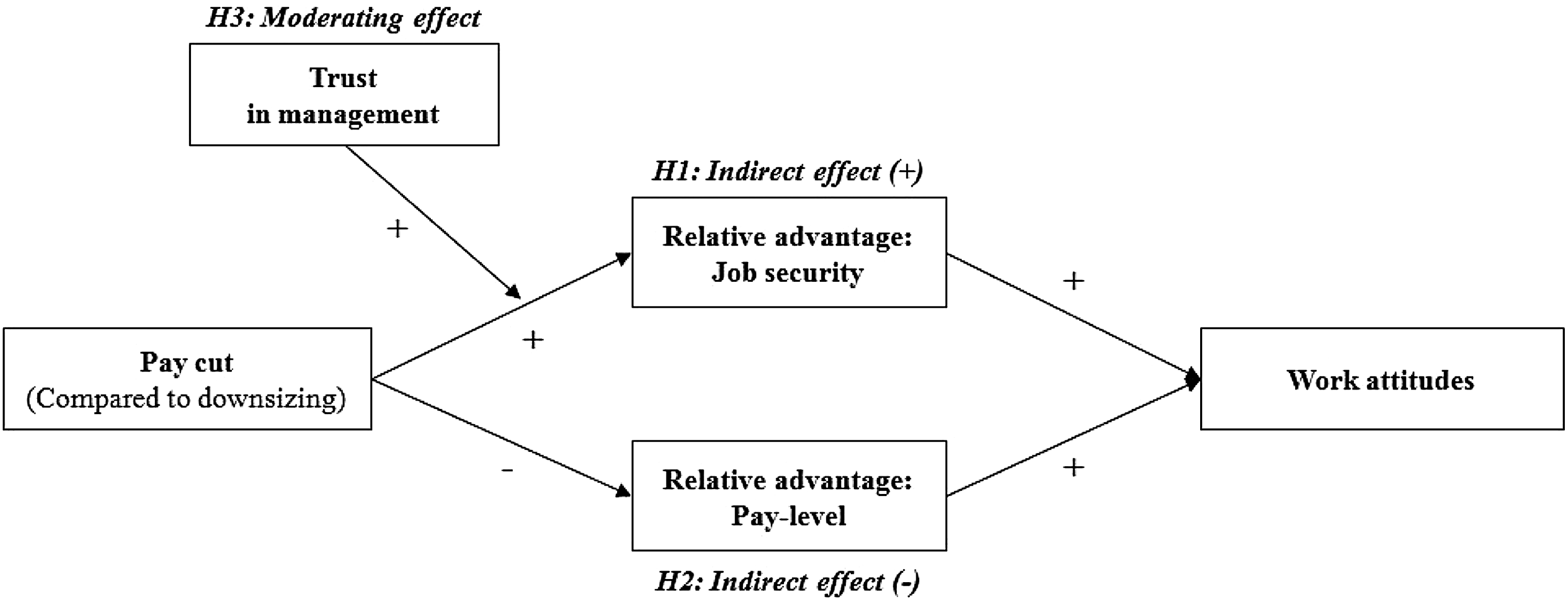
Study 1
In this study, the hypotheses are tested by conducting a within-subject design online experiment. For examining the work attitudes of employees, attitudes related to two subjects (organization and job) were measured. First, organizations can be viewed as the initiator of payroll cost reduction (i.e., cutting pay or downsizing). As a result, cutting pay or downsizing can alter employees’ work attitudes related to organizations. Moreover, implementing payroll cost reduction can also affect employees’ work attitudes related to jobs since a person’s job is a medium that links the person to the organization. In line with this argument, measurements of job attitudes (e.g., job satisfaction) in various studies often measure attitudes not only of the aspect of work itself but also of other organization-related aspects such as work environment and relationships with managers and coworkers (e.g., Smith et al., 1969; Spector, 1985; Taylor and Bowers, 1974; Warr et al., 1979; Weiss et al., 1967).
For work attitudes related to organizations, affective commitment has been examined. Affective commitment refers to the strength of emotional attachment to and acceptance of values and goals of the organization that an employee works for (Allen and Meyer, 1990; Gong et al., 2009; Mowday et al., 1979). Affective commitment has been reviewed intensively in various areas due to its significant relationships with important managerial outcomes such as performance, turnover, absenteeism, and organizational citizenship behavior (e.g., Gong et al., 2009; Meyer et al., 2002).
For attitudes toward jobs, job satisfaction has been investigated. Job satisfaction can be defined as an appraisal of a person’s job or job experiences (Locke, 1976). The construct has been examined widely by researchers due to its significant relationships with important managerial outcomes at the individual level such as job performance, organizational citizenship behavior, turnover, and absenteeism (Carsten and Spector, 1987; Hackett and Guion, 1985; Judge et al., 2001; Organ and Konovsky, 1989) as well as the outcomes at the organizational level such as customer satisfaction (Koys, 2001). This approach of measuring employee commitment and job satisfaction as work attitudes is in alignment with past research examining similar issues (e.g., Yoon, 2022b).
Study 1: Method
Overview and sample
To conduct a within-subjects design online experiment, we solicited 138 1 subjects from Amazon Mechanical Turk. Participants had to be employed (those who were not employed, self-employed, students, or owners of businesses were excluded), over 18 years of age, and reside in the United States. Subjects were 49.3% female, 90.6% full-time employed, 53.6% with an undergraduate or higher degree, and with 6.4 years of organizational tenure (SD = 5.7). In terms of age, 28.3, 36.2, 21.7, 10.1, and 3.6% of participants were in the 20s, 30s, 40s, 50s, and 60s or older, respectively. The study took about 10 minutes to complete. The project was approved by the IRB Board of Cornell University (Protocol ID#: 1606006379).
At the beginning of the experiment, a participant’s baseline levels of dependent variables (i.e., affective commitment and job satisfaction toward their current organization and job, respectively) and trust in management were measured. In the next part of the online experiment, a participant read a scenario stating that his or her organization is suffering from poor financial performance and is currently in need of reducing its payroll cost by 10%. In the third part of the experiment, a participant first read about two possible methods that the organization might adopt to reduce its payroll cost (i.e., cutting pay and downsizing). The participant then read two sub-scenarios stating the payroll cost reduction method that the organization has implemented to overcome the challenge. The first sub-scenario showed that the organization had reduced 10% of the pay of all of its workers, including the participant’s pay (Sub-Scenario 1: Pay cut). In contrast, the second sub-scenario showed that the organization had dismissed 10% of its workers (Sub-Scenario 2: Downsizing). In the downsizing sub-scenario, the participant was depicted as a downsizing survivor. After reading each sub-scenario, the participant answered questions asking his or her anticipated levels of affective commitment, job satisfaction, and perceptions in the relative advantage of job security and pay level under the sub-scenario. To account for the possible ordering effect, we randomized the order that these two sub-scenarios were presented. In the final part of the experiment, demographic data such as gender and age were collected, and participants were debriefed.
Measures
Affective commitment. To measure affective commitment reflecting the hypothetical nature of the scenarios provided to respondents, we shortened and revised the measure by Marsden et al. (1993). Participants were presented with the following three statements (5-point scale of agreement and disagreement): “Under this change, I will be proud to be working for this organization (Affective commitment 1),” “Under this change, I will feel very little loyalty to the organization that I work for (Affective commitment 2)” (reverse coded), and “Under this change, I will find that my values and the organization’s are very similar (Affective commitment 3).”
Job satisfaction. To measure job satisfaction reflecting the hypothetical nature of the scenarios provided to respondents, we revised the measure by Cammann et al. (1983). Participants were asked with the following three statements (5-point scale of agreement and disagreement): “Under this change, I will like working here (Job satisfaction 1),” “Under this change, I will not like my job (Job satisfaction 2)” (reverse coded), and “Under this change, I will be satisfied with my job (Job satisfaction 3).”
Perception of relative advantage in job security/pay-level. These constructs were measured by asking to what extent the participant agreed or disagreed (5-point scale) with the following statement: “Because the management has decided to cut pay rather than to downsize (or to downsize rather than to cut pay in the downsizing sub-scenario), I will be better off with the following aspect of my job.” To measure the perception of relative advantage in job security, the items for the following aspect were: being sure I will always have a job (Relative advantage: Job security 1), being certain of keeping my job (Relative advantage: Job security 2), and being certain my job will last (Relative advantage: Job security 3). To measure the perception of relative advantage in pay-level, the items for the following aspect were: the amount of pay (Relative advantage: Pay-level 1), total compensation (Relative advantage: Pay-level 2), and salary level (Relative advantage: Pay-level 3). Job security and pay-level items were adopted from the Work Values Survey by Cable and Edwards (2004).
Trust in management. Trust in management was measured by asking to what extent the participant agreed or disagreed (5-point scale) with the following six statements: “Management at my organization is sincere in its attempts to meet the workers' point of view (Trust in management 1),” “I feel quite confident that the organization will always try to treat me fairly (Trust in management 2),” “Our management would be quite prepared to gain an advantage by deceiving the workers (Trust in management 3)” (reverse coded), “Our organization has a poor future unless it can attract better managers (Trust in management 4)” (reverse coded), “Management can be trusted to make sensible decisions for the organization’s future (Trust in management 5),” and “Management at work seems to do an efficient job (Trust in management 6).” This six-item measure was developed by Cook and Wall (1980) with the first three items reflecting the “faith” in management and the latter three items reflecting the “confidence” in management (McCauley and Kuhnhert, 1992).
Pay cut (compared to downsizing). The responses made under the pay cut sub-scenario were coded as 1. The responses made under the downsizing sub-scenario were coded as 0.
Control variables. Baseline levels of affective commitment and job satisfaction were controlled, as were various demographic variables (i.e., gender, age, education, full-time status, organizational tenure, and work hour). The relationships of interest were significant (and in the same direction) in the models with and without these control variables. Only the results of the model without controls will be reported.
Analysis model
Given the nested data structure (i.e., one response under the pay cut scenario and another response under the downsizing scenario per respondent) and the multiple-item measurement structure, multi-level structural equation modeling (SEM) was utilized to test the model. Only the trust in management variable is at the respondent level, and all the other variables in the model are at the response level. The Mplus software (Muthen and Muthen, 2012) was utilized for the analysis. For a more intuitive interpretation of the results, all the variables except pay cut (compared to downsizing) were standardized.
Study 1: Results
Descriptive statistics
Means, standard deviations, and correlations of the variables (study 1)
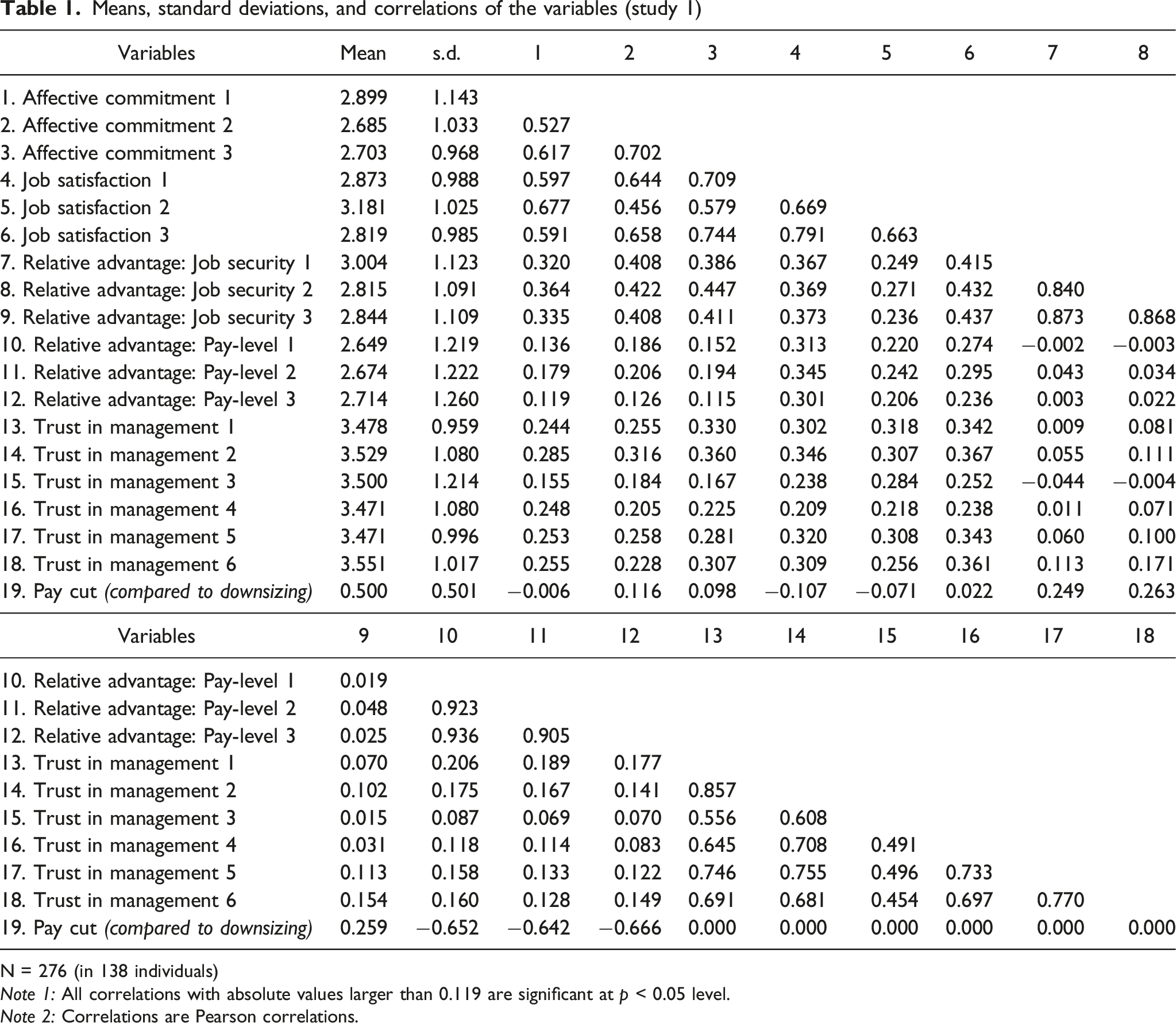
N = 276 (in 138 individuals)
Note 1: All correlations with absolute values larger than 0.119 are significant at p < 0.05 level.
Note 2: Correlations are Pearson correlations.
Confirmatory factor analysis
CFA model that treated affective commitment, job satisfaction, perception of relative advantage in job security, perception of relative advantage in pay level, and trust in management as separate latent factors yielded an acceptable fit to the observed covariance matrix (χ2(57) = 73.627, p = 0.068; SRMR within = 0.017, SRMR between = 0.037; RMSEA = 0.033; CFI = 0.993). Moreover, the factor loadings were all significant at the one percent significance level. The one-factor model in which all the variables were loaded in a single factor, however, yielded a poor fit to the observed covariance matrix (χ2(63) = 1342.483, p = 0.000; SRMR within = 0.245, SRMR between = 0.037; RMSEA = 0.271; CFI = 0.451).
Within-Level model testing
Model fit. The hypothesized model (Model 1 in Figure 2) fitted the data well (χ2(56) = 69.250, p = 0.110; SRMR within = 0.063, SRMR between = 0.000; RMSEA = 0.029; CFI = 0.994). All the paths in this model were also significant at the five percent significance level.
Hypothesis 1 testing
First, in Model 1 (Figure 2), the path from pay cut (compared to downsizing) to perception of relative advantage in job security is significantly positive (estimate = 0.549, SE = 0.129, p < 0.01). Next, the paths from perception of relative advantage in job security to work attitudes are all significantly positive (estimate for affective commitment = 0.668, SE = 0.270, p < 0.05; estimate for job satisfaction = 0.504, SE = 0.242, p < 0.05). Finally, the indirect effects of “pay cut (compared to downsizing) → perception of relative advantage in job security → work attitudes” were calculated. The estimate of unbiased variance (Goodman, 1960; Krull and McKinnon, 1999) was used to calculate the standard errors of indirect effects. When the affective commitment was utilized as the work attitude, this indirect effect was significant at the five percent significance level (estimate = 0.367, SE = 0.168, p < 0.05; not shown in Figures). The indirect effect was also significant, but only at the ten percent significance level, when job satisfaction was utilized as the work attitude (estimate = 0.277, SE = 0.145, p = 0.057; not shown in Figures). The results overall support Hypothesis 1.
Hypothesis 2 testing
First, in Model 1 (Figure 2), the path from pay cut (compared to downsizing) to perception of relative advantage in pay-level is significantly negative (estimate = −1.610, SE = 0.103, p < 0.01). Next, the paths from perception of relative advantage in pay-level to work attitudes are all significantly positive (estimate for affective commitment = 0.227, SE = 0.082, p < 0.01; estimate for job satisfaction = 0.173, SE = 0.073, p < 0.01). Finally, the indirect effects of “pay cut (compared to downsizing) → perception of relative advantage in pay-level → work attitudes” were calculated using the unbiased variance (Goodman, 1960; Krull and McKinnon, 1999) as the estimate for calculating standard errors of the indirect effects. The indirect effects were all significantly negative (estimate for affective commitment = −1.075, SE = 0.439, p < 0.01; estimate for job satisfaction = −0.811, SE = 0.392, p < 0.05; not shown in Figures). Therefore, Hypothesis 2 is supported. Within-Level SEM Results (Model 1) (Study 1). **p < 0.01, *p < 0.05.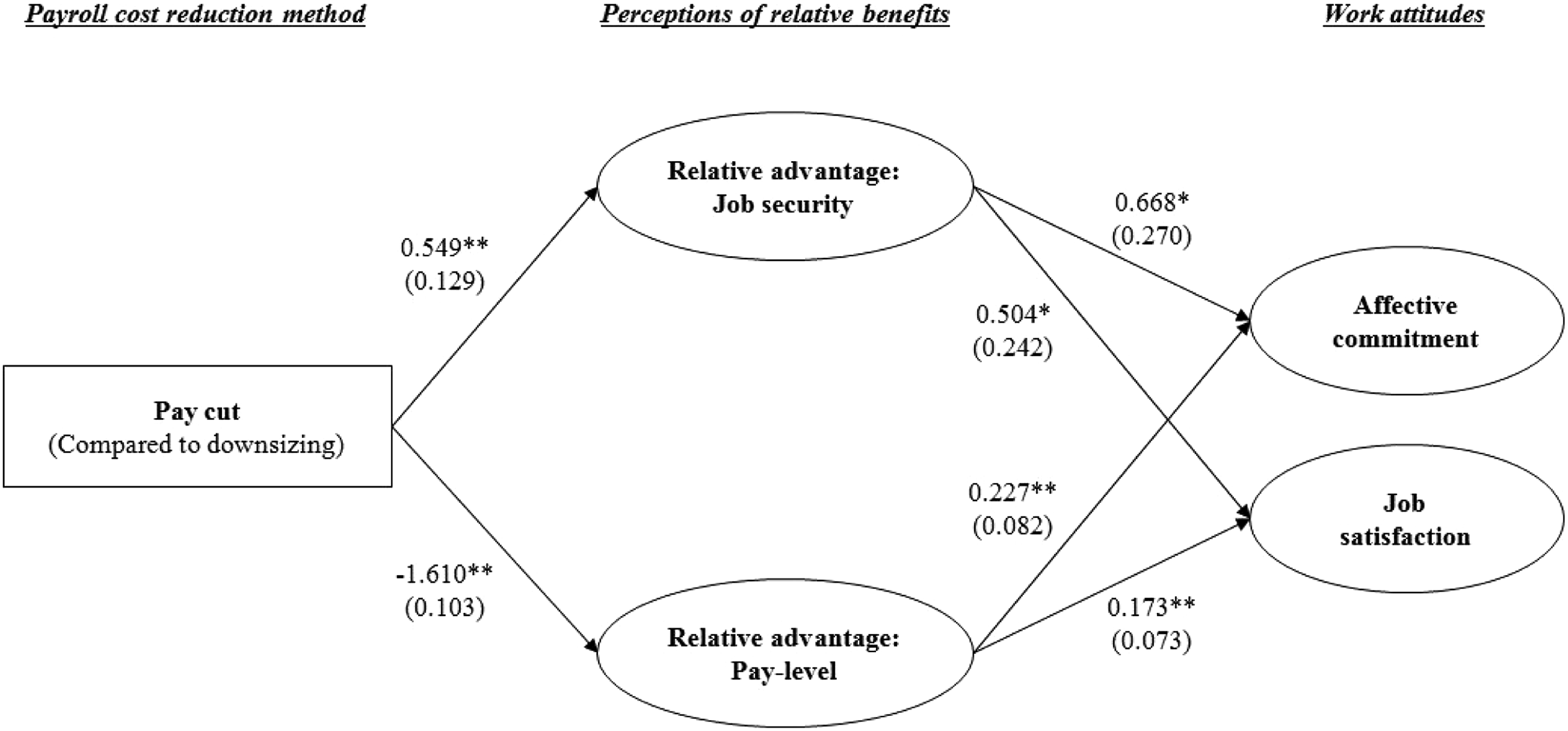
Cross-Level model testing
Hypothesis 3 testing
To test Hypothesis 3, we added paths from trust in management and perceptions of relative advantages and from the interaction term of “pay cut (compared to downsizing) * trust in management” to perceptions of relative advantages in job security and pay-level (as in Model 2 in Figure 3). In this model, the path from the interaction term of “pay cut (compared to downsizing) * trust in management” to perception of relative advantage in job security was significantly positive (estimate = 0.647, SE = 0.075, p < 0.01). However, the path from the interaction term of “pay cut (compared to downsizing) * trust in management” to the perception of relative advantage in pay-level was not significant (estimate = −0.056, SE = 0.206, ns). This indicates that the relationship between pay cut (compared to downsizing) and perception of relative advantage in job security is amplified as the level of trust in management increases. However, the result also indicates that the relationship between pay cut (compared to downsizing) and perception of relative advantage in pay-level is not amplified as the level of trust in management increases. Thus, Hypothesis 3 is supported.
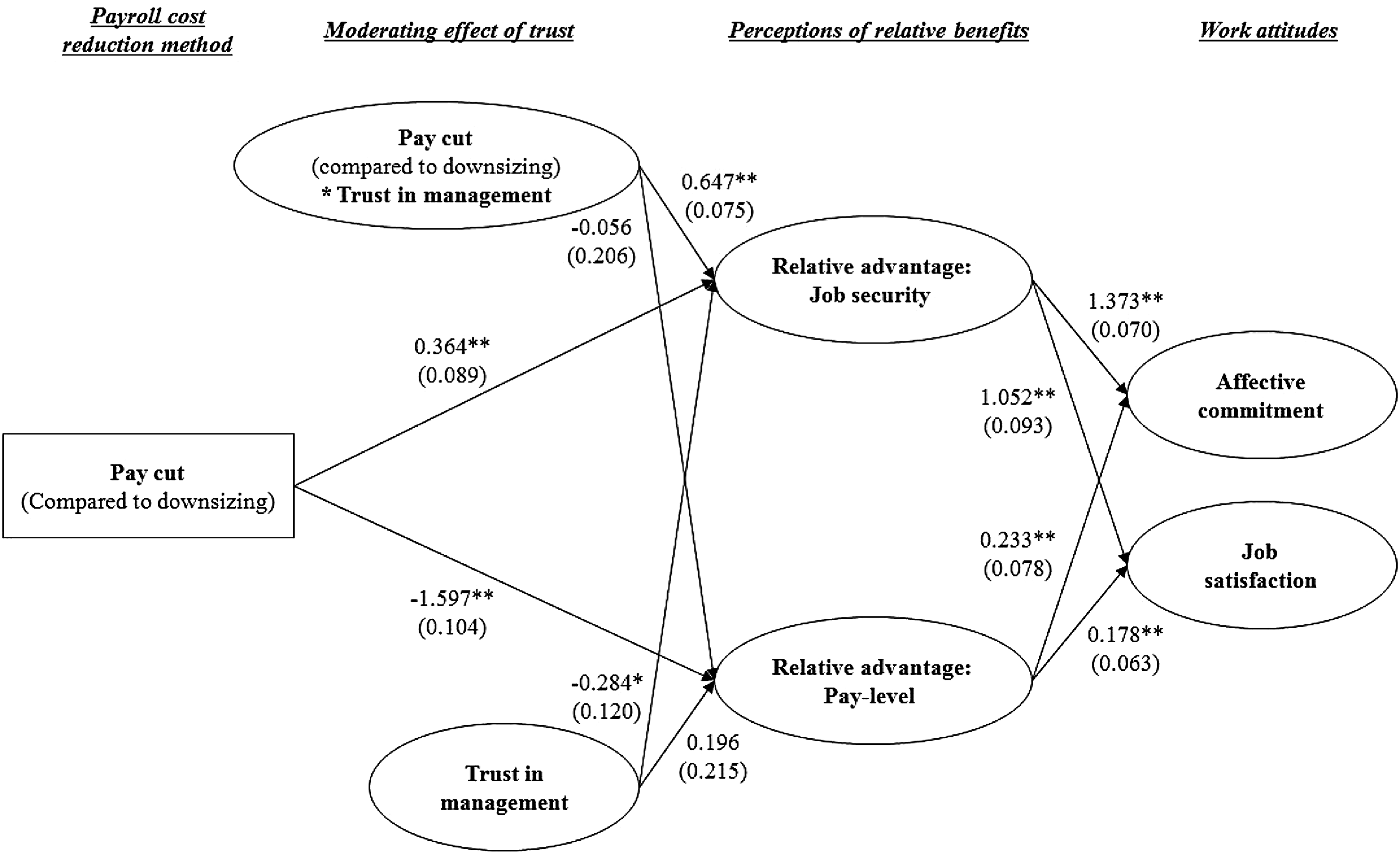
Cross-Level SEM Results (Model 2) (Study 1). **p < 0.01, *p < 0.05.
Split sample analysis
Hypothesis 4 testing
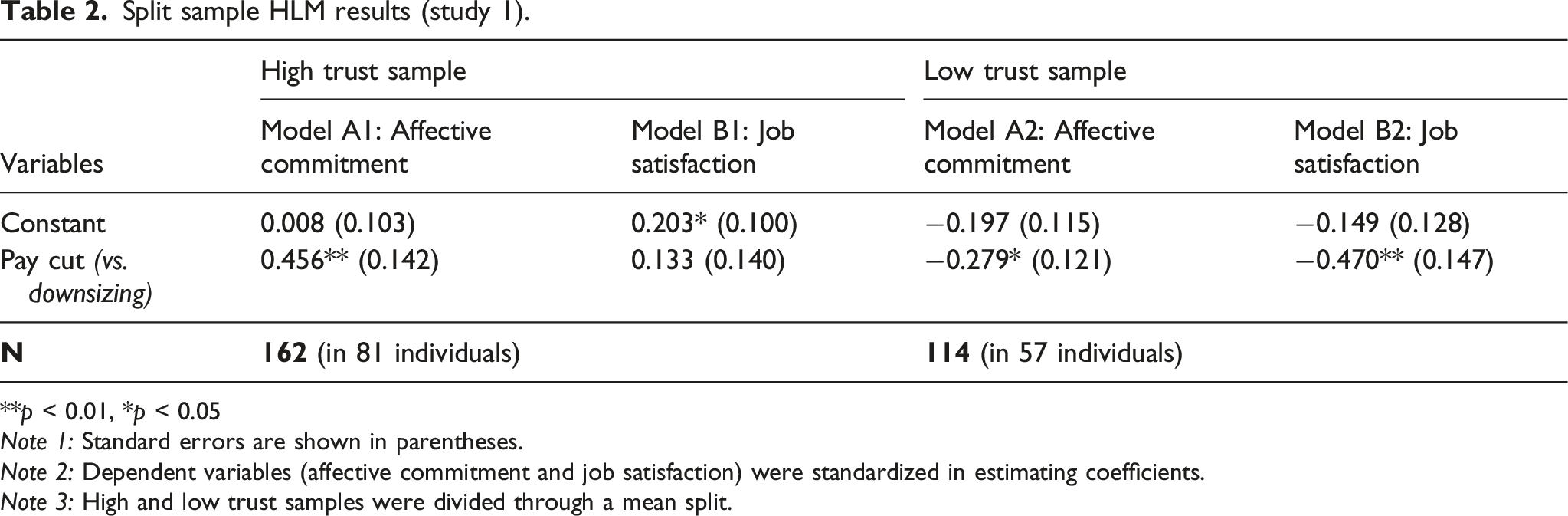
To test Hypothesis 4, we conducted a split sample analysis. The original sample was divided into high and low trust sub-samples using a mean split method. In each sub-sample, we examined how pay cut (compared to downsizing) predicted the level of work attitudes. Hierarchical linear modeling (HLM) was utilized, given the multi-leveled structure of the data.
Split sample HLM results (study 1).
**p < 0.01, *p < 0.05
Note 1: Standard errors are shown in parentheses.
Note 2: Dependent variables (affective commitment and job satisfaction) were standardized in estimating coefficients.
Note 3: High and low trust samples were divided through a mean split.
A similar pattern was found in the models predicting job satisfaction. As shown in Model B1 in Table 2, the coefficient of pay cut (compared to downsizing) on job satisfaction is not significant in the high trust sub-sample (estimate = 0.133, SE = 0.140, ns). This indicates that, in the high trust sub-sample, there was no difference in the levels of (anticipated) job satisfaction between responses under the pay cut condition and those under the downsizing condition. However, as shown in Model B2 in the same table, the coefficient of pay cut (compared to downsizing) on job satisfaction is significantly negative in the low trust sub-sample (estimate = −0.470, SE = 0.147, p < 0.01). This indicates that, in the low trust sub-sample, participants reported lower levels of (anticipated) job satisfaction under the pay cut condition than in the downsizing condition.
Results in the split sample analysis demonstrate that, when the level of trust in management is low, the levels of work attitudes of employees who survived downsizing is significantly higher than that of employees who had their pay cut. In the case of high trust in management, in contrast, no significant difference in the levels of job satisfaction was observed between employees who had their pay cut and employees who survived downsizing. Moreover, employees who had their pay cut exhibited higher levels of affective commitment than employees who survived downsizing. Therefore, the results overall demonstrate that cutting pay (compared to downsizing) has a less negative (or more positive) effect on work attitudes when the level of trust in management is high (compared to when the level of trust in management is low). Thus, the results provide support for Hypothesis 4.
Study 1: Discussion
The findings in Study 1 first indicate that cutting pay, compared to downsizing, has an advantage in maintaining work attitudes (i.e., affective commitment and job satisfaction) through having a more positive relationship with the perception of relative advantage in job security. On the other hand, the findings also indicate that cutting pay, compared to downsizing, has a disadvantage in maintaining work attitudes through having a less positive relationship with the perception of relative advantage in pay-level. The results, therefore, demonstrate that pay cut, compared to downsizing, has both relative advantages and disadvantages in maintaining work attitudes through different psychological mechanisms.
Second, and more importantly, findings in this study also indicate that the trust in management moderates this comparison by amplifying the positive path between cutting pay (compared to downsizing) and the perception of relative advantage in job security. Therefore, the findings indicate that pay cut can be a more feasible alternative to downsizing when the level of trust in management is high among employees.
Although the study provides some important implications, two significant methodological limitations are prevalent. First, the current study only compares the case of a 10% cut in pay and workforce. Although a 10% cut in pay is a reasonable magnitude when given the samples of studies investigating pay cuts (Gartrell and Paille, 1997; Greenberg, 1989, 1990; Lee and Rupp, 2007; Lovett et al., 2008; Smith, 2002), there may be a critical point where employees can no longer bear the consequences of cutting pay over downsizing. Therefore, the overall results may be altered under a different magnitude of cut in pay and downsizing. Future studies should examine cases of pay cuts and downsizing with various reduction magnitudes.
Second, and more importantly, the study only examines participants’ “anticipated” attitudes and perceptions in hypothetical settings. As a result, we can be less confident in generalizing the results to a real work setting. To address this concern, we conducted a follow-up study and analyzed two secondary datasets to see if the patterns observed in Study 1 are also observed in samples of individuals in real work settings.
Study 2
To conduct Study 2, we searched for datasets containing variables of payroll cost reduction methods (i.e., cutting pay and downsizing) that individuals have experienced, level of these individuals’ trust in management, and work attitudes of these individuals that were the outcomes of interest in Study 1 (i.e., affective commitment and job satisfaction). 2011 Workplace Employment Relations Study (WERS) dataset contained the first two variables and affective commitment. 2010 WageIndicator Survey (WIS) dataset contained the first two variables and job satisfaction. Therefore, for this second study, we have analyzed 2011 WERS (Study 2A) and 2010 WIS (Study 2B) to see whether the difference in the levels of work attitudes between employees who had their pay cut and employees who survived downsizing is moderated by trust in management as in Hypothesis 4. We were not able to locate a dataset that contained the mediating variables (i.e., perceptions of relative advantage in job security and pay-level) in the theoretical model. Therefore, we were not able to test hypotheses other than Hypothesis 4 in Study 2.
Study 2A: Methods
Overview and sample
In Study 2A, the 2011 Workplace Employment Relations Study (WERS) in Britain was analyzed. WERS is a workplace-employee matched survey including information on workplace policies and workforce characteristics as well as various employee perceptions. The stratified sampling framework was utilized in the survey to emulate the economy of Britain (for details of 2011 WERS, see Van Wanrooy et al., 2013). Employees who indicated that they were not working for current organizations during the most recent recession were excluded from the sample. This is because cutting pay and downsizing were measured by asking employees whether these events occurred in the organizations that they currently work for during the most recent recession (details will be discussed in the following Measures section). Excluding missing data, the final sample for the analysis consisted of 15,746 employees in 1,871 workplaces.
Measures
Affective commitment. The affective commitment was measured by asking an employee to which extent he or she agreed or disagreed (5-point scale) with the following three statements 2 : “I share many of the values of my organization,” “I feel loyal to my organization,” and “I am proud to tell people who I work for” (α = 0.851). The measure is similar (but shortened) to the measure by Mowday et al. (1979).
Trust in management. The trust in management of a given employee was measured by asking an employee to which extent he or she agreed or disagreed (5-point scale) with the following three statements: “Managers here can be relied upon to keep to their promises,” “Managers here are sincere in attempting to understand employees’ views,” and “Managers here deal with employees honestly” (α = 0.922). The measure is similar (but shortened) to Cook and Wall (1980), reflecting the “faith” in management.
Payroll cost reduction method: Pay cut. 2011 WERS asked employees whether the following eight events happened as the result of the most recent recession 3 : (1) work re-organization, (2) job change, (3) wage freeze or cut, (4) reduction in non-wage benefits, (5) reduction in contracted work hours, (6) restriction in work hours, (7) restriction in access to paid overtime, and (8) taking unpaid leave. Employees who indicated that their wage was frozen or cut (answer choice 3) were assigned to the pay cut group.
The measure of cutting pay in this study also encompasses the case of a pay freeze. Because inflation rates from 2008 to 2011 in the United Kingdom were all positive (3.6% in 2008, 2.2% in 2009, 3.3% in 2010, and 4.5% in 2011) 4 , the measure reflects pay cuts in “nominal” as well as “real” pay. It can be expected that real pay cuts also negatively affect employee attitudes as in the case of nominal pay cuts, as employees expect their pays to be increased at least at the level of inflation rate (Loewenstein and Sicherman, 1991). As a result, it is likely that maintaining the level of “real” pay is part of the psychological contract for employees in general. Supporting this argument, the media often compares the rate of pay raise with the inflation rate to assess the adequacy of the raise amount (e.g., Brecht, 2014; Strauss, 2014). Moreover, a study by Smith (2002) demonstrates that both nominal pay cuts and pay freezes (also a real pay cut in this case due to positive inflation rate in the region during the period of data collection) are negatively related to employee attitudes (i.e., overall job satisfaction and pay satisfaction) with no significant difference in effect sizes.
Payroll cost reduction method: Downsizing. Human resource or industrial relations managers of the workplace were asked whether redundancy actions (either compulsory or voluntary) were taken in the workplace in response to the recent recession. Employees in organizations where managers responded that these actions were taken were coded as the survivors of downsizing.
Payroll cost reduction method: Neither pay cut nor downsizing. Employees who were not survivors of downsizing and did not have their pay cut were included in this group.
Payroll cost reduction method: Both pay cut and downsizing. Employees who were the survivors of downsizing and had their pay cut at the same time were included in this group. These employees were not again included in either the pay cut or survivors of downsizing groups. Thus, the four conditions (i.e., pay cut, downsizing, neither pay cut nor downsizing, and both pay cut and downsizing) are mutually exclusive.
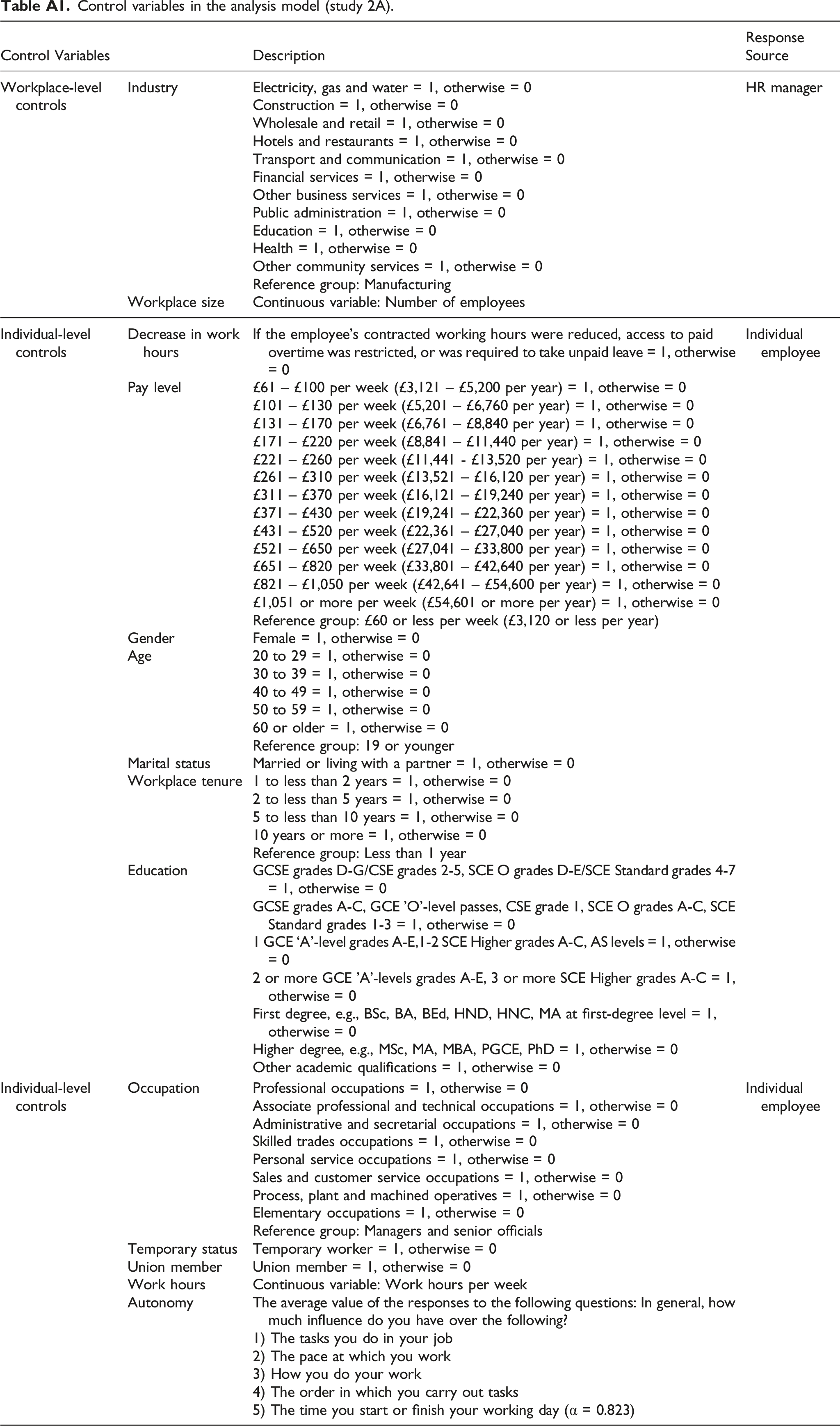
Control variables. Control variables were selected based on past studies examining employee commitment (e.g., Mathieu and Zajac, 1990) and their availability in 2011 WERS. Control variables entered in the analysis model are shown in Table A1 in Appendix 1.
Analysis model
Due to the multi-leveled structure (i.e., employees nested in workplaces) of the data (Hofmann, 1997), Hierarchical Linear Modeling (HLM) was utilized. Two-level HLM analysis was applied. The level-1 analysis models the relationship between individual-level variables (e.g., pay cut vs. downsizing, trust, and controls) and affective commitment. The level-2 analysis models the relationship between workplace level variables (e.g., workplace size and industry) and affective commitment. ICC(1) value for affective commitment was 0.168, suggesting the need for adopting a multi-level (e.g., HLM) method (Bliese, 2000; Krull and McKinnon, 2001). The HLM software (Raudenbush et al., 2011) was used in the analysis. For a more intuitive interpretation of the results, the affective commitment was standardized.
Study 2A: Results
Descriptive statistics
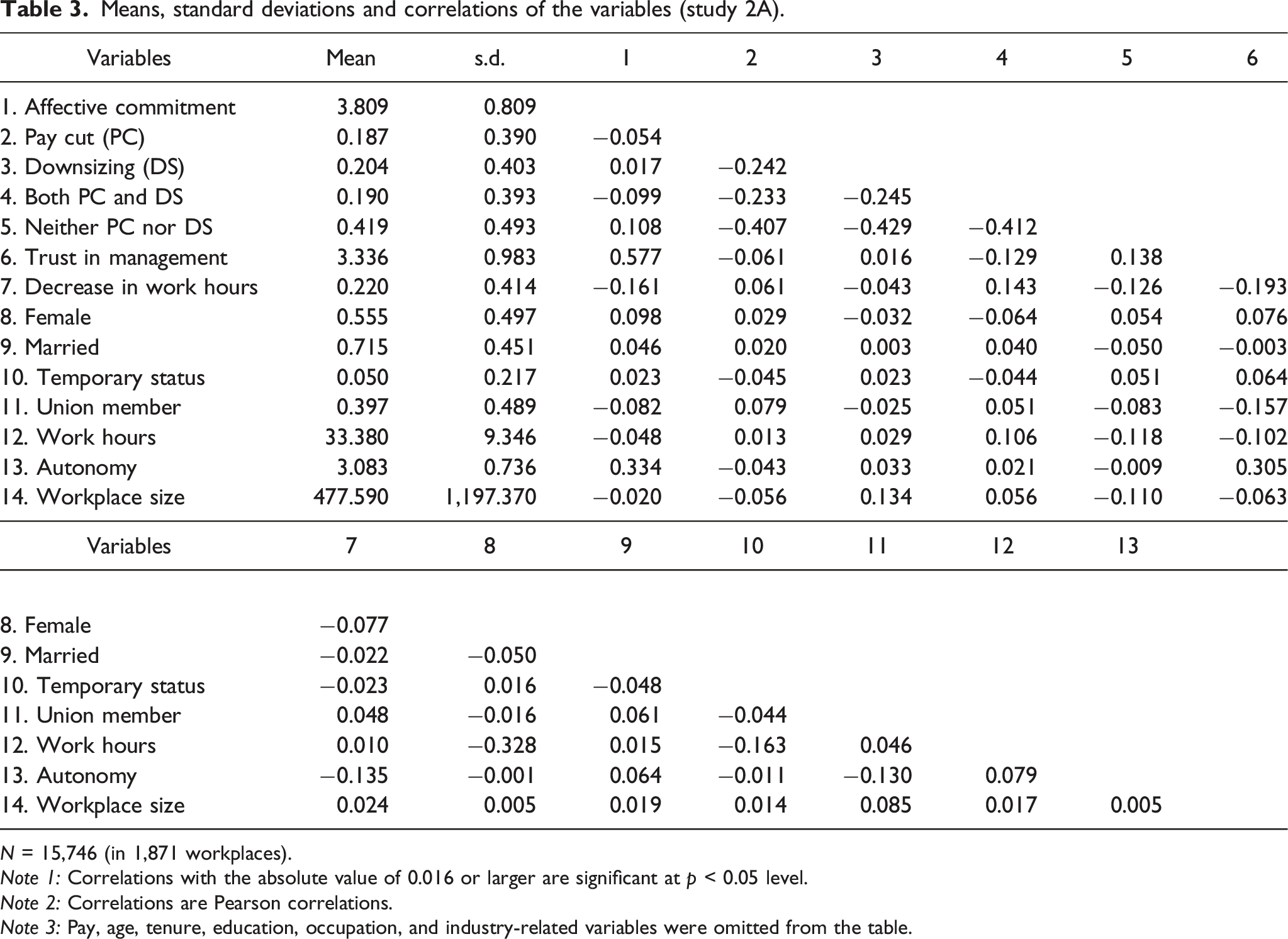
Means, standard deviations and correlations of the variables (study 2A).
N = 15,746 (in 1,871 workplaces).
Note 1: Correlations with the absolute value of 0.016 or larger are significant at p < 0.05 level.
Note 2: Correlations are Pearson correlations.
Note 3: Pay, age, tenure, education, occupation, and industry-related variables were omitted from the table.
Hierarchical linear modeling results
Hypothesis 4 testing
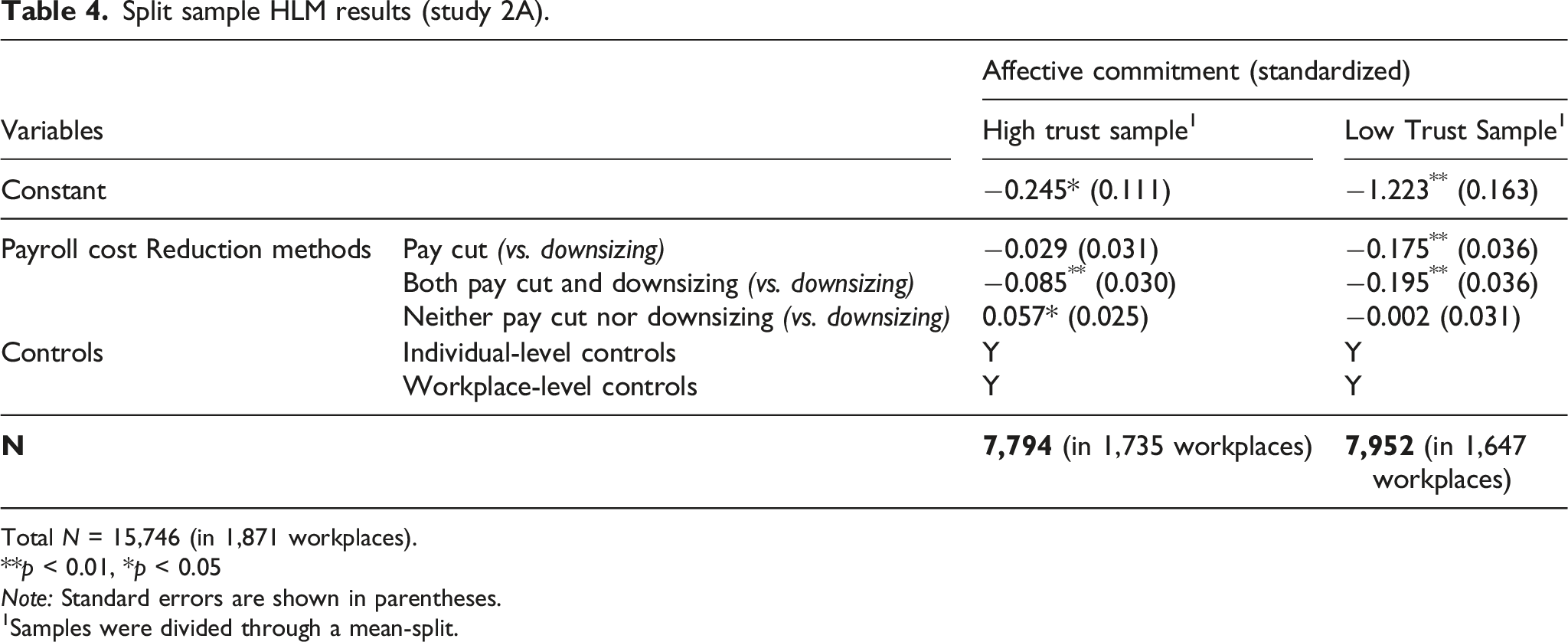
The results of the split sample HLM analysis are presented in Table 4. In the high trust sample, the coefficient for pay cut (compared to downsizing) on affective commitment is not significant (estimate = −0.029, SE = 0.031, ns). The coefficient of pay cut (compared to downsizing) on affective commitment, in contrast, is significantly negative in the low trust sample (estimate = −0.175, SE = 0.036, p < 0.01). These results indicate that the level of affective commitment of employees who survived downsizing is significantly higher than that of employees who had their pay cut only when the level of trust in management is low. In the case of high trust in management, no significant difference in the level of affective commitment was observed between employees who had their pay cut and employees who survived downsizing. Thus, the results indicate that cutting pay (compared to downsizing) has a less negative effect on affective commitment when the level of trust in management is high (compared to when the level of trust in management is low). Therefore, Hypothesis 4 is supported with affective commitment as the outcome variable, in a real work setting.
Split sample HLM results (study 2A).
Total N = 15,746 (in 1,871 workplaces).
**p < 0.01, *p < 0.05
Note: Standard errors are shown in parentheses.
Samples were divided through a mean-split.
Study 2b: Methods
Overview and sample
In Study 2B, the 2010 WageIndicator Survey (WIS) was analyzed. WIS is a voluntary online survey that contains information on working conditions (wages, benefits, etc.) of workers in over 50 countries around the world (for details of WIS, see Tijdens et al., 2010). Datasets from 2006 to 2015 were available at the time of conducting this study 5 . In this study, only the 2010 WIS was analyzed, given the limitations in time and budget. 2010 WIS was chosen among the other datasets because the economy in 2009 was heavily impacted by the global financial crisis that started in the second half of 2008 when Lehman Brothers has collapsed (The Economist, 2013). Thus, it is likely that many organizations were pressured to reduce payroll costs in 2009. The survey questions in 2010 WIS reflected the events that occurred in 2009.
Sample size by country and trust (study 2B).
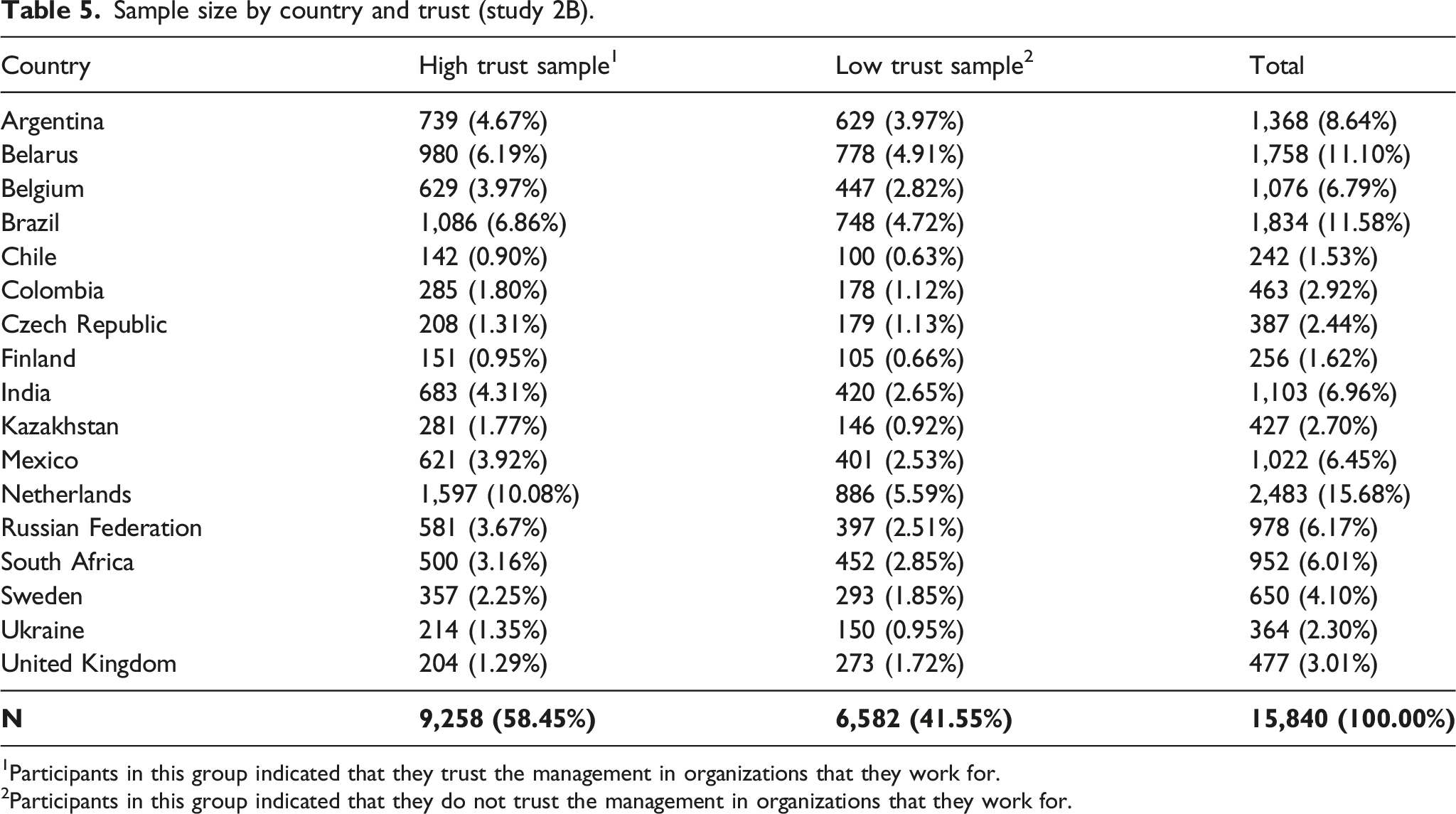
1Participants in this group indicated that they trust the management in organizations that they work for.
2Participants in this group indicated that they do not trust the management in organizations that they work for.
Measures
Job satisfaction. Job satisfaction was measured by asking how satisfied the participants were with their current job. Although this was a single-item measure, the practice of measuring job satisfaction with a single item has been reviewed by researchers as robust (Wanous et al., 1997).
Trust in management. Trust in management was measured by asking a participant if the participant trusts the management in the organization that he or she works for. Participants that answered yes to this question were categorized as high trust, and participants that answered no to this question were categorized as low trust.
Payroll cost reduction method: Pay cut. 2010 WIS asked participants if they received a pay raise in the previous year (2009). Participants who indicated that they had not received a pay raise were categorized into the pay cut group.
As in Study 2A, the measure of cutting pay in this study also encompasses the case of a pay freeze. 17 countries in the final sample all have recorded positive rates of inflation in 2009 6 . Therefore, the measure reflects pay cut not only in “nominal” pay but also in “real” pay.
Payroll cost reduction method: Downsizing. 2010 WIS asked participants if organizations that they work for announced redundancies in the past 12 months. Participants who answered yes to this question were coded as the survivors of downsizing.
Payroll cost reduction method: Neither pay cut nor downsizing. Participants who were not survivors of downsizing and did not have their pay cut were included in this group.
Payroll cost reduction method: Both pay cut and downsizing. Participants who were the survivors of downsizing and had their pay cut at the same time were included in this group. These employees were not again categorized either in pay cut or survivors of downsizing group. Thus, as in Study 2A, the four conditions (i.e., pay cut, downsizing, neither pay cut nor downsizing, and both pay cut and downsizing) are mutually exclusive.
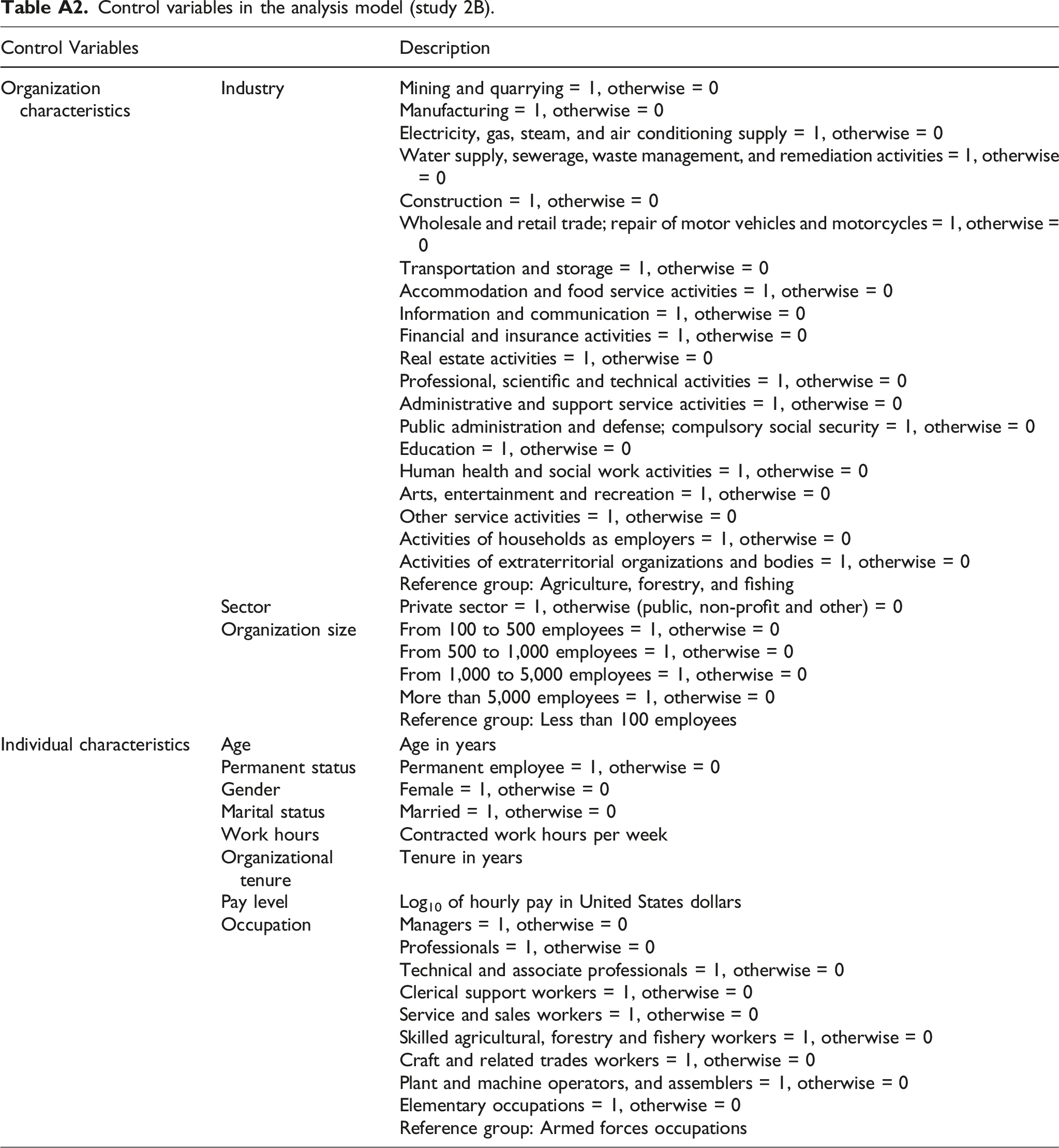
Control variables. Control variables were selected based on past studies examining job satisfaction (e.g., Judge and Kammeyer–Mueller, 2012; Weaver, 1978) and their availability in the 2010 WIS. Control variables entered in the analysis model are shown in Table A2 in Appendix 2. Individual (age, permanent status, gender, marital status, work hours, tenure and pay level), job (occupation), and organization (industry, sector, and size) characteristics that may relate to either or both affective commitment and payroll cost reduction methods were included as controls as well.
Analysis model
As in Study 2A, HLM was utilized due to the multi-leveled structure (i.e., participants nested in countries) of the data (Hofmann, 1997). Two-level HLM analysis was applied. The level-1 analysis models the relationship between individual/job/organization related variables (e.g., pay cut vs. downsizing, trust, and controls) and job satisfaction. The level-2 model was a country-level model. However, no other information at the country-level was provided in the dataset. Therefore, the level-2 model was a model only with a grand mean and a residual for the intercept in the level-1 analysis. ICC(1) value for job satisfaction was 0.044 7 . The HLM software (Raudenbush et al., 2011) was used in the analysis. For a more intuitive interpretation of the results, job satisfaction was standardized.
Study 2b: Results
Descriptive statistics
Means, standard deviations and correlations of the variables (study 2B).
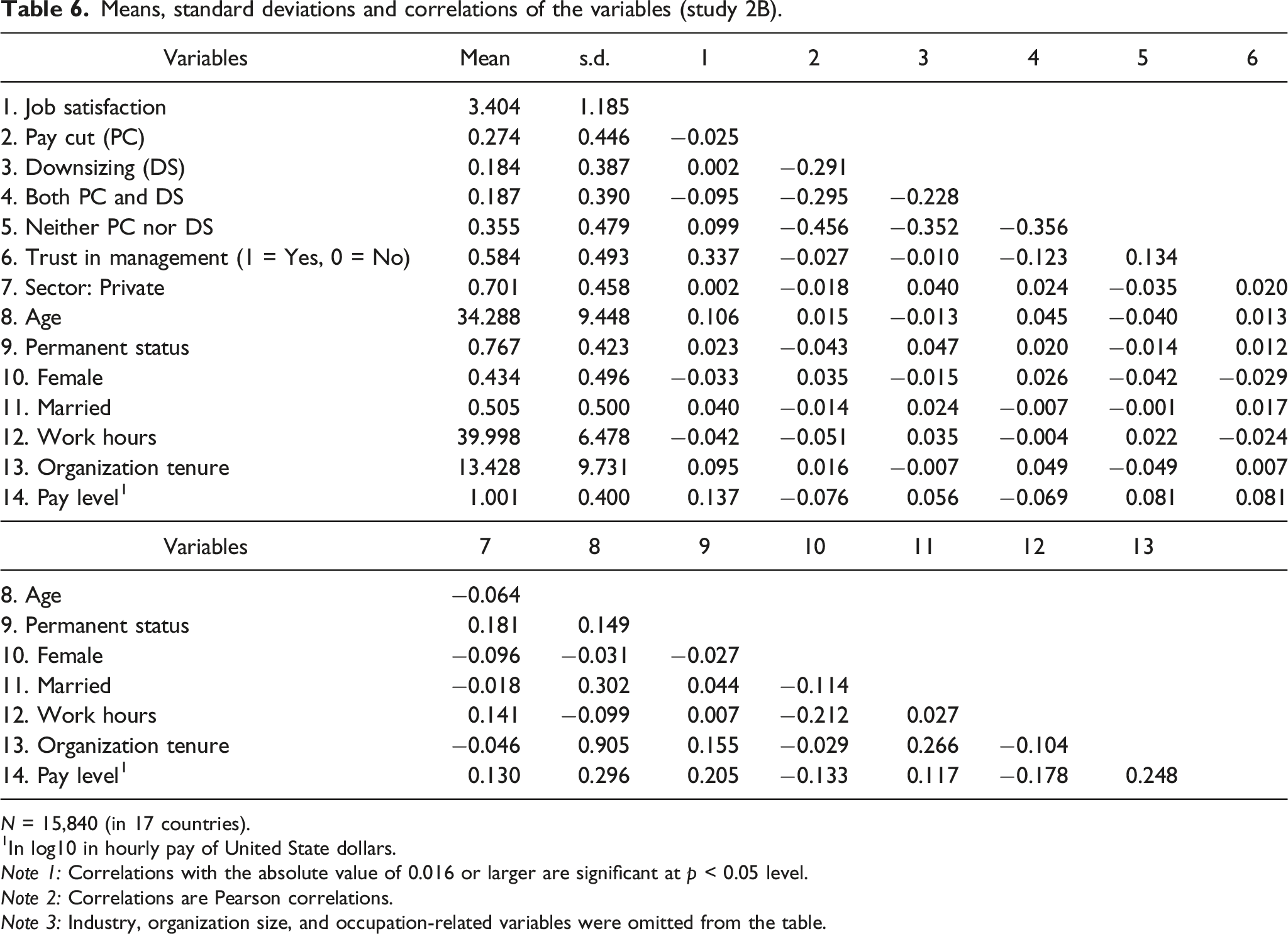
N = 15,840 (in 17 countries).
1In log10 in hourly pay of United State dollars.
Note 1: Correlations with the absolute value of 0.016 or larger are significant at p < 0.05 level.
Note 2: Correlations are Pearson correlations.
Note 3: Industry, organization size, and occupation-related variables were omitted from the table.
Hierarchical linear modeling results
Hypothesis 4 testing
The results of the split sample HLM analysis are presented in Table 7. In the high trust sample, the coefficient for pay cut (compared to downsizing) on job satisfaction is not significant (estimate = −0.049, SE = 0.028, ns). However, the coefficient for pay cut (compared to downsizing) on job satisfaction is significantly negative in the low trust sample (estimate = −0.093, SE = 0.036, p < 0.05). These results indicate that the level of job satisfaction of employees who survived downsizing is significantly higher than that of employees who had their pay cut only when the level of trust in management is low. When trust in management is high, there is no significant difference in the level of job satisfaction between employees who had their pay cut and employees who survived downsizing. Thus, the results indicate that cutting pay (compared to downsizing) has a less negative effect on job satisfaction when the level of trust in management is high (compared to when the level of trust in management is low). Therefore, Hypothesis 4 is supported for the case of job satisfaction as the outcome variable, in a real work setting.
Split sample HLM results (study 2B).
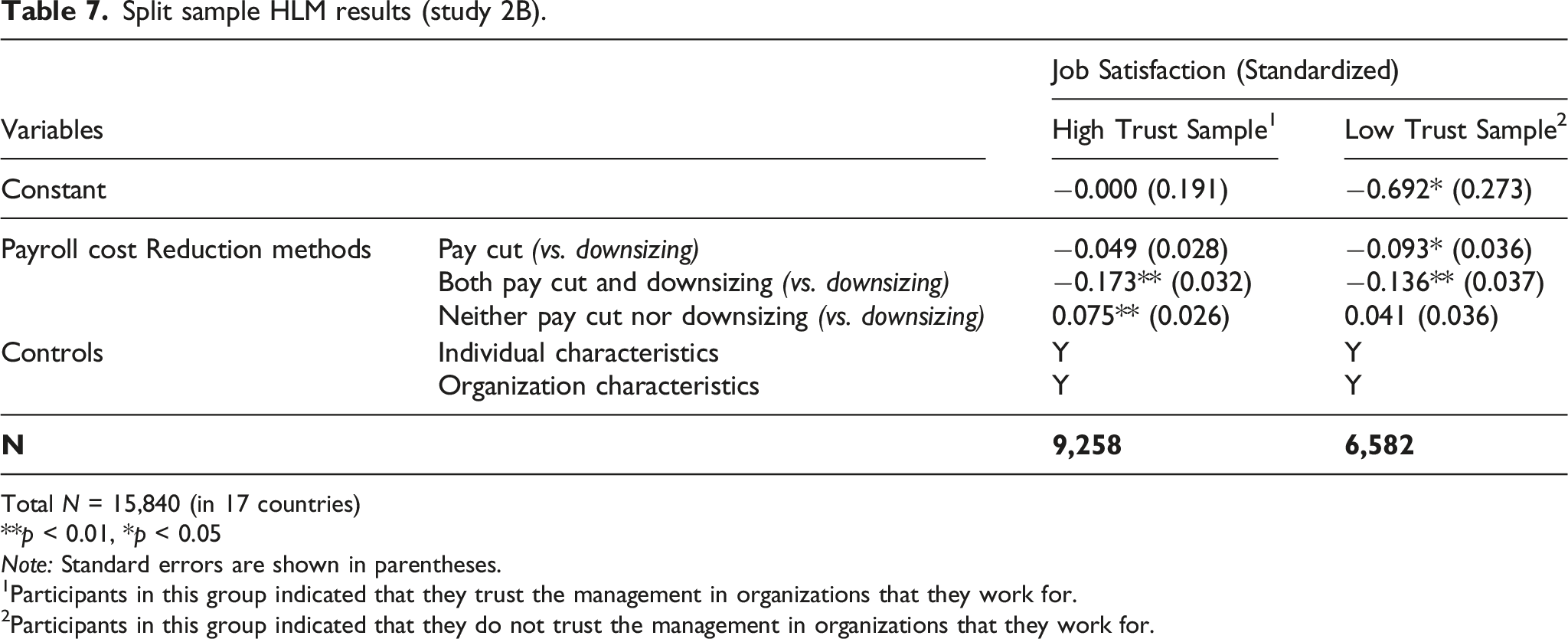
Total N = 15,840 (in 17 countries)
**p < 0.01, *p < 0.05
Note: Standard errors are shown in parentheses.
1Participants in this group indicated that they trust the management in organizations that they work for.
2Participants in this group indicated that they do not trust the management in organizations that they work for.
Study 2: Discussion
The results in Studies 2A and 2B replicate the moderating effect of trust in management when comparing the effects of pay cut versus downsizing in maintaining work attitudes in a real work setting. The results in these studies address the generalizability issue raised in the limitations of Study 1.
Although the studies address generalizability concerns, some methodological concerns should be acknowledged. First, the interpretation of the results should be made with caution due to the cross-sectional nature of the data. Employees with high levels of work attitudes may be more likely to have higher performance and thus to be the survivors of downsizing rather than have their pay cut. As a result, the causal mechanism in Studies 2A and 2B can be reversed.
Second, omitted variable bias may also be a concern. Although 2011 WERS (Study 2A) and 2010 WIS (Study 2B) provided a reasonable number of controls that likely impact work attitudes and payroll cost reduction, it does not include all potential variables. For example, analysis models in both studies were not able to control the number of employees and pay amount that was reduced. Thus, the effect size estimated with these models may be less precise due to these omitted variables.
Third, the pay cut measure does not perfectly reflect the construct as it also encompasses the case of pay freezes. The data on pay cuts are extremely difficult to obtain (Lee and Rupp, 2007), and this is a common limitation in utilizing a secondary data source. In the future, researchers should establish a survey that is specifically intended to compare the effects of cutting pay and downsizing on work attitudes to overcome these limitations.
Fourth, a sampling error can also be an issue in Study 2B due to participation in the 2010 WIS being voluntary. Although we have only included datasets from countries that are reasonably large in sample sizes, these sub-samples in 2010 WIS may not adequately reflect the working populations of the countries involved.
Despite these limitations, the results in Studies 2A and 2B are in alignment with those of Study 1. The method used in Study 1 (within-subjects design experiment) complements the methodological limitations in Studies 2A and 2B to some extent.
General discussion
Theoretical implications
The studies in this paper make some important contributions to the field of management. The studies establish a model of trust as a moderator in comparing the effects of cutting pay and downsizing on work attitudes. Past research on cutting pay and downsizing focus on answering why these practices negatively affect employee attitudes (e.g., Brockner et al., 2004; Gilson et al., 2004; Lovett et al., 2008; Luthans and Sommer, 1999; Wagar, 1998) and lacks a theoretical guide to address for whom and when one method may be more or less effective than the other method in maintaining work attitudes. The current study utilizes the expectancy theory (Vroom, 1964) and identifies trust in management as an important factor that can determine the relative effectiveness of the two methods. Moreover, the studies also address how trust in management influences the relative effectiveness by showing that trust strengthens the pay-reduced employees’ feelings of job security more so than those of employees who survived downsizing.
Practical implications
The contribution of the studies in this paper can be extended to policy and practice. First, although not the main interest of the studies in this paper, the results indicate that downsizing better maintains the work attitudes of remaining employees than does cutting pay. Using split samples, no case was found where employees who had their pay cut exhibited a higher level of work attitudes than survivors of downsizing (with the exception of affective commitment in Study 1). In all of the low trust samples, employees who survived downsizing exhibited a higher level of work attitudes than the employee who had their pay cut. The results are in alignment with the widely held concerns of practitioners that cutting pay would be more detrimental in managing work attitudes than downsizing (Bewley, 1998, 1999; Du Caju et al., 2015).
The studies in this paper, however, also demonstrate that cutting pay can be a feasible alternative to downsizing (in terms of maintaining work attitudes) when the level of trust in management is high. In high trust samples, there were no significant differences in the levels of work attitudes between employees who survived downsizing and employees who had their pay cut. Moreover, in Study 1, high-trust employees who had their pay cut exhibited higher levels of affective commitment than employees who survived downsizing. Therefore, for cutting pay to be a feasible alternative to downsizing, organizations should maintain high-trust relationships with their employees. The results highlight the importance of trust between employees and management in overcoming difficulties when wages and salaries of individuals need to be reduced.
Limitations and future studies
Although the studies in this paper provide meaningful implications, we should acknowledge some overall limitations. First, common method bias (Podsakoff et al., 2003) may be a concern given that most of the studies in this paper use a single data source. Even in Study 2A, where multiple data sources (i.e., employees and HR/labor relations managers) were utilized, the independent variable (i.e., pay cut) and dependent variable (i.e., affective commitment) were both collected from a single data source (i.e., only from employees). Therefore, the relationships that are observed in the studies may be stronger than they would otherwise be observed. However, as the main objective in these studies is to “compare” the effects of pay cut and downsizing on the outcomes of interests rather than to “estimate” these effects, this may be less of a concern (Yoon, 2022a, 2022b).
Second, although the theoretical model relies on expectancy theory (Vroom, 1964), studies in this paper only utilize the instrumentality factor in building the model. Future studies may also want to explore valence factors in expectancy theory to build a more comprehensive model of pay cut versus downsizing in maintaining work attitudes. For example, the relationship between the perception of relative advantage in pay-level and work attitudes may be strengthened when employees highly value pay. On the other hand, the relationship between the perception of relative advantage in job security and work attitudes may be strengthened when employees highly value job security. Therefore, work values (Cable and Edwards, 2004) may also be an important moderator in the model from the valence perspective in expectancy theory (Vroom, 1964).
Furthermore, there can be some debate about the extent to which these results would be applicable to other national and institutional contexts. Samples in Studies 1 and 2A were drawn from the United States and Britain, respectively. Moreover, a large portion of the sample in Study 2B was drawn from European countries. Thus, generalizing the current research results beyond these regions need to be made with caution. For example, in Eastern Asian countries like Korea and Japan, the cultures and institutions tend to be more collectivistic and coordinated, respectively (Hall and Soskice, 2001; Hofstede, 1980). In these societies, sharing the pain amongst the majority of employees through pay cuts and maintaining a long-term relationship with the organization may be preferred over individual job losses. Indeed, it is widely argued that members of individualistic countries are more likely to see themselves in an exchange relationship with their organizations and to stress their individual rights, while members of collectivistic cultures tend to prioritize the needs and goals of their organization rather than their own interests (Hofstede, 1980). Thus, the study results utilizing samples from these regions may result in more favorable outcomes toward pay cuts, and the theorized moderating effect of trust may not exist. As a result, we urge future studies to systematically explore national differences in pay cuts versus downsizing in maintaining work attitudes as well as the moderating effect of trust in this comparison.
Finally, although the overall results indicate that downsizing does a better job than cutting pay at maintaining work attitudes of employees who remain in the organization, we must acknowledge that the findings in this paper do not necessarily suggest that downsizing is a “better” method than cutting pay for reducing payroll costs. The studies in this paper only investigate work attitudes as an outcome. There are other important organizational outcomes such as job-seeker attraction, corporate image, and labor productivity. Additional studies comparing the consequences of cutting pay and downsizing on a number of organizational outcomes should be conducted to draw more comprehensive conclusions.
Conclusion
Though there are some limitations, the studies in this paper provide insight that trust in management among employees should be considered when predicting the relative advantages and disadvantages of cutting pay over downsizing for maintaining work attitudes. The results provide research-based answers to questions regarding when organizations should downsize or cut pay. The current study also provides an alternative perspective (i.e., relative reward perspective) for studying payroll cost reduction methods and broadens the possibilities of future research on the topic of cutting pay versus downsizing.
Footnotes
Declaration of conflicting interests
The author(s) declared no potential conflicts of interest with respect to the research, authorship, and/or publication of this article.
Funding
The author(s) received no financial support for the research, authorship, and/or publication of this article.

Notes
Appendix 1
Control variables in the analysis model (study 2A).
| Control Variables | Description | Response Source | |
|---|---|---|---|
| Workplace-level controls | Industry | Electricity, gas and water = 1, otherwise = 0 | HR manager |
| Construction = 1, otherwise = 0 | |||
| Wholesale and retail = 1, otherwise = 0 | |||
| Hotels and restaurants = 1, otherwise = 0 | |||
| Transport and communication = 1, otherwise = 0 | |||
| Financial services = 1, otherwise = 0 | |||
| Other business services = 1, otherwise = 0 | |||
| Public administration = 1, otherwise = 0 | |||
| Education = 1, otherwise = 0 | |||
| Health = 1, otherwise = 0 | |||
| Other community services = 1, otherwise = 0 | |||
| Reference group: Manufacturing | |||
| Workplace size | Continuous variable: Number of employees | ||
| Individual-level controls | Decrease in work hours | If the employee's contracted working hours were reduced, access to paid overtime was restricted, or was required to take unpaid leave = 1, otherwise = 0 | Individual employee |
| Pay level | £61 – £100 per week (£3,121 – £5,200 per year) = 1, otherwise = 0 | ||
| £101 – £130 per week (£5,201 – £6,760 per year) = 1, otherwise = 0 | |||
| £131 – £170 per week (£6,761 – £8,840 per year) = 1, otherwise = 0 | |||
| £171 – £220 per week (£8,841 – £11,440 per year) = 1, otherwise = 0 | |||
| £221 – £260 per week (£11,441 - £13,520 per year) = 1, otherwise = 0 | |||
| £261 – £310 per week (£13,521 – £16,120 per year) = 1, otherwise = 0 | |||
| £311 – £370 per week (£16,121 – £19,240 per year) = 1, otherwise = 0 | |||
| £371 – £430 per week (£19,241 – £22,360 per year) = 1, otherwise = 0 | |||
| £431 – £520 per week (£22,361 – £27,040 per year) = 1, otherwise = 0 | |||
| £521 – £650 per week (£27,041 – £33,800 per year) = 1, otherwise = 0 | |||
| £651 – £820 per week (£33,801 – £42,640 per year) = 1, otherwise = 0 | |||
| £821 – £1,050 per week (£42,641 – £54,600 per year) = 1, otherwise = 0 | |||
| £1,051 or more per week (£54,601 or more per year) = 1, otherwise = 0 | |||
| Reference group: £60 or less per week (£3,120 or less per year) | |||
| Gender | Female = 1, otherwise = 0 | ||
| Age | 20 to 29 = 1, otherwise = 0 | ||
| 30 to 39 = 1, otherwise = 0 | |||
| 40 to 49 = 1, otherwise = 0 | |||
| 50 to 59 = 1, otherwise = 0 | |||
| 60 or older = 1, otherwise = 0 | |||
| Reference group: 19 or younger | |||
| Marital status | Married or living with a partner = 1, otherwise = 0 | ||
| Workplace tenure | 1 to less than 2 years = 1, otherwise = 0 | ||
| 2 to less than 5 years = 1, otherwise = 0 | |||
| 5 to less than 10 years = 1, otherwise = 0 | |||
| 10 years or more = 1, otherwise = 0 | |||
| Reference group: Less than 1 year | |||
| Education | GCSE grades D-G/CSE grades 2-5, SCE O grades D-E/SCE Standard grades 4-7 = 1, otherwise = 0 | ||
| GCSE grades A-C, GCE 'O'-level passes, CSE grade 1, SCE O grades A-C, SCE Standard grades 1-3 = 1, otherwise = 0 | |||
| 1 GCE ‘A’-level grades A-E,1-2 SCE Higher grades A-C, AS levels = 1, otherwise = 0 | |||
| 2 or more GCE 'A'-levels grades A-E, 3 or more SCE Higher grades A-C = 1, otherwise = 0 | |||
| First degree, e.g., BSc, BA, BEd, HND, HNC, MA at first-degree level = 1, otherwise = 0 | |||
| Higher degree, e.g., MSc, MA, MBA, PGCE, PhD = 1, otherwise = 0 | |||
| Other academic qualifications = 1, otherwise = 0 | |||
| Individual-level controls | Occupation | Professional occupations = 1, otherwise = 0 | Individual employee |
| Associate professional and technical occupations = 1, otherwise = 0 | |||
| Administrative and secretarial occupations = 1, otherwise = 0 | |||
| Skilled trades occupations = 1, otherwise = 0 | |||
| Personal service occupations = 1, otherwise = 0 | |||
| Sales and customer service occupations = 1, otherwise = 0 | |||
| Process, plant and machined operatives = 1, otherwise = 0 | |||
| Elementary occupations = 1, otherwise = 0 | |||
| Reference group: Managers and senior officials | |||
| Temporary status | Temporary worker = 1, otherwise = 0 | ||
| Union member | Union member = 1, otherwise = 0 | ||
| Work hours | Continuous variable: Work hours per week | ||
| Autonomy | The average value of the responses to the following questions: In general, how much influence do you have over the following? | ||
| 1) The tasks you do in your job | |||
| 2) The pace at which you work | |||
| 3) How you do your work | |||
| 4) The order in which you carry out tasks | |||
| 5) The time you start or finish your working day (α = 0.823) | |||
Appendix 2
Control variables in the analysis model (study 2B).
| Control Variables | Description | |
|---|---|---|
| Organization characteristics | Industry | Mining and quarrying = 1, otherwise = 0 |
| Manufacturing = 1, otherwise = 0 | ||
| Electricity, gas, steam, and air conditioning supply = 1, otherwise = 0 | ||
| Water supply, sewerage, waste management, and remediation activities = 1, otherwise = 0 | ||
| Construction = 1, otherwise = 0 | ||
| Wholesale and retail trade; repair of motor vehicles and motorcycles = 1, otherwise = 0 | ||
| Transportation and storage = 1, otherwise = 0 | ||
| Accommodation and food service activities = 1, otherwise = 0 | ||
| Information and communication = 1, otherwise = 0 | ||
| Financial and insurance activities = 1, otherwise = 0 | ||
| Real estate activities = 1, otherwise = 0 | ||
| Professional, scientific and technical activities = 1, otherwise = 0 | ||
| Administrative and support service activities = 1, otherwise = 0 | ||
| Public administration and defense; compulsory social security = 1, otherwise = 0 | ||
| Education = 1, otherwise = 0 | ||
| Human health and social work activities = 1, otherwise = 0 | ||
| Arts, entertainment and recreation = 1, otherwise = 0 | ||
| Other service activities = 1, otherwise = 0 | ||
| Activities of households as employers = 1, otherwise = 0 | ||
| Activities of extraterritorial organizations and bodies = 1, otherwise = 0 | ||
| Reference group: Agriculture, forestry, and fishing | ||
| Sector | Private sector = 1, otherwise (public, non-profit and other) = 0 | |
| Organization size | From 100 to 500 employees = 1, otherwise = 0 | |
| From 500 to 1,000 employees = 1, otherwise = 0 | ||
| From 1,000 to 5,000 employees = 1, otherwise = 0 | ||
| More than 5,000 employees = 1, otherwise = 0 | ||
| Reference group: Less than 100 employees | ||
| Individual characteristics | Age | Age in years |
| Permanent status | Permanent employee = 1, otherwise = 0 | |
| Gender | Female = 1, otherwise = 0 | |
| Marital status | Married = 1, otherwise = 0 | |
| Work hours | Contracted work hours per week | |
| Organizational tenure | Tenure in years | |
| Pay level | Log10 of hourly pay in United States dollars | |
| Occupation | Managers = 1, otherwise = 0 | |
| Professionals = 1, otherwise = 0 | ||
| Technical and associate professionals = 1, otherwise = 0 | ||
| Clerical support workers = 1, otherwise = 0 | ||
| Service and sales workers = 1, otherwise = 0 | ||
| Skilled agricultural, forestry and fishery workers = 1, otherwise = 0 | ||
| Craft and related trades workers = 1, otherwise = 0 | ||
| Plant and machine operators, and assemblers = 1, otherwise = 0 | ||
| Elementary occupations = 1, otherwise = 0 | ||
| Reference group: Armed forces occupations | ||