



Abstract
This article examines the roles of organizational structure of decision-making and external pressure in determining the practice of environmental management. Using contingency theory, this study argues that having a decentralized structure, entrepreneurial firms are able to adapt to external pressure while implementing environmental management. The data were drawn from 106 small and medium-sized firms in the United Kingdom. The study found that a decentralized structure is positively associated with the practice of environmental management while external pressure from global awareness and social relationships has less impact on firms’ environmental management. Interestingly, the impact of decentralized structure on environmental management is strengthened in the context of high level of technological dynamic. Overall, the findings of the study have provided some recommendations to theory and practice of environmental management especially in the context of entrepreneurial firms.
Introduction
This article aims to examine the alignment between organizational structure of decision-making and external pressure in determining the implementation of environmental management in the context of entrepreneurial firms. Although some studies argue that entrepreneurial firms develop a structure that is flexible enough to deal with adaptation and external threat (Tamayo-Torres et al., 2011), their limited experience may constrain their ability to maneuver resources for implementing environmental management (Baumgärtner et al., 2015). Their objective focuses mainly on bringing products or services to market, which may hinder the effort to consider environmental management as part of the operational process. At the same time, entrepreneurial firms are vulnerable in facing external pressure, such as change in demand, technology, and regulation, due to the increased interest in environmental management. Thus, the alignment between organizational structure of decision-making and external pressure is critical for not only successful business performance but also the implementation of environmental management.
To bridge the gap in the literature, this study empirically analyzes how decentralized structure of organizational decision-making and external pressure such as social relationship, global environmental awareness, and the dynamic of technological development influence the practice of environmental management. More specifically, this study focusses on entrepreneurial firms which is defined as small and medium-sized firms aiming to bring products or services to the market by actively involved in exploring, evaluating, and exploiting opportunities (Acs et al., 2009; Shane and Venkataraman, 2000). Using the contingency theory as a framework (Drazin and Van de Ven, 1985), this study examines the interaction among those factors in encouraging entrepreneurial firms to implement environmental management. Despite being important, few studies on environmental management have focused on firms with the decentralized structure, when the decision-making has been disaggregated into a number of units, division, each making its own decisions (Siggelkow and Levinthal, 2003). Since instigating a new approach to business such as introducing environmental management requires a collective effort of the whole organization across different functional areas, firms with decentralized structure will be at an advantage to deal with external pressure and to manage the implementation (Frondel et al., 2007; Gallear et al., 2015; Lichtenstein et al., 2017; Martin et al., 2016).
Using data from 106 small and medium-sized firms in the United Kingdom, this study makes several contributions. First, this study investigates the role of organizational structure as an enabler for implementing environmental management in the context of entrepreneurial firms. It highlights the relevance of decision-making process that has often been overlooked in studying small firms’ environmental activities (López-Gamero et al., 2016). Although previous studies have been advocating the benefits and values of implementing environmental management, the understanding on the determinant factors in the context of entrepreneurial firms is still limited (Kunapatarawong and Martínez-ros, 2016; Mitra and Datta, 2014). Second, as few studies have been devoted to investigating the alignment between organizational structure of decision-making and external pressure, this study further advances the application of contingency theory by moving beyond management and organizational studies (Linnenluecke and Griffiths, 2010; Vroom and Philip, 1973; Weber et al., 2009) to environmental management and entrepreneurship studies. As contingency theory argues that the best way to organize is to depend on the nature of the environment to which the organization is related (Cui et al., 2014; Karim et al., 2016), the implementation of environmental management can be conceived as a product of the fit between the structure of organizational decision-making and a set of external factors. Lastly, the study aims to assist both managers and policy makers to understand more about how better policies can be designed to support the implementation of environmental policies, especially in the context of entrepreneurial firms (Johnstone and Labonne, 2009; Klassen and Angell, 1998). As there has been an increase in environmental degradation, such as depletion of natural resources and climate change, the efforts to preserve the environment (Ateş et al., 2012; Feng et al., 2014; Graham and Potter, 2015) and a new way of measuring firms’ competitive advantage have arisen where environmental management should be considered as a part of firms’ strategy (Gualandris and Kalchschmidt, 2016). Accordingly, entrepreneurial firms are considered to be less competitive unless they meet and follow trends in sustaining and maintaining the environment (Llach et al., 2015).
Organizational structure of decision-making and external pressure: A contingency theory approach of environmental management
As employing environmental management is a complex process, entrepreneurial firms need to align the pressure from external source with their internal organizational structure (Dahlmann et al., 2008; Ormazabal and Sarriegi, 2014). In one hand, entrepreneurial firms need to construct a decentralized structure, which is more receptive to the change due to their high degree of flexibility and freedom (King et al., 2005). On the other hand, entrepreneurial firms face pressure from global trends and competitor to implement environmental management. Additionally, customers or buyers have become critical regarding the source and process of production (Wong et al., 2020). Hence, entrepreneurial firms should be able to absorb external pressure while allowing adaptation and changes with their internal structure. Extant literature has been advocating the importance of having a decentralized decision-making process, which is often seen as a source of competitive advantage for entrepreneurial firms when operating in difficult environments (Luo and Rui, 2009; Martin et al., 2016). The logic is that external pressure might have a positive impact on firms if they are supported by suitable organizational structure (Brettel et al., 2015; Martin et al., 2016). By leveraging their adaptable organizational structure, entrepreneurial firms will be able to absorb external pressure as a driver that eventually facilitates the diffusion of environmental management into all aspects of the organization.
This thinking is in line with contingency theory, which explains how external conditions correlate with organization’s internal structure to form an organizational fit that determines their performance (Burns and Stalker, 1994; Tangpong et al., 2019). The origins of this theory can be traced back to the works of prominent scholars such as Donaldson (1987), Drazin and Van de Ven (1985), Thompson (1967), and Venkatraman (1989). The theory upholds the belief that there is “no one best way” of managing or organizing but it depends on the “fit” between the organization and the environment (Schoonhoven, 1981; Venkatraman, 1989). In the context of this study, external pressures in the form of social relationship, global awareness, and technological dynamic correlate with a decentralized structure to form the organizational fit that determines the effectiveness of environmental management (Aragón-Correa et al., 2008; McAdam et al., 2019; Perez-Valls et al., 2016). Figure 1 illustrates the framework of this study.
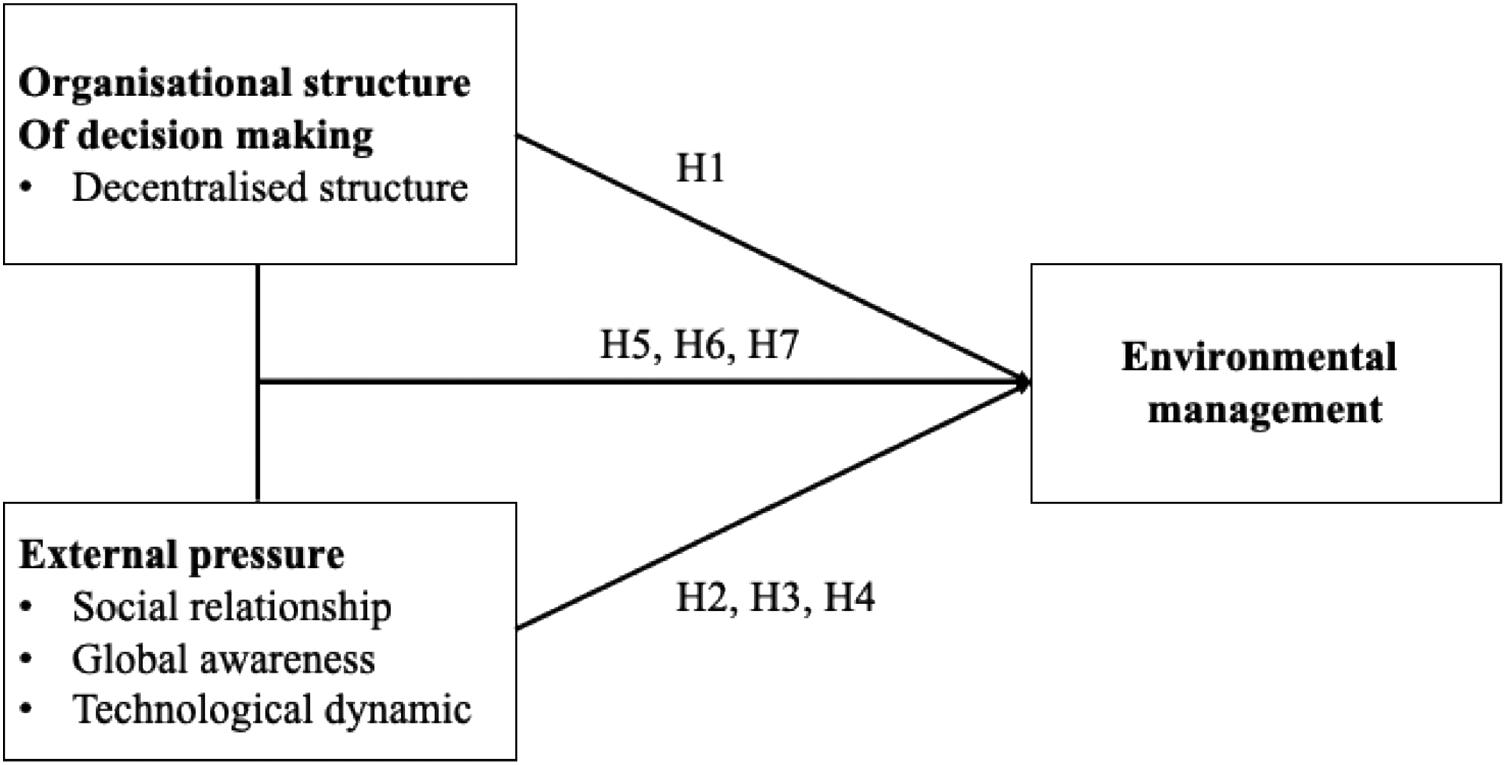
Research framework.
The construction of hypotheses
Research on organizational theories highlights the critical role of the organizational decision-making process in enabling organizations to respond quickly to external pressure and to greater uncertainty and competition (Csaszar, 2013). As external pressures may create uncertainty and reduce profit, there is still considerable confusion as to how organizations should respond to them (Zailani et al., 2012). Within the context of decision-making, the literature has been discussing two forms of structure. First, firms create structure for decision-making by developing a decentralized structure or bottom-up approach that encourages more involvement in the decision-making arrangement (Martin et al., 2016). Second, a top-down approach attempts to ease external factors through a more centralized form of organizational structure (Joseph et al., 2016).
This study argues that the implementation of environmental management in the context of entrepreneurial firms should be supported by a decentralized structure. The reason for it is because environmental management is seen as organization’s voluntary mechanism of techniques, policies, and routines to tackle environmental issues (Montabon et al., 2007; Wang, 2017). This includes formal standards or informal practice to reduce the negative impact on the natural environment. Unlike regulations and rules imposed through the government, environmental management is voluntarily driven; firms are not obliged to follow guidelines but are self-motivated (González-Benito, 2008). Since the implementation of environmental management involves a complex process and requires participation from workers at all levels in the firm, organizations will not be able to adapt with centralized structure (López-Gamero et al., 2016). This is because in centralized structure, organizations limit the involvement of lower level staff to participate in the decision-making process, while narrowing communication channels and creating a high level of authority (Cardinal, 2001). In contrast, a decentralized structure allows organization to implement new approaches within their traditional or normal routines. A decentralized firm by default will motivate employees to concentrate their efforts and warranted freedom to express their ideas without having to be distracted by bureaucratic hierarchy to achieve environmental performance (Hart, 1995). As the firm structure becomes more decentralized, the elements of autonomy emerge whereby lower-level staff are more regularly involved throughout the decision-making process. The less formal communication will encourage new idea developments (Narayanan et al., 2011) and expression of such an approach could lead to positive outcomes for the firm such as sustainable awareness.
Moreover, to gain employees’ support, top-level management needs to provide discretion to encourage contextual experimentation within the organization. Environmentally proactive firms would alter the pattern of authority, responsibility, and control to allow operating managers to tap into the budgeted funds (López-Gamero et al., 2016). This provides space for them to reconfigure while exploring the whole new routine as a result of applying environmental management. In that case, besides improvement of environmental impact, the cost-benefits and innovation will potentially be realized too (Sharma et al., 1999). In this respect, studies (Russo and Fouts, 1997) found that firms displaying environmental behavior are characterized, among other things, as decentralized and involving higher participatory decision-making structure. Organizational commitment to the environment involves employees at various levels (López-Gamero et al., 2016), hence they are required to have decision-making authority to increase environmental productivity (Sweet et al., 2003). Thus, organizations such as entrepreneurial firms embracing a decentralized approach are expected to contribute to environmental strategy as stated in the following hypothesis.
Another factor that encourages entrepreneurial firms to implement environmental management is pressure from external relationships. Environmental sociologists have emphasized the importance of social ties in shaping environmental practices (Hargreaves, 2016). Entrepreneurial firms learn from and are influenced by other firms in their geographical and social capital (McHugh and Perrault, 2018). As argued by Cantor et al. (2015), the engagement with environmental management practices at firm level needs be done collectively. Having another organization within their networks that implements environmental activities will put pressure on firms to follow the practices. The pressure from social relationships also applies at the individual level (Reichhart and Holweg, 2008). Among employees of firms, it is common for shared knowledge and information to happen among socially close individuals, especially interactions with those that meet on a frequent basis, such as customers, rivals, and suppliers. The pandemic of environmental awareness has been proven through an increase in interest toward the environment from various groups of scholars, firms, and consumers (Cho, 2014). Social relationships are responsible for the spread in awareness (Baumgärtner et al., 2015). Without the establishment of a social relationships, entrepreneurial firms may not be exposed to diverse knowledge and thus may be less motivated to pursue any environmental management strategy. Overall, it can be argued that pressure from social relationships has a positive effect on the implementation of environmental management. Entrepreneurial firms are likely to feel left behind if other players in their business ecosystem are following the market trend of sustainable practice.
Through early anticipation, entrepreneurial firms could act promptly by adapting certain environmental measures to ease the pressure from their network contacts. As a result, environmental management is becoming more of a response to social relationships, which, other than helping to preserve the natural environment, also acts as a tool to achieve competitive advantage and stay ahead of other businesses (Leonidou et al., 2015). The effect social relationships on the practice of environmental management yields the following hypothesis:
In recent years, global environmental awareness has changed the industrial competition patterns for firms around the world (Chang and Chen, 2012). Various groups, such as political stakeholders (e.g. government), economic entities (e.g. consumers), pressure groups (e.g. nonprofit bodies), and members of the community are becoming interested in ensuring the sustainability of the environment (Bansal and Hunter, 2003; Leonidou et al., 2015). Thus, entrepreneurial firms are becoming more concerned to focus on environmental issues as a result of rising trend (Keogh et al., 2006). Among the reasons to implement environmental management include the desire to (1) exhibit socially responsible behavior to influential entities such as governmental authorities and consumers; (2) present a corporate image that is concerned about environmental issues; and (3) avoid negative consequences such as penalties and consumer boycotts (Banerjee et al., 2003). Hence, experiencing high pressure to become sustainable, firms have no choice but to adapt to the situation (Walker et al., 2014). Flammer (2013) argued that as environmental issues become institutionalized as a norm, the stronger the effect of negative perceptions of a firm, and firms who are not following the norms will be punished.
The rise in global environmental awareness has also changed consumer behavior rapidly (Wang et al., 2014). Follows and Jobber (2002) reported that initially, very few environmentally responsible products were available in the market. However, the existence of such products in the market are signs that consumers are more aware of the sustainable issues and want to be part of the solution to the problem. Previous studies (e.g. Purhoit, 2012; Zhang et al., 2015) found that the majority of North American consumers have environmental concerns over the products that they buy. This increase in demand toward environmentally responsible products has resulted in the form of pressure for firms to employ environmental management (Cho, 2014). Consumers have acknowledged the importance of environmental issues and therefore tend to boycott companies conducting unethical environmental activities (Chang and Chen, 2013). To conclude, global environmental awareness can be considered as an influencer for firms to implement environmental management (Pacheco and Dean, 2015). Thus, the study posits the following:
Over time, industrialization has compromised living conditions through uncontrolled pollution (noise, water, and air) and unsafe machinery (Wong et al., 2012). However, over the last few decades, efforts through technological development were being made to avoid more environmental destruction of the natural environment. Technology is also another factor that may help entrepreneurial firms to implement environmental management. Not only does technological advancement create sustainable products but firms also undergo a whole new process of operation that considers how to avoid negative impacts toward the environment (Ogbeibu et al., 2019).
The dynamic in the development of technology is defined as a rate of change of product and process technologies used to transform inputs into outputs (Jaworski and Kohli, 1993). This study argues that technological dynamism will facilitate the creation of environmentally friendly products and might have a positive impact on firms’ environmental management. For example, in markets for high-tech products namely semiconductors and mobile telecommunications, the technology is evolving rapidly (Chang and Chen, 2013), which encourages the usage of advanced technology with sustainable features such as energy saving and reduced pollution effects. Moreover, the latest innovation practices are now more sensitive toward issues of environmental protection such as energy saving and wastage. In contrast, firms with less focus on innovation and technological dynamism will potentially suffer from obsolescence of existing products due to the rapid and constant redefinition of consumers’ preference structure (Suarez and Lanzolla, 2005).
The fast-changing technological development could also affect operations in general through advanced machinery with environmentally friendly routines, which can help to support firms’ ethical stance toward environmental initiatives (Ogbeibu et al., 2019). Based on the need to remain competitive, innovation can be an option for firms to survive and grow. It determines whether the firm will grow through applying the updated technology or decline due to obsolescence of existing technologies. Rapid innovation cycles also create more opportunities to build machinery involving processes of transforming inputs into outputs with environmentally friendly features (Chen et al., 2015b). Therefore, the following hypothesis is constructed:
The theoretical position underlying this study is that alignment between organizational structure of decision-making and external pressure is a desirable property that has implications for performance (Olson et al., 2005; Venkatraman, 1990; Vorhies and Morgan, 2003). The expectation is that entrepreneurial firms should reconcile these competing forces to effectively implement strategy. In other words, the success of environmental management is contingent on the ability of firms’ internal structure of decision-making to adapt and accommodate pressure and threat from external factors. External factors in this study include social relationship, strong global awareness on environmental management, and technological dynamics that should encourage firms to invest in building critical capability to deploy effective combinations for generating competitive outcomes (Zhao et al., 2018).
The next hypothesis argues that the implementation of environmental management is strengthened by alignment between a decentralized structure and external pressure from social relationships. As network partners share their unique ways of practicing environmental initiatives, the diffusion of environmental management practices increases. In the context of entrepreneurial firms with decentralized structures, firms authorize lower employee levels to make their own decisions. This enhances employees’ awareness about environmental management, and they can potentially gather information as a result of their social relationship with other business actors who practice environmental management (e.g. customers, suppliers, and competitors). The continuous interaction among business actors can catalyze the development of cooperative norms which therefore support the environmental management practices (Bercovitz et al., 2006). In contrast, in less decentralized firms, a firm’s perspective is narrowed to a few top decision makers and limits alternative perspectives (Martin et al., 2016). As the ideas about environmental solutions for the firm must be endorsed by the higher level of authority before the implementation, a centralized structure may weaken the implementation of environmental management. Based on the argument, this study assumes the interaction between social relationships and a decentralized structure will encourage the practice of environmental management. Thus, the hypothesis is constructed:
In the context of forms with centralized structure of decision-making, the pressure from global trend and awareness on environmental responsiveness would be less effective in forcing entrepreneurial firms to implement environmental management practices (López-Gamero et al., 2016). Due to the unpredictable environmental awareness in the market, as well government pressure for businesses to operate with lower impacts on the natural environment, adapting to market demands and trends may be delayed due to the communication and agreement that needs to be transmitted across certain functional levels before actions are executed (Joseph et al., 2016). In some cases, the decision is limited only to higher ranked executives. In this matter, the longer the time it takes for the firm to execute environmental practices, the higher the chance that they will lose their competitive advantage. In contrast, a decentralized structure will allow entrepreneurial firms to react quickly and flexibly enough to deal with global awareness on the environment and environmental issues (Agrawal, 2014). Global environmental awareness has forced entrepreneurial firms to explore the possibility of embedding sustainable elements in their business practices while adjusting their strategic planning accordingly (Buysse and Verbeke, 2003). With the exponential growth of concern for the natural environment globally, firms that practice environmental management are more likely to portray their business as supporting global sustainable agendas (Gadenne et al., 2009). Such a strategy is prevalent since a positive image could encourage business growth in the environmental era (Chang and Chen, 2013). Therefore, the following hypothesis was proposed:
The next hypothesis focuses on the interaction between technological dynamics and the decentralized structure in encouraging entrepreneurial firms to implement environmental management. A fast-changing technological development offers new opportunities for entrepreneurial firms to implement environmental management. However, they have to react quickly. As the accelerated pace of technological changes has encouraged the innovation of environmentally friendly products (e.g. solar powered electrical equipment and electric cars) and environmental operation (e.g. less wastage, less pollution, proper waste treatment), a decentralized structure provides flexibility to develop competitiveness through innovation (Hall and Rosson, 2006). Several studies (e.g. Kim et al., 2019; Ogbeibu et al., 2019) have found that firms met environmental target outcomes due to technological dynamics. This external pressure strengthens the ability of structurally decentralized entrepreneurial firms to implement environmental management. In a decentralized structure, firms react faster (Davis-Sramek et al., 2015), thus, they are more effective in the practice of environmental management. Hence, the following hypothesis is constructed:
Research method
Sample
This study focuses on entrepreneurial firms defined as firms with an aim to bring new products or services to market by creating opportunities. More specifically, this study chose small to medium manufacturing firms as the target sample since their operational activities have been associated with negative environmental impacts, thus, they are increasingly pressured to act ethically by paying attention toward the environment (Delgado-Ceballos et al., 2012). The sample for this study was firms with annual turnovers of less than £25 million and/or employing fewer than 250 people, coming from a broad sweep of manufacturers in terms of the sector.
Prior to the main data collection, a pilot survey with a sample of seven entrepreneurial firms was conducted. Those respondent firms came from various sectors of manufacturing. Before the interview, the complete questionnaire was sent via email. During the process of answering the questionnaire, at least one researcher was present to capture all comments and recommendations. Based on the feedback, some parts of the questionnaire had to be paraphrased to suit the background of respondents who were not familiar with research jargon. At the same time, a panel study involving academics, such as PhD students and researchers from the field of management, was conducted to evaluate the questionnaire. After receiving feedback from the pilot survey and the panel study, some questionnaire items were adjusted to increase clarity.
The sample of this study was derived from the Financial Analysis Made Easy database. To increase the effective response rate of the conducted survey, research assistants were employed to contact each selected company, explain the research objective and content of the survey. Furthermore, they were to gather details of the most suitable personnel from the firm to answer the questionnaire. For each firm, only a single representative was required. The survey was conducted online where the potential respondents received an invitation via email. We asked the respondents to answer the online survey within 1 week. In total, we contacted 2767 small to medium-size manufacturing firms; but only 1887 invitations were sent. This was due to certain firms contacted were not interested to participate in the survey. After two follow-up contacts with nonrespondents, 106 complete and valid responses were collected. The effective response rate was 5.6% which is similar to Yu and Ramanathan (2015). Moreover, the sample size of this study is also comparable with the sample size from recent research on this topic (e.g. Peng and Lin, 2008; Singh et al., 2015)
Measurements
Table 1 provides the measurements for this study. In this study, the practice of environmental management is measured through organizational activities including operations, inbound logistics, outbound logistics, services, and sales and marketing (Pal and Altay, 2019). The activities were selected based on Porter’s value chain approach as representatives of generic activities that are performed to design, product, market, and delivers value for customers. By covering all aspect within firms’ value chain, this study aims to include formal standards or informal practice of business to reduce the negative impact on the natural environment.
The variables and measurements of this study.
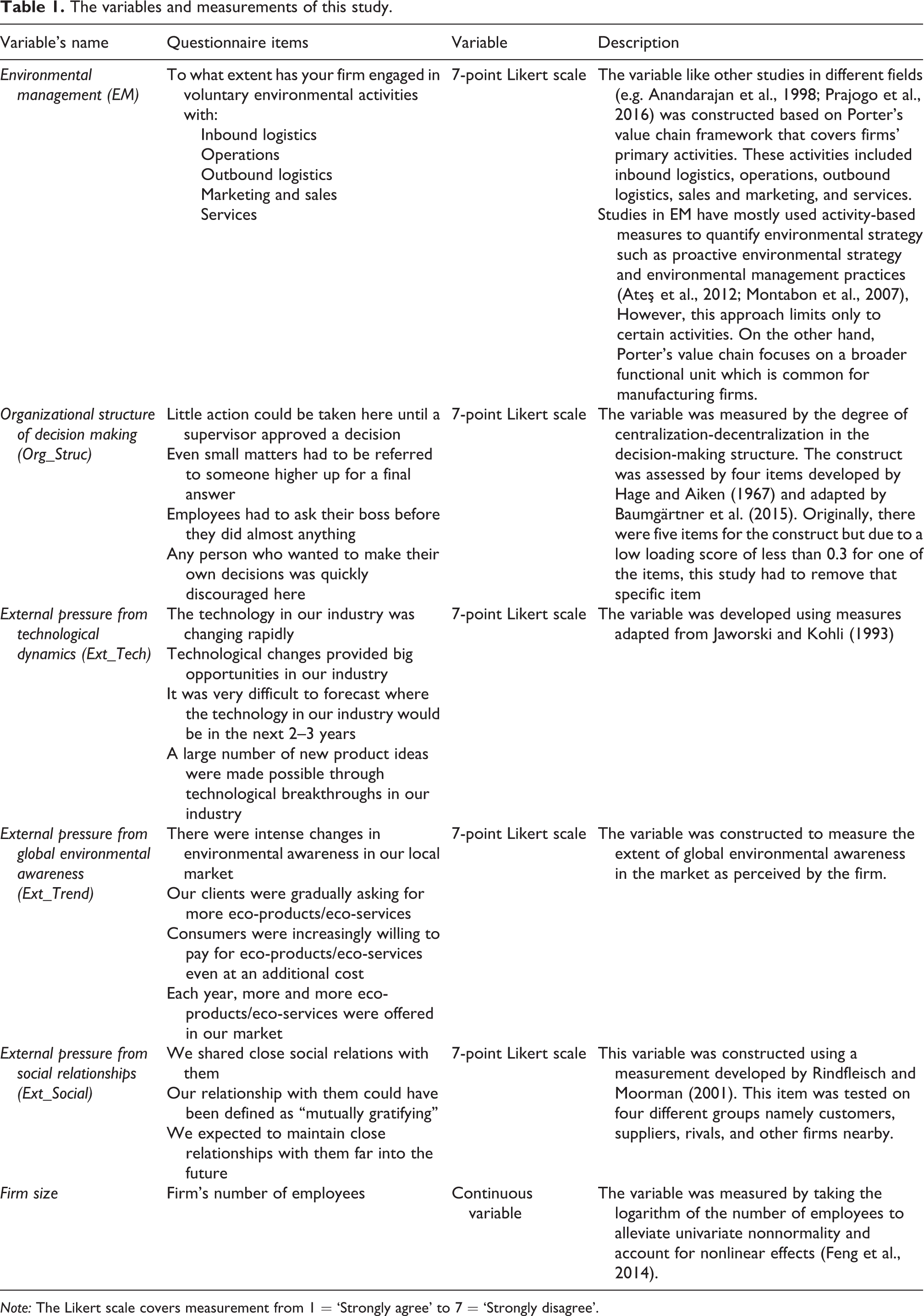
Note: The Likert scale covers measurement from 1 = ‘Strongly agree’ to 7 = ‘Strongly disagree’.
Considering that the data of this study were collected based on self-reporting, the results could be vulnerable to nonresponse bias and common method bias (Podsakoff and Organ, 1986). To reduce the risk, the study implemented a rigorous statistical approach to verify the reliability and validity of the study. Nonresponse bias was diagnosed using independent sample t-tests where analysis was performed by comparing 31 firms that responded and 31 firms that did not finish completing the survey. The data for nonresponding firms were collected via Qualtrics software (online questionnaire software – developed by software company, SAP SE) (online questionnaire software) which stores records of respondents that have fully responded as well as those that partially responded. The T-statistics were insignificant, concluding that nonresponse bias was not a major issue.
To check whether the survey could lead to common method bias, a few steps were taken. First, the measurements for each construct were drawn from the extant literature, carefully designed, and refined through several refinement processes. Second, anonymous responses were required in this study. The respondents were informed through a phone call, email, and questionnaire. Third, the layout of the questionnaire was not designed based on the themes, such as performance, organizational decision-making structure, and so on, so that it was nearly impossible for the respondents to determine the relationship between predictor and outcome variable. Fourth, Harman’s single test was performed to establish whether one single factor to account for most of the variance in the data could be identified (Podsakoff and Organ, 1986). The outcome of the test showed that there were four factors with an eigenvalue of more than one which accounted for 75.62% of the total variance. There was no single factor that could account for the majority of the covariance in the model. Overall, common method bias would not be a threat to this study.
Validation of constructs
In this study, the constructs used undergo a methodologically rigorous and comprehensive examination as a fundamental for meaningful and reliable research (Trumpp et al., 2013). The first analysis was exploratory factor analysis using principal component analysis with varimax rotation to examine whether the items fit with the constructs. The Kaiser–Meyer–Olkin (KMO) test for sampling adequacy was 0.76, indicating reliability toward the constructs. The list of items was reduced to five factors, each with an eigenvalue of more than 1 and explains 75.62% of the total variance. Internal consistency (reliability) of the model was established through the Cronbach α value of more than 0.7 for each factor (Nunnally and Bernstein, 1994). Table 2 shows the indicated measures’ item loadings, scale composite reliability (SCR) and average variance extracted (AVE).
Summary of measurement scales.
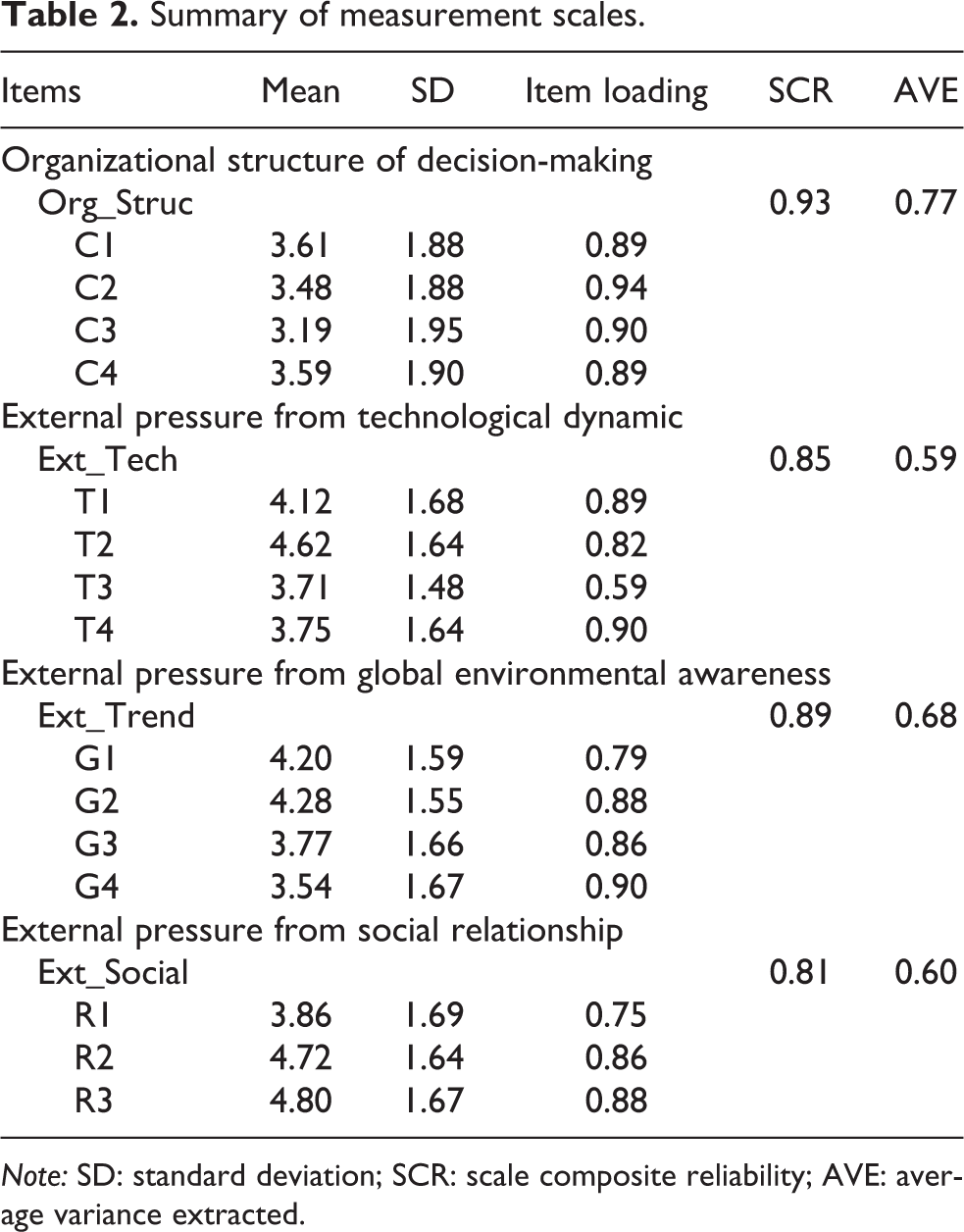
Note: SD: standard deviation; SCR: scale composite reliability; AVE: average variance extracted.
Second, confirmatory factor analysis to examine the reliability and validity of the measures was conducted. Table 2 shows SCR and AVE values meet the criterions (SCR > 0.7; AVE > 0.5) that suggested the theoretical framework had established convergent validity and, therefore, a reliable model. Moreover, an inter-construct correlation was calculated (Fornell and Larcker, 1981). The square root of AVE for each construct was found to be greater than the inter-construct correlations proving possession of discriminant validity. Based on the measurement fit indices used to assess the goodness-of-fit of models, it was confirmed as a good overall model fit (χ2 = 106.97, Good of Fit Index (GFI) = .89, Adjusted Good of Fit Index (AGFI) = .84, Comparative Fit Index (CFI) = .98, and Roof Mean Square Error of Approximation (RMSEA) = .05).
Findings
This study adopts the procedures of negative binomial regression (NBR). Since the dependent variable (environmental management) was a continuous variable, employing the ordinary least squares was not appropriate for two reasons (Gardner et al., 1995). First, the nature of the data would produce nonsensical, negative predicted value. Second, it is unlikely for count data to meet the assumptions on variance of scores. The data were not rescaled into subgroups to avoid dilution in statistical power. Since data for the dependent variable were over dispersed and not able to meet the restriction assumptions of Poisson regression (i.e. mean = variance), NBR was employed (Hausman et al., 1984). This regression embeds a random term to reflect the unexplained between subject disputes (Gardner et al., 1995).
Table 3 depicts the means, standard deviation, and correlation among the variables assessed in this study. Computation of correlation indicated multicollinearity is not a concern where the highest correlation coefficient is 0.32 (between external environmental awareness and number of employees). Since the values are below the usual threshold, it implies that no serious multicollinearity problems were in existence (Hair et al., 1998). For robustness purposes, eight models were used to address all hypotheses challenged in this study (Table 3). Model 1 contains the control variable and main effects. The moderating variables were added into model 2. Models 3–8 were employed to test individual interactions with the control variable and main effects.
Descriptive statistics and correlation coefficients.
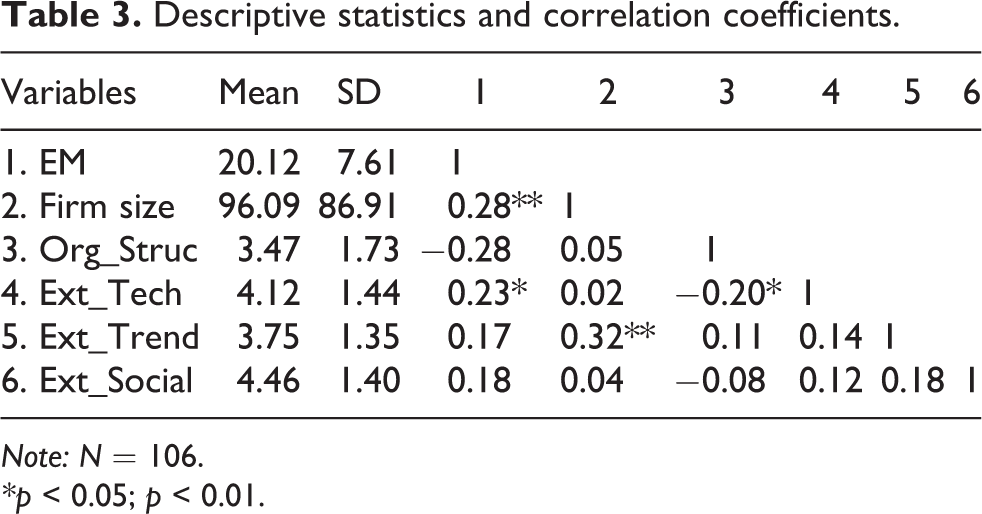
Note: N = 106.
*p < 0.05; p < 0.01.
Table 4 shows the results of the regression analysis. The independent variable and moderating variables were mean centered prior to running the regression analysis to minimize potential multicollinearity problems (Aiken et al., 1991). Based on the results, the control variables (firm size) were found not to have any significant effect on firms’ environmental management implementation level. Organizational structure of decision-making (decentralization) is found positively related to environmental management (p < 0.01) in all models. This further suggests that the baseline for this study (H1) is confirmed. Prior to testing the moderation hypothesis, Hypotheses 2, 3, and 4 were tested. The results from Table 4 show that all three hypotheses failed to establish a significant relationship, thus H2, H3, and H4 were rejected. Results indicated that the interaction between external pressure from social relationship and a firm’s decentralized structure on environmental management was not significant (p > 0.05), confirming the rejection of H5. The interaction term between global awareness and a firm’s decentralized structure on environmental management is significant (p < 0.05) but showing the opposite magnitude of what had been proposed, thus rejecting H6. However, in support of H7, the study confirms the positive moderating effect of external pressure from technological dynamics on the relationship between firms with a decentralized structure and environmental management. The coefficient of the interaction variable is significant (p < 0.05). Summary of findings is presented in Table 5.
Results of negative binomial regression analysis for environmental management.
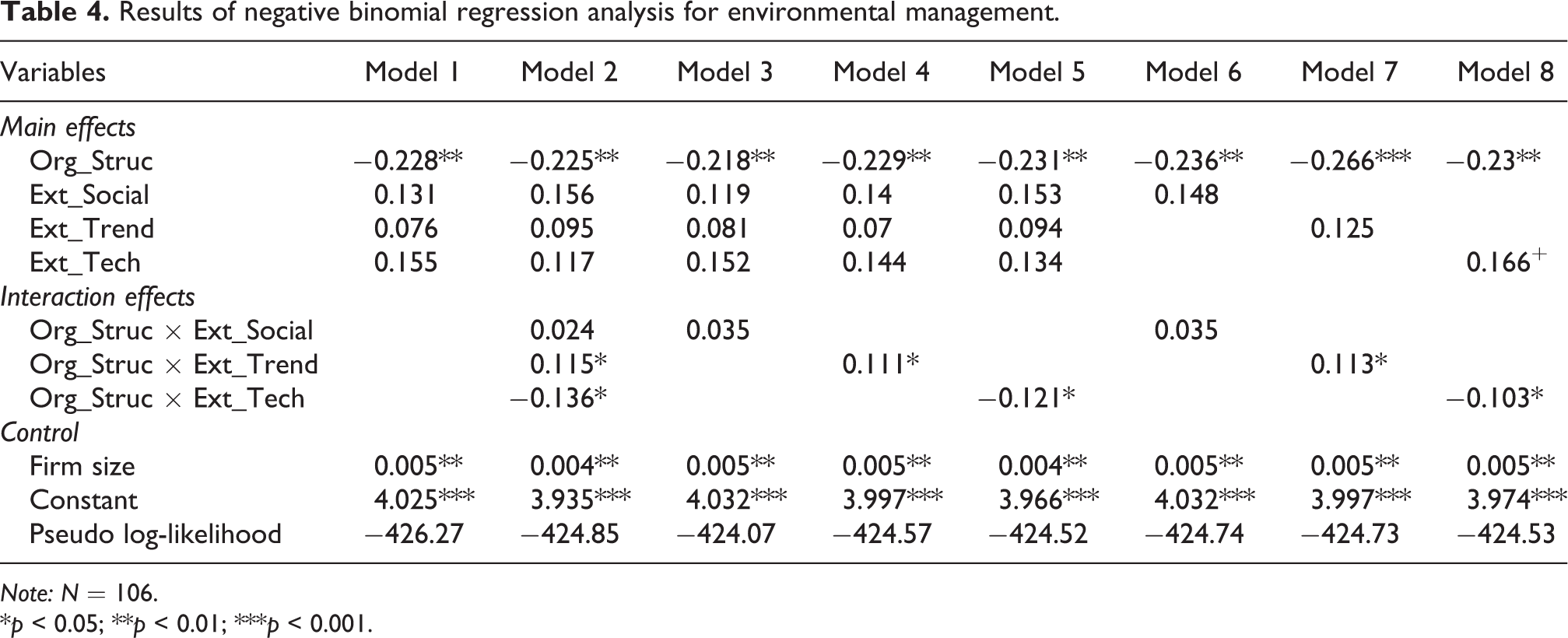
Note: N = 106.
*p < 0.05; **p < 0.01; ***p < 0.001.
Summary of findings.
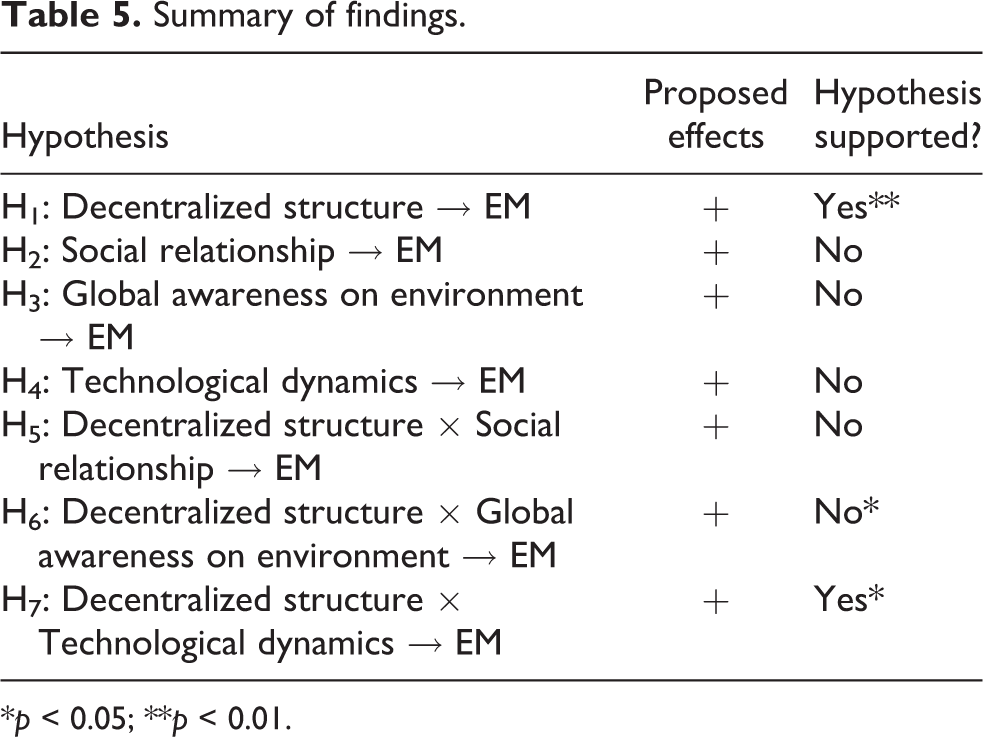
*p < 0.05; **p < 0.01.
Discussion
The findings from regression analysis confirm the relationship between decentralization and environmental management (H1). The result further verifies the importance of having a decentralized structure of decision-making to support the implementation of environmental management practice (Olson et al., 2005; Theodosiou and Katsikea 2013). The fact that entrepreneurial firms have a decentralized decision-making process, deciding and implementing a decision would require a shorter time. According to Perez-Valls et al. (2016), applying a “flexible” organization structure would produce “above-average” returns for developing environmental management. This study further tested the direct effect of external pressure from social relationships on environmental management. No evidence was found that showed a significant relationship between social relationship and environmental management. Thus, the results showed no support for H2. While the hypothesis is strongly supported in terms of the role of social network in influencing behavior and facilitating the sharing of information and knowledge, it might not be generalized for environmental management. Hence, more extensive research is needed to determine the other underlying factors that can help the implementation of environmental management through social pressure.
Moreover, the findings showed no relationship between global environmental awareness and environmental management that rejects the proposition of H3. Historically, environmentally friendly products have been associated with low-quality products (Bourn and Prescott, 2002). While there is also a concern about an increasing trend on environmental issues (De Jong et al., 2018), entrepreneurial firms may not be interested in applying environmental management. Furthermore, environmental management can be easily overstated as Aragón-Correa and Rubio-López (2007) illustrated that while sales of organic food have increased by a very high percentage, it still holds a small share compared to the increase in the total food industry growth. These factors potentially drive firms away from the implementation of environmental practices. The relationship between technological dynamics and environmental management was also proven to be statistically not significant. Thus, H4 was rejected. During periods of high technological dynamics, most firms are pressured to follow the latest technology. However, certain firms do not benefit from adapting to the latest technological development, especially for products that have been available in the market for a long period of time or have been developed strong market penetration (Chang and Park, 2013).
The results reveal that social relationship does not moderate the relationship between decentralized structure of decision-making and environmental management (H5). One explanation could be that adoption of environmental strategies is more institutionally driven compared to interfirm influences. Such actions are influenced by the need to comply with regulatory control of the institutional environment (Cummings, 2008). In any business entity, the sources of information and knowledge are carefully verified. Social relationship may not be the best source for advice or knowledge on matters concerning the environmental strategy of a firm. H6, which states that external pressure from global environmental awareness has a positive moderating effect on the relationship between decentralized structure of decision-making and environmental management, is not supported but resulted in a significant opposite finding (p < 0.05). This intriguing and somewhat counterintuitive result provides a new view on how firms should react during uncertainty. The idea of critical strategic thinking, and not focusing on where the trend sits (industrial players heavily and explicitly implementing their environmental strategy), is crucially important to why a focus on strategic renewal should be considered by firms. Due to the influx of key players focusing on sustainable approaches, it no longer provides a competitive advantage platform in the long run. The contemporary global trend that is paying more attention toward environmental awareness can sometimes be tough due to the establishment of new regulations (Zhang et al., 2019) and standards, which could burden businesses that wish to venture into environmental management. For example, environmental standards, such as ISO 14001, are recognized worldwide, could improve corporate reputation (Jiang and Bansal, 2003). However, the adoption of such a standard is related to excessive bureaucratization required by the system (Ferrón, 2017).
The latest hypothesis predicted a positive moderating effect of technological dynamics on the relationship between decentralized structure of decision-making and environmental management. The results indicate that this two-way interaction is significant (p < 0.05) as shown in models 2, 5, and 8, and hence, H7 is supported. In the context of firms with decentralized structure, nonhierarchical autonomy encourages quick decision-making based on local information or knowledge to deal with challenges of fast-changing technologies (Chen et al., 2015a). The result suggests that a “fit” organizational structure of decision-making is needed to match contingency to ensure firms’ effectiveness in implementing environmental management. Firms with a centralized structure are more effective in influencing environmental practices when the technological dynamics are minimal, while a high level of technological dynamics would encourage firms with a decentralized structure to strongly implement environmental practices.
To gain further insight into the nature of the two-way interaction, the interaction effect of the hypotheses 6 and 7 was illustrated (Dawson, 2014). When testing for hypothesis 6, both plots are sloping downwards, revealing that firms without a flexible structure have a negative effect on environmental management despite the presence of global awareness (Figure 2). However, low global awareness shows a stronger negative effect on the relationship (decentralization–environmental management) compared to high global awareness on the environment. For hypothesis 7, the predicted values of environmental management were calculated under different conditions (high and low values of decentralization, and high and low values of technological development). Based on Figure 3, the positive effect of decentralization on environmental management is stronger in firms with a high level of technological development in the industry compared to a lower level.
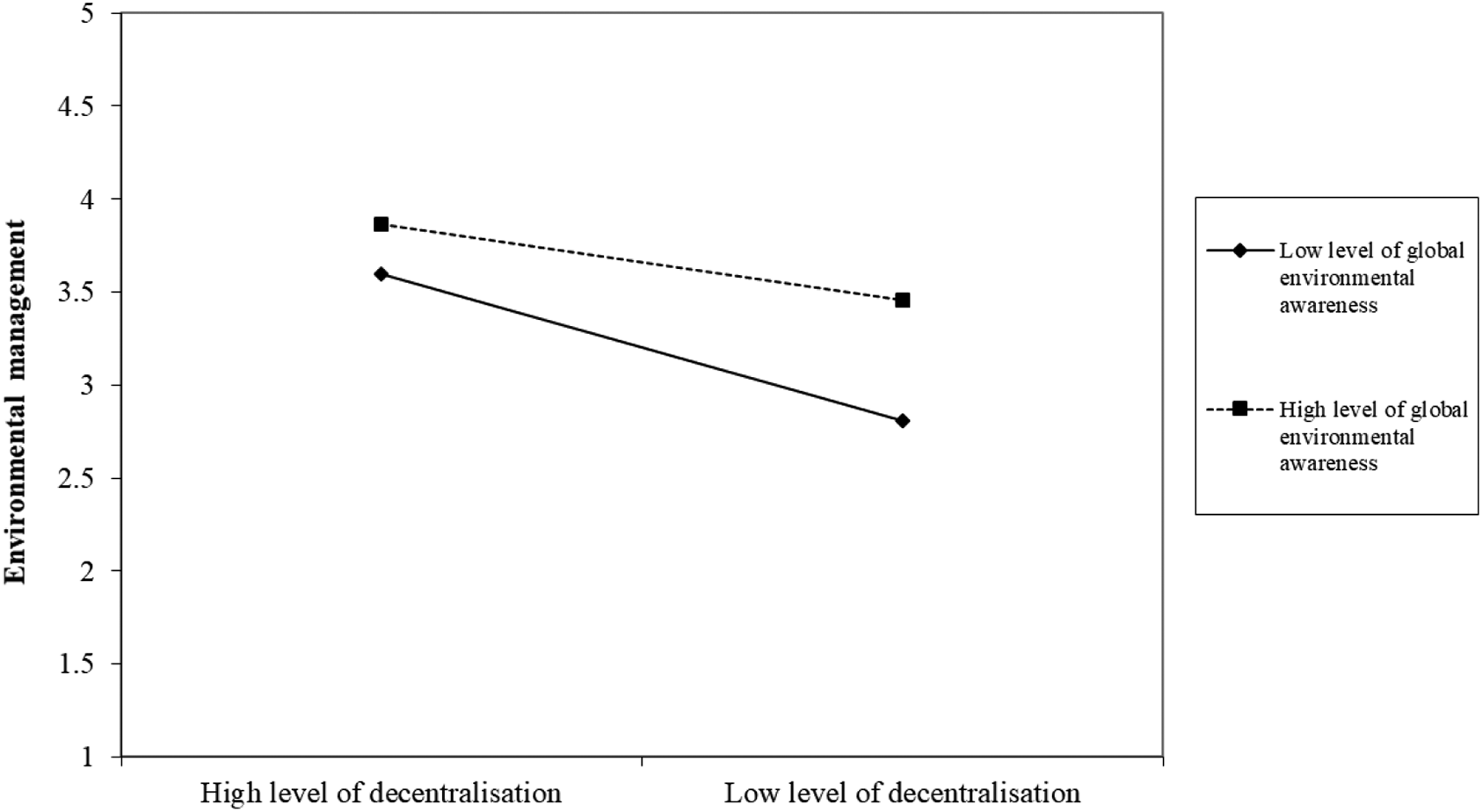
Global environmental awareness as a moderator of the relationship between decentralization and environmental management.
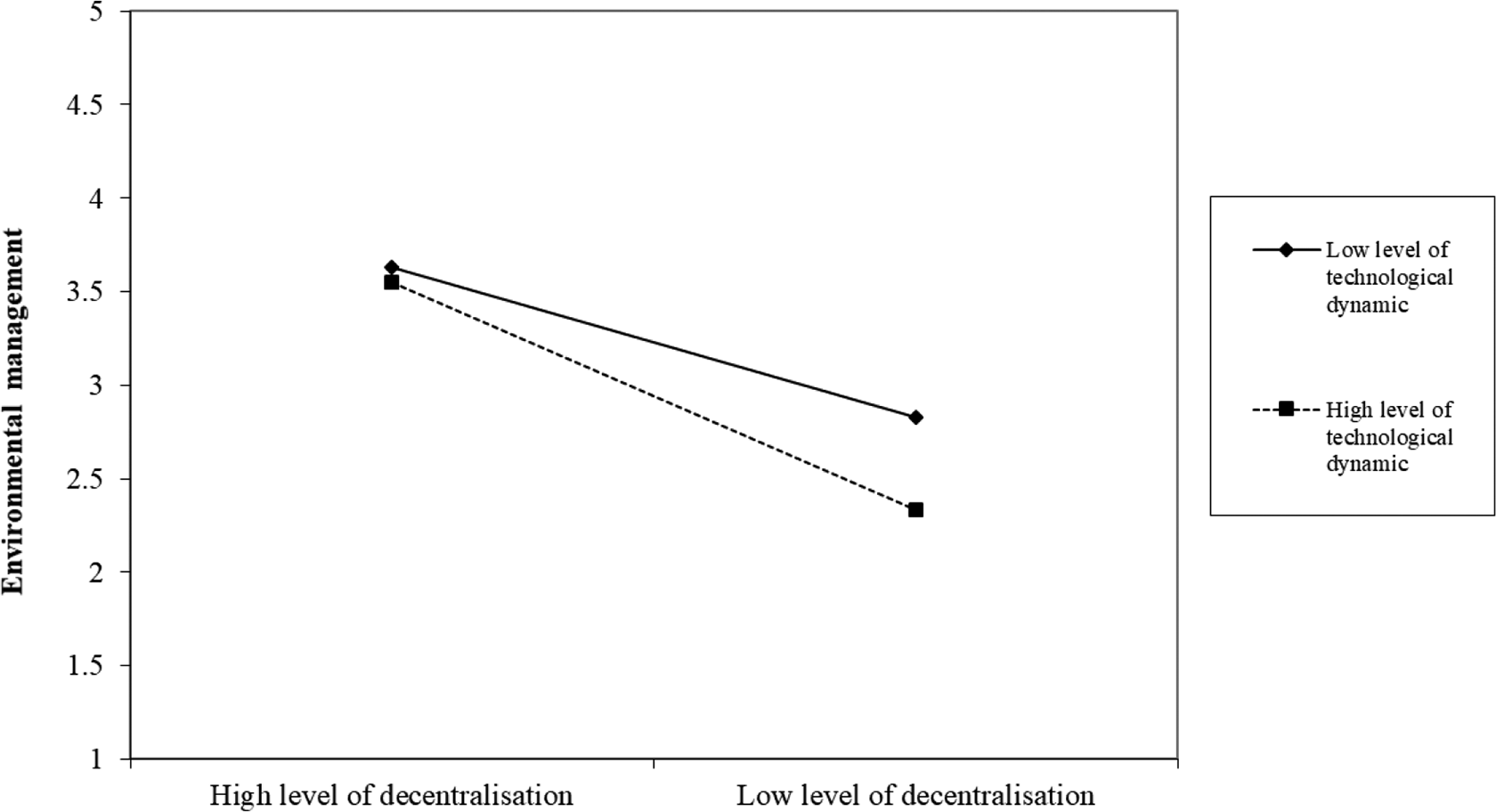
Technological dynamics as a moderator of the relationship between decentralization and environmental management.
Contribution to theory
This study aims to examine how entrepreneurial firms with decentralized structure of decision-making are more likely to affect environmental management in situations of high external pressure. This study makes a number of contributions to theory. First, the role of organizational variables such as decentralization has been adapted widely within the management research generally (Karim et al., 2016) but has received little insight within the specific context of environmental management (López-Gamero et al., 2016). Integrating the perspective of contingency theory, this study developed a new model for this relationship, which was further tested empirically. From the findings, the baseline relationship between decentralization and environmental management was confirmed, thus, verifying previous research that argues the important role of organizational structure of decision-making on firms’ performance (Boso et al., 2013). Furthermore, the findings is in-line with the concept of contingency theory that argues the optimal course of action and good fits is contingent upon the internal and external situation (Zhao et al., 2018). A key lesson from the finding may be that an individual employee’s role at all levels to support an organization’s policy on environmental management is important. Thus, as Quirin and Bower (1971) suggest, impetus for any firms usually begins from the lower levels of the organization, which reflects the importance of autonomy. On the other hand, it also shows that nonowners (e.g. employees) have concern over protecting the natural environment though not necessarily as part of the company’s main objective. At this level of finding, it can be suggested that there is a possibility that environmental strategies are motivated and self-driven at any level of the command chain.
Second, this research extends the existing contingency theory into the context of environmental management. A key premise to this theory is that firms’ actions are influenced by forces from external environments (Boso et al., 2013). The extant literature has approved the role of external influence toward environmental management (Menguc et al., 2010). On the other hand, scholars have also argued the need for firms to align current practice with its environment to obtain superior performances (Karim et al., 2016). By conceptualizing external factors and environmental management as multidimensional constructs, this study allows us to develop a comprehensive model and theory investigating the impact of organizational structure of decision-making on environmental management.
Third, by focusing exclusively on a firm’s primary activities, the implementation of environmental management in the context of entrepreneurial firms has a better chance of receiving the most accurate information. Previously, most studies used activity-based measures (i.e. Delgado-Ceballos et al. 2012; Gallear et al. 2015) to benchmark environmental management. The items included may be insufficient and deprive certain aspects of environmental management that were implemented specifically by firms. From another perspective, there is no consistency in terms of the items used to measure environmental management. Using Porter’s value chain (Porter, 1985) promotes consistency through the standardized activities covering all elements of environmental management practices throughout business facilities.
The next contribution focuses on the finding of this study. Going against the predicted outcome, the results showed an unusual result regarding the interaction between firms with decentralized structure of decision-making and global environmental awareness. This evidence provides a stronger basis that entrepreneurial firms tend to weigh-in the risks before committing to any “trending” strategies. A strong global pressure does not always influence firms to be environmentally proactive, since other industrial players will follow the same strategy as well as issues with uncertain benefits to the firm after engaging with environmental management practices (Ferrón, 2017).
Lastly, while most of the previous research applies a single-level approach to environmental management studies (Chen et al., 2015b), this study contributes to the environmental management literature by proposing a cross-level framework that bridges the organization-level variables and the environment-level variables. Due to the increased attention on sustainability issues, this study responses to the call for more research should be devoted to explore the role of multilevel variables in supporting environmental management (Rousseau, 1985).
Managerial implications
Practically, the research outcomes provide beneficial implications that could lead to valuable insights for entrepreneurial firms. First, firms may often be in dilemma as to which structure (centralized or decentralized) they need to adopt to improve their environmental management. This study examines the fundamental issue addressing the organizational “fit.” The framework of this study delivers some direction to managers, especially environmental managers, on how having an organizational structure orientation may translate into specific environmental proactivity within the context of entrepreneurial firms. Since there is a complex decentralization–environmental management relationship linked to exogenous uncertainties, managers can therefore make informed decisions about their strategy (López-Gamero et al., 2016). Unlike other strategies, environmental management initiatives are challenging (Lucas and Noordewier, 2016), needing firms to consider organizational design such as organizational structure of decision-making. As such, firms are warranted to align the structure of decision-making to ensure that they can implement environmental management.
Second, firms usually face difficulties in determining to what extent they should be committing to environmental practices to gain market position. This study shows that even when there is high external pressure for firms to engage with sustainable practices, those entrepreneurial firms are better-off not to focus intensively on environmental management. Many studies have found negative relationships between corporate environmental management practices and financial performance (Aragón-Correa and Rubio-López, 2007). The general overclaims that encourage firms to practice environmental management for financial gains have increased confusion around this topic and, in some cases, might lead toward disappointment which drives firms away from having an interest in practicing environmental management within their business. Furthermore, there are findings that the environmental statements and claims made by companies are not always trusted by stakeholders (Aragón-Correa and Rubio-López, 2007). On the consumers’ side, not all citizens have equal interest in every aspect of environmental preservation. This makes it riskier for firms implementing environmental practices that may have the least interest for their target market. Strategically, firms must analyze and conduct their due diligence and prepare their organization before deciding on any environmental management decisions.
Third, in cases of high pressure from technological development, entrepreneurial firms with a decentralized structure tend to have a better interest in committing to environmental management practices compared to those that are with a centralized structure of decision-making. Since technological advancement can only be managed by firms that are alert and can respond faster, a decentralized structure would best fit this description. In a decentralized structure, decision-making is made by those holding the relevant information (Davis-Sramek et al., 2015) while the decision-making in a centralized structure is usually in the hands of a few founding members (Martin et al., 2016). Hence, firms that are able to respond faster in an environment of high technological pressure will have strong complementary capability that helps their practices toward a more aggressive environmental goal (López-Gamero et al., 2008).
Limitation
Notwithstanding its contribution, this study has some limitations. First, it focuses solely on entrepreneurial firms. Although negative environmental outcomes usually relate to organizations involving production lines, other types of industry such as services were neglected. Since both industries have different operational settings, which could affect the natural environment in different ways, there would be a generalization problem if the study is based on a single industry. Future studies could look into the different industries, adapting the existing framework from this study to complement the results, hence generalizing the findings.
Second, in the extant literature, organizational structure is usually measured by three major structural variables, namely formalization, decentralization, and standardization. While seemingly they are supposed to form a unitary conception characterized by a highly positive relationship, there were studies that found otherwise (Child, 1972). In this study, only a single element of organizational structure was focused on, which is the degree of decentralization. Future research could therefore involve all aspects of organizational structure.
Footnotes
Declaration of conflicting interests
The authors declared no potential conflicts of interest with respect to the research, authorship, and/or publication of this article.
Funding
The authors disclosed receipt of the following financial support for the research, authorship, and/or publication of this article: This work was funded by Ministry of Higher Education, Malaysia, and Universiti Putra Malaysia.
