



Abstract
Literature on organizational learning (OL) shows that even firms who self-perceive themselves to have appropriate organizational structures still fail to generate appropriate learning outcomes. In this article, we claim that one of the neglected key factors explaining learning failures are organizational defensive routines (ODRs). Drawing on the literature, our theoretical inference is that high levels of ODRs can negatively moderate the relationship between organizational structures and OL. To test this moderation hypothesis, the study employs hierarchical regression analysis on a sample of 358 respondents from various industries in the United Kingdom. The result confirms that formalization negatively affects OL, and the effect of formalization on OL is negatively moderated by ODRs regardless of organizational age, size, and sector.
Introduction
According to the knowledge-based view, modern organizations’ sustainable competitiveness is perceived as relying on continuous improvement through learning (Park and Kim, 2018). Learning is considered as a crucial process for organizations to enhance their knowledge assets (Wu and Chen, 2014) on which they can build their competitive edge. For this and other reasons, it is important to understand the antecedents of what the literature names organizational learning (OL). Martínez-León and Martínez-García (2011) and Benavides Espinosa and Merigó Lindahl (2016) pointed out that organizational design could be an enabler or a barrier for OL. For example, Hong (1999) suggested that decentralized and flexible structures are beneficial for learning, though very limited empirical research has been carried out to explore this theoretical insight.
More problematically, however, most studies tackling the topic focus on conceptualizing learning and defining its components (e.g. Huber, 1991; March, 1991; Yeo and Marquardt, 2010) but neglect potential boundary conditions in this relationship. Addressing this shortcoming, we propose to move the attention to structural elements such as routines that are commonly presented in organizations. More specifically, and since the emphasis of this study is on boundary conditions, our focus is on organizational defensive routines (ODRs). These are “any actions or policies that prevent individuals or segments of the organization from experiencing embarrassment or threat” (Argyris, 1990: 25). They are omnipresent in all organizations, although to different extents, pervasiveness, and depth (Noonan, 2007). ODRs distort the validity of information and cover up issues resulting in anti-learning attitudes (Wilson, 2001). On a theoretical ground, research suggests that learning depends on the level of ODRs. When ODRs are strong, people in organizations tend to maintain a status quo and avoid taking risks to change their current way of work (Argyris, 1990). This bypassing and avoidable routine behavior is thought to be an obstacle to OL. We claim that the reason why some organizations fail to learn despite having appropriate structures and resources is because of the existence of ODRs and test this assertion empirically.
Thus, the purpose of this study is twofold. On the one hand, we intend to test the relationships between OL and features of organizational structure and, on the other hand, we enquire on the way in which ODRs affect the relation between OL and structure. The predominantly theoretical literature on this topic stipulates that the effect of ODRs—that is avoiding embarrassment and threat in the workplace—negatively moderates the relationship between OL and some of the most relevant organizational factors (e.g. structure in the form of formalization and centralization). Empirically identifying the relationships between features of organizational structure and OL sheds light on how managers can enhance their organization’s learning capabilities.
This study makes three contributions to the literature. First, building on the knowledge-based view, we empirically test how organizational structure influences OL under the presence of ODRs. Hence, we advance the literature on ODRs on both the theoretical and empirical aspect. To date, existing studies on ODRs are mainly qualitative, whereas we are producing new and unique empirical evidence which helps to refine and perhaps challenge current thinking on ODRs and OL (e.g. Argyris, 1990; Noonan, 2007). Furthermore, we enrich theories of OL by embedding the role ODRs play for OL. We thereby extend the work by Yang et al. (2018a) on the individual component of ODRs by shifting the focus to the organizational level and identify an important theoretical boundary condition that may constitute an impediment to OL.
Second, we add to the recent debate about routine dynamics referring to the double nature of routines being the source of both inertia and change (Feldman et al., 2016). This perspective posits that organizational routines have multiple functions which can either enable the organizational change or sustain the status quo. This view entails that when employees perceive there is a high level of ODRs impeding them from giving genuine opinions, even organizations with appropriate design would be afraid to adopt new approaches to solve issues. Drawing from Martínez-León and Martínez-García (2011: 558) who stated that “innovative organizations must have routines that can cross the limits set up by the organizational structure,” we propose that ODRs moderate the relationship between elements of structure and OL. Understanding this interaction effect could provide a more accurate prediction of OL but also contributes to understand new routines (Feldman et al., 2016).
Third, to the best of our knowledge, no previous study has simultaneously examined the relationship between the features of organizational structure and ODRs in the context of OL and our work responds to calls for further research to explore facilitators of OL in consideration of the limited existing studies in this area (see, e.g. Benavides Espinosa and Merigó Lindahl, 2016; Martínez-León and Martínez-García, 2011). In response to such calls, our study focuses on one prevalent type of organizational routine, that is, ODRs.
Theoretical background
Organizational learning
A knowledge-based view contends that individual knowledge contributes to make organizations more competitive. The way individuals manage their knowledge partially composes OL and relies on information sharing (Battistelli et al., 2019) and openness to conflict (Van de Ven et al., 2019). This, together with knowledge management is important for organizations to survive in the current dynamic and unpredictable environment (Park and Kim, 2018). OL has been studied from a diverse array of disciplines and viewpoints (Easterby-Smith et al., 1998). From a sensemaking process perspective, Ahn and Hong (2019) found that learning in organizations depends on participation and communication through dynamic interactions. From a perspective of the supplier value-creation processes, Zhang et al. (2020) analyzed how customers contribute to OL through social media. By studying ODRs, our study focuses on how the factors within organizations influence OL. However, studying routines requires to acknowledge the interplay between the individual and the organization. But many theories take either an individual or an organizational perspective. Huber’s (1991) learning model is one of the rare exceptions as it combines the process of learning and explains the transmission from individual levels to organizational level and thus it has been empirically validated frequently (e.g. Jiménez-Jiménez and Sanz-Valle, 2011; López et al., 2005; Segelod, 2001). Huber approaches learning from a cognitive perspective and suggests that an organization learns through an information management process and, for this reason, a range of potential behaviors changed (Huber 1991: 89). In spite of the rather narrow understanding of cognition (for a more contemporary view, see, e.g. Hodgkinson, 2015; Secchi and Cowley, 2020; Secchi, 2021), Huber shows that the four components used to describe the learning process are particularly useful in respect of an organizational knowledge-based approach. Recent works building on Huber (1991) by Lopez et al. (2004) and Jimenez-Jimenez and Sanz-Valle (2011) refer to those four components as knowledge acquisition, knowledge distribution, knowledge interpretation, and organizational memory.
Knowledge acquisition is the first step towards OL. Sources of knowledge can come from inside and outside the organizations. For example, internally, some of the knowledge is inherited from those already working in organizations at the time of the assessment. Also, knowledge can be created through interactions with peers in the practice (Elsey and Leung, 2004). Knowledge distribution concerns how to spread information among individuals and departments in organizations. It could be influenced by work context (e.g. see Burmeister et al., 2018, for analysis of age diversity), leadership (Gerpott et al., 2020), and organizational structure (Valentine, 2018). Knowledge distribution leads to “more broadly-based organizational learning” (Huber, 1991: 101). It benefits organizations to gain competitive advantage by transferring knowledge from individual and tacit knowledge to collective and explicit knowledge (Spoor and Chu, 2018). Knowledge interpretation concerns people in organizations giving one or more commonly understood meanings to information. Reaching a certain extent of common interpretation on information is necessary for organizations to make the right strategic decisions (Sinkula et al., 1997) and achieve efficient cooperation between departments (Huber, 1991). Organizational memory is about retaining information in organizations in forms of standard operating procedures, structural artifacts, and mental models (Walsh and Ungson, 1991). Not all memory is explicit; instead, some memory is covert, tacit, and difficult to observe (Becker, 2004). This nature of being unobservable creates difficulties to interpret information (Sinkula et al., 1997).
Organizational defensive routines
Argyris (1990) and Noonan (2007) explain the determinants of ODRs from a social and psychological perspective. From the former perspective, social virtues guide people’s behavior in societies and organizations. For example, people should not publicly embarrass others or embarrass themselves. This social virtue makes people think it is rational not to expose certain relevant information in a given social context because its exposure might cause embarrassment to some people, especially people with authority. Psychologically, defensive routines are guided by four principles: (1) achieve your intended purpose, (2) maximize winning and minimize losing, (3) suppress negative feelings, and (4) behave according to what you consider rational (Argyris, 2001: 57). Based on social cognition theory, Yang et al. (2018a) suggest that ODRs are the outcome of personal attribution and contextual attribution. Individuals in organizations mindlessly follow these governing principles and automatically adopt skills to avoid embarrassment and threat. As a result, individuals’ defensive routines become prevalent resulting in organizational level ODRs (Riley and Cudney, 2015). Therefore, Argyris (1996) argues that individual defensiveness is the origin of ODRs, but simultaneously ODRs operate like a fertilizer, by nurturing individual defensiveness and making it more acceptable in organizations.
According to Tranfield et al. (2000), all organizations have two kinds of routines in place—that is, enabling and defensive routines—and these two kinds of routines exert opposite forces toward OL. Organizations only learn when enabling routines become more prevalent than defensive routines. Hence, reducing ODRs is crucial for OL.
One way of how ODRs materialize is organizational pretense. Pretense means that organizations disguise themselves as appearing competent by avoiding taking risks and suppressing employees from expressing different opinions (Yang et al., 2018b). The aim is to appear competitive also in the face of crisis. Key elements enabling organizational pretense are dysfunctional communication through ambiguous messages to staff and customers, eventually discouraging risk-taking. Individuals self-censoring their view also contribute to this dynamic. Dysfunctional communication is ineffective, but employees who create this kind of communication assume it is rational to adopt it to avoid conflict with authorities (Peng and Tjosvold, 2011). Additionally. some organizations may adopt rigid, unfunctional rules and procedures to avoid potential negative consequences. Studies in the healthcare sector pointed out that staff engage some form of defensive routines to avoid potential patients’ complaints, such as ordering CTs, surgery, and antibiotics (He, 2014; Whittaker and Havard, 2016). Van Loon (2017) also found that employees in the studied organizations complied with the unfunctional rules to avoid negative repercussions and blames, which result to low performance.
The other manifestation of ODR is cover-up which means organizations hide existing issues whose exposure could cause embarrassment or threat to organizations (Yang et al., 2018b). Researchers found that 80% of managers at least made one defensive decision within 12 months (Artinger et al., 2019). Within the defensive behavior of cover-up, empirical work has explored organizational silence. This refers to how conditions where employees feel psychologically unsafe and unconfident to speak up potentially lead to organizational failure (Detert and Edmondson, 2011; Milliken et al., 2015). Milliken et al. (2003) found that 85% of employees of the study fear to voice their opinions. Hence, managers and employees lose opportunities to discuss solutions to deal with the issues in time. This double-blindness between managers and employees creates a self-reinforcing loop suppressing communication either top-down or bottom-up, enabling cover-ups, and facilitating pretense which results in embarrassment-free climates. Consequently, organizations suffering from increased levels of defensive routines are likely to face problems arising from issues aggravating without notice.
Organizational structure, learning, and ODRs
Coordination is achieved through controlling and integrating work activities in accordance with formal or informal rules (Child, 2015). Organizational structure plays a decisive role on how decision-making power is allocated (e.g. centralization) and how rules and procedures are used to facilitate members’ behaviors (e.g. formalization; Dalton and Tudor, 1980). By leading members’ behavior, organizations can guide employees to work toward organizational goals and improve efficiency. However, too much structure restricts employees’ flexibility to tackle with issues in a timely manner and usually posits a limit to innovation (Brown and Eisenhardt, 1997). In terms of OL, Cohen (1991: 135) posits that organizational structure is “a design of organizational learning, for acquiring information about the state of the world and for improving what the organization can do.”
Organizational structure has multiple characteristics. Among others, previous research shows that centralization and formalization are decisive dimensions of organizational structure, in fact they are by far the most commonly used in previous research (e.g. Benavides Espinosa and Merigó Lindahl, 2016; Chen and Huang, 2007; Cosh et al., 2012; Fredrickson, 1986). This study will focus on these two dimensions of organizational structure because their connection to ODRs is strongest from a theoretical perspective as we explain below and in the subsequent sections. In short, the reason for this choice can be founded on what these two potentially share with ODRs. While centralization is connected to the strong managerial support that ODRs must have to exist, formalization can be an index of organizational sclerosis when abused. Above all, ODRs can be thought of an absence of flexible (plastic) adaptation to threats and challenges, something that is usually aligned with formalization.
Centralization refers to whether the locus of decision-making power is dispersed throughout the organization or limited to the top management team (Dalton and Tudor, 1980). Organizations which either attenuates centralization or has a decentralized structure create the more opportunities for social interactions, hence facilitating higher levels of knowledge sharing (Herath et al., 2017). A less centralized (or decentralized) structure also facilitates open communication and enables organizations to react to market pressures (Král and Králová, 2016). Bisel, et al. (2012) argue that command structures in organizations could enable incompetent communication between supervisors and subordinates resulting in ignorance of organizational problems that may turn into, for instance, red tape (Hattke et al., 2018). Frost et al. (2010) use the case of American Airlines dealing with flight delays to illustrate that organizational hierarchical control creates a “culture of fear.” This results in individuals in organizations directing blame to other people instead of learning from failures. Therefore, too much control caused by centralized organizational decision-making and rigid organizational rules can negatively affect OL. Additionally, high centralization can force decisions into actions by bureaucratic power. This reduces employees’ motivation to interact with each other and rationalize decisions through open discussions (Child, 2015; Miller, 1987). In contrast, decentralization increases the likelihood of information sharing and better decision-making (Benavides Espinosa and Merigó Lindahl, 2016).
High centralization gives executives quite a significant amount of power to rights and authority of decision-making. This can widen social distance between executives, management, and regular employees. Since, in such a structure, regular employees are thought to execute decisions instead of participating in decision-making (Kaufmann et al., 2019), valid information that employees collect from work processes might be lost. Consequently, organizations miss learning opportunities. Hence, high centralization is often negatively related to organizational performance, knowledge management, and innovation both theoretically and empirically (Damanpour, 1991; Pertusa-Ortega et al., 2010). Hence, we hypothesize:
Highly centralized organizations tend to generate environments characterized by high power distance (Mintzberg, 1983), as only a small group of people have the autonomy to make decisions. And this power distance could be enlarged when defensive routines are in place. This is because, being averse to confrontation, some employees may think it could cause conflict or put their work in jeopardy, if they were to point out the flaws of managerial decision-making (Madrid et al., 2015). Therefore, debatable decisions made by a small group of people in a centralized organization might only be challenged in a subtle and opaque way, resulting in organizational problems cover up (Buchannan and Badham, 2020). Or, people may just remain silent (Morrison and Milliken, 2000). Consequently, defensive routines can hinder organizations with high centralization from identifying problems. Without tracking organizational problems, organizations are unable to learn and will not improve the current way of operating.
Formalization is the degree to which decision-making and actions adhere to rules and procedures in the organization as opposed to the relevance of a given situation (Child, 2015; Damanpour, 1991). High formalization reinforces routine behavior by established organizational rules. This could diminish the employees’ drive to initiate new knowledge or to share information (Fredrickson, 1986). Formalization is in general associated with bureaucratic red tape (Kaufmann et al., 2019) and is considered to be a hindrance to knowledge transformation (Martínez-León and Martínez-García, 2011). If organizations are in a turbulent market, quick and effective interdepartmental communication with a flexible and less formalized structure is more suitable (Burns and Stalker, 1961). Formalization reinforces established knowledge in organizations but also restricts people from creating new knowledge (Willem and Buelens, 2009). Therefore, formalization has been theoretically argued and sometimes also empirically shown to be negatively related to knowledge management (Chen and Huang, 2007) hindering the development of OL (Martínez-León and Martínez-García, 2011). However, certain advantages of formalization should not be neglected. For example, it can be assimilated to routines and serve as reservoir of organizational knowledge (i.e. memory; Feldman and Pentland, 2003). To some extent, formalization provides sources of basic learning in organizations. Nonetheless, rules and procedures tend to become obsolete over time due to the constantly changing environment. Thus, we hypothesize:
While ODRs are prevalent in organizations, people are prone to fear to make errors (Artinger et al., 2019). Hence, they follow rigid rules and procedures to avoid being blamed for mistakes. Rule designers in organizations with ODRs also prefer to compose red tape to serve their own interest to stay in control (Argyris, 1990). This will strengthen the negative effect of formalization on OL, as people in formalized organizations restrict their behavior to rules and procedures rather than flexibly adjusting their behavior in accordance to situational needs. Thus, we hypothesize:
Method
Data and sample
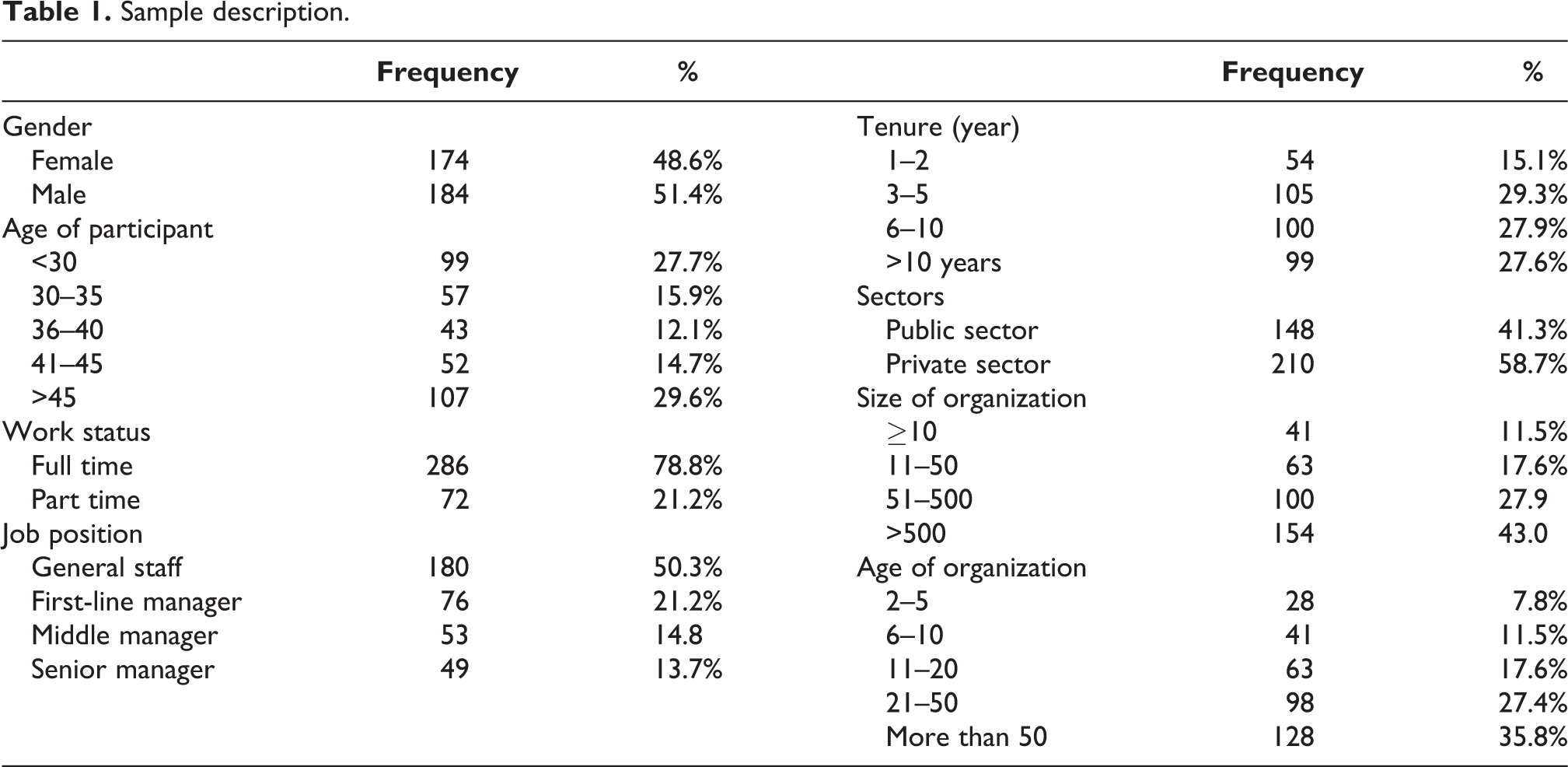
For data collection, we entrusted a research company, Qualtrics, to solicit responses, of 440 employees working in the United Kingdom from a broad variety of industries. All respondents have been working with their employer for more than 1 year, on the assumption that those with less than 1-year experience may not be familiar with OL processes and strategies as employees over time develop firm specific knowledge. Such knowledge enhances their understanding of OL process and strategies as individuals become more familiar with how the organization operates (Lecuona and Reitzig, 2014; Osterloh and Frey, 2006). This familiarity also facilitates employees’ judgment on whether enacting defensive routines is acceptable or not. After deleting unengaged respondents, 1 the usable data resulted in N = 358 observations. We had slightly more male respondents than female (51% vs. 49%). The majority of respondents work full time (79%), 41% of respondents work in the public sector, and 52% of them work in the private sector. Only 7% of them work in nonprofit sector. The average age was 38. Missing values only take 0.18% of our data. Cases with missing values did not display a systematic pattern. Hence, we imputed the data and replaced the missing values with the mean of the respective variables.
To reduce common method bias (Podsakoff et al., 2003), we randomized the appearance of the measurement scales and the items within them. As to diagnose its presence, we applied Harman’s single factor test by forcing all the predictors and outcome variables to load on one factor. The result shows that one factor only explains 26.31% of total variance (64.19). Statistically, this suggests there is no common method bias in the data. However, since Harman’s test has been criticized in the literature, we also provide results of an instrumental variable regression of the main variables of interest on OL in Online Appendix 2. Additionally, it is important to point out that our main findings relate to moderation effects and Siemsen et al. (2010) analytically showed that moderation effects are not subject to common method bias. While we fully acknowledge that a post hoc test in isolation may not be sufficient evidence that common method is not a problem in cross-sectional data, the combination with our precautionary measures in the design and implementation phases (e.g. randomization, order of questions), the result of the post hoc test, and the analytic solution by Siemsen et al. (2010) allows us to conclude that there is no evidence that results are biased.
Measures
The measures of the study are calculated based on 7-point Likert-type scales, where 1 means strongly disagree and 7 means strongly agree. Cronbach’s α is used to estimate reliability of the measurement scale. As shown below, all the factors established good reliability with Cronbach’s α over 0.7 (see diagonal in Table 3). One exception is formalization with α = 0.63. While this is not an ideal result, low αs appear to be common with the formalization scale (see, e.g. John, 1984). Thus, we decided to bring the measure forward to the analyses. The survey is shown in Online Appendix 1.
Organizational learning (α = 0.91): We used the 13-item scale developed by López et al. (2004) and applied by Jiménez-Jiménez and Sanz-Valle (2011) and López et al. (2005). It consists of 3 items for knowledge acquisition, knowledge distribution, and knowledge interpretation, while 4 items are for organizational memory.
Organizational structure: The scale adopted items from Ferrell and Skinner (1988). The higher the value selected, the more the organization is centralized or formalized. Centralization (α = 0.88) is measured by 5 items. Formalization is originally measured by 6 items, but in this study, the scale results in a very low Cronbach’s α. After deleting the items responsible for low reliability, the scale is reduced to 2 items with a α = 0.63.
Organizational defensive routines: We used the scale developed by Yang et al. (2018b). The construct is measured by two sub-factors, organizational cover-up (α = 0.76) and organizational pretense (α = 0.80). Cronbach’s α for the aggregated ODRs scale is 0.76. To isolate effects more clearly, we transformed ODR into a binary variable indicating “high level of ODRs” assigning the value of 1 to the highest 25% of ODR values.
Control variables
Organizational size: Size is closely related to organizational routines, and organizational routines constituting organizational memory are part of OL (López et al., 2004). Large organizations normally have more disposable resources to facilitate the development of new ideas, which makes learning easier than in small organizations (Espinosa and Lindahl, 2016). Hence, we control for size measuring the number of employees (Camisón-Zornoza et al., 2004). We used the following answer options for size: up to 10 (micro-company, coded 1), 11–50 (small company, 2), 51–500 (medium company, 3), and more than 500 (large company, 4). For analytical purposes, we also created a dummy variable distinguishing organization with less than 501 employees from the rest (i.e. we indicate small and medium sized firms in our sample).
Organizational age: OL theorists argue that organizations learn from experience, and experience provides guidelines to future organizational problems (March, 1991). Old organizations have more experience to deal with unpredictable situations (Thornhill and Amit, 2003) and become resilient after gaining vast previous experiences to face volatile markets. Nonetheless, the same reason that confers competitive advantage for old organizations can instill organizational inertia and impede OL. Hence, we ask respondents to indicate the age of their organizations offering them six groups, namely 0–1, 2–5, 6–10, 11–20, 21–50, and more than 50 (see, e.g. Sorensen and Stuart, 2000). Next, for the purposes of the analyses, we distinguish very young organizations from the rest using a dummy variable that takes the value of 1 if the age is less than 21 years old.
Other controls: Job level, tenure, and job status affect people’s perception of OL (Yau and Cheng, 2011). Therefore, we controlled for these variables using a dummy variable for job status (1 = part time, 0 = full time), job level (1 = general employees, 2 = supervisory, 3 = middle manager, 4 = senior manager, 5 = executive), and organizational tenure (1 = less than a year, 2 = 1–2 years, 3 = 3–5 years, 4 = 6–10 years, 5 = 11–15 years, 6 = 16–20 years, 7 = more than 20 years). Finally, we controlled for sector affiliation, that is, public, private, and nonprofit.
Results
Descriptive statistics
Table 1 presents the sample background and Table 2 displays the means, standard deviations, and correlations of all the variables. According to these results, centralization is strongly and negatively correlated with formalization (r = −0.62, p < 0.01). Formalization is negatively correlated with OL (r = −0.2, p < 0.01). ODRs are negatively associated with OL (r = −0.39, p < 0.01) and they are positively correlated with centralization (r = 0.41, p < 0.01), but negatively correlated with formalization (r = −0.23, p < 0.01). Organizational age and size are not correlated with OL, but they are negatively correlated with ODRs, young organizations (r = −0.14, p < 0.01) and small organizations (r = −0.21, p < 0.01).
Sample description.
Means, standard deviations, and correlations (N = 358).
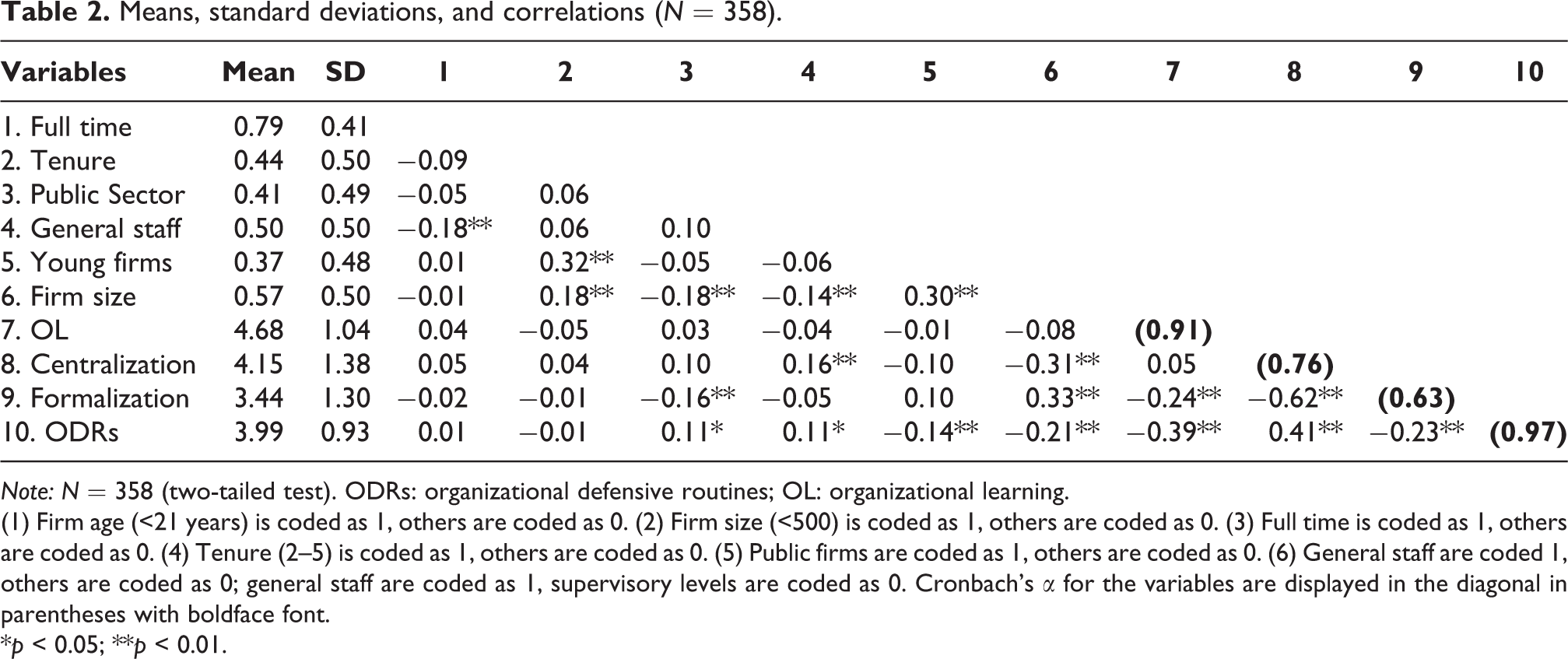
Note: N = 358 (two-tailed test). ODRs: organizational defensive routines; OL: organizational learning.
(1) Firm age (<21 years) is coded as 1, others are coded as 0. (2) Firm size (<500) is coded as 1, others are coded as 0. (3) Full time is coded as 1, others are coded as 0. (4) Tenure (2–5) is coded as 1, others are coded as 0. (5) Public firms are coded as 1, others are coded as 0. (6) General staff are coded 1, others are coded as 0; general staff are coded as 1, supervisory levels are coded as 0. Cronbach’s α for the variables are displayed in the diagonal in parentheses with boldface font.
*p < 0.05; **p < 0.01.
Organizational defensive routines and OL
We also tested the correlation between ODRs and sub-factors of OL. The result shows that ODRs are negatively and significantly associated with the four sub-factors: knowledge acquisition (r = −0.38, p < 0.01), knowledge distribution (r = −0.21, p < 0.01), knowledge interpretation (r = −0.47, p < 0.01), organizational memory (r = −0.31, p < 0.01). Among these four sub-factors, ODRs have the highest correlation with knowledge interpretation.
Testing hypotheses
We used hierarchical regression analysis to examine the relationships between variables. ODRs and variables for centralization and formalization are centered. We used VIF on model 4 to check for multicollinearity. From the literature, we know that VIF should not exceed 10 (Field, 2013). The average variance inflation factor of this study is 1.85 and the single highest VIF is 2.64. Therefore, multicollinearity is not a concern for this study.
Table 3 displays the main results of the regression analysis. Model 1 includes all the control variables. The result shows that none of the control variables has a statistically significant influence on OL and, in fact, the regression model shows a poor fit. Model 2 adds the core predictors (centralization, formalization). Results show that centralization (β = −0.11, p = 0.03) and formalization (β = −0.26, p < 0.001) negatively and significantly affect OL. These findings support Hypothesis 1a and Hypothesis 2a.
Multiple regression analysis.
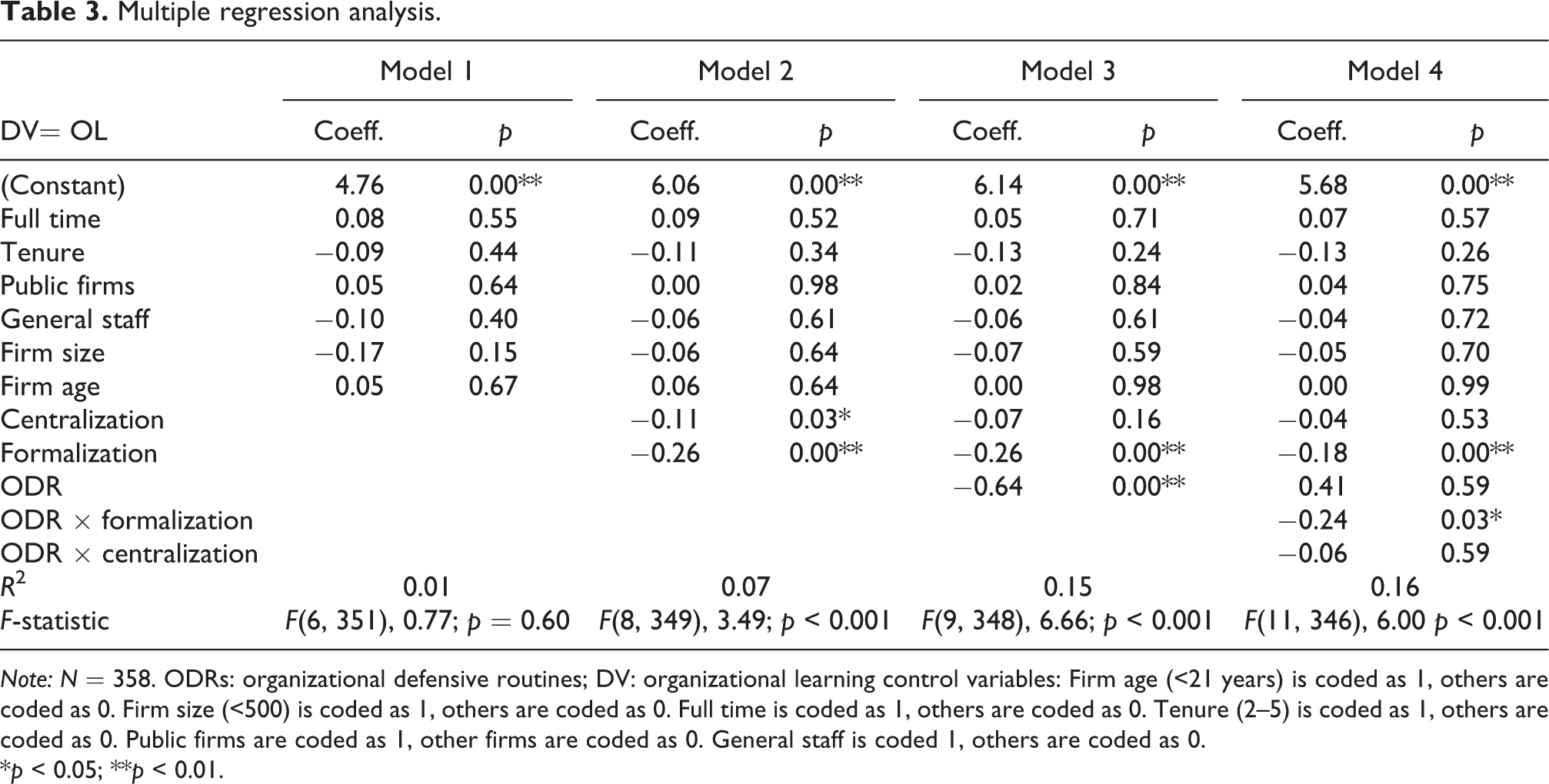
Note: N = 358. ODRs: organizational defensive routines; DV: organizational learning control variables: Firm age (<21 years) is coded as 1, others are coded as 0. Firm size (<500) is coded as 1, others are coded as 0. Full time is coded as 1, others are coded as 0. Tenure (2–5) is coded as 1, others are coded as 0. Public firms are coded as 1, other firms are coded as 0. General staff is coded 1, others are coded as 0.
*p < 0.05; **p < 0.01.
Model 3 adds ODRs. The result shows that formalization remains negatively and significantly associated with OL, but centralization (β = −0.07, p = 0.16) becomes nonsignificant toward OL. Model 3 also suggests that ODRs have a negative and significant direct relation with OL (β = −0.64, p < 0.001). The R 2 has increased from 0.07 in model 2 to 0.15 in model 3. The F-value also increases from 3.49 to 6.66, which shows that model 3 has better fit than model 2. Hence, ODRs make the largest contribution to predicting OL compared to other variables in the model.
Model 4 investigates whether the association between the main predictors (centralization, formalization) and OL depends on the extent of ODRs. This study adopts Aguinis’s (2004) method of analyzing moderation. We centered centralization and formalization. Then we computed ODRs-by-centralization, ODRs-by-formalization are added as new variables in model 4. The results of model 4 indicate that ODRs moderate the relationship between formalization and OL, with β = −0.24, p = 0.03. R 2 slightly increases to 0.15 from 0.16. Therefore, hypothesis 2b is supported, but hypothesis 1b rejected.
Figure 1 displays the simple slopes for the relationship between formalization and OL at low levels and high levels of ODRs. The slope shows that when defensive routines are high, organization learning declines.
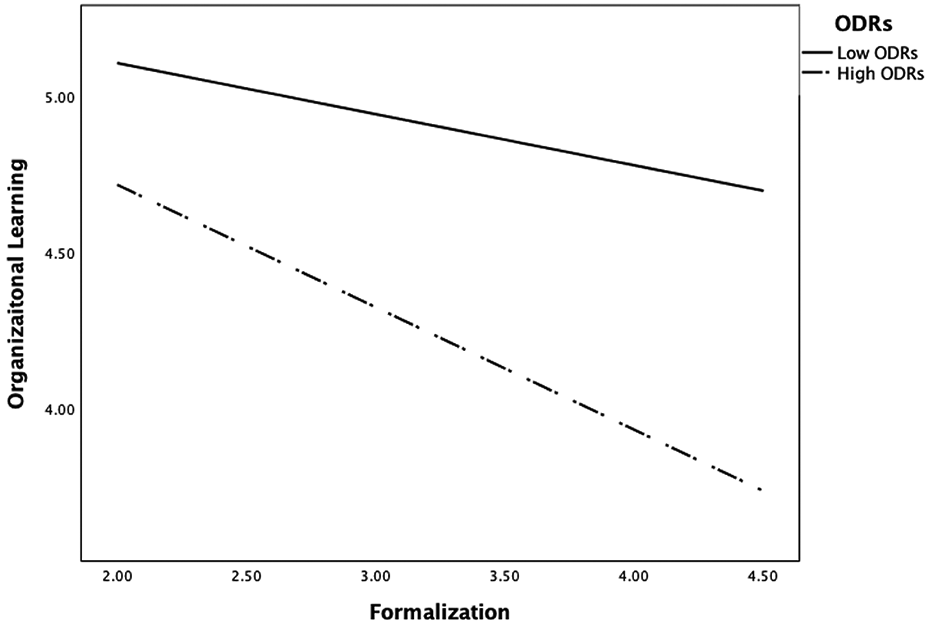
Regression slopes for organizational defensive routines.
Subdimensions of OL and robustness checks
Apart from testing hypotheses proposed in this study, we also note some additional findings which captured our interest. Multiple regression analyses show that cover up (one of the factors in the ODR scale) negatively affects OL (β = −0.12, p < 0.05). So is organizational pretense (β = −0.43, p < 0.001), and, by simply observing the beta estimates, it becomes clear that pretense affects OL more negatively than cover up. Additionally, we also assessed whether cover up and pretense have different effects on each component of OL. Multiple regression analyses show that cover up is negatively and significantly related to knowledge acquisition (β = −0.54, p < 0.001); knowledge interpretation (β = −0.46, p < 0.01), but did not indicate statistically significant relationship with knowledge distribution (β = −0.22, ns); organizational memory (β = −0.37, ns). The analysis also indicates that pretense is negatively and significantly related to knowledge acquisition (β = −1.36, p < 0.001); knowledge distribution (β = −1.17, p < 0.001); knowledge interpretation (β = −1.34, p < 0.001); organizational memory (β = −1.71; p < 0.001). These results reinforce that pretense damages OL more than cover up.
Discussion, implications, and conclusion
One purpose of the study was to test the moderating effect of ODRs on the relationship between organizational factors (i.e. centralization, formalization) and OL. Results from the data analyses only show that ODRs negatively moderate the relationship between formalization and OL. In the following sections, we begin by discussing our findings in more detail, then we indicate how they reflect upon theory and practice.
First, the existing literature on defensive routines posited that they are a barrier to OL (Argyris, 1990; Noonan, 2007). However, this proposition is rarely tested empirically. This article is one of very few attempts to put this theoretical proposition to the test and our results indicate that ODRs are negatively associated with OL. This finding is consistent with the current literature, and it empirically confirms that ODRs work as a barrier to OL.
Second, the findings of this study also show that ODRs have a negative association with all the four sub-factors of OL. This means that their existence reduces employees’ desire of knowledge acquisition and distribution. Organizations with high levels of defensive routines tend to maintain the status quo to avoid potential risks of failure. Hence, people who are the agents of such routines in the organizations will be more likely to censor their own opinion rather than acquiring new ideas from other people (Noonan, 2007). They also lean to recommend second-best options for organizations (Yang et al., 2018a). Holding information which could evoke change in the current way of doing things becomes a strategy for people performing ODRs to stay in control and protect oneself (Argyris, 1990). Nevertheless, this avoidance behavior can impede organizations from gaining new insights of solving core causes of problems. From a knowledge-based angle, knowledge competitive advantages stem from the organizations’ ability of acquiring and applying knowledge to improve their performance. Without frankly acknowledging the best approach of solving issues, organizations will lose opportunities to create new knowledge.
Among these four sub-factors, ODRs have the highest negative correlation with knowledge interpretation (r = −0.47, p < 0.01). This moderately strong negative correlation could be explained by the manifestation of ODRs in the form of mixed messages (Argyris, 1990; Noonan, 2007). Mixed messages are defined as being inconsistent, undiscussable, ambiguous (Wilson, 2001). When this kind of message is adopted to convey the issues causing embarrassment or threat, message receivers could interpret the information incorrectly. Subsequently, it can result in poor organizational memory.
The findings suggest that formalization is negatively associated with OL. High formalization hinders OL because formalization constrains people to make decisions based on rules and procedures instead of situations (Child, 2015). Highly formalized organizations could increase efficiency and reduce costs in terms of meeting organizations’ standards and deadlines, but this does not allow for any slack for organizations to reflect on their procedures and come out with creative ideas for (radical) changes (Lavie et al., 2010).
Finally, the study did not find statistical support for the moderating effect of ODRs on the relationship between centralization and OL. This shows that it may not be appropriate to lump centralization into one dimension as centralized coordination can be perceived from two dimensions, vertical and horizontal. Willem and Buelens (2009) found that horizontal coordination can bring different knowledge together and encourage knowledge sharing, but the positive association disappears when centralization is analyzed in general. Additionally, the positive correlation between ODRs and centralization (r = 0.41; p < 0.01) points at an association that could be explained either by the consideration of moderators and mediators or, as indicated already, by qualifying the measure of centralization. Hence, there is a need to further refine ODRs theory in future studies.
Implications for theory
The findings of this study contribute to the current literature on knowledge management, OL, and ODRs, intended both together and separately. This empirical study provides support for the theoretical proposition on the importance of organizational structure for OL (Dodgson, 1993; Fiol and Lyles, 1985). It comes as no surprise that a less formalized organizational structure facilitates OL (e.g. Martínez-León and Martínez-García, 2011). Instead, and in partial contradiction with the literature (e.g. Damanpour, 1991, Mintzberg, 1983), the study shows that organizational age and size do not have a significant effect on OL. This latter finding means ODRs negatively affect OL regardless of organizational age and size—which is an important finding.
On the one hand, we have provided support for a more traditional view of OL, in that defensive mechanisms seem to hinder learning. Since this is one of the few cases in which this relation has been tested empirically, we do not want to claim that our findings can be generalized to all settings. However, they certainly provide a more concrete grip for the theory, specifically with reference to knowledge management. In fact, when the effects of ODRs are split on its two sub-factors, it is clear that presenting information as a strategy to hide something potentially unpleasant or harmful is particularly detrimental for knowledge acquisition, interpretation and, obviously, distribution. And this is more relevant than activities dedicated to hiding information completely. From a theoretical point of view, we are claiming that aspects of OL that are related to explicit knowledge are those among the most affected by ODRs. This is somehow counterintuitive because routines are usually defined as carriers of tacit knowledge (e.g. Nelson and Winter, 1982). However, this is only apparently so, because there is a stream of literature that identifies routines as being particularly meaningful in relation to a wide range of organizational activities—not just tacit circling around tacit dimensions (e.g. Feldman and Pentland, 2003). ODRs clearly are no exception, with an impact that is weaker for other routines (memory) rather than for other aspects of knowledge management and OL (formation, interpretation, and distribution of knowledge).
The above work suggests that we need a more fine-grained theory of OL in relation to ODRs. A proposal for a refinement of the theory should explicitly include aspects of knowledge management and characterize them as fundamental for our understanding of learning dynamics in organizations. The most challenging claims of this article relate to organizational characteristics. We hypothesized that more formal and centralized organizations would be more exposed to the negative effects of defensive routines. Instead, we found that only formalization has a direct negative effect on OL which is amplified by the moderating role of ODRs. Instead, we have identified formalization as a key aspect in the dynamic between ODRs and OL. We may assume that some of the impacts of a highly formalized organizations are not visible and happen as a structure-based rationale takes priority over a problem-based rationale. When this divide is in place, it is particularly apparent that ODRs may be more detrimental to knowledge and OL.
Implications for practice
This study also has some implications for practitioners. The first message that stems from the findings of this study is that it is extremely beneficial to identify ODRs. A management group who acknowledges the potential existence of ODRs in the organization reveals high sensitivity to the way in which knowledge processes can be damaged. Hence, practitioners should make attempts to identify ODRs. An obvious aspect that follows this first is that of reducing ODRs. As shown above, they can significantly prevent organizations from learning regardless of organizational age, size, structure, and sector. This means that there is some harm done notwithstanding organizational characteristics; hence, a second message is that of taking steps toward reducing the sources of defensive routines in the organization. How could that happen? This article does not provide specific indications on antecedents of ODRs, but it divides them in pretense and cover-up, anchoring abstract routine conceptualizations to practice. Of course, reduction of both aspects would be desirable but, if management has to set priorities, this study suggests organizational pretense would be the most relevant.
A less formalized structure could encourage employees to communicate the issues at hand in accordance with the situations they are facing. By analyzing different information and opinions collected from employees, management could get a better understanding of the elements that hinder learning. As a guide on conducting these interviews, we suggest one could start from the items used to measure ODR. Furthermore, our study should sensitize managers for the fact that ODRs can negatively moderate the relationship between formalization and OL. One way of reducing these negative routines is to have a culture embracing open discussion on issues which could evoke embarrassment and threat. To summarize this last point, another message to practitioners is that of considering relaxing formalization for reasons affecting two of the most important dynamics in the organization, that is, knowledge and learning.
Limitations and future studies
It is worth of pointing out two limitations of the study. First, the analyses are based on a cross-sectional data set providing limited opportunities to identifying causal effects, even though our additional analyses provide sufficient support for the accuracy of the findings (see Online Appendix 2). Therefore, a future study should use longitudinal data to confirm our results.
Second, we treat originally continuous variables such as firm age and size as if they were categorical. However, as a robustness check, we compared three methods for each variable. First, following common practice, we treated the variables as quasi-continuous variable. Second, we categorized the variables into dummy variables based on frequency. For age, organizations operating for less than 21 years are considered young organizations; otherwise, they are old organizations. For size, organizations with less than 501 employees are considered as small and medium enterprises; otherwise, they are large organizations. The third method is that we recoded the respective variable to a continuous function, which brings it closer to their true continuous nature. As the different coding strategies did not generate materially different results, the article here only presents result generated by the second method treating the variables as dummy variables for ease of interpretation.
Another aspect that could have been considered in the analysis relates to industrial sectors. It is fair to assume that organizations operating in sectors where the use of technology is ubiquitous may experience faster changing learning processes than those who operate in more traditional sectors. This could be an aspect to include in the future research studies. 2
Finally, using a professional survey research firm for data collection is acceptable practice in academic research, albeit one needs to be aware of the limitation of this type of data (Schoenherr et al., 2015). We have taken great caution in designing and administrating the survey. For example, we added screening questions to make sure the respondents meet our sample specification criteria.
Conclusions
In summary, this study provides empirical evidence for the moderation role of ODRs in the relationship between organizational structure and OL. Succinctly, this finding means that even organizations have an effective structure to support OL, they still need to be precautious about the potential existence of ODRs as high level of ODRs can hinder the intended positive impact of formalization on OL.
Supplemental material
Supplemental Material, sj-pdf-1-gem-10.1177_03063070211038922 - Organizational structure and organizational learning: The moderating role of organizational defensive routines
Supplemental Material, sj-pdf-1-gem-10.1177_03063070211038922 for Organizational structure and organizational learning: The moderating role of organizational defensive routines by Yumei Yang, Davide Secchi and Fabian Homberg in Journal of General Management
Footnotes
Declaration of conflicting interests
The author(s) declared no potential conflicts of interest with respect to the research, authorship, and/or publication of this article.
Funding
The author(s) received no financial support for the research, authorship, and/or publication of this article.

Supplemental material
Supplemental material for this article is available online.
Notes
References
Supplementary Material
Please find the following supplemental material available below.
For Open Access articles published under a Creative Commons License, all supplemental material carries the same license as the article it is associated with.
For non-Open Access articles published, all supplemental material carries a non-exclusive license, and permission requests for re-use of supplemental material or any part of supplemental material shall be sent directly to the copyright owner as specified in the copyright notice associated with the article.
