




Abstract
Implementation of human resource management (HRM) practices in Iran has been patchy and unenthusiastic despite them having been found to be beneficial in Western countries. To investigate this problem, survey data were gathered from 63 private sector organizations in Iran, producing 325 usable responses, and were analysed using structural equation modelling. Our findings unexpectedly show that transactional leadership had a similar impact on balanced organizational culture to transformational leadership. Also, no relationship was found between balanced organizational culture and team working, or between team working and job satisfaction, which contradicts previous research. We argue that, in HR departments in Iran, culturally generated attitudes towards aspects of HRM itself may produce low job satisfaction, and thus may compromise the implementation of HRM practices. We also argue that, since the cultural conditions that create these anomalies are common to other Middle Eastern and Southern Asian countries, our results can be generalized to these regions. Based on these findings, recommendations are made for practitioners.
Keywords
Introduction
Western human resource management (HRM) concepts and practices have not been received with universal enthusiasm in Iran. The adoption of HRM has been slow and patchy and there is a high turnover of employees in human resource (HR) departments (Namazie and Frame, 2007; Tayeb, 2003). Following Sadri and Lees (2001), who argue that for an organization to be effective its culture must be aligned with the values of its employees, we assume that any negative feelings towards aspects of HR of personnel within HRM departments themselves in Iran may tend to reduce their job satisfaction, defeat the successful implementation of HRM practices and lead to high turnover (Frenkel et al., 2013; Salleh et al., 2012; Yih and Htaik, 2011). Thus, this article investigates factors affecting job satisfaction among employees in HRM departments in Iranian private sector organizations.
This research contributes to the literature that examines the influence of national culture on HRM practice which is based on the assumption that HRM practice is context specific (Afiouni et al., 2014; Budhwar et al., 2018) and uses the conceptual integrative framework of Budhwar and Sparrow (2002). Our study was designed so that it would produce results that would help practitioners to adapt Western theories and practices for use in other parts of the world. We chose not to gather data on national culture because this is not something that managers can have any effect on, also there are reliable secondary data available (GLOBE, 2004). Managers can directly affect their own leadership style, so this factor was included. They can also affect how they use their leadership style to build organizational culture so this factor was included also (Cameron and Quinn, 2011; Schein, 2017). Additionally, to investigate factors that might have a more specific effect on HRM practices and that might be influenced by national culture, team working and personal and professional development were included. Therefore, in this research, we measured the effect of these on job satisfaction.
Budhwar and Sparrow (2002) point out the need to understand how HRM practices in the West may be applied in other parts of the world by conducting empirical research to understand the relationships between HRM practices and their determining factors. Thus, the aim of this study was to discover whether the lack of enthusiasm reported in Iran for the adoption of Western HR practices are influenced by a difference in the relationships between factors affecting job satisfaction in HR departments in Iran. This aim led to our research questions which were, in the Iranian HR context, (1) what is the effect of leadership style on balanced organizational culture? (2) what are the effects of balanced organizational culture on team working and personal and professional development? and (3) what are the effects of team working and personal and professional development on job satisfaction?
The answers to these questions are important for practitioners since they indicate some specific guidelines for managers in Iran for the successful implementation of HR practices. Our results show that, as expected, personal and professional development did have a positive relationship with job satisfaction and was influenced by the organizational culture. Our results also show that, despite Bass’s (1990) assumption that only transformational leadership really makes a difference, transactional leadership had as strong an influence on organizational culture as transformational leadership and there was no significant relationship between either organizational culture and team working, or team working and job satisfaction, which contradicts the current literature (Griffin et al., 2001). From these results, we argue that the national cultural conditions within Iran, which has high in-group collectivism, accompanied by comparatively low institutional collectivism (House et al., 2004), indicate that Iranian managers should adopt a combination of transactional and transformational leadership styles and should attempt to build an organizational culture where employees perceive their colleagues as being within their circle of trust enabling team working to produce benefits for the organization. Additionally, we argue that these national cultural characteristics of Iran are also found in other countries in the Middle East and Southern Asia (House et al., 2004; Sarkar, 2009); hence, our results may be generalized to these regions also.
The remainder of this article offers an overview of the literature on the relevance of these variables to the problems of HR departments, providing justification for the suggested hypotheses, and explains the methodology used to address them. This is followed by an analysis and discussion of the findings leading to concluding remarks regarding implications and suggestions for future research.
Background of research and conceptual framework
National culture and HRM practice
Iran was chosen for the context of this study because it has experienced difficulty in introducing Western HRM practices and because Iran is in the Middle Eastern region of the world which has some significant cultural differences between it and the West (Javidan and Dastmalchian, 2003; Nazarian et al., 2020). Iranian managers have been thrown back on their traditional values by the economic pressures of the sanctions imposed on the country (Budhwar et al., 2019; Tayeb, 2003) Thus, for them to make progress in developing their organizations, they have to be mindful of how their implementation of practices originated in the West needs to be adapted to their cultural context.
This research builds on Budhwar and Sparrow’s (2002) integrative framework for analysis of cross-national HRM practices which was developed in response to the authors’ recognition of the need for a model that would enable the analysis of the roles of the context-specific factors that affect HRM practices. The main adaptation of this model for this study is to place more emphasis on culture than in the original version by specifically including organizational culture as a significant factor.
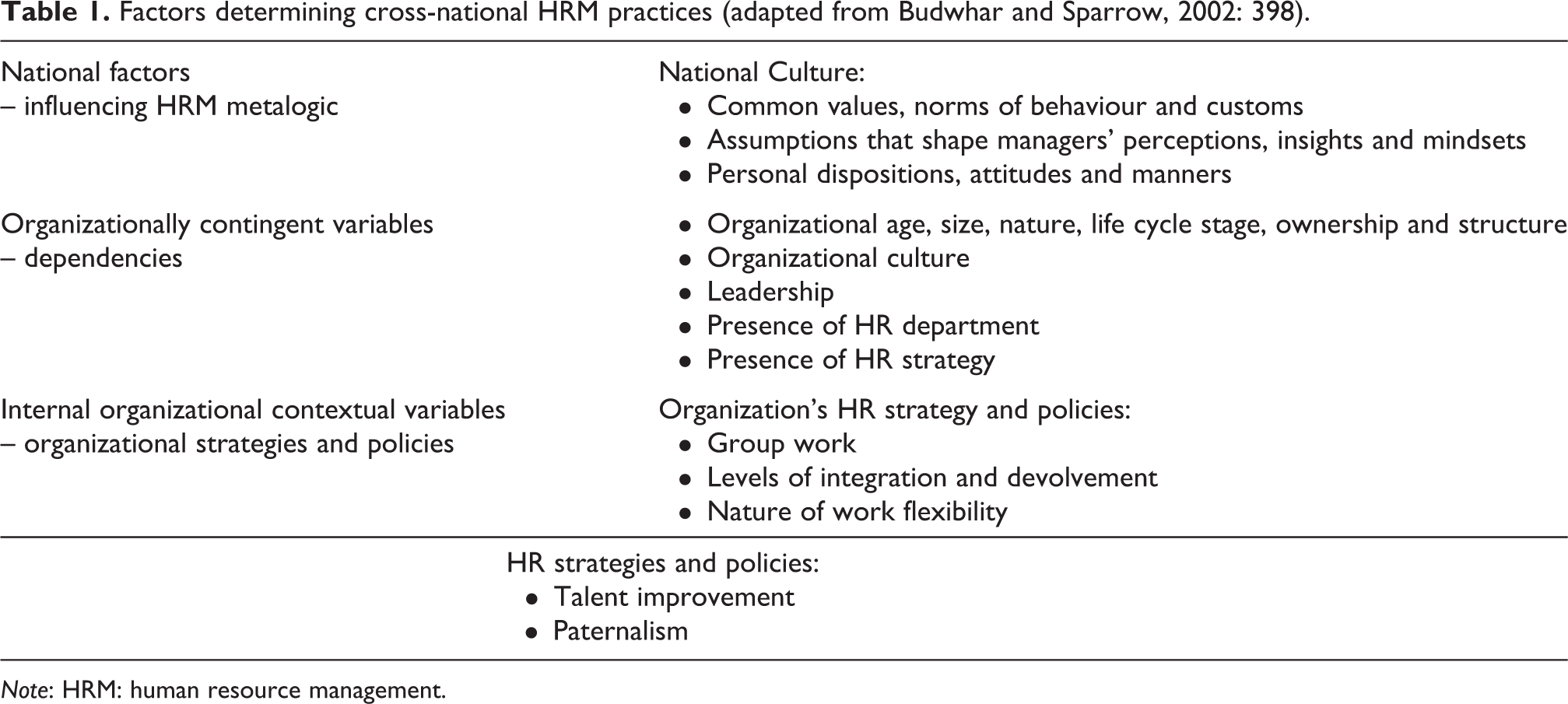
Budhwar and Sparrow’s framework has four levels, each one creating a context for the next level below. At the outer level are national, or environmental, factors which create an ‘HRM meta-logic’ (p. 387) that is the conditions and mindset that creates implementations of HRM in that country or region. These factors are national culture, institutions, industrial sector and dynamic business environment. For the purposes of focus and simplification, only the factors in the levels beneath national culture have been included (Table 1). At the next level are factors that define the specific organization such as its size and legal structure. It is here that this study has inserted organizational culture. At the third level is Organizational Strategies and Policies and these include policy about group working. At the core of the framework are the HR Strategies and Policies of the organization which include paternalism and professional development.
Factors determining cross-national HRM practices (adapted from Budwhar and Sparrow, 2002: 398).
Note: HRM: human resource management.
This study focuses on the influence of certain factors on job satisfaction among the employees in the HR department. These are organizational culture and leadership from the second level of this study’s adaptation of Budhwar and Sparrow’s framework, organizationally contingent variables; group work from the third level, internal organizationally contingent variables and talent improvement, represented here as personal and professional development, from the fourth level, HR strategies and policies. All of these are constrained by the metalogic of the national context partly determined by the national culture.
The Global Leadership and Organizational Behaviour Effectiveness (GLOBE) Project’s survey (House et al., 2004) measures national culture using nine dimensions giving two scores for each, one being for values and the other being for practice. The scores for two of these dimensions for Iran help to understand attitudes towards HRM in the country. The institutional collectivism dimension, which measures the degree to which collectivist behaviour is rewarded in society as a whole, scores highly as a value whereas in practice it only scores in the medium range. The in-group collectivism dimension measures the degree to which people create loyalty and cohesion in a circle of trust based on family and people they know well. Here, Iran scores highly on both in-group collectivism as a value and in practice, though it scores even higher in practice than as a value suggesting that this is a deeply ingrained principle in Iranian culture. The scores on these dimensions indicate that it may be revealing to examine the influence of team working on job satisfaction in the Iranian context since, if organizations do not have an organizational culture where employees regard their colleagues as part of their circle of trust, it is the institutional measure of collectivism that is relevant and on this measure Iranians are only moderately collectivist and might be expected to gain little satisfaction from working in teams. Team working is often promoted by HR professional training as a way of achieving good levels of effectiveness (CIPD, 2014; HRPA, 2014) and in the popular subject textbooks (e.g. Armstrong and Taylor, 2014; Beardwell and Claydon, 2010; Cornelius, 2001; Torrington, 2009) so attitudes towards team working and team climate (Sun et al., 2014) among HR professionals may also tell us something about their gaining satisfaction from their work. Thus, we included team working as a factor that may play a part in the relationship between organizational culture and job satisfaction.
The GLOBE Project’s dimension of power distance, that measures the degree to which people who lack power accept that others have more, shows that Iran has a relatively low score for power distance as a value but a relatively high score for it in practice (House et al., 2004). This suggests that it is entrenched in Iranian culture, and other studies have shown that in Iran there is an expectation that managers adopt a role of paternalistic nurturing in developing selected subordinates (Javidan and Dastmalchian, 2003; Tayeb, 1997). Thus, it might be expected that the HRM practices of learning and development might be consistent with the culture and a measure of this factor was included in our research. To measure this aspect of Iranian HR departments, we developed the novel construct of personal and professional development which combines training with the professional development of individual employees.
Leadership styles
In this study, we assume that leaders have the ability to shape organizational culture since leaders shape and develop organizational values, beliefs and strategy (Bass and Avolio, 1994; Denison, 1990; Schein, 2017). The transformational–transactional model of leadership styles (Bass, 1985, 1990) was chosen for this study because it is a well-established construct that is in constant use by many researchers and covers a full range of styles. Transformational leadership inspires followers with a vision of an ideal future where they are transformed through their involvement with something bigger than themselves. Transactional leadership, on the other hand, motivates followers with material rewards for desired behaviour. The model also includes laissez-faire leadership, where the leader adopts a passive role as an uninvolved figurehead, as a third type.
Leadership style, as it is represented in the literature, is a Western concept and its relationship with other organizational factors has also been investigated, for the most part, in Western contexts. However, these relationships may be different in the contexts of developing countries. Studies of leadership in Iranian organizations have been inconclusive as a whole with, Tojari et al. (2011) finding a positive effect of transformational leadership on organizational culture and effectiveness and a negative effect of transactional leadership, whereas Bikmoradi et al. (2010) and Mehrabani and Mohamad (2011) suggest that the predominant leadership style is patriarchal and transactional. Thus, we chose to investigate the effect of leadership style on job satisfaction through organizational culture
Balanced organizational culture
One of the most commonly used approaches to the study of organizational culture has been the competing values framework (CVF) which posits that there are four organizational culture types: hierarchy with a focus on stability, structure and clear rules and procedures; market with a focus on competitiveness, customer focus and responsiveness; adhocracy with a focus on innovation and flexible, adaptable structures and clan with a focus on internal consensus and external cooperation (Cameron and Quinn, 2011). An understanding of these culture types is useful for managers since they may find it valuable to influence the organizational culture so that the proportions of each type in the mixture is appropriate to the needs of the organization at that time.
Some researchers have argued that it is desirable for an organization to have a supportive combination of all culture types (Cameron and Quinn, 2011; Quinn, 1988). According to Quinn (1988), all four culture types are present in varying degrees in all organizations and Denison and Spreitzer (1991) follow Quinn (1988) in advocating a balance between the CVF culture types. They argue that all four types produce cultural resources which comprise a mix of different values and perspectives, which enable the organization to respond to a changing environment that may produce unexpected circumstances, and generally boost its performance (Gregory et al., 2009; Nazarian et al., 2017). Organizations exhibiting all four culture types would be likely to have the flexibility to be able to fully implement HR. Cameron and Quinn (2011) draw attention to the fact that subunits of an organization may exhibit a different dominant culture type to the organization as whole. Thus, this study examines the culture of the HR department using the construct of balanced organizational culture.
Cross-cultural leadership research has shown that collectivist societies tend to be more receptive to transactional and autocratic leadership styles while individualistic, Western societies tend to be receptive to transformational, participative styles (Bass, 1998; Gerstner and Day, 1994). However, much of the research on the effect of leadership style on organizational culture has been conducted within Western organizations, mostly in the United States and the United Kingdom (Yeganeh and Su, 2011); hence, further research is necessary to understand the effect of the national context on this relationship (House and Aditya, 1997; Huang et al., 2006; Tsui et al., 2004) and particularly in developing countries. For these reasons, we investigate the effects of all three leadership styles on organizational culture in Iranian HR departments, by testing the following hypotheses:
Job satisfaction
Job satisfaction is an overall attitude towards jobs based on individual perceptions (O’Reilly et al., 1991; Weiss, 2002). In a meta-analysis, Judge et al. (2001) showed that there is a significant relationship between job satisfaction and job performance despite the results of earlier studies that apparently showed a contrary result. This disparity is explained by the complexity of job satisfaction which aggregates many facets all of which may not have an effect in a particular context suggesting that job satisfaction may be sensitive to national cultural variation in its antecedents. For this study, we chose job satisfaction as the main dependent variable because it indicates how, in general terms, employees feel about their jobs and has been correlated with intention to turnover (Abraham, 1999; Aydogdu and Asikgli, 2011).
A study conducted in India by Lange et al. (2010) showed that intrinsic motivators, as well as the expected extrinsic motivators, influenced job satisfaction. These authors speculate that this result might be explained by the increasing dynamism of the Indian economy which has shifted the national culture towards individualism and indicates that HR practices should be introduced that address employees’ individual aspirations and needs. This observation again suggests that the national culture may have an effect on job satisfaction and, therefore, that its relationship with other variables may vary geographically.
Several studies in Western contexts have shown that transformational leadership influences job satisfaction (Dirks and Ferrin, 2002; Podsakoff et al., 1996) as well as team performance (Ishikawa, 2012) and is linked to organizational culture. Goodman et al. (2001), Silverthorne (2004) and Brazil et al. (2010) found that group (clan) culture values were positively related to job satisfaction whereas hierarchical cultural values were negatively related to job satisfaction.
Among scholars and practitioners in HR, generally, there are several principles that have entered the episteme of the discipline. For example, most introductory textbooks on HRM contain sections on team working and professional development (in the form of training or coaching) of employees, and attitudes towards these factors among HR personnel could be indicative of their attitudes towards HR in general. Team working, coaching and training are not novel concerns and there is overall awareness of their importance. Thus, to investigate how organizational culture and job satisfaction are related to each other, we included two possible intermediating variables in our study that are related to HRM processes: team working and personal and professional development.
Team working
Beer and Spector (1985) identify a set of HRM assumptions that include levelling hierarchical differences in order to encourage collaboration and improve communications for team building to engender trust and increase commitment. A direct relationship between leadership and team working has been shown (Dionne et al., 2004), and it has been suggested that transformational leadership works primarily at the group, rather than the individual level (Lord and Dinh, 2011). Transformational leaders can generate the perception of high competence and a clear vision which in turn spawns enthusiasm and commitment to the team’s objectives (Conger and Kanungo, 1987; Keller, 2006; Waldman et al., 2001). However, the majority of these studies have been conducted in Western countries, particularly in the United States.
Studies have also shown that there is a relationship between culture and team working. At the national level, Sosik and Jung (2002) compared team working between US students, representing an individualist culture, and Korean students, representing a collectivist culture, and they found that the US students exhibited higher levels of group potency and performance. On the other hand, Chen and Tjosvold (2002) argued that in the collectivistic values developing justice can improve team effectiveness. At the organizational level, Cameron and Quinn (2011) connect team building and open communication with clan culture. Since balanced organizational culture must, by definition, have a component of clan culture, it may be expected that the clan culture type would have a positive relationship with team working. Therefore, this hypothesis is proposed:
Apart from the failure to develop a strategic function, the dysfunctionality of HR departments is evidenced by the high staff turnover. The relationship between staff turnover and job satisfaction has been well known for some time (Holtom et al., 2008; Mobley, 1977; Porter et al., 1974). Team working has been shown to have a positive correlation with job satisfaction. In a study conducted in Australia, Williams (1998) found that team working was positively correlated with job satisfaction but that pressures to complete work could cause legacy hierarchical practices to reappear and disrupt the self-managing nature of the team. They conclude that training is required for team members on how to maintain practices for self-managing team working. Griffin et al. (2001) found that though there was a generally positive relationship between team working and job satisfaction this was also affected by the degree of autonomy from hierarchical supervision perceived by team members. A study of inter-professional team working among German healthcare staff found that team working completely mediated the relationship between organizational culture and job satisfaction (Körner et al., 2015). Hanaysha and Tahir (2016) showed that there was a positive correlation between team working and job satisfaction among university staff in Malaysia. To investigate the relationship between team working and job satisfaction in Iran, the following hypothesis is proposed:
Personal and professional development
In this study, we extend the concept of training, which is something that is provided by the employer, by adding personal development, which is an enhancement of the individual’s professional skills for his or her own development. This combination makes the construct professional and personal development as employed in this study. This construct was developed by combining different variables used in previous studies such as training (Choi and Yoon, 2015), skills development (Byham et al., 2002) and personal development (Cameron, 1978) as the authors believe that any one of these alone is insufficient for analysing the requirements of the HR department. Hence, for the purposes of this study, professional and personal development is defined as a ‘planned intervention that is designed to enhance the determinants of individual job performance’ (Chiaburu and Tekleab, 2005: 29); thus, training is often a large component of professional and personal development. There have been few studies of the relationship between organizational culture and training; for example, Rougas et al. (2015) found that the different CVF culture types produced different types of feedback in medical training, and Simosi (2012) found that organizational culture influences the application of knowledge and skills acquired in training to the job. However, these are concerned with specific aspects of training rather than giving us a general overview, and no studies could be found regarding the relationship between organizational culture and the professional development of individuals. Therefore, using our novel construct of professional and personal development, in this study, this hypothesis is proposed:
Studies which have addressed the question of which HRM practices affect job satisfaction have found that training is one of the most significant of these practices. Studies have confirmed that training has a positive effect on job satisfaction in a Western context (Choo and Bowley, 2007; Eaglen et al., 2000; Georgellis and Lange, 2007). However, this effect holds good not only for the Western context but also for the Far East, though no studies for the Middle Eastern context could be found. For example, Hosie et al. (2013) showed that training was the best predictor of job satisfaction among the factors that they examined in a study of employees in Singapore, and Ljigu (2015) found a similar result in a study of Ethiopian bank employees. A concern of employers is that training employees increases their value on the labour market and may encourage them to seek better paid employment elsewhere; however, a study by Koster et al. (2011) found that training did not increase intention to turnover among Dutch pharmacy assistants, as predicted by Human Capital theory, but instead had the opposite effect. Cameron (1978) discovered in a study of American academics that, to achieve organizational effectiveness, the personal development of individuals needs to be considered alongside the professional development provided by their employers. However, no studies could be found that investigate the effect of the paternalistic, career nurturing expectations of managers in the Middle East. To investigate the relationship between these factors in our Iranian sample, this hypothesis is proposed:
The more PPD is promoted the better is job satisfaction.
Since data were gathered from the employees of the HR departments of private sector organizations, H6 and H7 may be expected to indicate the attitudes and, therefore, the motivation to implement practices that support team working and professional and personal development on the part of these employees.
Conceptual framework
The conceptual framework shows the relationships between the five constructs used in this research: leadership, balanced organizational culture, team working, professional and personal development and job satisfaction (Figure 1). First, the relationship between leadership styles and balanced organizational culture is tested to discover the extent to which each of the three leadership styles correlates with balanced organizational culture. In this case, it is not the culture of the whole organization that is being measured but only the organizational culture of the HR department where all four culture types are present to a significant degree. Second, the relationship between balanced organizational culture and team working and balanced organizational culture and professional and personal development is tested. Finally, the relationship between team working and job satisfaction, also professional and personal development and job satisfaction, is tested. Job satisfaction is a construct that allows an insight into what the respondents perceive as being normal and correct. In this case, where there is a positive relationship it would imply that there is a tendency to pursue team working or personal professional development built into the specific culture of the organization, whereas the absence of a positive relationship would imply that these are not pursued.
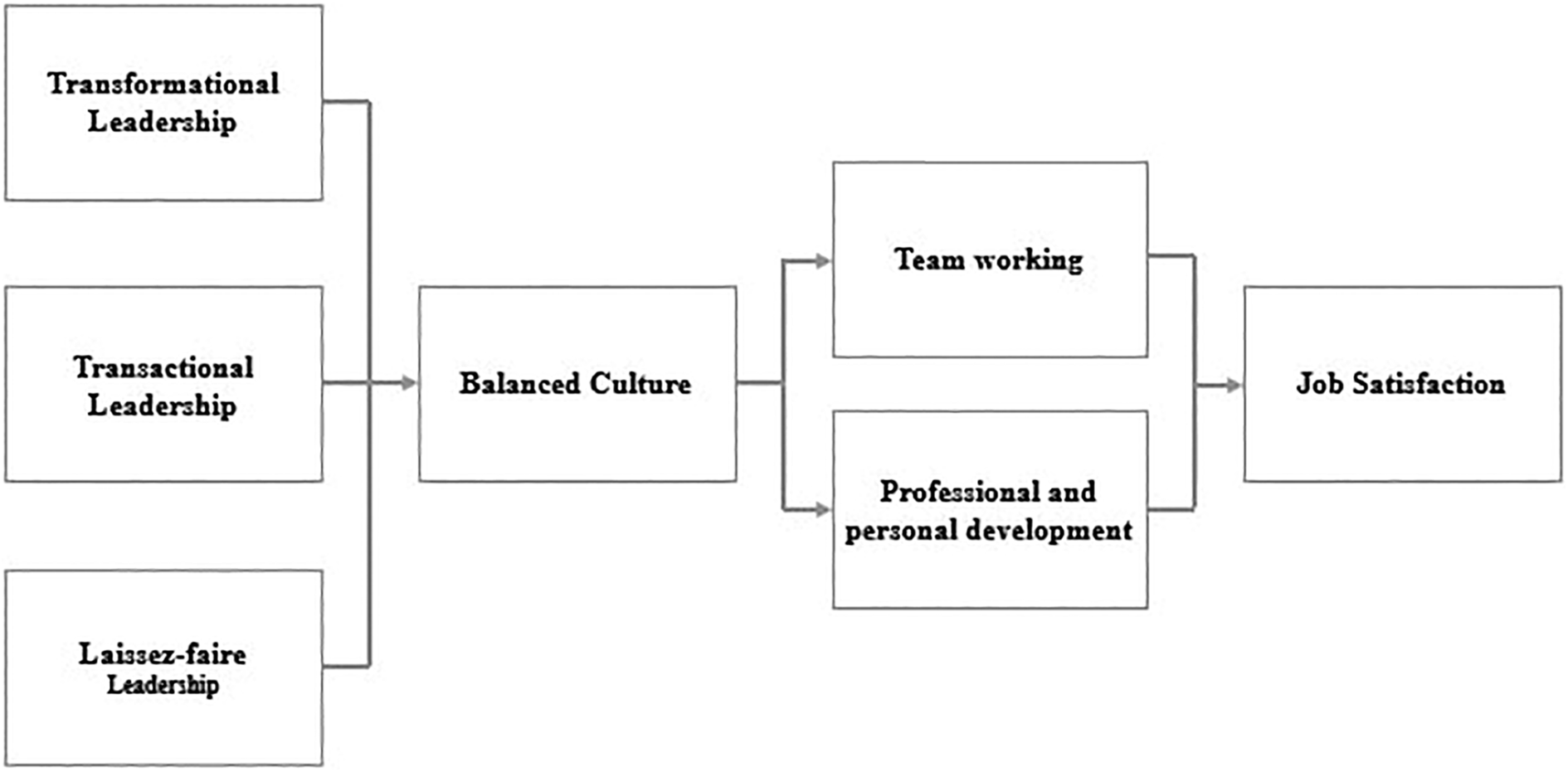
The research model.
Methodology
Data collection and sample
This study investigates some of the problems of implementing HRM principles and practices in Iran. We approached this task by gathering data from employees in the HR departments of private sector organizations. We chose these data population because if the cultural preferences of these personnel are not in alignment with HRM principles, this may in itself impede the implementation of HR practices.
Data were gathered using the questionnaire survey method. The instrument contained items on leadership style, organizational culture, team working, professional and personal development and job satisfaction. The selection criteria were that the company must be registered with the Iranian ministry of labour and must have an organizational structure where the HR department was clearly defined and have a minimum of five employees in this department; 150 organizations of various sizes and in different locations were identified in the first stage to be contacted. After contacting these organizations using either email or telephone, 46 of them agreed to participate in our study. Due to travel and time restrictions, and other constraints, the researchers proceeded with 38 of these organizations. However, after the first round of data collection, using the non-probability snowball technique of using respondents to make further contacts, the number of organizations was increased to 63. Generally, in the Middle East, it is difficult to collect substantial data as there is a tendency not to trust outsiders; however, once trust is built between researcher and managers, data collection becomes easier.
The questionnaire was produced in both hard copy and digital form. The HR departments had the choice of whether the questionnaires should be completed in hard copy or in the digital version. Approximately, 80 packages were sent to managers of HR departments in these 63 organizations which included hard copies of the questionnaire accompanied by a covering letter about the aim and objectives of the research for distribution. Additionally, an email which included the covering letter and a link to the digital version was also sent to the managers who were asked to forward it to their colleagues if appropriate.
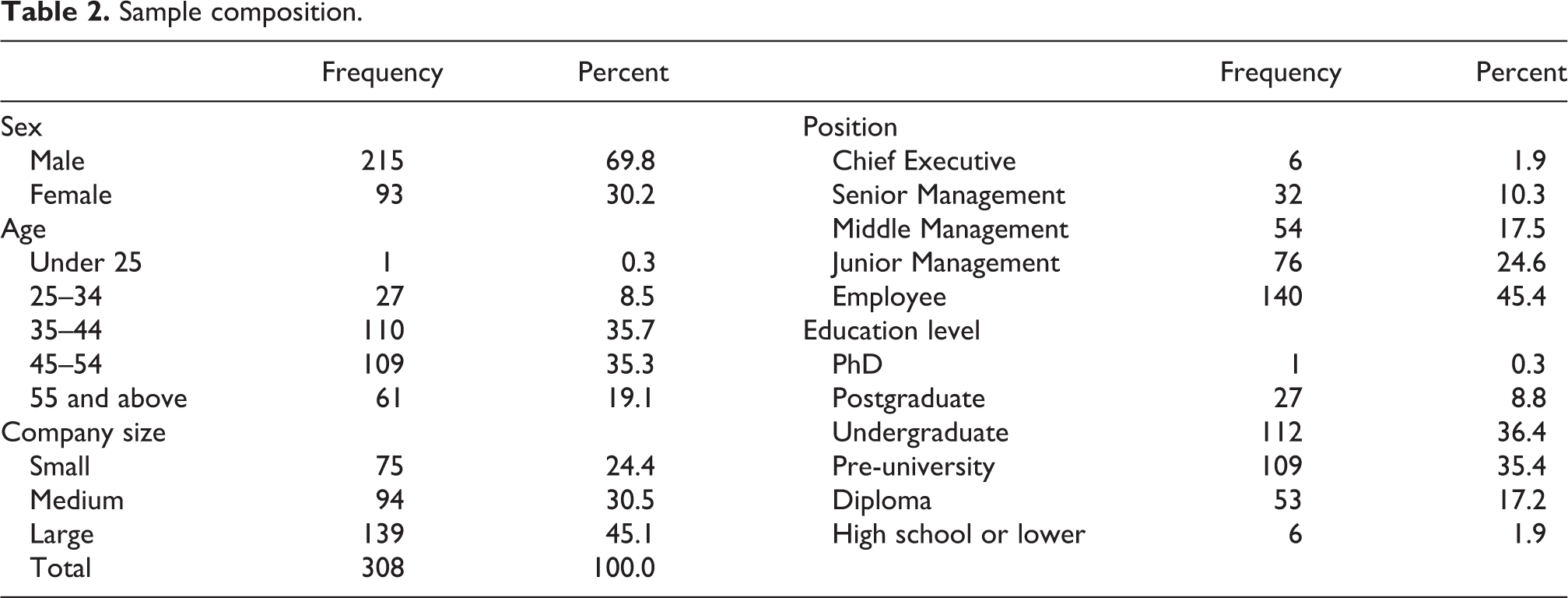
After 6 weeks, a total number of 325 questionnaires were received in either hard copy or digital format. After eliminating incomplete responses and missing data, 308 were found suitable for use in this study. Data were gathered from organizations in the motor manufacturing, telecommunications, food, packaging, IT, advertising and financial industries. The 63 organizations had a total of approximately 920 staff in their HR departments which provided us with the effective response rate of 34.67%. Of the 308 respondents, 69.8% were male (30.2% female), 71% of the respondents were aged between 35–44 and 45–54, 36.4% held undergraduate degrees and 35.4% pre-university degrees and 45.1% worked in large organizations (over 250 employees). Among the participants, 10.3% were in senior management positions and 42.1% in junior management and middle management positions, as summarized in Table 2. The non-response bias was examined by comparing the construct means for early and late respondents (Armstrong and Overton, 1977). No significant differences were found between these two groups, suggesting that non-response bias was not a problem.
Sample composition.
Instrument
The questionnaire was designed in English and then translated into Farsi (local language) using the four steps of the back-translation technique (Brislin, 1986). In the first stage, the questionnaire was designed in English and then translated into Farsi by one of the researchers who was native in the language. In the second stage, a professional translator was hired to translate the questionnaire back from Farsi to English to check for precise meaning and cross-cultural equivalence of the language. In the third stage, the researchers reviewed the translated version and layout to look for discrepancies. After reviewing the translated questionnaire, expert opinion was consulted on both versions and, as a result, some corrections were made to the Farsi version by the native researcher. Finally, another professional translator was hired to translate the new version of the questionnaire into English. This version was reviewed by the researchers to make a final quality check of the questions. When the questionnaire was thought to be of the best possible quality, the final survey questionnaire in Farsi was sent to organizations for data collection.
Measures
To develop the measurement scales, this study followed standard psychometric procedures recommended by Anderson and Gerbing (1988). We employed the validated scales from previous studies to measure the constructs. A seven-point Likert-type scale was used with scale 1 (‘strongly disagree’) to 7 (‘strongly agree’). Leadership style was measured using the dimensions transactional, transformational and laissez-faire, and items were adopted from the Multifactor Leadership Questionnaire (Avolio and Bass, 2004). Transformational leadership was measured using 12 items, transactional leadership was measured using 6 items and laissez-faire leadership was measured using 6 items.
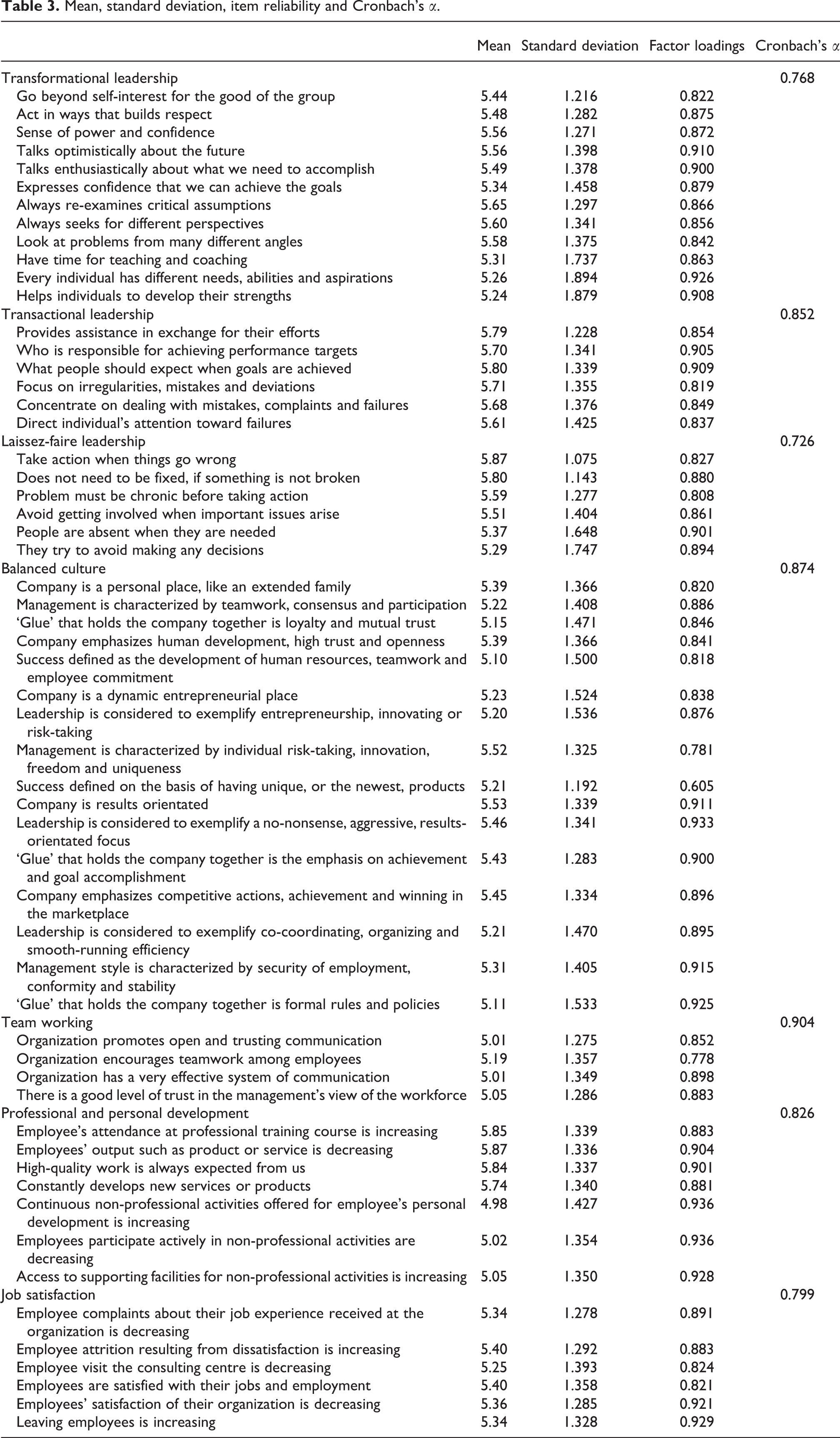
Organizational culture was measured using 20 items from the Organizational Culture Assessment Instrument (OCAI) developed by Cameron and Quinn (2011) based on CVF. The original questionnaire asked respondents to divide 100 points among four statements related to six dimensions based on their judgement where the closest to their situation would score the highest and others according to their closeness to the situation would score lowest and the total adds up to be precisely 100. However, after discussion with different experts in the field, and in light of the fact that some studies have used a Likert-type scale for OCAI (Table 3).
A seven-item scale drawn from the existing literature was used to measure team work (Katzenbach and Smith, 1993, 2005). The professional and personal development section included 10 questions. In order to design this section of the questionnaire, the authors employed the five stages model of managers’ skill development proposed by Byham et al. (2002) which are (1) employees having high level of potential are drawn together, (2) further assessment of the employees’ development/training possibilities, (3) making specific recommendations for improvement, (4) implementation of the program and process documentation and (5) assessment of progress and defining new directions. Using this theory and using some existing instruments for measuring professional and personal development (Cameron, 1978, 1995), this section was designed to measure professional and personal development. Job satisfaction was measured using items modified from Cellucci and DeVries (1978), MacDonald and MacIntyre (1997) and an adapted version of the Minnesota Satisfaction Questionnaire (Weiss et al., 1967), which was originally developed for measuring employees’ intrinsic and extrinsic job satisfaction.
Mean, standard deviation, item reliability and Cronbach’s α.
Several procedures were used to test the properties of the reflective scales with the data. Discriminant validity was examined through confirmatory factor analysis (CFA) and measured by average variance extracted (AVE) for each construct and compared with the square correlation between them (Fornell and Larcker, 1981). Based on Dillon and Goldstein’s (1984) and Fornell and Larcker’s (1981) recommendations, the variance extracted for each construct was compared to the square of each off-diagonal value within the Phi matrix for that construct. The results show that the AVE for each construct and the items represent a distinct underlying concept. Moreover, a good rule of thumb is that an AVE of 0.5 or higher indicates adequate convergent validity (Hair et al., 2006). To address multicollinearity, established procedures were followed to calculate mean centre-related variables prior to generating proposed interaction terms to assess the hypotheses (Aiken and West, 1991).
Results
Reliability and validity of the measures
According to the recommendations of Anderson and Gerbing (1988) and Hair et al. (2006), the two-stage approach in structural equation modelling (SEM) was employed to test the importance of all pattern coefficients of the seven hypotheses, using 308 observations for analysis. The first stage examined the measurement model (inner model) by using AMOS 21 and was carried out to identify the causal associations between observed items (variables) and the latent (unobserved) construct. The validity of the construct was tested by CFA in this stage. The second stage was tested using the structural (i.e. regression path) model (outer model), which explained the causal relations among the observed constructs (Anderson and Gerbing, 1988). The items that were measured were unidimensional, and CFA provided an acceptable fit (df = 1.673; CFI = 0.934; IFI = 0.934; TLI = 0.930). Reliability was assessed using Cronbach’s α. As given in Table 3, Cronbach’s α was higher than 0.871 for all measures, indicating a high degree of internal consistency (Bagozzi and Yi, 1988).
In addition, the reliability of each measure was examined using composite reliability (rho). They were found to be greater than the recommended 0.7 which suggested a satisfactory level of reliability (Bagozzi and Yi, 1988; Hair et al., 2006). Convergent validity was checked with the values of CFA loadings and standard errors. All item and construct loadings were noteworthy (t-value/CR > 1.96). The correlations between study variables are presented in Table 4. We examined common method bias by using Harman’s one-factor test (1967), and the result suggests that there is 39% variance which is lower than the common method bias value (Podsakoff et al., 2003). Also, we tested a common latent factor by employing a χ2 difference assessment among the original and fully constrained model. Two models were meaningfully dissimilar but share a variance, and the data were credited for additional study.
Constructs correlation matrix.
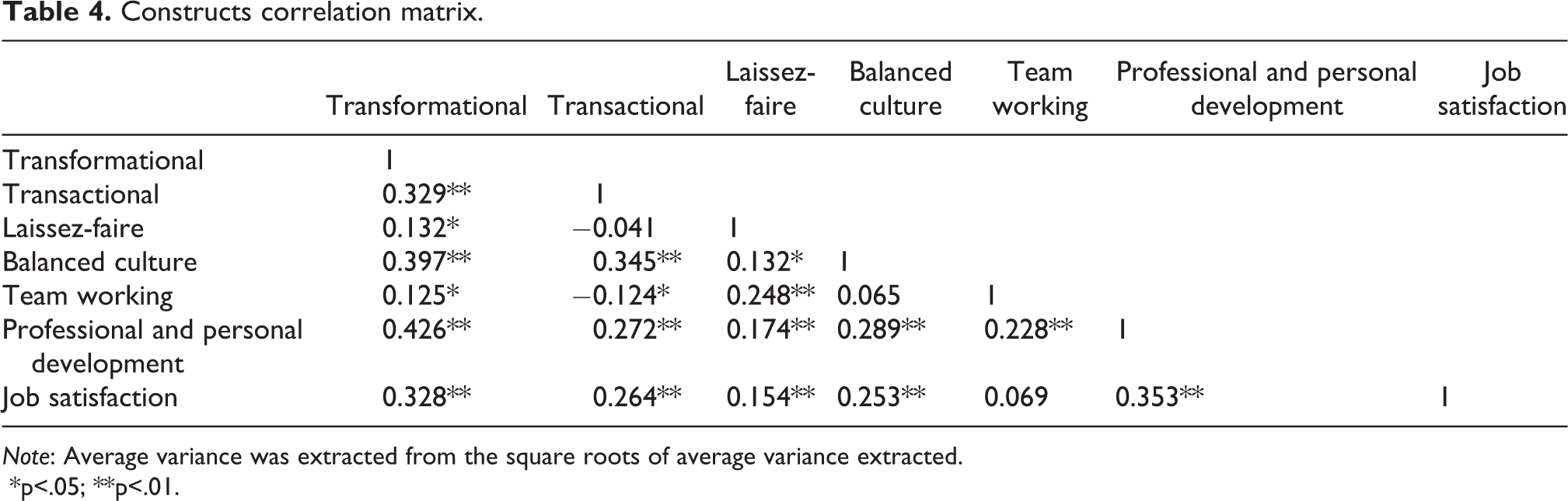
Note: Average variance was extracted from the square roots of average variance extracted.
*p<.05; **p<.01.
Hypotheses testing
Using the relationships shown in the conceptual model, Figure 1, the seven hypotheses were tested using SEM. The results are given in Table 5 and depicted in Figure 2. Hypothesis 1 posits that transformational are positively related to balanced culture. The result supports this hypothesis (γ = 0.96, t = 2.906). Figure 1 shows that hypothesis 2 posits a positive relationship between transactional and balanced culture. The result, however, does not support this hypothesis (γ = 0.162, t = 2.520). The results show that hypotheses 3 (laissez-faire > balanced culture) and hypothesis 4 (balanced culture > team work) are significantly different from 0 at the 0.001 significance level, therefore, were rejected (γ = 1.669, t = 1.046, p = 0.296; γ = 0.271, t = 1.761, p = 0.078, respectively). There is a positive relationship between balanced culture and professional and personal development, and hypothesis 5 was supported (γ = 1.245, t = 4.673). Hypothesis 6, which predicts the relationship between team work and job satisfaction, is not supported (γ = −0.090, t = −1.924, p = 0.054). The last hypothesis concerns the potential impact of professional and personal development on job satisfaction. The analysis shows that there is significant positive relationship (γ = 0.433, t = 2.294) (Table 5). Thus, the conceptual model (Figure 1) was validated through testing these hypotheses resulting in a validated model shown in Figure 2.
Results of hypothesis testing.
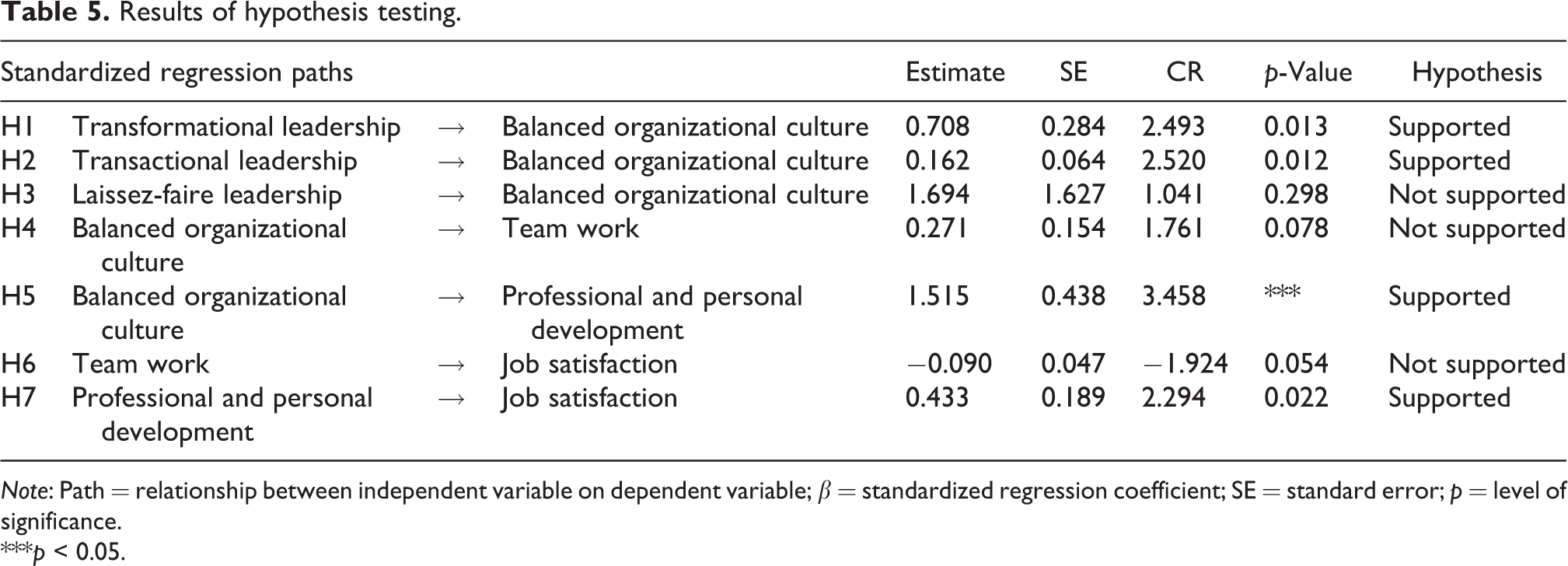
Note: Path = relationship between independent variable on dependent variable; β = standardized regression coefficient; SE = standard error; p = level of significance.
***p < 0.05.
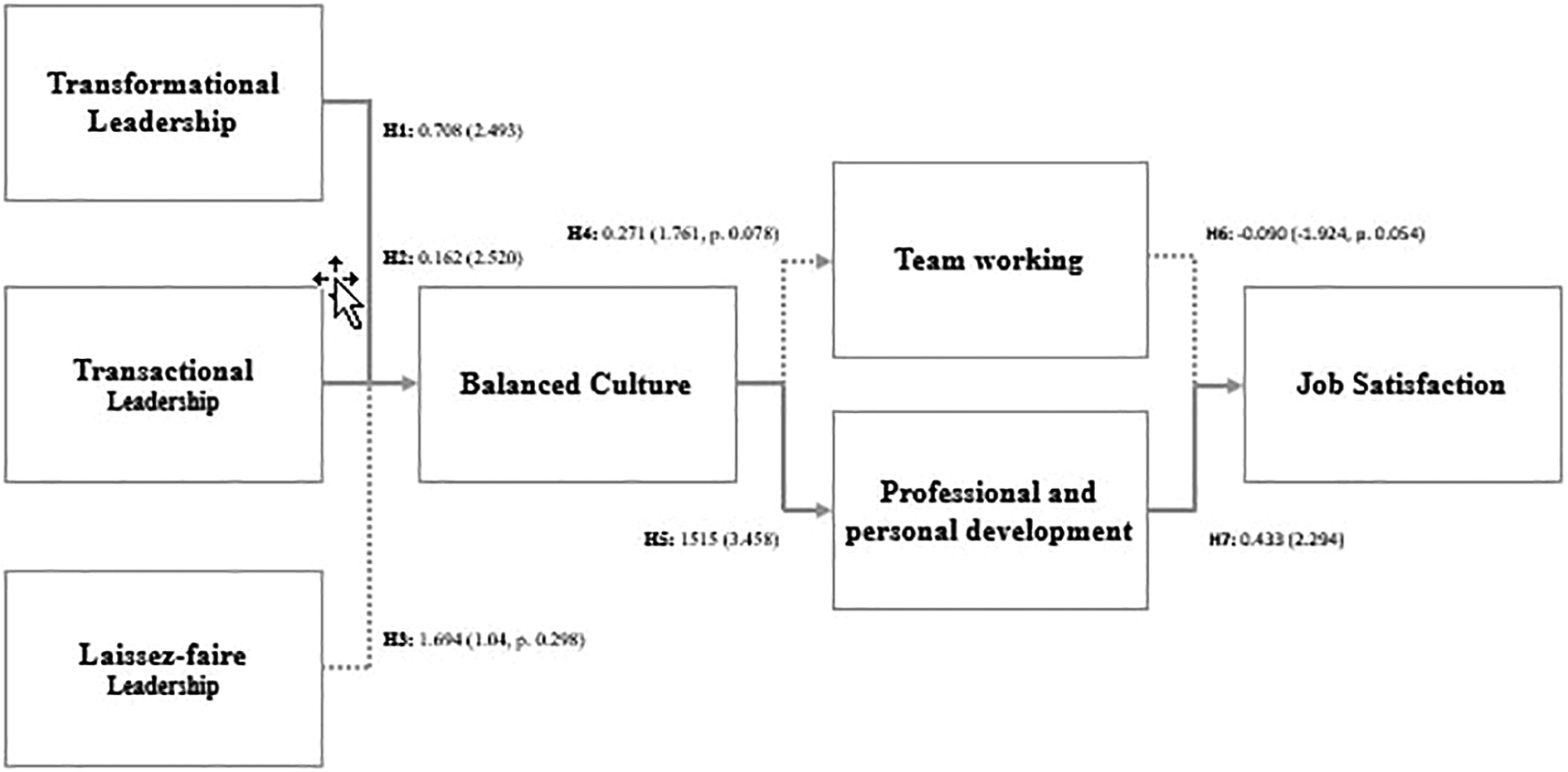
Validated model.
Discussion
As shown in previous studies, there have been problems with the implementation of HRM principles and practices in Iran. Among the problems for the HR function in Iranian organizations have been HR not having a strategic role and high staff turnover (Namazie and Frame, 2007; Soltani, 2010; Tayeb, 2003). To investigate these problems, this research examined the relationship between leadership style, balanced organizational culture, team working, professional and personal development and job satisfaction of employees in the HR departments of Iranian private sector organizations. The analysis of the data resulted in two unexpected findings concerned with the relationship between leadership and organizational culture and the perception of team working. These relationships indicate that the values and beliefs of employees are somewhat different from those of employees in Western contexts where most of the previous research has been conducted and that a different approach is required for managing Iranian employees.
First, both the transactional and transformational leadership styles have a similarly strong positive relationship with balanced organizational culture. This finding was unexpected since the literature indicates that transactional leadership is generally thought to have this relationship less strongly than transformational leadership (Bass and Avolio, 1993; Xenikou and Simosi, 2006). It suggests that Iranian employees are more often motivated by extrinsic factors and, therefore, have a more transactional work orientation (Wrzesniewski et al., 1997) than Westerners, who are more often motivated by intrinsic factors.
The recent history of Iran should be kept in mind. Because of uncertainties in the general economic circumstances, brought about by years of sanctions, management thinking may have become overly risk averse and unimaginative. The stronger than expected role of transactional leadership found in this study suggests that managers in Iran tend to place a higher priority on organizational stability and consistency of processes (Afsar et al., 2017) than Western managers. While Western management theories and practices may eventually prove to be beneficial, their introduction is a step into the unknown for Iranian managers.
Second, team working took no part in the relationship between balanced organizational culture and job satisfaction. Also, there was no relationship between balanced organizational culture and team working and no relationship between team working and job satisfaction. The literature dealing with team working in a Western context indicates that team working should be expected to have a positive relationship with job satisfaction (Judge et al., 2001; Nielsen et al., 2009; To et al., 2015). This suggests that these relationships are affected by a different set of values and beliefs among Iranian personnel from those of Western employees.
According to Tayeb (2003), Iranians are reluctant to participate in self-regulating teams, do not automatically perceive colleagues as being members of their circle of trust and expect managers to exercise control. These factors add up to a perception that peer consultation and decision-making is inappropriate and that decisions should be made autocratically by superiors (Yeganeh and Su, 2007). This is supported by the GLOBE survey (2004) which found that people in the Middle East region, which includes Iran, are collectivist when their interactions are within their circle of trust but individualistic outside it (Javidan and Dasmalchian, 2003).
Thus, our findings indicate that attitudes towards team working within the HR department itself may be indicative of attitudes towards HRM principles concerning how to enable employees to work together effectively that could affect job satisfaction, and so compromise the full implementation of HRM practices. Team working depends on a sense of trust and belonging, and it may be that managers need to make a deliberate effort to promote an organizational culture that fosters these.
On the other hand, the relationship between transformational leadership and balanced organizational culture was as expected and so too was the finding that laissez-faire leadership had no effect on balanced organizational culture. According to previous studies, the Iranian perception of the manager as a father figure means that employees are dependent on him for his active interventions (Tayeb, 2003) and Iran scores highly on Hofstede’s dimension of power distance (Hofstede, 1980), so having a passive manager who, for example, encourages self-regulating teams would be unsatisfactory to them.
Additionally, it was also expected that professional and personal development as a newly developed construct based on the concept of training would have an effect on the relationship between balanced organizational culture and job satisfaction. Since managers are expected to be father figures, Iranians tend to see personal development alongside of professional development (the notion of training) as a natural aspect of that relationship. So, professional and personal development, when it occurs, contributes to job satisfaction because it fulfils an expectation of paternalistic nurturing (Javidan and Dastmalchian, 2003; Tayeb, 1997) which has been observed by previous researchers, where managers take responsibility for developing the skills of selected junior employees to prepare them for more responsibility (Namazie and Frame, 2007; Yeganeh and Su, 2011).
The GLOBE Project (2004) collected data on national culture. Countries are grouped into regions with Iran included in the South Asian region along with India and Malaysia. On the dimension which is most significant to this study’s findings about team working, the practice of in-group collectivism, the countries of this region have similar scores: Iran scores 86% compared to the regional average of 83%. For comparison, the lowest scoring region on this dimension is the Nordic countries at 53% and one region, Middle East, scores a little higher at 81%. Since the Iranian score on this dimension is close to the scores for both the Middle East (Qatar, Kuwait, Egypt) and the Southern Asia (India, Indonesia, Malaysia, Philippines and Thailand) regions, it follows that our results concerning team working may be generalized to these regions.
Implications and limitations
Our research set out to investigate some problems reported to be experienced by HR departments in Iran. This problem was addressed by collecting data from personnel working in HR departments in 63 private sector organizations. We chose to collect data from within the HR department to find whether some HRM principles are not in alignment with the culture of the personnel who are expected to implement them. Our results have interesting and practical implications for scholars and practitioners.
Theoretical implications
This study has several theoretical implications. First, it improves the utility of Budhwar and Sparrow’s (2002) integrative framework by including organizational culture and leadership. Second, it contributes to our understanding of team working in Iran, and by generalization in the Middle East region as a whole and Southern Asia. Third, it demonstrates that transactional leadership is as significant in bringing about job satisfaction as transformational leadership in Iran. Fourth, it introduces the new construct, professional and personal development, which combines concepts of training and development from the employer’s point of view with the concept of professional development from the employee’s point of view. Fifth, it demonstrates the usefulness of balanced organization culture, which has been a relatively neglected construct (Quinn, 1988).
Although previous studies (Namazie, 2003; Nazarian, 2013; Tayeb, 1997) have speculated that team working would not be successful in the Middle Eastern context, this study empirically demonstrates that it does not contribute to job satisfaction. This could create a problem for HRM implementation as, generally, in the HR department there is a need for group and team effort to achieve organizational goals (Jiang and Liu, 2015). Additionally, HR personnel may be expected to promote a culture of team working in the rest of the organization, for example, through training. Since the Iranian score on the dimension of the Globe Project national cultural survey which is most relevant to this phenomenon, practice of in-group collectivism, is similar to those of other countries in the Middle East and Southern Asia, we argue that our results may be generalized to these regions.
Our novel construct of personal and professional development combines the constructs of training and coaching. Training is concerned with developing the usefulness of the employee to the organization whereas coaching develops the capacity of the employee to achieve his or her personal professional goals (Bright and Crockett, 2012). We suggest that this new construct is a potentially powerful one since training and coaching should have aims which are aligned and the combination should produce employees who are both more useful and more motivated.
This study uses the construct of balanced organizational culture, meaning that all four of the CVF culture types are represented in the organization’s culture, or as in this case, subculture. Balanced organizational culture helps to maintain flexibility and responsiveness and it seems likely that it may have an impact on a wide range of organizational factors and further research is needed to investigate this. In our study, its impact on job satisfaction has been investigated. This construct has not been used in this way before since, in the past, researchers have tended to focus only on the effects of the individual cultural types though, as Cameron and Quinn (2011) point out, they are not separable entities.
Practical implications
From a practical standpoint, these results suggest that managers should also be mindful of the cultural context when attempting to transfer Western HRM principles and practices to another context and this is valid whether they are foreign managers, local managers trained abroad or local managers implementing Western practices. This research implies that interpretations and measures of job satisfaction, leadership and organizational culture are all relative to national culture (values and beliefs) and it follows that this principle applies not just in the context of HR but to all the organizational functions. Our study shows that transactional leadership exhibited more influence than expected on balanced organizational culture (e.g. Bealer and Bhanugopan, 2014; Xenikou and Simosi, 2006) and transactional leadership was shown to be as important as transformational leadership in its influence on job satisfaction. Together these, suggest that extrinsic motivation is as important as intrinsic motivation for Middle Eastern employees. Therefore, it is useful for managers to be aware that they need to develop a complimentary mixture of extrinsic and intrinsic factors when considering the motivation of their employees.
The HR function particularly requires a flexibility of approach which comes from diversity of thinking, not only to successfully run its own processes but also to work with the subcultures of the other functions within the organization (Torrington, 2009). Thus, balanced organizational culture is a good context for HRM implementation because it encourages diversity of thinking which may be harnessed through team working if employees are willing to accept teams. Our findings demonstrate a relationship between balanced organizational culture and professional and personal development, also between professional and personal development and job satisfaction, thus supporting existing research into the relationship between organizational culture and training (e.g. Hanaysha and Tahir, 2016; Hosie et al., 2013; Simosi, 2012; Tabvuma et al., 2015). However, the novel construct of personal and professional development created for this study extends the existing constructs of training and coaching by adding the element of personal development which combines developing the individual as an employee through training and developing the individual towards achieving personal goals through coaching. Our findings suggest that, due to the collectivist nature of Middle Eastern culture where managers are expected to fulfil a paternalistic role, they are expected to take an interest in the personal goals of their subordinates as well as seeing them as a resource of the organization.
Our findings suggest that to leverage the positive effects of team working observed elsewhere (Lehmann-Willenbrock et al., 2015; Nielsen et al., 2009; To et al., 2015), Middle Eastern managers should promote a clan organizational culture so that employees accept each other as part of their own circles of trust. Clan culture might, for example, be fostered by using some of the principles and techniques of DHL (Chan, 1997) which encourages friendly and collaborative relationships between employees, trust between managers and subordinates and promotes the idea of ‘us’ against their competitors.
Limitations and future studies
Inevitably, this study has limitations in the distribution and size of the sample. The first limitation is that these data were collected from a few major cities and in order to have a better view of HR departments it would be sensible to expand the data collection locations. Additionally, an increase in sample size would increase the reliability of the results.
Another limitation is that this study only looked at private sector organizations and, as the public sector plays a major role in the Iranian economy, it would give a more complete picture to look at the HR departments in the public sector and compare them with the private sector. It would also be advantageous to investigate organizations recently privatized according to Article 44 of the Iranian Constitution (which enables the privatization of state-owned entities) and perhaps make comparisons between them and existing private sector organizations so as to make policy recommendations and assist managers and employees in the transition from public to private sectors. Also, it may be revealing to look at the HR departments in joint ventures involving Western companies and compare them with local organizations.
Given the particular nature of the context considered, the conclusions of this research also imply that job satisfaction, leadership and organizational culture are relative to national culture, in this case, Middle Eastern values and beliefs. This principle applies not just to the HR department but to all the organizational functions. Since we have found that the relationships between the chosen constructs were not as expected, further research is required to confirm and further explore these findings. This further research would probe the causes of these relationships and would, therefore, be of a qualitative nature. Once the relationships between these constructs have been explained, researchers will be in a better position to formulate further recommendations for practitioners.
This study gives rise to other further questions for future study, particularly in connection with organizational culture types and location. We have looked at organizational culture in terms of balanced organizational culture which is thought to be advantageous to organizations because it allows them the flexibility to respond to a changing environment. However, it may be instructive to examine how each of the four CVF culture types affect team working and professional and personal development; for example, it may be that clan culture has a relationship with team working. Having shown evidence that suggests that HR theories and practices are not transferrable to the Middle East without adaption it would also potentially be useful to investigate how these theories and practices are received in other regions of the world.
Footnotes
Declaration of conflicting interests
The author(s) declared no potential conflicts of interest with respect to the research, authorship, and/or publication of this article.
Funding
The author(s) received no financial support for the research, authorship, and/or publication of this article.
