




Abstract
This article discusses risk management processes in Britain’s civil nuclear industry from a corporate governance perspective. As an example of a hazardous industry that can inflict catastrophic environmental damage and fatalities, effective governance of Britain’s nuclear industry is a critical issue. Yet the industry’s history of corporate governance suggests that processes of corporate governance have regularly failed to meet core requirements of its stakeholders. A core requirement is for governance designs that recognize the interests of public owner–stakeholders. In meeting this requirement, the article offers a framework for a relationship-driven form of corporate governance that enables meaningful stakeholder engagement in decision-making.
Introduction
This article discusses risk management 1 processes in Britain’s civil nuclear industry from a corporate governance perspective. 2 As a hazardous industry with the potential to inflict catastrophic environmental damage and fatalities, effective governance of Britain’s nuclear industry is a critical issue. Yet the industry’s history of corporate governance suggests that operational decisions were taken within opaque governance processes that met the requirements of government confidentiality rather than the industry’s stakeholders. This article’s focus, therefore, concerns governance challenges in Britain’s civil nuclear industry and the relational processes that may promote transparency and facilitate routine, meaningful stakeholder engagement. The approach taken involves a historical review of corporate governance practices based on a corporate governance theoretical lens.
The civil nuclear industry is hazardous, due to its endemic characteristics. These characteristics include an enduring toxicity in the operational materials used, large-scale cutting-edge technological and safety demands, and blurred, overlapping relationships between military and civilian uses of technology. The impact of these characteristics together with the forms of governance implemented has led commentators to describe the state-owned nuclear project as “the greatest misallocation of public funds in British industrial history, costing the taxpayer £11 billion (UK) at 1981 prices” (Durie and Edwards, 1982: 28).
Furthermore, Britain’s civil nuclear industry has created a potentially catastrophic nuclear legacy. This legacy includes redundant plant and equipment, nuclear waste, and highly radioactive materials stored in temporary facilities, all of which pose a persistent hazard to public health and the environment (Flowers Report, 1976). Yet, despite these challenges, the British government has sought to enter into international collaborations seeking to build new reactors on British soil. In exploring the thinking behind these decisions, it is suggested that consideration of various corporate governance paradigms in Britain’s nuclear industry offers examples for other hazardous industries to follow in their risk management processes. For the nuclear industry, the concept of balancing stakeholder interests with those of the owner appears particularly relevant in terms of legitimizing its potentially catastrophic activities. However, in Britain’s geographically dispersed, government-sponsored nuclear industry, many divergent interests exist that make such an alignment of interests challenging. Nonetheless, for hazardous industries to continue seeking social acceptance, corporate governance paradigms will necessarily include processes that enable effective engagement between stakeholders of those industries.
Against this background, the industry’s historical phases of corporate governance were reviewed against the degree to which they appeared appropriate to address specific challenges. Appropriateness was considered with reference to the degree that economic and individual goals of state owners, on the one hand, and the social–communal goals of public citizens, on the other, were, or were not, in equilibrium. To achieve this, governance-related events were identified and assessed in scaling the industry’s challenges. For instance, a consistent focus of the nuclear industry’s state owners and directors has been on the utilization of site-based organizational structures and practices that meet the requirements of its site license. This focus derives from a statute-based regulatory approach (The Nuclear Installations Act, 1965) and its subsequent quality assurance that has been the principal means of monitoring and controlling the industry’s site activities. In supporting this approach, Britain’s nuclear industry was governed by contemporary corporate governance paradigms that reflected the political approach to the public sector at the respective period of time. Such paradigms included the use of trusted stewards (allowing scientists and engineers to manage sites), agents (allowing corporations to manage sites), and stakeholders (a limited communication with identified stakeholders). However, these governance approaches proved unable to prevent a demise in the industry and the creation of a legacy. This article therefore seeks to establish factors that influence the equilibrium for stakeholder and owner interests in this hazardous industry.
How stakeholders engage with management processes in hazardous industries is complex. However, based on Clarke’s (2007) definition, a paucity of stakeholder engagement may be deemed to be a failure of corporate governance, as this would include a failure to address external challenges such as satisfying stakeholder needs. This governance requirement was examined in another context but proved helpful to our analysis.
Mathews (2005) identified a need in the state-owned nuclear industry to locate an equilibrium point for the twin governance interests of maximizing production and protection. Mathews reflected on a scenario in which resources are finite and decisions are therefore required in the way that investments may be optimized to improve efficiency (production) or safety (protection). Adopting this approach, an appropriate balance of state, industry, and communal interests that draws together and reports on core concerns of the industry’s principal stakeholders (namely, the state owner, plant managers, and local communities) may lie at the center of a well-managed system of “nuclear governance.” Accordingly, a form of “nuclear governance” that aligns the industry’s efficient production of nuclear-generated energy with high, societal levels of protection could serve as a suitable system of risk management of this industry.
The article proceeds by analyzing relevant corporate governance paradigms. It examines each paradigm used in the industry. In addition, three seismic nuclear incidents reflecting societal levels of risks are considered. A discussion of the public implications of these risks is followed by preliminary conclusions of their effects on policy in sustaining nuclear and other industries in and beyond Britain.
Paradigms of corporate governance
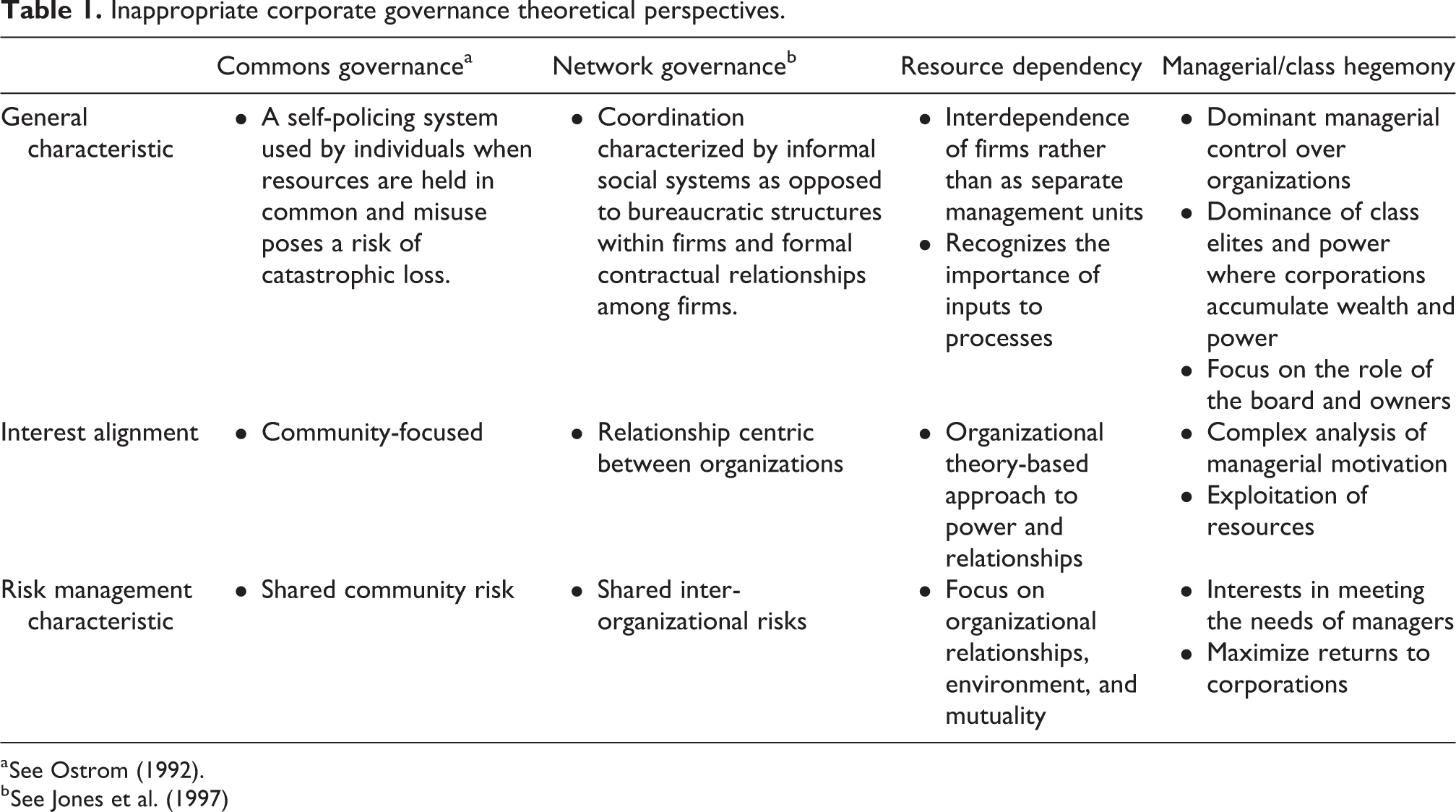
Initially, seven possible governance approaches were identified together with Clarke’s (2007) limitations for each approach. However, in terms of generic hazardous industries and, in particular, Britain’s civil nuclear industry, four of the governance approaches (Commons, Network, Resource Dependency, and Class Hegemony) were discounted in their limited applicability to the industry. Its key characteristics were its potentially catastrophic hazards, cutting-edge technological requirements, uncertain financial requirements, and enduring timescales. Following this view, a theoretical focus developed in which Stewardship, Agency, and Stakeholder theory were seen as key paradigms. Table 1 identifies characteristics of the four discounted governance approaches followed by a priori reasons for this decision.
Inappropriate corporate governance theoretical perspectives.
a See Ostrom (1992).
b See Jones et al. (1997)
Commons governance scholars suggest how user contributions may support shared assets (Ostrom, 1992; see www.iasc-commons.org/goals/) to a sustainable level. Issues in this paradigm concern rule definition, boundary definition, and membership of groups together with sanctions and mediation. Commons governance identifies the shared-user problem but is not applicable where users are required to pay for a service, such as electricity generation. By contrast, network governance considers how networked managers may enforce Ostrom’s (1992) eight principles of commons governance (Giest and Howlett, 2013). Network governance constitutes a “distinct form of coordinating economic activity” (Powell, 1990: 301), which contrasts and competes with markets and hierarchies (Jones et al., 1997: 914). Economic activity is coordinated through socially driven rather than legally driven needs. This paradigm was excluded from further analysis following the regulated and legal framework of the nuclear industry.
Resource-dependent governance has an organizational focus that recognizes the strengths of mutuality. This perspective highlights the “interdependency” (Clarke, 2007: 27) of firms and the impact of uncertainty on their strategic development. Work performed in the nuclear industry relies on procured services, which is a regulatory requirement (as set out in the Energy Act, 2004). By contrast, managerial or class hegemony perspectives offer power-based insights into control within organizations. In managerial paradigms, corporate stakeholders may form alliances within the organization to perpetuate “elite and class power” (Clarke, 2007: 27). Yet Britain’s nuclear industry has not been the subject of class power challenges.
Clarke (2007) also reviewed theoretical concepts adopted in this article. For example, he suggested that agency theory was narrowly focused and ignored organizational complexity. Stewardship is “largely untested” (Clarke, 2007: 28), while stakeholder theory is thought to contain conceptual and operational issues around a core difficulty in distinguishing among the respective interests of stakeholder parties (Laplume et al., 2008). However, prominent elements of these paradigms were drawn on at various stages in the industry’s development, and those elements are set out in Table 2.
Key corporate governance theoretical perspectives.
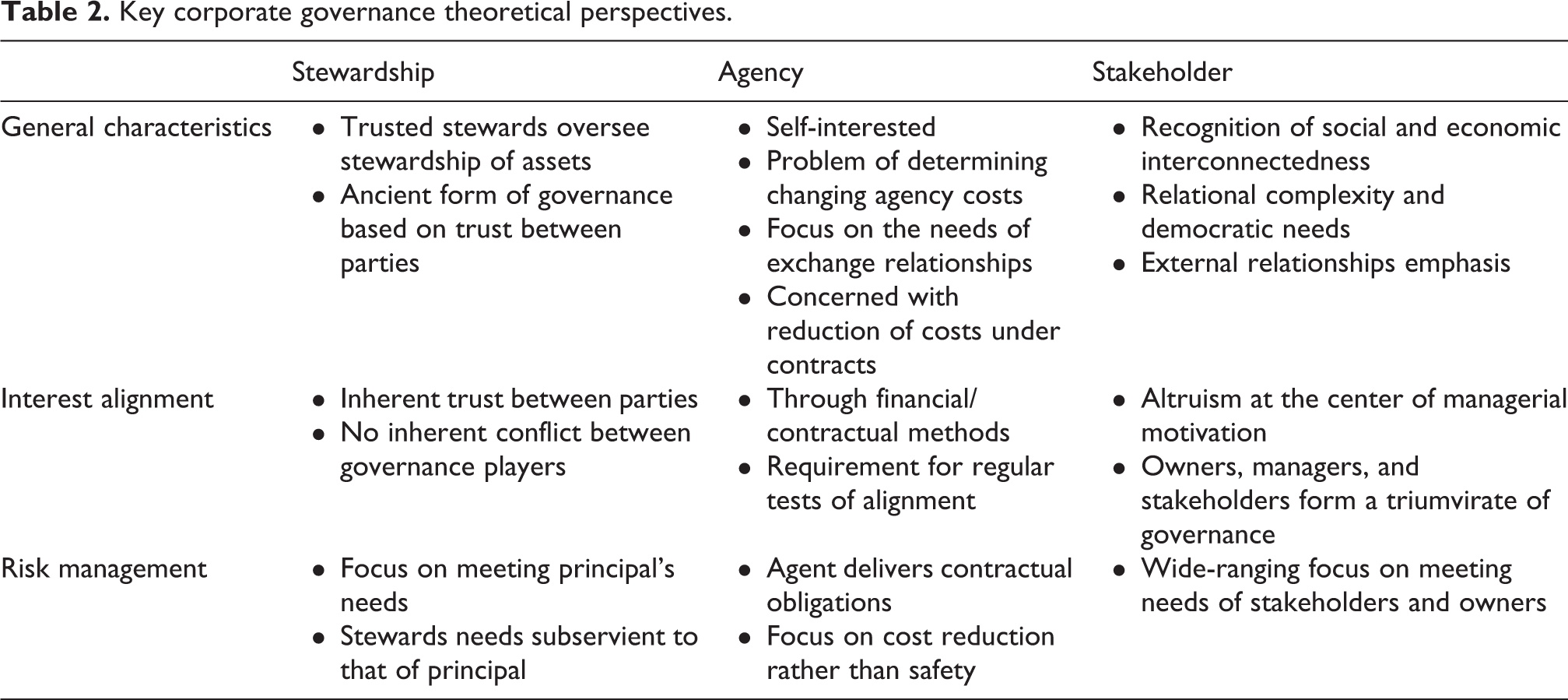
In sum, suitable governance paradigms for the hazardous nuclear industry may include a fundamental need for trust among members of the public with a deep interest in one or more nuclear energy sites (“public stakeholders”). This trust would rely on agents to perform highly complex contractual tasks on behalf of its many stakeholders.
Stewardship, agency, and stakeholder theories
If the effectiveness of corporate governance in Britain’s high-risk nuclear industry depends on processes that affect an alignment of interests between its stakeholders, three corporate governance paradigms would appear relevant. Stewardship, one of the older governance-related notions (Chen, 1975), would be relevant where ownership is segregated from control (Clarke, 2007), and there is a need for trust among stakeholders. In industries where information asymmetries exist due to the technical nature of the industry’s operations or its military connections, stewardship may also be a desirable governance characteristic. Although reward strategies (Muth and Donaldson, 1998) are also relevant in influencing alignment, stewardship identifies a fundamental trait in human behavior that “characterizes human beings as having higher-order needs of self-esteem, self-actualization, growth, achievement, and affiliation” (Arthurs and Busenitz, 2003: 154).
Such epithets have been challenged by agency scholars (Fogarty et al., 2009; Jensen and Meckling, 1976) and motivational observers (McGregor, 1960), where segregation of ownership and control (Branston et al., 2006; Colley et al., 2005; Shaw, 2003), or societal levels of risk exist (Crane and Ruebottom, 2010). However, it may be timely to reconceptualize stewardship, particularly in cases where ownership and control are managed by multinational firms operating across international borders. Here, stewardship concepts could be an important principle when defining and sustaining governance roles and responsibilities, for example, where stakeholder “voice” proves ineffective.
Scholars have suggested that a more formal approach to stakeholder recognition is required where “each stakeholder could have a contract with the firm…[and that] through bargaining, contracts are able to protect stakeholder interests” (Boatright, 2002: 1852). Contracts in this sense are not legally binding instruments with each stakeholder, which could be costly, but are instead a liability that may be recognized generically. Such notions extend discussion of the scope of corporate governance and the societal role of organizations. A principal tenet of this stakeholder literature is that public stakeholders—particularly local communities in this article, with a deep interest in the nuclear facility that operates in its neighborhood—constitute a key element in ensuring the continuing success of any facility (cf. Freeman, 1994). Corporate governance, therefore, would need to consider the structure of relationships among stakeholders and groups of stakeholders, as “the core of stakeholder theory [concerns] economic value created by people” (Freeman et al., 2004, p. 364).
While this widening of the governance constituency seeks to ensure legitimacy, the stakeholder literature is thought to pose other problems. For example, fundamental questions are posed to “determine what publicly traded corporations can do, who controls them, how that control is exercised and how risks and returns from the activities they undertake are allocated” (Blair, 1995: 3). Blair (1995) also acknowledged that while corporations cannot be seen in societal terms, corporate goals should be congruent with the interests of society. Hence, outward-facing governance issues may appear more complex primarily due to the recognition that corporate governance has, at its core, behavioral relationships that need to be managed. However, stakeholder theory widens the governance focus from board and shareholder relationships to include more complex constituencies (Blair and Kochan, 2002; Blair, 2005). This is a theme that is developed in this article.
Key corporate governance issues in the nuclear industry
Beginning in the 1970s, with greater public engagement in Britain’s nuclear industry, the focus of corporate governance widened to consider governance issues that historically proved troublesome for the industry. Four issues are identified: levels of transparency, information asymmetry, regulatory capture, and ineffective stakeholder engagement.
Firstly, the issue of transparency has been a problem in the industry due to its military links where “billions of public money are at stake and…chronic…technological and organizational problems…have beset the nuclear industry [in a]…closed system” (Durie and Edwards, 1982: 87). The need to meet government demands created a culture that remained for many years and which included “a record of inefficiency, government interference…and, above all, a culture of concealment” (Kenny, 2003: 50).
Secondly, while the industry’s inherently complex scientific and engineering issues created an effective barrier to stakeholder engagement and decision-making, this complexity was heightened by issues of commercial confidentiality associated with private sector management. This issue was accompanied by an unwillingness among state officials to provide open communication in a politically sensitive industrial sector (Pemberton, 2016). Furthermore, the use of statutory powers over information releases has made it “so hard to disentangle the innocent from the dangerous and the civil from the military. That is why…the Official Secrets Act is applied to all staff” (Durie and Edwards, 1982: 88).
Thirdly, while the industry’s explicit regulatory paradigm can be traced back to the Nuclear Installations Act (1965), this formal approach is reliant on staff who are appointed and paid through public sector processes. There is then a risk that government may apply direct or indirect influence over regulatory findings: Regulation and advisory bodies are not independent enough and unacceptable risks are disregarded…a “root and branch” review of nuclear regulation is needed, together with a new, independent regulatory body to look at the “deeper” issues surrounding nuclear power. (Stimpson and Lynch, 2011: 484)
Corporate governance and the nuclear industry
It is publicly known that the operations of Britain’s nuclear industry present significant and continuing challenges, for instance, in how this industry addresses the legacy of radioactive plant and materials that it has created (DTI, 2002), and how it addresses operational criticism (Durie and Edwards, 1982). Durie and Edwards (1982) may be considered a seminal publication in critiquing the governance and management of Britain’s nuclear industry. This is largely because a number of scholars have developed key themes in their work. One of these themes forms the focus of this article as it potentially unlocks the problem of risk management of the hazardous nuclear industry. This theme concerns an exploration of one or more processes in which currently weak relations may be strengthened among public and state-employed stakeholders in Britain’s nuclear industry. These stakeholders include, on the one hand, state-appointed regulators and site managers (Pemberton, 2016; Williams, 1980), and local communities, on the other hand, who live and/or work close to nuclear energy facilities. Additionally, where hazards are such that enduring societal levels of risk exist, as in the nuclear industry, and where risk arises from its legacy, it is unsurprising that transparency in this industry has been questioned (Blowers and Pepper, 1987; PAC, 2013).
The opaqueness of the industry’s decision-making can be understood in terms of Britain’s postwar development of nuclear weapons, which grew alongside construction of nuclear energy reactors. The industry’s military connections influenced its approaches to corporate governance. After World War II, the nuclear industry was launched with government-financed public laboratories. Subsequently, experimental Magnox-type reactors were developed to support bomb-making activities (Winskel, 2002; Williams, 1980), together with the Windscale Piles at Sellafield (Durie and Edwards, 1982). Reprocessing of fuel at Sellafield also created necessary bomb-making material. Consequently, over 100 tons of plutonium remain stored at Sellafield with a radioactive half-life of 24,000 years (NRC, 2003).
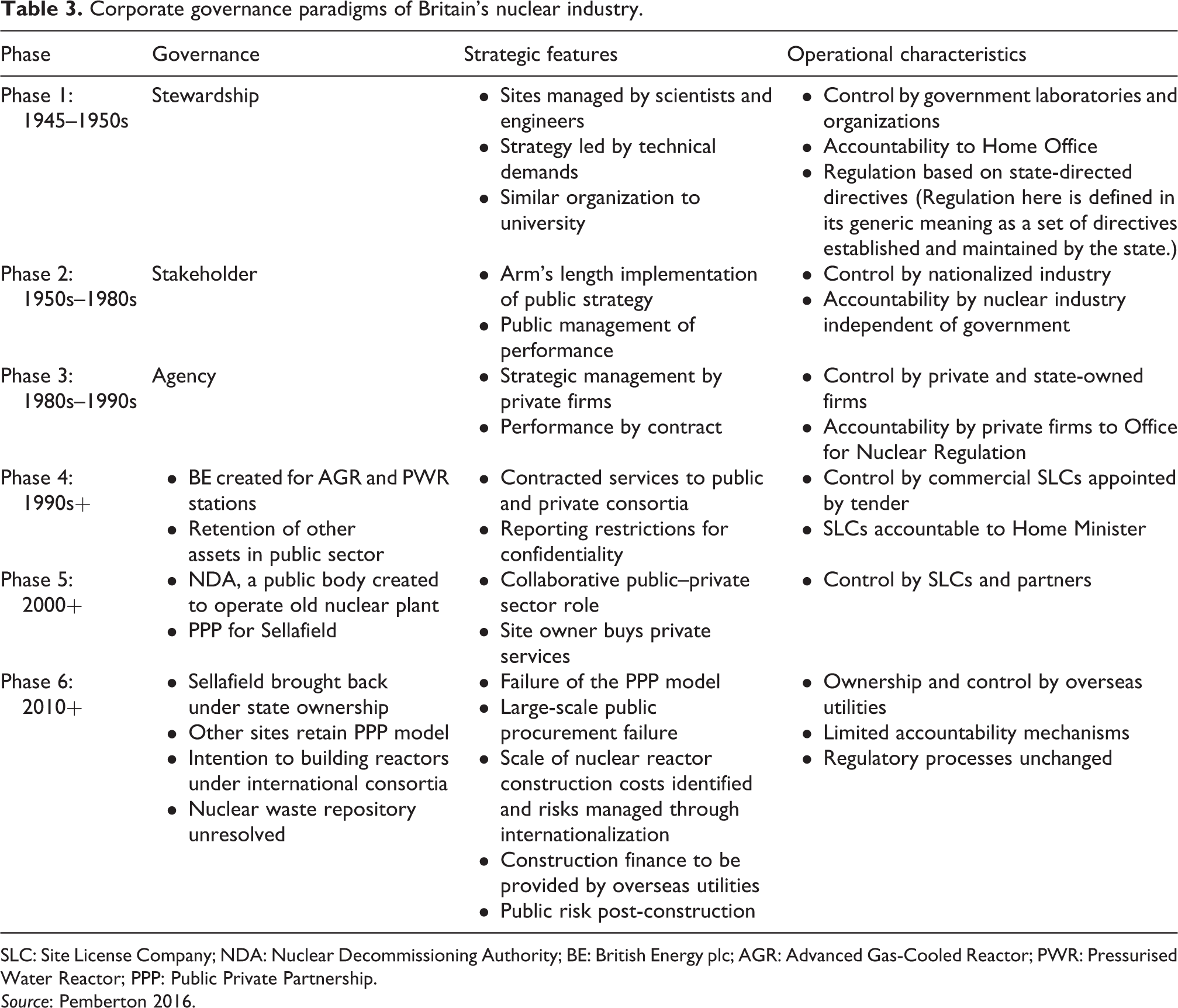
In parallel with technological developments, new governance structures were set up as a means of coping with the military-into-civilian transformation of Britain’s nuclear industry (Table 3). These facts suggest that the nuclear industry’s military heritage may continue to retard the development of an independently structured and supported civil nuclear industry. Yet its state owner has taken few steps to establish an open and transparent system of corporate governance supportable by the market, together with a fit-for-purpose system of public relations that could stake out its future as an important civilian industry:
Corporate governance paradigms of Britain’s nuclear industry.
SLC: Site License Company; NDA: Nuclear Decommissioning Authority; BE: British Energy plc; AGR: Advanced Gas-Cooled Reactor; PWR: Pressurised Water Reactor; PPP: Public Private Partnership.
Source: Pemberton 2016.
From the 1950s, successive British governments appeared to implement governance paradigms with low levels of transparency that met twin strategic-military and civilian objectives. These paradigms appeared to keep the responsibilities of the state owner at arm’s length from the accountability of public stakeholders. Either through the development of nationalized industries or through other contractual arrangements, the government’s control over the industry’s hazards and expenditure appeared to be designed on the basis of topical public sector governance paradigms and not of hazard-based industry concerns, such as the industry-wide issue of nuclear waste.
The state’s owner control of the industry became apparent in the nature of the industry’s development (Pemberton, 2016; Williams, 1980). Driven by military requirements, the tempo of nuclear industry development reflected that of a technological arms race (Winskel, 2002). This arms race defined Britain’s approach to nuclear reactor design: Britain’s reactors, with the exception of Sizewell B in Suffolk, were all experimental and “resulted in a series of reactors fuelled by natural uranium metal moderated by graphite and gas-cooled” (Hore-Lacy, 2006: 149). The hegemonic effect of joint military and civilian nuclear development also created latent financial issues (Durie and Edwards, 1982: 11). While new reactors and new research-based organizations (e.g. the United Kingdom Atomic Energy Authority) were funded by successive generous governments, the extent of the back-end costs had not been identified. Hence, the costs of managing and decommissioning nuclear plants and the disposal of nuclear waste were largely unknown and remain difficult to predict (NDA, 2019).
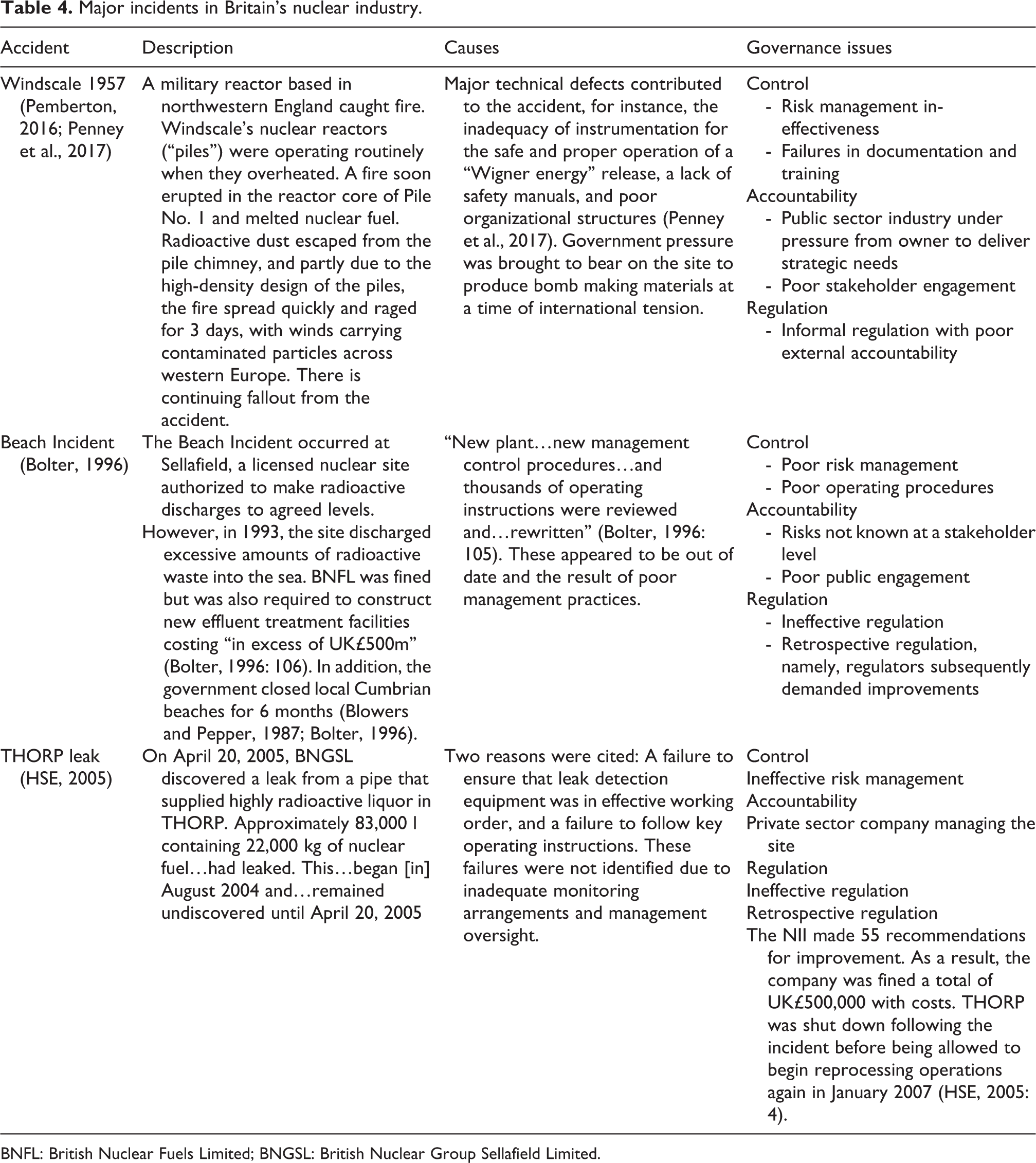
In parallel, a number of major, internationally significant nuclear incidents (Table 4) occurred during the shifts in corporate governance outlined in Table 3. 3
Major incidents in Britain’s nuclear industry.
BNFL: British Nuclear Fuels Limited; BNGSL: British Nuclear Group Sellafield Limited.
Scholars have suggested that such incidents indicate a need for an appropriate governance régime to be applied to the industry that reflects the societal scale of its risks: Governments…allow nuclear plants to emit hundreds of thousands of curies of radioactive gases and other radioactive elements into the environment every year. This waste contains extremely toxic elements that will inevitably pollute the environment and human food chains…for many generations to come. (Caldicott, 2006: ii)
Discussion
The above review of the theoretical and historical approaches to the industry’s governance has suggested a need for a bespoke approach in the governance of hazardous industries. While these typically highly visible industries may have a large number of stakeholders, the risk management of a number of industries such as Britain’s nuclear industry is difficult to evaluate because its corporate governance and other systems of reporting are opaque. Here the arguments developed by Mathews (2005) may offer a useful framework for capturing their interests. Matthews (2005) suggested that owner and stakeholder interests may reach a state of equilibrium for hazardous industries. This view is now discussed in the context of Britain’s nuclear industry. Throughout the industry’s history, a lack of transparency has been noted due to high levels of military-induced secrecy that stunted public debate on the industry’s development. A paucity of public engagement obfuscated much-needed attempts to align interests between stakeholders. Additionally, while the issue of governance and regulation of the nuclear industry has been the subject of debate (Downer, 2014; Mills and Koliba, 2015), this article seeks to develop concepts of risk-based governance (Rothstein et al., 2013) in considering how an interest equilibrium, as suggested by Mathews (2005), may be attained. In such an equilibrium, governance practices that enable engagement with public owner–stakeholders, who bear the industry’s physical and financial risks, are required. It is suggested that the nature of the industry’s risks, embedded in the industry’s characteristics, emphasizes the case for bespoke governance arrangements that provide the opportunity to reach an equilibrium consonant with Matthews (2005).
For Britain’s nuclear industry, the primacy of the industry’s characteristic need for assurance on issues of protection should be recognized. Although having an apparent low risk of catastrophic failure, nonetheless any failure in the industry’s control can be extremely impactful (Table 3). While the industry demonstrates practical difficulties associated with cost control over projects (Connor, 2012), given the unusual technical issues and idiosyncratic nature of solutions, the key stakeholder interest may lie in physical safety. Therefore, an internalized approach to corporate governance appears to offer only partial, short-term solutions. For example, owners may traditionally focus on short-term gains on their investments (Friedman, 1970), without identifying any need to accommodate longer term, protectionist approaches.
In Britain’s nuclear industry, however, owner needs are complex, not least in terms of owner definition. For instance, the industry’s state owner typically has other responsibilities, such as maintaining the nation’s defense strategies that may conflict with short-term profit-based approaches. Additionally, in Britain, the industry’s owner has also regularly intervened in the governance of the industry through its regulatory mechanisms (Table 3). Based therefore on Britain’s example, the nuclear industry’s state owner has several roles to play that may conflict with the conceptual governance requirements of owners or shareholders. Furthermore, while the British government has allocated funds to its nuclear industry through public sector expenditure plans, those funds are derived from taxpayers who bear operational risks. Hence, public citizens, as providers of funds and risk-bearing, share “the responsibility for bearing certain risks associated with possession” (Blair, 1995: 5).
Again, this situation in Britain is long-standing. Although the nuclear industry was commissioned by a postwar government, it has been funded largely by public sources. Given that the British public have also carried the operational physical risks, the perceived ownership role may well cede to the public (Pemberton, 2016). If so, that state’s role may be more clearly defined in terms of a steward of the industry. Hence, it would make sense for the steward to facilitate definition of the equilibrium point between production and protection requirements for public stakeholders. In this governance paradigm, implementing governance processes that may give greater weight to stakeholder voice is required so that the needs of stakeholder-cum-owners can effectively be assured.
Drawing on stakeholder theory (Freeman, 1994), it may appear that public engagement mechanisms may be designed that both define needs and review executive performance (Hendry, 2005). In Britain’s nuclear industry, there has been little interaction between internal and external stakeholders (see, e.g., http://wcssg.co.uk). Yet an engaged and open process of public interaction could move manager-steward and citizen relationships from a public right-to-know view (Arnstein, 1969) to consultation in achieving agreed goals (Wiedemann and Femers, 1993). A further objective in this relationship would be in mobilizing citizens to jointly explore sustainable development strategies, such as in preventing pollution from nuclear site activities (Banerjee and Bonnefous, 2011) and chemical effluence (Grougiou et al., 2016). Control of this process could entail an overhaul of current procedures under a consultative form of decision-making between nominated public representatives and government stewards (Arnstein, 1969).
Based on this argument, there is a requirement for a fundamental reevaluation and redesign of the industry’s governance process in Britain that moves away from a traditional rate of return focus (production) toward assurance of stakeholder needs (protection). In seeking an equilibrium between these twin aims, a definition and agreement of objectives would (initially) be required, together with the development of an effective monitoring and reporting process and an inclusive process of dynamic (namely, continuously evolving) interaction between government stewards and publicly elected representatives.
These issues of corporate governance seem to coalesce in the urgent problem of nuclear waste disposal. Although this issue is shared by all economies with a nuclear energy industry, the problem of Britain’s nuclear waste disposal has endured for over 60 years because Britain was one of the first economies to generate nuclear energy. The length of time that its nuclear waste has been left without permanent storage has increased the costs of the economy’s temporary storage, while potentially increasing the danger of accidents from old power plants, such as at Sellafield (Pemberton, 2016). The status of nuclear waste solutions worldwide has been reviewed (see, e.g., Choudri and Baawain, 2016; World Nuclear Waste Report, 2019). These reviews suggest that only one country, Finland, has established a Geological Disposal Facility (GDF) for the most toxic, or high-level, nuclear waste (HLW). A major reason for Britain’s poor record of HLW disposal has been suggested to be the paucity of trust by public stakeholders in the government’s proposals for GDFs. In particular, local communities remain poorly engaged with processes of deciding where GDFs will be sited (Pemberton, 2016). Financial inducements have been offered (Pemberton, 2016), but state officials and power plant managers have continued to relate at a distance from public stakeholder groups. The main constituents of these groups are local residents where nuclear power stations are located. For example, public stakeholders began to be consulted only after nuclear power plants had been built and they had become operational. Consequently, Britain does not have a publicly acceptable solution to its accumulating levels of HLW.
The efforts of British governments in seeking public consent for their GDF policy may be seen in public documents, such as the “National Policy Statement for Geological Disposal Infrastructure” (2019), and “Implementing Geological Disposal—Working with Communities” (2018). While detailed, these documents do not mention public acceptance of GDF proposals. Britain’s development of policy for GDF siting may be contrasted with the process-driven approach in Finland of continuing, open consultation with local communities. An example of this approach is in the Finnish government’s creation of its GDF on the West Coast of Finland. The Olkiluoto Nuclear Power Plant at Onkalo is, to date, the only known repository for nuclear waste. The site has reportedly been established following an assiduous process of securing public support (Choi, 2018). Choi (2018) assessed the reasons for this support. A key reason was the ability of Finnish authorities to connect professional risk management of a nuclear power plant with the need for public trust of managerial policies. Choi (2018) explored two forms of trust, trust associated with competence, and trust associated with care. At Onkalo, public trust was built by competence in the way that demands placed on nuclear agents were timely and supported by an institutional and legal framework that clearly defined managerial responsibilities: “The Finns well recognized the uncertain risks of the final disposal, [but] trust in competence and care of the nuclear companies enabled particularly local people to accept the repository” (Choi, 2018: 53). The Olkiluoto Power Plant’s need for permanent waste disposal was an integral part of the Plant’s construction from the planning stage. This need was then developed in public consultations, particularly among local communities, throughout the plant’s operating life.
By contrast, Britain’s efforts at stakeholder consultation have not been built into the construction of its nuclear plants. This fact suggests that British policy makers may have considered public consultations as an arbitrary procedure that recognized the interests of local GDF-communities, as opposed to a necessary process in gaining their confidence, first in the policy of GDF siting, and then in the location of proposed sites. At Onkalo, Finland adopted a process of securing public support for its GDF; while it is too early to suggest that this process is an exemplar for HLWs elsewhere, the fact remains that Onkalo is the first GDF site that has been established worldwide.
Practice models for the operationalization of public, face-to-face accountability (Di Nucci et al., 2017, in Europe; La Porte and Metlay, 1996, for USA) have suggested how ordinary citizens may be mobilized in the same way as Non Executive Directors (NEDs) who perform a critical friend’s role in questioning management decisions. A similar practice model of public accountability has existed in the oil and gas industry in Europe for many decades, but here too the model has remained only partially enacted (Grougiou et al., 2016). This model, revisited and developed, may now lie at the heart of processes that mobilize citizen engagement in the nuclear and other hazardous industries (cf. Di Nucci et al., 2017). Typically, these processes would also require well-developed communications and engagement structures for meaningful consultations to take place. Such requirements stem from the personal nature of risks in operating the nuclear facilities. Meeting these requirements calls for a sustained level of interaction among stewards and owner–stakeholders to address those risks. This perspective of public interaction develops conceptions of corporate governance beyond competency (Hendry, 2005) and collaboration perspectives (Roberts et al., 2005) by proposing a dynamic steward–owner–stakeholder relationship where open feedback against agreed objectives would be encouraged. Here, relationship-centered forms of corporate governance involving stewards and stakeholder consultative processes would be required to generate corporate governance mechanisms that reduce society-wide risks.
Transparency in management activity relocates the locus of relationships from private boardrooms, where public stakeholders have no voice, to open public fora where stewards are obliged to seek public engagement to govern. Consequently, decision-making in governance is expected to change from a dependence on contractual performance criteria to dynamic, site-specific relationships driven by public leaders (Di Nucci et al., 2017) in partnership with trusted stewards.
These processes should seek to ensure adequate owner–stakeholder engagement and that their needs can be voiced and codified. Achieving this end requires an effective reporting process to all stakeholders that assesses progress of defined needs (Heath and Norman, 2004; Manzungo, 2004; Swift, 2001). Transparency of this process, where citizens can engage and feedback, would play a potentially critical role in mobilizing public engagement in the governance process (Mårtensson and Westerberg, 2016).
Preliminary conclusions
As Britain’s nuclear industry expanded its operations, alternative governance paradigms were applied; but each regime proved ineffective in managing the fundamental risks of a hazardous industry. Consequently, governance over Britain’s nuclear legacy and any new reactors needs to be urgently reviewed, given the potentially broad impact of its public hazards. It is argued that the nuclear industry is an extreme but by no means unique example of the need for appropriate governance systems to be implemented where shared risks to public health can act as a proxy for governance designs that are based on the recognition of owner–stakeholders. Long-term processes of hazards managements, guided by trustworthy principles, have resonated in other hazardous industries, including the chemical and energy sectors, with toxic waste issues (Balmer et al., 2011). Here, in the same way as governments facing nuclear accidents have been compelled to respond very publicly, energy giants such as British Petroleum (BP) have also been compelled to respond to international concerns over catastrophic outcomes, in BP’s case from a major oil spill at Deepwater Horizon (2010).
In hazardous industries, it is suggested that trusted stewards should facilitate the articulation of owner–stakeholder needs together with a requirement to effectively report on progress. This stems from a recognition of the rights and needs of owner–stakeholders and the stakeholder concept of moral obligation (Freeman, 1994). It may be that many of the nuclear industry’s governance issues resonate in other hazardous industries where retrospective regulatory approaches, observable in many other industries, may not meet their needs. Critics have argued that democratic complexities can act as a screen for inadequacies in managerial accountability (Key, 1999; Rodin, 2005; Sternberg, 2004). Specifically, by introducing measures by which stakeholder interest may be assessed, the evaluation of subsequent performance in a firm’s governance shifts away from measurable standards of financial performance. Furthermore, the introduction of stakeholder engagement is thought to complicate managerial demands by introducing multiple, impersonal citizen-managers (Philips, 2003: 484).
Yet this article has suggested how the needs of the nuclear industry pose significant risk to public citizens who are normally its funders as well as its risk bearers. The contribution of the article centers on the development of a governance-related profile of a hazardous industry that has created an enduring and potentially catastrophic legacy. It has then been argued that a prime test of appropriateness in governance design requires the capture of public stakeholder needs and a comprehensive assessment of governance constituencies so that an equilibrium may be sought and routinely reported on.
Widening the article’s focus to other hazardous industries, a similar governance paradigm should reflect appropriate designs that manage risk effectively and seek to balance stakeholder and owner needs. Drawing on Mathews (2005), this article has suggested how transparency and engagement issues may be addressed by recognizing and integrating diverse corporate governance interests. In this perspective, reforms in the governance of hazardous industries that do not prioritize public participation would be inadequate. Without this participation, it would be questionable if any measures for the public’s protection would be socially acceptable, above all in deciding permanent locations for the disposal of HLW near residential areas (Di Nucci et al., 2017).
For general management concepts, the article highlights a useful tool in drawing on Mathews’ (2005) production and protection approach. Managers will ultimately have to make these decisions on resource utilization with judgments that are based on limited, and often inaccurate, information (Mathews, 2005). They will nonetheless be held to account by their directors, shareholders, and stakeholders, but in many commercial organizations, production and protection will normally be connected, and they should feed into the resulting public image of the firm.
The article’s process-driven view of corporate governance in the nuclear industry raises a number of questions for further research. For example, such approaches may diverge from state-directed practices of governance, and its implementation will require buy-in by a large number of stakeholders. Furthermore, existing public administration arrangements would need to be unwound, with consequent legal issues. However, stakeholder participation in decision-making on fundamental issues, critically in the nuclear industry on the management of its legacy, has been presented as a potential master key in unlocking the burden of the complex, endemic risks of managing this unusually hazardous industry.
Footnotes
Declaration of conflicting interests
The author(s) declared no potential conflicts of interest with respect to the research, authorship, and/or publication of this article.
Funding
The author(s) received no financial support for the research, authorship, and/or publication of this article.
