




Abstract
The combined effect of strategic ambidextrous management (dynamic capabilities and contextual ambidexterity), marketing and brand communication management has been implicitly and explicitly identified as bearing critical implications for competitive advantage. However, the mutual influence of these knowledge streams on competitive advantage as well as its key component of contextual ambidexterity are much under-researched. This article follows an inductive constructivist method to develop a theoretically founded conceptualisation of the means through which the various stakeholder contextual ambidextrous dynamic capabilities can leverage the organisational authenticity learning process in cross-functional management to explore and exploit new competitive advantage scopes. Specifically, this research proposes a theoretically synchronised conceptual framework that focuses on identified key attributes of the knowledge streams, interlinking their individual and combined influences on brand positioning and corporate reputation for the creation of competitive advantage. Scholarly and empirical implications are also presented along with future research avenues.
Keywords
Introduction
Contemporary business environments are characterised by continuous changes consequent to technological, economic and social advancements. In this shape-shifting context, a primary concern, beyond the nature of the changes, is their rate and intensity. This requires businesses to adopt strategies that increasingly deviate from the traditional path, demanding more creative, cross-functional and multi-stakeholder business constructs for their survival and growth (Huber, 2003). Hence, utilised strategies must amplify the collective knowledge and competencies to reflectively adapt to environmental changes and create lasting competitive advantage (Campanella et al., 2016; Güttel and Konlechner, 2009).
Carter (2018) defines strategic ambidextrous management as the reflection of the top management’s capability to blend paradoxical strategic planning styles to align with an ambidextrous strategic orientation. Imperative to ambidextrous management are organisational abilities to reconfigure specific asset positions and path dependencies to accommodate ambidextrous strategic orientations. These are defined as ambidextrous dynamic capabilities (Teece et al., 1997). Organisational strategic ambidextrous management with a strong scope on the resource-based view (RBV) and contextual ambidextrous dynamic capabilities (CADC) is able to establish research domains with direct and indirect implications for competitive advantage (Chebbi et al., 2015, 2017). RBV and academic areas stemming from branding and marketing were identified to be contributing factors to organisational competitive advantage, yet the combined influence of these research areas has not been adequately researched so far. Specifically, academic exploration of dynamic capabilities (Brix, 2019a; Carson and Harwood, 2007), authenticity (Cording et al., 2014; Molleda and Jain, 2013; Zeng et al., 2012), branding (Eggers et al., 2013; Ezeuduji et al., 2013; Spiggle et al., 2012) and reputation (Argenti and Druckenmiller, 2004; Firestein, 2006) focused on examining each respective concept for achieving and sustaining competitive advantage. To our knowledge, conceptualisation of the synergistic application of the four aforementioned components for the achievement of competitive advantage is relatively underexplored.
In addition, the literature acknowledged that contextual ambidexterity makes for a promising research area, which if focused on, as recommended by Quaratino and Mazzei (2018), can help with reinforcing employees’ mindsets and skills across different functional areas of the business. Aiming to reduce this knowledge gap in ambidexterity, this research applies an inductive constructivist analysis method (Naidoo and Wu, 2014) to delineate the means through which CADC could leverage organisational authenticity learning processes to explore new scopes of competitive advantage. Focusing on the synchronised dynamics of CADC and organisational authenticity that could be specifically developed and reinforced, and based on the collective cross-functional learning experience, the research proposes a conceptual framework to attain and sustain a competitive edge. The underlying propositions in developing the conceptual framework are methodically justified through empirical insights with the first giving rise to managerial and scholarly implications, constructing in parallel methodological avenues for future research. Managerial implications include the use of organisational knowledge to simultaneously leverage existing resources and capabilities (e.g. knowledge based on cross-functional learning) from the mature side of business to gain competitive advantage in new developing areas.
Specifically, the aim of the proposed framework is to develop conceptual insights that reinforce competitive advantage building, based on a synchronised accumulation of different, yet relevant, knowledge streams – specifically RBV, CADC, reputation, brand positioning and authenticity. The emphasis here is in demonstrating the potential of the valuable, rare, inimitable and non-substitutable (VRIN) conditions through stakeholders’ perceived experience, where authenticity serves as the key driving factor (Eisenhardt and Martin, 2000). Additionally, the proposed framework seeks to position the authentic attributes of the VRIN conditions through brand positioning and corporate reputation in an attempt to provide organisations with a competitive edge.
Structurally, this article continues with establishing the theoretical foundations of this work and specifically the influencers of dynamic capabilities and strategic ambidextrous aspects of competitive advantage; the significance of ambidexterity in supporting competitive advantage and the relationship between reputation, dynamic capabilities and authenticity in attaining competitive advantage. Next, the research gaps are identified and discussed, and argumentation is presented to demonstrate how the anticipated dynamics of CADC and authenticity could reinforce an organisation’s competitive position. Subsequently, the conceptual propositions and framework are schematically developed and discussed in the context of paradigms of application. Finally, future research directions are provided to invite and guide researchers in empirically testing, developing and refining this theoretically synchronised conception.
Theoretical analysis
VRIN and dynamic capabilities for competitive advantage
Dynamic capabilities are organisational coordination, integration, learning, reconfiguration and transformation processes utilised for the improvement of organisational capabilities (Teece et al., 1997). Dynamic capabilities are employed to strategically allocate resources and assets’ position through strategic directions. The purpose of dynamic capabilities’ configuration/reconfiguration of organisational processes, resource positions and strategic directions is to respond to the changes in the competitive business environment and ultimately to achieve and sustain a competitive advantage (Eisenhardt and Martin, 2000; Peteraf et al., 2013; Teece et al., 1997). The dynamic capabilities theory primarily inherits the logic of the established RBV for strategic management (Barney, 2001a, b). In this context, the organisational processes signify an administrative routine of coordination, integration, learning, reconfiguration and transformation of organisational skills to develop higher administrative capacities.
The resources/assets that could be strategically explored and exploited to achieve the firm’s goals are categorised as physical resources (Williamson, 1975), for example, plant and equipment, human resources (Becker, 1964) and organisational resources (Tomer, 1987), which include a company’s formal and informal decision-making structures. Human and organisational resources are essential for the coordination, integration, learning, reconfiguration and transformation of organisational skills. The physical resources are critical in enhancing the performance of human and organisational resources by allocating them in alignment with the organisation’s strategic direction (Rowland et al., 2017; Rozen-Bakher, 2018; Vrontis et al., 2017). Consequently, the dynamic capabilities theory acts as an extended view of the traditional RBV.
A pivotal thought in the dynamic capabilities knowledge stream has been introduced by Eisenhardt and Martin (2000), which outlines dynamic capabilities similar to the aforementioned view of Teece et al. (1997), making the two views congruent. The RBV offers a significant direction towards identifying and understanding the determinants of sustained competitive advantage. Previous research (Serra and Ferreira, 2010) also congruently denotes the importance of Barney’s (1991) VRIN characteristics of resources that could be utilised to develop dynamic capabilities, with the latter defining them as: Valuable: must be valuable to explore business opportunities and/or to deactivate business threats in the competitive environment, where the business operates; Rare: must be rare to actual/future competitors, as the resources cannot be available to them; Inimitable: must be improperly imitable or inimitable, since the organisational development relies on unique historical conditions, such as path dependencies and strategic directions; Non-substitutable: must be non-substitutable, as other resources or bundles of resources of current and future competitors cannot create an equal result.
Peteraf et al. (2013) argue that different exceptional conditions that could be learnt from the overall experience of an organisation and their allied stakeholders, focusing on different competitive market forces, would be able to retrieve a valuable resource’s VRIN competencies to sustain competitive advantage. Such VRIN conditions could include timing, sequence, location, unique reputations of service and so forth, which could be evolved and acknowledged, based on an organisation’s interactions and learning experience with its stakeholders (Peteraf et al., 2013). For example, interactions can be facilitated through service encounters, and perceived stakeholder experiences can be accordingly explored (Wei et al., 2014). In this vein, the organisational ambidexterity theory would result in streamlining the process and practice of such organisational learning to recognise VRIN conditions through the lens of the ambidextrous skills of organisational exploration and exploitation to sustain competitive advantage. The subsequent part of this article, thus, focuses on the latter proposition and its underlying constructs.
Organisational ambidexterity for competitive advantage
Organisational ambidexterity is defined as a firm’s capacity to ‘efficiently exploit current competencies while flexibly exploring future competencies with an equal degree of skill’ (Raisch et al., 2009; as cited in Vahlne and Jonsson, 2017: 58) and focuses on the simultaneous exploration and exploitation of organisational scope. O’Reilly and Tushman (2008: 189) define the latter terms: ‘exploitation is about efficiency, increasing productivity, control, certainty and variance reduction (e.g. business risk neutralisation), while exploration is about search, discovery, autonomy, innovation and embracing variation’. Cao et al. (2009) translate these elements of exploitation and exploration into two dimensions of balanced and combined ambidexterity accentuating the importance of their individual and combined effects for organisational performance. Furthermore, Vahlne and Jonsson (2017: 59) define and summarise three types of ambidexterity: ‘sequential ambidexterity’ implies that the organisation focuses on one competing objective after another; ‘structural or simultaneous ambidexterity’ implies that the organisation allocates different tasks to different sub-units of the organisation and ‘contextual ambidexterity’ is when each member of the organisation can switch between the competing tasks of exploitation and exploration as the demand or opportunity arises. Brix (2019a, b) also supports that contextual ambidexterity is reflected in a complex set of decisions and routines in the form of dynamic capabilities that enable the organisation to explore and exploit new opportunities through the reallocation of organisational assets.
Literature, however, on ambidexterity is incomplete, with contextual ambidexterity being a prominent case of these deficiencies. Specifically, Vahlne and Jonsson (2017: 59) accentuate the importance of future contextual ambidexterity research to focus on how we could ‘present (the contextual ambidextrous skill) in the mind of all co-workers rather than only incorporated (this concept and skill) into the structure of a few at the top-management level’. Stemming from this, a key aim of this study is to identify and explain how dynamic capabilities might integrate contextual ambidextrous skills across the human resource of different organisational departments.
In terms of the ambidextrous dynamic capabilities’ contribution to organisational competitive advantage, O’Reilly and Tushman (2013: 330) argue that ‘the essence of organizational ambidexterity is to be found in the ability of the organization to leverage existing assets and capabilities from the mature side of the business to gain competitive advantage in new areas’. They further accentuate the importance of organisational ambidexterity and organisational learning by specifying ‘how they (the managers/leaders) actually do this is seldom addressed in the research on ambidexterity [and that] in-depth studies are required to answer these questions’ (O’Reilly and Tushman, 2013: 330). A similar view is expressed by Thrassou et al. (2018a, b), who underline the need for strategic agility, refining the concept to develop a corresponding cross-functional model that encompasses environmentally contextual elements such as ‘change’ and ‘culture’, and the human, social and marketing capital, placing them within the wider organisational strategic marketing process.
To contribute to this ambidexterity research gap, focusing on organisational learning that is centred on cross-functional business management areas emerges as an imperative. In support of this and similar to Brix’s (2019b) work, Uhl-Biena and Arena (2018: 3) argue that ‘managers should enable cross-functional…linkage devices (Westerman et al., 2006) to…design and implement integrating mechanisms (e.g. formal/structural, informal/social) in and across…(cross-functional) levels (Galbraith, 1973; Galunic and Eisenhardt, 2001; Tsai, 2002) to enable ambidexterity’. Moreover, and as a future direction of ambidexterity research, Ojha et al. (2018: 39) suggest that organisational learning will be a very exciting area of research as it will open the black box of how individual learning dimensions have varying impact on exploration versus exploitation. Such research would provide valuable guidance to managers on how to match the various type of learning to a goal (exploration versus exploitation) more pertinent to their context.
Authenticity, reputation and brand management for competitive advantage
Products and services offerings are regularly branded based on the authenticity of their claims and contributions to stakeholders’ needs (Chhabra, 2005). In such promotional efforts, to occupy a distinct position in consumers’ minds, brand positioning generally attempts to convey the message of genuineness (authenticity), that is how a product/service can uniquely/differently meet customers’ needs. Shams (2016a: 142) argues that ‘authentic assertions about the activities of a company, the performance and behaviour of their employees and products and services, and delivering that authentic promise, generally form the positive reputation of that company’. The extent of perceived authenticity, relevant to reputation and brand positioning could vary from customer to customer because of their dissimilar learning experiences and behaviours (Littrell et al., 1993). From this discussion, it can be argued that the perceived authenticity experience of customers and other stakeholders is a common factor in reputation and brand positioning to influence their thoughts towards a preferred perception of a firm and its products/services.
Centred on the perceived authenticity experience, in relation to reputation, conducting business with a company is usually a prerequisite for stakeholders’ motivation. Brand positioning reinforces the fact that their motivation or willingness to make a purchase is influenced by how relevant an offering is to customers’ needs and how differentiated this offering is in comparison to the competition (Shams, 2016a). Such interrelated strategic communications have an impact on stakeholders’ perceived experience by conveying an authentic message (Grayson and Martinec, 2004). This is particularly relevant to the current experience economy (Molleda and Jain, 2013), wherein the strategic communication processes, it is essential to further review the influence of authentic messages on stakeholders’ overall perceived experience (Milman, 2013) and to build and sustain an authentic perception in their minds. In the long run, this perceived authentic experience, centring on reputation and positioning, could contribute to a company’s performance and sustainability. This is particularly relevant considering the business’ immense reliance on its reputation in building and sustaining competitive advantage (Argenti and Druckenmiller, 2004; Firestein, 2006). Furthermore, differentiation strategies of brand positioning impact a company’s competitive advantage and performance (Ezeuduji et al., 2013). In this setting, therefore, a naturally consequential purpose of this study is to contribute to the nexus of authenticity as a cross-functional area of dynamic capabilities that could leverage a firm’s cross-functional learning in marketing management (i.e. reputation and brand positioning) and strategic management (i.e. RBV and dynamic capabilities). This will allow us to understand how dynamic capabilities could integrate the contextual ambidextrous skill into co-workers across different departments of a firm to sustain its competitive advantage.
Earlier sections show that academic views recognise the individual impact of authenticity, reputation, brand positioning and dynamic capabilities on competitive advantage and organisational performance; however, no study has been uncovered that concerns the collective impact of these concepts and theories on organisational performance. Furthermore, ‘it is recognised that reputation is a relational construct; however the impact of stakeholders’ various relational dimensions on their perceptions to influence reputation is not widely understood’ (Shams, 2016b: 314). Therefore, a concise research gap is identified in relation to the potential link between authenticity, reputation, positioning and the associated dynamic capabilities across different cross-functional areas. This includes the exploration and exploitation of VRIN conditions of a company and its stakeholders’ ‘perceived authenticity and experience (learning)’ to ascertain the factors driving authenticity, relevant to authentic reputation and positioning that have impact on competitive advantage.
Following from the above, this study seeks to discuss and analyse the nexus of authenticity, contextual ambidexterity, RBV and dynamic capabilities on how CADC could leverage the organisational authenticity learning process across different cross-functional management areas to explore and exploit new competitive advantage scopes.
A theoretical synchronisation and conceptual framework
The theoretical evaluation of this research finds that dynamic capabilities and authenticity both contribute to competitive advantage (Bosch and Taris, 2014; Carson and Harwood, 2007; Eggers et al., 2013; Zeng et al., 2012). Additionally, dynamic capabilities stimulate stakeholders’ distinct/exceptional states of perceptions (the extent of authenticity) of organisational activities (Huy, 2005). For example, promoting a service through expert opinions or satisfied customers could influence the extent the target market perceives authenticity. Accordingly, if promotional activities (dynamic capabilities) are attributed to VRIN competencies, the capabilities would have higher influence on the extent of stakeholders’ perceived authenticity experience. This is attributed to stakeholders’ perceptions of VRIN conditions of organisational activities and their products and services assist with extending the sense of uniqueness and originality. Understanding stakeholders’ experience and current levels of perceived authenticity can reveal opportunities for distinctiveness, transparency and consistency (Fombrun and Van Riel, 2004) to recognise new exceptional conditions. The latter is based on stakeholders’ evaluations of a company’s claims and promises vis-à-vis its actions (Molleda and Jain, 2013). The underlying exceptional conditions to such authentic actions of a company that persuades stakeholders to consider its actions as authentic contribute to the company’s competitive advantage and performance in the long run. Furthermore, it is widely acknowledged that higher authenticity positively impacts competitive advantage and organisational performance (Cording et al., 2014; Jensen and Luthans, 2006; Rego et al., 2012). From the theoretical evaluation provided in earlier sections, Table 1 provides an accumulation of academic views regarding the influence of VRIN capabilities through their identification and strategic promotion towards stakeholders’ overall perceived authenticity (component PP1).
Summarisation of the flow of effects between components with selective references of support.
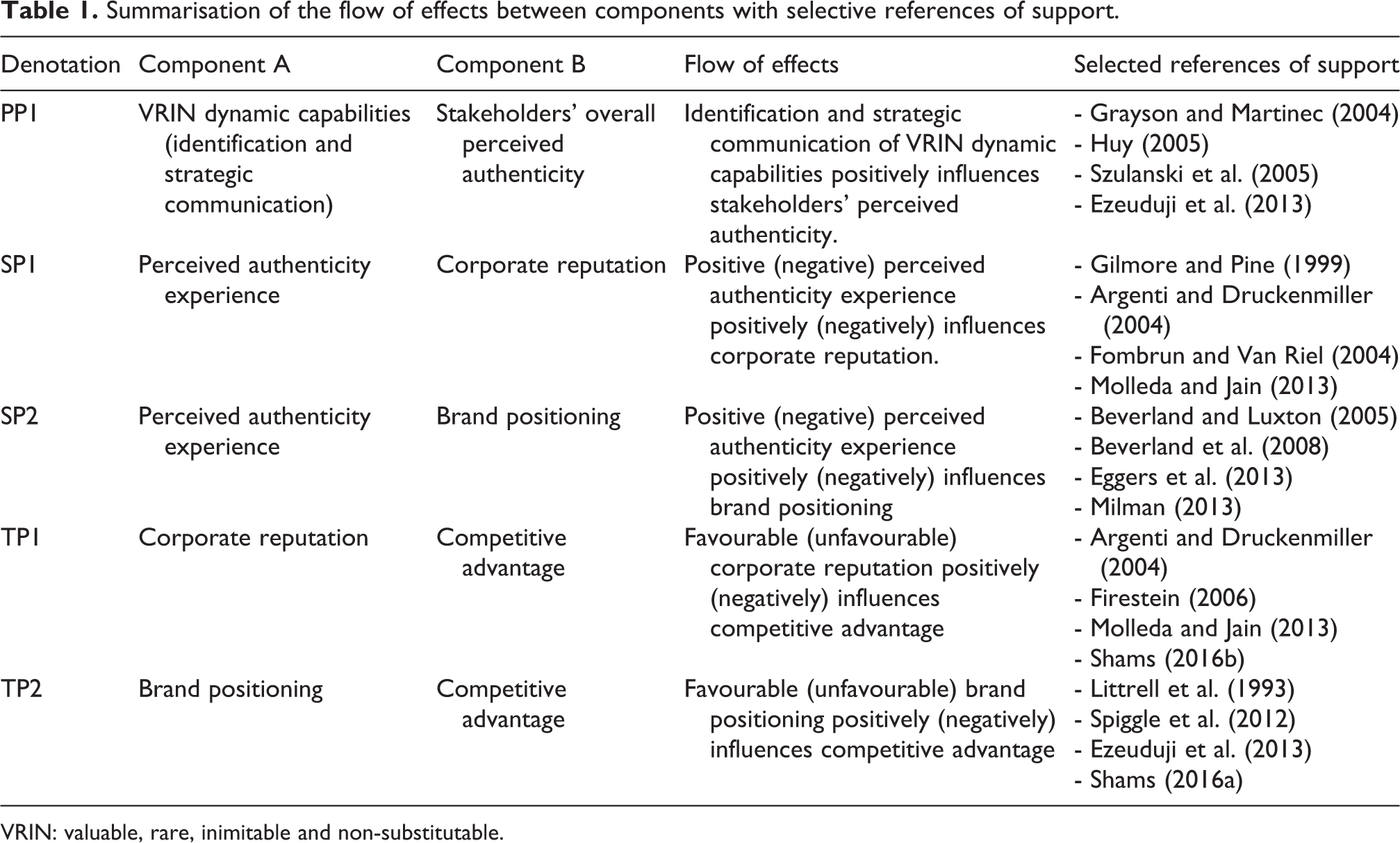
VRIN: valuable, rare, inimitable and non-substitutable.
Following the discussions thus far, it is further evident that brand positioning and reputation are valuable strategic communication tools, where VRIN conditions from stakeholders’ perceptions can profoundly serve as authenticity driving factors for messages that are conveyed through positioning and reputation (Firestein, 2006). From the theoretical evaluation, academic views converge on how positive perceptions of authenticity enhance brand positioning and corporate reputation (i.e. Argenti and Druckenmiller, 2004; Eggers et al., 2013; Littrell et al., 1993). In Table 1, components SP1 and SP2 reflect this argument.
Additionally, TP1 acknowledges that a strong corporate reputation can be a driving factor in achieving and sustaining competitive advantage (Argenti and Druckenmiller, 2004; Firestein, 2006). TP2 demonstrates in a similar fashion how strategically favourable branding positioning positively influences competitive advantage (Ezeuduji et al., 2013; Spiggle et al., 2012)
Findings and convergence points of the above academic views are schematically incorporated into a conceptual framework of the ‘Antecedents of contextual ambidexterity for competitive advantage’, presented in Figure 1. Therein, on the left, VRIN capabilities are initially identified from stakeholders’ perceptions and experiences with the company (Peteraf et al., 2013). This is followed by strategically communicating these identified capabilities with existing and potential stakeholders to shape their perceptions of authenticity (Grayson and Martinec, 2004).
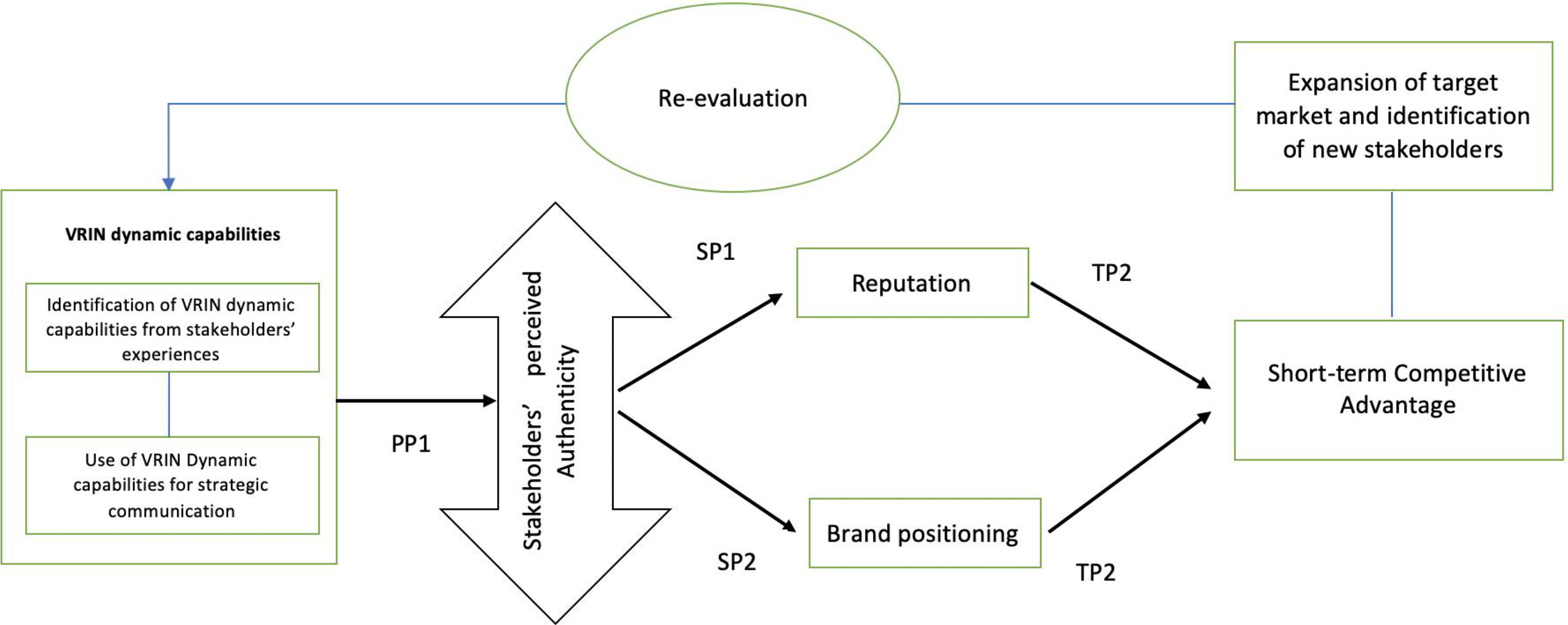
The antecedents of contextual ambidexterity for competitive advantage.
The framework acknowledges Bartunek’s view (1984) that stakeholders’ perceived authenticity influences their decision-making. Recent literature transcends Bartunek’s view that companies should authentically be linked to the issues associated with the competitive environment (Cox and Mowatt, 2012). It is widely acknowledged that authenticity contributes to organisational performance through higher competitive advantage (Eggers et al., 2013; Gilmore and Pine, 1999; Zeng et al., 2012). The following assertion is specifically true: ‘when consumers want what’s real, the management of the customer perception of authenticity becomes the primary source of competitive advantage’ (Gilmore and Pine, 1999: 5). The reasoning of the perceived stakeholder experiences is founded on the premise that competitive advantage exists in the minds of diverse customers. Gundlach and Neville (2012), for example, apply this to demonstrate the diverse extents of perceived authenticity in the minds of different stakeholders in authenticity theory. This is because the perceived extent of a competitive advantage positioned in the minds of associated stakeholders in relation to the competitive advantage’s ability to authentically satisfy individuals’ value anticipation may differ from stakeholder to stakeholder (Grayson and Martinec, 2004; Littrell et al., 1993). In Figure 1, ‘Stakeholder’s perceived authenticity’ is within a double-headed arrow because customers and other stakeholders perceive the extent of competitive advantage differently. Consequently, the more positive an experience is perceived authentic, the more positive is its impact on reputation (Molleda and Jain, 2013) and strategic brand positioning (Eggers et al., 2013). Components SP1 and SP2 on the diagram, respectively, reflect this relation. The positive enhancement of the latter two elements is evident in the literature to assist organisations in attaining and achieving competitive advantage (Table 1, components TP2 and TP3).
The framework additionally considers that attained competitive advantage can only be sustained for a short term through the prescribed actions. It is evident that when organisations attain a competitive advantage, their customer base and other stakeholders expand and diversify, thus imposing a difficult challenge on the organisations to sustain them long term (Williams, 1992). For a mature business, it is imperative for the organisation to re-evaluate the perceptions and experiences of new stakeholders to re-explore, identify and exploit new VRIN conditions for competitive advantage. Prior to this mature stage of the business, the learning experience of the business throughout its cross-functional areas, such as CADC and RBV, would enable members of the business from different functional areas to retain scope for both exploring and exploiting contextual ambidexterity opportunities.
Example of application: IEI
To practically transcribe the above proposition, the case of the international education industry (IEI) makes for an elucidating paradigm. The major competitive global international education destinations, such as United Kingdom, United States, Asia and Australia, modify their student visa rules and regulations recurrently to adapt to varying socio-economic needs (Shams and Gide, 2012). They do this to expand their customer base and accordingly accommodate more students from a wider range of countries. Therefore, industries like IEI, which encounter rapid changes in competitive forces, could identify and utilise potential VRIN conditions from their stakeholders’ perceived authenticity experience to acquire and retain a competitive edge. Taken from Singh et al.’s (2014: 470) research, a student studying in a Malaysian university said the following: Malaysia is very near to China so if I want to come back is very convenient. (Asian international student)
Sustaining competitive advantage depends on re-evaluating experiences and perception of new and existing stakeholders to identify new VRIN conditions. A new VRIN condition could be identified through electronic-word-of-mouth (e-WOM) for example. The literature argues that e-WOM is an effective and cost-efficient promotional tool (see, e.g. Litvin et al., 2008). In IEI, universities that use e-WOM promotion through their official websites and social media channels allow students’ opinions to be added to an archive of past experiences and testimonies which are perceptible to prospective students. A dedicated promotional webpage focusing on honest testimonies and including ratings of the university’s services can serve as a good identification tactic for VRIN conditions. For example, ‘vibrant student life’ could be a unique selling point for the institution accentuated through online sections of relevant student testimonies while other competitive universities might be lacking this unique feature.
Also important is the fact that the contextual ambidexterity dynamics, as depicted in Figure 1, enable cross-functional university staff members in administration, student services, marketing department, IT department and strategy department, and academic faculty to consider exploring potential VRIN conditions. For example, the cause–effect relationships and interactions between international students and an administrative staff or a faculty member could enable the staff member to understand specific needs, wants and expectations of international students. Upon exploring and understanding customer needs, the staff members across different functional areas, both individually and jointly, could capitalise on international students’ interests. At the mature stage of such e-WOM promotional efforts, analysing the varied extents of diverse stakeholders’ perceived authenticity experience (e.g. not only the South-East Asian international students’ but also other prospective international student groups) would be instrumental to explore and exploit further business opportunities for a competitive edge.
Conclusion
The aim of this study is to understand how CADC could leverage organisational authenticity learning processes across different cross-functional management areas to explore new scopes of competitive advantage. The latter serves as the cornerstone for any organisation’s survivability and endurance. Managerial processes, resource allocation and strategic directions are essential to understand stakeholders’ perceived authenticity experience. On the one hand, a company’s dynamic capabilities allow it to allocate resources according to its strategic direction. On the other hand, a company that learns about stakeholders’ authentic perceived experience results in it recognising VRIN conditions.
The present framework seeks to develop conceptual insights that reinforce competitive advantage building based on a synchronised accumulation of relevant knowledge streams including RBV, CADC, reputation, brand positioning and authenticity. The proposed framework seeks to position the authentic attributes of VRIN conditions through brand positioning and positive organisational reputation in the long run, ultimately contributing to the competitive position of a company. The framework elaborates on this by focusing on two main issues: first, the VRIN-attributed exceptional conditions must not be available in the market from other competitive entities and second the authentic performance, positioning and reputation of such VRIN-attributed exceptional condition must uniquely satisfy the target markets’ needs. These are essential to favourably influence the associated stakeholders’ perceptions of the company to carry out businesses with it.
Limitations and future avenues of research
Grounded on previous research, the present article focuses on a theoretical synthesis and conceptualisation that consider cross-functional synergistic means for developing and supporting organisational competitive advantages. It is a first step to which future research is invited to build upon and empirically test through three main axes. The first axis relates to the discussion on the VRIN conditions being evolved and acknowledged, based on the interactions and cross-functional learning experience of an organisation and its stakeholders. This includes service encounters, perceived stakeholder experiences and so forth. Therefore, based on the cause and effect of stakeholder relationships and interactions, the organisational processes and resources of an organisation should be concentrated to recognise exceptional conditions, in line with the organisational path dependencies or strategic direction. From this perspective, future research could be directed to reinforce current understanding of how CADC may analyse the cause and consequence of stakeholder relationships and interactions to recognise the VRIN-attributed exceptional conditions to attain a competitive advantage and sustain it.
The second axis could proceed to establish instrumental methodological criteria in analysing the cause and effect of stakeholder relationships and interactions. This can be done by recognising VRIN conditions that could redirect organisational path dependencies. For example, once a new VRIN condition is identified, an organisation could reorganise its resources to ensure the optimum benefit and utility of this newly recognised condition. This would also influence the organisation’s dynamic capabilities. Future research could concentrate on developing new insights into how an organisation could systematically analyse their stakeholders’ perceived authenticity experience to support their VRIN competent dynamic capabilities. The significance of this is that stakeholders’ perceived authenticity is essential in developing a positive reputation and synthesising a favourable perception in the minds of stakeholders. The interrelationship between CADC and VRIN conditions and their influence on stakeholders’ perceived authenticity experience and, by extension, overall authenticity dynamics in the long run serves as another promising avenue for future investigation.
The final axis of future research relates to cross-foci and cross-functional opportunities. Specifically, further research could be directed towards identifying and reducing the gap between the initial conceptual development and its practical application. Reinforcing the generalisability of conceptual development is an important aspect. In this context, cross-industry, cross-market and cross-cultural studies could be valuable in expanding this framework further. More precisely, this research avenue could focus on the integration of additional concepts and variables into this theoretical development. The present conceptualisation limited its examination on the organisation concepts of ‘reputation’ and ‘brand positioning’ yet adjacent research area like ‘image’ were excluded from this exploration due to academic ambiguity regarding the concept’s link with VRIN dynamic capabilities. Yet, Kotler et al. (1993) define image as the blend of beliefs, ideas and impressions that people have about the product, service or organisation identifying a direct link to reputation. Analysing the relationships between the discussed authenticity dynamics and organisational ‘image’ would be another promising area of investigation. Lastly, the correlation of arguments of these initial CADC in the contexts of two other types of ambidexterity, namely ‘sequential’ and ‘structural’, serves as a promising expansion avenue for this theoretical conceptualisation.
Footnotes
Declaration of conflicting interests
The authors declared no potential conflicts of interest with respect to the research, authorship, and/or publication of this article.
Funding
The authors received no financial support for the research, authorship, and/or publication of this article.
