




Abstract
Gilbert and Sullivan's eighth Savoy opera Princess Ida (1884) is best understood against the backdrop of women's higher education and emancipation in nineteenth-century Britain. Careful work has been done in tracing correspondences between the opera and its source texts, but Ida is not only a descendant of literary figures. She is the peer of the pioneering women of Girton College, Cambridge whose biographies attest to the challenges faced by women in pursuit of an education at the end of the nineteenth century. This association allows Ida and her students to be positioned as precursors of that fin-de-siècle phenomenon, the New Woman. Often dismissed as an uncomfortable relic of Victorian male chauvinism, the political and ideological complexity behind Princess Ida is recognised here as the opera is identified as one moment in continuous literary, cultural and social history.
The title role of Gilbert and Sullivan's comic opera Princess Ida (1884) represents a prototype for the New Woman: the cultural icon appears on the Savoy Theatre stage a full decade before the English novelist Ouida gives her a name. Direct references are made in contemporary reviews of Princess Ida to institutions and individuals, including Ouida, forever associated with the development of the New Woman type. In the audience at the premiere on 5 January 1884 sat Arthur Wing Pinero, who would help to define the genre of the emancipated woman play. 1 George Bernard Shaw, creator of an archetypal New Woman in his character Vivie Warren, drew comparisons in his music criticism between W.S. Gilbert and Henrik Ibsen, the playwright credited with inventing the New Woman on the English stage by Sally Ledger. 2 And yet, Gilbert and Sullivan's eighth collaboration is not positioned or fully recognised as existing within the same cultural milieu. Instead, Princess Ida has suffered from a critical approach that judges the opera and its source texts against the standards of late twentieth- or early twenty-first-century feminism. Carolyn Williams explained Princess Ida's comparative unpopularity by suggesting that, when it premiered, ‘the ridicule of higher education for women seemed distinctly out of date’. 3 Williams's explanation is, to an extent, challenged by the evidence presented in this article, which, at the same time, considers the more serious propositions of this comic opera. By reacquainting Princess Ida with episodes in the history of women's education and by putting the pupils of Castle Adamant in conversation with the New Women debates, both the opera and its cultural contexts might be more fully understood.
Respectful Perversions: Accounting for Princess Ida
Gilbert's script and lyrics were developed out of his own farcical five-act play, The Princess (1870), which was itself based on Alfred Lord Tennyson's medley, The Princess (1847); Princess Ida was described in programmes as a ‘respectful operatic perversion’ of the work of the Poet Laureate. Like the poem it perverts, Princess Ida is the story of two royal families, headed by Kings Hildebrand and Gama. The setting is ‘high’ medieval. Hildebrand's son Hilarion and Gama's daughter Ida were married in infancy; now, 20 years later, it is the contractually appointed time at which Ida must join Hilarion, otherwise the families will go to war. When Hildebrand and his son attempt to claim Ida, they are informed by Gama that his daughter has exiled herself to one of his many country houses to establish a university for women: 100 students are in her charge at Castle Adamant. If war between the two kings is to be prevented, the castle must be stormed, and Ida captured and convinced to follow less radical ways. The popularity of the seven previous collaborations between Gilbert and Sullivan meant that, according to the Manchester Courier's London correspondent, ‘[t]he application for seats to witness the first performance last night […] was something enormous; in fact, I hear that about 10,000 seats were applied for’. 4 Tennyson himself and the Prime Minister, William Gladstone, had both been expected to attend. 5
Reflecting on the opening night of Princess Ida, the reviewer for the London Morning Post noted something paradoxical about the opera's theme: ‘The claim of women to be considered equal with men forms a subject ever new, though old. According to the Gilbertian philosophy this should be treated in a manner perversely, in speech that is old but called new’.
6
More recently, critics concerned with Princess Ida have adopted a comparative approach towards Tennyson's The Princess, Gilbert's The Princess and the Savoy opera. Often, these critical perspectives do a disservice to Gilbert's ‘operatic perversion’. Gayden Wren takes issue with the prevailing comparative critical attitude. He casts the poem as the more conservative text; after all, Wren writes, ‘[a]n antifeminist would surely prefer Tennyson's intelligent, kind, and warm men to Gilbert's harsh, implacable, brainless warriors’.
7
Wren sees Gilbert's opera as a far-from-comic exploration of the themes of male superiority and female emancipation: Princess Ida is not about women's education nor even women's rights. The satire of feminism is no more central than the political satire of Iolanthe or The Gondoliers. The actual theme lies deeper: Princess Ida is the first and best working-out of a theme that was to inform the subsequent Mikado and Ruddigore – the necessity of young people breaking with the past (and especially with the sins of their parents or ancestors) to achieve the hope of progress.
8
A sense of context is also absent from Laura Fasick's comparative analysis of Tennyson's The Princess and Gilbert and Sullivan's Princess Ida. Conjectures are made about ‘sensitive and imaginative’ Victorians who, Fasick believes, ‘understood’ the description of learning experiences and the learning environment given by Tennyson's narrator.
9
By contrast, as Fasick elides, Gilbert and Sullivan's perspective is considered ‘far glibber, less interesting, and less insightful’.
10
The focus of Fasick's argument is the reform of women's education in the years between 1847 and 1884. She contrasts the poet and the librettist thus: Tennyson appears most deeply interested in what men and women have in common and he strongly suggests that improved education can deepen these commonalities. Gilbert's waspish libretto insists on differences and threatens apocalyptically that to ignore those differences would be to erase human existence. Too often, Gilbert is blamed for employing stereotypes – when that is the whole point. Only by making the received views, the stereotypes, and the cultural absurdities of the Victorian period show up in high relief could he launch a critique. Gender roles, relations, norms, assumptions, and patterns of socialization – all are subject to this critique. The surprising thing is: seen through this lens, the comic operas of Gilbert and Sullivan turn out to be not at all as conservative as many people have thought.
12
‘These Girton Days’: Women's Education in the Popular View
There is no mention of Princess Ida in Ellen Jordan's article ‘The Christening of the New Woman: May 1894’. Surveying the cultural landscape within which the New Woman appeared, she writes: As an ideal of womanhood, the New Woman was born in the 1880's [sic.], and it was the second generation of English feminists, those women who had profited from the educational and vocational opportunities won by the pioneer feminists of the sixties, who acted as both parents and midwives.
13
The public had not yet begun to appreciate the wit of Gilbert, and most of it went over their heads. And the second fact is that the college with girl graduates, which was but a fantastic creation of Tennyson's and Gilbert's grotesque imaginings, is now translated into solid fact in the shape of Girton College, Cambridge.
14
Neither do the gowns of the lady students dispel the illusion of a gay court. They are beautifully designed and grouped together, form a perfect bouquet of harmonious colour; they will, we seriously apprehend, cause a revolution at Newnham and Girton, but they certainly do not suggest the severity of academic discipline.
15
In March 1883, the Girton Review reported that Tennyson had donated a copy of his complete works in seven volumes to the college library. 17 Today, Girton's library catalogue still includes a copy of The Princess owned by founder Emily Davies. 18 It is unsurprising that a poem such as Tennyson's The Princess had a special resonance for the founders of Girton and that the college library was (and remains) proud of its associations with its creator. Research into the history of the college has demonstrated how the complex and contents of buildings which opened to students in 1873 on the Huntingdon Road site had been strategically designed and curated to improve not only women's prospects in higher education but also the image of women's higher education in the popular consciousness (Figure 1). Girton's rooms had been carefully furnished under the management of founder Barbara Leigh Bodichon and, according to Petra Clark, sympathetic journalists covering the college in the Victorian periodical press cultivated images of ‘Girtonian women living in buildings and rooms that more resembled houses than the other colleges of the day’. In so doing, they were able to ‘subtly combat fears about the masculinising effect of university education’. 19 When it came to the scenery for Princess Ida, there were no interiors for designers to imagine. Instead, reviewers enjoyed the beautifully rendered gardens of Castle Adamant – echoing, perhaps, the Arts and Crafts influences in Gertrude Jekyll's borders for Girton – and the opportunities for pretty tableaux – prefiguring, perhaps, the fanciful arrangements of young women in Sir Noel Paton's poem ‘A Girton Girl’ (1893). 20 The correspondent for Reynold's Newspaper wrote effusively of ‘almost fairy-like stage pictures, the most perfect grouping of this kind, and graceful spectacular detail carried to the point of perfection’. 21 Meanwhile, in describing the opening scene of the first act, the Pall Mall Gazette's reviewer appreciated: ‘a chorus of undergraduates in round caps and silk and brocade gowns. Even a doctor of music in all his glory cannot compare with the least of these’. 22 Backdrops also displayed architecture that, for the same reviewer at least, satirised the ‘pointed “new buildings” of the University of Oxford’: a sketch accompanying the article captioned ‘Ye Distant Spires’ shows a castle replete with turrets, steeply pitched rooves, towers and battlements (Figure 2). 23
As the painted women's college exhibited all the features of nineteenth-century Gothic architecture, it was very much in keeping with current trends in civic design. William Whyte notes with reference to late nineteenth-century periodicals how, at this time, Gothic ‘evoked education itself […] it was an approach seen to be “rich in a sort of learned ease”, and by the 1860s it was noted that nearly all schools were now built in the “Collegiate Gothic”’. 24 But in the more specific references to Oxford's ‘new buildings’ in the Princess Ida review, one might reasonably assume that the critic is here referencing the Gothic structures and polychromatic brickwork of Keble College, designed by William Butterfield and opened to students in 1870. The reference here would be entirely in keeping, since Keble also had an access agenda of a kind: the mission of the college was to diversify the exclusively male student body by making an Oxford education more affordable. Butterfield's version of Victorian Gothic seen in Keble has much in common with the designs for Girton made by Alfred Waterhouse. Both buildings are, then, singularly appropriate reference points within Princess Ida, Gilbert's second attempt at adapting Tennyson's The Princess for the stage. In a sense, these buildings serve as alternative histories, taking students and academics back to an imagined moment in the past at which they might redirect the course towards the future. Princess Ida exhibits that same potential: within the opera's parallel universe, women's education might have been much longer established, were it not for the sacking of Castle Adamant and the surrender of its residents.
In reality, at the end of the nineteenth century, the women of Cambridge were subject to renewed assaults on their right to an education. As W.S. Gilbert was preparing the latest edition of The Bab Ballads with which are included Songs of a Savoyard (1898), a motion was proposed to the Senate of the University of Cambridge in 1897 that female members of the institution should be granted the right to obtain degrees. This right was enjoyed by their male peers and also by women at other universities. 25 Until that point, women had been admitted to Cambridge to follow degree programmes and won the formal right to sit examinations in 1881, but their work was not recognised with the conferral of official honours. Male undergraduates revolted en masse to the proposal; the logical next step towards equality in education at Cambridge. Aggressive and threatening protests were staged in the streets; the protestors’ targets were the students of the first Cambridge colleges for women, Girton and Newnham, which were founded in 1869 and 1871, respectively. 26 A photograph taken on voting day (Figure 3) shows an effigy of a woman on a bicycle – wearing a divided skirt and riding astride brazenly, rather than adopting the side-saddle position – suspended from a window in the city's central Market Square, as if executed by hanging. Beneath her, young men congregated and waved banners daubed with slogans such as ‘Get you to Girton Beatrice Get you To Newnham Here's No Place for You Maids Much Ado About Nothing’. The effigy was dragged to the ground, decapitated and torn to shreds by the victorious, hostile crowd after the Cambridge Senate rejected the resolution to grant women degrees. Her remains were then stuffed through the railings of Newnham College. It was not until 1948 that women were granted degrees by the University of Cambridge on an equal basis with their male peers. 27
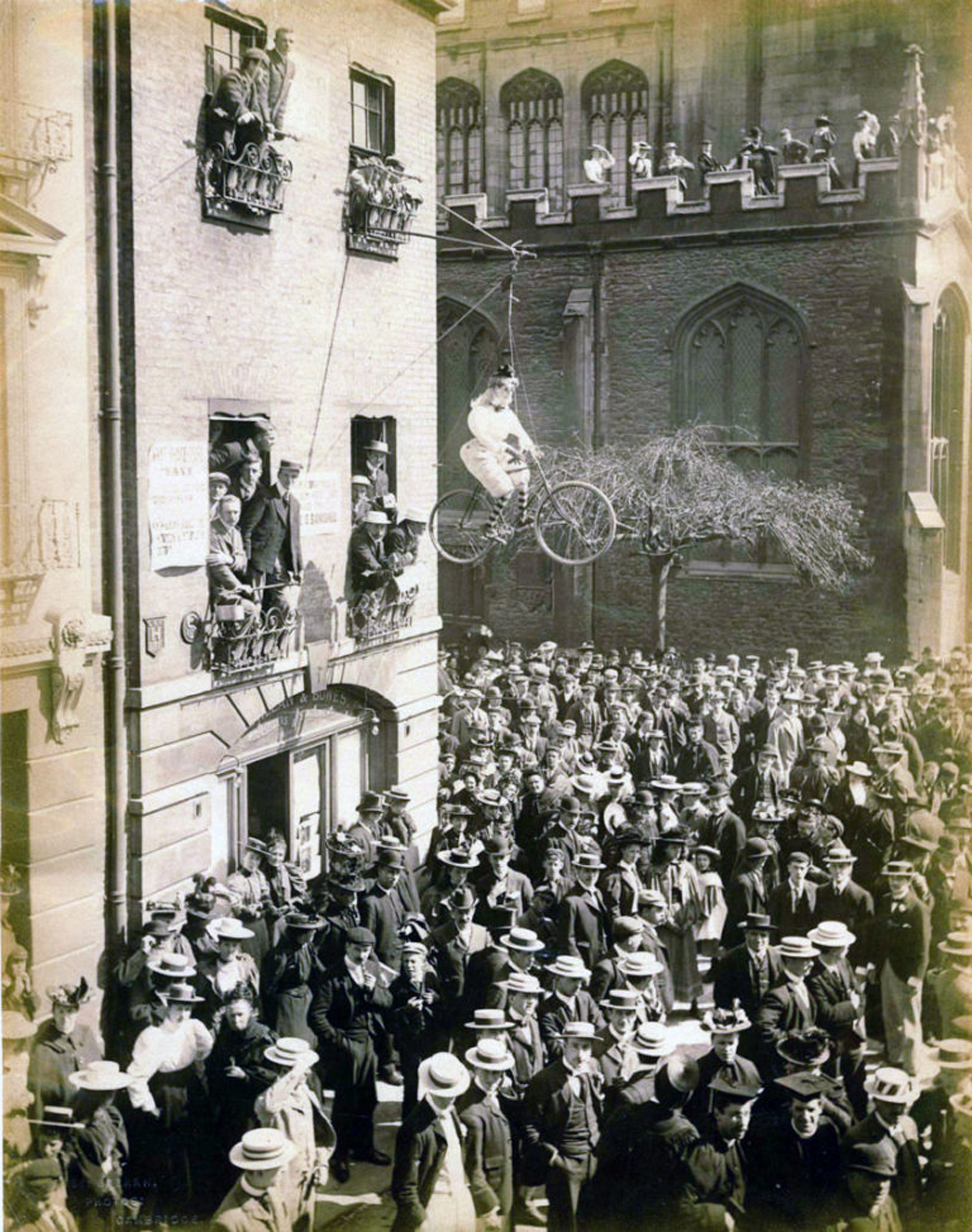
Thomas Stearn. University of Cambridge Protest: Effigy of a woman hung from Caius College across Trinity Street. 21 May 1897.
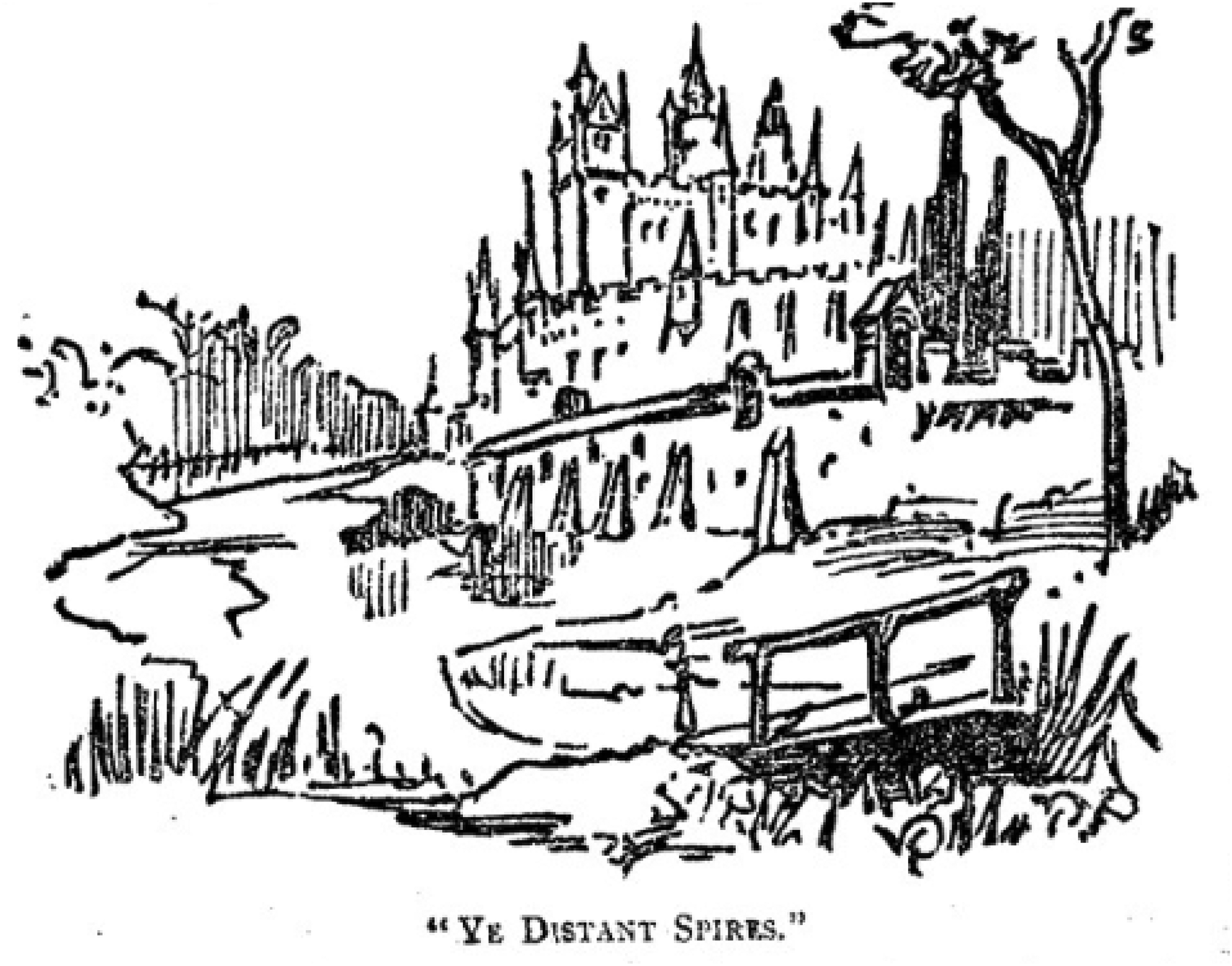
Artists unkown. Illustration for 'The Princess Ida' in Pall Mall Gazette. 7 January 1884. Newspaper image © The British Library Board. All rights reserved. With thanks to The British Newspaper Archive.
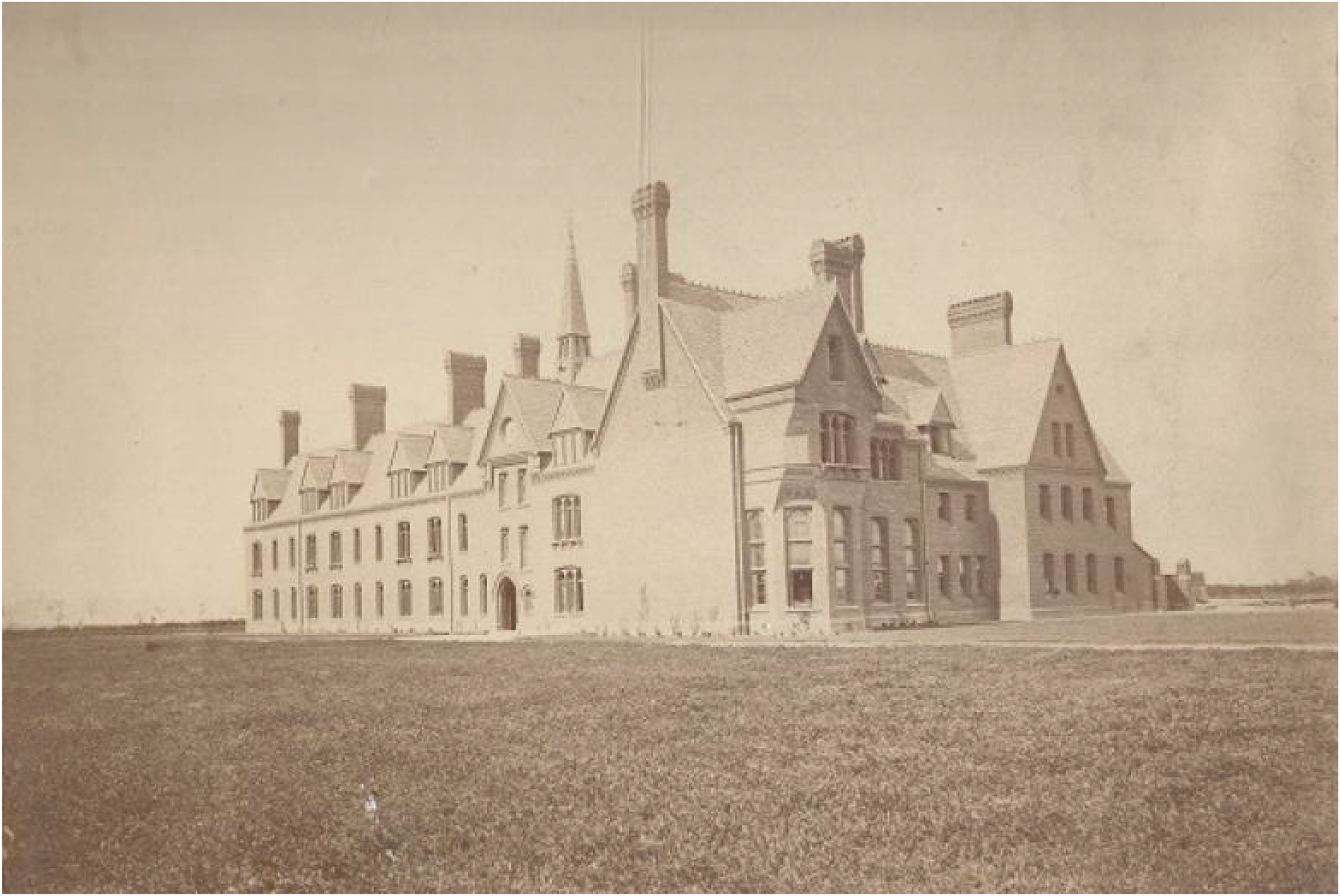
Photographer unknown. The first building at Girton, circa 1873.
One of those ‘Songs of a Savoyard’ that would feature in Gilbert's 1898 edition of Bab Ballads was ‘Girl Graduates’, lifted from the libretto Princess Ida. 28 The trio – performed in the opera by Cyril, Hilarion and Florian – successfully conveys, in the most odious of attitudes, that the education of women and its consequences is ridiculous. The domina of this jolly silly ‘Univsersit-ee’ have all sorts of absurd notions that are stressed metrically with shrill disbelief – ‘To get sunbeams from cucumbers’, for example. These women are, it is inferred, delusional in their pursuit of impossible ends, which might only be achieved by unnatural practices. The comedy of the song depends upon the increasing hysteria of the singer, panicked finally by his own disquieting notion that affording women access to education will result in changes to the status quo not only so far as gender is concerned but also race. Moreover, intellectual endeavour has an impact on a woman's appearance. Prettiness is put at risk as fashion is forsworn and celibacy is enforced at this particular institution where Man, too, is repudiated. In the lyrics of ‘Girl Graduates’, we, therefore, get a clear and unforgiving sighting of the New Woman caricature.
Stern Philosophies: Ida as New Woman
On opening night at the Savoy, the correspondent for the Freeman's Journal delighted in the setting of the second act and the appearance of ‘Princess Ida and her fellow amazons’: when the curtain rose some two score ‘Girl Graduates’ were discovered reclining on the stage. This was one of the prettiest pictures of the play, the gowns were rich velvet and brocade, and the graduates were, or at least looked, as pretty an assemblage as any male intruder might wish to encounter.
29
It is well-documented how certain elements of the periodical press of the late nineteenth century were at once titillated and repulsed by the figure of the New Woman. A ‘Character Note’ published in Cornhill Magazine in 1894 described her ‘somewhat aggressive air of independence which finds its birth in the length of her stride’; she was ‘always manly’ and the product of a ‘cheap education’.
31
The first mention of Ida at the opening of Act One imagines a rare moment of cross-dressing in a Savoy opera: men are almost mistaken for women. King Hildebrand and his courtiers anxiously watch King Gama approach the family palace:
The audience is set up for Ida's ‘strangeness’ immediately through this potential gender switching. Florian's facetious suggestion that Ida might be approaching the palace under a masculine guise is not beyond the realms of possibility, given the rumours about her habit of doing ‘odd things’. But the six-foot cavalier seen on the horizon by Hildebrand and his entourage is not Ida. Her absence is explained by Hilarion, who divulges that she has supposedly isolated herself in an intellectual nunnery:
Hildebrand responds with the punch-line: ‘Then I should say the loss of such a wife / Is one to which a reasonable man / Would easily be reconciled' (p.136). What is imagined in this conversation is an early sketch of the New Woman: the figure who could be Ida rides astride like the lady cyclist dangling above Cambridge Market Square; they sport armour like the military volunteer famously imagined in the Punch cartoon ‘Donna Quixote’ (1894); and they smoke cigars like Vivie Warren of Shaw's Mrs Warren's Profession (1893). Ida's rebelliousness is perceived by those men who look unfavourably upon her mission at Castle Adamant as strange or delusional. Pioneering women in fiction and in fact were subject to the same dismissive, derisive and disabling criticism. Philanthropist, educator and Scottish Suffragist Dame Louisa Lumsden was among the first five students of Benslow House, Hitchin: the women's higher educational establishment founded by Emily Davies in 1869 that would become Girton College. ‘Going up’ by train on one occasion, Lumsden found herself in a carriage with a clergyman who announced as they pulled into Hitchin: ‘Ha! This is Hitchin, and that, I believe is the house where the College for Women is: that infidel place!’ 33 In so disdaining the College for Women, the clergyman implies faithlessness and deviance, and these implications are racialised through that pejorative term ‘infidel’. Various crusades are suggested in this further example of the correspondences between contemporary racial and gender prejudices. 34 Infidels and infidel places such as Benslow House and Castle Adamant, it is implied, are there to be conquered, corrected and converted.
Lumsden is commemorated in the College song ‘The Girton Pioneers’ as one of three women to take the Cambridge University Tripos Examination in 1873:
The phrase ‘Senior Wrangler’ is peculiar to Cambridge and refers to the highest-performing undergraduate in the Mathematics Tripos. Principal Ida's lengthy monologue at the start of Act Two confirms the centrality of mathematics to the syllabus at Castle Adamant and to the mission of this women's college overall. Ida seeks to inspire her students with the rallying cry that Woman leads the way in every field. Notably, Man will first be conquered in mathematics, thanks to some creative accounting on the part of the simple home economist:
The suggestion in this extract is that the excellent Woman mathematician makes sly use of her numeracy skills. But in the real world of current affairs beyond Gilbert's opera, those who championed the cause of intellectual freedom and equality believed that mathematics might serve women a purpose other than cooking the pantry account books. By the late nineteenth century, mathematics as both subject and potential occupation, had achieved special significance for those who believed in equality and intellectual emancipation for women. The Cambridge Tripos examinations became something of a public spectacle, chiefly because of the outstanding achievements of women undergraduates. In 1890, Philippa Fawcett of Newnham College beat all her male competitors to become the Senior Wrangler. In this way, Fawcett materially advanced the cause for women's higher education and, according to the Dictionary of National Biography, ‘naturally gave her mother the greatest satisfaction’. 36 Her achievements inspired Shaw as he wrote Mrs Warren's Profession: the story of Kitty Warren, a madam, and her Cambridge-educated daughter Vivie.
Vivie is drawn in Shaw's stage directions as the typical New Woman:
She is an attractive specimen of the sensible, able, highly-educated young middle-class Englishwoman. Age 22. Prompt, strong, confident, self-possessed. Plain business-like dress, but not dowdy. She wears a chatelaine at her belt, with a fountain pen and a paper knife among its pendants.
Men Versus Girls: Staging and Scoring Comic Resolution
When Leonora Braham appeared on stage for the first time as Princess Ida in January 1884, her costume created a striking contrast with the fine robes of the chorus of girl graduates. Braham wore ‘bridal costume […] gay in white satin and a crown, not in academic costume at all’ (see Figure 4). 41 There are various possibilities to consider when assessing the intended effect of this pointed distinction. Ida might have appeared to audiences like a secular Mother Superior: not a bride of Christ, but a servant of Athena, goddess of wisdom. Or perhaps the seriousness of her resolve was undermined by a costume suggesting that she was, in fact, wedded to social convention; a costume which foreshadowed the (inevitable) failure of Castle Adamant. In either case, education causes extremes of maidenly reserve in Princess Ida. The convent-like Castle Adamant is an entirely self-sufficient, separatist community of women where, we are told, even the cockcrowing is performed by an accomplished hen. Girls are expelled for having wooden chessmen in their possession and for shamefully drawing not just perambulators but double perambulators in rare idle moments (144). Ledger isolates sexual inversion as one of the main sources of panic caused by the fictional New Women written by male novelists of the 1890s: ‘the very real fear that she may not be at all interested in men, and could manage quite well without them’. 42 That fear is first made light of in Gilbert's libretto in the course of Gama and Cyril's conversation:
Artist unknown. The second page of the opening night programme for Princess Ida. 5 January 1884.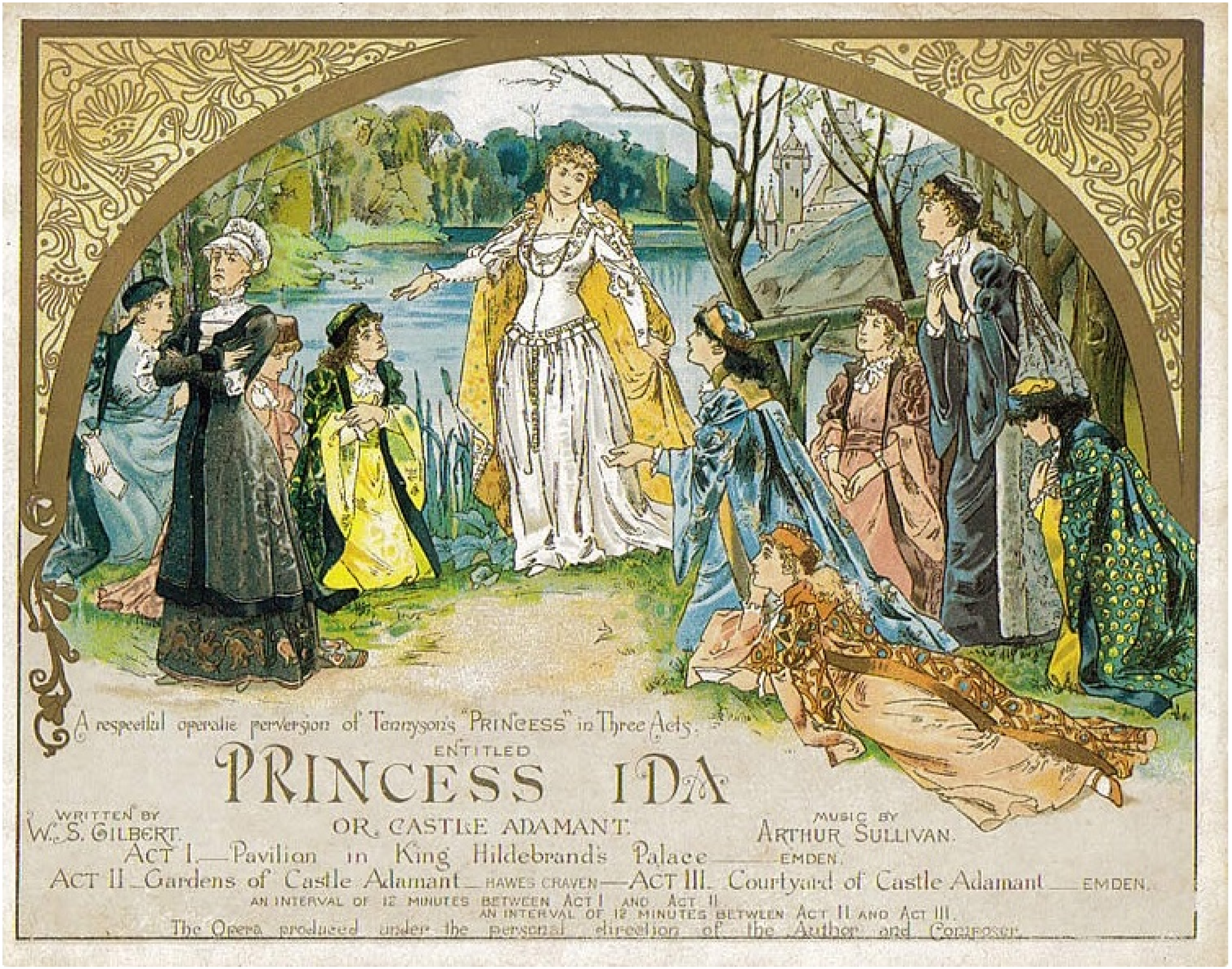
There is an undercurrent of serious concern that reflects the world outside Princess Ida's setting. Angelique Richardson and Chris Willis use the census returns of 1851 – when 400,000 unmarried women were registered – to underpin their suggestion that these ‘surplus’ women ‘posed a considerable if inadvertent threat to separate-sphere ideology: uncontained by spouses they risked spilling out into the public sector, becoming public and visible’. 43 In Gilbert's libretto, the men ensure that the only women to leave the walls of Castle Adamant are married women, thereby eliminating the threat of Ida's principles becoming public.
The reporter for the Edinburgh Evening News described the setting of the last act in the original production, ‘where the ladies, with helmets on their heads, glittering battle-axes in their hands, and silver chain armour over their frocks, sing a martial chorus lapsing comically into verse’, before ‘[t]he gates are opened, the girls mount the battlements, the soldiers rush in, and the two choruses of women and warriors are cleverly intermingled’. 44 Williams has demonstrated how an operatic chorus, divided into male and female cohorts characterised as stereotypical opposites, was especially useful in allowing both Gilbert, the writer, and Sullivan, the composer, to emphasise their thematic concerns with gender. 45 In the case of Princess Ida, the women's chorus consists of studious, staid pupils and the men's chorus of belligerent, impetuous courtiers. Ensemble pieces are scored for ‘GIRLS’ and ‘MEN’: verses are sung together to two different melodies. In this way, there is an opposition established in words and music between feminine brains and masculine brawn – albeit of a fairly ineffectual variety. An ensemble piece performed as the castle gate is breached is a fine example of how a divided chorus might be used to convey distinct gendered perspectives:
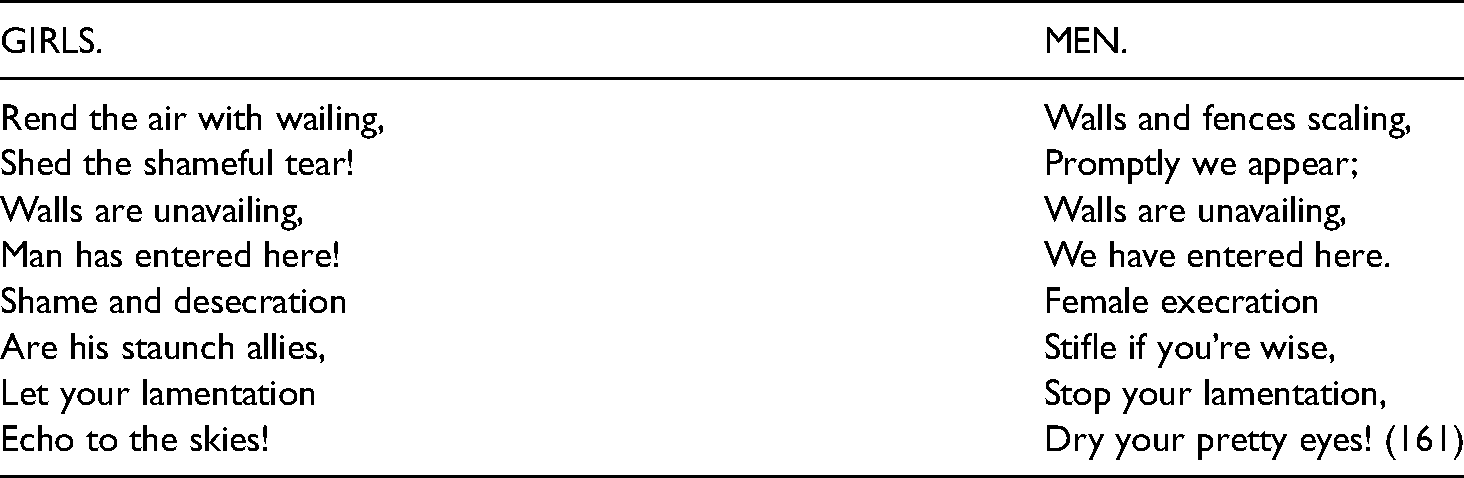
Williams has written that, in general, this structuring principle of a split chorus has been oversimplified by critics who consider it a means of merely reflecting the ‘reductive gender stereotypes prevalent in the Victorian period’. Instead, she believes that these divisions expose their absurdity, ‘revealing them to be the repetitive and parodic stereotypes they are’. 46 In the verses supplied above, there are classical echoes in the wailing and lamentations of the girls’ part which conveys the contemporary anxiety regarding the preservation of female purity. Ida's girls, who have enjoyed something of classical education, might be associated with those women violated in ancient myth, not necessarily in the act of rape, but in the transgression of sacred geographical boundaries: Diana and her nymphs, for example, or the Sabine women.
Despite their helmets, armour and glittering battle-axes, the pupils of Castle Adamant come quietly in the end, forsaking Principal Ida and their principles. Even Lady Psyche conforms to convention and accepts a proposal from Cyril; she will only return to the celibate, studious life if her husband ‘[d]oes not behave himself’ (172). The college is pillaged for its finest natural resource – its women – and Ida is corrected to fulfil her contractual obligations of marriage. Among her final lines is the concession: ‘I have been wrong – I see my error now’ (172). The ending is, on various levels, deliberately dissatisfying. Williams wonders whether the suddenness of resolution (which is common to both the play The Princess and the opera Princess Ida) is perhaps meant to be funny. 47 But on the strength of this ambiguous and untrustworthy ending, The Taming of the Shrew might be added to the list of Shakespearean source texts compiled by Gayden Wren and Ida's kinship with Katherine suggested. 48 Although, like Kate, Ida is compelled to recognise that her lances are but straws, an audience might question her sincerity in memory of her rebellious potential – a memory which might be exciting or disquieting.
Ida in Earnest: The Seriousness of Comic Opera
Along with reviewers for the Observer, the London Morning Post and the Edinburgh Evening News, the correspondent for the Pall Mall Gazette queried the topicality of Gilbert's treatment of his subject in Princess Ida: The chaff about ladies’ colleges is rather outworn, and the metaphysics of the very comic Blanche (Miss Brandram) are less amusing than Mr. Lewis Carrol's [sic.] feminine Hegelianisms in ‘Phantasmagoria’. Lady Psyche has learned her classics at Ouida's feet, or Mrs Malaprop's. She sings about ‘crossing the Helicon’, probably half mindful that the Rubicon was a river and quite forgetful that Helicon (can the Helmund enter into the muddle?) is a hill.
49
I saw the Emperor – this world-soul (Weltgeist) – riding out of the city on reconnaissance. It is indeed a wonderful sensation to see such an individual, who, concentrated here at a single point, astride a horse, reaches out over the world and masters it…this extraordinary man, whom it is impossible not to admire.
51
Now, the Princess of the Laureate lives in a noble and poetical world of topsy-turvy, a medley of all ages and styles and fancies. How was the genius of comic inversion to deal with what was already inverted?
53
Surveying the interrelationship of characterisations of the New Woman and the developing new drama movement during the 1880s and 1890s, Jan McDonald comments that ‘the issues raised by these men [the new dramatists] were felt to be relevant to the intelligent women of the period’.
55
The new dramatists, McDonald contends: in presenting for scrutiny what they perceived to be the social inequalities of their time, posed questions to their audiences rather than proffering solutions. In dealing with the ‘woman question’, one of their greatest innovations in terms of dramaturgy was to move the female character into prominence as the real subject of the play – to give her an active rather than a passive role.
56
For Gilbert, Ida's educational project is merely a matter for mockery and, while she herself is portrayed as sincere and even courageous, she is also enough of an ‘airhead’ to need a reminder, in the final scene, that total isolation of the sexes from one another would spell the end of the human race.
58
Echoing Carolyn Williams, Fischler concludes that: The reason Princess Ida is not fundamentally funny is that the combination of women and university education is not a blending of incompatibles, although Gilbert meant them to be seen as such, and the very suggestion that the twain should never meet is obviously offensive.
65
It is in this way – in thinking carefully and inventively about how the scene might be played out and in investing Ida, the character, with a cynical sense of humour that sits comfortably with all her earnestness and ardour – that the concerns of comic opera directors such as Shawna Lucey might be assuaged. Fischler records that when Lucey was asked to direct a ‘pro-feminist’ Pirates of Penzance for Skylight Music Theatre in Milwaukee in 2016, her initial reaction was: ‘How am I gonna make these silly girls feminist?’ 69 Given the original context and subject matter of Princess Ida that question is all the more pertinent and urgent for any company looking to revive the eighth Savoy opera and make it newly relevant today. It would seem that the easiest, perhaps the only way to do that is to return to the text itself and to find those spaces within it where Gilbert is inviting, if not permitting, interpretation. The comedy of comic opera need not, necessarily, derive from satire or mockery; more subtle ironies might be at work in this world of topsy-turvy, where what lies beneath might be brought to the surface effectively through patient and cognizant reading – and watching. Ouida stated that, ‘[f]or the New Woman there is no such thing as a joke’. 70 Conversely, if the New Woman's contemporary critics have not recognised the serious potential of English comic opera until now, perhaps that is why Princess Ida has never been admitted to the sisterhood.
Footnotes
Declaration of Conflicting Interests
The author(s) declared no potential conflicts of interest with respect to the research, authorship, and/or publication of this article.
Funding
The author(s) received no financial support for the research, authorship, and/or publication of this article.
