



Abstract
Denise Levertov is regarded as a key figure in the New American Poetry and a committed political activist of the 1960s counterculture. Reading a treatise on poetry contained in Emmanuel Levinas’s Existence and Existents (1947) alongside Levertov’s early poems prior to her adoption of the American idiom, this essay re-positions the poet as the pathfinder of an intense period of assimilation in the immediate aftermath of the Second World War. The essay focuses on Levertov’s first collection of poems, The Double Image (1946), before turning to the frequently overlooked poems in her notebooks for 1947, in particular, ‘Fear of the Blind’. Examining key tropes of sight, visual impairment and observation, ‘Fear of the Blind’ deals with a personal and political trauma in the birth pains of the postwar period and marks a pivotal moment in Levertov’s lyrical reflexivity. It is the argument of this essay that the de-humanising rhetoric of anti-Semitism traumatised language by driving it against its ethical grain. In response, Levertov's unique poetics of materialism provides not only a revitalisation of language in the lyric form but an important contribution to current political and ethical debates concerning twenty-first century living.
Introduction
Considering the possibility of ethical thought after the crimes of National Socialism, Alan Itkin argues that the ‘traumatic nature of the Nazi’s crimes reveals a key truth about injustice in general: that it creates a wound in the moral structure that binds us together as a human community’. 1 The poetry of Denise Levertov (1923–1997), exploring the ethical relations between self and other, breaks down a complex set of dualities: light/dark, vision/blindness, carnal/spiritual, material/semantic. Levertov’s early postwar poetry also harnesses the power of the poetic image through sound, syntax and metaphor, opening up the pathway to a complex engagement of history, subjectivity and ethics. A visionary poet, or seer, of the Second World War generation, the visual and tonal texture of her poetry contains imagery of light overcoming darkness that irradiates and sutures the moral wounds of political violence.
Re-assessing Levertov’s significance from the perspective of the British Isles, this essay positions Levertov as the first poet writing in English to begin an intense assimilation period in the immediate aftermath of the Second World War. Over-turning a long held critical consensus, it argues that it is in the crafting specifically of her early poetry prior to her arrival in America that Levertov, emerging from her experience of war, achieves a powerful new voice in the history of the bardic tradition. With characteristic lyrical reflexivity, she uses sight, visual impairment and observation as important tropes that will sustain this essay’s reading of the political vision and poetic ethics that distinguishes her position as progenitor of the postwar lyric.
The essay begins by reconsidering the schematisation of Levertov’s poetic development and the criticism on the representations of blindness in Levertov studies before turning to her wartime experience and the opening of a new lyrical and symbolic terrain in her first collection of poems The Double Image (1946). Next, the essay traces the biographical, textual and historical genesis of the poems in her notebooks for 1947, in particular ‘Fear of the Blind’, making a claim for this poem’s importance in Levertov’s developing political vision. Rejecting the ego of the lyric ‘I’ in favour of a joyful non-totalising optics, and with a special depth or layering of sublimation in image and sound harmonies, Levertov’s early postwar poetry, the essay concludes, invites the reader into the ethics of civic responsibility.
Levertov and her Critics
The celebrated publication of Levertov’s first American book, Here and Now, in 1957 established her literary reputation. Since then, critics have described at least three key phases in Levertov’s poetic oeuvre. As Albert Gelpi observes, there is a ‘dramatic shift’ between her poems written in England and those written after she moved to America in 1948. 2 In contrast to the traditional form and metre of the poems written in England (typically regarded as insufficient to constitute a phase in themselves), her poems of the first phase written early in America (such as ‘Merritt Parkway’ or ‘Poem from Manhattan’) show Levertov adopting the open form of the new American poetry and, in particular, using the line-break and visual arrangement in the movement of perception. For James Breslin, she moves initially through a style ‘derived from [William Carlos] Williams … to a poetry of her own, a poetics of magical realism’. 3 A second phase follows what Audrey Rodgers describes as the ‘turning point’ of her 1961 collection The Jacob’s Ladder to a ‘poetry of engagement’, a preoccupation that Levertov embraced in her subsequent protest poetry against the Vietnam War. 4 During this period, and particularly following the publication of To Stay Alive (1971), Levertov lost favour with notable critics including Marjorie Perloff and Charles Altieri and with her close friend and mentor Robert Duncan. 5 For a decade or more, although she remained a popular and widely read poet, Levertov’s reputation in the academy was diminished by a suspicion of naivety allegedly evidenced in the romantic pastoral of her early poems and a didactic polemics of agitprop in her poems written during the 1960s and 1970s. For Anne Dewey, it is not until ‘the mid-1970s she developed a theory of political poetry and activism as grounded in personal voice’. 6 Finally, a concluding phase in Levertov studies followed what James Gallant describes as the ‘turning point [which] came in the writing of the “Mass for the Day of St. Thomas Didymus”’, a religious turn or pilgrimage theme, ‘since her profession of Christianity in 1984’. 7
For critics taking a long view of Levertov’s poetic oeuvre, these discrete phases are problematised. As Gallant notes, ‘the evolutionary, metamorphic quality of her work makes it difficult to categorize’. 8 In fact, the remarkable character of Levertov’s poetry is that the gritty timbre of the poet’s voice can be heard distinctly in almost all of her poems. This continuity is primarily the effect of a creative disposition to poetic language, an openness or non-totalising persuasion to the depths of experience that is carried forwards in the quality of the breath the poet is able to give to the material form. As Thomas Duddy observes, the ‘pervasive theme in her poems’ is ‘this quest for an authentic mode of celebration [which] illustrates a body of poetry ambitiously confronting its primary intentions’. 9 While there are then three or four different phases in Levertov’s poetic oeuvre, critics identify her ability to embrace new poetic ideas by refining her creative process as her continuing preoccupation.
Two recent biographies by Donna Hollenberg (2013) and Dana Greene (2014) confirm the critical consensus that Levertov began to find her poetic voice when she listened to the American idiom, and yet both accounts of her early life also point to the possibility for new readings against the backdrop of ‘a postwar cultural exhaustion in London and Paris’. 10 As Rodgers has pointed out, ‘too many critics forget that Denise Levertov’s social consciousness was hinted in her poetry from the very beginning’. 11 For Rodgers, the creative impulse and context for the poems of 1944–46 is that ‘images of war were part of her unconscious’. 12 Yet comparatively little critical attention has been afforded to Levertov’s early poems written while she was working as a nurse in wartime London and collected in her first book The Double Image while even scanter attention has been paid to the unpublished poems of her diary and notebooks that she kept during her travels after the war to Holland and Paris in 1947 and 1948. Yet Levertov’s wartime experiences and, in particular, the years in its immediate aftermath are fundamental to her poetic maturation.
A number of critics have addressed the handful of Levertov’s poems across her poetic oeuvre where visual impairment is explicitly referenced. Cristina Fernández’s ‘Beyond Vision: The Role of Perception in Denise Levertov’s Examination of Blindness’, brings these poems together in order to make the claim that ‘identity issues resound in all six of [the] poems’. 13 Building on readings by James Wright and Harry Marten, Fernández shows how Levertov’s comprehension of blindness eventually evolved ‘from a dark and evil condition to a half-divine form of life’. 14 More recently, Alan Marshall has advanced this argument, drawing out the connection between blindness and aesthetic vision by pointing toward the political act of looking. Reading the ethics of encounter and empathy in two poems, ‘A Solitude’ and ‘During the Eichmann Trial’ from Levertov’s 1961 collection The Jacob’s Ladder, Marshall shows how the poet illustrates the transition from moral blindness toward ‘our common humanity’. 15 While struggling with an attitude toward blindness that sub-divides communities by a particular grouping or categorisation, it is the first of the six poems (identified by Fernández), ‘Fear of the Blind’, however, which, this essay claims, marks a crucial breakthrough for the poet.
One of the ways to read Levertov’s first collection of poems, The Double Image, is as an apprenticeship in poetic craft, with light and blindness as the key theme latent in the book’s title. As Gelpi observes, ‘Astigmatism, myopia, spliced images – these have more and more painfully afflicted the modern capacity for seeing, and split vision has polarized every aspect of experience’. 16 While there is ‘awareness of doubleness’, most explicitly in The Double Image, Gelpi argues that Levertov’s poetry has been ‘more remarkable for its centeredness: its tenacious grasp of the one grounding the two’. Other critics, such as Breslin, have argued that The Double Image explores ‘the dilemma of a centreless world, how to enter it, how to live and write in it’, 17 but Gelpi’s reading can be extended to show how Levertov’s first experimentation is to craft a hermeneutical space which brings together the material and the visual into a revelation of the numinous. ‘[T]he double propounds not contradiction but paradox’, Gelpi writes, ‘aspects of relationship twinned in concentricity’. 18 ‘If the two adhere as one’, he reasons, ‘the one inheres in doubleness’. 19 ‘This conviction’, Gelpi concludes, ‘has become explicit during the course of her career, but it was the implicit assumption and the underlying inclination of her poetry almost from the start’. 20 The major contribution of The Double Image is that it is with this first book of poems that Levertov strikes out to resolve the bifurcated vision or taxonomy in which modern experience is categorised. Thus an ethical poetics will go on to be developed by the poet as she masters her poetic form.
The Double Image and Levertov’s Wartime Experience
In her earliest published poem, ‘Listening to Distant Guns’, written in Buckinghamshire during or just before the Battle of Dunkirk of May and June 1940, and in a foreboding of her own historical and political awakening, Levertov writes: ‘That low pulsation in the east is war’. 21 Soon her experience of the war became more immediate; as an Assistant Nurse in London during the middle years of the war, Levertov was confronted daily with the bodies of injured soldiers. The experience of war deepened Levertov’s commitment to poetry for poetry promised both a future vocation and an artistic craft in which to understand the present. In an unpublished poem from November 1943 titled ‘Night Trains’, she writes: ‘Now words are no threadbare rags on wraps / about the bones of fear: / having learnt that tomorrow is the only somewhere, / words are the only here’. 22 Later, some thirty years into the postwar period, in ‘The Malice of Innocence’ from Footprints (1972), she recalls how ‘the well-rehearsed / pavanne of power’ that played out in the nurses’ nighttime rounds of the ‘death rooms’ – counting the ‘pairs of open eyes turned to us’ or the ‘old mouth gaping at death’ – extends into ‘remembering being (crudely, cruelly, / just as a soldier or one of the guards / from Dachau might be) in love with order’ (443).
In April 1945, Levertov would have read the news reports from the liberated Belsen concentration camp in the London newspapers and heard the first eyewitness accounts broadcast by the BBC. The images from Belsen brought home the suffering and mass exterminations in the concentration camps but it would take further historical reflection and analysis to show how a divisive distortion of reality had coiled language like barbed wire. By 1940, Winston Churchill talked of a ‘malignancy in our midst’ and, as Andrew Sinclair has shown, ‘the national mood turned against the refugees from Europe’, many of whom were detained in make-shift camps. 23 In his 1940 poem ‘Escape’, W.R. Rodgers warned those who were trying to escape: ‘You will be more free / At the thoughtless centre of slaughter than you would be / Standing chained to the telephone-end while the world crashes’. 24 In Vichy France, a special commission set up in July 1940 reviewed naturalisations granted since 1927, a bureaucratic process that was instrumental to the green ticket roundup of 14 May 1941 that resulted in the internment of fifteen thousand persons, mostly Jews. In Poethics: And Other Strategies of Law and Literature, Richard Weisberg illustrates the wider picture: ‘Vichy France poignantly symbolizes an entire European culture in distress, a culture that had in some ways been indicating the Holocaust mentality for a century before the event’. 25 It is when feelings are structured through language that they take a powerful hold on the body politic and discourse has been nowhere more dangerous in the twentieth century than in the bifurcating language of anti-Semitism.
In Purify and Destroy: The Political Uses of Massacre and Genocide, Jacques Semelin introduces the term ‘delusional rationality’ to describe the ‘rhetorical core from which a process of violence radiates that can lead to massacre’. 26 As Saul Friedländer shows, national resentment was cultivated against a Jewish populace blamed for the defeat of 1918 while a ‘millennial redemption’ was promised in the necessary annihilation of ‘Them’ to save ‘Us’. 27 Ultimately, Nazi Germany’s use of a xenophobic logic in a calculated ‘redemptive anti-Semitism’ facilitated the murder of six million European Jews between 1941 and 1945 and affected a distortion of language with global consequences. As Sander Gilman claims: ‘The language damaged in the Holocaust was the universal language of humanity’. 28 Emphasising its aural dimension, Arthur Cohen writes: ‘Language … created its own rhetoric of dissimulation, and conscience was no longer required to hear accurately – a phenomenon not unique in Nazi Germany, but, indisputably, a consequential aspect of its discipline’. 29 For Susan Gubar, the violence of the Shoah brought a seemingly permanent severing of the material from the semantic. Adopting the visual imagery from Paul Celan’s poem ‘Death Fugue’, she writes, ‘the “knife of parting” wounded language, that “black milk” effected a pollution of the symbolic order’. 30 Against the backdrop of a politics of exclusionary thinking and human categorisation, Levertov’s first published poems inaugurate her exploration of the poetic image.
Despite its distance, war is an ever-present trauma in the poems of The Double Image. ‘To the Inviolable Shade’ refers to the blackouts during the Blitz and registers how ‘murder overhead / knocks at our hearts like an impatient ghost’ (20). Aged just sixteen years old when Britain and France declared war on Germany in 1939, Levertov writes poems that are also about the concerns of adolescence and of coming of age in wartime. The poems of The Double Image are thus divided into two sections – ‘Fears’ and ‘Promises’ – which describe the individual divided and separated into the binary oppositions required by the social expectations of roles and performances, silos and competition, and they reflect situations where there is no authentic connection or deal with the nakedness of the other’s face: ‘A mask’s protection – ah, and there’s the treason – / can make the hidden face its own dark image; / whip off that covering, no doubt you’ll find / only the bright indifferent gaze of reason’ (31). In these lines from ‘Meditation and Voices’, Levertov rejects the abstraction of language if vision is merely a process of persuasion by logic or dialectics, indifferent to the other. In political rhetoric or drama the clear ‘bright indifferent gaze of reason’ leaves the face hidden in ‘its own dark image’ (31).
In the first poem of The Double Image Levertov begins by describing a foundational life force: ‘The world alive with love, where leaves tremble, / systole and diastole marking miraculous hours’ (19). Dysfunction in the contraction (systole) and relaxation (diastole) of the heart muscles can adversely affect a person’s blood pressure, ultimately even damaging the eyesight. Across the poems of The Double Image such medical knowledge, however, is secondary to the inner vision that is reached most often in the experience of the woods as a salve from the daily turbulence of wartime. In ‘Durgan’, for example, Levertov writes, ‘out of a wood the waking dream of day, / blind eyelids lifting to a coloured world’ (21). Learning and experience meet for the poet in the apperception of the trees or where knowledge reaches inward and it is here that the poet finds insight into being and personhood.
Levertov early understood that the symbolical power of light, as it illuminates the world, is fundamentally a poetic device. Any simple essentialist or positivist truth is thus carefully problematised as Levertov’s conceit is extended. Later, in an influential essay on poetic craft, Levertov puts the relationship between persuasion, argument and aesthetics into ‘organic form’. 31 In order to do so, she theorises poetic language using Gerard Manley Hopkins’s concept of ‘inscape’ as ‘the essential form of individual objects and their relation to each other’ and ‘instress’ as ‘the act of perceiving inscape’. 32 Perhaps intuitively, the poems of The Double Image begin the working out of a new relationship between the inner and the outer, the personal and the historical or public by way of a reconciliation or convergence in her poetic vision. The first of more than nineteen books of poetry that she would publish in her lifetime, The Double Image marks an initial breakup of the categories of experience and the opening of a new lyrical and symbolic terrain.
Fear of the Blind
In March 1947, Levertov wrote in her notebook: ‘Be patient with the seasons; let the spring assail your fears’. 33 With Levertov’s dictum as a guide, the following reading traces in her notebooks for 1947 the biographical, textual and historical genesis of her short and unassuming poem, ‘Fear of the Blind’, which she wrote in June 1947 shortly after her arrival in Paris. Reading Emmanuel Levinas’s Existence and Existents (1947) alongside the poem, the impact of the poet’s personal experience of war and of pregnancy and abortion are considered within an ethics of signification or human gesture that ground the poet’s political vision.
While the biographical context of Levertov’s personal experience of pregnancy and abortion is not essential to an interpretation of the politics of representation in ‘Fear of the Blind’, it does reveal how Levertov begins to develop the politics of her poetic ethics. After the liberation of Europe, Levertov was free to travel and on 17 January 1947 she moved to Reeuwijk, Holland. After spending the winter of 1946–47 first in Holland Levertov was to have an illegal abortion in March of that year. This period, culminating in her poem ‘Fear of the Blind’, is pivotal to Levertov’s development as a poet. Her intelligent enquiry into human beings enables the poet to break new technical ground in the visual and aural character of her poetry. Levertov’s personal experiences as a young woman in the first years after the war crucially deepen her ethical insight and vitalise her capacity for political vision.
In June and July 1947 Levertov wrote about her abortion to the American poet, Kenneth Rexroth. She explained that she would ‘never forget seeing it, because it was old enough to be pretty well-formed; intuitively I feel morally bankrupt over it – oh, a hollow feeling’. 34 Levetov explained that ‘both parents ought to want a child’, and that she was certain that she would not have been able to provide for a child on her own either ‘materially’ or ‘emotionally’. 35 While Levertov is motivated by the welfare of the unborn child, personal ethics and public morality nonetheless converge for the poet in the particular circumstances of the historical context within which she decided to have her abortion. In 1947, abortion was both illegal and dangerous. In the last months of 1946, the Allied prosecutors at the Nuremberg trials had furthermore made the case that voluntary or forced abortion was an ‘act of extermination’ and one of the means of genocide in Nazi Germany. 36 The trials at Nuremberg sought to restore moral authority over the exclusionary thinking that valued certain peoples as less than human. In the first time in the history of international criminal law, statesmen who carried out acts of aggressive war were held culpable for their actions. For a global audience following these trials, it was also a period of political and ethical reflection.
There is, of course, no comparison between the Nazi crimes and Levertov’s abortion nor is there any moral equivalency. But Levertov’s ‘hollow feeling’ may be read in the context of this unprecedented time focused on moral retribution and restoration. The difficult decision of abortion, particularly in such a historical context, engages Levertov in an ethics of the concepts of the material body and of subjectivity. Among the many complex issues involved in the ethics of abortion are questions of the criterion of personhood in the relations of self and other as well as the capacity of the subject for sensory awareness and by extension its capacity to feel and to communicate what is inadequately called pain. Such moral and philosophical considerations are foundational in the thinking behind the poems Levertov wrote in the first months of 1947.
The last few weeks of March 1947 were an intensely creative period during which Levertov wrote ten poems, sometimes two in one day. Levertov’s daily struggle to find the words for an image true to her present instinct (an image that will also speak more broadly to a postwar public) is an obsession of craft that finds fulfilment in her poem ‘Fear of the Blind’ but is revealed in gestation in her 1947 notebooks. In a heavily revised first draft of her poem ‘Praise’, for example, Levertov writes: ‘Probe the summer with growing impatience as the blind cross from one darkness to another feeling across the road in planetree shadow’. 37 It is here that the seeds of Levertov’s accomplished imagery in ‘Fear of the Blind’ are rooted as the poet experiments with the possibilities of poetic images.
In her unpublished poem, ‘Annunciation’, dated February 1947, Levertov writes, ‘the weight of earth lifted’ and that the poet’s eyes are ‘re-endowed with sight’: ‘The stone awakens, and I live again, / and know within my womb there lies / a quickening life’. 38 A first poem written soon after discovering that she was pregnant, ‘Annunciation’ brings the poet and the fetus in utero together in a growing sensory awareness of the body, the self and the world. For the poet, the potential of a new life shifts the conceptions and relations of self and other. In her self-awareness of the responsibilities of motherhood, ‘the awakening of the stone’ overturns the duality or de-sacralisation of the body into, on the one hand, an anatomical and physiological material being and, on the other, a soul or mind as cogito or consciousness. 39 Instead, the poem’s unification of spirit and matter transcends the Cartesian rationality. In another poem that she wrote for a close friend early in March 1947, ‘Poem for Caroline’, the poet describes ‘the body’s darkness’, ‘the most elemental darkness, the cool dark of water which is nowhere, nothing, null’ and ‘the dark of fires which burn the morning skies away / charr the bright world to a cinder’. 40 Here, in a poem that addresses the personal difficulties for a generation emotionally buffeted by the traumas of the war, the dualities of light and darkness and of body and mind are fused in a poetic imagery that in darker tones speaks both to a physiological existence and to a re-birth from the postwar embers.
In the first poem written after her abortion in March 1947, ‘Into What Darkness?’, the literal and the figurative are broken down in an analogy between the foetus and the ‘lost poem’: ‘all your vivid life that I have broken […] calls for fulfilment’. 41 In response to the poet’s moral self-examination (‘Into what darkness is my jewel fallen?’), the pre-term infant ex utero is addressed directly: it ‘looks at me from the light with eyes of light. Your image burns my breast’. 42 Though not erased from her notebook, the poem is twice struck through with diagonal line crossings. Unpublished, the poem is aborted before it could enter into public consciousness; the foetus, the poem concludes, is ‘the ghost I have created, my hunger and my poem’. 43 The pain in the poem’s gustatory language and its imagery of ritual sacrifice (‘the fire that I stole from you’) resonates both with the Ancient Judaic practice of the burnt offering consumed by fire and with the bodies of the victims of Hitler’s final solution consumed whole or in crematoria at the Nazi extermination camps. 44 This difficult imagery, and its historical resonances, again raises the question of a culture’s civic responsibility. Levertov later recorded in her diary that she had felt after her abortion, ‘a physical sensation of sinewy lightness – lighter clothes and a loss of weight’ and the emphasis in this first poem is on the individual responsibility that she feels to ‘repay some measure of my debt’ through her new found life and freedom. 45
When the poem ‘Fear of the Blind’ first appears in Levertov’s ‘Notebook, c. 1947–1949’ under its title, it is a ‘transcript’ or fair copy of the poem ready for publication (Figure 1). The poet’s later annotation in blue biro notes its first print appearance in the Spring 1951 issue of Poetry Quarterly. Conceived on the banks of the River Seine in the same year during which the Allied Powers signed the Paris Peace Treaties, Levertov’s ‘Fear of the Blind’ caresses the reader with its autumnal sunshine. In Paris, as Levertov later wrote to Charles Wrey Gardiner, where ‘one sees and is oppressed by blind men always’, the poem describes the calm serenity of the dappled, leafy canopy and the blind men whom the poet witnesses as she walks beside the river. 46 Considering this scene within the poem’s stated rhetorical frame, ‘Paris, 1947’, it is possible to imagine that the blind men are war wounded veterans relearning how to live, precariously searching for a firm footing. Labelling this specific time and place situates the speaker within a cultural palimpsest of negotiated war reparations, migratory populations, minority rights, rubble and ash, mutilated and disfigured bodies of veterans missing limbs and sensory organs.
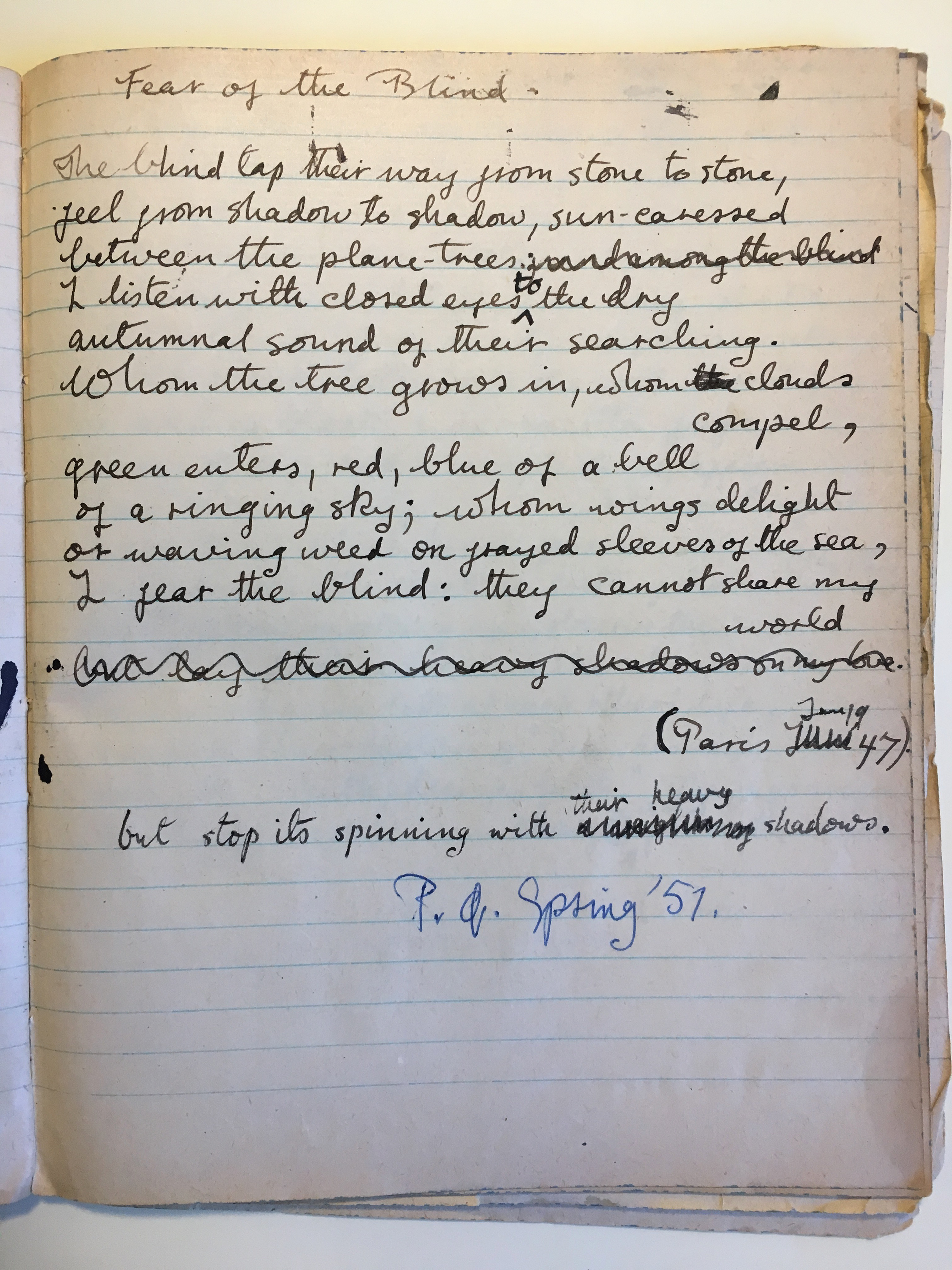
‘Notebook, c. 1947–1949’, Denise Levertov Papers, M0601, Series 2, 1:4. Courtesy of the Department of Special Collections, Stanford University Libraries.
Two metaphors registering a desire and relation with difference are at play in this poem: the light differently experienced by blindness, particularly as it gives perspective or is mottled and patterned by the canopy of the trees; but also the sea, at once both a dividing boundary and a great unknown, an expansive opening up between continents. Most explicitly, the poem presents the speaker’s fear of blindness and specifically of ‘blind people’, considered here as a single group. This homogenised grouping is not allowed to be straightforward, however, as the poem puts the lyric ‘I’ into an intense self-interrogation. In this way, Levertov demonstrates how meaning is found both in sound and in semantics – it is both linguistically constructed and sensuously (or existentially) felt – rather than solely the a priori meaning of the light, a truth that just is. Though it is not immediately apparent from what is said in the poem over and above the visual perception afforded by the eyesight, meaning is finally shown to operate through the language of a poem that promises to unite the reader with the poet in its shared world. In the metrical tapping of the stones, in other words, the reader is the pathfinder of a syntagmatic chain, from word to word.
The generalisation of the singular grouping in ‘Fear of the Blind’ paradoxically reveals that it is the quality of ‘otherness’ that unsettles the speaker’s identification with the same. This perceived fear for ontological security is brought to account with the ‘heavy shadows’ contrasting the poem’s light denouement (7). The weight of responsibility for the other, and the guilt that is subconsciously felt by civilians and survivors after the war, is taken up as a personal encumbrance. Even at a distance from the presence of alterity (its substance), the other’s shadow recasts the light of her world and this awareness stops the poet in her tracks. Yet the poet remains fearful of the blind men whom she considers to perceive, and to exist, in a world hermetically sealed from her own. In the closing line of the poem there is perhaps a slight resentment toward the blind men for their interruption of her reverie. It is, however, in observing the blind men that the poet is drawn outward from her own personal difficulties into a more complex panorama of the public landscape both political and cultural. Though the poem does not finally close the gap between the speaker and the blind men, the poet nevertheless begins to recognise that she sees in a particular way, and by awareness of others’ perception sees for the first time a city devastated and impoverished by military occupation and one that had been forced to evacuate its sovereignty to Vichy France. Indeed, the pain and loneliness of others and the consequences of the violence and destruction of war are all around her and absorbed and refracted within her own personal experience and postwar identity.
As the readers unfold the difficulty of Levertov’s ‘Fear of the Blind’ they discover much more than the young woman’s first impressions of Paris. The most troubling word in the poem is ‘whom’ – repeated three times. As a formal grammatical term of obligation and responsibility, this single object pronoun contains the poem’s political and ethical charge while circumscribing a particular yet parlous relation between subjects. The sentence beginning with the ‘whom’ clauses appears initially to refer to the blind men who arrest the poet’s attention. The object pronoun ‘whom’ avoids the interrogative ‘who’, which points to identification, and offers instead a softened, or open, embrace and a relation that will not presuppose the other but is of a non-totalising, or non-possessive, knowledge. Similarly, by avoiding an impersonal ‘you’, ‘whom’ resists the potential doubling of the I-you by the ego where the observation of self-other and subject-object relations might reduce the other to the same.
‘Fear of the Blind’ also disrupts a linear reading chronology by orchestrating a second reading through its aesthetic effects. The closing repetition of ‘I fear the blind’ functions as a dramatic musical refrain or coda transporting the reader back to the beginning of the poem. Activating a bi-directional syntax whereby the opening of the sentence ‘whom’ operates both backwards and forwards, ‘whom’ is extended to refer not only to the blind men, or to the war wounded, but also to the poet herself. With an ambiguity of gesture, the multiple signifying structure of the ‘whom’ clauses disrupts oppositional or binary identity politics. The poem thereby begins to bridge the inner and outer, the personal and the public, and shifts the dualities and categories of experience, and their moral coding, into a complex perspective of process and synthesis.
Initially, ‘Fear of the Blind’ categorically distances the poet’s sighted reality from that known by the blind men because of the speaker’s ocular-centric experience. The blind men trapped in the poem are unable to share in nature’s mystery. Images of the waving weed, the plane-trees, the wings of birds, the clouds in the sky, the break of sea waves are wonders that bring personal growth, inspiration and healing for the poet while the blind men remain incarcerated in an existential or imaginative stasis. Yet, on a second reading, the poem over-turns what is said in the poem in the manner of its saying. As a counter-balance to the poet’s fear of the blind, the magisterial power of the words of the poem comes from the graceful fluidity of its gentle, multi-sensorial expression. Against the fear of unending darkness, the speaker’s anxiety is quenched by the poet’s deft use of words and nature imagery to transition between the auditory, visual and somatosensory senses in the imagination. Transported into an intimate proximity with the blind men that does not close down distance, the poet witnesses: ‘I listen with closed eyes to the dry / autumnal sound of their searching’, a poetry that sings, ‘whom wings delight / or waving weed on frayed sleeves of the sea’ (7). There is sadness in the separation but the controlled imagery of the movement of the seaweed, combined with the metaphor of the sea, is felt not as a visual imagery of entanglement and turbulence but as the shared familiarity of lived-in and worn fabric sleeves, providing an authenticity to the encounter that is more pervasive and permanent than the stasis of anxiety and isolation. While the poem declares that the blind men do not share in her sighted reality, it makes the ethical commitment to break through a self-other binary at the very limits of language.
A further aesthetic effect is achieved by reading the ‘whom’ clauses forward. Here, the embrace affected by the closing letter ‘m’ creates a sublimated rhyme between ‘whom’ and ‘womb’, indicating not the war wounded but the speaker of the poem who has aborted her foetus. If ‘whom the tree grows in’ is a metaphor for pregnancy, it reveals the grammar of a radical love: the tree, taken into herself as more seen object than felt shade, belongs to her for she has autonomy over her body (it is a possessive love); and the tree grows or is felled (both requiring a sacrificial love) (7). The personal tragedy of Levertov’s abortion motivates the natural imagery of the tree’s growth but the event of the poem widens the poetic image to include the destitution of others and of society’s moral failure toward them, a public tragedy in which the reader also bears civic responsibility. Throughout history, face to face with an other, there is a moral choice that cannot be universal; rather, the complex and specific circumstances demand a response that measures up to the ‘unimpeachable criterion’ of human value. 47 It is in this moral choice that humankind often fails. ‘When had it ever been a guarantee to be valuable?’, Levertov writes in her diary in January 1949. ‘Wasn’t all history full of the destruction of precious things?’ 48 Such an acute human empathy, and the pain of abortion that the poet carries, is made most explicit in the lines from Levertov’s poem ‘The Beggars’, written in Paris in June 1947. The poem concludes, ‘the crying out of silence / the gesture never made / the red wound staring / the ghost unlaid’. 49 While a distant other may not be able to cry out, or to gesture with an outstretched hand, their destitution nonetheless requires a political responsibility to which the public remains accountable.
One of the ways in which we can read Levertov’s poems of 1947 is as a poetry about the existential experience of coming out from the darkness of the womb into the daily light of the world, a breaking through from fearfulness into an intersubjectivity made possible by the other. In these poems, Levertov’s nascent political vision is grounded in a personal experience of the phenomenology of ethics that crucially extends personal responsibility to those beyond the field of sight and thus into the civic and political arena. Understanding this encounter with, or proximity to, otherness, or the unknown, as a coming into the world is an idea elucidated in the philosophical writings of Emmanuel Levinas. In Levinas’s ethics as first philosophy, prior to subjectivity the gesture of the sign inaugurates an anarchical responsibility for the other. ‘Signification as proximity’, Levinas claims, ‘is thus the Latent birth of the subject’. 50
Levinas had begun a philosophical enquiry into the relationship between language and subjectivity in his 1947 study Existence & Existents. Written during 1940 while he was held captive in a Nazi concentration camp, Levinas’s text closely describes phenomenology in order to enquire into the nature of being in the world. Like Levertov’s early postwar poetry, this idea forms the book’s ‘ontological adventure’ and provides the basis for Levinas’s ‘renewal of ontology in contemporary philosophy’, 51 just as Levertov’s poems at the time, and ‘Fear of the Blind’ in particular, can be seen as the basis for a renewal of the modern lyric in twentieth-century poetry.
The darkness of the imagery in Levertov’s 1947 poems, such as the lines quoted from ‘Poem for Caroline’, resonates with the darkness in Levinas’s Existence and Existents, or what Levinas calls, the ‘insomnia that endures the night’. 52 The il y a (‘there is’), to which Levinas’ philosophical writings were to be dedicated in his subsequent studies, is shared by the poet who carves words into the world, to the poet who must speak in some ways to the ‘horror or immortality, [the] perpetuity of the drama of existence’ and who has to bring political vision to poetic ethics in the ‘necessity of forever taking on its burden’. 53 There are in these words both philosophy and poetics shared by Levinas and Levertov and a mutual acutely felt response to the traumas of the Second World War.
In Existence and Existents, Levinas is able to articulate a philosophy in which ‘the fear of nothingness is but the measure of our involvement of Being’. 54 Equally, there is a nascent political vision in the deeply personal poems Levertov wrote in Holland and Paris in 1947. Together with her poem ‘Fear of the Blind’, ‘The Migrants’, ‘The Beggars’ and ‘Mental Hospital’ are all poems that take as their subject the destitute or displaced persons of the postwar condition. Rather than universalising the other, these poems invite the reader into a textual encounter with the politics of a civic responsibility for poverty, disability and mental health.
In the context of this political milieu, Levertov’s personal experience of war, pregnancy and abortion would become her ethical yardstick. As she reflected in January 1949: ‘So often in any serious discussion I find myself referring in my mind to my experience in Holland – sensations of death and rebirth – as to an unimpeachable criterion, a touchstone by which to gage values’. 55 The lessons of abortion, and of war, underscore the precious value of freedom and of human life, and this ‘unimpeachable criterion’ would guide Levertov’s politics through adulthood. In a poem from her 1989 collection, A Door in the Hive, that shares its title with her unpublished poem, ‘Annunciation’, Levertov writes: ‘Choice is integral to humanness’ (836). Like the embodiment of subjectivity, for Levertov moral choice is constitutive in human being.
One further significant revision to her poem ‘Fear of the Blind’ distinguishes this poem for its political vision. The revision to the last line changes ‘but lay their heavy shadows on my love’ to ‘but stop its spinning with their heavy shadows’ (7), providing a conscious pivot which helps to draw the poem from the personal, or confessional, into the historical plane. This is not, however, a straightforward switch from one discrete mode to another. Rather it is a determination drawn by the poet’s responsibility to the other to move on, or look outwards, to the world; it is the necessity in fact to break from introspection and from the love she has for the father of her unborn child.
With Levertov’s complex tropology of light and darkness in ‘Fear of the Blind’, there is a problematising of the injustice of political violence. In a courageous poetic act of unification and resilience, Levertov’s experience of pregnancy, the trauma of abortion and the emotional difficulty required in making and breaking connections with the father of her unborn child, may have helped the poet to experience the trauma of the war wounded, bridging the difficulty of making connections between a public that did not experience the war directly and the trauma of the war itself. The ability to overcome the fear of nothingness, to have compassion and to build connections with those who have not only different experiences but also a different way of seeing the world, while crucially not reducing others to the same, categorising their difference or de-humanising them as alien others, informs the poet’s political vision.
Conclusion
Writing in her diary on 23 March 1948, Levertov acknowledges the significance of her personal experiences of war, pregnancy and abortion to her developing poetic craft. ‘Only through Holland (the culmination of all that went before it)’, she writes, ‘did life become reality to me…unless moral pain had first done so I could not have realized present joy, never have probed its depth even one finger deep’. 56 Levertov’s poetic method is altogether different to the confessional mode because her poetry is never simply an over-flowing of emotion or a creative expression of feeling. As she explained in an interview in 1978: ‘A poem is not vomit! It is not even tears. It is something very different from a bodily purge’. 57 The accomplishment of ‘Fear of the Blind’ is its reorientation of the lyric ego toward a responsibility and openness to alterity bringing, for the first time, the material subject of her poetry into an ethical relationship with her political vision.
In her apprenticeship as a poet leading up to her poem ‘Fear of the Blind’, Levertov develops an inchoate poetic strategy that begins with an open observation of the material in context, reflects on its relations to the poet and finally gives shape to political vision through the imagery of the material’s essential value. Her method provides for a politics in an aesthetic ethics that she will go on to describe in her book of essays The Poet in the World: ‘The act of realizing inner experience in material substance is in itself an action toward others’, ‘[the] poem bodies forth the known material that led to it’. 58 This, for Levertov, is at the heart of the crafting of an ethics of poetry: ‘the conscious and unconscious living of the inner life, living it and not denying it, are essential to human value and dignity’. 59 Levertov’s commitment to her creative vocation lies behind this poetic theory. The complex, multifarious form and relations in her poetry celebrate with clarity of light her irrepressible joy in the poetic word and the world.
In the face of the coruscating trauma of war and abortion, Levertov’s ‘Fear of the Blind’ is a healing poem. It embraces the challenge of obligation and responsibility to the other, demonstrating one of the ways in which the word in symbiosis with the organic world can provide a space in which difficult experiences can be assimilated. While her understanding of the disability of blindness is imperfect, ‘Fear of the Blind’ nonetheless begins a creative process by which ‘the poet does not see and then begin to search for words to say what he sees: he begins to see and at once begins to say or to sing, and only in the action of verbalization does he see further’. 60 For the reader, peeling back the multiple layers of the poetic imagery in ‘Fear of the Blind’ is to listen to the poem’s sounding caress as a response to its ethical question. Insofar as the reader’s conscience can hear and see accurately, the full linguistic resonance of the poem’s historical imbrications resound in the present.
Footnotes
Declaration of Conflicting Interests
The author(s) declared no potential conflicts of interest with respect to the research, authorship, and/or publication of this article.
Funding
The author(s) received no financial support for the research, authorship and/or publication of this article.
