




Abstract
International Relations (IR) bends the time of global warming into a linear event, an abstract and cumulative representation, missing something more singular. First, I begin with a critique of IR and its disciplinary history and aesthetic, arguing both are informed and shaped by global racial capital’s tendency to sequence heterogeneous entities under its abstract temporality and accumulation imperatives reinforced by Anthropocene narratives. Second, I reckon with Fanon’s politics of invention and his refusal of a segregated ‘history’ and ‘aesthetics’ as an invitation for IR to leap, that is to decolonize the world marked by climate change, itself a colonial aesthetic paradigm defined by a linear and colonial temporality. Finally, I read Vertigo Sea, an art installation by John Akomfrah, as an aesthetics of invention, a creation of forces both refusing capital’s demands and unshackling existence from the temporality of environmental racial coloniality.
Introduction
The Metronome is a large digital clock in New York’s Union Square, originally a privately funded art project measuring hours, minutes, and seconds left in the day, but it has morphed into a climate crisis countdown, pointing to a ‘critical window [of time] for action to prevent the effects of global warming from becoming irreversible’. 1 Climate change is not a distant existential threat but an imminent crisis demanding immediate response. Academics and climate activists have issued a call to arms, arguing ‘Despair about our climate will never create solutions but aggressive action can’. 2 We all need ‘to play our part in safeguarding the world we inhabit’ (Figure 1). 3
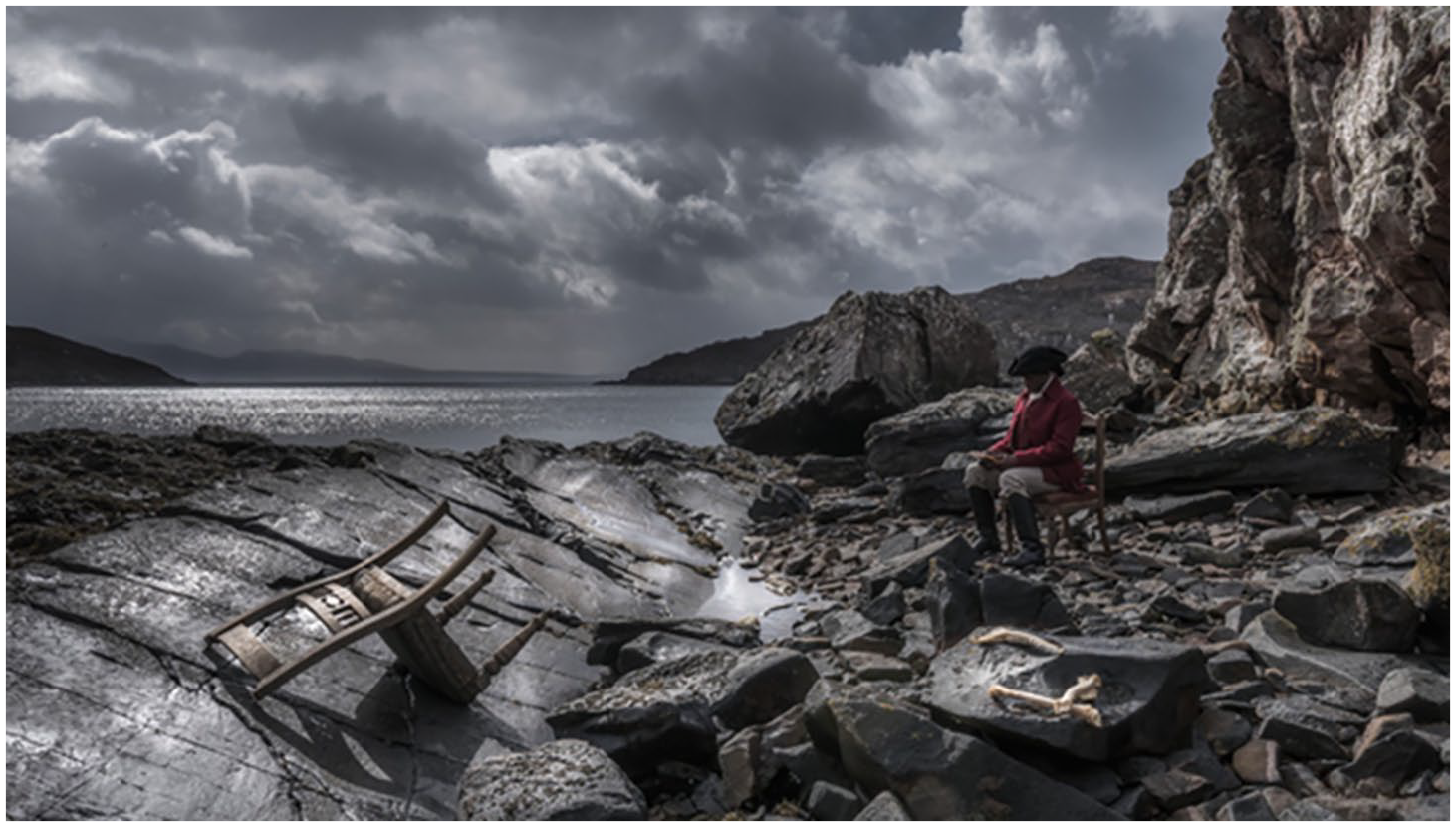
John Akomfrah, Vertigo Sea (2015). © Smoking Dogs Films, All Rights Reserved, DACS 2024.
Global warming is a crisis of grave proportions, guided by a collective temporal uncertainty inscribed in social and natural sciences and humanities conversations about the future of our planet. 4 Uncertainty manifests in forms ranging from aesthetic expression (e.g. the Metronome) to activism, intertwining scientific temporal predictions with efforts to manage the present and the future, all asking: ‘How long do we have left?’ 5
International Relations (IR) presupposes a notion of universal (linear) time in this debate, through certain social imaginaries, 6 in an ordering of various lived experiences (i.e. temporalities). 7 IR was initially formed within a paradigm of what could be called urgent and critical work to figure out how the past informs and shapes the present and the future. Thus, IR and its politics, in both theory and practice, are rooted in conceptions of time, linear, and cyclical, 8 in what Andrew Hom calls the ‘silent order’ or the ‘temporal turn’. 9 Though the world’s phenomena have always occurred in open systems, created by a variety of causal structures, processes, and fields, IR has followed a Newtonian orientation when looking at the world and the environment, with its ‘explanations premised on assumptions of predictability rooted in the conviction that international life is a closed system, changing in a gradual manner and following linear trajectories, which can be elicited through discrete assessments of dependent and independent variables’. 10 Yet this attempt to turn IR into a rigorous field by following the natural sciences has chained it to ‘the parochialist and imperialist features of conventional disciplines’. 11 It is a discipline with an amnesiac and ‘tunnel vision’ 12 engendered with a ‘monodisciplinary dogmatism’, making it impossible for scholars to explain emerging phenomena like the Anthropocene. 13 The times of the Anthropocene are marked with uncertainty. IR cannot continue business as usual, insisting on the ‘development of predictive capabilities’. 14 ‘A no-analog future’ cannot be explained through Newtonian assumptions, past actions, experiences, and the configurations of current institutional designs. Nonlinearities and unexpected change are the Anthropocene’s key features, 15 putting pressure on conventional IR’s ‘naïve assumption that there is a static world outside which is ready to be completely discovered and perfectly anticipated’. 16
Godet and Durance observe, ‘The future is open, thus any form of prediction is tantamount to fraud [and] anticipation is not predicting what will happen but rather that which leads to action. [Science should] enlighten our actions in the context of possible futures’. 17 IR cannot continue as a discipline or field by leveraging archaic and linear assumptions of the disciplinary origin or closing its eyes to how capital deploys time restrospectively, positing its constitution as the origin point, an ‘outcome of social conditions, and not an inevitable result of an ancient grounding force of particularity’ or racial difference. 18
Conventional IR’s insistence on linearities and predictability evades that the human development paradigm, that is, the dominant capitalist modes of production, reproduction, and consumption, is impacting the planet in ways that cannot be predicted or linearly mapped. Environmental instability and extreme events have the capacity to destabilize the international system, putting the security and survival of Earth and the human species at risk. 19
This article challenges the idea of revitalizing IR and extending its intellectual life or significance in the co-production
20
of knowledge regimes and a planetary order by introducing alternative ‘ontologies and future ideals’
21
(engendering alternative temporalities) by expanding human agency through the addition of ‘nature’ or nonhuman existence or embracing the new geological conditions confronting humanity (the Anthropocene). Even IR’s calls to policymakers and activists to work together do not redress its limitation, namely its dependence on prediction and a future that is ‘purposefully worked towards in the hope of one day reaching it’.
22
J. C. Pereira says it is time to understand what animates the discipline: The IR community [must] realize that it must reinvent itself to survive. A turn that breaks with disciplinary self-censorship and encourages creativity will be essential. However, for IR to take advantage of the Anthropocene, it will have to abandon its distant attitude towards the environment. . . . Recognizing uncertainty. . .adopting a post-anthropocentric perspective are some of the possible pathways presented for the future of IR.
23
This article challenges the rush to reinvent IR by leveraging the Anthropocene. Doing so in the name of creativity does not necessarily grapple with the narrow, patriarchal project of what we came to know as modern science. 24 Even calls for the adoption of a post-Anthropocentric perspective to generate an alternative ‘international life’ 25 will not do. The introduction of new ontologies can still rest on assumptions of linear temporality. Such imaginaries sneak in ideas of an ideal future while ignoring the ‘unimaginable’ because it ‘assumes the guise of everyday practice’ recorded in different historical archives, such as that of colonialism, slavery, and environmental change. 26 Irrespective of how this idea is posited as radical, it remains wedded to a Baconian, Kantian, and Newtonian logic of a mechanistic and reductionist declaration of nature as dead and a ‘regulative ideal, according to which “man” should be seen as an end in itself’. 27
Such ideas and modes born at a time when the industrial revolution needed ideas to justify extraction and exploitation, positing them as the only reliable knowledges, miss something more sticky and difficult: the idea of constituting asymmetrical existence with the international. Such science and its imaginaries sneak in logics guided by a principle of this asymmetry and its technologies of substitution, where reconstruction, history, security, and justice are dependent on the creation of a system of equivalences. 28
Instead of trying to leverage such logics and their contingent narrowly punctuated scientific principles to reinvent IR by assembling the past and its fragments into measurements, I turn to a conversation with Frantz Fanon’s rupture of history through invention, his call for a focus on the structure of time and decolonization or tabula rasa. He has rightly been read as calling for the revolution, for anticolonialism, for invention – a new beginning whose arrival would suspend time. Of course, his idea of independence may be read as a series of explicit claims to redeem colonized humanity. Yet Fanon’s idea of invention provides something beyond the teleological eschatologies of Western science and modernity. Fanon asks us to ‘take one step more, one step further, to set afoot a new man in the radical transformation of all areas of colonial culture’, 29 defining such ‘work as a series of leaps or steps characterized by points of departure rather than endings’. 30 For Fanon, the future is not a simply a future past, nor is it a ‘history’ as a ‘weave of traces and memories outside of time’; rather, it is ‘the tabula rasa [which] opens in return a movement of temporalization that is never simply present, or timely’. 31
Many have explained Fanon’s anticolonial politics as a project of nationalist-humanist sovereignty, and he can certainly be read that way. However, the revolutionary subject does not simply coincide with the national-humanist project. The postcolonial moment cannot just be about creating a new anticolonial world with the same kind of ideas, subjects. Here, Fanon’s understanding of the crisis of the international as engendered through colonialism and its contingent aesthetics and its future has important implications for IR. Attending to the sensorium is a key theme of Fanon’s approach to the international as inscribed with colonial and global racial capital. Rather than seeking to salvage the humanism and esthetics of the nationalist-sovereign project, his introduction of the ‘wretched’ puts pressure on that alternative temporal vision of the future of nature and the nature of the (inter)national itself as both a material and esthetic project and the idea of erasure or the end of the world as we know it. The time of the ‘nature’ of Fanon’s international does not lead toward some moment, even when linearities in the temporal, implications, and causalities are created to ensure the reproduction of an international as engendered through global racial capital’s projects. To that end, he introduces invention not as a ‘rhetorical figure’ but as a force ‘which cuts through the continuum of history: and in its wake only remnants remain’. 32 Invention is a radical transformation and cannot be reduced to a ‘teleological schema’, 33 simple political calculations, economic frameworks, and strategies. Rather, it is a leap, ‘neither a catastrophe or fall, advent or realization and is mostly incomprehensible to what came before’. 34 As a political project or reinvention, it is a ‘fracture’, ‘a situation of radical indecision whose emergence introduces something entirely new into the world’ 35 a situation in which the ‘new humanism’ has not been determined or written. This world’s structure is outside teleology and eschatology and cannot be predicated on national-humanist sovereignty or viewed as a coincidence between the nation and the postcolonial moment.
First, I begin by discussing the ways the notion of the Anthropocene has been articulated in IR. Some see it in terms of the temporal, an ecological epoch including the presence of crisis, and push for the possibility of awakening a planetary consciousness to save Earth beyond particularistic demands. Others say the Anthropocene is rooted in ‘histories’ of anti-Blackness and colonization and tied to the decimation of indigenous life-worlds. I then turn to postcolonial and decolonial debates, showing first how Dipesh Chakrabarty’s work complicates the founding of the international as a colonial and esthetic structure, with global and senses crisis writ large, highlighting the inherent anthropocentrism of IR. Then, I engage with decolonial debates and their challenge of this short term-based understanding of crisis. Next, as a challenge to this IR’s ‘dead-end’ and (un)disciplined frame, 36 and in conversation with Fanon and Akomfrah about the structural relationship of language, time, and racial capital, I highlight the significance of invention as a decolonial leap that fractures narrowly punctuated international systems of thought and political ‘history’. To rupture the teleological form of the writing of history and the international structure, I build on these authors to show how history and the senses within and of the international are colonized. Only the ceaseless work of invention can re-open decolonial possibilities to the international and its forces.
Temporality and IR
As I argued in the introduction, the idea of making IR robust has led many IR scholars, similar to other social sciences, to adopt a linear Newtonian approach. 37 However, with the emergence of debates on global warming and the Anthropocene, many realized ‘discontinuity is an extremely important feature of international interactions’. 38 Critical scholars, ranging from Michael Shapiro to Kimberley Hutchings, and more recently, Andrew Hom, and Christopher McIntosh, have addressed the various ways time can assimilate specific sociotechnical imaginaries of history, be sequenced, experienced, and constructed in IR encounters that undergird the international and its conceptions of temporality.
Accordingly, the last decade has witnessed a burgeoning interest in various forms of temporality – including rupture, 39 revolution, 40 waiting, 41 crisis, 42 acceleration, 43 colonial time, 44 and the future. 45 An element pertinent to all these, albeit underexplored, is urgency. In recent IR debates, the idea of urgency is instrumentalized pulling together strands of natural science, social science, and humanities to create a coherent picture of reality in response to the Anthropocene’s challenge of a ‘monodisciplinary dogmatism’. 46 This world is demanding new reading approaches that move us beyond the linear order infusing the discipline. Material and esthetic changes because of global warming put pressure on Newtonian linear closed systems, as in the Anthropocene world, ‘disorder assumes a very important role’. 47
IR’s inability to grapple with uncertainty, or to think the unthinkable 48 in the face of chaos, 49 comes through in its analytics (if it decides to focus on the environment) of the complexities accompanying global warming: ‘IR traditionally seeks to explain phenomena by assuming linearity, using a small number of variables, and aspiring to predict international developments. . . .The “international” of the Anthropocene comprises the interactions between human, sociopolitical, nonhuman, and biophysical elements’. 50 Much of IR remains anthropocentric in its analysis by prioritizing the human as the actor who can produce a more desirable future in the world of politics, thus sustaining the ideal that ‘“man” should be seen as an end in itself’. 51 Kant’s key point was not to treat man as a means. In IR, many have mobilized his moral philosophy ‘to harmonise relations between human subjects, beyond the segregating borders that separate them on the basis of their citizenship’. 52 Yet in the times of the Anthropocene, scholars recognize increased freedoms can no longer be the key purpose of critique. Humans can no longer see themselves as the primary actors of international politics; they must harmonize with the environment, beyond the ‘political community that continues to place man at the centre’. 53
Tom Lundborg says the former primary focus of critique on realizing human freedom is part of the problem of the discipline and field. 54 Audra Mitchell and Anthony Burke call for the ‘end of IR’, arguing against its anthropocentrism and insisting we think beyond the human or ‘man’ as the primary agent of history and change. Mitchell points to an IR ‘dominated by a profound anthropocentrism that renders Western secular images of humanity the focal point of cosmology, the sole source of agency and the referent of all ethical action’. 55 She argues IR has to be more inclusive of other life forms and entire ecosystems, redefining its idea of ‘survival’ to prevent being extinguished as a discipline and to be an agent in the future. 56 The conventional cosmopolitanism of IR has to be expanded to a new cosmopolitics, 57 ‘attun[ing itself] to the nonhuman and inhuman forces and conditions of the universe’. 58 Mitchell emphasizes a beyond-the-present horizon for a future that will include life forms systematically excluded from the present, where ‘life forms. . .bear resemblances to, but are not restricted by, existing norms of “humanity”’. 59 Her argument demonstrates how the modern anthropocentric telos of both critique and practice is problematic. As Lundborg aptly writes, ‘The future [in these works] is an ideal that regulates aspirations in the present, inviting a linear historical trajectory going from the past via the present and into the future’. 60 While unpredictable, the future remains something to be aspired toward.
Similarly, the authors of ‘Planet Politics’ exhibit a teleology in their critique of anthropocentrism. For them, the relationship between humans and Earth must be reimagined if we are to avoid catastrophe. 61 Historical IR is anthropocentric, with analyses of the human and its security focusing on states, perceiving the environment as a stable scenario within which states pursue their interests. But in the Anthropocene, international life comprises the interactions between human, sociopolitical, nonhuman, and biophysical elements, thus requiring a new ontology and ethics of the ‘international’, that without removing humans from the top, entangles humans, nonhumans, and objects and their multiple interactions. 62 The international, the manifesto says, ‘is not “our” world, as the grand theories of IR, and some accounts of the Anthropocene have it – an object and possession to be appropriated, circumnavigated, instrumentalised and englobed’, and it points to ‘a complex of worlds that we share, co-constitute, create, destroy and inhabit with countless other life forms and beings’. 63 Yet the manifesto depends on a linear history that presumes a certain reality (past actions), a present, and an unpredictable future that needs to be realized.
Time in the post-anthropocentric world is still imagined as a linear procession assisting people in structuring their perceptions and their senses of the past, present, and future. This linear logic turns into an unshakeable structure, demanding humans build their activities on that solid bedrock. For this reason, the narrators of ‘Planet Politics’ accentuate the process of implementation and outcome, suggesting an ‘Earth System Council’ could issue warnings, based on majority voting among ‘earth system scientists, major ecosystems, species groups, and states’. 64
The demand foregrounds a linear temporal logic. Any delay, it seems the authors are saying, becomes a challenge to the planet. Their call for IR to ‘treat. . .the shuddering ecological tectonics of the planet like a shadowy ghost in that human picture, rather than as a brute ontic fact that threatens to overwhelm everything that “man” has made’ 65 follows linearity, asking IR to complete a pre-established task which ends up concretizing human accomplishments in the form of redressing the diminishment of human agency.
The links between the critique of anthropocentrism and the call for ‘simple ends’ reveal speculations on time. With the diminishment of human agency, time is supposed to recede from being linear and reveal its dimension of perpetual violence through the ‘shadowy ghost’ of both the environmental decimations and the shadow of time. History or historicism emerges as an issue in these works because of the structure of change itself: the ensuing teleology situates a series of ‘ends’ toward a new beginning. Yet such an envisioning of a post-Anthropocene future does not mean the limits of a modern understanding of ‘history’, as a kind of knowledge that makes sense of the world in terms of linearity (distinguishing past, present, and future), has been challenged, let alone ruptured. Attempts to imagine the international beyond anthropocentrism may be ‘a salutary act of moral imagination’, 66 but ‘we are still looking at the world anthropocentrically – the way a human imagines that a nonhuman might look at the world’. 67 The human subject invents and writes history, its ‘borders’ 68 and its discourses. 69 Ultimately, the imagination remains entangled with a linear understanding of history, and thus, an ‘end to IR’ in the name of decimations and ecological crises does not redress the global power relationships that make possible a certain human agent or the desires for a certain kind of sovereignty and liberation. As Lundborg points out, ‘Exploring this uniqueness and potential through the language of one history, the history of man, which is supposed to incorporate the history of both humans and the Earth is therefore an inadequate form of response’. 70 A future imagined from the vantage point of the Anthropos, the Man, cannot necessarily transcend the limits of the understanding of history; incorporating the history of human and Earth cannot then redress the larger question of asymmetrical power and wealth constituting these ‘ecological tectonics’ and/or the decimation of existence.
Tom Lundborg argues the incorporation of the history of the human and Earth is not an adequate response. The international cannot be seen either as a ‘static system’ or as something ‘present or absent’ but rather as ‘something that both conditions life and itself has a life’. 71 As he puts it, ‘International life offers a way of thinking about the end of man, a structure that makes theorizing his finitude possible’. 72 Lundborg’s emphasis on the international and its changing nature highlights a point postcolonial theorists have been making for a long time about the international as a structure in flux despite colonial arguments about its stability and order. I agree with Lundborg. IR must understand the international and the future ‘not on the basis of the past or the present, but along deconstructive lines, as something radically other’. 73 However, I differ from Lundborg on how this assemblage of the international deploys technoscientific practices inscribed with temporal mechanisms to ‘govern’ itself. Technoscientific practices are both linear and recursive 74 and continuously modulate international structures by bringing heterogeneous elements into contact through a common measure, with which their dynamic experiments can be narrativized. Thus, for example, the narrative goes that ‘all states interested in a given territorial change in principle recognized the same economic order, even when they were at different stages of development’. 75
I stretch his logic to argue a history inscribed with linear coordinates linearity has been used to justify supremacist and patriarchal claims and effects. Anything that deploys historical judgment without grappling with the forces of colonialism and its ongoing transubstantiation into the international, which have confined both native life and the writing of history is deploying fetishisms and ‘inherited’ differences to do its work. Thus, in their discussions of temporality or critiques of universal time, the IR authors mentioned above miss something much stickier and end up reconstituting the canonical narratives of European Man (secular or anthropological explanations of humanism and the institution of colonialism). They contain life within the colony’s ethno-bourgeois economy in the form of debt and dependency and political definitions of sovereignty and self-ownership. Our engagement with IR’s deployment of a linear temporality cannot simply focus on this linearity and its critique of anthropocentrism. After all, what brings this sovereign European Man into being also makes possible the ‘backward’, the dead matter called nature itself, whose relationship with history is identified as the past.
We must go farther. Inquiring into the metaphysical roots of modernity, the prominence of the chronological view of time, and the current global narrative of great acceleration is a must. Identifying the conflicting temporalities at work in planetary phenomena does not necessarily address the conditions that enable the metaphysical premises of modernity and its deployment of time and ordering in the form of the international either. Focusing on the co-existence of a variety of heterogeneous timelines of humans, carbon, forests, microbes, rocks, etc. as some postcolonial literature suggests (see below) does not rupture the conditions of colonial and racial capital’s globality. It is crucial to center the colonial as engendered through global racial capital projects to understand the prerequisites of their co-constitution with a universal timeline.
With the rise of capitalism, the West appeared to control time itself. Through capital, the modern subject owned up to the risks and vicissitudes of temporality, seizing time, as it were, by seeking its accumulation, deferral, and return. 76 Capital even claimed the capacity to explode all ‘autarchies’, to translate all kinds of local and social life into quantifiable and therefore commensurable labor time units. In colonial modernity, time – conceptualized in nonmodern philosophies as the limit to thought – became the possession of the rational and thinking subject, who could judge others in terms of their lack of temporality. Time thus became the ‘universal’ parameter of judgment, and colonized people became timeless ‘primitives’ without determinacy or will. The secular time of natural history, and later ethnology, classified the world into categories, species, and locations. 77 As Johannes Fabian suggests, this was fundamentally different from earlier sacred and theological time-senses, which sought to battle and win over nonbelievers and ‘barbarians’, rather than categorize them as belonging in another time. This secular time, later supplemented by the evolutionary law of Darwinian biology, socialized the law of Newtonian physics, the law that two bodies cannot occupy the same space at the same time. Simply stated, to usurp the colonized’s world, the West transposed others to the time of the past. 78
Karl Marx hints at this attempt to equivalency when he speaks of primitive accumulation, but he denies that his approach is informed by the conditions of the colonies: ‘The only thing that interests us is the secret discovered in the new world by the political economy of the old world. . .[the] self-earned private property; in other words, the expropriation of the laborer’. 79 Marx wants to generalize about the expropriation of the worker, the direct violence of creation in the erection of capitalist structures, and its development projects with the state as the key mediator of these relations. However, this process of making commensurable the world of heterogeneous singular existence depends not only on the process of expopriation but also on the process of extraction. In addition, it depends on the process of cataloguing and on the process of singularities into a hierarchized system able to articulate two forms of life capable of an ‘encounter’ (albeit unequal and hierarchized) based on a shared or common measure – clock time. Capital’s capture of singularities by turning them into things depends on the formation of specific and hierarchized difference out of the flux of pure heterogeneities, a moment of singularity, an untraceable line of capture. 80 In this process, clock time becomes the common measure allowing phenomena to be computed within the framework of universal versus particular or global versus local. Global racial capitalism follows a temporal directionality within the irreparable colonial moment of the modern condition.
Within the global capital project, stewardship of biodiversity or greenhouse gas (GhG) emissions requires everything to be quantified and commensurable on a linear timeline still within geopolitical nation-state arrangements. Carbon footprint assessments deploy this temporal strategy, constructing global visions by attempting to make everything commensurable in clock time. In notions like ‘zero-carbon economy’ or ‘low-carbon energy’, carbon is just an indicator of the human footprint. Yet this is picked up in the theorizations of the management of the environment, wherein CO2 is selected as the standard of all GhGs, thus providing a general equivalent to measure the global warming potential of all GhGs. This equivalent has become a currency, supposedly to regulate the flux of carbon exchanges and control climate change. When carbon becomes abstracted, allowing quantitative comparisons of various gases and activities (e.g. flying from the United States to Canada), a compensation mechanism can be set up. For instance, planting trees in Liberia is supposed to compensate for CO2 emissions in Canada. As Bernadette Bensaude-Vincent argues, this commensurability makes possible the equivalence of all localities and equates the present and the future: ‘By making things the same [and] by creating commensurability, carbon trading and time scaling enrol the entire planet in a process of monetization of the world’. 81 The process or appearance of ‘equivalences’ is hierarchized in the idea of developed versus underdeveloped, carbon emitters versus carbon absorbers, enabling capital’s deployment in local gradients attempting to ground themselves in a stratum of particularity.
In these times of crisis, capital will continue to ensure its (re)production by deploying multiple forms of violence, including enrolling the state to foster colonialism and race in its regeneration of capital-relations. These crises cannot be solved on the level of the nation-form (i.e. planting forests to balance global carbon emissions). In fact, the nation itself is a form of credit whose life depends on the ongoing colonization of heterogenous existence, whether in the form of biodiversity or backward primitive others. At its origin, there is already a violence, because ‘nature’ has been presupposed as a given, with capital utilizing this presupposition as a lever, as the site of its violence, for its own possibility through the erection of (inter)national arrangements. 82 This colonial violence or attempts to code it as the beginning of the world or the geological epoch is recoded as the history of the state with its multiple contradictions, always evading the antagonism that makes transubstantiation of international arrangements possible.
Capital deploys ‘historical’ time as a counterpoint to the other, the racialized ‘primordial’. Much of the Global South’s first event of national history is imagined as the defeat of the other by Europeans. This battle is posited as a foundational one between backward and civilized, an origin battle generating the time of history. In other words, capital constitutes time as the site of innovation and sorting. Narratives and discourses designating history as the narrative of things past refuse to consider seriously the consequences of multiple institutions and sites of production.
Global racial capital deploys time by constantly dividing the world into the backward and the competent to recode the social basis in its image. It can never be severed or completely divorced from history, and it is always exposed to a certain undecidability among those deemed out of time. Working against this, Franz Fanon calls for invention, for the possibility of not being confined by this history, for an open decolonial struggle that cannot be imagined, sensed, or contained in advance.
Postcolonial and the Decolonial Condition as the Present?
Postcolonial studies and postcolonial IR have attempted to devise a radical ontology by interrupting historicism and suggesting it is a technoscientific that presupposes most of the world to be backward while evading the long-term process of struggle that challenges linear and retrojective forms of colonial epistemologies. Theorists call for an ‘ontological and epistemological break with modernist [and metaphysical] assumptions’ 83 by considering the environmental crisis captured in the Anthropocene. They speak of the Anthropocene and the urgency engendered through it as a ‘representational concern’, 84 problematizing the notion of urgency from the perspective of a temporal break. They visibilize the human impact on Earth and different communities’ decimations because of coloniality, its long-term causes and its possible futures. As Neel Ahuja argues, ‘Environmental injustices must be understood as components of longer processes of colonialism and racial disposability generated by extractive capitalist development’. 85
Even if the Anthropocene manifests everywhere and is thus planetary in nature, it does so in asymmetrical ways. In addition to being a geological, political, and ethical problem, it is a sovereign and international structure and order problem; as such, it is best understood with reference to postcolonial studies and their focus on colonial and imperial structures of power and wealth. For postcolonial thinkers, the Anthropocene is too totalizing and universalizing, at odds with the variegated, globally unequal impacts of both climate change and mitigation efforts. The idea that the Anthropocene applies to humanity is also at odds with postcolonial theory’s focus on the processes and constitution of colonial and imperial difference, multiple temporalities, and historical and sovereign asymmetries. Though coined to point to the entanglement of geological and human-species histories, its origin is a site of challenge. Even when geologists argue the Anthropocene marks the moment when human influence on the planet became geologically legible, there are questions about when this moment occurred, the Industrial Revolution, Columbus’s arrival in the Americas, or ‘the post-1945 Great Acceleration’. 86
Dipesh Chakrabarty introduces the Anthropocene to postcolonial studies, 87 pointing to the challenge Anthropocene thinking poses to historical – and by extension, humanist – thinking: the scales with which we work are being altered in the current moment of global warming. The separation between geological history, human history, and socioeconomic history – summarized as Earth, the human species, and capitalism – no longer holds. The universalist and accelerationist bent of this argument goes against postcolonial studies’ emphasis on the ways colonization and imperialism and the creation of the modern state have ensured historical asymmetries between countries. This clash leaves postcolonial studies and postcolonial IR in an awkward intellectual spot. On the one hand, questions of the modern on Earth depend on the conquest of land and environment. On the other, the ambiguity and layers of meaning of the Anthropocene make visible the imbrications of past events, present inequalities, and future possibilities and bring value-neutral planetary developments together with their human and civilizational supposed consequences. Indeed, Chakrabarty suggests these two levels are now intertwined: the intellectual challenge is not to think them together, but to use their linkage as an entry into climate change.
Ian Baucom criticizes Chakrabarty’s understanding of history in the Anthropocene, introducing the idea of ‘forcings’ and ‘forces’ or what he calls Materialism I and Materialism II, articulating forcings as planetary pressures and forces as manmade. Yet these work together toward ‘the reactivation of old and the animation of new modes of subalternity, inequality, and vulnerability’. 88 Planetary forcings can reinforce already existing colonial and imperial power and wealth relations and asymmetries. ‘Time does not pass, it accumulates’, Baucom tells us; ‘Accumulation does not end, it doubles back and piles on’. 89 Baucom’s postcolonial reorientation relies on a methodological question that pushes analytics. It is no longer about the ways to know force and forcings but rather what ‘order of time’ 90 is required and why. His complex philosophy of history and history of philosophy provides a method to consider an ethic of freedom in the times of climate change which is our historical moment. His is an ethic for thinking anew our troubled world.
Amitav Ghosh writes to challenge the modern temporal order, stating, ‘The Anthropocene has reversed the temporal order of modernity’. 91 He calls for more representations of catastrophism, such as the environmental apocalypse, to understand the scale and violence of climate change. As his writing revolves around the invocation of a state of emergency, it ends up centralizing an event or circumstance, using it to instill fear to motivate action. Yet Ghosh remains tied to historicization. He takes the Anthropocene to point to the destruction of the environment. In deploying this ‘colloquialism’ for crisis and ‘terrestrial destruction’, 92 his narrative remains linear by taking for granted the Anthropocene and rendering all humanity universally responsible for terrestrial decimation. Thus, as Rose Deller writes, Ghosh makes the Anthropocene the ‘latest historicisation that makes human existence itself a thing of the past’. 93 He uses the Anthropocene to mask the uneven realities of settler colonial capitalism responsible for historical, current, and anticipated future environmental injustices.
Indigenous scholars show the source of crisis is detachment from land after more than 500 years of colonialism. Taiaike Alfred (Kahnawake Mohawk) and Jeff Corntassel (Cherokee) argue, ‘Even if neoliberalism has intensified the scope and the pace of dispossession, it is nothing new, but rather the deepening, hastening and stretching of an already-existing empire’. 94 The extraction of natural resources for capital accumulation runs through colonization, and ‘the colonial mind nurtures the belief that there is always somewhere else to go and exploit once the current site of extraction has been exhausted’. 95
Heather Davis and Zoe Todd similarly understand ‘the current start of the crisis as inherently invested in a specific ideology defined by proto-capitalist logics based on extraction and accumulation through dispossession – logics that continue to shape the world we live and that have produced our current era’.
96
While a number of dates have been proposed to signify the start of the Anthropocene, Davis and Todd suggest dating it as the beginnings of colonization to underscore colonialism as responsible for the contemporary climate crisis: The Anthropocene is the epoch under which ‘humanity’ – but more accurately, petrochemical companies and those invested in and profiting from petrocapitalism and colonialisms – have had such a large impact on the planet that radionuclides, coal, plutonium, plastic, concrete, genocide and other markers are now visible in the geologic strata.
97
This articulation disrupts easy linear understandings leading to the contemporary moment or even the rush to bring together Earth and human time.
Andreas Malm goes farther. He challenges the Anthropocene as sanitizing modernity and directs attention to the international, world-historical, politico-economic organization of capitalism over centuries of colonialisms, industrializations, and globalizations as the source of today’s biospheric crisis. 98 It is the consequence of an ideology of profit-above-all-else, the ultimate manifestation of capitalist colonial violence enacted on bodies and lands. As Sioux scholar Nick Estes explains, in ‘Indigenous notions of time. . .there is no separation between past and present, meaning that an alternative future is also determined by our understanding of the past. Our history is the future’. 99 By observing temporal relationships in this way, Estes demonstrates how Earth and humans are entangled with a collective projection of the future and the histories informing their actions in the present. A set of ‘diagnoses of the times in which we live’ provides a vision ‘of what must be done to get free’. 100 He disrupts the idea of universalism (linear temporality) by arguing movements like communism and classical socialism as universal revolutionary projects cannot respond to the decimation of the environment as a result of fossil capitalism: ‘Whereas past revolutionary struggles have strived for the emancipation of labor from capital, we are challenged not just to imagine, but to demand the emancipation of earth from capital. For the earth to live, capitalism must die’. 101 Kyle Whyte argues the present and predicted future apocalypses cannot be abstracted from the longer history of settler colonial conquest, genocide, and resource extraction, making the present more like a postapocalyptic dystopia. 102
The conquest, segregation, containment, and ordering of the world depend on a contingent historical event or violence which is made to appear as if it is the only viable option; in other words, ‘what ought to be an accident was always in fact a necessary outcome’. 103 Racial capital works on a global scale, relying on notions of territorial, national, international, and esthetic boundaries and colonial difference to authorize its workings, ‘cyclically repeating its origin in capture in order to harness its hazardous flux retrospectively, to conjure itself up as if its origin were a mere testament to its necessary emergence’. 104
Decolonial authors expand the postcolonial. In their view, the Anthropocene and the temporality of Earth and the human are not a priori phenomena inscribed with a linear temporality but products of a recursive process, hierarchization, and relegation to ‘nature’ (without time or value), best understood in terms of global racial capital accumulation. In keeping with the general modus operandi of global racial capital, the myth that ‘nature’ has no time or is dead matter becomes ‘operationally co-opted into the colonization of the future as both probe and delimitation’. 105 It functions retrospectively, as ‘a recursive pattern that both repeats across – and trades in – time’. 106 The Anthropocene is posited as a critical continuity between the slow tempo of Earth history and the fast changes in historical time. But assuming a linear arrow of time that moves in one direction allows only speculative fictions of speed variations and permits few possible responses to global warming. And the linearly punctuated arrow of progress heralded as the only viable development option of the international structure is now posited as a catastrophic future due to global warming.
Global visions of responding to climate change to avoid ecological catastrophe are grounded in the same logic: a modern order whose arrow of time is linear like the ‘modern regime of historicity’ emerging in the late 18th century, 107 or more accurately, the coloniality of time. 108 This global vision depends on a few indicators, such as carbon. By heralding the Anthropocene, the heritage of past technological choices, as a new epoch, the human age still is taken as a given (à la Chakrabarty), remaining in colonial logics and practices. The primary goal is to hold onto the present by conquering nature in all its forms and to homogenize localities by equating the present and the future.
Tending to the collision of two notions of time – those of history and geology – or the diversity of timelines displayed in all local ecosystems yields an alternative diagnosis of the current crisis but one still wedded to the epistemic and ontological structural relationship of language and time. The clash between the slow tempos of nature and the fast tempo of the international are understood as a collision between two notions of time expressed by one kind of time, the chronological one, 109 that resonates with meteorological time in the irruption of cataclysms and disruption of seasonal cycles.
Although human and Earth history can no longer be seen as separate, the human remains the key agent in change. Kathryn Yusoff argues the popular concept of the Anthropocene ‘exhibits a colonial and racist geology’ relying on a chronological timeline divided up into a sequence of epochs differentiated in terms of white supremacy’s scales. 110 Yusoff suggests the temporal disjuncture of human and Earth time cannot be thought outside white supremacy and the ways it positions different humans in asymmetrical geological strata and time zones. If so, what does it mean to think about our institutions in the past as we move forward?
By introducing the Anthropocene to postcolonial and decolonial approaches, scholars have pushed asunder familiar notions of linear history, complicating how we understand the past, present, and future and demonstrating geological and human-species histories are not so easily discernable, nor do they easily map onto the shifts and changes of global warming. Deller writes: ‘History always does, in the end, leave one stranded exactly where one already is. Always it comes too late to make any difference. History now cements the antiquation of homo sapiens itself’. 111 The homo sapiens, this universal technology of making history, is now rendered something of the past, reinserting the Anthropos as part of the lag of global racial capital’s imaginary and thereby a problem for its regeneration. Heeding this, Timothy Clark calls our contemporary moment the ‘Anthropocene disorder’ 112 and argues for an analysis that attends to scales of time and space extending beyond our human frames of reference.
But this rendering of the homo sapiens antiquated is simply another technoscientific strategy that different approaches to climate change have deployed. While it speaks to all homo sapiens as responsible for global warming in theories such as ecological modernization theory,
113
it misses the ways postcolonial and decolonial theorists centralize colonization as a living force in the making of structures of sovereign subjects, power, and wealth. EMT reduces complex problems, including colonialism and the development of a now-global politico-economic system and the intensifying economic and ecological crises, to the dependence of certain humans on nature, those who are considered dead matter, including ecology itself. It does not consider questions of inequality of violence on different ecologies for the co-production of the current international life: A word you won’t find in the Ecomodernist Manifesto is inequality. . . . There is no sense that processes of modernisation cause any poverty. . . . There’s nothing on uneven development, historical cores and peripheries, proletarianisation, colonial land appropriation and the implications of all this for social equality. The ecomodernist solution to poverty is simply more modernisation.
114
EMT’s linear technological fixes reproduce racism by attributing responsibility for environmental problems to those it judges to be closer to nature: ‘people who depend on firewood and charcoal for fuel [and who] cut down and degrade forests [or] people who eat bush meat for food’. 115 In this way, the poor of the Global South are held directly culpable for climate collapse: ‘In the ideology of ecological modernisation, the poor are characterized as unsophisticated “victims” and patronized as unwitting contributors to the environmental crisis’. 116 It is such kinds of teleological narratives inscribed with colonial and racial violence that Fanon’s invention or tabula rasa wants to disallow. The decolonial, for Fanon, is first, an acknowledgement of the ways capital depends on retrojection to regenerate itself and second, an affirmation of the endless interruption of the political that inscribes the international as such.
The Politics of Invention
Fanon speaks of history and invention as contrasting positions in his attempts to understand colonial violence and racial capital and time’s role in affecting conceptions and administrations of urgency and change. For him, it is important to ask how to tell the difference between an impelled linear ‘solution’ to the problem of ecological decimations and a more creative/organic/visionary approach. How does time become engendered in technoscientific solutions in the name of urgency, and how does such a treatment of time affect conceptions of certain horizons? Fanon argues he is ‘not a prisoner of History’ and thus ‘should not seek there for the meaning of my destiny. . . . In the world through which I travel, I am endlessly creating myself’. 117 The idea of not being confined by ‘History’ signals the arrival of the ‘real leap’, something that cannot be known, prescribed, or contained in advance in a movement of time. His segregation of history and invention (i.e. the leap beyond history) is his way of refusing the normal teleological form of the writing of history or even the retrojection strategies of capital which posit its own (re) productions as the starting point of existence. 118 Invention is refiguring existence as event. It is not merely the future at stake: historical judgment or anything that presents the past as a criterion is incommensurable with the leap or invention.
Fanon’s commentary on how history works, I suggest, has implications for IR in the times of the Anthropocene. Rather than seeking to overcome the limits of IR by sneaking in an idea of newness, or arguing for a multiplicity of temporalities, for technoscientific approaches, Fanon’s idea of invention is an ‘endless deferral and complication’. 119 He refuses to found history and the international on coloniality and race and their contingent senses that presume time as a given. For him, this would mean any claims to revolt against colonialism in all its forms have to not merely deconstruct but also to invent new modes of relating to earth. 120 It cannot involve ‘a teleological appeal to a postracial future that compromises the escape the moment it is claimed’. 121 Such a future retrenches colonialism and imperialism and reinserts race as the foundation for any institution, colonial, or otherwise, distinguishing temporality into past, present, and future.
While Fanon does not directly theorize the narrow question of climate change, he shows how colonial violence in the time of the Anthropocene can be found in our values, arts, literatures, and politics. He reads different interventions, showing how the modern sovereign is intertwined with the capital project and how crisis presents a challenge. How does one produce new values, art works, and reading strategies, attuned to the complexities of the world’s ecosystems and the contemporary imbalances wrought by manmade climate change, when history itself and its accounts are always about a modern desire to conquer time from the past, present, and toward a progressive (historical) future, and with this, the conquering of certain ecologies and subjects? What would it require to take one more step to start a radical transformation of all areas of global warming as part and parcel of the international colonial and global capitalist structure which is attempting to regenerate itself through the notion of the Anthropocene?
In introducing invention, Fanon disrupts our notions of the international and its violence, not only at the register of equivalencies in the configuration of inter/national relationalities (i.e. friend vs enemy; black vs white; Global North states vs Global South) but also at the register of the international as coloniality. He grapples with the ways racialization is a political fantasy, leading the subject ‘to project itself as a boundary or limit to experience (and so forge dangerous and delusory fictions about others)’. 122 He asks how the mechanisms of the state and capital work to effect a specific logic of the social dimension of temporal segregation entangled with esthetics that already presume are nature, the ‘Negro’, and the wretched dead matter. In his view, global capital forces a mechanism of antagonisms, deranged in the form of political contradictions, as a temporal order. Fanon’s exposure of the mechanisms of imagining, founding, authorising, segregating and ordering the international structure highlights how it depends on both a racialized fantasy of a nation-state or body politic always necessary for capitalist development and a racialized body always-already a body for the capturing. He calls for a disruption of this coloniality, deranged in the form of the international structure, toward a radical tabula rasa or disinvestment, whereby ‘a whole social structure [is] changed from the bottom up’ 123 through ‘absolute violence’. 124
Global warming is a coloniality project employing techniques of temporalization as a form of racialization, such as preordained meanings ensuring the segregation, sequencing, and determinacy of life. Yet the fractal temporalities of violence invariably disrupt and challenge the very categories global warming coloniality depends on to do its workings, such as urgency. Violence against ecologies begets violence against nonhuman species, terror against nonhuman species begets more terror against humans and harm against certain humans begets more terror against those humans. Left to fester, global warming coloniality is a path toward planetary conquest, capital accumulation, and more death. Fanon’s idea of atmospheric terror can be used to challenge ideas about the catastrophe and fatalism accompanying projects of coloniality. Anticolonial activists have used and continue to use conditions of atmospheric violence to catalyze the anticolonial analytics of the real leap and invention, prompting us to move beyond the Anthropocene, in both its optimistic and pessimistic hues. But for Fanon, it is coloniality that engenders the whole international structure as a global racial capital project: There is not occupation of territory, on the one hand, and independence of persons on the other. It is the country as a whole, its history, its daily pulsation that are contested, disfigured, in the hope of a final destruction. Under these conditions, the individual’s breathing is an observed, an occupied breathing. It is a combat breathing.
125
The ‘occupied breathing’ is a vantage point (like Akomfrah’s ocean in Vertigo Sea) from which to start thinking about moments or events enabled by a global racial capital structure and an international order whose ‘first priority has been state survival, rather than the survival of the planet, extreme weather events bring problems that this order was never meant to resolve’. 126
The survival of Earth is a concern of theorists who problematize the formation of the international order as a global racial capital structure whose accumulation regimes depend on extraction and exploitation and racial regimes of esthetics. Fanon’s diagnosis of the Black body’s ‘petrification’ or being turned into stone ensures the reproduction of this terror. In the hands of these nation-state and global capital arrangements, the Black ‘racialized body (petrified, rigidified, inanimate, ankylotic)’ turns into ‘a series of discontinuous but arrested signs of affect, movement, musculature, aggression and passivity’. 127 These fragments are leveraged semiotically, libidinally, and materially to co-produce a global racial accumulation order even when they cannot be referred to a metaphysical human constitution or even to the ‘enfleshed, ante-metaphysics of Black existence’. 128 ‘Decolonization’, Fanon tells us, ‘which sets out to change the order of the world, is, obviously, a program of complete disorder’. 129
Some scholars argue life in the international structures of power has been both resilient and vulnerable to forces that exceed it, focusing on how global warming and climate change challenge the modern state-based territorial conception of power as a result of fluid boundary-crossings of all kinds,
130
but these same scholars also argue: The purpose of international life, if there is one, therefore cannot eradicate the particular in favour of the universal. Its only possible purpose, as it were, lies in maintaining the tensions between the particular and the universal, which is what conditions the possibility of response within this particular horizon.
131
Fanon allows us to question the relations of the particular and the universal, the infinite and finite, especially when mobilized to provide a response to the asymmetrical effects of global warming. For Fanon, the wretched are the ‘gangrene at the heart of the colony’, whose leap can introduce invention into existence: [As a] radical overturning of that which has ossified or become a fetish. . .[invention] is bound to a form of jouissance, that is to a kind of radical expenditure without subject or recuperation. . . . the leap remains a question; it has no thematic content (materialist, humanist, political), and yet without it no decision is possible, or is recognizable as such. This is why its locus (to name only one) is the tabula rasa: an inscription that is always the abyss of itself.
132
Against a conventional understanding of l’histoire, or history and its Anthropocene, invention can be seen as a radical expenditure rather than a linear and developmental move (the means) toward an end (eschatology or teleology) and as part of the retrojections of global racial capital itself, inseparable from the here and now.
Global warming coloniality is an essential aspect of international life and engenders the violence that makes possible the international by conveying time as universal, finite, and transcendent, and history and life as a ‘progressive unfolding that finds its culmination in the human condition, as it existed in post-Enlightenment Europe’. 133 For Fanon, this violence is neither positive nor negative. Rather, it marks the possibility of the making of every relationship, including subject constitutions in global warming, and to posit such a possibility is to reduce antagonism to a delusion in which the saving of the planet can be ‘prescribed as the teleological end of politics’. 134 In other words, appealing to a new international structure that can respond to global warming coloniality by transcending it or overcoming it misses that a new planet entails a thinking of irreducible violence that is not derivative of some prior or hoped-for saving. Fanon’s tabula rasa and undecidable moments are more or less violent, but nonetheless necessary (in their undecidability) for the constitution of any planet without radical expenditure or sacrifices of nature of any kind for the securing of another or the making of the international.
Disrupting Order and Chaos and the Anthropocene: Installations as Invention?
The breeze at dawn has secrets to tell you. Don’t go back to sleep. (Rumi)
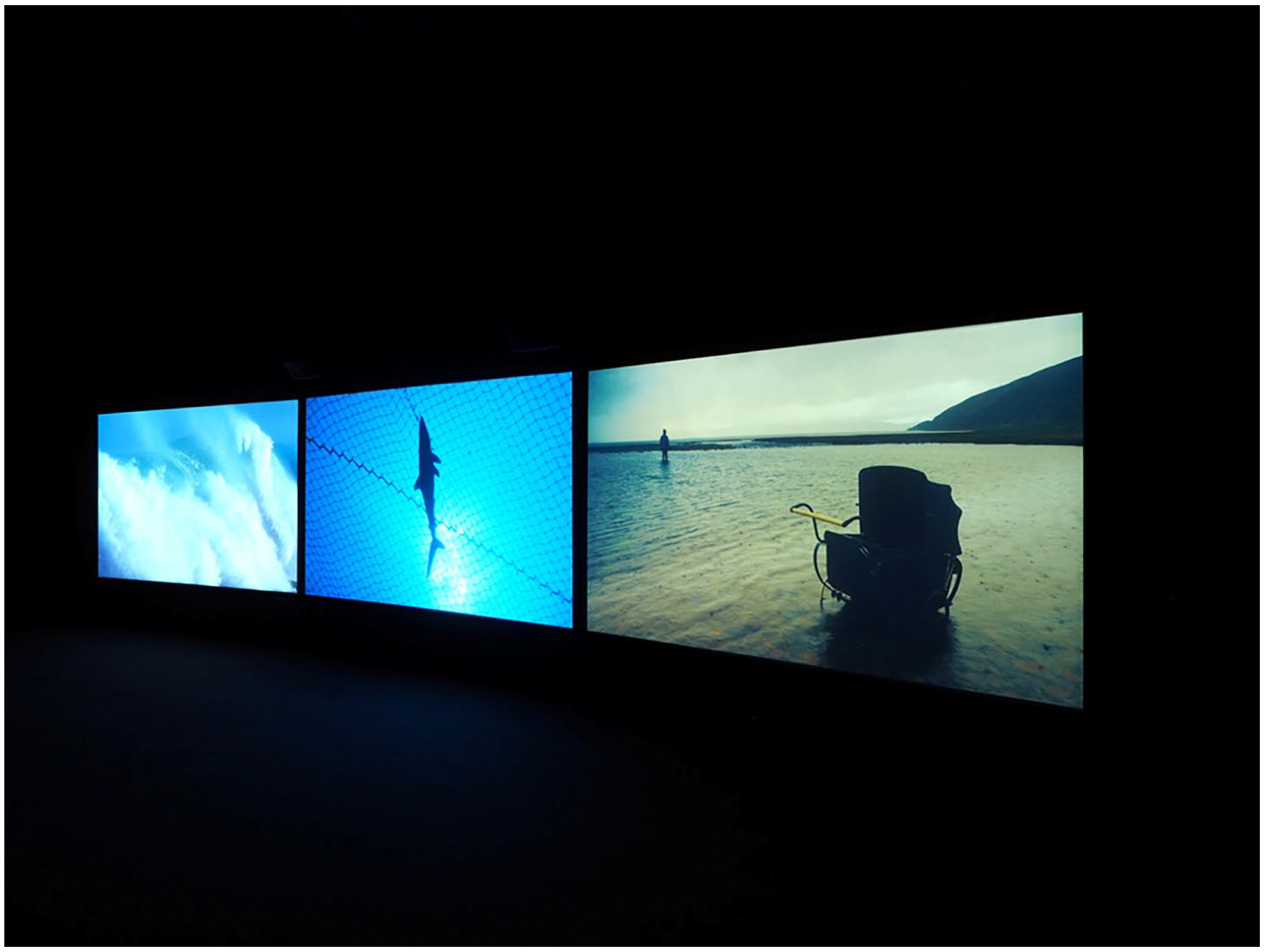
John Akomfrah’s Vertigo Sea is a radical experiment. It grapples with the coloniality of time and images of the international as a closed structure articulated in a hierarchic order, with history as an evolutionary continuum from the backward to the modern, from feudalism to capitalism. For him, this history is one of chattel slavery, colonization, immigration, and decimation of biodiversity. These are not ‘single’ issues but entangled as part of global racial capital’s system of rival states and corporations, the engine that destroys the planet in its search for profit. Like Fanon, Akomfrah offers an account of this system. Vertigo Sea is at once a meditation on ‘Europe [’s projects], [a mirror] of the future, [an] advanced form of the history of the entire species’, 135 and an invention (Figures 2 and 3).
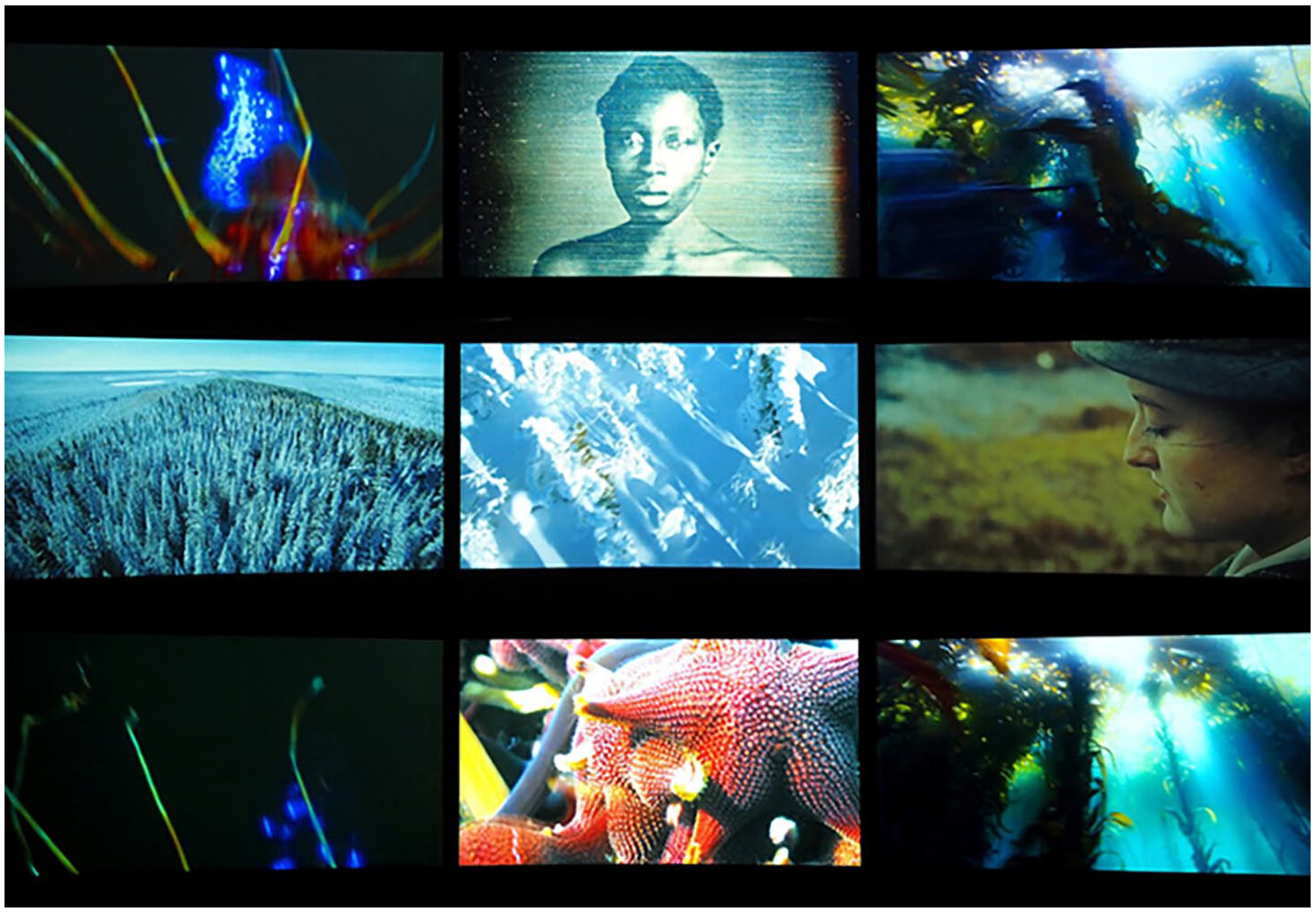
Installation views of Vertigo Sea, 2015, three-channel HD video installation, 7.1 sound, 48 minutes 30 seconds. © Smoking Dogs Films, All Rights Reserved, DACS 2024.
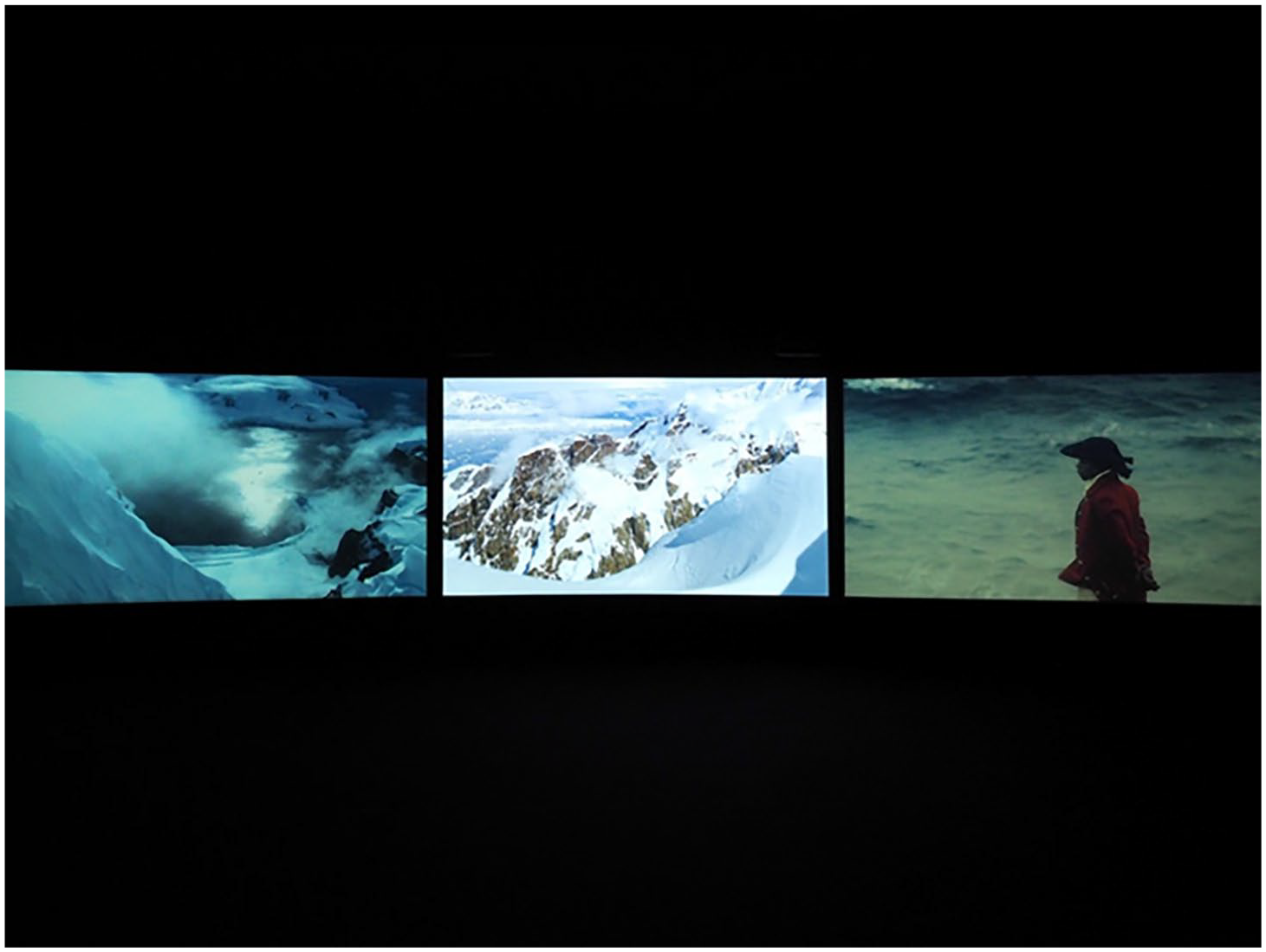
© Smoking Dogs Films, All Rights Reserved, DACS 2024.
In Vertigo Sea, Akomfrah takes us to the ocean to reveal the order/disorder of our global present. The 48-minute, three-screen installation is nonlinear, bringing together material sourced from thousands of hours of archival footage, mostly from BBC, screened alongside newly shot scenes from Greece, Alaska, Arctic Greenland, and Marquesas Islands. Despite its reliance on the archive, the installation has a starting point in contemporary questions. It exposes the multiple sedimentations of violence and beauty, grappling with contemporary inquiries into and the incommensurabilities of our global present and exploring a range of events, from whaling to nuclear testing, deep-sea executions, and the recent Mediterranean migrations. Akomfrah assembles these events as ‘oceanic ontologies’ or the ‘abyss’, 136 building on the contention that global chaos, both geopolitical and esthetic, commences with the sea.
For Akomfrah, the archive is not a static or transparent assemblage of material but an epistemic resource that can bring us back to the moment of the ‘ruin’, that is, ‘man’s relationship with the sea and exploration of its role in chattel slavery, migration, extraction of biodiversity, and conflict’. Akomfrah sees his art as informed and shaped by the oeuvre of crossroads, what art critic Kobena Mercer calls the ‘cut-and-mix esthetic’. For Akomfrah, the crossroads is a pressure point that activates a radical esthetic invention that Black people call living. As he says, ‘For my generation, nervous energy grows like cancer’.
To bring order to the current chaos of the global order, he conjuncts 137 the archival and the present, thus setting ‘a migration towards the past and the present within the same frame’. 138 Deploying a three-screen format, he reframes diverse images and sets them into dialogue with each other. High-definition footage of pristine oceans and woods shot by the BBC’s Natural History Unit is set alongside grainy images of the perilous voyages of Vietnamese boat people, a man shooting polar bears from the deck of a ship, and a reenactment of the Zong massacre of 1781, in which 132 slaves were thrown overboard in the Caribbean whose enslavers claim insurance value as their lost cargo. The result is mutual complication and interrogation. Images of violence, greed, and brutality both foreground and refute the convenient elision of centuries of exploration and trade that exerted a formative influence on the emerging politics of slavery and environmental depredation. His conjunction disrupts familiar fictions all the while offering new understandings about the multivalent, violent, and bountiful histories of our planet’s seas.
Focusing on material transformations, Akomfrah works on multiple levels. On the register of content, he shows how narratives about catastrophe and running out of time (urgency) and demands for ‘transition’ miss the multifariousness of Black diasporic experience; on the register of form, he points to the complexities of various systems of mediation and representation which composes categories that end up reproducing ‘ruins’. Like Fanon, he shows how notions of form and content-assembled through the framing of life as a thing of time leading to genocidal deciphering and ordering-are fatal. Simultaneously, he focuses on composition, decomposition, and recomposition in the sea as an experiment, describing what happens without having to recall linear time’s presentation of form and content inscribed as change as a temporal progression. Instead, he figures change as material transformation; therefore, ‘It’s important to read images in the archive for their ambiguity and open-endedness’. 139
Akin to Fanon who asks us to leap beyond the regimes and projects of global racial capital and its racial regimes of esthetics. Akomfrah uses documentary to describe the colonial esthetic as sensorium, condition, structure, and method and engages with the violence in the abyss of the ocean to rupture and radicalize his and the audience’s position. Deploying the ocean as a compositional site, he demonstrates how its relegation to the margins of the political as something with no sovereignty misses the stickiness of the mensural in the possibility of capital’s life. The ocean’s ephemerality challenges modernity’s linear and recursive divisions, sequencing and determinacy of a certain order. The audience is pushed to confront this condition and connect what has been assumed to have no connection – enslavement, colonization, the decimation of biodiversity, and displacement with a capitalist machine. Akomfrah uses the ocean to show us that all forms of life – soil, water, slaves, animals, immigrants – are caught in vertigo. His documentary makes the audience feel this vertigo – dizzy, giddy, and unstable – as it is confronted with a vast ocean, an abyssal environment, a miasma of memory and forgotten people, animals, acts, murders, massacres, slaughter, disaster, and of course, beauty.
His complex and nuanced articulation of global power points to multiple gaps in the premises and promises of sovereign power, corporate profits, and progress, to the ways global warming ‘is a process rooted in technology and exploitation. . .the realisation that everything overlaps at some profound level, that the great shifts in human progress that are made possible by technology can also cause the profoundest destruction and suffering’. 140 Akomfrah experiments with the abyss and its imaginaries. He enacts a decolonial invention to disrupt dominant ideas of history and urgency. The ocean is his vantage point. The rising temperatures are a guide for thinking through how the coloniality of time implicates and intertwines the colonial, the racial, and capital. The ocean is the abyss, a ‘condition of ephemerality’, 141 a condition that cannot be contained, that erodes the structure of language and universal and retrojection (i.e., a “kind of projection that retrospectively testifies to `what comes before’”). 142
The first sound we hear is a ticking clock. Clocks are everywhere in the film. Like Fanon, Akomfrah suggests the sensorium regimes of global power diffuse the international with an idea of time as a thing and race. Time ticks away, a sign we are running out of time. But an obsession with linear time is absurd: covering the beach with clocks cannot and will not stop the tide from coming in; rather, we must abandon ‘time and refuse its seductions’. 143 The abyss is not bound by the familiar coordinates of space and time, linear time, or violent assemblages of form and content recursively to sort the subjects of value and self-determination from nature (i.e. primitives, elements such as soil, water, air, fire) upon which the modern projects of global power depend for their viability and regeneration.
Violence is pervasive in Vertigo Sea, including images of enormous walls of whaling flesh, fat and blood and entrails pouring across the decks of ships, and men in oilskins wading through the slurry. Fanon decries the global racial reduction of the native and the Negro to a capital-generating thing of time; so too, in Akomfrah: ‘The primary driving forces behind these acts was the pursuit of and creation of an economy based on money – capitalism’. 144 Fanon says: ‘When I search for Man in the technique and the style of Europe, I see only a succession of negations of man, and an avalanche of murders’. 145 Akomfrah similarly points to an ‘avalanche of murders’, generated by colonialist rapacity for slaves, land, and natural resources, manifested through impoverishment, violence, and extraction. The continuation of these disasters is entrenched and amplified by technologies of displacement from one site into another. Akomfrah transmits this displacement, the attempt to localize certain violences on different bodies, but he also creates the cracks in the displacement. The ticking of the clock points to the ongoing political physics of global modern power’s logics and logistics, including the persistence of racist stereotypes, but it also suggests ephemerality (Figures 4 and 5).
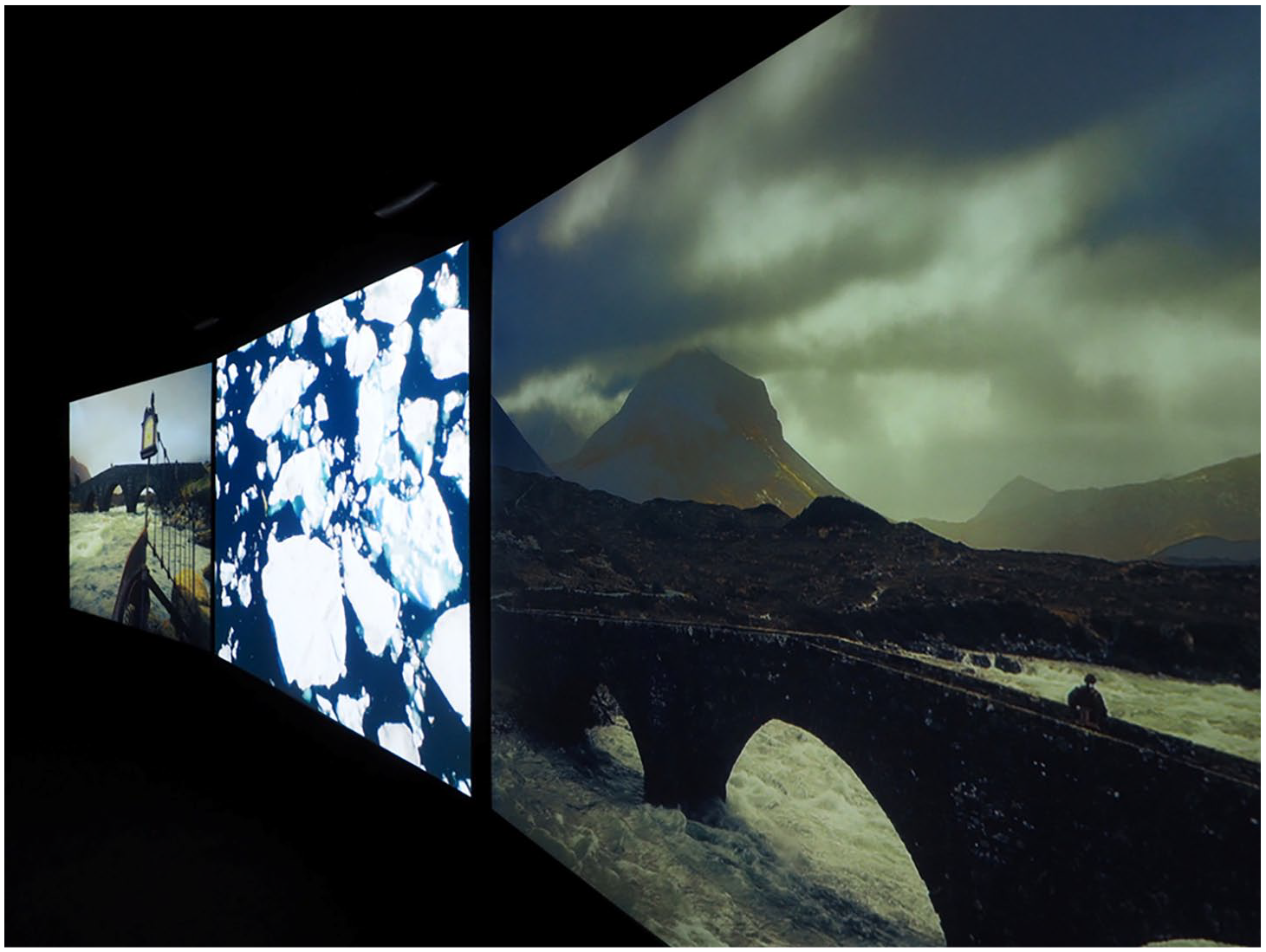
© Smoking Dogs Films, All Rights Reserved, DACS 2024.
© Smoking Dogs Films, All Rights Reserved, DACS 2024.
Fanon and Akomfrah both expose the violence at the center of the modern social contract. The fictions that generate dualisms (i.e. ocean/earth, culture/nature, Blackness/sovereign subjects; particular/universal; national/international; form/content) are arrangements and political settlements that take for granted time as a thing. 146 Within these arrangements, the European turns into the only proper form of political subject, the ‘mirror of the future’ and the ‘advanced form of the history of the entire species’. 147
Akomfrah is explicit about his purpose: ‘In Vertigo Sea there are a lot of clocks. Which merely asserts the fact that there isn’t one time. It at least alludes to this idea that all three screens are happening simultaneously, in different times and different spaces’. 148 The movement of the ocean also disrupts the linearity of structures and power that deploy time to enslave and colonize and to ontologically segregate existence into the forms of human or whale life. His work starts from the idea that time has been deployed to ‘precariously perch. . .on the precipice of oblivion’, and as he notes, ‘The questioning of the untold remains this beguiling absence in all of this’. 149
The question of eco-social decimation, human and otherwise, is key in Vertigo Sea. The conditions of violence and in/security of the subject that modernity promised to eliminate through the social contract seem to have been engineered to create terror and destruction, including the destruction of the basic elements that make life itself. In putting into conversation the multiple violences, such as environmental degradation and multispecies death, militarization, and displacement, as well as the beauty of the biodiversity of the ocean, the film demands the audience hold together the familiar understandings strategies of and meaning-making systems of the world, the capital privileges and underlying anxiety of racial capitalists and their images of ‘catastrophe’ and urgency.
For Akomfrah, capital is an international project, a structure that enables some life at the expense of other multiple forms. This structure deploys time (linear) as an organizing and sorting principle of its project relegating Blacks, the wretched, living creatures, and waste to chaos. While all this death is for generating more profits, Akomfrah demands the audience stay with the ocean, this abyss in which life and death ebb and flow. It cannot be contained in the modalities and temporal esthetic trajectories of racial capitalism. In his composition of montages, Akomfrah experiments with the abyss to demonstrate how the tropes of crisis and urgency and turning points in the story of climate change are touched by colonial and racial violence. At the same time, creation in the abyss is ‘invention into existence’. 150
As a Way of Conclusion: Climate Change and Abyss as a Question of Invention?
So we come back to the same question. What creative poetics and sensoriums can IR perform in the times of the Anthropocene, an epoch when metaphysical finitude is being replaced by ecological finitude?
When we look to Fanon for answers, we see something stickier about global racial power. Not only is it entangled with a presentist history and its esthetic imaginaries demanding investments in global racial capital’s projects to sustain colonization but it is also displaces inquiry into the material and epistemic nature of Western humanism and the power organized under the name of Man as a thing of time. This power insinuates itself through quasi-historical and esthetic fictions. In grappling with anti-Blackness and colonization, the wretched of the earth, Fanon suggests the dimensions and forces of existence are themselves productive of violence and evidenced in the colonial and imperial project of global capital and its transmutation of violence into national and international arrangements. Ultimately, in a Fanonian reading, the question of climate breakdown cannot be separated from the attempts of colonial imperialism to assemble a global power esthetic that remains colonial, deploying race as a given to secure its regeneration. Its fabrication cannot be disentangled from the ‘foundationally anti-Black’ and anti-wretched metaphysics of capitalism. 151 The wretched can liberate themselves from this colonial power, this climate change violence, by refusing to remain fixed in an urgency that does nothing but detach existence from its biospheres, and then appropriate it as a thing, standardized and integrated into global capital’s tentacles. Importantly, a decolonization that grapples with climate change will involve neither the revelation of a solution nor a postclimate catastrophe. Rather, it will involve invention, a radical disruption of conquest of existence; we must make a leap whose outcome cannot be a priori decided or prescribed. 152
In many ways, Akomfrah takes up this challenge in Vertigo Sea. His installation exposes the excesses of colonization to radically disrupt capital’s practices of turning everything into currencies of time. He turns to the ocean as the site of contestation between the more naturalistic forces of what Prasenjit Duara calls ‘historical time’, or ‘emergent. . .currents shaping societies’. 153 Linear histories of modernization or nationalization inflected through the international as a global racial capital structure still dominate the political understanding of history even at the moments when capital deploys recursivity to localize and posit itself as if it has always been there. In focusing on the ocean, Akomfrah suggests moments of conquest and enclosures, that is, specificities generated to ensure the movement of the universal, are problematic or complicit in ensuring a bordering that makes two sides appear. He points to the importance of the untold, and his work engenders the ‘enigma of the arrival’ as self-invention. 154
Fanon’s tabula rasa challenges the opposition between means and ends and thus allows a critique of the Kantian regulative understanding of politics. Similarly, Akomfrah’s ocean precipitates a foundational crisis in the colonial and enslaving project/s of global capital and its pillars of historiography that linearly punctuate a transformation toward its own ends. Both Akomfrah and Fanon introduce a tabula rasa without striving to ‘translate or present’ either the ocean or the wretched. 155 They challenge how global racial capital sustains the illusion of immediacy, of urgency, through genealogical metaphors of revolution, renewal, reproduction, and more recently, innovation. Their radical ruptures of global power and sensorium regimes implicate our lives in everything on earth. Both point to how divisions of nature (Earth) and the human are abstractions entangled with an assembled esthetic that allows us to see hyperobjects like global warming and toxic ecologies independent of the times of industrialization, war, nuclearization, neo-colonialisms, anti-Blackness, and displacement. But both remind us they are not independent.
In acknowledging the ongoing absolute violence of the global racial structures of power that generate chaos, Fanon and Akomfrah work to rupture the petrification in which they find themselves. For Fanon, this involves a disinvestment of the colonial subject from the colonial international asymmetrical structures of violence, with ‘a whole social structure being changed from the bottom up’. 156 As Marriott points out: ‘In the decolonial struggle, violence has a regulatory function insofar as it is detoxifying and destructive, creative and reinventing’. 157 For Akomfrah, vertigo is a starting point of self-invention. As a conversation with them suggests, any kind of poetry, any radical act, cannot simply rush to respond to an urgency that comes out of dominant thought systems that presume Man and the international as the marionettes of time.
IR is at a crossroads, a moment for a possibility, an invention, a radical vertigo that does not presume or prescribe the reproduction of coloniality and its contingent sensoriums. But taking the leap requires simultaneous inventions of the international and IR. It requires disrupting the idea that species and natures of all forms can turn into currencies of time. The goal of this leap is to substitute the history of decimation for a modality no longer enslaved to conquest and accumulation. Invention as a leap, a decolonial radical transgressive act, refuses equivalencies and compulsions to gather the international into a temporal verb or presence, a category that can be put to work as capital’s alibi. Invention is always a question but ‘without it no decision is possible or is recognizable as such’. 158 It is time for IR to take the leap – invention is the possibility for a decolonial dawn. . . .
Supplemental Material
sj-docx-1-mil-10.1177_03058298241292513 – Supplemental material for Decolonizing IR’s Environmental Racial and Colonial Temporality: Frantz Fanon, John Akomfrah, and the Politics of Invention
Supplemental material, sj-docx-1-mil-10.1177_03058298241292513 for Decolonizing IR’s Environmental Racial and Colonial Temporality: Frantz Fanon, John Akomfrah, and the Politics of Invention by Anna M. Agathangelou in Millennium
Footnotes
Declaration of Conflicting Interests
The author declared no potential conflicts of interest with respect to the research, authorship, and/or publication of this article.
Funding
The author received no financial support for the research, authorship, and/or publication of this article.
Supplemental Material
Supplemental material for this article is available online.

Notes
Supplementary Material
Please find the following supplemental material available below.
For Open Access articles published under a Creative Commons License, all supplemental material carries the same license as the article it is associated with.
For non-Open Access articles published, all supplemental material carries a non-exclusive license, and permission requests for re-use of supplemental material or any part of supplemental material shall be sent directly to the copyright owner as specified in the copyright notice associated with the article.
