




Abstract
At the United Nations (UN), the early years of the post-Cold War era were marked by a historically novel sense of urgency to render governing practices in development cooperation and humanitarian affairs more ‘human’, ‘people-’ and ‘rights’-centred. Since then, the UN ‘Human Rights-Based Approach’ (HRBA) has become widely accepted as an authoritative methodology for grasping the practical implications of rights language. This paper examines the politics of the HRBA by exploring how it ‘fixes’ the multifaceted, normatively charged and elusive object of ‘human rights’ and renders it actionable for UN agencies. It contributes to recent theorizing on knowledge in IR and ties in with critical human rights scholarship by developing a post-foundational reading of human rights and the HRBA that frontloads constitutive power and politicizes ontology. Through an in-depth reconstruction of UN knowledge production on the HRBA, I find that it excludes concerns with international power relations and depoliticizes inequality through a narrow focus on lacking subject capacities. Moreover, I illustrate that the HRBA operates according to dichotomous spatial metaphors and implicit hierarchies that locate UN agencies ‘above’ the subjects and settings they interact with, both normatively and epistemically. The paper contributes to the critical study of human rights by excavating the ambiguous power effects at work in rights-based UN methodologies.
Introduction
The cause of human rights has entered a new era. For much of the past 60 years, our focus has been on articulating, codifying and enshrining rights. [. . .] But the era of declaration is now giving way, as it should, to an era of implementation.
1
A new ideal has triumphed on the world stage: human rights. It unites traditional enemies, left and right, the pulpit and the state, the minister and the rebel, the developing world and the liberals of the West.
2
In academic and practitioner circles in the West, the early years of the post-Cold War era were marked by high hopes that cosmopolitan globalization would usher in a new post-political liberal world order grounded in shared values and institutions, the spread of democracy and the realization of universal human rights. 3 Among international organizations (IOs), this moment in history gave birth to new kinds of questions that seemed to demand attention from practitioners and academics alike: how could practices of governing be oriented towards the good of an increasingly globalized humanity? How could they become more people-centred, empower the marginalized and further human rights? 4 In other words, making human rights bear upon the everyday practices of international institutions emerged as a problem in the genealogical sense of the term: it was formulated as something that needed to be known and governed. 5
For the United Nations’ (UN) development and humanitarian agencies, this shift soon had tangible implications. Traditional commitments to reduce human suffering, 6 fulfil the needs of developing populations and enhance economic growth 7 that had long informed and legitimized their work were now increasingly understood to ‘exist in a human rights framework’. 8 In other words, there was a growing consensus that UN practices in development and humanitarian affairs had to be rethought through the lens of human rights. 9 In the words of then UN Secretary-General Kofi Annan, as the world seemed to enter an ‘age of human rights’, the belief that their ‘promotion’ and ‘defense’ had to be placed ‘at the heart of every aspect of [the UN’s] work’ gained traction. 10 In the early 2000s, a consensual and actionable understanding of what human rights implied for the everyday mundane practices of UN’s humanitarian and development organizations was established in the inter-agency ‘Human Rights-Based Approach’ (HRBA). 11 Today, the HRBA continues to shape programming and evaluations practices of UN agencies as a both compulsory and authoritative methodology for how human rights ought to be furthered and taken into account in development cooperation and humanitarian affairs. Since the mid-2000s, it constitutes a normative programming principle that UN agencies need to apply ‘at all stages of programming’. 12 More recently, it has been embraced as one of the ‘six Guiding Principles’ that are meant to inform all implementation and evaluation of the Sustainable Development Cooperation Framework. 13 Indeed, pertinent contributions by development and human rights practitioners have deemed the HRBA so ‘dominant’ and ‘influential’ an approach that it is now ‘habitually received and promoted as the way to incorporate a human rights practice within the development sector’. 14
Despite their continuing salience and historical novelty, human rights-based methodologies that are produced and put to work by international institutions have received little critical scrutiny in International Relations (IR) and critical human rights research. The bulk of work that has been published on right-based approaches and the HRBA in academic outlets closely echoes practitioner discourses and technical international legal discussions by pondering ‘lessons learnt’, ‘pros and cons’ and the ‘added value’ of applying HRBA. 15 As critical engagements with human rights have flourished across IR, international law and history in recent decades, they have shed important new light on the uses (and abuses) of human rights language across international affairs 16 and critically reexamined their historical origins. 17 Yet the formulation of rights-based methodologies in development and humanitarian affairs – and with it the entering of rights language into the core of UN practices beyond the traditional ‘human rights machinery’ 18 – has so far received little scrutiny in critical scholarship. Rights-based approaches and the HRBA as the arguably most authoritative and firmly institutionalized example thereof, 19 are therefore both markedly understudied, historically novel and practically salient.
In this article, I aim to amend this research gap by throwing new light on the politics of the HRBA. Studying the HRBA in depth, is also relevant from a more philosophical perspective and it has important implications for the study of knowledge production in IR. As a seemingly technical and mundane object, I will argue, the HRBA is in fact profoundly political since it tells UN agencies what human rights imply and what they do not imply and allows for UN agencies to clothe their work in the normative language of human rights. Thereby, the HRBA fixes a specific reading of what human rights imply in practical terms as self-evident and given. As I shall argue below, this objectivation in turn unfolds constitutive power effects. The central research interest driving this article is therefore to grasp the politics of the HRBA as an object of specialized knowledge that is (re)produced and employed by UN agencies and to make sense of how the HRBA relates to ‘human rights’ as an abstract moral and political language. On a related theoretical level, I am therefore interested in the ontological multiplicity and world-making constitutive power of human rights as objects of knowledge in international politics.
To this end, I will build on the strand of critical political theorizing known as post-foundational ontology 20 and draw on critical human rights research across scholarly disciplines in order to develop a reading of human rights and the HRBA that frontloads the political work that they perform. Here, I suggest that objects of specialized knowledge, such as the HRBA, can be understood as precarious, yet socially consequential ‘ontic fixes’ that render the multifaceted, contested object of human rights actionable and concrete. Such an account, I will argue, promises to politicize ontology and thus may help orient IR research on knowledge practices and the objects that they constitute towards a more sustained engagement with ‘the question of power’. 21 Theoretically, I therefore contribute to discursive, practice-theoretical and object-oriented approaches to knowledge 22 and the related, burgeoning interest in ontological theorizing in IR. 23 Moreover, a post-foundational theoretical lens productively ties in with existing critical human rights scholarship in and beyond the discipline as it throws into relief the political-ontological multiplicity of human rights and their world-making power. Aligning with political and discursive (rather than narrow, legal) accounts of human rights that draw attention to the ambiguous political effects of rights practices, 24 I argue for tracing human rights politics in the plural by accounting for how rights language is rendered tangible and possible to act upon in concrete practices of knowledge production.
Embarking from these starting points, my empirical account of the HRBA first shows how it was gradually established as an object in UN discourse and made tangible through a proliferation of specialized knowledge and institutional entities in UN’s humanitarian-development nexus. In a subsequent in-depth reconstruction of the HRBA, I then explore how epistemic practices that are associated with the HRBA render social settings where UN programmes are to be implemented knowable and possible to engage with for UN agencies. To grasp the specificity of this constitutive operation, and what other ways of being in the world are excluded in the process, I draw attention to discursive regularities that are drawn upon in said practices. Methodologically, the article builds on a retroductive research process 25 that included an extensive genealogical tracing and discourse-analytical reading of a wide range of UN materials from high-level conferences, human rights bodies, individual agencies, country teams and other institutional entities within the United Nations Sustainable Development Group 26 (UNSDG). Besides high-level declarations and policy statements, I looked at a wealth of materials that serve everyday, practical purposes: fact sheets and action plans, toolboxes and manuals, programming guides, evaluation reports and collections on ‘best practice’, online platforms and educational material meant to explain the value and proper conduct of HRBA to UN country staff.
Based on this in-depth reconstruction of the HRBA, I find that it pits subjects who are identified as ‘duty bearers’ against such that are categorized as ‘rights holders’ whilst imagining UN agencies themselves as benevolent helpers and custodians of human rights, who join forces with disadvantaged, marginalized groups and ‘those left behind’. Despite a progressive, intersectional rhetoric of empowerment and claims to political neutrality, I contend that this operation is not inherently opposed to – or indeed itself devoid of – power. Here, I develop two more specific points. First, the HRBA enacts a limited notion of inequality, marginalization and exclusion. By translating the language of human rights into a specific repertoire of epistemic practices performed by UN offices in the ‘field’, the HRBA excludes unequal power relations that transcend state borders and depoliticizes concerns with disadvantage and inequality by reducing them to a question of lacking subject capacities. Second, I argue that HRBA practices operate according to normative-epistemic hierarchies and dichotomous spatial metaphors that privilege norms, knowledge and actors that are seen to belong to the ‘global’, ‘international’ or ‘UN level’, whilst locating obstacles to progress, development and rights within the ‘domestic’ sphere, the ‘country’ or ‘local communities’. The different actors whom UN agencies encounter in human rights-based humanitarian and development programmes are understood as both epistemically and normatively deficient and unfinished: as subjects ‘in the making’ in need of guidance and assistance. As a consequence, divergent political articulations are analytically categorized and made sense of as lacks in knowledge and competence, hence producing a strong discursive closure.
I thus conclude that the HRBA places human rights within an ambiguous, power-ridden ontic framework. On the one hand, the HRBA introduces the language of rights and participation, marginalization and inequality to UN programming. But through its practical, epistemic operation – that is, how it allows for UN agencies to know and engage with concrete social settings – the HRBA fixes an epistemically violent, hierarchical reading of human rights. Empirically, the paper thus adds to the critical study of human rights and development by highlighting the ambiguous power effects at work in contemporary rights-based approaches directed towards the ‘empowerment’ of marginalized groups. Thereby, it joins a rich lineage of critical scholarship on human rights governing practices and it contributes to the growing body of literature on technical applications of human rights by international institutions. 27
The Precarious Politics of Objects: A Post-Foundational Reading of Human Rights
The Declaration of Rights states that all men are born free and equal. Now the question arises: What is the sphere of implementation of these predicates? If you answer, as Arendt does, that it is the sphere of citizenship, the sphere of political life, separated from the sphere of private life, you sort out the problem in advance. The point is precisely where do you draw the line separating the one life from the other? Politics is at that border.
28
In recent years, scholarly work on knowledge production in IR and International Political Sociology has sought to decentre the Cartesian subject and it has abandoned its conventional focus on epistemic communities and IOs as agents in possession of specialized knowledge and expert authority. 29 This movement has been described as a turn to discourse, practice and/or objects. 30 Despite their diverse theoretical emphases, 31 newer IR approaches to knowledge production share an interest in the productive constitution of social realities through knowledge production and they therefore emphasize that social identities, objects and problems that pose themselves to the present are not neutral, natural or given, but rather ‘imply distinct politics’. 32
In this article, I contribute to these conversations on knowledge production and the burgeoning interest in ontological theorizing in IR 33 by drawing on post-foundational ontology to make sense of the HRBA and its politics. Post-foundational ontology is a strand of political theorizing with Post-Marxist, Foucauldian and Left-Heideggerian allegiances that has so far received little attention in IR. 34 Put succinctly, post-foundational ontology assumes social reality to have no ‘last ground’, but to emerge out of contingent acts of institution. 35 This interest in the contingent coming-into-being of social reality unites critical histories that draw on Foucauldian archaeology and genealogy with theoretical approaches that take their primary theoretical inspiration from Martin Heidegger’s notion of the abyss (der Abgrund) and his distinction between the ontic and ontological, the so-called ‘ontological difference’. 36
Post-foundational perspectives therefore converge in seeking to trace the contingent emergence of social, historical conditions that enable us to say ‘what counts as a thing, what counts as true/false and what it makes sense to do’. 37 As Foucault puts it, ‘the great problem’ of such analyses ‘is no longer one of lasting foundations, but one of transformations that serve as a new foundation, the rebuilding of foundations’. 38 Positing the world ‘as nothing’ is not to say that there are no foundations. Rather, an ontology of the world as ‘void’ points to an excess of ontologically possible worlds compared to the ontic, historical specificities that we encounter in given moment and place, it disposes of absolute grounds and turns attention to contingent grounding. 39 In a post-foundational reading, the shape of the world in a particular time and space can therefore be understood as a product of power relations: ‘ontologically, no world is necessary even if all that appears in it is real’. 40
Such a perspective can be fruitfully drawn upon to throw new light on the operation of human rights, the HRBA and other objects of knowledge in IR: it opens for a reading of objects as contingent political inscriptions that unfold constitutive power effects and it hence promises to ‘politicize ontology’. 41 Thinking objects and knowledge practices that make up IR’s world through a post-foundational lens directs attention to object constitution, since the absence of ‘last grounds’ and essential qualities implies that discursive ‘practices systematically form the objects of which they speak’. 42 This aligns well with insights from existing discursive, practice- and object-oriented contributions that emphasize how ‘international phenomena [are] rendered knowable [. . .] in practices on knowledge generation’. 43 Yet, a post-foundational reading pushes the conceptual borders of these research strands since it underlines the political non-necessity of objects’ past and current forms, hence promising to direct more focused attention to their entanglements with power. By stressing the radically contingent nature of social practices, identities and institutions, post-foundationalism invites a reading of objects as discursive, political closures that lend themselves to and inscribe specific ‘conditions and roles that must be satisfied if a particular practice of articulation is to qualify as meaningful’. 44 It invites us to understand objects as precarious, yet socially consequential ‘fixes’ and to theorize the latter as ‘politics that has forgotten itself’. 45
This enables a shift in focus away from constitution in the sense of (re)production and emergence towards constitutive power effects, that is: the political, world-making power of objects. By virtue of being shaped and objectified in a specific manner, objects of knowledge invite and support some practices, subjectivities, kinds of utterances and more generally some ways of being in the world – whilst excluding others. From a post-foundational perspective, this operation is both productive and contingent: objects such as ‘human rights’ imply distinct, but potentially conflicting politics depending on how they are enacted and reproduced. In other words, we need to turn attention to how they productively shape social relations as they become entangled and receive ‘fixed’ ontic forms in concrete localized practices of knowledge production – such as, for instance, the formation of UN practices that are associated with the conduct of ‘HRBA’.
On Multiple Objects and Ontic Fixes: Human Rights and the HRBA
How can these starting points help us make sense of the HRBA and its relation to the more elusive, encompassing and normatively charged object of human rights? Drawing on the theoretical commitments described above, ‘human rights’ can be understood as a ‘multiple object’: an abstract, moral and political language that may be differently enacted and objectivized. This can be illustrated by drawing on existing critical human rights research. As the turn to critical, revisionist human rights history attests to in great empirical detail, the historical and political entanglements of human rights are multiple, ambiguous and contested. 46 To mention just a few examples from a varied and conflict-laden historical legacy, take only the second half of the 20th century. Here, ‘human rights’ became involved in, informed and were differently rendered in various, heterogeneous ‘group[s] of rules that are immanent in a practice’, 47 including post-war European conservatism, 48 neoliberal market morality, 49 cosmopolitan internationalism 50 and the political project of Third World solidarity, post-colonial self-determination and international economic justice. 51 A synchronic view brings to light a similar proliferation: today, ‘human rights’ are inscribed and continuously reconstituted in a multitude of different texts, practices and institutions. Beyond the Bill of Rights (UDHR, ICCPR, ICECPR) and the broader UN human rights machinery, ‘human rights’ take on different forms in regional human rights regimes and national human rights institutions, in the context of human rights activism and the professionalized world of human rights advocacy, in foreign policy doctrines, practices of military intervention, international sanctioning regimes and, last but not least, in various branches of the social sciences including IR scholarship.
It this sense, ‘human rights’ are an unruly object, multiplying and transforming across historical and contemporary sites. To lend a formulation from Annmarie Mol, politically and ontologically ‘there are options between the various versions of [human rights] as an object’. 52 However, human rights nonetheless become fixed and objectified: ‘[i]nsofar as an act of institution has been successful [. . .] the instituted tends to assume the form of a mere objective presence’. 53 What human rights ‘are’ and ‘do’ depends on relations with other discursive elements; relations of existence that enables something ‘to appear, to juxtapose itself to other objects, to situate itself in relation to them’. 54 Human rights are hence neither coherent across time and space, nor inherently progressive but the specific contours that they take on in concrete practices are intimately connected with ‘the question of power’. 55
To understand the politics of human rights as a both elusive, pervasive and highly normatively charged object that multiplies across IR’s world(s), this multiplicity and indeterminacy needs to be taken seriously. In this journal, David L. Blaney and Arlene Tickner have provided an excellent discussion of how conventional constructivist IR norm scholarship on human rights fails to grasp the politics inherent to the ontology of rights, thus reenacting a colonial world that posits ‘Western conceptions of human rights [as] exclusively universal’. 56 Despite a number of notable, but dispersed critical contributions to the study of human rights in the discipline, 57 the US-centred, positivist mainstream of IR research persistently conceptualizes human rights as a relatively stable and coherent set of progressive universal liberal norms and it typically ponders the causal mechanisms of human rights’ global spread or decline in a language of progress and set-backs, effectiveness and legitimacy. 58 The discontinuities and impositions, plural and conflicting renderings that mark struggles around the very meaning, political implications and thus of different worlds that are brought forth through rights language are thereby concealed from view.
Recognizing the political-ontological multiplicity of human rights and their world-making power therefore has important implications for advancing scholarship on human rights in IR and it productively ties in with critical research in and beyond the discipline. Notably, it implies a conscious, consistent move away from recovering the ‘true origins’ and the ‘actual’ politics of human rights. Did ‘human rights’ as we know them today emerge as a moral response to the horrors of war and the Holocaust, 59 or did they rise to prominence much later in 1970s US foreign policy discourse? 60 Can their beginnings be relocated in anti-colonial struggles and counter-hegemonic international law-making, 61 or do they belong to a dark history of gendered, racialized exclusions and empire? 62 Are human rights an emancipatory force in contemporary international affairs or a tool of power and domination? The answer to these pertinent questions might seem banal, but it is, I believe, consequential: ‘all at once’ and ‘it depends’. From this insight follows a need to trace human rights politics in the plural: to account for how human rights receive ‘fixed’ forms as they become entangled in concrete practices of knowledge production, hence productively co-constituting different social and political relations. As Upendra Baxi puts it, human rights can ‘enabl(e) both the legitimization of power and the praxes of emancipatory politics’. 63 This view aligns with Costas Douzinas’ observation that ‘the idea of “humanity” has no fixed meaning’, 64 and extends it to the object of ‘human rights’ itself.
Rather than providing the means for one unifying reconstruction of what human rights ‘are’ and what they entail, a post-foundational perspective thus suggests focusing attention on how human rights become nameable and actionable only as they form part of more specific socio-political frameworks and practices of knowledge production that sustain them. In the remainder of this article, I will explore how human rights are constituted in the context of UN development and humanitarian programming and I will seek to grasp the politics of the HRBA as an object of specialized knowledge that is (re)produced and employed by UN agencies. Here, I am interested in accounting for how the latter renders concrete social settings know- and governable, as well as in exploring the ambiguous power effects that this specific way of ‘fixing’ and objectifying the meaning and practical implications of human rights unfolds. My main point is thus to illustrate how the HRBA renders the more abstract, multifaceted and ambiguous political vocabulary of ‘human rights’ tangible and possible to act upon within a specific ontic frame, a way of ‘being in the world’.
The Ambiguous Power Effects of Rights-Based Governing Practices
In more empirical terms, this article contributes to critical human rights scholarship and critical development studies in two ways. First, it addresses an empirical research gap at the crossroad of these literatures: the formulation of human rights-based methodologies in development and humanitarian affairs and the entering of rights language into the core of UN practices – well beyond the traditional ‘human rights machinery’ – has so far received little scrutiny in critical scholarship (cf. above introduction). Second, the paper highlights the ambiguous power effects at work in contemporary governing practices directed towards the ‘empowerment’ of marginalized groups. It therefore moves one step beyond the well-established normative critique that decries the exclusion of the marginalized and vulnerable in international development cooperation. 65 It also extends on pertinent criticisms of the exclusive universality that underwrites Eurocentric, white and male conceptions of human rights, 66 by critically scrutinizing practices that are themselves clothed in an intersectional rhetoric of empowering the marginalized and excluded.
Thereby, the article adds to the rich lineage of critical human rights scholarship that has sought to elucidate and critique power relations in human rights governing practices conducted by non-governmental organizations (NGOs), IOs, Western states and other, ‘main authors of the human rights discourse’.
67
More specifically, the article contributes to the small body of literature at the intersection of international law, anthropology and sociology that critically addresses some of the manifold mundane and seemingly technical applications of human rights that have been introduced by the UN and other international institutions in the recent past, such as human rights mainstreaming,
68
quantitative human rights indicators
69
and the rise of human rights ‘audit culture’.
70
Here, my account of the HRBA shares in Martti Koskenniemi’s scepticism about the emancipatory potentials of human rights governing practices by international institutions and his assessment of the latter as ‘profoundly ambivalent in [their] political significance’.
71
Yet, while Koskenniemi is chiefly concerned that technical applications may dilute human rights of their revolutionary potential as ‘trump cards’ and turn the language of rights into a ‘strategy of institutional power’ that bolsters the position of ‘human rights experts’ in international bureaucracies,
72
my interest in the HRBA lies in understanding its constitutive effects and political, world-making qualities. My approach therefore has more in common with Sally Engle Merry’s Foucault- and Latour-inspired critique of the steep rise of quantitative indicators in the global governance of human rights, gender violence and sex trafficking. Merry’s central concern in this late work is with the power of numbers
73
and the politics of statical measurements within the UN system.
74
She stresses that ‘numbers are political resources, valuable to whoever is able to harness them’ and she underlines the constitutive power of quantitative indicators:
While we assume that [indictors] describe the world, they actually construct that world. [. . .] It is the unnoticed quality of the power that they exercise that renders their study critically important.
75
In the rest of this paper, I similarly seek to render visible the ‘unnoticed’ power, or – as I have preferred to call it – the ‘forgotten’ politics of the HRBA as a prominent, but under-researched qualitative methodology and object of specialized knowledge at the UN.
To this end, the next section provides a diachronic, birds-eye view of how the HRBA emerged at the UN. I show how it was gradually established and constituted as an object through the proliferation of specialized knowledge and the establishment of new institutional entities. Moreover, I provide a comprehensive interpretive reconstruction of how the HRBA ‘fixes’ human rights and I seek to grasp the constitutive power effects unfolded by this operation. To this end, I turn to two more concrete conceptual resources: epistemic practices and archaeological regularities. As I will illustrate below, the conduct of HRBA programming is associated with a distinct repertoire of practices that render knowable the objects, relationships and places where a HRBA is to be applied by ‘construct(ing) objects and suggest(ing) or provid(ing) means of manipulating them’. 76 To grasp the specificity of this constitutive operation, my interpretative reconstruction of the HRBA also draws on Foucault’s discussion of the rules of formation. These are ‘rules of existence’ that enable social entities to appear as something nameable, something that can be talked about. 77
The ‘Coming-Into-Being’ of the HRBA
How did the HRBA emerge historically? What novel necessity, sudden opportunity or normative calling inspired its formulation, and how did it become durable and objectivized? As alluded to in the above introduction, the emergence of the HRBA was historically premised on a broader shift in thinking that placed human rights at the centre of UN practices. In this section, I illustrate how this new problematization emerged and I show how the HRBA was constituted as an object through the proliferation of specialized knowledge and the establishment of new institutional entities.
The Problem of Governing for Human Rights
From the early 1990s onwards, the problem of placing ‘people’ and ‘human rights’ in the foreground of governing efforts and a perceived need to specify the implications of human rights for the organization’s everyday operational activities figured in speeches, reports and declarations. The 1993 Vienna Declaration and Programme for Action ‘invok[ed] the spirit of our age and the realities of our time’ to call on states, peoples and the UN to ‘rededicate themselves to the global task of promoting and protecting all human rights’.
78
The Copenhagen Declaration on Social Development painted a similar picture of historical novelty and a need to ‘prioritize’ human and people-centred understandings:
For the first time in history [we] recognize the significance of social development and human well-being for all and to give to these goals the highest priority both now and into the twenty-first century.
79
Over the course of the decade, UN discourse became marked by a perceived need to engage an increasing number of actors within the organization in the task of governing for the sake of humanity, its well-being and rights. In this vein, the Vienna Declaration underlined the need for ‘increased coordination on human rights within the United Nations system’ 80 and deduced a series of measures aimed at reorganizing UN practices well beyond the more narrowly defined human rights machinery from a human rights perspective. As alluded to in the above introduction, furthering human rights thus emerged as a new problem in the genealogical sense: ‘a specific problem encountered by a domain of practices’ that would ‘give rise to the formation of [. . .]new concepts’ and to ‘a new type of knowledge (savoir)’. 81 As the emphasis on the desirability of reorganizing evermore UN activities according to ‘human rights’ continued to proliferate in the late 1990s and early 2000s, it appears in further declarations, in publications by individual UN agencies and pertinent reports on the UN reform process. 82 In the ‘age of human rights’, their promotion had to be placed ‘at the heart of every aspect of [the UN’s] work’. 83
Proliferation of Specialized Knowledge and Institutional Entities
As this concern with making human rights bear upon UN practices proliferated and canonized, it also gave rise to new forms of mundane technical knowledge and institutional entities. The proper conduct of rights-based development work was increasingly explained in ‘fact sheets’, ‘action plans’, ‘programming guides’, ‘practice notes’, ‘toolboxes’ and ‘manuals’. 84 The relative success of implementing rights-based approaches become the topic of evaluation reports and ‘best practice’ collections. Extensive practitioners’ learning platforms were established, workshops and seminars were held with the purpose of schooling UN staff in applying the HRBA and initiatives were formed to ensure coherence in how implementation is carried out. 85 As a part of this development, a plethora of specialized programmes, mechanisms and institutions dedicated to the purpose of reorganizing UN agencies’ work around the object of human rights emerged. One early example was the joint United Nations Development Programme (UNDP) and Office of the High Commissioner for Human Rights (OHCHR) Programme for Human Rights Strengthening ‘HURiST’ (1999–2006), where OHCHR staff provided technical support on human rights and, together with their UNDP counterparts, sought to develop human rights-based programming practices. 86 In the next years, further entities followed: In 2004, the Action 2 Global Programme on Human Rights Strengthening (Action 2 Programme) was brought to life by the United Nations Development Group (UNDG) to support UN country teams in ‘mainstreaming’ human rights into all aspects of their activities. 87 Seven years later, the Action 2 Programme was succeeded by a permanent UNDG Human Rights Mainstreaming Mechanism (HRM) to ‘help meet the growing demand [for technical assistance on human rights]’. 88 In 2014, the ‘increasing emphasis on human rights’ motivated a further step of institutionalization as the UNDG transformed the HRM into a permanent Human Rights Working Group. 89
The Establishment of the HRBA as a Discursive Object
This proliferating series of new specialized knowledge and institutional entities provided the ground for the establishment of the HRBA as a delineable object. In 2003, the UNDG adopted a Common Understanding entitled ‘The Human Rights Based Approach to Development Cooperation: Towards a Common Understanding Among UN Agencies’ (henceforth ‘the Common Understanding’). 90 This document constituted a first consensual and authoritative statement among agencies in the UNDG on the necessity for ‘all programmes of development cooperation to further the realization of human rights’ and for human rights standards and instruments to guide ‘all phases of the programming process’. 91 Whereas earlier documents also make reference to human rights ‘mainstreaming’ and ‘streamlining’ or refer to ‘rights-based approaches’ in the plural, the Common Understanding marked the establishment of the HRBA as a ‘discursive object’ in the Foucauldian sense – as an approach that may be differently interpreted, but that nonetheless constitutes an entity that can be referred to as one, as something that can be talked about in the singular. 92 In other words, the Common Understanding was the first document to refer to the HRBA, and it therefore contributed to establishing the latter as a delineable object that UN agencies could refer to and seek to implement. It also established the HRBA as an authoritative and consensual UN approach for implementing human rights in development and humanitarian affairs. Following the drafting of the Common Understanding, from 2006 onwards the HRBA became a compulsory ‘normative programming principle’ that UN agencies need to apply ‘at all stages of UN common programming’, 93 as well as in the evaluation of their operational activities. 94 Today, it has been embraced as one of the ‘six Guiding Principles’ that are meant to inform all UN implementation and evaluation of the Sustainable Development Goals. 95 Through the simultaneous proliferation of institutional entities and materials detailing its practical application, the HRBA was established as a standardized, obligatory procedure for conducting humanitarian and development work in a normatively desirable manner and as a measurement by which their relative success or failure can be decided.
While the Common Understanding marked the establishment of the HRBA as an object, the ‘UN Inter-Agency Common Learning Package on Human Rights-Based Approach to Programming’ 96 (henceforth ‘CLP’) marked a decisive step in spelling out its practical implications. The CLP was first developed in 2006 97 to assist UN country teams and resident coordinators by detailing more concrete steps and techniques involved in applying HRBA in ‘local’ and ‘country’ settings. 98 Since then, the package has been updated twice by the UNSDG 99 (in 2011 and 2017) and it has been continuously used across UN agencies to guide standardized workshops for country offices on how to implement HRBA in their everyday work. 100 In the remainder of this article, I reconstruct how the HRBA fixes the meaning of human rights for UN programming based on a close reading of this comprehensive collection of materials (for an overview, see Annex I).
HRBA Programming as a Repertoire of Epistemic Practices
A HRBA helps the UN and partners to answer 4 critical questions: →
How do UN agencies go about conducting their work using the HRBA? What are the specificities of this operation, and what other ways of being in the world are excluded in the process? As UN agencies plan and execute their work, the task to design HRBA interventions falls to UN agencies’ country offices and UN country teams. In its most general form, this practice is referred to as ‘country analysis’. As an initial step of conducting country analysis, UN practitioners gather information ‘about development problems’ from a ‘variety of sources’. 102 These range from official statistics and reports by human rights NGOs, civil society organizations, foreign ministries, parliamentary bodies and academic institutions, to media reports, expert opinions and surveys and reports by victims of human rights abuses. 103 At the first glance, different kinds of data and knowledge claims thus exist side by side as equally relevant and authoritative. Yet, upon closer inspection, this is further qualified and narrowed down in several ways. Notably, information needs to be gathered from ‘reliable’ sources, 104 special importance needs to be placed on reports issued by UN human rights institutions 105 and, finally, emphasis is placed on the need for data that is disaggregated according to ‘normative grounds of non-discrimination’. 106
Following this initial exercise in compiling suitable sources of information, HRBA country analysis encompasses a series of more elaborate, nested practices of knowledge production that rendered social setting knowable and ultimately possible to engage with for UN agencies (see Figure 1). These include the naming and hierarchization of governance problems (‘assessment’) and, in a subsequent step, intricate analyses of social relations and causalities (‘analysis’). I explore them in-depth below.
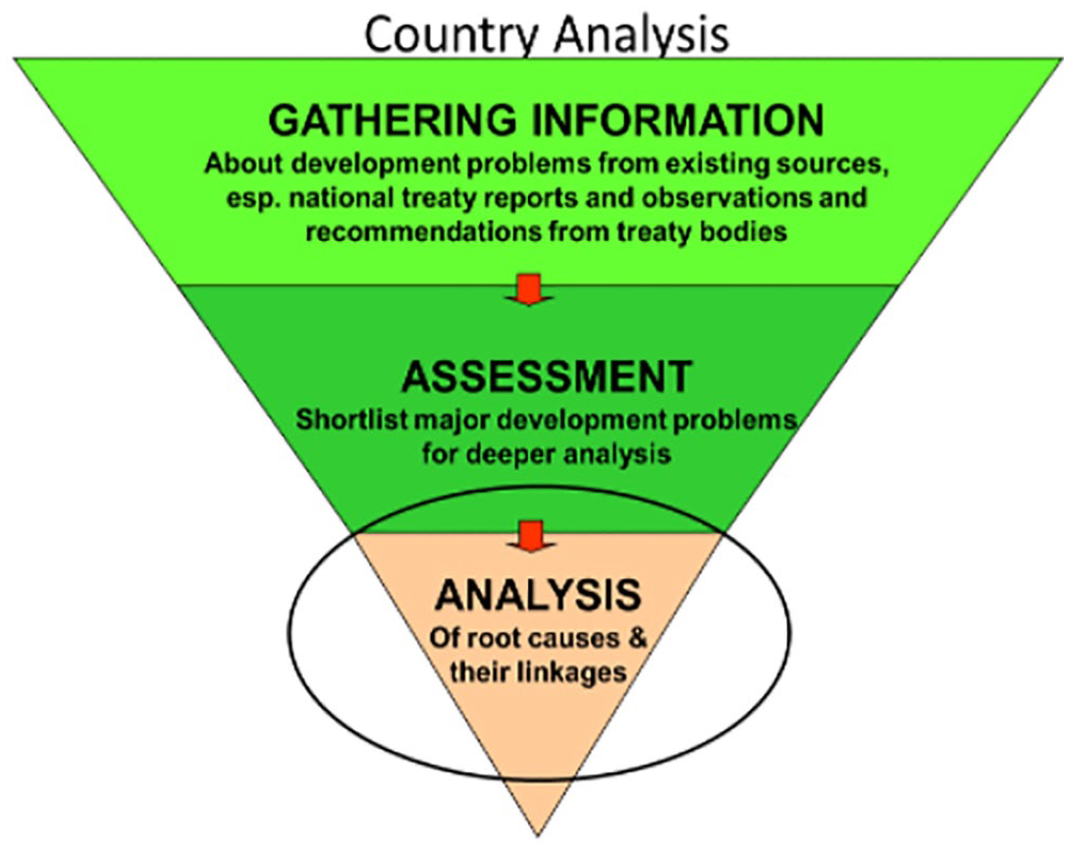
Country analysis. 107
‘Assessment’ or the Intertwining Hierarchies of Problems and Spaces
As a practice of knowledge production, ‘assessment’ aims at a hierarchization of ‘problems’. The ‘purpose of the assessment’ is to ‘identify the main development challenges’ by asking ‘what is happening? To whom? Where?’. 108 To determine what problems are to be singled out for further analysis and subsequent design of HRBA interventions, two different archaeological patterns are drawn upon and become productive. First, the ‘international’ realm figures as a nameable and delineable socio-spatial place that is distinct from and located above the ‘domestic’, the ‘country level’ and its different ‘local communities’. Notably, objects that are related to the purposes and desirability of governing practices, such as ‘norms’, ‘values’, ‘commitments’, ‘standards’ and ‘human rights’, are associated with and derived from the ‘international’, ‘global’, the ‘UN’ and – less frequently – the ‘regional level’. In contrast, obstacles against development, human rights and their promotion by UN agencies are seen to reside in the domestic realm, that is, in the respective developing country or the ‘local community’. For instance, we learn that development problems ‘include things such as tradition, economic resources, ideology’. 109 Once identified, they necessitate a ‘review of policies and laws to assess consistency with global human rights standards’. 110
In the conduct of ‘assessment’, UN treaties, norms, standards and other ‘commitments’ that are understood to belong to the global or international realm thus help determine what constitutes a development challenge in the first place, as well as what is more (and hence what is less) important:
[. . .] commitments, goals and targets of international conferences, summits, conventions and human rights instruments of the UN system are the benchmarks against which it can be determined whether and where major challenges exist in a country and their severity.
111
In contrast, ethical, normative or political goods that are located within the country in question or its ‘local communities’ are not seen as relevant sources of direction, as something to be considered in the conduct of HRBA problem assessment. Within the framework of these regularities, the ‘international’, the ‘global’ and the ‘UN level’ are therefore imagined as a place where universal, consensual norms and values crystallize. In contrast, the ‘domestic’ realm, ‘country level’ and the ‘local’ community function as spatial containers for various obstacles to progress, development and rights; as deficient places in need of external, superior values and knowledge. They therefore appear as the natural places of intervention and change, whereas the international/global realm functions as a source of direction for governing activities and becomes hard to imagine as a field of political intervention, struggle or a place of change. UN knowledge production on the HRBA therefore operates according to dichotomous spatial metaphors and implicit hierarchies that locate UN agencies above the subjects and settings they interact with, both normatively and epistemically.
These findings align with sophisticated critiques of the global/local and international/domestic binaries in anthropology, human rights and IR that do not only call into question the underlying assumptions and problematic ‘pre-theoretical commitments’ that come with uncritically adopting the latter in academic research, but also underline the constitutive function that such distinctions fulfil in the social worlds that we study. 112 As Henrietta Moore puts it, notions of the global (and its opposite, the local) are ‘important not only to social scientists’ but are ‘part of most people’s imagined and experienced worlds’. 113 To understand how these distinctions operate, it becomes important to ask how social entities are attributed across the imagined borders that separate one realm from another and how such attributions may vary across social and historical contexts. 114
In the case at hand, it is illuminating to pause for a second to compare the hierarchical attribution of objects and subjects across the international/domestic divide in UN knowledge production on the HRBA and with pertinent critical literature on this spatial distinction IR. Here, scholars drawing on conceptual history and deconstructivist theorizing emphasize how modern political thought and government was underpinned by a binary separation between the domestic realm, as the place of legitimate authority and social order, and the international realm as marked by competition and anarchy between sovereign states. 115 As Jens Bartelson puts it, ‘the domestic sphere is conventionally associated with the presence of order and peaceful progress’, whereas ‘the international sphere is characterized by the absence of these conditions, and instead carries the stigma of war and moral stagnation’. 116 Against this historical backdrop, the relational constitution of the domestic/local and international/global sphere thus seems turned on its head in the HRBA: the realm of international institutions and inter-state relations figure as a source of desirable societal ends and order, while ‘domestic’ and ‘local’ realities figure as obstacles to progress, as something to be remoulded according to universal knowledge and visions of the good. UN knowledge production on the HRBA thus has little in common with the ‘old’ IR world of war-torn anarchical inter-state relations, and instead echoes narratives of global commonality and universality as an escape from backward ‘local’ particularisms and antagonism. 117
A second discursive pattern that is (re)produced in the hierarchization of problems through HRBA ‘assessment’ is the notion of disadvantage, discrimination, marginalization and exclusion. These characteristics are derived through statistic disaggregation according to varying criteria such as ethnicity, gender, age, disability, sexual orientation, religious beliefs, rural versus metropolitan residence, wealth/poverty, drug consumption, health conditions (such as HIV/AIDS status) and a limited set of vulnerable occupational statuses, such as sex workers, domestic or agricultural workers. 118 This knowledge plays a prominent role in attributing a limited set of issues with comparatively greater importance and in singling them out as particularity promising for rights-based interventions. The conduct of rights-based country assessment ultimately seeks to answer the question ‘who has been left behind?’. 119 Rather than seeking to compare and construct knowledge about development or enjoyment of rights at an aggregate or average level, this technique for determining the relative severity of problems makes it necessary to define population groups who are deemed to experience more rights violations or enjoy less protection or fulfilment of rights compared to other population groups within the same country or community setting.
The practice of HRBA therefore becomes specifically directed towards groups that are seen as vulnerable, marginalized, discriminated or disadvantaged. As such, the latter are located within a broader dichotomy of subject positions that juxtaposes ‘rights holders’ and ‘duty bearers’.
120
Yet, in the context of assessment, recourse to the notions of vulnerability, marginalization, discrimination and/or disadvantage becomes practically important. They help specify where intervention is (most) needed by constructing a more specific subject position that interventions can target and engage. As an illustration, consider the following account of human rights-based water and sanitation programme in Bosnia and Herzegovina and Tajikistan:
The human rights principles of non-discrimination and equality guided the situational analysis of water and sanitation in both countries. This helped to identify the specific groups that were marginalised in regards to access to water. In BiH these groups included displaced people, Roma, minority returnees, school children and people with disabilities. In Tajikistan it concerned primarily individuals in rural communities, schools and medical institutions. These are the main groups that UNDP water projects needed to target.
121
This concern for disadvantage and marginalization echoes intersectional critiques of multiple, overlapping social exclusions and emancipatory struggles for political participation and inclusion. However, in epistemic practices associated with the HRBA, such demands are at the same time limited in two significant ways.
First, comparisons of advantage and disadvantage invariably take place within the country or community in question. By translating the equation of human rights and development into a specific governance knowledge that is to be implemented by UN staff on the operational ‘country’ or ‘local’ level, HRBA therefore excludes and blackens out power relations, wealth asymmetries and other forms of disadvantage or inequality that transcend state borders.
A second limitation lies in the silence that surrounds the privileged, powerful or advantaged. Whilst these categories implicitly function as a constitutive silence that make knowledge production about the underprivileged, powerless and the disadvantaged meaningful, they are not deemed relevant for determining what constitutes a problem or how it ought to be tackled in HRBA programming. Any analysis of how advantage and disadvantage, power and powerlessness or privilege and lack thereof might be connected is therefore excluded from the practices of knowing by which the HRBA is reproduced and brought to bear in its contemporary UN form.
‘Analysis’: Connecting the Flow of Causes and Mapping Dichotomous Subject Positions
Building on these practices of problem construction and specification, the conduct of ‘analysis’ enables UN agencies to identify causal relations and lacking subject capacities that are taken to produce a given problem and hence to produce actionable knowledge on how to act upon a given operational setting (see Figure 2). To cite a concise statement from the CLP, ‘analysis’ entails: ‘apply[ing] the HRBA to the analysis of real country development challenges in three basic steps: causal, role and capacity gap analysis’. 122
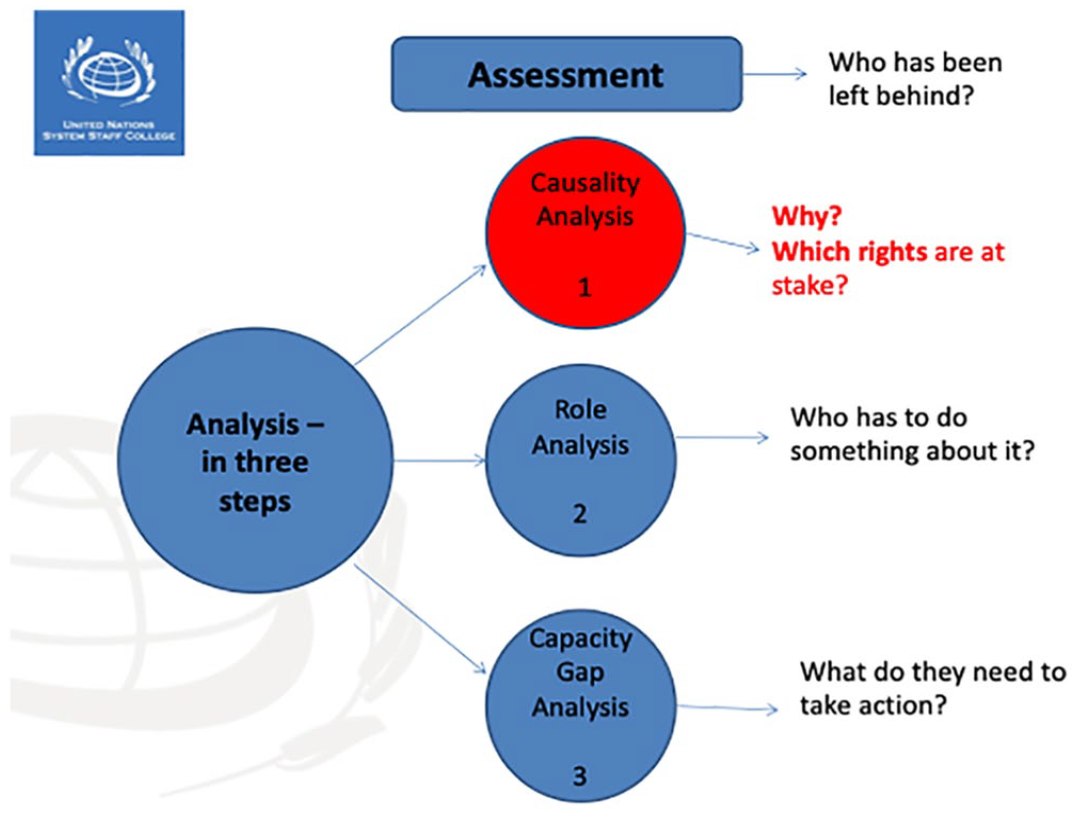
Analysis. 123
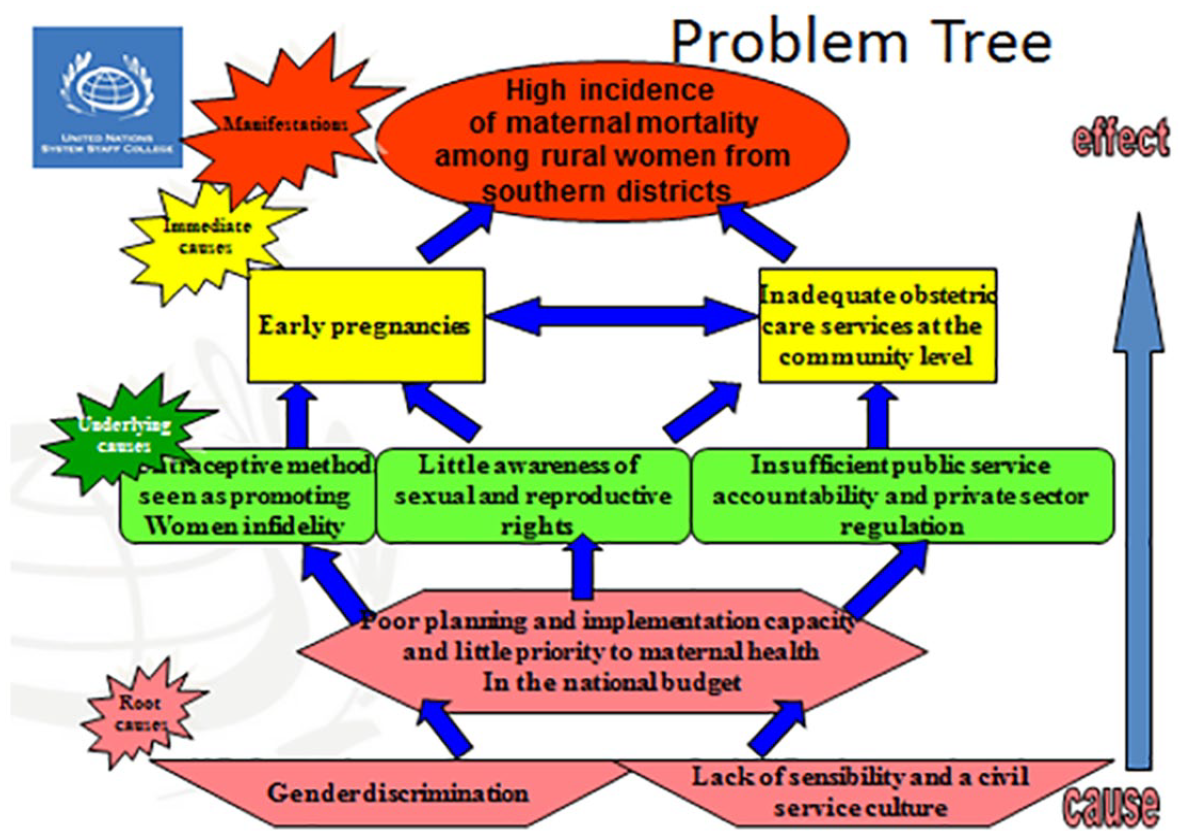
The first of these three steps, ‘causality analysis’, is described as ‘a technique for identifying causes of a problem which can then be used to formulate appropriate responses’ 124 by answering the question ‘who has been left behind and why?’. 125 This practice in therefore premised on the identification of disadvantaged or discriminated groups of subjects that was discussed earlier. As the name suggests, causality analysis aims to identifying relations of cause and effect in order to clarify how the outcome of social processes can be altered. To this end, it employs a distinct typology of causes: ‘Causality analysis should lead to the identifications of immediate, underlying and root causes’. 126 To understand how a problem is caused, social actors, entities, process, etc. are assigned to these categories and ordered in hierarchical, successive manner in a so-called ‘problem tree’. Thereby, immediate causes are conceived to be ‘the most direct cause’ which ‘affects individuals and households’, whilst ‘underlying causes normally involve service delivery and behaviour’ and ‘root causes include things such as tradition, economic resources ideology’. 127
As Figures 3 and 4 illustrate, causality analysis presupposes a multi-causal understanding of social processes. Problems are seen to be caused by ‘multiple and interrelated causes’ which can be identified by mapping the latter and ordering their relationships according to their level of depth in a tree-like web that depicts the ‘flow of causality’. 128
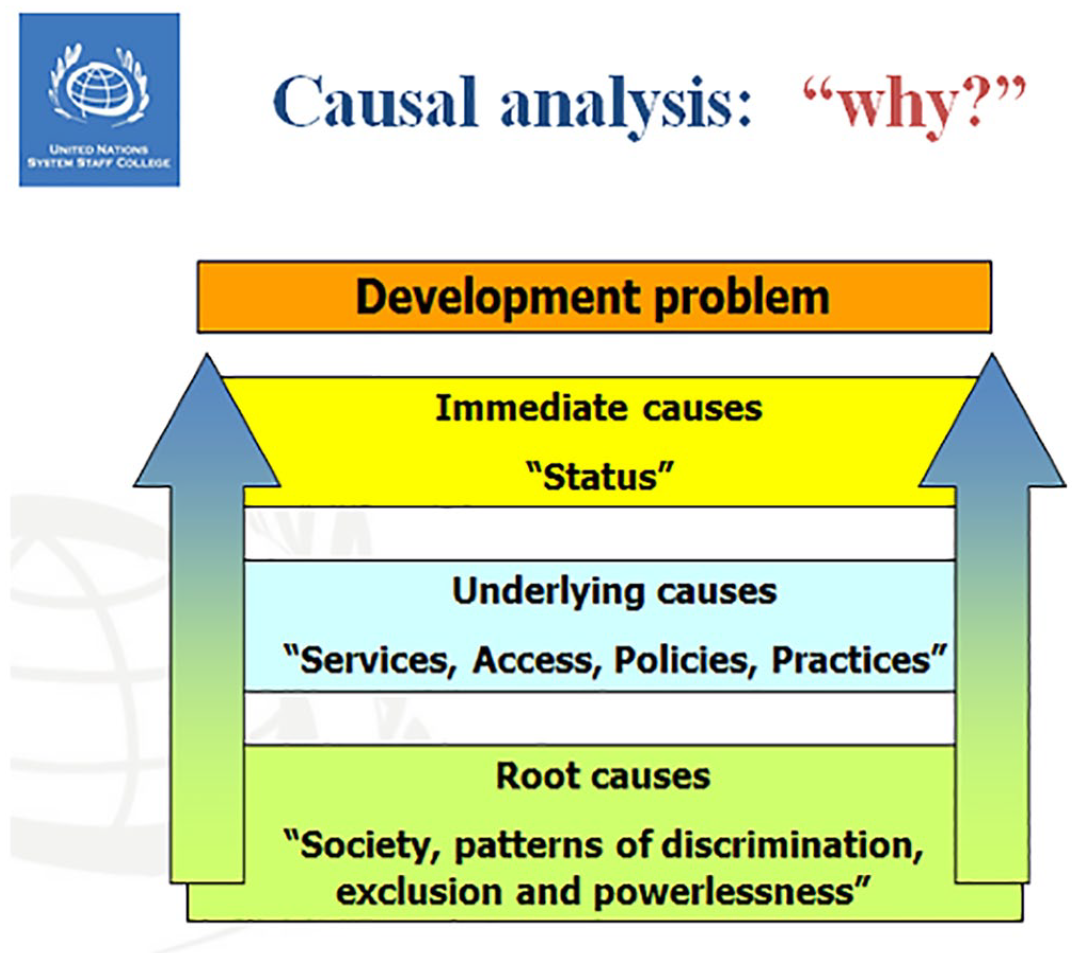
Causality analysis. 129
Producing Knowledge of Lacking Capacities: Benevolent UN ‘Midwives’ and Local/Domestic Subjects ‘in the Making’
Following the construction of a problem tree, HRBA ‘analysis’ encompasses two additional, analytical operations: ‘role pattern analysis’ and ‘capacity gap analysis’. Both of these epistemic practices draw upon the dichotomous subject positions mentioned earlier. ‘Role pattern analysis’ involves identifying ‘rights holders’ and ‘duty bearers’ with respect to the human right(s) deemed relevant by the foregoing causality analysis. It asks: ‘who are the duty bearers?’, ‘who are the rights holders?’ and ‘who has to do something about it [i.e. the previously identified problem]?’. 132 Through this practice, subjects in concrete settings where UN agencies operate are therefore ordered, categorized and ultimately rendered possible to engage with according to the juxtaposition between the ‘duty bearers’ and ‘rights holders’.
At the first glance, the constitution of these subject positions draws heavily on international human rights law: The ‘duty bearer’ is a social agent obliged to uphold human rights and, accordingly, it is typically equated with the state or different branches of local or national governments. 133 In principle, the ‘rights holder’ is understood in terms of an abstract human subject ‘Every individual, either a man woman or child, of any race, ethnic group or social condition’. 134 However, these positions become more tangible and receive more specific contours if one considers the broader, diverging vocabularies that they are associated with. In the case of ‘rights holders’, the latter include notions such as mobilization, awareness raising, participation, civil society and the voicing of rights-based demands. In the case of ‘duty bearers’, words such as accountability, responsibility, leadership, legitimacy and similar terms associated with responsible, controlled exercise of power come into play.
The subsequent, final step involved in the performance of HRBA ‘analysis’ is called ‘capacity gap analysis’. It introduces UN agencies to the equation and identifies ways for them to intervene upon the scenario that the foregoing steps helped to construct. Compared to duty bearers and rights holders, self-depictions are relatively rare in UN materials. When they do occur, they evoke narratives of ‘supporting’, ‘enabling’ and ‘strengthening’ the agency and ‘capacity’ of duty bearers and rights holders:
By developing the capacities of rights holders, we [the UN] are empowering them to claim their rights. [. . .] By developing the capacity of the State to respect, protect and fulfil, the State institutions and government officials become more accountable.
135
UN agencies therefore paint a picture of their interactions with other social actors as a supporting, educative encounter that aims to unleash an inherent potential on the part of the latter to understand and take on their respectively foreseen role within HRBA discourse: to ‘claim and exercise rights’ and to ‘fulfil obligations’. 136 Put in more literary language, a suitable metaphor for this kind of self-image in UN discourse might be ‘midwifery’: a caring activity that helps bring to life an inherent capacity already latently present in the supported subject. Capacity analysis therefore operates according to implicit epistemic-normative hierarchies and dichotomous spatial metaphors that place the UN above ‘local duty bearers’ and ‘right holders’: the UN system is at once understood to act on behalf of its unique ‘normative mandate’, to have a ‘comparative advantage’ over other actors through its ‘impartiality’ and to possess knowledge that ought to be imparted to ‘local’, or ‘domestic’ others so that they may better understand and fulfil their roles as ‘duty bearers’ and ‘rights holders’. 137
In more concrete terms, three main questions guide HRBA capacity analyses:
What capacity gaps are preventing duty bearers from fulfilling their duties? [. . .] What capacity gaps are preventing rights-holders from claiming their rights?[and] What do they need to take action?
138
For both duty bearers and rights holders, ‘capacity’ is understood to consist of a ‘can’ and a ‘want’ component. For the analysis of ‘duty bearers’ can-capacity, ‘knowledge’, resources (human, technical and financial)’ and ‘organizational abilities’ are deemed relevant. 139 ‘Rights holders’ ‘can-capacity’ is similarly broken down into the sub-categories ‘knowledge’, ‘resources’ and ‘individual abilities’. 140 To analyse ‘duty bearers’ capacity to want to respect and fulfil rights, ‘responsibility’, ‘motivation’ and ‘leadership’ are to be taken into account, whereas producing useful knowledge about rights holders’ capacity to want to claim rights involves paying attention to their ‘security’ and ‘motivation’. 141
Despite the emphasis on empowerment and participation as inherent elements of the HRBA, capacity analysis therefore reproduces strong normative and epistemic hierarchies between UN agencies and the various actors they encounter. In particular, the subsumption of ‘want’ under the broader category of ‘capacity’ precludes any meaningful, understandable, legitimate articulation by subjects allocated to the identity of either ‘duty bearer’ or ‘rights holder’ to be either critical towards or unwilling to take part in rights-based development work as defined by UN agencies. Within the imaginary that HRBA practices construct, there is no possibility not to want to engage in HRBA programmes, but only incapacity to do so. Any potential unwillingness or resistance is instead to be treated as a ‘gap’ to be filled with the right knowledge, normative sensibilities and technical abilities.
In other words, as practices of knowledge production, human rights-based ‘role pattern’ and ‘capacity analysis’ are premised on a silence around any potential unwillingness of targeted subjects to (re)articulate their own identity as duty bearers or rights holders, to grasp their being in the world within the socio-political imaginary of the HRBA or to engage in UN activities designed in accordance with the latter by performing their foreseen subjectivity therein. As per definition, HRBA practices engages local subjects as deficient subjects, who are yet ‘in the making’: Subjects who are equal in principle but who need to be educated and bettered to become their true selves.
Concluding Discussion
This paper has examined the politics of the HRBA by illustrating how it ‘fixes’ the both powerful, multifaceted and elusive object of human rights and renders it actionable for UN agencies. On a theoretical level, I sought to contribute to recent discussions on knowledge production in IR and to tie in with critical human rights scholarship by developing a post-foundational reading of human rights and the HRBA that frontloads constitutive power effects and promises to politicize ontology. In my subsequent empirical reconstruction and critique of the HRBA, I traced how UN discourse on the need to make human rights bear upon a multitude of practices proliferated from the early 1990s onwards. I showed how the HRBA was gradually established as a response to this ‘urgent need’, 142 how it was made tangible as an object through a proliferation of specialized knowledge and institutional entities. The discussion of epistemic practices illustrated how social objects, relations and subjects in concrete settings where UN agencies operate are rendered knowable and possible to engage with through a series of specific, nested operations. Despite a progressive, intersectional rhetoric of empowerment and claims to political neutrality, I sought to show that the HRBA is not devoid of power. In this regard, the above discussion can be recast more succinctly along two main points.
First, the above discussion suggested that epistemic practices associated with the HRBA operate according to normative-epistemic hierarchies and dichotomous spatial metaphors that privilege actors, norms and knowledge that are understood to populate the ‘global’, ‘international’ or ‘UN level’, whilst conceiving of ‘local’ and ‘domestic’ social agents with whom UN agencies interact as deficient subjects ‘in the making’. More specifically, epistemic practices in the HRBA are permeated by a contradiction between the need to establish actionable knowledge according to the fixes of the HRBA, on the one hand, and notions of participation, inclusion and equality, on the other hand. In other words, the need to establish authoritative knowledge – that allows for a subsequent drafting of concrete interventions by performing a number of specific epistemic operations associated with HRBA – contrasts with notions of inclusion and equality that suggest that ‘local’ and ‘domestic’ actors ought to be engaged as ‘active’ and ‘equal’ subjects. This underlying tension lends itself to a legitimization of practices that engage with social agents in concrete development settings as subjects ‘in the making’, who are equal in principle but who need to be educated into becoming their true selves. In epistemic practices, this becomes evident in the ordering of identified groups of ‘duty bearers’ and ‘rights holders’ in accordance with their (lacking) ‘capacities’ to conduct themselves as foreseen within the HRBA imaginary. As a consequence, HRBA epistemic practices make interventions by UN agencies seem logical and appropriate and position the latter as ‘midwives’ in possession of neutral knowledge and universal normativity. Moreover, by subsuming any potential resistance by ‘local’ actors against accounting for their social situatedness in accordance with the HRBA as a lack of ‘will-capacity’, they produce a strong discursive closure, where the HRBA itself becomes the only legitimate way of conceiving of a given social constellation. In the practical enactment of the HRBA, being equal becomes premised on accepting the HRBA and articulating oneself according to its fixes, as a ‘duty bearer’ or a ‘rights holder’. In more general terms, this illustrates how abstract pledges to equality can unfold paradoxical, deeply problematic effects when paired with epistemic hierarchies and naturalizations of specific subject positions, as the not-yet-equal become the target of educational, subjectivating efforts.
Second, I found that the HRBA enacts a limited notion of inequality and exclusion and pointed to the ambiguous power effects unfolded by the concern for marginalized groups that permeates epistemic practices in the HRBA. Here, the above discussion showed how the focus on ‘those left behind’ lends itself to programming and intervention since it facilitates the hierarchization of problems that governance ought to address (see ‘assessment’) and helps identify more specific target populations that it can be directed towards. In a paradoxical manner, the concern for ‘those left behind’ therefore renders successful evaluations of projects more attainable. Compared to both modernization-theoretical and neoclassical economic understandings of the development enterprise that purport to ‘benefi[t] everyone’ 143 imaginaries of progressive change in the HRBA focus on selected issues and groups that are deemed to be of greater causal importance and to be comparatively worse-off. The perceived need and normative desirability to focus on ‘those left behind’ and on enabling marginalized groups to ‘catch up’ therefore feeds into a neoliberal logic that is concerned with ‘levelling the playing field’ rather than any aspiration for overall societal or material progress.
Moreover, I also argued that the specific employment of marginalization and disadvantage in the HRBA excludes unequal power relations that transcend state borders and depoliticizes concerns with disadvantage and inequality by reducing them to a question of lacking subject capacities. In the HRBA, any analysis of disadvantage, marginalization or vulnerability is limited to the domestic realm and focuses on the relationship between citizens, civil society (rights holders) and ‘their’ respective state (duty bearer). By translating a ‘human rights’ perspective into a specific kind of specialized knowledge that is to be implemented by UN staff in the ‘field’, the HRBA therefore renders power relations, wealth asymmetries and other forms of disadvantage and inequality that transcend state borders unspeakable – in the sense that any utterance addressing them becomes either inconsequential or socially costly in practical terms. Moreover, epistemic practices in the HRBA offer no ways of knowing how disadvantage and advantage, powerlessness and power, or privilege and lack thereof might relate to each other. Rather than being understood as a social relation amongst advantaged and disadvantaged groups, disadvantage, marginalization, etc. are implicitly understood as attributes inherent to certain individuals or groups. In the language of the HRBA, mitigating disadvantage becomes a question of ‘strengthening capacities’. Despite echoing political concerns reminiscent of intersectional, feminist and post-structuralist critiques, this deployment of the ‘marginalized-discriminated-vulnerable-excluded-disadvantaged’ continuum of subject positions therefore helps sustain and naturalize a certain ‘unevenness of the social’. 144 It lends a progressive rhetorical flavour to governing practices and underpins UN agencies’ imagined position as bearers of universal normativity, as agents acting in pursuit of a unique ‘normative mandate’, 145 whilst rather narrowly ‘restrict[ing] the range of socially meaningful practices of articulation and [hence] regulat[ing] social subjects’. 146
To conclude, the HRBA therefore places the multiple, normatively charged and elusive object of human rights within a hierarchical and power-ridden ontic framework. Through its explicit but narrowly circumscribed focus on empowering marginalized groups and ‘those left behind’, it unfolds deeply ambiguous power effects. On the one hand, the HRBA introduces the language of rights, power asymmetries and inequality to the mundane business of UN programming. It echoes concerns reminiscent of intersectional critiques and emancipatory struggles as it insists on the rights of the marginalized and excluded to mobilize and participate, to speak and act upon topics that affect them. On the other hand, an in-depth scrutiny of epistemic practices and archaeological regularities at work in this operation reveals that the HRBA fixes an epistemically violent, hierarchical reading of human rights. In practice, the HRBA requires social actors whom UN agencies encounter to articulate and know themselves, the(ir) social world and political agency in a manner that privileges ‘international’/‘global’ norms and knowledge and that is set out by (supposedly) superior and benevolent international/‘global’ actors. To become ‘equal’, ‘empowered’ subjects within an HRBA framework, ‘local’ subjects are thus first made mute through a reification of strong assumptions of global ‘sameness’. For critical human rights scholars and practitioners, a more fruitful route for future research and practice that a post-foundational reading opens for would be to deepen a reading of human rights as a pluriverse: an unruly object with multiple political renderings and ‘version of itself’ and to ponder the philosophical and political (im)possibilities and implications of such a ‘flat’ ontological understanding.
Supplemental Material
sj-docx-1-mil-10.1177_03058298221146303 – Supplemental material for On Multiple Objects and Ontic Fixes: Human Rights and the ‘Forgotten’ Politics of the United Nations’ Human Rights-Based Approach
Supplemental material, sj-docx-1-mil-10.1177_03058298221146303 for On Multiple Objects and Ontic Fixes: Human Rights and the ‘Forgotten’ Politics of the United Nations’ Human Rights-Based Approach by Laura Pantzerhielm in Millennium
Footnotes
Acknowledgements
Earlier versions of this paper were presented at the Annual Convention of the German Political Science Association at the University of Freiburg in October 2020, the virtual 14th Pan-European Conference on International Relations in September 2021, the International Studies Association Annual Convention in March–April 2022 and two consecutive workshops entitled ‘Objects of Expertise: The Politics of Socio-Material Expert Knowledge in World Society’ that took place at the University of Bielefeld in May 2021 and the Graduate Institute for International and Development Studies in Geneva in May 2022. For comments on earlier versions of this article I would like to thank Bentley Allan, Audrey Alejandro, Luis Aue, Jens Bartelson, Alejandro Esguerra, Katharina Glaab, Anna Holzscheiter, Anam Soomro and the participants in the two ‘Objects of Expertise’ workshops.
Declaration of Conflicting Interests
The author(s) declared no potential conflicts of interest with respect to the research, authorship, and/or publication of this article.
Funding
The author(s) disclosed receipt of the following financial support for the research, authorship, and/or publication of this article: The research presented in this article was supported by a Sydney-WZB Merit Fellowship awarded by WZB Berlin Social Sciences Center for a research stay at the Department of Government and International Relations at the University of Sydney and a generous stipend for international doctoral research awarded by the Sixten Gemzéus Foundation and Gålöstiftelsen.
Supplemental Material
Supplemental material for this article is available online.
1.
UNGA. (1997). Renewing the United Nations: a programme for reform. Report of the Secretary General. A/51/950; UNGA. (2000). United Nations Millennium Declaration. Adopted by the General Assembly on 8 September 2000. A/RES/55/2; UNGA. (2005a). In larger freedom: towards development, security and human rights for all. Report of the Secretary-General. A/59/2005; UNGA. (2005b). World Summit Outcome. Resolution adopted by the General Assembly on 24 October 2005. A/RES/60/1; UNGA. (2006). “Delivering As One”. Report of the High-level Panel on System-wide Coherence. A/61/583; UNICEF ESARO. (2003). Human Rights Approach to Development Programming. 
2.
Costas Douzinas, ‘The Paradoxes of Human Rights’, Constellations: An International Journal of Critical and Democratic Theory 20, no. 1 (2013): 51.
3.
For examples, see Francis Fukuyama, The End of History and the Last Man (New York: The Free Press, 1992); John G. Ruggie, Multilateralism Matters: The Theory and Praxis of an Institutional Form (New York: Columbia University Press, 1993); Held D, McGrew D, Goldblatt D et al., Global Transformations: Politics, Economics and Culture (Cambridge: Polity Press, 1999); for two excellent critiques see Beate Jahn, Liberal Internationalism: Theory, History, Practice (New York: Palgrave, 2013) and Douzinas, ‘Paradoxes of Human Rights’.
4.
Mary Kaldor, Human Security (Cambridge: Cambridge University Press, 2007); Ivan Manokha, ‘Foucault’s Concept of Power and the Global Discourse of Human Rights’, Global Society 23, no. 4 (2007): 429–52; Selly Edge Merry, ‘Measuring the World: Indicators Human Rights and Global Governance’, Current Anthropology 52, no. 3 (2011): 83–95; Mark Goodale, ‘After International Law: Anthropology Beyond the “Age of Human Rights”’. AJIL Unbound 115 (2021): 289–93.
5.
Michael Foucault, The Use of Pleasure: Volume 2 of The History of Sexuality (New York: Vintage Books, 1990); Clive Barnett, ‘On Problematization: Elaborations on a Theme in “Late Foucault”’, Nonsite.org 16 (2015): 1–29; Phillipe Bonditti, ‘Chapter 9. Violence and the Modern International: An Archaeology of Terrorism’, in Foucault and the Modern International: Silences and Legacies for the Study of World Politics, eds. Philippe Bonditti, Didier Bigo and Frédéric Gros (Paris: Palgrave Macmillan, 2017), 155–74.
6.
Michael Barnett, ‘Human Rights, Humanitarianism, and the Practices of Humanity’, International Theory 10, no. 3 (2018): 314–49.
7.
Aram Ziai, Development Discourse and Global History: From Colonialism to the Sustainable Development Goals (London: Routledge, 2016).
8.
UN General Assembly, Vienna Declaration and Programme of Action, A/CONF.157/23, 12 July 1993.
10.
11.
12.
UN, Common Country Assessment and United Nations Development Assistance Framework. Guidelines for UN Country Teams on Preparing a CCA and UNDAF (New York: UN, 2007), ii.
13.
Tine Destrooper and Sally Engle Merry, Human Rights Transformation in Practice (Philadelphia: University of Pennsylvania Press, 2018); Morten Broberg and Hans-Otto Sano, ‘Strengths and Weaknesses in a Human Rights-Based Approach to International Development: An Analysis of a Rights-Based Approach to Development Assistance Based on Practical Experiences’, The International Journal of Human Rights 22, no. 5 (2018): 664–80; Hannah Miller and Robin Redhead, ‘Beyond “Rights-Based Approaches”? Employing a Process and Outcomes Framework’, The International Journal of Human Rights 23, no. 5 (2019): 699–718; UNSDG, Universal Values: Human rights Based Approach (New York: UNSDG, 2021). Available at: https://unsdg.un.org/2030-agenda/universal-values/human-rights-based-approach; also see : UNDG 2017a, UNSDG 2019b, 2020.
14.
Miller and Redhead, ‘Right-Based Approaches’, 699.
15.
For instance, Brigitte I. Hamm, ‘A Human Rights Approach to Development’, Human Rights Quarterly 23, no. 4 (2001): 1005–31; Samuli Seppänen, Possibilities and Challenges of the Human Rights-Based Approach to Development (Helsinki: Erik Castrén Institute Research Reports, 2017); Jakob Kirkemann Hansen and Hans-Otto Sano, ‘The Implications and Value Added of a Rights-Based Approach’, in Development Ethics, eds. Asuncion Des Gasper and Lera St. Clair (London: Routledge, 2010), 45–69; Dan Banik, ‘Support for Human Rights-Based Development: Reflections on the Malawian Experience’, International Journal of Human Rights 14, no. 1 (2010): 34–51; Peter Uvin, ‘From the Right to Development to the Rights-Based Approach: How “Human Rights” Entered Development’, in Deconstructing Development Discourse Buzzwords and Fuzzwords, eds. Andrea Cornwall and Deborah Eade (Oxford: Practical Action Publishing Ltd, Oxfam GB, 2010), 163–73; Broberg and Sano, ‘Strengths and Weaknesses’; for an exceptional see Andrea Cornwall and Celestine Nyamu-Musembi, ‘Putting the “Rights-Based Approach to Development” into Perspective’, Third World Quarterly 25, no. 8 (2018): 1415–37.
16.
For example, David Chandler, From Kosovo to Kabul: Human Rights and International Intervention (London: Pluto Press, 2002); Upendra Baxi, The Future of Human Rights (Oxford: Oxford University Press, 2008); Costas Douzinas, Human Rights and Empire. The Political Philosophy of Cosmopolitanism (Abingdon: Routledge, 2007); Louiza Odysseos and Anna Selmeczi, ‘The Power of Human Rights/The Human Rights of Power: An Introduction’, Third World Quarterly 36, no. 6 (2015): 1033–40.
17.
Samuel Moyn, The Last Utopia: Human Rights in History (London: Benkamp, 2010); José-Manuel Barreto, ‘Chapter 5. Imperialism and Decolonization as Scenarios of Human Rights History’, in Human Rights from a Third World Perspective: Critique, History and International Law, ed. José-Manuel Barreto (Newcastle upon Tyne: Cambridge Scholars Publishing, 2013), 140–71; Pamela Slotte and Miia Marika Halme-Tuomisaari, Revising the Origins of Human Rights (Cambridge: Cambridge University Press, 2015); Joseph R. Slaughter, ‘Hijacking Human Rights: Neoliberalism, the New Historiography, and the End of the Third World’, Human Rights Quarterly 40, no. 4 (2018): 735–75; Jessica Whyte, ‘Powerless Companions or Fellow Travellers? Human Rights and the Neoliberal Assault on Postcolonial Economic Justice’, Radical Philosophy 2, no. 2 (2018): 1–29.
18.
The term ‘human rights machinery’ commonly refers to the 10 human rights treaty bodies and the Charter-based human rights monitoring mechanisms within the UN system.
19.
Destrooper and Engle Merry, Human Rights Transformation; Broberg and Sano, ‘Strength and Weaknesses’; Miller and Redhead, ‘Right-Based Approaches’.
20.
Oliver Marchart, Post-Foundational Political Thought: Political Difference in Nancy, Lefort, Badiou and Laclau (Edinburgh: Edinburgh University Press, 2007); Johanna Oksala, ‘Foucault’s Politicization of Ontology’, Contemporary Philosophical Review 43 (2010): 445–66; Sergei Prozorov, Ontology and World Politics: Void Universalism 1 (New York: Routledge, 2014); Kurt C. M. Mertel, ‘Two Ways of Being a Left-Heideggerian: The Crossroads Between Political and Social Ontology’, Philosophy and Social Criticism 43, no. 9 (2017): 966–84.
21.
Michel Foucault, The Archeology of Knowledge and the Discourse on Language (London: Tavistock, 1972), 120.
22.
See, Christian Bueger, ‘From Expert Communities to Epistemic Arrangements: Situating Expertise in International Relations’, in The Global Politics of Science and Technology, vol. 1, eds. Maximilian Mayer, Mariana Carpes, and Ruth Knoblich (Berlin: Springer, 2014), 39–54; Bentley B. Allan, ‘Producing the Climate: States, Scientists, and the Constitution of Global Governance Objects’, International Organization 71 (2017): 131–62.
23.
For instance, Laura Zanotti, Ontological Entanglements, Agency, and Ethics in International Relations: Exploring the Crossroads (London: Routledge, 2019).
24.
Such as, Baxi, The Future of Human Rights; Douzinas, Human Rights and Empire; Douzinas, ‘Paradox of Human Rights’.
25.
Jason Glynos and David Howarth, Logics of Critical Explanation in Social and Political Theory (London, New York: Routledge, 2007).
26.
27.
For illustrations, see David Kennedy, The Dark Sides of Virtue: Reassessing International Humanitarianism (Princeton: Princeton University Press, 2004); Lori Allen, The Rise and Fall of Human Rights: Cynicism and Politics in Occupied Palestine (Redwood City: Stanford University Press, 2013); Lena Khor, Human Rights Discourse in a Global Network: Books Beyond Borders (Farnham: Ashgate, 2013); Bal Sokhi-Bulley, ‘Government(ality) by Experts: Human Rights as Governance’, Law and Critique 22 (2011): 251–71; Martti Koskenniemi, ‘Human Rights Mainstreaming as a Strategy for Institutional Power’, Humanity: An International Journal of Human Rights Humanitarianism and Development 1, no. 1 (2010): 47–58; Merry, ‘Measuring the World’, and The Seductions of Quantification: Measuring Human Rights, Gender Violence, and Sex Trafficking (Chicago: Chicago University Press, 2016); David McGrogan, ‘Human Rights Indicators and the Sovereignty of Technique’, European Journal of International Law 27, no. 2 (2016): 385–408.
28.
Jacques Rancière, ‘Who Is the Subject of the Rights of Man?’ South Atlantic Quarterly 103, no. 2–3 (2004): 303.
29.
Peter M. Haas, ‘Introduction: Epistemic Communities and International Policy Coordination’, International Organization 46, no. 1 (1992): 1–35; Michael Barnett and Martha Finnemore, Rules for the World: International Organizations in Global Politics (Ithaca: Cornell University Press, 2004).
30.
Charlotte Epstein, The Power of Words in International Relations: Birth of an Anti- Whaling Discourse (Cambridge: The MIT Press, 2008); Bueger, ‘Expert Communities to Epistemic Arrangements’; Brentley B. Allan, ‘From Subjects to Objects: Knowledge in International Relations Theory’, European Journal of International Relations 24, no. 4 (2018): 841–64.
31.
These range from genealogy, discourse and governmentality, see Richard Ashley, ‘Untying the Sovereign State: A Double Reading of the Anarchy Problematique’, Millennium: Journal of International Studies 17, no. 2 (1988): 227–62; Jens Bartelson, A Genealogy of Sovereignty (Cambridge: Cambridge University Press, 1995); Epstein, Power of Words; Kevin C. Dunn and Iver B. Neumann, Undertaking Discourse Analysis for Social Research (Ann Arbor: University of Michigan Press, 2016); Eva Lövbrand and Johannes Strippe, ‘Making Climate Change Governable: Accounting for Carbon as Sinks, Credits and Personal Budgets’, Critical Policy Studies 5 (2011): 187–200; Bourdieusian reflexive sociology, see Ole Jacob Sending, The Politics of Expertise: Competing for Authority in Global Governance (Ann Arbor: University of Michigan Press, 2015); Mikeal Rask Madsen, ‘Reflexivity and the Construction of the International Object: The Case of Human Rights’, International Political Sociology 5, no. 5 (2011): 259–75; and new materialism, see Claudia Aradau, ‘Security That Matters: Critical Infrastructure and Objects of Protection’, Security Dialogue 41, no. 5 (2010): 491–514; Mark B. Salter, Making Things International I: Circulation (Minneapolis: University of Minnesota Press, 2014); Gitte Du Plessis, ‘When Pathogens Determine the Territory: Toward a Concept of Non-Human Borders’, European Journal of International Relations 24, no. 2 (2017): 391-413; to science and technology studies, see Christian Bueger, ‘Making Things Known: Epistemic Practices, the United Nations, and the Translation of Piracy’, International Political Sociology 9, no. 1 (2015): 1–18; Allan, ‘Producing the Climate’; Alejandro Esguerra, ‘Future Objects: Tracing the Socio-Material Politics of Anticipation’, Sustainability Science 14 (2019): 963–71.
32.
Esguerra, ‘Future Objects’, 964.
33.
Colin Wight, Agents, Structure and International Relations: Politics and Ontology (Cambridge: Cambridge University Press, 2006); Jens Bartelson, War in International Thought (Cambridge: Cambridge University Press, 2017); David L. Blaney and Arlene B. Tickner, ‘Worlding, Ontological Politics and the Possibility of a Decolonial IR’, Millennium: Journal of International Studies 45, no. 3 (2017): 293–311; Zanotti, Ontological Entanglements.
34.
For a notable exception, see Sergei Prozorov, Ontology and World Politics: Void Universalism 1 (New York: Routledge, 2014), and Theory of the Political Subject: Void Universalism 2 (New York: Routledge, 2014); for an introduction, see Marchart, Post-Foundational Political Thought.
35.
Ernesto Laclau, New Reflections on the Revolution of Our Time, 1st ed. (London; New York: Verso, 1990); Marchart, Post-Foundational Political Thought; Oliver Marchart, ‘Politik und ontologische Differenz. Zum “strengen Philosophischen” am Werk Ernesto Laclaus’, in Diskurs – radikale Demokratie – Hegemonie, ed. Martin Nonhoff (Bielefeld: Transcript, 2007), 103–121; Claude Lefort and Marcel Gauchet, ‘Über die Demokratie: Das Politische und die Insitutierung des Gesellschaftlichen’, in Autonome Gesellschaft und libertäre Demokratie, ed. Ulrich Rodel (Frankfurt am Main: Suhrkamp, 1990), 89–120.
36.
For discussions of their convergences, see Nikolas Kompridis, Critique and Disclosure: Critical Theory between Past and Future (Cambridge: The MIT Press, 2006), 126–32; Hubert Dreyfus, ‘Being and Power: Heidegger and Foucault’, International Journal of Philosophical Studies 4, no. 1 (1996): 1–16; On Foucault’s historical ontology, see Ian Hacking, Historical Ontology (Cambridge: Harvard University Press, 2002); and Sergei Prozorov, Political Pedagogy of Technical Assistance: A Study in Historical Ontology of Russian Postcommunism (Tampere: Studia Politica Tamperensis, 2004); On Heidegger’s notion of ‘Ab-Grund’ (abyss), the ontological difference and his imprint on critical, ‘left’, poststructuralist and Post-Marxist theorizing, see Marchart, Post-Foundational Political Thought; Marchart, ‘Politik und ontologische Differenz’; and Mertel, ‘Being a left-Heideggerian’; Finally, for a discussion of ‘radical ontological negativity’ in Mouffe and Laclau, see Allan Dreyer-Hansen, ‘Laclau, Mouffe and the Ontology of Radical Negativity’, Distinktion: Scandinavian Journal of Social Theory 3 (2014): 283–95.
37.
Dreyfus, ‘Being and Power’, 4.
38.
Foucault, Archeology of Knowledge, 5.
39.
Prozorov, Ontology and World Politics; Marchart, Post-Foundational Political Thought.
40.
Prozorov, Ontology and World Politics, 30.
41.
Oksala, ‘Foucault’s Politicization’.
42.
Foucault, Archeology of Knowledge, 49.
43.
Bueger, ‘Making Things Known’.
44.
Tomas Marttila, ‘Post-Foundational Discourse Analysis: A Suggestion for a Research Program’, Forum Qualitative Social Research 16, no. 3 (2015): n.p.; cf. also Ernesto Laclau and Chantal Mouffe, Hegemony and Socialist Strategy: Towards a Radical Democratic Politics, 2nd ed. (London: Verso, 2001); David Howarth, ‘Towards a Heideggerian Social Science: Heidegger, Kisiel and Weiner on the Limits of Anthropological Discourse’, Anthropological Theory 4, no. 2 (2004): 229–47. L. Pantzerhielm 2017, L Pantzerhielm, A Holzscheiter, T Bahr 2019.
45.
Oksala, ‘Foucault’s Politicization’, 445.
46.
For pertinent contributions, Moyn, The Last Utopia; Stephen Hopgood, The Endtimes of Human Rights (Ithaca: Cornell University Press, 2013); José-Manuel Barreto, ‘Chapter 5. Imperialism and Decolonization as Scenarios of Human Rights History’, in Human Rights From a Third World Perspective: Critique, History and International Law, ed. José-Manuel Barreto (Newcastle Upon Tyne: Cambridge Scholars Publishing, 2013), 140–71; Slotte and Halme-Toumisaari, Revising the Origins; Jessica Whyte, The Morals of the Market: Human Rights and the Rise of Neoliberalism (New York: Verso, 2019); Slaughter, ‘Hijacking Human Rights’.
47.
Foucault, Archeology of Knowledge, 46.
48.
Marco Duranti, The Conservative Human Rights Revolution: European Identity, Transnational Politics, and the Origins of the European Convention (Cambridge: Cambridge University Press, 2017).
49.
Whyte, Morals of the Market.
50.
Douzinas, ‘Paradoxes of Human Rights’.
51.
Antony Anghie, ‘Whose Utopia? Human Rights, Development, and the Third World’, Qui Parle 22, no. 1 (2013): 63–80; Fantu Cheru, ‘Developing Countries and the Right to Development: A Retrospective and Prospective African View’. Third World Quarterly 37, no. 7 (2016): 1268–83; Slaughter, ‘Hijacking Human Rights’.
52.
Annmarie Mol, ‘Ontological Politics: A Word and Some Questions’, The Sociological Review Monograph 47, no. 1 (1999): 74.
53.
Laclau, New Reflections, 34.
54.
Foucault, Archeology of Knowledge, 45.
55.
Foucault, Archeology of Knowledge, 120.
56.
Blaney and Tickner, ‘Wording Ontological Politics, 299–301.
57.
See inter alia, Chandler, From Kosovo to Kabul; Nicalas Guilhot, The Democracy Makers: Human Rights and International Order (New York: Columbia University Press, 2005); Milja Kurki, ‘Governmentality and EU Democracy Promotion: The European Instrument for Democracy and Human Rights and the Construction of Democratic Civil Societies’, International Political Sociology 5, no. 4 (2011): 349–66; Hopgood, Endtimes of Human Rights; Odysseos and Selmeczi, ‘The Power of Human Rights”.
58.
For recent pertinent illustrations, see David P. Forsythe, Human Rights in International Relations, 4th ed. (Cambridge: Cambridge University Press, 2018); Kathryn Sikkink, Evidence for Hope: Making Human Rights Work in the 21st Century (Princeton and Oxford: Princeton University Press, 2019).
59.
Jack Donnelly, International Human Rights (Boulder: Westview Press, 2012).
60.
Moyn, The Last Utopia.
61.
Inter alia, Balakrishnan Rajagopal, ‘Counter-Hegemonic International Law: Rethinking Human Rights and Development as a Third World Strategy’, Third World Quarterly 27, no. 5 (2006): 767–83; Roland Burke, Decolonization and the Evolution of International Human Rights (Philadelphia: University of Pennsylvania Press, 2010); Siba N. Grovogui, ‘The Orphaned, Dispossessed and Illegitimate Children: Human Rights Beyond the Republican and Liberal Traditions’, Indian Journal of Global Legal Studies 18, no. 1 (2011): 41–63; Steven L. B. Jensen, The Making of International Human Rights; The 1960s, Decolonization, and the Reconstruction of Global Values (New York: Cambridge University Press, 2016).
62.
Inter alia, Spike V. Peterson, ‘Whose Rights? A Critique of the “Givens” in Human Rights Discourse’, Alternatives 15, no. 3 (1990): 303–44; B. S. Chimni, ‘International Institutions Today: An Imperial Global State in the Making’, European Journal of International Law 15, no. 1 (2004): 1–37; Khor, Human Rights Discourse; Nikita Dhawan, Decolonizing Enlightenment: Transnational Justice, Human Rights and Democracy in a Postcolonial World (Leverkusen: Barbara Budrich Publishers, 2014).
63.
Baxi, The Future of Human Rights; see also Odysseos and Selmeczi, ‘The Power of Human Rights’.
64.
Douzinas, Human Rights and Empire, 55, see also ‘Paradoxes of Human Rights’, 52–3.
65.
For pertinent account, see Amartya Sen, Social Exclusion: Concept, Application and Scrutiny (New Delhi: Asian Development Bank, 2000).
66.
For pertinent examples, see Peterson, ‘Whose Right?’; Baxi, The Future of Human Rights.
67.
Makau W. Mutua, ‘Savages, Victims, and Saviors: The Metaphor of Human Rights’, Harvard International Law Journal 42, no. 1 (2001): 201–45; for illustrations, see Kennedy, Dark Sides of Virtue; Anghie, Whose Utopia?; Khor, Human Rights Discourse; Sokhi-Bulley, ‘Governament(ality) by Exports’.
68.
Koskenniemi, ‘Human Rights Mainstreaming’.
69.
Merry, ‘Measuring the World’; Merry, Seductions of Quantification; McGrogan, ‘Human Rights Indicators’.
70.
David McGrogan, ‘The Population and the Individual: The Human Rights Audit as the Governmentalization of Global Human Rights Governance’, International Journal of Constitutional Law 16, no. 4 (2019): 1073–1100.
71.
Koskenniemi, ‘Human Rights Mainstreaming’, 1.
72.
Koskenniemi, ‘Human Rights Mainstreaming’, 3; see also Martti Koskenniemi, The Politics of International Law (Oxford and Portland: Hart Publishing, 2011), 131–68.
73.
Merry, Seduction of Quantification.
74.
Sally Engle Merry, ‘Chapter 7. Expertise and Quantification in Global Institutions’, in Palaces of Hope: The Anthropology of Global Organizations, eds. Ronald Niezen and Maria Sapignoli (Cambridge: Cambridge University Press, 2017), 152–71.
75.
Merry, Seduction of Quantificaiton, 33.
76.
Bueger, ‘Making Things Known’, 6; Karin Knorr-Cetina, ‘Sociality With Objects: Social Relations in Post-Social Knowledge Societies’, Theory Culture Society 14, no. 4 (1997): 1–30.
77.
Foucault, Archeology of Knowledge, 38–54; for more detailed discussions of Foucauldian archeology and genealogical research strategies, see L. Pantzerhielm 2016, 2017, L Pantzerhielm, A Holzscheiter, T Bahr 2019.
78.
UN General Assembly, ‘Vienna Declaration and Programme of Action’, 12 July 1993, A/CONF.157/23: preamble.
79.
UN, ‘Copenhagen Declaration on Social Development’, 14 March 1995, A/CONF.166/9: 1.
80.
UN General Assembly, ‘Vienna Declaration’, IIA.1-8, I.4.
81.
Bonditti, ‘Chapter 9’, 158; see Foucault, Archeology of Knowledge; Barnett, ‘On Problematization’.
82.
For illustration of pertinent declarations, see : UN 1994a, UNGA 1997, 2005a, UN 1993, 1995, UNGA 2000, UNDP 2000, UNGA 2005b, UNDG 2003, UNGA 2006, GA, 2000, 2005b; for reports by individual agencies, see UNICEF 1998, UNICEF ESARO 2003, UNDP 1998, 2000, UNFPA 2004, UNESCO 2003; on the UN reform process, see UNGA 1997, 2005a.
83.
Annan, ‘The Age of Human Rights’, n.p. Emphasis added.
84.
85.
86.
UNICEF ESARO, Human Rights Approach to Development Programming (Nairobi: UNICEF, 2003), 10; Economic and Social Council, Implementation of Recommendations on the Six Mandated Areas and on MDGs, E/C.19/2007/3/Add.12 (New York: GA, 2007), 7.
87.
UNDG, Human Rights Mainstreaming Mechanism. Summary of the Operational Plan 2011–2013 (New York: UNDG, 2011); UNDG, UNDG Strategy for the Deployment of Human Rights Advisers to Resident Coordinators and UN Country Teams, UNDG Human Rights Mainstreaming Mechanism (New York: UNDG, 2012), 2.
88.
UNDG, ‘UN Inter-Agency Common Learning Package on Human Rights-Based Approach to Programming’, 2017, Avaialble at: . Last accessed September 3, 2019; UNDG, UNDG Strategy for the Deployment of Human Rights Advisers to Resident Coordinators and UN Country Teams, UNDG Human Rights Mainstreaming Mechanism (New York: UNDG, 2012).
89.
90.
UNDG, Human Rights Based Approach.
91.
UNDG, Human Rights Based Approach, 1.
92.
cf Foucault, Archeology of Knowledge, 41–2.
93.
UN, Common Country Assessment.
94.
96.
UNDG, ‘Learning Package’.
97.
99.
UNSDG, ‘Learning Package’.
101.
UNSDG, Leaning Package, session 0, ppt, slide 15. Emphasis in original.
102.
103.
104.
UNSDG, Leaning Package, session 5, ppt, slide 11.
105.
UNDG, Learning Package, session 5, ppt, slide 2, comment.
106.
UNDG, Learning Package, session 5, ppt, slide 11.
107.
UNDG, Learning Package, session 5, ppt, slide 5
108.
UNDG, Learning Package, session 5, ppt, slide 7.
109.
UNDG, Learning Package, session 5, ppt, 16.
110.
UNDG, Learning Package, session 5, ppt, 16; For further examples, see : UNDG 2017a, session 1, ppt, slide 40, Action 2 Concept paper on national protection systems, session 5, ppt, slide 16, session 2, ppt, slide 2, slide 9–10, session 5, ppt, slides 5, 7–8, 12, HO Questions to incorporate principles, 1, Facilitation Guide – HRBA-RBM In-country workshop, 9, 12, 14, 16, 25, 33, background material, OHCHR FAQ on HRBA – english: 17.
111.
UNDG, Learning Package, session 5, ppt, slide 7, notes.
112.
Henrietta L. Moore, ‘Global Anxieties: Concept-Metaphors and Pre-Theoretical Commitments in Anthropology’, Anthropological Theory 4, no. 1 (2004): 73; see also Gregory Feldmann, ‘If Ethnography Is More Than Participant Observation, Then Relations Are More Than Connections: The Case for Nonlocal Ethnography in a World of Apparatuses’, Anthropological Theory 11, no. 4 (2011): 375–95; Mark Goodale, “Introduction: Locating Rights, Envisioning Law Between the Global and the Local’, in The Practice of Human Rights: Tracking Law Between the Global and the Local, eds. Mark Goodale and Sally Engle Merry (Cambridge: Cambridge University Press, 2007), 1–38; Ashley, ‘Untying the Sovereign State’; Jens Bartelson, Critique of the State (Cambridge: Cambridge University Press, 2001); R. B. J. Walker, After the Globe, Before the World (London: Routledge, 2010).
113.
Moore, ‘Global Anxieties’.
114.
See, Author 2016: 35–7, 2017, Author et al. 2019.
115.
Ashley, ‘Untying the Sovereign State’; R. B. L. Walker, Inside/Outside: International Relations as Political Theory (Cambridge: Cambridge University Press, 1993).
116.
Bartelson, Critique of the State, 12.
117.
For a sophisticated theoretical discussion of how the ‘politics of the international’ and the ‘politics of the world’ are interwoven within the same modern political imaginary, despite frequent claims by both scholars and practitioners about a historical transition from the first to the latter, see Walker, After the Globe; On the conceptual history of world community, see Jens Bartelson, Visions of World Community (Cambridge: Cambridge University Press, 2009).
118.
119.
UNDG, Learning Package, session 4, ppt, slide 44, session 5, ppt, slide 6.
120.
For instance, UNDG, Learning Package, Background materials, OHCHR FAQ on HRBA, 1, 15, 35; UNDG, Human Rights Based Approach.
121.
UNDG, Learning Package, Background material, UNSSC HRBA Experiences: 13.
122.
UNDG, Learning Package, session 5, ppt, slide 2.
123.
UNDG, Learning Package, session 5, slide 15.
124.
UNDG, Learning Package, session 5, ppt, slide 13.
125.
UNDG, Learning Package, session 5, HRBA Questions & Steps: Linkages, 1.
126.
UNDG, Learning Package, session 5, HRBA Questions & Steps: Linkages, 2.
127.
UNDG, Learning Package, session 5, slide 18, comment.
128.
UNDG, Learning Package, Facilitation Guide – HRBA-RBM In-country workshop, 17.
129.
UNDG, Learning Package, session 5, ppt, slide 7.
130.
UNDG, Learning Package, session 5, ppt, slide 18.
131.
UNDG, Learning Package, session 5, ppt, slide 18.
132.
UNDG, Learning Package, session 5, ppt, slides 22, 23.
133.
UNDG, Learning Package, see, for instance, UNDG 2017a: session 1, ppt, slide 41, session 4, ppt, slide 12.
134.
UNDG, Learning Package, session 4, ppt, slides 9, 11.
135.
UNDG, Learning Package, session 4, ppt, slide 14, comment.
136.
UNDG, Learning Package, session 4, ppt, slide 14.
137.
UNDG, Learning Package, session 4, ppt, slides 6, 8, session 5, ppt, 30.
138.
UNDG, Learning Package, session 5, ppt, slides 22, 23.
139.
UNDG, Learning Package, session 5, ppt, slide 31.
140.
UNDG, Learning Package, session 5, ppt, slide 31.
141.
UNDG, Learning Package, session 5, ppt, slide 31.
142.
Foucault, Archeology of Knowledge, 95.
143.
Ziai, Development Discourse, 224.
144.
Laclau, New Reflections, 34–6.
146.
Marttila, ‘Post-Foundational Discourse’.
Supplementary Material
Please find the following supplemental material available below.
For Open Access articles published under a Creative Commons License, all supplemental material carries the same license as the article it is associated with.
For non-Open Access articles published, all supplemental material carries a non-exclusive license, and permission requests for re-use of supplemental material or any part of supplemental material shall be sent directly to the copyright owner as specified in the copyright notice associated with the article.
