




Abstract
How can we appreciate non-Western agency in theorising world politics without reintroducing parochialism and exceptionalism, thus reproducing the very problem that motivated global international relations (IR) in the first place? In this article, I explore an alternative approach to engaging with non-Western IR theories, which I refer to as the embedded observer approach. First, taking the scholarship on Chinese IR as an example, I argue that the present predicament of global IR is in part attributable to the way scholars engage with non-Western political thought. Drawing from discussions in critical IR and Comparative Political Theory, I propose a methodological adjustment for the study of non-Western theories. Specifically, I argue that by shifting focus from isolated scholars and texts to critical dialogues among autochthonous intellectuals, the researcher has the chance to learn about and appreciate the clashes of ideas, analytical perspectives, and methodological tools that together constitute the living intellectual tradition in a non-Western society. As a demonstration, I analyse the People’s Republic of China (PRC) scholars’ critical reaction to Zhao Tingyang’s Tianxia System through the lens of three key topics in the debate over the thesis. The discussion highlights the need to rethink interlocutors in global IR and the utility of an embedded observer approach for engaging with knowledge traditions beyond the West, both in IR and beyond.
神奇理论在哪里?反思全球国际关系学中的对话者
Introduction
Global international relations (IR) has advised us to avoid ‘ethnocentrism and exceptionalism irrespective of source and form’. 1 However, articulations of non-Western IR theories are often found to exhibit traits and tendencies running against this anti-ethnocentric thrust. 2 This paradox highlights the challenges to appreciate the agency of the ‘apparently “powerless”’. 3 Is there a way to pluralise the ‘voices, questions, approaches, methods, and standards of what constitutes good work’ 4 in IR without encouraging responses to ‘Western ethnocentrism by putting forth an ethnocentric paradigm of their own making’? 5 How can we appreciate non-Western agency in theorising world politics without opening a backdoor to parochialism and exceptionalism, thus reproducing the very problem that motivated global IR in the first place? In the following pages, I propose an alternative approach to engaging with knowledge traditions beyond the West.
In the first step, I discuss how the present predicament of global IR is in part attributable to the way in which this project is conceived. Despite a shared commitment to promoting diversity and inclusiveness in IR, many works that seek to explore and engage with non-Western knowledge often end up fixating on ‘national schools’ with a strong inward-looking character 6 while overlooking the agency of non-Western intellectuals to engage in situated critical discussions with counter-hegemonic potential. Using the scholarship on Chinese IR as an example, I show that both its advocates and critics have to a large extent focused on ‘exotic’ theories with ethnocentric undertones, while reducing Chinese international relations discourse to a teleologically defined enterprise of creating a specific product known as IR. While initially informative, this approach is ultimately detrimental to the anti-ethnocentric thrust of global IR.
As an alternative, I propose an ‘embedded observer approach’ based on the extant debate in critical IR and Comparative Political Theory (CPT). The key feature of this approach lies in its focus on critical dialogues among autochthonous intellectuals. Specifically, it shifts one’s focus from reading ‘representative’ non-Western scholars and texts in an isolated fashion toward studying situated dialogues within the autochthonous intellectual community, and from approaching non-Western theories based on expectations for radical differences toward examining how non-Western scholars creatively open up spaces for critical discussions with counter-hegemonic potential both locally and beyond. This approach, I argue, can better help researchers to locate and engage with interlocutors situated in different scholarly traditions, and consequently, better appreciate non-Western agency without reproducing ethnocentrism and exceptionalism.
To demonstrate this, I reassess the significance of the debate over the Chinese theorist Zhao Tingyang’s Tianxia System 7 from the vantage point of contemporary Chinese critical discourses. Relatively few to date have seriously examined the broader discussion inside the People’s Republic of China (PRC) on homegrown IR theorising. 8 This is a missed opportunity for us to appreciate how differently situated agents promote critical discussions bearing local and global significance. Inspired by the holistic approach to China studies advocated by the New Sinology scholarship 9 , I critically appraise the ‘Tianxia debate’ using essays of mainland Chinese scholars during the last decade and a half. In contrast to existing works, my analysis shows that contemporary Chinese critical discourse contests not only Eurocentrism but also Sinocentrism, Han-chauvinism, authoritarianism, and epistemological relativism. More importantly, it does so by mobilising a variety of intellectual resources without falling into the nativist trap that the better-known ‘Chinese School’ has been often (rightfully) accused of. 10
My discussions point to the need to rethink how we should engage with non-Western knowledge in IR. The embedded observer approach, I argue, rewards the observer with not only ‘thick descriptive’ knowledge but also potentially transformative experience, as one approximates the perspectives of differently situated actors to appreciate the emancipatory potential of non-Western discourses. Importantly, this approach does not assume a cultural relativist epistemology that might lead one down the path of radical cultural singularity. 11 What it does ask from us is to immerse ourselves in the world of autochthonous intellectuals, to try replicating their perspectives so as to locate those who share anti-ethnocentric politics, and to work as a translator and bridge between geographically dispersed and linguistically isolated communities of knowledge. 12 Ultimately, I believe this approach and the steps it entails have the potential to offer scholars a better chance of practicing the kind of cross-cultural learning beyond geographical binaries as envisioned by global IR.
Global Cartographer, Indigenous Advocate, and Coproduction of ‘National Schools’
Recent decades have witnessed a growing consensus on the need for achieving greater inclusiveness and diversity within the discipline of IR. This is evidenced by the emergence of several intellectual projects that similarly advocate for a broader engagement with knowledge and practice of IR beyond the West so as to overcome the discipline’s Eurocentrism and to reimagine a ‘non-Western’, ‘post-Western’, ‘global’, or ‘pluriversal’ IR. 13 Despite a significant amount of common ground, sharp disagreements exist as to how the above goals should be realised. One strand of thinking seeks to do so by surveying IR scholarship in the non-Western world in order to identify and incorporate the various non-Western theoretical approaches to world politics into IR. 14 Postcolonial theory-inspired critics, on the other hand, while sharing the former’s anti-Eurocentric thrust, are dissatisfied with the refusal to challenge the epistemological and ontological universalism of disciplinary IR. In particular, they problematise a series of premises underlying the former projects–such as ‘pluralism’, 15 the ‘West versus non-West’ binary, 16 as well as the notion of ‘global’. 17
The insights emerging from this debate notwithstanding, an equally important question remains unresolved on the methodological level, that is, how should one approach knowledge traditions outside the spatio-temporal experience of the West in a way that eschews exceptionalism and parochialism of any kind? 18 This is the point of departure for the discussion that follows, in which I use ‘global IR’ to refer to the body of literature that by and large follows the first line of arguments described above. Within this corpus, a growing number of works have attempted to move ‘beyond critique’ 19 by entering into dialogue with scholarship and traditions from the non-West. 20 Most of the interlocutors of these projects, however, have been trained in Western IR if not also at academic institutions in the West. Only a relatively small number of those based in Europe and North America could speak in the vocabulary of a non-Western scholarly tradition, not to mention participate in it. 21 Consequently, dialogue with non-Western IR knowledge in the Anglophone world has mainly relied on inviting those presumed to be knowledgeable about intellectual traditions of the identified ‘Others’ to speak on their behalf, rather than on engaging with those traditions directly.
This form of inquiry is not value-neutral, but rather based on the premise that there are ‘repositories of discrete knowledge’ 22 beyond the West which IR could easily bring in to the fold to help pluralise the discipline, without the need to submit its own epistemic framework to critical transformation by engaging with alternative intellectual traditions or interrogating the ideological implications of globalism underlying such endeavours. 23 This premise is evident in the tendency to appraise non-Western theories based on whether they contribute to the theoretical diversity of IR, 24 understood unproblematically to be centred around ‘mainstream theories’ consisting of realism, liberalism, and constructivism. 25 Equally importantly, the search for alternative IR perspectives is often motivated by a tacit recognition of certain non-Western states’ economic and political clout vis-à-vis the West, which not only reflects a built-in methodological nationalism but also bias against the ‘powerless’ in the material sense. 26 In practice, this often translates into projects striving to catalogue ‘theoretical Others’ predicated on the expectation of radically different theorisations rooted either in a ‘petrified’ past or ‘exotic’ present. 27
At the same time, national IR communities in several non-Western countries have actively sought to develop alternative, ‘indigenous’ theories to legitimize their respective countries’ elevated international status and/or to counterbalance the epistemic as well as discursive hegemony of Western IR. 28 Echoing the above assumptions, these endeavours often mobilise according to a geographic principle of ‘school-making’ 29 and produce theories ascribing exceptional if not exceptionalist qualities to the respective states. 30 Some also promote a radical form of epistemological relativism that unconditionally favours ‘national’ theories over ‘Western’ ones. 31 Many ‘non-Western’ theories also follow rather uncritically concepts (e.g. anarchy, state), categories (e.g. explanatory, normative), and/or criteria (e.g. falsifiability) rooted in the Western IR literature. 32
The ‘global IR cartographers’ and the ‘indigenous IR advocates’ thus converge in a similarly self-contradicting position of critiquing Eurocentrism yet still practicing it at the same time. The quest for ‘discrete knowledge’ has served to reinforce the assumption that non-Western theories could and should be examined according to the categories and criteria of Western IR, rather than appreciated for the kinds of questions they pose and the inquiries they engage in. Furthermore, it recognises ‘indigenous IR advocates’ as the ideal interlocutors in global IR, while trivialising those who work either in the Western IR tradition or other fields. Consequently, the scholarship of global IR has been complicit in the production of ‘national schools’, 33 often with the expectation of ‘radical differences’. 34 Unsurprisingly, the ‘mapping exercise’ tends to ‘find’ ethnocentric non-Western theories, 35 consequently perpetuating the image of a world divided ‘based on essentialised constructions of ethnic and cultural difference’. 36 Worse still, by overlooking critical discourses and counter-hegemonic projects within non-Western traditions, 37 this form of inquiry further silences rather than recognises the critical agency of non-Western intellectuals, thereby negating their potential to transform IR.
Particularly worthy of our attention here is the case of ‘Chinese IR’. Dissatisfied with IR’s Eurocentrism while noting also the PRC’s growing international influence, many scholars turned their attention to China in their search for ‘non-Western perspectives’. 38 Incidentally, convinced that IR in China was ‘backward’ 39 and ‘no match for Western theoretical achievements’, 40 the PRC academic establishment has been proactively pushing for homegrown theory development, going from ‘building IR theories with Chinese characteristics’ 41 to the ‘Chinese School Movement’. 42 The convergence of these interests has resulted in a surge of writings on the so-called ‘Chinese IR’, whose development is usually understood as functionally reactive to the changing geopolitical circumstances that a rising China confronts, 43 while intellectually derivative from modern Western social science 44 and traditional Chinese philosophies. 45 Importantly, this scholarship has popularised a number of Chinese authors and their theses, such as Qin Yaqing’s ‘Relational Theory’, 46 Yan Xuetong’s ‘Moral Realism’, 47 and Zhao Tingyang’s ‘Tianxia System’, 48 which are usually studied either separately in an exegetical examination, 49 or collectively as the ‘house of Chinese IR’ – to paraphrase Agathangelou and Ling 50 – in a sociological-institutional investigation. 51 While some recent works have surveyed international studies more broadly in China, 52 the above names and titles remain commonly accepted as the ‘representatives’ of the ‘Chinese School’ and to this day, the main reference point in the debate about the merit of Chinese/non-Western IR.
The scholarship on ‘Chinese IR’ highlights the paradoxical tendency in the existing approach of global IR to reintroduce ethnocentrism by inviting non-Western contributions. First, it reinforces Western IR as the model which non-Western/Chinese IR should emulate and aspire to become comparable to. Qin, for example, argues that Chinese IR should evolve through different stages: from producing ‘research products that test major [Western] theories with the purpose of verification or falsification’ to eventually creating new theories ‘with distinct core assumptions and [which serve] as a powerful explanation of the reality’. 53 In a similar vein, Pan and Kavalski lamented the development of Chinese IR for its lack of theorising on China’s rise. 54 Others have also in one way or another affirmed the inferiority of homegrown IR in the global epistemic hierarchy, perpetuating a narrative of Chinese IR catching up with Western IR to produce proper ‘scientific’ theories with regional characteristics. 55
Second, it elevates a small group of scholars to the position of being the sole legitimate representatives of IR knowledge in today’s China while overlooking the wider intellectual landscape and political context. This not only gives disproportionate voice to a selected few individuals, who write from a position of privilege within the highly state-dependent Chinese academia prone to align with the government’s exceptionalist rhetoric. 56 More importantly, it also encourages one to see the ‘indigenous’ interlocutors as junior contributors to a universal hegemonic knowledge regime. This is evidenced by the tendency to evaluate the ‘achievement’ of Chinese scholars solely in terms of contribution to Western IR, such as how much they have ‘carved out a space for regional thinking’ in the mainstream Anglophone IR 57 or if they have moved beyond mid-range theorising to create a whole new paradigm. 58
More generally speaking, the scholarship on Chinese IR tends to reduce the open-ended discussion on international relations which exists as a part of Chinese critical inquiry into a teleologically defined enterprise of creating a specific intellectual product (‘IR’) to fit the modernist, Eurocentric expectation of a ‘proper’ modern social science. 59 Yet since the Qing dynasty’s encounter with Western powers in the mid-19th century, intellectuals in China have been in continuous dialogue with both China’s own traditions and the world at large in their pursuit of various political projects. Leigh Jenco, for instance, shows how Chinese thinkers from the late 19th and early 20th centuries engaged in intense debates on how the Chinese society should be restructured, where ‘awareness of Chinese ethnocentrism as well as methods of learning from difference were subject to heightened [. . .] scrutiny’. 60 While seeking knowledge and resources from the outside, many of them also developed a keen understanding of international politics and nuanced perspectives on China’s relationship with the world. Sun Yat-sen’s creative adaptation of Marxism in developing his own critique of European imperialism as well as his advocacy for Chinese state-building and international justice is one such example hereof. 61 In today’s PRC, discussions of international relations remain intimately related to a variety of subjects, including history, philosophy, literature, and domestic politics. Much of these circulate primarily in the Sinophone world, where writers of different ideological leanings – e.g. New Left, Neo-Confucian, Liberal – debate China’s past, present, and future. 62 These discourses constitute what the New Sinology scholarship refers to collectively as the Other China, ‘the multifaceted culture and society that has existed in counter distinction to the orthodoxies’ and which has resurfaced following the end of Cultural Revolution, existing ‘variously in creative tension or subjugated compliance’ with the official discourse propagated by the party-state. 63 Failure to appreciate the articulation of indigenous IR theories against the immediate intellectual background represented by the Other China means overlooking the very context required for their interpretation.
It might be useful to recall here that Western IR had its own particular social, political, historical, and geographical origins 64 and has intensely engaged in reflections and debates before momentum to pluralise voices and perspectives eventually took hold in recent decades. 65 In comparison, it is rarely acknowledged – not to mention tackled – the situatedness of a non-Western IR discourse as part of a living scholarly tradition, ‘conducted by people who are located in particular places, with particular experiences, and using particular languages’ 66 and thus bearing its own historical and philosophical perspectives. In the end, this is perhaps also an economic decision: assessing non-Western IR as how Western IR scholars are more receptive to – that is, an IR with ethnonym – entitles one to speak about a subject without going through the ‘hassles’ of actually acquiring the necessary interpretative adequacy. 67
Such an approach, I believe, is both detrimental to the study of non-Western thought and counterproductive to the emancipatory vision of global IR. As Fonseca reminded us: ‘it is also Eurocentric to only recognize authors from the Global South when they [. . .] can “exoticize” the discipline. This implies a practice of essentialization of those on the “margins” who are expected to represent the “Other” by mainstream imaginaries’. 68 If non-Western IR appears to offer ‘relatively little of the kinds of alternative knowledge that critical scholarship so eagerly seeks’, 69 perhaps we should also rethink how we approach the non-West, rather than faulting the latter for its current shortcomings.
Engaging with the Other as Embedded Observer
As the preceding section has shown, a key issue that the extant global IR scholarship fails to problematise is the very conceptual categories that underlie their inquiry. While Buzan 70 as well as Hellmann and Valbjørn 71 have all rightly warned against the ‘re-nationalization’ of IR, they did not adequately attribute this tendency to the convergence between the core’s expectation for ‘theoretical Otherness’ and the non-core’s inclination to advertise ‘exotic differences’. Unreflective on its own methodological nationalism while overlooking the complexity of the ‘Other’ knowledge traditions that it set out to study, the call for global IR has the built-in tendency to produce ‘national schools’ centred around ‘exotic differences’, often with anti-Western, ethnocentric undertones. To overcome this predicament, it is necessary to systematically question and reassess the assumptions behind the ‘mapping exercise’ of IR knowledge beyond the West. Building off the preceding discussion and insights from recent debates in critical IR and CPT, I argue that a more context-sensitive and reflective form of engagement with different knowledge traditions – which I term the ‘embedded observer approach’ – offers a better alternative against to safeguard reproducing ethnocentrism than the existing mode of inquiry in global IR. My proposal is built on the following three considerations.
The first step is to rethink the interlocutors of the global IR project. Should it be only professional IR researchers? Is the discipline the only site where knowledge production about international relations can be expected? If the history of Western IR is to offer any clues, it is clear that what it is known as ‘IR’ today only became so through the inclusion of people and ideas from all sorts of places beyond the narrow boundaries that defined the discipline on its inception: anthropology, geography, history, literature, philosophy, to name just a few. 72 Why should one look for non-Western IR only in the department of international relations when the very call to go beyond IR’s Eurocentric monologue came out of such interdisciplinary engagement? More importantly, if Eurocentrism is to be understood as privileging one idealised geo-cultural site of knowledge production, is it not consistent with this critique that we look for interlocutors beyond this site not only in the geographical sense – that is, beyond the West – but also in the cultural and institutional ones too – that is, beyond the discipline of IR?
A second and closely related point concerns expectations. One often taken-for-granted objective of global IR is to hold dialogues between Western IR and ‘radically different’, non-Western knowledge. 73 But is being ‘radically different’ the only way in which non-Western knowledge is to be deemed useful and non-Western agency is to be acknowledged and appreciated? These questions are important not only because sometimes it is the ‘nearly the same’ deserving greater attention in the study of non-Western IR, 74 but also because the expectation of radical differences could further silence non-Western contributions that fail to ‘exoticize’ the discipline 75 while reduces the non-West to a geo-cultural category that eschews dynamics of power, inequality, oppression, and struggle. As Fierke and Jabri 76 as well as Gonzalez-Vicente 77 have pointed out, neither states, individuals, nor meta-regional identifiers such as Global North/South or West/non-West can be treated as the site of a stable, singular, homogenous identity. Why, then, should global IR continue to be driven by a desire for radical differences predicated upon the essentialised dichotomy of the West vs. the Rest, while ignoring the contingent, hybrid, and relational character of international relations, as well as the possibility to study and appreciate situated struggles against parochialism of different origins and forms around the world? If the aim of global IR is epistemic liberation, shouldn’t those instances of counter-hegemonic mobilisation against epistemic violence embedded in different locations be precisely the places to look for knowledge that might help to make IR truly global?
A final point to consider is the mode of engagement. Although much has been said about improving ‘dialogue’ between the West and the Rest, 78 relatively few scholars have questioned whether dialogue is indeed the best way to approach and engage with differently situated knowledge traditions. To Jenco 79 and Fierke and Jabri, 80 the answer is no, as both highlight the built-in tendency of a dialogue to perpetuate divisions rather than overcome them. Their solutions, however, go in very different directions. While Jenco advocates ‘self-transformation’ that entails a complete immersion in and learning of a foreign culture so as to access the socially embedded knowledge, Fierke and Jabri prefer open-ended ‘global conversations’ among ‘relational wholes’ based on an ethos of ‘epistemic compassion’ as a better alternative to dialogues. I have no intention to adjudicate on the merit of either proposal. Rather, I would like to emphasise the prerequisite for pursuing either of those strategies. If one is interested in learning beyond one’s own frame of reference, should the very first step of the inquiry already be conceived as dialogue, conversation with, or transformation into the ‘Other’ knowledge tradition, before proving one’s interpretive competence? 81 How can we be confident that we possess the adequate conceptual coordinates to make sense of our interlocutors if we have not grasped the constitution of the ‘Other’ knowledge tradition per concepts, questions, methods, languages, and experiences that may be different from our own? If a scholar trained exclusively in realism should at least learn the basics of postcolonial theory before assessing the latter’s merits in studying world politics, why should we not adopt the same attitude towards knowledge traditions beyond the West?
Synthesising these considerations, I propose an ‘embedded observer approach’ as a first step to reforming global IR. Specifically, I invite scholars to rethink who their interlocutors should be, what they should expect from engaging with them, and how the engagement should be practiced so that the knowledge and practice of these differently situated interlocutors could be appreciated beyond the essentialised categories that reproduce rather than overcome ethnocentrism and parochialism. Rather than expecting to find ‘exotic’, ‘radically different’ knowledge beyond our habitat in the ‘West’, as if they are some sort of ‘fantastic theories’, researchers should shift their focus away from representative figures of a narrowly conceived ‘national’ or ‘regional’ IR toward historically situated and politically engaged dialogues within an autochthonous intellectual community. Specifically, studies should scrutinize how critical insiders 82 within those communities respond to homegrown theorising and – in this process – creatively open spaces for critical discussions and counter-hegemonic projects that have broader relevance.
To do so, researchers should actively acquire the interpretive competence to understand the differently situated scholarly tradition as practiced both historically and today. In practice, a foreign investigator could – when possible – supplement their study of the philosophical texts of ‘Others’ with ethnographical methods that enable one to become sufficiently knowledgeable about the social, political, and cultural frameworks that make the text intelligible among the autochthonous interlocutors themselves. This is not to imply a necessary privileging of an insider’s perspective or to suggest that non-Western theories can only be made sense of from within. 83 Rather, the goal is to approach and appreciate non-Western knowledge traditions as constituted by ‘the world of the lived, embodied experiences and ritualized, cultural practices’. 84 At the same time, by focusing on the ‘historical story of contested and multiple traditions and patterns of thought and practice’, 85 this form of inquiry could help the researcher to avoid falling prey to unhelpful macro units of analysis such as the ‘Chinese perspective’, ‘Indian approach’, or ‘Islamic values’. In the end, this would hopefully help global IR to learn to appreciate non-Western agency in ways that the ‘mapping exercise’ hitherto has failed to capture and understand.
I make no claim that my analysis is free from any ethnocentric interpreting position: my inquiry is driven by a quest for subversive potential in non-Western intellectual discourses. In doing so, I want to bring awareness to the agency of autochthonous intellectuals to contest ethnocentrism and parochialism of the local and extra-local kind. While not normatively neutral, my analysis’s embedded sensitivity towards local context has the advantage of shifting focus from decontextualised ‘non-Western theories’ to how differently situated intellectuals practice their knowledge through engaging in critical political discussions rooted in specific social, political, and historical circumstances. At the centre of my analysis are interlocutors who share not only a similar cultural script but also a kindred positionality as ‘non-Western intellectuals’ vis-à-vis the West, which allows them to address each other as equal subjects in a dialogue among similarly situated ‘critical insiders’. Consequently, they do not stand as isolated textual specimens who bear no interpretative cues or as uncontested representatives of an objectified non-Western discourse to a foreign audience. 86 By adopting such an approach, the researcher has the chance to learn about and appreciate the clashes of ideas, analytical perspectives, and methodological tools that together constitute the living intellectual tradition of a ‘different’ society.
To some, the approach outlined here might present nothing novel from the research strategies of area specialists. Consequently, it might be also contended that not all IR scholars could afford to undertake the intensive training and work required to achieve the interpretive competence described above. In fact, my proposal draws inspiration from not only well-contextualised area studies 87 but also feminist IR theory, which has similarly advocated for replacing ‘dialogue’ with ‘listening’ as the preferred methodology for engaging with differently situated knowledge traditions. 88 The embedded observer approach extrapolates the insights of those scholarships for a specific application in the context of global IR. The approach might indeed require challenging and potentially time-consuming travel, training, and research. Yet, the same can be said of studying other scholarly traditions within the ‘West’ as well. Engaging with feminist IR as a man, according to Park-Kang, 89 requires a researcher’s willingness to not only reflect on one’s positionality but also treat feminism as essentially a ‘foreign language’. It is hard to imagine a truly global IR if new generations of IR scholars remain trained solely in the Western intellectual traditions. For those who are interested in learning about knowledge traditions beyond their own, such an undertaking – via language training, deep immersion, ethnographic exercises – is not just rewarding but indeed necessary.
Chinese Critical IR Discourse: Tianxia System and Its Critics
To demonstrate the above approach, I examine now the mainland Chinese debate revolving around the Beijing-based philosopher Zhao Tingyang’s Tianxia System as an example. Recent years have witnessed the increasing presence of traditional concepts such as Tianxia in the Chinese official discourse, particularly in the context of foreign relations, such as the call for ‘strengthening China’s discourse power’. 90 Extant scholarship has extensively scrutinised Zhao’s thesis as well as the broader revival of the Tianxia concept in mainland China. 91 Taking this literature as my point of departure, the following discussion looks at Tianxia System not just as a text of IR theory, but as a nodal point around which various voices and perspectives across the Chinese ideological spectrum can be identified, which can inform us about the broader political discussions in today’s PRC. More generally, my analysis draws on the insights of New Sinology scholarship, which has long advocated for acquiring cross-cultural reading competence through deep immersion in the Other China which ‘exists variously in creative tension or subjugated compliance with Official China’. 92 This Other China, as I show below in my analysis, is precisely the kind of the ‘critical discourses within non-western traditions’ 93 that students of global IR should focus on.
Zhao Tingyang and Tianxia System
Over the course of a decade and a half, Zhao has authored a number of essays and books on Tianxia, 94 in which he called for a fundamental rethinking about international relations. His central argument is to consider the ‘world’ (shijie) as the most important analytical unit in and of itself. To properly manage ‘world affairs’, we ought to adopt the ‘world perspective’ rather than that of any particular place, country, or people. Only by designing institutions according to this perspective can we ensure that people live harmoniously with one another instead of being divided by the particularistic interests rooted in culture, language, religion, or nation. For Zhao, the spiritual root of the Tianxia System lies in the ancient Chinese Zhou dynasty (1046-256 BCE), where a quasi-interstate order operated based on the shared recognition of the Zhou king’s authority and prestige. Zhao claims that despite Zhou dynasty being an imperfect implementation of the Tianxia ideal (the state of Qin overthrew Zhou and unified China through military campaigns), it nonetheless embodied a universalist perspective better than any other historical or contemporary cosmopolitan solution to global governance. As such, it shows what the best possible ‘world institution’ (shijie zhidu) should look like. Consequently, for Zhao, Tianxia proves the superiority of ‘Chinese philosophy’ over ‘Western philosophy’: only the former has the capacity to theorise international relations from a truly ‘world perspective’.
A researcher at the Philosophy Department of the state-run Chinese Academy of Social Sciences (CASS), Zhao published his first treaty on Tianxia in the early 2000s in response to the Chinese debate on ‘empire’, which itself was a reaction to Edward Said’s Cultural Imperialism and Michael Hardt and Antonio Negri’s Empire. 95 While English translations of Zhao’s works focused mainly on those about Tianxia, 96 he has written on a number of different subjects in Chinese, including on theory of liberty, human rights, and Confucianism. 97 The selective exposure of international readers to Zhao’s scholarship is evident from the response essays included in the 2011 reprint of Tianxia System, where international critics engaged with the thesis mainly as international political theory, while domestic ones received it also as intellectual history, cultural critique, CPT, and epistemology.
To assess the significance of Zhao’s Tianxia theory from the perspective of the autochthonous intellectual community, I use mainland Chinese authors’ essays as my primary source while consulting the literature on Chinese intellectuals for my interpretation hereof. 98 My analysis is guided by two overarching questions: first, how the different responses to Zhao act simultaneously as interventions in various ongoing political discussions in today’s China and second, how those reactions reveal the counter-hegemonic potential of the autochthonous intellectual community. To this end, I refrain from a comprehensive survey of the debate but look instead at three points of contestation between Zhao and his critics: 1) Tianxia and China; 2) Tianxia and political order; and, 3) Tianxia and politics of knowledge. These three topics were derived inductively from the source material and are intended to showcase the diverse angles of critical reactions to Tianxia System. To illustrate the substance and strategy of these reactions while keeping a manageable length, the analysis below focuses on a single commentary per topic as an example. For those interested in reading more about the debate, which went well beyond the disciplinary boundary of IR, I have compiled a list of references (see Table 1).
Tianxia System and its Critics.
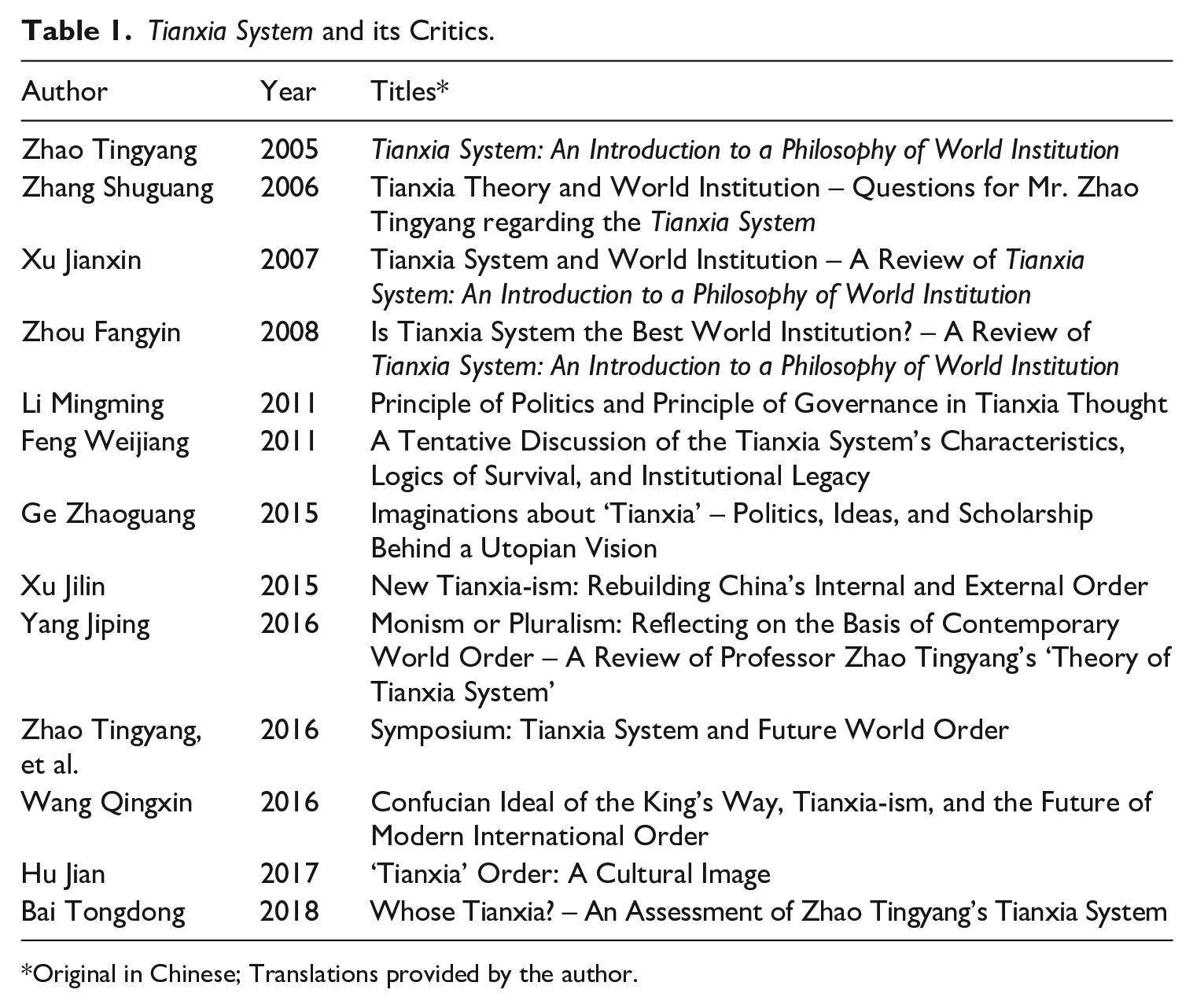
Original in Chinese; Translations provided by the author.
Tianxia and China
In Zhao’s thesis, one key assertion is that China represents a fundamentally different and superior civilisation vis-à-vis the ‘West’. This is part of the reason why, as he argues, everyone needs to learn from China. Yet exactly what is ‘China’? For Zhao, the latter exists as an ahistorical cultural and political entity whose singular, essential identity is represented by Tianxia. Yet such a one-dimensional definition of China is hardly shared by other PRC scholars. A good example is the Beijing-based economist and fellow CASS researcher Zhang Shuguang, who wrote one of the earliest critiques of Tianxia System and of its conceptualisation of China specifically.
Zhang’s critique focuses mainly on three issues. First, he questions Zhao’s binary worldview by observing that Zhao ‘intentionally or unintentionally set up China and the West as opposites and assume two different attitudes, respectively, complimenting and denouncement (towards the two), at times even using double-standard’. 99 Second, he challenges Zhao’s use of utopian theorising as a defence against accusations of logical and factual errors in his writing, calling into question the practical value of Tianxia as merely a ‘utopian imagination’ without addressing how we should concretely go forward. Finally, he criticises Zhao’s methodology, particularly his selective use and misinterpretation of evidence in support of his argument.
More than just a critique of Tianxia System’s scholarly quality, however, Zhang’s essay skillfully problematises Zhao’s essentialist reading of China as a timeless, unique, and superior civilisation, while offering a critical reading of Chinese history and his liberal vision for China’s future, often through turning the former’s argument against itself. For example, Zhang admits that the US had on numerous occasions breached the principles of human rights despite its avowed commitment to upholding them. But contrary to Zhao’s rejection of human rights, Zhang turns the question back. Citing Zhao’s own words that the US had ‘destroyed liberty and democracy in the name of liberty and democracy, prosecuted people in the name of human rights, and rejected morality with all sorts of moralistic reasons’,
100
Zhang asks: ‘has China not been doing the same? Can we reject the universal value of human rights and civil liberty simply because of such instances?’ Similarly, while conceding that Chinese philosophers tend to advance a more holistic mode of thinking, Zhang pushes Zhao on the latter’s uncritical, total approval of them ‘without a single word on their shortcomings and weaknesses’ by asking a ‘so-what’ question:
The notions of tianxia and minben [‘people as the foundation’] are indeed profound, but why did they result in prolonged despotism, so much so that even today we still have to struggle for human rights, and that realizing and securing individuals’ rights and liberty remain the most pressing and serious task in front of us?
101
Zhang is most critical of Zhao’s dismissive attitude toward the value of philosophy, political practice, and institutional design in the ‘West’, in particular Zhao’s dismissal of human rights. To date, few researchers outside the PRC have seriously examined Zhao’s view on this topic. 102 However, Zhao had been debating the merits of human rights with other Chinese scholars long before Tianxia System was published. 103 Importantly, Zhao’s opposition to ius naturale (tianfu renquan), which many in mainland China have criticised, is integral to his Tianxia thesis, serving to disqualify both ‘Western philosophy’ and ‘Western institutions’. In his essay, Zhang dedicated an entire section to his rebuttal of Zhao’s view on human rights, focusing on the weaknesses in the latter’s argumentation. Zhang first challenges the latter’s conceptual dichotomy by asking if Chinese concepts such as minben (‘people as the foundation’), minquan (‘people’s right’), and hexie (‘harmony’) are really at odds with the idea of human rights. He then disputes Zhao’s substantive critique, questioning how an all-inclusive system such as Tianxia would function if it refuses to acknowledge the existence of individuals and their rights. Finally, he asks Zhao to reflect on the latter’s own proclamation in the monograph on the need to understand rather than oppose the West, before writing that: ‘[the superficial critique of Western philosophies] is probably a profound irony for a Tianxia theory self-entitled as “cultural liberalism”’.
In Callahan’s critique of Tianxia System, Zhang’s essay was cited as an example of Chinese scholars’ reactions which, allegedly, focus mainly on Zhao’s arbitrary use of classical Chinese texts and lack of ‘proper historical and philosophical understanding of the Tianxia concept’. 104 This critique, however, underestimates both the extent and significance of the above piece, which not only disputes Zhao’s argumentation by laying bare his factual errors and logical inconsistencies, but also problematises his methodological choices in a way that skillfully exposes the ideological bias behind Zhao’s ‘Tianxia/China’ equivalency and ‘West vs. China’ binary, which define Zhao’s intellectual profile at large.
Tianxia and Political Order
Throughout his writings, Zhao argues that the Tianxia System represents the best political order, a claim largely justified based on an idealisation of the practices of historical Chinese regimes vis-à-vis peoples on the periphery. 105 This claim constitutes another major point of contention in the Tianxia debate while bridging multiple important discussions in China. The commentary by Shanghai-based historian Yao Dali 106 is both an exemplary critique of the topic and a good demonstration of its wider ramifications.
Yao’s commentary proceeds in two steps. He first challenges Zhao’s description of historical Tianxia. Pointing to the strong historical association between Tianxia and the hierarchical Sinocentric order, Yao argues that it is impossible to detach the term from the latter phenomenon. Consequently, he asks how useful it is to employ the Tianxia metaphor while proposing a de-centralised, non-hierarchical vision of global order. In a second step, he questions the prescriptive value of Tianxia for either contemporary global governance or China’s multiethnic governance. He is particularly concerned about the implication of Zhao’s thesis for China’s ethnic minorities, whom he believes would be victimised by recent policy proposals following the Tianxia’s logic.
Like many authors, Yao disputes Zhao’s interpretation of Tianxia from a historical perspective. But what distinguishes his critique from that of others is his highly critical stance toward the practices of historical Chinese regimes vis-à-vis their ‘Others’. A recognised specialist in frontier politics (bianjiang zhengzhi), Yao has written extensively about empire, ethnicity, state- and nation-building in both historical and modern China. Departing from the orthodox historiography of the state, Yao considers past regimes led by non-Han people – such as the Mongolian Yuan dynasty and Manchu Qing dynasty – to be more adept at managing ethnic and cultural diversity than those led by Han people – such as the Qin, Han, Tang, and Song dynasties. This brings him closer than many of his fellow historians to the perspective of the New Qing History, 107 which he has publicly defended against domestic critics. 108 His unorthodox position also won him opponents among the wider public. In 2018, for example, Yao found himself embroiled in controversy after criticising the Han dynasty’s (206 BEC-220 CE) military campaign against the nomadic Xiongnu people, as he apparently contradicted the popular narrative glorifying the campaign as part of ‘China’s unification efforts’. 109
In his critique, Yao challenges not only Zhao’s reading of historical Tianxia but the very Han-centric historiography that serves as the basis of both Zhao’s argument and the popular nationalist narrative.
110
Specifically, Yao highlights the rigidity and incapacity of Han-led regimes to manage cultural diversity – in direct opposition to Zhao – by contrasting them with the diverse technology of governance devised and employed by ‘barbarian’ (manyi) dynasties in the popular historiography:
[. . .] those that managed to incorporate territories in the northwestern borderlands, beyond the Hancivilization, were not really ‘Confucian’ dynasties such as Song or Ming [. . .] Instead, the Yuan and Qing dynasties which established a unified multiethnic state had managed to do so only because they had combined a Han-Tang style bureaucratic monarchy with an Inner-Asian frontier empire.
111
But Yao was not simply interested in lecturing Zhao on ancient history. Rather, this forms a part of his broader critique of Tianxia’s implications for China’s ethnic policy. Building on his earlier remarks, Yao rejects Tianxia’s historical role as a useful philosophy for governing pluralistic societies, calling it mainly concerned with ‘covering the entire Chinese territory with a Han culture’. Moving on to contemporary ethnic politics, Yao further notes that some proponents of Tianxia are extending precisely such a logic to the present-day politics by advocating an assimilationist policy towards ethnic minorities. This, Yao believes, would lead to ‘repressive consequences’ for interethnic relations in China. Instead, Yao prefers Kymlicka’s theory of multiculturalism and writes that ‘we have no reason to doubt that it is entirely possible to realize the geographically defined and historically rooted self-governing rights of ethnic minorities in China’. 112
Yao’s reference to ethnic politics might seem to miss the point for those who knew Tianxia only as an IR theory. But the significance of his comments lies precisely beyond this disciplinary reading, namely in the rising ethnic tensions in China and the increasing divide among intellectuals on how the country should respond to them. Observing the unfolding unrest in Tibet in the spring of 2008, Callahan 113 acutely points out the inclination of Tianxia System to favour forceful assimilation of the non-Han population into the mainstream Han society. Eight years later, Yao’s commentary came just after a nationwide debate over the future of China’s ethnic policy, where scholars and government officials clashed over a high-profile proposal calling for revoking minorities’ right to constitutionally-guaranteed regional autonomy and preferential policies. 114 Importantly, the concept of Tianxia was invoked by a number of people who advocated this proposal, such as the Peking University sociologist Ma Rong. 115 In this sense, Yao’s comments can be read as both a revisionist historical note on China’s frontier politics and a warning call against intellectual currents serving to justify an assimilationist policy towards China’s ethnic minorities. His critique, therefore, is an attempt to simultaneously intervene in the multiple debates that Tianxia System is directly or indirectly involved in.
Tianxia and Politics of Knowledge
Finally, Tianxia System is also a thesis on epistemological nationalism. For Zhao, Tianxia is more than just a utopian vision of global order. Equally important is that it is a ‘Chinese’ vision. His book is about both exposing the deficiencies of ‘Western’ ideas and (re)creating a knowledge system from a ‘Chinese’ perspective so that China could ‘regain the ability to think and [. . .] reestablish its own framework of thinking and fundamental beliefs’. 116 The imperative to ‘let China think again’ serves as a key justification for Zhao’s intellectual undertaking, an argument that finds many sympathetic ears in PRC, especially those also interested in using Tianxia for their own theory building. But not everyone was persuaded. Ge Zhaoguang, a scholar of cultural and intellectual history of China, has made one of the most extensive and sophisticated critiques of Tianxia System’s approach to ‘indigenous’ knowledge-making and contemporary epistemological nationalism in China more generally. 117
In his long essay, 118 Ge interrogates the concept’s recent popularity by examining two parallel contemporary processes – namely, the rise of Chinese nationalism and the appropriation of Western critical theories around the turn of the century – which contribute to the present Tianxia fever. While many have noted Tianxia’s connection with the broader social context, 119 very few possess the kind of in-depth knowledge and the ability to empirically demonstrate those connections as Ge. Calling Tianxia a form of ‘nationalism disguised as cosmopolitanism’, Ge explains how, with nationalist sentiment burgeoning since the mid-1990s, critical reflections among Chinese intellectuals on empire and global order have paradoxically awoken simultaneously ‘the sentiment to avenge the “century of humiliation”, an intellectual movement to critique “modernity”, and the ambition to rebuild a “Tianxia” system’. 120 But Ge did not stop at revealing the immediate political and intellectual origins of Zhao’s thesis. For him, an equally if not more important task is to problematise Tianxia System’s epistemological revisionism, which Ge does through historicising Zhao’s methodology, that is, the very act of extrapolating new ideas from old texts. Adopting a macro-historical perspective, Ge recounts the recurring attempts to reinterpret and redeploy Confucian ideas for different ends throughout history, demonstrating the constant entanglement between politics and knowledge in each of those instances and consequently, the deeply political and problematic revival of Tianxia in Zhao and others’ work.
Specifically, Ge focuses on the Gongyang Scholarship (gongyangxue), a school of Confucian thought that inspired late-Qing reformers such as Kang Youwei and Liang Qichao as well as contemporary mainland New Confucian writers such as Jiang Qing. 121 Tracing its evolution, Ge carefully shows how the connotation of ‘Sinocentric Confucian order’ in earlier articulations of Tianxia had been deliberatively deemphasised by Gongyang scholars through successive reinterpretations, ultimately paving the way for its modern rediscovery and rebranding as a ‘cosmopolitan’ Chinese philosophy. Zhao’s thesis, therefore, should not be simply understood as a product of the intellectual and political conditions in today’s PRC, as other scholars have claimed, 122 but in fact the latest occurrence in a long tradition of ‘reforming the system by appealing to antiquity’ (tuogu gaizhi), in which Chinese classics were reinterpreted and reinserted into the present debate as the more ‘authoritative’, ‘legitimate’, and ‘valid’ knowledge by virtue of their status as ‘ancient wisdom’. By historicising Zhao’s thesis, Ge’s response thus directly challenges Zhao’s approach of reclaiming ‘indigenous’ knowledge.
Furthermore, while Zhao has become internationally known as a prominent Tianxia theorist from China, he is not alone in that regard. Since the mid-1990s, scholars from different disciplinary backgrounds have proposed alternative versions of Tianxia theory, such as the liberal economist Sheng Hong, the Confucian philosopher Guo Yi, and most recently, the liberal historian Xu Jilin, among others. 123 What unites these diverse theoretical endeavours is their often idealised and ahistorical reading of Tianxia as built upon an apparent conviction about the epistemological advantage granted by the concept’s ‘antiquity’ and ‘Chinese-ness’. By linking Zhao with his fellow contemporary Tianxia theorists and historical predecessors who had similarly attempted to claim the superiority of the ‘Chinese perspective’ in knowledge-making, Ge’s essay puts not just a single thesis and its knowledge-making claim but the very epistemological nationalism that underlies the broadly inward-looking, ethnocentric intellectual movement exemplified by the Tianxia fever firmly under the spotlight.
Autochthonous Intellectuals and Counter-Hegemonic Potential in Chinese Critical IR Discourse
As one can see from the critiques by Zhang Yao and Ge a critically minded autochthonous intellectual community exists in today’s China, where scholars step across disciplinary boundaries to meet each other in dialogues and debates about Chinese homegrown IR theorising, and where concerns about ethnocentrism of both local (Chinese) and extra-local forms were not only voiced but also addressed head-on via the deployment of a variety of intellectual resources. Among the participants in this debate, those who work in the institutionalised IR are but a small fraction. Yet despite the obvious relevance of this debate to global IR, few if any of those scholars outside the ‘proper’ IR – the above three, for example – have been considered by the Anglophone IR literature as legitimate interlocutors of global IR. Commenting on IR development in China, Peter Katzenstein once wrote:
China is confronting daunting problems of environmental degradation, urban sprawl, sky-rocketing inequality, structural rigidities, wide-spread corruption, cult of personality, and dictatorial power. [. . .] But, these are not the concerns of the Chinese School of IR. It is not interested in the unique problem created by the simultaneity of preindustrial, industrial, and post-industrial processes.
124
His observation is correct only if one takes institutionalised IR in mainland China as the sole legitimate representative of ‘the Chinese perspective’. Once we go beyond this narrow definition, as I tried to show in the above analysis, it is evident that contemporary Chinese critical IR discourse has a strong sense of reflexivity toward identity, history, and knowledge production, as well as a keen interest in critical examination of Chinese society and politics. Each commentary exposes and problematises a particular aspect of parochialism in Tianxia System in a way that is simultaneously grounded in the ongoing political struggles in China, including, inter alia, anti-Westernism, Han-chauvinism, Neo-authoritarianism, Neo-statism, and Sinocentrism. 125 Together they demonstrate the capacity and creativity of autochthonous intellectuals inside today’s China to practice powerful social and philosophical criticisms as critical insiders, for whom the shared cultural script and similar positionality help them to turn the discursive resource of ethnocentric IR theorising – such as Tianxia System – against itself, introducing a voice of resistance and the potential for a theory of oppression 126 from within the autochthonous community, but without essentialising any argument or scholarly profile as ‘Chinese’, ‘non-Chinese’, or ‘Western’, etc.
But more than showing the richness and reflexivity of Chinese critical IR discourse and the importance of looking beyond institutionalised IR, the above analysis highlights the usefulness of engaging with non-Western knowledge based on a reconceptualisation of the very subject of inquiry and a more embedded form of engagement therewith. Specifically, the embedded observer approach encourages us to contextualise a given text and its author in the immediately associated discourses, with that not only improving the interpretation of their own significance but also shedding light on the social and historically situated scholarly practices beyond the ‘West/non-West’ binary. 127 This enables the researchers to be sensitive to the fact that, as it is often the case in a non-Western context, intellectual resources from different traditions are creatively deployed to address a specific local research agenda, while at the same time being open to the possibility that the local forms of inquiry might have broader relevance beyond its spatio-temporal location. It shows how it might be particularly rewarding to refrain from seeking to capture ‘authentic views from the periphery’ under categories such as ‘Chinese IR’ or ‘Indian IR’, but try to locate and study critical discourses within non-Western traditions, such as the variegated Chinese critical IR discourses of Other China. It further reminds us that, just as ‘the West today consists of citizens constituted by diverse and at times radically discontinuous ethnic, religious, and racial identities’, 128 ‘Chinese’, ‘Indian’, and ‘Islamic’, for example, are also umbrella terms covering a range of positions that may disagree profoundly with each other. The so-called non-Western approach to IR, in this sense, should be seen as a syncretic perspective, ‘a product of multiple identities and traditions’. 129 To truly appreciate alternative knowledge traditions beyond the West, global IR should boldly explore and study the rich, diverse, contested, and ever-evolving intellectual world of the non-West.
Conclusion: Rethinking Interlocutors in Global IR
Recent scholarship has paid increasing attention to the various theoretical, conceptual, and methodological pitfalls of global IR, particularly the reproduction of ethnocentrism while simultaneously critiquing it. Juliette Tolay, for example, shows how anti-Eurocentric discourse could ‘inadvertently reproduce’ Eurocentrism rather than help overcome it, using the example of Turkish immigration and asylum policy. 130 Taking a step back, Felix Anderl and Antonia Witt question the ideological implications of ‘globalism’ in the very design of global IR, highlighting its tendency to become ‘a novel, apparently benign, hegemonic project [. . .] glossing over old power relations, that structure how and by whom the international is studied’. 131 Lastly, tackling the issue of representation head-on, Murray points out that ‘epistemic difference should not be seen simply as a reflection of an externally existing reality, but as a process of representation, which is power laden and dialectical’. 132
These reflections reaffirm the critique laid out in this article and further underlie the need for a reorientation of our inquiry in global IR. Specifically, I have argued that a key issue with existing global IR scholarship lies in its tendency to privilege and canonise select individuals and/or writings over situated forms of scholarly practices, thereby reducing so-called ‘non-Western knowledge’ to ethnised additions to a singular, global hierarchy of knowledge, while further denying the critical agency of non-Western intellectuals. To overcome this, I have proposed an embedded observer approach based on rethinking our interlocutors, expectations of differences, and modes of engagement. I argued that rather than passively anticipating the ‘periphery’s revolt against IRs concepts’ that can meet the expectation of ‘critical, disciplinary self-reflection at the core’, 133 researchers should actively push their inquiry beyond the confines of institutionalised IR into the realms of critical discourses and counter-hegemonic projects within non-Western traditions, and learn to appreciate ‘the richness of engaging in debates with lesser known scholars from the Global South, regardless of whether or not these scholars are proposing radically critical ideas as defined by critical scholars from the Global North’. 134
A critical reappraisal of the debate over Zhao Tingyang’s Tianxia System based on this approach shows that, different from the conventional understanding of the ‘Chinese IR’ as an inward-looking ‘national school’ with strong ethnocentric overtones, Chinese critical IR discourse possesses not only a strong sense of reflexivity and commitment to self-critique, but also the capacity to engage in critical discussions with counter-hegemonic potential, contesting various forms of parochialism – e.g. Anti-Westernism, Sinocentrism, Han-chauvinism – that has both local and global relevance. In addition, the exercise confirms my claim that Chinese critical IR discourse – like other non-Western discourses – is rooted in specific social and intellectual conditions that call for interpretive nuance, such as the interdisciplinary nature of the discussion, the interconnectedness with topics of domestic politics, and the embeddedness in the evolving political and ideological landscape of post-Mao Chinese society. Understanding these backgrounds plays a crucial part in recognising and appreciating the agency of critical intellectuals in contemporary China.
How can the discussion here help us to achieve a more inclusive IR? To begin with, we should stop expecting to achieve this goal by simply cataloguing presumably marginalised knowledge under the assumption that one can simply capture the non-West through ‘their wholly “authentic” scholarly gaze’. 135 This might not only lead to a sort of ‘intellectual potluck’ without acknowledging crucial epistemological or meta-theoretical differences between different knowledge traditions; 136 worse still, it could also ‘obfuscates the concrete practices and processes’ that contribute to the marginalisation of non-Western knowledge, thereby perpetuating both the latter’s marginal status and the global hierarchy of knowledge. 137 Instead, we should go boldly where few IR scholars have gone before: namely relinquish the fantasy to find the ‘fantastic theories’ and start seeing the ‘other’ not as the one with a capitalised ‘O’ but as a mutual-learning encounter between concrete, particular individuals. Taking a pluralistic approach to knowledge production, researchers should feel free to venture beyond the institutionalised field of IR and try to approach the unfamiliar knowledge tradition not by seeking a timeless, authentic representation, but by instead embedding themselves in the situated dialogues as the living practices of that tradition. Ultimately, we should let our own participation in these dialogues and the cultural accounts of it be the first step toward a truly transformative movement of global IR.
Supplemental Material
sj-docx-1-mil-10.1177_03058298221110923 – Supplemental material for Fantastic Theories and Where to Find Them: Rethinking Interlocutors in Global IR
Supplemental material, sj-docx-1-mil-10.1177_03058298221110923 for Fantastic Theories and Where to Find Them: Rethinking Interlocutors in Global IR by Sinan Chu in Millennium - Journal of International Studies
Footnotes
Acknowledgements
I thank Rafael Castro Alegría, Ruben Gonzalez-Vicente, Heike Holbig, Lynda Chinenye Iroulo, Sharinee Jagtiani, Jan Klenke, Sabine Mokry, Johannes Plagemann, Hakkı Taş, Christian Wirth, as well as the editors and the anonymous reviewers of Millennium for their valuable comments and suggestions. I also thank Lukian De Boni and Clara Franco Yáñez for the respective French and Spanish translations of the abstract, keywords, and title. Any remaining errors are my own.
Declaration of conflicting interests
The author declared no potential conflicts of interest with respect to the research, authorship, and/or publication of this article.
Funding
The author disclosed receipt of the following financial support for the research, authorship, and/or publication of this article: The research for this essay was supported by the German Research Foundation (Deutsche Forschungsgemeinschaft, project no. 394229330).
Supplemental material
Supplemental material for this article is available online.
1.
Amitav Acharya, ‘Global International Relations (IR) and Regional Worlds: A New Agenda for International Studies,’ International Studies Quarterly 58, no. 4 (2014): 647.
2.
Knud Erik Jørgensen, ‘Inter Alia: On Global Orders, Practices, and Theory,’ International Studies Review 19, no. 2 (2017): 286–87.
3.
4.
5.
Amitav Acharya and Barry Buzan, eds., Non-Western International Relations Theory: Perspectives on and beyond Asia (London: Routledge, 2010), 227.
6.
7.
Tingyang Zhao, Tianxia Tixi: Shijie Zhidu Zhexue Daolun [Tianxia System: An Introduction to a Philosophy of World Institution], Reprint (Beijing: Remin University of China Publishing House, 2011).
8.
For exceptions, see Peng Lu, ‘Chinese IR Sino-Centrism Tradition and Its Influence on the Chinese School Movement,’ The Pacific Review 32, no. 2 (2019): 150–67. https://doi.org/10.1080/09512748.2018.1461681; Xiao Ren, ‘Grown from Within: Building a Chinese School of International Relations,’ The Pacific Review 33, no. 3–4 (2020): 386–412.  .
.
9.
Geremie R. Barmé, ‘Worrying China & New Sinology,’ China Heritage Quarterly, no. 14 (2008). Available at: http://www.chinaheritagequarterly.org/articles.php?searchterm=014_worryingChina.inc&issue=014; Geremie R. Barmé, ‘On New Sinology,’ China Heritage (blog), 9 April 2016. Available at: .
10.
11.
12.
13.
Amitav Acharya and Barry Buzan, ‘Why Is There No Non-Western International Relations Theory?,’ International Relations of the Asia-Pacific 7, no. 3 (2007): 287–312; Giorgio Shani, ‘Toward a Post-Western IR: The Umma, Khalsa Panth, and Critical International Relations Theory,’ International Studies Review 10, no. 4 (2008): 722–34; Arlene B. Tickner and Ole Wæver, eds., International Relations Scholarship Around the World, Worlding beyond the West (Oxford; New York: Routledge, 2009); Acharya, ‘Global International Relations (IR) and Regional Worlds’; Amaya Querejazu, ‘Encountering the Pluriverse: Looking for Alternatives in Other Worlds,’ Revista Brasileira de Política Internacional 59, no. 2 (2016). https://doi.org/10.1590/0034-7329201600207. David L. Blaney and Arlene B. Tickner, ‘Worlding, Ontological Politics and the Possibility of a Decolonial IR,’ Millennium: Journal of International Studies 45, no. 3 (2017): 293–311. .
14.
Acharya and Buzan, ‘Why Is There No Non-Western International Relations Theory?’; Acharya, ‘Global International Relations (IR) and Regional Worlds’; Ersel Aydınlı and Gonca Biltekin, ‘Widening the World of IR: A Typology of Homegrown Theorizing,’ All Azimuth: A Journal of Foreign Policy and Peace 7, no. 1 (2017): 45–68. https://doi.org/10.20991/allazimuth.328427; Yaqing Qin, ‘A Multiverse of Knowledge: Cultures and IR Theories’, The Chinese Journal of International Politics 11, no. 4 (2018): 415–34. .
15.
Vasilaki, ‘Provincialising IR?’; Querejazu, ‘Encountering the Pluriverse.’
16.
Pinar Bilgin, ‘Thinking Past “Western’ IR?”, Third World Quarterly 29, no. 1 (2008): 5–23. https://doi.org/10.1080/01436590701726392. Kimberly Hutchings, ‘Dialogue between Whom? The Role of the West/Non-West Distinction in Promoting Global Dialogue in IR,’ Millennium: Journal of International Studies 39, no. 3 (2011): 639–47. https://doi.org/10.1177/0305829811401941. Melody Fonseca, ‘Global IR and Western Dominance: Moving Forward or Eurocentric Entrapment?’, Millennium: Journal of International Studies 48, no. 1 (2019): 45–59. .
17.
18.
Pinar Bilgin, ‘“Contrapuntal Reading” as a Method, an Ethos, and a Metaphor for Global IR’, International Studies Review 18, no. 1 (2016): 134–46. https://doi.org/10.1093/isr/viv018. Hellmann and Valbjørn, ‘Problematizing Global Challenges’; Karin M. Fierke and Vivienne Jabri, ‘Global Conversations: Relationality, Embodiment and Power in the Move towards a Global IR’, Global Constitutionalism 8, no. 3 (2019): 506–35. .
19.
Hurrell, ‘Beyond Critique’.
20.
Acharya and Buzan, ‘Why Is There No Non-Western International Relations Theory?’; Tickner and Wæver, International Relations Scholarship Around the World; Ingo Peters and Wiebke Wemheuer-Vogelaar, eds., Globalizing International Relations (London: Palgrave Macmillan UK, 2016). . Ersel Aydinli and Gonca Biltekin, eds., Widening the World of International Relations: Homegrown Theorizing, Worlding beyond the West 15 (London; New York: Routledge, Taylor & Francis Group, 2018).
21.
For exceptions, see Amitav Acharya, ‘Dialogue and Discovery: In Search of International Relations Theories Beyond the West’, Millennium: Journal of International Studies 39, no. 3 (2011): 619–37. https://doi.org/10.1177/0305829811406574. L. H. M. Ling, The Dao of World Politics: Towards a Post-Westphalian, Worldist International Relations, New International Relations (London and New York: Routledge, 2013); Yaqing Qin and Astrid H. M. Nordin, ‘Relationality and Rationality in Confucian and Western Traditions of Thought’, Cambridge Review of International Affairs 32, no. 5 (2019): 601–14. .
22.
23.
Anderl and Witt, ‘Problematising the Global in Global IR’.
24.
Acharya and Buzan, Non-Western International Relations Theory.
25.
Acharya, ‘Global International Relations (IR) and Regional Worlds’, 650.
26.
Isaac Kamola, ‘Reading the Global in the Absence of Africa,’ in Thinking International Relations Differently, ed. Arlene B. Tickner and David L. Blaney, Worlding Beyond the West (New York and London: Routledge, 2012), 183–204.
27.
Fonseca, ‘Global IR and Western Dominance’, 52.
28.
Andrei P. Tsygankov and Pavel A. Tsygankov, ‘New Directions in Russian International Studies: Pluralization, Westernization, and Isolationism’, Communist and Post-Communist Studies 37, no. 1 (2004): 1–17. https://doi.org/10.1016/j.postcomstud.2003.12.005. Ching-Chang Chen, ‘The Im/Possibility of Building Indigenous Theories in a Hegemonic Discipline: The Case of Japanese International Relations’, Asian Perspective 36, no. 3 (2012): 463–92. . Nele Noesselt, ‘Revisiting the Debate on Constructing a Theory of International Relations with Chinese Characteristics’, The China Quarterly 222 (2015): 430–48.
29.
Yongjin Zhang and Peter M. Kristensen, ‘The Curious Case of “Schools” of IR: From the Sociology to the Geopolitics of Knowledge’, The Chinese Journal of International Politics 10, no. 4 (2017): 429–54.
30.
Nicola Nymalm and Johannes Plagemann, ‘Comparative Exceptionalism: Universality and Particularity in Foreign Policy Discourses’, International Studies Review 21, no. 1 (2018): 12–37.
31.
Andrey Makarychev and Viatcheslav Morozov, ‘Is “Non-Western Theory” Possible? The Idea of Multipolarity and the Trap of Epistemological Relativism in Russian IR’, International Studies Review 15, no. 3 (2013): 328–50. . Lu, ‘Chinese IR Sino-Centrism Tradition and Its Influence on the Chinese School Movement’.
32.
Andrei P. Tsygankov and Pavel A. Tsygankov, ‘A Sociology of Dependence in International Relations Theory: A Case of Russian Liberal IR’, International Political Sociology 1, no. 4 (2007): 307–24. . Arlene B. Tickner, ‘Latin American IR and the Primacy of Lo Práctico’, International Studies Review 10, no. 4 (2008): 735–48; Aydınlı and Biltekin, ‘Widening the World of IR’. I admit that not all instances of ‘similarity’ are proofs of reproduction of hegemonic thinking from disciplinary IR in the West. As Bilgin (2008) has pointed out, some cases can in fact provide useful insights into non-Western ways of thinking about and doing world politics, as they are better understood as ‘almost the same but not quite’ or ‘mimicry’. The point here is rather that well-known ‘non-Western theories’ in the Anglophone IR literature as cited here do not seem to fall under that category.
33.
For example, see Ersel Aydınlı and Julie Mathews, ‘Turkey: Towards Homegrown Theorizing and Building a Disciplinary Community’, in International Relations Scholarship Around the World, ed. Arlene B. Tickner and Ole Wæver, Worlding Beyond the West (Oxford; New York: Routledge, 2009), 208–22; Chaesung Chun, ‘Why Is There No Non-Western International Relations Theory? Reflections on and from Korea’, in Non-Western International Relations Theory: Perspectives on and beyond Asia, ed. Amitav Acharya and Barry Buzan (London: Routledge, 2010), 69–91; Takashi Inoguchi, ‘Why Are There No Non-Western Theories of International Relations? The Case of Japan’, in Non-Western International Relations Theory: Perspectives On and Beyond Asia, ed. Amitav Acharya and Barry Buzan (London: Routledge, 2010), 51–68; Yaqing Qin, ‘Why Is There No Chinese International Relations Theory?’, in Non-Western International Relations Theory: Perspectives on and beyond Asia, ed. Amitav Acharya and Barry Buzan (London: Routledge, 2010), 26–50; Makarychev and Morozov, ‘Is “Non-Western Theory” Possible?’
34.
35.
Hurrell, ‘Beyond Critique’, 150; Jørgensen, ‘Inter Alia: On Global Orders, Practices, and Theory’, 286–87.
36.
37.
Shani, ‘Toward a Post-Western IR’.
38.
For example, see Tickner and Wæver, International Relations Scholarship Around the World; Acharya and Buzan, Non-Western International Relations Theory; Robbie Shilliam, ed., International Relations and Non-Western Thought: Imperialism, Colonialism and Investigations of Global Modernity, Interventions (London: Routledge, 2011); Niv Horesh and Emilian Kavalski, eds., Asian Thought on China’s Changing International Relations (Basingstoke and New York: Palgrave Macmillan, 2014).
39.
40.
Gustaaf Geeraerts and Men Jing, ‘International Relations Theory in China’, Global Society 15, no. 3 (2001): 251.
41.
Song, ‘Building International Relations Theory with Chinese Characteristics’.
42.
43.
Peter M. Kristensen and Ras T. Nielsen, ‘Constructing a Chinese International Relations Theory: A Sociological Approach to Intellectual Innovation’, International Political Sociology 7, no. 1 (2013): 19–40.
44.
Peter M. Kristensen, ‘Navigating the Core-Periphery Structures of “Global” IR: Dialogues and Audiences for the Chinese School as Travelling Theory’, in Constructing a Chinese School of International Relations: Ongoing Debates and Sociological Realities, ed. Yongjin Zhang and Teng-Chi Chang (Abingdon: Routledge, 2016), 143–61.
45.
46.
Yaqing Qin, A Relational Theory of World Politics (New York: Cambridge University Press, 2018).
47.
Xuetong Yan, Ancient Chinese Thought, Modern Chinese Power, ed. Daniel A. Bell and Zhe Sun, trans. Edmund Ryden (Princeton: Princeton University Press, 2011).
48.
49.
William A. Callahan, ‘Chinese Visions of World Order: Post-Hegemonic or a New Hegemony?’, International Studies Review 10, no. 4 (2008): 749–61; Jeremy T. Paltiel, ‘Constructing Global Order with Chinese Characteristics: Yan Xuetong and the Pre-Qin Response to International Anarchy’, The Chinese Journal of International Politics 4, no. 4 (2011): 375–403. . Cunningham-Cross, ‘Using the Past to (Re)Write the Future’.
50.
51.
Kristensen and Nielsen, ‘Constructing a Chinese International Relations Theory’; Qin, ‘A Multiverse of Knowledge’.
52.
Kristensen, ‘How Can Emerging Powers Speak?’; Lu, ‘Chinese IR Sino-Centrism Tradition and Its Influence on the Chinese School Movement’; Ren, ‘Grown from Within’.
53.
Qin, ‘Why Is There No Chinese International Relations Theory?’, 32.
54.
55.
For an exchange on this topic, see Song, ‘Building International Relations Theory with Chinese Characteristics’; William A. Callahan, ‘China and the Globalisation of IR Theory: Discussion of “Building International Relations Theory with Chinese Characteristics”’,Journal of Contemporary China 10, no. 26 (2001): 75–88. .
56.
For example, see Callahan, ‘Chinese Visions of World Order’; Cunningham-Cross, ‘Using the Past to (Re)Write the Future’; Feng Zhang, ‘The Tsinghua Approach and the Inception of Chinese Theories of International Relations’, The Chinese Journal of International Politics 5, no. 1 (2012): 73–102; Peter J. Katzenstein, ‘The Second Coming? Reflections on a Global Theory of International Relations’, The Chinese Journal of International Politics 11, no. 4 (2018): 373–90. https://doi.org/10.1093/cjip/poy012. Qin, ‘A Multiverse of Knowledge’; Amitav Acharya, ‘From Heaven to Earth: “Cultural Idealism” and “Moral Realism” as Chinese Contributions to Global International Relations,’ The Chinese Journal of International Politics 12, no. 4 (2019): 467–94. . Eric M. Blanchard and Shuang Lin, ‘Gender and Non-Western “Global” IR: Where Are the Women in Chinese International Relations Theory?,’ International Studies Review 18, no. 1 (2016): 48–61.
57.
58.
Acharya, ‘From Heaven to Earth,’ 482.
59.
Ibid.
60.
Leigh K. Jenco, Changing Referents: Learning Across Space and Time in China and the West (New York: Oxford University Press, 2015), 1–2.
61.
62.
Gloria Davies, Worrying about China: The Language of Chinese Critical Inquiry (Cambridge: Harvard University Press, 1999); Edward X. Gu and Merle Goldman, eds., Chinese Intellectuals between State and Market (London; New York: RoutledgeCurzon, 2004).
64.
Brian C. Schmidt, The Political Discourse of Anarchy: A Disciplinary History of International Relations, SUNY Series in Global Politics (New York: State University of New York Press, 1998); John M Hobson, The Eurocentric Conception of World Politics: Western International Theory, 1760-2010 (Cambridge: Cambridge University Press, 2012); Vineet Thakur, Alexander E. Davis, and Peter Vale, ‘Imperial Mission,’Scientific’Method: An Alternative Account of the Origins of IR,’ Millennium: Journal of International Relations 46, no. 1 (2017): 3–23.
65.
Robert W. Cox, ‘Social Forces, States and World Orders: Beyond International Relations Theory,’ Millennium: Journal of International Studies 10, no. 2 (1981): 126–55; Richard K. Ashley and R. B. J. Walker, ‘Introduction: Speaking the Language of Exile: Dissident Thought in International Studies,’ International Studies Quarterly 34, no. 3 (1990): 259–68. https://doi.org/10.2307/2600569. Arlene Tickner, ‘Seeing IR Differently: Notes from the Third World,’ Millennium: Journal of International Studies 32, no. 2 (2003): 295–324. https://doi.org/10.1177/03058298030320020301. S. Nair, ‘FORUM: Edward W. Said and International Relations,’ Millennium: Journal of International Studies 36, no. 1 (2007): 77–82. https://doi.org/10.1177/03058298070360010501. Sanjay Seth, ‘Postcolonial Theory and the Critique of International Relations,’ Millennium: Journal of International Studies 40, no. 1 (2011): 167–83. . Acharya, ‘Global International Relations (IR) and Regional Worlds.’
66.
67.
68.
Fonseca, ‘Global IR and Western Dominance,’ 52.
69.
Tickner, ‘Latin American IR and the Primacy of Lo Práctico,’ 745.
71.
Hellmann and Valbjørn, ‘Problematizing Global Challenges.’
72.
Cox, ‘Social Forces, States and World Orders’; Ashley and Walker, ‘Introduction’; Tickner, ‘Seeing IR Differently’; Nair, ‘FORUM’; Seth, ‘Postcolonial Theory and the Critique of International Relations.’
73.
Kristensen, ‘How Can Emerging Powers Speak?’
74.
Hurrell, ‘Beyond Critique,’ 151.
75.
Fonseca, ‘Global IR and Western Dominance,’ 52.
76.
Fierke and Jabri, ‘Global Conversations,’ 511.
77.
78.
Felix Rösch, ‘The Inter as Liminal Spaces: Prudence, Transience, and Affection,’ International Studies Review 19, no. 2 (2017): 287–91; Morten Valbjørn, ‘Dialoguing about Dialogues: On the Purpose, Procedure and Product of Dialogues in Inter-National Relations Theory,’ International Studies Review 19, no. 2 (2017): 291–96; Gunther Hellmann, ‘Interpreting International Relations,’ International Studies Review 19, no. 2 (2017): 296–300.
79.
Leigh K. Jenco, ‘Global Knowledge Frameworks and the Tasks of Cross-Cultural Philosophy,’ Journal of World Philosophies 2, no. 2 (2017): 82–87.
80.
Fierke and Jabri, ‘Global Conversations.’
81.
Hellmann, ‘Interpreting International Relations.’
82.
83.
Makarychev and Morozov, ‘Is “Non-Western Theory” Possible?,”’ 345–46.
84.
Shani, ‘Toward a Post-Western IR,’ 724.
85.
Hurrell, ‘Beyond Critique,’ 151.
86.
For example, see Kristensen and Nielsen, ‘Constructing a Chinese International Relations Theory,’ 27.
87.
For example, see Andrei P. Tsygankov, ‘Contested Identity and Foreign Policy: Interpreting Russia’s International Choices,’ International Studies Perspectives 15, no. 1 (2014): 19–35. https://doi.org/10.1111/insp.12000. Andrew Phillips, ‘Contesting the Confucian Peace: Civilization, Barbarism and International Hierarchy in East Asia,’ European Journal of International Relations 24, no. 4 (2018): 740–64. .
88.
For example, see Sungju Park-Kang, ‘Utmost Listening: Feminist IR as a Foreign Language,’ Millennium: Journal of International Studies 39, no. 3 (2011): 861–77. https://doi.org/10.1177/0305829811403024. Fiona Robinson, ‘Stop Talking and Listen: Discourse Ethics and Feminist Care Ethics in International Political Theory,’ Millennium: Journal of International Studies 39, no. 3 (2011): 845–60. .
89.
Park-Kang, ‘Utmost Listening.’
90.
91.
Callahan, ‘Chinese Visions of World Order’; Allen Carlson, ‘Moving Beyond Sovereignty? A Brief Consideration of Recent Changes in China’s Approach to International Order and the Emergence of the Tianxia Concept,’ Journal of Contemporary China 20, no. 68 (2011): 89–102; Chishen Chang, ‘Tianxia System on a Snail’s Horns,’ Inter-Asia Cultural Studies 12, no. 1 (2011): 28–42. Available at: https://doi.org/10.1080/14649373.2011.532940. June Teufel Dreyer, ‘The ‘Tianxia Trope’: Will China Change the International System?,’ Journal of Contemporary China 24, no. 96 (2015): 1015–31. https://doi.org/10.1080/10670564.2015.1030951. Noesselt, ‘Revisiting the Debate on Constructing a Theory of International Relations with Chinese Characteristics’; Hung-Jen Wang, ‘Traditional Empire–Modern State Hybridity: Chinese Tianxia and Westphalian Anarchy1,’ Global Constitutionalism 6, no. 2 (2017): 298–326. . Nymalm and Plagemann, ‘Comparative Exceptionalism.’
92.
Barmé, ‘On New Sinology.’
93.
Shani, ‘Toward a Post-Western IR,’ 727.
94.
Tingyang Zhao, ‘“Tianxia tixi”: diguo yu shiije zhidu [Tianxia System: Empire and World Regime].’ World Philosophy, no. 5 (2003): 2–33; Tingyang Zhao, Tianxia Tixi: Shijie Zhidu Zhexue Daolun [Tianxia System: An Introduction to a Philosophy of World Institution]; Tingyang Zhao, Tianxia de dangdaixing: shijie zhixu de shijian yu xiangxiang [A Possible World of All-under-Heaven System: The World Order in the Past and for the Future], (Beijing: CITIC Press Group, 2016); Zhao, Redefining A Philosophy for World Governance.
95.
Zhao, ‘“Tianxia tixi”: diguo yu shiije zhidu [Tianxia System: Empire and World Regime]’; see also Zhaoguang Ge, ‘Dui “tianxia” de xiangxiang – yige wutuobang xiangxiang beihou de zhengzhi, sixiang yu xueshu’ [Imaginations of ‘Tianxia’ – Politics, Ideas, and Research Behind a Utopian Vision]. Aisixiang (blog). 14 October 2015. Available at: .
96.
For example, see Tingyang Zhao, ‘Rethinking Empire from a Chinese Concept “All-under-Heaven” (Tian-Xia, 天下),’ Social Identities 12, no. 1 (2006): 29–41.
97.
For example, see Tingyang Zhao, ‘Youchang renquan he zuoren zhuyi [Paid Human Rights and Humanizationism],’ Philosophical Research, no. 9 (September 1996): 18–24; Tingyang Zhao, ‘Guanyu Ziyou de Yizhong Cunzailun Guandian [An Ontological Perspective on Liberty],’ World Philosophy, no. 6 (2004): 57–65; Tingyang Zhao, ‘“Yufu Renquan”: Yizhong Feixifang de Pubian Renquan Lilun [“Credit Human Rights”: A Non-Western Universal Theory of Human Rights],’ Social Sciences in China, no. 4 (2006): 17–30, 205.
98.
99.
100.
Tingyang Zhao, Tianxia Tixi: Shijie Zhidu Zhexue Daolun [Tianxia System: An Introduction to a Philosophy of World Institution] (Nanjing: Jiangsu Education Publishing House, 2005), 114–15.
101.
Zhang, ‘Tianxia Lilun Yu Shijie Zhidu.’
102.
For example, see Callahan, ‘Chinese Visions of World Order’; Chang, ‘Tianxia System on a Snail’s Horns’; Feng Zhang, ‘The Rise of Chinese Exceptionalism in International Relations,’ European Journal of International Relations 19, no. 2 (2011): 305–28; Salvatore Babones, Taking China Seriously: Relationality, Tianxia, and the “Chinese School” of International Relations. Oxford Research Encyclopedia of Politics. Retrieved 19 Aug. 2022, from .
103.
For example, see Zhao, ‘Youchang renquan he zuoren zhuyi [Paid Human Rights and Humanizationism–>’; Haiming Wang, ‘Youchang renquan haishi wuchang renquan – yu zhao tingyang, qiu ben erwei xiansheng shangque [Paid or For-Free Human Rights – A Response to Mr. Zhao Tingyang and Mr. Qiu Ben],’ Philosophical Research no. 7 (1997): 49–53; Dasheng Liu, ‘Lun huaren renquan yu haoren renquan de guanxi – yu zhao tingyang xiansheng shangque’ [On the Relationship between Human Rights for the Good and the Bad People – A Response to Mr. Zhao Tingyang]. Yuelu Law Review, no. 2 (2003): 61-62; Zhao, ‘“Yufu Renquan”: Yizhong Feixifang de Pubian Renquan Lilun [“Credit Human Rights”: A Non-Western Universal Theory of Human Rights]’; Jinrong Huang, ‘Hechu xunzhao “feixifang de pubian renquan lilun” – dui zhao tingyang xiansheng “yufu renquanlun” de yidian zhiyi [Where to Look for “Non-Western Universal Theory of Human Rights” – A Few Questions for Mr. Zhao Tingyang’s “Credit Human Rights”],’ Journal of National Prosecutors College, no. 1 (2009): 91–95.
104.
Callahan, ‘Chinese Visions of World Order,’ 753.
105.
Zhao has been inconsistent about the historical reference point for Tianxia. Sometimes he identifies it exclusively with the Zhou dynasty (e.g. Zhao, ‘“Tianxia tixi”: diguo yu shiije zhidu’; Zhao, ‘Tianxia tixi de yige jianyao biaoshu’), whereas other times he also allows other periods to serve as examples of Tianxia (e.g. Zhao, Tianxia tixi; Zhao, Tianxia de dangdaixing).
106.
Dali Yao, ‘Xin tianxia: zhengjiu zhongguo haishi zhengjiu shijie [New Tianxia: Saving China or Saving the World],’ Exploration and Free Views, no. 5 (2016): 54–57.
107.
New Qing History is a wave of studies on the Manchu Qing Dynasty led by American historians since the 1990s that emphasize, among other things, the Manchu factor, global history perspective, and source material in non-Han script. Many Chinese historians deem the New Qing history to be a revisionist conspiracy of the US to deemphasize the ‘Chinese-ness’ of the Qing Dynasty so to challenge the narrative of Chinese civilisational continuity and harmonious interethnic relations. Others have shown a more welcoming attitude. For a summary, see Yizhuang Ding and Mark Elliott, ‘How to Write Chinese History in the Twenty-First Century: The Impact of the “New Qing History” Studies and Chinese Responses,’ Chinese Studies in History 51, no. 1 (2018): 70–95.
108.
Dali Yao, ‘“Xin qingshi” zhizheng beihou de minzu zhuyi [Nationalism Behind the Debate over “New Qing History”],’ The Paper, 12 April 2015. Available at: https://www.thepaper.cn/newsDetail_forward_1320067; Rongzu Wang, ‘Xueshu piping bushi “da bangzi”’ [Academic Criticism Is Not ‘Hitting with a Club’]. Tengxunwang, 22 June 2015. Available at: .
109.
110.
Peter Hays Gries, China’s New Nationalism: Pride, Politics, and Diplomacy (Berkeley: University of California Press, 2004).
111.
Yao, ‘Xin tianxia: zhengjiu zhongguo haishi zhengjiu shijie’ [New Tianxia: Saving China or Saving the World],’ 55.
112.
Ibid., 57.
113.
Callahan, ‘Chinese Visions of World Order,’ 755–56.
114.
For a summary of the debate, see James Leibold, Ethnic Policy in China: Is Reform Inevitable? (Honolulu: East-West Center, 2013); Mark Elliott, ‘The Case of the Missing Indigene: Debate Over a “Second-Generation” Ethnic Policy,’ The China Journal 73 (2015): 186–213; Yan Sun, ‘Debating Ethnic Governance in China,’ Journal of Contemporary China 28, no. 115 (2019): 118–32. .
115.
Rong Ma, ‘Minguo shiqi de shaoshu minzu jingying: lijie zhongguo cong “tianxia diguo” dao “minzu guojia” jincheng de yaoshi’ [Ethnic Minority Political Elites during the Republican Era: Key to Understand China’s Transition from ‘Tianxia Empire’ to ‘Nation-State’]. Social Science Front, no. 8 (2011): 162–66.
116.
Zhao, Tianxia Tixi, 5.
117.
For a similar discussion on the ‘Chinese School Movement’ more broadly, see Lu, ‘Chinese IR Sino-Centrism Tradition and Its Influence on the Chinese School Movement.’
118.
119.
Callahan, ‘Chinese Visions of World Order’; Zhang, ‘The Rise of Chinese Exceptionalism in International Relations’; Nymalm and Plagemann, ‘Comparative Exceptionalism’; Chih Yuan Woon, ‘China’s Contingencies: Critical Geopolitics, Chinese Exceptionalism and the Uses of History,’ Geopolitics 23, no. 1 (2018): 67–95. .
120.
Ge, ‘Dui “tianxia” de xiangxiang.’
121.
Stephen C. Angle, ‘The Adolescence of Mainland New Confucianism,’ Contemporary Chinese Thought 49, no. 2 (2018): 83–99. https://doi.org/10.1080/10971467.2018.1549352. Jun Deng and Craig A. Smith, ‘The Rise of New Confucianism and the Return of Spirituality to Politics in Mainland China,’ China Information 32, no. 2 (2018): 294–314. .
122.
Callahan, ‘Chinese Visions of World Order.’
123.
124.
Katzenstein, ‘The Second Coming?,’ 378.
125.
Gries, China’s New Nationalism; William A. Callahan, China: The Pessoptimist Nation (Oxford: Oxford University Press, 2010); Allen R. Carlson et al., ‘Nations and Nationalism Roundtable Discussion on Chinese Nationalism and National Identity,’ Nations and Nationalism 22, no. 3 (2016): 415–46. . Kevin Carrico, The Great Han: Race, Nationalism, and Tradition in China Today (Oakland: University of California Press, 2017).
126.
Nandy, ‘Cultural Frames for Social Transformation.’
127.
128.
Roxanne L. Euben, ‘Contingent Borders, Syncretic Perspectives: Globalization, Political Theory, and Islamizing Knowledge,’ International Studies Review 4, no. 1 (2002): 48.
129.
Ibid., 48.
130.
131.
Anderl and Witt, ‘Problematising the Global in Global IR,’ 37.
132.
Murray, ‘Imperial Dialectics and Epistemic Mapping,’ 422.
133.
Ole Wæver and Arlene B. Tickner, ‘Introduction: Geocultural Epistemologies,’ in International Relations Scholarship Around the World, ed. Arlene B. Tickner and Ole Wæver (Oxford; New York: Routledge, 2009), 3.
134.
Fonseca, ‘Global IR and Western Dominance,’ 52.
135.
Godrej, ‘Towards a Cosmopolitan Political Thought,’ 153.
136.
Anderl and Witt, ‘Problematising the Global in Global IR,’ 44.
Supplementary Material
Please find the following supplemental material available below.
For Open Access articles published under a Creative Commons License, all supplemental material carries the same license as the article it is associated with.
For non-Open Access articles published, all supplemental material carries a non-exclusive license, and permission requests for re-use of supplemental material or any part of supplemental material shall be sent directly to the copyright owner as specified in the copyright notice associated with the article.
