



Abstract
This article examines the analytical and political potentials of creative methods for peace research. Specifically, the article argues that creative methods can textile, i.e. render material and irregularly textured, (research on) post-conflict politics. Grounded in a collaborative research project with former combatants in Colombia, the article takes this project’s methods – narrative practice, textile-making, and a travelling exhibition – as examples to demonstrate how creative methods’ element of making contributes to the development of post-conflict subjectivities and relationships. Casting the data generated by creative methods as crafted stories, the article also shows how in these stories, semantic meaning becomes entangled with material traces of emotional, affective, and embodied experiences of violence and its aftermath, effecting a shift in the post-conflict distribution of the sensible. By exploring creative methods’ capacity for textiling peace (research), the article contributes to research on creativity, the arts, and peace and on the post-conflict trajectories of former combatants.
Introduction
‘I did it thinking about saying to the people that [. . .] really, if they take the time to get to know us, and. . . and then once they have gotten to know us, we’ll see whether we are different, whether we are these monsters that they say we are’. 1 Jhonatan is a demobilised combatant living in the Espacio Territorial de Capacitación y Reincorporación (Territorial Space of Training and Reincorporation, ETCR) in Llano Grande, a village in the Colombian Andes. He and I were sitting in the open-air space of the educational centre in Dabeiba, about an hour’s drive on gravel roads from his village, besides the small exhibition of textiles that my colleagues and I had mounted the previous day, and which featured his embroidery of a human heart (Figure 1). Next to the anatomically rendered heart, Jhonatan had stitched a message: ‘We, the FARC, are human beings who love and feel like EVERYONE ELSE’. In the Colombian media and among parts of the country’s urban population, dominant narratives about the conflict and its aftermath paint demobilised combatants like Jhonatan as enemies, terrorists, delinquents, or indeed, non-human monsters – with grave real-world consequences. The idea that the FARC constituted a terrorist group was one of the main reasons for the narrow win of the ‘no’ vote in the 2016 referendum on the peace agreement between the government and the FARC-EP (Fuerzas Armadas Revolucionarias de Colombia-Ejército del Pueblo). 2 Since the referendum, more than 200 demobilised FARC fighters and another 40 members of their families have been killed. 3 In this context, Jhonatan intended his textile as an invitation: ‘That people take a moment to get to know [us], that was [. . .] what I have wanted to reflect in my embroidery’.
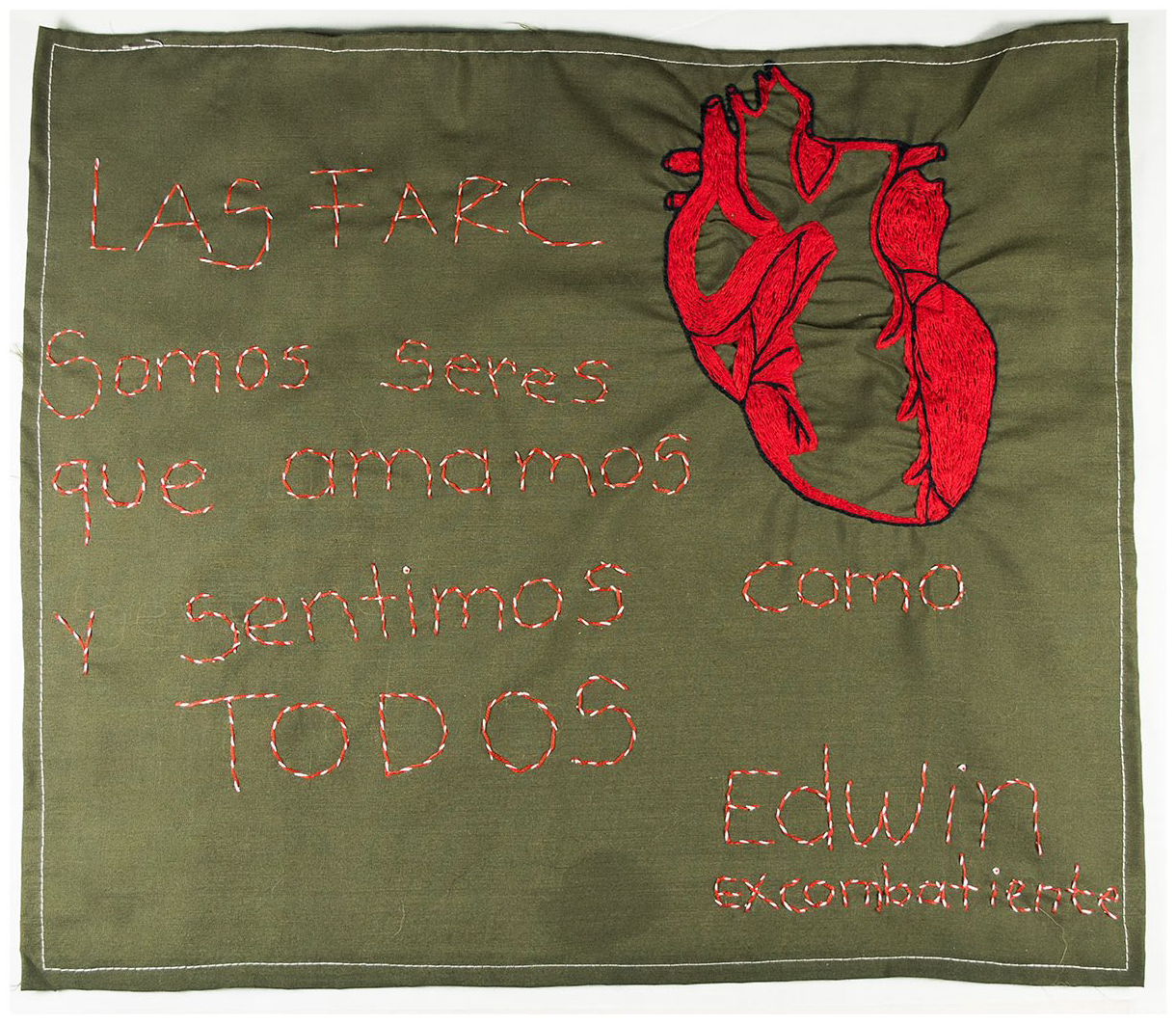
‘Un corazón como el de todos/A heart like everyone else’, Jhonatan, ETCR Llano Grande (Photo: Laura Coral Velásquez).
In the aftermath of violent conflict, how do people – former combatants, their supporters, their victims, and society at large – (re-)narrate their lives to live on and live together? And how can peace research contribute to this? These were the questions driving our research with demobilised FARC fighters, their families, and their new peasant neighbours in Llano Grande and San José de León, two rural communities in the Colombian department of Antioquia. 4 Through methods including narrative practices, textile-making workshops, and a travelling exhibition, we sought not just to understand, but also to actively encourage people’s sense-making about their violent past and transitional present to develop their life stories towards a hopefully more peaceful future. Besides constituting tools for gathering data, triangulating interpretations, and disseminating initial findings, our methods were also meant to complicate the dominant public narrative about the former FARC combatants and thereby to contribute, in a modest way, to ongoing peace efforts in Colombia.
Grounded in the insights afforded by this collaborative research project, in this article I make the case for the analytical and political potential of creative methods to textile peace (research). Taking ‘textile as a transitive verb’, art historian Julia Bryan-Wilson suggests the concept of textile(d) politics ‘to indicate a procedure of making politics material’ and to refer to modes of thought and practice that examine, unravel and resignify binary logics and categorisations. 5 Along these lines, creative methods can textile post-conflict politics by facilitating the development of subjectivities and relationships and by helping to expand the range of what can be thought, said, and felt about a conflict. Moreover, by socially, materially, and emotionally implicating peace researchers in the social and political processes they study, creative methods can also textile the politics of research on/in post-conflict situations. To substantiate these arguments, the article focuses on two aspects of creative methods in particular: on the element of making inherent in the creative generation of data, and on the thus created data as crafted stories entangling referential meaning with material traces of that which lies beyond linguistic expression.
Arguing for the power of creative methods to textile the politics of (research in) the post-conflict, 6 I hope to make two contributions. For one, the article furthers debates in peace research about the role of visuals and the arts in efforts for peace, reconciliation, and conflict transformation. 7 Basing themselves on the cultural, visual, and aesthetic turns in International Relations (IR), 8 contributors to these debates see great potential in visuals and the arts as approaches to peace, 9 yet also find that much of this potential remains to be developed. 10 Creative methods can help peace research fulfil some of this potential. Firstly, while existing research mostly takes the visual as its pivot, 11 creative methods urge researchers to pursue multisensory and multimodal lines of inquiry. 12 Secondly, creative methods call into question binary understandings of ‘high’ art and ‘traditional’ or ‘folk’ craft that seem to underlie some of the current debate on arts and peace. 13 Thirdly, while existing research mostly relies on found materials for its data, 14 creative methods encourage researchers to partake in the (co-) production of their data. 15 Finally, rather than approaching the transformative powers of arts for peace through institutional frames, 16 creative methods call on research to start from the experiences and agency of people living in and through post-conflict situations.
In connection with this last point, the article additionally aims to contribute to the emerging literature on post-conflict situations that centres the experiences of former combatants in Colombia and elsewhere. This literature highlights the complex and heterogeneous involvement of ex-combatants in post-conflict processes, 17 particularly with regard to these processes’ gendered dimensions, 18 and offers new theorisations of former fighters’ agency. 19 Frequently, these aims are pursued through an analytical focus on narratives and by means of methods such as interviews and participant observation. 20 A handful of studies have also trialled creative methods, including filmmaking and photography. 21 Their authors indicate that creative methods can enable a better grasp of everyday realities, 22 give former combatants as research participants a greater degree of authorship of their stories, 23 and render explicit the ‘power dynamics and hierarchies’ structuring the research. 24 To this emerging discussion, this article contributes by developing, not just practically but also theoretically, some of the more general characteristics distinguishing creative from more standard research methods, especially insofar as they bear on matters of narrative, subjectivity, and agency.
In what follows, I first lay the theoretical groundwork for the argument that creative methods can textile the politics of peace (research). I then provide some background on the Colombian conflict and on our research with former FARC fighters. Next, I suggest making as a common element of creative methods. Based on ideas about making as connecting 25 and as a locus of agency, 26 and drawing on conversations with my colleagues and our research participants, I ponder how textile- and exhibition-making engendered changes in post-conflict subjectivities and relationships. Thereupon, I turn to the data generated by creative methods. Casting these data as crafted stories that speak of their makers’ experiences in multisensory ways, I focus on the stories crafted by Jhonatan and another research participant to suggest that creative methods can affect a shift in the post-conflict ‘distribution of the sensible’. 27 In conclusion, I discuss the limits and possibilities of what creatively entangled peace research can achieve in terms of textiling (research on) post-conflict situations.
Textiling Politics through Creative Methods
Insofar as creativity is ‘a process of creating something from elements that already exist by putting them together in a new way’, all research is creative. 28 However, in peace research as in International Relations (IR) more generally, research methods are usually not seen as part of a creative process but assumed to serve a primarily representational function. Whether quantitative or qualitative, research methods are most often still taken to be universal and neutral techniques for capturing and reproducing information about social reality. 29 By contrast, creative methods such as collage, 30 curating, 31 drawing, 32 filmmaking, 33 performance, 34 and photography 35 do not seek to represent reality as faithfully as possible. Rather, their aim is to bring existing elements together in new ways to generate ‘richer and more distinctive’ insights, 36 thereby ‘broadening, deepening and expanding the universe of human understanding’. 37 In particular, creative methods excel at realising those aspects of social and political life that evade unambiguous representation, for instance its emotional, affective, embodied, and sensory dimensions. 38
A second aspect that distinguishes creative from other research methods are the kinds of empirical materials they work with. Creative methods are commonly understood as means for generating or analysing data that is not (or not mainly) textual or linguistic. 39 Among the plethora of approaches that this definition potentially subsumes, Dawn Mannay, whose research with young people uses various creative methods, further distinguishes between methods by means of which researchers can creatively generate data, methods that facilitate creative data-generation by research participants, and methods for analysing creatively generated data. 40 More recently, scholars have also explored creative methods for the analysis of more standard data such as documents and interviews. 41
Further defining characteristics of creative methods can be gleaned from a comparison with like-minded methodological orientations such as interpretive, arts-based, and action research. While interpretive methods are ‘meaning-focused’, 42 creative methods put an equal emphasis on the making aspect of meaning-making, 43 complementing hermeneutical with material, embodied, and emotional/affective insights that may be hard to put into words. 44 In this, creative methods are akin to arts-based research (ABR), 45 which seeks to enable non-linguistic and experiential insights into, for instance, (post-) conflict situations. 46 However, neither are all creative methods arts-based, 47 nor is all ABR creative or transformative. 48 With action research, creative methods share not only this kind of transformative intention, but also an inclination to ground themselves in tensions and uncertainties rather than in definitudes and an understanding of knowledge as produced in and through practical doing. 49 Yet unlike action research, creative methods do not necessarily involve the collaboration of research participants at every stage of the research process. 50 Overall, the difference between creative methods and interpretive, arts-based, and action research is often a difference in emphasis rather than in kind, suggesting the possibility of their combination. 51
My argument in this article is that creative methods can textile the politics of peace (research). Following Bryan-Wilson, to textile politics means ‘to give texture’ to it: ‘to refuse easy binaries, to acknowledge complications’, and to engage it in such a way that it becomes ‘textured as in uneven, but also [. . .] as in tangibly worked and retaining some of the grain of that labor’. 52 The concept of textile(d) politics seizes on the materiality of textiles, their being made up of many different threads, and their resulting ‘capacity to be pulled, stressed, and withstand tension’. 53 It also plays on what art historian and psychoanalyst Rozsika Parker refers to as textiles’ ‘dual face’ 54 – namely, that the slow and repetitive nature of textile-making practices has historically been utilised to further both ‘hegemonic and counterhegemonic’ political agendas, particularly with regards to women’s rights. 55 In light of textiles’ material, political, and practical traits, Bryan-Wilson’s research pursues a textile(d) politics by examining and at the same time un- and re-doing otherwise some of the constitutive dichotomies of her discipline, art history, most importantly that of ‘high’ art versus ‘low’ craft.
It is along analogous lines that creative methods can textile peace (research). Characterised by a propensity ‘to resist binary or categorical thinking’, 56 creative methods enable research to weave together multimodal and potentially contradictory materials and meanings. Thereby, they hold a two-fold potential for contributing to a post-conflict peace that incorporates rather than smoothes over existing lines of conflict. They can enable analytical processes that facilitate the development of patchy and knotty subjectivities and of new entanglements between people who used to be on different sides of a conflict, and they can generate richly and irregularly textured data that help expand the range of what can be thought, said, and felt about a conflict.
Furthermore, by pursuing explicitly transformative and frequently also collaborative research agendas, creative methods intertwine peace research within the social and political transformations it seeks to study. First institutionalised in the late 1950s as a sub-field of IR, peace research defines itself by an analytical focus on violence, conflict, and peace as well as by a normative-political commitment to peace. 57 However, this commitment is still only partly actualised in the (methodological) practice of research. 58 In this regard, creative methods push researchers to more actively engage in the inevitable politics of research and to develop what Richard Jackson, in a recent state of the field chapter, has called a ‘critical praxis’. 59
Before further expanding on these arguments, the following section introduces the research project with former FARC fighters on which this article is based. It pays particular attention to the various creative and other methods we used. While the creative part of our project’s methodology centrally revolved around textile-making practices, my argument about the potential of creative methods for textiling peace (research) is not limited to such literally textile-based methods. Preferences for particular creative practices may vary between researchers, and different creative methods may be appropriate for different research projects and contexts. Therefore, this article seeks to extend an invitation to peace researchers to engage in all kinds of creative methods.
(Re-)storying and (Un-)stitching Subjectivities, Relationships, and Lives in Post-agreement Colombia
The 2016 peace agreement between the Colombian government and the FARC-EP formally put an end to an armed conflict that had lasted for more than five decades, killed about 220,000 people (81.5% of whom were civilians), and displaced almost six million. 60 The agreement includes provisions for the demobilisation, disarmament and reintegration (DDR) of former FARC fighters, and a DDR process has since been rolled out in so-called ‘zones of transition’ and, more recently, the aforementioned Territorial Spaces of Training and Reincorporation (ETCR). 61 While overall levels of violence have decreased since the agreement’s ratification, the number of assassinations of social leaders, human rights defenders, and former combatants is on the rise. More generally, the implementation of the agreement has stalled, and the polarisation of Colombian society continues unabated. 62
Within this context, our research project sought to learn about the (changing) subjectivities of and relationships between former FARC fighters, their family members, and their new neighbours in the ETCR. Specifically, we were interested in the stories through which people narrate themselves and their lives within the post-agreement transition. Our understanding of ‘stories’ stemmed from narrative practice, a poststructuralist approach to psychotherapy which assumes that people construct stories to give expression to lived experience and that these stories are constitutive of people’s subjectivities and relationships. 63 Stories capture some parts of a person’s lived experience but not others, and hence, they – and with them people’s subjectivities and relationships – are changeable. However, stories are also bound within discursive orders: while those aspects of lived experiences that are deemed normal and central find expression in so-called ‘dominant’ stories, other parts that seem insignificant or deviant fail to be narrated. This is where narrative practice steps in to help people identify these ‘alternative’ (insignificant) and ‘silenced’ (deviant) stories, to choose their ‘preferred’ stories, and to ‘re-story’ their lives, subjectivities, and relationships. 64
Basing our project on narrative practice’s concept of ‘storying’, we conceived of our research methods as means for jointly identifying alternative, silenced, and preferred stories about our participants’ lives during and after the conflict. The notion of ‘alternative’ and ‘silenced stories’ employed here does not imply stories that we as researchers ‘revealed’ or ‘unearthed’, nor that we ‘gave voice’ to otherwise ‘voiceless’ actors. Rather, our project picked up on what former FARC fighters wanted to say and were saying already and tried to amplify the attention that these stories receive from other Colombians. We also did not arrive at the research with a pre-conceived list of topics but were open to whichever stories people chose to relate. 65 Overall, our research sought to enhance our research participants’ authorial agency – not we as researchers, but our participants were the relevant experts 66 – and to increase the visibility and audibility of their preferred stories within wider Colombian discourses.
During 12 months of fieldwork (the originally planned 18 months were cut short by the Covid-19 pandemic), we used biographical interviews, ethnographic observations, textile-making, and a travelling exhibition to learn about how ex-combatants and other research participants story their lives. 67 The method of textile-making was inspired by some team members’ prior experiences with textile-based social and political research and by their existing textile practice. 68 Secondary literatures on textile practices for peace, 69 on textiles, feminism, and politics, 70 and on textile-making as a research method provided further inspiration. 71 As a method for generating data, textile-making was also conceived in the context of existing traditions and initiatives of (political) textile-making in Colombia 72 and built on the practical knowledge of basic stitches which our participants had acquired during their time in the FARC, when they labelled and mended their clothes and sutured the wounds of comrades. 73
What did textile-making as a creative method look like in practice? In a series of collaborative textile-making workshops which we ran in San José de León and Llano Grande, we introduced participants to different textile-making practices (embroidery, appliqué, beadwork, textile collages, and doll-making), provided them with materials, and invited them to render their preferred story – an experience from their lives that they would like to share with other Colombians – in the form of a textile narrative. 74 Between workshops, many participants worked on their textile narratives in the intimacy of their homes. The workshops also helped us to secure access to and build trust with the communities. 75 Moreover, our research team also undertook individual and collaborative embroidery projects as a means of practical reflexivity. 76 Finally, textile-making provided for the generation of different and rich kinds of data, as the workshops became an occasion for innumerable informal conversations.
According to emerging themes, we grouped participants’ textile narratives into 12 books which then became the central pieces of a travelling exhibition. The exhibition was put on show in the two fieldwork sites and in the regional hub Apartadó, and the books also formed part of a collaborative exhibition in the departmental capital Medellín. Alongside these exhibitions, we also ran workshops for their audiences, students and colleagues at the University of Antioquia, and the staff and visitors of a community centre in a particularly disadvantaged neighbourhood of Medellín during which we invited participants to produce textile responses to the original pieces. Thereby, the travelling exhibition constituted a method not only for disseminating our research findings, but also for generating additional data and for triangulating and reflecting on our initial interpretations of the original textile narratives.
With the permission of our research participants, their textile narratives have been digitised and made available in an illustrated book 77 as well as a web archive. 78 The originals will be returned to their makers as soon as the Covid-19 pandemic permits. As part of our research ethics, we also ensured that our research participants knew their textile narratives would be publicly exhibited and could take an informed decision on whether to participate in the workshops and on what story they wanted to tell. Having said that, the ethics of textile- and exhibition-making as creative methods extended beyond the official forms and standard practices of informed consent. As one of my colleagues reflects, ‘our impression was that these words [exhibition] had little meaning until they [the research participants] actually saw the exhibition – museums and galleries are neither a part of life “in the bush” (en el monte) nor of peasant life in Colombia’s rural areas (territorios)’. 79
As this last point already hints at, there is more to creative methods than this section’s technical descriptions let on. ‘It was a total surprise’, my colleague Martha Rendón told me about the exhibition in San José de León, ‘it exceeded my own expectations’. Laura Coral, another one of my colleagues, added that for her, textile-making was not simply a method of data-generation, but also ‘a practical exercise for understanding the social fabric and for grasping the power of un- and restitching ourselves’. 80 The remainder of this article teases out more precisely this ‘more’ that there seems to be to textile-making and exhibitions as creative methods.
The Power and Politics of Making as Method
Creativity is ‘notoriously hard to define’. 81 Commonplace understandings equate it with ideas of ‘originality’ and ‘usefulness’ 82 and associate it with the individual, disembodied, and solitary genius producing world-shattering works of art or making paradigm-changing scientific discoveries. 83 Against this only seemingly neutral understanding of creativity, more critically inclined social scientists emphasise the social, embodied, processual, and everyday dimensions of creativity, conceptualising it as ‘little c creativity’ 84 and as ‘a form of making’. 85 Based on these alternative readings, in this section I focus on making – the bringing into being of something new – as a common element of creative research methods.
While making has rarely been reflected upon in IR and peace and conflict studies, 86 anthropologists, 87 geographers, 88 and sociologists 89 have theorised making as a way of engaging the self, others, and the world. For the power of making as an element of creative research methods, two aspects seem particularly relevant. Firstly, making can facilitate agency and subjectivisation. Psychoanalyst Rozsika Parker suggests that making serves ‘containing’ and ‘mirroring’ functions: it enables a maker ‘to hold in her hands a coherent object which exists both outside in the world and inside her head’ and to see ‘a positive reflection of herself in her work and, importantly, in the reception of her work by others’. 90 Moreover, as sociologist David Gauntlett argues, ‘making is connecting’: to create any new object, we have to connect materials and/or ideas, connect with people, and connect with our natural, physical, and social environments. 91 Through the element of making, creative research methods can thus not only generate data, but also further agency, subjectivities, and relationships.
For peace research using creative methods, these powers of making raise questions about how these methods textile post-conflict politics. Whose agency do creative methods’ practices of making affirm? What processes of subjectivisation do they facilitate? How do creative methods challenge or reproduce existing political structures, practices, and relationships? I discuss these issues as they came to the fore in our textile- and exhibition-making with former FARC combatants.
Textile-making
To our research participants, we proposed textile-making as a means of expressing their experiences of the conflict and the post-agreement transition. The demobilised FARC’s reincorporation into civilian life implies many transitions at once: from mobile life in the guerrilla to sedentary life in an ETCR; from living with comrades to living as a traditional family; from a strictly hierarchical to a more horizontal organisation of collective life; and from a default defensiveness, seeing in others a potential source of danger, to a standard assumption that one’s neighbours generally do not mean harm. For the ex-combatants we worked with, coming to grips with these multiple transitions has been a challenge that has consistently required them to exert their agency and revaluate how they viewed themselves – and whatever our textile-making methods could offer to their individual and collective processes of transition was an add-on to what they were doing already. 92
Many of the former combatants’ textile narratives express their makers’ experiences of the transition from military to civilian life. The three textiles in figure 2 show a group of FARC still in arms, then on their way to the disarmament zone, and finally an ex-combatant arriving there, a child in their arms. In another textile narrative, a gun, a house, and a pond symbolise what giving up her gun felt like for Adriana, a former FARC fighter living in San José de León (Figure 3): ‘When I started carrying a gun, I knew that this was my defence, [. . .] it was my faithful companion, [. . .] that’s what happens to you when you are in the war, it’s the only one that doesn’t betray you. . . if you don’t pay attention, it kills you. [. . .] It was very hard for me to turn it in, I cried a lot. [. . .] It is a void’.
93
Adriana’s textile narrative shows the disorientation of the transition to civilian life. It is the flipside of the ‘pleasure of agency’ that rebels often find in their armed struggle for a more just society. 94 As Jhonatan, the ex-combatant who embroidered the human heart, explained to me: while he and the others in Llano Grande were committed to the peace process, they also still hoped to change Colombia for the better – and while they were no monsters, ‘in reality, we don’t know what we are’. 95
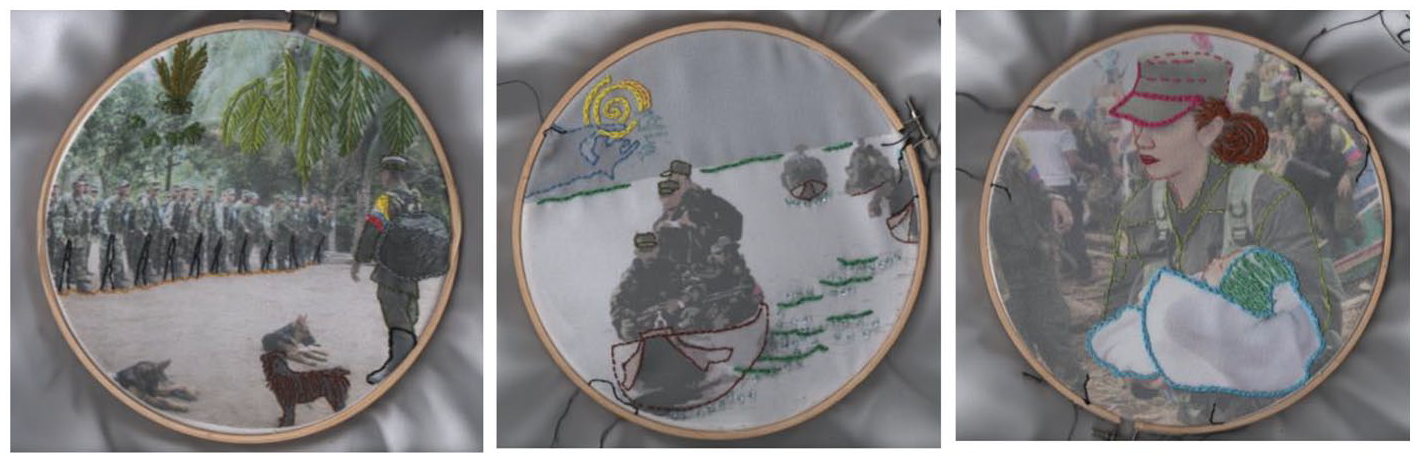
‘Del monte a la reincorporación/From the bush to reintegration’. Photographs by an anonymous ex-combatant (left) and Jesús Abad Colorado (centre and right), sublimation-printed on fabric, embroidered intervention by research participants from San José de León (Photos: Laura Coral Velásquez).
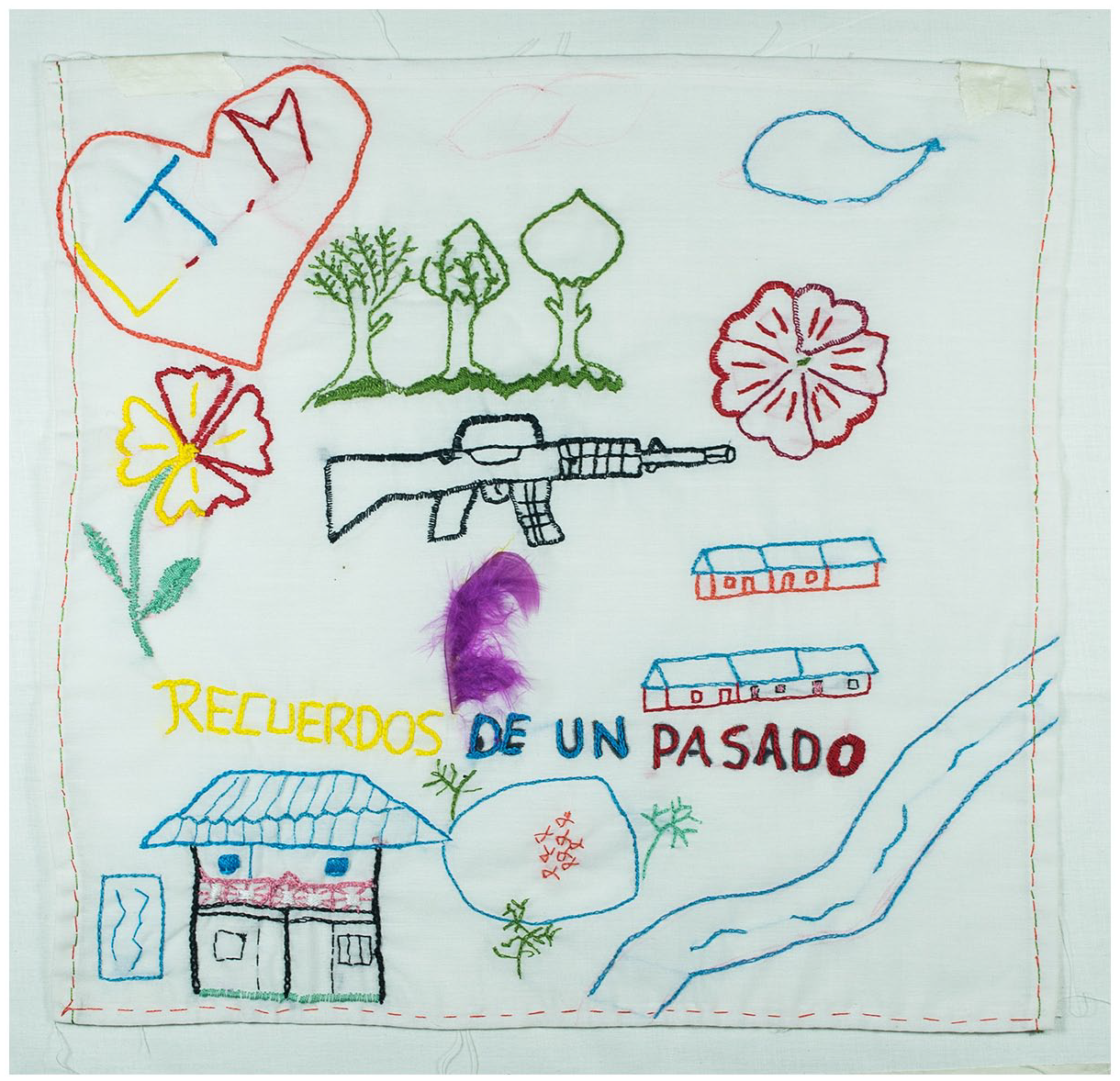
‘Fúsil/Gun’. Adriana, San José de León (Photo: Laura Coral Velásquez).
In the context of the reincorporation process’s uncertainties, textile-making constituted a means through which some of our research participants affirmed or furthered their sense of self. To some, textile-making appealed because it registered, materialised and gave a firmer shape to their experiences. Jhonatan, for instance, was initially drawn to our textile-making workshops because their out-of-the-ordinary nature corresponded to how he viewed himself: ‘I am very curious, and therefore I wanted to know what it was that you were going to do’. 96 For other ex-combatants textile-making took a leap of faith. As my colleague Martha reflected, our research participants had previously been active in the war, carrying weapons and killing people: ‘A rifle is a very sturdy thing. To then take up a little scrap of fabric and transform it, you have to undo a lot of things before you can give [embroidery] a try’. 97
Exhibition-making
To prepare our research participants’ textile narratives for the travelling exhibition, we washed, dried, and ironed them, sewed them onto pieces of semi-transparent voile fabric, stapled these pieces into purpose-built wooden frames, and screwed the frames together to form accordion pleat-type textile ‘books’. For the exhibition in Medellín, we suspended these textile books from the ceiling or placed them on plinths. In Dabeiba, we worked until late into the evening to transform the educational centre’s first floor into an exhibition space. And in San José de León, before my colleagues could install the actual exhibition, they first had to outfit a chicken coop with side walls to make it into an improvised gallery. 98
The travelling exhibition and its making textilled the Colombian post-agreement situation by introducing new threads into the social fabric of our research communities. 99 At the inauguration of the exhibition in San José de León, for instance, several of the female ex-combatants whose textile narratives were on show took the floor and confidently claimed their contribution to the exhibition. This ‘puntadita’ (small stitch) against the generally patriarchal gender relations in the community – a fitting pun courtesy of my colleague Laura – caused the male community leaders visible discomfort. 100 Furthermore, the exhibition intertwined the textile narratives with the social and natural contexts in which they had been made. As Laura, a fine artist by training, explained: ‘In contemporary art in Colombia, a piece of art speaks about and in a context, [. . .] and this gives it vitality’. 101 Along these lines, the pleasure people took in seeing their embroideries form part of the exhibition reinforced the textile narratives’ significance, as did the soft blow of the wind sweeping through the textiles in Dabeiba (Figure 4), the chicken still on the loose and the tamped earthen floor of the make-shift gallery in San José de León.
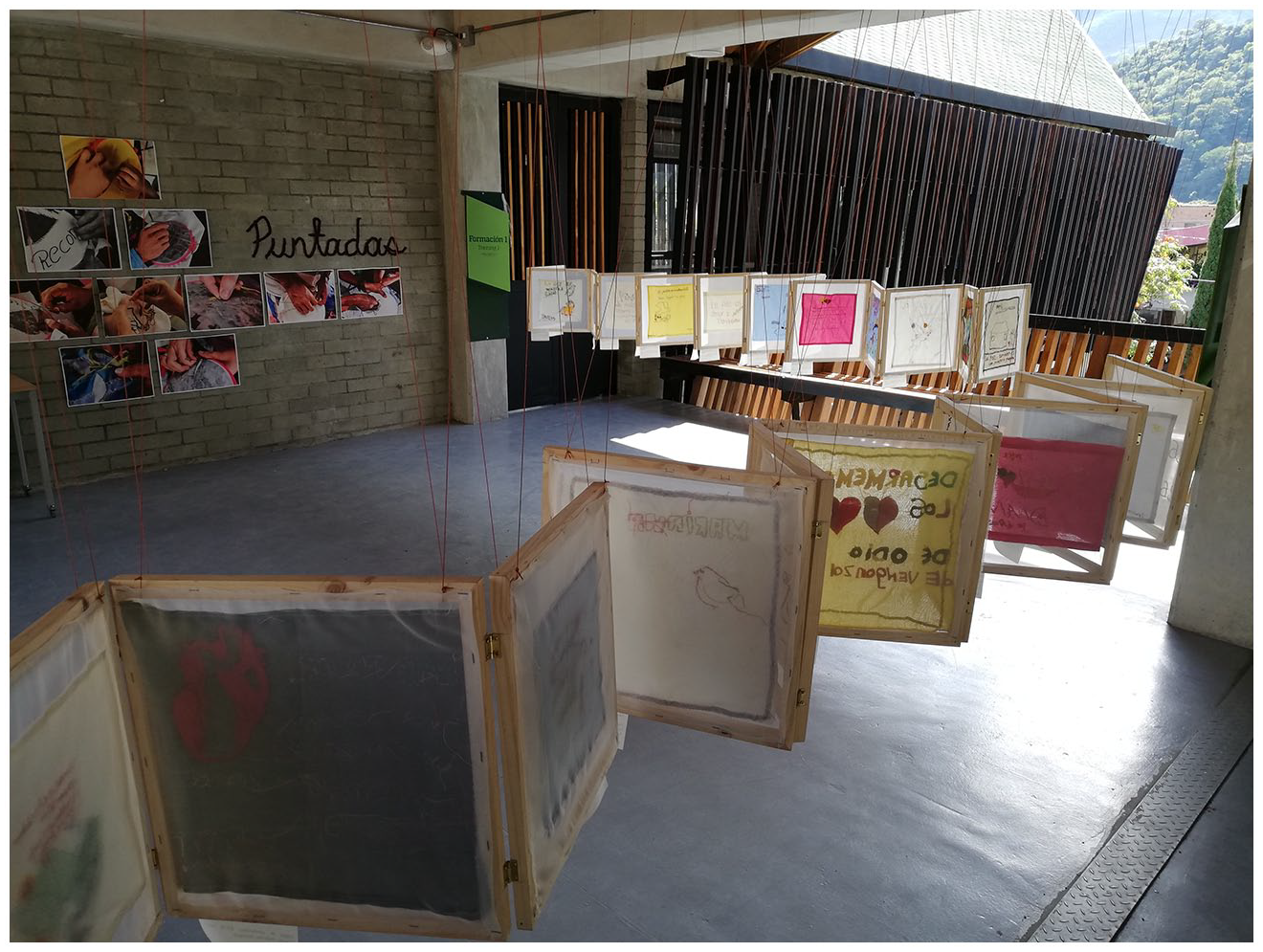
Part of the exhibition in the Parque Educativo, Dabeiba (Photo: Christine Andrä).
The exhibition also spun further connections between the communities, our team, and our research. Helping with the exhibition’s installation was a chance for community members to get involved with our research in a different way (Figure 5). Many were also touched to see how we had taken care of their textiles. As one of them noted when visiting the exhibition in Dabeiba: ‘I gave [the textiles] to you all dirty, and now they are so clean’. People were astounded by the very different aesthetics the exhibition spaces took on. Surely, not all inhabitants of San José de León and Llano Grande visited the exhibition, yet those who did stressed the importance they accorded our work.
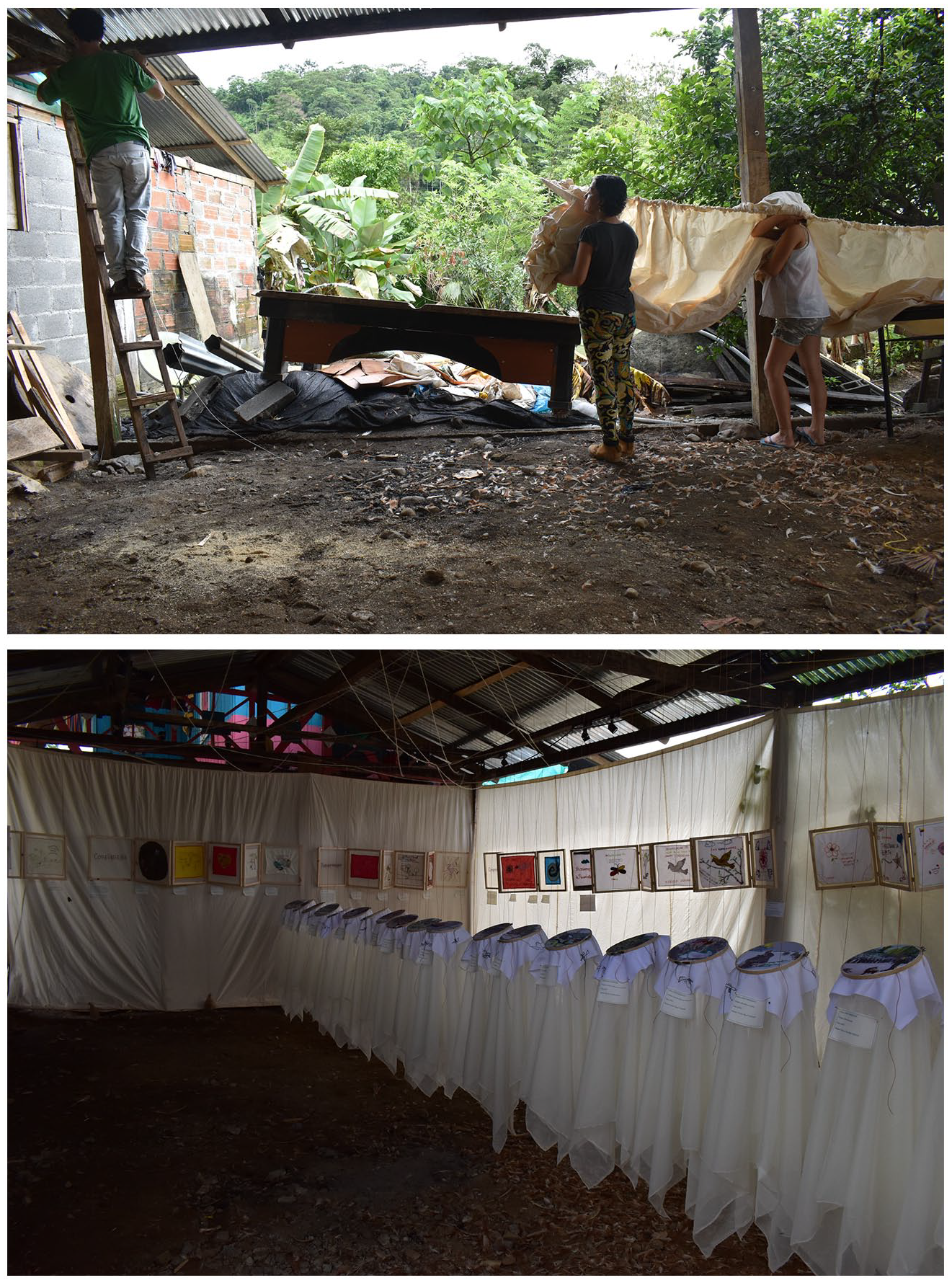
Installing the exhibition in San José de León (Photo: Laura Coral Velásquez).
To pick up again on the question of the ethics of creative methods, the exhibitions also helped to clarify for research participants and the communities what our project was about. In San José de León, while many members of the community had previously thought nothing much of our research, the exhibition completely changed how people understood it. Between the fieldwork communities and our team, the exhibition thus amounted to ‘a collective creation of trustful relationships’. 102
Finally, the travelling exhibition forged new connections between our fieldwork participants and urban audiences in Medellín, leading at least some among these audiences to rethink their relationship with the former FARC fighters. Exhibition visitors in Medellín were surprised by the commonalities between the former combatants’ and their own lives, such as the importance of the family and of annual festivities. They were equally astounded by elements in the demobilised fighters’ stories that were specific to life in the guerrilla, for instance the complexity of people’s reasons for joining the FARC, the fact that divisions between different armed groups often ran right through communities and families, and the challenges of having to redefine oneself after spending many years en el monte. Audience members in Medellín were also surprised that our research consisted in speaking to and indeed embroidering with former FARC combatants. Yeraldine, a university student who had participated in a workshop in Medellín, was bewildered by ‘this new bet of yours, with these others. . . these other people. . . who were from the other side, the ex-combatants. I was like: no! Are they insane?!? [laughs] It surprised me so much’. 103
These cumulative surprises had a profound effect on the exhibition’s audiences in Medellín. The demobilised combatants’ stories opened the doors for a rehumanisation of audience members’ views of the former FARC. As one exhibition visitor reflected in their guestbook entry, ‘we are all equal, there are differences but these differences make us perfect’. Many people also left the exhibition and workshops wanting to learn about the former fighters’ lives. 104 Moreover, at a time when the peace process in general seemed largely stalled, the ex-combatants’ stories rekindled audience members’ faith in the attainability of peace and in their own agency in making this happen. 105 Finally, the exhibition inspired many of its visitors to reconsider their relationship to the former combatants. Yeraldine wanted to try and put herself in these ‘others’’ shoes. 106 William, a university lecturer, saw violence as a problem that included both the former FARC living in rural areas and himself and others like him in the ‘big cities’: ‘[W]e here [. . .] are reproducing the same violence. [. . .] there is violence there and we need to look at the actors [there], but we also need to look at ourselves [. . .] the commitment to peace is also born from here and in each and every one of us’. 107
Making Post-conflict Politics
Facilitating agency and forging new connections, creative methods can textile post-conflict politics through their element of making. In San José de León, for instance, politics is organised in the form of a monthly assembly and several working committees, both of which in theory deliberate and reach decisions collectively. However, during our fieldwork, these official fora were often dominated by a small number of men who used to be military leaders, causing many in the community to disengage from local politics. 108 In this context, the textile-making workshops and the exhibition offered community members a chance to interact with each other and tell their stories along lines that did not follow previous chains of command. As one of my colleagues remembers, ‘[t]he exhibition also highlighted the contributions of community members who are seldom in the limelight’. 109
The relatively short timeframe of the research and its interruption due to the Covid-19 pandemic make it impossible to estimate the longer-term impact of our methods on the communities’ organisation and practice of politics. What can be said is that the textile-making workshops and the exhibition rendered more visible the military and patriarchal hierarchies structuring public life in the village. Already before our fieldwork, these hierarchies had come under pressure due to the Colombian peace agreement, which is noteworthy for its inclusion of feminist ideas about gender and sexuality, 110 as well as to the feminist ideas of many women ex-combatants (farianas), who during the war had experienced ‘a more egalitarian environment in the FARC-EP than in their former social and family circles’. 111 Nonetheless, gendered hierarchies in the communities were proving more persistent than especially many women research participants had been hoping for. 112 By rendering these hierarchies more visible, our research methods sought to contribute, in a small way, to ongoing efforts to challenge them.
Moreover, our project’s textile- and exhibition-making also sought to counter the narrative, prevalent at the national political level, of the former FARC as terrorists, criminals, and non-humans. Already during the conflict, this narrative had served the Uribe government to deny the political aims of FARC’s armed struggle, legitimise extrajudicial killings of FARC fighters, and animate Colombians to side against the FARC. 113 In the current post-agreement context, characterised by political and social polarisation and the continuation of politically motivated assassinations, this narrative ties in with what many Colombians perceive to be the Duque government’s insufficient commitment to the peace process. Against this background, urban audiences in Medellín read the textiles and the exhibition also as criticisms of the government. The message these audiences took away from ‘other’ Colombians’ textile narratives was that ‘you have to trust the peace process and help to materialize it’. 114
A final way in which the making element of creative methods textiles post-conflict politics is through the political frameworks in which practices of making are invariably steeped. As already alluded to, textile-making, and particularly embroidery, is a gendered practice which across diverse contexts has provided women with a ‘means to independence’, but also contributed to their economic exploitation and ‘promoted submission to the norms of feminine obedience’. 115 In our research, the gendered nature of textile-making – which prior to our arrival was not an established practice in our fieldwork communities – fed into the tensions and contradictions characterising gender relations in post-agreement Colombia. Many female ex-combatants find their agency simultaneously capacitated by having been a FARC fighter and circumscribed by everyday patriarchal norms and practices, charged by the need to generate an economic income and curtailed by the lack of public spaces accessible to women. In this context, our textile-making method contributed to furthering their agency, as several female ex-combatants who participated in our research later set up a small textile-making business. 116 Yet community members, exhibition audiences, and also our team read our project’s methodology through gendered lenses. 117 While our research had initially attracted the interest of community members of all genders, over the course of our fieldwork, the ‘core’ group participating in the textile-making turned out to consist mostly of women. 118 Arguably, there are some ways in which the making element of our project’s creative methods thus did not so much undo gender relations as it rewove and resignified them. And while the example given here is one of textile-based methods, it indicates that peace researchers using all kinds of creative methods need to pay careful attention to how these methods’ practices of making figure within gendered and other inequalities.
Creatively Generated Data as Crafted Stories
‘I wanted to express it in another way,’ Jhonatan told me about his textile narrative. ‘I wanted it to reflect that our process [of reincorporation] is hard, that it takes time, and there is a lot of fear. I wanted to not just embroider for embroidery’s sake, but to show that [. . .] embroidery is a way of telling a story, too’. 119 As Jhonatan explained, what makes his and the other research participants’ textile narratives analytically rich and politically powerful is not only their semantic content, but also their hinting at the emotional, affective, and embodied experiences of their makers. 120 Their power lies both in what they are about and how they are told.
To capture the nature of the data generated by creative methods and to specify these data’s capacity for textiling the politics of peace (research), I suggest understanding them as crafted stories. As stories, creatively generated data go beyond commonplace understandings of the ‘storying of experience as dependent on language’ 121 to also incorporate non-linguistic elements. As Beatriz Arias López reflects about the writing-up of her research with victims of the Colombian conflict, telling the story of this research involved ‘more than a simple exercise in writing’ – it also required her to ‘give an account of the [narrative] process’ that she had undertaken jointly with the research participants. 122 Thus, to at least somewhat appropriately convey participants’ emotional, embodied, and everyday experiences meant finding a way to also convey their ‘voices, their nuances, [the story’s] rhythm, its key’. 123
Craft, in turn, is a metaphor for how these aspects of a narrative process and the experiences they help convey can materialise beyond the spoken or written word. As queer theorist Eve Kosowfsky Sedgwick suggests, a crafted object invites those that engage with it to imagine how it was made – by somebody’s hands (Figure 6), working with materials, through repeated movements, with skill and with care. 124 It also asks us, as Arias López describes, to appreciate an object’s ‘artisanal’ character, its being ‘a unique result that [. . .] carries the particular stamp of its creator’. 125 In an object’s crafted quality, that is, some of its process of creation remains palpable, bearing testament to its maker.
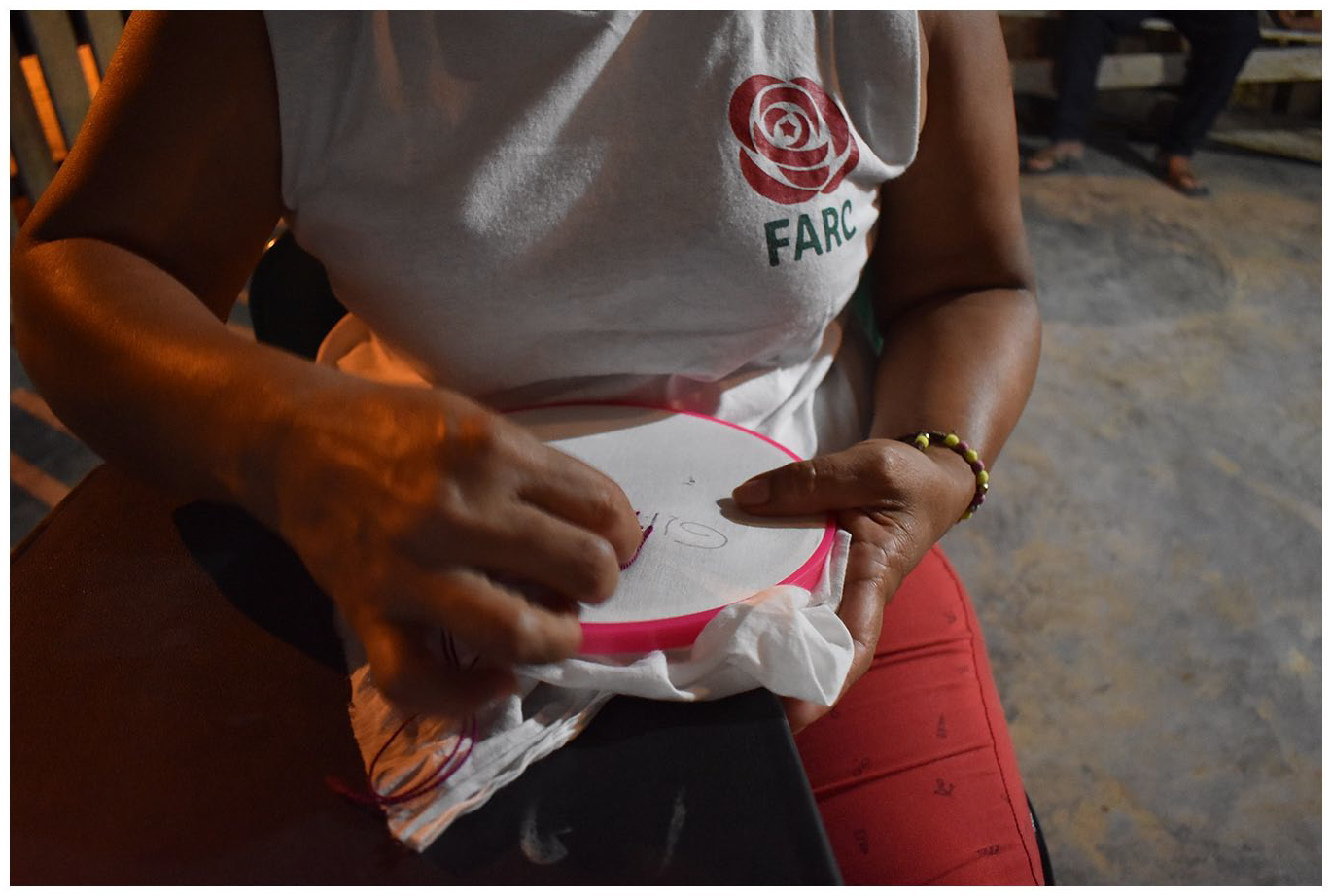
An ex-combatant embroidering, San José de León (Photo: Laura Coral Velásquez).
Thus, to think of creatively generated data as crafted stories casts them, quite literally, as the result of meaning-making. They give meaning to experience, and they leave perceptible some of their making, the acts of ‘sensory translation’, as Catherine Baker calls them, that their authors engaged in to not only put ‘embodied feeling into words’, but also give it material expression. 126 Understanding the data generated by creative methods as crafted stories means to recognise that in them, semantic meaning becomes entangled with material traces of those aspects of experience that exceed our capacities for linguistic articulation and analytical generalisation.
Semantic Meaning, Material Traces, and Embodied Sensations
At first glance, it is striking how rich the textile narratives of our research participants are in referential content. In Jhonatan’s textile narrative, it is not just the embroidered phrase that carries meaning. The textile panel’s colour – a ‘military green’, Jhonatan said – is meant to ‘represent us’, the former FARC fighters who, as his panel exclaims, are human beings just like everyone else. The heart stitched in red thread reinforces this message. Unlike many other research participants, Jhonatan did not embroider a heart that looked ‘like a caricature. No. I wanted it to be real to demonstrate that we are real’. By its naturalistic design, the heart is intended to explain that while ‘the war had its faults, [. . .] this does not mean that we are somehow different, inhuman’. Jhonatan deliberately ‘chose stitches that give you more work’ to reflect that ‘what I am longing for will not be easy to achieve’. Ultimately, he hoped that the design of his textile narrative would help to convey to its audience the weight of its message. 127
Yeraldine, the university student, said she had gotten this message: ‘There are people who want to make a change, [. . .] who do not want to deceive us, who deserve the opportunity to be with us’. The correlato Yeraldine embroidered in response to the former combatants’ textile narratives reflects her changing views of them (Figure 7). Her initial understanding of the (former) FARC as ‘bad people doing damage to the country’ had already begun to shift when she moved to Medellín to attend university. Our project further altered her perspective, and she began to see the former combatants as people who actively wanted to build peaceful new lives. Yeraldine’s correlato expresses this change symbolically: while the flowers stand for ‘the possibility of flourishing and starting over from the root’, the boots ‘used to be a symbol of this uniform, and of this figure [of the guerrillero]. [. . .] And now they are no longer boots of war, they are work boots, they are about being in community, about understanding’. The boots are the metaphorical ‘shoes that I want to put myself in’. 128
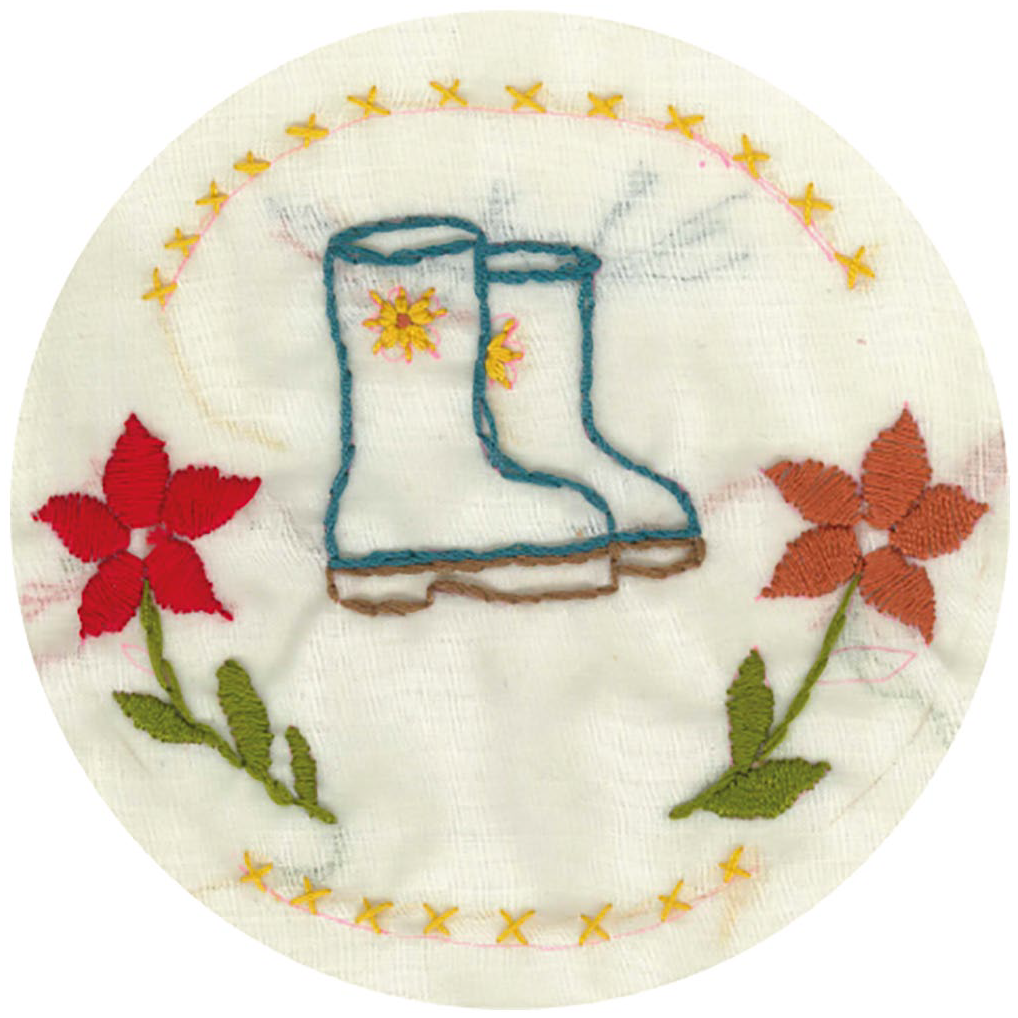
Yeraldine’s correlato (Photo: Laura Coral Velásquez
To invest their crafted stories with these layers of referential meaning, Jhonatan and Yeraldine engaged in sensory translations which left material traces within their textiles, relating something about their processes of creation. On Yeraldine’s correlato, the marks with which she had pencilled her design onto the fabric remain faintly visible underneath some of her carefully placed stitches. The upper right corner of Jhonatan’s textile narrative is crinkled, the fabric resisting all efforts at smoothing its surface as the hundreds of stitches making up the human heart pull it in all directions at once. The small, meticulously implemented stitches with which the heart is rendered offer a striking contrast to the whipped running stitch of the exclamatory phrase, which leaves the lettering rough and irregularly shaped.
These material traces hint at emotional, affective, and embodied experiences of textile-making, but also of the conflict and its aftermath. When I asked them what stitching felt like, Jhonatan and Yeraldine both spoke of the lifting of burdens. Still searching for the right words, Yeraldine added: ‘the sensation was, I dunno, a bit like I was relaxed, I was reflecting, and I was thinking about many different things’.
129
Meanwhile, Jhonatan found that stitching calmed his body and mind: ‘When I’m embroidering, I concentrate. There’s even a moment when I don't think about anything, only about the embroidery. I focus on the stitches, that I do them well. [. . .] Often, I took up my embroidery, I de-stressed, and I didn’t feel hunger or anything. . . and it's, like, a good feeling’.
130
Studies of textile-making in therapeutic settings note its capacity for helping with processing feelings and calming the nervous system. 131 These embodied sensations of textile-making are materialised in Jhonatan’s and Yeraldine’s embroideries, too.
Jhonatan’s and Yeraldine’s experiences of textile-making also indicate how in the creative generation of data, manual doing and embodied sensations become entangled with abstract, reflective, and speculative thinking. As Andrea Carolina Bello Tocancipá and Juan Pablo Aranguen Romero found in textile-making with women victims of the Colombian conflict, so long as someone lacks the necessary (manual/practical) skills, ‘all their efforts will go into comprehending the task itself’, yet once they have acquired a ‘tacit knowledge of the practice, thinking and movement become one and the same thing’. 132 Giving rise to new ideas about oneself and the world, this coincidence of manual doing, reflective thinking, and affective sensation can produce ‘meanings that span the embodied, the relational and the emotional’. 133 When I asked Jhonatan whether one could say that textile-making was helping him in his transition to civilian life, he replied that ‘yes, embroidery helps because it is. . . like a kind of mourning in thread. A mourning for the things that happened, the things that pain you. As you embroider, you are thinking about them, but you are also thinking about how. . . every stitch is another step you take, and a change’. 134
As creative methods encourage the generation of crafted stories, there are also certain tensions between these stories’ meaningfulness and their materiality. On the one hand, while the material enables the expression of ideas, experiences, and sensations, it also imposes limitations. 135 As my colleague Laura explained, ‘the fabric demands you to be careful. [. . .] It is flexible, you have to [proceed] with patience. It’s not quick and immediate, but a slow and delicate rhythm’. 136 Sometimes, the material ensnared meaning-making, as when Yeraldine chose the red thread for her flowers not to attribute it any meaning, but simply because she liked it. 137 Sometimes, the material also outright thwarted the generation of meaning, as when our participants ran out of thread knowing that it would be a while before new supplies would arrive. 138
On the other hand, there are also limits to the intellectual interpretation of creatively generated data. As crafted stories, they are, as Bryan-Wilson argues, ‘filled with uncertainties and contradictions’ and defy any straightforward usage as social-scientific ‘evidence’. 139 Rather, and as Roxani Krystalli reflects on encountering textiles made by victims of the Colombian conflict, researchers working with such creatively generated materials have to be willing to bear ‘the uneasiness that comes with not quite knowing [. . .] how to interpret a different kind of document or artifact of violence and peace’. 140 Creatively generated materials often require non-intellectual modes of engagement – asking their audiences, including researchers, to leave behind well-trodden interpretive paths and give other, more creative ways of interacting with them a try. 141 Overall, crafted stories demand of researchers a carefulness that neither dismisses these materials’ non-semantic content nor reads too much into it, and a readiness to stray from tried-and-tested ways of engaging data and ‘doing analysis’.
Challenging the Distribution of the Sensible in the Post-conflict
Containing myriad semantic and material threads, our research participants’ crafted stories speak of the emotional, affective, and embodied experiences of their makers. Herein lies a second way in which creative methods can textile post-conflict politics. Going beyond what can be articulated in words and images, the stories crafted by our research participants give multisensory expression to their makers’ experiences of the Colombian conflict and its aftermath and shift the boundaries between what can and cannot be perceived, felt, said, and understood. Thereby, they challenge the ‘distribution of the sensible’ characterising post-agreement Colombia. 142
Of course, there are limits to what any method can achieve in terms of shifting what is thinkable, knowable, and sayable about a conflict. In our research, for instance, the former FARC fighters’ repentance for war-time wrongdoings has been circumscribed. Many of the ex-combatants in San José de León belonged to a front of the FARC that was involved in the 2002 Bojayá massacre of more than one hundred civilians. 143 Yet while the FARC’s leadership later acknowledged its share of the responsibility for the massacre, some of the ex-combatants we worked with – whether because they truly did not want to do so or ‘merely’ wanted to protect themselves – neither wanted to recognise their individual responsibility nor express remorse about the massacre. Likewise, there were also limits to what our engagement of urban audiences could contribute to changing the distribution of the sensible among these audiences. William thought that there was no chance of the general discourse on the former FARC ‘doing a one-eighty’, 144 and Yeraldine recounted how whenever she visited her family at home, she kept her changing views about the FARC to herself. 145
Still, by generating crafted stories whose power lies in their content as much as in their telling, creative methods can contribute to changing the post-conflict distribution of the sensible, amounting to a particular kind of aesthetic politics. 146 According to Roland Bleiker, aesthetic politics is ‘about the ability to step back, reflect and see, hear, and sense political conflict [. . .] in new ways’, and it is located in our dealings with the inevitable ‘gap between a representation and what it represents’. 147 Insofar as people’s emotional, affective, and embodied experiences of violent conflict and its aftermath can never be fully represented, creative methods partake in post-conflict politics not by seeking to close this gap, but by rendering it material and giving it texture.
Conclusion
This article has explored the analytical and political potential of creative methods for peace research. Grounded in a collaborative research project with former FARC fighters, their families, and their new neighbours, it has argued that creative methods, through their elements of making and by producing crafted stories, can serve not only as means for the generation and analysis of data, but also to textile post-conflict politics – in Colombia and elsewhere. Creative methods can help to increase the visibility of stories of the (post-) conflict that are otherwise not in the limelight.
This is not to suggest that creative methods naturally contribute to peace. As Bryan-Wilson highlights, ‘textile-based techniques, like any others, have no immanent politics’ 148 – and neither do textile-making, exhibitions, and other creative methods. However, creative methods all have a politics: by examining, un-doing, and re-doing otherwise binary logics and categorisations, including in material ways, they implicate research in the realities it studies.
Therefore, creative methods require peace researchers to be clear about how their methods entangle them with research participants and with one another. As an alternative to more standard methods’ practices of knowledge extraction, 149 creative methods constitute one possible answer to the methodological imperative of recognising how the agency and subjectivities of people living in (post-) conflict situations also ‘[unfold] through research encounters’. 150 However, creative methods do not offset ‘asymmetries of wealth, health, knowledge and agency’ between researchers – from the Global North and the Global South – and research participants. 151 While our project sought to centre people’s own stories, for many of our research participants, issues such as income cultivation and access to medical care outweighed the rather more abstract question of how they understood themselves. Nothing we did to accommodate their concerns could solve the fundamental predicament that the questions we brought to the research sometimes diverged markedly from our participants’ priorities.
Moreover, while creative methods can enable the close and effective collaboration between researchers from very different geographical, disciplinary, and biographical backgrounds, 152 they are no panacea for the structural inequalities and violence often characterising peace research conducted by scholars from the Global North in the Global South. 153 Our collaborative project was unusual in this regard, as it was conceived by my Colombian colleagues, who then also led the way in conceptualisation, fieldwork, and analysis. To highlight my colleagues’ contribution to my thinking about creative methods, I have cited their published work and our ongoing conversations. Yet this is but a puntadita, as my colleague Laura would say, against the persistent division of academic labour in peace research which all too often accords scholars from the Global South no more than a supporting role – including in Colombia, where, as my colleague Martha explained, ‘it is always necessary to have [international] validation’. 154
Finally, and considering the sheer scale of the Colombian conflict and the continued violence of its aftermath, what our creative methods could do to support the post-agreement transition to peace was even more limited in scope. Most importantly, perhaps, they could share and help to boost our research participants’ hopes for a more peaceful future. ‘There is always something that can be done from the base,’ William said, 155 and Yeraldine ‘wanted to have hope that [. . .] the war and the conflict maybe won’t end, but there will be less of them’. 156 The communities of Llano Grande and San José de León had, prior to the pandemic, invited us to return and develop new textile practices with them. And Jhonatan was already planning his next embroideries: first, a replica of the textile narrative he had entrusted us – and then, ‘the idea is not to stop there. The idea is to continue as long as possible and to do many of them’. 157
Footnotes
Acknowledgements
I would like to thank my colleagues on the ‘(Un)stitching/(Des)tejiendo' research project – Beatriz Elena Arias López, Berit Bliesemann de Guevara, Grey Yuliet Ceballos, Laura Antonia Coral Velásquez, Olivia Morales, Martha Rendón, Berena Torres Marín, Elsa Pilar Parra, Blanca Valencia, and Jessica Valencia – as well as our research participants and audience members who very generously shared their insights and stories with me. Many thanks are also due to the editors and the two anonymous reviewers for their constructive and thoughtful comments. Finally, I would like to thank Caitlin Hamilton, Danielle House, Katharina Krause, Katarina Kušić, Amaya Querejazu and Victória Santos for very helpful feedback on earlier versions of this article.
Declaration of Conflicting Interests
The author declared no potential conflicts of interest with respect to the research, authorship, and/ or publication of this article.
Funding
The author disclosed receipt of the following financial support for the research, authorship, and/or publication of this article: This research was jointly supported by the Ministry of Science, Technology and Innovation in Colombia, Minciencias (project reference FP44842-282-2018) and the Newton Fund, UK (project reference AH/R01373X/1).
