



Abstract
This article furthers the debate on the political implications of the Anthropocene – the most recent geological epoch marked by catastrophic environmental change – by engaging it through the lens of political theology. The article starts from the observation that discourses on the Anthropocene and related political projects are deeply influenced by a linear temporality and a common orientation towards the threat of the end of time. It distinguishes three competing discourses of the Anthropocene, eco-catastrophism, eco-modernism and planetary realism. The article analyses how these discourses invoke and update key symbols, images, and storylines of Christian political theology. Furthermore, it studies how each discourse mobilises these secularised Christian motifs to promote competing planet political projects. Each of these projects develops a different position towards the unfolding planetary crisis and the related threat of the end of time. Eco-catastrophism calls for a planetary emergency management, eco-modernism promotes ongoing experimentation with the planet, whereas planetary realism translates into what could be called a ‘realpolitik of resilience’. Revealing the Western theological roots of the Anthropocene and planet politics is essential if the emerging literature on the Anthropocene wants to live up to its promise of pluralising and decolonising IR.
Introduction
In the summer of 2018, a month-long drought plagued large parts of the Northern Hemisphere. People in the world’s major cities, such as New York and Tokyo, suffered from a life-threatening heatwave. Across North America and Europe, massive wildfires were raging. Even Siberia and other parts of the Arctic Circle were on fire. The extreme weather had a remarkable impact on the public discourse across the Western world. The summer of 2018, according to the Western media, would allow a brief glimpse into the planetary future, and give ‘us’ a ‘warning of what we will have to deal with’. 1 Within just a few months Extinction Rebellion, grew into a major political movement in Europe, mobilising thousands of people to protest against a looming climate emergency and mass extinction. With this new public attention to a looming climate and extinction crisis, the Western public has become attuned to a debate that has gained traction in numerous academic disciplines in recent years. This is, namely, the discourse on the Anthropocene as the latest geological epoch of the Earth, defined by human impact on the planet. 2 The Anthropocene thesis has recently had strong repercussions within the discipline of International Relations (IR) too. 3 The widely-perceived ‘Planet Politics Manifesto’ 4 published in Millennium: Journal of International Studies, for example, argued that the Anthropocene represents a temporal rupture for the entire discipline. Core beliefs about the separation of nature and culture, the Cartesian dualism of subject and object, would crumble against the backdrop of this planetary crisis, thus requiring IR scholars to fundamentally rethink what we mean by concepts such as security, diplomacy and democracy. With these assertions, the Manifesto sparked a controversy about international politics in and for the Anthropocene around the notion of ‘planet politics’.
This article contributes to this emerging debate by showing that discourses on the Anthropocene and related political projects are deeply influenced by a linear temporality and a common orientation towards the threat of the end of time. 5 Drawing on the reading of the Anthropocene as secular eschatology, which refers to to the Christian doctrine of the last things and is concerned with the final events of history, this article shows that there is not one single political project ensuing from the acknowledgment of an existential planetary crisis. Rather, there are multiple projects of planet politics – each unfolding within different discourses 6 and actor networks – that revolve around competing visions of the end of time. Following these assumptions, I ask how different symbols, icons, imaginaries and storylines of Christian eschatology are rearticulated and mobilised in the current discourses on the Anthropocene and related planet political projects.
The answer to this question is also of relevance for the IR readership in general. In rearticulating Christian eschatological motifs, the recent debate on the Anthropocene attracts critiques parallel to those lodged by post-colonial, decolonial, feminist and post-structuralist scholarship towards IR’s broader theoretical canon. The debate on the ‘religious turn’, which was featured by Millennium: Journal of International Studies in the year 2000, 7 for example, already developed a critique of IR’s underlying Euro- and anthropocentrism, which is surprisingly similar to the present discourse around the Anthropocene. Indigenous and decolonial scholars such as Axelle Karera, Zoe Todd, Heather Davis, Anupama Ranawana and James Trafford, have recently criticised the discourse on the Anthropocene – and the Extinction Rebellion movement that uses it for political mobilisation – for its apocalyptic logic. 8 They have argued that the idea of a (single) future catastrophe and its underlying assumption that ‘we are all in this together’ 9 conceals social antagonisms in the present. Furthermore, this apocalyptic framing disregards that many people in the majority world have already lived through the ecological catastrophe brought about by European colonialism and its repercussions. Thus, if the IR literature on the Anthropocene fails to acknowledge its Christian eschatological roots, it risks reproducing exactly the kind of anthropo- and Western-centric worldview that it initially sought to overcome. 10
The next section presents three competing discourses of the Anthropocene – eco-catastrophism, eco-modernism and planetary realism – that each tie in with a different political project to cope with the threat of the end of time. 11 In each case I briefly trace, first, the evolution of the respective discourse. Second, I provide a more detailed analysis of contemporary articulations by actors representative of each particular discourse. 12 The third section of the article introduces the notions of eschatology and apocalypse. On this basis, I demonstrate why the discourse on the Anthropocene is essentially eschatological and compare the three planet political projects along the lines of key eschatological questions to discuss similarities and differences. The concluding section summarises the problems of a secular eschatology of the Anthropocene and discusses the possibility of pluralising planet politics.
Planet Politics Multiple
The concept of the Anthropocene expresses the idea that the human species has become a geologic actor that has begun to reshape the planet through the mining and burning of fossil fuels, the production of nuclear waste, littering of the oceans and other activities. Accordingly, the human impact on the planet justifies the formal definition of a new geological epoch, functionally different from the Holocene – the interglacial period that began about 11,700 years ago that is the official current geological epoch. 13 Drawing on geologic time, the concept of the Anthropocene thus identifies humanity (‘anthropos’) as a singular subject and narrates the evolution of this actor in linear temporal terms – as an ‘ambivalent odyssey of Man from hunter-gatherer to telluric force’. 14
The notion of geologic time, first proposed by James Hutton in the 18th century, replaced the six aetates of wordly (i.e. human/planetary) history described by St Augustine, 15 with geological intervals – ages, periods and epochs separated by crucial geological events. 16 While the secular concept of geologic time displaced humanity from the history of the planet, with the idea of humanity as a geological force, the distinction between human and planetary history collapses once again. 17 Through the concept of the Anthropocene, geologic time becomes related to the problem of a human-caused transformation of the planet, mass extinction and the threat of global ecological collapse. At the heart of the discourse thus is a linear, eschatological notion of time that brings with it questions of finitude, irreversibility and temporal ending. 18 Anthropocene discourse thus paints the picture of a threat that is not only irreversible but also both spatially as well as temporally absolute. 19 This can be illustrated with the problem of biodiversity loss. 20 The extinction of entire species is temporally absolute because it is irreversible. At the same time, extinction is spatially absolute because ‘if you exterminate a species in one area only, it’s not extinction; extinction means the whole world has lost that species’. 21 The same applies also to other planetary-scale threats of the Anthropocene, like global warming or nuclear annihilation.
Due to its reliance on the Anthropocene concept and its underlying linear notion of time, any planet political project thus has to address the phenomenon of finitude and time coming to an end. However, how that end is narrated and how one relates to the problem of time running out is contingent. This contingency opens up spaces of political contestation. I outline here three competing discourses of the Anthropocene and related political projects: ‘eco-catastrophism’, ‘eco-modernism’ and ‘planetary realism’.
Eco-catastrophism
Eco-catastrophism is one of the most salient discourses on the Anthropocene. 22 Eco-catastrophist imaginaries of the Anthropocene dwell upon a much older discourse of a ‘green eschatology’ centred around projections of global collapse and the exhaustion of natural resources that can be traced back to the thinking of the 18th-century economist and theologist Thomas Robert Malthus. In his 1798 ‘Essay on the Principle of Population’, 23 Malthus described a vicious cycle between increased food production, population growth, resource depletion and the resulting spread of famines, disease and moral deformation among the lower classes. More than 150 years later, at the height of the Cold War, publications such as Paul R. Ehrlich’s The Population Bomb linked Malthus’ thesis on population growth, resource scarcity and societal collapse to the problem of global environmental change. 24 As Betsy Hartmann has argued such discourses reproduced colonial stereotypes of ‘Third World’ peasants degrading their environment through over-grazing and population growth. 25 The prominent ‘Limits of Growth’ report by the Club of Rome in 1972 popularised this emerging neo-Malthusian environmentalism among a broader public. 26 The bleak scenarios painted in this report, two of which anticipated an overshoot and collapse of human and earth systems in the 21st century, produced considerable resonance in popular culture – and also in academic discourse. In the coming years and in particular after the end of the Cold War, neo-Malthusian narratives continued to influence public and political debates – most importantly debates on the linkages between climate change, resource scarcities, migration and violent conflict. 27 The concept of ‘carrying capacity’, developed by Ehrlich and others, for example, sought to develop a single analytic to measure the maximum human population size that the Earth system can sustainably supply. 28
More recently, a group of researchers around the Stockholm Resilience Centre developed the concept of the ‘Planetary Boundaries’ 29 and thereby linked eco-catastrophism to the emerging discourse on the Anthropocene. Drawing upon Earth System Science, the planetary boundaries model conceptualises the Earth as a complex system and accounts for the feedback mechanism between its different subsystems. 30 The model defines critical thresholds of nine different Earth system processes – including, for example, climate change, biodiversity, ocean acidification, global freshwater use and land-system change – that we must not exceed if we want to exist within a ‘safe operating space for humanity’. 31 Rather than absolute limits, the model defines two critical boundaries for each Earth system process. The lower one marks the threshold from a safe level of change to a ‘zone of uncertainty’ (see Figure 1). The upper boundary marks a zone ‘beyond uncertainty’ with high risks of ‘substantially eroding the resilience of the Earth system [itself]’. 32
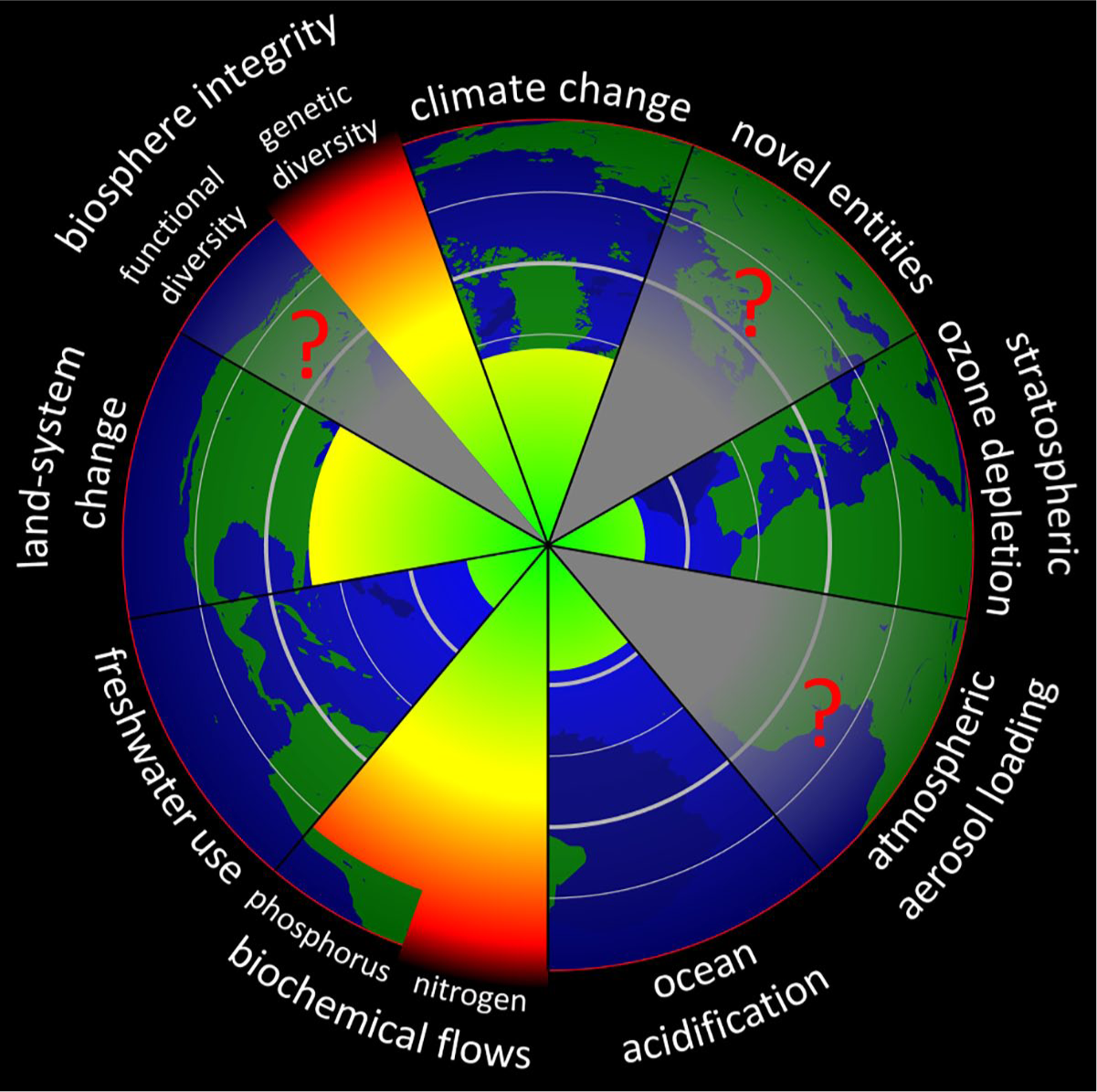
The planetary boundaries model, source: Wikimedia commons.
In a 2010 TED talk, the director of the Stockholm Resilience Center, Johann Rockström, explained the idea of planetary boundaries through the analogy of a person standing at the edge of a massive waterfall. 33 Rockström said ‘You don’t want to stand there! [. . .] At the foaming, slippery waters at the threshold. In fact there’s a fence, upstream of this threshold, beyond which you are in a danger zone’. 34 The entire complexity and non-linearity of the Earth system is thus broken down into an image of linear movement towards a temporal threshold, which humanity (represented metaphorically by the person at the edge) must not cross. The underlying apocalyptic imaginary becomes even more apparent in a more recent publication on the risks of a ‘Hothouse Earth’. 35 The paper, authored by several of the scholars behind the ‘Planetary Boundaries’ model, describes the risk that beyond the critical threshold of 2°C average warming, a cascade of feedbacks between so-called tipping elements could ‘push the Earth irreversibly onto an apocalyptic ‘Hothouse Earth’ pathway’. Tipping elements refer to land and ocean systems, such as the Arctic permafrost or the Amazon rainforest, that work as negative feedbacks that keep the current Holocene climate in a temporarily stable state. However, once a critical threshold of warming has been crossed, such negative feedbacks might turn into positive ones – for example by rapidly releasing large amounts of stored CO2 or methane into the atmosphere. The result could be a domino effect, by which these critical elements of the Earth system would tip each other into a so-called ‘tipping-cascade’. 36 Thus, according to the authors, humanity is left with less than two decades to mitigate ‘conditions that resemble planetary states that were last seen several millions of years ago’. 37 Eco-catastrophism in relation to the Anthropocene concept – as portrayed by the planetary boundaries model – thus focuses on the risk of acceleration and the threat of ‘abrupt, nonlinear change’. 38
The planet political project that relates to these eco-catastrophist articulations of the Anthropocene is one of planetary emergency management through new forms of ‘Earth system stewardship’. 39 Accordingly, urgent international action is required to mitigate a dangerous state shift in the Earth system. However, existing global environmental governance is deemed incapable of dealing with the systemic crisis of the Anthropocene because it breaks down ‘the environment’ into a myriad of different governance objects subject to an equally large number of related regulations, conventions and mechanisms. Earth system governance, instead, draws on the idea of the interconnected Earth system as a single governance object. For this, the epistemic community around the planetary boundaries model has, for example, called for the establishment of a comprehensive global (carbon) monitoring system under the umbrella of the United Nations (UN), the extension of Earth observation and other environmental monitoring capabilities and even the creation of new international organisations such as a high-level ‘UN Sustainable Development Council’. 40
Sylvia Wynter shows how the universal category of the ‘human’ has been established through the exclusion of various racialised others during the process of enlightenment. 41 As a result, humanity became equated with the model of European, ‘rational’, modern Man. Eco-catastrophism draws on this universal subject position of ‘anthropos’ and rearticulates it through the figure of the planetary manager: a ‘rational’, scientific subject that manages the different parts of the Earth system on the basis of a comprehensive knowledge of the Earth system.
Eco-modernism
Eco-modernism represents a second, oppositional approach to the planetary crisis of the Anthropocene. In contrast to eco-catastrophism, eco-modernism paints a more optimistic picture of the Anthropocene that stresses not only the human responsibility but also the human capacity to re-shape the planet. 42 Contemporary eco-modernist discourses on the Anthropocene have their epistemic roots in the Californian Whole Earth movement of the late 1960s. 43 In this movement around Steward Brand’s ‘Whole Earth Catalog’, 44 cybernetic systems thinking merged with Californian counterculture, an evolving environmental consciousness and enthusiasm for emerging computer technologies. Inspired by the first images of the whole Earth from space, the movement developed a technology-oriented environmentalism in which technical tools where seen as a means of transforming the inner self as well as the entire Earth system. 45 While the Whole Earth movement eventually disappeared, its underlying techno-environmentalism has survived. It is now most vigorously championed by Brand’s Long Now Foundation as well as the Californian Breakthrough Institute. Brand’s Long Now Foundation promotes cultural and political projects that adopt a ‘long-term’ perspective – that is the next 10,000 years – as a corrective to the sense of immediacy and urgency of mainstream environmentalism. As Stefan Skrimshire notes: ‘Referring to the unfathomably vast stretches of geological time is promoted as a kind of consolation for the catastrophe of the present moment’. 46
In the case of the Breakthrough Institute, its two then directors, Michael Shellenberger and Ted Nordhaus, developed their eco-modernist ideas out of a critique of conventional environmentalism and its ‘politics of limits’ and individual sacrifice in ‘The Death of Environmentalism’ in 2004. 47 Over the coming years, they successfully established a vast international network of scholars and activists that shared their views. In 2009, 18 members of this network – including Brand – published the ‘Ecomodernist Manifesto’ – comprising seven theses. Through the smart use of technologies including geoengineering, nuclear power, big data and genetic engineering, humanity could, according to the manifesto, ‘create a planet that is better for both its human and nonhuman inhabitants’. 48 To express this optimistic vision, the manifesto coins the term of the ‘good, or even great, Anthropocene’. 49 Due to the long history of agriculture, humans would have acquired wide experience with shaping their natural environment. 50 Major interventions in the climate system through geoengineering would thus not represent a novelty but rather a continuity of such human attempts to manipulate the planet. According to this discourse, ‘it was not planetary boundaries, but human system boundaries that constrained human development in the Holocene’. 51 By acknowledging the fundamental lesson of the Anthropocene, namely that humans have established planet-shaping powers, humanity could overcome these self-imposed boundaries.
The corresponding planet political project is one of planetary experimentation. A modest programme of planetary experimentation is, for example, the ‘Seeds of the Good Anthropocene’ project. 52 This is an online database that collects best-practice examples of local projects, including urban sustainability labs or resilience endeavours drawing on smart technologies. More ambitious eco-modernist proposals include the construction of whole-forest cities, in which the boundaries between human and natural infrastructures would dissolve. 53 On the extreme end, eco-modernist discourse involves proposals of terraforming Earth – and even other planets such as Mars. In eco-modernist discourse, experimentation with the planet becomes possible because the Earth system is considered ‘so resilient that it can recover rapidly from even the most powerful human disturbances’. 54 Drawing on examples of human flourishing before the stable climatic conditions of the Holocene epoch, eco-modernists such as Erle Ellis also stress the remarkable resilience 55 of human systems: ‘[i]t seems all too evident that human systems are prepared to adapt to and prosper in the hotter, less biodiverse planet that we are busily creating’. 56 Eco-modernists take the resilience of human and natural systems as a given – rendering technological experimentation with the planet both feasible and legitimate. The related planet political project revolves around the figure of the planetary engineer – a venturesome, optimistic (privileged and male) subject, whose creativity is to be fostered through flexible and experimental governance.
Planetary Realism
The third discourse of the Anthropocene, one that I term planetary realism, revolves around the assumption that the end times are neither near nor far but in fact already taking place. 57 Planetary realism acknowledges that human history is embedded into broader temporal rhythms beyond the species’ control. In this understanding, humanity should give up its attempts to accelerate or decelerate the course of history and instead embrace the uncertainty of a world marked by the temporalities of complex socioecological systems. 58 The actor-network behind the planetary realist position is a heterogenous and dynamic field – one that draws on many different epistemic sources. One central source is James Lovelock’s and Lynda Marguli’s ‘Gaia concept’. They developed the concept in the 1960s to express the idea that the Earth and the biosphere could be understood as a single dynamic system that is stabilised by life itself. In 2006 in The Revenge of Gaia, Lovelock described how one particular species – that is, humanity – has begun to bring this complex dynamic system out of balance. 59 As a result, Gaia would eventually turn against humanity. Planetary realists such as Bruno Latour adopt the idea of Gaia and update it for the current Anthropocene age. For Latour, the Anthropocene would force humanity to acknowledge our ‘earthboundness’, that is our entanglement in and dependence on a dynamic Earth system that is beyond our control. 60 The philosopher Timothy Morton is one of the most prominent proponents of the thesis that with the advent of the Anthropocene the world has already ended: ‘Clearly Planet Earth has not exploded’ he writes. ‘But the concept world is no longer operational’. 61 This assumption reconfirms a realist position towards the current planetary crisis. As David Chandler argues: ‘It is not just that “the end of the world is more easily imaginable than the end of capitalism”: it would appear that “after the end of the world” it is no longer possible even to imagine any alternative’. 62
At the level of policy, this new post-apocalyptic sensitivity of the Anthropocene is mirrored in the recent rise of ‘resilience’. 63 As a new governance paradigm, resilience perfectly resonates with planetary realist assumptions about the uncertainties and complexities of the Anthropocene. The sources of resilience thinking are manifold and include, for example, the design theory of Herbert Simon, 64 Friedrich Hayek’s 65 neo-liberal critique of central planning, Crawford Holling’s 66 work on ecosystem resilience, and the institutional economics of Elinor Ostrom.67,68 The common denominator of these heterogeneous epistemic sources is a shared understanding of complex systems that challenges the very idea of central steering, top-down control and prediction. Thinkers such as Holling and Simon, then, developed resilience as a policy model that works by addressing a particular political subject – one that Kevin Grove identifies as ‘homo adaptivus’. This refers to a subject whose ways of knowing and engaging with the world are always bound by a particular context: ‘Homo adaptivus is always embedded in the world [. . .]. And the adaptive subject can no longer hope to control the world; the best it can do is to hope it might adapt’. 69 Resilience as a policy model to cope with uncertainty and complexity thus works through the (earth-)bounded rationality of resilient subjects, and mobilises their established forms of local knowledge and self-organising capacities for their own survival.
The policy discourse on adaptation to the adverse effects of global climate change is a good case in point. The Intergovernmental Panel on Climate Change (IPCC), for example, acknowledges that given the degree of global warming that is already inevitable, massive adaptation efforts are required to prevent catastrophic impacts upon vulnerable regions worldwide. 70 However, due to the uniqueness of every vulnerable community as well as the unpredictability of local impacts, centrally organised forms of adaptation are deemed neither possible nor indeed desirable. 71 Instead, the IPCC holds that only the vulnerable communities themselves would possess the appropriate forms of tacit knowledge required for successful adaptation. In particular, indigenous populations have been identified as promising agents of adaptation policies and resilience programming due to their (perceived) embeddedness into their surrounding ecosystems. 72 The UNESCO report ‘Weathering Uncertainty: Traditional Knowledge for Climate Change’, for example, stresses that ‘indigenous peoples and local communities are actively responding to changing climatic conditions and have demonstrated resourcefulness and resilience in the face of climate change’. 73
In this imaginary, indigenous resilience is inherently tied to local, traditional forms of knowledge and the ability of indigenous people to detect signs of change from their environment. 74 Planetary realism frames indigenous populations as perfectly adapted to local ecosystems and their various rhythms, patterns and cycles. 75 Given the difficulties of modern scientific methods to anticipate and predict environmental changes at the local level, planetary realism discourse turns to indigenous forms of knowledge and related cosmologies. As indigenous cosmologies are perceived as being established through interaction with nature’s own rhythms, they are considered more appropriate for local practices of adaptation. 76 Politics of resilience, thus, transvalue indigenous forms of knowledge only insofar as they can be appropriated by white people to guarantee their own survival in the turmoil of the Anthropocene. 77 Such apparently benevolent practices and discourses of the UN and other global governance actors in fact essentialise indigeneity and romanticise black suffering as a resource of survival. 78
Indigenous and black scholars have thus criticised planetary realism and its affirmation of indigenous forms of knowledge. Scholars such Kyle Whyte, Zoe Todd, Heather Davis, and Axelle Karera have argued that for many indigenous and black people, the world has in fact already ended. 79 However, unlike Morton and other Western thinkers, they base these arguments on the concrete historical experience of marginalised people with colonialism and the violent destruction of their lifeworlds. As Christina Sharpe argues, the repercussions of chattel slavery and European colonialism are felt until today and are reinforced through the effects of unfolding climate change. 80 By claiming that the world (in singular) has already ended, planetary realists universalise the experience of black and indigenous people and thus dramatise ‘white people living under the conditions they have forced upon others’. 81
Visions of the End: Anthropocene Eschatology
Eschatology as the Christian doctrine of the last things 82 relies on a linear notion of time as a flow or movement from a starting point (the creation) towards a final event in the divine plan (the eschaton). Early Christian thinkers such as Augustine of Hippo (also known as St Augustine) developed such an understanding of time in opposition to ancient Greek philosophy, which had conceived of time and history as eternally recurring cycles. Unlike cyclical time, the linear model of eschatology allowed accounting for progress and change, to write a human history that distinguished clearly defined periods and epochs. At the same time, however, a notion of linear time also brought with it the question of how time will end. There are crucial differences between different Christian thinkers concerning these questions of the end of times.
One of these differences refers to whether the end of times is imminent or not. While Christian political theology is and has always been eschatological, it is not necessarily apocalyptic. Apocalypse refers only to a specific eschatological genre, namely the belief in an imminent cataclysmic intervention by God in history. However, for early Christians, the end of time was not so much a catastrophe to fear as a promise of radical change and of the revelation of the secrets written in heaven. 83 As a moment of revelation, the coming of the eschaton was expected to result in the creation of a ‘Heaven on Earth’ and thus referred to the possibility of overcoming ‘the power structures of the present world’. 84 Other than as implied by its colloquial use, a reduction of apocalypse to existential fears and the threat of annihilation is therefore misleading. 85
Drawing on the observation that the notion of apocalypse does not have any fixed meaning but is rather ‘flexible, migratory, and unstable’, 86 Alison McQueen proposes to understand it as a social ‘imaginary’. The concept of imaginary refers to a collectively shared set of narrative, symbols, values and images that help to make sense of our world. 87 According to McQueen, the apocalyptic imaginary revolves around five core beliefs: first, that the end of the world is imminent; second, that the imminent rupture will be equally cataclysmic and transformative; third, that it will bring an end to an identified evil; fourth, that it represents a rupture in an otherwise undisrupted linear flow of history; and, fifth and finally, that it involves the revelation of the secrets written in heaven. McQueen’s notion of the apocalyptic imaginary helps in studying how Christian eschatology becomes translated into the contemporary discourses on the Anthropocene and to distinguish apocalyptic imaginaries from other eschatological discourses that do not share the same sense of imminence and rupture.
A further differentiation in Christian eschatology that is crucial for the Anthropocene discourse concerns the role of human agency in the course of history. Michael Dillon identifies messianism and katechontism as two opposite positions vis-à-vis the problem of the end of time. 88 In messianism, the end represents a (utopian) promise of salvation and revelation (or societal transformation, in secular terms). In opposition to the apocalyptic imaginary, where the prospect of salvation rests on divine intervention, messianism refers to the belief that a human actor – the messiah – will lead the people of God to a better future. A messianic approach to the end of time thus means taking sides with the eschaton and accelerating or actively bringing about the end of an existing temporal order.
A katechontic approach to the threat of finitude, on the contrary, aligns with the existing temporal order and involves taking action – political or religious – to sustain it. In Christian eschatology, katechontism had the function of constraining the apocalyptic enthusiasm of some early Christian communities. According to this doctrine, the katechon would use its powers to hold back the arrival of the Antichrist. During the Holy Roman Empire, this katechontic function of postponing the arrival of the Antichrist until the return of Christ was fulfilled by the Church. With the Enlightenment and the emergence of modern statehood, the political sovereign took over this role of the katechon – using their exceptional powers to delay the arrival of the eschaton. 89 In the secular eschatology of sovereignty, the transcendental threat of the Antichrist is replaced with worldly threats to the political order such as war or social unrest. Through the concept of modern sovereignty, thus, the theological concept of the katechon became secularised and an essential feature of (security) politics.
The End is Near: The Apocalyptic Imaginary of Eco-catastrophism
Eco-catastrophism mirrors the apocalyptic imaginary as described by McQueen. For eco-catastrophism, the threat of climate change is imminent, cataclysmic and represents a temporal rupture in the planetary history: the transition from the relatively stable Holocene to the highly dynamic and uncertain Anthropocene epoch. 90 Through powerful symbols such as the planetary carrying capacity or the planetary boundaries the discourse delineates the time that remains to ward off this cataclysmic transformation. Furthermore, for eco-catastrophists, the announcement of the Anthropocene is equally revelatory – another feature of the apocalyptic imaginary identified by McQueen. 91 In the eco-catastrophist discourse, the Anthropocene is ‘already revealing itself as a time of increased suffering’ 92 – and this suffering is taken as a sign that urgent intervention is required to save Planet Earth.
At the same time, however, eco-catastrophism also translates and rearticulates the Christian apocalyptic imaginary. As Judith Wolfe notes, liberal philosophy and secularisation did not make apocalyptic eschatology obsolete but rather translated it into what she calls ‘philosophical eschatology’. ‘In an apocalyptic eschatology’, Wolfe writes, ‘the eschata are received as data of revelation; their warrant is their divine source. [. . .] By contrast, a philosophical eschatology is one in which the eschaton is postulated or posited from within a system’. 93 The same holds true for eco-catastrophist articulations of the Anthropocene: here the imminent planetary crisis is not revealed through divine intervention but from within the system itself – that is by Earth System Science.
By drawing on the framework provided by Dillon, we can identify a further difference between eco-catastrophism and the Christian apocalyptic imaginary. This difference concerns the human capability to intervene in the course of history – that is, to arrest, change or accelerate time. With the Age of Enlightenment, the force to intervene in the course of history was detached ‘from other-wordly sources such as God and nature, placing it firmly in human hands’. 94 This human capability is of crucial importance for the political project of eco-catastrophism, that is, Earth system governance. For, in the secular eschatology of the Anthropocene, ‘no heavenly being will intervene to redeem the humans from Exile’. 95 Instead of an external God, eco-catastrophism addresses political decision-makers as well as scientists to guarantee that the Earth system remains in a Holocene-like state. 96 The resulting political project thus perfectly mirrors a logic of katechontism as described by Dillon. Science (in the form of Earth System Science) and the United Nations (UN), here, together take the role of the katechon that endlessly defers the arrival of the eschaton. Earth system governance is thus a form of katechontic management – keeping global environmental change at a tolerable level and thereby indefinitely postponing the fatal outcome. 97
The End Must Not Be Feared: The Optimistic Millennialism of Eco-modernism
Just as for eco-catastrophists, for eco-modernists the Anthropocene represents a moment of revelation. According to them, the Anthropocene reveals that human and Earth history are entangled, and that the modernist human/nature dichotomy is but a myth. 98 For eco-modernists, this revelation justifies a comprehensive human project of planetary experimentation. Modern science and progress would allow humans to decipher nature’s inner secrets, including the human genome or the Earth system, which renders interventions such as genetic modification or geoengineering possible. Eco-modernism could thus be understood as a messianic discourse bordering on Prometheanism, in which the figure of the planetary engineer as the modern Prometheus takes centre stage. 99 As Clive Hamilton puts it, ‘in place of a theodicy they instate an ‘anthropodicy’ in which human-directed Progress takes the place of God’. 100 In this reading, eco-modernism rests on the messianic promise to ‘immanentize the eschaton’ 101 – that is, to accelerate the course of history and to actively bring about the kingdom of heaven in the immanent world. 102 Humankind’s transition into the Anthropocene represents the messianic event, initiating a period of messianic time, in which the salvation of humankind through technological innovation needs to be accomplished.
Readings of eco-modernism as messianism, however, overlook that messianic time actually contradicts the temporality of the long view that informs the political project of planetary experimentation. As the two pioneers of eco-modernism, Michael Shellenberger and Ted Nordhaus, argue:
Each new act of salvation will result in new unintended consequences, which will in turn require new acts of salvation. What we call “saving the Earth” will, in practice, require creating and recreating it again and again for as long as humans inhabit it.
103
Salvation here becomes an eternal process – one that requires continual experimentation, reflection and learning. Such a view of history does not have much in common with messianism as described above. With its belief in continuous progress and improvement it rather mirrors progressive millennialism. Progressive millennialists believe in the possibility of a major transformation that will come about through gradual betterment rather than a sudden cataclysmic event. 104 Secularised narratives of progressive millennialism played a major role in the emergence of modernist political ideologies such as liberalism. Drawing on a linear notion of time, liberalism revolves around the belief in transformation through continuous economic development and scientific progress. 105 Rather than being messianic, eco-modernism mobilises and updates this modernist belief in science and technology for the planetary crisis of the Anthropocene. The eschaton is made immanent, but, in this process, also increasingly banalised – and thus deprived of its utopian potential.
The End is Here: Resilience and Its Eschatology of ‘Factical Finitude’
Planetary realism, with its acknowledgment that the final time of the Earth has in fact already begun, puts an end to any form of messianic or apocalyptic speculation about the future. The recourse to Augustine of Hippo, one of the crucial Christian eschatological thinkers, helps further unpack the political project of planetary realism, and in particular its ambivalence between letting go (embracing uncertainty and adapting to the new reality of the Anthropocene) and the will to control time (by turning resilience into a policy model of polycentric governance and self-management). 106
St Augustine developed his eschatological thinking in the 4th century AD107 – at a time when Christians were experiencing increased violence and bodily suffering. 108 Against the backdrop of the resulting spiritual turbulences, St Augustine opposed ‘[t]he twin “Gnostic” temptations of either purist retreat from a denigrated world or an eschatological outbreak of political messianism’. 109 For him, the incarnation of Jesus Christ marked the crucial eschatological moment and the advent of the senectus mundi – the last period of history. 110 Yet, contrary to millennialists, who held that the period of the end times would last a thousand years, he understood the senectus mundi as a period of indefinite length. 111 St Augustine challenged the assumption that the end times could be calculated, anticipated or deduced from earthly signs (such as natural disasters). 112 This interpretation of the end times as a radically open and uncertain period deprived Christian eschatology of its utopian potential, as ‘[s]uch a view frees from any speculation regarding the end of the world’. 113
St Augustine is often described as the first political realist, who inspired many later ones such as Niccolò Machiavelli, Hans Morgenthau or Reinhold Niebuhr. 114 According to this reading, the common denominator of these thinkers is their anti-utopianism. We also find this anti-utopianism in the planetary realist discourse of the Anthropocene. In this discourse the Anthropocene ‘is not something than can be repaired or transformed, only endured’. 115 Furthermore, just like St Augustine rejected any human speculation about the duration or unfolding of the senectus mundi, planetary realism rejects any belief in the final revelation of Gaia’s secrets to humans. 116
Resilience then turns this fundamental uncertainty and insecurity into a resource for a policy model of self-management and adaptation. To understand how this translation works, we need to come back for a moment to St Augustine and his writing on human sin and salvation. Here, St Augustine addressed the fundamental question of why devout Christians who had not personally committed any wrongdoings had to experience increased suffering. 117 St Augustine’s answer was that meaningless suffering was in fact proof of the original sin of men, which in his reading was not based on the individual deeds of Christian subjects but instead the literal inheritance of humans as the children of Adam. 118 As Vassilios Paipais notes: ‘In its Augustinian formulation, original sin was linked to a soteriological perspective; that is, a defence of its status as a corollary of the doctrine that all human beings are equally in need of salvation in Christ’. 119 However, with original sin as the literal inheritance of all human beings, even faithful members of the Church could never be certain about their inclusion in the ‘City of God’ – that is, salvation after the return of Christ. 120 Salvation, thus, was not so much a promise of an open future but rather required a continuous process of self-reflection and inner change – albeit with an uncertain ending. This re-articulation allowed the Church to establish an entire ‘economy of salvation’, 121 based on the practice of confession, in which the uncertainty faced by Christian subjects was turned into a governance model of pastoral conduct.
The realpolitik of resilience, then, updates the pastoral model of self-government for the secular era of the Anthropocene and replaces the ‘soteriological finitude’ of the Christian subject with the ‘factical finitude’ of all living beings. 122 Here, human suffering is neither considered a necessary evil that has to be endured until the completion of salvation (as in eco-modernism) nor a sign that dramatic actions is needed (as in eco-catastrophism). In planetary realism and resilience thinking, suffering is not considered an evil in the first place. Rather, it becomes an essential feature of (finite) life in the Anthropocene and a driver of learning, adaptation and renewal. Just as Christian eschatology made the Christian subject accept their original sin as the basis of a ‘political economy of salvation’, the secular eschatology of planetary realism forces homo adaptivus to accept their vulnerability as the basis of a political economy of resilience, in which adaptability becomes the core value. 123 As lifeforms at risk from environmental change can neither turn to an omniscient god nor to modern science in the hope of salvation, resilient life becomes itself the key katechontic power in the struggle with the eschaton. The everyday lives of racialised communities and marginalised people in the Majority World become the primary battleground of this struggle. In this way, planetary realism links the Augustinian interpretation of meaningless suffering to the normalisation of black and indigenous suffering through discourses and practices of resilience. 124
Conclusion: Towards an Anthropocene Pluriverse
The concept of the Anthropocene portrays the transformation of homo sapiens sapiens into a geological force on a planetary scale. In an attempt to delineate and periodise the human impact on the planet, it draws on an eschatological, linear notion of time that necessarily raises the question of it eventually ending. All discourses on the Anthropocene and the political projects they make possible need to confront, then, the threat of finitude and irreversible change. In this article, I have analysed how different discourses rearticulate symbols, narratives and themes of Christian eschatology to mobilise competing political projects to address this threat.
A first, eco-catastrophist, discourse of the Anthropocene invokes metaphors and symbols of Christian apocalyptic texts to stress the imminence of ecological collapse and calculate the time that is left. The resulting political project is one of planetary emergency management through a complex global architecture of managing and controlling the Earth system. Eco-modernism, the second anthropocentric discourse, represents a secular form of progressive millennialism. Here, the advent of the Anthropocene is less a warning than a promise of substantial transformation. The resulting political project promotes technological intervention in, and human experimentation with, the planet. Both discourses and related political projects reinstate ‘Man’, implicitly conceptualised as white, rational, European, as a central political subject’ – either as planetary manager or as planetary engineer. Planetary realism, the third discourse on the Anthropocene, aims at overcoming this anthropocentrism. This discourse calls for acknowledgment of the complex temporalities of coupled socio-ecological systems – and finding alternatives to the liberal-modernist attempts of controlling nature. The resulting political project focuses on local communities and indigenous forms of knowledge – but only to re-appropriate them for a global politics of resilience that romanticises and normalises black and indigenous suffering.
All three planet political projects take a different position concerning the problem of time ending, and all three articulate competing political demands to cope with this. Notwithstanding this diversity, all three converge around a linear eschatological time. As a result, they fail to address matters of climate justice and environmental racism, and the question of whose worlds are actually ending in the Anthropocene and whose worlds are extended at the costs of others. Is the Anthropocene thus simply ‘another stage of racialized and neo-colonial mode of a “global design”’ 125 as Anna Agathangelou asks? The common reliance on Western eschatologies of all studied discourses might support this suspicion. However, the Anthropocene concept also leaves space to envision a different kind of planet politics – one that acknowledges the plurality of worlds in and the heterogenous temporality of the Anthropocene. A possible way of defining such a pluralist notion of planet politics can be to follow Sylvia Wynter and understand ‘being human as a praxis’. 126 Understanding ‘human’ as a verb rather than as a noun resists any ahistorical, homogenised account of humanity and instead accounts for the heterogenous ways of being human. 127 This might allow overcoming ‘anthropos’ as a mono-humanist referent point of the Anthropocene – established through the exclusion of racialised others as non-human – and instead find alternative genres of the human. These genres would stress the multiplicity and plurality of (more-than-)human lifeworlds in the Anthropocene, while at the same time being attentive to their joint entanglement in processes of planetary change. 128 Such a revised notion of planet politics would be attentive to the slow violence faced by the many people living in areas in which the climate catastrophe has in fact already arrived. It would, at the same, generate impetus for ambitious action at the international level – not in order to save the world, but to increase the chances of the most affected communities and ecosystems to adapt. If freed from their universalist aspirations, policy ideas and technologies around experimentation, learning and creative adaptation could also play a productive role in such a political project. 129 Such a notion of planet politics might then even become a means of re-enchanting and pluralising IR more broadly.
Footnotes
Declaration of conflicting interests
The author declared no potential conflicts of interest with respect to the research, authorship, and/or publication of this article.
Funding
The author disclosed receipt of the following financial support for the research, authorship, and/or publication of this article: Deutsche Forschungsgemeinschaft (Grant / Award Number: 335616337).
