




Abstract
This longitudinal study explored the connections between self-concept clarity (SCC) and music preferences across early adolescence into young adulthood. Six times, N = 900 Dutch adolescents and young adults (Mage T1 = 12.48 years, 51% females) completed a survey assessing their SCC and music preferences, categorized into mainstream music (including pop, hip-hop, popular rock, and dance/trance) and non-mainstream music (heavy metal, goth, and hardstyle dance). Latent growth curve analyses with SCC as time-varying covariates confirmed that there was no systematic association between SCC and mainstream preferences for pop, hip-hop, and dance/trance in mid- to late adolescence, and that this relationship became mostly positive in young adulthood. However, SCC was negatively associated with a preference for another type of mainstream music: popular rock. As predicted, adolescents with low SCC also preferred thematically complex, non-mainstream genres such as heavy metal and goth, or music that is linked to a non-mainstream subculture: hardstyle dance. Lower SCC levels remained linked to higher preferences for goth and heavy metal music even into young adulthood. This suggests that goth and heavy metal continue to hold significant importance for young people who struggle with clarifying their identity.
“I can see clearly now the rain is gone.
I can see all obstacles in my way.
Gone are the dark clouds that had me blind.
It’s gonna be a bright (bright) sunshiny day.”
Establishing a clear sense of identity is a crucial developmental task during adolescence and young adulthood (Erikson, 1968). A key element of this identity formation process is the development of a coherent and consistent sense of self across contexts and time, commonly referred to as self-concept clarity (SCC, Campbell et al., 1996). Theoretical and preliminary empirical studies suggest that adolescents and young adults may find support to clarify their identity by listening to music (Dys et al., 2017; Schäfer et al., 2013; Tarrant et al., 2002), but whether and when SCC and music are most strongly connected has not been studied before. The aim of this longitudinal study is to explore these relationships by examining the associations between SCC and liking for various types of popular music, both mainstream—such as pop, hip-hop, popular rock, and dance/trance—and non-mainstream—heavy metal, goth, and hardstyle dance—during adolescence and into young adulthood.
Self-concept clarity during adolescence and young adulthood
SCC refers to the structural aspects of the self, distinct from evaluations of self-esteem (Weber et al., 2023). Individual differences in SCC and identity become more pronounced during middle to late adolescence. For instance, individual differences in identity certainty (commitment) and identity uncertainty (reconsideration of identity commitments) seem to become most differentiated during middle to late adolescence (Becht et al., 2016). Similarly, individual differences in SCC seem to increase from early to middle adolescence and become most pronounced and stable during middle to late adolescence (see Online Supplementary Material Figure S1 in the study by De Moor et al., 2023) and remain relatively stable during young adulthood (Crocetti et al., 2016; De Moor et al., 2023).
Music and identity
Music and music videos contain a wide range of messages that can be important to young people trying to find out who they are and what they want to become, as persons, friends, romantic partners, fellow students, or colleagues (Arnett, 1995; MacDonald & Saarikallio, 2022). Since its emergence in the mid-fifties, popular music has consistently prioritized themes of romance and sexuality, particularly within heterosexual relations. However, alongside these themes, the exploration of “who I am,” “my place in the world,” has also played a significant role (Schäfer et al., 2013). Social, political, and religious ideals and ideas are addressed in pop music as well, but to a lesser degree than romance, sex, and (social) identity (Christenson et al., 2019; Christenson & Roberts, 1998). While the most popular type of popular music, pop, such as the music found in the charts, may heavily lean on the infatuation and boy meets girl/girl meets boy motive, other genres have embraced a wider range of issues relevant to youth. Non-mainstream music genres, such as heavy metal, goth, and punk, have delved into peer outsider status, alienation, social anxiety, depression, and societal issues (Arnett, 1993; Olsen et al., 2023; Weinstein, 2000). Hip-hop artists have added an impressive array of themes into the musical landscape. While hip-hop undeniably celebrates having a good time, partying, and dancing, there is a strong undercurrent addressing social issues such as poverty, racial relations, discrimination, police brutality, the drug economy, and drug addiction (Christenson et al., 2019; Rabaka, 2013). Although this lyrics are less sophisticated than these types of rock or Black American music, dance has evolved as a distinct genre thriving on strong rhythms. Dance fosters exuberant nightlife experiences, offering an escape from the monotony and challenges of everyday life. Originating from and deeply rooted in the gay (Black) community (non-mainstream), dance music has long provided a sanctuary for young adults seeking refuge from the constraints of societal norms and routines (Collin, 2010).
Artists, their music, lyrics, videos, and social media presence, serve as crucial resources for identity construction as they provide examples of how to present oneself (clothing, makeup, hairstyles, tattoos, jewelry, accessories, and even preferred vehicles). They may show how to move (gestures, poses, gait), how to talk (typical expressions, slang), and what to consume (cigarettes, alcohol, licit and illicit drugs). Artists can even exemplify how to perceive (appraisal), how to feel (emotions, mood), and how to think and evaluate (attitudes, values, ideas, ideals, expectations (Fischer et al., 2011; Greitemeyer, 2009; Lacasa et al., 2017; North & Hargreaves, 1999)). Particularly in the field of ethnographic research and cultural studies, a plethora of articles and books has shown that artists may, thus, consciously or implicitly propagate a definite style that is attractive to their fans and at the heart of youth subcultures, even when their members are aging (Bennett & Hodkinson, 2020; Hebdige, 1979; Willis, 1978). Thus, there is extensive scientific literature on music in relation to adolescents’ development of their personal and subcultural identity (Erikson, 1968; Hargreaves et al., 2017). However, whether and how preferences for major genres of music are related to SCC has never been investigated.
Music preferences in adolescence and young adulthood
Simon Frith (1998) argued that genres are essential for organizing the practices of music-making, music marketing, and music listening into distinct categories. Genre thus presupposes a more-or-less fixed set of rules concerning instrumentation, rhythmic structure, harmonic progression, and the texture of music and vocals, which are employed by music creators and recognized, acknowledged, and expected by listeners as constituting a specific type of music (Fiske, 2010; Kallberg, 1988). Critical music scholarship on genre emphasizes that genres should not be understood as fixed or formally ratified categories. Genres evolve, and their boundaries are stretched or more strictly defined not only by music creators but also through their interaction with communities of music critics, the music industry, and, last but not least, fans and listeners (Lena, 2012; Merlini, 2020; Shuker, 2003, 2017).
Despite their fluidity, a number of genres have persisted over decades and, while evolving with new artists, are deeply rooted in cultural memory and listener perception. These are widely recognized in the classifications of pop (from 1950s rock ’n’ roll), rock (1960s–70s), and hip-hop and disco (1970s–80s), and they are taken to represent long-standing musical traditions (George‑Warren et al., 2001). Lange et al. (2025) studied extensively the categorization of music by genres. They engaged quite comprehensively with critiques of the use of genre labeling yet made a positive empirical evaluation of the use of broader genre categorizations and narrower subgenres. Researchers have explored how these enduring genres provide insights into the structure of personal preferences, highlighting how genre acts as a lens through which individual and cultural identities may be reflected and analyzed. Music genres play a crucial role in shaping personal and cultural identity (Boer & Fischer, 2012; DeNora, 2000). Empirical studies further demonstrate that preferences for genres such as pop, classical, and traditional music are often positively associated with mental health, whereas strong orientation toward heavier music genres may indicate problems (Ter Bogt et al., 2021; Wang et al., 2022).
The music industry maintains an elaborate scheme of genres and subgenres that includes hundreds of categories, but research among adolescents and (young) adults in different countries has consistently identified that five or six of “meta-genres” or overall music styles dominate the field (Greenberg et al., 2022; North, 2010; Schäfer & Sedlmeier, 2009; Ter Bogt et al., 2003). A widely used five-factor framework is the MUSIC model developed by Rentfrow and colleagues that organizes genres into broad dimensions: Mellow, Unpretentious, Sophisticated, Intense, and Contemporary (Rentfrow et al., 2011). Mulder et al. (2009) adhere more closely to the labels used by the music industry and listeners themselves when designating overall musical styles in their classification of genres. They characterized a first style as comprising the music that is literally the most popular, pop music, such as that found in the charts. Pop is a category in itself, but the best sounding songs—melodic, soft, fun, catchy—from hip-hop, R&B, rock, and dance can also land in the charts and thus also be labeled pop (Lena, 2012). The second style, hip-hop or rap, comprises Black American and Afro-Caribbean music (e.g., hip-hop, R&B, and reggae). A third style, rock, can be characterized as loud, energetic, and rebellious music and comprises music with a degree of mainstream attractiveness (rock itself) and far heavier, if not extreme genres competing in loudness, shock, and tempo (e.g., heavy metal, hardcore, punk, and gothic). In the fourth music style, different types of electronic dance music (e.g., house, trance, techno, hardstyle, deep house, gabber, and dubstep) are subsumed. A fifth music style, sophisticated music, comprises cultured and complex music such as jazz and classical music. The overwhelming majority of adolescents know all these styles and keep preferring them into adulthood (Mulder et al., 2009; Ter Bogt et al., 2011).
At a more general level, music genres can be labeled as mainstream and non-mainstream (Steinbrecher, 2021). Mainstream music includes the most melodic, easily accessible, sing-along types of pop, rap, rock, and dance that dominate the charts and other lists indicating the most listened to music. Mainstream music appeals to a broad spectrum of young audiences. Conversely, less accessible or more musically and lyrically radical forms of popular music are deemed non-mainstream. This category caters to a much smaller audience of fans. Examples include certain subgenres of rock such as heavy metal and goth, as well as specific styles of hip-hop such as gangsta rap and drill (Frith, 1978; North, 2010; Steinbrecher, 2021).
Music preferences and SCC: connections?
Young people who enjoy the most popular music genre, pop, generally do not encounter many psychosocial problems across adolescence (Ter Bogt et al., 2021). They typically exhibit upbeat moods, maintain positive relationships with parents and friends, and transition into young adulthood smoothly (Laffan, 2021; Mulder et al., 2006; Wang et al., 2022; Xu, 2025). Having a clear SCC may go hand in hand with liking pop music. What applies to pop music can be extended to other forms of mainstream music found on the charts: popular rock, hip-hop, and dance. There may be a positive association between SCC and liking these popular genres. However, it is important to acknowledge that mainstream music holds widespread appeal among young audiences. It offers enjoyable, easy-to-listen-to melodies and lyrics that invite sing-alongs, thus uplifting or maintaining the mood of young people (Christenson et al., 2019; Knobloch & Zillmann, 2002). This suggests that there may not be a consistent association between levels of SCC and liking mainstream popular music. Mainstream music may remain a favored choice regardless of one’s level of SCC. In summary, SCC may be either not associated with or positively associated with liking mainstream music.
The situation differs for young people who are less inclined toward mainstream pop music. In the 1980s, Keith Roe conducted a rare longitudinal study at the time, finding that young people who performed poorly in school and held negative attitudes toward it were more likely to consume so-called “socially disvalued media,” such as heavy metal music. Roe observed that immersion in this type of non-mainstream music and extensive knowledge of it formed the foundation of an alternative identity, which diverged from and was not aligned with an identity strongly rooted in school experiences (Roe, 1985, 1987). It is also evident from other literature that those who prefer more extreme genres of rock music, such as heavy metal and goth, tend to experience higher levels of social alienation, depression, and anxiety on average (Arnett, 1993; Bowes et al., 2015; Olsen et al., 2023; Ter Bogt et al., 2021; Xu, 2025) and that lower well-being and poorer mental health may sustain into adulthood (McConnell et al., 2024). Non-mainstream music may then be attractive as it reflects and thematizes an outsider perspective. Adolescents confronted with personal or social challenges will question their identity and place in the world more often. This suggests that a preference for non-mainstream music may be associated with lower SCC.
On the contrary, non-mainstream forms of music often lie at the core of subcultures where young people find a sense of belonging (Weinstein, 2000). Sharing a love for the same music creates strong bonds, fostering a sense of community where individuals can openly discuss issues and problems among peers (Bešić & Kerr, 2009). Listening to metal or goth and being part of a music scene can benefit adolescents in terms of improved mood, identity formation, peer affiliation, and (collective) self-esteem (Clark & Lonsdale, 2022; Olsen et al., 2023). In this sense, non-mainstream musical subcultures may indeed contribute to the development of a clearer self-image, as they provide clear guidelines on identity, appearance, and values. Within these subcultures, it is evident who one should aspire to be, what appearance to adopt, and which ideas and ideals to embrace. It is, therefore, quite possible that, over time, listening to music and being part of these subcultures contribute to the strengthening of SCC.
In summary, there appears to be no consistent correlation between levels of SCC and preferences for mainstream pop, hip-hop, rock, and dance music; or if such an association exists, it tends to be positive. Individuals with lower SCC may prefer non-mainstream music. However, it is worth noting that engaging with this music and connecting with peers who share similar tastes can be an enlightening experience, potentially strengthening SCC later in adolescence or early adulthood (Baker & Brown, 2016; Bešić & Kerr, 2009 Olsen et al., 2023; Sharman & Dingle, 2015; Travis, 2015).
Although music has been shown to be important for identity construction, so far, no longitudinal empirical studies have examined how SCC and music taste development are associated. However, preliminary empirical evidence suggests that both individual differences in identity and music preferences become most consolidated during middle to late adolescence (Becht et al., 2016; De Moor et al., 2023). Adolescence and young adulthood are critical periods for the development and consolidation of both identity and music preferences, underscoring the need for further research into their interrelationship during this formative stage of life.
This study
In this longitudinal study, the associations between SCC and music preferences were investigated for both mainstream and non-mainstream music genres, from adolescence into young adulthood. Four mainstream genres were included (pop, hip-hop, popular rock, dance/trance) and three non-mainstream genres (heavy metal, goth, and hardstyle). The first step was to examine the development of music preferences over time and subsequently link SCC to music preference scores, assessing these associations at six time points spanning early adolescence to young adulthood.
Exploratory Hypothesis 1 predicts that SCC is either weakly positively associated or not associated with a preference for mainstream music (Laffan, 2021; Mulder et al., 2006; Xu, 2025). Mainstream genres included pop, hip-hop, popular rock, and dance/trance. Hypothesis 1 was tested for each mainstream genre separately. Hypothesis 2 posits that SCC is negatively associated with non-mainstream preferences, that is, youth with lower levels of SCC will have a stronger preference for non-mainstream music compared with youth with higher levels of SCC (Olsen et al., 2023; Roe, 1985, 1987). However, listening to this type of music and being part of musical subcultures may actually enhance SCC later in life. Again, Hypothesis 2 was tested for each non-mainstream genre, that is, heavy metal, goth, and hardstyle, separately.
Method
Participants
Participants were 900 adolescents (Mage T1 = 12.48 years, SD = 0.49, 50.1% female) who participated in the longitudinal CONAMORE study (Conflict And Management Of RElationships; Meeus & Branje, 2001). For this study, data from all six waves were used, with 1-year intervals between successive waves 1and 5 and a 5-year interval between waves 5 and 6.
Procedure
Participants came from various high schools in the Dutch province of Utrecht, the Netherlands. Parents and students received a letter outlining the study’s aims and the option to opt out. Less than 1% chose not to participate. Participating students provided written informed consent and completed questionnaires in their classrooms after school hours. Research assistants provided verbal and written instructions, ensuring confidentiality. For absent students, a second assessment was organized, but those absent on both testing days were not assessed. Participants received 10 euros at each of the first five yearly waves. Five years later, when the students were young adults (mean age at T6: ~21 years), they were re-approached. The CONAMORE study was approved by the Ethical Review Board of the Faculty of Social Sciences at Utrecht University.
Measures
Mainstream and non-mainstream music genres
Adolescents’ music preferences were assessed with the Music Preference Questionnaire (Ter Bogt et al., 2003). A shortened version, that included 17 music genres, was used in the current CONAMORE longitudinal study (Meeus & Branje, 2001). As highlighted above, music preferences can be categorized into five main categories: four regarding popular music and one sophisticated music, such as classic and jazz. From the four major styles of pop music, the most central and popular, mainstream genres have been selected: pop, hip-hop, trance/techno, and (popular) rock. In addition, the database included three measurements for less popular, more eccentric, non-mainstream music: two within the rock domain (goth, heavy metal) and one within the dance domain (gabber/hardcore/happy hardcore, referred to as hardstyle in the remainder of this article). The fifth main category, sophisticated music—including classical, jazz, and gospel—was not the subject of this study and was, therefore, not further analyzed. Other subgenres that are less central to the four overall popular music categories, or genres that are relatively unpopular or lesser known, were also excluded from further analysis. These include Dutch pop, Ballads, Soul/R&B, Clubhouse/Mellow, Reggae, Rai/North African music, and Punk/Hardcore/Grunge. Thus, further analyses were conducted using four types of mainstream pop music (pop, hip-hop, trance/techno, and rock) and three types of non-mainstream music (goth, heavy metal, and hardstyle).
Participants were instructed to indicate how much they liked each music style (one item per music style), rated on a 5-point Likert scale (1 = do not like at all; 5 = like very much).
Self-concept clarity
Participants reported on their SCC using the 12-item Dutch version of the Self-concept Clarity scale (Campbell et al., 1996). An example item reads, “In general I have a clear sense of who I am and what I am.” Items were rated on a 5-point Likert scale (1 = strongly disagree to 5 = strongly agree). A mean based on all items was computed (Cronbach’s α ranged from .83 to .90 across waves).
Statistical analyses
Latent growth curve modeling (LGM) is a structural equation modeling technique that examines how variables develop over time by estimating average trajectories (e.g., increasing/decreasing trends in music preferences) and individual differences around these trajectories. It separates systematic group-level trends from person-specific variations while accounting for measurement error, making it ideal for longitudinal data such as the six-wave design in this study. By incorporating SCC as time-varying covariates (i.e., variables that can change over time), LGM evaluates how predictors influence outcomes at each measurement wave beyond the overarching growth trajectory (Muniz-Terrera et al., 2016). This approach allows us to test whether SCC “pitches” individual music preference levels above/below their expected trajectory at specific time points.
A series of LGMs was conducted with SCC (T1 through T6) added as time-varying covariates to examine the associations between SCC and music preferences across adolescence into young adulthood. First, to establish the baseline growth curve models, seven univariate LGMs were conducted to compare linear with quadratic growth models for mainstream and non-mainstream music preferences over time. Second, SCC as a time-varying covariate was added to examine the four hypotheses. SCC was predicted to be unrelated or weakly positively related to a preference for mainstream music at each wave (Hypothesis 1). Next, potential negative associations between SCC and non-mainstream music at each wave were investigated (Hypothesis 2). All associations were evaluated at α = .05.
All LGMs were estimated with the Maximum Likelihood with Robust standard errors (MLR) estimator to account for anticipated non-normal distribution of some music preferences (e.g., non-mainstream music preferences). Inspection of histograms indeed revealed that non-mainstream music genres (i.e., goth, heavy metal, and hardstyle) were all positively skewed with many participants reporting relatively low preferences for these music types. Popular rock and dance/trance showed relatively normally distributed data. Pop music and hip-hop were negatively skewed.
Absolute model fit was evaluated with the comparative fit index (CFI), the root mean square error of approximation (RMSEA), and the standardized mean squared residual (SRMR). CFI values of ⩾.90, and RMSEA and SRMR values of ⩽.08 indicate acceptable fit (Byrne, 2012). Fit of the linear and quadratic growth models was compared with the Satorra Bentler chi-square difference test. All analyses were conducted in Mplus version 8 (Muthén & Muthén, 1998–2017). Missing data of the dependent variables (i.e., music genres) were handled using full information maximum likelihood (FIML).
Missing value analyses
For the LGMs with SCC as time-varying predictors, only participants with complete SCC data from T1–T6 were included (default setting in Mplus because SCC T1–T6 variables were exogenous variables). A total of 653 participants (54% females) had complete SCC data for all waves. To check whether dropout affected the main results, missing value analyses were conducted, using MANOVAs with missing versus non-missing as the grouping variable and T1–T6 music preferences as dependent variables, separately for each music genre. The analyses showed no differences in music preferences between participants with complete and incomplete SCC data across T1–T6 (F-values: 0.29–1.94, all ps > .178, effect sizes η2: 0.00–0.02). Participants with incomplete SCC data were slightly older (M = 12.47 vs. M = 12.34 years), F(1, 898) = 13.01, p < .001, η2 = 0.014, and more often male, χ2(1, N = 900) = 16.00, p < .001, φc = 0.13.
Results
Music preference development
Model comparisons of the linear versus quadratic growth models revealed that all developmental trajectories of mainstream and non-mainstream music types were best described by a quadratic model, with Satorra Bentler chi-square difference tests ranging from 117.88 to 213.86 (all ps < .001, df = 4). Absolute model fit results are presented in the Online Supplementary Material Table S1. Mean development trajectories of all music preferences are presented in Figure 1. With two exceptions, all intercepts, linear slopes, and quadratic slopes were significant (p < .05). The exceptions were a non-significant quadratic slope for heavy metal and a non-significant linear slope for hardstyle. Figure 1 supports the distinction between mainstream and non-mainstream music preferences with the intercepts and mean levels of mainstream music (i.e., pop, hip-hop, popular rock, and dance/trance) being highest across adolescence into young adulthood and mean levels of non-mainstream music (heavy metal, goth, hardstyle) being the lowest and mostly declining (except for hardstyle) across adolescence and young adulthood. As additional descriptive information, the development of SCC was modeled. Results revealed relatively stable mean levels of SCC across adolescence into young adulthood. Mean observed music scores per wave are presented in Figure 1. Mean level development of music is presented in Online Supplementary Material Figure S2. Mean level development of SCC is presented in Online Supplementary Material Figure S3.
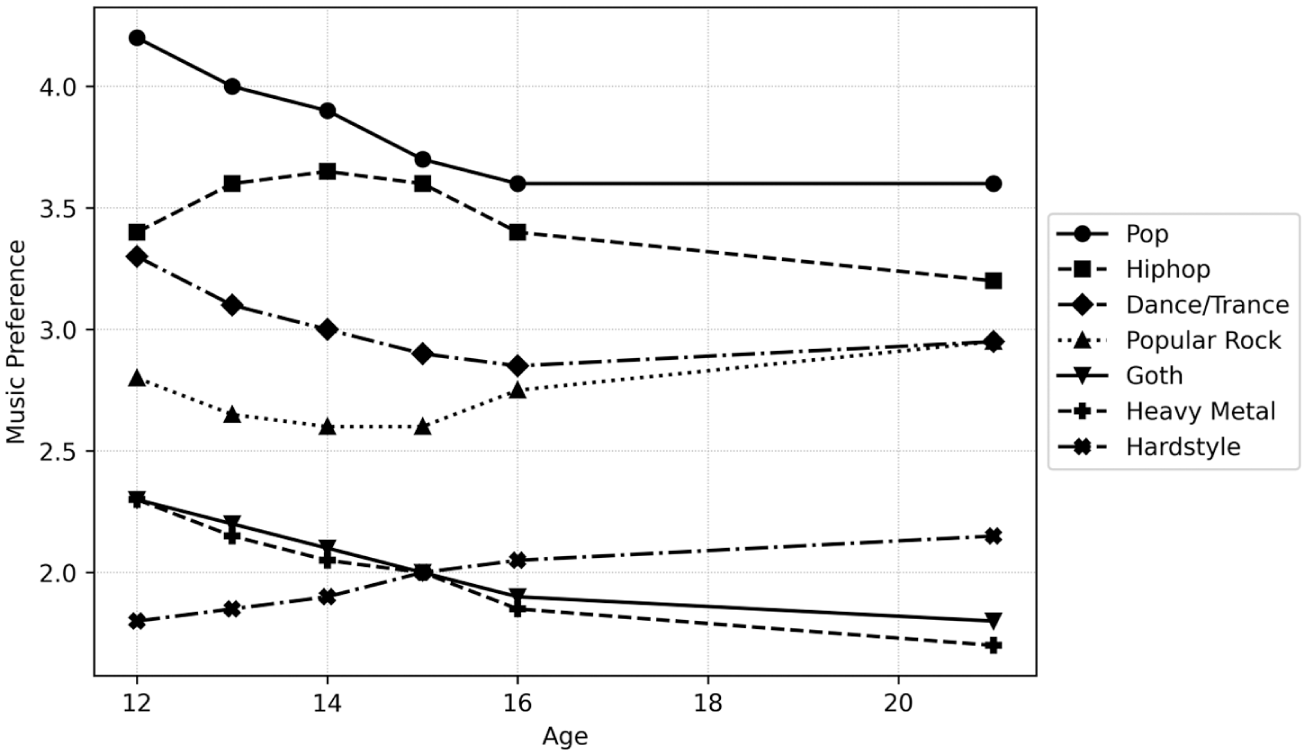
Mean Observed Scores for Mainstream and Non-mainstream Music Preferences across Early Adolescence into Young Adulthood.
Mainstream music preferences
Pop, popular rock, and dance/trance all decreased in early to middle adolescence and showed a small increase or leveling off into young adulthood. Hip-hop music preference showed an increase and subsequent decrease across adolescence into young adulthood.
Non-mainstream music preference
Levels of heavy metal and goth were relatively low and further decreased across adolescence into young adulthood. Hardstyle music preference was lowest during early adolescence and increased during late adolescence into young adulthood.
Time-varying associations between SCC and mainstream and non-mainstream music preferences
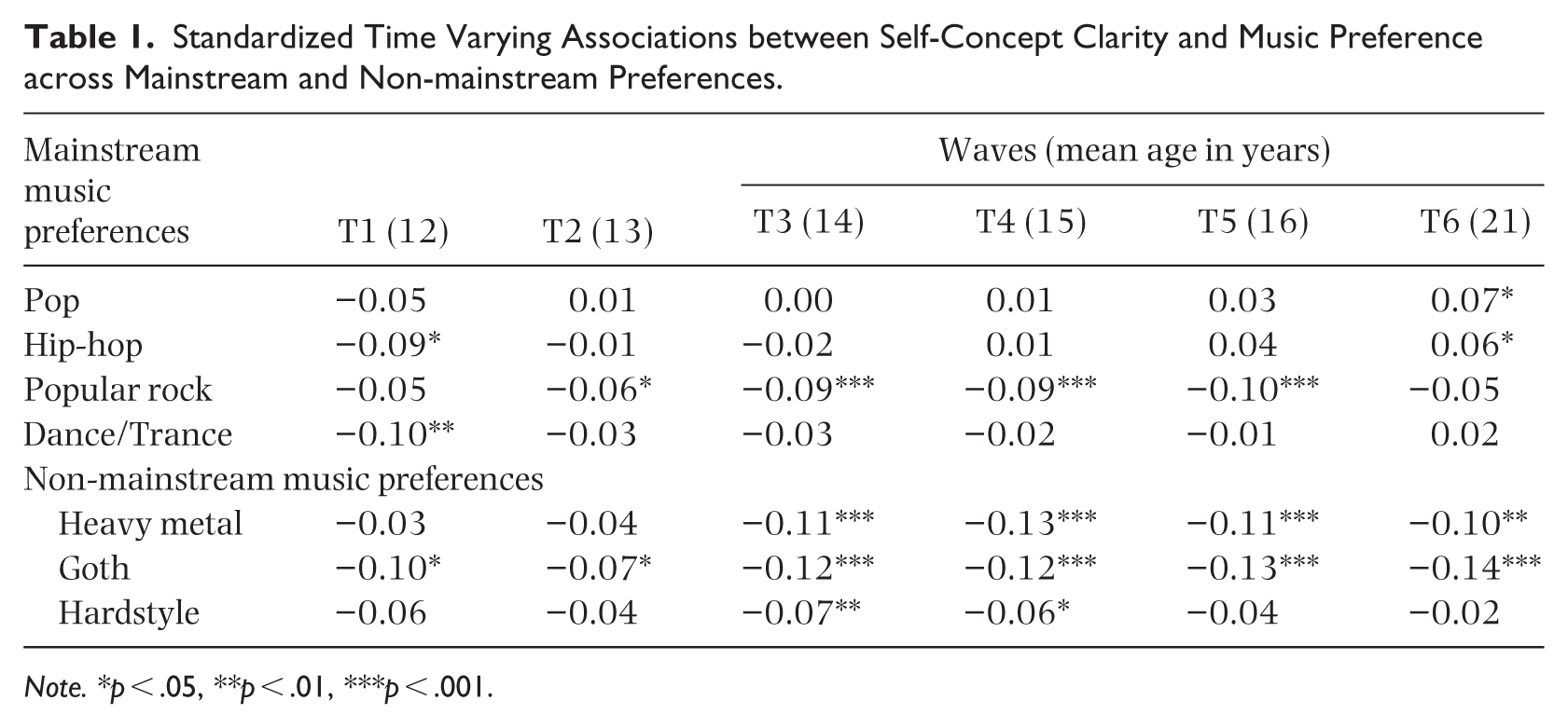
To test Hypotheses 1 and 2, the time-varying associations between SCC and mainstream and non-mainstream music preferences were examined. All models provided a good fit with the data (Online Supplementary Material Table S4 presents all fit indices). Table 1 presents all time-varying associations between SCC and mainstream and non-mainstream music preferences.
Standardized Time Varying Associations between Self-Concept Clarity and Music Preference across Mainstream and Non-mainstream Preferences.
Note. *p < .05, **p < .01, ***p < .001.
Mainstream music preferences
Limited support was found for Hypothesis 1 that SCC did not or positively predict mainstream preferences. During mid-to-late adolescence, virtually no associations were found between SCC and preferences for pop, hip-hop, and dance/trance, and at T6, SCC was positively related to pop and hip-hop. Contrary to Hypothesis 1, SCC negatively predicted dance/trance and hip-hop at T1 and popular rock across T2–T5.
Non-mainstream music preferences
Evidence for Hypothesis 2 was found, indicating that SCC was negatively related to non-mainstream preferences. Indeed, SCC negatively predicted goth music preference across T1–T6. SCC also predicted lower levels of heavy metal music from T3 T6 and hardstyle music preferences at T3 and T4.
In sum, some evidence was found for Hypothesis 1 that SCC is not or a positively related to mainstream music preference. More consistent support was found for Hypothesis 2 that SCC is a negative predictor of non-mainstream music preferences, most consistently for goth and heavy metal music.
Discussion
During adolescence and young adulthood, music serves as a tool for clarifying one’s identity. Lyrics, music videos, and the expressions of artists themselves often serve as examples for young individuals to emulate. While numerous cross-sectional studies have explored the relationship between identity in general and music listening, the specific longitudinal associations between SCC and music preferences had not been investigated. Through longitudinal analyses, this study aimed to elucidate the relationship between SCC and music preferences throughout the developmental stages of adolescence and young adulthood.
This investigation yielded several noteworthy results. First, during adolescence, a preference for mainstream music genres such as pop, hip-hop, popular rock, and dance/trance did not show a systematic association with SCC. However, in young adulthood, higher levels of SCC positively predicted higher preferences for hip-hop and pop music. Second, results showed that individuals with lower SCC were indeed more inclined to lean toward non-mainstream music genres, especially heavy metal and goth, but also hardstyle dance. Third, contrary to expectations, results revealed that particularly young adolescents with lower SCC levels showed a preference for two types of mainstream music: dance/trance and hip-hop. Fourth, and also unexpectedly, slightly older adolescents with lower SCC tended to prefer another type of mainstream music: popular rock music. Fifth, as expected, the associations between SCC and music preferences were evident during middle adolescence. However, even in young adulthood, individuals who continued to struggle with SCC favored non-mainstream rock genres, specifically heavy metal and goth.
We expected that there would be no systematic associations between SCC and non-mainstream pop, hip-hop, rock, and dance music, but that a positive association between SCC and liking mainstream music could be present. Results showed that there were no links between SCC and liking pop, hip-hop, and dance/trance in middle and late adolescence. But it is noteworthy that in young adulthood, a higher SCC was associated with a stronger preference for, specifically, pop and hip-hop music. This suggests that youth with fewer personal problems and a clearer sense of self indeed gravitate toward more conventional and mainstream forms of music when they grow into young adulthood (Laffan, 2021; Mulder et al., 2006). The expectation that preferences for the most popular pop music would either show no association or a positive association with a higher level of SCC was, therefore, confirmed, but this finding raises new questions. The process through which a preference for pop music becomes systematically associated with SCC in young adulthood, having not been so in adolescence, needs further investigation. What is the mechanism that causes this connection to emerge?
Second, as hypothesized, when adolescents grapple with lower SCC, non-mainstream music genres indeed become more pertinent. Genres such as heavy metal and goth delve into themes of not belonging to the mainstream, of not knowing who you are or where you belong. They explore the experiences of feeling unable to keep up with peers, or even facing active exclusion (Skutlin, 2016). For individuals navigating these feelings of alienation or exclusion, music genres that articulate such experiences may resonate more deeply. The results seem to corroborate findings from an earlier study on shyness and preferring goth music. Bešić and Kerr (2009) proposed that “radical” youth cultures centered around music, such as punk and goth, are safe havens particularly for shy, introverted, and sometimes anxious individuals who find it easier to express themselves among like-minded peers. For young people with relatively low SCC, not only are goth and metal attractive, but also another type of non-mainstream music, especially in middle and late adolescence: hardstyle dance. Although less texturally sophisticated than non-mainstream rock music, this music and the scene associated with it could provide an outlet for young people who do not yet know exactly who they are. The loud, energetic music can lift the mood, and a dance party offers fun, and a degree of oblivion (Collin, 2010). As in the case of fan scenes of goth and metal, the dance community offers togetherness and a place for young people who may not yet know or feel quite what their place is. Interestingly, the negative link between SCC and hardstyle disappeared in young adulthood.
Third, the link between low SCC and liking mainstream hip-hop and dance/trance in early adolescence presents a somewhat puzzling finding. Possibly, these results are coincidental. However, a cautious interpretation suggests a potential explanation. During early adolescence, it is common for young people to gravitate toward upbeat, sing-along, and low-complexity pop music. In contrast, hip-hop tends to be more layered and less straightforwardly happy-go-lucky than pop, while dance/trance music typically becomes more relevant as young people mature and begin going out to dance. Therefore, a preference for hip-hop or dance/trance in early adolescence could be viewed as a somewhat unconventional pattern. In line with one of the hypotheses, it is plausible that music that deviates from the mainstream holds greater appeal to young individuals with lower SCC. This could explain why hip-hop and dance/trance, while classified as mainstream music, attract those with lower SCC during early adolescence. It is, furthermore, intriguing to observe that in early adolescence, lower SCC is connected to a stronger preference for hip-hop music, whereas in young adulthood, the relationship is reversed. In this stage, a higher SCC is associated with a preference for hip-hop. Again, further replication research is necessary to ascertain whether these connections and trends are merely coincidental or hold meaningful implications.
Fourth, an unexpected result was that young people with lower levels of SCC also preferred another type of mainstream music: popular rock. A possible explanation could be that young people with a less clear sense of who they are do not only prefer goth and metal more often, but also the popular music that most closely aligns with those preferences: popular rock. This type of rock, while generally more melodic and more comfortable with most young people, perhaps also addresses some of the issues that are certainly addressed in the non-mainstream varieties of rock: rebellion, maladjustment, fear, and alienation (Arnett, 1993, Olsen et al, 2023; Weinstein, 2000).
Fifth, as anticipated, the associations between SCC and music preferences were evident during middle adolescence. Overall, indeed a negative association between SCC and, particularly, non-mainstream music in middle and late adolescence was found. It may be that while adolescents with lower SCC initially exhibit a greater inclination toward non-mainstream music, the exposure to this music and the discussions with peers within their music scene could potentially elevate their SCC levels later on in life. But while music and conversations with peers may indeed play a role in clarifying SCC, the findings further indicate that lower levels of SCC are associated with preferences for goth and metal music, in young adulthood as well. Again, these types of music may hold important messages, and the associated music scenes can provide a sense of belonging and camaraderie, but they might not ultimately resolve deeper emotional or psychological challenges such as feelings of alienation, depression, or lower levels of SCC. If SCC maintains relatively low, non-mainstream goth and heavy metal seem to remain attractive in young adulthood.
Calling for an interdisciplinary approach
At a more general level, the current longitudinal study reveals that two key developmental tasks of youth-identity development and music taste development are meaningfully associated across adolescence and young adulthood. This underscores the importance of future research to integrate different fields of study, such as developmental psychology and the psychology of music, to increase our understanding of how these processes interact and evolve over time.
Limitations
Longitudinal studies on music listening, music preferences, and music fandom in relation to a range of adolescent developmental outcomes are scarce. This study fills this gap. It is the first longitudinal study to examine a crucial feature of identity formation, namely, SCC development, in relation to music preferences from early adolescence into young adulthood. Despite this strength, this study also has limitations. First, while this study tested how SCC and music preference are associated at different stages of adolescence and young adulthood, it did not explicitly explore the dynamic interaction and mutual influence between SCC and music preferences. This dynamic relationship warrants further investigation. Second, although music preferences themselves were operationalized, this study lacks detailed information on the specific music and artists young people listened to, the frequency of their listening habits, and the significance they attributed to it. Understanding these processes of listening, interpretation, and meaning making is crucial for elucidating identity formation and should be explored in follow-up studies. Third, and this may stem from the fact that the operationalizations were not always optimal: although significant associations were found between music preferences and SCC, the magnitude of the standardized coefficients (ranging from −.14 to .07) was modest, indicating that all associations are small in terms of effect size. The structure of these results is intriguing, but further research using more refined measurements is needed to clarify the precise magnitude of the observed effects. Fourth, the data set did not include an item specifically related to the more radical non-mainstream varieties of hip-hop. It would have been insightful to examine whether the associations between SCC and non-mainstream rock and dance music also apply to hip-hop.
Conclusion
Results from this study once again indicate that enjoying upbeat mainstream music rarely signals problems, while a preference for non-mainstream music often correlates with problematic outcomes in adolescent development. However, we caution against stereotyping or stigmatizing this music. Particularly for young people facing challenging situations, such music can offer solace, elevate mood, and provide a sense of belonging in a social context where those feeling marginalized can find acceptance (Baker & Brown, 2016; Sharman & Dingle, 2015; Travis, 2015). Over 30 years ago, Christenson and Roberts (1998), in their groundbreaking book “It’s Not Only Rock ’n Roll,” observed that there is no such thing as “problem music,” but rather that young people facing difficulties are more likely to resonate with what adults may deem as “problematic music.” We wholeheartedly support this conclusion. Our findings suggest that adults working with young people in school, youth work, or therapeutic settings should be particularly attentive to those who prefer music that many adults perceive as harsh, norm-defying, chaotic, or nihilistic. Understanding these musical preferences offers valuable insights into the emotional and psychological landscapes of young people. Rather than dismissing or pathologizing these preferences, the findings of this study underline their potential significance in identity formation and resilience-building.
Supplemental Material
sj-docx-1-pom-10.1177_03057356251414392 – Supplemental material for “I Can See Clearly Now”: On the time-varying associations between self-concept clarity and music preferences across adolescence into young adulthood
Supplemental material, sj-docx-1-pom-10.1177_03057356251414392 for “I Can See Clearly Now”: On the time-varying associations between self-concept clarity and music preferences across adolescence into young adulthood by Andrik Becht and Tom ter Bogt in Psychology of Music
Footnotes
Data availability

Funding
The authors received no financial support for the research, authorship, and/or publication of this article.
Ethical Considerations
The CONAMORE study was approved by the Faculty Ethical Review Board and by the Medical-Ethical Committee of Utrecht University, The Netherlands.
Supplemental material
Supplemental material for this article is available online.
References
Supplementary Material
Please find the following supplemental material available below.
For Open Access articles published under a Creative Commons License, all supplemental material carries the same license as the article it is associated with.
For non-Open Access articles published, all supplemental material carries a non-exclusive license, and permission requests for re-use of supplemental material or any part of supplemental material shall be sent directly to the copyright owner as specified in the copyright notice associated with the article.
