




Abstract
Musical chills, a subjective emotional experience associated with goosebumps, shivers, and/or tingling sensations, have recently been linked to experiences of social bonding. Thus, there is some rationale for expecting music performance to afford chills, as performance can involve strong emotional responses and social bonding experiences. However, almost all musical chills research focuses on listening contexts. This study explores experiences of musical chills while performing music. Data for the study were collected through a questionnaire survey with 218 musicians about their chills experiences. Results show that chills are experienced by musicians during performance and that they are largely positive experiences. Important factors for chills in performance include various musical features, performance qualities, interpersonal connections between performers, and personal associations with the music and performance context. Findings align with links between chills and social bonding, although further research is required to understand underlying psychological mechanisms of the phenomenon. Finally, various characteristics of chills in music performance suggest that the experience may be linked to psychological wellbeing, posing a novel route for continued research.
Musical chills can be conceptualized as a subjective emotional experience accompanied by goosebumps, shivers, and/or tingling sensations (Bannister, 2020). They are associated with peak experiences (Panzarella, 1980), pleasure (Ferreri et al., 2019; Salimpoor et al., 2011), physiological arousal (Grewe et al., 2007; Rickard, 2004; Sumpf et al., 2015), and personality traits including openness to experience (Colver & El-Alayli, 2016; McCrae, 2007; Nusbaum & Silvia, 2011). Research involving music listeners outlines correlations between chills and musical or psychoacoustic characteristics such as new or unprepared harmonies (Sloboda, 1991), crescendos (Panksepp, 1995), sudden dynamic or textural changes (Grewe et al., 2007), the human voice, lyrics, perceived moments of unity in the music (Bannister, 2020), loudness, brightness, and roughness (Nagel et al., 2008). Preliminary, explanatory accounts of musical chills (De Fleurian & Pearce, 2021) have linked the response to violations of musical expectation (Huron, 2006), peak emotional arousal (Rickard, 2004), and social separation or bonding elicited through sounds in music that may resemble mammalian distress vocalizations (Panksepp, 1995; Panksepp & Bernatzky, 2002). Recently, chills have been correlated with being moved and kama muta, in the context of music listening and engagement with other stimuli (Bannister, 2019; Bannister & Eerola, 2023; Benedek & Kaernbach, 2011; Fiske et al., 2019; Schubert et al., 2018; Vuoskoski et al., 2022; Wassiliwizky et al., 2015; Zickfeld et al., 2020). Being moved is a socio-relational emotion (Menninghaus et al., 2015), linked to significant social life events (Cova & Deonna, 2014; Kuehnast et al., 2014). Kama muta is conceptualized as a positive social emotion accompanied by physical responses including goosebumps (Fiske et al., 2025). Kama muta results from suddenly intensified communal sharing relations, which reflect a feeling of sameness or oneness with another person, group, culture, or broader concept (e.g., the universe). Recent empirical work has linked kama muta to music listening experiences (Vuoskoski et al., 2022) and virtual music concert attendance (Swarbrick et al., 2021).
Almost all empirical research on musical chills has focused on listeners. However, musical engagements are diverse beyond listening, with an immediate example being music performance. Performing 1 has been linked to strong emotional experiences (Gabrielsson, 2011; Lamont, 2012) and to social bonding (Camlin et al., 2020; Clayton et al., 2020). Given the recent work highlighting relationships between chills and emotional social bonding experiences such as being moved or kama muta, music performance may be effective in affording chills experiences. Thus, this study aimed to perform one of the first exploratory investigations of chills experienced while performing music.
Social interactions in ensemble performance
Ensemble performance may afford chills experiences, given that it involves social or communicative interactions (Davidson & Good, 2002; Keller, 2014; Volpe et al., 2016). Indeed, interpersonal experiences are common in musicians’ strong experiences with music (SEM; Gabrielsson, 2011; Lamont, 2012).
Group performance can involve shared intentionality and intersubjectivity (Cross et al., 2012). Experiences of musical and social alignment have been associated with “group” or “collective” “flow” (Gaggioli et al., 2017; Sawyer, 2014; Tay et al., 2021) involving collective attentional attunement. This phenomenon has been conceptualized widely, from the “mutual tuning-in” of musicians inhabiting the “inner time” of performance (Schütz, 1951, p. 79; Cook, 2004/2017); to communitas (Enticott, 2000), the sense of togetherness experienced by those undergoing change together (Turner, 1979); to “shared absorption” (Høffding, 2018; Høffding et al., 2023), describing the communal affective, affiliative, and cognitive states experienced during ensemble playing. Finally, group performance has been identified as affording empathy (Cross et al., 2012; Seddon, 2005; Seddon & Biasutti, 2009; Waddington, 2017), involving a diminished sense of self or blending of individual egos (Hytönen-Ng, 2016).
Further evidence of the relational aspects of ensemble performance comes from group singing, which has been associated with feeling moved (Clift & Hancox, 2001), social bonding (Kreutz, 2014), and shared emotional states affording social coherence and cooperation (Cross, 2009; Maury & Rickard, 2016). Social benefits of singing together include connecting with new people (Clift & Hancox, 2001; Maury & Rickard, 2022; Moss et al., 2018), facilitating a sense of belonging (Livesey et al., 2012), and social bonding (Pearce et al., 2015).
Entrainment is an integral process of group music-making that affords interpersonal synchronicity and shared intentionality (Clayton et al., 2020; Cross, 2008). Interpersonal entrainment has been associated with social bonding (Launay et al., 2014; Stupacher et al., 2017; Tarr et al., 2014), trait empathy (Bamford & Davidson, 2019; Stupacher et al., 2022), and prosocial behavior, including in early development (Cirelli et al., 2014; Kirschner & Tomasello, 2010). Indeed, contemporary theories of the evolution of music relate to the facilitation of social bonding and group cohesion, with collective movement a crucial aspect of this process (Cross & Morley, 2009; Huron, 2001; Savage et al., 2021).
To summarize, ensemble performance has been associated with musical, social, and emotional connection or togetherness that can be experienced with varying levels of intensity (Bishop, 2024; D’Amario et al., 2022). Playing and singing together affords shared intentionality and affective states, suggesting potential links to the sudden intensification of communal sharing relations underlying kama muta experiences (Fiske et al., 2025) and, in turn, chills responses (Bannister, 2019).
Summary and rationale for the current study
Existing research on ensemble performance suggests that performers can experience shared intentionality, intersubjectivity, and social bonding. Given these qualities, there is an extended rationale for expecting that chills, potentially indicating being moved or kama muta, are common during the performance of music.
However, existing evidence on chills during music performance is substantially limited. Although a small number of chills episodes are recorded in musicians’ SEM (Gabrielsson, 2011), the relative importance and potential interrelation of musical, performer-related, and contextual factors is unclear. In addition, although the above discussion has focused on ensemble contexts, chills might equally be experienced when performing alone, if associated with specific moments or features of the music (Bannister, 2020; Grewe et al., 2007; Panksepp, 1995; Sloboda, 1991). Finally, although most chills research has focused on music listening, performance requires distinctive and complex demands, including heightened attention to a range of foci (Allingham et al., 2021), overt motor action, and often interpersonal interaction. The potential impact of these tasks on chills experiences is unclear.
Given these lacunae, this study aimed to explore chills experiences while performing music, underpinned by the following research questions:
RQ1. Do people experience chills when performing music?
RQ2. How do people characterize their experiences of chills when performing music?
RQ3. What are the important musical, performer-related, and contextual factors of chills experienced while performing music?
Methods
Design and materials
An online questionnaire was designed (using Qualtrics) to investigate chills experienced while performing music. The questionnaire comprised three sections. The first collected demographic information, including age, gender, years playing music, music styles performed, main instrument (including voice), self-defined musicianship (amateur, semi-professional, professional, other, not sure), and typical performance context or location (e.g., café, concert hall or theater, home, etc.).
The second section included questions about musical chills, such as whether participants had experienced chills while listening (if so, how often) and whether they had experienced chills while performing music (if so, how often); if participants responded with “no” or “unsure” to this latter question, the questionnaire ended. A definition of chills was provided to participants, informed by existing literature.
The final section asked participants to recall an experience of chills while performing; if participants could not recall one, the questionnaire ended. Participants were asked how recent the chills experience was; what music they were performing; whether it was a solo performance or involved co-performers; whether the performance was audience-facing, a rehearsal, social activity, livestream, or other; where the performance took place (i.e., venue); whether the chills occurred during a specific moment of the music (and if so, whether they could describe the music at that moment); and whether they were actively performing when they experienced chills. In addition, participants were asked to freely describe their subjective feelings of the chills experience, the context of the performance, and to offer a possible reason for their chills experience. Finally, participants were asked to rate (via 1–7 Likert-type scales) how important a series of factors were to their chills experience, which included the music, co-performers (if applicable), audience (if applicable), venue, broader context of the performance, or other participant-nominated factors; following this, participants were asked to freely explain their ratings.
If participants could recall a second experience of chills, they could respond again to the final questionnaire section. The questionnaire took approximately 15 min to complete and was approved by the Faculty of Arts and Humanities Research Ethics Committee of the University of Leeds (Ref: LTMUSC-143). The full questionnaire is available in the Supplementary Materials.
Participants
The questionnaire was engaged with by 218 participants (M age = 43.60, SD = 15.77, range = 18–88), comprising 57 males, 147 females, 1 transgender male, 2 transgender female, 6 non-conforming/gender variant, and 5 other/not listed. In total, 93% (n = 201) of participants reported having more than 10 years’ playing experience (M = 29.84, SD = 16.17, range = 2–75).
The most frequent styles of music performed were classical and orchestral (n = 230), pop (n = 60), folk (n = 54), jazz (n = 49), and rock (n = 47). The most frequent performance settings were concerts (n = 172), religious venues (n = 79), and bars (n = 51); however, participants also reported that they often performed music at home (n = 118).
Most participants defined themselves as amateur musicians (n = 89), followed by semi-professional (n = 59) and professional (n = 52). Frequently reported main instruments included voice (n = 71), piano/keyboard/organ (n = 47), strings (n = 43), woodwind (n = 33), and guitar (n = 28).
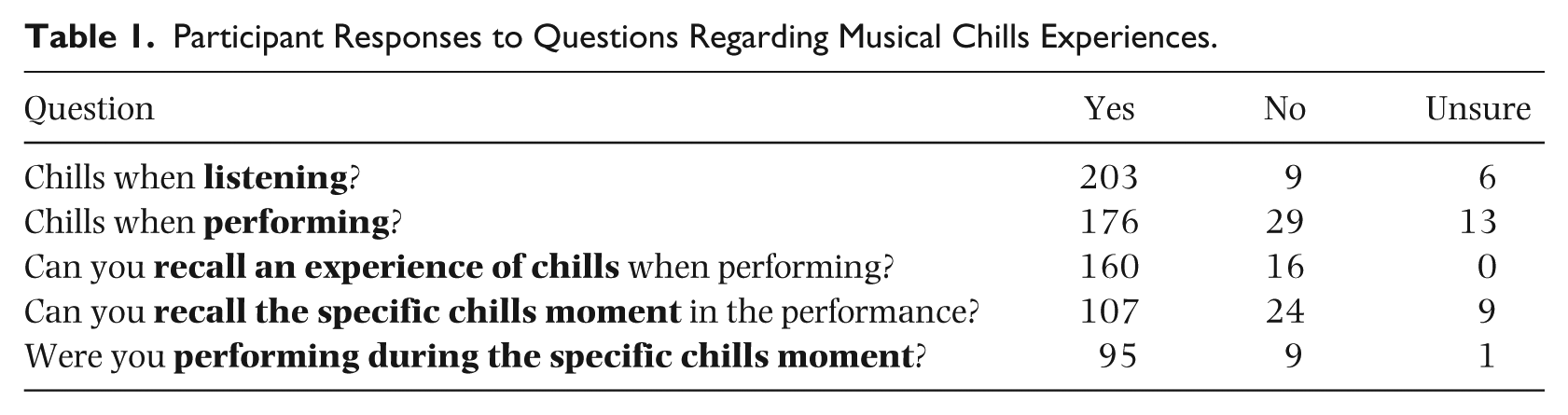
Resulting from screening questions (e.g., responses of “no” or “unsure” to whether they had experienced chills in performance or whether they could recall a chills experience in performance), 58 participants did not complete the full questionnaire (see Table 1). An additional 27 participants who were not screened out did not complete the full questionnaire (as determined by formally ending the questionnaire in Qualtrics) but provided data in relation to chills experiences in performance. Given the exploratory nature of the research, all data, including those from screened participants and incomplete questionnaire responses, were retained for analysis. For a breakdown of demographic data across screened participants, participants who provided incomplete responses, and the remainder of the participant sample, please see the Supplementary Materials.
Participant Responses to Questions Regarding Musical Chills Experiences.
Procedure
Participants were recruited via advertisements on music academic mailing lists, Facebook music interest groups, and professional networks. As data were fully anonymized at all points of the research, participants provided informed consent through agreeing to continue with the questionnaire, after reading the participant information sheet.
Data analysis
Descriptive statistics of quantitative data were generated through R. Open-ended responses were subject to inductive content analysis (Hsieh & Shannon, 2005). The two researchers each coded approximately 50% of the raw qualitative data, organized by six open-ended questions in the third section of the questionnaire: the first researcher coded responses to questions about subjective feeling, performance context, and the specific chills moment in the performance; the second researcher coded responses to questions about important factors for the chills experience, other important factors that participants reported, and the reasons for the chills experience from the participant perspective. Codes were grouped iteratively, in terms of similarity and patterns in meaning. Code groupings were then used to develop holistic code categories for each of the six questions, containing information on how frequently the associated codes appeared across participant responses. Each participant response could be assigned several codes.
Next, inter-rater reliability was evaluated as a reflexive process to ensure shared interpretation of data. Both coders used the coding schemes for each of the six open-ended questions and independently coded the same random 20% of responses from each question. Krippendorff’s Alpha was calculated to assess inter-rater reliability (O’Connor & Joffe, 2020). After the first process, there was substantial agreement between the coders, with an alpha value of .71 (range across six questions = .64–.87). The coders subsequently discussed variations in interpretation, resulting in an improved level of agreement, with an alpha level of .80 (range across six questions = .77–.87).
Results
Descriptive statistics
Table 1 presents data regarding general questions on chills experiences. Most participants experienced chills when listening to, and performing, music. Many participants could recall a chills experience while performing. Of these, most could recall the specific chills moment in the performance, with many participants performing during this moment.
Across recalled chills experiences, 71% (n = 114) involved co-performers. The most common performance “types” included audience-facing performances (n = 71) and rehearsals (n = 43), whereas social activity (n = 8) and casual jams (n = 7) were less frequent; other reported performance types included practicing at home, singing in a car, and recording sessions. The most common venues were concert halls or theaters (n = 52), home (n = 32), or a religious venue (n = 25); other reported venues included educational settings, outdoor settings, and practice or rehearsal spaces. Finally, there was notable variation in the music pieces being performed in recalled chills experiences (see Supplementary Materials; details have been lightly edited for consistency, with some identifiers removed to preserve participant anonymity).
Subjective feelings
Across open-ended responses describing how participants felt during the chills, 343 codes were generated, with overarching categories visualized in Figure 1.
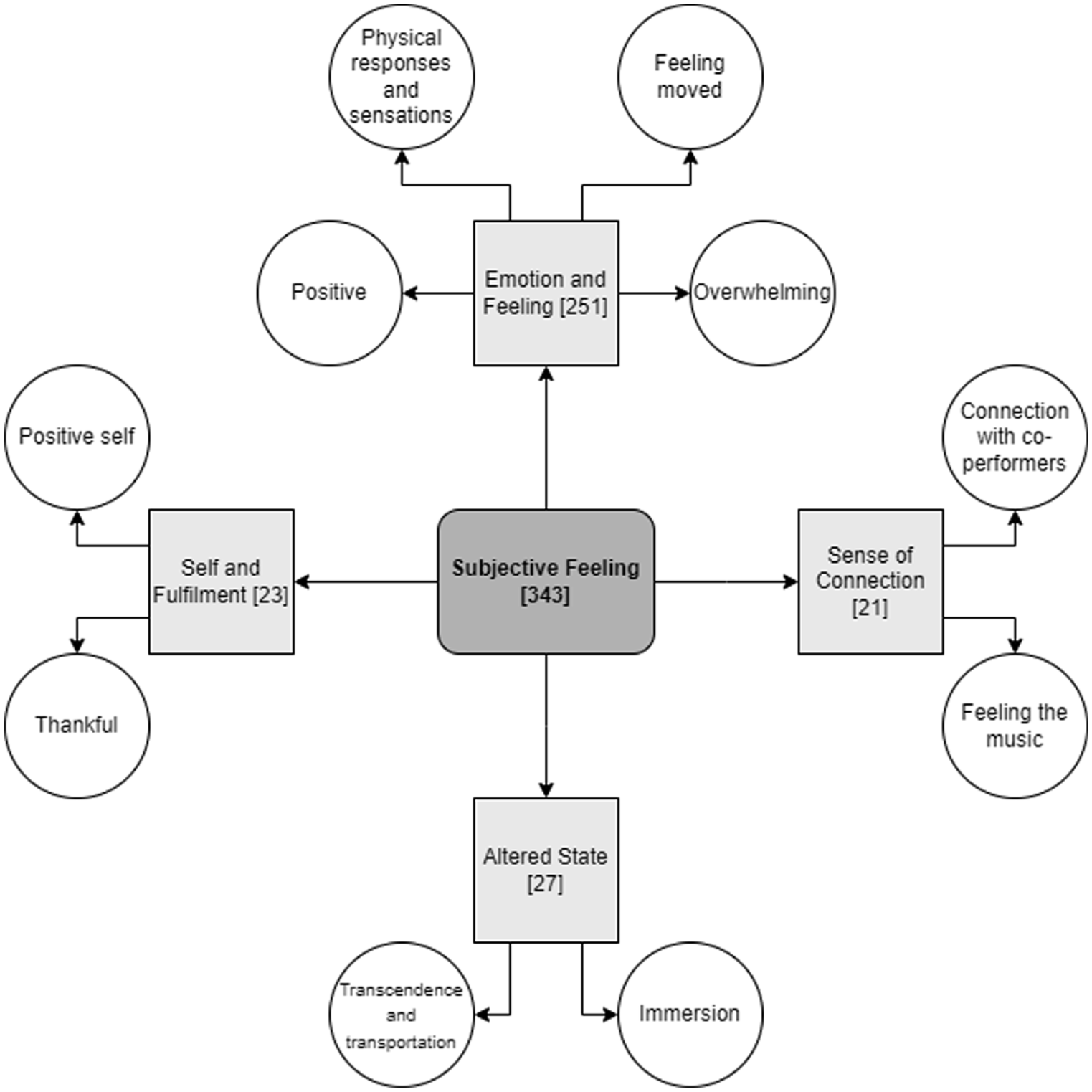
Visual mapping of code categories (gray squares) and highlighted subcategories (white circles) for subjective feeling responses. Code totals are provided in parentheses.
The prevalent code category was Emotion and Feeling. Many participants described physical sensations experienced during chills, including goosebumps, shivers, tingling, tears, and warmth or cold. Largely, chills during music performance were characterized as positive experiences (e.g., enjoyable, joyous, exciting). Some participants described chills as moving experiences: “Very moved by the music (my favorite piece) but also the group participation. Electric when it comes together” (Cello, male, aged 46, amateur).
Others also characterized their chills responses as intense, referring to feelings of awe, profundity, and euphoria. A few participants felt overwhelmed during the chills, which sometimes disrupted their performance: “Hairs on arms ‘stood up’, I was so moved I couldn’t continue singing the next couple of bars of my part” (Voice, female, aged 70, amateur).
A further code category, Altered State, encapsulated transcendental experiences and feelings of transportation. For example: “It was a touching experience. It is music that envelops you, encapsulates you and takes you away from the audience, away from the living room, and into something quite different altogether. It is rather profound” (Multiple instruments, male, aged 30, semi-professional). Other responses in this category mentioned attention, focus, and flow, and being immersed in the music.
A third code category was Self and Fulfillment, in which participants described feeling motivated, proud, fulfilled, or satisfied in relation to their performance. Some participants outlined experiences of empowerment and confidence, and others described feeling thankful, grateful, or fortunate.
Sense of Connection encapsulated feelings of connection with the music, co-performers, the composer, or more general feelings of connection.
Other code groupings encapsulated responses where participants described qualities of the music or performance, or a phenomenological feeling of “rightness” in which elements of the performance “seemed just right” (Voice, gender variant/non-conforming, aged 34, professional).
Performance context
For descriptions of the recalled performance context, 430 codes were generated and grouped into broader categories (see Figure 2).
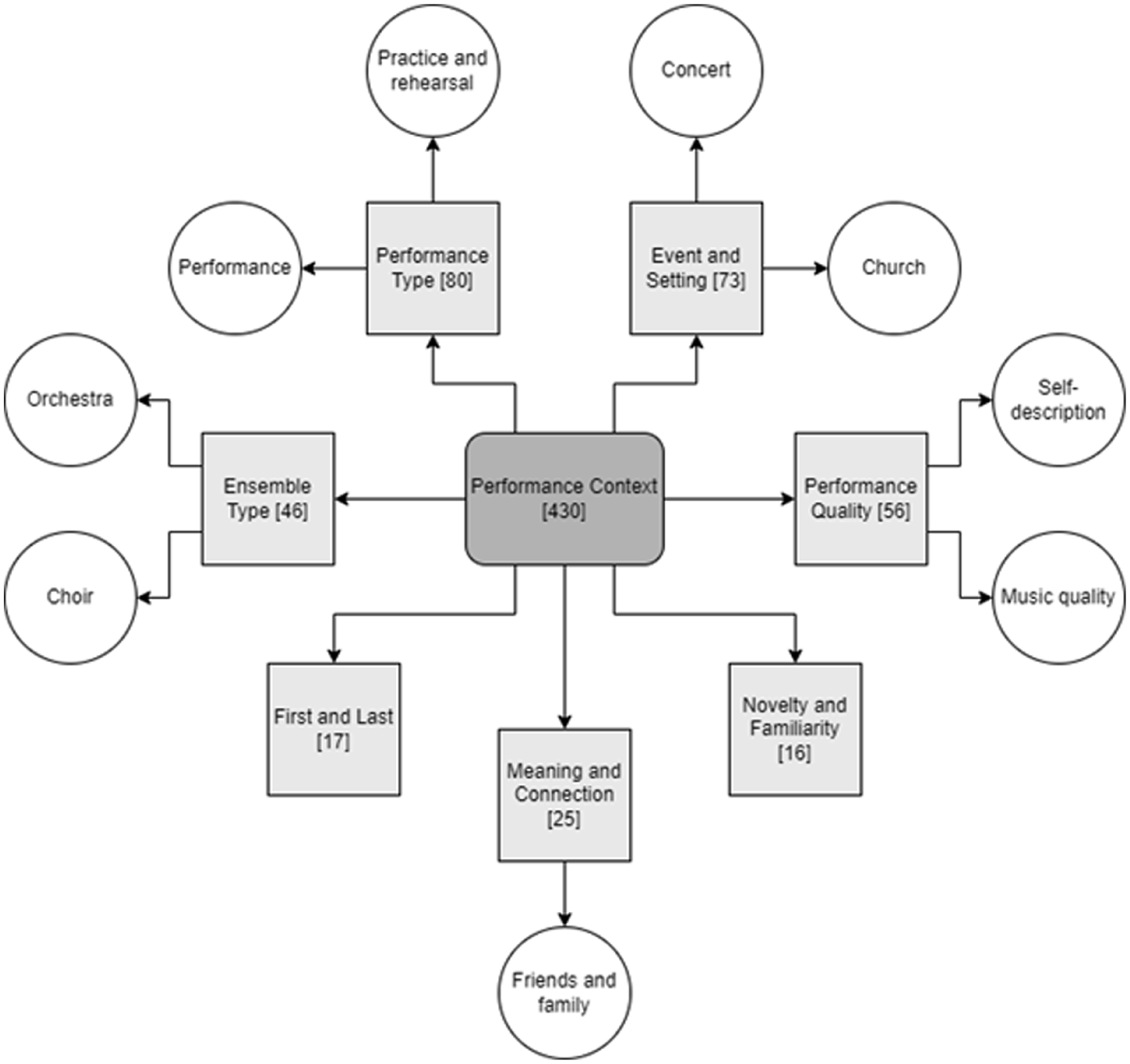
Visual mapping of code categories (gray squares) and most prominent subcategories (white circles) for performance context responses. Code totals are provided in parentheses.
The larger code categories—Performance Type and Event and Setting—mostly reflect responses in the corresponding questions regarding performance type and venue (see section “Descriptive statistics”). Regarding Ensemble Type, orchestras and choirs were often mentioned, alongside jazz bands, wind bands, guitar performance, solo singing, piano performance, and barbershop.
The Performance Quality category detailed aspects of the performance. The music was sometimes described, ranging from chorales to folk jams; the venue was highlighted, referring to positive characteristics such as acoustics, aesthetics, and suitability for the music; finally, participants occasionally described their own part in the performance, and the good quality of the overall performance.
Two related code categories were Novelty and Familiarity and First and Last. In Novelty and Familiarity, some participants noted they had performed the piece numerous times before, whereas others described a novel contextual aspect of the performance, such as recently joining the band, releasing an album just before the performance, or experiencing something new in a rehearsal compared with previous sessions. For First and Last, some participants described their performances as a first-time experience; for example, playing the piece or performing in public for the first time, or performing on an instrument for the first time. However, other responses touch on a sense of finality in the recalled performance; for instance, the last performance in a tour or workshop, or a final performance before leaving an ensemble or university.
Such responses may imply a sense of meaning attributed to the recalled performances, and this is apparent in the data, within a Meaning and Connection category. Primarily, participants contextualized the meaning of their performances in relation to relatives or friends. For example, This was a performance for my Year 12 Music Extension recital. “Nessun Dorma” by Jeff Beck was a very special piece for me to perform, as it was my Grandad’s favourite song, and he has been battling cancer for many years. It was a special moment performing this song for him, and my whole family and peers. (Voice, female, aged 57, amateur)
Beyond this, a few responses described other feelings of meaning and connection, such as performing at a concert that they used to play at with another choir, or feeling a connection to one’s ancestors and heritage through the music.
Further code groupings encapsulated responses describing the size and behavior of audiences (e.g., standing ovations, positive feedback, remaining silent), and subjective or phenomenological feelings of participants, such as feeling that “the music was going through my heart and my soul” (Piano, female, aged 28, professional).
Specific chills moment
Participants were asked to describe the music during the specific moment in which they experienced chills. Across responses, 225 codes were generated, with broader groupings visualized in Figure 3.
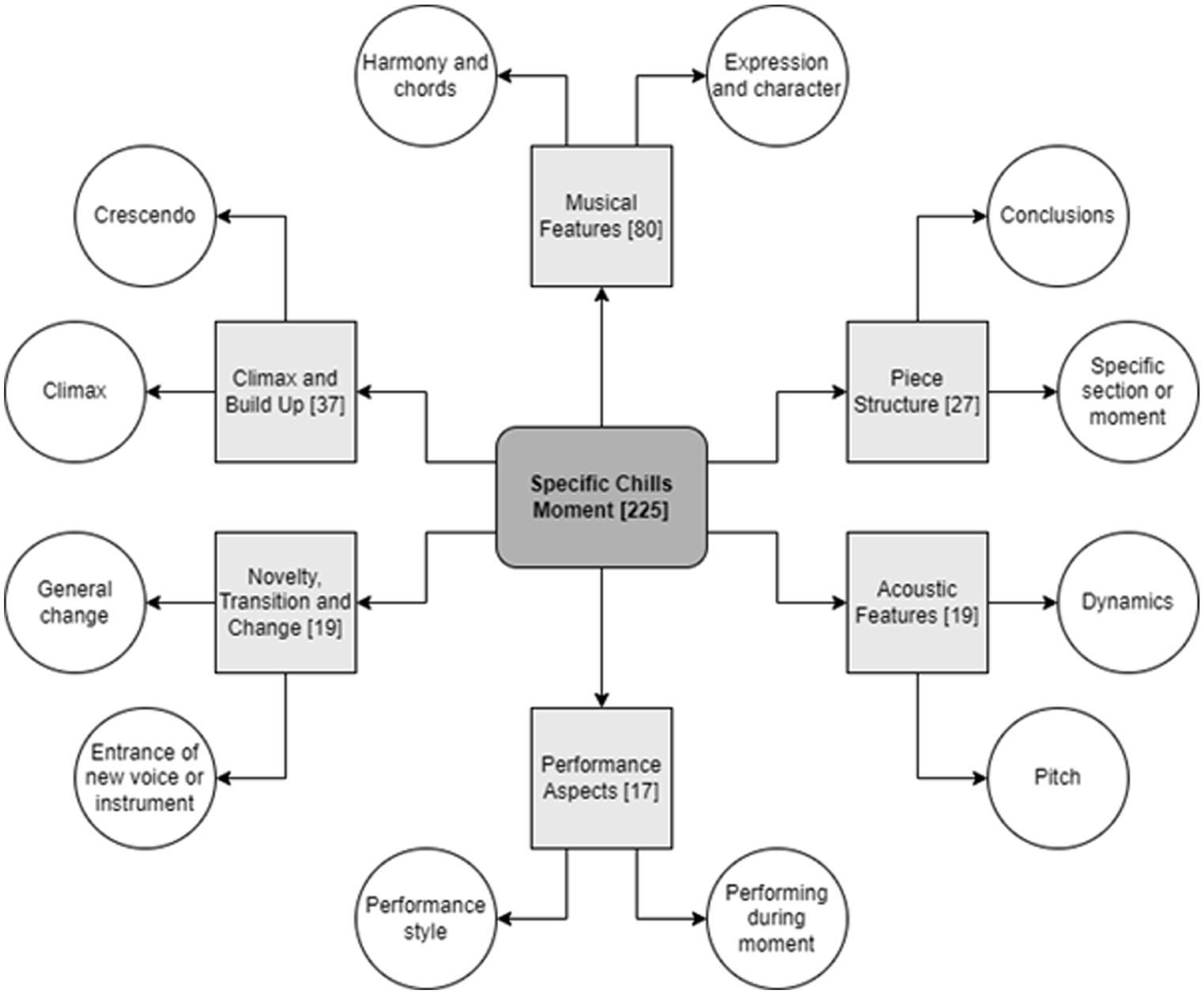
Visual mapping of code categories (gray squares) and most prominent subcategories (white circles) for specific chills moment responses. Code totals are provided in parentheses.
Several Musical Features were noted by participants, including harmony and chords. Some of these descriptions emphasized harmonic resolution, for instance, “There is a rising series of dissonant and unresolved chords that finally resolve. [. . .]” (Piano, male, aged 65, professional).
Other participants referred to chord progressions, beautiful chords, harmonic transpositions, and cadences. Expressive characteristics of the music were also highlighted, with the music sometimes described as epic, cinematic, dramatic, expressive, intense, rhythmic, and thrilling. Other Musical Features included lyrics, melody, solo voices/instruments, repetition, and tempo.
Responses in the Novelty, Transition and Change category touch on general moments of change in the music when experiencing chills. More specific accounts mention harmonic change, or the entrance of a new voice or instrument: “The organ entrance. Very powerful” (Bassoon, female, aged 53, amateur).
In the Climax and Build Up category, the music during chills experiences was described as building up in some way, or as reaching the climactic point in the music. For instance, When the piece reached its final climax of volume and textural density, which is preceded by an accelerando. I could even point to the exact bar where I felt the “ping” of fuzzy feelings in my head. And as we rehearsed again and again it was quite consistently that exact bar (Multiple instruments, male, aged 26, professional) Towards the end of the piece, the theme builds to a huge timpani roll. Gets me every time! (Viola, female, aged 56, amateur) Final climax, where soprano soloist reaches a top C. (Timpani, male, aged 65, semi-professional)
Similarly, in a code grouping labeled Piece Structure, most responses point to chills occurring in finales or final movements or moments in a piece. A few participants noted that chills occurred during a chorus, or at the beginning of a piece.
Across other responses, acoustic features were noted, including dynamics, pitch, and timbre. A few participants mentioned that elements of the music came together in the chills moment, and others described getting chills when playing a main theme or chord, singing a refrain or specific line, or performing a solo line.
Reason for chills
Participants were asked to describe their perceived reasons for the recalled chills experience. These responses generated 529 codes, grouped into broader categories (see Figure 4).
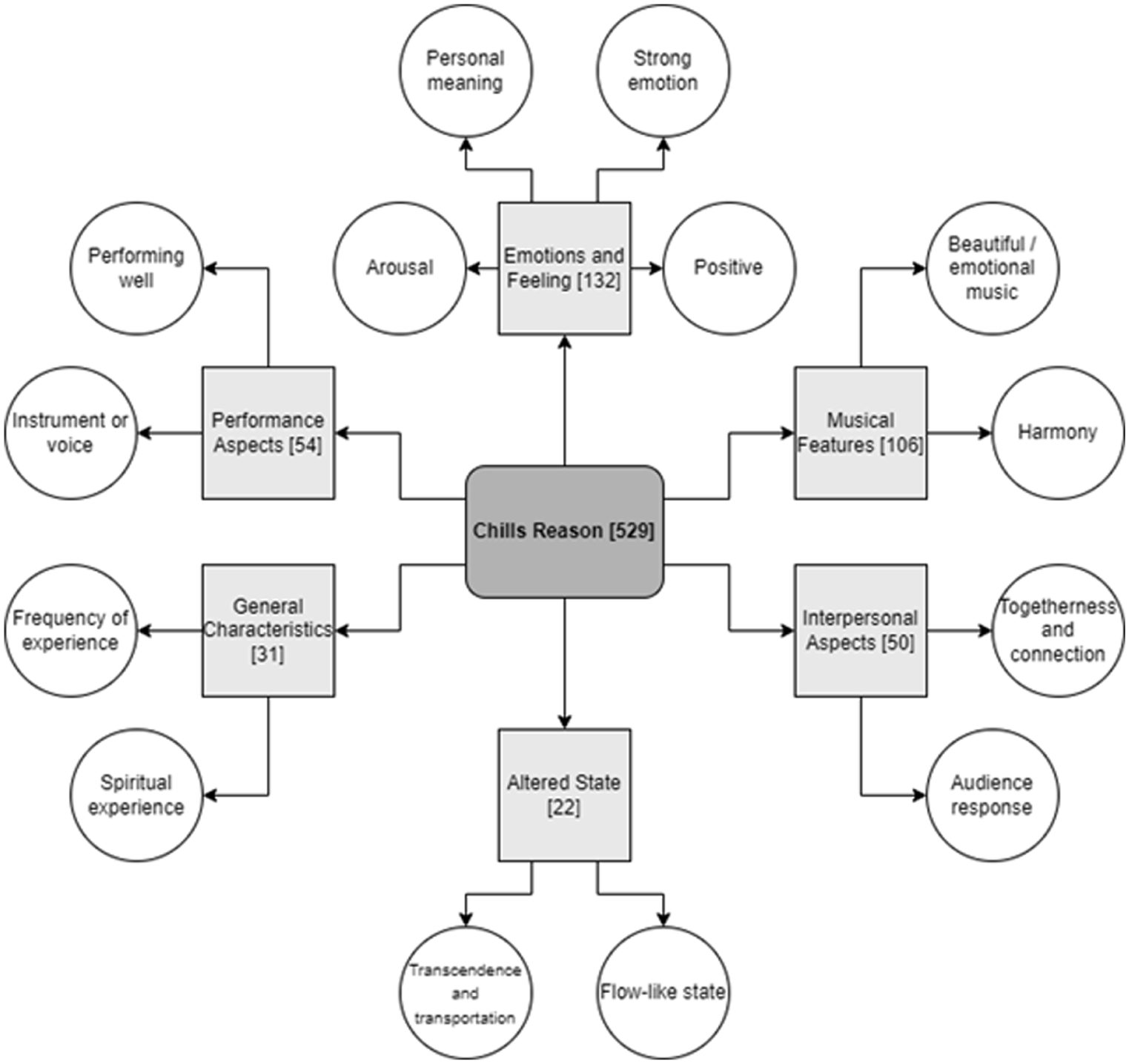
Visual mapping of code categories (gray squares) and most prominent subcategories (white circles) for chills reason responses. Code totals are provided in parentheses.
Numerous participants attributed their chills experiences to Emotions and Feelings evoked by the music, as well as their current mood or state. Responses included feeling moved, positive emotions (e.g., joy, pleasure), aesthetic feelings (e.g., beauty, awe), and arousal (e.g., energy levels, excitement, anxiety, anticipation). Reports of strong emotions could be positive or negative, referring to intense experiences, moments of “emotional climax” (Piano, male, aged 65, professional), and feeling overwhelmed. A small number of participants described mixed or negative emotions such as nostalgia and sadness. Personal meanings of the music included perceived meanings of lyrics, memories, and thoughts of friends or relatives attributed to the music or performance context. Other participants ascribed their experiences to the embodied aspects of performing, characterized as carnal or related to sound production, such as “bodily sensation of the pitches, and opening of vocal tract” (Recorder, male, aged 19, semi-professional).
Several codes identified feelings relating to rightness and alignment. These might relate to a quality perceived in the music, such as “the melody and instrumentation fitting together perfectly” (Drumkit/percussion, male, aged 48, semi-professional). However, responses more frequently described the emergent phenomenon of performance elements working well together unexpectedly, or feelings of things “clicking,” and feeling unified. For example, “It was a moment where the vision I had for the song I was recording seemed to click, pieces moved into place and everything felt right” (Guitar, transgender female, aged 27, semi-professional) and “The alignment of all the different elements of the performance complimenting [sic] each other-almost as if it was planned. [. . . ]” (Voice, female, aged 22, professional). Other codes in Emotions and Feelings touched on experiences of satisfaction and pride or described the performance as realizing ambitions.
The Interpersonal Aspects category largely comprised responses mentioning connection or relationship to an “other” (e.g., co-performers). This connection could be perceived as musical (e.g., playing/singing together, rhythmic alignment, tuning), social, or emotional. For example, [. . .] I sometimes get chills when I feel that an ensemble I’m part of does a particularly good job of working together and the ensemble members seem to be of one (positive) mind about a piece we’re performing. (Flute, female, aged 51, semi-professional)
Togetherness was also perceived with audience members or imagined others. For example: “Emotional connection via sound with the audience—it only happens when people listen and the sound reverberates somehow[;] it also coincides with strong emotions[.] Often when these are echoed by the audience like an emotional catalyst” (Guitar, female, aged 56, semi-professional). Another participant wrote: “[M]e thinking about this special person for whom I was imagining to play. . . made me feel connected to him even though he was not there” (Violin, female, aged 31, semi-professional).
A smaller grouping within Interpersonal Aspects concerned audience responses, which identified specific audience behaviors that were perceived to contribute to the chills experience, including being receptive, appreciative, or “pin-drop silent” (Voice, female, aged 50, semi-professional).
Within the Performance Aspects category, numerous responses described optimal performance experiences. These included general assessments of performing well through to more detailed descriptions such as “Great singing quality: good tuning, matched voices” (Voice, female, aged 54, amateur). Notably, there were several descriptions of perfection, precision, and accuracy, perhaps overlapping with the rightness and alignment codes discussed above. Other responses in this category referred to emotional performances and familiarity with the music.
The categories Musical Features and Acoustic Features contain accounts referencing aspects of the music. Although large, these categories bear similarities to codes for participants’ descriptions of their specific chills moments. Musical Features included references to harmony, beautiful or emotional music, melody, climax, lyrics, structure, build-up, style and genre, rhythm, tempo, and references to the music “itself.” Codes in Acoustic Features mentioned a (sudden) change (of harmony, texture, dynamics), pitch and frequencies, timbre and sound quality, and dynamics.
Other responses touched on Altered States (e.g., attention, focus, flow-like states, transcendence, and transportation). For example, “A combination of adrenaline and pure enjoyment of the moment—a realisation of being totally present in what I was doing” (Drumkit, male, aged 38, semi-professional) and “A realisation that we were in sync and playing the piece fairly effortlessly. We were all accomplished musicians, but this one particular time we had all found the groove of the song” (Drumkit/percussion, male, aged 41, amateur).
Others highlighted experiences of imagery (e.g., visual imagery, imagined others, imagined performances) or accounts of expectations being violated.
Important factors for chills experience
Participants were asked to rate the importance of several factors for their experience of chills in music performance. Figure 5 outlines participant ratings of importance for the music, co-performers (if applicable), audience (if applicable), venue, context of the performance, and other factors. Descriptively, participants considered the music (M = 6.61) and co-performers (M = 5.66) to be important in their chills experiences, with the venue (M = 3.62) and audience (M = 3.62) considered less pivotal.
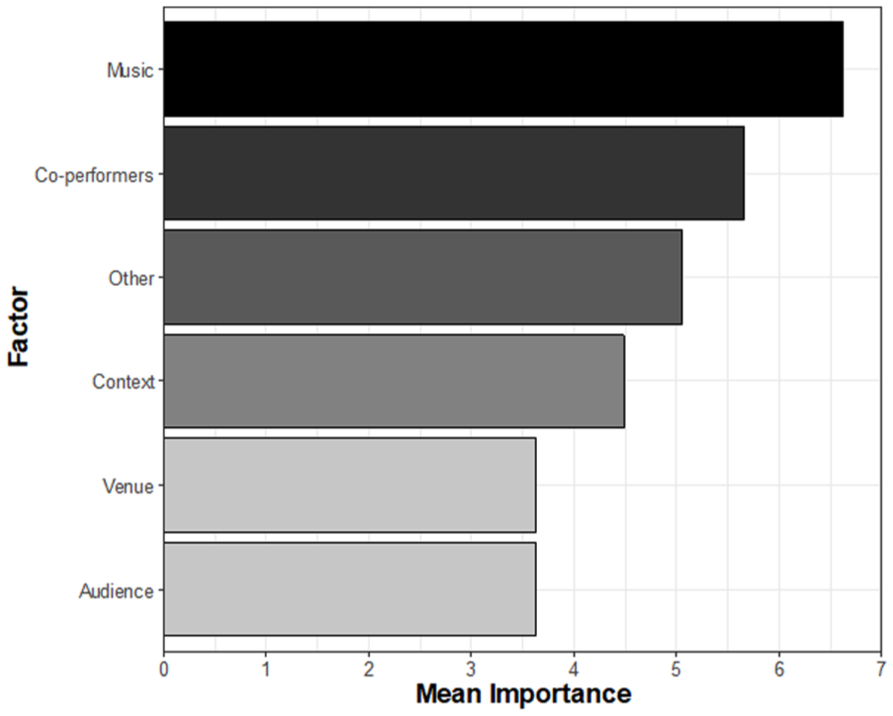
Bar chart visualization of mean importance ratings (range = 1–7) for participants’ experience of chills in performance.
Participants were asked to elaborate on their ratings. Many responses reiterated the participants’ ratings of factors (e.g., “Music was the most important”; “Audience was irrelevant”). These aspects of the data were excluded from analysis, with a focus instead on participants’ explanations for their ratings. In addition, there was some overlap in content with responses to the “Chills Reason” question. Nevertheless, some additional insights were gained regarding the factors and how they were perceived to interrelate.
Some comments touched on the frequency of the experience. Several participants emphasized that their recalled chills experience was contingent on a combination of factors. A few responses identified factors (the music and the audience) that were perceived as being catalysts that enhanced or elevated the chills experience. For example: “When performing in front of an audience I feel more involved in the music, a deeper focus. This heightens the effect of playing the music [ . . .]” (Piano, male, aged 18, unsure of definition as a musician).
Responses also described the performance space, perhaps prompted by the inclusion of venue as a factor to rate. Many participants commented on the acoustics of the space. Other responses commented on the space’s aesthetic qualities (e.g., homely, special, spiritual, casual, beautiful). The complex interplay between these features and their impact on participants’ experience is captured in the following response: Venue [. . .] doesn’t have a huge impact because I’ve experienced it in rehearsal spaces before. Having said that, if the space is somehow compromising the performance, e.g. it’s too hot and makes us uncomfortable, or the suitable accompaniment instrument is not present, being in the right venue can matter. Being in incredible venues can increase my sense of wonder, which can contribute to the sense of group accomplishment. (Multiple instruments, male, aged 26, professional)
Where ratings for the “Other” factor were provided, participants were able to freely describe them. Some responses aligned with the original factors (music, co-performers, context, venue). Most of the remaining responses identified the performer as a factor (n = 25), as well as the performance (n = 2), and a combination of factors (n = 1).
Performer-related factors included the participant’s current mood or emotional state, memories and personal associations with the music, levels of arousal and attention, enjoyment, effort, and familiarity with the music. Performance included the performer’s instrument and the quality of the performance itself, which might align with the emphasis on performing well in the qualitative responses.
Discussion
The present study explored experiences of chills while performing music and sought to answer research questions pertaining to (a) whether people experience chills while performing music; (b) how people characterize their chills experiences when performing; and (c) what the important music, performer-related, and contextual factors might be for these experiences.
People experience musical chills while performing
This work demonstrates that people experience chills when performing music. The number of people who reported having chills during performance was comparable to the total who reported chills while listening to music (see Table 1), suggesting that chills in performance are not comparatively rare in relation to those in music-listening contexts. Most participants who recalled a chills experience confirmed they were performing with co-performers and that they were actively performing during the chills. Finally, chills experiences occurred in various performance contexts and ensemble configurations. A crucial caveat is that the current study does not provide a comprehensive picture of chills’ prevalence. This survey, advertised with a focus on chills in performance, would likely have attracted performers who experience chills during performance, meaning that there may be many other performers who do not relate to the experience. This reflects the broader pattern in musical chills research, where few studies have provided a clear indication of prevalence.
Subjective experience of musical chills in performance
Musical chills in performance often involved positive feelings such as joy, pleasure, excitement, elation, and satisfaction. For some participants, chills were overwhelming, strong, or moving experiences. These findings reflect research on chills in music-listening contexts, where the phenomenon has been linked to positive emotion and peak pleasure (Bannister, 2020; Ferreri et al., 2019; Salimpoor et al., 2011), being moved and kama muta (Bannister & Eerola, 2018, 2023; Benedek & Kaernbach, 2011; Konečni, 2005; Vuoskoski et al., 2022), and peak emotional arousal (Rickard, 2004).
Participants sometimes associated their chills in performance with altered states, such as transcendence, transportation, and flow (Csikszentmihalyi, 2008). Flow can be experienced when performing music (Chirico et al., 2015; Wrigley & Emmerson, 2013) and may be experienced collectively with co-performers (Sawyer, 2014). Possible links between chills and flow seem intuitive given that both are linked to reward (Blood & Zatorre, 2001) and attention (Grewe et al., 2007); however, these links have rarely emerged from music-listening contexts in existing chills literature. Intriguingly, transcendence, transportation, and flow may all reflect self-transcendental emotional experiences (Yaden et al., 2017), including peak experience (Maslow, 1964), awe (Keltner & Haidt, 2003), and absorption (Sandstrom & Russo, 2013). These emotional concepts have links with chills (Bannister & Eerola, 2023; Konečni, 2005; Laeng et al., 2016; Panzarella, 1980; Schurtz et al., 2012), so it may be pertinent for future research to investigate chills in relation to self-transcendent experiences, including during performance (Høffding et al., 2023; Hytönen-Ng, 2016; Lamont, 2012; Perdomo-Guevara & Dibben, 2024).
A further aspect of participant responses concerned feelings of connection. Connection could be felt with co-performers, the music, and occasionally with audience members or imagined others. Some participants noted being in sync with, feeling unity with, or performing as one with, other performers. Others reported “feeling the music” or a deep sense of connection with the music. Interestingly, both the music and co-performers were rated as the two most important contributing factors for chills. In addition, many participants described a feeling of togetherness and connection as a reason for their chills experience, reflecting recent work on musical togetherness in performance (Bishop, 2024). In the context of the current study, this feeling of togetherness is broad in scope, encompassing a sense of connection and unity with others, collective mood, and shared emotions and understanding between performers. These experiences reflect socio-affiliative concepts from research on ensemble performance, including shared intentionality, intersubjectivity (Cross et al., 2012), and empathetic attunement (Seddon & Biasutti, 2009; Seddon, 2005 see also Waddington, 2017). Indeed, feeling connected to the music may also be a social experience for performers or listeners (Bannister et al., 2025). Emotionally, feelings of togetherness and connection during chills resemble kama muta (Fiske et al., 2025), and the suddenly intensified communal sharing relations that may be experienced as a sense of sameness or oneness with other people, groups, cultures, or concepts.
Finally, there are notable, although less prevalent, experiences reported by participants in this study. For instance, feelings of “rightness” or alignment were occasionally described, encompassing moments where a performance “comes together,” where elements seem to “click” or fit, or where things feel “right.” In some cases, this appears to be an emergent (i.e., unexpected or irreplicable) property of the performance. These experiences resemble other emergent phenomena in performance such as shared absorption (Høffding, 2018) and collective or group flow (Hart & Di Blasi, 2015; Sawyer, 2014). As another example, some participants reported feeling pleased or satisfied with their performance, fulfilled, thankful, grateful, or proud, or characterized their experience as realizing an ambition. These responses may establish some preliminary links between chills and wellbeing (Seligman, 2011), which will be revisited below.
Musical, performer-related, and contextual factors of chills experiences
Current findings highlight the importance of various musical, performer-related, and contextual factors in the experience of musical chills in performance. When describing the music in their specific chills moments, participants highlighted various musical features, including harmony and chords, melodies, lyrics, expressive qualities of the music, climaxes and build-ups, and moments of novelty, transition, or change. Similarly, when giving reasons for their chills experiences, some participants noted the importance of beautiful or emotional music. These findings corroborate existing chills research in listening contexts, linking the response with new or unprepared harmonies (Sloboda, 1991), musical expectations (Huron, 2006), crescendos (Bannister & Eerola, 2018; Panksepp, 1995), melodies (Grewe et al., 2007), and lyrics (Bannister, 2020). Recently, Fleckenstein et al. (2024) noted that some experiences of musical beauty emphasized the emotional features of the music and listening experience, with some participants linking beautiful music to chills. Importantly, current and existing findings remain largely correlational, and the extent that performers are responding to the music as a “listener” in a performance situation is unclear. Instead, it may be that particular moments in music afford certain experiences of performance that are conducive to chills.
Regarding performer-related factors, several participants drew attention to performance quality. Some noted an emotional performance as the reason for chills, whereas others described themselves as performing well or the performance as being of high quality; this overlaps with feelings of rightness or alignment that some participants reported. Another performance-related factor concerned audience behaviors; although this factor was rated as less important by participants, some responses highlighted the possible effects of appreciative and engaged audiences, resonating with growing research on the impact of audiences (Burland & Payne, 2025), including imagined others (Schiavio et al., 2024), on performers. Across other responses, numerous participants perceived their recalled chills experience to depend on their existing state, suggesting that chills might not necessarily be consistent across performances (see Grewe et al., 2007).
A further performer-related and contextual factor was the meaning and associations that participants attributed to the performance or music. Several participants noted the importance of personal meanings, memories, or associations of the music. Other participants described their recalled performance as special in some way. For instance, it may have been their first or last time performing a piece or with an ensemble. In other cases, participants described performing with friends or in specific contexts such as a funeral. Music-evoked autobiographical memories are often social in nature (Jakubowski et al., 2021) and are linked to mixed emotions such as nostalgia (Jakubowski & Ghosh, 2021; Janata et al., 2007) that are related to being moved (Menninghaus et al., 2015). Similarly, personal meaning or relevance has also been considered important as positive “core values” in concepts of being moved (Cova & Deonna, 2014; Cullhed, 2020; Kuehnast et al., 2014). As such, it may be informative for further chills research to situate the phenomenon in relation to personal meanings, extra-musical associations, and memories often intertwined with the music being listened to or performed.
Implications and future directions
This present work has important implications for musical chills research. First, this study suggested that music performance often involves social, affiliative, and communicative (inter)actions, potentially affording chills experiences. Current exploratory findings not only demonstrate that chills can be experienced while performing music, but that these experiences may be associated with interpersonal connections and affiliations between performers, or with broader connections between performers and the music or context that may involve social dimensions. These results align with associations between social bonding and chills (Bannister, 2019; Fiske et al., 2025; Menninghaus et al., 2015; Panksepp, 1995). Crucially, however, chills experiences reported by participants were diverse and reflect the variability across chills found in extant literature (De Fleurian & Pearce, 2021; McPhetres & Zickfeld, 2022). For example, although chills in music performance were associated with interpersonal aspects and personal meanings, they were also connected to structural elements in the music, some of which have been related to other underlying mechanisms including the violation of musical expectation (Huron, 2006). Music performance entails a complex interplay of specialized motor movements, cognitive resources, perception-action loops, interpersonal interactions and relationships, and subjective experiences, amongst other aspects (Van der Schyff et al., 2022). Similarly, chills are multifaceted, with varied definitions and reported characteristics. Consequently, although this work was motivated by recent research linking chills to social bonding, musical chills continue to be correlated with numerous other aspects and dimensions of musical experience. Future work will need to explore the chills experiences of performers in more controlled settings, to begin investigating possible mechanisms underlying the phenomenon.
Second, one interpretation of current findings could be that there are possible associations between chills and wellbeing. From a positive psychology perspective (Seligman, 2011), music engagements can manifest all of the conditions that enable life wellbeing (Croom, 2015): positive emotion, engagement, relationships, meaning, and accomplishment. More broadly, eudaimonic wellbeing benefits connected to meaningful performance experiences could engender and sustain motivation and ongoing engagement in music (Lamont, 2012; Perdomo-Guevara & Dibben, 2024). Intriguingly, in the current study, musical chills while performing have been associated with positive emotions; engagement, attention, and flow; interpersonal connections and relationships; personal meanings and “special” performances; and self-fulfillment, gratitude, and pride. Results suggest that musical chills may be linked in some ways to psychological wellbeing, a possibility that has rarely been considered in the context of musical listening engagements. Future research on musical chills should explore these possibilities, perhaps through more targeted self-report approaches.
Limitations
There are some limitations to the current study. First, regarding the retrospective self-report method, participants may only recall their most emotionally intense chills experiences, which may not necessarily be representative of broader musical chills responses. Second, the current exploratory study cannot make claims regarding the causal mechanisms underlying chills; experimental tests of chills would be a possible next step. Finally, from current results, it is not yet clear as to whether the emotional, musical, performer-related, and contextual dimensions reported are specific to experiences of musical chills while performing, or whether they are attributable to the recalled music performances more generally. Further research is needed to specify and disentangle musical chills experiences, their characteristics, and psychological mechanisms involved from the localized contexts in which they occur.
Conclusion
This study provides one of the first explorations of chills experiences while performing music. Results show that chills are experienced by music performers and that they are largely positive experiences. Important factors for chills in performance include various musical features, performance qualities, interpersonal connections between performers, and personal associations with the music and performance context. Findings align with associations between chills and social bonding, although further research is required to understand underlying psychological mechanisms of the phenomenon. Finally, various characteristics of chills in music performance suggest that the experience may be linked to psychological wellbeing, posing a novel route for continued research.
Supplemental Material
sj-docx-1-pom-10.1177_03057356251383805 – Supplemental material for A survey of musical chills experiences while performing music
Supplemental material, sj-docx-1-pom-10.1177_03057356251383805 for A survey of musical chills experiences while performing music by Scott Bannister and Emily Payne in Psychology of Music
Supplemental Material
sj-docx-2-pom-10.1177_03057356251383805 – Supplemental material for A survey of musical chills experiences while performing music
Supplemental material, sj-docx-2-pom-10.1177_03057356251383805 for A survey of musical chills experiences while performing music by Scott Bannister and Emily Payne in Psychology of Music
Footnotes
Acknowledgements
We thank the Leeds Music Psychology Group for their useful and insightful feedback on an earlier version of the questionnaire utilized in this study.
Consent to participate
Participants were invited to complete an anonymous online questionnaire. They were first presented with a participant information sheet and provided consent to participate through choosing to continue with completing the questionnaire.
Consent for publication
The authors confirm that informed consent was given by all participants for the publication of this research and anonymous research data.
Ethical approval and informed consent
This study was approved by the University of Leeds research ethics committee (reference: LTMUSC-143). All participants provided informed consent through agreeing to continue with the questionnaire, after reading the participant information sheet.
Data availability
The data that support the findings of this study are not openly available due to reasons of participant confidentiality and are available from the corresponding author upon reasonable request. Data are stored in secure data storage at the University of Leeds, UK.
Declaration of conflicting interests
The authors declared no potential conflicts of interest with respect to the research, authorship, and/or publication of this article.
Funding
The authors received no financial support for the research, authorship, and/or publication of this article.

Supplemental material
Supplemental material for this article is available online.
Notes
References
Supplementary Material
Please find the following supplemental material available below.
For Open Access articles published under a Creative Commons License, all supplemental material carries the same license as the article it is associated with.
For non-Open Access articles published, all supplemental material carries a non-exclusive license, and permission requests for re-use of supplemental material or any part of supplemental material shall be sent directly to the copyright owner as specified in the copyright notice associated with the article.
