




Abstract
Musicians experience varying degrees of musical togetherness, defined as a sense of social connectedness that they experience with co-performer(s) in music ensembles. Previous investigations focused on optimal experiences and suggested a link between social connections and musical and contextual aspects. However, it is not fully understood how this concept aligns with musicians’ experiences of togetherness. This research analysed experiences of togetherness in classical ensemble performances, based on semi-structured interviews with 22 advanced music students. Thematic content analysis demonstrates the emergence of four main themes associated with togetherness experiences as follows: (1) togetherness sensation, (2) quality of the interpersonal relationships, (3) performance settings, and (4) ensemble skills. This study broadens our understanding of ensemble playing experiences and reveals how togetherness experiences can arise or be negatively affected. These results are valuable to ensemble pedagogy and social interactions.
During ensemble performances, musicians experience varying degrees of connection with their co-performer(s), that is, a varying sense of togetherness. Togetherness experiences have been observed in semi-professional (Gaggioli et al., 2017) and professional (Seddon & Biasutti, 2009) ensembles as well as therapeutic settings (Smetana et al., 2023), and can be perceived to some extent by audience members (D’Amario et al., 2022). Several studies focused on peaks of these connections, i.e., the optimal experiences of ensemble performances. These peaks are often described as special and magical moments that occur when things click and are in synch. They result from the quality of the interactions between musicians (Sawyer, 2006) and provide joy and highly rewarding feelings to the musicians (Berliner, 1994). More recent quantitative investigations suggest that togetherness feelings can be related to the coordination of musical (D’Amario et al., 2022; Wing et al., 2014) and behavioural (Bishop et al., 2023; D’Amario et al., 2022) parameters. However, how musicians reflect on their own experiences of togetherness has not been fully understood yet.
This study investigates self-reported musical togetherness from musicians’ perspectives based on semi-structured interviews and describes how they experience ensemble togetherness during music performances when playing, practising, or performing together. In the following sections, we introduce literature on joint action activities, including optimal experiences and the hypothesised (extra-)musical correlates of togetherness experiences (i.e., the behavioural, physiological and musical components). We then conclude with some hypotheses for the current study.
Joint action: joint agency and togetherness
We coordinate our activities with others in everyday life and professional contexts. From crossing the street to dancing, playing cards, music, or sports with others, we often intentionally, spontaneously, or unconsciously coordinate our actions in time and space with others. In some of those activities (e.g., music ensemble playing), successful joint action within a group can depend on the group members’ abilities to share a task representation, predict each other’s actions, and integrate their own and others’ actions (Sebanz et al., 2006). These joint actions can provide a sense of joint agency: a feeling of shared control over actions and their effects (Pacherie, 2012; Bolt et al., 2016). Joint agency experiences depend on the predictability of the partner’s actions (Bolt & Loehr, 2017) and on the success and perception of the joint performance (Loehr, 2018; Zhou et al., 2023). High levels of commitment may increase feelings of joint agency by regulating expectations and improving predictability, and may make joint experiences rewarding (Fernandez-Castro & Pacherie, 2023).
During joint actions, people can also experience a sense of group connectedness, i.e., feelings of togetherness between the agents. In collective dance improvisations, togetherness largely relates to the movements’ similarity and synchronicity (Himberg et al., 2018). In highly trained basketball teams, fluctuations in the experiences of togetherness during regular sporting seasons can be related to the shared understanding of the experience and task cohesion based on highly complex and specific dynamics (Bourbousson & Fortes-Bourbousson, 2017). The fluctuating feeling of being and acting together was also analysed in collaborative artistic swimming performances. Continuous increases and decreases were reported by swimmers taking part in the performance and consistently recognised by external expert raters (Gesbert et al., 2022). In addition to sports and dance activities, togetherness feelings can also be related to musical domains. However, very little is known about the factors that modulate feelings of togetherness between musicians. This study investigates how cognitive, behavioural, physiological, and musical aspects can give rise to feelings of togetherness between co-performers during ensemble performance.
Optimal experiences
A line of research has investigated the features of optimal experiences that occur during individual and joint action activities. Mihaly Csikszentmihalyi developed the theory of optimal experience focused on the concept of flow, ‘the state in which people are so involved in an activity that nothing else seems to matter; the experience itself is so enjoyable that people will do it even at great cost, for the sheer sake of doing’ (Csikszentmihalyi, 1990, p. 8). Therefore, this enjoyable state of consciousness is characterised by a complete absorption in the task and a deep concentration (Csikszentmihalyi, 2002), and can take place when there is a balance between the task’s challenges and the person’s ability (Csikszentmihalyi, 1988). People experiencing flow also often reported having clarity of goals, constant availability of feedback, a sense of total control, loss of self-consciousness and distortion of the temporal dimension of the task as well as a fusion of action and awareness (Csikszentmihalyi, 1996). Flow experiences are very similar across cultures, ages and genders (Csikszentmihalyi, 1990, 1996) and observed in different domains, including sports and physical activity settings (S. Jackson & Marsh, 1996), and work (Csikszentmihalyi, 1988).
Flow experiences have also been reported in the musical domain, including live music performances (Wrigley & Emmerson, 2013) and among young musicians (O’Neill, 1999). Csikszentmihalyi highlighted the relevance of flow in choral music (Gilbert, 1995), and several components of optimal ‘flow’ experiences were observed in choral singers, such as clarity of goals, deep engagement and concentration, self-directness, self-awareness, receiving of immediate feedback, and a challenge-skill matching (Freer, 2009). Flow experiences may cross from music teachers to their students (Bakker, 2005), in line with the emotional contagion theory (Hatfield et al., 1994), since it was found that the more flow experience the teachers reported, the more flow of similar experiences their students showed.
Flow experiences of an individual can expand to those of a group performing a task together. While individual flow refers to a state of intense, sustained attention within the individual performer, group flow represents an emergent property of an entire group performing at its peak: everything comes naturally and the musicians are tightly synchronised (Sawyer, 2003). It is described as a magical moment when musicians are very close, intimate, and communicative and ‘everyone gets locked in together’ (Berliner, 1994, p. 388). Being an emergent property, group flow is difficult to predict well in advance and it does not occur every time that the same group performs (Sawyer, 2006).
E. Hart and Di Blasi (2015) investigated the subjective experiences of group flow during musical jam sessions, which they named combined flow. Many of the key elements observed by Csikszentmihalyi (1996) were also observed in these musical jam sessions. The researchers also observed a unique positive outcome of empathy emergence during combined flow experiences and a sequential progression of stages characterising these experiences (E. Hart and Di Blasi, 2015). Several stages were reported, comprising: finding a niche (i.e., each musician finds their way to contribute to the group), breaking on through (i.e., musicians find a common group), finding the group groove (i.e., the climactic stage of the experience associated with deep immersion and the exclusion of any distractions), bridging sound to silence (i.e., returning to normality associated with a sense of achievement, relaxation and well-being), and sharing highs and lows (i.e., conceptualising the experience, by discussing high and low points, which brings to empathetic feelings).
While many investigations have focused on the characteristics of these positive peaks of experiences associated with optimal task performance during ensemble playing, how a sense of togetherness between musicians emerges and is experienced has not been fully understood yet. Specifically, the repertoire performed, the co-performer’s personality and the musicians’ teachers might play a fundamental role in felt togetherness in music ensembles (Berliner, 1994). This study aims to shed more light on how feelings of togetherness among musicians arise and how repertoire, teaching, and co-performer characteristics can affect those feelings.
Behavioural, physiological and musical correlates of togetherness experience
Several behavioural and musical aspects are related to the togetherness perceived by audiences and performers during joint activities, including ensemble playing. Studies investigating togetherness judgements of piano-piano duo and clarinet-clarinet duo performances revealed the relevance of sound intensity, note-to-note synchronisation and musicians’ body motion on synchronisation and togetherness evaluation (D’Amario et al., 2022). Specifically, D’Amario et al. (2022) observed that novices rated the level of togetherness in advanced duo performances based on the similarity in musicians’ right arm motion and sound intensity; they also found that togetherness ratings of the same performances by an external group of semi-professional musicians were related to musicians’ chest motion coordination and sound synchrony.
Togetherness can also relate to timbre perceived in singing performances. D’Amario, Ternstrom, Goebl, and Bishop (2023) showed that advanced choristers judged least together performances featuring extreme differences (in the order of 17 dB) between the spectral components of the sound. In another study investigating the relationship between individuality and togetherness during joint improvised motion, it was found that during togetherness moments both players performing these motion tasks change their individually preferred motion to a universal stroke shape (Y. Hart et al., 2014). The latter differed from their basic motion and did not converge to an intermediate motion signature. The authors suggest the resulting motion maybe be easier to anticipate and agree on. Group flow, measured as average flow within musical bands, is also negatively associated with exchanges of orders and positively associated with exchanges of gazes (Gaggioli et al., 2017). In summary, research suggests that sound and body motion synchronisation, and visual contact might be relevant to togetherness feelings. However, the extent to which these potential factors overlap with togetherness feelings or whether togetherness represents a broader concept that goes beyond the musical and behavioural synchrony has not been understood yet.
In addition to the above markers of togetherness observed during musical activities, studies have also reported the relevance of certain physiological components to togetherness moments in joint activities. Noy et al. (2015) observed that periods of enhanced sense of togetherness featured increased cardiovascular activity and motion intensity in pairs jointly performing synchronised motion improvisation tasks. According to the authors, the increased cardiac activity during periods of strong togetherness might indicate enhanced engagement and enjoyment of flow experiences. Recent investigations on the relationship between shared flow and physiological synchrony during Javanese gamelan performances revealed a positive association when participants were improvising that did not hold during traditional performances. These results suggest that the relations between physiology synchrony and flow might depend on the playing style (Gibbs et al., 2023). There is also evidence that the shared musical absorption in string quartets in concert settings compared to the disrupted absorption induced by a sight-reading task is paired with higher cardiac synchrony between musicians (Høffding et al., 2023).
Building on these studies, Bishop et al. (2023) investigated the behavioural markers of togetherness experiences during piano-singing duo performances. The authors found that musicians’ ratings of their own togetherness were positively associated with the strength of head motion coordination. In a different study on the focus of attention and motion similarity in piano duos, Bishop (2023) found that head motion measures were unreliable correlates of togetherness, while joint and mutual attention related to strengthened togetherness experiences. The difference in observed effects of head motion coordination on togetherness might be attributable to the different way that these studies assessed togetherness (via continuous ratings during stimulated recall versus via discrete ratings post-performance). Feelings of musical connectedness might be low in virtual reality settings where embodied avatars mediate real-time interaction between musicians. A recent case study analysing music interactions in virtual reality showed that pianists were unsatisfied when performing duets with a computer-controlled agent that, while visible as a moving avatar, did not perform with human-like musical flexibility (Van Kerrebroeck et al., 2021).
In summary, empirical investigations on the correlates of togetherness experiences suggest that many aspects, from the alignment of musical parameters and the coordination of body motion and musician physiology, can be related to feelings of togetherness. However, there is a lack of mixed-methods studies that combine objective measurement of togetherness with musicians’ perspectives. This investigation analyses how musicians reflect on the role that certain behavioural, physiological, and musical parameters (resulting from empirical studies) play in musical togetherness. The novelty of the current study is relating subjective reports of musical togetherness to bodily and musical alignments.
Aim of the study
We focused on the self-reported experiences of togetherness between musicians performing in classical ensembles and analysed the relevance of contextual aspects, such as musicians’ compatibility, repertoire, teaching and circumstantial problems, on experiences of musical togetherness. The overall aim was to observe how classical musicians reflect on behavioural, psychological, and musical aspects that empirical investigations suggest to be indicators of togetherness feelings.
Our study was partly motivated by descriptions of togetherness and the factors impacting it in the context of improvisation. We aimed to build on this literature by examining the potential relevance of these factors to togetherness in classical duo performance. In line with the literature regarding optimal experiences in joint action activities, we hypothesised (H1) that the key dimensions of individual and group flow (Berliner, 1994; Csikszentmihalyi, 1990; Gaggioli et al., 2017; Sawyer, 2006) are relevant to the rise of togetherness feelings. We also hypothesised that togetherness experiences are related to alignment of musical features (H2), including note synchronisation, based on studies on classical duo (D’Amario et al., 2022) and quartet (Wing et al., 2014) performances, and timbre (D’Amario et al., 2023). Then, we hypothesised that togetherness experiences are related to the coordination of musicians’ body motion, based on quantitative studies on classical piano-singing duos (Bishop et al., 2023; D’Amario et al., 2022) and coordination in breathing, in line with the jazz musicians’ experiences (Berliner, 1994) (H3).
Finally, we hypothesised that several contextual aspects negatively affect togetherness experiences (H4). Incompatibility between musicians with a significant disparity in musicianship levels and personal tastes related to several musical parameters (e.g., timing, rhythm, dynamics, and timbre) is expected to be a factor undermining optimal experiences, in line with studies focused on jazz improvisations (Berliner, 1994). Similarly, we hypothesised that circumstantial problems in musicians’ personal lives would result in reduced experiences of musical togetherness (H5), based on previous evaluations of group performances (Berliner, 1994).
Methods
Participants
Twenty-two participants (13 females and 9 males; age M = 24.7 years old, SD = 2.3 years old) took part in the study. Ten of them were advanced piano students and 12 were advanced singing students from the departments of Piano Performance, Chamber Music or Vocal Studies and Music Theatre at mdw – University of Music and Performing Arts Vienna. They reported having on average 13.2 years of formal training (SD = 5.6 years) and practising on average 3.4 hr per day (SD = 1 hr per day). This study constituted a follow-up interview from a performance study analysing interperformer interactions in piano-singing duo performances, in which participants received a compensation of 200 Euros (D’Amario et al., 2023). They received no additional compensation for the interviews. The Ethics Committee at MDW – University of Music and Performing Arts Vienna (Austria) ethically approved the experimental procedure with reference EK Nr: 05/2020. The study was conducted in accordance with the Declaration of Helsinki. Participants received spoken and written explanations of the research project, and they gave written consent to take part in the study.
Data collection
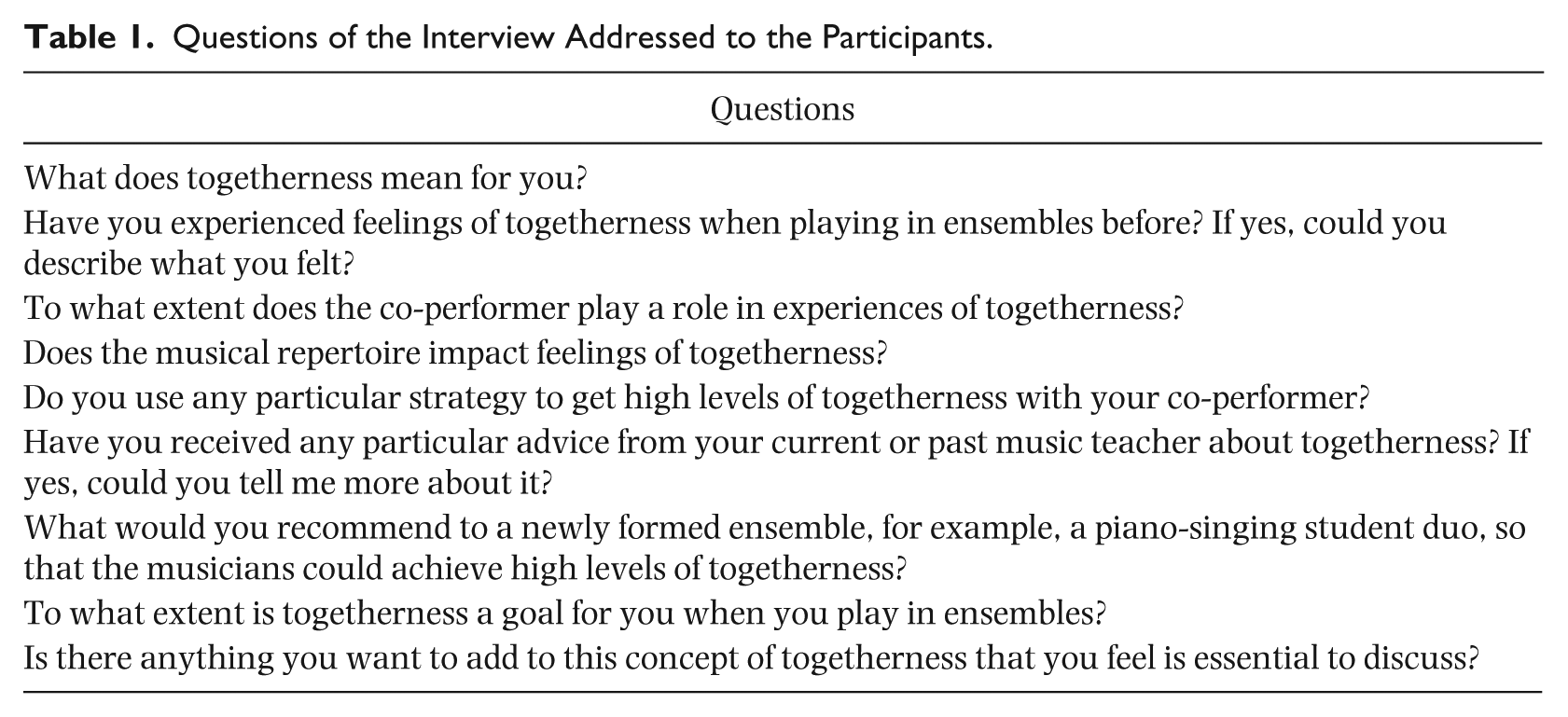
Data were collected through semi-structured interviews conducted via phone by the first author at a time convenient to each participant. Interviews were conducted in English. They were audio-recorded with an iPhone 11, lasted on average 15 min (SD = 5 min) and took place over 6 months. Table 1 shows the interview schedule. All questions were kept short and open so participants could respond freely and the interviewer could follow-up on aspects of interest raised by the respondents. The interview schedule covered the following main areas: (i) description and importance of experiences of togetherness, (ii) roles of the repertoire and the co-performer in experiencing togetherness, and (iii) strategies targeting togetherness feelings.
Questions of the Interview Addressed to the Participants.
Data analysis
Audio recordings were transcribed by the first author using the Trint transcription platform 1 and the transcripts were checked for accuracy. Then, transcripts were analysed using a thematic inductive process modelled on grounded theory and reflecting a ‘coding up’ approach (Fielding & Thomas, 2016), so themes and concepts could emerge from the data. Specifically, three steps were implemented as follows:
Raw data coding: data were coded, then codes were compared between transcripts, and re-coding was carried out where necessary to ensure consistency
Subthemes clustering: codes were clustered to form subthemes; subthemes were identified as such when they were observed in at least half of the participants
Themes clustering: subthemes were clustered to identify the overarching themes that characterise experiences of togetherness in the pool of participants
The co-authors (SD and LB) independently coded the transcripts and clustered the subthemes and themes to ensure the reliability of the analysis. Coding and clustering resulting from each analytical step were discussed between co-authors until a consensus was reached. Disagreements between co-authors were solved by re-analysing the transcripts. NVivo 14 (K. Jackson & Bazeley, 2019) was then used to analyse the themes’ and subthemes’ recurrence during the steps described above.
This study was carried out as part of a larger project on the topic of musical togetherness, and as a result, the authors already had preconceptions about togetherness and what it means for musicians. During the semi-structured interviews, the interviewer adhered closely to the prescribed list of questions, with follow-up questions asking only for clarification or examples. Nevertheless, the authors’ bias affected the questions that were chosen for the interviews and, to some degree, the coding and interpretation process.
Results
As shown in the thematic recurrence analysis of Figure 1, four content themes, and their corresponding subthemes, affecting togetherness experiences emerged as follows:
Togetherness sensation (comprising embodiment, importance of togetherness, obviousness, unpredictability, fluctuations, oneness, absorption, flow, effortlessness, joy, energy, self-reported emotions; see Figure 2).
Quality of the interpersonal relationships (referring to musical, cognitive and emotional sharing, reciprocal knowledgeability and responsiveness, leadership, interactions and communication; see Figure 3).
Performance settings (involving rehearsing, training, repertoire, concerts, and ensemble size; see Figure 4).
Ensemble skills (featuring adaptability, openness, professionalism, own part knowledge, presence, attention, listening, and circumstantial factors; see Figure 5).
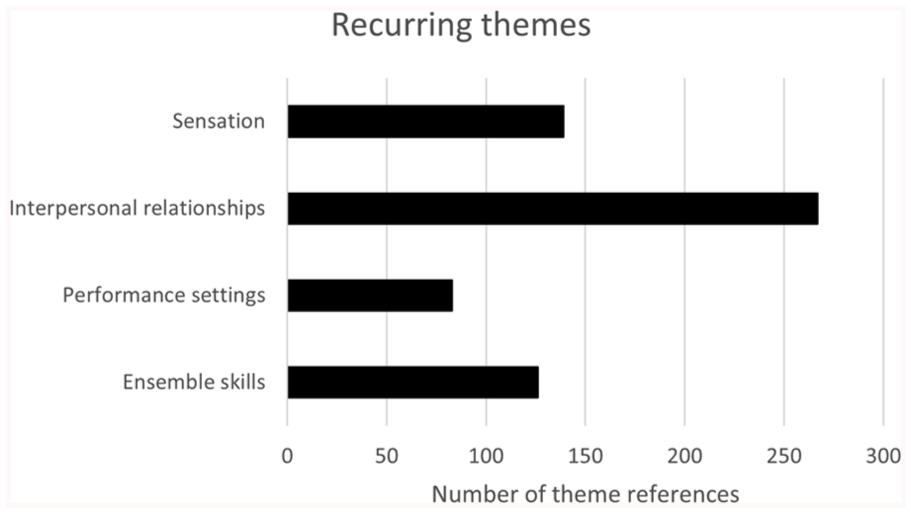
The Four Main Recurring Themes, along with the Corresponding Number of References.
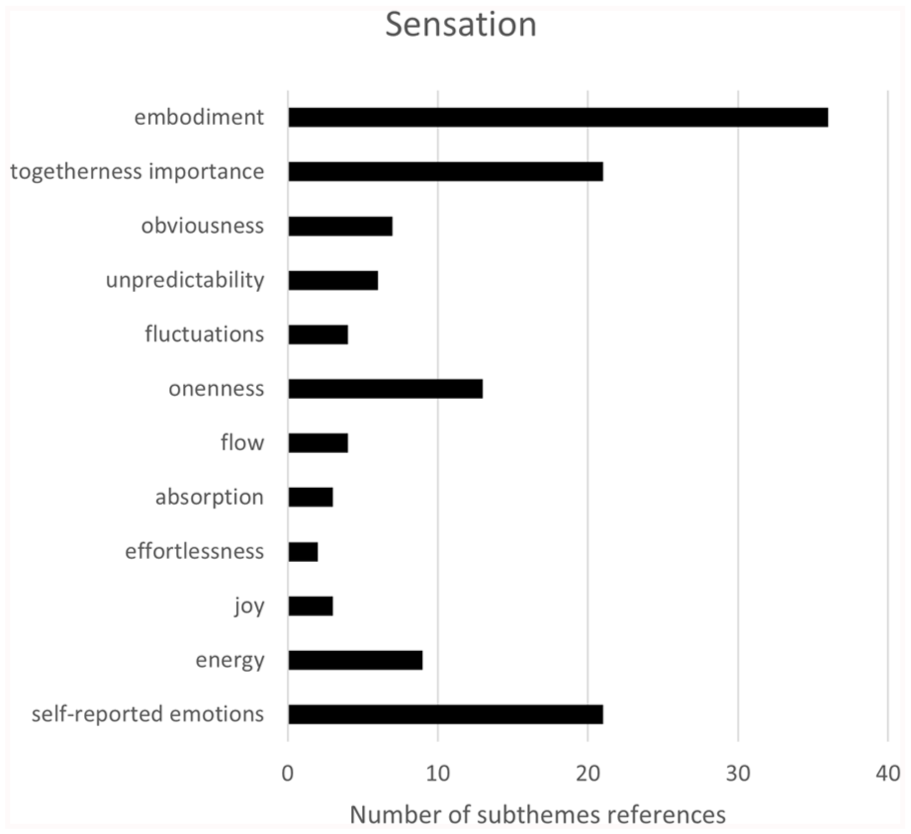
Subthemes List and Number of Subthemes References to the Togetherness Sensation Theme.
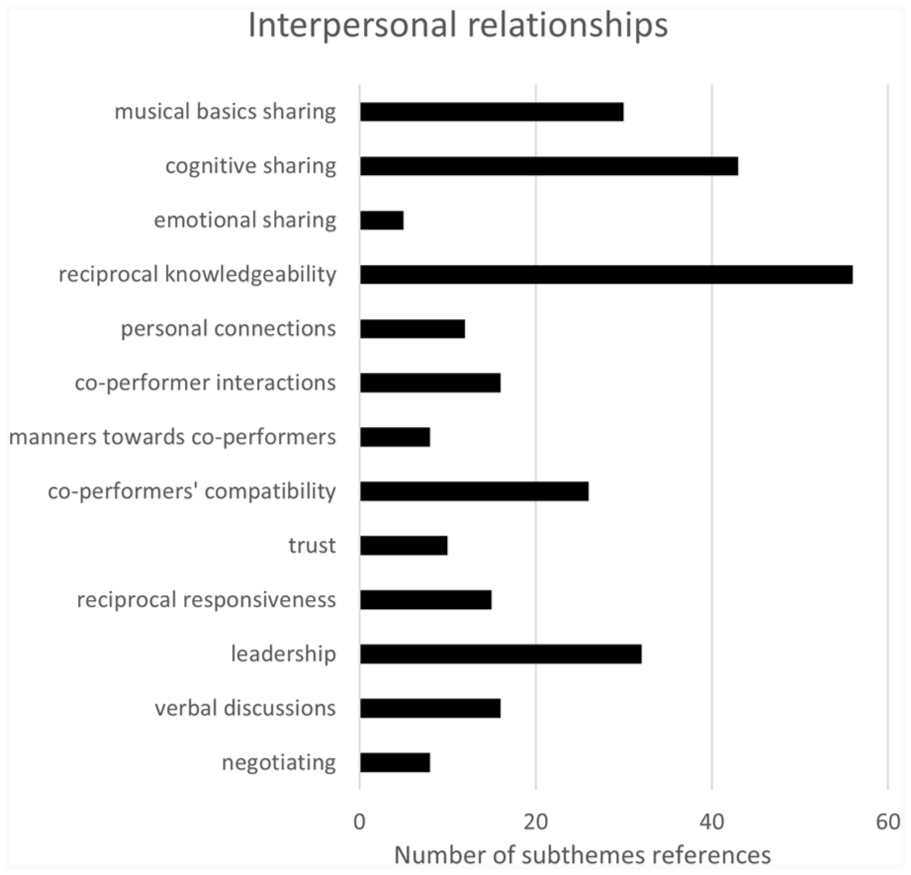
Subthemes List and Number of Subthemes References to the Theme of Interpersonal Relationships.
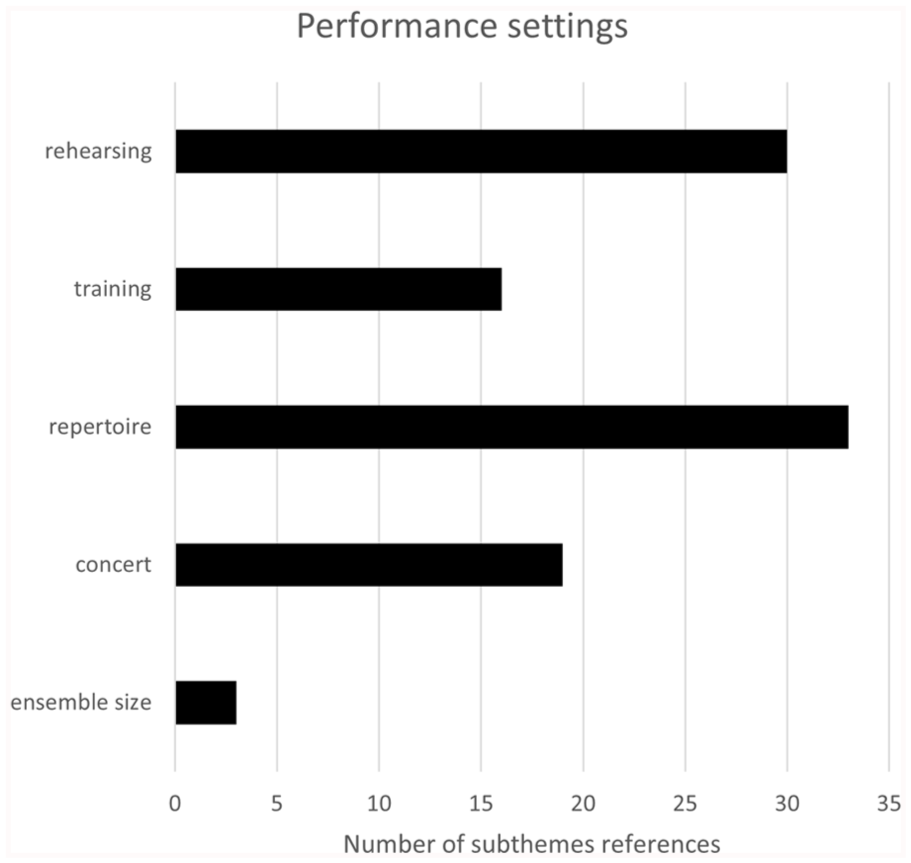
Subthemes List and Number of Subthemes References to the Performance Settings Theme.
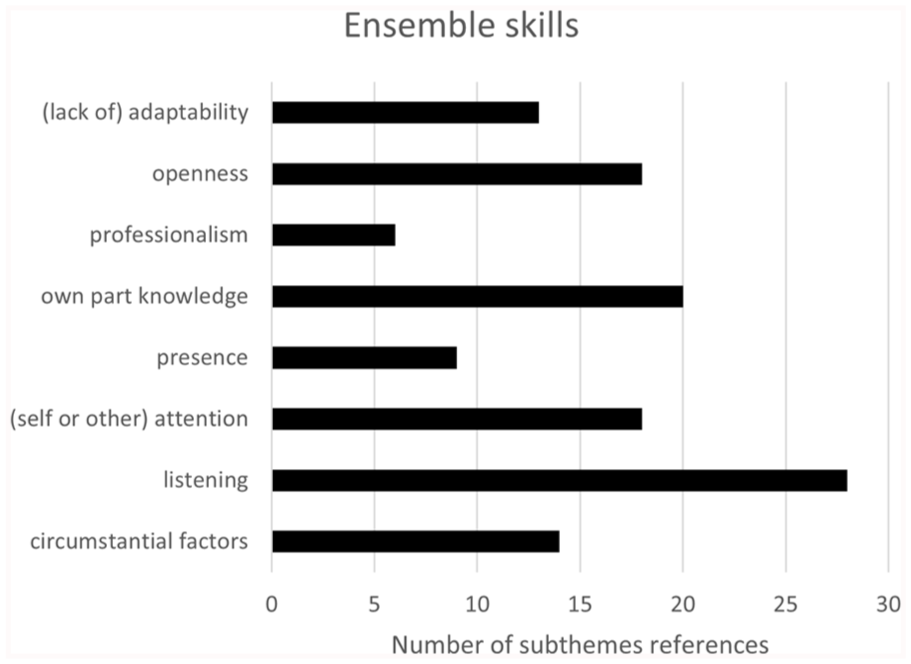
Subthemes List and Number of Subthemes References to the Ensemble Skills Theme.
Togetherness sensation
Togetherness experiences are embodied. Many respondents defined togetherness as breathing alignment: I think the main component of togetherness is mostly breathing together. I think that’s extremely important because, you know, sometimes . . . it just doesn’t work. . . . But sometimes without even having to work so much on whatever piece is given to you, you just somehow breathe together. That is, I think, a sign where some musical magic can happen. And for me, that’s the most important aspect of togetherness. (P28)
Other respondents highlighted the importance of body motion synchronisation for the rise of togetherness feelings. ‘[Togetherness] is just body movements, gestures you make with ending the phrase, with starting the new one’ (P24). Others discussed how togetherness feelings can occur in instances of eye contact between musicians, suggesting the relevance of seeking visual contact with co-performers. ‘Sometimes if you’re lucky enough that you can actually make eye contact with the people you’re making music with because often you don’t. But if you do, sometimes it’s in the eyes, sometimes it’s in the eye contact’ (P13).
They all agree that togetherness is a fundamental goal of classical music ensembles and most of them defined togetherness as the ultimate goal. ‘I think it’s the ultimate ultimate [goal]. I mean, I think any performer, any artist, any musician speak about it, they live for these moments. It’s the whole point of what we’re doing’ (P13).
Togetherness experiences are obvious and easy to recognise: ‘When you experience this togetherness, . . . you react instantly and without thinking. It’s just so obvious to you. . . . It just hits you like a train’ (S27). Nevertheless, those experiences are difficult to predict, as they can be impacted by several factors. Regardless of the familiarity with the piece and co-performer(s) and level of professionalism of the musicians, togetherness feelings can not be predicted: ‘Even if you know each other so well, [for example,] a singer with whom I’m playing together since five, six, seven years, you can end up at the first level or at the last level [of this feelings range]’ (P20).
Togetherness changes and fluctuates during the performance as the quality of their interactions unfolds: ‘It always happens in the performance that . . . the togetherness is not on the same level. But actually my goal is always being together and that’s what I’m searching for’ (S14). During togetherness peaks, ensemble members feel like they become ‘one person’, sharing music ideas (e.g., applying the same articulation and dynamics and breathing at the same spots) and the same mode and state of feelings.
Moments of high togetherness can coincide with the concept of flow, where you feel fully absorbed and immersed in the performance. According to S14, ‘I felt . . . more in the piece, . . . more involved in the piece.’ During these special moments, the task becomes effortless, and the easiness of the moments reflects on feelings of body lightness: [During togetherness peaks], there is definitely less stress and therefore you can feel that lightness in your body as well. [This is so] because then you’re not as tense; you don’t have to follow whoever you’re playing with all the time. . . . And, I think mentally when I look back on some of the moments . . . where I had that feeling of like, ‘wow’, . . . I felt at ease. (P28)
These moments of high togetherness are associated with joy, peace and energy. The positive emotions self-reported are described as priceless, highly rewarding, magical, and unique. ‘It’s a really pure joy’ (S3).
When you’re rehearsing for the first time and you both do a small detail or a small crescendo where it was not written in the scores: this is sort of like a wonderful feeling. . . . It’s just the feeling inside that you get. I mean, it’s energy, it’s vibrations. It’s all of these kind of voodoo things, these magical things that none of us can really explain. (P13)
Interpersonal relationships
Respondents reported that their notion of togetherness relates to the alignment of the expressive musical parameters, such as pulse, timing, timbre, articulation, dynamics, intonation and pronunciation. This coordination is a relevant but insufficient condition for establishing felt togetherness in ensemble playing. In addition to coordinating these parameters, sharing a similar understanding, interpretation and imagination of the piece and the music style also contributes to togetherness feelings. While acknowledging that having the same imagination is impossible, the similarity of musical ideas between musicians can foster feelings of togetherness to such an extent that interperformer(s) visual cues might not be necessary for timekeeping. Minor slips in timing, intonation, and dynamics cannot harm the overall coherence of the performance; on the contrary, ensemble performances can be mechanical because of different music expectations and the co-performer(s)’ lack of interpretation. Togetherness also relates to the shared emotions that musicians feel during the performance. Strong feelings of togetherness are associated with the freedom to express and find emotions: [When I experienced high levels of togetherness] I felt that I’m free, fully free to express the emotion. But when we began, before we played or before I sang, I didn’t really know which emotion I would find, because I had in my head one emotion that I wanted to express (that gives me the composer) but I found it another way of expressing the same emotion. And I found another emotion just from that being together with this pianist. And it felt really free being out there together with someone who gives you also the freedom to find and express what you found. And it’s totally amazing feeling. (S14)
Respondents also highlighted the relevance of knowing each other’s limitations, abilities, musical understanding/interpretation, and musical parts. Practising a co-performer(s) musical part and attending co-performer(s) instrumental/singing lessons are often mentioned to advance the knowledge of the other’s part.
Mutual interactions, physical connections with the co-performers, reciprocal support, commitment to the ensemble, taking part in extra-musical activities (e.g., spending time together in recreational contexts) and the musician’s manner towards the co-performer (i.e., mutual respect, politeness and making the other comfortable) are contributors to the establishment of solid personal connections and strong interactions with the co-performer. Establishing personal connections with the co-performer(s) can also foster reciprocal knowledgeability.
Our respondents reported that togetherness is easier to achieve with some co-performers than with others. Although it can potentially work with everybody, togetherness often depends on the co-performers’ compatibility, as personality (mis)match, ego, and (different) musical backgrounds can impact togetherness feelings. ‘It’s a bit about the personality. Like with some people, it just works better, like, right away. And, with some, you can, like, rehearse, but it will work [only] until a certain point, but maybe not further’ (P12).
Two additional self-reported elements of the interpersonal relationships between co-performers that characterise togetherness feelings were trust and reciprocal responsiveness: musicians can rely on each other and believe that they feel free to ‘let it go’ because they trust the co-performer will be able to quickly respond: So I was very involved . . . and trusting, I think. I think trust is the big thing . . . but in the sense of knowing that person knows your cues well enough to respond to you quickly and vice versa, but without really thinking about it. (S4)
A fundamental factor contributing to interpersonal interactions is the leader-follower relationship. Although leadership was a recurrent theme among our respondents (16 of 22 musicians talked about this), they presented different opinions: some musicians reported feelings of togetherness when leadership was equally distributed in the ensemble, while others associated togetherness with a clear definition of leader and follower roles between co-performers. Some reported that all members of an ensemble have to contribute equally to the performance and musicians should never fully cover the personality of their co-performers: ‘We are partners: there is no somebody more important than the other; we are both equal, and we both really have to work’ (P29). In contrast, others affirmed the importance of pianists covering accompanying roles when accompanying singers or other instrumental players such as violinists and cellists. Concerning past experiences in a piano duo ensemble, one respondent stated: Well, for me, especially as a singer, I mean, in this moment I am, of course, the lead instrument. And it’s always going to be like that. So I think that I, as a singer, really need to focus that my intentions are so clear. And the pianist will get at it just through me. (S46)
Some respondents also highlighted that leadership in ensembles is induced by the repertoire, being equally distributed in chamber music (e.g., Lied repertoire) and unbalanced in the operatic repertoire: If I were doing a Lied recital where, you know, the material, the music, the pieces were really equally, you know, relying on both the pianist and the singer, then I would really want to take the time and perfect everyone. And then I guess if I’m doing opera repertoire, which I do more often, then of course, I still want for my pianist and I to be together, but I would worry about it a bit less because it is more accompaniment rather than an equal partnership. (S18)
Regardless of the leader-follower roles, most respondents highlighted that verbal discussions about technical as well as expressive and interpretative aspects are fundamental to solving conflicts between musicians. Co-performers should attempt to negotiate their own positions by aiming for a common consensus and sometimes even sacrificing their own opinion to keep the ensemble together. Nevertheless, in rare instances, heightened feelings of togetherness are reported in the absence of verbal communication: The first time when we met, she just played with me and I had the feeling she understand me fully, even though we didn’t speak about interpretation and what I want to do and where I want to stop and make a comma, for example, to express some part of the text and to do something, also dynamics everything. It was just perfect, even though we didn’t discuss it and we didn’t know each other. And that was a higher level of making art together and we were together really fully and it wasn’t rehearsed before. (S14)
Performance settings
Rehearsing is often reported as a way to improve the quality of the musical experience; some practice techniques have also been mentioned, such as singing/playing co-performers’ parts and singing together. Lack of rehearsal often triggers low togetherness, and expanded rehearsal sessions are particularly recommended when the ensemble struggles. Interestingly, a few respondents mentioned rare cases where peaks of togetherness experiences occurred without extended practice: ‘There are also people with whom I have rehearsals whereby within 10 minutes, it’s become clear that we can make very good music and really bounce off each other’ (S4).
Training is considered a fundamental part of the togetherness experience. Many reported a lack of togetherness training during their formal studies, as togetherness feelings in ensembles were not a topic of discussion with their music teacher. Nevertheless, respondents wish to have received formal education on this topic. The standard formal singing lessons with the accompaniment of the teacher at the piano are not particularly conducive to establishing feelings of togetherness since singing students are focused on themselves and are mainly expected to follow teachers’ instructions. According to one of the respondents, ‘[during my singing lessons], I’m just doing what they want, and I’m not doing really what I want. Or so I don’t feel that togetherness. I’m just trying to be in rhythm and sing well’ (S17).
A common theme that respondents discussed was the repertoire performed: to some extent, professionalism is supposed to ensure a cohesive performance, regardless of the repertoire performed. Nevertheless, a good fit between the performer’s expertise and the technical and artistic demands of the piece is said to be a fundamental condition for the togetherness sensation. Practising easy pieces can heighten the togetherness experience in newly formed ensembles at the beginning of their ensemble careers. A lack of knowledge of the music style of one of the co-performers can be detrimental to the social connection. Liking and connecting with the repertoire are considered essential aspects: ‘It depends completely on the piece; If I feel it and if the other person feels it. If one person is like, “I don’t like it, but I will play it anyway”. Then, this will not work’ (S17). Interestingly, while some respondents agree that familiarity with the piece is a facilitator factor, others recommended the importance of being open to uncommon repertoire: ‘Even though the person doesn’t speak the language and maybe also doesn’t know exactly what the words mean, [this person] can also be together with you, but really together on this high level’ (S14). Regarding the specific genres, a few underlined how the classical and romantic repertoire with clear melodic lines and stable rhythms might facilitate a togetherness performance; others reported that some complex rhythmical structures of modern music might require longer times for togetherness feelings to emerge.
Live concert settings can facilitate togetherness feelings by allowing connections between musicians, the audience and the music: ‘I feel the connection not just between me and the co-performer, and not just between me and the co-performer and the music, but also between me, the co-performer, the music and the public. And that’s something. This is togetherness’ (P4). The interaction with audience members can occur during solo and ensemble performances and is highly rewarding: ‘There’s a togetherness with the audience . . . it’s just incredible when it happens’ (S27). The visual interaction and energy exchange with audience members can enhance these feelings: Most of the time, the moments, where it really leaves and you have this feeling of real togetherness, this kind of feeling, you have mostly in a concert, [because] I suppose that you are pushed, especially in concert with the public. I mean, you already have this togetherness with each other, [but] I think it also depends on outside factors. For instance, when you have a concert, it is also the energy of the public or even if there are three people listening. . . The energy of those people wanting, expecting something of you and wanting to receive something from you. So, you want to give them this and you get back from them also this energy of. . . I don’t know, it’s this kind of an exchange. (P20)
The ensemble’s size can also impact the togetherness experience: high levels of togetherness can be difficult to experience in large ensembles. One respondent reported preferring chamber music to the piano concerto for the ease of establishing connections between co-performers while playing.
Ensemble skills
Specific ensemble skills are fundamental to togetherness experiences. Co-performers’ willingness to adapt to each other and be open to suggestions and new ideas are crucial skills for these experiences. Many instances of low levels of togetherness were associated with situations when musicians were closed, their attention directed towards themselves, and they did not listen to co-performers’ needs and ideas. Additional instances of low togetherness feelings occurred with co-performers who did not behave professionally or had not prepared their part: If someone approaches something with: ‘Oh, I know this already; I’ve done it a million times. This is the way to do it!’ They’re not looking at it flexibly, as this is a new partner, who may hear it differently. If they feel that they’ve already found THE version of the piece and don’t want to adapt, that is mostly when you run into problems. Usually, everyone has been very cooperative and has listened to my wishes, but sometimes that does occur. (S18)
Being present during the performance, directing one’s attention externally away from the score towards the co-performer, and listening to the co-performer are highly recurrent suggestions offered as key advice to students: I would recommend them to actually try and make eye contact while playing and not focus on the scores that they have in front of them because this is also important when you communicate with your face, which is where you can also see whether the other person is actually making a crescendo or making a ritardando or just in general you can feel in which kind of direction the other one is going. (P29)
According to the definition of togetherness by some respondents, togetherness is . . . listening to each other carefully, then not only being very concentrated on your part. Also listen to what the other friend’s playing, and to be in his music also. For me, this is what I call togetherness. (S51)
Listening to one’s own recordings can also improve knowledge of the co-performer's part and support feelings of togetherness.
Several circumstantial issues can affect ensemble performance and induce low levels of togetherness. Poor commitment, human distractions, poor performance, environmental distractors (e.g., room temperature and level of noise in the room), fatigue, musicians’ mood, physical distance due to COVID-19 restrictions, and personal factors are often detrimental to togetherness performance.
Discussion
This study focused on the sensation of togetherness between musicians during classical ensemble performances and was based on togetherness experiences self-reported by 22 advanced piano and singing students during semi-structured interviews. Specifically, this research analysed how togetherness feelings arise and how certain contextual factors, such as musicians’ compatibility, repertoire, teaching, and circumstantial problems, impact them.
In line with our expectations (H1), specific flow dimensions such as clarity of goals and distraction exclusions are observed in togetherness experiences. These results build on the literature on jazz improvisations (Berliner, 1994; Sawyer, 2003, 2006) by highlighting similar components of musical togetherness in the context of classical ensembles, though presumably the types of goals might be different in line with the different musical genres.
In line with our hypotheses (H2 and H3), results demonstrate that musical togetherness is a multidimensional experience that can involve the interpersonal alignment of expressive musical parameters and emotional, cognitive, behavioural, and bodily aspects. The togetherness sensation is embodied in the sense that it can be reflected in the alignment of gestures, breathing, and eye contact between co-performers and audience members. These results align with empirical evidence based on music ensemble performance studies (Bishop et al., 2023; D’Amario et al., 2022, 2023; Wing et al., 2014). Overall, this suggests the emergence of certain features that can be relevant to the judgement of musical togetherness. However, the process of establishing a shared musical interpretation and how musical and behavioural alignments contribute to such a process has not yet been fully understood. Future studies might consider how musicians arrive at a shared expressive interpretation and how the alignment of bodily and musical parameters can change during this evolution.
It is notable that participants were able to reflect on how coordinated breathing, body motion, and eye contact affect their togetherness, given that people are not always aware of everything that they are doing with their bodies. Our findings affirm that prior empirical studies on ensemble musicians’ body coordination targeted performance behaviours that musicians deem important. Some studies have also discussed behavioural or physiological factors that musicians are unaware of and could not be expected to reflect on, such as coupling in cardiac activity. Such factors may indeed be important indicators of togetherness, despite being inaccessible to musicians’ conscious reflection, and remain important to study. Ultimately, mixed-methods studies that involve both bodily measurements and interviews will be needed to understand how musicians experience the effects of bodily processes that are not accessible to awareness or control.
Despite the positive feelings always associated with the concept of group flow, musical togetherness encompasses a spectrum of emotions: from dissatisfaction and lack of emotions during low togetherness moments to highly rewarding, absorptive, and effortless sensations during optimal togetherness moments. These results corroborate previous investigations showing that the experience of being and acting together changes during artistic swimming performances and alternates phases of decrease and increase in felt togetherness (Gesbert et al., 2022). All together, these findings suggest that these contrasts might be useful in motivating behaviours increasing musical togetherness. It is also interesting to note that the relevance of the enjoyment during high moments of togetherness in these semi-professional musicians implies that professional musicians are driven by enjoyment in addition to musical excellence.
Togetherness experiences have also been described in terms of bodily lightness, feelings of energy and lack of stress. These comments point to changes in arousal, perhaps reflecting an emotional response to successful musical interactions. Overall, this suggests that these energising emotions can be induced by the music and by playing together successfully.
Lower levels of togetherness were sometimes described as ‘mechanical’ and ‘vertical’ togetherness (P20), characterised by aligning basic music features with high technical accuracy but lacking shared musical ideas, attention, commitment, and involvement. These results demonstrate that the alignment of musical parameters is relevant but insufficient for the rise of feelings of enhanced togetherness. On the contrary, high levels of togetherness were described as ‘horizontal’ togetherness (P20); these moments feature shared musical interpretations, ideas, reciprocal knowledge and responsiveness, adaptability, openness, and feelings of being one. These findings advance our knowledge of joint action activities by revealing the broad spectrum of social experiences that can arise within a musical context. The importance of adapting and responding to each other and knowing the co-performer’s musical intentions suggests that musicians value individual contributions. This further expands the literature on joint action, which focuses on joint contribution, implying that musical togetherness reflects individual and shared outputs.
A recurrent theme in the interviews was leadership, which has been discussed in contrasting terms. Some respondents highlighted the importance of an equal contribution to performance to give rise to feelings of togetherness. Others reported the relevance of the lead role over the accompaniment role, implying that some musicians might feel together with a co-performer even when playing a follower role. These suggest that musical togetherness depends on different music expectations and that an equal balance of roles is not a distinctive goal that performers pursue in an effort to achieve togetherness.
In addition, musical togetherness is obvious, dynamic, and to some extent unpredictable: based on continuous fluctuations, several contextual (H4), circumstantial (H5), and musical factors can affect the sensation. Fundamental components of musical togetherness are attention directed towards the co-performers and the audience, openness and adaptability towards the co-performers, and reciprocal knowledgeability and responsiveness that facilitate trust and trigger high moments of togetherness. These instances can be facilitated by live concert settings in the presence of an audience, where co-performers push to the limits and try to establish a connection with the audience. Training and rehearsals can facilitate togetherness, supported by a number of social and musical tricks during and outside the rehearsal sessions. Togetherness peaks without rehearsing are rare. Despite togetherness’s importance, musicians reported a lack of attention in pedagogy, which they desire to fill. These results are valuable for music ensemble pedagogy, which aims to refine rehearsal strategies that boost group cohesion and performance excellence.
Much of the literature on togetherness in music-making (and the related constructs of absorption and flow) concerns jazz improvisation, but we assumed that aspects of how it is experienced and impacted by personal, situational, and social factors might be generalisable across musical genres and traditions. Indeed, Hindustani musicians report intersubjective states that overlap with our definition of togetherness (Cooper, 2022). Our study provides a comprehensive description of togetherness from the classical musicians’ perspective, which researchers studying other musical traditions can compare against their musicians’ experiences.
Our interviewees were not provided with a definition of togetherness. Based on their responses to the initial question regarding what togetherness meant for them and the most highly recurrent subthemes of the whole interviews, a definition can be presented as follows: Togetherness in Western classical ensembles is an important (21) embodied (36) sensation, associated with positive feelings (21), characterised by reciprocal knowledge (56), and musical (30) and cognitive (43) sharing. Togetherness depends on the repertoire (33) and leader-follower relationships (32), and can be enhanced through rehearsal (30) and by listening to co-performers (28) (numbers reflect times each subtheme recurred).
These interviewees were non-English native speakers with extended professional musical experience. They often discussed the complexity of describing a felt experience; nevertheless, they all had a very clear opinion of togetherness, indicating that musical togetherness is something they know, they have thought about, and they can reflect on. This also seems to emphasise the relevance of getting a clear framework for the togetherness construct. Nevertheless, the definition resulting from this study might have been more colourful if they could have expressed it in their native language. Notably, these results are relevant to skilled musicians and further studies are needed to test whether these hold in the context of amateur ensembles.
To minimise potential biases in the coding process, co-authors independently coded and clustered the subthemes and themes. Then they discussed the results of each analytical step to ensure a final consensus and maximise their valid representation of the raw data. Although this practice is common in the field (Perkins et al., 2016), it does not fully eliminate potential biases, given that the coders were not naive to the hypotheses. Future studies involving at least two researchers who are fully independent of the study could address this limit.
The results of this study have contributed to the development of a model for musical togetherness that is described by Bishop (2024). The model integrates many of the points that were raised in the interviews, including the importance of reciprocity and responsiveness, shared musical understanding, and a distribution of roles in line with performers’ expectations. It argues that musicians must feel together to play together well and presents musical togetherness as a performance goal that guides musicians’ behaviour and decision-making. In conclusion, this research contributes to an improved understanding of ensemble playing. It points towards a clearer definition of musical togetherness experiences from musicians’ perspectives, corroborating findings from empirical studies of musicians’ behaviour and expanding the literature on social interactions.
Footnotes
Funding
The authors disclosed receipt of the following financial support for the research, authorship, and/or publication of this article: This research was supported by the Austrian Science Fund, project P32642, the University of Oslo and the Research Council of Norway through its Centres of Excellence scheme, project number 262762, and the European Union’s Horizon research and innovation programme under the Marie Skłodoswka-Curie Grant agreement No. 101108755.
