




Abstract
This scoping review addresses empirical work on pedagogical approaches to promoting self-regulated learning (SRL) in musical instrument learning. This work sought to investigate (1) the types of approaches that were considered by studies to be SRL promoters, (2) how they were applied, and (3) the effects of each type of approach on student learning and performance. Following the Preferred Reporting Items for Systematic Reviews and Meta-Analyses for Scoping Reviews (PRISMA-ScR), we searched four databases and 30 specialised journals. This process returned 934 records. After analysing these records, we selected 17 studies that met our inclusion criteria. The results show a variety of pedagogical approaches to developing SRL skills. Teaching practices ranged from self-regulation instructions to tools such as practice journals and digital tools (e.g., electronic portfolios, software applications). Most of the selected studies demonstrated the beneficial effect of SRL teaching approaches on students’ outcomes. Thus, the findings suggest that both pedagogical approaches (self-regulation instruction and tools) can foster SRL. Furthermore, the findings indicate a gap in research on self-regulation pedagogical approaches in different contexts beyond face-to-face teaching, including online and hybrid environments. In addition, the effects of long-term interventions utilising these approaches on students’ learning remain underexplored.
Keywords
Self-regulated learning (SRL) is a complex construct that focuses on aspects that influence learning, such as motivation, cognition, and metacognition (Panadero, 2017). Zimmerman and Moylan (2009) defined SRL as “self-generated thoughts, feelings, and actions for achieving one’s learning goals” (p. 299). According to McPherson and Zimmerman (2011), a self-regulated music learner proactively adheres to self-regulatory strategies such as goal setting, use of task strategies, self-monitoring, and self-evaluation.
Research has indicated a relationship between the adoption of self-regulated behaviours, actions and thoughts and achievement in musical performance (Araújo, 2016; Ersozlu et al., 2017; McPherson & McCormick, 2000). Thus, due to the positive impact of self-regulation strategies on the quality of students’ musical practice – given the influence of this activity on students’ musical development (How et al., 2022) – authors have pointed to the importance of adopting pedagogical approaches that explicitly – through the principles of SRL – instruct students on how to practise the instrument (Austin & Berg, 2006; McPherson et al., 2018).
Despite the findings of the systematic review by Varela et al. (2016), which indicated that self-regulation instructions correlated more strongly with self-regulated behaviours than did standard musical instructions, and other research shedding light on the importance of promoting SRL in musical instrument learning (as mentioned above), we did not find any review study that explored the characteristics of teaching approaches aimed at developing SRL skills. In addition, there is a lack of studies on how these approaches are applied, and their impact on student learning/performance.
Thus, this scoping review aimed to gather evidence on pedagogical approaches that promote self-regulation in musical instrument learning up to the date of the search (October 2023). The systematic review by Varela et al. (2016) was not conducted for this same purpose and does not reflect the current research landscape, as their bibliographic search was carried out in 2011.
Self-regulatory learning processes
Zimmerman and Moylan (2009) presented a model of self-regulation composed of three phases: forethought, performance, and self-reflection. In the forethought phase, the learner prepares the ground for the task, that is, the learning. At this stage, the learner engages in task analysis methods involving goal setting and strategic planning. Self-motivation beliefs such as self-efficacy, outcome expectations, intrinsic interest, and goal orientation are also connected to this phase.
During the performance phase, the learner engages in strategies of self-control and self-observation. Zimmerman and Moylan (2009) considered self-control strategies as: self-instruction, imagery, time management, environmental structuring, help-seeking methods, interest incentives, and self-consequences. Self-observation strategies include (1) metacognitive monitoring, which allows automatic error correction and (2) methods of self-recording, such as taking notes about learning. Both are ways of tracking the learning process (Zimmerman & Moylan, 2009).
The last stage is characterised by task evaluation. Here, the learner engages in self-judgement (i.e., self-evaluation and causal attribution) and self-reaction (i.e., self-satisfaction and adaptive/defensive decisions). At this stage, the learner will make a series of decisions that will influence the next learning cycle.
McPherson and Zimmerman (2011) classified the key processes of self-regulation into six dimensions. Each dimension is accompanied by a scientific question to highlight the processes involved. The six dimensions, the questions, and the strategies classified in each dimension are: (1) Motive (Why?) goal setting and self-efficacy; (2) Method (How?) task strategies; (3) Time (When?) time management and concentration strategies; (4) Behaviour (What?) metacognitive monitoring strategies; (5) Physical environment (Where?) strategies for organising the place of practice; (6) Social (With whom?) seeking help and external sources.
Purpose of the study
The aim of this study was to conduct a scoping review of pedagogical approaches designed to promote self-regulation in musical instrument learning. In this research, the term “pedagogical approaches” encompasses teaching instructions or teaching tools used by teachers or researchers to facilitate students’ self-regulation of learning. “Self-regulation of learning” is the processes part of the multidimensional theory established by McPherson and Zimmerman (2011) and Zimmerman and Moylan (2009). We sought to answer the following exploratory research questions:
What is known in the literature about pedagogical approaches aimed at promoting SRL in musical instrument/voice students?
What are these pedagogical approaches, and how are they applied to the students?
What is the impact of these pedagogical approaches on students’ learning/performance?
The research questions were created using the “Population, Concept and Context” approach (Peters et al., 2020). We considered “population” to be the instrument/voice of students of all ages, “concept” to be the SRL theory, and “context” to be the musical instrument/voice learning in one-to-one lessons, heterogeneous or homogeneous group lessons, formal or informal learning environments, and in different formats (in-person, online, or hybrid).
Method
Design
This work was based on the guide for conducting scoping reviews published by the Joanna Briggs Institute (see Peters et al., 2020). Scoping reviews use a systematic approach to map key concepts in a field of research (Tricco et al., 2018). Unlike systematic reviews, which address precise questions (Peters et al., 2020), scoping reviews seek to examine the scope of the literature, map and summarise the evidence, identify gaps, and provide conceptual clarity and insights for future research (Munn et al., 2018; Tricco et al., 2016). We therefore conducted a scoping review to explore the diversity of evidence on the topic addressed.
This scoping review was reported according to the Preferred Reporting Items for Systematic Reviews and Meta-Analyses for Scoping Reviews (PRISMA-ScR). The protocol was reviewed at five research team meetings. Involving three team members (the authors), these meetings focused on refining the inclusion/exclusion criteria to address our research questions and developing search strategies, such as selecting the search terms.
Literature search
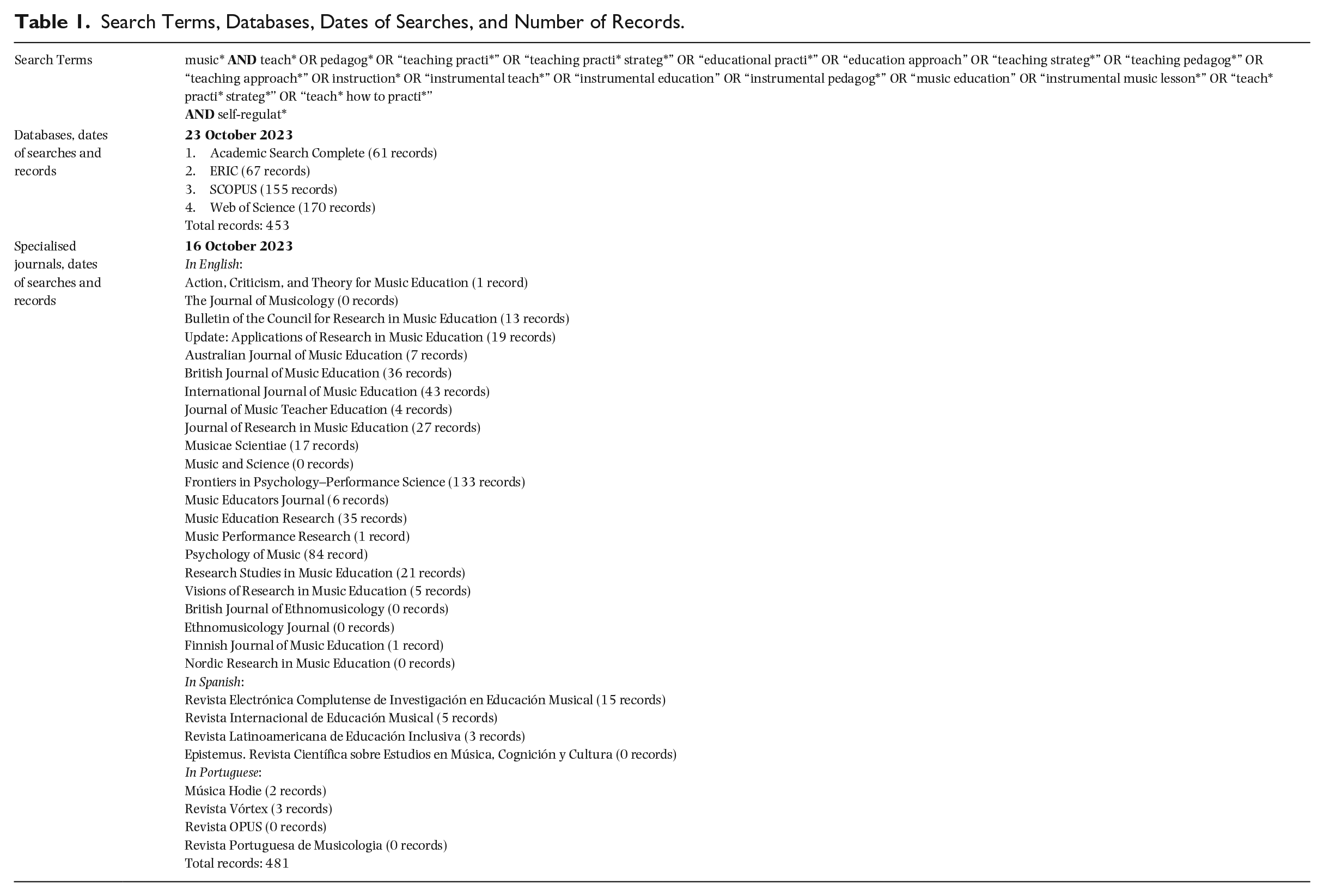
The terms used in the search are shown in Table 1. An experienced librarian from the University of Aveiro reviewed the search strategy. We used a wild card in the following words: music* (to represent “music”, “musicians” and “musical”), teach* (covering “teach”, “teaching”, “teacher” and “teachers”), pedagog* (including “pedagogy” and “pedagogies”), and practi* (which encompasses “practice”, “practise”, “practicing” and “practising”). Database searches were carried out by the first author in October 2023 and totalled 453 records (Scopus: 155; Web of Science: 170; ERIC: 67; Academic Search Complete: 61). In the same month, manual searches were carried out in specialised music education and music psychology journals, totalling 481 records (see Table 1). Adding up the records from the databases and specialised journals, we reached 934 records in our search.
Search Terms, Databases, Dates of Searches, and Number of Records.
Study selection
After the search, 252 duplicate records were excluded. Thus, the title and summary of 682 records were screened. In this process, 605 irrelevant records were excluded (e.g., non-peer-reviewed research studies, not related to pedagogical approaches to promoting SRL, outside the field of music, full text not available in English, Portuguese or Spanish, non-empirical commentaries, book summaries and texts). The authors blind-checked the 77 included full texts using Rayyan platform 1 . After discussion and refinement of the exclusion criteria, 60 full texts were excluded for the following reasons: (1) did not address all of our research questions; (2) did not involve musical instrument lessons (e.g., composition, improvisation); (3) non-empirical (purely theoretical); (4) full text not available (e.g. conference abstracts without full text available); (5) little or unclear relationship to SRL theory; (6) included principles from other theories together with SRL theory, which could compromise the interpretation of results, especially those related to the effects of pedagogical approaches to promoting SRL; and (7) design, sampling, or type of document was unclear or inadequate. We selected 17 articles that met our inclusion criteria: (1) studies involving pedagogical approaches to promote SRL in musical instrument/voice students of all ages, learning in different formats (one-to-one or group lessons, and face-to-face or online or hybrid courses; (2) empirical studies published in peer-reviewed journals; and (3) complete works available in English, Portuguese, or Spanish. Figure 1 shows the article selection process following the PRISMA flowchart (Moher et al., 2009).
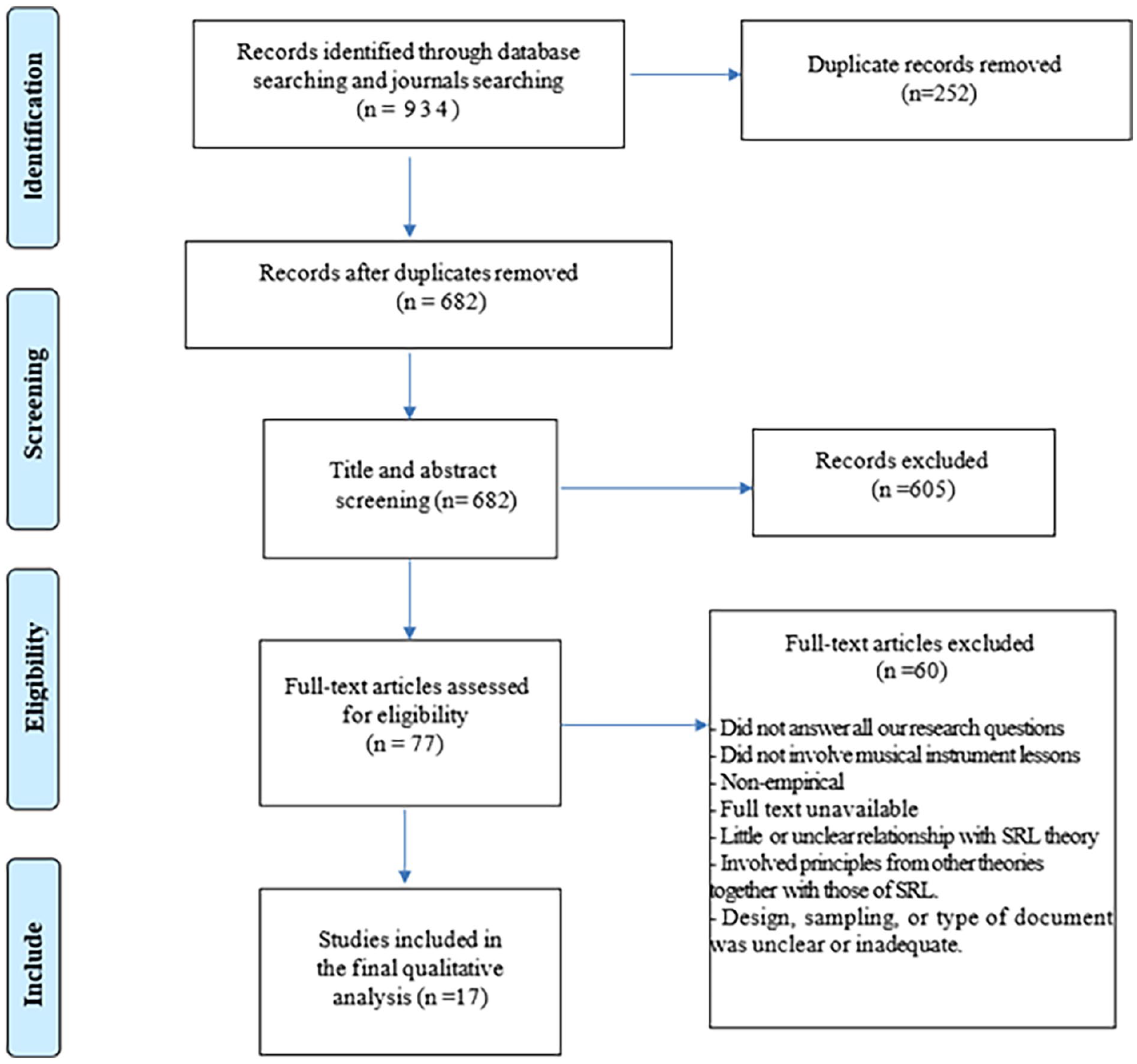
PRISMA Flowchart.
Data analysis
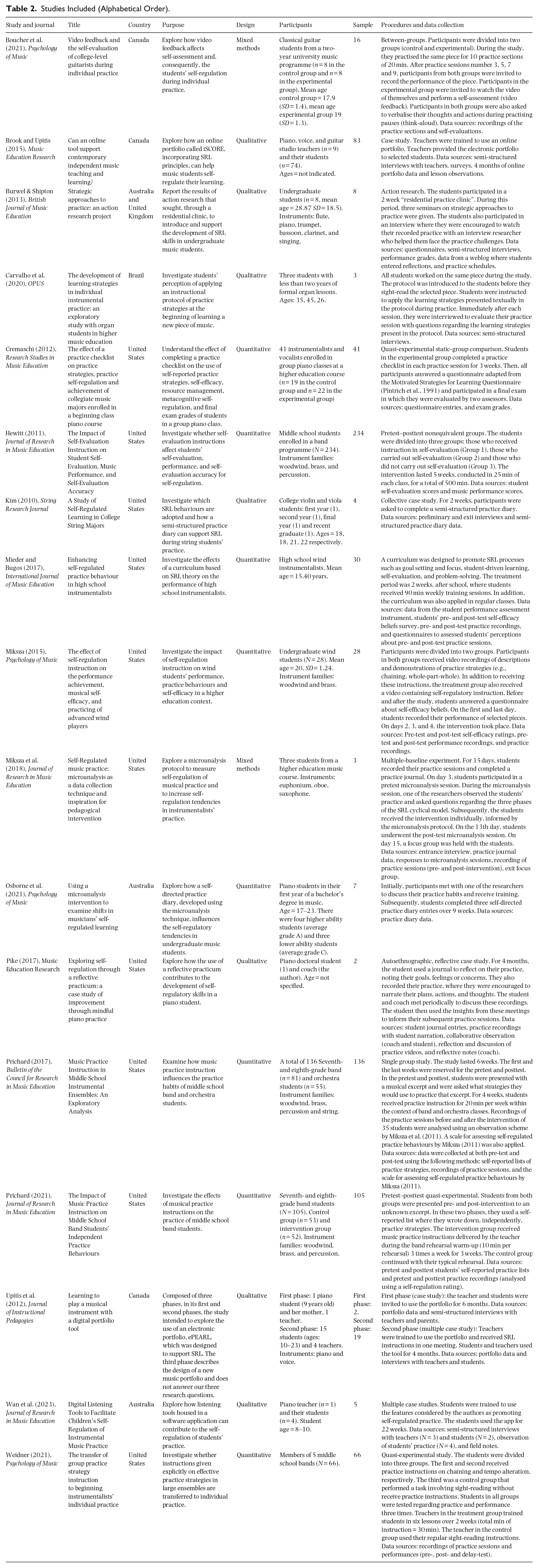
After selecting the 17 studies, all the three authors read the articles, and the first author conducted the data extraction process, organising the information into an evidence table (Table 2). We then performed a theoretical thematic analysis of the studies’ findings based on Braun and Clarke (2006). The studies were then divided into seven categories based on the types of pedagogical approaches used to promote SRL.
Studies Included (Alphabetical Order).
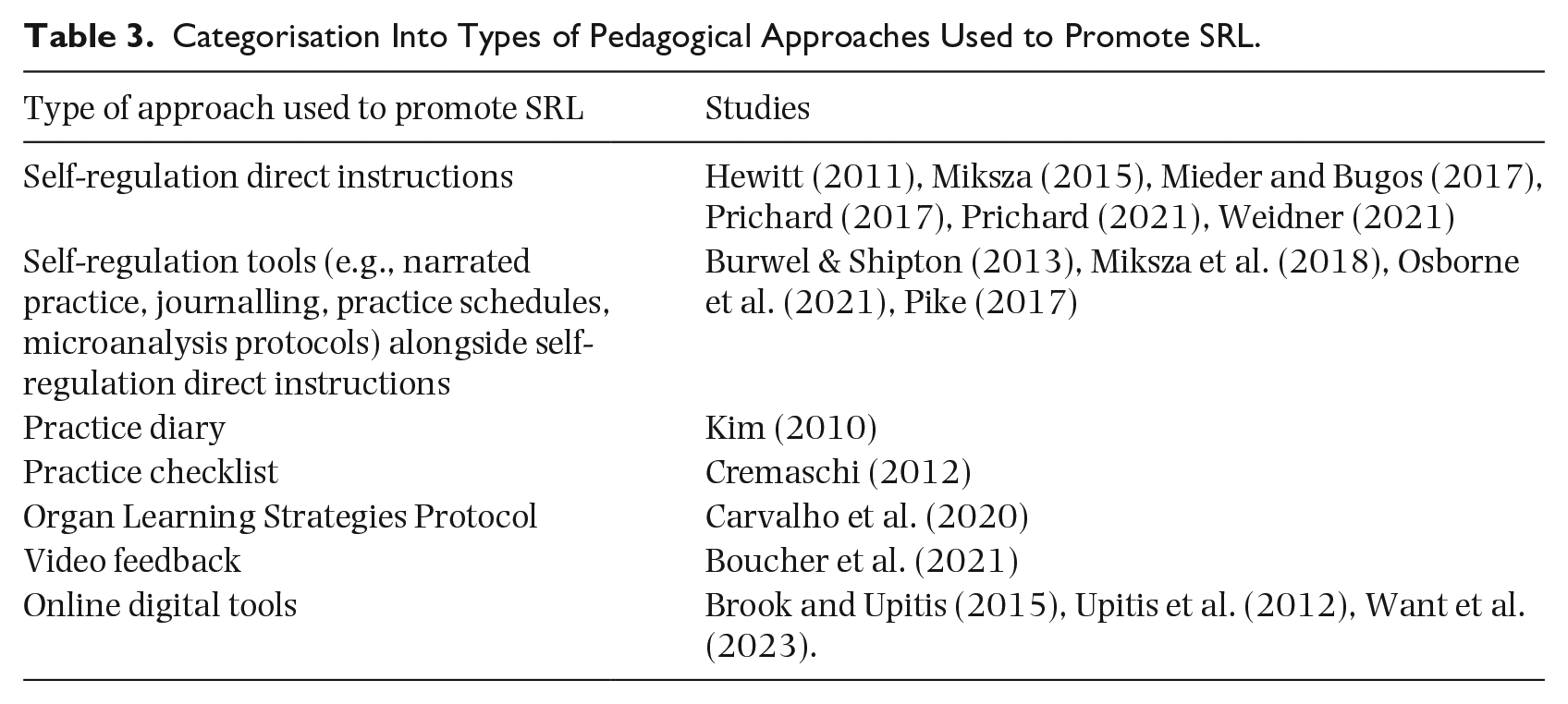
In order to build our categorisation, we started from the precept that SRL can be promoted directly and/or indirectly. Therefore, in the category of direct instructions for self-regulation, we included the selected studies that aimed to promote SRL through instructions delivered by teachers/researchers. Indirect support included the following instruments or tools to develop SRL skills: narrated practice, journalling, microanalysis protocols, practice diary, practice checklist, learning strategies protocol, video feedback, and online digital tools. Some studies used both pedagogical approaches, that is, incorporating self-regulation tools and direct instructions. The categorization is presented in Table 3.
Categorisation Into Types of Pedagogical Approaches Used to Promote SRL.
Discrepancies in the categorisation were discussed and solved in the meetings involving the research team. In these discussions, all authors contributed to refining the categorisation and ensuring consistency in the interpretation of the data.
Findings
In this section, we move from an overview of the 17 selected studies to a more detailed presentation of each study using our categorisation. In seeking to answer our research questions, we describe which pedagogical approaches were used, how they were applied, and what the results of their application were in terms of student performance and learning. Within each category, the studies are presented in alphabetical order. Information regarding the study design, sampling, and procedures for each selected study can be found in Table 2. A comprehensive synthesis of the studies is provided in the Discussion and Conclusions section.
Overview of the studies
The data presented in Table 2 provide an insight into the selected studies. The 17 studies included in this scoping review were primarily conducted in the United States (n = 10), followed by four other countries, Canada (n = 3), Australia (n = 2), the United Kingdom (n = 1) and Brazil (n = 1). Of the 17 studies, seven used qualitative data analysis, eight used quantitative, and two used mixed methods. The selected articles were published between 2010 and 2023 and used a variety of research designs (e.g., case studies, pretest–posttest quasi-experimental, action research). Not all studies specified the research design, so we only included it in the evidence table if it was clearly described by the author(s). In terms of data collection, the studies mainly used interviews, practice diary data, observation of students’ practice, online portfolio data, surveys, and performance recordings.
The number of participants in the studies ranged from two to 234. Of the 17 articles selected, seven studies were conducted with higher education students (Boucher et al., 2021; Burwel & Shipton, 2013; Cremaschi, 2012; Kim, 2010; Miksza, 2015; Miksza et al., 2018; Osborne et al., 2021), four with high school students (Hewitt, 2011; Mieder & Bugos, 2017; Prichard, 2017, 2021; Weidner, 2021), and one with a mix of undergraduate and university extension course students (Carvalho et al., 2020). The studies by Wan et al. (2023), Brook and Upitis (2015), and Upitis et al. (2012) were conducted with school-age students and studio teachers. The study by Pike (2017) was conducted with a doctoral student and the author/researcher as a coach. All studies were conducted in person with students learning in face-to-face settings.
Many of the interventions took place outside of regular instrument lessons and were implemented by the researchers. However, Mieder and Bugos (2017), Prichard (2017) and Upitis et al. (2012) applied interventions in the regular classes conducted by the teachers, while Hewitt (2011), Prichard (2021), and Weidner (2021) implemented their interventions during designated times in the middle school band class, also facilitated by the teacher(s).
Self-regulation direct instructions
Hewitt (2011) suggested that self-evaluation is an essential component of self-regulation of learning. Hewitt’s work incorporates a pretest–posttest design with non-equivalent groups. The student participants (N = 234) were divided into three groups: Group 1 received instruction on self-evaluation, Group 2 performed self-evaluation, and Group 3 did not engage in self-evaluation. The instructions for self-evaluation were based on the precepts of Ross et al. (1998):
(a) defining the criteria for evaluation, (b) learning to apply the criteria to their performances and those of others, (c) receiving teacher feedback on their self-evaluations, and (d) engaging students in the development of goals and action plans to implement in their learning. (p. 10)
The results indicate that self-evaluation instructions did not have a significant impact on student performance, as students in the group that received the instruction performed similarly to those who did not. The author attributed the lack of impact of self-evaluation instruction on students to the duration of the study (5 weeks), as other studies have applied more extensive interventions (minimum of 8 weeks) and obtained favourable results.
In Miksza’s (2015) study, students (N = 28) were divided into two groups and exposed to two different experimental conditions. Participants in both groups received instructional videos containing descriptions and demonstrations of practice strategies, such as varying rhythm, using a metronome, and slowing down. In addition, participants in the treatment group also received videos containing descriptions and demonstrations of SRL principles, based on McPherson and Zimmerman (2011), such as environmental structuring, “finding a time and place to practice where you can concentrate and remain focused on the task at hand is of utmost importance” (Miksza, 2015, p. 235); goal setting, “it can be helpful to choose two or three objectives to focus on for any particular practice session” (p. 235); and self-evaluation, “your self-evaluation may reveal it is time to move on to another objective or perhaps it is time to try a new strategy” (p. 238). The results indicate that both pedagogical approaches had a positive impact on student performance. However, participants who received self-regulation instruction showed greater performance outcomes and commitment to working on musical nuances during practice (e.g., dynamics and articulation). The author suggests that this may have occurred because these students applied the practice strategies more effectively as they incorporated SRL principles into their practice.
Mieder and Bugos (2017) designed a curriculum to encourage SRL processes in students (e.g., problem-solving and self-evaluation). The data collection methods aimed to understand the students’ self-efficacy before and after the intervention through their responses to a questionnaire, practice behaviours through video recordings of the practice sessions, and participants’ perceptions about the frequency of their practice behaviour, which were also assessed through a questionnaire. Based on Bugos and High (2009) and Smith (2005), these authors created 22 practice strategies and grouped them into categories: “elimination”, to reduce challenges by having students focus on improving one skill at a time (e.g., singing, tapping, clapping); “thoughtful repetition”, which reinforces the combination of repetition with practice strategies such as chaining and using the metronome; and “make it musical”, which includes pedagogical approaches to developing musical expressiveness, such as articulation and dynamics. During the 2-week treatment period, the instructor engaged the students (N = 30) in discussions about musical challenges and practice strategies, taking time to ask questions such as “In measure eight, what strategy or strategies would you use to better facilitate the technical challenge of the sixteenth note passages?” (p. 583). The results indicate an increase in students’ self-efficacy, which may be linked to their positive perceptions of the practice strategies. However, no significant differences in student performance were noted. The authors attributed this result to the short duration of the intervention, 2 weeks, which proved insufficient for students to assimilate all the curriculum concepts.
Prichard (2017) conducted a single-group study. The intervention took place over 4 weeks (20 min of instruction per week) and was applied in the regular educational context of band and orchestra classes (N = 136). The practice strategies aimed to develop skills related to “rhythmic accuracy,” “note accuracy,” and “musical accuracy” (based on Miksza et al., 2011). The teachers’ pedagogical practices included, first, identifying a challenging musical excerpt and subsequently, using cognitive modelling, e.g., the teachers modelled their thinking primarily. Finally, the students practised the strategy in groups. The pedagogical approaches that could promote SRL were based on Bandura (1986) and Miksza et al. (2011). The results indicated that participants listed significantly more practice strategies on the post-test compared to the pretest. Some inefficient strategies showed substantial decreases, such as “playing from beginning to end.” Analysis of the students’ practice recordings indicated that after the intervention, students spent more extended periods working on specific excerpts (indicated as an increase in time management skills) and showed greater diversity in their practice objectives. Self-regulation ratings did not increase significantly after the intervention. The author believes this last result occurred due to the short duration of the intervention and the need for additional instructions on other principles of self-regulation.
Prichard (2021) conducted a pretest–posttest quasi-experimental study with 105 students. The intervention consisted of a 3-week instructional protocol during band class warm-ups (30 min of practice instruction per week). Based on Bandura’s (1986) concept of observational learning and the works of Miksza et al. (2011) and Prichard (2017), the protocol included: “(a) identification of a challenging excerpt, (b) cognitive and live modelling (Bandura, 1986), and (c) group practice of one or more appropriate practice strategies” (p. 424). In class, the teacher modelled the recognition of the challenge, the selection of strategies and their application. Participants in the treatment group reported an increase in the number and variety of strategies. In the control group, the number of strategies used remained similar and focused on “note accuracy”. There were no significant differences between the groups in terms of self-regulation observed in practice. However, students who already showed high levels of self-regulation benefitted more from the intervention than those who were less self-regulated.
In Weidner’s (2021) quasi-experimental study, one group of students received instructions on chaining (n = 23), another group received instructions on tempo alteration (n = 23), and the final group received no instructions and simply read the pieces assigned to students in all groups (n = 20). “Chaining” refers to the practice strategy in which the student divides challenging sections into smaller ones; once they are able to play the smaller section, the student recontextualises the excerpt within the musical piece; and “tempo alteration” refers to slowing down and, after achieving accuracy, increasing the tempo. The teacher named the strategy in each lesson, gave explicit descriptions, modelled it, and guided the practice. There was no significant change in the frequency of strategy use; however, in terms of performance, students in the treatment group showed changes that differentiated them from students in the control group. The author attributed the best performance results to a better understanding and use of the strategies taught.
Self-regulation tools (e.g., narrated practice, journalling, practice schedules, and microanalysis protocols) alongside self-regulation direct instructions
In Burwel & Shipton’s (2013) action research study, students (N = 8) were introduced to practice strategies for each SRL phase (Before, During and After), based on Jørgensen (2004), during three seminars held by the researchers. As strategies for the “Before” phase, students were guided to use “practice schedules” in which they had to indicate the items they were studying and the time spent on each of them; for the “During” phase, their practice was recorded and then reviewed and discussed in an individual interview/intervention session with a researcher; and for the “After” phase, a weblog was used where students wrote their reflections on the practice strategies. The practice schedule was a time management concept, nicknamed the “15-min rule”, originating from the English pianist Ronald Smith. According to this concept, students should choose a musical passage and practise it for 15 min, after which they could repeat or change the musical content. The findings showed that the 15-min rule proved to be an effective tool, widely used by students, which helped them recognise challenges, establish goals, and monitor and evaluate their practice.
Based on the microanalysis protocol developed by Cleary et al. (2012), Miksza et al. (2018) conducted a multiple-baseline experiment consisting of individual meetings in which the students (N = 3) and the researcher discussed relevant aspects of the students’ practice. The authors used different data collection sources (e.g., entrance and focus group exit interviews, participants’ responses to the microanalysis data collection section, practice recordings). The interview data were analysed using thematic analysis, while the practice session recordings were analysed for the frequency of practice behaviours. Taking on the role of coach, the researcher guided students, for example, in setting goals for practice (“Do you or your teacher usually set goals for your practice sessions? Please explain.” p. 9), in reflecting and selecting practice strategies (“Think back to your goals. What strategies do you plan to use to achieve those goals?” p. 11), and to improve concentration during practice (“What do you do to keep your concentration?” p. 12). The results indicated a slight increase in students’ confidence post-intervention. Furthermore, students began to articulate their practice goals more clearly and reported a more varied list of practice strategies. Finally, students engaged in more detailed self-observation and metacognitive monitoring through the questions about their thoughts. The students affirmed the importance of the experience, particularly in terms of its potential to bring individual weaknesses to light.
Osborne et al. (2021) developed a practice diary, based on a microanalysis protocol devised by McPherson et al. (2019), which included questions designed to engage students in adopting the self-regulatory behaviours and thinking of the three phases of SRL. For instance, before starting practice, participant students (N = 7) had to respond to practice diary items to prompt task planning; during practice, they responded to items to encourage self-observation; and, after practice, to items to support self-reflection. Furthermore, at the beginning of the study, students participated in a training meeting on the components and principles of SRL as described by Zimmerman (2002) and Zimmerman (2013). The quantitatively driven results showed that the SRL process with the most significant improvement in students was metacognitive monitoring. Students with higher ability demonstrated stronger motivational beliefs, while those with lower ability demonstrated investment in strategic planning and goal setting.
Pike’s (2017) case study explored the promotion of self-regulation in a piano student’s practice by adopting Schön’s (1987) reflective practitioner model. In this work, the author assumed the role of coach and encouraged the participating student (N = 1) to narrate their plans, actions, and thoughts during practice (narrated practice). Another approach was journalling, where the student was guided to reflect, for example, on their goals and how they would achieve them, and the coach and student also met to discuss recordings of the practice sessions. The procedures adopted led to an increase in the student’s self-regulation. The process of reflecting aloud was necessary for the student to identify any difficulties, and the sessions with the coach helped to explore ideas and find an “artistic voice”. Both the student and the piano teacher noted the resulting improvements in the student’s performance.
Practice diary
In a multiple case study with four participants, Kim (2010) developed a semi-structured practice diary based on Hallam’s (1997) concepts of self-regulated practice. The author did not provide further details or examples of the diary’s contents. The practice diary was used for 2 weeks with string students and proved to be a tool that could investigate and support self-regulated behaviours. It helped students to use metacognitive resources, plan practice sessions in more detail, concentrate, keep practice records, understand where improvements were needed, plan subsequent practice sessions, and adopt mental practice strategies and mental imagery.
Practice checklist
Cremaschi (2012) employed a quasi-experimental static-group comparison design with 41 participants. The intervention involved the application of a practice checklist to encourage self-reflection, characterised as the third phase of the SRL model introduced by McPherson and Zimmerman (2011). This checklist included strategies such as “slow and sectional practice, metacognitive self-regulatory strategies such as practice planning, monitoring, and self-evaluation items (e.g., ‘inner teacher’, progress and concentration self-ratings), and a time tracking section for each piece or exercise” (p. 226). Students in the experimental group reported higher levels of metacognitive self-regulation (planning, monitoring, and adjusting) than those in the control group. There were no significant differences between the two groups with regard to the use of practical strategies, self-efficacy, resource management, and final performance grades. The author attributes these last results to the short treatment period (3 weeks).
Organ learning strategies protocol
Carvalho et al.’s (2020) qualitative study applied a protocol containing 17 learning strategies with instructions on how to apply them, which were presented to the students in text form. The 17 strategies were based on the authors’ experience of teaching the organ and on the analysis of the piece that all students were asked to practise during the study. Furthermore, the protocol included practice strategies to optimise musical performance (e.g., “slowing down the tempo in practice, skipping to critical sections”, p. 6). Student participants (N = 3) reported that the protocol provided them with effective practice strategies that helped them to achieve their goals in less time than usual and to develop an artistic interpretation of the piece.
Video feedback
Based on the assumption of the importance of self-evaluation for self-regulation of learning and the suggestion that video feedback may be beneficial in preparing for performance, Boucher et al. (2021) conducted an intervention using video feedback as a self-regulation tool. The study used an experimental between-groups design (n = 8 in the control group and n = 8 in the experimental group). In this study, students in the treatment group were asked to record their performance and provide self-evaluative verbal comments while watching it. The qualitative analysis involved coding participants’ verbalisations during practice (thinking aloud). The quantitative analysis involved calculating the frequency of coding for the think-aloud comments made during the practice sessions across the intervention period. Throughout the self-evaluation sessions, students in the experimental group began to evaluate themselves differently, and these changes were more pronounced in participants with higher performance skills. In the final video feedback sessions, students in the experimental group commented more on practice strategies to be used in subsequent practice sessions. This led the authors to speculate that this tool can lead students to reflect on which strategies to use in future practice sessions.
Online digital tools
Brook and Upitis (2015) conducted a case study with 83 participants, investigating iSCORE 2 , an electronic portfolio that was the successor to ePEARL (see Upitis et al., 2012) and was specifically designed to support SRL in music lessons. The portfolio comprised 24 features to assist students in setting goals and learning new repertoire. The tools also facilitated students’ communication with teachers and peers outside of lesson time, for example, by allowing them to comment on recordings. The platform also included examples specific to music practice in its help sections. The findings showed that students valued the features that made it easier to set goals and share videos of their performances with teachers and peers. Furthermore, the tools that allowed feedback to be sent from outside the classroom were cited as a form of co-regulation of students’ practice. The students’ adherence to the portfolio depended on encouragement from the teachers.
Upitis et al. (2012) explored the use of the ePEARL electronic portfolio, which was deliberately built around the principles of SRL. The ePEARL (Electronic Portfolio Encouraging Active Reflective Learning) tool was designed to be student-centred, with features that encouraged students to set their learning goals and list the strategies they would use. It also had a space to make recordings and allow interactions between teachers, parents, and peers. The findings of the first phase (a case study with two participants) indicated that utilising the portfolio increased communication between teacher, student, and parents, in addition to helping with planning and reflecting on practice through the recordings. Finally, the ability to set goals increased the students’ motivation to practise for exams. The findings of the second phase (multiple case study with 19 participants) showed that the requirement to make recordings motivated students to solve challenging sections of the repertoire and to listen critically to their performances. Teachers provided feedback and helped guide students’ practice between lessons using communication tools.
Wan et al.’s (2023) multiple case studies trained students (N = 4) to use features of a software application to promote self-regulation processes from the three cyclical phases of SRL. These resources included recordings of tasks and making personal adjustments to the listening experience (e.g., varying the tempo or listening to separate hands). In addition, the application provided suggestions for task-oriented strategies (e.g., playing smaller sections/larger sections) and problem-solving tactics (e.g., “Too easy? Make it more challenging! Too hard? Make it simpler,” p. 9). The findings suggest that the application, through its listening tools, enhanced students’ aural perception and problem-solving processes, which facilitated self-regulation of practice. Furthermore, the importance of the teacher in encouraging the use of the app was highlighted, as well as the students’ learning preferences.
Discussion and conclusion
The aim of this scoping review was to identify evidence regarding teaching approaches that foster self-regulation within the context of musical instrument learning. In our search, we identified 17 articles that met the inclusion criteria. Most of the studies demonstrated that pedagogical approaches promoting SRL had a positive impact on the students’ learning and performance. It was evident that there is a diversity of approaches to promoting self-regulation, including direct instructions, the use of video feedback and digital tools embedded with SRL principles. However, it was not possible to generalise the results and findings due to the diversity of study designs and measures across studies.
In studies that employed direct instructions for self-regulation, the instructions were intended to develop self-regulatory skills such as time management, task strategies, environmental structuring, and self-evaluation. However, not all studies that used direct instruction guided by teachers/researchers specified how self-regulation strategies were delivered. Nevertheless, some authors provided details indicating, for example, the use of questioning (Mieder & Bugos, 2017), modelling (e.g., Miksza, 2015; Prichard, 2017, 2021; Weidner, 2021), guided practice (e.g., Weidner, 2021), and “dialogue” with the student (Pike, 2017). Thus, a gap was identified in studies that focused on the detailed description of the specific behaviours teachers/researchers used to teach self-regulation strategies.
Some findings indicate a positive influence of direct instructions on instrumental learning. Miksza (2015), Pike (2017), and Weidner (2021) suggest improvements in student performance, Mieder and Bugos (2017) in students’ self-efficacy beliefs, and Prichard (2017, 2021) in students’ more significant and diverse use of task strategies. Especially in studies based on microanalysis protocols, there was a development in students’ metacognitive monitoring during practice (Miksza et al., 2018; Osborne et al., 2021). These findings are in line with the research conducted by Varela et al. (2016) and Ewijk et al. (2013), which showed a correlation between pedagogical methods that explicitly teach self-regulation strategies and the improvement of students’ self-regulatory skills. However, contrasting results were found in studies by Cremaschi (2012), Hewitt (2011), and Mieder and Bugos (2017), which failed to establish a correlation between the SRL pedagogical approaches and improved student performance. In these three studies, the authors indicated the need for a longer treatment period in order for students to assimilate SRL instructions and thus significantly optimise student performance.
In addition to direct instructions, some selected studies investigated the effectiveness of using tools to promote self-regulation in musical instrument learning. Kim (2010) and Osborne et al. (2021) investigated the use of a practice diary with their participants and Cremaschi (2012) the application of a practice checklist. These three studies demonstrated the potential of self-report tools for developing SRL skills in students. In a similar vein, the studies by Brook and Upitis (2015), Upitis et al. (2012), and Wan et al. (2023) showed that digital tools can be designed with a set of features that facilitate the adoption of self-regulated behaviours by students, such as help seeking and the use of task strategies.
The studies by Brook and Upitis (2015) and Wan et al. (2023) were conducted with school-age students and highlighted the importance of teacher encouragement to ensure that digital tools are used effectively. On the contrary, the results of the study by Carvalho et al. (2020), which involved students over the age of 26, showed positive effects of self-regulation strategies even without direct teacher intervention. These findings may suggest differences in the implementation of the use of self-regulation tools with students of different ages, as younger students generally have lower levels of self-regulation (McPherson & Renwick, 2001) and may require more external regulation on the part of teachers or parents, as indicated by Brook and Upitis (2015) and Wan et al. (2023).
Not all the studies specified the SRL theory processes they intended to promote. However, Boucher et al. (2021) and Hewitt (2011) focused their studies on self-evaluation instruction for self-regulation of learning, Weidner (2021) focused on the instruction of task strategies, and Cremaschi (2012) on a self-regulation tool (practice checklist) to encourage self-reflection. On contrary, studies based on microanalysis protocols, such as Miksza et al. (2018) and Osborne et al. (2021), provided detailed descriptions of how these protocols applied were designed to activate self-regulation processes present in all three phases of the cyclical model of SRL (forethought, performance, and self-reflection) during the intervention.
The results of this research highlight the need for future studies employing observational methodologies to investigate teachers’ or researchers’ behaviours more deeply when instructing self-regulation strategies during the interventions. Such studies would be essential to deepen the understanding of the teaching–learning dynamics involved in developing students’ SRL. Similarly, the results indicate that few studies have developed interventions in regular instrumental music lessons. This highlights the need for research that examines the effects of pedagogical approaches in more authentic teaching contexts, to better understand their impact in real-world educational settings.
In terms of class format (i.e., one-to-one lessons or group lessons), the findings of Prichard (2017, 2021) and Weidner (2021) highlight how instructions to promote SRL delivered in group lessons have an impact on students’ individual practice. Although the studies by Hewitt (2011), Mieder and Bugos (2017), Prichard (2017, 2021), and Weidner (2021) were conducted in group lessons, which differentiates them from other studies that were mainly conducted in individual lessons, all studies were conducted face-to-face. Therefore, this work identifies a research gap related to the scarcity of studies investigating pedagogical approaches to developing students’ self-regulation in other educational contexts, such as online or hybrid lessons. All 17 studies can inform future interventions. However, further research is still needed to understand which teacher pedagogical practices can promote SRL and their impact on musical instrument learning in online/hybrid educational settings.
This study presents a set of evidence-based strategies that can inform teaching practice and the creation of learning environments that promote SRL in musical instrument learning. Thus, the study provides not only types of self-regulation instruction that can positively affect students’ instrumental learning, but also tools that can be added to the curriculum for the same purpose (e.g., practice diaries and checklists, digital tools).
Given that this study suggests both direct instruction and self-regulation tools effectively support the development of students’ SRL skills, a key implication is the need for instrumental teachers to receive training in SRL theory principles and the effective use of tools to foster students’ self-regulation of musical learning. This training can occur both during the initial education of music teachers and as part of continuous professional development, with courses that integrate research advances and provide opportunities for teachers to apply these pedagogical approaches in the classroom.
Although this scoping review has identified and described several promising teaching strategies and tools for fostering self-regulation in musical instrument learning, it is essential to recognise that this field is constantly growing. The searches for this review were carried out in October 2023, and since then a new study has been published in 2024, exploring the impact of applying the microanalysis protocol on cellists preparing for public performances (López-Íñiguez & McPherson, 2024). This fact highlights the ongoing evolution of research in this area and suggests that new approaches and techniques are being developed to understand and enhance self-regulation in musical instrument learning.
One of the limitations of this study is that it only considered studies written in English, Portuguese, or Spanish, excluding potentially relevant studies written in other languages. Furthermore, the study only included articles published in peer-reviewed journals and did not integrate grey literature.
Footnotes
Funding
The authors disclosed receipt of the following financial support for the research, authorship, and/or publication of this article: This research had the financial support of FCT (Fundação para a Ciência e a Tecnologia), Portugal, through the research grant awarded to the first author, with the reference UI/ BD/151260/2021, and the scientific employment program awarded to the third author, with the reference DOI 10.54499/CEECIND/03404/2017/CP1459/CT0047.
