




Abstract
Music listening can evoke a wide range of thought types, including autobiographical memories, fictional stories, visual imagery, and mind-wandering. Previous studies have typically examined these thought types individually, which precludes investigation of why certain music evokes certain thought types over others. This study investigates the impact of musical genre, familiarity, enjoyment, contrast, and emotional expression on the occurrence of different thought types during music listening across 17 genres targeted towards UK and US listeners. We systematically selected 356 music excerpts and collected data from 701 participants from the United Kingdom and the United States, analysing the frequency of thoughts occurring during these excerpts and various excerpt ratings (e.g., familiarity, emotional expression). We found significant genre-specific effects on thought types, such as Film music primarily evoking media memories and fictional imaginings. Familiarity, contrast, enjoyment, valence, and arousal ratings all significantly influenced certain thought types, suggesting that both compositional features and one’s previous experiences of music affect listeners’ inner mental worlds. This study extends previous research by exploring a broader range of genres and musical features, offering new insights into the mental landscape of thoughts occurring during music listening.
Thoughts during music listening
Music listeners often experience a variety of extramusical thoughts. Some may be evoked directly by the music, such as autobiographical memories, fictional stories or scenes, visual imagery, or observations about features of the music itself (e.g., Dahl et al., 2023; Jakubowski et al., 2024; Margulis & Jakubowski, 2024). In other cases, listeners may move into a state of mind-wandering, thinking about everyday matters or future plans, for instance (Koelsch et al., 2019; Taruffi et al., 2017). Music’s dynamic and evolving nature makes it a potent stimulus for influencing ongoing thoughts and contributes to its ability to evoke a broad spectrum of mental experiences (Christoff et al., 2016; Dahl et al., 2023; Klinger, 2013; Taruffi et al., 2017).
Previous research exploring individual thought types evoked by music offers insights into specific categories of mental experience. Visual mental imagery, a common experience during music listening, is purportedly a significant contributor to music’s emotionality and forms a basis for various music-evoked thoughts (Dahl et al., 2023; Eldar et al., 2007; Juslin & Västfjäll, 2008; Taruffi & Küssner, 2019). Visual mental imagery ranges from material objects or scenes (e.g., people, places) to abstract conceptions like colours or shapes (Küssner & Eerola, 2019). Music-evoked autobiographical memories frequently occur in everyday life, featuring vivid visual and motor imagery, often accompanied by sensory details and complex emotional reliving (Cady et al., 2008; Jakubowski, 2022; Jakubowski & Ghosh, 2021). Music can also evoke story-like imaginings (Hashim et al., 2023; Margulis et al., 2022b; McAuley et al., 2021) even in the absence of deliberate compositional storytelling; for example, music written for media (McClary, 1997; Tagg & Clarida, 2003).
Previous research typically examines distinct thought types in isolation, such as autobiographical memories or fictional narratives (Jakubowski & Ghosh, 2021; Margulis, 2017). This separation limits our understanding of why certain music evokes certain thought types over others. For instance, examining how music evokes autobiographical versus fictional thoughts can provide new insights into the dynamics of memory and imagination (Margulis & Jakubowski, 2024). This article aims to advance the field by considering how specific musical features and listener factors influence the occurrence and nature of different thought types, laying the foundation for comparative studies examining them within a unified framework (Jakubowski et al., 2024; Margulis & Jakubowski, 2024; Taruffi et al., 2017).
Understanding how different types of music elicit different thought types is important for practical applications of music, in everyday life, performances, and therapeutic settings. Notably, music’s ability to evoke story-like imaginings has been used in therapeutic settings to guide mental narratives, aid in self-regulation, and foster creativity (Antović et al., 2023; Dukić et al., 2021; Völker, 2021). Music-evoked imaginings provide a valuable lens through which to study the relationship between perception and imagination, essential to music’s capacity to connect or divide people, for people to make sense of and be moved by music (Margulis & McAuley, 2022).
Effects of genre on thoughts during music listening
The importance of considering the effects of genre (musical style) on thoughts during music listening is underscored by theoretical frameworks that emphasise the contextual and experiential roles of musical styles. For example, Thompson et al. (2023) proposed a theoretical framework of ‘source sensitivity’, an under-researched psychological process, to highlight how listeners’ sensitivity to the causal and contextual origins of music plays a critical role in music appreciation. Musical genres are often tied to specific contexts and experiences. These contexts, whether involving social settings, cultural practices, or media associations, shape the way listeners engage with and respond to diverse types of music. For example, music composed for video games might evoke memories of engaging with games or game-like narratives, even if the listener hasn’t heard the specific music excerpt before. Even when encountered in artificial contexts, such as successive short excerpts played through headphones during an experiment, genre-related associations can profoundly influence the types of thoughts and feelings that arise (Ben Sassi & Ben Yahia, 2021; Rentfrow, 2012).
Empirical studies support the idea that genre influences the emergence and experiential judgement of thoughts during music listening. For instance, Jakubowski et al. (2024) compared three genres (classical, electronic, pop/rock) and found that classical and electronic music evoked more thoughts than pop/rock, with classical music eliciting more narrative and media-related memories, while electronic music induced more abstract imagery. Other research has demonstrated that different genres tend to evoke distinct emotional profiles (Strauss et al., 2024; Zentner et al., 2008 although see also Aljanaki et al., 2016), and emotion induction mechanisms may also vary across genres (Juslin et al., 2022).
Previous studies have typically been limited in the number and scope of genres investigated (e.g., three in Jakubowski et al., 2024; two in McAuley et al., 2021 and Margulis et al., 2022a; one in Margulis et al., 2022b). In addition, most previous work focuses on differences in felt emotion evoked across genres, with limited consideration of how these genres and their associated emotional profiles influence concurrent extra-musical thoughts. In the present study, we aim to address these limitations by investigating the influence of a wide range of genres, with consideration of the scope of their compositional and contextual variety, on thoughts during music listening.
Effects of contrast and emotional expression on thoughts during music listening
Music varies not only across broad genre categories but also in its structural and expressive features. Musical features vary naturally across genres and provide convenient parameters for experimental manipulation. For example, changes in tempo have been shown to affect memory recall (Balch et al., 1992), while specific musical and acoustical characteristics (e.g., emotional valence, instrumentation) influence the content and vividness of visual mental imagery (Dahl et al., 2023; Herff et al., 2021).
Musical contrast, operationalised here as the degree of change in musical elements such as dynamics, rhythm, and melody over time (McAuley et al., 2021), seems to have some influence on music-evoked thoughts. For example, changes in musical tension have been shown to predict changes in narrative thought (Margulis et al., 2022b), suggesting music with more contrast might evoke richer, more dynamic thoughts. Furthermore, visual imagery is more frequent when listeners are more engaged with the music (Presicce & Bailes, 2019) and music that evokes more vivid imagery is rated as more appealing and arousing (Belfi, 2019; Küssner & Eerola, 2019), both of which may be aided by greater interest in and attention to musical features such as contrast. However, McAuley et al. (2021) did not find an effect of contrast (operationalised in terms of instrumentation and dynamic variation) on narrative engagement with Western or Chinese art music, and Margulis (2017) reported only qualified support for contrast’s role in narrative engagement, with familiarity and enjoyment playing larger roles. Thus, the effect of contrast is currently inconclusive.
Emotional expression of music (Eerola & Vuoskoski, 2012; Schubert, 2013) may also affect thoughts occurring during music listening. While Jakubowski et al. (2024) found that the emotional expression of music had fewer effects on thought types compared with genre, they also observed that negatively valenced music elicited more thoughts overall, aligning with prior findings on sad music and mind-wandering (Taruffi et al., 2017). In addition, Jakubowski et al. (2024) reported that positively valenced music elicited thought descriptions containing more positively valenced words. This concurs with previous findings (Jakubowski & Francini, 2023; Sheldon & Donahue, 2017) that emotional music tends to elicit emotionally congruent autobiographical memories.
In this study, we incorporate ratings of the emotional valence, arousal, and contrast of music excerpts to test how these features affect thoughts during music listening. We also examine their interaction with genre, given the expected variation both within and across genres (e.g., Metal and Ambient music likely occupy distinct emotional spaces, but excerpts within these genres may also vary notably).
Effects of familiarity and liking on thoughts during music listening
In addition to structural and compositional features, listeners’ prior experiences shape music perception and associated cognition. Less familiar music tends to evoke thoughts rated as more novel, suggesting that less familiar music may evoke more imagined fictional scenes (Jakubowski et al., 2024). More familiar music tends to evoke more autobiographical memories, elicits them faster, enhances the ability to manipulate spatiotemporal aspects of memories, and is often associated with higher liking ratings and more positive emotions (Bloom et al., 2023; Jakubowski & Francini, 2023; Murphy et al., 2023). Moreover, greater liking of music appears to override or operate independently of the music’s emotional valence in evoking positive thoughts and emotions (Jakubowski & Francini, 2023). Higher liking has also been shown to predict increased occurrence of imagined fictional narratives (Margulis, 2017).
The present study
This exploratory study investigates how genre, contrast, emotional expression, familiarity, and liking of music influence the frequency and type of thoughts occurring during music listening. We build on the findings of Jakubowski et al. (2024) by including a diverse array of 17 genres that represent many of the styles UK and US listeners typically encounter – ranging from art and popular music subgenres to music composed specifically to accompany narratives in various media – to provide a more comprehensive understanding of how music- and listener-specific variables affect thought types during music listening. Our study seeks to contribute deeper insights into the cognitive processes underlying thought types occurring during music listening, examining the factors that modulate these experiences. This research has relevance to many aspects of people’s everyday music listening experiences, including both scenarios where it is the main focus (e.g., music therapies, listening for pleasure) and where it serves as ‘background’ ambience to other tasks (e.g., commuting, gaming, working out, shopping) but may still influence people’s thoughts. Thus, our study may inform future research and practical applications in areas such as music medicine, marketing, creativity, and aesthetic practices.
Method
Materials/stimuli
Music stimulus selection
We systematically curated a diverse selection of music clips spanning 17 frequently listened-to Western music genres informed by UK and US listening statistics (Statista, 2024a, 2024b): Ambient, Classical, Country, Dance, Electronic, Film music, Folk, Funk, Hip-hop, Jazz, Metal, Pop, Rhythm & Blues (R&B), Rock, Video Game, Sixties pop, and Eighties pop music. We collected commercially released tracks with 30-s sections (same duration as in Jakubowski et al., 2024) containing no lyrics except some non-lexical vocables (e.g., ‘oh’, ‘la’). 1 Within each genre, we deliberately selected music excerpts that we anticipated would vary from highly familiar to highly unfamiliar using listening and sales statistics from Last.fm and IMDb online databases. We also used lists of previously validated low familiarity Classical tracks (Jakubowski et al., 2024) and online records of Jazz standard popularity (Standard Repertoire, 2021). More details on the stimulus selection criteria can be found in our ‘stimulus_collection_method’ document on OSF (https://osf.io/5ebz2/). Each 30-s clip had a 0.5-s fade in and out. This curation process resulted in a final set of 357 stimuli (21 from each genre).
Main study questions and tasks
The study was created on PsychoPy and run online via Pavlovia (see Appendix 1). Following each stimulus, participants completed a ‘Clip response’ survey comprising questions about the type(s) of thoughts (multiple-choice option) they experienced during listening, perceived contrast within the music excerpt, familiarity ratings of the specific song/piece, enjoyment ratings, and emotional valence and arousal ratings of the music excerpt. Responses regarding familiarity with the excerpt’s music style, genre perception, estimation of the creation era and continental origin, and contextual associations were also collected, but these will be considered in separate publications.
Ten multiple-choice statements indexed the categories of different thought types from previous studies (Jakubowski et al., 2024), which probed for both music-evoked thoughts and thoughts that might be less directly evoked by music, such as future or personal plans or thinking about everyday stuff. Six options aimed to specifically probe music-evoked thoughts: ‘I imagined a fictional story or scene’; ‘I imagined abstract shapes, colours, and/or patterns’, ‘I imagined smells, tastes, and/or other sensory sensations’; ‘I recalled memories of experiences from my life’, ‘I recalled memories from media such as films, TV, or video games’; and ‘I had thoughts about the music’. Two response options probed thoughts less directly connected to the music itself: ‘I had thoughts about the future or personal plans’ and ‘I was thinking about everyday stuff’ (indexing two common subjects of mind-wandering). A ‘No thoughts’ response option was also included. Finally, ‘Other’ opened a free response text box that allowed participants to describe a thought type they felt was not encapsulated by the multiple-choice options provided. Participants could choose multiple thought types in response to this question.
Participants also rated their listening frequency to each of the 17 genres presented in the study (1 = never to 5 = regularly) and completed a demographic survey including questions regarding headphone usage, hearing impairments, educational background, and self-reported musicianship (Ollen, 2006).
Participants
Participants were recruited, screened, and compensated (£3.75) through Prolific. To qualify, participants had to be from the United Kingdom or the United States (‘Place of most time spent before turning 18’ had to be either the United Kingdom or the United States) and were evenly recruited across four age groups (18–30, 31–45, 46–60, and 61–75). We also ensured even male/female gender balance and representation from both the United Kingdom and the United States (using stratified sampling across these age groups, genders, and countries on Prolific).
A total of 701 participants completed the study, ranging in age from 18 to 75 years (M = 44.74, SD = 15.44; 344 female, 345 male, 10 other, 2 preferred not to say). Most participants reported current residency in the United Kingdom (n = 344) or the United States (n = 356), with one participant residing in the United Arab Emirates. Regarding birthplace, 334 participants (47.6%) were born in the United Kingdom and 333 (47.5%) in the United States. English was the native language for 685 participants (97.7%), followed by Spanish (n = 6, 0.9%). Twenty-five percent of participants held qualifications equivalent to A-Level, Scottish Highers, or a US High School Diploma, 4.9% were pursuing undergraduate degrees, 42.5% had completed undergraduate degrees, 2.6% were pursuing graduate degrees, and around 15% had completed graduate degrees. Some participants did not wear headphones during the study (6%), and a small proportion reported hearing impairments (3.3%) but these were mild to low level or with corrections (e.g., “Tinnitus, no correction”); none of these participants failed the audio attention check or reported difficulties hearing the music, so their data was retained. Regarding musical background, 22.7% classified themselves as non-musicians, 53.9% as music-loving non-musicians, 15.3% as amateur musicians, 4.9% as serious amateur musicians, 2.7% as semi-professional musicians, and 0.6% as professional musicians. Participants’ self-reported mean prior exposure to each of the 17 genres highlighted Pop, Rock, Eighties, and Film as the most listened-to genres, with Metal, Jazz, Folk, and Funk as the least.
Procedure
The 357 music clips were divided into 21 stimulus groups, each containing 17 clips (one clip from each genre), with clip familiarity levels (preassigned from stimuli collection stage) evenly distributed within each group. Participants were randomly assigned to one of these stimulus groups (participants heard one excerpt from each genre) using Pavlovia’s online counterbalancing feature; each stimulus group was heard by 30 to 38 participants in total. Stimulus group clip allocations can be found in our ‘MUSIFEAST-17 Normative Data Tables’ files on OSF.
Participants were first presented with the study information sheet and gave informed consent. They then completed a volume check featuring two 7-s clips, one quiet and one loud, with instructions to adjust their device volume to a comfortable level where both clips could be heard, and to maintain that volume throughout the study. Participants were asked to relax, listen alone in a quiet environment, preferably with headphones, and minimise distractions.
Next, participants listened to the 17 music clips from their assigned stimulus group in a random order. After each clip, they were presented with questions about their responses to the clip they had just heard (thought types, familiarity, emotional expression, etc.). After hearing and responding to all 17 clips, participants rated their prior exposure to each of the 17 genres and completed the demographics survey.
No time limit was set on the clip response pages, allowing participants to go through the questionnaire at their own pace. Prolific has measures in place to stop participants from leaving and returning to a study, and for a study estimated to take 30 min, Prolific set a maximum completion time of 87 min. Participants’ median study completion time was 34 min.
Analysis
Of the 701 participants who completed the study, data from 2 participants were partially excluded: one could not hear the 10th clip, and the other encountered an issue with the genre perception questions (a task not analysed in this article). These portions were marked as ‘NA’ for analysis. In addition, one Sixties music excerpt was excluded post-hoc due to an editing error, as the section included in the study contained lyrics. Thus, the final number of clips totalled 356.
All analyses were conducted in RStudio (version 2024.04.1 + 748). A power analysis run using the pwr package in R showed that our inclusion of 21 musical excerpts per genre enabled us to detect small to medium differences between the 17 genres at 80% power (Cohen’s ω = 0.24; medium effect size is traditionally considered to be ω = 0.30; Cohen, 1988). To analyse the categorical thought type data, the proportion of each thought type’s occurrence was calculated for each music clip and the rating data for each clip was averaged; thus, each music clip was represented by one row in the dataset. This allowed us to subsequently analyse how often each clip evoked each thought type, and the degree to which features of the clip (genre, familiarity, etc.) predicted the frequency of each thought type. ANOVA models were employed to test the effects of the stimulus features and participant ratings (genre, familiarity, enjoyment, contrast, valence, and arousal) on the proportion of occurrence of each thought type, Bonferroni corrected for 7 tests (2-tailed). Two-way interactions of genre with all other factors were included in the ANOVAs to investigate if genre effects were independent of other variables. Normality of residuals was checked via the Shapiro Test; when models deviated from normality, square root transformation of the dependent variables was applied to meet normality assumptions. Accordingly, square root transformations were necessary for ‘Fictional imaginings’, ‘Abstract imaginings’, and ‘Thoughts about everyday stuff’. Estimated marginal means with sum contrasts were used for post-hoc genre comparisons, Bonferroni corrected for 17 tests (2-tailed), where genre was shown to have a significant main effect or interaction in the overall ANOVA. Spearman correlations were used investigate whether certain thought types tended to co-occur across the stimulus set.
All music stimuli and datasets generated and analysed during the current study are openly available online in the MUSIFEAST-17 repository, https://osf.io/5ebz2/.
Results
Frequency of thought types
At least one thought type was selected in 90.6% of trials overall. Music-related thoughts were selected in 52.6% of trials, followed by media memories (23.6%), fictional imaginings (22.5%), autobiographical memories (16.4%), abstract imaginings (10%), no thoughts (10%), and ‘everyday stuff’ (9%). The least frequently selected thought options were sensory sensations (5.9% of trials), thoughts about future or personal plans (2.8%), and other thoughts (1.1%). 2 Given the particularly low occurrence rates of sensory sensations, thoughts about the future or personal plans, and other thoughts, these were subsequently excluded from the main analyses. Frequencies of the seven retained thought types by genre can be seen in Figure 1.
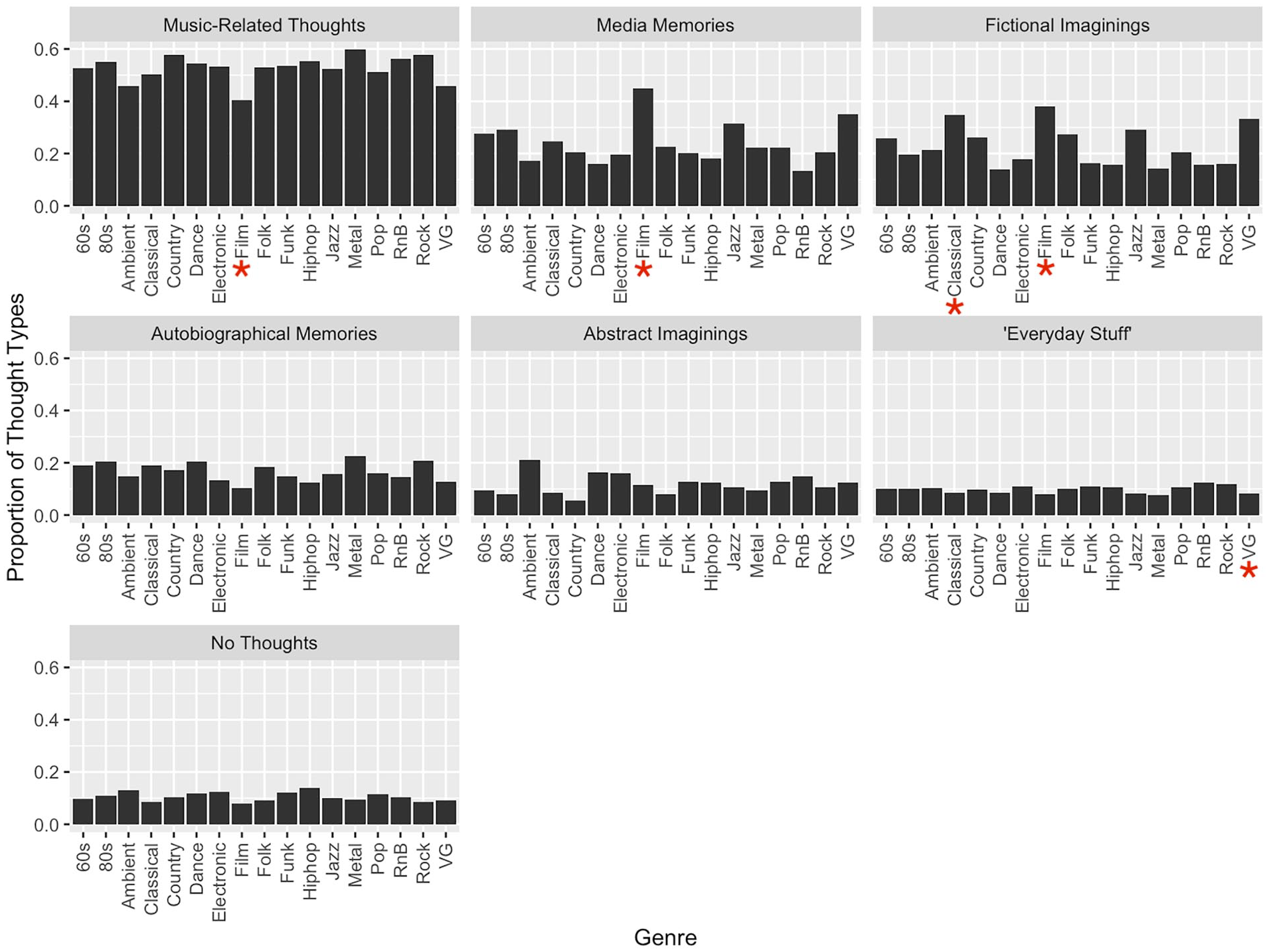
Proportion of Thought Type by Genre Summed Across All Excerpts and Participants.
Predictors of thought types
Table 1 summarises the results of seven ANOVA models (one for each thought type). Familiarity had a significant effect on all thought types (ps < .001) except fictional imaginings; it had positive effects on the occurrence of music-related thoughts (B = 0.95, SE = 2.15), autobiographical memories (B = 3.39, SE = 1.45), abstract imaginings (B = 0.18, SE = 0.39), thoughts about everyday stuff (B = 0.93, SE = 0.39), and no thoughts (B = 0.88, SE = 1.09), but a negative effect on media memories (B = −1.55, SE = 2.09). Enjoyment had significant positive effects on fictional imaginings (B = 1.53, SE = 0.59, p < .001) and autobiographical memories (B = 2.87, SE = 2.24, p < .001), and significant negative effects on abstract imaginings (B = −1.02, SE = 0.61, p = .003), thoughts about everyday stuff (B = −1.74, SE = 0.60, p < .001), and no thoughts (B = −2.44, SE = 1.68, p < .001). Music rated higher in contrast was associated with fewer thoughts about everyday stuff (B = −0.23, SE = 0.33, p = .002), higher valence ratings were linked to more fictional imaginings (B = 0.20, SE = 0.68, p < .001), and higher arousal ratings were linked to more everyday stuff thoughts (B = 0.15, SE = 0.36, p = .002) and fewer media memories (B = −1.36, SE = 1.92, p < .001).
F-Statistics (Partial Eta Squared Values) for ANOVA Results.
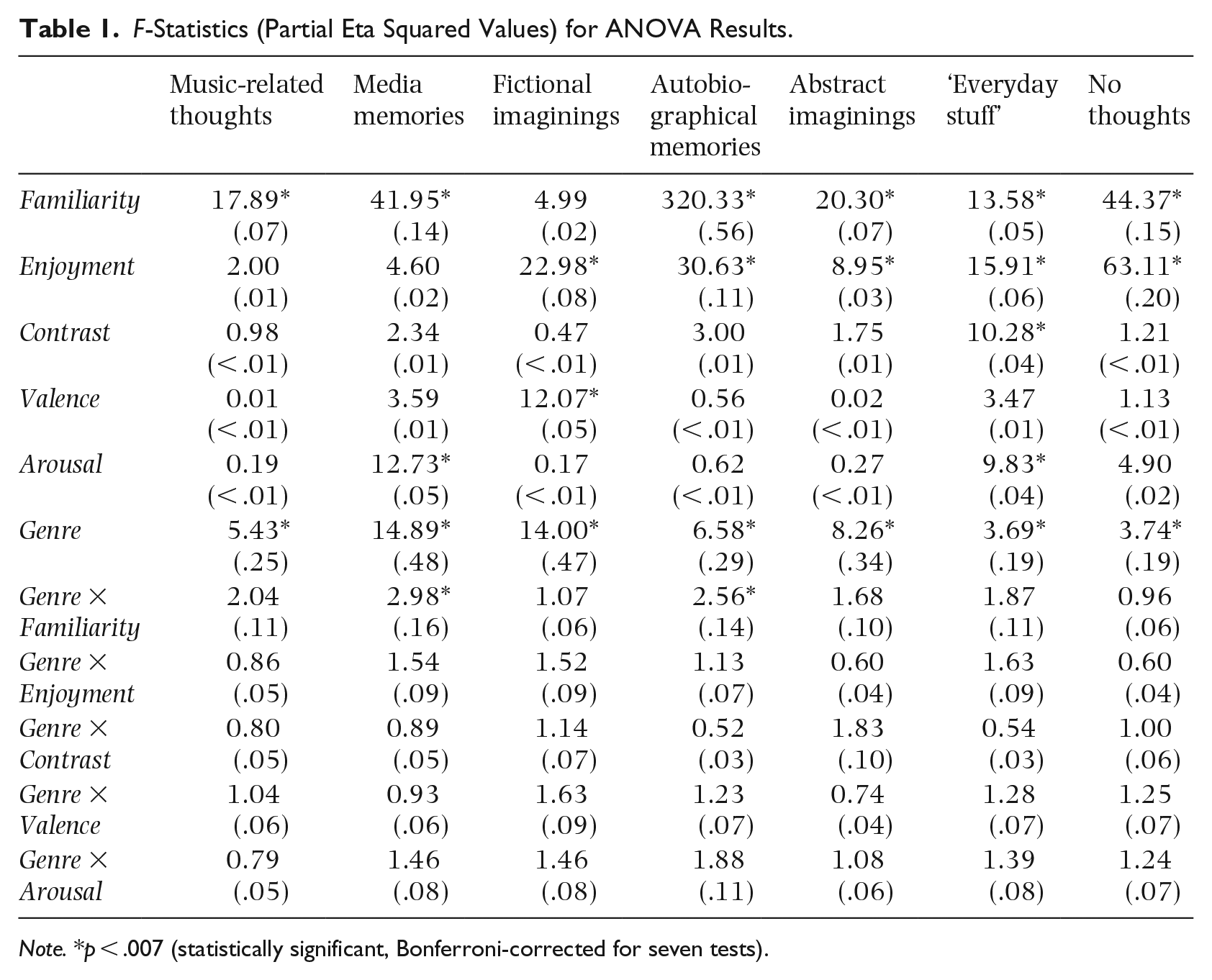
Note. *p < .007 (statistically significant, Bonferroni-corrected for seven tests).
Genre had significant effects on all thought types (ps < .001). Post hoc comparison of genres revealed that for music-related thoughts, only Film music had a significant negative effect (B = −5.15, SE = 1.10, p < .001) compared with other genres (see Figure 1). For media memories, only Film music had a significantly positive effect (B = 5.84, SE = 1.07, p < .001) compared with the other genres. For fictional imaginings, Classical (B = 0.86, SE = 0.23, p = .004) and Film (B = 0.71, SE = 0.20, p = .007) music had significant positive effects compared with other genres. For thoughts about everyday stuff, only Video Game music (B = −0.67, SE = 0.26, p = .039) had a significant negative effect compared with the other genres. For autobiographical memories, abstract imaginings, and no thoughts, no post-hoc genre comparisons were statistically significant.
Interactions between Genre and familiarity were found for media memories and autobiographical memories. Post-hoc analysis of media memories revealed a significant dependency of Film music on familiarity compared with other genres (B = 5.96, SE = 1.13, p < .001); that is, Film music evokes comparatively more media memories when it is more familiar, whereas other genres do not display significantly different patterns based on familiarity. Jazz and Folk music also showed trends in the degree to which more familiar music evoked media memories and more familiar Country music tended to evoke fewer media memories, but these results were not statistically significant. For autobiographical memories, Dance and Video Game music along with several ‘popular music’ genres (e.g., Metal, Rock, Hip-hop) showed more pronounced trends in the degree to which more familiar music elicited autobiographical memories, whereas some ‘art music’ genres were less affected by familiarity (e.g., Ambient, Jazz). However, none of the post-hoc trends for autobiographical memories were statistically significant for any of the 17 genres.
Correlation of thought types across stimuli
As shown in Table 2, moderate positive correlations were found between the number of media memories and fictional imaginings evoked by the same stimulus, and the number of music-related thoughts and autobiographical memories. Weak positive correlations were found between no thoughts and both thoughts about ‘everyday stuff’ and abstract imaginings.
Spearman’s Rho Correlation Statistics (df = 354).
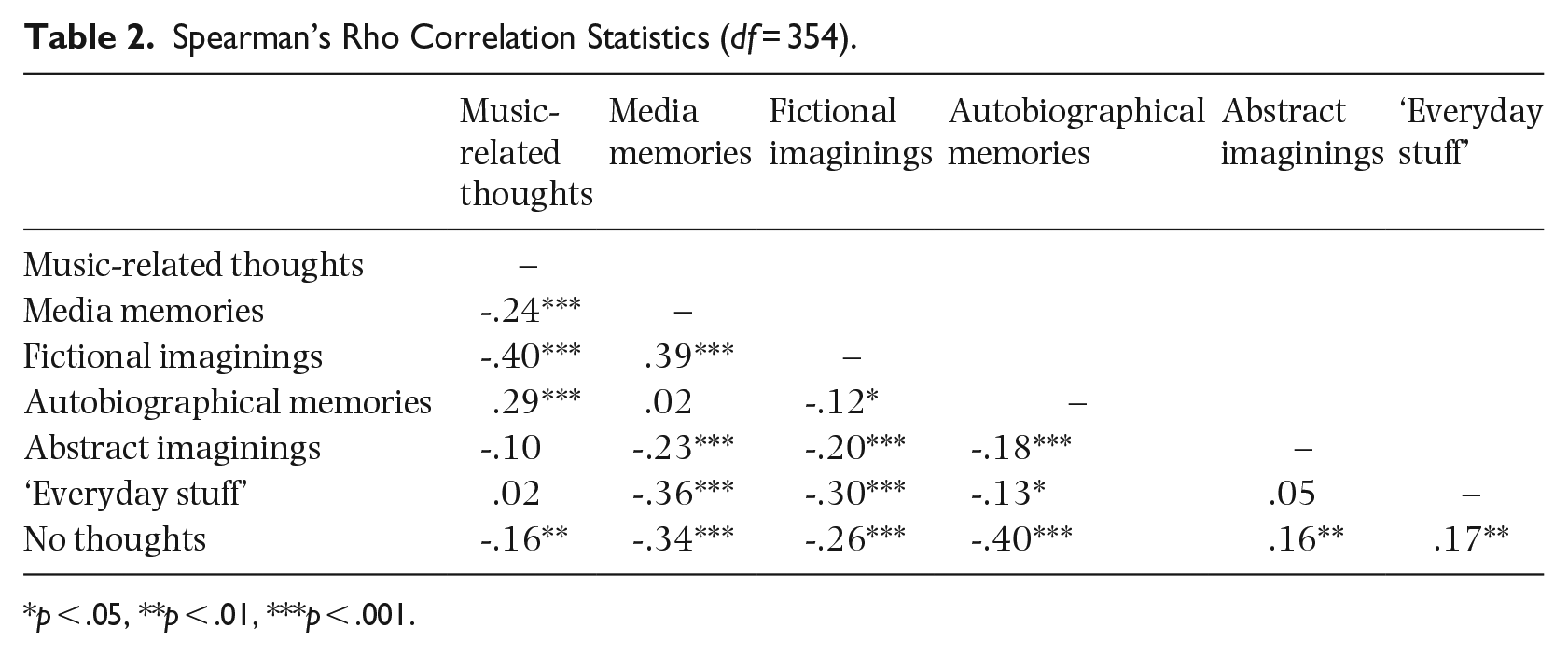
p < .05, **p < .01, ***p < .001.
Moderate negative correlations were found between music-related thoughts and fictional imaginings, between no thoughts and both autobiographical memories and media memories, and between thoughts about ‘everyday stuff’ and both media memories and fictional imaginings. Weak negative correlations were found between fictional imaginings and no thoughts, between media memories and both music-related thoughts and abstract imaginings, and between abstract imaginings and both fictional imaginings and autobiographical memories.
Discussion
Our findings confirm that diverse mental experiences frequently occur during music listening, such as autobiographical memories, fictional stories, visual imagery, and mind-wandering (e.g., Dahl et al., 2023; Jakubowski et al., 2024; Koelsch et al., 2019; Taruffi et al., 2017). Specifically, media memories, fictional imaginings, autobiographical memories, and abstract imaginings were reported in 54.6% of all trials, a comparable rate to music-related thoughts (52.6%). Relatively fewer instances of mind-wandering occurred, including thoughts about ‘everyday stuff’ (9%), future or personal plans (2.8%), and other types such as sensory sensations (5.9%). These thought occurrence rates closely align with those found by Jakubowski et al. (2024), who examined the prevalence of thought types across three genres in UK young adults. Given that the only qualitative difference was a marginally higher frequency of media memories in our study (conceivably attributed to the inclusion of media genres and familiar music in this study), these observed thought occurrence patterns replicate – even with our more diverse array of genres, familiarity levels, and participants. Relative to previous literature, particularly regarding largely unexplored genres included in the current study (e.g., Ambient, Funk, Video Game music), our findings offer significant, novel contributions in conjunction with, and in addition to, current understanding of the various thoughts occurring during a range of music listening.
The high prevalence of music-related thoughts likely reflects, in part, task demands; participants were aware they were in a music-listening experiment and would be rating properties of each excerpt, which may have increased the preponderance of evaluative thoughts about the music itself. This interpretation is supported by the limited influence of stimulus properties on the occurrence of music-related thoughts, with only a positive effect of familiarity and negative effect of Film music. Nevertheless, a significant portion of the thoughts occurring during music listening involved cognitive processes beyond music evaluation, invoking capacities such as remembering, imagining, or generating mental imagery – referred to as music-evoked thoughts (Jakubowski et al., 2024).
Music-evoked thoughts
The prominent occurrence of media memories in our study (23.6% of all trials) matches previous literature showing that music, perhaps owing to its prolific use within everyday media (e.g., films, TV, video games), can trigger and shape these types of thoughts even when the music is unfamiliar (Jakubowski et al., 2024). The significant interaction between familiarity and genre showed that more familiar excerpts of Film music evoked more media memories, suggesting that participants were supplying the missing cinematic content to Film music they already knew. Interestingly, the significant negative effect of familiarity suggests that (outside of the Film music genre) more familiar music led to a decrease in media memories. This makes sense, as participants who recognised the music as unrelated to any media would be less likely to associate it with a media memory. Notably, previous exposure to specific pieces of music is not always necessary for memory evocation; novel music can resemble or evoke elements of familiar music, such as themes from a well-known film, prompting listeners to imagine related scenes or narratives. In addition, music rated higher in arousal led to fewer instances of media memories. This contrasts with previous findings that higher arousal excerpts were more likely to evoke media-related memories (Jakubowski et al., 2024), suggesting a need for further research on this feature.
Fictional imaginings occurred in 22.5% of all trials, demonstrating music’s capacity to stimulate narrative engagement and generation of story-like imaginings (Margulis, 2017; Margulis et al., 2022a). Fictional imaginings were more likely to be reported in response to music with higher enjoyment and valence ratings, suggesting that music perceived as more emotionally positive and enjoyable is more likely to stimulate imaginative and creative thought processes. Positive affect tends to foster a more open and exploratory mindset, with previous research indicating positive emotions increased participant exploration and engagement in novel experiences (Fredrickson, 2001). Future studies in this area could explicitly manipulate enjoyment and valence to test their impact on creative capacities, such as exploration and innovation, among music listeners. Classical and Film music evoked more fictional imaginings than the other genres. Film music appears to be particularly conducive to imaginative thinking, when considering its significant positive effects on both media memories and fictional imaginings and negative effect on music-related thoughts. Other genres can similarly exhibit programmatic qualities; this could be because the music is expressly composed to support narrative hearings or because some music elicits a strong recognition of its typical contextual associations and uses (Margulis et al., 2022a; Tagg & Clarida, 2003); for example, Classical compositions often aim to evoke particular narratives or themes.
More broadly, genre’s significant effect on all thought types highlights the importance of musical content and contextual associations in shaping cognitive responses (Aljanaki et al., 2016; Juslin et al., 2022; Zentner et al., 2008). Genres differ not only in their compositional elements but also in how they are used by their listeners. It is important to determine which of these factors – musical content or contextual use – plays the most crucial role. For example, Video Game music had a negative effect on thoughts about ‘everyday stuff’, perhaps due to immersive, narrative compositional aspects engaging listeners and pulling them away from task-irrelevant thoughts. However, while Film music evoked significantly more media memories and fictional imaginings than the other genres, Video Game music did not have a significant effect on these thought types. Video Game music often allows multiple narrative paths depending on player choice (Kalinak, 2023; Summers, 2011), whereas the relationship between Film music and narrative content tends to be more fixed. Sensitivity to this difference in contextual use could account for Film music’s ability to cue concrete media memories and story imaginings more frequently than Video Game music.
Autobiographical memories occurred in 16.4% of trials. Comparing this occurrence rate to those of media memories and fictional imaginings indicates that although music does evoke past personal experiences, it may do so less often than associative or imaginative thoughts, which replicates previous findings in this domain (Jakubowski et al., 2024). Autobiographical memories occurred more frequently during familiar music, consistent with previous findings that familiar music is more likely to evoke personal memories and can facilitate quicker retrieval of those memories (Jakubowski & Francini, 2023). As familiarity did not significantly affect the occurrence of fictional imaginings, this suggests that familiar music may anchor listeners in more personal or introspective thoughts. In addition, although a significant interaction of genre and familiarity on autobiographical memory occurrence was found, none of the individual post-hoc genre comparisons were statistically significant. This may be attributed to the diverse listening preferences of the participants, who likely varied notably in their familiarity with different genres. Furthermore, greater enjoyment of music was a significant predictor of autobiographical memories. These results thereby suggest memory recollection is largely dependent on listeners’ experience with and affinity to the music.
Abstract imaginings occurred in 10% of all trials and sensory sensations in only 5.9%. The comparatively lower frequency of these thought types suggests that listeners are more likely to experience concrete or narrative forms of mental imagery when engaging with music. Abstract imaginings were more likely to occur in response to familiar music, but less likely to occur in response to music that participants rated higher in enjoyment. Given that higher enjoyment was linked to increased fictional imaginings and autobiographical memories but decreased abstract imaginings, thoughts about ‘everyday stuff’, and no thoughts, enjoyment of music appears to encourage more immersive and personal mental experiences over abstracted or task-irrelevant thoughts.
Other thoughts occurring during music listening
Thoughts about ‘everyday stuff’, indexed as a type of mind-wandering in this study, occurred in only 9% of trials. Another mind-wandering type considered in the study, thoughts about future or personal plans, had an even lower prevalence rate (2.8%). Participants reported fewer thoughts about ‘everyday stuff’ with music rated higher in contrast, suggesting that greater musical contrast is more engaging and captures attention, reducing thoughts less directly related to the music. This aligns with previous research showing that greater musical contrast evoked more dynamic thoughts, and more attentive listeners experienced increased music-evoked imagery (Margulis et al., 2022b; Presicce & Bailes, 2019). While higher contrast appears to reduce mind-wandering within the range of stimuli used here, there might be a threshold beyond which excessive musical contrast could lead to disengagement and an increase in task-irrelevant thoughts, which could be investigated further in future studies.
The opposite effect was found with arousal, where music rated as more arousing (energetic sounding) was linked to increased thoughts about ‘everyday stuff’. One might expect both high contrast and high arousal music to operate similarly in capturing attention, reducing task-irrelevant thoughts. Perhaps contrast, by varying elements within a piece, keeps attention focused on the music itself, preventing drifting thought to everyday matters, whereas high arousal may stimulate an active cognitive state that brings practical concerns to mind, despite – or because of – the heightened alertness it induces (such arousal patterns were observed with intentional or active/exploratory mind-wandering in Martínez-Pérez et al., 2021 and Unsworth & Robison, 2018). This distinction suggests that arousal and contrast influence attention and distraction in different ways, and that the relationship between musical emotional expression and cognitive engagement is multifaceted.
Correlation of thought types across stimuli
We found moderate positive correlations between the occurrence of media memories and fictional imaginings, and between music-related thoughts and autobiographical memories, and some negative correlations were observed, for instance between music-related thoughts and fictional imaginings. While positive correlations may suggest that certain thought types may occur together, these thoughts might not occur simultaneously. For instance, music prompting evaluative thoughts might first evoke music-related thoughts, leading to autobiographical memories, where listeners recall past experiences of hearing similar music. Similarly, media memories, such as scenes from a movie like Batman, might subsequently inspire the generation of fictional scenarios involving those characters. Negative correlations may suggest mutually exclusive relations between thought types; for example, focusing on technical aspects of the music may inhibit the generation of fictional scenarios, as cognitive resources are directed towards different types of processing. However, we cannot ascertain a causal relationship nor any temporal information regarding the occurrence of thoughts throughout the pieces from these correlations. Future research is needed to explore the temporal dynamics of these thought processes during music listening.
Limitations and future directions
We acknowledge the exploratory nature of this study; the relatively novel approach taken here should be bolstered by future replication efforts. In addition, we rely on self-report data, which comes with the standard limitations of this approach (i.e., we must rely on introspective abilities of the participants). As this was an online study, participants’ listening devices were not standardised. Listening on one’s own device/headphones is arguably more similar to everyday listening scenarios. Nevertheless, the range of audio quality between listening apparatus may have resulted in variations in participants’ perception and experience of the music. Despite encouraging participants to wear headphones for the study duration (96% of participants reported doing so), this is still considered a limitation of the current study. The use of short music excerpts (30 s) in this study limits our ability to capture how thoughts evolve over time alongside the music.
In future, expanding the genre range and including stimuli tailored towards populations outside the United Kingdom and the United States is necessary, as the current study is limited in its generalisability to a specific geopolitical location (i.e., UK/US, and similar WEIRD populations). While there are some recent studies on music-evoked thoughts in cultures and musical styles outside of the global West (Borgohain et al., 2023; Margulis et al., 2022a), there is scope for much more work in this domain. Investigating individual differences, such as personality traits or musical training, would also offer a deeper understanding of how personal factors interact with musical features to influence cognitive responses to music (Bailes, 2010; Margulis et al., 2022a; McAuley et al., 2021; Sakka, 2018). The findings of this study reflect current listener experiences; genre-specific results and contextual associations, for example, may change over future decades with technological developments and sociocultural shifts. These could be an interesting avenue for longitudinal studies in the future.
While we explored the effects of genre and all rating variables on thought type, future research could explore potential combined effects of variables such as valence and arousal. In addition, future research could probe specific compositional music features (e.g., tempo, dynamics, harmonic complexity) that likely contribute to observed differences in thought types (Dahl et al., 2023; Herff et al., 2021; McAuley et al., 2021; Taruffi et al., 2017). Testing whether musical features are predictive of the type and content of thoughts occurring during music listening will provide more precise insights into the mechanisms underlying the genre effects reported here.
Conclusion
This study enhances our understanding of thoughts occurring during music listening. It evidences how music engages listeners’ minds in varied ways, from evoking memories to encouraging imaginative thought. Genre emerged as a key influence, elucidating how both compositional and contextual elements shape the types of thoughts that arise and the nature of listeners’ engagement. This finding emphasises the importance of incorporating wider ranges of music styles in future research to better capture the diversity of thoughtscapes during music listening. This study also revealed how familiarity, enjoyment, and musical features of contrast, valence, and arousal modulate thoughts during music listening, from immersive engagement to mind-wandering. Interactions between familiarity, enjoyment, and genre highlight how personal connections to music can anchor listeners to specific mental experience, supporting previous research on the role of prior experience in shaping cognitive responses (Jakubowski & Francini, 2023; Margulis & Jakubowski, 2024). Overall, these insights suggest a complex relationship between listener factors, musical elements, attention, and cognitive responses. Our findings lend themselves to practical applications, from online listening recommendation systems, educational material, and music-based therapeutic tools. This research lays the groundwork for future studies exploring the temporal dynamics of thoughts during music listening and investigating the influence of specific musical features and listener factors on these thoughtscapes during music listening.
Footnotes
Appendix 1
Acknowledgements
Thanks to Charlotte Polomsky, Germaine Poon, Isabella Qian, Layla Nabi, and Yaxuan Zhai (Durham University) for assistance with stimulus selection.
Data availability statement

Declaration of conflicting interests
The author(s) declared no potential conflicts of interest with respect to the research, authorship, and/or publication of this article.
Funding
The author(s) disclosed receipt of the following financial support for the research, authorship, and/or publication of this article: This work was supported by a Leverhulme Trust Research Project Grant (RPG-2023-164) awarded to authors K.J. and E.H.M.
Ethical considerations
Ethical approval was granted by the Durham University Music Department Ethics Committee. Informed consent to participate was obtained.