




Abstract
Seemingly paradoxically, sad music has exhibited potential in improving mood in individuals, as well as being detrimental to mood and indicative of maladaptive behaviours concerning emotion regulation. Research suggests that different adaptive and maladaptive behaviours underlie sad music listening. Therefore, we explored if cognitive reappraisal (CR) was an effective tool for promoting mood enhancement. CR is a cognitive skill that focuses on the reframing and re-evaluation of negative events in a positive way. Across two studies, the combined effect of sad music and CR, in conjunction with events having a neutral or sad effect on mood, was explored. Data analyses revealed that CR significantly enhanced mood notably more than the control task. A three-way interaction effect revealed that higher levels of depression symptoms were associated with worse mood regulation across all but one condition; only happy music with the control task was associated with an increase in mood regulation for individuals with higher levels of depression. Therefore, CR was shown to be effective in improving one’s mood, though mood regulation typically decreased as depression symptoms increased. The discussion covered how these results fit into the existing literature and the relevant theoretical implications, with the most pronounced finding being that CR remained effect whether in the presence of happy or sad music.
In 2022, 16% of adults (above 16 years old) in the United Kingdom reported moderate to severe symptoms of major depressive disorder (MDD; Atwell et al., 2022), a considerably burdensome mental health disorder (Eaton et al., 2008). Those with MDD are unable to effectively regulate their emotions (Beauregard et al., 2006), exemplified through maladaptive behaviours including rumination (McLaughlin & Nolen-Hoeksema, 2011) and attentional biases towards negative information (Donaldson et al., 2007). With less than 60% of MDD cases receiving treatment (McManus et al., 2014), it is imperative for researchers to develop more accessible interventions, such as those that involve music listening. Many individuals can achieve enjoyment from experiencing negative emotions from sad music (Garrido & Schubert, 2011). Despite expressing and inducing negative emotions (Garrido & Schubert, 2013), sad music can simultaneously produce positive experiences, such as pleasure (Herdson et al., 2023; Sachs et al., 2015). Experiencing sadness has also been linked to abilities such as acceptance-based coping (van den Tol et al., 2016) and may therefore be a pivotal mechanism underlying the processing of negative experiences. However, many individuals with MDD may use music detrimentally. Hence, finding a way to preserve an individual’s musical preference while enhancing psychological outcomes is an important step in ensuring positive outcomes from sad music listening as an intervention.
Typically, individuals seek positive affect when experiencing negative affect (van den Tol & Edwards, 2013) in line with the mood management theory of music preference (Knobloch & Zillmann, 1988, 2002). This theory dictates that music listening choices are based on the inclination to maintain positive or repair negative mood. Emotion regulation (ER) strategies are not inherently positive or negative and strategies that sometimes seem diametrically opposed (e.g., cognitive reappraisal [CR] and counterfactual thinking) comprise overlapping mechanisms: ‘thinking’ and ‘overthinking’ (Cheung et al., 2018). This fine line between strategies and their outcomes, therefore, is also driven by factors such as strategy selection, goals, and context (English et al., 2017). Consequently, adaptive regulation in many respects requires a ‘perfect storm’. Thus, individuals that seek sad music when already low in mood must use sad music with adaptive behaviours to achieve mood enhancement (van den Tol, 2016). However, maladaptive tendencies in individuals listening to sad music, such as rumination, are associated with the maintenance of negative mood and emotions (Herdson et al., 2023; Schubert et al., 2018) and are more evident in those experiencing depression symptoms (Garrido et al., 2017).
The research field for sad music has not settled on an understanding of why sadness associated with music can attenuate both positive and negative moods (Campbell et al., 2021). This may be explained by investigations into differential states of sadness associated with sad music: while some sad states may be aligned with positive ER techniques, others are more closely associated with maladaptive tendencies and more negative outcomes (Herdson et al., 2023; Peltola & Eerola, 2016). Considering sadness as a complex emotion allows for the existence of both negative and positive experiences to be associated with sad music. In our prior review (Herdson et al., 2023), the emotion of sadness was broken down into several categorisations using evidence from wider literature. The model posited there allowed for a multifaceted understanding of different states of sadness and the associated experiences and outcomes. Within these categorisations, there are two particularly pertinent sad states with relevance to (mal)adaptive behaviours within emotion (dys)regulation: melancholia and sweet sorrow. Melancholia captures the experience of listening to sad music and maladaptively using this experience to downregulate mood, while being heavily associated with rumination and depression. Sweet sorrow meanwhile captures the experience of using sad music to regulate emotion and mood in a positive direction (Peltola & Eerola, 2016; van den Tol et al., 2016). Within this review, melancholia was most closely linked with behaviours such as rumination, while sweet sorrow was tied to the processing and regulating of emotions. It was thus concluded that consideration should be given to potential interventions that shift individuals away from negative sad states and towards positive ones – one such example may include the use of CR.
Individuals with MDD – those most likely to exhibit melancholia (Herdson et al., 2023) – show reduced preference for, and often attempt to downregulate, positive emotions (Vanderlind et al., 2020), which is linked to ineffective ER strategy selection and implementation (Gross & Jazaieri, 2014; Liu & Thompson, 2017). Rumination, for example, increases depressive symptoms while CR was associated with fewer symptoms (Aldao et al., 2010; Nolen-Hoeksema et al., 2008) and fewer negative emotions (Gross & John, 2003). Thus, ER strategy selection and implementation may be a targetable deficit for depression interventions. CR involves reframing negative events and thoughts in a positive manner (Cutuli, 2014; Gross, 2014; Gross & John, 2003; Lazarus & Alfert, 1964). In a systematic review, Dryman and Heimberg (2018) asserted that emotions yielded from CR were both internally felt and externally expressed. Thus, CR should be considered an effective tool for reducing depression symptoms (Morris et al., 2015).
In addition, some sad states of emotion experienced when listening to sad music may be entangled with maladaptive ER behaviours, such as rumination (Garrido, 2009). As such, if these maladaptive behaviours could be replaced with adaptive behaviours, listeners of sad music may more reliably achieve positive outcomes, such as pleasure (Sachs et al., 2015) and mood enhancement (van den Tol, 2016; van den Tol & Edwards, 2013). Furthermore, van den Tol and Edwards (2013) suggested that CR and sad music could be an effective combination. While CR already improves mood, it may also increase an individual’s likelihood to benefit from the sad music, as CR is able to enhance their mood through (re-)experiencing affect and the processing of emotions (Garrido & Schubert, 2015a, 2015b; van den Tol & Edwards, 2013). Furthermore, repeated CR use within therapeutic settings improves an individual’s CR and ER strategies and is thus associated with further reductions in depressive symptoms (Rodriguez et al., 2020). As many barriers to common therapies such as cognitive behavioral therapy (CBT) exist, such as unavailability and waiting lists (Cooper, 2018), it is important to consider the potential of the combination of CR and sad music. This need is accentuated by the fact that those with higher levels of depression, who are habitual ruminators, are less likely to follow the principles of the prior-discussed mood management theory (Knobloch & Zillmann, 2002; Zillmann, 1988), meaning such interventions could be especially helpful to these individuals.
This research paper explores the combined effects of CR and sad music on mood by exposing participants to different music excerpts of varying valence while they complete a mix of CR (experimental condition) tasks, using participant-generated sad prompts, and descriptive writing (control condition) tasks using researcher-generated neutral prompts. In Study 1, participants were asked to apply CR to their sad prompts and descriptive writing to neutral prompts, while in Study 2, they were asked to apply descriptive writing only to both types of prompts. We predicted that (1) CR would enhance mood, regardless of the emotional tone of the music accompanying the task (Morris et al., 2015); (2) sad music would result in reduced mood enhancement for those with higher depression as compared with those with lower depression scores (Herdson et al., 2023; Vanderlind et al., 2020); and if so (3) reduced mood enhancement with sad music in those with high depression scores would not be exhibited when participants undertook CR (Herdson et al., 2023; van den Tol & Edwards, 2013). As such, our prediction was that sad music may be detrimental to those with higher depression scores, but that this detriment may be averted if the sad music is accompanied by CR. Thus, the aim of this study was to explore the positive impact of CR in combination with sad music. This would point towards a useful mechanism capable of negating the potential negative impact of sad music on those who may be more likely to otherwise utilise it in maladaptive manners via the introduction of and engagement with CR.
Method
Participants
In Study 1, the sample consisted of 103 undergraduate students (mean age = 19.39, SD = 1.39), of which 97 were female and 6 were male. Meanwhile, Study 2 consisted of 77 undergraduate students (mean age = 20.31, SD = 1.91), of which 58 were female and 19 were male. The female-majority sample reflects the wider university sample that was available and was not an inherent characteristic of our study.
Those who were not fluent in English were excluded from participation due to the necessity to fully understand the English language to understand and engage with the CR instructions and task. This was assessed by a ‘demographics’ question in which participants were asked how long they had been within an English-speaking educational system. Only those who had accumulated 3 or more years in an English-speaking system were eligible for the study. However, all recruited participants were fluent in English. All participants gave written informed consent. The procedure of the study was approved by the local ethics committee in the School of Psychology at University of Kent.
Design
This study utilised a mixed 3 (depression: low vs mild vs high) x 2 (emotion of music: happy and sad) × 2 (condition: experimental vs control) design. Depression scores acted as a between-subjects variable. Meanwhile, music emotion and condition were within-subjects variables, meaning there were four within-participant conditions: the happy music, experimental condition; the sad music, experimental condition; the happy music, control condition; and the sad music, control condition. Participants underwent three separate sessions: the initial questionnaire and topic generation session, the experimental session, and the control session. Significant durations (a minimum of 22 h) between sessions were implemented to avoid any priming effects from prior sessions.
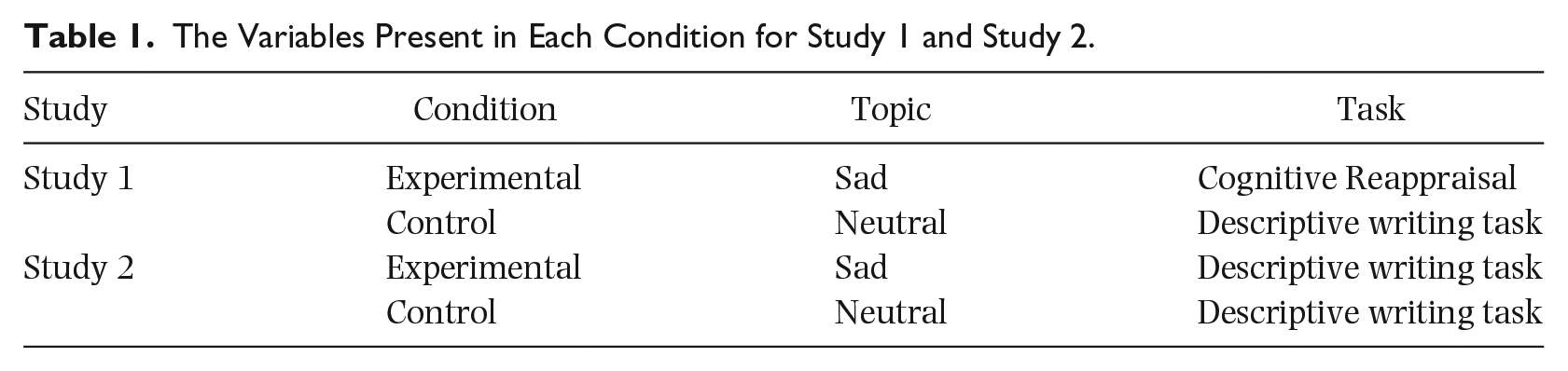
This project utilised two studies. In Study 1, the experimental condition differed from the control in two ways: topic prompt (sad vs neutral) and writing task (CR vs descriptive writing task). After running Study 1, it was determined that to isolate the effects of the writing task, a further control condition was required. Therefore, in Study 2, the writing task was the same across both conditions: topic prompt (sad vs neutral), writing task (descriptive writing task in both). Consequently, any findings from Study 1 that did not repeat in Study 2 could be assumed to have been driven by the presence of the writing task in Study 1.
Materials
Qualtrics Survey 1
Qualtrics Survey 1 collected demographic information, followed by a collated questionnaires section, consisting of the following:
Public Health Questionnaire
The public health questionnaire (PHQ-9) was used to assess depression scores. The PHQ-9, commonly used in clinical settings, is a 9-item self-report questionnaire consisting of an overarching question – ‘Over the last two weeks, how often have you been bothered by any of the following problems?’ – for topics such as ‘Feeling down, depressed, or hopeless?’ and adopts a 4-point Likert scale ranging from 0 (not at all) to 3 (nearly every day). It is scored on a 27-point scale measuring depression severity: 0–4 none, 5–9 mild, 10–14 moderate, 15–19 moderately severe, 20–27 severe. Kroenke et al. (2001) claimed that due to its validity (reporting strong construct and concurrent validity), reliability (Cronbach’s α = .89 as well as excellent test-retest reliability), sensitivity (73%), specificity (94%), and brevity (only nine items long), the PHQ-9 is an effective measure for depressive symptoms in a research context.
Topic generation
Participants were asked to generate nine sad topics that were relevant and personal to themselves. Example prompts were offered (such as ‘loss of a loved one’, or ‘a failed exam’) to help participants generate their topics. A title (five word maximum) was required as well as a brief description of what the topic consisted of. These titles will hereby be referred to as topic prompts. No time restraints were set for this task.
Qualtrics Survey 2
Qualtrics Survey 2 was used for the main sessions of the experiment and consisted of training modules followed by the experimental trials (see Figure 1). Each practice and experimental trial consisted of a given prompt, a free-text response, and a subsequent mood rating scale.

Procedure of Study 1 and Study 2.
Mood rating
Mood ratings, taken during every trial, were collected via a sliding scale (0–100), with 0 being low mood (sad) and 100 being great mood (happy). Participants’ mood ratings were taken once after hearing the music excerpt (using the question: ‘How sad/happy did the music make you feel?’), and once after writing their passage (using the question: ‘Please use the slider below to indicate your current mood now you have written your passage about the sad event’).
Music stimuli
Pilot study
A pilot study was conducted to aid stimuli selection in which 354 thirty-second instrumental excerpts were rated by 140 participants (mean age = 19.9, SD = 5.35). Of the participants, 123 were female, 15 were male, and 2 selected ‘other’. The 30-s music clips were presented to participants one by one. After each clip, participants were asked to rate that clip on a slider scale (1–100) for familiarity (1 being completely unfamiliar and 100 being extremely familiar) and then emotion (1 being extremely sad with 100 being extremely happy). To ensure participant attention was not depleted, each participant only listened to 59 randomly assigned excerpts. All songs were rated by the same number of participants in total. Subsequently, excerpts were ordered by emotion rating and then ‘high familiarity’ excerpts were removed so that familiarity would not constitute a confounding factor.
Music excerpts
The excerpts were divided into happy and sad groups based on ratings obtained via the pilot study. Nine sad excerpts and nine happy excerpts were selected for the main experiment based on the emotion ratings as well as familiarity scores. For emotion, nine excerpts were taken at equidistant points beneath the mean rating, and nine were taken from equidistant points above the mean. Excerpts with low familiarity were selected to minimise the likelihood of participants having pre-existing associations with the selected excerpts.
Procedure
Procedure: Study 1
Participants were invited to participate via a credit-reward system for their university module. After signing up, participants were asked to read an information sheet and then fill out a consent form. In the first session, participants completed Qualtrics Survey 1 and generated the nine sad topics, to be used later in the experimental condition of the main experiment. Participants were then randomly assigned to an order of conditions, with half taking part in the experimental condition first, the other half doing the control condition first. Each condition was held in a further separate session, with each session being held on a separate day (a minimum of 22 h later), that is, participation involved a total of three sessions. Both the experimental and control session used Qualtrics Survey 2.
The experimental and control sessions (see Figure 1 and Table 1) each began with participants being introduced to the task with training. A description and instructions were provided through written text. In the experimental condition, this explained the goals of CR and how to approach CR, whereas in the control condition, the descriptive writing task was explained. Depending on the condition, participants were asked to write a brief practice CR passage (experimental condition) or description (control condition) of a provided topic. After the practice trial, they were shown an example answer written by the researchers to offer an example of how the task should be completed to ensure participants gained a full understanding of the task. Participants completed four practice trials in each session, then continued with the main task trials.
The Variables Present in Each Condition for Study 1 and Study 2.
In the main task trials, participants were prompted by a topic and were then asked to rate their mood (Mood Time 1) on the slider scale. They then listened to a 30-s clip of music before starting the respective writing task. Asking participants to think in-depth about their topic prompt is a method of inducing sadness adapted from prior research (Evers et al., 2010; van den Tol et al., 2022). In the experimental condition, participants were given a sad topic prompt selected from their list that they wrote in the first session. They then listened to the music clip before writing a CR passage about the topic. Guidance was offered on how to approach this through written instructions: ‘Please think back to the “sad event” you thought of before. We will then ask you to write a small passage of text covering the following points’ followed by a list of points to cover, including ‘How does the topic make you feel?’ as well as ‘Did you learn anything from it?’ (see Appendix 1 for full task instructions).
In the control condition, participants were given a researcher-provided neutral topic (one of: ‘your morning routine’, ‘your walk to work/university’, ‘the dinner you ate last night’, ‘your bedroom’, ‘the weather’, ‘the contents of your school bag’, ‘your last food shop’, ‘your last lecture’, or ‘your desk’). They then listened to the music clip before writing a descriptive passage about the topic (see Appendix 2 for full task instructions). Both writing tasks required a minimum of 300 characters (approximately 50 words) before participants could continue.
In total, each block had nine trials and the emotion of the music was randomised for each trial, meaning each participant experienced a selection of music and a variety of happy and sad music within each block of trials. Participants rated each excerpt’s emotion on a 1 (sad) to 100 (happy) scale immediately after listening to the clip. Self-report mood ratings were taken after each writing task (Mood Time 2). Each trial took participants (on average) 48.00 s to complete, with the overall session taking participants approximately 30 min to complete.
Procedure: Study 2
Study 2 had a nearly identical procedure to Study 1 but was different in one primary aspect (see Table 1): In Study 2’s experimental condition, participants were given the descriptive writing task with their sad events instead of the CR. This was done to act as a comparison with Study 1, allowing for inferences to be made surrounding the role of CR as a variable. The rationale behind Study 2’s inclusion is as follows: Study 1’s experimental condition differed from its control in two ways: the task and topic. Thus, the differences between these conditions alone cannot be attributed solely to CR, but rather CR and the topic. In Study 2, however, the experimental and control conditions both had the same descriptive writing task, while only the topic changed. Therefore, any differential effects between the two studies, concerning condition, can be more confidently attributed to CR if they only appear in Study 1 and not Study 2.
Statistical analysis
Analysis of the data was carried out using SPSS (IBM Corp., 2020).
Music ratings
Subjective ratings of the music were taken per participant. In analysis, a mean was calculated of each participant’s music emotion ratings across the 18 excerpts they heard. Excerpts above that mean were assigned as happy, whereas those below the mean were assigned as sad, creating a dichotomous variable. This approach aimed to reflect individual assessment and selection of happy versus sad music listening in participants. The decision to utilise music emotion as a dichotomous variable was considered a more ecologically valid and suitable fit to reflect individuals electively choosing to listen to ‘sad’ music.
Depression scores
Depression scores were categorised via a three-way median split. This median split allowed for the most equal group sizes. The first group (low depression scores) contained 35 participants with depression scores between 0 and 8, the second group (mild depression scores) consisted of 34 participants with scores between 9 and 13, and the final group (high depression scores) contained 34 participants with scores between 14 and 24.
Mood as a change score
To enable the exploration of the potential confounding effect that depressive symptoms may have had on baseline mood (mood ratings taken prior to topic prompts and music), a Pearson’s correlation was run between depression scores and starting mood. There was a significant negative correlation between depression scores and baseline mood in both conditions within both studies, depicting that as depression scores increased, baseline mood decreased (see Table 2).
Summary of the Pearson’s Correlations Between Depression Scores and Baseline Mood Across Conditions in Study 1 and Study 2.
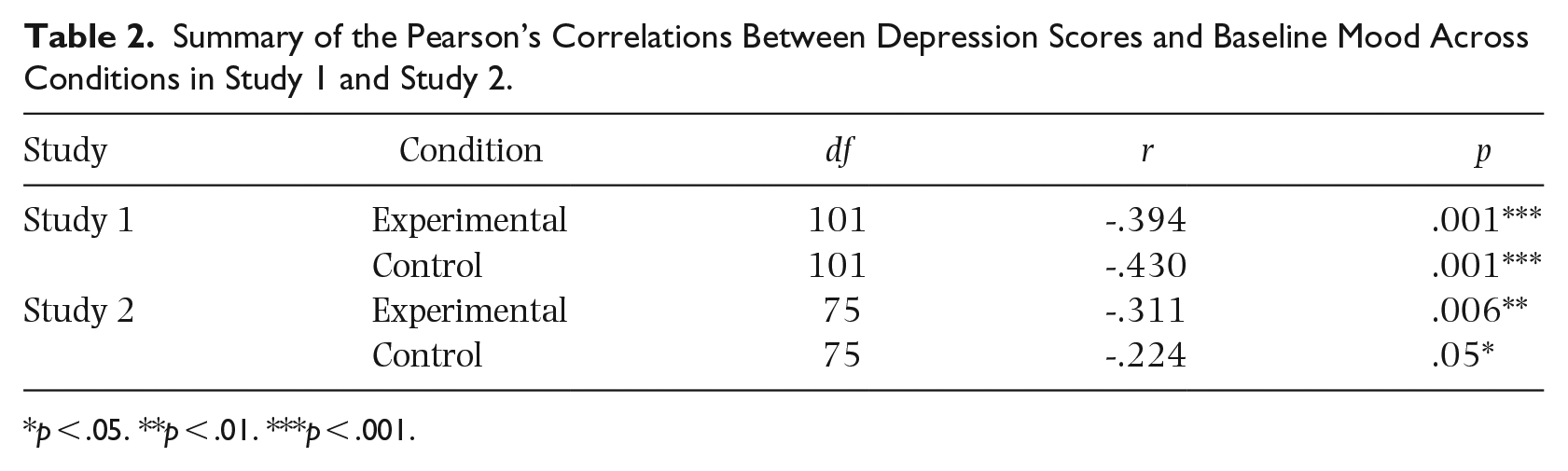
p < .05. **p < .01. ***p < .001.
Consequently, it was decided that a change score would be utilised for the dependent variable. By calculating a change score, an individual’s mood regulation would be measured, not their baseline mood. By using this change score, it was ensured that we did not simply measure the confound of low mood, nor that the effects were arising from the mood induced by the topics, but rather an individual’s mood regulation:

Finally, given our elected analysis (repeated-measures analysis of variance [ANOVA]), to detect an effect size as small as ⩾0.05 at p < .05 with 95% power, a sample size of 66 was required. As such, both samples for Study 1 and Study 2 provided sufficient power.
Results
Descriptive statistics and confounds
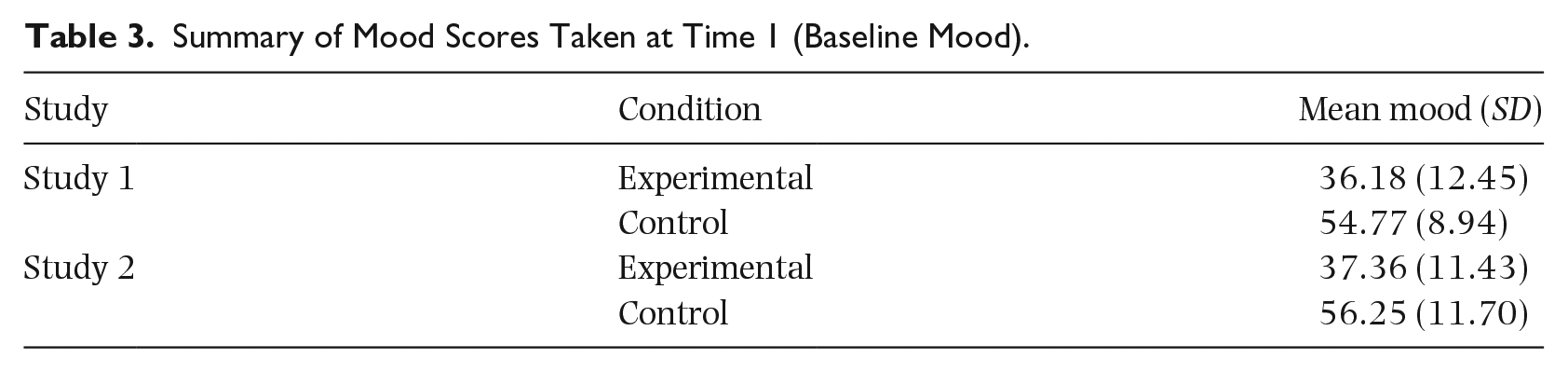
An independent t-test revealed that there was no significant difference between the baseline mood of participants in Study 1 (M = 60.1, SE = 1.70) and Study 2 (M = 60.00, SE = 2.22), t(208) = .02, p = .985. In addition to this, we ran paired samples t-tests on baseline moods in each condition to ensure that the correct mood was being evoked. Moods after the sad prompts were both significantly lower than their control condition counterparts in Study 1: t(102) = 14.05, p < .001, and Study 2: t(76) = 11.94, p < .001, see Table 3 for means.
Summary of Mood Scores Taken at Time 1 (Baseline Mood).
There was no significant difference in depression scores between participants in Study 1 (M = 10.95, SE = 0.55) and Study 2 (M = 11.05, SE = 0.67), t(178) = −1.66, p = .91. In our samples, only 8.8% (Study 1) and 9.1% (Study 2) scored in the severe category for depressive symptoms (according to the established clinical thresholds), ensuring baseline depression scores were not a confounding variable between the two studies.
Finally, random quality spot-checks were performed on 25% of the data by the research team during the collection phase. Responses were scanned to ensure that there were no errors and that instructions were being followed accurately. From these quality checks, no exclusions were made and all tasks were found to be completed. We believe that the built-in breaks and engaging nature of this task led to people actively and accurately engaging with this study and that recurring breaks and music-listening offered sufficient reprieve for participants to stay on-task.
Analysis
A 3 × 2 × 2 repeated-measures ANOVA (rANOVA) analysis was used with depression incorporated as a grouping variable in both Study 1 and Study 2. For both studies, Levene’s test returned non-significant results (ps > .05) in all groupings – meaning homogeneity of variance was not violated. In addition, Q-Q plots were assessed and both suggested that all data were normally distributed.
Study 1
In line with Hypothesis 1, a significant main effect of condition was found, F(1, 100) = 196.63, p < .001, ηp2 = .663, where mood regulation was significantly greater in the experimental condition compared with the control condition (experimental: M = 17.12, SE = 1.07; control: M = 1.96, SE = 0.49). There was no significant main effect of music emotion or depression level, nor were any of the two-way interactions among the three variables significant (see Appendix 3). Interestingly, there was a significant three-way interaction between condition, music emotion, and depression level, F(2, 100) = 4.099, p = .019, ηp2 = .076.
The significant three-way interaction was explored further by examining the estimated marginal means (see Table 4) and running post hoc comparisons (with Bonferroni corrections). To best address the research question, we ran paired-sample t-tests between music emotion levels within conditions, within each depression category. Interestingly, no significant differences were identified (ts ⩽ ± 1.755, p > .05).
The Estimated Marginal Means of the Three-Way Interaction Effects Displaying the Mean Mood Change in Each Condition, Split by Low, Mild, and High Depression.
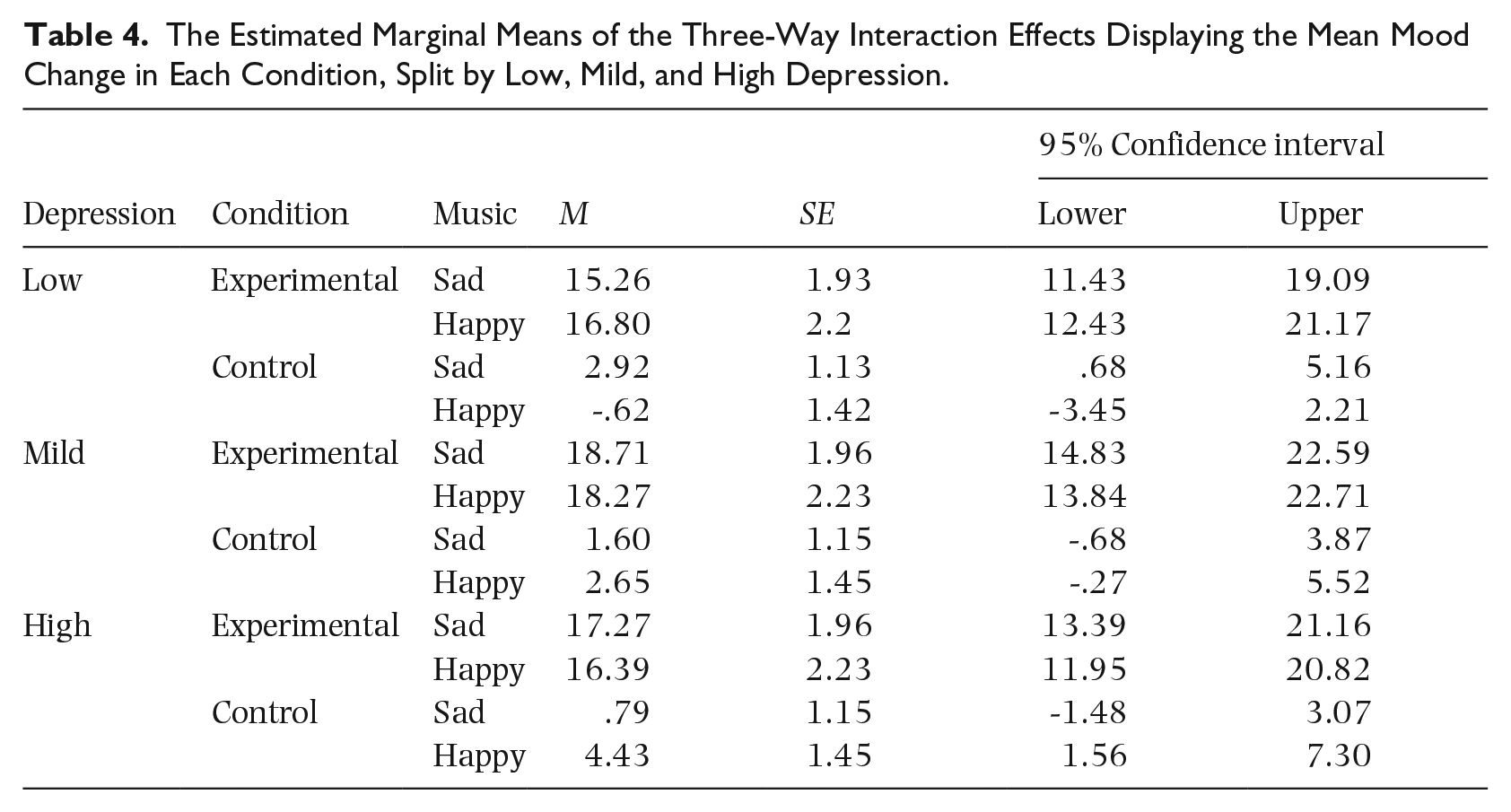
Despite the lack of significance observed in the post hoc comparisons, however, the pattern of results displayed by the estimated marginal means is interesting (see Figure 2). In the control condition, those with low depression were seen to have greater mood enhancement when listening to sad music as compared with happy music. The inverse was true for those with higher depression. When looking at the experimental condition, greater mood change can be observed in the lower depression group when listening to happy music, while once again, the inverse is true in the high depression group.
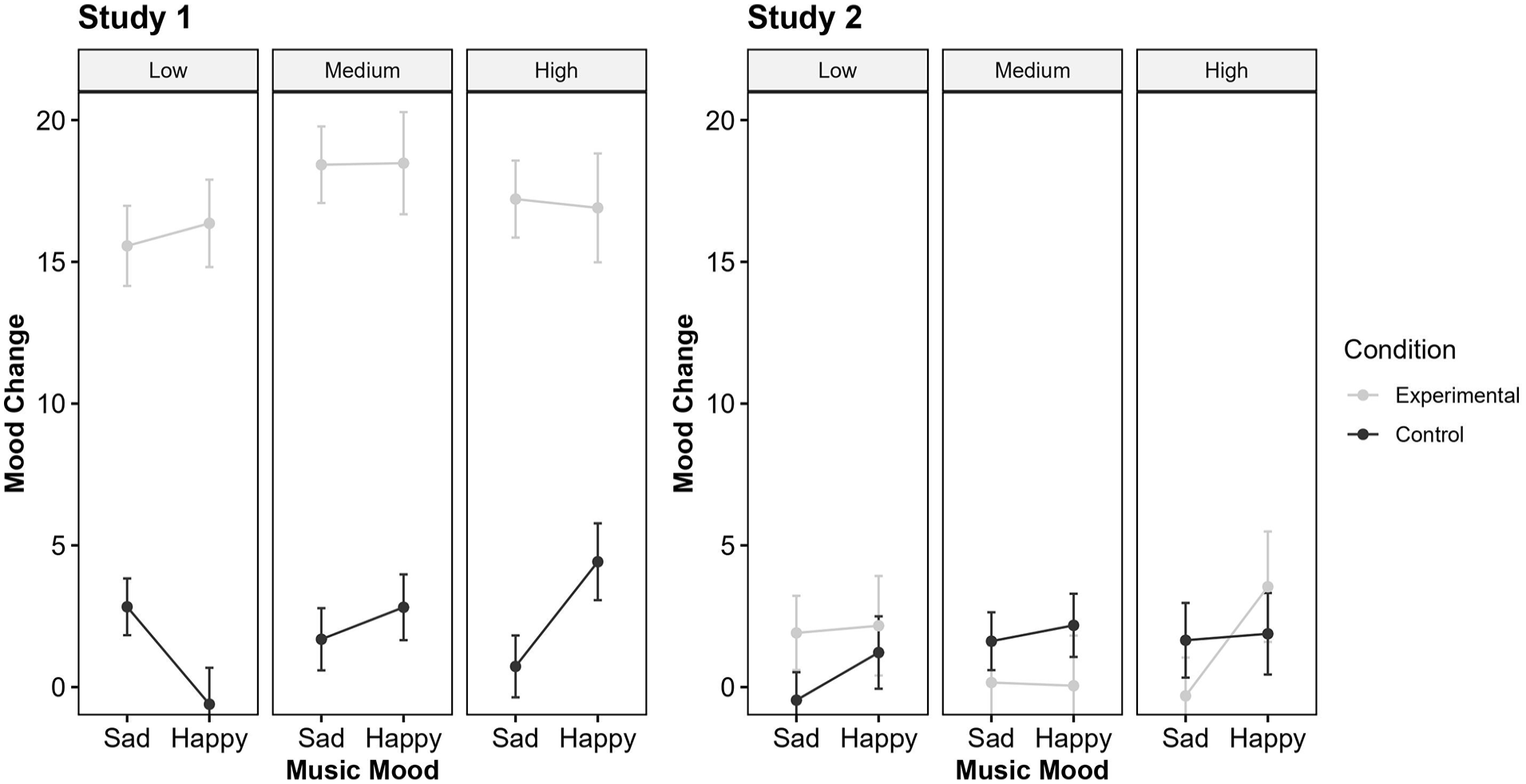
Line Chart Showing the Mood Change of Participants Across Music Emotions, Broken Down by Condition and Depression Categories, Using the Estimated Marginal Means.
Study 2
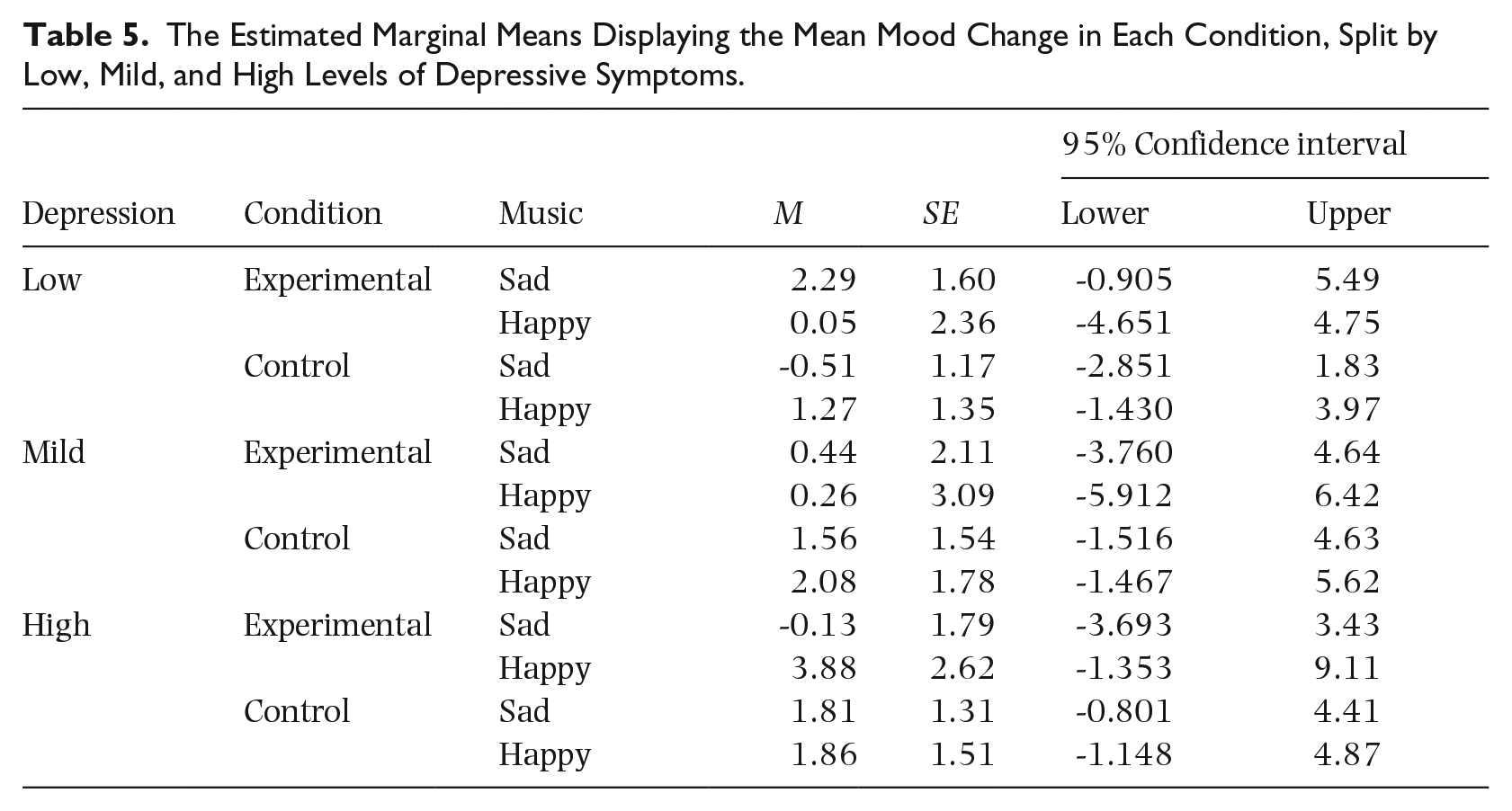
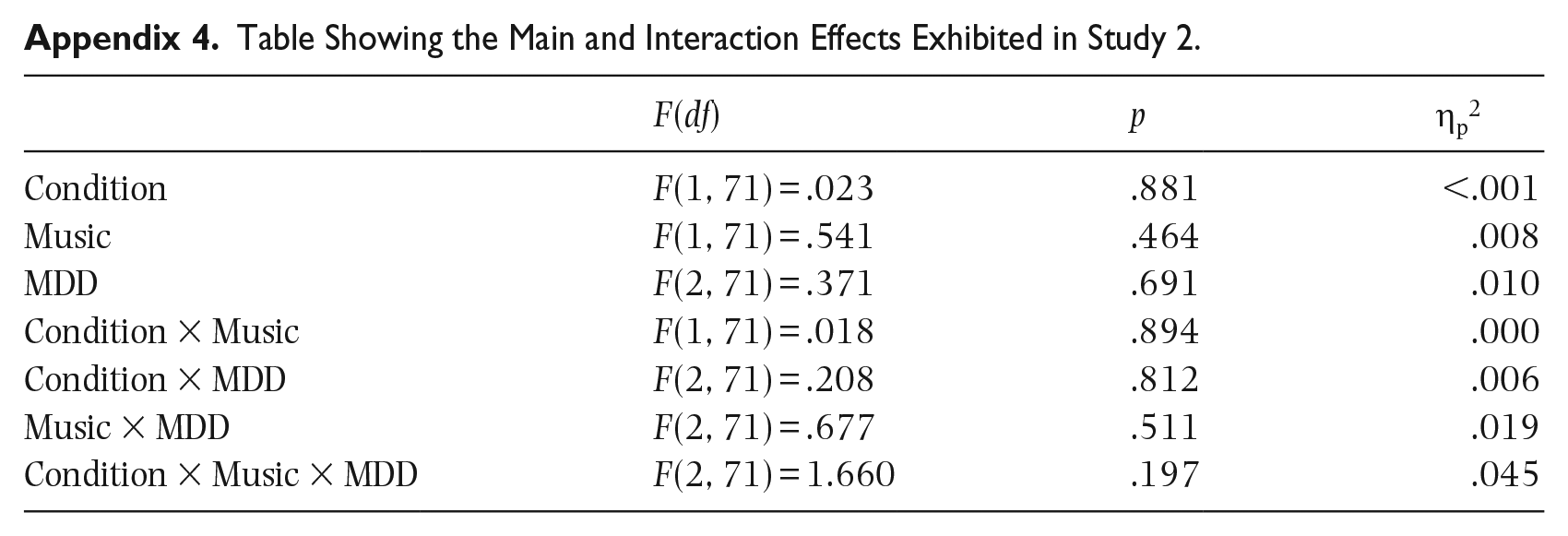
In Study 2, the same analysis was run, with the only difference being the absence of CR in Study 2’s experimental condition. No significant main effects nor interactions were found (see Appendix 4). Unlike Study 1, Study 2’s experimental condition did not differ significantly from the control. Similarly, Study 2 saw no three-way interaction; with the absence of CR from the experimental condition, no effects on mood regulation were observed. The estimated marginal means for this study have also been provided to allow for comparison (see Table 5). The absence of significant results in Study 2 allows for the inference that the results found in Study 1 were not a result of the topic’s mood induction, but instead were driven by the presence of CR.
The Estimated Marginal Means Displaying the Mean Mood Change in Each Condition, Split by Low, Mild, and High Levels of Depressive Symptoms.
Discussion
Study 1 revealed that mood regulation was greater when participants undertook the CR task as compared with the control task, demonstrating that CR promoted positive mood regulation and supporting Hypothesis 1. Neither music nor level of depression differentially contributed to mood regulation. Although a significant three-way interaction was found, large standard errors paired with nonsignificant post hoc analyses suggested that there were no meaningful differences when examining this effect. Consequently, neither our second nor third hypothesis was supported. Study 2, conversely, produced no significant main effects or interaction effects. With the difference between Studies 1 and 2 being the omission of CR in Study 2’s experimental condition, it is confirmed that the significant effect found in Study 1 was driven by CR and not natural mood repair overtime.
CR was consequently found to be an effective mood regulation intervention. This is in agreement with previous research, with the use of CR being linked to reduced depressive symptoms, improved well-being (Gross & John, 2003), and greater positive emotion (Dryman & Heimberg, 2018). This finding adds to a vast literature suggesting that CR functions to improve mood via the positive reframing of negative events (Morris et al., 2015). The CR task used in this study had similarities to McRae et al.’s (2012) ‘Explicitly Positive’ ER tactic, such that participants were explicitly requested to find positives in their given situations. McRae et al. found this tactic maximised the increased positive affect to the greatest degree. While the strong effect of CR, therefore, was unsurprising, it is noteworthy that this effect remained despite the brevity of the task. These findings also provide support for claims that negative outcomes can be negated by promoting positive ER strategies (such as CR) under instruction (Liu & Thompson, 2017), and may be beneficial in reducing depressive symptoms (Aldao et al., 2010; Dryman & Heimberg, 2018; Liu & Thompson, 2017). Moreover, CR was effective across different severities of depression and regardless of external stimuli such as happy or sad music.
It was strongly expected that higher depressive symptom scores would be related to greater negative affect after listening to sad music (Garrido et al., 2017; van den Tol, 2016) due to high levels of depression being associated with the use of maladaptive ER techniques. It was then posited that CR would be capable of negating such an effect. However, no meaningful differences were found within the three-way interaction, meaning that these predictions (Hypotheses 2 and 3) were not supported. The lack of effect of music was an unexpected finding. This incorrect expectation for music to have a larger impact may have occurred due to previous literature having overstated the negative impacts of sad music, falsely conflating depressed individuals’ attraction to sad music and aversion to happy music (Friedman et al., 2012; Matsumoto, 2002; Taylor & Friedman, 2015) with detrimental and beneficial outcomes, respectively. In addition, it is possible, if not even likely, that depressed mood and maladaptive ER precedes sad music selection and that this is not a bi-directional pathway. In the context of these results, this would suggest that the sad music condition did not induce the often-associated maladaptive ER seen in those with high depression scores. Rather, the maladaptive ER may only be observed in association with sad music in a naturalistic setting in which the individual would naturally choose to listen to sad music. Regardless, this project would suggest that, if induced to a positive ER strategy, pre-existing maladaptive tendencies may be overwritten.
Limitations and future directions
Given the variability within the sad music literature, it is not always clear which musical stimuli are best suited to a given design. Consequently, it is important to give consideration to the possible associated impacts of the selected stimuli and design on the experience of the participants.
Previous research has found that features of the music listened to, above whether it is happy or sad, can affect the mood elicited. For example, music including lyrics has been linked to greater emotional responses (Ali & Peynircioǧlu, 2006; Brattico et al., 2011). Familiarity with the song has also been seen to influence the mood elicited, and may be as or more influential than the music emotion itself (Garrido et al., 2016; Kim, 2011). Familiar music with lyrics has thus produced larger impacts on mood due to connections to the message conveyed in the lyrics, high aesthetic value to the listener, and triggering of memories (van den Tol & Edwards, 2015). However, in the current studies, unfamiliar, researcher-selected music (as determined by the pilot study) with no lyrics was used to reduce the influence of familiarity as a confounding variable. A greater effect on mood may have been seen if participants had been able to select familiar music of their choice, inducing deeper mood effects (in both directions) as compared with researcher-selected music (Ali & Peynircioǧlu, 2006). This must therefore be considered a limitation of the current studies due to their utilisation of researcher-selected music. Future research could replicate these studies using participant-selected happy and sad songs to explore whether a deeper connection to the music impacts subsequent ER (Eerola & Vuoskoski, 2013).
Within this study, several methodological considerations need to be raised. Firstly, the design did not account for full controls to be implemented. Control conditions observing the effect of CR and music separately would have provided greater clarity over whether a combined effect (CR and any type of music) was observed or if CR was the sole driver of mood regulation in this study. The research questions in this study were concerned with the differential experience of sad music versus happy music and thus did not plan to examine this aspect. However, this is something that should be implemented in future research in order for researchers to better understand the role that music plays.
Furthermore, music was presented to participants in 30-s clips, which may not have been long enough to elicit deep emotional responses. While some research suggests this is sufficient to induce an emotional response (Eerola & Vuoskoski, 2013), contrary findings suggest that there is a threshold of 9 min between emotions and mood induction (Garrido, 2014). In addition to this, the current design randomised music mood per trial, meaning participants did not listen to the same music mood repeatedly. Listening to blocks of sad or happy music and reaching the above threshold would potentially allow for stronger emotions and mood induction to be experienced. Future research could, therefore, use this altered design to focus on deep emotional responses, sparking more ecologically valid responses and findings.
Finally, mood regulation (a change score) was used as the outcome measure. It may be the case that baseline differences between those with high and low depression scores affected the outcome measure of mood regulation (Clifton & Clifton, 2019). The correlations between depression scores and baseline mood indicated that those with higher depression scores had lower baseline mood. Consequently, these individuals may have shown regression towards the mean, resulting in a larger change in mood than those with low depression scores. Consequently, it is important to take these findings of mood regulation with caution as depression and the associated lower baseline moods may act as a confounding variable across both studies. Future research could instead measure alternative outcome measures to ensure the effects exhibited here were not driven by baseline differences.
A consideration around the sample used need also be noted. Throughout both studies, there was a largely unbalanced sample with regards to gender. The samples mostly comprised females, limiting the generalisability of the results. Instead, the results might more strongly reflect the relationship between ER strategies, music, and depressive symptoms in females, specifically. It has been found that gender differences exist in both depressive symptoms and music-listening behaviours, such that females are more likely to make use of mood management strategies (Miranda & Claes, 2007; Zillmann, 1988). Consequently, it is possible that the female-dominant samples in these studies show greater tendency towards adaptive ER strategies when listening to music. Thus, the differences between conditions and music moods may become more exaggerated if observing only male participants or grouping by gender.
It is important to also keep in mind that each individual will have their own relationship and associated tendencies with music. The field of sad music has recently begun considering sadness as a more complex, multidimensional emotion. As a result, sadness has been classified into various sad states and experiences (for reviews, see Eerola & Peltola, 2016; Herdson et al., 2023). Developing the understanding of these sad states has allowed research to investigate ‘sadness’ and emotion in greater depth. As such, considerations of mood and ER need to incorporate the growing understanding of sadness. In this instance, having a multidimensional measure of mood/sadness that is sensitive to different sad states/experiences, such as bitter-sweet emotions or aesthetic sadness as stated in the above reviews, is needed. Aesthetic beauty, for example, is linked to the sad state of sublime sorrow and the enjoyment of music (Eerola & Peltola, 2016; Hanser et al., 2016; Herdson et al., 2023). Without being able to accurately measure participants’ aesthetic enjoyment of music whilst simultaneously considering their ‘type’ of sadness and ER strategies, it will continue to prove difficult to disentangle this complex emotion or to understand it and its contributing factors comprehensively. While various measures are currently in circulation, we find it important to note that none reflect the current literature and classification of sadness.
Implications
A theoretical implication of these studies was that both happy and sad music were associated with positive mood regulation. Furthermore, and perhaps most importantly, findings suggested that the introduction of a short CR task was sufficient to remove any potential disparity in resultant mood regulation exhibited between sad and happy music. Considering the clinical implications of this, the findings here suggest that even if an individual exhibits maladaptive tendencies surrounding their music listening habits, brief CR interventions could be sufficient to mitigate any negative effects of their everyday music-listening. This would, therefore, allow the individual to maintain their musical preference – which may increase the likelihood of individuals engaging with and continuing with given interventions. To achieve a naturalistic setting in future studies, research could consider using a music diary-keeping task in which participants are given fewer instructions and can perform their habitual music-listening processes. Such designs would be more likely to also capture other ER techniques commonly found in music listening such as diversion (Saarikallio, 2008). Subsequently, research should consider the effects of prolonged and repeated exposure to the combination of sad music and CR to ensure that the positive effects offer a long-term solution as well as to explore what effects this may have on mental health conditions such as depression over time.
The pattern of results exhibited here links to discussions surrounding differential sad states. For instance, when experiencing the experimental condition, participants were able to positively regulate their mood. This reflects the state of sweet sorrow (Eerola & Peltola, 2016; Herdson et al., 2023) for which a core characteristic is the ability to process and regulate sadness in such a way that results in improved mood. While CR may therefore promote sweet sorrow, maladaptive tendencies exhibited by those with higher depression may otherwise induce states such as melancholia (Herdson et al., 2023; Peltola & Eerola, 2016), a state centred around ‘self-pity’ and rumination. As a result, interventions that promote adaptive ER selection could be specifically targeted at those exhibiting greater signs of melancholia.
Conclusion
The results of the current studies suggest that CR can be used as an effective intervention, allowing individuals to experience positive mood regulation regardless of depression levels or the accompanying music’s emotional tone. While this study may point towards evidence of CR not being disrupted in highly depressed individuals when listening to sad music, further research is required before arriving confidently at such conclusions. Specifically, such research should focus on the combination of CR with an individual’s day-to-day music listening, outside of experimental conditions. The combination of CR and music listening represents a highly accessible intervention and research should thus persist to provide those with depression with new approaches to aid ER.
Footnotes
Appendix
Table Showing the Main and Interaction Effects Exhibited in Study 2.
| F(df) | p | ηp2 | |
|---|---|---|---|
| Condition | F(1, 71) = .023 | .881 | <.001 |
| Music | F(1, 71) = .541 | .464 | .008 |
| MDD | F(2, 71) = .371 | .691 | .010 |
| Condition × Music | F(1, 71) = .018 | .894 | .000 |
| Condition × MDD | F(2, 71) = .208 | .812 | .006 |
| Music × MDD | F(2, 71) = .677 | .511 | .019 |
| Condition × Music × MDD | F(2, 71) = 1.660 | .197 | .045 |
Funding
The author(s) received no financial support for the research, authorship, and/or publication of this article.
