




Abstract
Beneficial effects of music on wellbeing and group cohesion are well established. Furthermore, participation in music groups has been shown to be associated with increased orientation to the host culture, while orientation to culture of origin appears to remain unaffected. In order to gain insight into the effects of music activities on acculturative stress in adult migrants, a group of musically active migrants to Germany (n = 80) was compared with migrants who had never played a musical instrument (n = 86). We saw that music group members (n = 42) reported lower levels of acculturative stress and a stronger orientation to mainstream culture compared to participants who are not actively making music. The association between music group membership and acculturative stress was mediated by orientation to host culture. Solo-musicians (n = 38) did not differ from group-musicians and musically non-active subjects. We found no differences in orientation to the culture of origin between the study groups. The findings suggest that (group) music making can support acculturation processes in migrants.
The influx of refugees to Germany has inspired numerous musical initiatives aimed at furthering the integration of immigrants into German society (Bundesamt für Migration und Flüchtlinge [BAMF], 2023; Deutsches Musikinformationszentrum, 2024). Music, especially when practiced in groups, is often regarded as a cost-effective means to promote health and empower migrants to participate in their new societies, even with little or no language skills (Juan-Morera et al., 2023; Keles et al., 2021). Research in this field typically provides qualitative data in the form of interviews and observational data and is mostly limited to clinical samples, children, and adolescents (Henderson et al., 2016; Lidskog, 2016). This study aims at shedding further light on potential effects of music activities on acculturation and at contributing to existing literature by investigating the relationship between musical activities and adaptation in adult migrants living in Germany.
Migration and stress
Migration is a critical life event and, as such, can elicit a stress response (Demiralay & Haasen, 2011). Discrepancies between migration-related demands and subjective coping mechanisms are referred to as acculturative stress (Berry, 2006; Sam & Berry, 1995). Acculturative stress is associated with maladaptive coping and a multitude of psychological symptoms such as anxiety, depression, and psychosomatic complaints (Capielo et al., 2015; Haasen et al., 2008; Sirin et al., 2013). Accordingly, higher prevalence of health problems in migrants is often discussed in the context of acculturation (Beutel et al., 2016; Bhugra, 2004; Koneru et al., 2007).
Acculturation subsumes all changes due to direct and prolonged contact between the members of different cultures (e.g., Sam & Berry, 2010). Berry (1997) proposed a two-dimensional model which describes psychological acculturation based on an individual’s cultural orientations, that is, the degree to which an individual’s attitudes, values, and behaviors are aligned with their host culture and culture of origin, respectively. He further differentiates between four acculturation styles: integration, assimilation, separation, and marginalization. Acculturation style is viewed as one of the strongest mediators of acculturative stress, with integration being associated with the lowest, and marginalization with the highest levels of stress (Berry & Schmitz, 2009; Schmitz, 1992, 1994; Sullivan & Kashubeck-West, 2015). This may be due to the fact that integration allows individuals to maintain strong ties to two cultures (receiving culture and heritage culture) and to potential sources of social support (see also Lee et al., 2004). In Western European societies, such as Germany, migrants are expected to adopt mainstream culture while relinquishing their culture of heritage (Frankenberg et al., 2013; Zick et al., 2001). Here, stronger orientation to the host culture in particular is associated with lower levels of stress (Berry & Schmitz, 2009; Bourhis et al., 1997) and is regarded as crucial for migrants’ participation and adaptation (Angelini et al., 2015; Kartal et al., 2018).
Music (group) activities
Existing literature suggests that music activities can be effective in reducing stress and maintaining or increasing functioning and wellbeing (e.g., MacDonald et al., 2012; Ruud, 2013; Toyoshima et al., 2011). Indeed, music represents a popular means for self-regulation, an important source of pleasure and a medium to support identity formation (Hargreaves et al., 2002; Saarikallio, 2011).
Participation in music groups in particular seems to promote resources for coping and wellbeing (Croom, 2014; Leubner & Hinterberger, 2017; Ruud, 2013). Since music bands and orchestras require their members to coordinate their efforts via nonverbal communication in order to work toward shared goals, they represent a forum of increased social interaction (D’Ausilio et al., 2015; Turino, 2008), with beneficial outcomes such as increased feelings of belonging and prosocial behavior (Gembris, 2008; Kirschner & Tomasello, 2010), strengthening of social relationships, group cohesion, and group identity (Koelsch, 2013; Spychinger et al., 1995). Experiences in music-making generalize and contribute to behavior outside the musical context. For example, Rabinowitch et al. (2012) observed that regularly engaging in music-making within a group increased emotional empathy in children (see also Croom, 2014; Tzanaki, 2022). Further studies showed improvements in symptom severity and emotional and social wellbeing in patients who received music group therapy (Bensimon et al., 2008; Carr et al., 2012; Eren, 2015). Such effects correspond with neurophysiological changes due to synchronized musical play, for example, in terms of higher activity in the nucleus caudate and nucleus accumbens. These are key regions of the brain’s reward system and involved social motivation, pleasure, and pain perception (Koelsch, 2010, 2014; Kokal et al., 2011; Tarr et al., 2014).
Migration and music (group) activities
Music is considered to facilitate intercultural communication, to foster mutual understanding, and to promote social inclusion of members of ethnic minorities (Juan-Morera et al., 2023; Keles et al., 2021). Its inherent universality and broad accessibility may render it an optimal medium for such purposes (Thompson & Balkwill, 2010; Trehub et al., 2015). By enabling nonverbal emotional and self-expression and facilitating self- and other-exploration, music serves as a catalyst for establishing connections between different cultures (Hargreaves et al., 2005; Keles et al., 2021; Saarikallio, 2012). There is also empirical evidence of music’s efficacy in facilitating the acquisition of foreign language skills (Besson et al., 2011; Slevc & Miyake, 2006). These, in turn, are crucial for migrants’ social and cultural participation and their acculturation process in general (Dustmann & Fabbri, 2003; Engels et al., 2011; Yağmur & van de Vijver, 2012). Several programs have successfully utilized music-making in groups in order to foster respect for ethnic plurality, and to reduce negative stereotyping of and prejudice against minorities and other cultural groups (Cain et al., 2019; Odena, 2010; Sousa et al., 2005). Marsh (2012) also showed that participation in a school music program increased a sense of belonging to the school community as well as to Australian society at large in adolescent refugees living in Australia. Furthermore, Baker and Jones (2005) showed significant improvement in classroom behavior in male students who participated in music group therapy. Many authors have highlighted beneficial effects of music group activities on wellbeing and resilience in migrant and refugee children (e.g., Henderson et al., 2016; Heyes et al., 2022; Nijs & Nicolaou, 2021).
Music (group) activities and ethnic identity
Being able to maintain bonds with and symbolize one’s cultural heritage is indispensable for comfort and feelings of inclusion and participation. Since some migrants, and refugees especially, do not bring more than a few tangible items from home, clothing, dance and music become all the more important (Kenny, 2018; Lenette & Sunderland, 2016; Lewis, 2015). Music activities in host societies can provide opportunities for culture- and self-representation and support identity formation in members of ethnic minorities (Cain et al., 2019; Lewis, 2015; Lidskog, 2016). As young African refugees employed the beats of African drums, Baker and Jones (2005) also observed feelings of pride demonstrating their proficiency to others. Here, Gilboa and colleagues (2009) observed stronger identification with both native and host culture, in young adult migrants after they participated in a music therapy program which used music from both cultures. They also observed more acceptance and openness toward other group members’ cultural heritage, which manifested in feelings of “togetherness.” Our previous research suggests that making music within an ensemble or choir leads to an increased orientation to the host culture in migrant children (Frankenberg et al., 2016) and adult refugees, whose mental health also improved (Chantah et al., 2020; see also Lenette & Sunderland, 2016; Schwantes & McKinney, 2011). As music from native cultures was not covered by the curricula, orientation toward the culture of origin remained rather unaffected in these studies (Chantah et al., 2020; Frankenberg et al., 2016).
Hypotheses
Drawing upon previous research, we expected lower levels of acculturative stress in migrants who are musically active (Hypothesis I; e.g., Lenette & Sunderland, 2016). Furthermore, musicians were expected to display stronger orientation toward the host culture than non-musicians (Hypothesis II). No effect on participants’ orientation to their culture of origin was expected (Hypothesis III; e.g., Gilboa et al., 2009). Due to the expected association between orientation to mainstream culture and acculturative stress (e.g., Angelini et al., 2015; Berry & Schmitz, 2009), the relationship between musical activity and acculturative stress was expected to be partially mediated by orientation toward the host culture in the sense that lower levels of acculturative stress in musically active participants are mediated by a stronger orientation to the receiving culture (Hypothesis IV).
Group-musicians were expected to display the lowest levels of acculturative stress compared to solo-musicians and non-musicians (Hypothesis V; e.g., Nijs & Nicolaou, 2021). Since social experiences and intergroup contact provided by music groups have been shown to contribute to participants’ orientation to mainstream culture, fostering social cohesion, and belonging (e.g., Marsh, 2012), we further expected orientation to mainstream culture to be strongest in group-musicians, followed by solo-musicians, and non-musicians (Hypothesis VI). Again, we expected differences in orientation to the host culture to mediate the association between acculturative stress and membership to the music-related subgroups (Hypothesis VII). No differences between subgroups were expected in relation to their culture of origin (Hypothesis VIII, e.g., Frankenberg et al., 2016).
Method
Participants
The study was carried out as an online survey. Participants were recruited from music schools, music colleges, and music projects as well as migrant associations, integration projects, and organizations for immigrants or migrant students. The different organizations and institutions were contacted via social media, e-mail, or via word-of-mouth. The sample consisted of N = 166 participants. Ages ranged from 18 to 65 years (M = 32.44 years; SD = 9.94). Two thirds were female (n = 108, 65.1%). The majority of participants (n = 118, 71.1%) were first-generation immigrants to Germany, representing 53 countries of birth. The rest (n = 48, 28.9%) were second-generation immigrants born in Germany, with one or two foreign-born parents. Of the first-generation immigrants, n = 16 (13.6%) reported having refugee status. After Germany, India was the second most strongly represented country of birth (n = 15; 9%), followed by the United Kingdom, the United States, Afghanistan (n = 7, 4.2% each), and Syria (n = 5, 3%). This does not reflect the distribution of ethnic groups currently living in Germany and may limit the generalizability of results. Parental countries of birth were similarly distributed, with India being the second most strongly represented among mothers (n = 14, 8.4%), followed by Turkey (n = 13, 7.8%), Afghanistan (n = 13, 7.8%), and Germany (n = 9, 9%). For fathers, Turkey was the most frequently reported country of birth (n = 15, 9%), followed by Afghanistan (n = 13, 7.8%) and Germany (n = 11, 6.6%). Participants’ duration of stay in Germany varied widely, ranging from less than one to 62 years (M = 10.87 years, SD = 11.42).
Participants who had never sung or played a musical instrument in structured, regular ways were assigned to the group of non-musicians (n = 86, 51.8%). Roughly half of the participants (n = 80, 48.2%) who were currently musically active and had practiced music for at least 1 year formed the musician group. Three participants reported singing regularly but did not play an instrument. Since these participants were too few to form another group, they were excluded from the study. Participants in the musician group reported an average of M = 17.13 years of musical activity (SD = 10.23, range: 1–50 years), n = 59 (73.8%) of them had received musical training for an average of 7.47 years (SD = 5.77, range = 1–30 years). Age was broadly equivalent for musicians (M = 32.50, SD = 10.07) and non-musicians (M = 32.38, SD = 9.88; see Table 1). Musicians who were first-generation migrants reported a similar average duration of stay (M = 10.31, SD = 11.66) to those in the group of non-musicians (M = 11.43, SD = 10.79).
Number of First- and Second-Generation Immigrants by Study Groups.
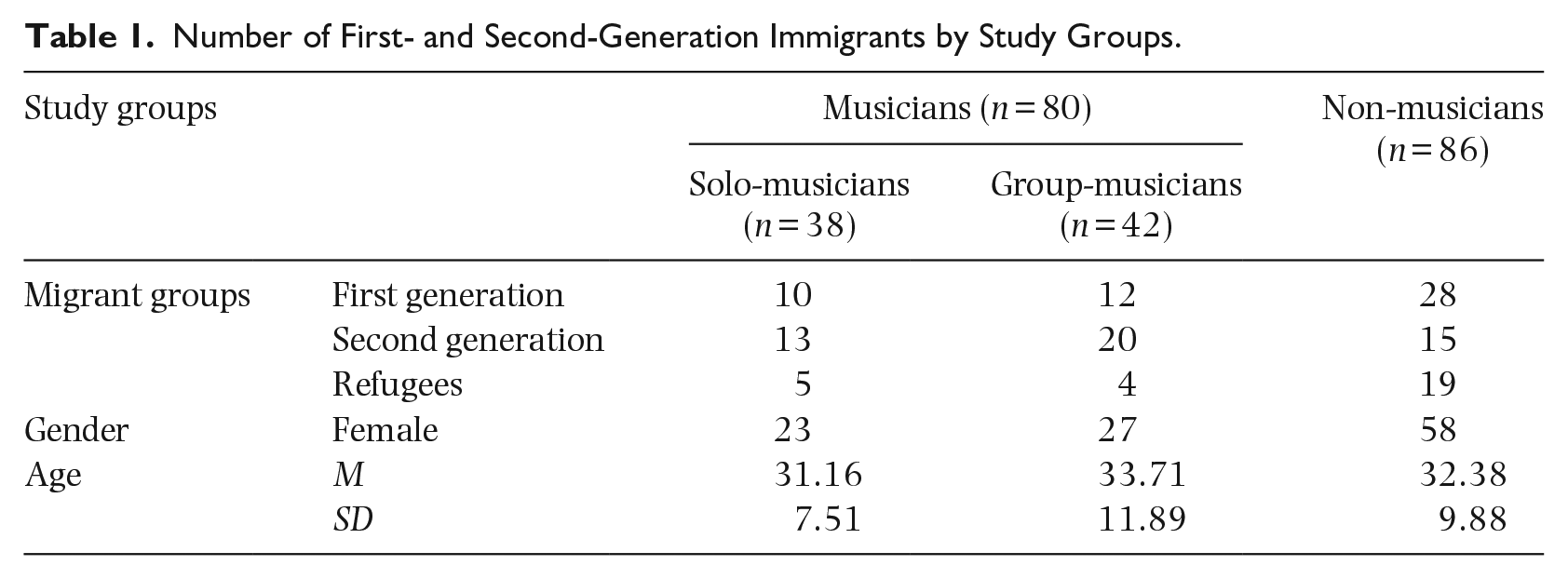
Within the group of musicians, those who reported playing and practicing alone only were assigned to a subgroup labeled solo-musicians (n = 38) and those who reported playing in a group (band, orchestra, etc.) were assigned to a subgroup labeled group-musicians (n = 42). Participants who reported both playing their instrument alone and in a group were assigned to the group-musicians group (see Table 1). Solo-musicians reported an average of 15.32 years (SD = 10.24) of being musically active. They practiced 4.49 h per week on average (SD = 5.80). Group-musicians had been musically active for an average of 18.76 years (SD = 10.07). On average, they practiced 4.14 hours in groups (SD = 3.39) and 7.60 hours alone (SD = 7.32; n = 30). Solo-, group-, and non-musicians where about the same age, F(1, 163) = .66, p = .518. However, first-generation migrants in the solo-musician group reported a somewhat shorter duration of stay in Germany (M = 7.48, SD = 6.38) than those who were members of music groups (M = 15.91, SD = 12.99) or non-musicians (M = 10.31, SD = 10.31).
In further explorations of musical activities, we found that n = 10 (12.5%) musically active participants with a non-Western European background primarily played music from their foreign home culture. Furthermore, n = 16 (20.0%) participants from non-Western European cultures focused on Western European music, and n = 21 (26.3%) participants with a foreign cultural background reported playing music from both Western Europe and their culture of origin. While the latter were equally distributed among solo- and group-musicians, somewhat more solo-musicians (n = 7, 18.4%) than group-musicians (n = 3, 7.1%) focused on music from their foreign home cultures. Where this information was given, playing strings was reported by the majority of musicians in the sample (n = 42, 52.5%), followed by keyboard instruments (n = 32, 40.0%). Keyboard instruments were equally represented in solo- (n = 16, 42.1%) and group-musicians (n = 16; 38.1%), as were strings (n solo = 20, 52.6% vs. n group = 22, 52.4%). N = 22 (27.5%) participants played more than one kind of instrument. Fewer solo-musicians played more than one instrument (n = 7, 18.4%) compared to group-musicians (n = 15, 35.7%).
Measures
Musical activity was assessed using an 18-item questionnaire constructed for the purpose of this study (see Supplementary Material).
Acculturative stress was measured using the Riverside Acculturation Stress Inventory (RASI; Miller et al., 2011). The 15-item scale assesses culture-related challenges in the following five domains: language skills, work challenges, intercultural relations, discrimination, and cultural/ethnic makeup of the community. Answers are marked on a 5-point scale ranging from 1 (strongly agree) to 5 (strongly disagree). In this study, only the total score was used (Cronbach’s α = .84).
Acculturation was assessed using the Frankfurt Acculturation Scale (FRACC; Bongard et al., 2020). This 20-item scale assesses two dimensions, Orientation to Culture of Origin (C-Origin) and Orientation to Host Culture (C-Host), on a wide range of behaviors and attitudes. Answers are given on a 7-point scale ranging from 0 (does not apply at all) to 6 (fully applies). The questionnaire was presented either in English or German. In the present sample, the scale yielded good internal consistency (C-Origin: α = .81, C-Host: α = .84).
Data analyses
To test our hypotheses, we applied a cross-sectional design for biographical and psychological variables. We analyzed our data with IBM SPSS Statistics 29. To compare the means of two groups, we used t-tests for independent samples. For our final analyses, we performed one-way analyses of covariance (ANCOVAs) and mediation analyses were performed with the PROCESS macro for SPSS (Hayes, 2022).
Results
Before analyzing the sample in relation to our hypotheses, we checked for potential covariates. Generation was a potential covariate for between-group variance in the outcomes (Angelini et al., 2015; Beutel et al., 2016; see Table 1). Consistent with previous studies, the group mean of acculturative stress was lower in second-generation (M = 32.29, SD = 9.97) than in first-generation migrants (M = 38.15, SD = 11.31), t(164) = −3.13, p = .002, 95% CI = [ −9.56, −2.16]. When compared to first-generation migrants, second-generation migrants reported higher levels of C-Host (M2nd = 58.42, SD = 8.06; M1st = 51.33, SD = 9.63), t(164) = 4.50, p < .001, 95% CI = [3.97, 10.20], and lower levels of C-Origin (M2nd = 41.70, SD = 11.28; M1st = 29.69, SD = 10.08), t(164) = 6.41, p < .001, 95% CI = [8.31, 15.72]. Consequently, immigrant generation was added as a covariate in every model of analysis. Gender was added as a covariate for the analyses of C-Origin, as the average score was significantly higher in female (M = 39.77, SD = 12.41) compared to male participants (M = 35.36, SD = 11.38), t(164) = 2.24, p = .026, 95% CI = [.53, 8.28]. This result is consistent with existing literature that sees women, especially mothers, in the role of transmitting and preserving cultural heritage (Rezaei, 2022; Varghese, 2007). In line with this, more females in our sample reported having children (n = 39) than did males (n = 16). We did not see any gender differences in the other outcome variables (all ps > .297).
On average, musicians reported lower levels of acculturative stress than non-musicians (see Table 2). Further confirming Hypothesis I, one-way between-groups ANCOVA revealed musicians to report lower levels of acculturative stress than non-musicians (see Table 2), F(1, 162) = 7.78, p = .006, 95% CI = [1.41, 8.22], partial η² = .06, and indicated a difference of medium effect size. Here, we controlled for immigrant generation, F(1, 162) = 5.52, p = .020, 95% CI = [.71, 8.23], partial η² = .03, R² = .10.
Means and Standard Deviations of RASI, C-Host, and C-Origin Scores in Musicians and Non-Musicians.
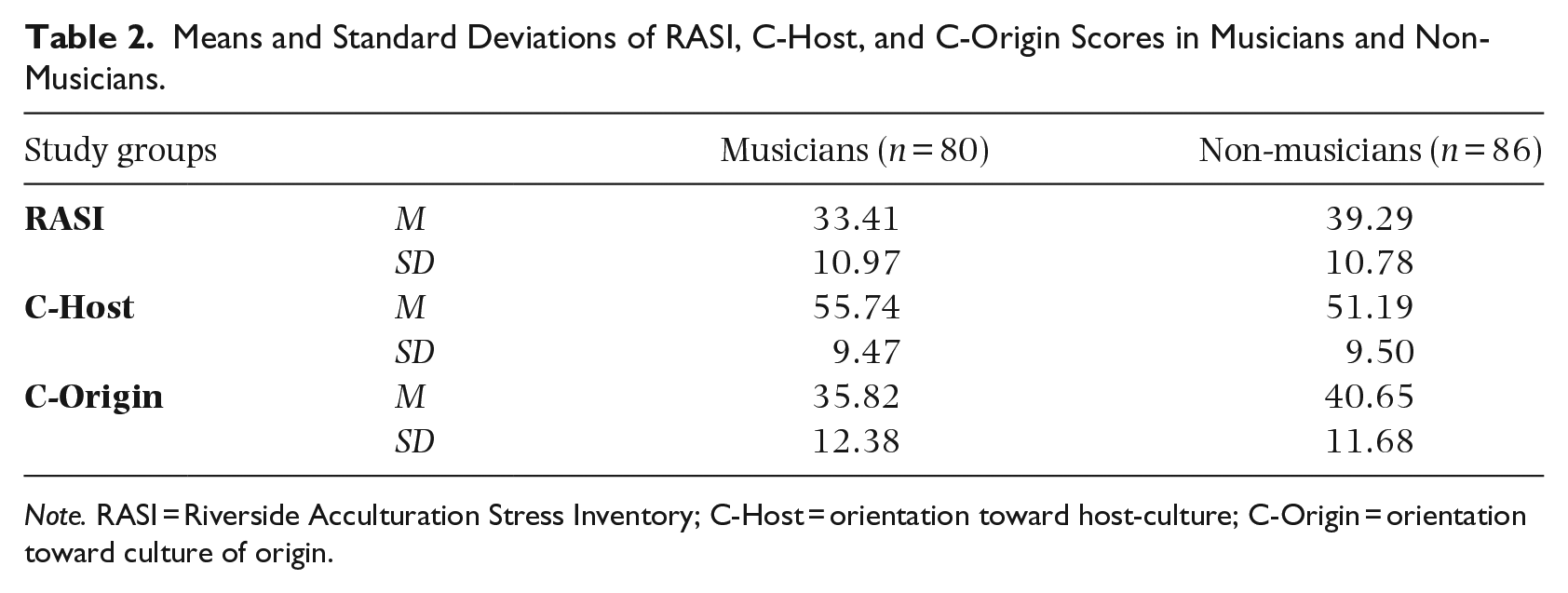
Note. RASI = Riverside Acculturation Stress Inventory; C-Host = orientation toward host-culture; C-Origin = orientation toward culture of origin.
As proposed in Hypothesis II, average C-Host was somewhat higher in musicians than in non-musicians (see Table 2). Indeed, results from ANCOVA showed that C-Host scores were significantly higher in musicians than in non-musicians, F(1, 162) = 4.40, p = .037, 95% CI = [−5.97, −.18], partial η² = .03, while controlling for migrant group, F(1, 162) = 14.67, p < .001, 95% CI = [−9.39, −3.00], partial η² = .08, R² = .13, although the effect size was small. With regard to C-Origin, we saw a somewhat lower group mean in musicians than in non-musicians (see Table 2). Further analyses indicated no systematic differences between groups, F(1, 162) = .72, p = .398, 95% CI = [−1.94, 4.86], while we controlled for immigrant generation F(1, 162) = 41.07, p < .001, 95% CI = [8.45, 15.97], partial η² = .20, and gender, F(1, 162) = 10.47, p = .002, 95% CI = [2.09, 9.00], partial η² = .20, R² = .25, confirming Hypothesis III.
Regarding Hypothesis IV, a regression model (see Figure 1) including musical activity as predictor variable and acculturative stress as dependent variable, C-Host as mediator, and migrant generation as covariate showed a meaningful association between C-Host and RASI-scores, β b = −.70, t(162) = −9.44, p < .001, 95% CI = [−.85, −.55], and a marginal association between RASI scores and musical activity, β d = −2.66, t(162) = −1.88, p = .061, 95% CI = [−5.44, .13]. The covariate yielded no systematic effect on the outcome here, β cov = −.12, t(162) = −.08, p = .939, 95% CI = [−3.28, 3.03]. The model accounted for 41.90% of variance in the outcome variable. Bootstrapped confidence intervals indicated a significant indirect effect of musical activity on acculturative stress via C-Host, (β indirect = −2.16, 95% CI boot = [−4.33, −.10], which confirmed our expectations.
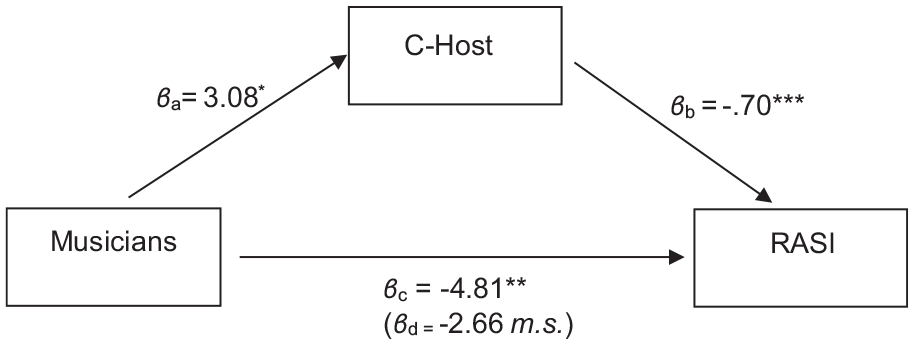
Mediation of Acculturation Stress Scores (RASI) in Musicians and Non-Musicians by Orientation toward Host Culture (C-Host).
Regarding differences based on the musical setting (group and solo-musicians; Hypothesis V), means and standard deviations in the three study groups (see Table 3) indicate that average RASI scores were lowest in group-musicians, followed by solo-musicians and non-musicians. Further results showed significant differences of moderate effect size between the three groups, F(2, 162) = 4.68, p = .011, partial η² = .06, while controlling for immigrant generation, F(1, 162) = 4.87, p = .029, 95% CI = [.44, 7.99], partial η² = .03, R² = .11. A Bonferroni post-hoc test revealed no significant difference in average acculturative stress when comparing solo- to non-musicians, p = .170, 95% CI = [−1.04, 9.05], and a significant difference between group- and non-musicians, p < .001, 95% CI = [2.70, 12.46], dCohen resp. gHedges = .71. Group-musicians and solo-musicians did not differ significantly, p = .413, 95% CI = [−2.22, 9.37]. Therefore, our results partially confirmed Hypothesis V.
Means and Standard Deviations of RASI, C-Host, and C-Origin Scores in the Subgroups.
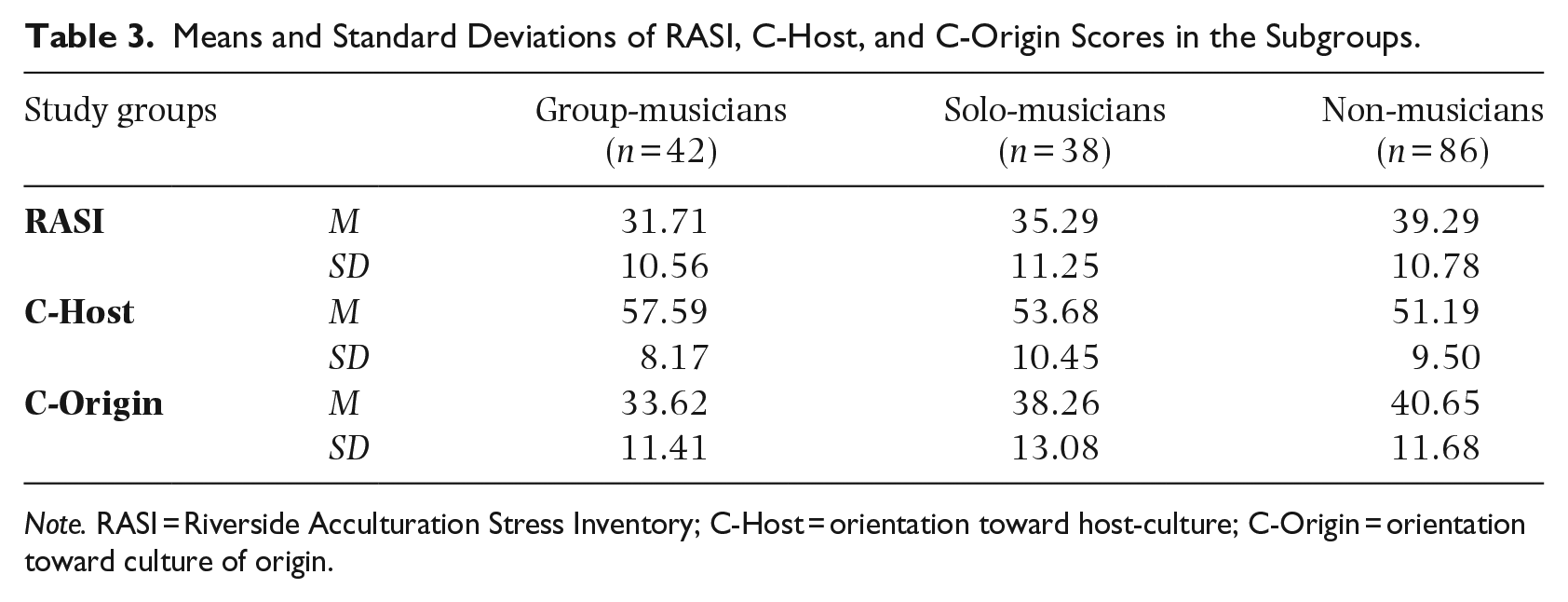
Note. RASI = Riverside Acculturation Stress Inventory; C-Host = orientation toward host-culture; C-Origin = orientation toward culture of origin.
As expected (Hypothesis VI), descriptive statistics indicated average C-Host to be highest in group-musicians, followed by solo-musicians and non-musicians (see Table 3). Results from an ANCOVA showed statistically significant differences between the study groups, F(2, 162) = 3.38, p = .036, partial n² = .04, while we controlled for migrant generation, F(1, 162) = 13.43, p < .001, 95% CI = [−9.13, −2.74], partial η² = .08, R² = .14. A Bonferroni post-hoc test showed significant differences of moderate effect size in average C-Host between group- and non-musicians, p < .001, 95% CI = [2.28, 10.54], dCohen resp. gHedges = .70. There was no significant difference in C-Host when comparing solo- to non-musicians, p = .478, 95% CI = [−1.78, .48] or solo- to group-musicians, p = .168, 95% CI = [−8.83, 1.00].
Next, we conducted another mediation analysis to investigate whether C-Host scores mediated the association between the subgroups and acculturative stress (Hypothesis VII). As our analyses did not yield significant differences in C-Host and RASI-scores between solo- and non-musicians, these pairs of groups were excluded from mediation. With regard to group-musicians versus non-musicians, a significant effect of musical activity and acculturative stress became marginal, βd = −1.55, t(124) = 1.79, p = .076, 95% CI = [−3.27, .16], after controlling for C-Host, βb = −.73, t(124) = −8.42, p < .001, 95% CI = [−.91, −.56], and migrant generation, βcov = −.77, t(124) = .41, p = .680, 95% CI = [−2.91, 4.45], R² = .44. Finally, bootstrapped confidence intervals suggested a total mediation of the association between group-musicians/non-musicians and acculturative stress levels by C-Host, βindirect = −1.68, 95% CIboot = [−2.97, −.48] (see Figure 2), confirming Hypothesis VI.
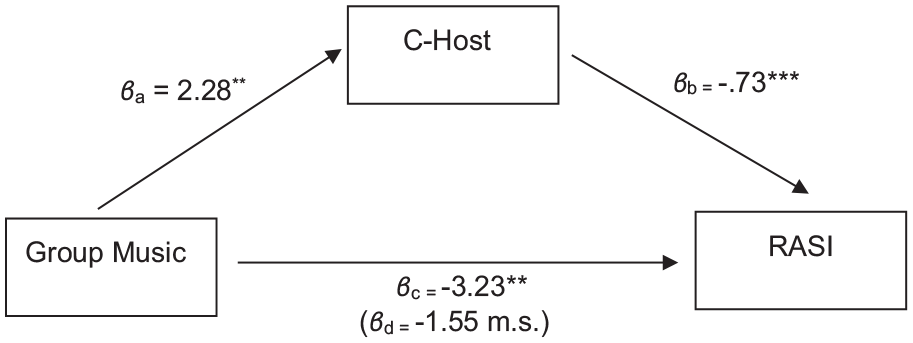
Mediation of Acculturation Stress Scores (RASI) in Group-Musicians and Non-Musicians by Orientation toward Host Culture (C-Host).
With regard to C-Origin (Hypothesis VIII), mean scores differed slightly, but not significantly between the musical subgroups, F(2, 161) = 1.29, p = .279, 95% CI = [−1.05, 7.18], and were significantly affected by the covariates migrants’ generation, F(1, 161) = 39.06, p < .001, 95% CI = [8.17, 15.71], partial η² = .20, and gender, F(1, 161) = 10.22, p = .002, 95% CI = [2.13, 9.03], partial η² = .06, R² = .33. Thus, and confirming Hypothesis VIII, C-Origin did not vary as a function of the musical setting.
Discussion
This study investigated the relationship between musical activity and acculturation to provide further insight into potential benefits of music activities in adult migrants. We showed that music group membership is associated with a stronger orientation to mainstream culture, and that a stronger orientation to mainstream culture, in turn, is associated with lower levels of stress in host societies such as Germany, where migrants are expected to assimilate to mainstream culture (Frankenberg et al., 2013, 2016). This study builds upon previous research suggesting that musical activities, especially with others, can promote wellbeing and identity formation, foster positive relationships and inclusion and encourage cultural participation in migrants (e.g., Henderson et al., 2016; Keles et al., 2021; Rinde & Kenny, 2021). Furthermore, the results are in line with observations that musical activity in culturally heterogeneous groups leads to active interaction with members of the mainstream society as well as with cultural aspects of the host country (e.g., Marsh, 2012, 2017) and studies that reported beneficial effects from music in other areas, such as language (Slevc & Miyake, 2006), empathy (Rabinowitch et al., 2012) and coping (Croom, 2014). In previous studies, we also observed that participation in music ensembles or groups increased orientation to host culture both in children (Frankenberg et al., 2016) and in adult male refugees (Chantah et al., 2020). Our finding that the effect of musical activities on acculturative stress was mediated by music group participants’ stronger orientation to the host culture could provide evidence that migrants may benefit from musical activity in two ways: Not only do they enjoy the well-documented effects of music that promote health and wellbeing (e.g., MacDonald et al., 2012), they also experience an additional positive impact of music-making via increased orientation to mainstream society which targets intercultural experiences and processes that support coping with acculturative stress (e.g., Berry, 2006; Keles et al., 2021; Nijs & Nicolaou, 2021).
Our investigation showed no meaningful differences between solo- and group-musicians in the outcomes. Musical activity is generally regarded as beneficial for wellbeing in migrants (e.g., Lenette & Sunderland, 2016; Saarikallio, 2012). Nevertheless, the absence of significant effects from making music on one’s own further highlights contributions associated with the social setting in music groups (e.g., Koelsch, 2013; Turino, 2008). Here, it should be noted that most music group members in our sample also reported playing on their own, which offers additive opportunities to address individual topics besides group activities where they are not as dominant. However, making music on one’s own should not be viewed as an activity that happens in social isolation (Trehub et al., 2015) and interestingly, our descriptive data indicates that solo-musicians focused more on music from their culture of origin than music group members (Lidskog, 2016).
There was a higher percentage of refugees in our sample of non-musicians. Thus, we cannot rule out whether our findings may be due to greater disadvantage in non-musicians (Hajak et al., 2021). Moreover, among participants who were not born in Germany, group-musicians reported the longest duration of stay while solo-musicians reported the shortest. These differences could have also affected our findings, as time since migration is a strong predictor of acculturation (e.g., Beutel et al., 2016; see also Haasen et al., 2008). It may also be that a (pre-existing) strong orientation to the host culture makes individuals become musically more active or that more possible mediators are reflected here, for example, personality factors. Both orientation toward the host-culture and musical activity may be caused by the same third factor, such as openness to experience (Schmitz & Schmitz, 2022; Silvia et al., 2015). Thus, it may be that especially people scoring high on openness to experience participate in musical activities, specifically in music groups. These individuals may connect with members of the host society and adapt to a new culture more easily for the same reason.
Musically active participants and non-musicians did not differ in terms of their orientation to culture of origin, which replicates previous findings (Gilboa et al., 2009; Kenny, 2018) and we are not aware of literature that suggests a diminution in orientation to culture of origin through musical activities.
To our knowledge, no studies of this nature exist which document an association of musical activity with acculturative stress. Existing evidence mostly stems from interviews and observations from refugee patients, adolescents, and children. In this regard, our investigation contributes evidence that participation in music groups may support psychological acculturation in migrants of all ages and that beneficial effects are not limited to specific migrant groups. However, this study has several limitations. First, data were based on non-randomized samples from a single German city and the distribution of ethnicities was not representative of the general population, which may limit the generalizability of the findings. Clearly, no conclusions can be safely drawn with regard to causality. For example, the data do not provide insight into other cultural activities in non-musicians and musicians. Future research should aim at shedding light on the association between cultural orientation and music group membership by conducting longitudinal studies which allow for the systematic analysis of causal relationships.
Our study raises questions regarding potential differences due to the social and cultural context of the music activities people engage with, as well as the musical genres (e.g. modern, classic, jazz, or pop music), the types of music group activities (like playing in an orchestra, ensemble, a band), the structure of the musical sessions (e.g. in term of regularity) and the types of musical instruments (e.g. keyboards, strings, other or traditional instruments, voice). The removal of singers from our sample represented an unintended restriction to instrumental music. Singing, especially in choirs, can certainly be assumed to be comparable in its effects to instrumental music (Bullack et al., 2018; de Quadros & Vu, 2017; Weinstein et al., 2016), but may be less comparable regarding the degree of required coordination in the apparatus of movement. Another aspect that should be addressed by further research is whether music activities include public performances and inform about other cultural activities in non-musicians. Besides low numbers of observations to further investigate such issues, our data do not provide necessary information. Qualitative studies in particular could be useful to delve into these phenomena within a variety of naturalistic music making settings.
Although not without limitations, this study provides first evidence that musical activity may have benefits beyond those that have already been well documented. Music may be a means of reducing acculturative stress and furthering orientation to the host culture and thus may have a positive impact on migrants’ acculturation process.
Supplemental Material
sj-docx-1-pom-10.1177_03057356241243333 – Supplemental material for Music-making facilitates acculturation and reduces acculturative stress: Evidence from a survey of migrants living in Germany
Supplemental material, sj-docx-1-pom-10.1177_03057356241243333 for Music-making facilitates acculturation and reduces acculturative stress: Evidence from a survey of migrants living in Germany by Jasmin Chantah, Emily Frankenberg, Zora Kasanda and Stephan Bongard in Psychology of Music
Footnotes
Declaration of conflicting interests
The author(s) declared no potential conflicts of interest with respect to the research, authorship, and/or publication of this article.
Funding
The author(s) received no financial support for the research, authorship, and/or publication of this article.

Supplemental material
Supplemental material for this article is available online.
References
Supplementary Material
Please find the following supplemental material available below.
For Open Access articles published under a Creative Commons License, all supplemental material carries the same license as the article it is associated with.
For non-Open Access articles published, all supplemental material carries a non-exclusive license, and permission requests for re-use of supplemental material or any part of supplemental material shall be sent directly to the copyright owner as specified in the copyright notice associated with the article.
