




Abstract
This study aimed to explore whether music perception is correlated with the load of exposure to musical activities in daily life, such as attending musical events, playing an instrument, attending music classes (at school or for a social project), and the time children spend listening to music using a non-experimental design. We are reusing data from the studies by Barros et al. and Cogo-Moreira & Lamont, from a random school-based sample (multilevel design) including 1,006 children from first to fifth grade in 14 schools in São Paulo, Brazil. Data were collected using the “M-factor”, a new paradigm to assess music perception, and a questionnaire to track children’s self-reported musical activities related to their individual daily lives in different environments (home and school). At the within-participants level, self-reported exposure to music activity accounted for only 5.3% of the variance in music perception after adjusting for age and sex. Hence, the magnitude of the association between music exposure and music perception skills was small when both music exposure and music perception skills were evaluated under continuous scores and using a heterogeneous population.
Does exposure to a musical environment predict levels of music perception (MP) during childhood? Exposure to music-making is commonly assessed by evaluating how long (i.e., the number of years) a person has studied a given instrument or whether the person is a musician. However, both assessment forms have limitations. The former is strongly related to a memory bias, whereas the latter involves dichotomizing a continuous measure, which is not good statistical practice (Royston et al., 2006). Moreover, dichotomization does not capture musical exposure beyond the traditional view of music-making, which is normally centered on classical musical activity, limiting the perspective of the concept of a “musician” (see Rickard & Chin, 2017). Tools with good psychometric features, such as showing different types of validity evidence (e.g., evidence based on internal structure and on relations with other variables) are rare, especially in the context of childhood. During childhood, different music activities that may not be formally related to music-making can influence and accumulate in the load of exposure to a musical environment in daily life (e.g., exposure to TV shows focused on music performance, parents or relatives who play a musical instrument, and social projects where non-traditional instruments might be taught). Therefore, we propose a deeper evaluation of how the environment might corroborate the prediction of musical perception using two robust tools: a musical exposure tracker developed specifically for children and the M-factor, a new paradigm to measure MP in childhood (Barros et al., 2017).
Using a multilevel sample of children who responded to two multidimensional scales (one measuring MP and the other measuring music exposure), we tracked the magnitude of the association between both constructs in a naturalistic environment. The advantage of this sampling approach was its naturalistic design in which children were nested in schools. Hence, we have a heterogeneous sample of children from the largest city in Brazil (São Paulo). Moreover, the large sample allows us to explore the association between MP and music exposure in the context of a heterogeneous scenario, with children with low and high loads of exposure to a musical environment and different levels of MP skills. This approach offers a different perspective for understanding how the two phenomena are correlated, because most studies on this topic have used either an experimental or quasi-experimental design to evaluate the causal effect of musical learning on different musical outcomes (e.g., capacity for processing Western music).
Method
Participants
This study reused the same sample of 1,006 children from a wider project designed to (1) assess and validate a battery of MP skills among children (Barros et al., 2017) and (2) to create a scale for assessing music exposure in childhood (Cogo-Moreira & Lamont, 2018). Therefore, this study reuses data already collected to test the correlational hypothesis between MP and music exposure in childhood. A stratified random sample of 14 elementary schools (35% private schools) was chosen from a pool of São Paulo state districts and cities (São Paulo, Jacarei, Marilia, and Mogi das Cruzes). Ethical approval for this project was provided by the Ethics Committee of the Federal University of São Paolo (CAEE: 00751812.3.0000.5505).
Selection of children
In each of the 14 schools, one teacher was instructed on how to randomly select 14 students per grade from the first to fifth grades using www.random.org, returning an average of 70 children per school. Teachers, nominated by school principals, evaluated the children using the MP test. Based on the school’s enrollment list for each grade, five working days were given to the students’ parents to provide informed consent regarding their child’s participation in the research. If there was no interest in participating or no informed consent from parents, another child was selected using the same procedure. This random selection method, without any inclusion or exclusion criteria, was used to maximize generalizability and representative sampling of the MP spectrum in terms of music exposure.
The M-factor
The M-factor battery comprises 80 items assessing seven specific domains of MP: timbre, meter, contour, scale, loudness, pitch, and duration (Barros et al., 2017). In contrast to other available batteries, the M-factor goes beyond the tonality paradigm, whereas others exclusively consist of stimuli built around tonality (Peretz et al., 2013). Although the M-factor battery is a multidimensional assessment tool for MP, the M-factor, a general latent factor underlying 80 items per se, explained 93% of the reliable variance in the MP measurement. Only 3.9% of the reliable variance could be attributed to the multidimensionality caused by the seven specific domains. In terms of other psychometric features, the M-factor battery showed no differential item functioning based on sex, age, or enrollment in public or private schools (Barros et al., 2017).
Exposure to Music in Childhood Inventory
The Exposure to Music in Childhood Inventory (EMCI) is a new tool designed to capture the amount of exposure to music activities, and is suitable for use with children, which goes beyond the dichotomy of “with music experience” versus “without music experience” (Cogo-Moreira & Lamont, 2018). It is designed to be self-reported by children aged 5–13 years, and comprises ten categorical items describing two main domains: social (four items) and personal (six items). The former domain includes questions such as, “In the last year, did you attend any musical events offered by your school?”, “Do you play an instrument?” and “Have you ever taken music classes (at school, social projects, or private schools)?”. The personal domain includes questions such as “How much time do you spend listening to music?” and “Do you have any personal device (MP3, cell phone, or iPod) that allows you to listen to music?”. The EMCI was shown to have most of its items with factor loadings superior to 0.4 (indicating a substantial correlation with the domains) and good model fit indices obtained via exploratory and confirmatory factor analysis, which provides evidence-based on the internal structure (for more details on the type of validity evidence, see Bandalos, 2018).
Covariates
We used the following covariates: children’s age (as a proxy for child development), school enrollment status (public vs private, as a proxy for socioeconomic status), and sex.
Statistical analysis
Multilevel linear regression was used to evaluate the impact of the EMCI continuous score on the M-factor (raw score) among the participants. At the within-level, together with the EMCI score, we also considered age and sex, and at the between-level of the model, we considered the type of school (i.e., private or public). R-squared was calculated within each level and standardized, and the estimator was a maximum-likelihood parameter estimate with standard errors and a chi-square test statistic (when applicable) that was robust to the non-normality and non-independence of observations (called as maximum-likelihood robust (MLR) estimator; see Muthén & Muthén, 2020). The MLR standard errors were computed using a sandwich estimator. All analyses were performed using Mplus, version 8.6.
Results
The demographic features of the sample were presented by Barros et al. (2017). Table 1 shows the descriptive statistics for the M-factor and EMCI per school type and grade. Figure 1 shows the correlation between the M-factor and EMCI and their distributions.
Mean, Standard Deviation, and Minimum and Maximum Scores for the EMCI and M-Factor per School Type (Private or Public) Across the Grades.
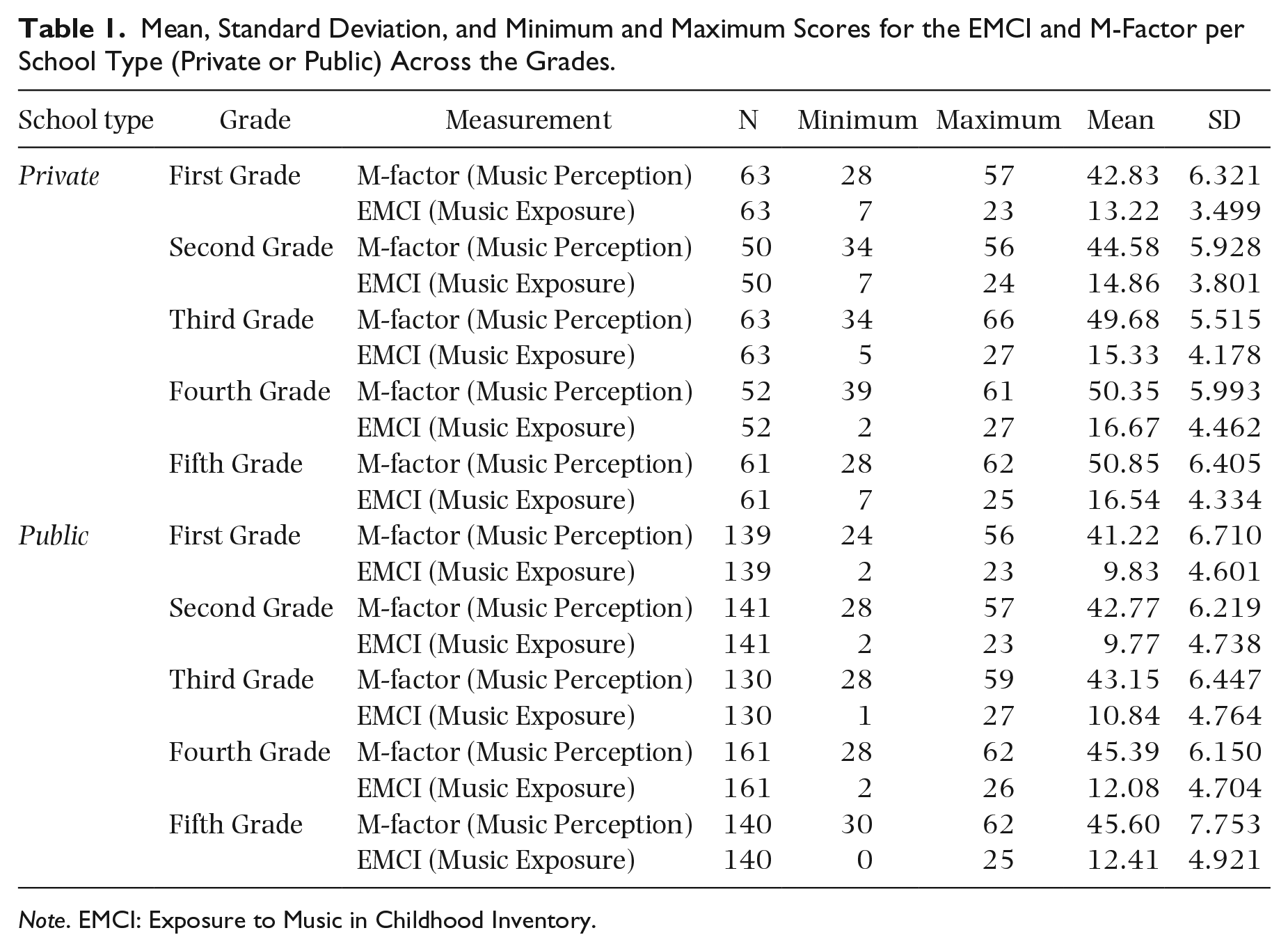
Note. EMCI: Exposure to Music in Childhood Inventory.
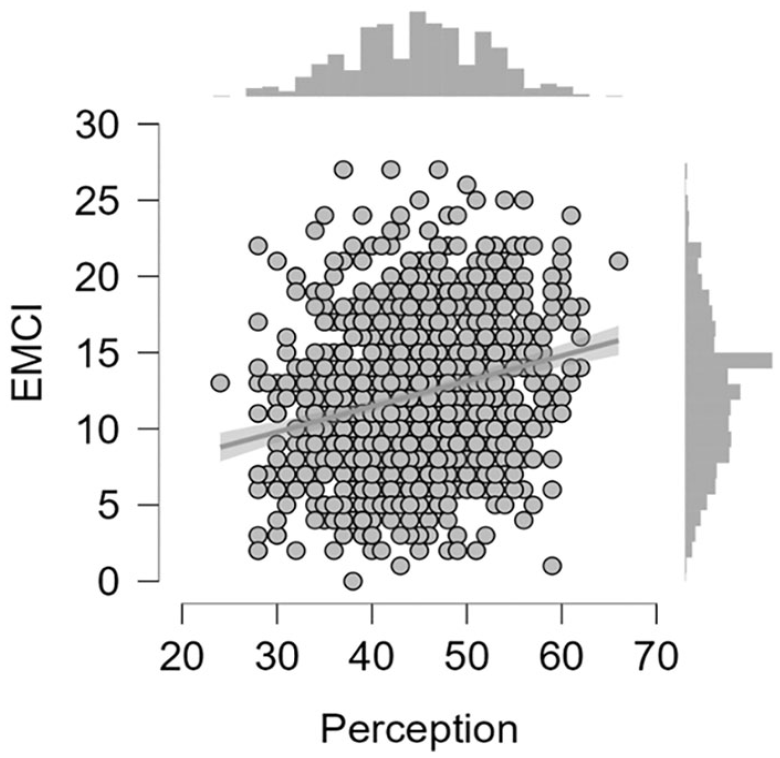
Correlation Plot Between the EMCI and M-Factor and Their Respective Distributions.
At the within-level (children), EMCI (unstandardized beta = 0.153, p = .027) and age (unstandardized beta = 0.545, p = .024) were statistically significant in predicting the M-factor. Sex was not statistically significant (unstandardized beta = 0.525, p = .213). In terms of the R2 for the within-level, we obtained .053, p = .117, indicating a very low explained variance of the three predictors on the M-factor score. At the between-level (school), being enrolled in public schools was related to lower levels of the M-factor (unstandardized beta = –3.850, p = .003), which was associated with a large R2 value of .440, p = .020.
Discussion
Although statistically significant owing to the large sample size, our findings for the first regression analysis of the ECMI on the M-factor showed that environmental elements have a small effect in terms of magnitude on MP skills. The set of three covariates at within-level (i.e., sex, age, and ECMI) showed an R2 < 6%.
Although research has argued that children’s musical abilities appear to change with age (Ireland et al., 2018), it is fundamental to provide evidence regarding the invariance of the musical tasks used. In other words, one needs to evaluate whether the correct or general responses to musical tasks are invariant across ages (or grades) in terms of psychometric parameters (i.e., item difficulties); otherwise, inferences describing correlation with grades or ages might be biased (Cheung & Rensvold, 2002). By invariant, we mean that the difficulties of the items might be unfair across ages (e.g., older children might have a higher likelihood of providing a correct answer compared with younger children); this effect should not be misinterpreted as the correlation of age with the underlying MP skills (e.g., the M-factor). The M-factor battery was the first to provide such invariance evidence at the item level (Barros et al., 2017) not only for age, but also for sex and type of school (private or public); such results are not generalizable to other available MP tests.
In terms of the “environmental package” at the children’s level (comprising the ECMI score, age, and sex), such elements together contributed to less than 6% of the M-factor explanation. These results provide new insights into how naturalistic and heterogeneous environments, in terms of music exposure load, might be correlated with MP.
Most studies have used an experimental or quasi-experimental design, which makes it difficult to understand the inherent magnitude of the correlation between the two phenomena without an experimental design. For example, it has been shown that both musical expertise and musical training affect pitch processing in music (Besson et al., 2007) by pseudo-randomly assigning children to either music or painting training groups. The effects of musical training on the processing of musical sounds are derived from functional and structural changes in the auditory system (Hannon & Trainor, 2007). Hannon and Trainor (2007) described two types of experience that fundamentally shape development: (1) “enculturation processes,” in which basic auditory capacities are modified by everyday experience of listening to the music of a particular culture and (2) “formal musical experience,” through which perception and production skills are trained to a high level, and musical knowledge becomes explicit. Most studies involving youths focus on the latter (for example, see Schlaug et al., 2005) and do not consider the active process of producing music or engaging in musical activities that are not classified as formal acquisitions focused on high-performance activities. For example, watching or attending concerts may be considered informal practices, as these are also not devoted to and considered classical music repertoires, and producing and writing music is not necessarily formalized in the form of a music sheet in such cases.
The gap between the two concepts of conducting musical activities (formal and informal) remains. Green (2005) attempted to shed light on the aspects of informal music-learning practices as important components of musical practice (see more in Green, 1997, 2005). The ECMI was developed to capture both traditions of exposure to musical practice incorporating items beyond the traditional “musical literacy” skills related to high performance and embracing a more diverse spectrum of musical activities. Moreover, from the perspective of capturing different sources of musical activities in daily routines, this study introduces important social elements that might be neglected by the formal definition of musical activities (i.e., by incorporating sources such as YouTube and TV channels for music listening). In the context of a representative sample of a population from a middle-income country where music education is not fully implemented as part of the syllabus, and with high social inequality between those who have access to pay for formal musical education and those who do not, EMCI offered heterogeneity in terms of distribution for EMCI scores.
Limitations
The study was designed in 2014, and data were collected in 2015; thus, some items of the ECMI might have become obsolete, for example, items 5 (“Do you watch The Voice Brazil?”) and 6 (“Do you watch Esquenta?”). The latter inquired about a TV show that included music from the suburbs (favelas). Both The Voice and Esquenta were aired during prime time by Globo, Brazil’s largest broadcasting TV station. Therefore, if the survey is replicated, items such as these should be adapted to the current scenarios experienced by the children. The small correlation we found was attributable to the measures we used, and different tools might predict different effects given their psychometric features.
Future large studies investigating interaction between biology (e.g., genetics) and environmental exposure might bring new insights into the prediction modeling of MP skills.
Supplemental Material
sj-pdf-1-pom-10.1177_03057356241235665 – Supplemental material for Very low association between multidimensional musical environment exposure and musical perception skills among children: Evidence from a large multilevel cross-sectional study
Supplemental material, sj-pdf-1-pom-10.1177_03057356241235665 for Very low association between multidimensional musical environment exposure and musical perception skills among children: Evidence from a large multilevel cross-sectional study by Hugo Cogo-Moreira and Anders Nordahl-Hansen in Psychology of Music
Supplemental Material
sj-xls-2-pom-10.1177_03057356241235665 – Supplemental material for Very low association between multidimensional musical environment exposure and musical perception skills among children: Evidence from a large multilevel cross-sectional study
Supplemental material, sj-xls-2-pom-10.1177_03057356241235665 for Very low association between multidimensional musical environment exposure and musical perception skills among children: Evidence from a large multilevel cross-sectional study by Hugo Cogo-Moreira and Anders Nordahl-Hansen in Psychology of Music
Footnotes
Authors’ note
To ensure independence, as this article was based on earlier work which involved the Editor in Chief as a co-author, the review process was handled by one of the Associate Editors.
Funding
The author(s) disclosed receipt of the following financial support for the research, authorship, and/or publication of this article: This research was funded by the São Paulo Research Foundation (FAPESP), grant number 2014/06662-8.

Supplemental material
Supplemental material for this article is available online.
References
Supplementary Material
Please find the following supplemental material available below.
For Open Access articles published under a Creative Commons License, all supplemental material carries the same license as the article it is associated with.
For non-Open Access articles published, all supplemental material carries a non-exclusive license, and permission requests for re-use of supplemental material or any part of supplemental material shall be sent directly to the copyright owner as specified in the copyright notice associated with the article.
