




Abstract
In the context of instrumental teaching, developing student autonomy is a major goal of teachers in addition to transmitting knowledge and fostering musical learning. This research, which consists of two successive studies, focused on the development of student autonomy from the teacher’s perspective. In the first study, I conducted a qualitative analysis of 21 teachers’ beliefs and intentions with regard to the development of student autonomy and their roles in this process. The results showed that teachers considered themselves somewhat at the periphery of the process in which students attain autonomy. In the second study, I analyzed in depth the joint action of three teachers with their students during two successive lessons. My analysis of the film recordings revealed that teachers performed many pedagogical actions to develop student autonomy, albeit unconsciously and without verbalization. The results of this second study suggest that there are four possible teaching stances that make it possible to develop autonomy. Based on a synthesis of the two studies, I propose a model that helps teachers to develop student autonomy through the understanding and clarification of the four key phases of the self-regulation process.
Developing student musicians’ autonomy is important and challenging for both teachers and students. As musical learning integrates both the acquisition of technical and musical knowledge as well as the development of self-regulatory behavioral, environmental, and relational skills (Zimmerman, 2008; Zimmerman and Martinez-Pons, 1990), it is difficult for a student to self-manage the learning process. This includes planning actions, organizing strategies, and evaluating activities (Cosnefroy, 2011; Hallam, 2001a; Zimmerman, 2008).
Reflective cognitive behaviors emerge consciously in the learners’ thinking process, resulting from the explicitness of their cognitive activity (Cosnefroy, 2011). By explaining what they are doing, students become aware of their learning process, find words to describe the experience, and integrate strategies to develop autonomy. To activate students’ awareness of their own learning mechanism, teachers need specific strategies. Several authors have argued that these strategies are effective if they are performed directly in the context of learning and not learned theoretically, separately from the practical learning process (Deschênes, Fernandez, & Goudreau, 2020). My two-part research design first addresses the representations, intentions, and strategies described by teachers and then confronts teachers with their teaching actions in the reality of the classroom.
Pratt (1998) defines the teacher’s perspective on teaching as an interrelated set of beliefs and intentions which give meaning to their actions. In this article, I use the term stance, defined by Lameul (2016), as it incorporates all three components: beliefs, intentions, and actions.
My research focuses on these three components of stance: what do experienced teachers believe, want, intend and do with regard to the development of their students’ autonomy? In the first part of the research project (Chardonnens, 2021), I examine teachers’ beliefs and intentions, and in the second part, I compare these beliefs and intentions with the actions taken by teachers during lessons. This allows me to describe and better understand teachers’ stances during joint action with their students.
The theoretical section presents the concepts of autonomy and stance as well as Marzano and Kendall’s (2006) taxonomy, which proposes a hierarchy of the tasks assigned to students in terms of their difficulty. After clarifying the research questions (RQs), I explain the framework for the qualitative analysis in the “Method” section. The “Results” section is structured according to the three components of stance: (1) teachers’ beliefs about autonomy, (2) teachers’ intentions, and (3) teachers’ actions and their comments on these actions. These three sub-sections allow me to highlight different teaching strategies in relation to teachers’ stances. Based on my results, I propose future avenues for research and teacher training, supported by a representative model of joint teacher–student action which describes the different strategies and actions that are conducive to the development of autonomy.
Theoretical framework
Music education
One-to-one instrumental teaching is marked by historical traditions (Hargreaves, 1995), varied esthetic criteria (Tarasti, 2011), and a balance between knowledge transmission (Coen, 2018; Lahire, 2001) and educational constructivism. In the eyes of students, the teacher is very often the great master of musical and technical knowledge related to learning an instrument as well as an expert in the learning procedures for developing instrumental skills (Hallam, 2001a, 2001b; Jorro, 2016). For this reason, it is inherently difficult for students to develop autonomy (McPherson & Zimmerman, 2011).
Development of autonomy
Autonomy in educational science in general has been discussed by many authors (Cosnefroy, 2011; Wright & Kanellopoulos, 2010; Zimmerman, 2008). Ideally, autonomous learners define their own goals, decide on the criteria for success, implement strategies, and monitor and self-regulate their actions (McPhail, 2013; Zimmerman, 2008). As Carey et al. (2017) state, this critical reflexivity about performance and knowledge combines analysis and evaluation. Ultimately, knowledge is assimilated and integrated by students, who are reassured and, thus, able to assert themselves and to detach themselves from their role model, the teacher. They gain autonomy and create their own pathways, developing self-regulation and learning management skills. Grangeat (1999) describes this process as metacognitive regulation. The students observe themselves in their thought process and increase their regulation capacities, building new metacognition.
Research has shown that self-regulation includes verbalization of cognitive processes (Runtz-Christan & Coen 2017) in addition to the learner’s skills and degree of expertise (Cosnefroy, 2011; Hadji, 2012). Verbalization, according to Loewenstein and Gentner (2005), is a powerful tool for structuring knowledge. The learner develops reflective cognitive behaviors, notably prompted by the verbalization of his or her cognitive activity (Cosnefroy, 2011; Mucchielli, 2009).
Teacher’s stance
These self-regulatory behaviors and skills emerge in particular through interactions between the teacher and students (Duffy et al., 2009; Regelski, 2004; Sensevy, 2011). The teacher’s stance is therefore essential in this process. Ursin and Paloniemi (2019) show that teachers’ conceptions of their own role are important for their choice of teaching strategies. Depending on their beliefs, personal conceptions, experiences, and actions (Pratt, 1998), teachers can influence the autonomy development process. In this project, I therefore hypothesized that teachers can improve the development of autonomy in joint action with the student, notably through the verbalization of cognitive processes (Deschênes, Pelletier, et al., 2020; Gentner & Loewenstein, 2002).
Based on these theoretical foundations, this study investigates the stance of the instrumental music teacher in light of research on self-regulation and the development of autonomy. The first part of the study focuses on experienced teachers’ beliefs and intentions as well as on what autonomy is and how it develops. A teacher is considered experienced based on his or her number of years of experience as well as on the precision of his or her pedagogical argumentation. The second part involves observing and analyzing teachers’ actions and teachers’ explanations of their actions during teacher–student interaction in the lesson. The results describe the stance of teachers and identify possible contradictions between their actions and intentions.
Research questions
The research project was split into two complementary studies with the objective of answering the following questions:
Study 1
1. What beliefs do teachers have about student autonomy? (RQ1)
2. What are teachers’ intentions with regard to the development of student autonomy? (RQ2)
Study 2
How do teachers develop student autonomy in joint action with their students?
3. What actions do teachers adopt to enable the development of student autonomy? (RQ3)
4. What kind of patterns emerge from the links between beliefs, intentions, and actions? (RQ4)
By answering these questions, I aim to define the teachers’ stances on teaching, that is, teachers’ beliefs, intentions, and actions with regard to developing student autonomy in joint action with students. As a result, I propose avenues for training and research which involve joint action between teachers and students with a focus on verbalization during teaching.
Method
Design
To conduct hermeneutic research (De Landsheere, 1996) of this kind, I applied a comprehensive approach. From this perspective, it is important to highlight that I, as researcher, was involved in the whole process (Charlier, 1998), which entailed elaborating the RQs based on experience and literature, collecting data through interviews and then analyzing and interpreting the data based on the work of Miles and Huberman (2003).
After analyzing the teachers’ intentions and strategies (Part 1), I looked at the teachers’ actions during the lesson and, more specifically, at the student–teacher relationship, trying to understand what kind of stance helps to develop autonomy from the teacher’s point of view. To identify all the actions and stances that could develop autonomy, I filmed six lessons, identified relevant moments in the lessons, and confronted the teachers and students individually with the recordings (12 recorded interviews). This self-confrontation method involved collecting data on the teachers’ activity and the teacher–student interactions. Following the activity clinic approach (Clot, 2008), the method applied a cultural, linguistic, and proximity framework to allow reflexivity on experience.
Participants and procedure
The participants were all music school teachers and students in Switzerland. They were contacted by the researcher personally. To increase the richness of the data, the teachers were of 10 different nationalities, with between 7 and 35 years of teaching experience. They were also chosen according to the instrument they teach to represent as many different instruments as possible (strings, winds, brass, percussion, voice). Participants were informed of the confidentiality of the study and materials were treated confidentially so that research participants cannot be identified (ethical consent and approval). In the first part of the study (January–May 2018), the data were collected in individual interviews (conducted by the author of the study) with 21 experienced music teachers of 6 different nationalities, with between 8 and 40 years of experience and representing the main instrument families (strings, woodwind, brass, and percussion). They answered 20 semi-open-ended questions in which they were asked to define autonomy and the autonomous student and to describe the part of their lessons devoted to developing autonomy. They described the strategies, tools, and attitudes that they believed could develop autonomy.
The second part of the research (autumn 2019 to spring 2020) focused on the work of three experienced teachers, each teaching two students more than two consecutive lessons. The 3 teachers were selected from the 21 interviewed during the first part of the research. They were specifically chosen because of their reputation as teachers (excellent results from their students over many years) and because of the quality and finesse of their pedagogical arguments during the first interviews.
Materials
For the interviews in the first part, a microphone and an audio recorder recorded the dialogues, which were then transcribed by the researcher herself into Word documents. After transcriptions, the interviews were analyzed and then coded using the Hyper Research Software.
For the second part of the research, the lessons were filmed by a camera and the post-lesson interviews (individually) with the teacher and the student were recorded and transcribed by the researcher.
The dialogues from the filmed lessons were also transcribed by the researcher.
The 2,747 collected elements (videos, comments, explanations, and arguments) were transcribed, coded, and analyzed using the MAXQDA software.
Analysis
A qualitative content analysis method was used (Bardin, 2001; L’Écuyer, 2011; Mayring, 1993).
The data were analyzed in two ways. Using the Hyper Research software (Part 1) and MAXQDA (Part 2), I created an initial categorization of the interviews, extracting the terms spontaneously linked to autonomy and the autonomous student and analyzing them semantically. Next, the definitions of autonomy were classified according to “what” and “how.” For the first part of the study, the teachers used verbs of different taxonomic levels to describe autonomy. For some teachers, being autonomous meant “managing a score alone,” whereas, for others, it meant “defining one’s learning objectives, evaluating and controlling one’s work and learning to learn.” These levels of complexity were analyzed using Marzano and Kendall’s (2006) taxonomy.
When teachers described their intentions and strategies, they used specific action verbs to refer to the hypothetical tasks assigned to their student. To analyze the data accurately and especially to categorize the types of teacher intentions and strategies, I used Marzano and Kendall’s (2006) taxonomy. It consists of categories with six levels of difficulty, ranging from retrieval to systems thinking (Table 1). Each level has sub-categories that specify a different way of information processing, thus allowing for a more detailed analysis of the data collected.
The New Taxonomy.
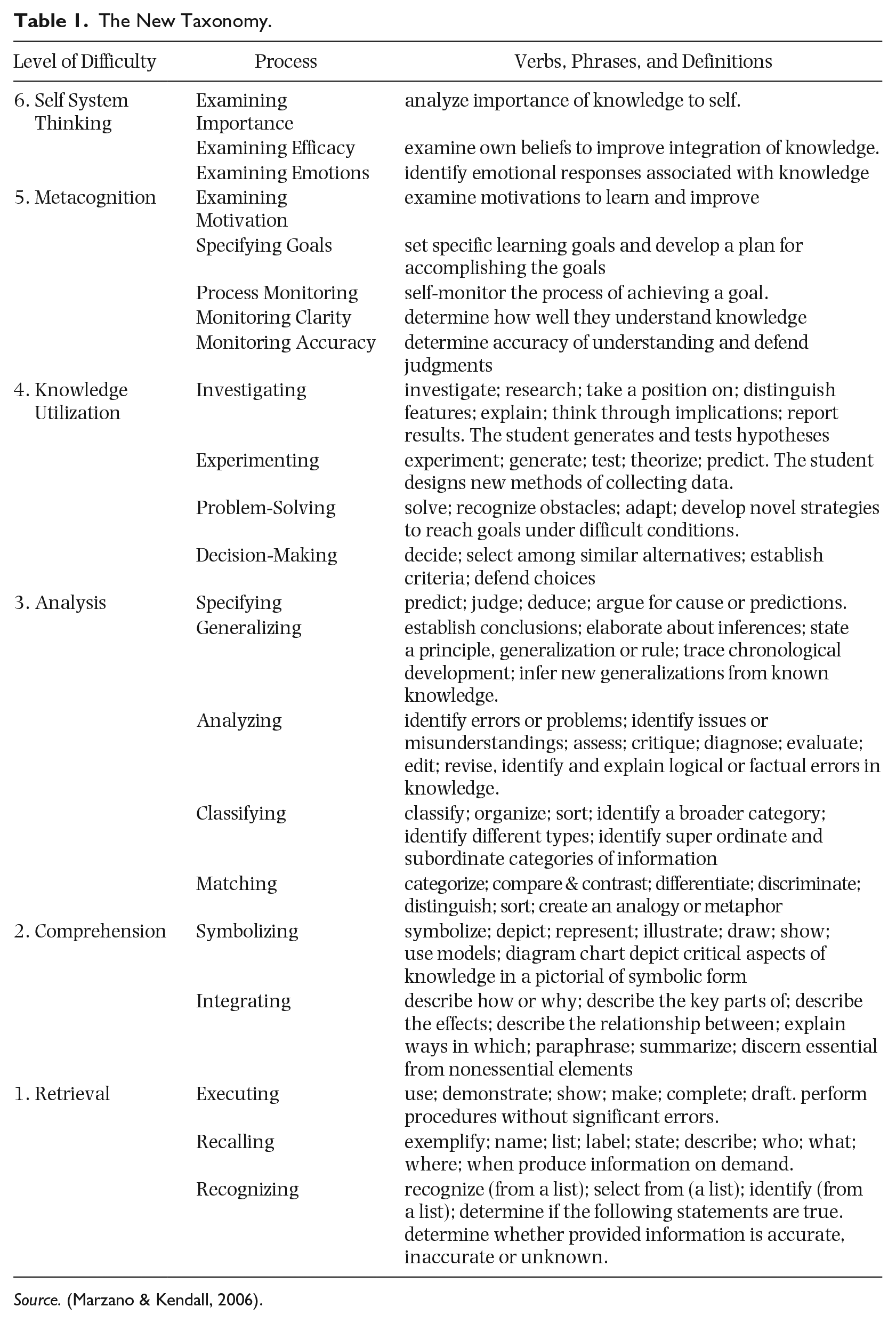
Source. (Marzano & Kendall, 2006).
The interactions filmed (Part 2) combined with the explanations and comments by the teachers and students allowed me to detect the importance assigned to the pedagogical acts and choices and to verify the assumed associations with the development of autonomy.
Results
The results derived from the data analysis are presented in three parts. I describe (1) teachers’ beliefs about autonomy and its development (RQ1) (Figure 1), and (2) teachers’ intentions and strategies for developing autonomy (RQ2) (Figure 2). The lengths of the lines in the figures represent the number of data records collected and therefore the importance given to autonomy by the teachers. The data were collected from 21 teachers interviewed.
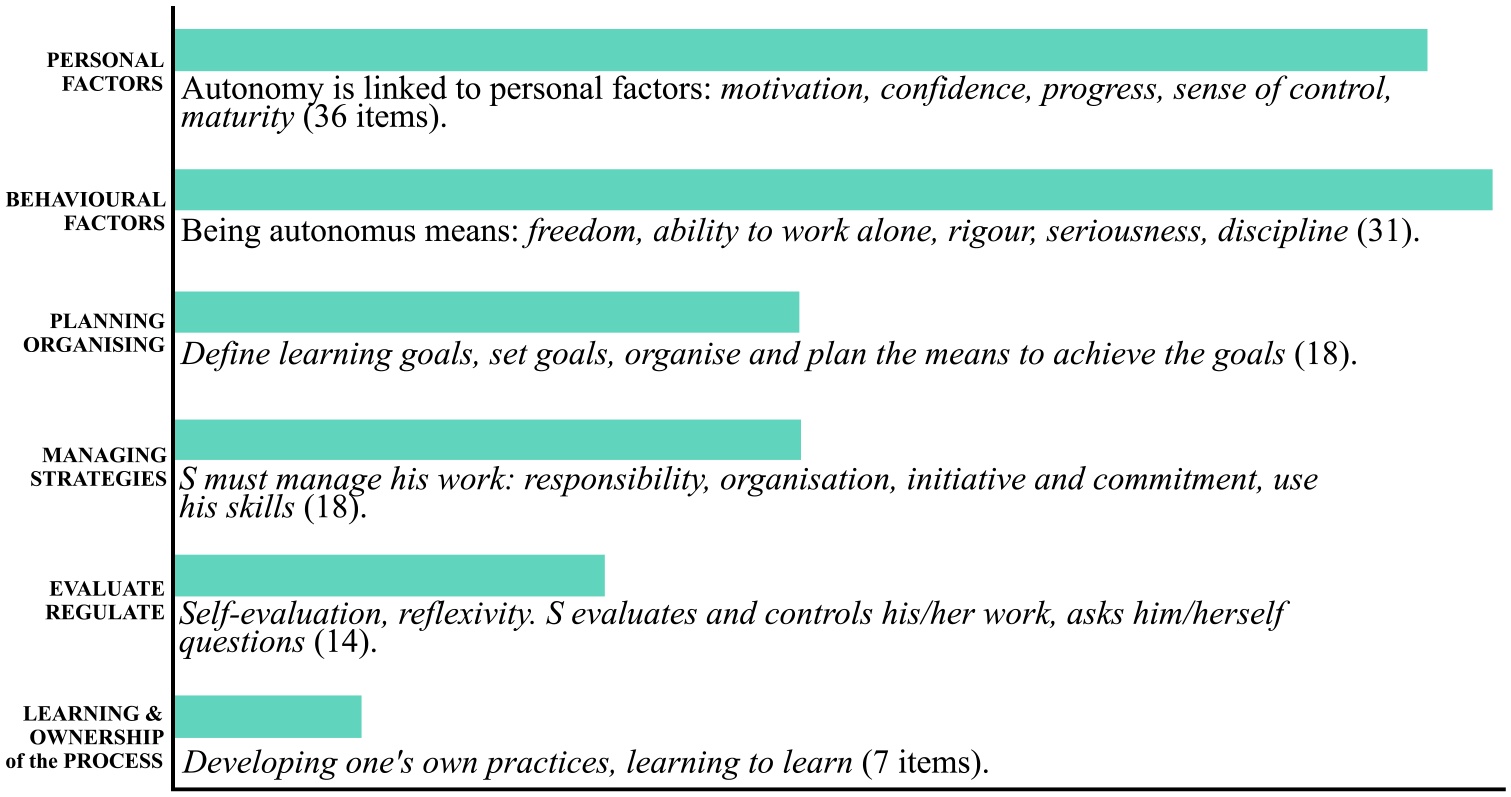
Teachers’ Beliefs About the Development of Autonomy.
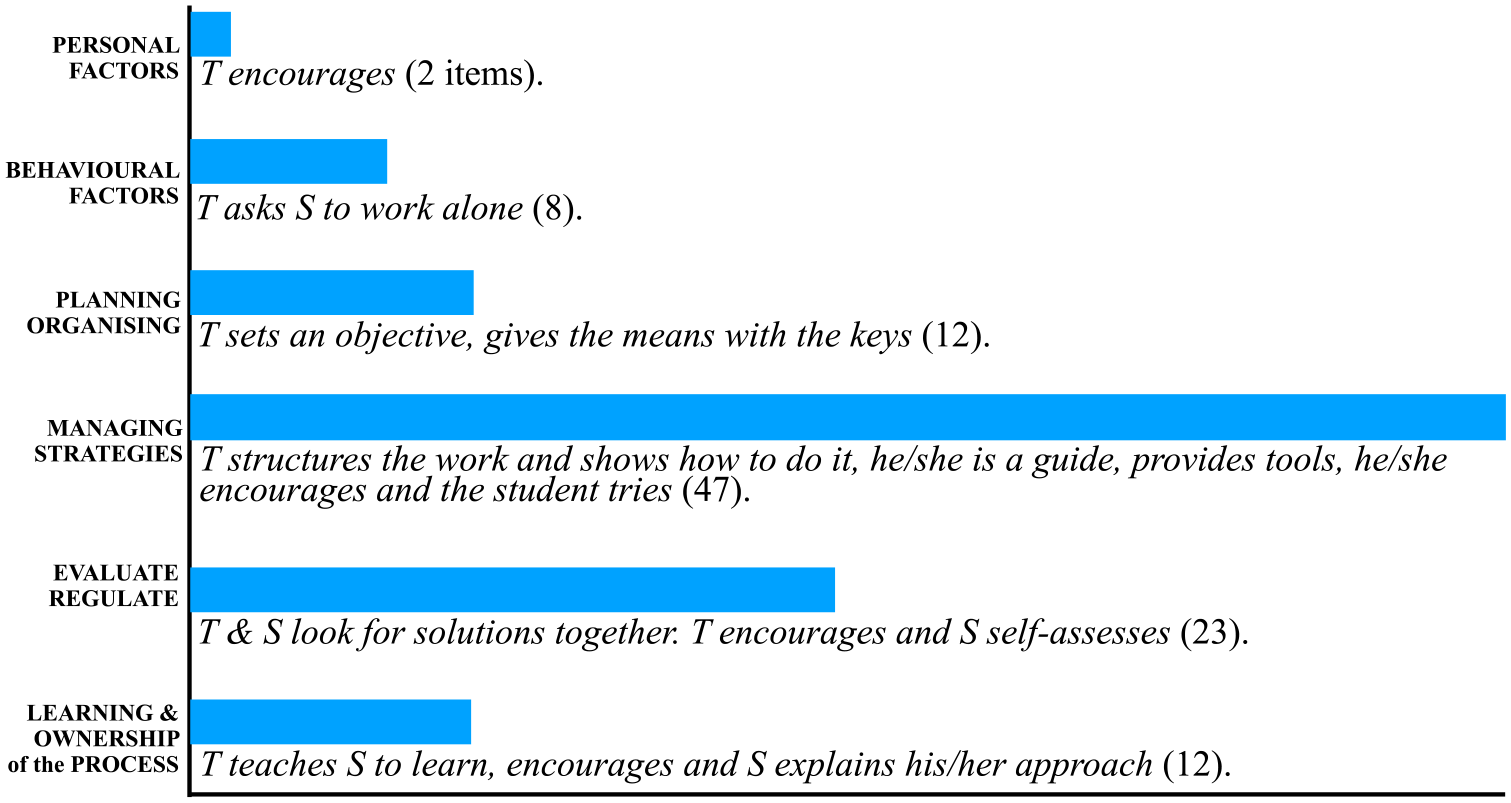
Teachers’ Intentions Regarding the Development of Autonomy.
These results also allow me to (3) compare the filmed actions, which were commented on by the teachers (RQ3), with their beliefs, intentions, and strategies to better define their stance in joint teacher−student action with a view to developing autonomy (RQ4). For the third part, three teachers were filmed and interviewed. The analysis of the results is presented in text form, illustrated by extracts from the lessons and the self-confrontation.
Teachers’ beliefs about autonomy and its development
The teachers linked autonomy primarily to motivational aspects and personality characteristics. They talked about autonomy first using terms such as “motivation, self-confidence, pride, sense of mastery, maturity, independence and freedom” (47 items). Second, cognitive skills were mentioned: “self-evaluation, reflexivity, synthesising, setting goals, developing strategies, deciding on criteria for success, controlling one’s behaviour, thoughts and emotions for self-regulating and improving performance” (36 items). Finally, the teachers named the necessary interpersonal characteristics: “rigour, seriousness, respect, discipline, curiosity and self-awareness” (24 items).
Teachers’ intentions and strategies for developing autonomy
The teachers emphasized the difficulty of developing student autonomy. They proposed solutions such as “guiding the student, supporting the activity, proposing tools and ways of working.” All items in Figure 3 were taken from the 21 teacher interviews and grouped together semantically. The number of items collected is indicated by the number after each description.
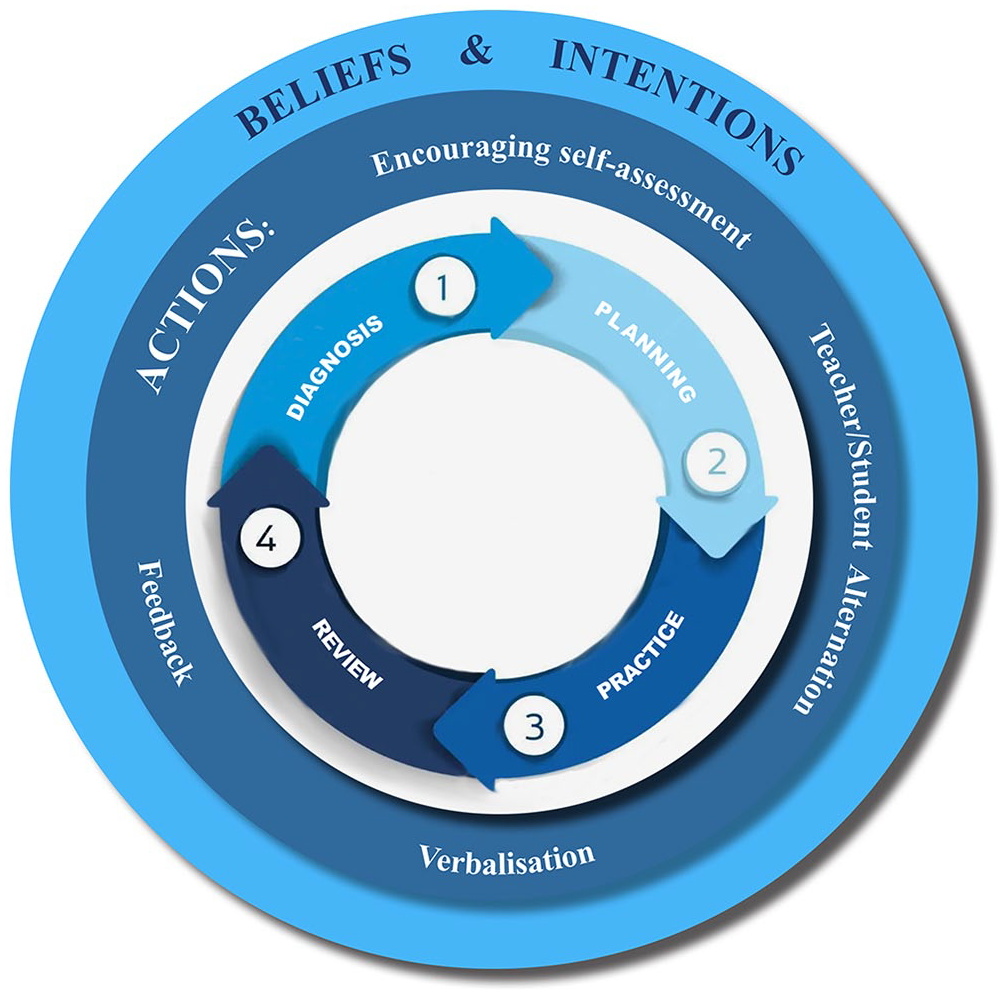
Model for Developing Student Autonomy.
According to the teachers, the complex process of students attaining autonomy includes actions with different levels of difficulty, ranging from “getting by alone with a score” to “learning to learn.” These elements relate to the “what” (working alone, solving problems alone) and the “how” (managing what has been done during the lesson, evaluating one’s own work, defining learning objectives).
Using Marzano and Kendall’s (2006) taxonomy to classify the data from this first part of the research, I found that the 21 teachers described their actions mainly in relation to tasks of a low taxonomic level (retrieval, comprehension). According to the teachers, they structure the work, show students how to do it themselves, and encourage students to try to do it (Figure 2). However, more complex tasks such as encouraging students to explain their approach (use of knowledge, metacognition, and systems thinking) were not mentioned. They consider themselves on the periphery of the process of students attaining autonomy and do not feel that they can really take actions to develop student autonomy.
The teachers reported that they were very present in terms of structuring work, providing tools, and encouraging students to assess themselves. The majority of teachers interviewed stated that the teacher is a guide for the student. However, they did not elaborate on the actions this status as guide involves. For this reason, I filmed the lessons to see precisely what the teachers actually did during joint action and to reveal the elements that make up teachers’ stance. After the lessons, when asked about their actions, the teachers were able to give more concrete information.
Teachers’ actions
Transmitting knowledge and guiding students in the acquisition of skills were the main actions mentioned by teachers in the first part of my research. Teachers reported supporting, guiding, and mentoring as well as offering tools and working methods. Most teachers implicitly assumed that students were able to reproduce the proposed strategies and actions in their individual work. According to them, it is sufficient for them to act as models for their students to reproduce and integrate a skill.
Based on the reality of the filmed lessons (Part 2) with the three selected experienced teachers, I observed that the teachers did much more to develop students’ autonomy than reported. Four types of strategy could be identified in their teaching:
First, encouraging self-assessment: The teacher checks the student’s intention: “I wanted to make sure I understood what she wanted to work on.” In short interventions, the teacher frequently encourages the student to express himself or herself on the difficulty of an action, the choice of a work strategy or asks him or her to monitor his or her progress, and evaluate his or her performance.
Are you able to visually point out the places that are difficult for you?
Well, in fact, I noticed while playing that it wasn’t always the same note.
Did you work on a mistake?
Yes, and so I still have to work on it.
In fact, you noticed that it’s the octaves, right?
Yes, yes, in fact it’s always re re re re re do si la . . .
Ah! You had another logic! And you realised that. Ok. So, you can work on it again.
Yes, it’s good.
Second, teacher–student alternation: This involves working through imitation, not only in terms of sound but also based on a verbalization, if the teacher wants to guide the student’s thinking, self-regulation, or activity with a closer dialogue: “Well, yeah, with every little try, she improves if she thinks about what she’s doing and the details. I think it gets her to think and judge her work when she’s at home. It becomes a habit to listen critically to what we’ve done.” The teacher guides the student, demonstrates, makes him or her aware that several pathways are possible, and assists the student with the development, automation, and transfer of knowledge. By giving brief feedback, the teacher confirms and clarifies what the student says or does. The teacher also gives the student space and remains silent after asking a question or at the end of a student’s performance.
Third, feedback: the teacher’s feedback and approval allow the student to adjust his or her activity, reinforcing his or her feeling of “doing the right thing”. There is a lot of feedback in the video data. Through this feedback, the teacher confirms the student’s actions, encourages him/her, and gives him/her confidence to work independently at home. Sometimes using words, sometimes using head movements or a smile, the teacher indicates to the student that he or she is on the right track. The process of a student attaining autonomy is long and complex. The teacher motivates the student, giving meaning and value to the content, and emphasizes the importance of the student’s effort and commitment: “Great! It’s already better. The sound isn’t perfect yet, but I’m not worried, it will come. We’re well on our way.” The teacher directs the student’s attention and interest to his or her strengths and weaknesses, supporting his or her concentration.
Fourth, verbalization: In a dialogue with the student, the teacher asks questions and stimulates reflexivity and metacognitive analysis: “So, I don’t understand, do you play smoothly to control the bow well? What’s the idea?” This stance encourages self-assessment and guides self-regulation, contributing to the joint analysis of goals and strategies.
The teacher encourages the student to put his or her actions and reflections during the lesson into words, thus allowing the student to set milestones—pillars on which he or she will be able to rely for his or her independent work. This encouragement takes the form of close questioning and insistence on the use of the right terms (“make it prettier” becomes “hold the embouchure, take care of the binding and then integrate the detached”). This verbalization can be stressful for the student, but it fosters the development of strong self-regulatory skills. (“It’s a little stressful, because I don’t really know what to say. And at the same time, I find that it helps you to figure it out yourself. It’s kind of complicated to figure out how you played. I have to be my own teacher for several methods or exercises.”) The verbalization also allows the teacher to understand how the student is proceeding, as students sometimes take unexpected pathways. “It’s interesting because it suggests a way of grouping things that I hadn’t thought of. It’s great to see that they’re finding strategies and a logic that works for them, that’s important. For me, it teaches me not to impose anything, to let the student look for himself or herself. Little by little, they build a repertoire of solutions to work with.”
In the excerpt below, the teacher encourages a student to self-regulate and guides her by asking specific questions. He reassures her that she is on the right track.
plays.
Bravo! So, tell me now, let’s imagine that you’re the teacher and the student plays this for you . . . what would you say?
(laughing . . .) I don’t know . . .
What advice could you give to help the student make progress?
Maybe to try to play less group-by-group and do bits together. Work two bars at a time . . .
Instead of playing everything?
Yes . . .
And why two bars? And not one . . . or three?
Well, I have the impression that the music is more on two bars . . . and like that, it’s not too much either.
OK, yes . . . and the idea is to repeat these two measures to memorise them . . . for the drill.
Yes. And then look at those that don’t go so well, we would work on them several times, or more slowly.
Yes, ok.
The teachers do not explicitly mention awareness of the learning process. Their questioning remains quite general, for example, “What did you notice?” or “What happens when you do this?” This is an important point that will be developed in the “Discussion” section.
Conclusive synthesis of the results
Beliefs and intentions
Teachers are aware that the development of autonomy is essential. In the first part of the study, they emphasize the importance of motivation and the personal characteristics of the student. They also mention the skills required for self-regulation as essential pillars for the development of autonomy. However, their beliefs and intentions reveal that they see themselves as being on the periphery of the process. For Zimmerman (2008), the autonomous learner is a learner who defines his or her own goals, decides on criteria for success, chooses strategies, monitors, and self-regulates. The teachers’ intentions reveal that it is the teacher who performs these tasks with the student, who takes charge of the process.
Actions
The three teachers carry out many actions that support the development of student autonomy. However, they are not always aware of the specific strategies used and do not conceptualize or mention them in their interview responses.
In their professional actions, they encourage the verbalization of cognitive processes, as highlighted in the work of Runtz-Christan and Coen (2017), Cosnefroy (2011), or Mucchielli (2009). However, they do not mention verbalization in the interviews.
The teacher’s stance
While guiding their students, the teachers encourage them to express themselves, to find words to describe different important moments of the lesson. They support their students with a reassuring guiding stance: “We’ll get there!” They set an example by frequently introducing students to self-assessment and self-regulation through dialogue and by offering them challenges aligned with their abilities. Teachers sometimes leave students to fend for themselves, but never abandon them.
As noted by Regelski (2004), Duffy et al. (2009), and Sensevy (2011), self-regulatory behaviors and skills emerge in interaction between teacher and students. The four types of strategy derived from my findings confirm the importance of teacher stance. The research of Ursin and Paloniemi (2019) and Pratt (1998) showed that teachers’ beliefs influence the choice of teaching strategies. I observed real involvement of teachers in the action, even if they had difficulty describing it when they talked about their work.
Discussion
Aiming at specifying the role of teacher stance in fostering the development of student autonomy, this study generated findings that can be divided into three main areas: the balance between transmission and construction of knowledge, the quality of teacher support depending on the difficulty of a task, and the place, role, and quality of verbalization in music lessons.
First, finding a balance between the transmission and construction of knowledge is difficult (Coen, 2018; Lahire, 2001). The transmission of knowledge and teacher explanations take up a lot of space in lessons. It is difficult for music teachers to allow students to take charge of their learning, especially when students have to accomplish complex tasks, as shown by my results based on an analysis according to the Marzano-Kendall taxonomy. When describing their beliefs and intentions, teachers do not explicitly mention the subtle mechanisms that allow students to integrate self-regulation procedures (Grangeat, 1999; Zimmerman, 2008). Teachers impart knowledge, demonstrate to students how to work independently, and assume that students will be able to acquire these skills over time. Allowing students to take responsibility for their own learning can appear to be a loss of control for teachers.
Second, the teachers provide a lot of explanations and demonstrations of their strategies, but mainly with regard to simple tasks. For more complex tasks, which are higher in the taxonomy, they have few strategies for engaging students and making them aware of self-regulation. Nevertheless, the results reveal a large number of teaching actions that encourage self-regulation, taking the form of demonstration or accompaniment, which are often performed instinctively and not verbalized by teachers. Teachers implicitly expect students to be able to recreate the learning process that has been demonstrated to them, regardless of the amount of guidance provided. One of the reasons for this lack of explanation becomes directly clear in the interviews with teachers. They rely mainly on their experience to carry out actions fostering self-regulation and are not sufficiently informed theoretically on the foundations of self-regulation development.
Third, the results of the second part of the study on actions reveal moments of verbalization that the teachers do not systematically refer to in the self-confrontation interviews. Although the teachers often make the student aware of the learning process (Cosnefroy, 2011) through verbalization (Deschênes, Pelletier, et al., 2020), they do not mention it as an important element in the self-confrontation interviews.
Future directions and presentation of the model
To integrate self-regulatory procedures, students need to learn how to handle complex tasks. Encouragement of verbalization by teachers is a first step, but not sufficient. Guiding students to analyze instrumental techniques or working procedures in detail and asking students to explain these analyses are two indispensable steps that should be integrated into music lessons. “Yes, but it takes time!”, teachers reply. However, taking this time is not really a constraint. Although the acquisition of autonomy is a long process (McPherson & Zimmerman, 2011), asking good targeted questions at specific moments in the learning process only takes up 2 or 3 min during a lesson, yet it paves the way to the student developing autonomy. The teacher’s stance supports musical learning and, at the same time, encourages student verbalization to foster student awareness of the learning process.
Model for developing student autonomy
As the teacher’s stance is decisive in the process of acquiring autonomy, I propose a model of joint teacher–student action in four mutually flexible phases, which allow for backtracking, reminders and moments of experimentation:
Phase 1 (Diagnosis) is centered on the activity of the student who presents his/her intentions and strategies, guided or redirected by the teacher. This moment guides the rest of the work. It is a focused dialogue lesson which allows the teacher to move directly to Phase 2.
Phase 2 (Planning): The student verbalizes and makes explicit the objectives, strategies and priorities. This anticipation of the work and the links with the teacher’s experience reassure the student, give him or her confidence and, above all, allow the integration of metacognitive strategies. The teacher confirms or readjusts the student’s proposals.
Phase 3 (Practice) consists of guided work, imitation, regulation, self-regulation, and individual training. Even in action learning and musical learning, awareness is essential. There are two powerful ways of developing awareness which were identified in the actions of experienced teachers: first, moments when specific questions make students listen specifically to a detail, and second, when students are encouraged to describe their perception of this detail. This sharpens students’ hearing and interest, builds their confidence, and fuels their motivation. Finally, it is important to be silent. In Phase 3, the teacher’s silence is worth its weight in gold. It allows the student to try out, reflect, test, and have time for musical practice.
Phase 4 (Review) consists of brief and very focused feedback on the process carried out in Phases 1−3. This final verbalization is guided by the teacher (“Could you explain to me how we improved this passage?”). It allows the teacher to check understanding of the “how” and the student to become aware of the processes experienced. Under guidance, the student is proactively involved and gradually builds a technical and (meta)cognitive repertoire of skills, knowledge, and strategies.
Limitations of the research
This research project in music education highlights the fundamental role of the music teacher. However, my research is subject to a number of limitations.
First, each teacher−student pairing is unique. The teacher orients his or her stance according to his or her affinities, organizes his or her own value system (built up since childhood), which influences his or her pedagogical and didactic choices as well as assessment practices. The student also has a distinctive profile, family, social context, and personality. The teacher–student duos followed and analyzed in this project are only several examples from a multitude of possible pairings.
Second, we are in a pedagogical model (Hargreaves, 1995) rather than a pedagogy of creation. The institutional framework imposed constraints on the frequency and duration of lessons. Furthermore, the extensive historical past of the instrumental teaching of the master virtuoso (Marchand, 2011) still leaves traces that are difficult to parameterize in my study.
Third, the educational system, school, and social environment have a very important impact on students’ attitudes. Ideally, students are the actors of their learning and considered intelligent, responsible, reactive, proactive, and able to build their knowledge. Autonomy is based on transparency (everything must be explained) and objectification (based on knowledge and skills). The student must have the necessary tools to progress with his or her self-assessment (analysis grid, criteria, etc.). Developing autonomy is demanding and requires a significant cognitive effort, hence the importance of homework management by the teacher with regard to this activity, which has the status of an extracurricular leisure activity (hobby).
Finally, I place great importance on verbalization. However, verbalization is not always possible as the student experiences feelings that are sometimes difficult to define and even more difficult to express and describe in words. The expression of emotions is a personal matter, which is why it is important to give students the freedom to express themselves individually. The teacher can offer tools for self-expression with a vocabulary adapted to the age of students, but the essence of music is, above all, experiencing it without speaking. On the contrary, talking and exchanging about the technical aspects of learning is important. The secret probably lies in striking a fine balance between listening, practicing, imitating, describing, conceptualizing, and planning.
Research perspectives
The next step in my research will be to integrate the student’s perspective, stance and perceptions. I will then be able to propose a model of teacher education that integrates conceptions, actions and thinking about actions and a method of increased reflexivity that is individually tailored to the student.
The acquisition of autonomy is a progressive and constant process, in which the teacher’s role is fundamental at every stage. It seems indispensable that the teacher has better and more detailed knowledge of the entire process. This requires teachers to be informed and attentive to the specific actions and interactions at certain key moments of the lesson. The teacher’s stance thus allows students to develop self-regulation skills and to be capable of producing (meta-) observations of his or her learning. Understanding the issues as well as training and informing teachers is therefore the future direction of my work.
Music is a social activity to be experienced together, to be shared with peers. It would be interesting to conduct research on autonomy in chamber music, in small instrumental groups, or in orchestras. The importance of social interaction for the development of student autonomy is certainly a relevant avenue for future research.
