




Abstract
Evidence to date suggests there may be a link between interpersonal synchronization and sense of connectedness to others in both music and non-music tasks. However, earlier studies have used a fixed tempo, thereby ruling out the study of spontaneous synchronization that might emerge from a group of agents. This design is essential to test theories that implicate intrinsic systems governing rhythm within individuals as the source of interpersonal synchronization, coordination, and shared positive affect. The current study used an impromptu music-making task to study the relationship between spontaneous synchronization and sense of connectedness. A total of 49 participants were recruited in dyads or triads and were asked to play percussion sounds on MIDI keyboards for a period of 10 min. Every minute they gave a rating of how connected they felt with the other group members. Participants who showed longer periods of spontaneous synchronization during the joint music-making task reported greater average connectedness with the group members during the task, and a greater increase in connectedness over the duration of the task. Within-individual correlations between synchronization and connectedness revealed a tight coupling in around a third of the participants. We discuss the theoretical implication that the collective control of perceptual variables—such as tempo—may achieve and maintain a sense of connectedness to others.
Music is a cross-cultural human phenomenon, with most individuals possessing at least some level of musical ability (Launay et al., 2014). Researchers suggest that one of the explanations why music has evolved is that it emerged as a means to establish and maintain social bonds between members of groups (Huron, 2001; Peretz, 2001; Savage et al., 2021). Looking into traditional small-scale societies, we can notice quite a few examples of including music in the most important cultural practices and rituals, such as worshipping, weddings, funerals, or preparations before hunts or combat, which are taken to be vital for the maintenance of the identity of a group (Clayton, 2009). Consistent with these observations, researchers have found that groups engaging in music-making activities show an increased amount of prosocial behavior, social connectedness, trust, and bonding (Keller et al., 2014).
One of the reasons presented in the literature for why engagement in music activities has such a large positive influence on connectedness across group members is that it possesses a great amount of physical interpersonal synchronization (Kirschner & Tomasello, 2010). Interpersonal synchronization is defined as coordination and adjustment of simultaneous rhythmic actions throughout the time (Bernieri & Rosenthal, 1991). It has been shown that interpersonal synchronization is a desirable state between people (Müller & Lindenberger, 2014), involving activity in the reward-processing brain regions, such as the ventral striatum (Kokal et al., 2011). Researchers have proposed that activities involving rhythmic synchronization are important for group cohesion, social affiliation, and bonding, can create the feeling of expanding into the larger group and weaken the boundaries between self and others (Cohen et al., 2010; Konvalinka et al., 2011; Miles et al., 2011; Wiltermuth & Heath, 2009). For example, in an early study of teacher–student interactions, increased rapport correlated with external ratings of their movement synchronization (Bernieri, 1988). Similar results also have been found in parent–child bonding (Isabella et al., 1989). Synchrony and perceived affiliation have also been studied (Hove & Risen, 2009). Participants tapped their fingers with visual pacing alongside the experimenter who was tapping either in synchrony, asynchrony, or did not tap at all. Results showed that tapping in synchrony with the experimenter increased perceived affiliation, and the more precise the tapping was, the more affiliated they felt. Furthermore, they found that results in the not-tapping-at-all condition were similar to those in the asynchronous, indicating that it was not asynchronization that decreased the ratings—it was synchronization that boosted them. Within musical interactions, people showed more helpful behaviors toward their partner who drummed with them in synchrony as opposed to when the drumming was non-synchronous (Kokal et al., 2011). In a further study, after a synchronous music task, participants cooperated more, even if the tasks required personal sacrifice (Reddish et al., 2014). Furthermore, it is important to note that these positive social consequences of the interpersonal synchronization develop early and so they could be based around innate systems within the developing human (Keller et al., 2014). For example, it was found that after a synchronized task with an experimenter, 14-month-old infants were more likely to assist him in raising “accidentally” dropped items from the floor (Cirelli et al., 2014). Another study also found that synchronized joint music-making task promotes spontaneous cooperative and helpful behavior in 4-year olds (Kirschner & Tomasello, 2010).
As a caveat, social synchronization can be non-ideal in certain circumstances, such as when different synchronized groups conflict with one another, or when synchronization to a leader entails obedience toward engaging in harmful activities (Gelfand et al., 2020). Such an account may help to explain situational and individual differences in the tendency to synchronize with others. There are also methodological issues with regard to the measurement of prosocial behavior, with one meta-analysis finding that the association with interpersonal synchrony is eliminated when restricting the analysis to studies in which the researcher is blind to the hypothesis (Rennung & Göritz, 2016).
A theoretically grounded review has proposed two factors that explain how interpersonal synchronization influences positive social consequences (Keller et al., 2014). First, interpersonal coordination may draw one’s attention to one’s partner and therefore, improves the perception of him or her (Macrae et al., 2008). For example, it was shown that after moving in synchrony, participants better recalled discourse of their partner; however, during the non-synchronous task, they better recalled their own words (Miles et al., 2010). Keller et al. (2014) claim that through directed attention and enhanced representation of the other, the perception of similarity is, in turn, created and this mediates the effects on a sense of connectedness. Indeed, it was evidenced that after acting in synchrony, participants experienced a sense of similarity with their partner (Valdesolo & DeSteno, 2011). Keller et al. (2014) concluded that synchrony helps us feel more similar and united, and in turn, more connected.
Secondly, synchronization may tune temporal adaptation and anticipation, resulting in the success of joint actions. For example, it was found that after rocking in synchrony, participants both felt more connected and were able to anticipate, coordinate, and adapt their movements better in a following joint action task (Valdesolo et al., 2010). Authors concluded that synchronization augments cognitive-motor skills required for cooperative ability. It is proposed that joint action success includes co-representing and simulating each other movements and therefore, the representation of another person and self is highly connected during a successful synchronization. It creates a decreased difference between activity produced by self and the other and thus, drives affiliation (Keller et al., 2014).
A third factor has also been articulated. Kirschner and Tomasello (2010) proposed a concept of shared intentionality to explain how synchronized joint music-making tasks relate to positive social consequences. Joint music-making demands the collaborative formation and representation of musical goals. In music-making tasks, this goal is directed at content, that is both generally pleasurable and of affective significance. In that way, joint music-making encourages the formation and experience of shared values and we are able to strengthen a feeling of a “we” unit and thus achieving that desire to share emotions, experiences, and also bond with each other.
The above proposals appear well justified, but they still raise the question of how synchrony, joint action, and shared intentionality work at a mechanistic level. Specifically, it appears that people playing music together develop joint attention to elements of the music (Cochrane, 2009); people who perform together, perceive together. To answer this question, the mechanism of entrainment also needs to be understood. Entrainment is the capacity to synchronize to an externally perceived rhythm, such as dancing and music in humans, and there is an emerging consensus that it requires the phase locking of an external rhythm to one or more intrinsic oscillators that are organized in a “metric hierarchy” (Levitin et al., 2018). One key question is how the phase-locking process occurs. Arguably, a working, computational model of the process to test against behavioral data would be a robust test of the mechanism (Mansell & Huddy, 2018).
A number of theoretical frameworks may lend themselves to the modeling of interpersonal synchrony. A contemporary approach is active inference (Koban et al., 2019). We do not aim to describe this particular theory in detail, but rather point out that active inference overlaps considerably with perceptual control theory (PCT; Parr et al., 2022). PCT (Powers, 1973), however, provides a simpler conceptual framework grounded in classic control engineering that could explain and model the mechanism of developing and maintaining interpersonal synchrony. PCT proposes that actions are varied to keep perceived aspects (e.g., the rhythm of a drum one is hitting) at a desired reference state (e.g., the rate of an internal oscillator) through a negative feedback control system. PCT has been used to model the development of synchronization within a simple robotic device (Moore, 2007). The robot computed the temporal gap between its own percussion sound and the external beat, and continuously adjusted the timing of its outputs to keep the gap as short as possible. PCT has also been used to model “collective control” (McClelland, 2004). Collective control occurs when multiple agents, connected by a shared environment, act together to control an aspect of their environment, that often would not be possible alone. Interpersonal synchronization would be an example of the emergence of collective control, where multiple agents strive to achieve the perception of a matched tempo.
Synchronization may be one of a number of perceptual goals that serve an intrinsic need for a sense of connectedness to others that enables collective control, with, or without, joint action or simulation of the other person, as assumed by other theories (e.g., Keller et al., 2014). In line with this idea, PCT proposes that control of intrinsic variables that promote survival through processes, such as threat evasion, safety-seeking, and social cooperation is at the heart of health and well-being (Mansell, 2005). Thus, in the terms of PCT, synchrony may emerge as individuals act together to keep their perceptions of the music (e.g., rhythm, harmony) at its desired value, and in doing so, are more able to meet the intrinsic goal of social cooperation.
One key empirical requirement for testing any of the above theories is that in order for interpersonal synchronization to occur naturally and be assessed or modeled, neither instructions nor external input to direct the tempo of the performance should be provided (Oullier et al., 2008). A common social example would be clapping of the audience after the concert. Both anecdotal evidence and empirical studies have shown that even with an absence of influences from the stage, the audience still is able to synchronize their movements to become a single synchronized ensemble (Néda et al., 2000). In a study using rocking chairs, participants who spontaneously coordinated their movements with another individual perceived a greater sense of “teamness” in a pair (Marsh et al., 2009). Spontaneous pattern formation is evidenced early in childhood in a form of imitation or mimicry and has been noted in groups of various sizes (e.g., Barsalou et al., 2003; Motter et al., 2003).
A range of methodologies have been developed to study spontaneous synchronization in groups of two or more individuals. One set of studies used the “mirror task” in which two individuals were instructed to work together to produce a synchronized and interesting pattern using a handle that moved in one dimension (Noy et al., 2011, 2015). Synchronization was indexed by shorter latencies between points at which the handles were motionless at the peak of a periodic rhythm. The studies showed that participants were able to spontaneously synchronize as instructed, and a mathematical model based on control theory could be fitted to their data (Noy et al., 2011). The index of synchronization showed only a modest correlation with subjective measures of “togetherness” made by the participants (Noy et al., 2015). This paradigm is limited with regard to understanding the relationship between music performance and synchronization because it does not involve musical performance, and the participants are explicitly primed by the experimenter with regard to achieving synchronization with one another.
One study addressed the limitations of the above paradigms through using spontaneous musical improvisation between dyads using MIDI instruments and providing no explicit instructions to synchronize (Setzler & Goldstone, 2020). Synchronization was indexed by independent raters, and objectively through calculating the mean latency between two “near-identical” onsets (below 100 ms). Spontaneous synchronization was found, but the study did not aim to exclude other forms of communication between the participants, nor did it explore the relationship with social connectedness. Similarly, another study allowed musicians to view each other as they performed over a backing track (Walton et al., 2018). An alternative paradigm, involving large groups of musicians, did not aim to explore the relationship between musical synchronization and social connectedness (Goupil et al., 2020, 2021). One study did find that synchronization between individuals was associated with the perception of togetherness, but it used an external rhythm while performing a non-musical task—moving on a rocking chair (Demos et al., 2012). A highly ecological study involved groups of musicians improvising together with no external rhythm (Saint-Germier et al., 2021). They found that the points at which musicians played notes that aligned with other musicians in time, they felt more “immersed within the group.” This study did not limit social communication with the participants and its index of synchronization did not involve an alignment with a shared, emergent rhythm.
The current study therefore aimed to address the limitations of earlier studies by assessing the emergence of spontaneously occurring synchronization using an impromptu music-making task with no external rhythm, and in which non-musical forms of communication between participants were limited. We hypothesized that the amount of time of spontaneously occurring synchronization possessed in a music-making task would be positively correlated with perceived connectedness among the group members both between and within participants. The main index of synchronization was provided by a musically trained rater but we also used the study to trial a novel objective index—mean absolute onset difference from an emergent best-fit rhythm (DiffEBR)—which is described in the “Method” section. We explored the pattern of emergence of synchronization and sense of connectedness over time to inform future studies, including computational modeling of collective control during music-making.
Method
Participants
Ethical approval was obtained from the University of Manchester Research Ethics Committee (2018-5341-7329). A total of 49 university students (43 females and 6 males, aged 18–25 years; M = 19.84, SD = 1.59) were recruited using an experimental participation scheme. The number of participants was selected to be an achievable target for recruitment in the timeframe available and would be sufficient to detect a moderate–large effect size (> r = .40) for an alpha of .05 at 80% power (n = 47). All participants reported having normal or normal-corrected hearing.
Materials
Everyday sense of connectedness (psychological state) was assessed using the Sense of Connectedness Instrument—SCS-R. The SCS-R is a 20-item, six-point Likert scale used to measure social connectedness (Lee et al., 2001). Participants were asked to indicate their level of agreement with each of 20 statements about social connections on a Likert scale, ranging from strongly disagree (1) to strongly agree (6). Examples of the scale items include “I feel close to people” and “I don’t feel related to most people.” To score the scale, 10 of 20 items were reverse-scored. The final score was summated and ranged from 20 to 120, with higher scores indicating a higher connectedness score. This scale has been found to have good internal reliability, as well as convergent and discriminant validity, with coefficient alpha in a college student sample being .93 (Williams & Galliher, 2006).
The current state of connectedness (connectedness) scale was developed to quickly (in a 10-s window) and sensitively capture the change in a sense of connectedness over short periods of time. Connectedness was assessed using a single-item (“Please indicate how connected you feel with other group members”) 10-point scale, 1 indicating complete separation from the group members and 10 indicating complete connectedness with them. Single-item connectedness scales were shown to have excellent test–retest reliability, discriminant, and convergent validity when measuring a sense of connectedness in the community settings (Mashek et al., 2007).
A happiness scale was developed to sensitively capture the current overall state of happiness both pre- and post-playing task. Happiness score was assessed using a single-item (“How happy do you feel at the moment?”) 10-point scale, 1 being an indicator of not feeling happy at all and 10 being an indicator of feeling extremely happy. As evidenced by many academics, single-item questions are the most commonly used method to measure happiness (Kalmijn et al., 2011; Krueger & Schkade, 2008). Single-item happiness scales such as “Do you feel happy in general?” were reported to have a temporal stability of 0.86 (Abdel-Khalek, 2006), and also high positive correlation with both the Oxford Happiness Inventory (Hills & Argyle, 1998) and the Satisfaction with Life Scale (Pavot & Diener, 1993), showing a good concurrent validity. To improve validity, our measure included specific and explicit time landmark (“at the moment”) (Husser & Fernandez, 2018). Following the critique on the Likert scales for measuring different types of subjective quality of life as not being sensitive enough (Cummins & Gullone, 2000), we used Cummins and Gullone (2000) recommendation of 10-point, end-defined scale.
Acquaintance level was developed as a single-item—“Do you know anyone from the group? If yes, how many people and how well” on a scale from 1 (not at all) to 10 (extremely well)—measuring whether participants knew anyone from the group they were playing in. That was used to guard against the possibility that the connectedness stemmed from a general familiarity with group members.
MIDI piano keyboards AKAI MPK Mini MKII, Yamaha DJX, and Yamaha NP11 Piaggero were used for the playing task. Output grand piano sounds were changed to artificial percussion sounds, such as drums or triangle to alleviate individual differences in musical harmony and rhythmical knowledge. Each participant in a group was given a different percussion sound that they could play at five different pitches (C, D, E, F, and G) using five pre-marked buttons. MIDI files were recorded using M-AUDIO audio interface and Ableton Live 9 Suite software.
Procedure
The number of participants per group was considered carefully and we concluded that recruiting trios of participants would allow the potential for individual differences in synchronization between three different pairs of participants to develop, yet be a manageable number to recruit together. If only two participants came to the test session, they were tested as a duo, and the results compared. They were seated side by side in front of the table with the instruments on it, 1 m away from each other, facing the experimenter. Participants did not have visual access to each other’s ratings and were specifically asked not to look at each other or talk to each other throughout the task. They were given a study information sheet and consent form to read and fill in, were asked to provide some demographic information, fill in the SCS-R, and give the current happiness score. Then, they were asked to fill in the connectedness scale, indicating how connected they felt toward other participants in the same room. Instructions to the participants were given exactly as follows: Your task will be to play with the music instrument you have in front of you for the following 10 minutes. After each minute passes, I will verbally indicate you to rate how connected you feel with other peers in this room, giving the rating on the piece of paper provided in front of you. You will have 10 seconds to give your rating. Whilst playing, do not look at each other and play with the marked buttons only.
After a practice playing trial, the experimenter verbally indicated the start of the experiment. During the 10-min playing tasks, the experimenter gave a verbal sign after each minute passed, indicating participants to provide a connectedness score. After the playing task, participants were asked to provide a happiness score and to indicate the acquaintance level. At the end of the study, participants were debriefed and thanked.
Subjective synchronization analysis
Synchronization time analysis was performed subjectively by an experimenter who holds 10 years of music education. The audio data were examined by the listener by making a binary judgment (yes/no) of synchronization occurrence in every second of recording. Judgments were carried out blind to the connectedness ratings. The participant was judged as performing synchronization if he/she was synchronized with at least one person in a group. The use of computer algorithms based on note onset and duration to assess synchronization was trialed but it did not approach the level of accuracy achieved by human listeners as the periodic tempo, or beat, was absent from the data. Periodic tempo gives a grid of reference points, which can then be used to capture deviation from the standard. Unlike other synchronization studies, our task did not employ an explicit beat. As the data pattern is fluctuating in an unpredictable order both within a participant and between them, tempo tracking employing a computational analysis becomes hard if not an impossible task at the moment.
To check the homogeneity of synchronization data, an inter-rater reliability analysis using a Pearson correlation was performed on 20% of data. Synchronization time analysis was carried out by a non-musically trained independent rater. An earlier study found that musically trained and non-musically trained raters could distinguish different levels of synchronization within musical performances (D’Amario et al., 2019). The inter-rater reliability for the raters was found to be strongly positive, r(8) = .998, p = .001, 95% CI = [.99, .1]. To explore the degree of agreement among raters within each participant individually, 10 Pearson correlations were carried out on the variables of interest. Within 10 out of 10 participants, there was a significant positive relationship between both raters, with r values ranging from .897 to .998.
Also, a benchmark scenario was carried out to assess the profile of synchronization when explicitly instructed to do so. A dyad in the benchmark study reached synchronization within 4 s of the playing task start, while a trio reached it within 5 s.
Development and implementation of an objective index of synchronization
The measurement of synchronization varies widely between studies and can be direct or indirect. An example of an indirect method is recurrence quantification analysis, which quantifies the degree to which patterns in data reoccur over time (e.g., Proksch et al., 2022). A commonly used direct method is to assess the deviation in latency between the onset of participant notes, with shorter average latencies thought to represent better synchronization (e.g., Setzler & Goldstone, 2020). However, we identified a number of issues with this approach. First, there needs to be a way of defining those discrepancies in onset that are meaningfully asynchronous rather than being examples of onsets that might occur “off-beat,” such as an alternating rhythm played by two individuals who are synchronized but never play at the same time. Second, these methods do not include any rhythmic reference point, as would be used to establish the level of synchrony with a fixed, external rhythm; hypothetically, if two individuals played at the same time, but not in time with a rhythm, they would still get a high synchronization score.
For the reasons above, we developed a new method employing k-nearest neighbor (KNN) search (a machine learning method) that incorporated “quantizing” in electronic music production, to establish a best-fit model, and the established latency calculations. We assumed that true synchronization would occur when two or more individuals play in time with a shared rhythm that emerges during the session. We constructed the code to generate a range of possible emergent rhythms and then selected the one that matched most closely with each 4-s segment of the whole recording; this allowed for the emergent rhythm to change over time. While a fully developed algorithm would have the capacity to generate all possible forms of shared rhythms (e.g., waltzes, sambas, etc.), we restricted them to a fixed number of beats per minute, each with quarter beats. Once the best-fit emergent rhythm was selected, for each participant within each time window, the mean absolute time difference in onset between their notes and those of the nearest quarter beat of the best-fit rhythm was established as a proportion of the number of beats per minute. The mean of the value for each minute of the recording was recorded. This produced an index of how well each participant synchronized with the emergent rhythm for that period, whereby smaller values indicated better synchrony. To calculate the extent to which the participants in a dyad synchronized with each other, the absolute difference between these two values was calculated. This produced the same value for both participants in a dyad. For trios, the synchrony of all pairs of dyads was calculated, and each participant retained a score that was the most synchronous of all possible dyads (i.e., their level of synchrony with the other member of the trio with whom they synchronized the best).
A flow diagram of the algorithm is shown in Figure 1, and the full code is available at https://github.com/PCT-Models/Music_synchrony.
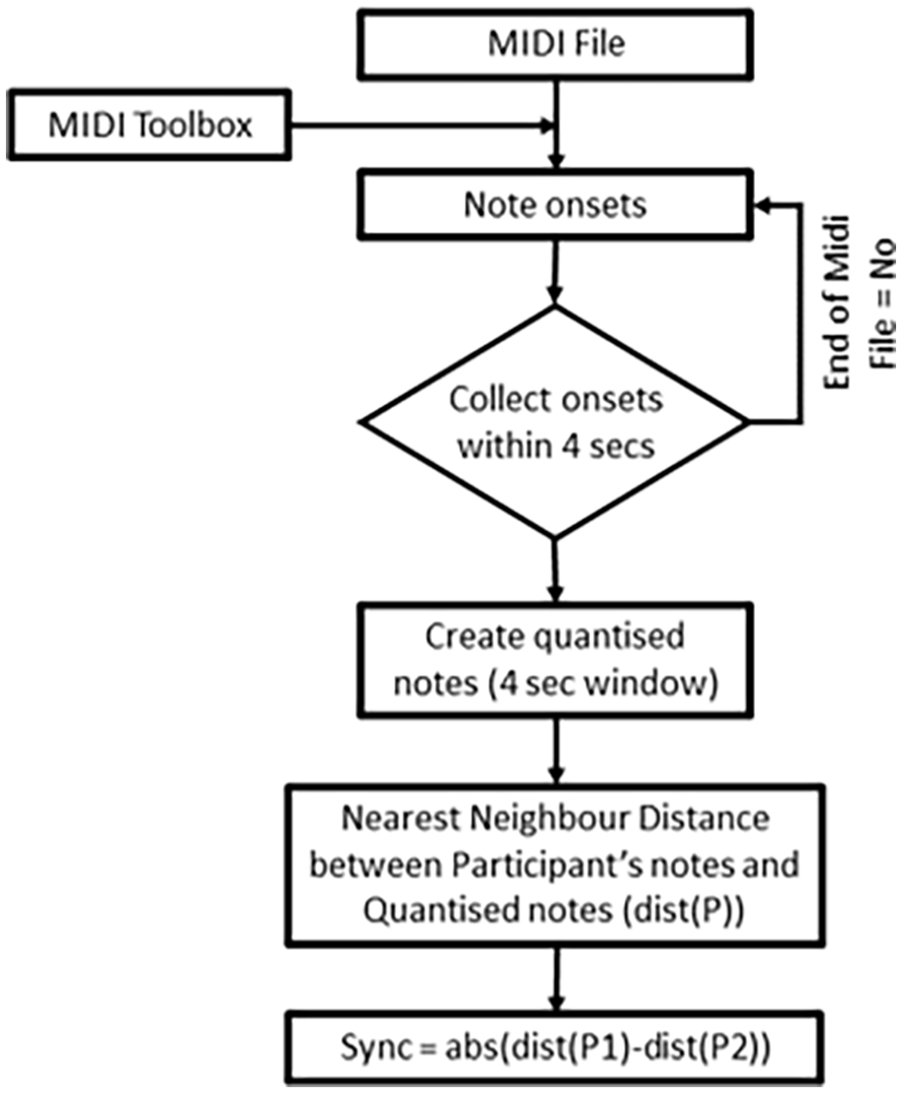
A Flow Diagram of the DiffEBR Method of Calculating Interpersonal Synchronization.
Statistical analyses
SPSS 22.0 was used to conduct the statistical analyses. Prior to parametric analyses, data were checked for normality of distribution and potential outliers were checked by eye after constructing histograms. Skewness and kurtosis values were inspected. All of the data were within the expected interval of −2 and + 2 (George & Mallery, 2010). However, the Kolmogorov–Smirnov test revealed that the overall synchronization time, D(49) = 0.16, p = .004, and connectedness change, D(49) = 0.14, p = .023, did not follow a normal distribution. Due to the robustness of parametric statistical analysis to minor deviations from the normal distribution (Rasch & Guiard, 2004), parametric analyses were deemed appropriate. Nevertheless, non-parametric analysis was also performed on significant effects as a precaution. 1
To assess whether the connectedness was correlated with overall synchronization time, we conducted a Pearson correlation between the connectedness average (obtained by averaging connectedness scores for each participant) and overall synchronization time (obtained by summing the total time each participant was in synchronization with at least one person in a group). To assess whether the increase in connectedness was correlated with overall synchronization time, we conducted a Pearson correlation between the connectedness change (obtained by measuring the change between first and the last connectedness score).
To guard against the possibility that the results stemmed from a general familiarity with group members, a partial correlation was run alongside each Pearson correlation to control for acquaintance level effects. To guard against the possibility that the connectedness results stemmed from a general (everyday) connectedness, two Pearson correlations were run—one between everyday sense of connectedness and connectedness change scores and another between everyday sense of connectedness and connectedness average scores. Repeated-measures t-test was used to explore changes in happiness ratings before and after the playing task. To explore the relationship between segment synchronization time (obtained by measuring the synchronization time for each minute) and connectedness in each participant individually, 49 Pearson correlations were run on variables of interest. Each correlation included 10 connectedness scores and 10 measures of segment synchronization, as assessed by each minute of playing.
Results
Descriptive statistics are reported in Table 1. As predicted, average sense of connectedness was positively correlated with overall synchronization time across the group, r(47) = .535, p = .001, 95% CI = [.30, .71] (Figure 2). This relationship was still significant once acquaintance level had been partialled out, r(46) = .551, p = .001, 95% CI = [.32, .72]. Increase in connectedness during the session was also positively correlated with overall synchronization time, r(47) = .459, p = .001, 95% CI = [.21, .66] (Figure 3). This relationship was again significant once acquaintance level had been partialled out, r(46) = .461, p = .001, 95% CI = [.21, .66]. A paired t-test revealed that the difference between Happiness PRE and Happiness POST was not statistically significant, t(48) = −1.53, p = .132. The mean difference (−.22, 95% CI = [−.51, .07]) demonstrated a small effect size, d = 0.16. There was no relationship between everyday sense of connectedness and connectedness average, r(47) = .134, p = .360, 95% CI = [−.15, .04] or everyday sense of connectedness and connectedness change, r(47) = .036, p = .807, 95% CI = [−.25, .31].
Descriptive Statistics.
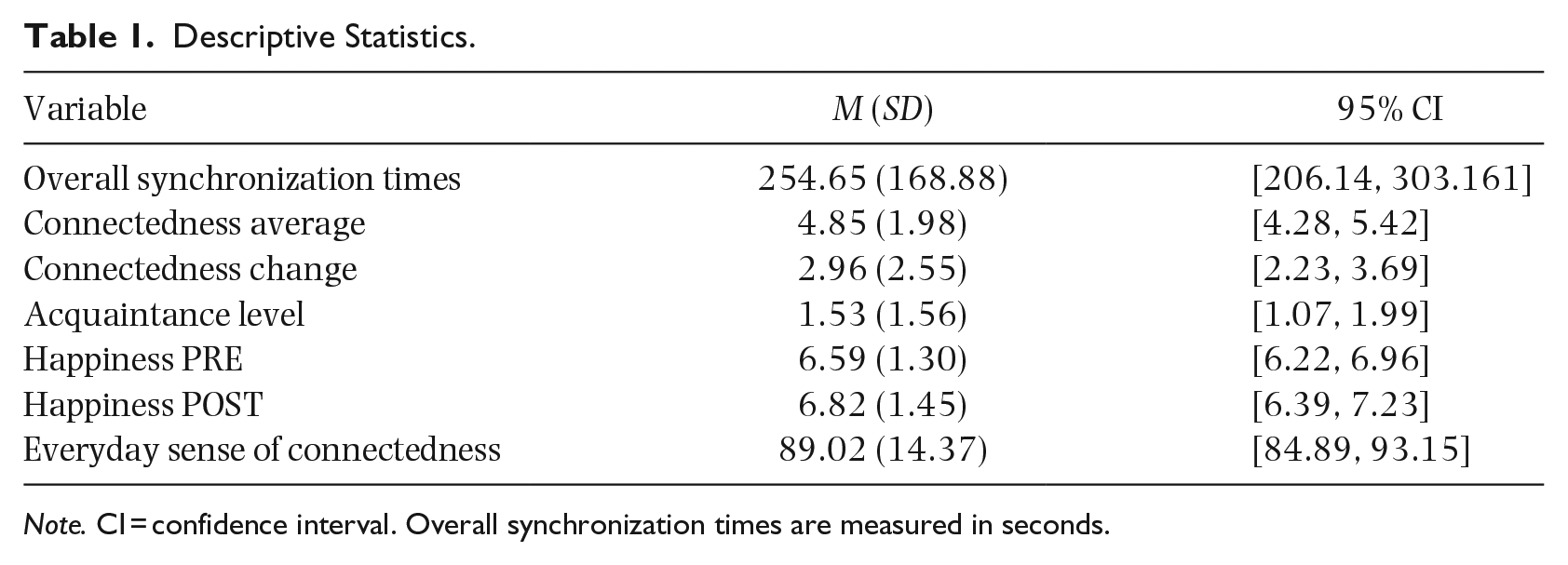
Note. CI = confidence interval. Overall synchronization times are measured in seconds.
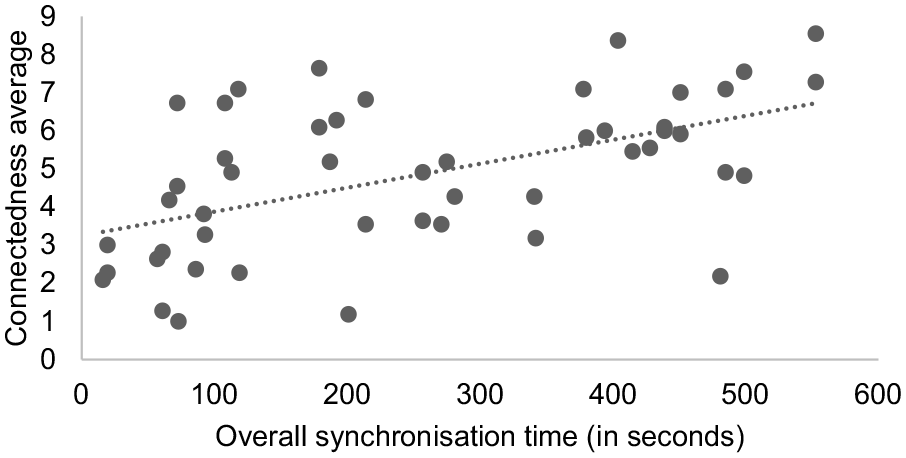
Relationship Between Connectedness Average and Overall Synchronization Time.
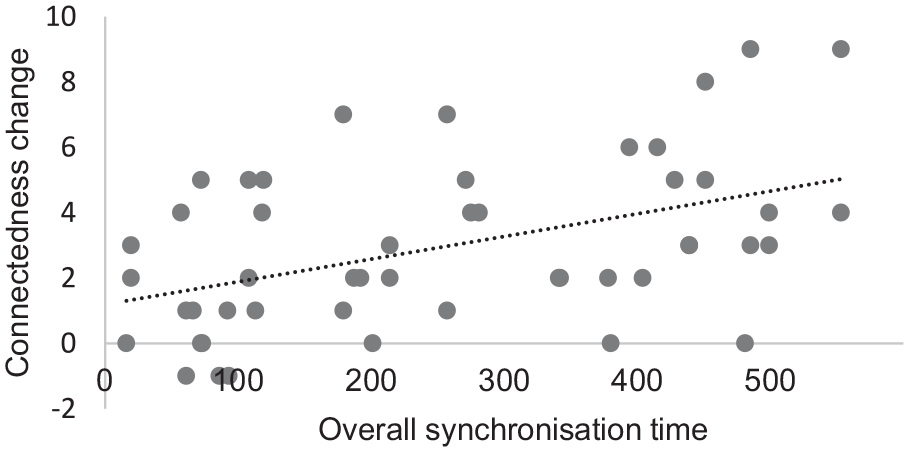
Relationship Between Connectedness Change and Overall Synchronization Time. Positive Values of Connectedness Change Represent the Increase in Connectedness, While the Negative Values Represent the Decrease.
Each participant’s individual relationship between connectedness and synchronization time, their segment synchronization time range and connectedness range is reported in Table 2, with the graphs of all participants available in the Supplementary Appendix. Within 17 out of 49 (35%) participants, there was a significant positive relationship between current sense of connectedness and the degree of synchronization with others over the preceding minute. Using a .05 level of statistical significance, one would expect two correlations to be significant in our dataset if they had occurred by chance. Significant positive correlations occurred in 4 out of 9 triads (44.4%) and 5 out of 11 dyads (45.5%). These participants showed an increase in synchronization that was matched by a very similar increase in synchronization (Groups 1, 2, 8, 14, 16, 17, 18, and 19), with some participants matching the fluctuation of synchronization with fluctuation in connectedness very precisely (Group 16: P40 and P41).
Summary of Each Participant’s Individual Relationship Between Connectedness and Segment Synchronization Time, Their Segment Synchronization Time Range (in seconds) and Connectedness Range.
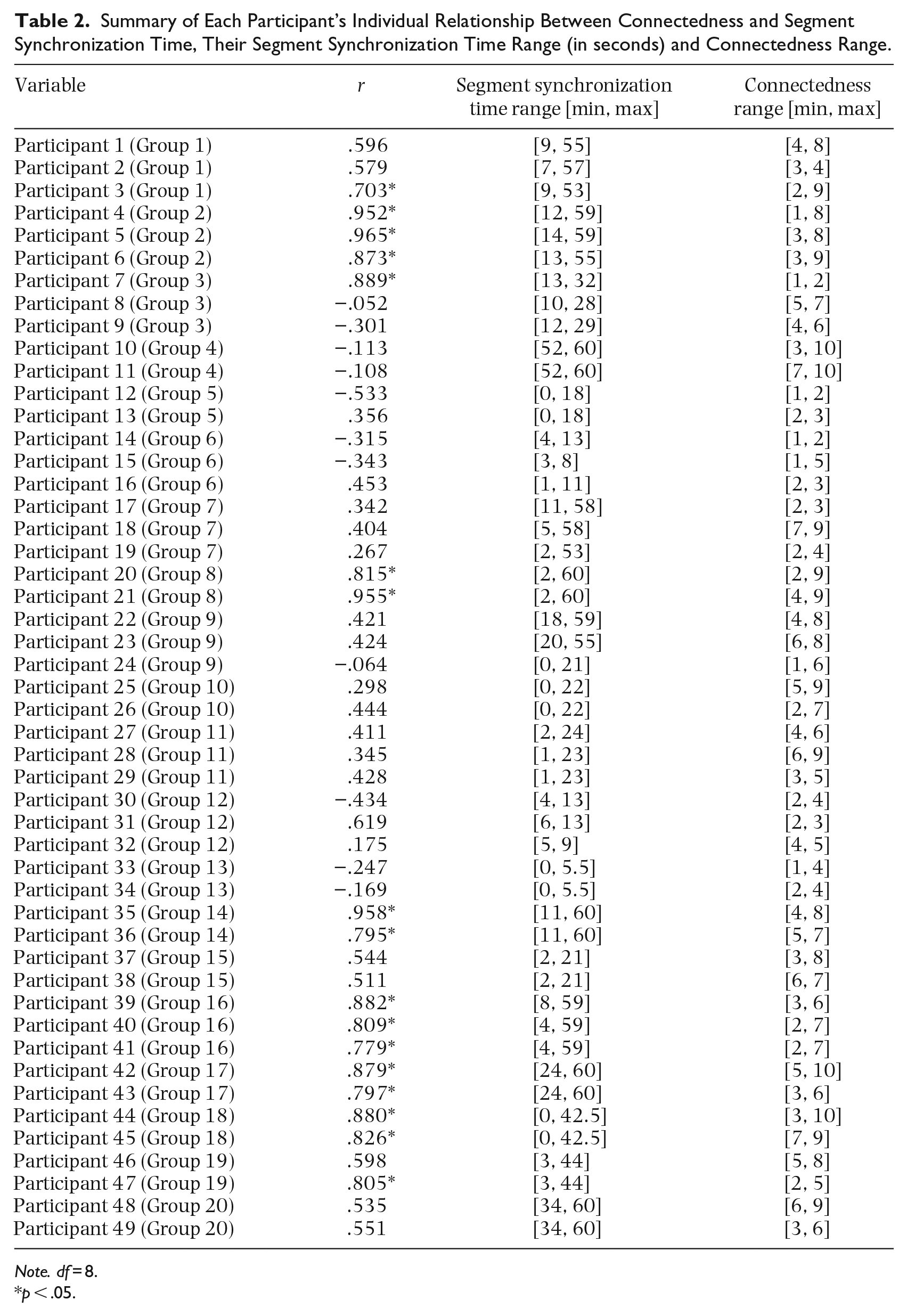
Note. df = 8.
p < .05.
In the remaining 32 participants, the correlations did not reach statistical significance, with 21 in the positive direction and 11 in the negative direction. The stronger positive correlations tended to be associated with higher ranges in both connectedness and segment synchronization time scores than the non-significant correlations. Around 10 of the participants showed very little variation in either measure (e.g., Group 1 (P2), 5, 6 (P14, P16), 15 (P38)). However, for some individuals, connectedness increased in the absence of increase in synchronization, with very low amounts of synchronization present or with fluctuating synchronization.
Pilot data for the objective analysis of interpersonal synchronization
The DiffEBR values for each participant for each minute of their session were calculated. To illustrate how the algorithm worked, Figure 4 illustrates the emergent rhythm at the beginning and end of a recording of a dyad (Participants 20 and 21) who showed an improvement in synchronization with one another and sense of connectedness over the course of their session. Figure 5 illustrates the means of these indices for each minute of the session, showing a clear trend for subjective ratings of synchronization and participant ratings of connectedness to increase, and for DiffEBR to decrease over the course of the session.
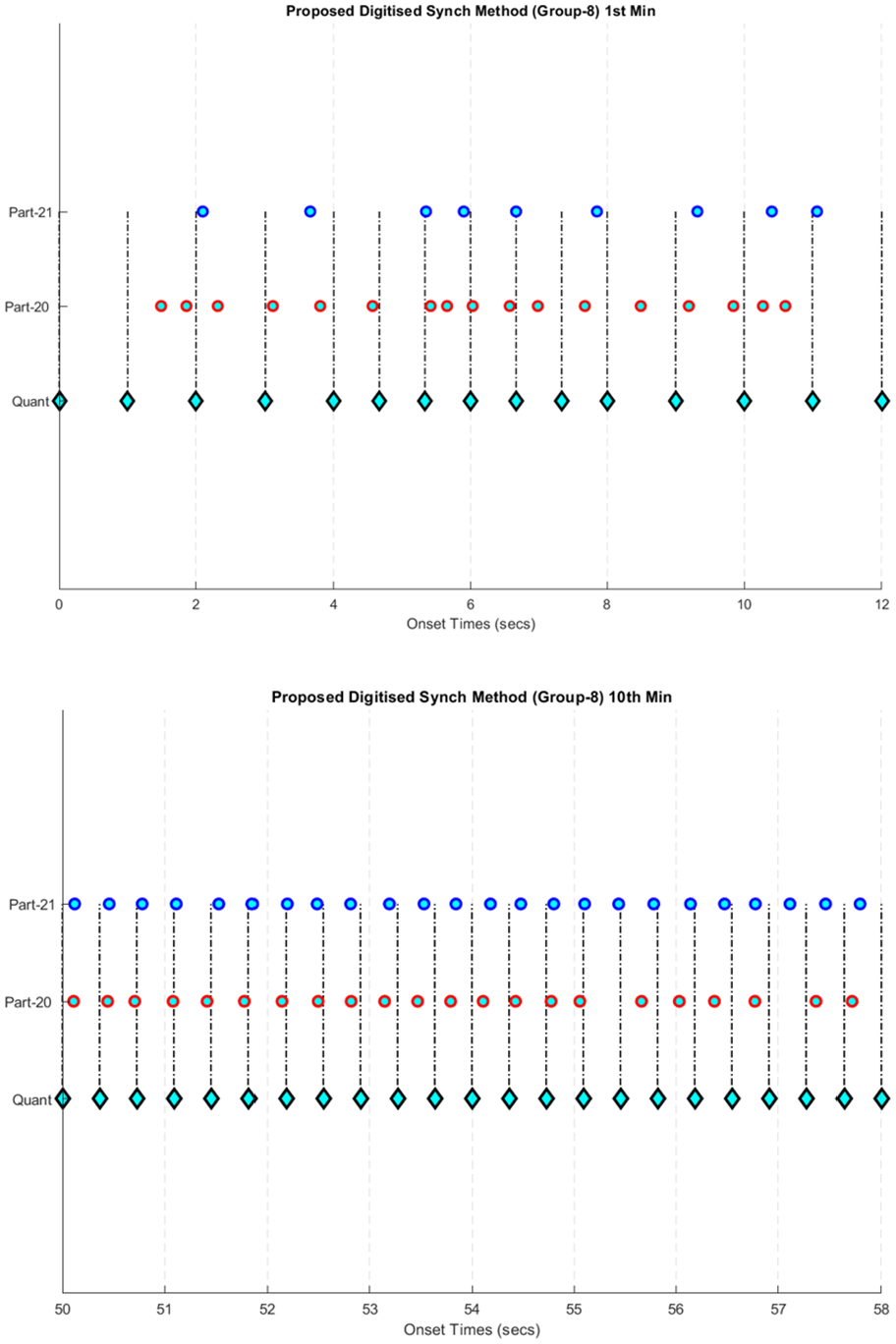
Graphical Representation of the DiffEBR Method.
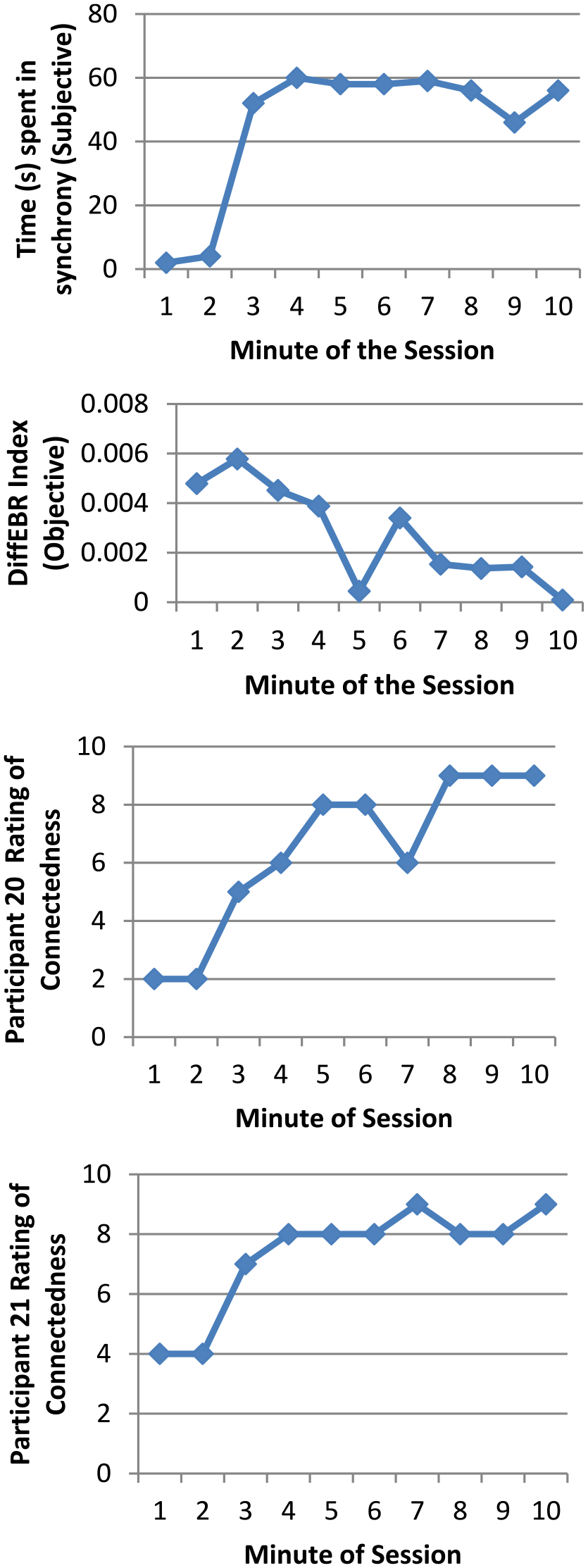
Graphs of the Changes in Subjective (Observer-Rated) Synchrony, the Objectively Calculated Index of Synchrony (DiffEBR), and Each Participants’ Ratings of Connectedness Plotted for Each Minute of the Session.
Discussion
This study is the first to investigate the relationship between spontaneously occurring synchronization and the sense of connectedness in a music-making task. Supporting our hypotheses, participants who synchronized with their group members for longer also felt more connected with the group members during the joint music-making task. In addition, we found that the greater the overall synchronization, the greater the increase in connectedness during the session, indicating a possible cumulative effect of synchronization over time. Indeed, at an individual level, 17 out of 49 participants (above the chance level of 2) showed a positive relationship between the two constructs over the course of the session, whereas no participants showed a significant negative relationship between these two constructs. These findings confirm the existence of a link between these two concepts found in earlier literature (Koban et al., 2019). Moreover, as our study looked into the interpersonal synchronization arising specifically during music-making, our results also support the emerging view of synchronization being a core mechanism in music that allows social connectedness to flourish (Anshel & Kipper, 1988; Keller et al., 2014; Kirschner & Tomasello, 2010; Wiltermuth & Heath, 2009). We also trialed a machine learning method to calculate interpersonal synchronization, illustrating its application to a dyad who improved over the course of a session.
Our results may show how collective control emerges when the shared medium of music is provided. The fact that people were able to produce synchronization, even without being told to, and without being given opportunities to observe and talk to one another, serves as an example of collective control, where people share similar perceptions and are able to align them in a shared environment (McClelland, 2004). Collective control may be achieved through reference points for perception that are internal oscillators (Levitin et al., 2018). Consistent with the notion of an intrinsic control system that promotes synchronization, several studies have found that people tend to synchronize without explicit instructions or plans to do so (e.g., Issartel et al., 2007). Our study has found the association within a paradigm that is restricted to one channel of musical communication, with no external rhythm, nor instructions to try to coordinate with others, unlike several earlier studies (e.g., Goupil et al., 2020; Noy et al., 2011). However, we did not manipulate or assess the role of shared intentionality or the emergence of joint attention which would be part of a more detailed account. Yet, if people can synchronize using only one channel of communication, PCT may provide the most parsimonious account for how interpersonal synchrony is achieved through a simple process of negative feedback control, as demonstrated in an earlier robotic device (Moore, 2007).
Considering that we have observed a relationship between spontaneous synchronization time and increased connectedness, we might speculate that people wanted to synchronize because it somehow led them to increase connection. As already mentioned in the introduction, we argue that synchronization might be a means of keeping the sense of connectedness near people’s desired intrinsic state through negative feedback control. Our future research program will use the current paradigm and involve building computational models of spontaneous music-making to test these hypotheses informed by collective control and PCT against the human data.
Happiness ratings before the music task were not different from the happiness ratings after the task, suggesting that happiness was not influenced by the general music-making activity or synchronization occurrence. We also did not observe the relationship between everyday sense of connectedness and current connectedness state during the experiment. This may imply that the connectedness during the experiment did not arise from the general (everyday) connectedness. Thus, our results indicate that the increase in connectedness was related with the increase in synchronization time and not the general proclivity to connectedness experienced by people, which may not be tied to synchronization during music.
Despite the positive findings, it is notable that a sizeable number of participants did not show the expected relationship between synchronization and connectedness. There are at least two plausible explanations. First, because it was important in this experiment not to give leading questions that would bias the participants toward assuming synchronization leads to connectedness, there were no instructions to synchronize. Therefore, there was no “leading” beat to follow and it is possible that participants did not attempt synchrony because they did not realize the opportunity. In our experiment, we did not check whether participants were aware of the opportunity to match their playing. Future research might tackle this problem by explicitly asking participants after the music task whether they have considered an option of playing in synchrony with others. The second reason might be the possibility that people produced different amounts of synchronization just because of different rhythmic skills and musical training or expertise. Interpersonal synchronization is a complex interaction of different cognitive, motor, and even social skills that create individual differences in the abilities of rhythmic coordination (Keller et al., 2014). Our study did not account for differences in rhythmic skills, musical, dance, or sports training, that also being one of the limitations of our experiment. However, in our pilot study, we saw that when explicitly instructed to synchronize both a dyad and a triad reached synchronization within 5 s, showing that people are capable of synchronizing in this specific setting. Future research might assess this problem by adding a condition where everyone is explicitly asked to synchronize, to assess the differences in synchronization preciseness. Also, it might be useful to explicitly ask participants whether they have received any musical training.
As already noted above, our study also had a number of limitations. First, our main findings were based on a subjective measurement of interpersonal synchronization. Given the limitations of existing objective methods, we developed a novel machine learning algorithm and illustrated its application to one dyad. However, this work is preliminary and will require further refinement and validation. As in many studies in this area, the researcher conducting the study was not blind to the experimental hypotheses. While participants were instructed not to communicate with one another, there was no exclusion of participants based on breaking this requirement, and as they were in the same room as one another and the experimenter, it is possible that their behavior could have been affected by social factors, such as social desirability or group identity (Keller et al., 2014). Our main statistical analyses included both dyads and triads within the same dataset. Social psychologists suggest that the bigger the group, the less power each individual has in modifying its overall outcome (Hogg & Graham, 2014). Thus, dyads and triads might possess different underlying working mechanisms and our decision to merge these groups might have hidden some group-specific properties. Future research might use multi-level regression to take into account group size difference, although it could not replace the analyses we conducted to explore and describe the different relationships between synchronization and connectedness at the individual level. While a self-report of connectedness to others was used in the current study, a future study could use a measure of affiliation to others, or even a behavioral measure of prosocial behavior to examine the generalizability of a sense of connectedness to social relations outside the musical performance situation. Lastly, the gender and age distribution also should be taken into account while interpreting results as most of the participants were female undergraduate students. Our study also suggests some practical implications. Even though joint music-making is already used widely in an active music therapy session to elicit positive social and personal effects, the therapy usually is being provided by a therapist who leads the sessions (Erkkilä et al., 2008). Our results, however, might offer a different perspective and support the client-led practice (Nordoff & Robbins, 1977), where the therapist minimizes any influence on the patients’ creative music-making. Combining our argument together with the core principles of PCT, which claims that the ability to control important life experiences is at the core of well-being (see “Introduction” section), we might expect to see a therapeutic benefit of giving people more control and freedom to spontaneously synchronize in music therapy sessions.
In conclusion, we found evidence that the proposed relationship between interpersonal synchronization and sense of connectedness extends to a wholly spontaneous music-making context, with no instructions, leading beat or encouragement from the experimenter. This relationship was present in a large and significant number of individuals, but it was not ubiquitous, and we provided a number of explanations (e.g., limits in musical skill, alternative pathways to connectedness) for why this may have been the case. However, the relationship, where it emerges, could result from people’s intrinsic need to use synchrony to connect with others. We introduced the theory of collective control to explain these findings and the current study sets the groundwork for modeling this relationship in future research.
Supplemental Material
sj-docx-1-pom-10.1177_03057356231207049 – Supplemental material for What is the relationship between spontaneous interpersonal synchronization and feeling of connectedness? A study of small groups of students using MIDI percussion instruments
Supplemental material, sj-docx-1-pom-10.1177_03057356231207049 for What is the relationship between spontaneous interpersonal synchronization and feeling of connectedness? A study of small groups of students using MIDI percussion instruments by Deimantė Kavaliauskaitė, Tauseef Gulrez and Warren Mansell in Psychology of Music
Research Data
sj-xlsx-2-pom-10.1177_03057356231207049 – Research Data for What is the relationship between spontaneous interpersonal synchronization and feeling of connectedness? A study of small groups of students using MIDI percussion instruments
Research Data, sj-xlsx-2-pom-10.1177_03057356231207049 for What is the relationship between spontaneous interpersonal synchronization and feeling of connectedness? A study of small groups of students using MIDI percussion instruments by Deimantė Kavaliauskaitė, Tauseef Gulrez and Warren Mansell in Psychology of Music
Research Data
sj-xlsx-3-pom-10.1177_03057356231207049 – Research Data for What is the relationship between spontaneous interpersonal synchronization and feeling of connectedness? A study of small groups of students using MIDI percussion instruments
Research Data, sj-xlsx-3-pom-10.1177_03057356231207049 for What is the relationship between spontaneous interpersonal synchronization and feeling of connectedness? A study of small groups of students using MIDI percussion instruments by Deimantė Kavaliauskaitė, Tauseef Gulrez and Warren Mansell in Psychology of Music
Research Data
sj-xlsx-4-pom-10.1177_03057356231207049 – Research Data for What is the relationship between spontaneous interpersonal synchronization and feeling of connectedness? A study of small groups of students using MIDI percussion instruments
Research Data, sj-xlsx-4-pom-10.1177_03057356231207049 for What is the relationship between spontaneous interpersonal synchronization and feeling of connectedness? A study of small groups of students using MIDI percussion instruments by Deimantė Kavaliauskaitė, Tauseef Gulrez and Warren Mansell in Psychology of Music
Footnotes
Authors’ note
Tauseef Gulrez is also affiliated to enAble Institute and School of Population Health, Curtin University, Perth, WA, Australia.
Funding
The author(s) received no financial support for the research, authorship, and/or publication of this article.

Supplemental material
Supplemental material for this article is available online.
Notes
References
Supplementary Material
Please find the following supplemental material available below.
For Open Access articles published under a Creative Commons License, all supplemental material carries the same license as the article it is associated with.
For non-Open Access articles published, all supplemental material carries a non-exclusive license, and permission requests for re-use of supplemental material or any part of supplemental material shall be sent directly to the copyright owner as specified in the copyright notice associated with the article.
