




Abstract
Sight and sound are critical to the reception of music performance. Audiences respond to myriad nonverbal cues to appraise the performance, but little is known about Western classical performers’ approach to commanding attention and achieving performance mastery. This study aims to understand how expert performers conceptualize the audio and visual spectacle in the concert hall, and how they harness nonverbal communication and extramusical cues into performance. Nine expert pianists participated in semi-structured interviews about their approach to performance and their preparation for a hypothetical concert in an international venue. Their responses were coded, categorized, and eventually clustered into three themes. Experts were acutely aware of the audience’s gaze and viewed classical performances as theater. Sight was integral for expert performers who shared Liszt’s uncanny appreciation of showmanship. Experts choreographed performances for their audiences with dramatic stage entrance and elegant concert attire, and crafted performance through impressive memorization and amplified visual gestures. Future studies will explore how experts practice performance as theater and discover their strategies to prepare for the stage.
Expert music performers captivate their audiences through their performance mastery. Since Liszt revolutionized the concert, Western classical conventions have prioritized showmanship in the performance (Hilmes, 2016) and expert soloists appear to display a tacit awareness of stagecraft on the concert stage (e.g., Davidson, 2014). Audiences favor performers who dominate the stage with soloistic behavior (Küssner et al., 2020), with compelling stage entrance (Platz & Kopiez, 2013), expressive body movement (Davidson, 1993), and confident facial expressions (Waddell & Williamon, 2017). This study explores the parallels between expert practice and critical music research on sight and sound (e.g., Platz & Kopiez, 2012; 2022) by interviewing expert Western classical soloists about their approach to the audio and visual spectacle on the concert stage.
Music performance is a multisensory experience and audiences have a nonconscious dependence on visual cues to inform their interpretations (McPherson & Schubert, 2004). Audiences interpret music performances instinctively and form gestalt impressions about performers’ musical intentions and ability (Davidson & Coimbra, 2001; Stanley et al., 2002). In fact, they only need to see, not hear, 6-s-long clips of top-ranking performers in a competition to identify them as the original prize winners (Tsay, 2013), although the effect may not hold for the entire performance or for different performers (Mehr et al., 2018). In music examinations, interviews with examiners reveal that they are convinced of performance excellence even before the music begins (Stanley et al., 2002) and examiners’ written comments suggest that their initial impressions are difficult to separate from the performance itself (Davidson & Coimbra, 2001). The relative importance of sight and sound presents a challenge to performers and audiences in understanding how each contributes to performance.
Professional musicians believe that communication is key to successful performance (Hallam, 2010). In concerts, audiences rely on nonverbal communication and movement kinematics to interpret and understand the music. They observe performers’ gestures to infer emotional intent (Dahl & Friberg, 2007) and are convinced of expressive content when performers make more dramatic gestures (Davidson, 1993; Juchniewicz, 2008; Broughton & Stevens, 2009). Performers’ movements both increase and decrease their experience of tension, cue emotional changes, signify interpretation, and delineate musical structure for untrained and trained musicians alike (Vines et al., 2006). For the audience, overall body movements are more important than specific body location, such as arm or torso movements (Nusseck & Wanderley, 2009). In ensemble rehearsals, professional musicians choreograph gestures, and in performance, they combine this choreography with spontaneous gestures that reflect their “in-the-moment” feel of the music (King & Ginsborg, 2016).
Audiences watch performers’ demeanor to determine their appropriateness for the stage (Davidson & Coimbra, 2001). Audiences prefer to see performers who have memorized their performances and are not reliant on the score (Williamon, 1999), especially when their body movements are unobscured by a music stand (Kopiez et al., 2017). Viewers in perceptual studies prefer performers who walk on with confidence (Platz & Kopiez, 2013) and rate performers who smile and make eye contact with the audience more favorably (Wapnick et al., 1998). Observers make harsher judgments of performers who indicate errors by grimacing than those who maintain composure by not projecting their mistakes, both immediately following the mistake and in their final performance rating (Waddell & Williamon, 2017). We can infer that audiences are drawn to musicians who perform comfortably and confidently on stage.
Unconscious bias may impact audiences’ perceptions of performers. University music examiners immediately pass judgment on Western classical performers’ physical appearance and attractiveness, and conflate their visual impressions of the performer with legitimate musical critique (Davidson & Coimbra, 2001). In perceptual evaluations of performances, assessors preferred performers who were perceived as attractive (Wapnick et al., 1997) or behaved in an appropriate manner onstage (Wapnick et al., 1998, 2000). In evaluating appropriate concert dress codes, assessors favored clips of performers in traditional concert dress and penalized those in casual attire (Griffiths, 2008). When considering different forms of traditional concert dress (long dress, short dress, and a suit), assessors rated the outfits, but later admitted to judging how each item of clothing flatters or diminishes performers’ figures (Urbaniak & Mitchell, 2022). Audiences’ unconscious bias can interfere with their ability to focus and influences their appreciation of the music performance.
Behaving like a soloist attracts the audience’s attention. Audiences are captivated by Western classical soloists, such as Jacqueline du Pré, who are instantly identifiable by their performance style (Curtin, 2015). Investigations of audience gaze found that performers who behave soloistically, with exaggerated, decisive body language, are viewed for longer amounts of time than others on stage (Kawase, 2014; Küssner et al., 2020). When musicians play in pairs, performers designated as “leaders” impact other performers through gestures such as body swaying (Chang et al., 2017). Acting like a soloist appears to be beneficial to guide both performer/audience interaction and performer/performer interaction. While performer soloistic behavior has a clear impact on audience enjoyment (Coutinho & Scherer, 2017), how experts harness sight and sound is not acknowledged in professional performance training (Ford, 2013) and remains tacit knowledge (Biggs, 2004).
Throughout Western classical history, performers’ physical bodies have been watched, described, and painted (Leppert, 1993). Performers have engaged their audiences through visual showmanship, epitomized by Franz Liszt, who enthralled his audiences through his performance magnetism (Hilmes, 2016). Schumann remarked “if Liszt played behind a screen, a great deal of poetry would be lost” (Robert Schumann, in Gooley, 2004, p. 47). Liszt transformed the traditional stage and enchanted his audiences with his innate stagecraft, fashion, and exhibitionism (Hilmes, 2016). He discarded the score (Gibbs & Gooley, 2010) and directed attention with a dramatic stage entrance from the wings (Hamilton, 2007). Liszt demonstrated an uncanny appreciation of extramusical and nonverbal cues and harnessed them to revolutionize the role of the performer (Hamilton, 2007), declaring, ‘le concert, c’est moi’ (Franz Liszt, in Hilmes, 2016, p. 72).
Expert performers demonstrate ineffable performance quality (Biggs, 2004) and present a source of fascination for performance research. Davidson (2012) reviewed the performance style of expert classical soloists and codified a repertoire of gestures representing musical structure and interpretation. For pianists, physical gestures support and amplify musical intentions to enhance viewers’ auditory experience (Froneman, 2018). Gesture conveys meaning across musical genres, and jazz singers and classical singers use different kinds of gestures to transmit their interpretations (Davidson & Coulam, 2006). Thompson et al. (2005) analyzed video recordings of Judy Garland and blues soloist B. B. King, and reported patterns of facial expression, gesture, and nonverbal cues that these performers used to connect with their audiences.
How elite performers use sight and sound to communicate to their audiences remains a mystery. Experts have acknowledged their awareness of gestures in interpreting and performing music (Doğantan-Dack, 2011), and the potential of gestures as signals to shape audiences’ interpretations of the music (Barenboim & Said, 2002). Consummate performers indicate they use movement and physical gesture to enhance musical expression, which could provide nonverbal cues to guide their audiences (King & Ginsborg, 2016). Performers have even adapted their visual presentation to complement the music performance (Griffiths, 2011). This study aims to understand how expert Western classical performers conceptualize the audio and visual spectacle in the concert hall, and how they harness nonverbal communication and extramusical cues in performance.
Method
Participants
Expert pianists were identified based on their skill and experience as solo performers and their international reputations. Information about the study and invitations were emailed directly to performers, or their agents. Nine expert Western classical pianists (five female) volunteered to take part. Performers were in the prime of their careers, each with several decades of elite performance experience in major international venues.
Recruitment and selection criteria
This study prioritized the recruitment of expert pianists. Participation was open to world-class performers living across the globe, with particular emphasis on European, American, and Australian performers. All performers fulfilled five key selection criteria:
Performers must be well known nationally and internationally, and be familiar names to those in the Western classical music industry.
Performers must have extensive performance careers, possibly alongside academic roles in leading conservatoria.
Performers must have had extensive experience performing as soloists, soloists in concertos, and in chamber groups.
Performers must have performed regularly in major performance venues and have expert knowledge of performing for many thousands of people.
Preferably, performers have recorded albums.
Materials
A semi-structured interview was designed to explore expert performers’ lived experiences of the stage and impressions of sight and sound (see Table 1). Scenario-based prompts (e.g., Adler & Patahuddin, 2012) encouraged performers to reflect on their personal practice and lived experience of concert preparation. The interview format was flexible and allowed performers to spontaneously raise and expand upon pertinent issues (Holstein & Gubrium, 1995).
Interview Topics and Example Prompts.
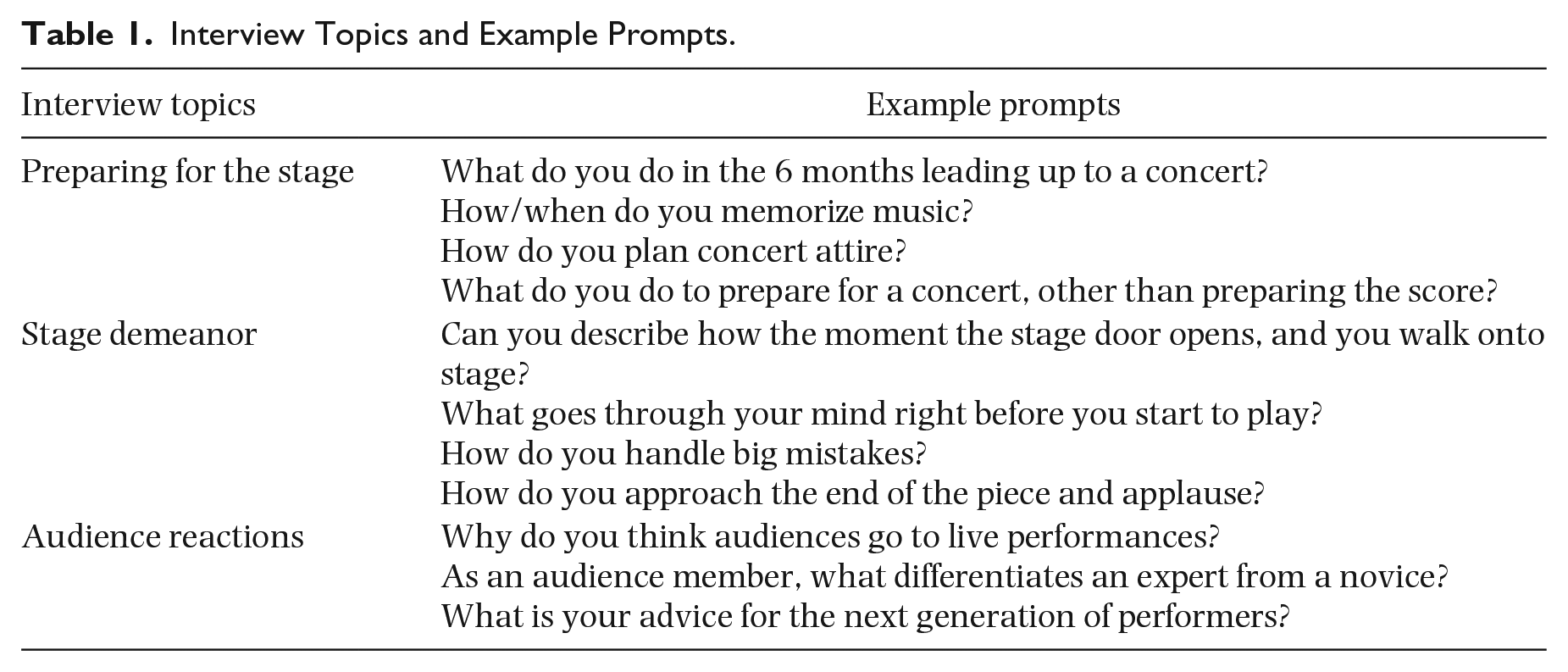
Participants were asked to imagine a classical solo concert in a major international classical concert venue, such as the Sydney Opera House. They were invited to detail their long-term preparation for this concert, and then their typical week and day of the performance. They described their experience as they walked onto stage, bowed, prepared to play, and the performance itself. Performers were encouraged to discuss their experiences on stage, reflect how their craft developed over their career, and explore the allure of live performance.
Questions followed a longitudinal pattern, beginning with the year before the concert, followed by the few months before, 1 week, the day before, and the day of the concert. Questions were organized by timeframe, though the structure was flexible to allow participants to talk freely about any topics raised (Holstein & Gubrium, 1995). The broad and open-ended prompts (e.g., what kind of preparation do you undertake in the 6 months before a concert?) ensured that participants raised and expanded upon ideas and strategies most closely aligned with their practical approach (Roberts, 2020). Follow-up questions were guided by interview answers and explored nuances in performers’ opinions and experiences (Roberts, 2020).
Procedure
Ethical approval was granted by The University of Sydney Human Research Ethics Committee. Participants were emailed information about the project directly, where possible, or via their agents. Interview times were agreed to accommodate different time zones and conducted during the first year of the COVID-19 pandemic. Due to the COVID-19 lockdowns, participants’ regular performing activities were put on hold, and so these highly sought-after performers were able to devote their time generously to this study. Interviews took place over Zoom or by phone and lasted between 1 and 2 h, and were recorded for later transcription. Performers are referred to as Performer 1 (P1), Performer 2 (P2), and so on, to ensure participant anonymity.
Analysis
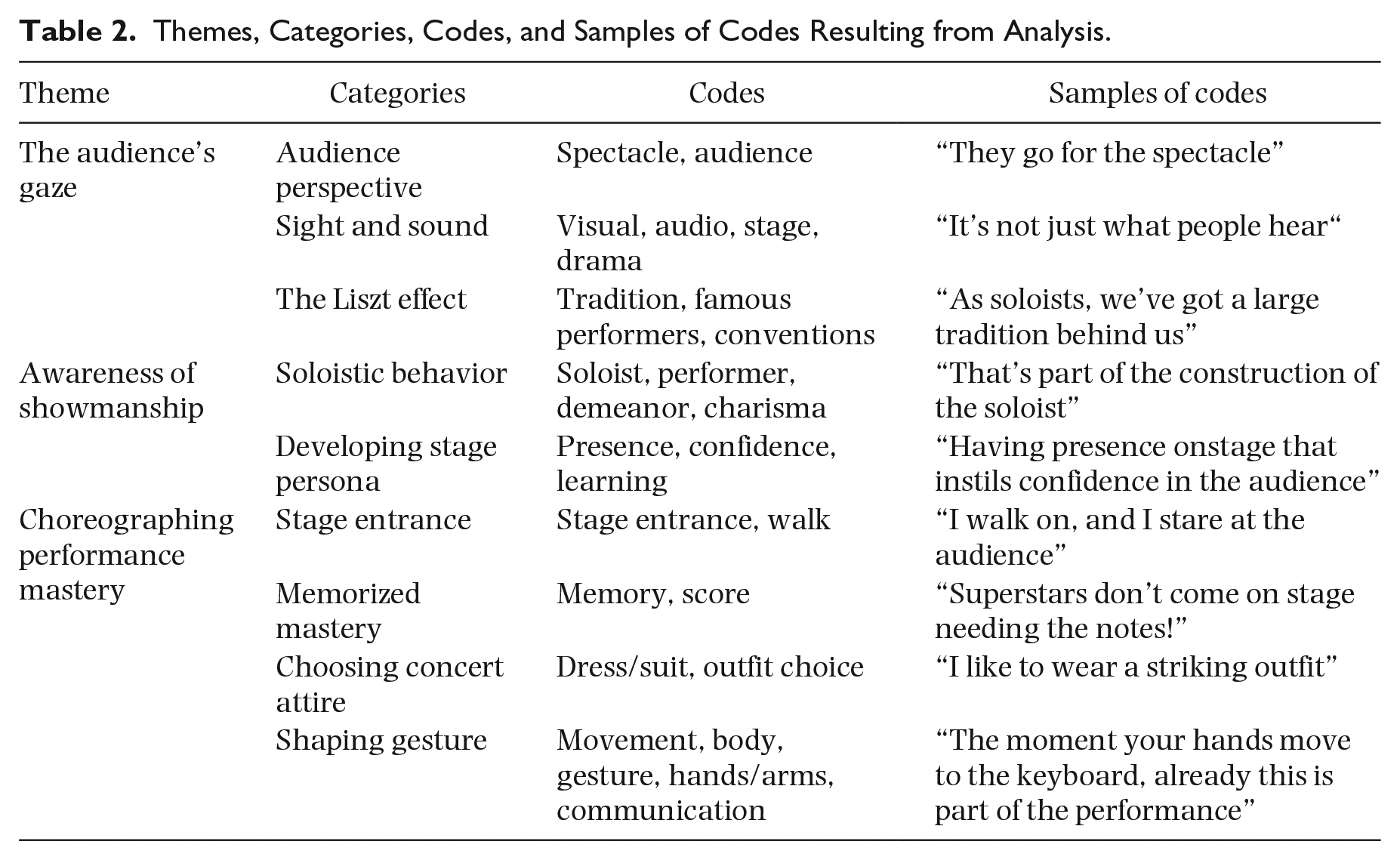
Interviews were transcribed by Author 1 and transcripts reviewed by both authors. Interviews were analyzed using an inductive analytic approach (Braun & Clarke, 2006), using both in vivo and constructed codes (Khandkar, 2009; Rivas, 2012) to capture rich qualitative insights (Saldaña, 2021). Coding was iterative until saturation of themes was achieved (Rivas, 2012), and themes remained stable across participants. The codes and themes were discussed and agreed upon between the first and second author. Individual codes were generated and grouped into categories and themes (Table 2). In total, there were 32 codes, which were grouped into nine categories that contextualized codes within research on sight and sound, and three themes that sorted categories into awareness of the audience’s gaze, awareness of showmanship, and choreographing performance mastery.
Themes, Categories, Codes, and Samples of Codes Resulting from Analysis.
Results
Theme 1: the audience’s gaze
Audience perspective
All performers considered performance an audiovisual artform. They imagined the audience’s gaze when preparing their performances and were aware that audiences seek more from performances than just the aural dimension, and that only “maybe twenty percent of the people come truly for music” (P4). Performers visualized the concert experience from the audience’s perspective and imagined their myriad reasons for attending a concert.
[Audiences go for] the whole thing, everything. They go for the spectacle, if it’s a difficult piece, there’s a wonder of will he or she play well. And they look for it to be beautiful, they look for it to be bad, I mean every gamut and aspect of human voyeurism is there. (P3)
Sight and sound
Performers imagined the audience’s reaction to visual as well as audio stimuli. They understood the necessity to complement musical performance with visual cues to create a multisensory experience: If we imagine 400 people sitting in a hall looking at us and listening to us, we’re totally naive if we imagine that the looking bit has got nothing to do with it. It’s part of the message, really. And also, our brains are visually dominated. When you see how much of the brain is given over to mapping and processing visual inputs, it’s huge! (P7)
Performers were aware that “it’s not just what people hear, they want to come in and have more than just that [aural] sense activated” (P1) and curated their performance for the audience’s gaze.
The very fact that people are there to listen to us means it’s not just our music, but the way we carry ourselves physically, and the way we carry ourselves in terms of what we wear, and the way we carry ourselves in terms of how we treat others is very, very important. (P2)
Performers revealed that they were proactive in shaping the audience’s experience of the concert, from the moment of stage entrance to the moment of stage exit. They viewed the entire performance as a kind of theatrical performance: It’s an act—it’s a performance—we’re actors, and we’re on stage and it’s a drama. (P2)
The Liszt effect
The majority of participants (n = 6) discussed great performers and the history of showmanship. Performers believed that “as soloists, we’ve got a large tradition behind us of having to act in a certain way—that Liszt inaugurated” (P2). They were aware that great Romantic performers redefined the soloist’s role in performance: I think [the expectations] did change with Liszt emerging—or Clara Schumann coming out—as a solo act [. . .] There was no one else but the pianist [on stage], and I think that really does change how people start looking at every aspect of the performer—not only playing. (P4)
This cohort agreed that the top performers, like Liszt, “are usually pretty exceptional [. . .], they’re just different” (P5). Their unique and artistic personalities were clearly visible from the stalls, and their onstage charisma made them irresistible to audiences.
I mean, many people go to a concert just to see the star, and to see how he manages tonight! I mean, there are so exciting artists, like Martha Argerich, for instance or Sviatoslav Richter, or Horowitz. I mean, this is just such an extreme experience to see these people. (P6)
Performers held complex views on innate and constructed showmanship. Some believed that true performers were born with a performative flair, which developed naturally into stage presence: “Beethoven didn’t work on being Beethoven, he became Beethoven” (P5). They may have been told “as a child that [they were] a born performer” (P5), and their showmanship developed naturally. Others believed that they were not born with a performer’s instinct and had to work on their stage persona. All performers agreed that refining performance skills through conscious development was a worthwhile pursuit.
I found it as something not terribly natural. I mean, you are not born to perform. This is something very special, to prepare something and to present it to other people is a very special task. [. . .] It’s good to know, to understand, this really needs special preparation. (P6)
Theme 2: awareness of showmanship
Soloistic behavior
These performers believed that soloistic behavioral tropes served to engage the audience, rather than fellow musicians. Their audiences sought an interpersonal connection from soloists that transcended the music or composer.
That’s part of the construction of the soloist as well—part of the drama of the performance that people are interested in the soloist. We [musicians] are all probably more interested in the music, but again it doesn’t sell. Like saying “Beethoven” as opposed to “I wear multicoloured socks.” (P2)
Performers achieved a sense of theater in their performances by acting the soloist. They amplified their demeanor to transmit their personalities across the stage lights, as “What is a performer? A performer is a charismatic individual with a large personality, and you’ve got to get that out” (P7). The cohort believed that soloistic behavior encompassed many possibilities for stage demeanor, so long as it projected clearly to the audience.
There are many ways of being a good performer: some performers really conspicuously show us and thrillingly so, someone like Yuja Wang, some maybe conceal that part of themselves more, or are more clearly subservient to the musical message: someone like Radu Lupu. Some might have a slightly monkish demeanour onstage, and yet, there must be something in them that likes being on stage. (P7)
Developing stage persona
Performers revealed that they developed stage persona with the audience in mind. For the audience, the illusion of confident soloist was impossible to resist, and performers were conscious to present the ideal performance persona.
That’s part of the art of performance, or charisma, is having presence onstage that instils confidence in the audience, and thereby allows them to relax into the experience, and receive what it is that you’re offering. (P7)
Performers used stage presence to enhance the music reception. They considered it in ill taste to exaggerate stage persona beyond naturalness, like a “theatrically self-conscious performing monkey musician” (P7). Instead, they balanced their charisma with humility and used their stage persona to serve the music.
Essentially, you’re a servant [to the music], but you’re also a servant that is standing in front of—or sitting in front of—hundreds, or thousands of people, and demanding that they pay attention to you. (P7)
Performers gained confidence in their stage persona through firsthand experience and had reached a level of automaticity in their stage presence. They attributed their showmanship to tradition and observation, as “many of my pianist habits have become so natural, that I call it natural, but I’m sure some of it is learned from culture” (P9).
Theme 3: choreographing performance mastery
Stage entrance
For these performers, stage entrance was a definitive moment in the performance that could guarantee the audience’s enthusiasm and set the tone for a spectacular event. For the audience, “the drama starts before the piece begins” (P2), so performers used their walk-on to set the scene for the spectacle.
So, you sit there and you’re in everyday mode, and then this person comes on stage and they’re not—and they will now change the way you experience life. So, it’s really for the performer at that moment to shape everybody. (P5)
Performers choreographed their entrance to give the impression of total ease on stage and assert their role as expert soloist, because “at that moment [of stage entrance], you’re already absolute king” (P5). They imagined stage entrance from the audience’s perspective: “I walk on, and I stare at the audience. I look at them in the face, and I smile” (P1).
Memorized mastery
Performers followed the Lisztian tradition of memorizing music. Like Liszt, they used performing from memory as a way to confirm audiences’ perceptions of the performer as a “demi-god” (P2), who possesses super-human abilities.
Liszt was a giant, he achieved everything—and he was a superstar. And superstars don’t come on stage needing the notes! He changed the psychology. (P3)
Performers revealed that performing from memory was a cultural indicator of virtuosity, rather than strictly necessary for good quality performance.
There’s always some spectacle [. . .] But when people arrived playing [Beethoven’s] sonatas from memory, he was angry, because he said “it means they won’t pay attention to all my instructions.” So, it was by no means a given that it was the best thing to do. (P3)
Playing from memory was “cultural showmanship” (P9), designed to amaze the audience. Most performers accepted memory as an essential part of the show as expected by audiences, who “admire the fact that the pianist can remember all this—it’s part of the game . . .” (P5). Performers appreciated the illusion of spontaneity created from a memorized performance, as in the theatrical arts, “When you go to a play, you don’t want to see the actors reading, you want to imagine that they’re inventing it in the moment” (P7). While the illusion of memorized mastery was an invaluable performance tool, playing from the score could be similarly engaging when handled correctly: I think that’s a terrible philosophy [that music should be memorised]! As I said, when you play with an iPad now, you can have the music stand down, and the iPad is quite unobtrusive. (P1)
Choosing concert attire
Performers imagined the effect of concert attire on the audience and chose performance attire that would create an immediate visual effect.
From the very beginning, I would sort out the venue and see what the venue looks like, I would decide how I want to look, how I want the stage to look and start working on those extra visual things. (P1)
The group was keenly aware that audiences are affected by what they see—even to the point of distraction, as “all people want to talk about is the dress” (P4). They harnessed the visual power of dress to engage audiences in the spectacle.
I like to wear a striking outfit . . . People have paid money for a concert, they’ve paid money for ticket: it’s an investment of time, energy, getting out, babysitters. (P7)
Some performers depended on a uniform that delivered a sense of occasion, without the need to plan anew every time. Other performers approached each concert like a ball, costuming themselves for the specific occasion.
This may sound totally superficial, but if it’s a big and scary concert I like to know what I’m going to wear, and often, if I’m doing a tour with an orchestra for instance, I’d like to often get some nice new gown. (P7)
Clothing could also act as a nonverbal indicator of musical character. Some performers tailored the color and style of their clothing to reflect the qualities of the music, so that it “expresses what the music is, I think it’s good manners” (P1). The function of concert dress was to instantly capture the audience’s interest, but not to overshadow performers themselves or become the sole focal point of the production.
I don’t want people to gasp when I come out on stage. [. . .] I want the reaction to be positive, but not the centre of attention. (P4)
Shaping gesture
Gesture was an integral part of expert performance. These performers agreed that body movement “can help, or it can spoil the result” (P9). They believed audiences form their interpretations by fusing visual gesture with the music, “because in the concert, you’re not only hearing, but also seeing how a person moves” (P9). Performers created audiovisual cohesion from the opening gesture.
The moment your hands move to the keyboard, already this is part of the performance. So that the piece already starts when your hands or arms are moving to the keyboard. (P6)
Performers believed that the experience of live performance differed from the recording studio due to the interplay sight and sound.
In a concert you transmit a lot by your body, by your personality and by everything: and you can tell the people a lot by your movements [. . .]. And in a recording, just the music counts. (P6)
Performers projected their performances through natural and expressive body language: [On expressive movement:] being super theatrical, and projecting, and throwing it out there, and we do need to do that: conveying the interpretation across stage lights. You do need to do that—you do often need to amp it up. (P7)
Choreography was particularly pertinent to the end of a performance. Performers noticed that audiences rely on body movement and “physical communication” (P2) to achieve a sense of fulfillment at the end of a piece. Performers directed their movements after the last note to keep the audience in suspense. Their total stillness created a hushed silence in the audience and a moment of magic.
[At the end,] there is no movement, just stand still. This is maybe one of the greatest moments of the whole performance, and this is so important really to make it. . . And then, you maybe then you move a little bit, and then audience understands “Now it’s over.” (P6)
At this point, performers rose, bowed, and reveled in the applause. Their celebratory mood was achieved with an easy and unforced showmanship, “I don’t think about the exit [. . .] In general, I think that’s where you can just let go” (P1).
Discussion
This study explored how expert pianists conceptualize sight and sound on the concert stage, and explored how they harness nonverbal communication and extramusical cues in performance. Expert performers revealed they could identify and incorporate key concepts of sight and sound and audiences’ visual preferences into their performances. They followed Liszt’s tradition of stagecraft, by conceptualizing performance as a multimodal spectacle, and capitalized on extramusical elements to maximize their performance success. These experts visualized their performances from the audiences’ perspective, imagining how the music drama would play under the spotlights. When preparing for the stage, performers choreographed their stage behavior, amplified their expressive gestures, and imagined their stage entrance and demeanor. They were acutely aware of the importance of their stage behavior on their audience and seized the opportunity to impress.
Performers were keen observers of other artists and demonstrated an intuitive understanding of sight in Western classical performance. These consummate performers shared Liszt’s uncanny appreciation of performance (Gooley, 2004) and transformed their role from transmitter to creator of the musical score (Cook, 2012). Like Liszt, performers demonstrated tacit knowledge of the impact of their stage manner on the audience and could identify and distill individual performance principles of the Lisztian tradition (Hilmes, 2016). Performers’ impressions of legendary performances, combined with reflections on Liszt’s legacy (Hilmes, 2016), enabled them to form a rubric for performance. Performers were aware that they operated within a strict set of performance conventions and used appropriate stage demeanor for the Western classical tradition (Davidson, 2012). These interviews confirmed that classical experts’ compelling visual language (e.g., Froneman, 2018) appears to be the result of careful forethought and crafting.
From the outset, performers visualized the concert stage and were aware of audience preference and bias (Platz & Kopiez, 2022). These experts demonstrated an intuitive understanding of sight and sound on the concert stage and were active participants in shaping the audience’s experience. Performers set the scene with a compelling stage entrance that utilized facial expression, a strong gait and direct eye contact to engage the audience (Platz & Kopiez, 2013). They prepared fabulous concert attire, knowing modern audiences keenly observe dress codes and make judgments about the appropriateness of dress for task (Griffiths, 2011; Urbaniak & Mitchell, 2022). Participants usually performed from memory (Kopiez et al., 2017; Williamon, 1999), despite their belief that memorization did not necessarily lead to better audio quality. By casting aside the score, they directed the audience’s attention to their role as creator, rather than supplier, of the music (Cook, 2012). From the first movement of hands to piano, performers used gesture to modulate dramatic tension (Vines et al., 2006) and guide the audience through the emotional journey of the piece (Dahl & Friberg, 2007). They ensured that no sign of doubt crossed their faces, to ease the audience into an enjoyable experience (Waddell & Williamon, 2017). These experts’ insights contextualize perceptual research on sight and sound within real-world practice, and confirm that expert performers actively manipulate stage demeanor to complement their musical prowess.
Nonverbal communication was integral to performers’ transmission of musical intent. In preparation, performers created a choreography of gesture (King & Ginsborg, 2016) to complement the musical interpretation (Davidson, 2012). Performers augmented their musical presentation with evocative gestures to ensure their interpretations were conveyed effectively to every audience member (Barenboim & Said, 2002). They were aware of the need to magnify movements to guide audiences’ understanding of the music and devoted energy to maximizing their audiovisual impact (Davidson, 1993). These experts confirmed that movement kinematics were an essential part of musical communication (Hallam, 2010) and used gesture to enhance expressivity (Davidson, 1993; Juchniewicz, 2008; Broughton & Stevens, 2009). Even though pianists have a relatively limited range of motion compared with other soloists or singers who can stand, bob, and sway (e.g., Vines et al., 2006), they still focused attention on maximizing visual expressivity.
Acting like a soloist was a conscious decision (Küssner et al., 2020), and performers crafted their stage personas with stage magnetism in mind (Curtin, 2015). On stage, performers created a soloistic, Lisztian charisma to control the audience’s gaze (Kawase, 2014), by using exaggerated nonverbal cues and a projected demeanor (Küssner et al., 2020). Adopting a performative mindset was key to communication (Davidson, 2014) and performers were active participants in embodying gesture (Doğantan-Dack, 2011) and presenting a complete musical experience. Here, experts confirmed that visual performance flair, which is immediately recognizable in video recordings of great artists (Thompson et al., 2005), is not solely the result of natural or innate skill, but rather a process of active planning and execution.
Exploring experts’ firsthand experiences of the stage is novel to the field of sight and sound. The semi-structured interview format (Saldaña, 2021) facilitated invaluable insights into elite performers’ tacit knowledge of stagecraft (Biggs, 2004). These experts’ insights built upon existing empirical (Platz & Kopiez, 2012) and observational performance analysis (Thompson et al., 2005), to provide key information on expert practice. It is well established that both sight and sound can sway audience impressions (Platz & Kopiez, 2012; Tsay, 2013) and it appears that the most successful Western classical performers both infer and extrapolate this information from their firsthand experience. As experts from other musical genres appear to display a similar tacit awareness showmanship (e.g., Thompson et al., 2005), this finding raises intriguing implications for how experts in diverse musical genres conceptualize their stagecraft. While traditional Western music performance education appears to prioritize the score over the performance itself (Ford, 2013), these experts revealed that they conceptualized their performances as theater. Their insights could provide a scaffold for students seeking learn from expert knowledge and integrate showmanship into performance style.
Conclusion and future directions
These interviews provided novel insights into contemporary expert performers’ perspectives on the use of expressive visual and aural information in live performance in the Western art tradition. These elite performers’ voices are essential to understanding the role of sight and sound in the Western classical context. In this study, experts were acutely aware of audiences’ perspectives and preferences in Western classical conventions, and revealed that they could manipulate performance visuals to command their audiences’ attention. Future studies could investigate how expert Western classical performers practice the theater of performance, to discover novel skills for emerging musical professionals to approach the stage.
