




Abstract
Groove is a popular and widely used concept in the field of music. Yet, its precise definition remains elusive. Upon closer inspection, groove appears to be used as an umbrella term with various connotations depending on the musical era, the musical context, and the individual using the term. Our aim in this article was to explore different definitions and connotations of the term groove so as to reach a more detailed understanding of it. Consequently, in an online survey, 88 participants provided free-text descriptions of the term groove. A thematic analysis revealed that groove is a multifaceted phenomenon, and participants’ descriptions fit into two main categories: music- and experience-related aspects. Based on this analysis, we propose a contemporary working definition of the term groove as used in the field of music psychology: “Groove is a participatory experience (related to immersion, movement, positive affect, and social connection) resulting from subtle interaction of specific music- (such as time- and pitch-related features), performance-, and/or individual-related factors.” Importantly, this proposed definition highlights the participatory aspect of the groove experience, which participants frequently mentioned, for example describing it as an urge to be “involved in” the music physically and/or psychologically. Furthermore, we propose that being immersed in music might be a prerequisite for other experiential qualities of groove, whereas the social aspect could be a secondary quality that comes into play as a consequence of musical activity. Overall, we anticipate that these findings will encourage a greater variety of research on this significant yet still not fully elucidated aspect of the musical experience.
Groove is a popular term in the field of music. Yet, when attempting to define it, we find various meanings depending on the describer, the context, and the era. Some examples of the term groove used in a sentence refer to a state of being, a specific style of performance, or a musical aspect. For example, “I am in the groove”, “this band plays groovy”, or “this song grooves”. Difficulty in describing the essence of groove has been expressed in previous work as “koan-like” (Zbikowski, 2004, p. 272) or “catching water in a net” (Hosken, 2020, p. 182).
The history of groove
Over time, groove has been linked with a diverse range of concepts. In fact, earlier uses of groove demonstrate that it was originally not a musical term. The Oxford English Dictionary (n.d.) provides various examples of groove (n., v.), grooving (n.), groovy (adj.) in mining, music, or in reference to a channel (in wood, metal as well as the spiral cut in a vinyl record). Some of these dictionary examples (gathered in Supplementary Materials 1 online) describe groove as: having a good time, an embodied state, performance/playing style, being related to rhythm, preference, referring to something as being good/cool/hip (slang), returning to one’s old self, being immersed in a task smoothly and efficiently, experiencing a particular successful period, and being in fashion/up-to date. Moreover, uses of “groove” in music are described rather as “transferred and figurative” 1 ; the idiom “in the groove” is described originally in a nonmusical context as meaning “running accurately in a channel or groove”, later used by jazz musicians from around 1920 onward to refer to a “good performance” (Back in the Groove, n.d.). Later, during the 1940s swing and jazz era, the phrase “in the groove” was used to refer to a specific musical routine, preference, or style, indicating its aesthetic properties (Kernfeld, 2002). During the 1970s, groove was mostly associated with music genres such as funk and soul (Hale, 2014). Around the same time, groove was even used as a phrase to say something is “cool” (Hein, 2011; Runyan et al., 2013). (For a German summary of the history of groove, see Pfleiderer, 2006, pp. 297–301.)
Groove in musicology
In addition to changing connotations over time, different branches of musicology have approached the term from different perspectives. From a music-historical approach, groove is associated with genres of North American and “Black Atlantic” music that emerged around the 1950s (Attas, 2011) such as jazz, funk, latin, reggae, and rock (Davies et al., 2012; Frühauf et al., 2013; Pressing, 2002). From an ethnomusicological perspective, groove is defined as an “unspecifiable but ordered sense of something that is sustained in a distinctive, regular and attractive way, working to draw a listener in” (Feld, 1988, p. 76). Groove has been described elsewhere in the ethnomusicological literature as being an important aspect of music (Keil, 1987, p. 96): “The power of music lies in its participatory discrepancies, and these are basically of two kinds: processual and textural. Music, to be personally involving and socially valuable, must be ‘out of time’ and ‘out of tune.’” Keil (1995, p. 2) further explains about participatory discrepancies: [Participatory discrepancies] exist. Between players. Between the beginnings of their notes. In the moment when each of us chooses to snap fingers, or nod a head, or in the instant when many decide to get up and dance because the music is so contagious.
While participation is described as a human experience, a kind of connection with our surroundings (including the body, society, and nature), discrepant is defined as a musical phenomenon, a “strong vehicle for participatory consciousness and action” (Keil, 1987, p. 98). The relation between such participatory human experience and the “discrepant” musical qualities is described as: “It is the little discrepancies within a jazz drummer’s beat between bass and drums, between rhythm section and soloists, that create ‘swing’ and invite us to participate” (Keil, 1987, p. 98). A similar view is held by the (music) philosopher Tiger Roholt (2014, p. 2): There are two aspects to groove: (a) the music (whatever it is that musicians do to create a groove which has primarily to do with timing nuances); and (b) the felt dimension (the feel of a “leaning” groove or one that “pushes,” “pulls” and so on).
From a music psychological point of view, groove is described as a “primordial aspect of music” (Madison, 2001), a “state of listening” (Witek, 2009), a “sensation of movement” (Davies et al., 2012), an “experience of music” that makes people dance (Madison, 2006; Madison et al., 2011; Stupacher et al., 2013) or that connects the body, mind, and music together (Witek, 2013). “A musical groove” is described as typically produced through the interaction of a small group of musicians (Zbikowski, 2004), through their “mutual tuning-in” as a mechanism of social entrainment (Doffman, 2009). With all these descriptions referring to the same term, it is hard to decide whether groove should be considered a historical, cultural, musical, or psychological phenomenon.
A decade ago, this ambiguity–or one might say complexity–was parsed out from the field of music psychology after the work of Janata and colleagues (2012). Since then, groove has been commonly operationalized in research as a pleasurable desire to move to music. After this milestone, groove has attracted the interest of many musicologists and led to a spike in research interest. To date, a number of intra- and extra-musical groove-related variables have been reported. While acknowledging the ease and applicability of this definition, and the fact that it has facilitated advancement in the field, we believe a more comprehensive definition would help develop further research in the field. In the current work, we sought to expand this definition by including recent findings as well as prior connotations of groove. To build our argument, we briefly reviewed the key variables reported in the groove literature over the last two decades in Supplementary Materials 2 online (for a more extensive review, see Levitin et al., 2018). Given the broad, multifaceted nature of the previous literature findings, defining groove simply as a pleasurable desire to move to music might be considered a little reductionist. To flesh out this argument we propose three reasons why groove should be defined more comprehensively (see Supplementary Materials 3 online for two additional reasons titled as “Dissimilar Definitions in the Literature” and “Different Methodologies Result in Limitations, Nuances and Challenges”).
Reasons for a more comprehensive definition of groove
Groove is a complex multidimensional phenomenon
First, we are not the only musicologists to view groove as multidimensional. Frühauf and colleagues (2013) approached groove from its musical and performance perspective, highlighting its “dual nature”–a satisfying groove definition must contain a specific rhythmic structure as well as how that structure is performed. They elaborated that the experience of groove is constructed if musicians consciously modify microtiming by playing “in the pocket.” More inclusively, Danielsen (2010) described the emergence of groove from the relationship between both the qualities of music and the listener experience. Similarly, Witek (2017, p. 138) advanced groove phenomenologically as being “distributed between mind, body, and music”. Senn and colleagues (2020) reviewed various meanings of groove by pointing out the nuances between “a groove” (referring to a musical quality such as a repetitive pattern in specific music genres), “to groove” (denoting an effortless and well-coordinated performance), and “has groove” (indicating for pleasurable- and movement-inducing music). Moreover, Senn et al. (2019) (for an updated version, see Senn et al., 2022) provided a psychological model of musical groove which encompasses “musical properties”, “entrained body movement”, “concrete listening situation” and “personal background”, among other variables. The authors further propose that to experience groove, one “needs to have an inner representation of the music’s temporal regularities, which allows for motor planning and synchronized body movement” (Senn et al., 2019, p. 1), and that music must induce in the listener the desire to move. These examples exhibit the concept of groove with its performance, music, and listener experience aspects.
Overlooked findings in the literature
Second, the few studies that have demonstrated groove to be a multidimensional phenomenon have been largely overlooked. Pfleiderer (2010) gives a comprehensive description of groove in the German language and presents the groove experience with four dimensions: “structural-cognitive”, “movement”, “emotional”, and “social”. It is possible that Pfleiderer’s findings have been overlooked or rendered less accessible due to the language of publication. According to Pfleiderer (2010) perception and cognitive processing of rhythmic-melodic-harmonic sound structures are called “groove”. Repetition of such cyclic patterns in popular music, which are produced by an interacting rhythm group (such as via percussion, bass, guitar, and piano), creates a foundation for the “experience of groove” and facilitates synchronized physical movements (such as dancing). This experience is also described with a positive emotional state that involves listeners, dancers, and musicians, and this is why it requires a social aspect such as a suitable ambience or an appropriate social framework (Pfleiderer, 2010).
Following a listening experiment, Madison (2006) operationally defined groove as “wanting to move some part of the body in relation to some aspect of the sound pattern” (p. 201). To arrive at a consensus, Janata and colleagues (2012) approached groove psychologically (other than a music-theory-based approach) and asked university students to provide free-text groove definitions, rate preselected items related to the experience of groove (which were generated based on general intuitions), and complete a series of listening and tapping tasks. For the free-text groove descriptions, a frequency-based analysis was described which was later linked with the rated items. Concepts that emerged from free-text groove descriptions included “movement and rhythm”, “a sense of feeling and compulsion”, and “integrating the movements of one’s body with the music”. Concepts that emerged from the rated items included “movement”, “positive emotions”, “a sense of integration with the music”, and “the presence of salient beats” (Janata et al., 2012, p. 56). Despite the breadth of concepts that emerged, the provided groove description primarily focused on pleasure- and movement-related aspects of groove, stating that “The groove is that aspect of the music that induces a pleasant sense of wanting to move along with the music” (Janata et al., 2012, p. 56). This widely used definition encompasses neither some of their own findings about groove (such as integration with music or salient beat) nor some of their related findings (for instance, the word “flow” was reported to appear in their data 19 times, more than the word “enjoy”–15 times). Moreover, one could also argue that the extensive findings of this study have been overshaded by only referring to its movement and pleasure aspects when reported in other studies.
Possible missed opportunities and the future of groove research
Third, developing a more comprehensive representation of groove will facilitate progress in the field and bring granularity to our understanding of this phenomenon in future studies. For example, the Experience of Groove Questionnaire (Senn et al., 2020) primarily included only the two dimensions of “pleasure” and “urge to move” for groove. Only in a recent preprint Senn and colleagues (2022) reported additional scales: “temporal regularity”, “time-related interest” and “energetic arousal”. Yet, in another recent paper, Senn et al. (2023) highlighted that the current groove model is incomplete, and that significant causal pathways which influence the groove experience are yet to be discovered. A revised definition of groove and careful consideration of its dimensions could, for instance, provide more substantial scale developments and help researchers to accurately measure the intensity of groove experiences.
The current work
The primary motivation for the study reported in this article was to develop a more holistic representation of groove. Since describing groove has been particularly stated as being koan-like (Zbikowski, 2004), we took a semiotic approach. Thus, we were interested in investigating what groove signifies in people’s minds. To investigate what “groove” means to a diverse range of people, we used a free-text survey-based approach and did not restrict our sample. This method would enable us to reach a relatively common representation, regardless of any context or particular situation (such as while performing or listening), as well as to reach a sample who often participate in scientific studies (such as young university students). Yet, participants were still able to reflect on a particular case/variable.
On the basis of the diverse work reviewed above, our principal prediction was that respondents’ definitions of groove would encompass a range of concepts that extended beyond pleasure and movement. We anticipated being able to construct a working definition of groove that would reflect this broader range of concepts, and that would in turn facilitate more finely nuanced investigations of groove in the future.
Method
Procedure
The research reported here formed part of an extensive online listening survey which was conducted to investigate a range of factors influencing people’s groove experiences. The survey was distributed on webropol.com via personal social media accounts and the University of Jyväskylä emailing lists. Initially, participants were informed about the content of the survey and their rights as a participant, and were requested to declare their consent to participate. Subsequently, participants (1) provided demographic information, (2) completed a set of questionnaires, (3) performed a brief online listening task, (4) named a piece of music that they move to and rated associated reasons for music listening, and (5) self-evaluated their familiarity with the term groove and provided free-text groove descriptions. Participation and data processing were kept anonymous. Completing the entire survey took about 45 min, and participants had a chance to win a 50 € voucher upon completion. General Ethical Guidelines of the University of Jyväskylä were followed in the study.
Materials
The following materials were included in the extensive survey:
Questionnaires
Ten Item Personality Index (TIPI: Gosling et al., 2003), Short Test of Music Preferences (STOMP: Rentfrow & Gosling, 2003), and a 21-item questionnaire of reasons for music listening (Duman et al., 2022).
Online listening task
Participants were presented with thirty 25-s musical excerpts consisting of popular songs from a range of genres with tempi centered around 120 bpm and were asked to rate a number of groove-related variables.
As part of this particular study, only the last section of the online survey–data about participants’ self-evaluated groove familiarity and free-text groove descriptions–was analyzed. All participants rated their familiarity with the term groove on a 7-point Likert scale (1 representing not at all and 7 very much). Subsequently, they were asked to respond to the question “could you describe below what makes a song ‘groove’ in your opinion” as free-text, on a voluntary basis.
Participants
One hundred five participants (61 women, 41 men, 3 other) aged 16 to 54 (M = 27.07, SD = 6.46) completed the entire survey. Participants originated from 19 different countries, with the majority of them reporting being Finnish (n = 56) or Turkish (n = 23) nationals. Fifty-nine of the participants were students. On average, participants reported 2.86 hr of music listening per day (SD = 1.90) and 1.85 hr of dancing per week (SD = 2.21). Moreover, three levels of musical training were observed among the participants: Eight years and above (n = 29, M = 15.73, SD = 5.16), less than 8 years (n = 35, M = 3.41, SD = 2.14), and no musical training (n = 41). Twenty-four of the participants received on average 3.69 years of dance training (SD = 2.18). Of the 105 participants, 88 provided free-text groove descriptions. As participation was voluntary, we assumed that participants had a sufficient command of English (the language of the survey) to complete all items. Additionally, we observed a satisfactory level of language competency in participants’ responses.
Analysis
Since the aim of this research was to review definitions of groove with a more holistic approach, a mixed data analysis method, abduction, was preferred. Abduction is described as “a creative inferential process aimed at producing new hypotheses and theories based on surprising research evidence” (Timmermans & Tavory, 2012, p. 167; also see: Douven, 2021). An abductive approach can be seen as a combination of inductive and deductive approaches. While inductive analysis reaches conclusions from specific observations in the data, deductive analysis bases its conclusions on general rules and known facts. In this way, both theory- and data-led analyses could provide a detailed analysis of participants’ free-text groove descriptions. Moreover, within the methods of qualitative research, thematic analysis was chosen since it is argued to be a “foundational method” of qualitative research that focuses on the identification of recurring patterns (themes) by affording “flexibility” for the researchers (Braun & Clarke, 2006). Therefore, thematic analysis provided the possibility to perform this mixed method, abductive, analysis.
As qualitative research is inherently subjective, to ensure reliability of the findings, there were initially two coders in this study. Furthermore, a method, bracketing, which aims to acknowledge the inherent preconceptions and biases of the researchers (Tufford & Newman, 2010), was considered in this article. Using the bracketing schema detailed in Tufford and Newman (2010), we explicitly state the mindset of the researchers who played a primary role in the design and analysis processes in Supplementary Materials 4 online.
For the analysis, while Author 1 familiarized herself with the data and generated initial codes with a theory-led, deductive approach, Author 2 investigated the data with a data-led, inductive approach. The particular difference between these two approaches in practice was that with the theory-led, deductive approach, Author 1 kept the key findings in the groove literature (such as wanting to move and syncopation) in mind, whereas Author 2, being less familiar with particular groove-related variables, was able to analyze the data free from the established concepts and focus on particular observations in participants’ responses. During analysis, authors followed a more interpretivist approach (rather than the so-called realism paradigm, where one considers words as names for concrete objects, etc), considering the aforementioned difficulty in describing the concept of groove. Interpretivism is a naturalistic approach welcoming individual differences by focusing on meanings and why or how a phenomenon might have occurred (Elliott & Timulak, 2005). Later, the codes generated by these authors were discussed and a mutual agreement upon categorization of the concepts was reached. As a final step, data were investigated one more time to ensure that the established categories did not leave out any further insights. Overall, a coding schema considering the six phases of thematic analysis (1—familiarizing with data, 2—initial coding, 3—looking for themes, 4—revisiting themes, 5—naming themes, and 6—reporting) described by Braun and Clarke (2006) was followed. The analysis and reporting procedures follow the reviewing and critiquing guidelines by Elliott and Timulak (2005). Furthermore, to ensure reliability of the analysis, a third, external coder (Author 3) then checked a subset of the data and provided a report about “dependability”, “credibility”, and “confirmability” of codes following the suggestions by Moon and colleagues (2016). This report can be accessed in Supplementary Materials 5 online.
Results and discussion
Groove familiarity ratings
The mean groove familiarity score was 4.6 (SD = 1.868), indicating that participants were somewhat familiar with the term. Participants were divided into three categories according to their familiarity ratings: ratings of 7–6 formed the high (very familiar, N = 39), 5–4 the mid (somewhat familiar, N = 35), and 3–2–1 the low (not very familiar, N = 32) groove familiarity levels. Participants with 8 years or more musical training reported higher groove familiarity (M = 5.24, SD = 1.5) compared with participants with fewer than 8 years (M = 4.49, SD = 2.06) and no music training (M = 4.16, SD = 1.5). An analysis of variance test revealed no significant difference in groove familiarity as a function of years of musical training, F (2, 103) = 2.916, p = .058. Four participants with more than 8 years of music training reported their groove familiarity as low.
Groove descriptions
The total word count across all groove descriptions was 2,348. The average length of responses was 27 words (SD = 27.08, median = 14). Several participants responded with a single word while another used 148 words. In Supplementary Materials 6 online, a visual representation of participants’ word counts can be found. Moreover, frequencies of the most commonly used words are presented in Table 1 which largely aligns with the list provided by Janata et al. (2012). All words were first simplified to their basic forms, language mistakes were corrected, then articles, pronouns, and prepositions were removed from the list. Words occurring at least eight times are presented in Table 1.
Frequencies of the Most Commonly Used Words.
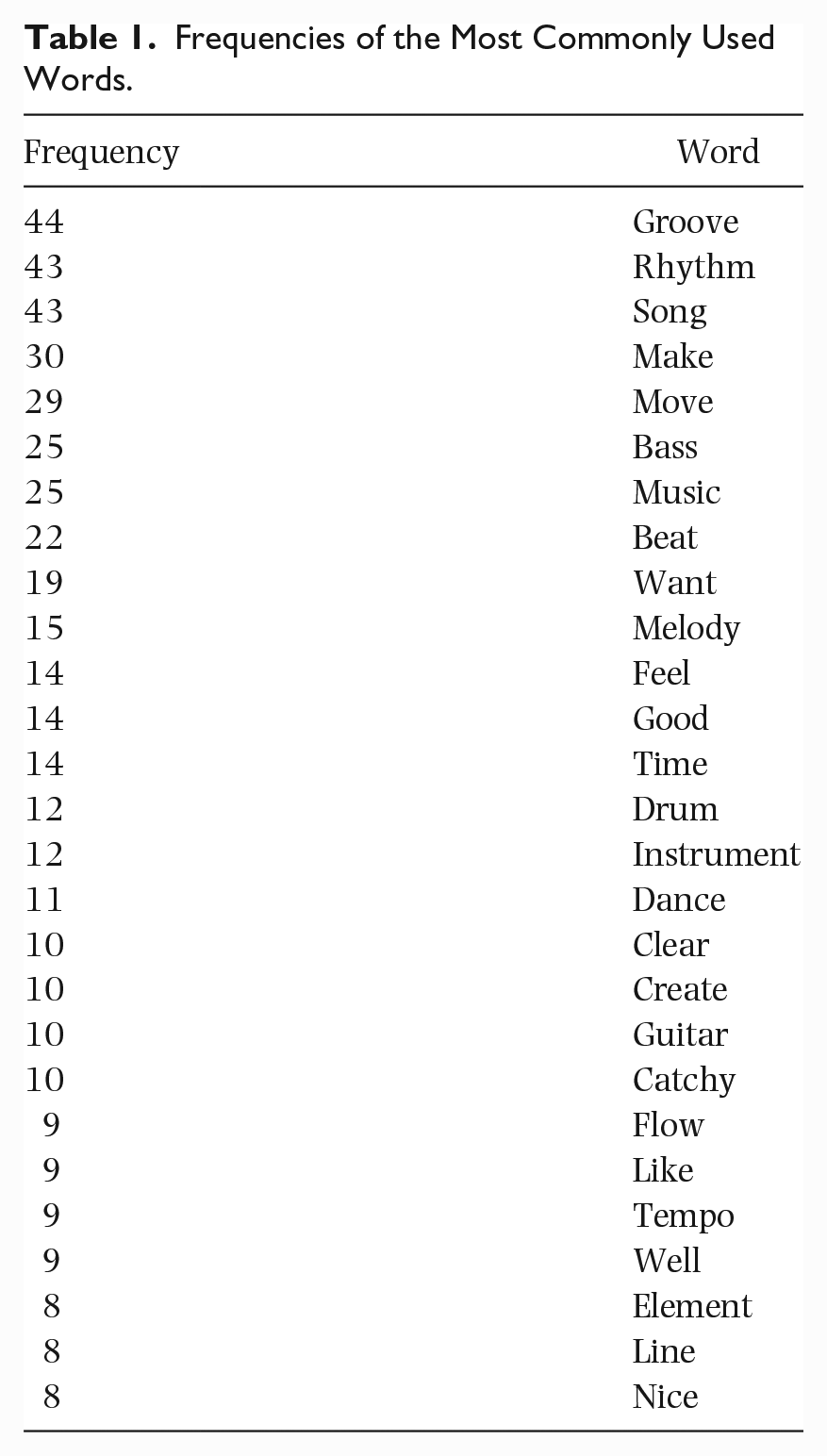
In line with previous research, the emergent categories depict groove as a multifaceted phenomenon (Hosken, 2020; Pfleiderer, 2010; Stupacher et al., 2016; see also “Groove is a complex multidimensional phenomenon” section). Despite the survey’s explicit inquiry (the question asked being “what makes a song ‘groove’ in your opinion”), participants still provided definitions of groove beyond what can be derived from a song. Specifically, we observed a multidimensionality in participants’ groove descriptions such that groove evoked concepts associated with music (both what and how music is performed), and experiences of the music by its listeners in relation to both their present and prior experiences. This highlights the multidimensional nature of groove, and how the notion is driven not only from the musical piece but how it is also significantly related both to one’s personal experiences as well as how the music is communicated by its players. As a consequence, we categorized various aspects of groove which are presented in the following section.
Categories defining groove
Participants’ groove descriptions revealed a tendency to refer to both music- (including what is played and how it is played) and experience-related variables of groove. While the musical aspect was referenced 159 times, the experiential aspect appeared a total of 109 times. Although these numbers should be approached with degree of caution in light of potential priming of music-related answers, this duality is in line with previous work (Roholt, 2014). Categories that we derived abductively from participants’ groove descriptions are presented in Table 2.
Main and Subcategories of Participants’ Groove Descriptions.
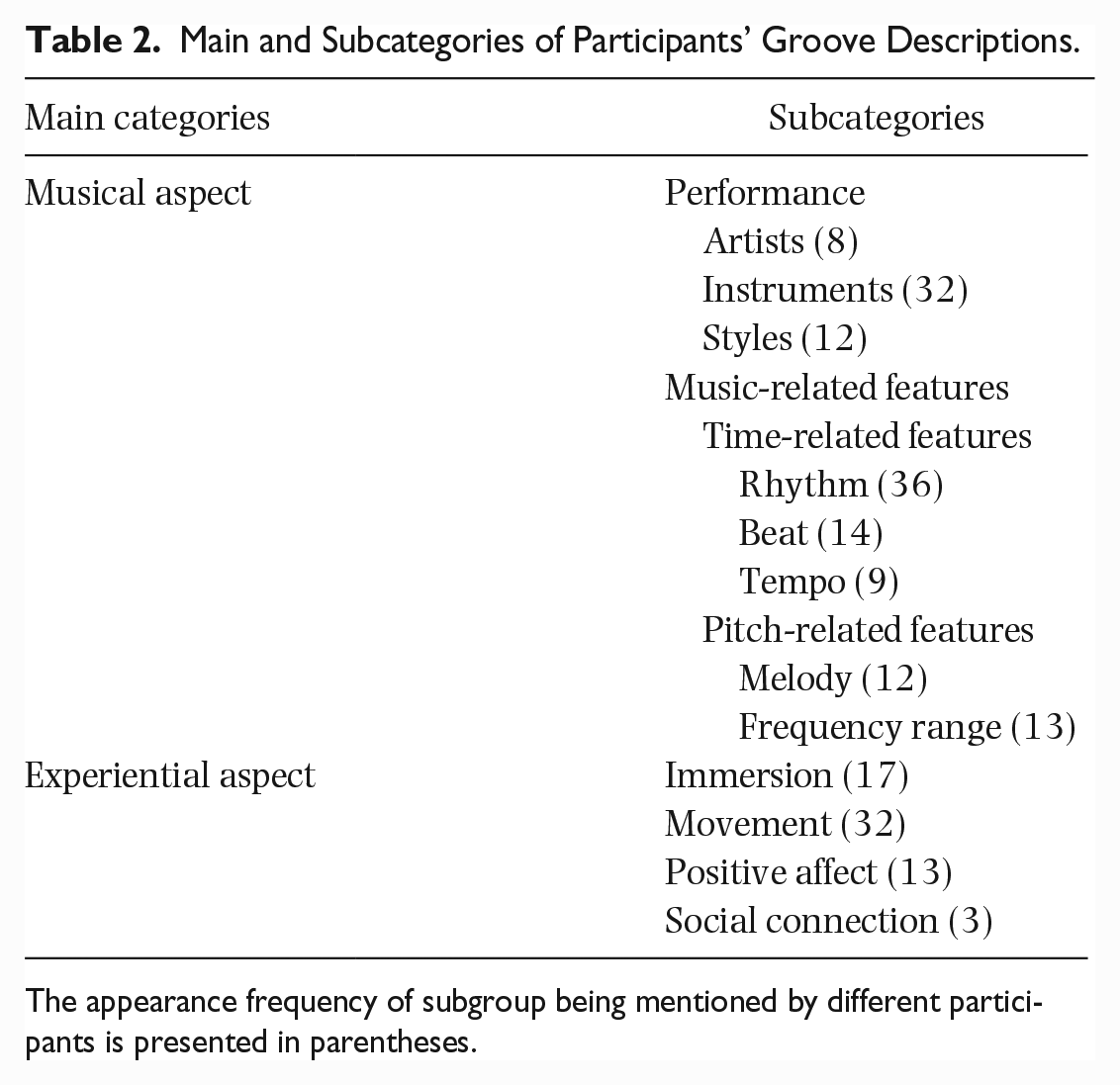
The appearance frequency of subgroup being mentioned by different participants is presented in parentheses.
Musical aspect
The musical aspect’s main category relates to subcategories performance (how the music is played) as well as music-related features (what is being played). This finding is in alignment with what Keil (1966) argues; not only what is being played but also how it is played influences expressivity and thus the production and the perception of groove. The performance subcategory covers producers of groove (artists), musical instruments, and musical styles associated with groove. The music-related features subcategory mainly consists of time- and pitch-related features.
Performance
This subcategory can also be seen as how groove is produced. Such a production can be live or recorded music, made by a band, producer, or a single artist.
Artists
A musical performance associated with groove was described as being skillfully performed by artists. In other words, “performance ability of the players” contributes to the production of groove, which echoes Zbikowski’s (2004) description of groove. P9 exemplified how a drummer’s performance is relatable with groove: A great drummer can make a single symbol [cymbal] “swing”, which can give a groove for a whole song.
Instruments
Instruments were mentioned rather frequently (32 times) and the most commonly named instruments related to groove were bass and drums, followed by guitars, wind instruments, and vocals. Especially “bass guitar and drums” instrument pair were associated with groove, which is in line with Allan Moore’s (2001) groove definition (p. 34): “the groove is more particularly the pattern laid down by the bass and drum kit.” Their function was suggested to produce a “good” rhythm and a basis for other instruments. Moreover, the harmonious interplay of instruments was often commented upon. As P105 said, A song with a groove has a clear and funky bass line, some wind instruments, usually a saxophone and two trumpets. Then add some percussions and all these playing well together.
Styles
Related to the performance aspect, several musical styles were mentioned in participants’ groove descriptions. Funk and jazz were the most frequently observed musical styles, followed by metal. Moreover, while some participants mentioned groove existing in various music styles, one associated groove with “funk and disco” and one other with “jazz and blues.” For example, There can be many different kinds of great grooves that can be found in different music styles. (P9) I usually connect groove to songs that are or have funk or disco elements. (P82) I associate “groove” with jazzy-bluesy type of music. (P98)
While funk and jazz are often linked with groove (Danielsen, 2006), metal appearing as the third most common musical style associated with groove might at first be surprising. However, it is important to highlight that our sample included a large number of young students from Finland, known to have one of the highest numbers of metal bands in the world (DeHart, 2018). Thus, participants’ groove descriptions might be naturally biased toward their musical preferences. Moreover, this would be in line with previous findings that reported musical taste influences the experience of groove (Senn, Bechtold, et al., 2021).
Music-related features
With this subcategory, we gathered participants’ descriptions referring to what is being produced by the artists. This subcategory mainly contains musical features associated with groove, namely, as time- and pitch-related features. Similar to the “harmonious interplay of musical instruments,” a delicate interaction between musical features was remarked upon as another factor in groove-related music. For example, P19 suggested groove as an interaction between rhythm and melody: It is a mix of rhythm and melody that work well together. Many times, a clear melody over more complex rhythm or beat, or a simple beat with a more complex melody.
Time-related features
Related to time-related features of groove, the most commonly emerging codes (rhythm, beat, and tempo) were further investigated. Certain timing variations in music such as using a steady beat as well as rhythmic complexity such as use of half notes or syncopation (appeared 3 times) were linked with groove. While in the groove literature, syncopation has received notable attention (such as Witek et al., 2014, 2017), it might appear surprising that there were only three mentions of syncopation. One logical explanation might be that syncopation is a musical term and not many of our participants were professional musicians. Nevertheless, certain key words appeared several times in the data which might be interpreted as referring to the function of medium levels of syncopation. Such words are clear (10), complex (3), interesting (6), and catchy (10). One can argue that for instance a syncopated musical pattern is not too simple nor too complex but is catchy and interesting enough to attract the attention of the listeners and make them engaged with it (for similar interpretations see Matthews, 2021; Stupacher, Matthews, et al., 2022). This engagement aspect is elaborated further below.
Rhythm
Numerous responses used rhythm as a primary descriptor for groove. Beat was the other temporal musical feature associated with groove. The groove description of P30 demonstrated this temporal aspect, specifically explaining how the production of rhythm and beat contributes to groove. Indeed, highlighted temporal irregularities in this quote can be interpreted with Keil’s (1987, 1995) participatory discrepancies in the music too: Groove is mostly rhythmic feel that a song or a band has. [. . .] Groove is not about getting everything perfectly on time and on the beat, but it is more like getting things in the right place related to the beat. For example, sometimes bass player has to play a little bit before the beat (maybe in jazz context) and sometimes a little bit behind the beat.
Related to participatory discrepancies, although there was no direct mention of microtiming, five participants referred to such timing variations by stating: “Enough air between notes” (P67) or “not perfectly on time” (P30), for example.
Tempo
Tempo was also mentioned in relation to groove. It was observed that groove might exist at different tempi, with some participants indicating their preference for slow, whereas others for fast tempo. P79, for example, remarked: I often prefer slower tempos that feel “heavy” but faster tempos can also be “groovy.”
This contradicts previous findings which suggest an optimum tempo for groove around 100–120 bpm (Etani et al., 2018). However, this contradiction should be approached with care, as Etani and colleagues focused on the Japanese nori which is seen as an equivalent term for groove. Alternatively, this finding might hint at the existence of different types of groove experiences (as also hinted in Hosken [2020] and elaborated further in Bechtold & Witek, 2021). Different kinds of groove and their relation with experience of time have earlier been proposed by Keil (1995, p. 8): “each person has a unique feel for time and that bringing different or discrepant personalities together generates different kinds of groove.” Moreover, while it is well known that dance songs typically have a tempo of around 120 bpm (Duman et al., 2022; Moelants, 2002), a recent study reported five subgroups of dance music (with various combinations of Spotify audio features, including tempo) associated with different listening reasons (Duman et al., 2022). This might also be related to why people embody music in various ways during spontaneous dance (Toiviainen & Carlson, 2022; Toiviainen et al., 2010). Therefore, we might suggest that groove is not necessarily limited to a typical tempo nor solely to experiences of pleasure and an urge to move, but instead to a combination of several factors (similarly as suggested with the groove model: Senn et al., 2019, 2023). Thus, it is clear that more research investigating different kinds of groove experiences is needed.
Pitch-related features
Pitch-related features of music were also often mentioned by participants. Particularly, a separation between high- and low-frequency ranges was noted. This separation might be further linked with bass and drum instruments creating a rhythm-related basis for the other instruments, as they often carry low-frequency range acoustic features. For higher frequencies, however, a few participants mentioned the function of melody to add a flavor to the song. The following descriptions exemplified the role of pitch-related features on groove: Drums and bass create the foundation for it in a band and other instruments support it. (P30) A lot of groovy genres also have a separation in the range of instruments and voices. The bass is heavy and solid, and higher instruments sort of sparkle over the top. (P29)
This finding is in alignment with previous literature. As a function of our hearing organ, the cochlea, whereas lower-ranged frequencies deliver the rhythmic information (called the low-voice superiority effect), higher-ranged frequencies provide the melody (called the high-voice superiority effect) over a sound. Thus, timing variations are better detected at lower frequencies such as bass-ranged instruments (Hove et al., 2014) and strongly linked to groove ratings and with tapping stability (Stupacher et al., 2016).
Other music-related features
Lyrics
In addition to time- and pitch-related musical features, four participants referred to lyrical aspects of music. To the best of the authors’ knowledge, no previous research has reported the role of lyrics in groove experiences. In our participants’ descriptions, lyrics seemed to play a subsidiary role in experiencing groove. It was suggested that the function of lyrics was to help the listener to connect with the song. Thus, lyrical elements of music might be interpreted as making it easy for listeners to connect with the music and contribute to their groove experience, as P67 stated: The lyrics have a big contribution to it since the words make it easier to connect with the song.
Relationship between musical and experiential aspects
The above-mentioned musical variations that relate to groove might be further associated with establishing certain “musical expectations” in listeners. These expectations were derived from the adjectives that appeared frequently in participants’ groove descriptions. Some of these adjectives that were linked with the musical aspect of groove and listener expectations were: clear, predictable, consistent, stable, steady and simple, whereas other adjectives demonstrated the function of violation of expectations such as unexpected and sudden. Similarly, in Hosken’s (2020) thematic analysis, expectation/tension was an emergent concept. Involvement of such musical expectations might bring people closer to music, make them engage with it more deeply. As a result, the above-mentioned musical variables induce certain psychological and physical states (participatory experiences) in the listeners and impact their groove experiences (see below).
Moreover, while describing their groove experiences, participants used certain keywords that revealed their “engagement” with music. For example, participants used adjectives like catchy, interesting, complex, intense, heavy, bonding and synchronizing; verbs such as make, create, want, keep, emerge, capture and drive; nouns like feel, weight, ambiguity, attention, and flavor. These keywords demonstrate how music associated with groove makes listeners engage with it. The groove description by P10 exemplifies these findings: It has a clear rhythm so that it is easy to dance to it, but it can’t be too predictable. The song also needs to have good energy and funny/clever/interesting lyrics. I’d say that if a song puts you in a good mood, has attitude and makes you want to move or sing, that song is groovy.
These arguments might be supported by recent studies by Senn and colleagues (2019, 2020, 2022) in which they developed additional scales for their Experience of Groove Questionnaire. They state having “inner representation of temporal regularity” as a prerequisite for experiencing an urge to move along with the music. Some of the items in this scale include keywords such as regular beat, clear pulse, predictable/repetitive/steady rhythm. They further argue that the temporal structure may facilitate increased “rhythmic interest”. Some of the items in this scale include keywords such as attention capturing/captivating/fascinating/interesting/exciting/boring/surprising rhythm. Looking at these keywords, a similarity between the concepts of expectations and engagement (described above) with “inner representation of rhythmic regularity” and “rhythmic interest” (Senn and colleagues’ additional scales) subsequently can be noticed.
Although further empirical research is needed to disentangle how music creates certain expectations and engagement leading to participatory bodily and psychological experiences in listeners, this rather automatic engagement or the compelling aspect of music might be understood within the predictive coding framework (Stupacher, Matthews, et al., 2022; Vander Elst et al., 2021; Vuust et al., 2018; Vuust & Witek, 2014). Predictive coding is described as a survival mechanism based on the idea of maximizing future predictions by minimizing the error between the perceptual input and the prior expectations in the brain (Vuust & Witek, 2014). From this point of view, musical rhythm might be regarded as facilitating constant predictions in the brain, substantiating experiences of pleasure and sensorimotor synchronization. Furthermore, validation of expectations has been suggested as a key to pleasure in music (Huron, 2006; Meyer, 1956) which should be considered as a contributor to the experience of groove as well.
The groove description by P29 further exemplifies how the musical aspect of groove creates a drive and leads to the experiential qualities of groove: Musically it’s about slightly thwarting timing expectations, leaning back on the beat but always getting where you need to be. There’s a naive physics to it; groove sounds heavier and stronger than other rhythms, but the momentum of it drives you to the next beat at the same time as holding you back, creating this sense of movement and weight that works well with some kinds of dancing [. . .] makes it fun to both dance and sing to.
Experiential aspect
The features of groove described thus far, which establish musical expectations and engagement, might be further interpreted as a bridge between the music and the listener. They invite the listener to participate and experience the music on a deeper level. According to Danielsen (2006), this invitation lies in tension produced by the interplay between the main beat and the counter rhythm which is then balanced by the listener by moving along or just thinking it. We present these experiences as aspects of engagement or participatory experiences with music, namely immersion, movement, positive affect, and social connection.
Immersion
Beyond finding groove-related music interesting and engaging, participants often mentioned being in an immersed state with music in describing their groove experiences. While immersion is described as a psychological state, referring to “being involved” mentally, physically, and emotionally, other related terms to immersion–absorption and presence–are described as “extreme involvement” and “being there” subsequently (Wycisk et al., 2022). Similar to Wycisk and colleague (2022), by immersed state, we primarily refer to an “experienced connection or involvement with music.” This involvement can be in any form such as mental, physical, or emotional. Qualities of such connections with music are various and observed from the following descriptions, which are also related to concepts of flow, time, and space:
when you understand and get into the flow of the song (P33)
feel the song and feel that you are a part of it (P78)
something that hooks me (P3)
feeling different from the present (P56)
it gives the listeners space and allows them to be immersed in the song (P36)
Importantly, we propose that being immersed in music is a prerequisite for other experiential qualities of groove. Câmara and Danielsen (2018, p. 2) have described groove as an immersive state: “Groove happens in the here-and-now of performance, meaning that groove is, in a sense, ungraspable as such—the very moment one tries to come to terms with a groove experience, one is no longer in the groove”. Thus, it could be the common case that participants are not truly aware of such an “ungraspable” state but instead have a tendency to relate such groove experiences to more external clues like dancing or feeling good, ignoring the trigger. Therefore, noticing or quantifying such an immersed state might not be as easy and apparent as the other–movement and affect-related–states. This difficulty in quantifying an immersed state further led us to consider indirect indications of an immersive state with the interpretivist approach (Elliott & Timulak, 2005). The interpretation of this analysis can be found in Supplementary Materials 7 online. With the following examples, the key role that immersion with the musical piece plays for the subsequent affect and movement aspect can be observed:
It has to do with song having the ability to immerse you in it in an embodied way. (P48)
It captures you to it’s rhythm, makes you want to move along. (P97)
Dig deep into the music and enjoy. (P31)
Some kind of catchiness, a song you want to dance. (P6)
Furthermore, we highlight subtle nuances in the terms “immersion” and “flow.” Previously, Stupacher (2019) reported that a flow state correlated with the experience of groove in a tapping experiment. However, the terms flow and immersion are not necessarily entirely interchangeable. Agreval and colleagues (2020) propose that states of flow and immersion differ depending on the activity one is engaged in having passive or active involvement. Unlike the experimental method that was used by Stupacher (2019), since our focus was primarily on listener’s groove definitions (which do not necessarily involve active engagement), we prefer to use the term immersion instead of flow. We hope that future research would invest in the concepts of immersion, flow, absorption, and presence and develop reliable methods to quantify them.
Movement
Movement-related responses were frequently reported experiences in participants’ groove descriptions. This subcategory covers the induced experiences, which include both the “psychological experiences toward movement” (such as a desire to move and sense of movement) and “bodily experiences of movement” (such as dancing, nodding, swaying, singing and jamming). Furthermore, this movement aspect was often mentioned as a “drive” rather than a quality that the listener consciously acts toward; as P16 and P68 described:
A song that make your hips move even if your brain don’t want to.
Song has a groove when it immediately makes you want to move.
Such drive toward automatically moving to music has been shown empirically in a series of “stand still” competitions. Specifically, when asked to stand still, participants exhibit a greater amount of movement when musical stimuli are presented compared with silent moments (González-Sánchez et al., 2018; Zelechowska et al., 2020).
Positive affect
Participants often associated their groove experiences positively with words such as happy, enjoyment, and satisfying, which are gathered under the “positive affect” subcategory. Here are some examples of how participants described their induced positive emotional experiences associated with groove:
It has to do with enjoyment. (P48)
It needs to have a good feel to it. I mean it doesn’t have to be happy, but it needs to have that something. (P13)
A sudden change to ‘half time feel’ can be very satisfying, because there is a release for the built-up ‘tension’ of the fast parts. (P79)
Social connection
In addition to feeling an immersive state to music and experiencing it in relation with movement and positive affect, a final subcategory, “experience of social connection”, emerged from the data. This social aspect subcategory is linked with experiencing affinity toward the performers of the music and/or the other people who share the same atmosphere with the listener. Instances of this induced experience of social connection with the performer and other people were described as:
Something I feel through the artists. For example, I feel the groove in a Jazz band. (P42)
Bonding you to the people who are also grooving at the same time. (P29)
It is well established that shared activities such as music listening and making, dance, and coordinated movements, as well as shared emotions, are closely linked with establishing social identity, bonding, and connection (Arewasikporn et al., 2019; Lee et al., 2020; Marsh et al., 2009; Savage et al., 2021; Solberg & Jensenius, 2017a; Stupacher et al., 2017; Stupacher, Mikkelsen, & Vuust, 2022). For instance, a motion capture study investigated structural components of EDM music (breakdown, build-up, and drop) and reported higher levels of group synchronization during such structural changes in the music (Solberg & Jensenius, 2017b). Additionally, participants of the study provided self-reports indicating that the involvement of the other participants shaped their own experience. Moreover, it is known that people feel affinity toward others with whom they share similar musical preferences (Boer et al., 2011) and when a listener has affinity toward a musician, experience of perceived groove is reported to be higher (Kowalewski et al., 2020). Although these shared experiences, which are closely related to a sense of social connection, are also related to groove, research examining groove experiences in relation to social connection is scarce (Stupacher, Matthews, et al., 2022). One recent motion capture study reported increased groove ratings, movement energy, and interpersonal connection when participants were able to access social cues (eyes open versus eyes closed) (Dotov et al., 2021).
Witek (2017) proposes that groove disables boundaries between the music, mind, and body, enabling its listeners to “feel at one” with music and others in the same environment: Collectively filling the gaps in syncopation draws many bodies into the same space, in which bodies are distributed and the boundaries between different agents are further blurred. [. . .] The open spaces in syncopated groove become portals through which people can share the same mental, temporal and physical dimensions (p. 149).
Witek (2017) further describes syncopation as affording “social entrainment” in which temporal, psychological, and physical experiences of people are exchanged within the group. Thus, we suggest this social aspect as a secondary quality related to groove experiences which comes into play as a consequence of musical activity. Therefore, a social context (as also discussed in the groove model by Senn et al. [2019]) can add to primary experiences of groove and can shape the intensity or the granularity 2 of the experienced groove.
In light of these findings, it would be worth investigating further how experience of groove is linked to social cues. Importantly, in such endeavors, as social connection is proposed to play a secondary role in listeners’ groove experiences, it might not be as apparent to the listeners as other experiences like the desire to move or positive affect, requiring careful experimental designs. It is also worth investigating whether one needs to be surrounded by other people, or whether solitary engagement with groove-related music is sufficient for a felt social connection, since music is inherently a social phenomenon and among the reasons why people engage with it (Boer & Fisher, 2012; Schäfer et al., 2013).
Other factors associated with the experience of groove
Thus far, we have presented various experiences of listeners associated with groove. The experiences of feeling immersed in music, movement, positive affect, and social connection appear to be affected by other individual-related factors. Our data provided evidence for two individual-related factors, namely, musical preferences and listeners’ current state.
Musical preferences
People’s listening habits, which also relate to their familiarity with music, shape their musical preferences (Senn et al., 2019). Participant responses that reflect features related to their musical preferences and groove are gathered in this subcategory. Such musical preferences were derived from descriptions when participants associated groove with their favorite music, referenced their genre preferences or gave musical examples of the artists that they listened to. Artists which appeared in groove descriptions either as participants’ associations with groove or their musical preferences were: ABBA, Lamb of God, Pantera, Jamiroquai, Childish Gambio, Lady Gaga, Hozier, Christina Aguilera, Kool & the Gang, and Earth, Wind and Fire. Associated eras and the musical styles of these artists are various, leading us to the consideration of groove as an individual and personal experience regardless of the kind or time period of the music. Moreover, the groove description by P13 exhibits how musical exposure (familiarity) might be linked with groove experience: It helps if I am at least somewhat familiar with the song.
Current mood
The current emotional state of the listener also seems to influence experiencing groove in a song. According to P47, to experience groove, music should match with the current emotional state: If a song expresses your emotions and emphasizes them, then song groove.
Although previous groove models consider the influence of personal background and concrete listening situation for groove experience (Senn et al., 2019, 2023), current mood of the listeners is a rather novel finding in the groove literature. Its contribution requires further investigation and might shed light on the personal and interindividual variance in experience of groove.
General discussion and conclusion
In this article, we initially provided a brief history of groove and then reviewed pertinent aspects of the groove literature, with a particular focus on how the term groove–with its numerous connotations–has been defined. Subsequently, we presented a new thematic analysis of groove descriptions which highlighted two main dimensions of groove, namely the musical and experiential aspects. Compared with previous literature, our findings can be seen as a combination of how Roholt (2014) and Pfleiderer (2010) conceptualize groove. While Roholt (2014) highlighted two dimensions of groove (music and experience), Pfleiderer (2010) introduced four, more nuanced aspects. While Pfleiderer’s (2010) “structural-cognitive” dimension could be equivalent to our musical aspect, the “movement”, “emotional”, and “social” dimensions proposed by him could be seen as how we have explained our experiential aspect, with the addition of immersion.
We summarize our findings in Figure 1. The musical aspect of groove facilitates its experiential qualities which are mediated by other individual factors. These subcategories are interrelated with each other by their nature. In the musical aspect of groove, artists play the musical instruments that give rise to production of certain musical features which are then associated with specific musical styles. These musical styles then become part of listeners’ personal music preferences, or listeners might prefer to listen to a certain type of music depending on their current mood; this influences people’s groove experiences. Furthermore, by creating certain musical expectations, listeners engage with music which gives rise to psycho-physical participatory experiences. We explained this expectation and engagement with music in terms of participatory discrepancies and predictive coding frameworks. Moreover, we proposed immersion with music as the primary participatory experience which gives rise to (or manifests itself as) the experience of a desire to move and positive affect. Embodiment of music and experience of positive affect lead to a feeling of social connection, which was argued to play a secondary role in groove experiences. These steps further shape the listener’s current mood and determine the degree of experienced groove (bidirectional arrows).
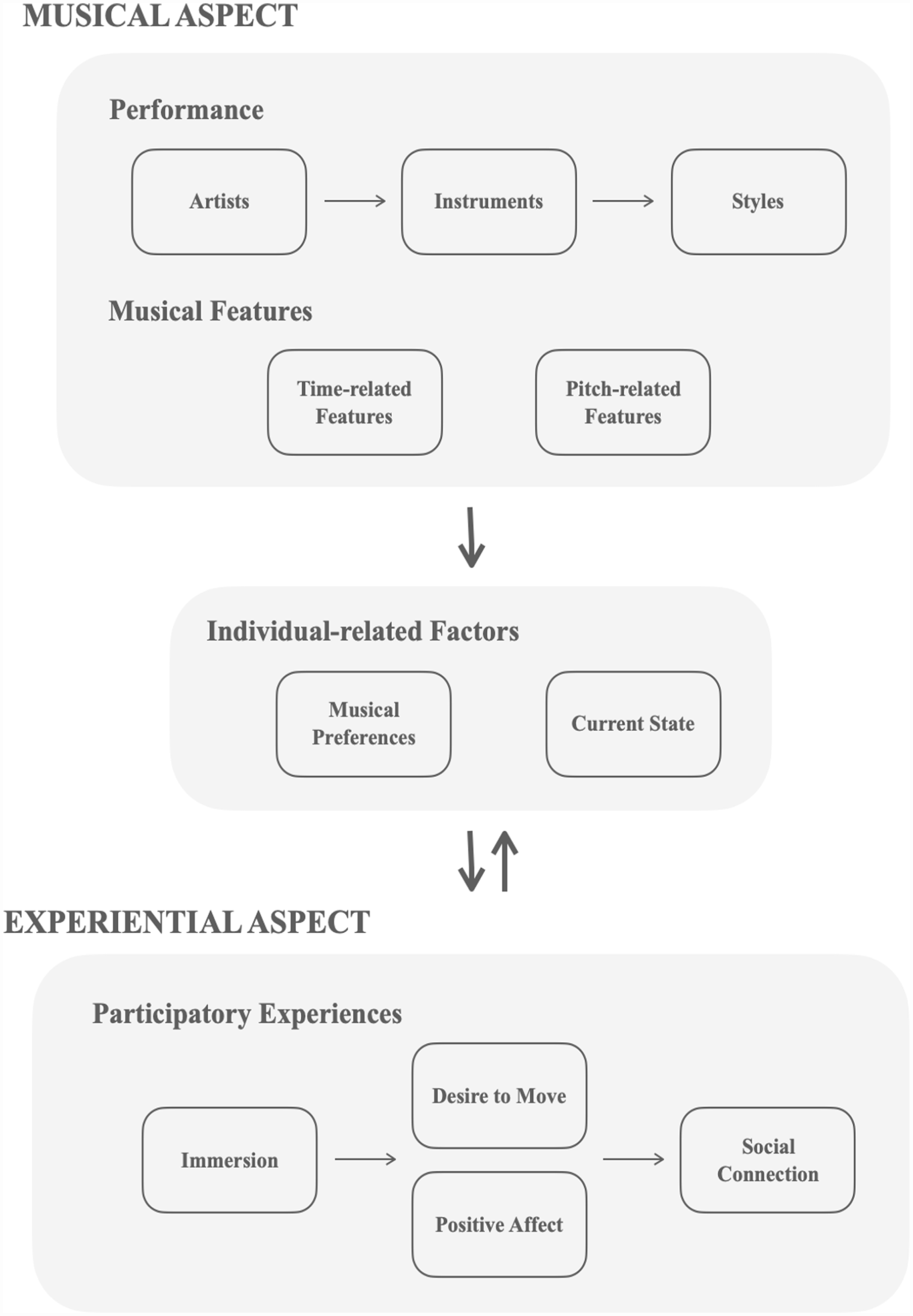
Summary of Main Findings, representing the relationship of the variables described by the participants. The musical aspect (performance and musical features) of groove facilitates its experiential qualities (participatory experiences) which are mediated by other individual-related factors.
Overall, it should be noted that with these results we are not offering a magic recipe for groove. Although groove evokes certain semantic associations in people’s minds, the ambiguity surrounding its description may emerge because of its multifaceted and complex character. Groove is not a simple concept, but one that arises from various interactions between (a) the artists who are performing the music, (b) the musical elements that emerge during the performance, (c) its listeners and the artists, (d) the listeners as individuals, and (e) the listeners within a group. Thus, the elements creating the groove experience might not be easily formulated. Instead, elements that create groove are interwoven. In other words, it can be said that specific performance of music shapes people’s personal groove experiences. Nevertheless, this model might not be complete; more research is needed in understanding how groove is produced and experienced.
A complementary definition of groove
Due to the evolving nature of groove over its history, definitions of groove remain ambiguous or confusing. Using categories derived from our thematic analysis, we hereby propose a more contemporary and complementary working definition of groove in the field of music psychology: “Groove is a participatory experience (related to immersion, movement, positive affect, and social connection) resulting from the subtle interaction of specific music- (such as time- and pitch-related features), performance-, and/or individual-related factors.” Importantly, our findings led us to suggest a shift from movement- and positive affect-focused definitions and measurements of groove toward describing it as a participatory experience. This is an aspect of groove that participants frequently mentioned, for example, describing it as an urge to be “involved in” the music physically and/or psychologically. This is in line with Keil’s (1987, 1995) participatory discrepancies and similar to what Levitin and colleagues (2018) describe by the “listener fills the missing beat” (p. 65) which can be interpreted as a contagious function of music. This might also extend the concept of groove as an invitation to “join”, or, as Witek (2017) states, “filling in the gaps” (which is described in its original context as a sophisticated bodily reaction to syncopation), if not with instruments, with one’s own body. In this way, groove induces participatory experiences in listeners in the form of an immersive state toward the music, a desire to move, an induction of positive affect, or a feeling of social connection. As described by Levitin and colleagues (2018), “when the music compels you to move along with it. This compulsion is the essence of groove” (p. 63). Overall, by defining groove as a “participatory experience” we highlight a compulsory or invitatory process (rather than a highly conscious act), which is also represented in the canonical definition with the word “urge.” This notion of an automatic and unconscious process in which one embodies or becomes “one” with (or through) music (and thus with the group by which the listener is surrounded) requires further empirical testing.
Moreover, we suggest a similar distinction between musical and experiential aspects of groove (as referred to earlier in this paper) be explicitly used in the future research. Clearer reference to these distinct aspects of groove could enable a common language to be used in future research, leading to a more profound understanding of groove in the literature.
Limitations and future directions
When developing our definition of groove, our aim was to capture multiple facets of the term. However, it should be noted that our sample included many young students from Finland, and their groove descriptions might be naturally biased toward their own understanding of the term. The fact that our sample was skewed toward younger people also made it impossible to make comparisons between different age groups. Future research should consider comparing groove definitions among different age groups, as well as people from different expertise groups. Other measures of individual difference that could be considered include personality, capacity for empathy, and daily music listening habits. Such research might reveal a more nuanced understanding of groove.
Moreover, since groove was reported to invite listeners to become “one with” or “participate in”, such as by inducing the urge to move to the music, the experience of groove might also be considered as a dynamic state. This view is in alignment with the argument suggesting that groove cannot be experienced analytically, but via physical engagement with music (Roholt, 2014). In other words, there might be differences in experienced groove depending on whether the listener experiences the music only by passive listening or actively participates through movements and dance. We suggest that future research would investigate new perspectives (such as granularity or different kinds of groove experiences) and focus in more detail on such influences on the experience of groove.
Supplemental Material
sj-docx-1-pom-10.1177_03057356231165327 – Supplemental material for Groove as a multidimensional participatory experience
Supplemental material, sj-docx-1-pom-10.1177_03057356231165327 for Groove as a multidimensional participatory experience by Deniz Duman, Nerdinga Snape, Andrew Danso, Petri Toiviainen and Geoff Luck in Psychology of Music
Footnotes
Funding
The author(s) disclosed receipt of the following financial support for the research, authorship, and/or publication of this article: This work was supported by the Academy of Finland (project 346210) and the Kone Foundation (project 202206934). The funders had no role in study design, data collection and analysis, decision to publish, or preparation of the manuscript. Authors received no other specific funding for this work.

Supplemental material
Supplemental material for this article is available online.
Notes
References
Supplementary Material
Please find the following supplemental material available below.
For Open Access articles published under a Creative Commons License, all supplemental material carries the same license as the article it is associated with.
For non-Open Access articles published, all supplemental material carries a non-exclusive license, and permission requests for re-use of supplemental material or any part of supplemental material shall be sent directly to the copyright owner as specified in the copyright notice associated with the article.
