




Abstract
This research examines the hypothesis that music experienced during puberty in early adolescence imprints on individuals to promote the pursuit of friendships and mating. We conducted an online survey with samples from the United States and China (Study 1) and a within-subject experiment (Study 2). Results suggest that most songs and poems identified as “favorites” were learned during early adolescence. Furthermore, compared with recently acquired songs and poems, those from early adolescence reminded participants more about friendship and induced more emotional reactions. In the Chinese sample, the shared preference for similar songs from early adolescence increased friendliness perception. Music from early adolescence also increased positive feelings more than other art forms, such as poems, fine arts, movies, dance, and views of natural scenery, especially when experienced in the company of friends than alone. In Study 2, singing songs from early adolescence (vs. those from recent years) enhanced the trustworthiness ratings of faces of the opposite sex and promoted intentions to cooperate. However, early adolescent music did not facilitate mating-related evaluations such as the ratings of facial attractiveness and artistic intelligence. The present two studies provide evidence that early adolescent songs learned during puberty possess imprinting-like effects on friendship formation and trust-building.
Keywords
Music is a world within itself, with a language we all understand.
Adolescents listen to music for up to 3 hr daily and spend more than 10,000 hrs actively listening to music throughout adolescence (Rideout et al., 2010). Adolescents top all other age groups in the number of songs listened to and the frequency of listening to music (Tarrant et al., 2000; Zillman & Gan, 1997). This consumption pattern is universal across countries and cultures (Klein et al., 1993; North et al., 2000) and has only been accelerated by recent technological advances and increased online socializing (Rideout et al., 2010). Despite its marked prevalence, the high music consumption among pubescent youths has yet to be explained.
From an evolutionary perspective, music serves as a means of social communication (Mehr et al., 2021; Savage et al., 2021a). We propose that humans are attuned to music during adolescence for specific adaptive functions, such as mate acquisition and alliance formation. We further propose that music learned during puberty in early adolescence is most likely to have imprinting-like behavioral effects as it is the period when an individual goes through the most significant hormonal, neurophysiological, and morphological changes (Kail & Cavanaugh, 2018; Marshall & Tanner, 1986) to begin tackling key adaptive problems. Here, we examine whether music consumed during early adolescence holds a higher psychological significance than music consumed at other ages and art forms.
Social functions of music
Humans are the only primates that make music and use music universally (Kirschner & Tomasello, 2010). Although human musicality has been viewed as a by-product of other adaptations (Pinker, 1997), it has long been theorized to be a prelanguage and more primitive communication tool (Darwin, 1871; James, 1890; Jesperson, 1922; Livingstone, 1973). Recent studies of music effects have identified several behavioral functions of music, including physical arousal and communicating emotions (Schäfer & Sedlmeier, 2011), emotional regulation (Leipold & Loepthien, 2015), social bonding (Huron, 2001; Rentfrow & Gosling, 2006), group-level communication (Brown, 2017; Podlipniak, 2022b), and mating (Huron, 2001; Miller, 2000). Other recent works have postulated that music may share a joint evolutionary origin with speech (Brown, 2017) and serve as a protolanguage (Podlipniak, 2022b). While speech can convey complex meanings, songs are rich in their advertising functions for mating or alliance formation (Fitch, 2013, 2015; Ravignani & de Boer, 2021).
Humans are social beings with a high need for relationships (Baumeister & Leary, 1995). Various mechanisms have likely evolved to help forge, maintain, and enhance social bonds, including grooming, play, non-procreational sex, laughter, and humor (Dunbar, 2012; Ross et al., 2010). Although these mechanisms are efficient for forming bonds in dyads or small groups (Savage et al., 2021a), human societies increased in complexity and size, thereby producing a need for new mechanisms that facilitate bonding within larger groups. Recent work has argued that humans evolved musicality (the ability to comprehend and perform music; Fitch, 2015; Honing, 2018) to facilitate large-scale social bonding via widespread auditory mass communications (Dunbar, 2012; Launay et al., 2016). Music and singing can be generated at different volumes, and large groups of people can hear singing from a distance.
Several processes have been put forth to explain how music facilitates social bonding. For instance, having shared music preferences can signal mutual lifestyle preferences and similar values (Puetz, 2021). Being able to identify such commonalities builds social bonds. Moreover, music helps to communicate emotions (T. Li & Ogihara, 2003) and synchronizes thoughts (Chen et al., 2008); these processes improve both dyadic and large-scale social bonding (Hoehl et al., 2021).
Various hypotheses explaining the functions of musicality have focused on different types of social interactions, such as mate-quality signaling (Miller, 2000), male coalitions (Hagen & Bryant, 2003), infant care (Falk, 2004; Mehr & Krasnow, 2017), and group cohesion (Dunbar, 2012; Trainor, 2015). More recent theories have consolidated these functions into two overarching evolutionary hypotheses of musicality. First, the social bonding hypothesis (Savage et al., 2021a) posits that music serves communicative functions that facilitate social bonding in general (i.e., building social relations, mating), such as coordinating movements or synchronizing moods. Second, in contrast to the social bonding hypothesis, the credible signaling hypothesis (Mehr et al., 2021) views music as a unique signal for specific adaptations facilitating coalitional interactions and infant care. In this regard, songs could signal social affiliation and facilitate coalition. These notable works by Savage et al. (2021a) and Mehr et al. (2021) sparked academic debates where some scholars suggest that their accounts are not mutually exclusive and can themselves be unified (Juslin, 2021; Podlipniak, 2022a; Savage et al., 2021b), while others even suggest against a unified framework of conceptualizing the function of music (Harrison & Seale, 2021).
Apart from facilitating social bonding, music has also been theorized to play a critical role in mate-seeking—more specifically, displaying skills of musicality signals cognitive, emotional, and physical competence (Dunbar, 2012). Empirical evidence has found that when a robot gently touches participants in the presence of music, perceptions of sexiness increase (Fritz et al., 2017). Furthermore, when reading self-descriptions of potential mates on online dating platforms, participants rated those who mentioned their musicality as more desirable (Lee et al., 2019). These findings support the hypothesis that music facilitates mating processes (Miller, 2000; Mithen, 2009). A recent review has consolidated empirical findings supporting the idea that musicality plays a key role in sexual selection as there is a genetic basis for the perception and production of music. Indeed, people with better musicality achieved higher mating success (Ravignani, 2018).
The role of music in pursuing adaptive goals during adolescence
Despite many hypotheses about the evolved functions of music and empirical studies linking music to the adaptive attainment or maintenance of interpersonal relationships, few empirical studies have identified life stages when music may be especially useful. In particular, adolescence is a critical period of transition and plasticity when significant physical, structural, and social functional changes occur (Lerner & Steinberg, 2009; Masten & Cicchetti, 2010). Life-long effects of adolescent experiences have been revealed in studies of autographical memory and music preferences. Rubin et al. (1986) first reported a phenomenon called the reminiscence bump, which refers to the increased proportion of autobiographical memories from adolescence and early adulthood observed in adults older than 40. This heightened memory for events or stimuli from younger ages has been applied with relevance to music preference (Schulkind et al., 1999). Further research has found that such preference for music from adolescence and early adulthood can be culturally transmitted over generations, demonstrating cascading reminiscence bumps (Krumhansl & Zupnick, 2013).
Two changes in adolescence among many are most evident. First, sexual motives start to develop (DeLamater & Friedrich, 2002) as adolescents begin initiating interactions with the opposite sex with (possibly unconscious) sexual agendas (Rowe et al., 1997; Volk et al., 2015). Second, they develop a strong desire for friendships (Berndt, 1992), which drives them to form relations with others. Friendship formation in adolescence is regarded as a developmental milestone (Youniss & Haynie, 1992).
Suppose humans evolved musicality to facilitate social affiliation (friendship or/and romantic bonds), and social affiliation begins to acquire great importance in early adolescent years. In that case, it is plausible that humans evolved to attach psychological significance to music consumed during early adolescence to achieve these goals. If so, songs people listen to during early adolescence would have strong imprinting-like effects that facilitate mating and alliance formation, and this effect would likely be stronger than it is for music consumed later in life or other art forms (e.g., fine arts, poems, movies).
Indeed, there is already some support for this argument. Some scholars have argued that alliance formation and alliance strengthening are critical adaptive functions of music (Huron, 2001; Savage et al., 2021a). Furthermore, Miller (2000) posits that music preferences facilitated assortative mating in our ancestral past and that this function confers the highest adaptive benefits at young ages ranging from adolescence to young adulthood. Empirical evidence shows that even after controlling for social background, Dutch adolescents reported similar music interests as their best friends (Selfhout et al., 2009), consistent with music cultivating social bonding. When people are asked to recall songs of significance, the chosen songs oftentimes date back to their adolescent years. These songs tend to be associated with episodic memories that are personally important (Loveday et al., 2020; Rathbone et al., 2017). Furthermore, qualitative data from interviewing adults about the music they heard during their adolescent years revealed that music played a crucial role in building friendships (Hines & McFerran, 2014). Finally, pertaining to its mating function, music has been identified as a key part of human (Dunbar, 2012; Miller, 2000) and animal mating processes, such as in the mating calls of birds, whales, and seals (Huron, 2001).
The abovementioned evidence suggests that music plays a crucial role in pursuing mate acquisition and alliance formation, especially during adolescence. We predict that music experienced during puberty in the early adolescent period imprints on individuals for a more extended period beyond puberty. On average, girls begin puberty at ages 10 to 11 and complete puberty at 15 to 16; boys generally begin puberty at ages 11 to 12 and complete puberty at 16 to 17, with an age range from 8 to 17 years (Kail & Cavanaugh, 2018; Marshall & Tanner, 1969; Rogol et al., 2002). Notably, evidence suggests that in addition to music, books, and movies consumed during adolescence were also frequently listed as “favorites” (Janssen et al., 2007).
We predict that imprinting-like effects of adolescent music would facilitate cooperation and reciprocal altruism. We review music imprinting as a tradeoff between social solidarity and flexibility. Musical imprinting would allow the adults who share their adolescent music to identify each other as in-group members. To test our arguments that music during adolescence serves the key adaptive functions of mate acquisition and alliance formation, it is crucial to empirically examine whether these social bonding pursuits are indeed less associated with memories of music acquired in adulthood or other forms of art that are more evolutionarily novel (e.g., movies) or restricted to physical proximity (e.g., paintings, poetry). Hence, we hypothesize that music acquired during adolescence will be more strongly associated with mating and alliance-forming cognitions than music acquired in adulthood or alternative art forms.
Theoretically, our study can shed light on the recent debate about whether musicality has evolved to cope with a group of problems related to social bonding in general (Savage et al., 2021a) or to solve domain-specific problems of coalition formation (Mehr et al., 2021). Particularly, in line with the notion of social bonding in general, favorite songs from early adolescence would be expected to enhance positive feelings and trust across social domains. In contrast, in support of the specific coalition-formation hypothesis, this effect would emerge in evaluations related to strengthening friendships but not mating-related assessments. Although the current research focuses on specific functions of adolescent music experience on coalition formation and mating, we acknowledge many hypotheses and research evidence regarding the life-long effects of adolescent music on other aspects of social behaviors, as partially mentioned in this section.
Study 1: Preliminary cross-cultural surveys on functions of early adolescent music
In Study 1, the participants freely recalled songs acquired in adolescence versus recently. We then examined the extent to which these songs were associated with specific mindsets or thoughts. We adopted similar methods used in previous research (Loveday et al., 2020; Rathbone et al., 2017) by asking participants to recall favorite songs and subsequently asking them about what associations they made with each song. Study 1, with cross-cultural samples, provided a preliminary examination of our hypothesis that music from adolescence (vs. from recent years or other art forms) is more strongly associated with thoughts and feelings about mating or friendship. As musical tastes vary by culture, results of musicality studies conducted in one location might reflect artifacts of a particular culture. As such, we collected data from two disparate cultures—the United States and China. In particular, these countries exemplify individualism and collectivism, respectively, and such cultural differences have been shown to affect a host of social-psychological behaviors (Hofstede, 1991; Triandis, 1995), including music preferences (North & Davidson, 2013).
Participants and procedure
We conducted an online survey with two samples of Chinese participants (N = 203) and U.S. participants (N = 230). The Chinese version of the survey was translated into English and then back-translated into Chinese by different researchers who are fluent in both languages. A native English speaker further verified the English version of the survey.
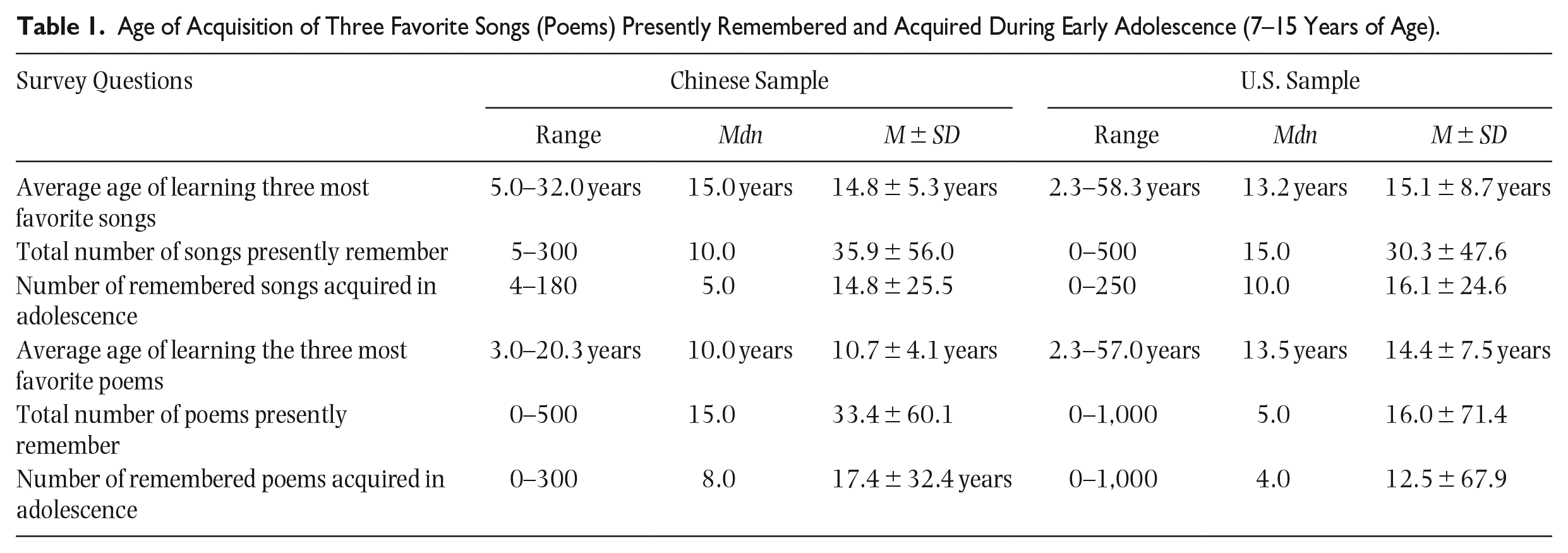
We recruited the Chinese participants using Credemo, a platform like Amazon’s Mechanical Turk generally used to recruit participants for surveys and experiments in China. After giving consent, participants wrote down the name or first line of each of their three favorite songs and the age they first heard the songs. They also wrote down the title or first line of their three favorite poems and the age at which they first encountered them. Next, they listed as many songs as they could remember at the moment and indicated the age at which they heard each song (see Table 1). It should be noted that the wording in the questionnaires for proms and songs acquired (heard, experienced, or learned) during adolescence or recent years was identical. For instance, “Write down the names of three of your favorite songs (poems) you learned in adolescence (the past two years).”
Age of Acquisition of Three Favorite Songs (Poems) Presently Remembered and Acquired During Early Adolescence (7–15 Years of Age).
In the second part of the survey, participants rated the extent to which the songs (from early adolescence vs. recent years) elicited psychological reactions relevant to social bonding: reminding friendship, emotionally soothing, willingness to take on challenges, and feeling happy (see Table 2).
Chinese (Left) and U.S. (Right) Sample: Comparison Between Music Acquired in Adolescence and Recent Years.
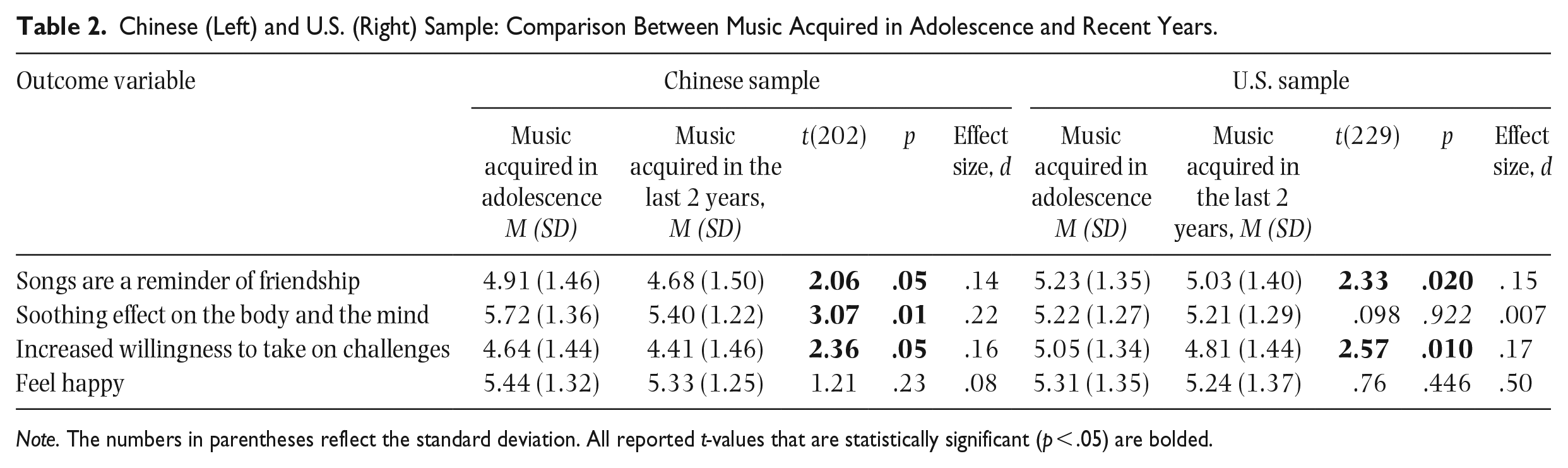
Note. The numbers in parentheses reflect the standard deviation. All reported t-values that are statistically significant (p < .05) are bolded.
The participants also rated the extent to which these variables are associated with other entertainment forms, including poems, paintings, and TV shows or movies. Responses were all made on a 7-point Likert-type scale with 1 = strongly disagree to 7 = strongly agree. See Table 2 for more details.
We conducted further exploratory tests comparing how music and other artistic experiences influenced physiological arousal and behaviors. Participants rated how excited they felt when listening to their favorite music versus other artistic activities. For example, the participants responded to the following question: “If you rate the level of how excited you feel when reciting your favorite poem as a 10, then how excited would you feel when singing your favorite music? (Please answer with a corresponding number in reference to 10).” Similarly, participants compared the effects of favorite songs versus other art forms in terms of the likelihood of affecting their preference for music/writing styles. We also gathered basic demographic information on gender, age, marital status, education level, and subjective socioeconomic status.
Results
Chinese and U.S. samples
The online survey recruited participants from China and the United States. The Chinese sample included 203 participants (133 females and 70 males) from 15 cities across China. The mean age of the Chinese sample was 26.3 ± 5.7 years (ranging from 18 to 52 years). The U.S. participants were sampled through Mechanical Turk (N = 230; 80 females and 150 males). The mean age of the U.S. sample was 35.1 ± 11.1 years (ranging from 18 to 77 years). For both samples, none of the participants was a music student or professional musician.
The key descriptive data for both samples are shown in Table 1. The following results are organized into three main research questions.
RQ1: Were favorite songs and poems largely learned in adolescence?
On average, participants’ favorite songs were from early adolescent years (Chinese sample: 14.8 ± 5.3 years; U.S. sample: 15.1 ± 8.7 years). Similarly, participants acquired their presently favorite poems near adolescence (Chinese sample: 10.7 ± 4.1 years; U.S. sample: 14.4 ± 7.5 years). Considering that some favorite songs and poems were acquired in recent years, these results suggest that their favorite songs and poems were largely acquired during puberty in their early adolescent years for both Chinese and U.S. participants.
The average age of the participants acquiring favorite poems was significantly younger than the age for learning favorite songs in the Chinese sample, F(1, 202) = 487.3, p < .0001,
RQ2: Does music acquired during early adolescence have higher associations with social bonding cognitions than music learned in recent years?
For both Chinese and U.S. samples, participants reported that songs from early adolescence had more significant effects on reminding them of friendship than recent songs (Table 2). In both samples, we found no significant effects of the age of music experience on reminding participants of romantic love. In addition, music acquired during adolescence (vs. recently) was significantly more associated with increased willingness to take on challenges, a characteristic in a small group context and during joint ventures (Wang, 2002; Wang & Johnston, 1995). These consistent results across the two samples more strongly support the coalition-formation function of musicality than a more general social bonding perspective. In addition, for the Chinese sample only, music from adolescence also extended to a greater soothing effect than recently acquired songs. In both samples, there was no significant difference in the ratings of “feel happy” between music from adolescence and music learned recently (Table 2).
Both samples also provided further support for the friendship-facilitation function of music from early adolescence. For the question “often did it with others,” music acquired in recent years had a significantly higher (M = 5.73, SD = 1.32) rating than that of music acquired in recent years (M = 4.79, SD = 1.52), t(202) = 2.67, p = .008, d = .19. Similarly, among the U.S. participants, having the company of others (vs. being alone) when engaging in music increased ratings on “feeling happy when hearing or singing favorite songs from adolescence,” F(4, 225) = 3.36, p = .011,
RQ3: Does music have higher associations with social bonding cognitions than other forms of entertainment?
Next, we explored whether music significantly affected some dependent variables more than other entertainment forms (Table 3).
Chinese (Left) and U.S. (Right) Samples: Results of Music Compared With Other Forms of Entertainment.
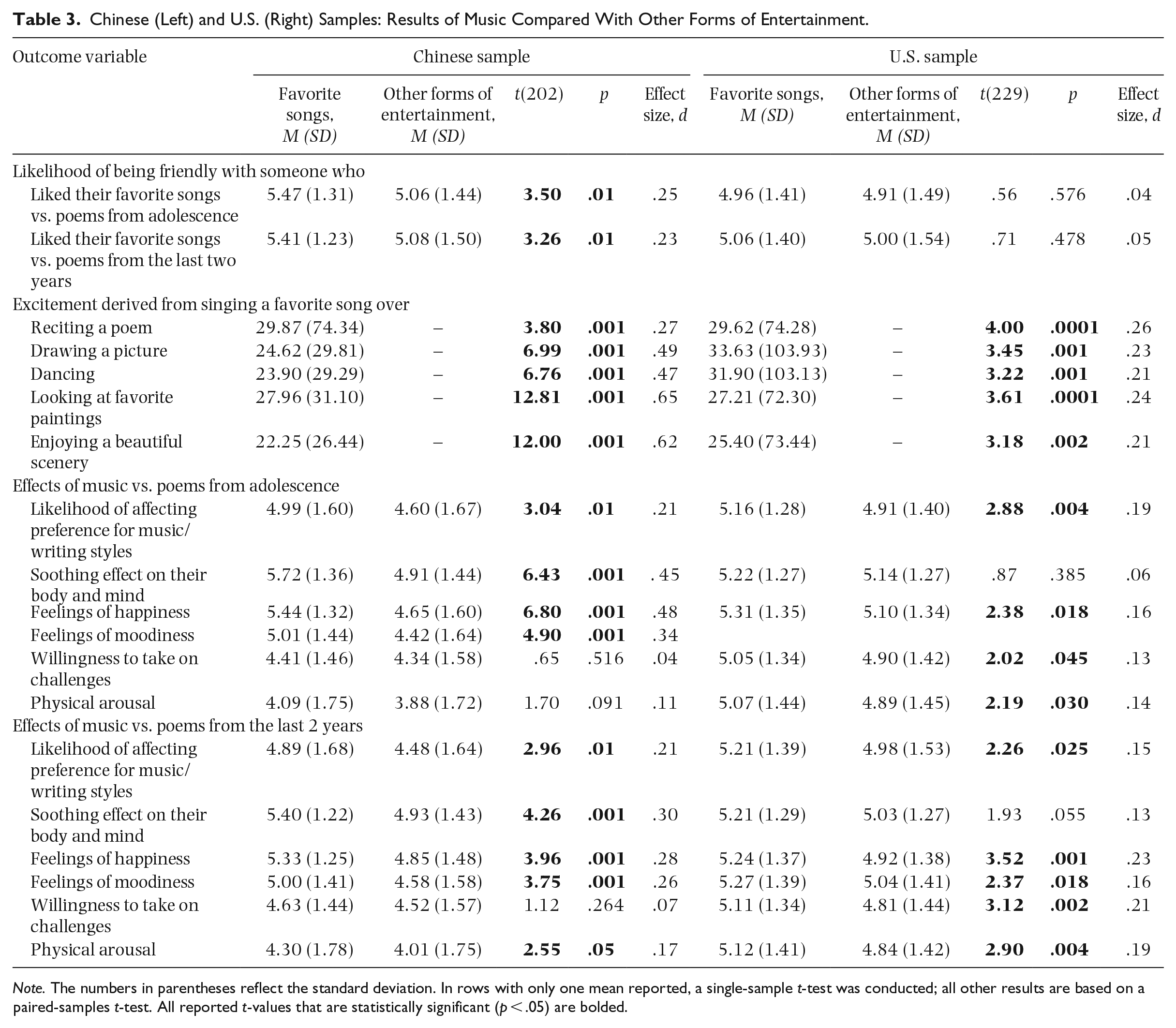
Note. The numbers in parentheses reflect the standard deviation. In rows with only one mean reported, a single-sample t-test was conducted; all other results are based on a paired-samples t-test. All reported t-values that are statistically significant (p < .05) are bolded.
Regarding our focal dependent variables about the effects of music on mating and friendship/coalition building, Chinese participants reported that they were more likely to be friendly with people who liked their favorite songs (vs. poems) acquired during adolescence and in recent years. Interestingly, this pattern was absent in the U.S. sample. Only for the Chinese participants, music had a more significant impact than poems on friendship-building, and this extends beyond the adolescent years.
Furthermore, the results suggest that music is superior to other forms of entertainment across both Chinese and U.S. cultures in terms of inducing some attitudinal preferences for music/writing styles and willingness to take on challenges and emotional changes (e.g., excitement, soothing effects, happiness, and moodiness). Interestingly, some cultural differences exist (Table 3). Importantly, for both samples, these superior effects of music (vs. other art forms) were not exclusive to music heard in adolescence but also applied to music and art consumed in recent years.
Chinese participants reported that listening to or singing adolescent songs helped regulate emotions better than other forms of entertainment, F(4, 198) = 2.48, p = .045,
In sum, across both Chinese and U.S. samples, music experienced during adolescence was more reminiscent of friendship than music experienced recently, suggesting a facilitating effect of adolescent music on coalition cognition. Adolescent music did not prompt thoughts about romantic love more than recent music experiences for both samples.
Furthermore, in both samples, listening to music in the company of others versus alone led to improved happiness and emotion regulation. Together, these results support the prediction that music consumed during adolescence (vs. recently) can facilitate thoughts and memories about alliance formation.
Moreover, our prediction that music (vs. other art forms) motivates friendliness to others was only supported in the Chinese sample, suggesting this may be a cultural-specific strategy of social bonding. Furthermore, among the exploratory dependent variables across the U.S. and Chinese samples, music was generally better than poems and other art forms in shaping participants’ music and writing preferences, eliciting excitement and positive moods, and regulating emotions. Notably, these effects of music extended to those consumed in recent years and were not exclusive to those consumed in early adolescence.
Study 2: an experimental examination on functions of adolescent music
Building on the results of the correlational study, we next investigated whether manipulating participants’ music engagement from adolescence versus last year can improve social judgments that facilitate mating and friendship formation.
Method
Experimental design
We adopted a within-subject experimental design with two counterbalanced conditions of music experience manipulation.
We determined the sample size partially based on previous studies measuring the behavioral effects of music experience. For instance, Anshel and Kipper (1988) found a significant difference in trust ratings between a music-listening group and a poetry-reading group (n = 24 for each group). Kirschner and Tomasello (2010) reported that joint music-making enhanced cooperative behaviors among 4-year-old children with a sample size of 24 in each between-subject condition. Considering these findings and the survey results of Study 1, we assumed a medium to large effect size in our within-subject experiment to detect the predicted enhancement of adolescent music on trust perception compared with listening to recent music. Based on a G-Power 3.1 analysis, the sample size should be 67 when effect size f = .35, at 80% power and .05 significance level.
Participants
Seventy-eight student volunteers of non-music majors at the Chinese University of Hong Kong (Shenzhen) participated in the experiment. The participants were at least 18 years old (M = 20.48, SD = 1.93), including 33 males (M = 20.15, SD = 1.41) and 45 females (M = 20.71, SD = 2.22). The participants received compensation by choosing between a 1-month QQ-Music VIP membership or a 1-month Netease Cloud Music VIP membership.
Procedure
Music experience manipulation
Before coming to the lab, each participant listed three favorite songs acquired during early adolescence (ages 8–17 years) and three in the past year. They then chose the most liked song from the two lists, respectively. The experimenter downloaded the two selected songs before the experiment.
Each participant was individually guided into a soundproofed room with an iPad placed on the desk. During the experiment, the two selected songs were played on an iPad one at a time, with the order counter-balanced. The iPad was preset to present the musical pieces at a standardized volume level of 50%. The participants were required to sing along with the lyrics of the song because songs with lyrics allowed for a stronger manipulation than music without lyrics (Daykin et al., 2018; Kreutz et al., 2004).
The participant was instructed to follow the steps shown on the iPad: (a) Play the first song in the playlist without changing the audio volume of the iPad; (b) Sing along to the playing song; (c) Pause the music when the song playing ended, and start to complete the corresponding set of tasks on the iPad, including rating face photos of the opposite sex in terms of attractiveness, artistic ability, and trustworthiness; rating scenery photos in terms of willingness to go for sightseeing with a friend or significant other, playing the trust game and the assurance game; (d) Start to play and sing along the second song and then complete the second set of tasks same as those following the first song.
Participants were instructed to sing aloud without worrying about being heard by the experimenter as they were in a soundproof room. The experimenter confirmed that participants did not feel claustrophobic, before leaving them in the room alone. Participants knocked on the door after completing the task. The experimenter then verified that the participant did sing along to the recorded song. After choosing their compensation, participants were then debriefed by the experimenter.
Dependent measures
After each singing experience, participants evaluated five face photos of the opposite sex on an iPad device. The digital color photos of faces displayed on the iPad served as the target person for each task. The dataset of faces included 10 photos (10 males and 10 females) selected from the Tsinghua facial expression database (Yang, 2020). The selection criteria were as follows: The faces all had a neutral facial expression and no particularly distinct features (e.g., facial scars) and appeared at an age similar to the participants.
Mating-related measures
Two mating-related social judgments were assessed—facial attractiveness and artistic intelligence. We assumed that if adolescent music, in comparison with music consumed recently, prompt mating, then participants would see opposite-sex targets as more desirable, as measured by the facial attractiveness and artistic intelligence ratings.
Facial attractiveness
Facial attractiveness, as an indicator of adaptive fitness, is positively correlated with successful mate acquisition (Hönekopp et al., 2007; Shackelford & Larsen, 1997). Five faces were randomly selected from the dataset. The participants responded to the item “how attractive do you think each face is” on a 7-point scale anchored at 1 (not at all) and 7 (extremely).
Artistic intelligence
Those who are more artistically talented (e.g., writing, singing, playing the instrument) have been hypothesized to have higher mate value (Miller, 2000) and have been shown to have higher physical attractiveness ratings (Kniffin & Wilson, 2004). Moreover, more successful artists have more sexual partners (Clegg et al., 2011). Participants rated the same five photos on the extent that they “think the target is good at playing a musical instrument” on a 7-point scale anchored at 1 (not at all) and 7 (extremely).
Coalition-formation and social bonding-related measures
If music facilitates friendships in adolescence, it is plausible that music learned in early adolescence (vs. recently) would facilitate judgments of trustworthiness.
Trust
Trust is a prerequisite in social bonding and coalition formation (Yamagishi, 2011). In this experiment, we measured trust using three measures. First, participants rated the extent to which they trusted each of the five protagonists randomly selected from the photo dataset. They responded to the item “How trustworthy do you think each face is?” on a 7-point scale anchored at 1 (not at all) and 7 (extremely).
Additionally, we adopted two economic games to assess cooperative behavior. In the trust game (Berg et al., 1995), the first player (the participant) is hypothetically endowed with some money; the player then decides how much to transfer to the second player, presented on the iPad. The amount transferred would be tripled and given to the second player. The second player can keep the whole amount without repercussion or send a fraction back to the first player. All participants were assigned to be the first player. The fraction of the initial amount (3,000 or 25,000 RMB in a counter-balanced order) they gave to the second player indicates their level of cooperation and trust toward the second player.
The second game is the assurance game, or the stag hunt game (Kollock, 1998). It involves three possible payout outcomes: high, low, and zero payoffs. If both players cooperate, both receive a high payoff (1,000 RMB). If both players decide not to cooperate, each will get a low payoff (500 RMB). However, if choices from the two players differ, the cooperator receives nothing, while the other player receives 500 RMB.
Results
We used paired samples t-tests to investigate whether songs learned in adolescence (vs. recent years) increased social judgments related to mating and friendship formation. Table 4 shows the results of paired-sample t-tests.
Adolescent Music Condition Compared With Recent Music Condition.
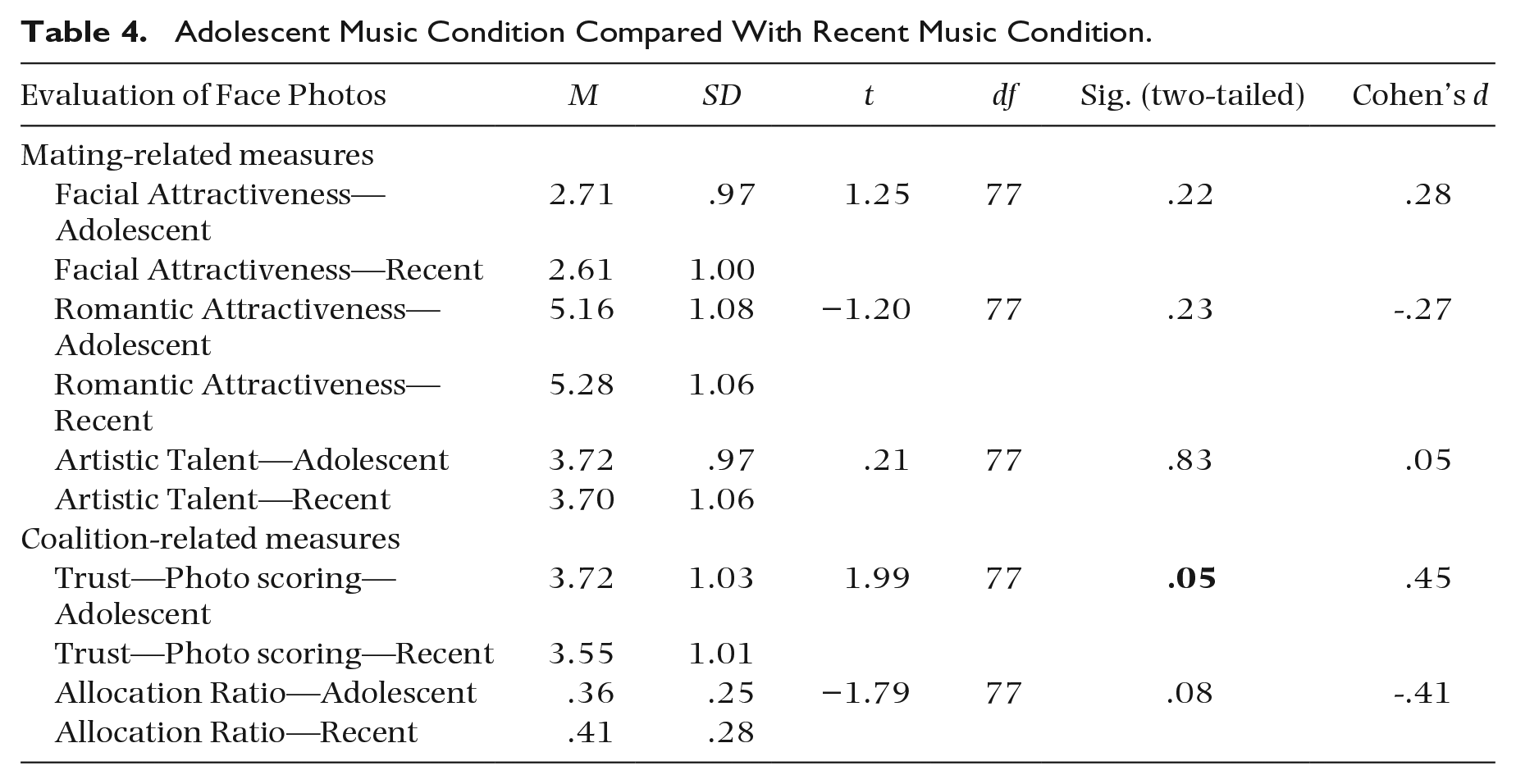
The song condition only had significant effects on the assessments of the trustworthiness of faces—perceived trustworthiness was higher under the adolescent music condition (M = 3.72, SD = 1.03) than in the recent music condition (M = 3.55, SD = 1.01), t(77) = 1.99, p = .05, d = .45. Compared with music learned recently, early adolescent music increased the trustworthiness ratings of a face photo of the opposite sex. This finding supports our hypothesis that adolescent music facilitates social bonding more than recent music (through promoting a sense of trust). In contrast, the three mating-related measures did not differ between the adolescent and recent music conditions. For the trust game, results between the two song-recital conditions were not significantly different (see Discussion for a possible explanation).
Finally, a chi-square test to examine categorical data in the assurance game revealed a statistically significant difference in choices between the two conditions, χ2(1, 78) = 11.403, p < .001. Specifically, 56 participants (out of 78) chose to cooperate under the Adolescent Music condition. Among the cooperators, 13 cooperated only under the adolescent music condition, and 43 maintained their preference for cooperation under both conditions. Thus, the evidence suggests that adolescent music increases the tendency to cooperate compared with recent music.
Overall, the results of the experiment suggest that adolescent (vs. recent) music facilitates social bonding (by increasing feelings of trust and the likelihood of cooperating) but shows no evidence of facilitating mating-related processes.
General discussion
Two studies investigated the imprinting-like effects of early adolescent music in facilitating mating motives and coalition cognition. To test the universality of musical experience effects, we chose the two major countries that are clearly different in their cultural values and musical styles. Specifically, cultural differences may affect music taste. For instance, individualistic cultures encourage attempts to use music to achieve personal goals, such as mood management, rather than collective social goals, such as securing friendships (North & Davidson, 2013).
Based on the results of Study 1 with the Chinese and U.S. samples, songs and poems identified as “favorites” traced back to their adolescent years (see Table 1). Adolescent songs were more reminiscent of friendship than recently learned songs. This imprinting-like effect of adolescent music was limited to thoughts facilitating friendship formation but not romantic relations. Furthermore, having a common preference for adolescent songs increased friendliness among Chinese participants only. In addition, there was evidence of discriminant validity: compared with other art or entertainment forms, music invoked higher positive feelings, arousal, and inclination to take on challenges.
In Study 2, participants sang along to a favorite song learned in early adolescence and a favorite song learned recently. In the tasks following each of the singing experiences, participants perceived higher levels of trustworthiness in others after singing songs from adolescence (vs. recently). Furthermore, in the assurance game, singing songs from adolescence (vs. recent songs) increased the choice to cooperate over selfishly hoarding resources. However, singing adolescent songs or recently learned songs did not differ in their effects on facilitating mating-related judgments such as facial attractiveness and artistic intelligence ratings.
Overall, these studies contribute to existing research seeking to understand the evolutionary function of music. Past work has proposed many explanations suggesting that humans evolved a capacity to perceive, enjoy, and produce music to facilitate social goals. While some scholars posit that music facilitates a broad range of social processes (Savage et al., 2020), such as mating (Miller, 2000; Ravignani, 2018), signaling coalition strength and territorial ownership (Hagen & Bryant, 2003; Hagen & Hammerstein, 2009), building group cohesion (Brown, 2000), and parenting (Mehr et al., 2021), our results are consistent with the hypothesis that music does not invariantly facilitate all types of social bonding but serves specific types of social functions (Mehr et al., 2021). We conclude that music experienced in adolescence leads to imprinting-like effects that promote alliance formation but not necessarily mating relations. We note, though, that this conclusion does not exclude possible roles of musical experience, in general, in serving mating and mate choice. It is conceivable that mating is a special type of coalition in addition to its romantic aspects.
Our results suggest that the behavioral effects of poetry and songs do not share the same mechanism. A sense of nostalgia may be a possible means for adolescent music to have a higher psychological significance compared with poems or other art forms from those years or music and other art forms learned in recent years. In other words, nostalgic feelings or other affective reactions are part of the hypothesized mechanism that makes adolescent songs more memorable and psychologically more significant. A recent study found that music helps cope with the Covid-19 pandemic by inducing nostalgia (Yeung, 2020). Coupled with research on the reminiscent bump (Krumhansl & Zupnick, 2013; Rubin et al., 1986; Schulkind et al., 1999), our findings suggest that the reminiscence bump may have arisen from psychological adaptations mainly catered to the specific adaptive goals of alliance formation.
Our studies also have practical implications for group processes and team-building. The studies suggest that being primed with music consumed in adolescence improves trust perception and cooperative tendencies. Accordingly, popular music during the teenage years may facilitate team building or the formation of social bonds.
Limitations, future directions, and conclusion
The current work is not without limitations that should be addressed in future research. For instance, to yield better theoretical validity, a perspective on the social function of music must account for other music functions. For instance, music is often appreciated alone and serves a mood-regulation function (Saarikallio & Erkkilä, 2007). Furthermore, music has also been found to signal social status (Cian et al., 2021). Future research can clarify how other purposes of music consumption fit with existing theories of the social functions of music.
Caution needs to be taken when comparing songs versus poems. Poems usually are less associated with attractive artists featured on media outlets than songs are. Thus, one potential reason why modern music makes an impact on us during adolescence is that we like or idolize the singers who are or appear alive in our everyday life. From this perspective, another non-music art experience, watching movies (with attractive actors and actresses), might serve as a better entertainment control than poetry.
A possibility for the lack of effect in the trust game is that experiences of songs from adolescent time made the participants more social and cooperative, but not necessarily more altruistic. Furthermore, as the trust game initially endows the participant with ownership of the initial money, this ownership may result in risk aversion in the trust game, especially if songs from adolescence promote a sense of self-identity. This postulation can be tested in future research.
Music may promote both mating and coalition formation within the adolescent period. However, outside the “mating period,” the long-lasting effects of adolescent music remained more evident in the contexts of coalition formation and strengthening. Furthermore, the lack of facilitative effects by music from early adolescence for the mating domain could have resulted from our focus on only two aspects of mating-related cognition, among others, such as perceptions of the target’s health, sociability, social status, warmth, and more (N. P. Li et al., 2002; Shackelford et al., 2005). Indeed, the evolutionary role of music in courtship has been proposed by researchers since Darwin (1871) and deserves further investigation.
It should be noted that our retrospective design and the wording concerning the music functions may result in a positive bias in the participants’ responses. However, our study’s design used identical wording for adolescent music versus recent music experiences and identically worded questions for music experiences versus non-music art experiences. In other words, if there was a positivity bias, it existed equally across all the conditions involved in statistical comparisons.
Another possible source of demand characteristics is the title of the survey. The U.S. and Chinese surveys (Study 1) were titled “Musical Experience Study” and “青少年期文艺体验研究” (Literary and Artistic Experience in Adolescence), respectively, and both titles appeared once on the first page of the survey. The title of the English survey may bias responses as it emphasizes “musical experience.” The title of the Chinese survey may lead to a different bias as it emphasizes “adolescence.” Future studies should have neutral and equivalent titles for both the Chinese and English versions.
We also noted that the results from the U.S. survey data revealed that music was not rated equally special across different times in life: music acquired during early adolescence had higher associations with social bonding than music learned in recent years. Although the participants may have a higher baseline rating for musical effects, they were able to differentiate the musical effects during different times in life. In the Chinese survey, the title did not mention music, but the music still had a higher association with social bonding measures than other art forms. The cross-cultural consistency in the survey results indicates that if there was demand characteristic bias due to the titles of the surveys, it did not systematically affect the results.
Several sample characteristics were less than ideal. Study 1 had a wide age range which may cause problems in making comparisons between adolescent and recent songs as the “adolescent” songs for younger and older participants would belong to different eras. In addition, for young participants, their adolescent and recent years may be too close to each other. Future work may include only older participants (e.g., older than 30 years old).
Furthermore, in Study 2, the sample size was not large enough to reliably detect expected differences when the effect size was small. The significant effects in Study 2 yield small effect sizes, ranging from .15 to .22. Based on a G-Power 3.1 analysis, the size of our sample (N = 78) is only suitable when the effect size is medium-to-large with f = .32, at 80% power and .05 significance level.
Our findings revealed cultural differences in associations with music (vs. other art forms; see Tables 2 and 3). Moreover, we had only included two cultures (Chinese and United States) in our study. Future research would benefit from distinguishing the effects of music across other cultures and examining how cultural differences may moderate these effects. Study 2 was built upon the findings from Study 1, assuming the effects of singing adolescent songs on trust and cooperative behaviors would be similar across cultures. However, this assumption is still subjected to further examinations with cross-cultural samples. Finally, prior work suggests that auditory stimuli should be intermittent and repetitive for effective imprinting (Salk, 1966). Future research can identify the minimum frequency and duration of music consumption required for imprinting-like effects to occur.
Conclusion
This investigation offers preliminary evidence of the imprinting-like effects of adolescent music on promoting alliance formation. Across two cultures, favorite songs were acquired mainly during adolescence. Furthermore, using an experimental design, we examined the long-term effects of adolescent songs versus recent songs on trust and cooperative behaviors. Singing songs acquired from adolescence (vs. recent songs) led to higher trust perception and cooperation but not mating-related cognition and feelings. These findings together contribute to the existing literature on the social functions of music, shedding light on the psychological significance of music consumed during adolescence in facilitating trust and cooperative motives underpinning alliance formation.
Footnotes
Funding
The author(s) disclosed receipt of the following financial support for the research, authorship, and/or publication of this article: This research was supported, in part, by the National Natural Science Foundation of China under grant number NSFC 31971025 to XT Wang.
