




Abstract
This study focused on the role music listening experiences play in the lives of three South African adults on the autism spectrum. The purpose of this interpretative phenomenological analysis (IPA) is to understand the role that music listening plays in the lives of three adults living with autism. IPA considers three key areas of philosophical knowledge, which include phenomenology, hermeneutics, and idiography. We, therefore, interpreted the role of music listening for our participants by highlighting similarities and differences between the participants’ lived experiences. The findings emerging from this study revealed five superordinate themes explaining the significance of music listening in the adults’ lives: (1) coping with auditory sensitivity, (2) getting lost in music, (3) music is a companion, (4) self-regulation, and (5) finding connection. The importance of music for masking or coping with sensory overload is distinct from the studies conducted to understand the music listening experiences of neurotypical individuals. It is our hope that the findings of this IPA provide rich idiographic descriptions of the individual experiences of our participants, thereby humanizing their music listening experiences.
Keywords
The focus of this study is on the role that music listening plays in the lives of three adults on the autism spectrum. The autism spectrum is characterized by various pervasive neurodevelopmental deficits, including challenges associated with social interaction, communication, the display of interests restricted to a limited number of fields, and repetitive behaviors (Grandin, 2011, p. 8; Pennington et al., 2014, p. 1; Preis et al., 2016, p. 106). Individuals on the autism spectrum consequently face various challenges (Allen & Heaton, 2010, p. 251). Therefore, a consensus has not yet been reached on the developmental and neurological aspects that make up the spectrum.
In this study, we seek to address the lack of literature on the music listening experiences of adults on the autism spectrum. The literature on the musicking experiences of persons on the autism spectrum primarily focuses on children’s experiences (Bakan et al., 2018; Epstein et al., 2020; Janzen & Thaut, 2018; Markworth, 2014; Reschke-Hernández, 2012; Wagener et al., 2021; Whipple, 2004). Consequently, literature that focuses particularly on the music listening experiences of adults on the autism spectrum is sparse (Allen & Heaton, 2010; Wiorkowski, 2012). This discrepancy could be attributed to the fact that autism spectrum conditions are often diagnosed in young children (Rickson et al., 2016). Children diagnosed with autism face many challenges because of the symptoms associated with autism, such as failing to develop peer relationships appropriate for their level of development, having difficulty with non-verbal communication and maintaining eye contact, and preoccupation with restricted patterns of interest (Boucher, 2008). The challenges faced by children on the autism spectrum prompt their parents to seek professional support (Grandin, 2011). However, adults on the autism spectrum may have developed various masking strategies to avoid harm or hide aspects of their autism, thereby making their atypical neurotype less visible (Miller et al., 2021). Consequently, the literature describing the music listening experiences of persons on the autism spectrum primarily focuses on childhood.
The effectiveness of music therapy for persons on the autism spectrum is well-documented (Bharathi et al., 2019; Rickson, 2021; Salomon-Gimmon & Elefant, 2019; Sharda et al., 2019). However, despite these studies, recent reviews have cast doubt on the effectiveness of music therapy as an intervention for persons on the autism spectrum and have called for more rigorous research to fully understand the affordances of music therapy for people on the autism spectrum (Marquez-Garcia et al., 2021).
Hillier et al. (2016) found that individuals on the autism spectrum were highly responsive to the influence of self-selected music and used this music to alter their psychological state, combat anxiety, and improve self-regulation. Despite the importance of listening to self-selected music for emotional regulation, music therapy interventions are still deemed more effective in addressing the challenges that individuals on the autism spectrum face (Rabeyron et al., 2020). However, music therapy remains largely inaccessible to individuals in South Africa, where this study was based. Therefore, it remains essential to understand the music listening experiences of adults on the autism spectrum. Kirby and Burland’s (2022) interpretative phenomenological analysis (IPA) of the functions of music in the lives of adults on the autism spectrum highlights the important emotional, social, cognitive, and identity-formation functions that music fulfills. Our study further builds on their work by seeking to better understand these functions through the lived experiences that our participants shared with us. Therefore, the purpose of this IPA is to understand the role that music listening experiences play in the lives of three adults on the autism spectrum.
Method
A qualitative IPA design was suitable for this study, as the study aimed to understand how our participants make sense of and interpret their lived music listening experiences. Consequently, the study drew on three “key areas of the philosophy of knowledge: phenomenology, hermeneutics and idiography” (Smith et al., 2009, p. 11). First, this study was phenomenological, because we were interested in the meaning that three adults living with autism ascribe to their own lived music listening experiences. Second, the study was hermeneutic, since we interpreted the transcribed in-depth semi-structured interviews as texts. Finally, the study was idiographic, as we analyzed each semi-structured interview separately and presented the findings for each participant separately before searching for similarities and differences between the cases.
Participants
The South African participants who participated in this study were purposefully selected (Chapman & Smith, 2002; Larkin et al., 2006) according to their diagnosis and their ability to share stories about their meaningful lived music listening experiences. Small sample sizes are possible in IPA research, due to the idiographic nature of the research (Brocki & Wearden, 2006) and the richness of the data collected (Smith et al., 2009). We consequently identified three adults living with autism to participate in this study.
Data collection
In-depth, semi-structured interviews are considered the primary data collection strategy in IPA research (Chapman & Smith, 2002), since observation is not suitable for gaining insight into how participants make sense of and interpret their lived experiences (Smith et al., 2009). Due to the COVID-19 pandemic restrictions, we consequently conducted in-depth, semi-structured interviews with each of the adults living with autism over Zoom, prompting participants to share stories about the meanings of their lived music listening experiences. Each participant participated in a 30- to 40-min initial and follow-up interview. During the first interview, participants were asked about their music listening experiences by prompting them to reflect on memorable occasions when they listened to music. Participants were asked to share stories about the emotions they experienced during certain music listening experiences and how music listening has supported them with specific challenges they spoke of during their interviews. The follow-up interviews focused on gaining clarity regarding the roles of their music listening experiences and the contexts of music listening experiences that the participants shared.
Data analysis
For data analysis, the interview transcripts were coded in Atlas.ti. The first author conducted the initial data analysis, after which authors two and three also analyzed the data to ensure trustworthiness. The data analysis process was guided by the participants’ direct words and stories, and the process was, therefore, inductive. We followed the six steps for data analysis provided by Smith et al. (2009, pp. 110–141). The six steps include the following:
Reading and re-reading interview transcripts;
Initial coding of the data, focusing on affective coding (focusing on emotions, conflicts, values and judgments identified in the transcripts) (Saldaña, 2013), where labels were assigned to the text based on participants’ direct words;
Developing initial themes within each individual case by grouping similar codes into categories and assigning broader labels to each category, and thereafter identifying themes for each participant separately by grouping related categories into emergent themes under new labels encompassing the similar categories (Saldaña, 2013; Smith et al., 2009);
Searching for connections across the emergent themes for each case, by searching for causality between themes (based on each participant’s story) and by organizing the themes into clusters (based on contextual narrative) (Smith et al., 2009);
Moving on to the next case once the previous case was analyzed entirely;
Looking for patterns across cases to construct superordinate themes during a cross-case analysis.
To stay true to the idiographic nature of IPA research, each individual case was analyzed completely by repeating steps one to five until the analysis for each participant was finalized and emerging themes were identified. Once all the cases were analyzed, a cross-case analysis was conducted to identify superordinate and unique emerging themes. During this final step, the authors searched for similarities among the emerging themes for each participant, which revealed superordinate themes. The unique emerging themes for each participant were also identified to stay true to the idiographic nature of IPA by highlighting differences between cases.
Ethics
Informed consent was obtained from all participants before the onset of the study. Since the participants in our study are over the age of 18 and require low support, they could willingly consent to participate in the study themselves. Participants were informed that they had the right to withdraw from the study during any stage (Creswell, 2012; Creswell & Poth, 2017; Smith et al., 2009). The online nature of the interviews was beneficial in terms of potential harm to participants. Physical harm and discomfort were of no consequence, because the participants could engage in the interviews from the comfort of their homes without facing potentially uncomfortable social interactions. We further avoided sensitive topics (Smith et al., 2009) during the interviews. Confidentiality and privacy were also ensured by not revealing the participants’ identities and by using pseudonyms during the transcription of interviews and in the final findings. Finally, the study’s findings were shared with participants to ensure that they were comfortable with our interpretation of their stories and that they were comfortable with the publication thereof.
Findings
The findings that emerged from this study provide insight into the importance of music listening experiences for Cassidy, Erica, and Marx. To ensure their anonymity, the names given to the participants are pseudonyms. Each participant will now first be introduced with a brief vignette. Each vignette was written according to what the participants shared about themselves and their music listening experiences during the interviews and according to how they responded during the interviews.
Cassidy
Cassidy is energetic and passionate about many things, including music. Her biggest passion, however, is writing. She has a vivid imagination that especially comes to life when she listens to music. Cassidy has created many vibrant fantasy worlds filled with interesting characters, each with a unique story to tell. She is fond of sharing her stories with others and will often discuss her novels with anyone who would listen. Cassidy is sensitive to noise and doesn’t like listening to loud music. However, that doesn’t stop her from enjoying the music that she loves (Table S1 in Supplementary Materials online).
Erica
Erica is a calm person with a strong personality. Even though she has faced many hardships in her life, she is kind, pleasant to be around, and always ready to support a friend in need. She is passionate about things that bring joy to her life, including listening to music. Some of Erica’s most significant music experiences were when she sang in a choir 5 years ago. She shared a story of how, during warm-up 1 day, each choir member had to sing a random note. After a few minutes, the choir automatically started to harmonize, making Erica feel as though she “ascended.” Erica doesn’t struggle to interact with people and was relaxed during the interview. However, she doesn’t like it when people tell her to act normally, especially when experiencing sensory overload. Erica shared how, after being diagnosed with autism roughly a year ago at age 23 years, things started to make sense for her and how she feels that she understands herself better because of it (Table S2 in Supplementary Materials online).
Marx
Marx is calm and even-tempered. However, he sometimes has trouble making sense of his emotions despite this. Marx was shocked when he first learnt of his diagnosis. He knew that it meant he would always have difficulty understanding certain things, especially about emotion and social interaction. His unease with emotions and social interaction also became clear during his interview. He was somewhat shy and uneasy at times, often looking to the ceiling when he was unsure what to say. As a Mathematics teacher, Marx likes making sense of things and prefers listening to music with a clear structure and discernible patterns. Marx recently emigrated to England and now finds himself in a new, unfamiliar environment that he likes to explore. When Marx goes on a journey of discovery, he tends to then listen to music that he hasn’t heard before, in a way enhancing his adventurous experience through music (Table S3 in Supplementary Materials online).
Superordinate themes
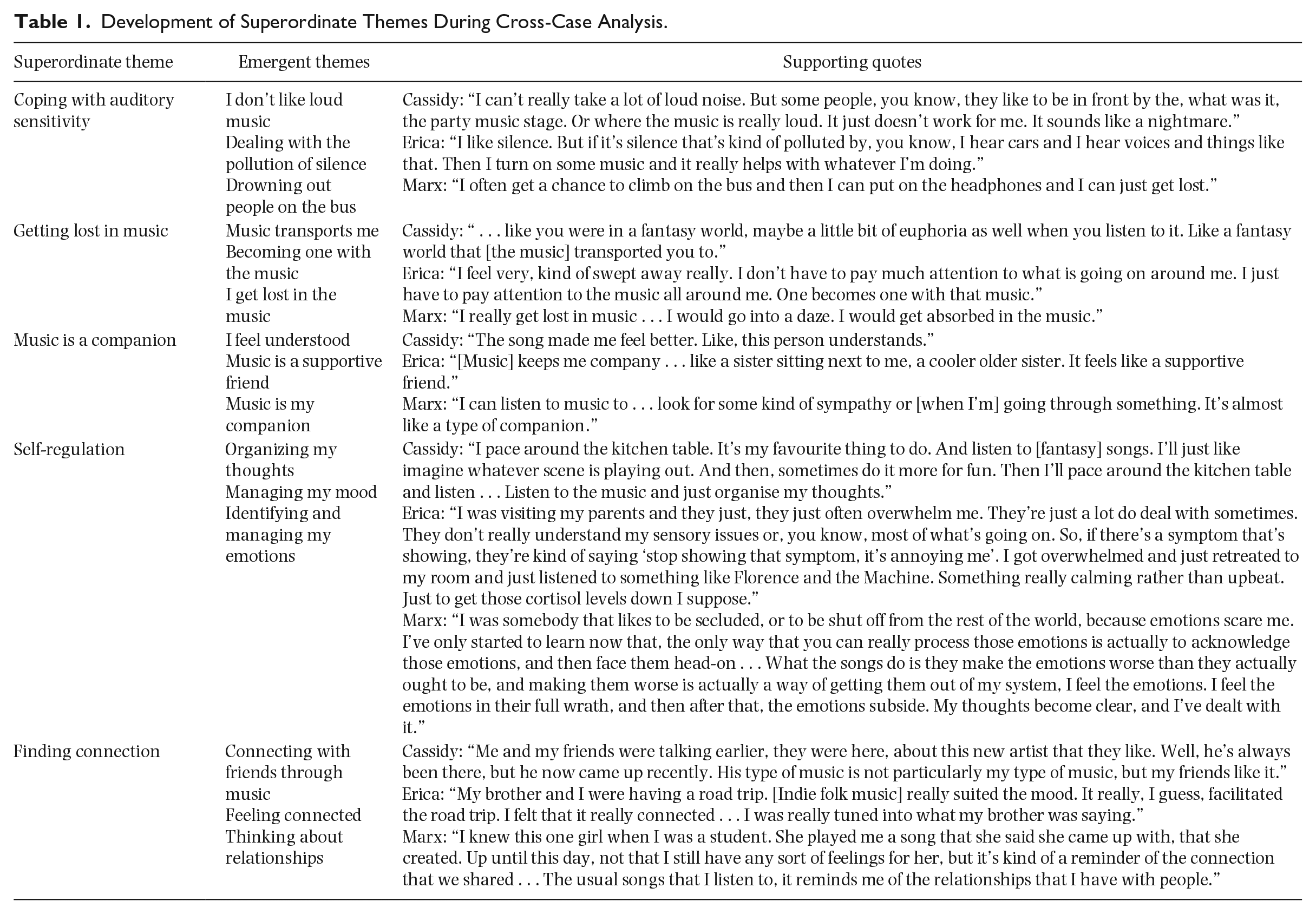
During cross-case analysis, five superordinate themes (Table 1) emerged that shed light on the importance of the lived music listening experiences of Cassidy, Erica and Marx. These themes are as follows:
Coping with auditory sensitivity;
Getting lost in music;
Music is a companion;
Self-regulation;
Finding connection (Figure 1).
Development of Superordinate Themes During Cross-Case Analysis.
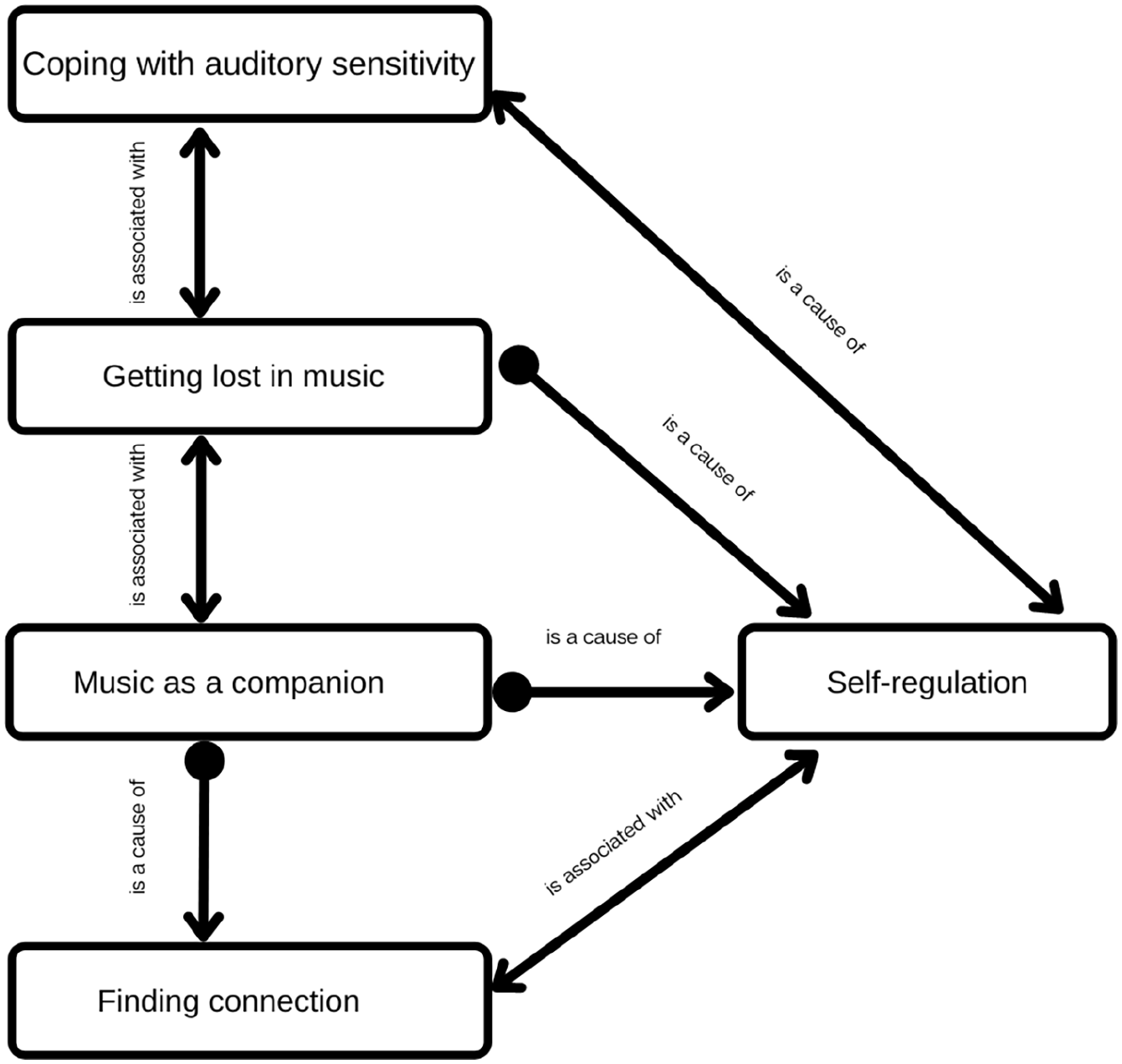
Superordinate Themes Reflecting the Lived Music Listening Experiences of Three Young Adults Living with Autism.
Cross-case analysis revealed that, by listening to music, each participant can cope with the auditory sensitivity that they face as part of their diagnosis. When Cassidy, Erica, and Marx use music to drown out noise, everyday sounds, and distractions, they get lost in and absorbed by music. This ability to get lost in the music that they love has led to the participants fostering a special relationship with music, which has become their companion and friend. Cassidy, Erica, and Marx feel supported and understood by music, especially when they get lost in music’s stories. Through their deep connection with and love of music, and by getting lost in music, they learn more about themselves, their emotions, moods, and behaviors during music listening. They also tend to become more mindful of their behavior and rely on certain routines that support self-regulation. When the participants can self-regulate, they can also cope with their auditory sensitivity. In turn, their ability to cope with and manage their auditory sensitivity is an important aspect of self-regulation. Through music listening, Cassidy, Erica, and Marx not only feel supported and connected with themselves, but can also make sense of social relationships and connect with friends.
Superordinate theme 1: coping with auditory sensitivity
During their interviews, Cassidy, Erica, and Marx all spoke about how they cope with various levels of auditory sensitivity. However, Cassidy was the only participant to mention that she doesn’t like loud music. She said “I really don’t like loud noises . . . even with my music. I don’t put it loud. Right where I’m comfortable.” She further explained that “the only time my phone’s speakers will be loud is when I’m pacing around the kitchen.” Erica and Marx, however, referred to sensitivity to everyday distracting sounds and noise. Erica shared how sound can get too much. I don’t classify music under that. Even if it’s a place, like, let’s say, a club or a restaurant, I don’t mind that. If I don’t like it, I just walk out. Uhm . . . but a sensory overload like . . . people talking too much, that I can’t distinguish whatever they’re saying. It becomes a lot, and I can shut down.
Erica consequently mentioned how she would “turn on some music” to drown out distractive sounds. Similarly, Marx explained how he “can put on the headphones” on the bus on his way to work “to forget about everything and everyone around me.” For Marx, drowning out everyday sounds often leads to getting “absorbed in the music.”
Superordinate theme 2: getting lost in music
Notions of getting lost in music were significant in all three participants’ interviews. Data analysis revealed that, for Cassidy, being transported by music during her creative process is an important aspect of the role that music listening plays in her life. She shared many stories of how “when you listen to it, it transported you to, like, a fantasy world. It was exciting, but also like you escaped to some fantasy world. It was very cool.” When Cassidy gets lost in music, her creative thought processes are consequently more focused. Marx explained that he would “really get lost in music” and that he gets “absorbed by music almost every day.” He shared how when I listen to music, I will randomly start tapping my foot or start moving about, not intensely so as to distract other people on the bus. I try to control myself so that it’s not distracting. But I would go into a daze. I would get absorbed in the music and try to forget about everything and everyone around me.
Similarly, Erica mentioned how “I feel pretty absorbed” and “it helps create a little bubble for me, just for a little bit. A little bubble around my head, where nobody can intrude.” Erica also shared feeling “like I ascended. It kind of felt like my soul left my body” when speaking about an experience where she was submerged in the sound of her choir warming up. In this instance, “hearing all these voices echo . . . was this spiritual experience for me.” In the data analysis, it became clear that through these experiences of getting lost in music, being absorbed by music, and drowning out the world, Cassidy, Erica, and Marx have found a friend in music.
Superordinate theme 3: music is a companion
Data analysis revealed that all three participants tend to personify music because they turn to it for support, as a friend, and as a companion. For example, while sharing a story about a falling out with a friend, Cassidy shared how she related to the lyrics of a song called “Just Friends,” feeling connected to the artist. She explained how music “made me feel better, like, this person understands.” Similarly, Marx explained how he turns to music for “sympathy” when facing challenges. He referred to music as “a companion.” Erica, in turn, mentioned how “music feels like a companion a lot of times. When I’m alone, I’ll just put in on [and it] keeps me company for a while.” She also explained how “it feels like I’m being given advice” when she listens to songs about relationships and that “it’s kind of like a blanket that you wrap around yourself.” Through music listening, Erica “feels understood.” Music makes her “feel special. Music makes me feel loved.” After data analysis, we realized that, by turning to music as a supportive friend and a companion during difficult times, Cassidy, Erica, and Marx can become aware of and manage their emotions, behavior, and mood, and consequently self-regulate.
Superordinate theme 4: self-regulation
Self-regulation is an essential skill that people need to acquire to find happiness, be hopeful, build meaningful relationships, and ultimately flourish. An important aspect of self-regulation is the ability to be mindful. Both Cassidy and Erica referred to times when music allowed them to “organise my thoughts” (Cassidy) and meditate (Erica) as a means to “focus” and “get into [a specific] state of mind.” For Cassidy, “pacing around the kitchen table” while listening to music is an important part of her focus and thought organization process.
Self-regulation is also associated with mood management and the ability to identify and manage emotions. Cassidy shared how she would listen to certain songs when mad with someone. She explained how “I felt, like, more empowered, and it did start to make me feel a little bit better. But definitely empowered. Like, getting some of this noise and anger out.” Through music listening, Cassidy can also “feel better about myself” when she is sad as she can “get all the emotions out” and “start feeling better.” She also spoke about how she felt “happy,” “excited,” and “at peace” while listening to music. Erica, similarly, mentioned how she feels “less stressed,” “stimulated,” “happy,” and “energised” when she listens to music. She spoke about experiencing “a certain calm” when listening to music that she enjoys. Music listening also enables Erica to manage her emotions. She explained how “sometimes the emotion that I’m feeling at that moment is amplified. If I’m feeling sad, I listen to sad music.” Erica also spoke about the influence of music listening on her mental state and shared how songs by Billie Eilish, an artist struggling with depression, “just makes me feel better. Uhm, it doesn’t pull me into some deep dark hole.”
Data analysis revealed that Marx struggles with identifying and managing his emotions and behavior. He shared how At first, I did not understand this. When I would hear songs, uhm, usually the way I perceive emotions . . . emotions, to me, were something you have to control. If you can’t control your emotions, you must be afraid of them. So what I did was I suppressed many of my emotions, whether they were happy emotions or whether they were sad emotions. Because it’s like, sometimes it feels like when you become happy, it’s like people start to bully you. When you become sad, it also starts to feel like people start bullying you because now they want to find out what’s going on, so now they are intervening. Usually, I was somebody who liked to be secluded or to be shut off from the rest of the world because emotions scare me. I’ve only started to learn now that the only way that you can really process those emotions is actually to acknowledge those emotions and then face them head-on. Listening to the songs is kind of like . . . what the songs do is they make the emotions worse than they actually ought to be, and making them worse is actually a way of getting them out of my system.
Marx also shared stories of how he would quickly get annoyed or angry and that this anger would fester for weeks or months. He explained that “music helps me to de-stress, music helps me to calm down.” He further mentioned that he tried “to find a way to express myself, and then listening to music where the words link up how I feel, kind of, uhm, is a way to express myself.” Through data analysis, it became clear that for Cassidy, Erica, and Marx, music listening offers a unique opportunity to learn to identify and manage their emotions, moods, and behaviors. Through music listening, and because music is their companion, the participants have learnt that they are allowed to feel sad and frustrated, but that it is important to face and deal with these emotions and that they have to communicate their feelings with friends and peers.
Superordinate theme 5: finding connection
The ability to self-regulate is essential if Cassidy, Erica, and Marx are to foster meaningful connections with friends and connect with themselves. For Cassidy, music offers opportunities to spend time with and understand her friends. Cassidy shared how she relates to her friends through music and that her friends, just like her, turn to music for comfort. She explained that “if something terrible is going on, [my friends] will put on their music and will calm down.” She also spoke of attending a music performance with her friends, but mentioned that she did not enjoy the loud sound of being too close to the stage.
Erica shared stories of how she and her brother connected through music listening while they were on a road trip. She explained that music “facilitated the road trip, and also facilitated conversation.” She also shared how she can overcome her struggle to connect and communicate her feelings with others by relating to others through music. Erica gave an example of connecting with others by recalling fond memories of favorite songs, listening to music, and dancing. For Erica, music “pushes you toward a direction, whereas this kind of opens up, uhm, and tells you to open up yourself. It’s okay to come closer, and it’s okay to open up to people.” The analysis of Erica’s interview also revealed that she can connect with herself through music. She shared how “if I feel disconnected from myself, I like to listen to [a specific song] because I would feel a strong connection with it. It feels like it was made for me.”
Like Erica, Marx also finds connecting with people challenging. He tends to turn to music to make sense of social situations and to understand why people behave in specific ways. Marx also enjoys listening to songs that “remind me of relationships that I have with people.” He shared a story about a work experience where he felt uncomfortable with colleagues’ behavior. He consequently left the situation and “started listening to music.” He shared how I noticed that the reason why I like certain types of music is, if they are complex, but they still follow a certain pattern that helps you to predict what’s going to happen next in the song. That is a way that I feel that my relationships with people can also become predictable.
For Marx, “music, and in a way, my identity with people are intertwined.” We have found that music allows Cassidy, Erica, and Marx opportunities to connect with themselves and explore social connections within a safe space. They learn about relationships and connection through music listening by emerging themselves in the stories that their favorite songs tell. Although the findings from analyzing Cassidy, Erica and Marx’s interviews all speak to auditory sensitivity, getting lost in music, music as their companion, self-regulation, and connection, there were some emerging themes that were unique to the participants.
Unique emerging themes
To stay true to the idiographic nature of IPA research, we need to acknowledge the unique emerging themes and categories that emerged during cross-case analysis. These themes highlight the uniqueness of the participants’ lived music listening experiences. Three unique emerging themes will be discussed:
Building new worlds through music;
Searching for patterns;
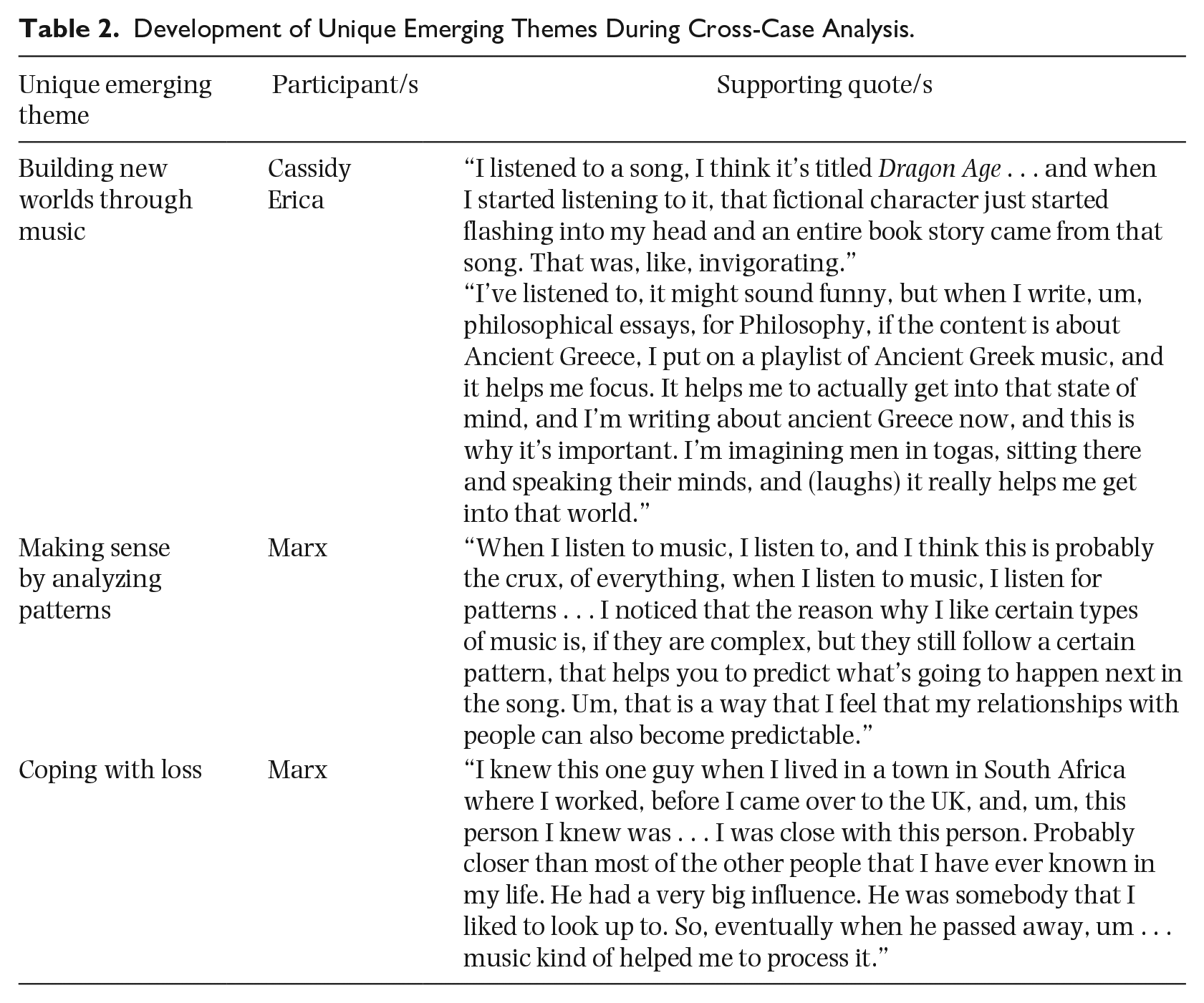
Coping with loss (Table 2).
Development of Unique Emerging Themes During Cross-Case Analysis.
Unique emerging theme 1: building new worlds through music
Both Cassidy and Erica use music to stimulate creativity and step into and create new worlds. Cassidy explained how “I listen to music often to stimulate or add to these fantastical worlds of mine.” Through music listening, she can “get into the fictional world” and “develop these fictional characters of mine.” Erica similarly draws on music for inspiration when writing essays or gaming and shared how she “actually gets into that state of mind” and “gets into [another] world.” For Erica, listening to music helps to take “a very, very foreign concept and bring it home.”
Unique emerging theme 2: making sense by analyzing patterns
During his interview, Marx often spoke of the patterns in music. He shared that “when I listen to music, I listen to, and I think this is probably the crux of everything, I listen for patterns when I listen to music.” Considering that he is a Mathematics teacher and trained musician, this focus on and fascination with the patterns in music seems suitable. However, for Marx it is about more than merely analyzing musical patterns. In his mind, the patterns in music relate to how people interact in their daily lives. He consequently also analyzes the patterns in music to relate them to how people interact and behave. He finds the “predictability” comforting, and it helps him to navigate the social world.
Unique emerging theme 3: coping with loss
Marx specifically spoke about how music listening helps him cope with loss. He mentioned how “music kind of helped me to process [the loss of a friend who passed away].” Marx also shared stories of previous breakups. He explained how I had to listen to certain songs. I remember that the only way that I could really process the emotions was to actually feel them in their full glory. Otherwise, the emotions are suppressed and they are with you the whole time. So then I listen to music to help build up those emotions, kind of forcing me to confront the negative feelings. I’ve also found that many times when I got down in life, when I wanted to move forward.
Considering Marx’s recent move to England from South Africa, it might also be that these feelings of loss and loneliness are more prominent as he finds himself in a new, unfamiliar environment, which then prompts him to seek refuge and support in music.
Discussion
Our study aligns with findings from the literature on the adaptive functions of music listening (Kirby & Burland, 2022; Groarke & Hogan, 2016; Schäfer et al., 2013). The participants in this study all became lost in music, though the ways in which the music absorbed them differed. Lange et al. (2017) state that a substantial amount of attention is allocated to the music being listened to when becoming absorbed in intense music listening (p. 71). Most of the listening experiences discussed by the participants may be described as attentive listening experiences. Similar to Herbert’s (2012) findings, the participants in our study’s attentive listening behaviors (which we describe under the theme of being absorbed by music) could not easily be mapped onto exclusively “special” music listening contexts. Instead, our participants displayed attentive listening behaviors in everyday contexts too.
Marx displayed a preference for understanding the structure of the music he listened to. This aligns with research indicating that musical mental models play an important role in the meaning that individuals ascribe to their listening experiences (Peterson, 2006). However, the importance of musical mental models is not central to the listening experience. Rather, music listening is also a means of self-creation and world creation (Peterson, 2006). This observation aligns with Cassidy’s description of using music listening to create alternative worlds while writing fiction.
The relationships between our findings and those of studies that focus on the music listening experiences of neurotypical individuals are noticeable. Music listening fulfills many of the same adaptive functions for neurotypical people as the functions highlighted by our participants. These include stress relief, relaxation, facilitating emotional engagement, creating personal space, improving negative mood, and aiding in persistence (Groake & Hoagan, 2016). Matsuno et al. (2021) also found similarities between the listening habits of neurotypical adults and adults on the autism spectrum. However, distinct from the listening experiences of neurotypical adults, our findings also illustrate the importance of music for adults on the autism spectrum to help them mask or cope with sensory overload. These findings, which are distinct from the listening experiences of neurotypical adults, align with Kirby and Burland’s (2022) findings concerning the cognitive, social, and emotional functions that music fulfills in the everyday lives of adults on the autism spectrum.
The strategies employed in an IPA allow us to gain an in-depth understanding of the role of music listening experiences for adults on the autism spectrum. However, it also places certain limitations on our abilities to generalize our findings to the broader population of adults on the autism spectrum. Furthermore, COVID-19 did impact data collection. Initially, we had hoped to conduct in-depth interviews in person, but the risks associated with the COVID-19 pandemic meant that interviews had to be conducted online. While this did provide some advantages, such as enabling the participants to participate in the interviews from the comfort of their own homes and enabling the first author to overcome geographical constraints to reach the participants, a small amount of data was lost because of connectivity issues during the interviews. Despite these limitations, this study has important implications for future research on the music listening experiences of adults on the autism spectrum. Mixed methods and quantitative methods could further be used to understand the extent to which the findings from this study can be generalized to the broader population of adults on the autism spectrum.
As researchers who occupy both insider and outsider spaces regarding autism, our research must not add to ableist research, thereby further othering people on the autism spectrum (Bakan, 2018; Shyman, 2016). Therefore, we are aware of the notion engrained through a medicalization of otherness to try and read otherness into the experiences of individuals on the autism spectrum. It is our hope, however, that the findings of this IPA provide rich idiographic descriptions of the individual experiences of our participants, thereby humanizing their music listening experiences.
Supplemental Material
sj-docx-1-pom-10.1177_03057356221126201 – Supplemental material for Understanding the lived music listening experiences of adults on the autism spectrum
Supplemental material, sj-docx-1-pom-10.1177_03057356221126201 for Understanding the lived music listening experiences of adults on the autism spectrum by Frans Venter, Janelize Morelli and Ewie Erasmus in Psychology of Music
Supplemental Material
sj-docx-2-pom-10.1177_03057356221126201 – Supplemental material for Understanding the lived music listening experiences of adults on the autism spectrum
Supplemental material, sj-docx-2-pom-10.1177_03057356221126201 for Understanding the lived music listening experiences of adults on the autism spectrum by Frans Venter, Janelize Morelli and Ewie Erasmus in Psychology of Music
Supplemental Material
sj-docx-3-pom-10.1177_03057356221126201 – Supplemental material for Understanding the lived music listening experiences of adults on the autism spectrum
Supplemental material, sj-docx-3-pom-10.1177_03057356221126201 for Understanding the lived music listening experiences of adults on the autism spectrum by Frans Venter, Janelize Morelli and Ewie Erasmus in Psychology of Music
Footnotes

References
Supplementary Material
Please find the following supplemental material available below.
For Open Access articles published under a Creative Commons License, all supplemental material carries the same license as the article it is associated with.
For non-Open Access articles published, all supplemental material carries a non-exclusive license, and permission requests for re-use of supplemental material or any part of supplemental material shall be sent directly to the copyright owner as specified in the copyright notice associated with the article.
