



Abstract
There is a discrepancy between a high inherent value of extracurricular music classes and a low proportion of low-socioeconomic status (SES) male participants. However, evidence on how to match out-of-school music classes to students’ preferences is lacking. Thus, we assessed the attractiveness of different versions of such classes via an experimental video vignette study featuring a 2 × 2-factor (setting × music; each with high vs. low proximity to informal youth culture) between-subjects design with N = 244 students (Grade 5–10). We assessed the intention to participate as criterion, and gender, age, and SES (highest International Socio-Economic Index [HISEI] quartile) as control variables. A hierarchical regression showed a positive effect of music associated with youth culture on intention and no effect of the setting. Female (and older) students displayed higher intention than male (and younger) students. The single effect involving HISEI was a significant interaction of music and SES, which resulted from high-SES adolescents being especially motivated for classes with music associated with youth culture. Thus, to motivate boys and older students in particular, special consideration should be given to the appropriate design and marketing of music classes. However, music close to youth culture might be especially beneficial for adolescents with high rather than low SES.
Out-of-school music classes: Discrepancy between value and participation
Out-of-school music classes may provide empowering, meaningful experiences for individuals and encourage them to explore the realm of musical culture. Moreover, participation in choirs, bands, or other music classes, as well as individual singing or instrumental activities are often considered to exert positive effects on domain-general and domain-specific outcomes (Colson, 2012; Hetland, 2000; Kokotsaki & Hallam, 2007; Mellor, 2013; Miranda & Claes, 2009). Regardless of the objectives pursued by the providers of music classes, a major obstacle to overcome is the fact that comparatively few adolescents actively participate in such cultural activities. To make things worse, this participation is less probable, given an unfavorable sociodemographic background (Grgic & Züchner, 2013; Keuchel, 2013). Thus, to increase the number of young people benefiting from out-of-school music classes, both access to these classes for all adolescents and the attractiveness of such classes need to be improved (Federal Ministry of Labour and Social Affairs, 2017).
Representative surveys indicate that there might be a mismatch between features of typical existing out-of-school music classes and young people’s interest (Ho, 2017; Keuchel, 2013). As highlighted in the reciprocal feedback model of musical response (Hargreaves, MacDonald, & Miell, 2005; Leblanc, 1982), all responses to music are determined by the three interacting components: listener, listening situation, and music (Hargreaves, North, & Tarrant, 2006). Therefore, both setting and music need to be mutually compatible and tailored to the preferences of adolescents. Combined, this contributes to a high perceived individual musical “fit” (North & Hargreaves, 2008, p. 124).
Regarding the setting, it might be beneficial to take social and cultural contexts into account to accomplish a high perceived proximity to youths’ leisure environment rather than to a school-like formal learning setting. Regarding the music, suitable genres and styles are of great importance: Playing and listening to low-brow rock/pop music is associated with informal youth culture, while playing and listening to highbrow classical music is associated not only with formal learning in school but also with a high socioeconomic status (SES; Bourdieu, 1984; H. Colley, Hodkinson, & Malcom, 2003; Green, 2002; Malcolm, Hodkinson, & Colley, 2003; van Eijck, 2005). Thus, out-of-school classes with a too formal character might impede voluntary participation for adolescents in general and those from families with a low SES in particular. To examine intentions to participate in out-of-school music classes, rather than focusing on the arbitrary and superficial categorization of whether they are situated in vs. out of school, one should focus on the setting and the content, in this case the choice of music, as these are important factors determining the perceived overall formality and individual fit (Malcolm et al., 2003; North & Hargreaves, 2008).
This is why the present experimental vignette study assessed effects of (a) the setting and (b) the music, and (c) effects of age, gender, and SES on the intention to participate in out-of-school music classes.
The intention to participate in out-of-school music classes and its determinants
The important role of music in adolescence has been an issue of interest, particularly, since in the 20th century, youth culture has increasingly been taken into consideration (Ros-Morente, Oriola-Requena, Gustems-Carnicer, & Filella Guiu, 2019). However, when it comes to the significance of music in the lives of young people, a distinction between active and passive participation must be made: While 95% of young people report listening to music, only about a quarter play an instrument themselves (Grgic & Züchner, 2013; Lamont, Hargreaves, Marshall, & Tarrant, 2003; Medienpädagogischer Forschungsverbund Südwest, 2018). This discrepancy seems to be difficult to overcome as the wide-ranging phenomenon of music in leisure time is difficult to grasp (Mantie & Smith, 2017) and little is known on what kind of out-of-school music classes are appealing to young people. However, keeping in mind that making music means cultural, social, and societal participation (Crooke, 2016), efforts should be made to motivate young people to actively make music.
The participation in out-of-school music classes can be understood as a planned behavior that can therefore be predicted by the intention to participate (cf. theory of planned behavior, Ajzen, 1991). The intention, in turn, can be predicted by youth’s beliefs and individual needs (Hargreaves et al., 2005; Malcolm et al., 2003). Young people who already take part in instrumental lessons, a choir or orchestra, are known to be motivated to participate in further music classes (McEwan, 2006). This might be due to the importance of previous achievement-related experiences and self-efficacy beliefs, as indicated in the expectancy-value model of achievement (Eccles & Wigfield, 2002). Since self-efficacy beliefs can be improved by positive experiences (Bandura, 1995, 1997), there is the need to provide young people with the opportunity for such experiences, for instance, in out-of-school music classes. If such classes are designed in a way that attracts adolescents, regardless of their previous musical experiences, for instance, comprising a setting and music that is in accordance with their preferences (Hargreaves et al., 2005; Malcolm et al., 2003; Woody, 2020), they may catch intrinsic interest, which is also a crucial element of long-term musical involvement (McPherson & McCormick, 2000).
Determinants of intention to participate in out-of-school music classes
Proximity of the setting to informal youth culture
With regard to the aforementioned need for cultural activities to fit youth’s preferences and the impact of the location on the perceived degree of informality, it seems to be helpful to examine the setting more closely. As the location of leisure activities is associated and interconnected with other aspects, like the kind of fellow participants and people in charge of the class, or the appropriate clothing styles, the setting may differ in the proximity to highbrow or youth culture and consequently in the degree of perceived informality. The one extreme may be a castle or villa, as music academies would often choose as a venue for their music classes—featuring a high degree of formality despite being out-of-school—and the other extreme a youth center, where informal classes addressed to adolescents are often situated.
It goes without saying that youth culture is constantly multiplying and characterized by plurality and individuality (Ferchhoff, 2016). Nevertheless, it can represent a certain contrast to high culture: While the highbrow cultural habitus stands for classicism, luxury, and distinction, the typical youth culture habitus is characterized by loose modern and dynamic trends. Such differences between high culture and youth culture are also reflected in individual cultural practices and aesthetic preferences for films, furniture, clothing, and sport (Bourdieu, 1984). As a familiar environment is known to be preferred by students who play an instrument or sing as a leisure activity (Jaffurs, 2004), choosing an informal setting relating to the adolescents’ everyday life may increase their intention to participate (Malcolm et al., 2003). Furthermore, with adolescents being predominantly peer oriented, they should be more attracted to a youth cultural setting (Kröner & Dickhäuser, 2009). This could be particularly true for young people with a low SES, as these in particular perceive youth centers as a retreat and safe space (Chechak, Dunlop, & Holosko, 2019). Furthermore, the interconnection of setting and music works both ways: While preferences in the setting might be related to the underlying motives for engaging in music (Chamorro-Premuzic & Furnham, 2007) or differences in the emotional associations of musical activities (Boal-Palheiros & Hargreaves, 2001), preferences in music also strongly depend on the setting (North & Hargreaves, 1996, 2000).
Proximity of the music to informal youth culture
Representing the content of the music class, the music played and heard and the instruments being used are pivotal to the intention to participate. As participation in out-of-school music classes is dependent on whether the participants may sing and play the music they like (Green, 2008), it may thus be useful to include the kind of music the potential participants prefer (Dingle, Gleadhill, & Baker, 2008; Kennedy, 2002). Such music is characterized by easy-listening attributes and often electronical (Bonneville-Roussy & Eerola, 2018; Bonneville-Roussy, Stillwell, Kosinski, & Rust, 2017). Adolescents therefore prefer popular forms of music such as pop, dance, rock, and R&B compared to classical music (Lamont et al., 2003; North, Hargreaves, & O’Neill, 2000), which they see as the embodiment of the “snobbish” and static adult world (Friedemann & Hoffmann, 2013; Kennedy, 2002).
Even when it comes to what kind of music young people want to play themselves, preferences depend on certain associations: While practicing classical music is perceived as something involving a high degree of self-discipline, playing pop music is perceived as more enjoyable (Green, 2002). This might also be the reason for the association of classical music not only with highbrow culture but also with formal learning, with a focus on acquiring knowledge and practice at the expert level (H. Colley et al., 2003). It can therefore be contrasted with rock/pop music, as music that is close to informal youth culture (Vogt, Heß, & Brenk, 2014). Apart from these culture-related aspects, music preferences may surely also differ depending on personality traits (Litle & Zuckerman, 1986; McCown, Keiser, Mulhearn, & Williamson, 1997; Rentfrow & Gosling, 2003; Schwartz & Fouts, 2003) and positive or negative momentary affects (Getz, Chamorro-Premuzic, Roy, & Devroop, 2012).
Sociodemographic variables
While it would be desirable for participation in out-of-school music classes to be stronger, there are some groups that are known to be underrepresented in such classes, depending on their age, gender, or SES.
Age: The interest in musical activities decreases with increasing age (Crowther & Durkin, 1982; Mizener, 1993; Wigfield et al., 1997). In particular, during the transition from primary to secondary education, many children seem to walk away from playing an instrument (Fritzsche, Pfeiffer, & Kröner, 2015; Sloboda, 2001). In consequence, the intention to participate in informal musical activities decreases (O’Neill, 2005), making adolescence a phase of life that should increasingly be addressed. In addition, the transition from childhood to adolescence is marked by low open-earedness, that is, a low tolerance for different music styles, which makes it even more difficult to choose the appropriate music for classes for this age group (Hargreaves, 1982; LeBlanc, Sims, Siivola, & Obert, 1996). While classical music is preferred with increasing age, contemporary music is preferred in adolescence (Bonneville-Roussy & Eerola, 2018; Bonneville-Roussy et al., 2017).
Gender: Studies on children’s cultural activities revealed strong differences in leisure activities based on gender, for example, in leisure writing or organized sports activities (Birnbaum, Schüller, & Kröner, 2020; Staudenmaier, 2012). This holds true, especially in the context of music making: Girls are more inclined toward singing than boys and they are also more likely to participate in musical activities (Crowther & Durkin, 1982; McPherson et al., 2015; Penthin, 2020; Welch, Saunders, Papageorgi, & Himonides, 2012; Wigfield et al., 1997). Regarding music preferences, Soares-Quadros, Lorenzo, Herrera, and Santos (2019) and A. Colley (2008) reported that their female participants displayed a stronger affinity for styles with a more emotionally charged nature, dance music, and music close to mass culture, whereas male participants preferred heavier music styles.
SES: A favorable home environment—including parental support as an important feature—is reported to exert an effect on musicality (Davidson, Sloboda, & Howe, 1995; North & Hargreaves, 2008). In the study of McPherson et al. (2015), in Grades 5–12, only 22.4% of the musically active Australian students belonged to the lowest SES third. Thus, in accordance with Bourdieu’s (1984) habitus theory, several studies indicate that a higher SES may still be assumed to come with an increase of children’s motivation to participate in musical activities and leisure classes (Albert, 2006; Corenblum & Marshall, 1998; McCarthy, 1980; McPherson, 2009; Philipps, 2003; Rau, 2016; Sichivitsa, 2007). Furthermore, children with a lower SES are also less likely to play classical instruments (Wießnet, Penthin, Fritzsche, & Kröner, 2018; Wilson, Hunter, & Moscardini, 2020). However, while low-SES students are generally underrepresented in out-of-school music classes, their intention to participate may still not be uniformly low, but rather depend on specific features of the classes.
Intention to participate: Lacking evidence from experimental studies
As an empirical method to examine the effects of setting, music, and sociodemographic variables on the intention to participate in such classes, field experiments might come to mind. However, field experiments involving real music classes are very costly, complex, and challenging to implement. Thus, it comes with little surprise that most studies on this issue are merely correlational (Austin, 1990; Elpus & Abril, 2011; Sichivitsa, 2004). In addition, field experiments with voluntary participants suffer from a substantial drawback due to a selection bias: There are large proportions of adolescents that would never consider registering (Chechak et al., 2019). Thus, especially when aiming to assess intentions, vignette studies might provide a good workaround (Rettinger, Jordan, & Peschiera, 2004; Reuveni & Werner, 2015). Vignettes provide short and precise descriptions of realistic scenarios with systematic combinations of characteristics and can therefore be used as economic stimuli to assess effects on dependent variables (Aguinis & Bradley, 2014; Atzmüller & Steiner, 2010).
In general, vignette methodology is based on working with prototypical features instead of varying innumerable details. In our case, a location that is close to youth culture, that is, a youth center, and music that is close to youth culture, that is, rock/pop music, can be considered prototypical features of a music class that is characterized by a high degree of informality (cf. Colley et al., 2003; Malcolm et al., 2003; Stern & Sommerlad, 1999). In contrast, a class that relies on classical music and is embedded in a setting related to highbrow culture can be considered prototypical for learning opportunities with a quite formal character. This may create a halo effect in adolescents’ perception. Thus, it can be assumed that adolescents fill in the slots of their out-of-school music class scheme with instantiations that are prone to informal learning for the youth culture class and prone to formal learning for highbrow class. This in turn should affect their intention to participate.
Research questions
Considering the discrepancies in participation, this study investigates the intention to participate in out-of-school music classes using the proximity of the setting and the music to youth culture as predictors, as well as age, gender, and SES as covariates. This leads to the following research questions:
We expect main effects of both setting and music on the intention to participate, with higher proximity to youth culture resulting in higher intention to participate for both variables.
We expect higher intention to participate for younger, female, and higher SES students. Furthermore, we expect an especially high intention to participate for students with low SES in classes where music and setting are close to youth culture.
Method
Participants
The N = 244 participants in this experiment were adolescents between Grade 5 and 10 (age: M = 12.96 years, SD = 1.31 years, range: 10–16 years; gender: 118 male, 122 female, 4 not declared) from three different secondary schools in three German federal states, two public schools in Baden-Wuerttemberg and North Rhine-Westphalia, and one private school in Bremen. The schools were selected to reflect different levels of educational achievement, different regions of Germany, and public and private operators. The participants belonged to 14 different classes without any special musical profile. Regarding SES, splitting the sample into HISEI quartiles led to the first quartile ranging below 32.50, the second one from 35.34 to 55.25, the third one from 56.00 to 72.30, and the fourth one beyond 72.83. Approval of the university’s ethics committee as well as consent of the participants and parents or legal guardians was provided.
Video vignettes
The present study has been aligned to the recommendations for designing and implementing experimental vignette methodology studies by Aguinis and Bradley (2014). To convey the combinations of the factors setting and music convincingly, we used videotaped vignettes, which according to Hughes and Huby (2002) provide a better foundation to model certain aspects of reality. To further increase the level of immersion and closely resemble the natural process of informing oneself about an out-of-school class, we have chosen a combination of fictitious advertising websites and videos. The video vignettes for the four different out-of-school music classes were therefore embedded in single-page websites containing images of the videos and short adjusted info texts. To make the advertisement more realistic, we provided a mock option to registrate for the class at the end of the website. Prior to the experiment, the material had been subjected to two cognitive lab studies each featuring four experts, covering expertise in research and practice in the fields of music education and cultural education. Each cognitive lab study was followed by a revision of the material. The differences in the factor setting were operationalized via the aspects building, furnishing, clothing, and leisure activity (cf. Appendix 1). The differences in the factor music were achieved by different instruments being displayed in the video and corresponding background music (cf. Appendix 1). To avoid that the adolescents might be biased toward music related to youth culture by knowing the sample used, we chose a part of Beethoven’s Symphony No. 5 in C Minor, Op. 67: IV, Allegro, for the classical music and an unknown background music for the music close to youth culture. Based on the reported differences in music preference across gender, we intentionally avoided using a distinct emotional pop beat as well as a heavy rock sound. Instead, we chose a rather electronic beat, aimed at pleasing both genders equally (Bonneville-Roussy & Eerola, 2018; Soares-Quadros et al., 2019). In addition, both pieces of music were intended to be asemantic, that is, supposed to convey a light-hearted and positive atmosphere without evoking specific associations (Ansani, D’Errico, & Poggi, 2017). This was also supported by refraining from using songs with lyrics, as these are, though mostly neglected in research, affecting the musical preference (North & Hargreaves, 2008). To enable a focus on relevant aspects and to avoid confounding variables, we used the same five actors aged 10–16 years for all video vignettes and focused strongly on varying the videos only in the intended variables proximity of the setting and music to youth culture using a parallel cut and scene sequence for all videos. Exemplarily, the equivalent scenes of each variation are displayed in Figure 1.
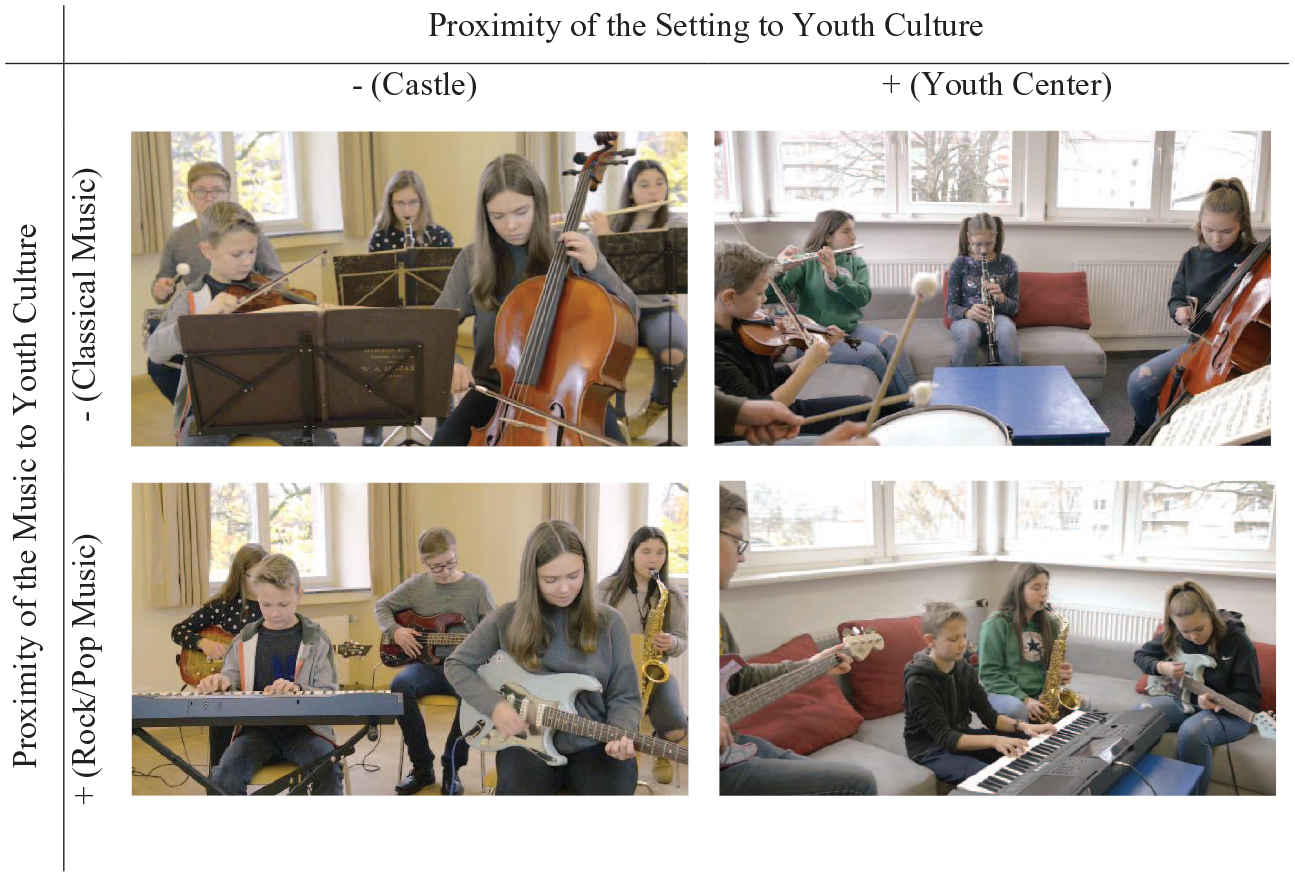
Variation of One Scene in Each Video Vignette.
Design and measurements
In our experiment, we used a 2 × 2 factorial between-subjects design with the independent variables proximity of the setting to youth culture and proximity of the music to youth culture (two levels: high culture = 0 vs. youth culture = 1). Thus, each participant was randomly assigned to one vignette and comparisons were made across participants (Atzmüller and Steiner, 2010).
Intention to participate
To measure the intention to participate, we used six self-developed items, for example, “I would like to participate in this music class,” all on a 4-point Likert-type scale (1 = strongly disagree, 2 = disagree, 3 = agree, 4 = strongly agree; α = .86; cf. Appendix 2).
Sociodemographic variables
In addition, the participants were asked for age (in years), gender (0 = male, 1 = female), and SES as covariates. The SES was operationalized by the highest International Socio-Economic Index (HISEI) in the family. The students named their parents’ occupational title and the specific professional activities. The answers were coded according to the International Standard Classification of Occupations categories and transformed into the International Socioeconomic Index ranging from 16 to 90 (ISEI; Ganzeboom Harry & Treiman, 1996). Finally, we split our sample into quartiles.
Manipulation check
To test whether the different vignettes were also perceived differently, we included a manipulation check. Therefore, for each vignette, we asked whether the adolescents perceived the location and the music of the vignettes as matching their personal youth environment. The manipulation check for the setting included four items, for example, “The location where the music class takes place is where my friends would like to be” (α = .85). The manipulation check for the music also consisted of four items, for example, “The music is typical for young people of my age”. All items were on a 4-point Likert-type scale (1 = strongly disagree to 4 = strongly agree; α = .86; cf. Appendix 2).
Procedure
The manipulation of the produced vignettes and the reliability of the corresponding scales in the questionnaire needed to be tested before the actual experiment and optimized if necessary. For this purpose, we carried out the exact same research design and procedure that was planned for the actual experiment with N = 50 adolescents (age: M = 13.4 years, SD = 2.19, range: 10–17, gender: 26 male, 24 female) in advance. Regarding the reliabilities of the test scales, this resulted in sufficient reliabilities of all scales (.72 ⩽ α ⩽ .92). Regarding the assessment of the proximity of the setting and music to youth culture, this resulted in a successful manipulation of the factor music, but an inconclusive result for the factor setting. This indicated the necessity of revisions of the test items: The original items might have been interpreted as referring to the evaluation of the total proximity of the music class to youth culture, rather than to the proximity of the actual location and thus the setting. Therefore, we modified the items to clearly refer to the location of the music class. The procedure of the experiment worked smoothly and could be finished in the scheduled time.
The procedure of the main study started with a short, standardized welcoming and a brief explanation of the procedure for the participants. After that, we handed a tablet and earphones to each of the participants. They then individually browsed through a website on a tablet for five minutes and afterwards watched an embedded video trailer (approximately 80 seconds) for a fictional music class twice in a row. After that, they received a paper-and-pencil questionnaire.
Data analysis
We worked with hierarchical regressions to highlight the effects of setting, music, covariates, and interactions separately. Preliminary analysis confirmed no violation of the assumptions of multiple regression: normality, linearity, independence of errors, and homoscedasticity.
Among the responses to the HISEI questions, 11% were either missing or too vague to be validly coded. Thus, multiple imputations were carried out using the package “mice” (van Buuren & Groothuis-Oudshoorn, 2010) in the statistical software R version 3.6.3 (R Core Team, 2019). Missing values were computed with M = 25 imputed datasets and 50 iterations (cf. Graham, 2009, p. 561). Estimates and standard errors were aggregated using the package “mitml” (Grund, Lüdtke, & Robitzsch, 2016). The data file and R code for this article are available at https://osf.io/z76qk/. The video vignettes can be requested from the first author.
Results
Examination of the experimental conditions
Differences between the groups
To check the experimental conditions, we first examined mean differences between the groups in the covariates. The four experimental groups did not differ in the covariates age, F(3, 241) = 0.17, p = .92; gender, F(3, 241) = 0.75, p = .52; and HISEI quartile, F(3, 241) = 0.45, p = .72.
Manipulation check
Regarding the assessment of the proximity to youth culture within the manipulation check for the variation in the factor (a) music, an analysis of variance (ANOVA) of the four experimental groups showed significant differences in the perception of the proximity to youth culture with F(3, 241) = 12.53, p < .001, η2 = .14. The Bonferroni post hoc test revealed that all pairwise comparisons involving vignettes constructed to represent different levels of proximity to youth culture were perceived as different regarding this proximity.
Regarding the assessment of the proximity to youth culture within the manipulation check for the factor (b) setting, there were also significant differences in the perception of proximity of the setting to youth culture with F(3, 241) = 4.82, p = .002, η2 = .06. The Bonferroni test, however, revealed pairwise differences only between the experimental condition that featured proximity to youth culture in both factors setting and music, and the experimental condition featuring no proximity in both factors. In contrast, differences in the proximity to youth culture of the setting were not perceived as such, if the proximity to youth culture of the factor music did not match the proximity to youth culture of the setting. The participants therefore did not rate the vignette with a setting that was intended to be close to youth culture as such, if the music was classical.
Descriptives
Correlations, means, standard deviations, and range for all relevant measures for the whole sample are presented in Table 1.
Pearson Correlations (With Standard Errors), Means, Standard Deviations, and Ranges for all Variables and HISEI Quartile.

HISEI: highest International Socio-Economic Index.
p < .05.
Hierarchical regressions regarding the intention to participate
As displayed in Table 2, the first step of the hierarchical regression with setting and music yielded an adjusted R2 of .04, F(2, 242) = 6.14, p < .001. Setting did not explain the intention to participate, whereas music did. The second step, with age, gender, and HISEI quartile, yielded a ΔR2 of .20, F(5, 239) = 16.11, p < .001; adjusted R2 of .24. In the third step, we added the pairwise interaction effects of independent variables and covariables. This led to the significant regression equation F(11, 233) = 8.22, p < .001 and an adjusted R2 of .25. In this step, the effect of music vanished. However, the analysis showed a significant effect of the covariates age and gender, with girls displaying higher intention than boys and younger adolescents showing higher intention than older adolescents. Furthermore, there was a significant and large interaction effect of music and the HISEI quartile (β = .34). This significant interaction effect showed that the higher the HISEI quartile was, the lower the intention to participate for music classes with classical music and the higher the intention to participate for music classes with music associated with youth culture (cf. Figure 2).
Hierarchical Multiple Regression Analyses Predicting Intention to Participate.

HISEI: highest International Socio-Economic Index.
Note. Missing values were estimated via m = 25 multivariate imputations by chained equations with mice.
p < .05.
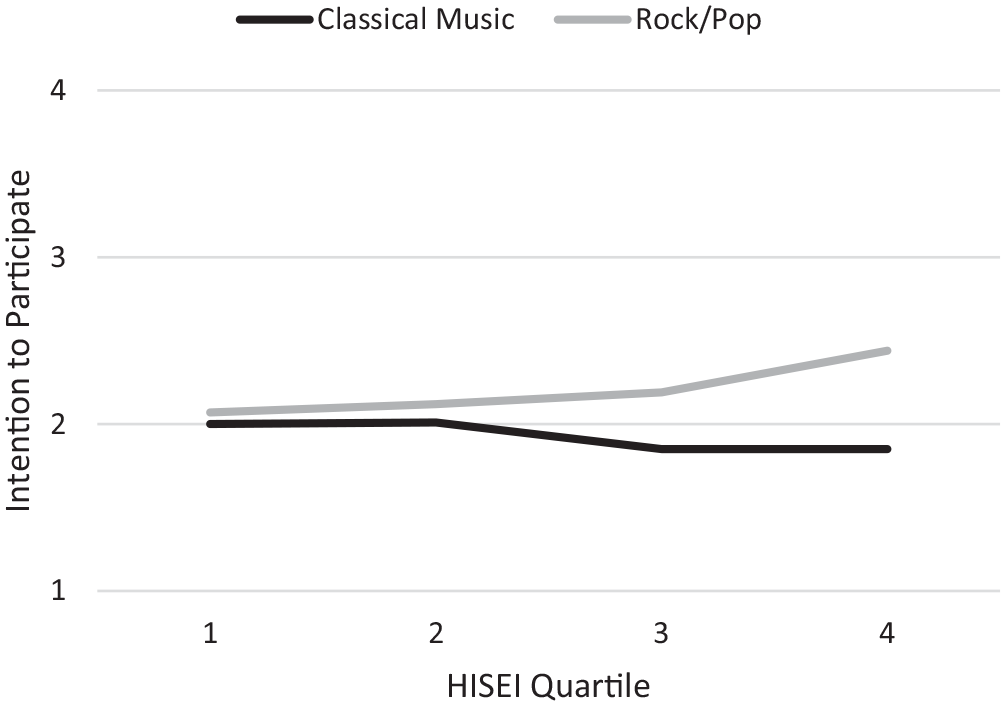
Line Diagram of the Mean Intention to Participate Across HISEI Quartile and Music.
We therefore continued with simple effects analysis comparing the intention to participate regarding the proximity of music to youth culture at different HISEI quartiles, F(4, 240) = 124.30, p < .001, η2 = .08 (cf. Cohen, Cohen, West, & Aiken, 2003). As indicated in Figure 2, this analysis revealed that the interaction effect was mainly due to differences in the fourth HISEI quartile, while there were no significant differences in the first HISEI quartile (β = .12, SE = .12, p = .32), in the second HISEI quartile (β = .20, SE = .13, p = .11), and in the third HISEI quartile (β = .28, SE = .15, p = .06). In the fourth HISEI quartile, the participants who had seen the vignettes with classical music showed a significantly lower intention to participate (M = 1.81, SD = 0.50) compared to the group with rock/pop music (M = 2.41, SD = 0.62), β = .50, SE = .12, p < .001.
Discussion
Summary of results
Results regarding setting and music
The aim of this experimental video vignette study was to explore effects of the proximity to youth culture of both setting and music on the intention to participate in out-of-school music classes for adolescents by experimentally varying two attributes of informality (Malcolm et al., 2003) and the reciprocal feedback model of musical response (Hargreaves et al., 2005; Leblanc, 1982) for the first time in such a context. The manipulation check examined whether the setting and music intended to be close to informal youth culture were also perceived as such. While this was successful for the perception of the proximity of music to youth culture, it was not entirely successful regarding the perception of the proximity of the setting to youth culture. Thus, for our study, it cannot be finally decided whether the setting (building, furnishing, clothing, leisure activities) should rather be matched to highbrow or to youth cultural schemata to achieve maximum intention to participate among young people (Research Question 1a). However, regarding the music, the results have shown unequivocally that proximity to youth culture is essential for the adolescents’ intention to participate (Research Question 1b; e.g., North et al., 2000). If one considers these results with regard to the attributes of informality, it can be assumed that for the perception of informality in out-of-school classes of any kind, the content is more important than the setting (Malcolm et al., 2003).
Results regarding covariates age, gender, and SES
In line with previous findings (Mizener, 1993; Wigfield et al., 1997), younger students were more motivated to participate in out-of-school music classes than older students (Research Question 2a). Furthermore, as expected, girls were more motivated to participate (Research Question 2b; e.g., Welch et al., 2012). To increase participation rates in boys, a musical environment must be created in which boys, with their particular individual challenges in music, feel good and content (Ashley, 2002; Welch et al., 2012). Thus, future studies should examine which design features motivate particularly boys to participate.
Regarding SES, it is promising that there was no main effect of HISEI quartile on intention to participate (Research Question 2c). However, unexpectedly, out-of-school music classes with a higher degree of informality were perceived as especially attractive by high-SES students. Thus, rather than closing the participation gap at the expense of the low-SES students, informal classes may even increase it (Research Question 2d). It may be assumed that the higher intention to participate for adolescents with a high SES is based on having generally easier access to out-of-school learning environments than their low-SES counterparts, given their better parental support and financial opportunities. In addition, the adolescents who are already participating in such activities are also known to be more motivated to participate in further activities (McEwan, 2006). This is congruent with the Matthew effect known in other domains like reading (Bakermans-Kranenburg, van IJzendoorn, & Bradley, 2005; Pfost, Dörfler, & Artelt, 2012). Thus, it is plausible that out-of-school music classes that fit adolescents’ perception of youth culture by using rock/pop music boost the intention to participate, especially for adolescents with a high SES. These, in turn, might not be the students who need this boost the most. While in hindsight, this explanation seems plausible, this interaction effect should be further examined in replication studies before its implications for the design of out-of-school music classes are considered. If, however, it turns out to be replicable, new ways of lowering the entry hurdle and thus alleviating a possible Matthew effect to out-of-school music class for low-SES students should be explored. One avenue of research could be their integration in extracurricular activities in cooperation with schools, in between formal and informal settings.
Limitations of the study and directions for future research
While our experimental manipulation regarding music worked just fine, this turned out to be more complicated for the manipulation of the setting. Even though the test items were revised in preliminary analyses to yield higher sensitivity for the detection of the manipulation, the manipulation check did not indicate a successful variation of the perceived proximity of the setting to youth culture across all experimental groups. Thus, the lacking effect of the setting for the intention to participate in our study should be interpreted with caution. Still, our findings regarding the lacking effect of setting are in line with Merkt et al. (2020) who reported that authenticity of the setting in instructional videos did not affect learning outcomes. They did not find an effect of the setting, despite a successful manipulation check. Before drawing conclusions for the design of out-of-school music classes, however, a replication should explore the following possible reasons.
First, the perception of the music could have overshadowed the perception of the setting. This could maybe be circumvented by explicitly instructing the participants to focus on the setting, or by showing them a further vignette with the opposite setting. The overshadowing might also be due to an insufficient visual contrast of the setting. Thus, in further studies, the experimental variation of the setting should be more distinctive, especially for vignettes that combine youth cultural setting with highbrow culture music or vice versa. The vignettes could provide more details, for example, more aspects of leisure time or statements of adolescents. This would require another manipulation check test. The missing effect of the setting, however, could also be due to the fact that despite high internal consistency of the scale, the content validity of the test items of the setting manipulation check might have been too weak, despite having been piloted and revised.
Second, one might argue that including a control group could have extended the possibilities to evaluate the results. There are studies, also in combination with music, which use vignettes to induce certain emotions and explore their effect on moral judgment or anxiety in an intervention-like manner (Ansani et al., 2017; Marzillier & Davey, 2005). In such studies, it could be useful to include a control group to assess, for example, pre- and post-test differences without any vignette being presented. In the present study, however, the vignettes served to describe a particular situation which was needed to express the intention to participate. The test items were also designed in such a way that it would not be possible to answer them without a description of a situation. Thus, the focus was on a comparison between different situations described, instead of assessing effects of presenting vignettes in general. For future studies, it would be interesting to extend the vignettes by further features and to check if the effects can be generalized on classes and programs regarding sports or other cultural activities.
Third, while sociodemographic variables, music, and perhaps setting should be taken into account for developing, motivating, and appealing out-of-school music classes for young people, there may be further relevant determinants like beliefs of peers and family members or beliefs regarding the perceived environmental conditions (Fritzsche, Kröner, & Pfeiffer, 2011; Penthin, Fritzsche, & Kröner, 2017) which should be scrutinized in future studies.
Conclusion
This study showed that younger adolescents and girls are generally more inclined to participate in out-of-school music classes. Moreover, classes based on music close to youth culture music are generally more attractive to adolescents than classes based on classical music. Furthermore, it turned out that it is the adolescents with a high SES that showed a particularly high intention to participate in classes which include music close to youth culture. Video vignette studies turned out to be a promising way of scrutinizing determinants of intention to participate. They may also be used in future studies on how to motivate boys, older adolescents, and especially those with low SES to participate in out-of-school music classes as a valuable form of cultural education.
Footnotes
Appendix
Items on Intention to Participate.
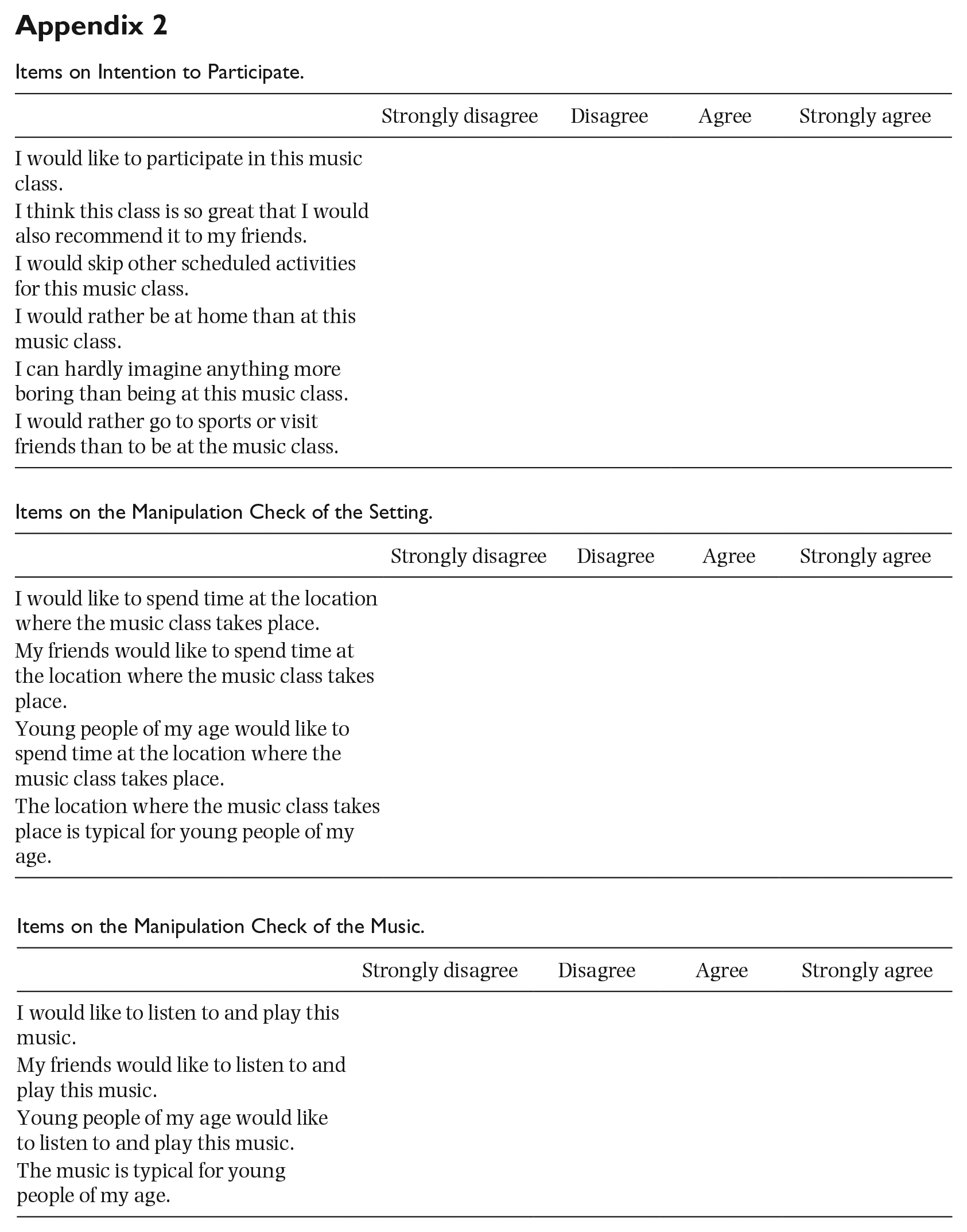
| Strongly disagree | Disagree | Agree | Strongly agree | |
|---|---|---|---|---|
| I would like to participate in this music class. | ||||
| I think this class is so great that I would also recommend it to my friends. | ||||
| I would skip other scheduled activities for this music class. | ||||
| I would rather be at home than at this music class. | ||||
| I can hardly imagine anything more boring than being at this music class. | ||||
| I would rather go to sports or visit friends than to be at the music class. | ||||
| Items on the Manipulation Check of the Setting. | ||||
| Strongly disagree | Disagree | Agree | Strongly agree | |
| I would like to spend time at the location where the music class takes place. | ||||
| My friends would like to spend time at the location where the music class takes place. | ||||
| Young people of my age would like to spend time at the location where the music class takes place. | ||||
| The location where the music class takes place is typical for young people of my age. | ||||
| Items on the Manipulation Check of the Music. | ||||
| Strongly disagree | Disagree | Agree | Strongly agree | |
| I would like to listen to and play this music. | ||||
| My friends would like to listen to and play this music. | ||||
| Young people of my age would like to listen to and play this music. | ||||
| The music is typical for young people of my age. | ||||
Acknowledgements
We would like to thank the adolescents who took part in the production of our video vignettes and those who participated in our study. We would also like to thank Alexander Christ for his methodological support.
Funding
The author(s) disclosed receipt of the following financial support for the research, authorship, and/or publication of this article: This research was supported by Grant 01JK1611A from the Federal Ministry of Education and Research (BMBF) to S.K.
