




Abstract
Studies in sport psychology show that using a pre-performance routine (PPR), a set of cognitive and behavioral elements, prior to performing, optimizes sport performance under pressure. We attempt to extend this effect to music performance, employing individually developed PPRs based on the centering technique. The hypothesis is that musicians with a PPR perform better and experience higher self-efficacy under pressure than participants with a control, goal-setting intervention. Thirty violin performance students performed an audition excerpt in a low-pressure pretest and a high-pressure posttest. Pressure was induced by the presence of an audience and a jury. Half of the students practiced their individualized PPRs during a 5-week period between performances, whereas the other half applied a goal-setting intervention to their practice. Participants’ music performance was measured by five expert jurors and self-evaluations. The results showed that both intervention techniques were perceived as equally helpful by the participants, but this did not translate into jurors’ performance evaluations. There were no significant differences between the PPR and goal-setting groups in music performance, but the PPR group had higher self-efficacy in the posttest than the goal-setting group. Future studies should include a third group without any intervention.
Successful performance under pressure is crucial in music (Oudejans, Spitse, Kralt, & Bakker, 2017) and sports (Mesagno & Mullane-Grant, 2010). Both musicians and athletes need to be able to show their best in stressful situations, such as an audition or a championship. This requires not only specific cognitive and motor skills but also effective strategies to deal with the psychological demands of public performance (Matei & Ginsborg, 2017). Sport psychologists have successfully implemented a pre-performance routine (PPR) intervention to help athletes perform under pressure (for a review, see Gröpel & Mesagno, 2019). A PPR refers to a set of cognitive (e.g., imagery) and behavioral elements (e.g., deep breathing), which a performer systematically engages in prior to performance (Cotterill, 2010). The aim of this study is to transfer sport psychological knowledge into the area of music and test the benefits of a PPR intervention for musicians.
PPRs have typically been applied in self-paced, closed skill tasks, such as putting in golf (Hill, Hanton, Matthews, & Fleming, 2011), executing a tenpin bowling delivery (Mesagno, Beckmann, Wergin, & Gröpel, 2019), and performing a routine in gymnastics (Gröpel & Beckmann, 2017). Evidence shows that using a PPR can optimize performance for all skill levels in general (Cotterill, 2010; Mesagno et al., 2019) and under pressure in particular (Gröpel & Mesagno, 2019). The underlying mechanisms of a PPR may include (but are not limited to) reduced negative introspection, lowered anxiety levels, and increased attention to the task at hand (Cotterill, 2010).
Many professional musicians report suffering from music performance anxiety (MPA) and disturbed attention during public performance (Buma, Bakker, & Oudejans, 2015). There are numerous studies aiming at reducing MPA through distal methods such as extensive mental skills training, therapeutic treatment, and medication (for a review, see Brugués, 2011). These distal methods may minimize the experience of anxiety, but when anxiety has already developed and exceeded an optimal and thus facilitative level (on stage, for example), it would also be important to have a proximal technique on hand, such as a PPR, that reduces the elevated anxiety, prevents distraction, and refocuses attention. Given that the performance of rehearsed solo repertoire constitutes a self-paced, closed skill (Colwell, 2006), the PPR intervention may be especially relevant for auditions and concerts, where well-rehearsed pieces of music are being performed.
However, the PPR intervention as a proximal technique has been rarely applied in the context of music performance. Broomhead and colleagues (Broomhead, Skidmore, & Eggett, 2010; Broomhead, Skidmore, Eggett, & Mills, 2012) tested a PPR intervention, but they measured musical expressiveness rather than performance as the outcome variable, which was indeed improved. Other researchers examined the use of a PPR in the context of extensive mental skills training programs (Clark & Williamon, 2011; Kageyama, 2007; Kinne, 2016). For example, Clark and Williamon (2011) implemented a 9-week mental skills training, including PPR elements such as deep breathing and self-talk. Their participants reported higher self-efficacy and more control over anxiety after the training. Kinne’s (2016) participants also reported lower anxiety and higher self-efficacy after a 10-week training program, but there was no control group, no pressure condition, and no test of performance.
More recently, Osborne, Greene, and Immel (2014) employed centering as a possible pre- and mid-performance routine to regulate excessive autonomic activity and refocus attention. Centering enables performers to control their body tension and concentration through directing their thoughts toward their body’s center of gravity (Nideffer, 1985). Adapted for music performance by Greene (2002), the main aspects of centering include (a) finding a focal point, (b) deep abdominal breathing, (c) releasing excess muscle tension, (d) distributing one’s body weight around one’s center of mass, and (e) directing one’s attention toward a specific cue. The effectiveness of centering in sports has been documented in studies with junior hockey players (Rogerson & Hrycaiko, 2002), basketball players (Haddad & Tremayne, 2009), and triathletes and elite runners (Patrick & Hrycaiko, 1998). In music, Osborne et al.’s pilot study showed positive effects of centering on music students’ well-being and self-confidence: the students reported being able to reach their optimal arousal level and to increase their present-moment awareness while reducing distractibility to task-irrelevant cues.
The above evidence is promising in regard to the PPR intervention, but also limited. Broomhead et al. (2010, 2012) measured musical expressiveness but not performance, while the studies by Clark and Williamon (2011), Kinne (2016), and Osborne et al. (2014) did not include a pressure condition, lacked a control group, or only used self-reports to measure outcome variables. Therefore, the first objective of this study is to develop and practice individualized PPRs based on centering and to test whether applying the PPRs would optimize music performance quality. The second objective is to test the effect of the PPRs on self-efficacy. Using a PPR may improve athletes’ feelings of control prior to performing (Hill, Hanton, Matthews, & Fleming, 2010). In music, self-efficacy is a strong predictor of performance quality (McPherson & McCormick, 2006). Music students showed increased self-efficacy after a mental skills training which included individualized PPRs (Kinne, 2016) and reported increased confidence in achieving optimal performance after lectures on the centering technique (Osborne et al., 2014). Consequently, self-efficacy is likely to underlie the effect of PPRs on performance.
The present research
While many professional musicians report suffering from MPA, music students report MPA even more often (Steptoe & Fidler, 1987). As opposed to professionals, music students still lack psychological strategies to deal with MPA appropriately (Pecen, Collins, & MacNamara, 2018) and have indicated being distracted before performing under pressure (Oudejans et al., 2017). Consequently, music students are a highly relevant sample to test the benefits of a PPR. We thus sampled music students and examined the effect of PPRs on their performance quality (Objective 1) and self-efficacy (Objective 2). We focused on only one instrument (violin) to avoid bias in the evaluation of music performance quality (Thompson & Williamon, 2003). The students performed twice: in a low-pressure pretest and in a high-pressure posttest 5 weeks later. In the meantime, half of the participants practiced an individualized PPR, whereas the other half was instructed to set a specific goal for their everyday instrumental practice. We hypothesized that participants using a PPR would perform better under pressure than participants using goal setting (i.e., control condition) and that participants using a PPR would have a higher self-efficacy under pressure than those using goal setting.
We employed the goal-setting intervention as our intended control condition rather than no intervention at all because knowing that one is not receiving treatment can affect study outcomes (Mohr et al., 2009). Since the time investment necessary for participation had to be communicated in advance, it was important to create a credible control condition that would likely not have an effect on performance under pressure. We chose goal setting as control condition because prior evidence showed null effects of goal setting on well-learned performance under pressure (Gröpel & Mesagno, 2019). Although goal setting represents a powerful motivational technique for acquiring a new skill (Locke & Latham, 2002), the breakdown of skilled performance under pressure is typically an attentional rather than a motivational problem.
Method
Participants and design
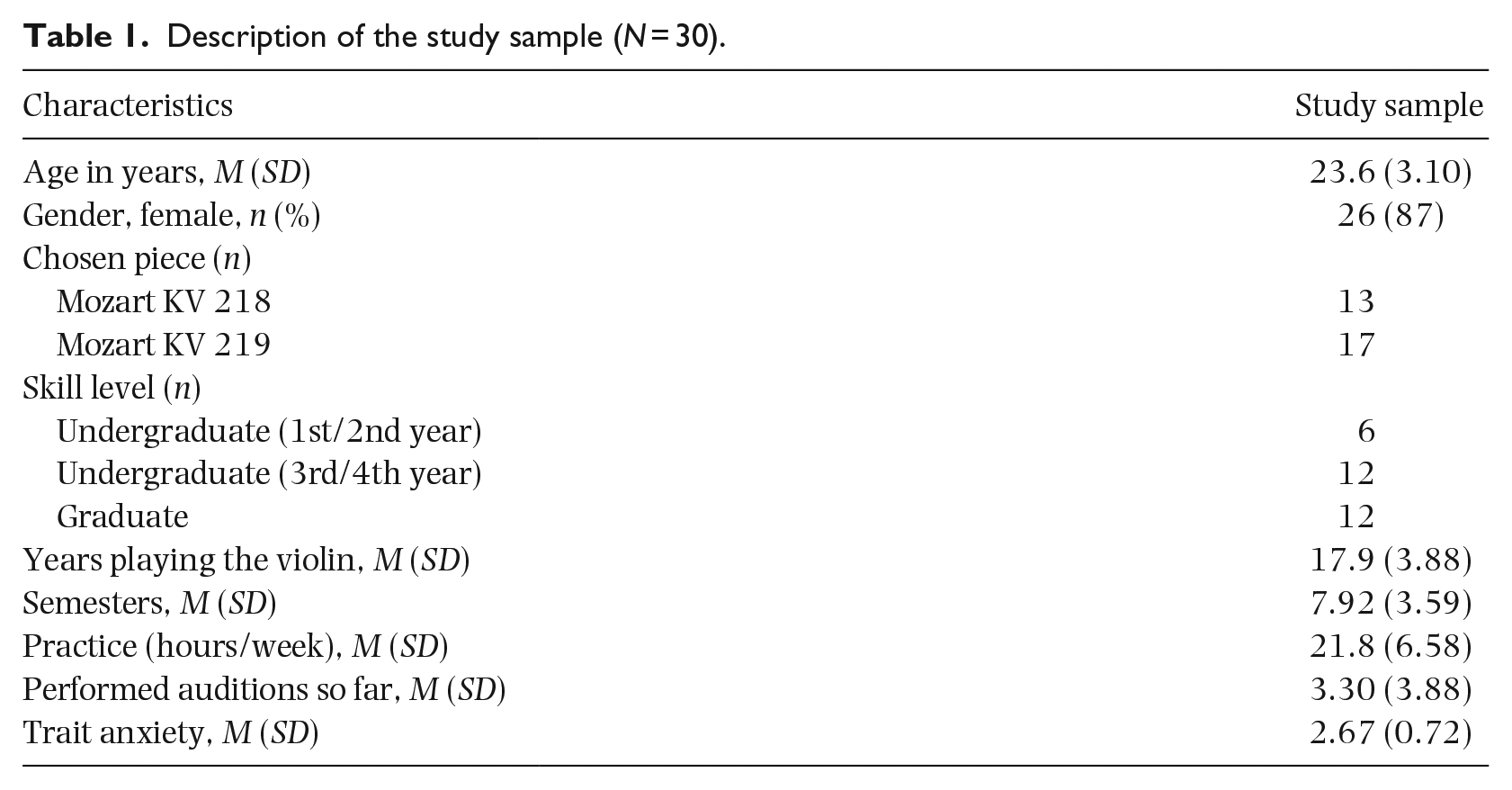
This was a pre-registered, prospective, randomized, blinded study with two distinct measurement occasions. An a priori calculation with G*Power (Faul, Erdfelder, Buchner, & Lang, 2007) revealed that a sample size of at least 34 would give sufficient power (.80) to detect significant differences at the alpha level of .05 with a medium effect size (f = .25). The medium effect size was based on prior evidence from sports (Lautenbach et al., 2015; Mesagno & Mullane-Grant, 2010). Thirty-seven violin performance students of 17 different nationalities were recruited from music universities in Austria. Inclusion criteria were familiarity with the standardized repertoire and proficiency in either German or English. Seven students did not participate in the posttest due to illness or insufficient preparation and were excluded from the main analyses. The final sample thus consisted of 30 participants, whose demographic characteristics are displayed in Table 1. The study was approved by the Institutional Review Board of the first author’s institution (#2018/S/005).
Description of the study sample (N = 30).
Performance task
The task was to play the exposition of the first movement of a Mozart concerto, either KV 218 or KV 219, with piano accompaniment. This ensures ecological validity, as these excerpts are standard repertoire for orchestra auditions and most violin students are familiar with them. Participants’ performance was audio-recorded. Audio files of each performance were sent to five expert jurors, who were not aware of the experimental condition, in a randomized order on a CD or via an online platform. They were experienced violinists: soloists, members of renowned orchestras and ensembles, and/or professors, who also regularly participated as jury members in orchestra auditions. Each juror was asked to rate each sample individually using criteria defined by Russell (2015; see below).
Measures
All questionnaires were provided in English and German.
Trait anxiety
The Kenny-Music Performance Anxiety Inventory (K-MPAI; Kenny, 2011) was administered. The scale consists of 40 items on a 7-point scale, ranging from 1 (strongly disagree) to 7 (strongly agree). An example item is, “Prior to or during a performance, I get feelings akin to panic.” Trait anxiety score was computed by averaging the responses to each item, with higher scores representing greater trait anxiety.
State anxiety
State anxiety was measured to check whether participants perceived the posttest as a high-pressure situation. Using the Mental Readiness Form-3 (MRF-3; Krane, 1994), the participants set marks for their present feeling on three separate lines, which were 95 mm long and anchored between calm and worried for cognitive anxiety, relaxed and tense for somatic anxiety, and confident and not confident for self-confidence. We used only the somatic and cognitive subscales for the analyses because they represent the central aspects of anxiety. The measured length between the left end of the line and the participant’s mark was calculated as a score out of 9.5, with higher scores indicating a higher anxiety.
Self-efficacy
The Self-Efficacy for Musical Performing Questionnaire (SMPQ; Ritchie & Williamon, 2011) was used to measure participants’ self-efficacy regarding their performance. The scale consists of nine items on an 8-point scale from 1 (not at all sure) to 7 (completely sure). An example item is, “I am confident that I can give a successful performance.” Item 6 (“I am likely to avoid this performance if the music looks or sounds too difficult for me”) was not included, as it was irrelevant due to the standardized repertoire. Self-efficacy scores were computed by averaging the responses to each item, with higher scores representing greater self-efficacy.
Music performance quality
An identical list of 11 criteria (Russell, 2015) was provided for jury evaluations and participants’ self-evaluations. The items included tone, intonation, articulation, rhythm, tempo, dynamics, timbre, interpretation, technique, musical expression, and overall musical performance. Each criterion was rated on a 5-point scale from 1 (bad) to 5 (excellent). An overall score was calculated by averaging the responses to each item, with a higher value indicating a better performance.
Study groups
Using a computer-generated list of random numbers (Microsoft Excel; Microsoft, Redmond, WA, USA), we randomized participants to either a PPR group or a goal-setting group. Because participants could choose from two excerpts of a Mozart concerto and differed in their skill level, the random assignment to the study groups was stratified according to participants’ chosen piece and skill level. Skill Level 1 included students in their first and second year of undergraduate studies, Skill Level 2 included third- and fourth-year undergraduates, and Skill Level 3 included graduate students and members of orchestra academies. 1
The PPR group involved participants developing or modifying their existing PPR. The first author met with each participant individually for 45 min. Participants were first asked what they usually do and think on stage before they start playing. Only one participant indicated that she already had an established PPR. All other participants were introduced to the concept of PPRs and the centering technique using the guidelines by Greene (2002). Imagining themselves on stage after just having tuned their violin, they were talked through the steps of a centering-based PPR: finding a focal point, deep breathing, releasing muscle tension, distributing one’s body weight around one’s center of mass, and developing a specific cue to which to direct attention. After discussing individual adjustments, each participant wrote down the steps of their PPR in their own words. They were requested to go through the PPR at least once a day until the posttest.
The goal-setting group involved participants setting goals for their practice. The first author met with each participant individually for about 45 min. Participants first described their usual approach of a practice session to find out existing goal-setting strategies. They were then introduced to SMART goals (Locke & Latham, 2002) as well as the 15-min rule, that is, choosing one aspect to work on for exactly 15 min (Burwell & Shipton, 2013). Next, they were asked to plan an exemplary practice session and set specific goals. It was requested that they set individual goals for each day until the posttest and reflect afterward on whether they had achieved them or not, encouraging adjustments for the goals of the next day.
Procedure
The study consisted of three distinct phases: a low-pressure pretest, an intervention phase, and a high-pressure posttest (Figure 1). The pretest was performed individually in a recording studio. Upon arrival and signing informed consent, participants warmed up, completed the MRF-3 and the SMPQ, and performed their excerpt with piano accompaniment. There were no persons present in the room except the pianist and the participant. The participants then provided demographics and completed the K-MPAI.
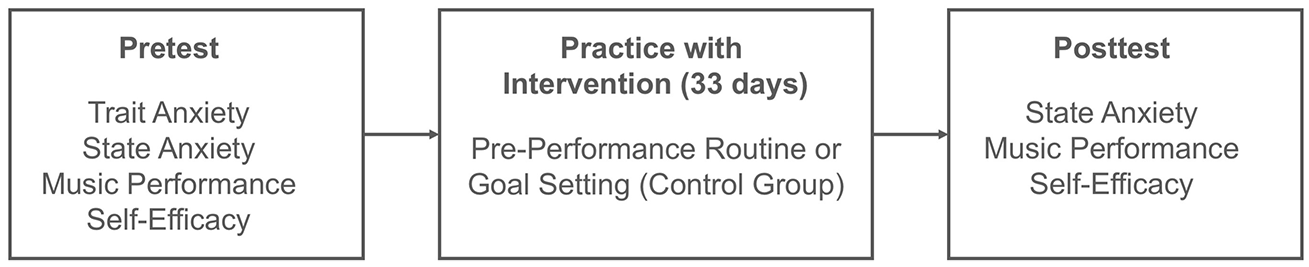
Study Procedure.
The intervention phase started after the pretest and lasted 33 days. Participants in the PPR group implemented their PPRs and participants in the goal-setting group set their individual goals. To ensure compliance with integrating the psychological techniques into their practice, participants received a protocol for the 33 days of the intervention phase. The PPR group had to indicate whether they had practiced their PPR on the given day (yes or no) and the goal-setting group had to state whether they had set goals on the given day and whether they had achieved them (yes or no).
The posttest was made public and took place at a concert hall in Vienna to create an authentic performance scenario. All participants were asked to come to the venue at 9:00 a.m. and draw a number to set the order in which they would perform. Only one large room was provided for warming up. Three expert jurors (not those who evaluated the performances for analyses) listened to all performances. Participants were made aware that these jurors were renowned violinists and would give them feedback at the end (Ritchie & Williamon, 2012). An audience award served as an external reward: in the end, €10 vouchers for a music shop were given to the six participants with the most votes. Five minutes before their performance, all participants completed the MRF-3 and the SMPQ for the second time. They were then led to the concert hall and performed their excerpt. Participants in the PPR group completed their PPRs immediately prior to performing, whereas participants in the goal-setting group performed without a PPR implementation. After performing, all participants rated their learned technique (PPR or goal setting) on a scale from 1 (not at all helpful) to 10 (very helpful) and were then debriefed and dismissed.
Results
Homogeneity of the groups
A chi-square test revealed no significant differences in the proportion of men and women in the two study groups (PPR group: 1 man; goal-setting group: 3 men). Furthermore, an independent-sample t test indicated no significant differences between the groups in age, practice hours, the number of past auditions, trait anxiety, and compliance with the protocol (Table 2). There was a significant difference in years playing the violin, t(27) = 2.16, p = .039, d = 0.80. However, this variable was not significantly correlated with any of the performance measures, and including it as a covariate did not substantially change the results. The seven dropouts did not significantly differ from the final sample in any demographic variable, K-MPAI scores, SMPQ pretest values, and pretest self- and jury evaluations.
Description of the study groups: means (standard deviations), t tests, significances, and effect sizes.
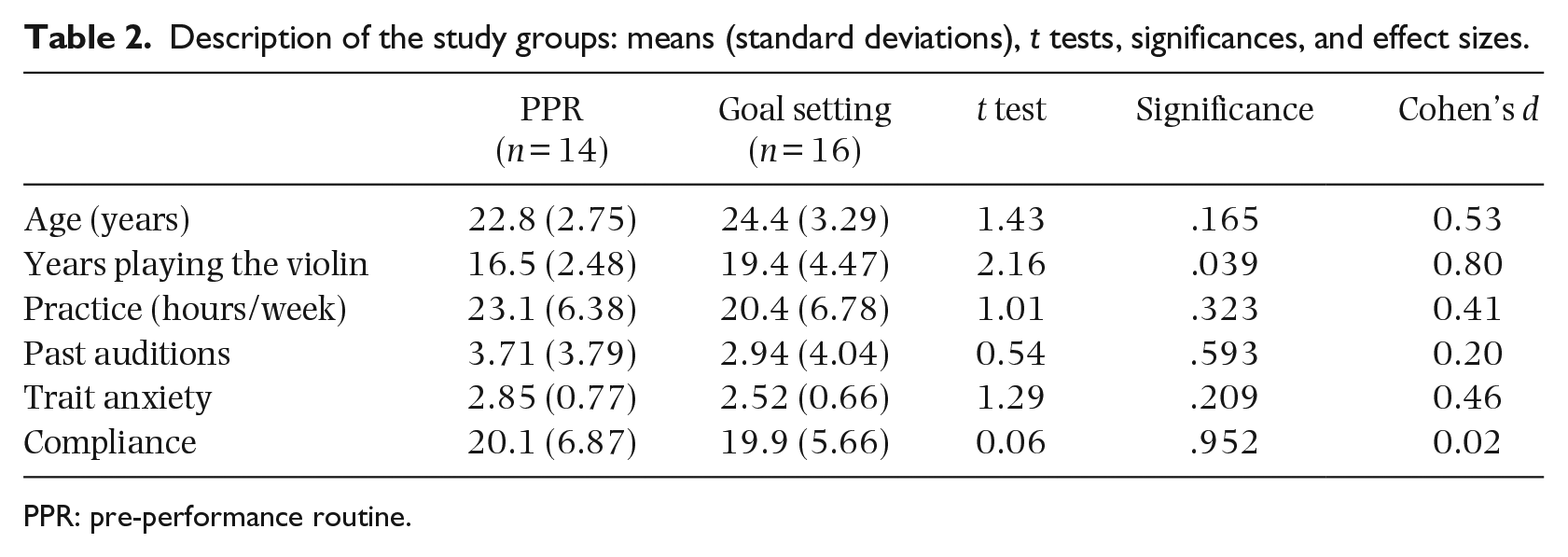
PPR: pre-performance routine.
State anxiety
A 2 × 2 (Phase × Group) repeated measures analysis of variance (ANOVA) yielded no significant main effects of Phase on somatic or cognitive anxiety, and also no significant interactions (Table 3). These results indicated that the PPR and goal-setting groups exhibited the same anxiety levels pretest and posttest and that participants did not experience higher anxiety in the high-pressure posttest.
Means (standard deviations) of the main study variables in pretest and posttest.
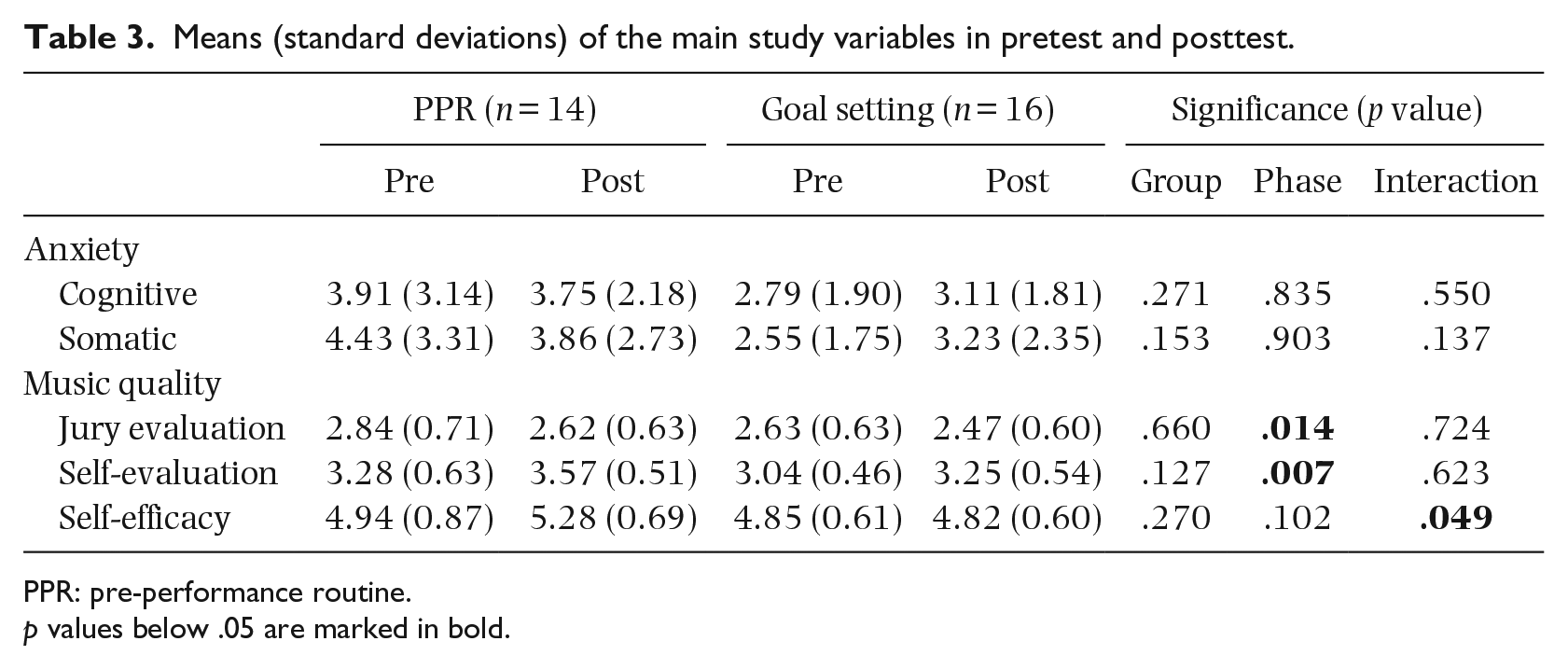
PPR: pre-performance routine.
p values below .05 are marked in bold.
Music performance quality
Two-way random intra-class correlations (ICCs) for absolute agreement were calculated to test the agreement between the five jurors. One juror was excluded because inter-item correlations were considerably lower than those for the remaining four jurors (±.11). Overall, for the four jurors, ICCs for music performance quality scores were .89 in the pretest and .87 in the posttest. A 2 × 2 (Phase × Group) repeated measures ANOVA was conducted on the jury evaluations. It resulted in a significant main effect of Phase, F(1, 28) = 6.90, p = .014,
Regarding self-evaluations of music performance quality, a 2 × 2 repeated measures ANOVA revealed a significant main effect of Phase, F(1, 28) = 8.41, p = .007,
Self-efficacy
One participant was excluded as an outlier because her difference between pretest and posttest was more than 3 SDs greater than the sample mean. A 2 × 2 (Group × Phase) repeated measures ANOVA revealed non-significant main effects of Phase and Group. However, there was a significant interaction, F(1, 27) = 4.26, p = .049,
Discussion
This pilot study was the first study in which individualized PPRs were investigated as a proximal intervention for music students in a pressure situation. Results revealed that participants who learned a PPR did not show better music performance than control participants who set goals for their practice. Hence, our first hypothesis was not supported. This is at odds with prior evidence on the effectiveness of PPR interventions in sports to prevent choking under pressure, a term which describes reduced performance in situations with elevated pressure (Gröpel & Mesagno, 2019). Evidently, the use of a PPR did not have the same benefits for the musicians in our study as it has for athletes. An alternative explanation for our results is that goal setting did not constitute a neutral, control condition. Many participants in the goal-setting group readily accepted the proposed goal-setting strategies, as they had not yet worked out an effective structure for their daily practice. Therefore, it is possible that this intervention, intended as neutral, did indeed help them. Yet another explanation could be that participants were not under enough pressure for the PPR intervention to exhibit a significant effect on performance quality. Participants’ anxiety did not increase in the posttest, as compared with a low-pressure pretest, despite the presence of an audience and a jury. Future research should employ a stronger pressure situation as well as a third group that would either receive no intervention or serve as a waitlist control group.
However, the present results support the second hypothesis that PPR participants have a higher self-efficacy than goal-setting participants. The higher self-efficacy of the students learning a PPR indicates that they were more confident in their playing and their ability to give a successful performance than those who learned goal setting (Ritchie & Williamon, 2012). Having a PPR on hand, rather than setting goals during practice, might give music students a better sense of control during the preparation time leading up to their performance (Hanton, Wadey, & Mellalieu, 2008).
We measured both self-reported and jury-evaluated music performance quality, which is one of this study’s notable strengths. However, it is remarkable that these self- and jury evaluations diverged from one another; compared with jury evaluations, participants overestimated the quality of their performance. The jurors were not informed about which participant or condition they were listening to, and they were instructed to evaluate each recording by itself. In contrast, the participants were likely to compare their performance of the posttest with the pretest or other previous performances and might have had a different focus than the jurors (Kageyama, 2007). Participants’ ratings thus could have been influenced by wishful thinking of improving, social expectancy, or a self-fulfilling prophecy. These results underpin the generally problematic nature of music performance evaluation (Hewitt, 2011; Thompson & Williamon, 2003). While expert jurors’ evaluations of audio-recordings were shown to be reliably consistent with real-life competitive rankings (Smith, 2004), self-evaluations may rather reflect how comfortable performers feel with a newly learned psychological strategy. Therefore, both evaluation perspectives should be included in future studies to get a comprehensive picture of music performance quality.
The pressure manipulation deserves mention. We organized a public audition with an audience, a jury, and an award. Such elements have been widely used to induce pressure (cf. Gröpel & Mesagno, 2019). However, we found no significant increases in state anxiety and one might conclude that the pressure manipulation did not work. Several alternative explanations exist. First, the questionnaire was administered 5 min before the performance as to not disturb the participants too much, but this might have been too early. During debriefing, some participants told us that they were more nervous in the moment before entering the stage than when they filled in the questionnaire. Second, it is possible that the pretest already induced pressure, which would have made the posttest a less threatening situation. Finally, it cannot be ruled out that both intervention techniques already influenced participants’ anxiety, which would be in line with studies demonstrating lower MPA after mental skills trainings (Spahn, Walther, & Nusseck, 2016).
This study had an ecologically valid setting with standardized, accompanied audition repertoire and a simulated audition. Another strength was that only little time and effort were required from the students, which had not been possible in other studies implementing more comprehensive programs. As music students are often reluctant to dedicate some of their practice time to other non-playing activities, it has been recommended that intervention programs should be reduced to a minimal time commitment (Clark & Williamon, 2011). Many participants gave us additional positive feedback regarding the opportunity to practice playing in front of a jury and receiving the jury feedback. Some participants indicated that they preferred to use their PPR routine at different points in time. Centering as a PPR technique should therefore be investigated on different occasions, such as when one is backstage or when one must pause between pieces.
A major limitation of the study was that the goal-setting condition was not neutral, and therefore, the goal-setting group cannot be considered an actual control group. This might result in less statistical power to detect an effect of the investigated treatment (Mohr et al., 2009). Researchers should therefore incorporate a no-treatment, waitlist control group in future studies. This study is also limited by the seven dropouts. Although the dropouts were not different than the remaining participants, the reduced sample size might reduce the statistical power. Another limitation is that most participants could not answer questionnaires in their native language, as 17 different nationalities (e.g., Russia, Spain, Taiwan) were represented in this sample. All questionnaires were provided both in English and in German and all non-native speakers had stated that they were able to speak at least one of these languages well; yet, it took many of them a considerable amount of time to complete the questionnaires. Furthermore, our compliance data are based on simple protocols. While it was emphasized that participants should answer honestly, we can only trust their self-report. In addition, we did not control for whether the participants in the PPR group also set goals for their practice. In future studies, this could be addressed in the debriefing. Finally, there were misunderstandings in the communication between pianist and violinists in the posttest: some participants did not have enough time for their PPR because the pianist had taken a certain gesture or nod as a sign to begin playing the introduction. As this is likely to occur in a real audition setting as well, it would be important to find an unmistakable sign for being ready and discuss it with pianist in advance. Given these limitations, our study should be considered as a pilot study.
Conclusion
With this pilot study, we provide preliminary evidence for PPRs having a positive effect on music students’ self-efficacy, while not having much effect on performance. Taking the difficulties of music performance evaluation into account, the performance-enhancing effect of PPRs found in sports still needs further investigation in music. Future study designs need an appropriate control condition but should include the beneficial aspects of our study: standardized repertoire, the opportunity for participants to experience a realistic audition setting with professional feedback and minimal time commitment, and both self- and jury evaluations of music performance quality.
Footnotes
Funding
The author(s) disclosed receipt of the following financial support for the research, authorship, and/or publication of this article: This research was supported by a grant from the University of Vienna, financed by the Austrian Federal Ministry of Education, Science, and Research.
