




Abstract
Besides innate dancing or musical predispositions, other factors contributing to success in these highly competitive domains are important to investigate. The present study examined the role of personality and intelligence in ballet and musical school performance. Data were obtained from 155 high school ballet (n = 75) and music (n = 80) students in Serbia (75% females, mean age = 16.12, SD = 1.14). Personality traits were assessed with the Big Five Inventory, and intelligence was assessed with the Cybernetic Intelligence Tests Battery, which measures perceptual, verbal, and spatial abilities. A hierarchical multiple regression was computed to investigate if ballet or musical success could be predicted by personality traits and intelligence. Personality traits and intelligence explained 26% of the variance in ballet success and 35% of the variance in musical success. Conscientiousness and general intelligence predicted both ballet and musical success. Low neuroticism and perceptual abilities contributed significantly to the prediction of a successful musical performance, whereas spatial skills had an important role in successful ballet achievement. This study adds to the understanding of the role of personality and intelligence in performing arts efficacy.
Keywords
Performing arts refer to different forms of creative activities performed in front of an audience intended to be appreciated for their beauty or emotional power (Siefring, 2004), and in general include music, dance, opera, and drama. Even though the public interest in performing artists is enormous, little attention has been paid to the study of these individuals (Kogan, 2002), particularly the study of characteristics related to failure or success in these highly competitive domains. In the past, an exceptional performance was considered solely as a privilege of divine beings, with gifted individuals being considered intermediaries channeling the gifts of these superhuman powers (Murray, 1989). However, once psychology of giftedness was conceptualized as an empirically supported science (Binet & Simon, 1916; Galton, 1869), these explanations were no longer adequate. Giftedness was first identified with high intelligence and intelligence based on test performance (Gallagher & Courtright, 1986; Terman & Oden, 1959). Although many authors recognized the need to conceptualize giftedness from a broader perspective, the first conceptions were formulated only in the 1980s (Altaras, 2006).
Multidimensional conceptions of giftedness were explained in terms of distinct components rather than as a single construct. For example, Robert Sternberg’s (1985) triarchic theory of intelligence makes a distinction between three aspects of intelligence: analytic skills (i.e., the ability to think abstractly and evaluate information), creativity (i.e., the ability to invent novel solutions or ideas), and practical skills (i.e., dealing with concrete situations). According to Sternberg, intelligent tests often neglected creativity and practical skills. Renzulli’s (1984) theory of giftedness made a distinction between “schoolhouse” giftedness and “creative–productive” giftedness. The former relates to learning capacities and is most common in highly skilled students who perform well on standardized and cognitive ability tests, while the latter reflects the ability to develop original knowledge/products by using thought processes in an integrated, inductive, and problem-oriented manner. In his theory of multiple intelligences, Gardner (1983) developed a list of seven abilities. The first two intelligences—linguistic and logical–mathematical—are valued in schools; musical, bodily–kinesthetic, and spatial are associated with arts; and interpersonal and intrapersonal are “personal intelligences.” In our study, we focused on giftedness in two non-academic domains, that is, giftedness in music and ballet. According to Gardner, giftedness in music encompasses the capability to recognize and compose musical pitches, tones, and rhythms, whereas giftedness in ballet includes bodily–kinesthetic intelligence—the mental ability necessary to coordinate bodily movements. Some authors argued that excellence in musical/ballet performance is determined primarily by innate capacities (Hamilton, 1986; Ruthsatz, Detterman, Griscom, & Cirullo, 2008). Hamilton (1986), for example, stated that Anteversion is genetically predetermined and cannot easily be altered to any great degree. The extent of turnout is probably complete by age 10 or 11 . . . a would-be ballet dancer who has poor turnout from the start probably will never be good, and the attempt to force it can create several knee problems. (p. 64)
Others believed that anyone could become an expert in any field by continuously practicing in a certain domain (Ericsson, 2007; Ericsson & Charness, 1994; Howe, Davidson, & Sloboda, 1998). For example, to become an expert in music, in addition to possessing the innate musical skills (e.g., sense of rhythm and pitch), one must also enter formal training at a young age and practice continuously for at least 10 years (Ericsson, 2007). Although both nature and nurture are necessary determinants of expert performance in various fields (Ackerman, 2014), it is unclear which other factors exert an influence to deliver top performances in ballet and music, next to innate talents and intensive practice. In the current study, we investigated if intelligence and personality characteristics can explain individual differences in musical/ballet performance. In this study, we define ballet or musical success as the ability to dance or play an instrument at a high level.
Some researchers claimed that a gift in specific artistic domains does not necessarily comprise advanced intelligence (Csikszentmihalyi, Rathunde, & Whalen, 1997; Winner, 1996), while others are convinced that general intelligence is of great importance in mastering skills in these domain-specific fields. For example, according to Seashore (1919) “the great musician is always a person of great intellect” (p. 253). Indeed, a vast majority of studies have supported a positive association between general intelligence and musical achievement (Lynn & Gault, 1986; Pekić, 2008; Schellenberg, 2011). Moreover, some studies have shown that not only general intelligence is related to success in a music career, but also more specific intellectual skills, such as spatial skills (Hassler, Birbaumer, & Feil, 1985; Štula, 2007), which have an important role in sight-reading (i.e., reading an unknown text; Sloboda, 1981; Štula, 2007). Considering ballet performance, to our knowledge, there is no empirical evidence of how intelligence is related to success. However, only one study examined differences in three aspects of spatial skill (i.e., body orientation, body awareness, and spatial skill necessary to manipulate an abstractly represented space) between 10 advanced ballet students and their matched controls. However, the results were non-significant (Corsi-Cabrera & Gutierrez, 1991). It could be that, due to the small sample size, the study did not have enough statistical power to find significant differences between dancers and non-dancers.
Furthermore, very little is known about whether personality dispositions contribute to success in the performing arts, since previous research mainly focused on personality differences between artists and non-artists (Bakker, 1988; Marchant-Haycox &Wilson, 1992). Although, the incremental contribution of personality has not been subject to extensive empirical investigation, the few relevant studies indeed showed that certain traits could be valuable predictors of artistic excellence. Specifically, research has shown that openness generally predicted achievement in arts (de Manzano & Ullén, 2018; Kaufman et al., 2016) as well as musical expertise, training, and practice (Butkovic, Ullén, & Mosing, 2015; Hille & Schupp, 2015). Moreover, there is evidence that student’s perceptions of self-efficacy play an important role in the music exam performance (McCormick & McPherson, 2003). According to another study, musical success at primary school age depends on discipline, emotional stability, relaxation, independence, and self-confidence (Radoš, Kovačević, Bogunović, Ignjatović, & Acić, 2003). Pekić (2008) also investigated the associations between personality traits and key components of musical success and found that high conscientiousness, high agreeableness, and high openness are relevant for achieving high levels of competence. With regard to ballet, Araújo, Cruz, and Almeida (2009) showed with a case study that, intense and hard work, discipline, and a strong commitment are crucial for the quality of ballet efficacy. More research is needed to better understand the role of intelligence and personality traits in excelling in music and ballet.
The purpose of this study was to investigate whether personality traits and general intelligence could predict success in ballet/musical performance. We also aimed to test whether ballet/musical performance could be explained by various aspects of intellectual skills (i.e., perceptual, verbal, and spatial) when they are included in the regression model instead of general intelligence. Based on previous research, we expected that openness would contribute significantly to the success in ballet/musical performance. We also hypothesized that low neuroticism, high conscientiousness, high agreeableness, high IQ, and excellent spatial skills would significantly predict musical success.
Given the associations between parents’ level of education and children’s intelligence (Von Stumm & Plomin, 2015), and the association between age and performance on cognitive tests (Burggraaf, Frens, Hooge, & Van der Geest, 2018), we would test for confounders of success in ballet/music including age and the level of parental education.
Methods
Procedure
Data were collected from students gifted in ballet or music, in four specialized secondary schools in Serbia. All ballet/music schools involved in this study belong to the same State Serbian ballet/music school, and follow the same curricula and exam procedures. This study was approved by the ethical committee of the University of Novi Sad and conducted in accordance with the Declaration of Helsinki. A member of the research team visited each school and provided students with the necessary information about the study. Participation in the study was voluntary and students had the opportunity to stop the study at any time, without giving a reason. All students agreed to participate and were asked to sign the consent form. The survey was conducted by a trained researcher during school hours. Once students entered the classroom and sat down, they were asked to fill in a test battery that measures various aspects of intellectual abilities. Before each test, students performed two pilot exercises together with a research assistant to ensure that everyone understood the task. The battery included a perceptual test of 4 min, a verbal test of 2 min, and a spatial test of 8 min. After completing the tests, the students were asked to complete the personality questionnaire. Finally, data related to performance in ballet/music were collected in cooperation with psychologists and pedagogues according to predetermined indicators.
Participants
The sample consisted of 155 music (n = 80) and ballet (n = 75) students from the first to the fourth grade of the specialized music and ballet high schools in Serbia. Seventy-five percent were females and the average age was 16.12 (SD = 1.14) years.
Measures
Personality traits
Personality traits were assessed by the Big Five Inventory (BFI; John & Srivastava, 1999), using the Serbian version. The Serbian version of the BFI demonstrated good psychometric properties and the factorial structure was very similar to that in Western European studies (Čerović, Pejić, & Petrović, 2013). The BFI consists of 44 items that measure five personality dimensions. All items were answered on a 5-point Likert-type scale ranging from 1 = strongly disagree to 5 = strongly agree. The internal consistency of the five scales was satisfactory: α = .79 (Neuroticism), α = .74 (Extraversion), α = .68 (Openness), α = .66 (Agreeableness), and α = .80 (Conscientiousness). The internal reliability of the entire scale was α = .73.
Intelligence
Intellectual abilities were measured by the Cybernetic Intelligence Tests Battery (KOG-3; Volf, Momirović, & Džamonja, 1992), which comprises three subtests measuring perceptual (IT-1), verbal (AL-4), and spatial (S-1) abilities. The IT-1 test (Thurstone, 1938) consists of 39 multi-choice tasks in which the respondent needs to identify which of the four suggested images is identical to the given image. The AL-4 (Wells, 1932) includes 40 judgment tasks in which the respondent needs to determine whether the pair of words have the same or opposite meaning, by choosing between two given options (i.e., 1 = words have the same meaning, and 2 = words have the opposite meaning). The S-1 (Reuchlin & Valin, 1953) contains 30 multi-choice tasks in which each task has a three-dimensional representation of a group of bricks. The task of the respondent is to make a choice between four transversal projections of the group that corresponds to the given representation when that group is observed from a certain angle. The score of each subtest was converted to z-values, using an appropriate reference table. Finally, an intelligence quotient (IQ) was computed as a total score derived from the subtests, where for the given sum score, a corresponding value of IQ, was read from the appropriate reference table. The psychometric properties of KOG-3 were satisfactorily validated in previous studies (Volf et al., 1992).
Success
Success in ballet/music was defined as an average grade at the end of the academic year, considering two grades from the most relevant school subjects (i.e., classical ballet and contemporary ballet/solfeggio and playing an instrument). Students’ grades in both schools were based on exam performance and assigned by the examination board, which consisted of three highly qualified members. At both schools, the exam performance is 100% of the grade for that subject. The grades awarded in the Serbian school system range from 1 (unsatisfactory) to 5 (excellent).
Statistical analysis
Analyses were conducted using SPSS v.24.0 (IBM Corp., Armonk, NY, USA). First, a preliminary analysis was performed to test for potential confounders of ballet/musical success by using Pearson’s correlations. Then, to investigate if success in ballet/music could be predicted by personality traits and intelligence, a hierarchical multiple regression was computed. Since IQ represents a composite score of three different tests, analyses were computed two times to avoid multicollinearity. In the first step, we entered either IQ or three different aspects of intelligence into the model, because intelligence has been shown to be an important predictor of success in academic (Neisser et al., 1996) and non-academic domains (Lynn & Gault, 1986). However, research has shown that in schools where the differences in intelligence are relatively small, personality can be an important addition to predicting school performance (Conard, 2006), and that is why personality was included in the second step (Lens, Pemberton, & Bogaerts, 2013).
Results
Descriptive statistics
The characteristics of both samples are presented in Table 1. Results showed that there were significantly more females in the group of ballet students than in the group of music students. Moreover, ballet students were more conscientious and had better developed perceptual abilities compared to music students, who in contrast, scored significantly higher on verbal abilities than ballet students.
Sample characteristics.
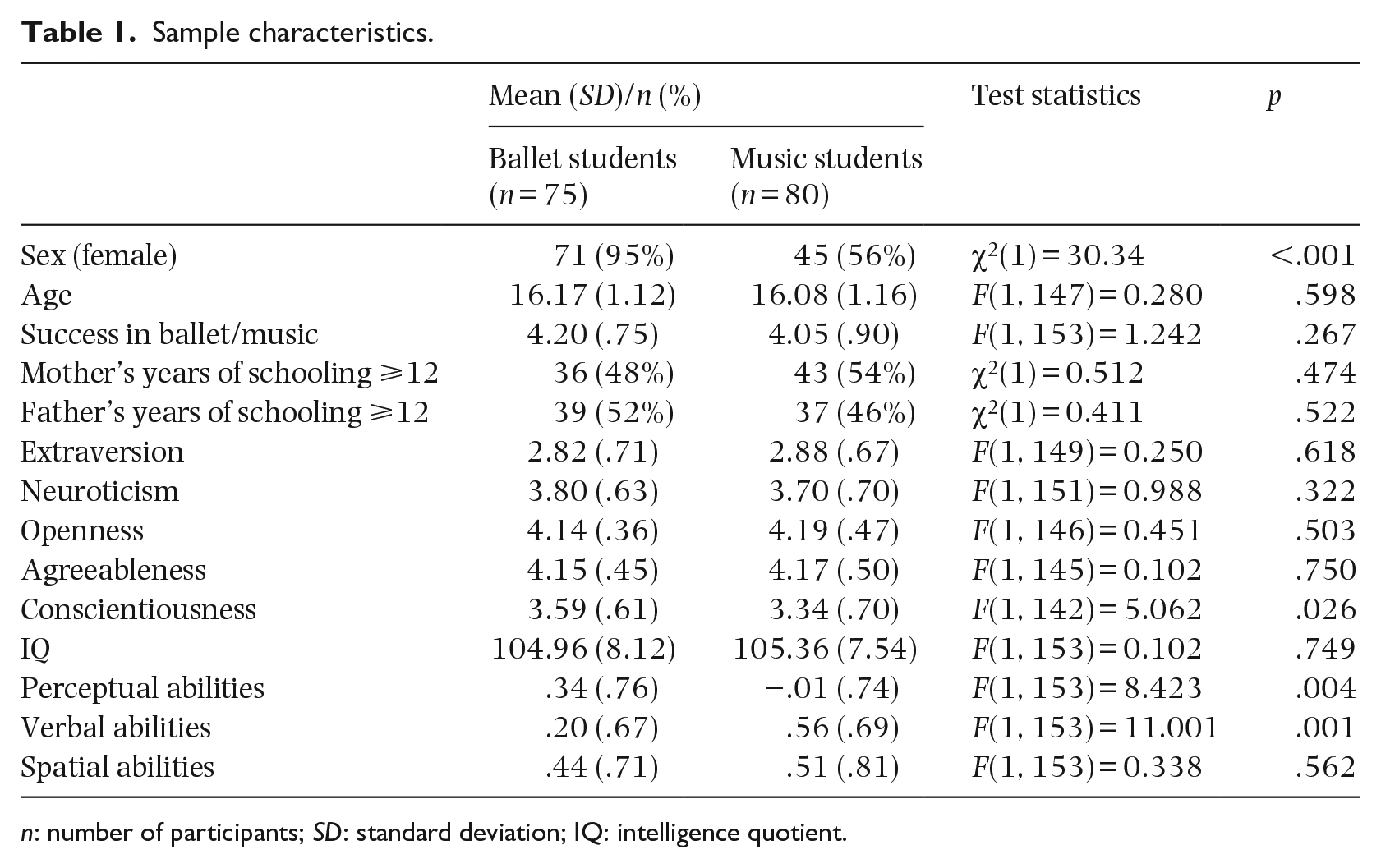
n: number of participants; SD: standard deviation; IQ: intelligence quotient.
Preliminary analysis
Potential confounders of ballet/musical success were assessed in preliminary analyses, including age and the level of parental education. The results (see Table A.1 in Online supplemental material) showed that age was a significant confounder of success but only in the group of music students. Contrary to our expectations, age was negatively associated with perceptual abilities, meaning that the performance of music students on this test decreases with age. Age and perceptual abilities were entered in a regression model, but only in the group of music students. There were no other potential confounders and therefore no adjustments were made.
Main analyses
Predicting success in students gifted in ballet
To test whether the Big Five personality traits and general intelligence (IQ) were significant predictors of success in ballet, a hierarchical multiple regression was applied (Table 2). First, IQ was entered that predicted 6.5% of the variance in ballet success. Second, personality traits were added in the model and predicted 16.5% of the explained variance in ballet success, while holding IQ constant. Personality traits and IQ improved the explained variance in ballet success to 23%. Partial correlations showed that conscientiousness made the largest contribution to the model, followed by IQ. Students who were more conscientious and intelligent had a better ballet performance.
Personality traits and IQ as predictors of ballet success.
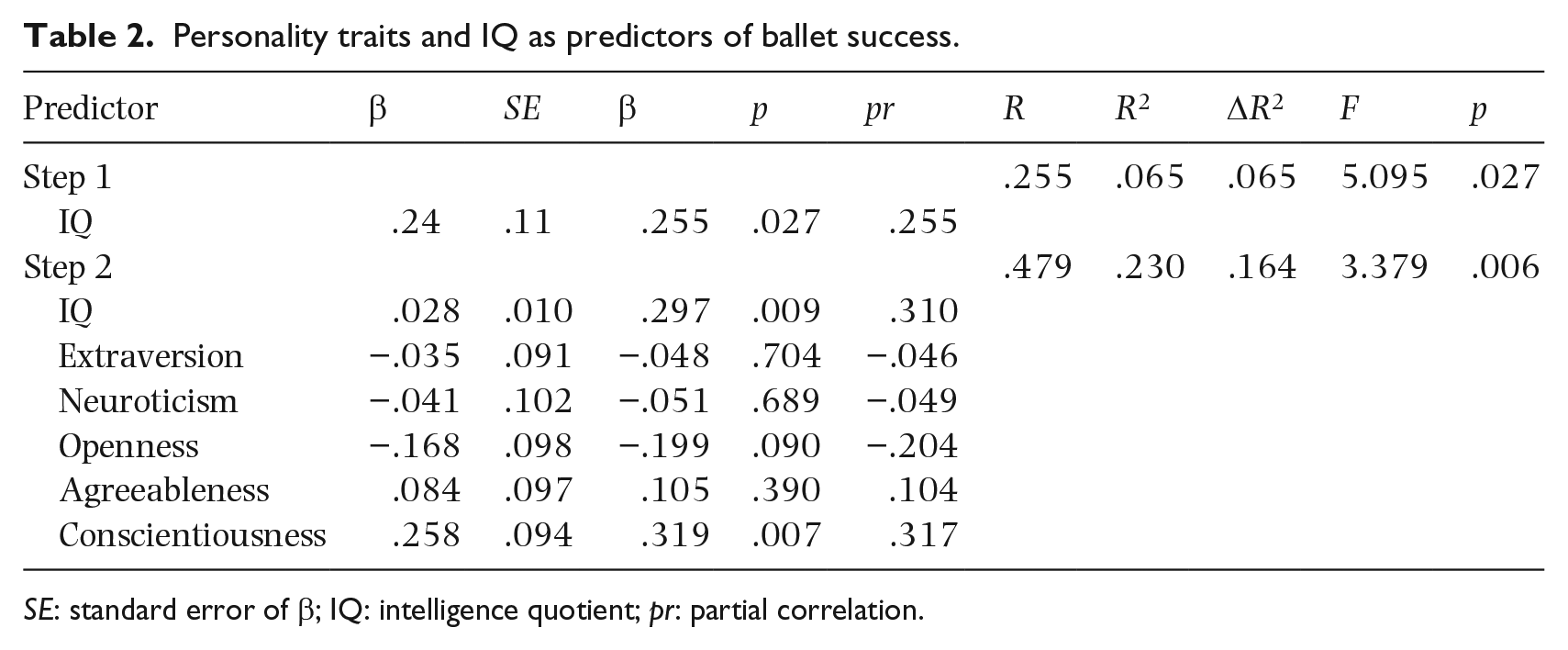
SE: standard error of β; IQ: intelligence quotient; pr: partial correlation.
The analyses were repeated, but this time, various aspects of intellectual abilities were entered in the model together with personality traits as predictors of ballet success. First, perceptual, verbal, and spatial abilities were entered in the model and predicted 11% of the variance in ballet success (Table 3). Partial correlations showed that spatial abilities made the largest contribution to the model. Second, personality traits were added to investigate whether personality traits contributed to ballet success when perceptual, verbal, and spatial skills were kept constant. By adding personality traits, the explained variance increased by 15%, so the new model predicted 26% of the explained variance in ballet success. Partial correlations showed that conscientiousness made the largest contribution to the model, followed by spatial abilities. The results indicate that ballet success depends on high conscientiousness and pronounced spatial abilities.
Personality traits and intellectual abilities as predictors of ballet success.
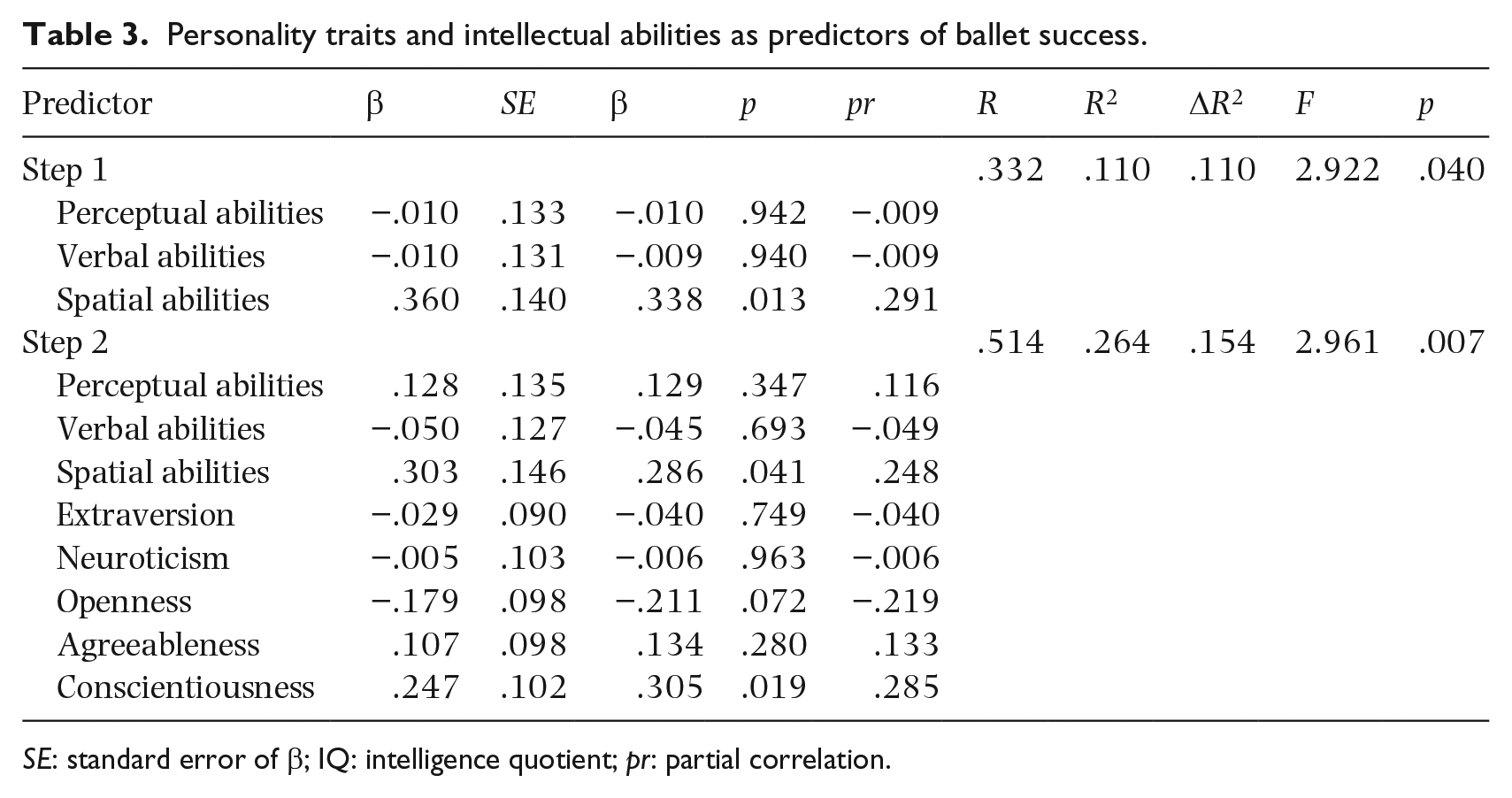
SE: standard error of β; IQ: intelligence quotient; pr: partial correlation.
Predicting success in students gifted in music
We also investigated whether the Big Five personality traits and general intelligence (IQ) were significant predictors of musical success by using a hierarchical multiple regression (Table 4). First, IQ was entered that predicted 16% of the explained variance in musical success. Second, personality traits were added to examine if personality traits contributed to the explanation of success in music when IQ was held constant. The addition of personality traits improved the explanatory power by 18%. The new model was therefore responsible for 34% of the explained variance in musical success. Partial correlations showed that conscientiousness offered the largest positive contribution to the model, followed by IQ. Neuroticism contributed negatively to the prediction of musical success. Students who were more conscientious and intelligent, and less emotionally unstable, did much better in musical performance.
Personality traits and IQ as predictors of musical success.
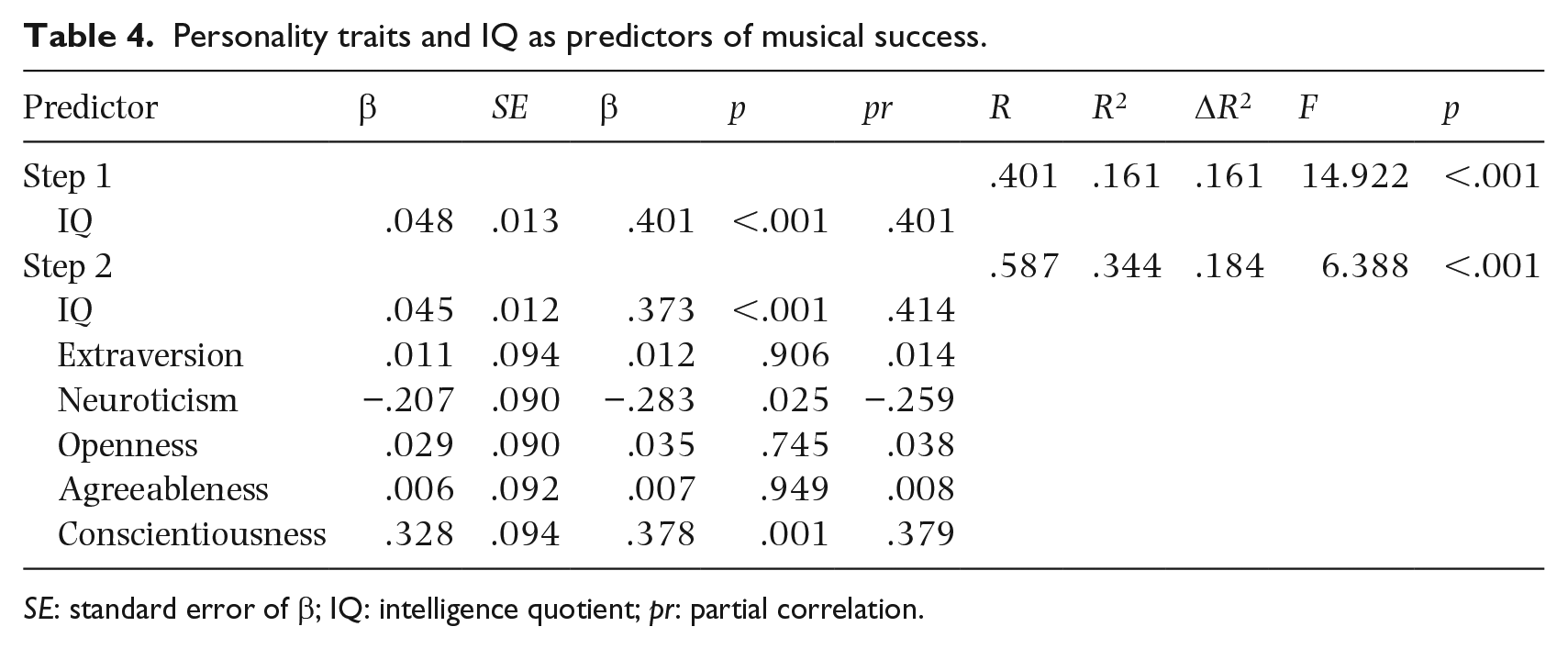
SE: standard error of β; IQ: intelligence quotient; pr: partial correlation.
Another hierarchical multiple regression analysis was performed. However, instead of IQ, perceptual, verbal, and spatial abilities were included as predictive variables in the model, along with personality traits. Age was also added to the model as an adjustment variable (Table 5). First, perceptual, verbal, and spatial abilities were entered together with age. The regression model predicted 18% of the explained variance in musical success. Partial correlations showed that perceptual and verbal abilities were significant predictors of musical success. Second, personality traits were added to the model when perceptual, verbal, and spatial abilities and age were kept constant. The addition of personality traits improved the explanatory power by 17%, with the new model accounting for 35% of the explained variance in musical success. Partial correlations showed that conscientiousness made the largest positive contribution to the model, together with perceptual abilities. Neuroticism contributed negatively to the prediction of musical success. In contrast to the previous analysis, verbal abilities did not contribute significantly to musical success. However, the association was near significant when age and personality traits were kept constant. The results indicated that success in music relies on high conscientiousness, low emotional instability, and pronounced perceptual abilities.
Personality traits and intellectual abilities as predictors of musical success.
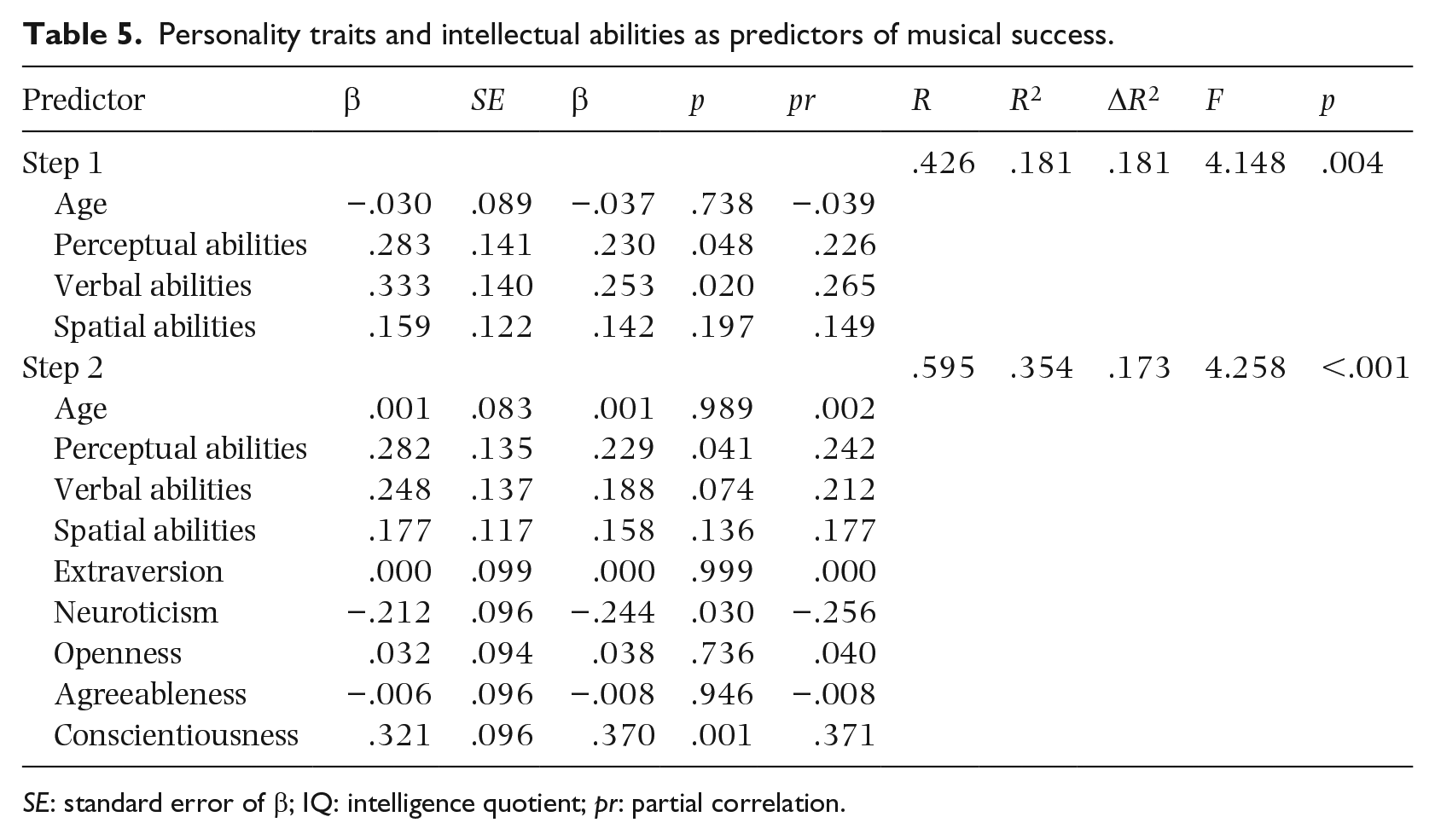
SE: standard error of β; IQ: intelligence quotient; pr: partial correlation.
Discussion
The aim of this study was to investigate whether personality traits and intellectual abilities could predict success in ballet/musical performance. Our findings showed that success in both ballet and musical performance depends on high general intelligence and high conscientiousness. In addition, low neuroticism and highly developed perceptual skills contributed significantly to musical success, while highly developed spatial skills were of great importance for a ballet performance. Our study provides some new insight into the role of personality and intelligence in musical/ballet performance and offers some support to previous findings in this field of research.
Consistent with previous research, high conscientiousness is of great importance to achieve high levels of musical (McCormick & McPherson, 2003; Radoš et al., 2003) and ballet performance (Araújo et al., 2009). According to the Five-factor model (Costa & McCrae, 2011), conscientiousness implies the ability to achieve a predetermined goal, whereby discipline and self-control are very important. It is reflected in the processes of planning, organizing, and fulfilling tasks and obligations. Conscientious people are highly goal-oriented, disciplined, hardworking, and reliable. People who score low on this dimension are less driven by success, more hedonistic-oriented, and have lower expectations of themselves and others. Mastering the domain of ballet or music is inextricably related to daily practice and perseverance. To maintain in such a solitary, monotonous, and demanding activity, a strong mental focus and willingness to work hard are essential, which is very consistent with high conscientiousness.
As expected, we found that low neuroticism is an important predictor of musical success, which is consistent with previous research (Radoš et al., 2003). According to the Five-factor model (Costa & McCrae, 2011), people scoring high on neuroticism are more likely to experience negative emotions, such as mourning, fear, anger, guilt, depressed mood, and loneliness than people who do not have these emotions. They are also more sensitive to reactions from others and have fewer skills and qualities to deal with stressful situations. Conversely, people scoring low on neuroticism are more emotionally stable, calm, even-tempered, and less reactive to stress. Musicians who score low on neuroticism are more likely to experience less performance pressure and stage fright during an important concert or audition, which can lead to better performance. Musicians, who score high on neuroticism, are probably more susceptible to fear of failure, which in turn can deteriorate their performance. Moreover, our hypothesis that agreeableness is an important predictor of musical performance is not supported. It is important to emphasize that our assumption was based on previous research (Pekić, 2008), showing that compliance, a facet of agreeableness of the revised NEO Personality Inventory (NEO PI-R), predicted musical performance. Therefore, the non-significant result in our study cannot be explained because only the five dimensions of personality were investigated and the individual facets were not taken into account. Contrary to our expectations, openness did not contribute significantly to success in both ballet and music. Although openness was shown to be a significant factor of musical success in many studies, Pekić (2008) found that only facets of openness of the NEO PI-R aesthetic and ideas predicted musical performance. Because we only investigated the five broad dimensions of personality instead of facets, we were not able to capture more nuanced characteristics of openness that could probably contribute to musical success. Similarly, it has been shown that openness predicts efficacy in various artistic domains. However, our study showed that it is not very important in ballet performance. Moreover, examining individual differences in personality between young ballet students, Bakker (1988) found that dancers were more introverted, achievement-oriented, and emotional compared to controls. He believed that these qualities are conducive to the world of classical ballet, as introversion could facilitate perseverance in such a solitary, monotonous, tiring activity. Motivation of performance is important to succeed in competitions, and high emotionality is needed to give emotional expression to music and choreography. Our study provides empirical support to Bakker’s findings that motivation of performance is important to succeed in the ballet profession. Other traits that distinguish dancers from non-dancers, that is, introversion and emotionality, are probably a reflection of a process of self-selection and attraction (Bakker, 1988) rather than constitutes of ballet success.
The current study also showed that general intelligence was an important factor in musical/ballet success. This result provides new insight into the role of intelligence in ballet performance and is consistent with findings from the number of studies showing that musical success is highly dependent on high intellectual capacity (Lynn & Gault, 1986; Pekić, 2008; Schellenberg, 2011). Given the result of this and some previous studies linking intelligence and success in different academic domains (Edwards & Tyler, 1965; Jensen, 1980; Neisser et al., 1996), it could be said that high general intelligence is, in fact, universal component of success, regardless of the domain in which it manifests.
Furthermore, the findings did not support our hypothesis that spatial abilities contribute significantly to musical success. Instead, spatial abilities were highly relevant to ballet performance, whereas perceptual abilities predicted musical success. In the context of musical performance, perceptual abilities can be related to the rapid and precise identification of the movement of the baton (or hands) of the conductor, which is highly relevant to certain musical performances to be consistent with the tempo required by a conductor. The role of spatial abilities in the ballet performance is very understandable, taking into account that every dance is primarily the rhythmic and physical movement in space (Savić, Mitro, Krčmar, & Čanak, 2006), and that every such “movement” requires spatial knowledge and the proper use of that space.
The present study could have important practical implications. Due to the significant association between musical success and emotional stability, it could be beneficial for schools to implement stress reduction prevention programs. These can improve the well-being of musicians and lead to a higher quality of performances. Moreover, during the entrance exam to be admitted to the ballet/music school, we also found that schools should include personality and intelligence assessment in their judgment to make the selection of students as good as possible.
The current study has strengths and weaknesses. The weakness of this study is that success in ballet/music was only based on specific school subjects. However, success in these specific artistic domains is not only limited to the context of school performance. Future studies should therefore also focus on broader operationalization of success, such as participation and awards in competitions, and the assessment of teachers of the quality of ballet/musical performance. Although grades from relevant school subjects were the only indicators of success in these artistic domains, they are still very relevant. Specifically, grades achieved during “classical and contemporary ballet” exams represent a person’s ability to perform various steps and movements, which are important in complex choreographies (e.g., Swan Lake). We considered grades from both classical and contemporary ballet, because nowadays, almost in all national theaters worldwide, dancers must be able to perform both styles equally well. Grades obtained during “playing an instrument” and “solfeggio” exams are very relevant for musical performance, because they represent the quality of a certain piece of music in a qualitative way. The major strength of this study is that intelligence was measured by a series of tests that separately measure different aspects of intellectual functioning, not just the general IQ. Another strength is that it is the first empirical study to investigate the role of personality traits and intelligence in ballet excellence.
In conclusion, this study offers new evidence for success in ballet and musical performance. Although the innate talent in ballet/music cannot be ignored to achieve high levels of performance, our research shows that intelligence and personality dispositions are also important factors for realizing full opportunities in the ballet or music career. This expansion of the understanding of the psychological correlates of success in musical and ballet performance illuminates further mechanisms, allowing intellectual abilities and personality traits to maximize performance in these highly competitive domains.
Supplemental Material
Supplemental_material_10.1177_0305735620911983 – Supplemental material for Predicting success in the performing arts: Ballet and music
Supplemental material, Supplemental_material_10.1177_0305735620911983 for Predicting success in the performing arts: Ballet and music by Marija Jankovic and Stefan Bogaerts in Psychology of Music
Footnotes
Declaration of conflicting interests
The author(s) declared no potential conflicts of interest with respect to the research, authorship, and/or publication of this article.
Funding
The author(s) received no financial support for the research, authorship, and/or publication of this article.

Supplemental material
Supplemental material for this article is available online.
References
Supplementary Material
Please find the following supplemental material available below.
For Open Access articles published under a Creative Commons License, all supplemental material carries the same license as the article it is associated with.
For non-Open Access articles published, all supplemental material carries a non-exclusive license, and permission requests for re-use of supplemental material or any part of supplemental material shall be sent directly to the copyright owner as specified in the copyright notice associated with the article.
