




Abstract
This study investigated the improvement in parents’ moods when attending group music lessons targeting their children aged 1–3 years. A questionnaire survey of parents’ moods was conducted under three conditions: immediately before and after the lesson, and on a non-lesson day. Results suggested that group music lessons for children enhanced parents’ positive mood and reduced anxiety. Thus, even peripheral participation in children’s group music lessons can be beneficial for parents. In addition, such mood improvements were more significant in the parents whose everyday state anxiety was high than in parents whose state anxiety was low. Since only few parents answered that their motivation in taking the lesson was to benefit themselves, the results of the study suggest side effects of children’s group music lessons for parents. These imply the potential benefits of musical activities for non-primary targeted participants who are not clearly aware of the positive musical effects for themselves.
Do parents who peripherally attend children’s music lessons with them obtain certain benefits? Most prior studies have highlighted the effects of children’s music lessons for children’s own benefit, such as the development of musical and non-musical (cognitive or social) abilities (Hallam, 2010; Schellenberg, 2009). Such benefits have been reported to be parents’ major incentive for enrolling children in music lessons (Dai & Schader, 2001). In our previous survey with similar types of group music lessons for children (aged 4–7 years) as in the present study, most parents also cited children’s education or their interest in music as the reasons for attending music lessons (Kawase & Ogawa, 2018). Meanwhile, in the pilot study, only 2% of parents (4 of 271 responses) chose the lessons for their own benefit. These 2% of responses suggested that parents’ incentives for joining lessons similar to the lesson in the present study were “to refresh myself” and “to reduce the burden of taking care of my child”.
Thus, even if parents do not chose music lessons for their own benefit, does relatively peripheral participation, namely, attending music lessons targeting children improve parents’ moods or stress? To address this issue, we investigated whether group music lessons for children aged 1–3 years influenced the mood of accompanying parents. To examine the parents’ moods change through children’s group music lessons, we conducted a survey at actual music classes on a non-lesson day and immediately before and after the lesson. We also checked the reasons for taking the lesson. We review relevant studies investigating the effects of musical activities and group musical activities below.
Benefits of parent–child musical activity
Benefits of parent–child musical activity have been reported (reviewed in Edwards & Abad, 2016). For example, a 10-week group therapeutic music intervention for parents and children in difficult situations improved not only children’ social behavior but also parenting. This intervention consisted of a session designed for the parents of children aged 0–3 years including greeting and farewell songs and action and movement songs (Nicholson, Berthelsen, Abad, Williams, & Bradley, 2008). In particular, promoting attachment between parent and child is one of the key benefits of parent–child musical activity. With regard to attachment, parent–child musical interaction and emotional communication reinforce attachment and bonding (Edwards, 2011). Creighton’s (2011) review suggested that infant-directed singing, such as play songs and lullabies, promotes attachment and emotional communication between mother and child. Given that attachment is associated with stress coping (Hallab & Covic, 2010), we hypothesized that this benefit can be connected to accompanying parents’ moods.
Attachment promotion generated by group musical activity can be linked with parent–child synchrony in light of the findings that infant–mother synchrony has been found to facilitate attachment (e.g. Isabella, Belsky, & von Eye, 1989). Synchrony has been reported to serve reinforcement of affiliative bonds (Feldman, 2012), and oxytocin production (Arueti et al., 2013; Feldman, Gordon, & Zagoory-Sharon, 2011) that is crucial to the mother–infant relationship (reviewed in Galbally, Lewis, IJzendoorn, & Permezel, 2011). In addition, coordination and empathy in shared musical activity can be related to the quality of the parent–child relationship (Wallace & Harwood, 2018). Given that parents will help their children and engage in activities with them, we predicted associations among parent–child synchrony, benefits of parent–child musical activity such as attachment or bonding, and mood enhancement of parents in group music lessons.
Social aspects of group musical activity
Given that social bonding can significantly reduce stress (Charuvastra & Cloitre, 2008), we assumed that social interactions among multiple children, parents, and a teacher during the group music lessons could affect parents’ moods. Indeed, group musical activity is deeply associated with social bonding, which can be derived from synchronous arousal, synchronization, and imitation in musical activity (reviewed in Trehub, Becker, & Morley, 2015). As a recent review of strong links between joint action and social aspects shows (Keller, Novembre, & Hove, 2014), joint action in group musical activity can also explain social bonding between members, because joint action such as synchronized tapping, movement, and dancing facilitates interpersonal likeability (Hove & Risen, 2009), rapport (Lakens & Stel, 2011), social closeness (Tarr, Launay, & Dunbar, 2016), and trust (Launay, Dean, & Bailes, 2013). Nonetheless, to obtain these social benefits generated by group musical activity, these study paradigms required continuous and strict synchronization or mimic actions of other persons in experimental settings. We thereby focused on this question: Can relatively peripheral participation in everyday musical activity yield positive impact?
Musical activity and mood enhancement
Musical activity itself produces psychological well-being (Croom, 2015). There is a wealth of evidence that musical activity enhances mood (Sloboda, Lamont, & Greasley, 2009). For instance, listening to music regulates mood (Saarikallio, & Erkkilä, 2007), engenders emotional self-regulation (Saarikallio, 2011), and reduces stress (Khalfa, Bella, Roy, Peretz, & Lupien, 2003; Knight & Rickard, 2001). In addition, recent reviews have shown that musical activities improve mental or physical health, such as by reducing anxiety, pain, and disease (Nilsson, 2008; Stuckey & Nobel, 2010). These findings suggest that musical activities affect mood.
Such favorable psychological impacts of group music lessons may alleviate parents’ stress, since parents’ stress crucially affects both parents (Deater-Deckard, 2008; Mulsow, Caldera, Pursley, Reifman, & Huston, 2002) and children’s behaviors such as their emotional and behavioral problems (Huth-Bocks & Hughes, 2008). If the group music lessons alleviate such parents’ stress, mood enhancement of parents may yield preferable effects on their children’s behavior. Simultaneously, if children’s mood improved through the effects of lessons, parents could more easily take care of their children, and parents’ stress could be alleviated.
Aims and hypothesis
The present study aimed to examine whether group music lessons for children aged 1–3 years improve the mood of parents who attend the lessons with them, even though the lesson aimed to benefit the child. We hypothesized as follows: (1) peripheral participation in children’s group music lessons would improve accompanying parents’ moods. Given the aforementioned findings of the benefits of group musical activity, we hypothesized this for parents of 1–3-year-old children, who could be severely stressed (Mulsow et al., 2002); (2) Such mood improvement would be observed more clearly in parents whose everyday anxiety is higher than that of parents with a low everyday anxiety; (3) These would be side effects of peripheral participation in children’s music lessons, while participants were actively involved in musical activity in most previous studies.
Method
Participants
Parents of children who took group music lessons at the Yamaha Music School participated in this study. These parents usually accompanied their children in the lessons. We obtained 85 valid responses (82 female; median age = 36 years; range: from 26 to 45 years; 6 in their 20s, 55 in their 30s, and 16 in their 40s). We excluded the data of two male participants due to imbalance in gender and that of a 62-year-old female participant who was an outlier. To ensure that participants would have similar socioeconomic backgrounds, we conducted a survey of the schools located in the capital area (Tokyo and Kanagawa) in Japan. The lesson required a fee. This was expected to reduce differences in socioeconomic factors and parents’ perspectives about the music lesson owing to regional differences. The median age in months of the children was 28 (range: from 15 to 39 months). Of the children, 51 were female, 29 male, and the sex of 2 was not stated.
Group music lesson
In the group lessons for children aged both 1–2 and 2–3 years, parent–child pairs assembled in an open space, thrice per month, for 40 minutes per session. The maximum capacity of the lessons was eight parent–child pairs. Children engaged in singing, appreciating music, playing an instrument (such as percussion, a compact glockenspiel, and so on). Specifically, besides these activities, in the group lessons for children aged 2–3 years, children also engaged in musical expression via physical activity. A teacher predominantly instructed and talked to children. Parents watched and helped their child, although they were not forced to do the same things as the children and were not required to have musical skills. When a teacher and the children interacted with each other, parents supported their children or facilitated their child’s participation in the lesson. Children occasionally engaged in activities apart from parents. We asked nine groups with children aged 1–2 years and 12 groups with children aged 2–3 years to participate in our survey.
Psychometric instruments
We employed three scales: The Japanese version of the Positive and Negative Affect Schedule (PANAS; Sato & Yasuda, 2001) for measuring participants’ mood, the Japanese version of State-Trait Anxiety Inventory (STAI; Shimizu & Imae, 1981) for measuring participants’ state anxiety, and the Japanese version of the Parenting Stress Index Short Form (PSI-SF; Asano et al., 2015) for measuring participants’ parenting stress. We used only the state-anxiety scale of the STAI. The PSI-SF consists of items that assess three types of stress: stress derived from characteristics or personality of children, stress derived from parents’ own problems such as being unable to be free, and holistic stress consisting of integration of these two types of stress. In answers to open-ended questions, parents described their reasons for starting the group music lessons, and whether their beliefs about the music lessons changed, and if so, how.
Procedure
We asked parents whose children attended music lessons to participate in the survey and collected their responses with the support of the staff at the music school. The participants completed the three scales and the open-ended questionnaire on a non-lesson day, and immediately before and after a lesson they completed the PANAS and STAI. The questionnaires on a non-lesson day were employed to measure parents’ moods in daily life, while the questionnaires immediately before and after a lesson measured changes in parents’ moods owing to attending the lesson. A voucher, with a value equivalent to 2000 yen (approx. US $15–20 or GBP £13), was given to each participant. Informed consent was obtained via the following statement that was part of the questionnaires: These questionnaires are anonymous; personal information is not collected. Participation is not mandatory. If participants do not wish to answer the questionnaire, please return it without responses. Not participating does not provide any disadvantage to participants.
Results
Change in mood
To examine if there were differences in the parents’ moods between that on the non-lesson day and before and after the lessons, we conducted ANOVAs on the average ratings of the PANAS and STAI (Figure 1). Ratings of positive affect changed significantly, F(1.694, 135.554) = 8.772, p = .001, ηp2 = .099, with Greenhouse-Geisser correction (see Figure 1a). Multiple comparisons revealed a significant difference between ratings of non-lesson days and those after lessons (p = .001), and a marginally significant difference between ratings on non-lesson days and those before lessons (p = .060). There were no significant differences in negative affect among conditions (i.e., before lessons, after lessons, and on non-lesson days), although the ratings of negative affect decreased in the order non-lesson days, before lessons, and after lessons. The ANOVA on state anxiety was significant, F(1.625, 129.981) = 9.795, p < .001, ηp2 = .109, with Greenhouse-Geisser correction (see Figure 1b). Multiple comparisons revealed significant differences between all categories (p < .05). Thus, ratings of positive emotions after lessons were significantly higher than ratings on non-lesson days. The ratings of state anxiety after lessons were significantly lower than on non-lesson days and before lessons.
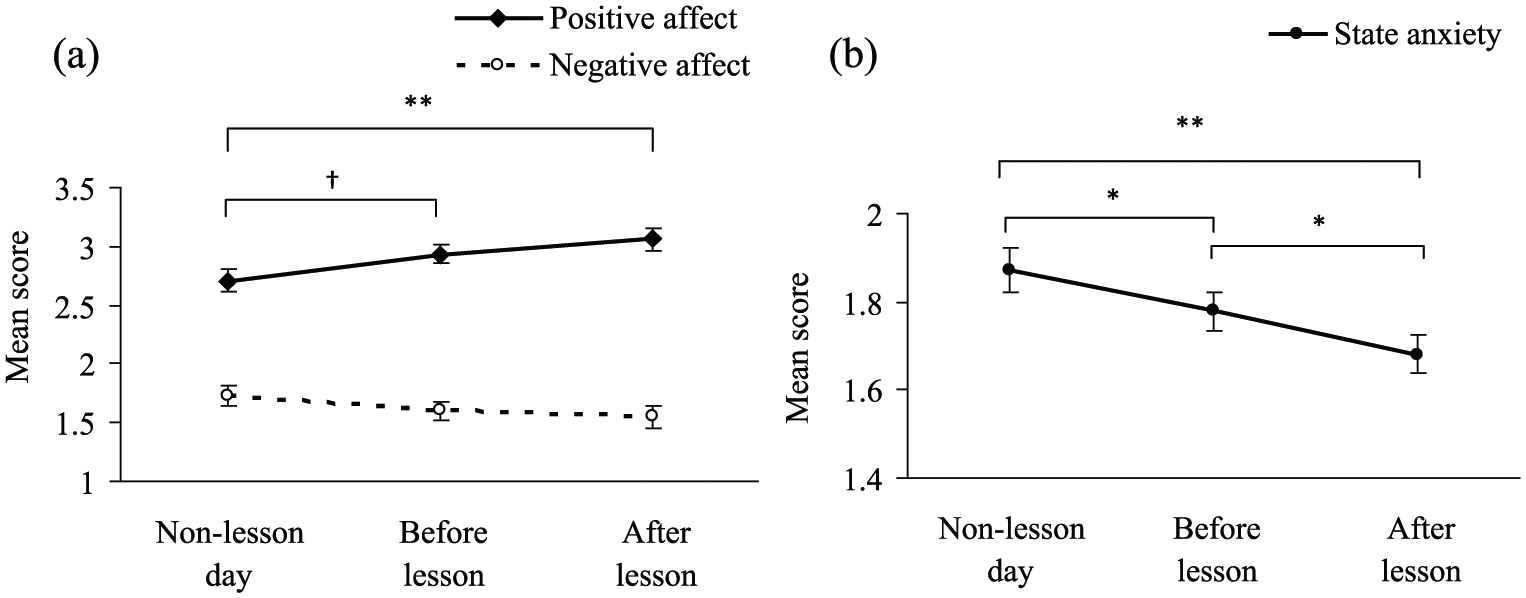
Mean participant mood scores. (a) Results of PANAS; (b) results of the state-anxiety scale of the STAI. Error bars represent standard errors. *p < .05. **p < .01. †p < .1.
Interaction of class age-range (age 1–2 years/2–3 years)
To examine the interaction of children’s age and parents’ moods change, we analyzed the effects of the type of class (i.e., aged 1–2 years and aged 2–3 years) via a two-way ANOVA with factors of class age-range (1–2 years and 2–3 years) × time of parents’ responses (non-lesson days, before lessons, and after lessons). There was no interaction for positive affect, F(1.692, 133.705) = 2.099, ns, ηp2 = .026, with Greenhouse-Geisser correction, whereas the main effect of time was significant, F(1.692, 133.705) = 9.413, p < .001, ηp2 = .106, with Greenhouse-Geisser correction. There was neither a significant interaction nor main effects for the analysis of negative affect. The analysis of state anxiety revealed no significant interaction, F(1.625, 128.358) = .008, ns, ηp2 < .001, but there was a significant main effect of time, F(1.625, 128.358) = 9.496, p < .001, ηp2 = .107. Thus, mood improvement of parents did not depend on their children’s age. Accordingly, the two types of classes (aged 1–2 years and aged 2–3 years) showed the similar tendencies to the mood of parents.
Differences according to anxiety on non-lesson days
Next, we examined the effect of everyday state anxiety on the changes in mood induced by accompanying the group lesson (Figure 2). We divided the state anxiety and PSI-SF ratings on non-lesson days into high and low groups based on the median value, and calculated the score changes from before to after the lessons. Negative affect, t(79) = 2.346, p = .021, d = .52, and state anxiety, t(79) = 3.215, p = .002, d = .71, significantly decreased in the parents whose state anxiety was high on non-lesson days versus the parents whose state anxiety was low. There was no significant difference between above and below PSI-SF groups. Consequently, participants who showed high state anxiety on non-lesson days significantly improved their mood.
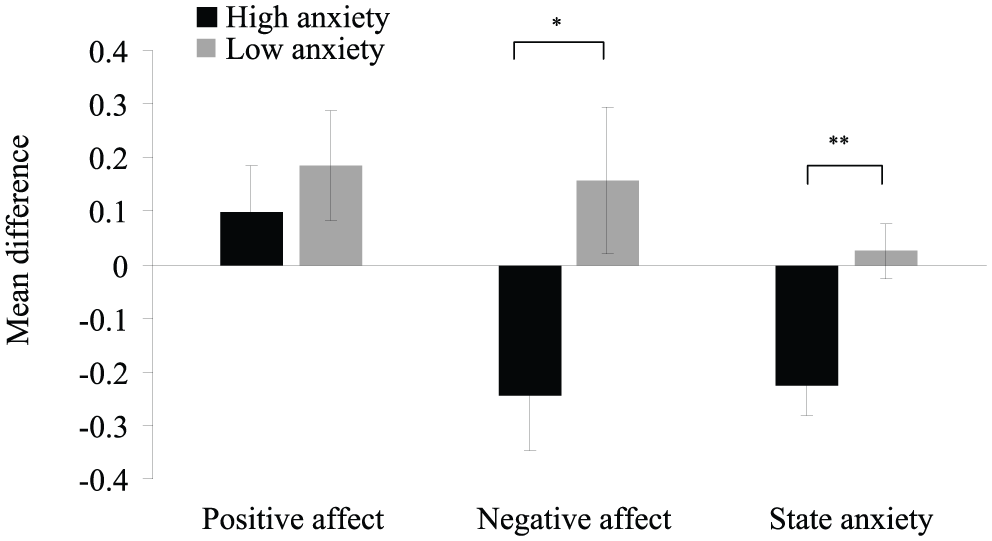
Changes of mood before/after the lessons based on the level of state anxiety in non-lesson days. Error bars represent standard errors. *p < .05. **p < .01.
Mood change and everyday PSI and state anxiety
We compared changes from before to after lessons, and investigated whether such changes were meaningful, via one-sample t-tests comparing measured changes against no change (i.e., a change of zero). To examine changes in general mood as assessed by PANAS and STAI, we divided participants into two groups: high PSI and state-anxiety scores versus low PSI and state-anxiety scores, and conducted one sample t-tests for each group. Table 1 (only outcomes with p < .1 are listed) shows that regardless of the level of PSI and state-anxiety scores, positive affect increased and anxiety decreased, as reflected in ratings of parenting stress due to raising a child, parenting stress due to being a parent per se, holistic parenting stress, and state anxiety. This tendency was particularly significant for parents whose parenting stress and anxiety were higher.
PSI and state anxiety on non-lesson day and the change of mood before or after the group music lessons.
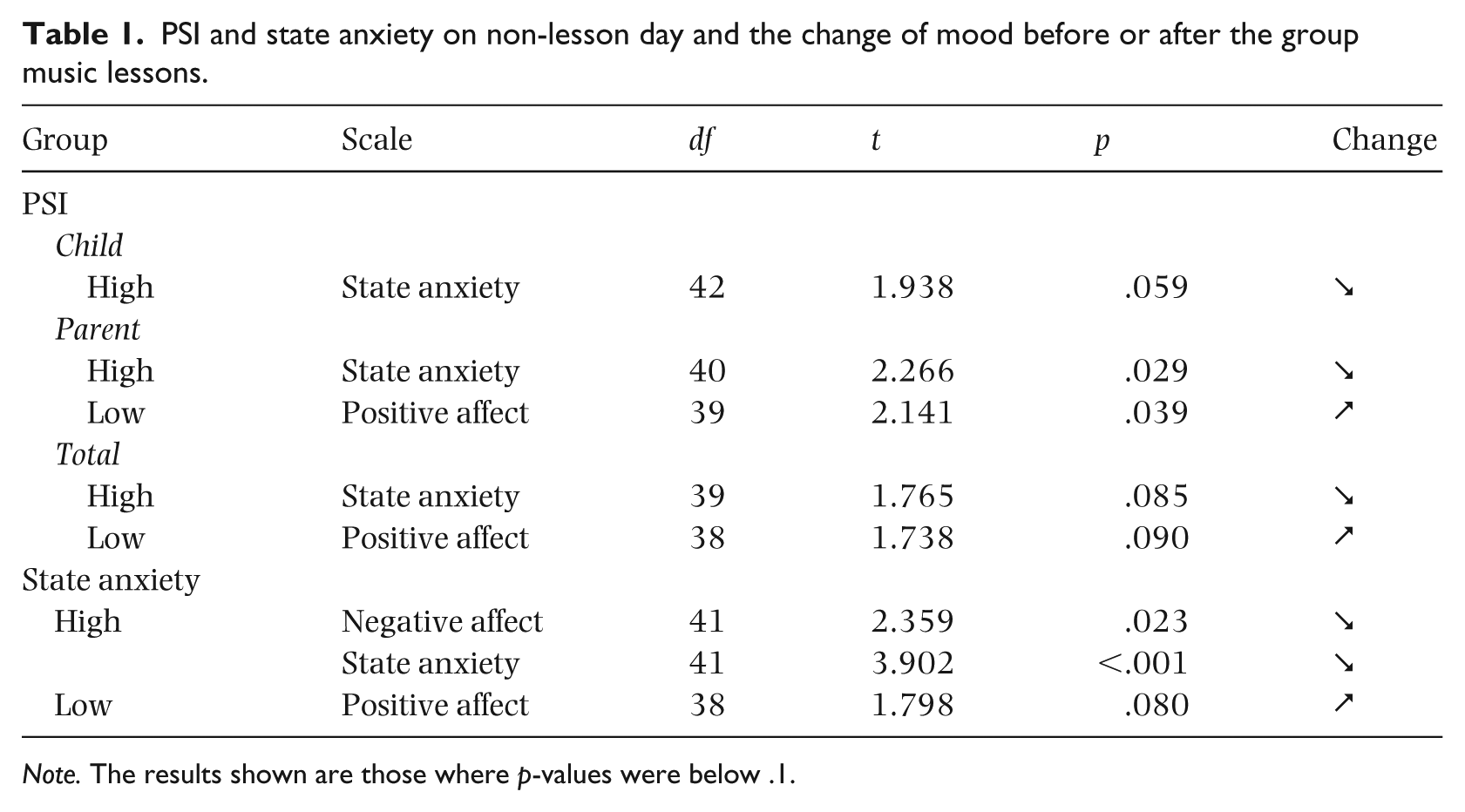
Note. The results shown are those where p-values were below .1.
The effect of age of parents
We calculated the correlations between the ages of parents, the age in months of children, the change in mood of parents from before to after lessons, and state anxiety. There was a marginally significant positive correlation between the parent age and changes in positive affect (r = .21, p = .068), but no significant correlation between the ages of children and the change in mood of parents (positive affect, negative affect, and state anxiety). In addition, there was no significant correlation between the durations of daily musical activities, such as singing and listening to music with children, and the changes in mood of parents from before to after lessons.
Motives for group music lessons expressed in the open-ended questions
We classified the motives for the group music lessons into three categories: for children, for parents themselves, and other reasons. Fifty-four responses (66%) were “for children,” but only two responses (2%) were “for parents themselves.” The number of “other” responses was 26 (32%). The main reasons for selecting “for children” were that children liked music and songs, and parents considered music as beneficial for children. “Other” responses included that music schools were near their house, or that siblings had already participated in similar lessons. The responses “for parents” indicated that parents wanted to spend time with their children. That is, for almost all parents, the motivations for the lessons were not to enhance the parents’ own mood. This confirms our pilot study, in which few parents chose the lessons primarily for themselves (Kawase & Ogawa, 2018). Overall, children’s group music lessons yielded side effects for parents.
With respect to whether the beliefs about the group music lessons changed after their children took the lessons, 25 parents (30%) responded “yes.” Of these responses, the changed beliefs about the group music lessons were derived from positive evaluations of the instruction methods, and factors that might potentially have enhanced the mood of parents. Seven responses (8%) indicated that “the lessons were more fun than expected.” Two responses (2%) indicated that “the degree of parents’ involvement in the lessons was higher than expected.” Other responses indicated that changed beliefs were due to the curriculum or the teachers. In sum, parents’ motives were mainly for their children, and only a few parents pointed out unanticipated pleasure of the lesson. These results imply that parents were not clearly aware of their mood improvement through the children’s musical lesson.
Discussion
In the present study, we examined changes in the mood of parents who accompanied their 1–3-year-old children to group music lessons at a music school by comparing mood assessments on non-lesson days, before lessons, and after lessons. The results showed that even peripheral participation in children’s group music lessons can be beneficial for parents. The main findings are: (1) the ratings of positive affect of the parents after the lessons were higher than those of the parents on non-lesson days; (2) the state anxiety of parents decreased after the lessons compared with that of parents before the lesson and non-lesson days; and (3) such mood improvement was more pronounced in those parents whose everyday state anxiety was high, rather than in parents whose state anxiety was low. Thus, the parent–child group music lesson served to enhance parents’ positive mood and reduced anxiety.
The crux of our findings is that accompanying their child to music lessons provided parents with a positive byproduct, even though they were not primarily targeted as participants. Furthermore, based on their reasons for taking the lesson and beliefs about the lesson, it can be assumed that parents were not clearly aware of the lesson’s positive effect for themselves despite their mood enhancement. Accordingly, the results suggest side effects of children’s group music lessons for parents, whereas prior studies have focused on parent–child musical interactions or group musical activity that required active engagement by all participants. Why did these beneficial effects for parents emerge? There are several possible explanations, namely effects of group musical activity (between parent–child, and interactions among lesson participants), and mood enhancement through music.
First, effects of parent–child musical activity could explain parents’ moods enhancement (Edwards & Abad, 2016). In accordance with the relationship between attachment and stress (Hallab, & Covic, 2010), attachment induced by parent–child synchrony (Isabella et al., 1989) in the group music lessons could have reduced parents’ stress. Previous studies have shown that parent–child musical activity contributes to their communication, attachment, and parent–infant bonding is reinforced by parent–infant musical interactions and emotional communication (Creighton, 2011; Edwards, 2011). This effect of parent–child musical activity is consistent with findings that synchrony in coordination or imitation of music performance facilitates attachment (Isabella et al., 1989), or affiliative bonding (Feldman, 2012). Similarly, parent–child synchrony could have emerged in the group music lessons of the present study, in which parents engaged in easy musical activity to support their children, although parents were not forced to participate in group music activities. This result can also be supported by the finding that therapeutic music for parents and children in difficult situations improved both children’s social behavior and parenting (Nicholson et al., 2008), and the finding that shared musical activity is correlated with the quality of the parent–child relationship (Wallace & Harwood, 2018). Taken together, parents’ stress could be moderated by parent–child attachment or preferable bonding derived from synchrony that occurred in the group music lessons.
Second, interactions with members of the lessons might have reduced parents’ stress. Compared with findings that employed continuous and strict synchronization or imitative actions, our results could shed light on relatively supportive actions with a child in daily musical activity that yield positive impact on parents. Based on the findings that social bonding significantly influences stress (Charuvastra & Cloitre, 2008), social bonding generated by group musical activity (Trehub et al., 2015) can be a solution for alleviating parents’ stress. This can be explained by joint action (Keller et al., 2014), which can be involved in group music lessons and facilitates interpersonal likeability (Hove & Risen, 2009), rapport (Lakens & Stel, 2011), social closeness (Tarr et al., 2016), and trust (Launay et al., 2013). These social benefits can boost feelings of connection with the other members, which might have led to alleviation of stress.
Third, the psychological well-being produced by musical activity (Croom, 2015) is consistent with our results. Alleviating parenting stress through music lessons may also be beneficial for parent–children relationships, since reciprocal relationships exist between parenting stress and child behaviors. Given that only listening to music, namely, relatively passive musical activity, served to regulate mood (Saarikallio, 2011; Saarikallio, & Erkkilä, 2007; Sloboda et al., 2009) and reduce stress (Khalfa et al., 2003; Knight & Rickard, 2001), it can be assumed that even peripheral participation in music lessons could have improved parents’ moods.
With regard to children, since children’s moods or temper affects the stress of parents (Deater-Deckard, 2008; McBride, Schoppe, & Rane, 2002), it can be inferred that as the children’s mood was enhanced by the music lessons, this affected the parents’ moods. The benefits of the group music lessons that parents received were also available for the children. If children’s mood improved due to the lessons, parents could more easily take care of their children, and parents’ stress could reduce.
In conclusion, parents’ moods was improved by accompanying their children to group music lessons. Peripheral participation for 40 minutes, thrice per month, is not a notable burden; therefore, such participation is a useful approach to enhancing parents’ moods. Over all, our results indicated the potential benefits of group music activities for non-primary target participants who were not clearly aware of such benefits for themselves.
Future studies are necessary to examine what types of factors, including children’s musical lessons, fundamentally influenced the accompanying parents. To address this question, experiments by controlling conditions such as effects of group musical activity, music itself, non-music-related interaction with members, children’s mood, or combinations of these elements should be conducted. In addition, the presence of mood enhancement before the lessons remains unexplained. Even before the lessons, positive affect increased and anxiety decreased. It is thus necessary to examine whether this pre-lesson effect may be attributed to expectation of mood improvement by participating in lessons, or the effects of leaving home to attend the lessons. Comparisons between the effects of music lessons and other activities are also useful for identifying the unique influence of music lessons, although there are not many activities that primarily target children with parents accompanying them. Furthermore, to explore the effects of music lessons on the entire family, comparisons between the effects on mothers and fathers would be beneficial, since most respondents in the present study were mothers, as it was a field study.
Footnotes
Acknowledgements
We would like to thank Makoto Tayama, Yoshitaka Kumasaka, Takayuki Yotsuji, the staff of SUGANAMI Musical Instruments and Yamaha Music School, and Kei Kawase. Furthermore, we are grateful for the valuable comments from the reviewers.
Funding
The author(s) disclosed receipt of the following financial support for the research, authorship, and publication of this article: this work was supported by Yamaha Music Foundation.