




Abstract
This article explores the complementarity between the criminalization of solidarity and the externalization of EUropean borders by mapping laws across states working with Frontex. While both strategies have been widely documented and are central to the EUropean border regime’s deployment of violence, they have often been studied in isolation. The article pursues two goals that aim to contribute to documenting the effects of EUropean policies while avoiding the pitfalls of EU-centrism and presentism. First, it maps the geographical spread of laws criminalizing solidarity. Second, it examines how the EUropean border regime operates by analyzing convergences and divergences between legal systems. This approach requires contextualizing and situating these strategies in the longue durée history of European colonial empires. The article’s main contribution is to show through laws criminalizing solidarity how the EUropean border regime operates as a vehicle for normalizing and circulating legal regimes to deter, intercept, and push back people on the move.
Introduction
The widespread and diverse forms of solidarity enacted along migrant routes play a vital role in mitigating and confronting border violence. In reaction, many states have adopted laws to limit, deter, and punish these acts. At the EU level, this has been conceptualized as the “criminalization of solidarity,” with studies examining its manifestations across EU member states. While the circulation and influence of EU laws within specific non-EU states have also been shown (Bachelet & Hagan, 2023; Dini & Giusa, 2020; Tchilouta & Plath, 2023), there has been no comprehensive mapping of the laws criminalizing solidarity across the whole “EUropean border regime.”
Such mapping is crucial to avoid the pitfalls of Eurocentrism and presentism, which treat the expansion of EU borders as ahistorical and unidirectional (Cappiali & Pacciardi, 2024; Cobarrubias et al., 2023; Cobarrubias & Lemberg-Pedersen, 2025). This entails two key recognitions. First, the violence of European borders is not accidental; it must be situated within the longue durée history and deliberate policy choices (Isakjee et al., 2020; Kundnani, 2023; Lindberg, 2024; Walia, 2021). The colonial and imperial histories that have shaped EUrope cannot be severed from the racial violence that underpins its contemporary borders (Brito, 2023; Rodríguez, 2018; Walia, 2021). Second, actors outside the EU are not merely passive recipients of its policies; they negotiate with and influence the EU (Adam et al., 2020; Jegen, 2023; Moctar, 2024). Taken together, these recognitions imply considering the multitude of actors, institutions, infrastructures, histories, and practices that underpin EU borders. Referring to this assemblage as the “EUropean border regime” allows for a multi-scalar analysis that captures its complex dynamics (Casas-Cortes, Cobarrubias, De Genova, et al., 2015; Moctar, 2023; Van Houtum & Lacy, 2020).
The EUropean border regime extends beyond EU member states through the process of externalization, enrolling “third countries” to remotely manage mobility (Casas-Cortes, Cobarrubias, and Pickles, 2015; Rodier, 2008; Zolberg, 2003). The main objective is to deter, intercept, detain, and pushback people before they reach the EU’s territory (Hyndman & Mountz, 2008; Isakjee et al., 2020; Lemberg-Pedersen, 2015). While this allows the EU to effectively circumvent international laws and escape accountability (Glouftsios, 2023; Hyndman & Mountz, 2008; Letourneux, 2022; Namara, 2013), this process does not happen outside the law; it is codified, at least partly, through regulations and agreements, which facilitate mapping. The most visible actor in this process is Frontex, which has been mandated since 2004 to “assist” both EU member states and “third countries” in the enforcement of EU borders (Bachiller López, 2022; Clément-Wilz, 2017; Fjørtoft, 2020). This role illustrates a growing discussion in the literature on the need to treat as interconnected the “internal” and “external” dimensions of EU borders (Cobarrubias et al., 2023; Heller & Pezzani, 2016; Menjívar, 2014).
The criminalization of solidarity constitutes another central strategy of the EUropean border regime, following a similar logic: deterring people from crossing borders and facilitating arrests and deportations (Heller & Pezzani, 2017; Juan Pablo, 2021; PICUM, 2023). In practice, it restricts people’s access to emergency rescue, food, shelter, care, legal aid, and political autonomy (Bontempelli, 2017; Dadusc & Mudu, 2022; Picozza, 2021). As with externalization, this strategy is codified, most notably through the 2002 EU’s “Facilitators Package” (Carrera et al., 2015; Fekete et al., 2017; Jones, 2017). Consequently, much of the knowledge production concerned with decriminalizing solidarity has focused on how this legal framework is implemented across EU member states (Carta & Gianco, 2024; PICUM, 2023; ReSOMA, 2019). This has supported advocacy to reform EU policies and generated critical debates over how solidarity is defined, given the tendency to foreground European, white, citizen, and humanitarian benevolent actors, while marginalizing political, autonomous, reciprocal, and “non-European” solidarities that are most subject to criminalization (Dadusc & Mudu, 2022; PICUM, 2022; Tazzioli & Walters, 2019).
This article contributes to these debates by offering empirical insights on the production of interconnected spaces and laws criminalizing solidarities and governing (im)mobility within and beyond the EU. The two tensions evoked, the difficulty to differentiate the internal and external dimensions of the EUropean border regime, as well as the narrowing of what counts as solidarity, can be further explored by mapping the states involved and the laws they enforce to criminalize solidarity. The discussion starts with a literature review providing context to the historical and spatial trajectories of EU policies. Foregrounding their fragmentation and circulation helps understand the grain against which efforts to document their effects are working, in addition to the denial of EU institutions. The second section explains the choices for the framing of the snapshot, focusing on the laws of EU member-states, Schengen signatories, and states that have signed an agreement with Frontex and states where Frontex is running “international projects.” The last section discusses the dynamics that are visible at this scale, including the weight of the longue durée history on the limits of the EUropean border regime’s expansion. Rather than an institutional weakness or failure, the relative diversity of legal frameworks masks and reinforces its overall coherence and resilience.
Mappings of the EUropean Border Regime
This section reviews the literature on laws criminalizing solidarity and the externalization of EU borders, tracing how these concepts circulated both prior to and following their institutionalization around 1999–2002 (Carrera et al., 2015). Since then, efforts to make visible the violence sustained by these policies have become increasingly comprehensive yet have mostly ignored the intersection between the two.
The genealogy of the EU’s Facilitators Package can be traced back to the French colonial empire, the 1687 Code Noir and the 1802 Arrêté Richepance (Coulaud, 2025; GISTI, 2009). These texts created the legal foundations of slavery, profoundly shaping racial relations (Allen, 2012; Moulier-Boutang, 1998) and included sanctions to prevent “free men” from helping “freedom seekers” (Castaldo and Taubira 2007, 58, 75). However, the direct source of the Facilitators Package lies in the 1938 law adopted by France the context of the rise of fascist Italy and Nazi Germany. Known as the “Law Against Illegal Foreigners,” it criminalized anyone who “facilitated the irregular entry, transit, or stay of a foreigner” (Ben Khalifa, 2012; Caron, 2008; Ferran, 2010; GISTI, 2017). This law remained in force until 2012, and its penalties were increased in 1976, 1991, and 1993, reflecting a broader trend toward the hardening of criminal laws across western states (Codaccioni, 2024; Gilmore, 2007; Wacquant, 2009). During the 1990s, the 1938 law crystallized the conflict between anti-racist, solidarity, civil society organizations and the French government. The repeated targeting of churches, trade unions, activists, and academics supporting the “undocumented movement” contributed to the popularization of the term délit de solidarité (Balibar, 2000; Carrère & Baudet, 2004; GISTI, 2009). While organizations called on the government to exempt “assistance provided without intent of profit,” in line with Article 27 of the Schengen Agreement, the Minister of the Interior advocated for reforming Schengen to combat networks of “Islamists, terrorists, and spies” (Ferran, 2010, 37 translation my own). 1
In 2000, France officially proposed a reform of the EU legal framework. The government motivated its proposal by claiming that the EU lacked a clear, harmonized framework. This was not entirely true since the 1990 Schengen Convention and the 2000 UN Protocol Against the Smuggling of Migrants were already effective (Spena, 2023). These legal frameworks required the presence of a financial gain or other material benefits to constitute a crime (Article 6-1 of the UN Protocol and Article 27-1 of the Schengen Convention). The UN framework explicitly designed this condition to avoid the “criminal liability of migrants” (Article 5) and to exclude “humanitarian and family assistance” (Mitsilegas, 2019, 70). In turn, the Facilitators Package required Member States (and Schengen signatories) to adopt sanctions on “any person who intentionally assists a person who is not a national of a Member State to enter, or transit across, the territory of a Member State” (Council Directive, 2002/90/EC article 1-1-a). Rather than filling a gap, it expanded the scope of who can be criminalized (Mitsilegas, 2019). It did not create a fully harmonized regime, as the EU granted states significant discretion, including the possibility of adopting exemptions for “humanitarian behaviors” and “aggravating factors.” Consequently, the transposition of the Facilitators Package into national laws has varied widely across the EU and Schengen signatories. This has complicated efforts to measure its effects within the EU, and the externalization of EU borders further exacerbates this problem.
The concepts of “integration” and “externalization” have circulated in EU policy discourse since the 1990s, but they became fully operational with the 2007 Treaty on the Functioning of the European Union (Casas et al., 2011; Hyndman & Mountz, 2008; Rodier, 2008). The treaty mandated the European Border and Coast Guard Agency (now Frontex) with implementing Integrated Border Management and harmonizing border controls across member states and non-EU “partner” countries (2007 Treaty, Article 77, 1-c; EU Regulation 2016/1624, Articles 5 & 6). Through this framework, the internal and external dimensions of EU borders are institutionally intertwined, as Frontex simultaneously monitors and supports member states, contracts private actors, and negotiates operational arrangements with non-EU states (Xanthopoulou, 2024).
Taken from the managerial vocabulary, these concepts help the “story of consolidated nation-state borders which then ‘respond’ to migration by externalizing control attempts” (Cobarrubias & Lemberg-Pedersen, 2025, 5). As pointed out by decolonial scholars, the colonial aphasia (Rodríguez, 2018; Stoler, 2002) obfuscates the continuity of imperial nation-states’ logic, where racial (b)ordering and border controls are disseminated everywhere within the empire (Davis, 2015; Prakash, 2022; Torpey, 2018). Many have described the development of integration and externalization as the redeployment of European imperialism and (neo)-colonial relations rather than a “new” strategy (Casas et al., 2011; Charles & Chappart, 2017; Dimitrovova, 2012; Pradella & Rad, 2017; Walia, 2021). Throughout the 19th and early 20th centuries, settler colonies like Canada and the United States established remote control explicitly to design “white nations” (Abu-Laban, 1998; Dunbar-Ortiz, 2021; Zolberg, 2003). Meanwhile, European states developed mechanisms of cooperation to combat the threat of “foreign Jews and Anarchists” (Jensen, 1981) and agreed to share the costs of policing colonies (Bell & Schreiner, 2018; Blanchard, 2014; Igbinovia, 1981). The EU’s “founding fathers” imagined the unification of Europe as a way to consolidate colonial empires, referring to this project as “EurAfrica” (Hansen & Jonsson, 2014, 2018).
Research on the contemporary politics of externalization has focused on how the EU extends its control over mobility, but not only. As EU officials anticipated and feared the “risks of migration” during the EU’s enlargement process to Eastern European countries in the 1990s (Moreno-Lax, 2017), they required the “improvement” of candidate states’ borders as a condition for access to the Schengen area (Appel & Orenstein, 2018; Collantes-Celador & Juncos, 2012; Dimitrovova, 2012; Kundnani, 2023). On the one hand, the EU provides significant financial support for the construction of walls, fences, and surveillance technologies, even after full accession (Akkerman, 2016; Akkerman et al., 2018). On the other hand, development programs and foreign aid are conditioned to implementing the EU’s security and economic reforms (Casas-Cortes et al., 2016; Prestianni, 2017). Within this framework, Frontex has played a central role, negotiating agreements that include training programs and joint operations aimed at strengthening border controls, particularly in states deemed insufficiently aligned with EU standards (Fjørtoft, 2020; Frenzen, 2017; Moraczewska, 2020; Rodier, 2008). These mechanisms are opaque and diverse, making it difficult to map out the entire border regime.
Through the criminalization of solidarity and externalization, the EU border regime governs not only mobility but also the visibility of its violence (Fekete et al., 2019; Mountz, 2020; Perera, 2007). As soon as the Facilitators Package was adopted, NGOs, including La Cimade, the Groupe d’information et de soutien aux travailleur•euses immigré•es (GISTI), Migreurop, and the Platform for International Cooperation on Undocumented Migrants (PICUM), began documenting its impact. Building on their efforts and media reports, Liz Fekete linked solidarity criminalization to the diffusion of racist political discourses and imaginaries (2009). This work has been met with what Thom Davies, Arshad Isakjee, and Jelena Obradovic-Wochnik conceptualized as the “epistemic borderwork,” through which testimonies and evidence of border violence are systematically dismissed, invisibilized, or presented as untrustworthy by authorities (2023).
In 2014, the EU Fundamental Rights Agency conducted an extensive analysis of what they termed the “criminalization of assistance,” reviewing laws in EU member states and Schengen signatories. Echoing the work of activists and scholars, the report concluded that the Facilitation Package “raises a number of fundamental rights challenges” (European Union Agency for Fundamental Rights, 2014, 15). That same year, the Director of Frontex terminated the Mare Nostrum search-and-rescue operation, asserting, without evidence, that it functioned as a “pull factor” encouraging migration to EUrope. As NGOs redoubled efforts to compensate for this withdrawal, Frontex’s Director accused them of complicity with “smuggler networks” (Bontempelli, 2017; Heller & Pezzani, 2017; Robinson, 2016). Despite the absence of evidence (Campbell, 2017), the accusation has been widely echoed by European political leaders, including Hungarian Prime Minister Orbán (Nelson, 2018), French President Macron (France 24, 2018), and the Italian Interior Minister Salvini (InfoMigrants, 2019).
In 2017, the EU Commission conducted its only evaluation of the Facilitators Package (European Commission, 2017). The review dismissed the testimonies of its own respondents, asserting that there was insufficient evidence that NGOs had been criminalized. It reframed the issue as one of the misinformed “perceptions” of the EU’s legal framework, while simultaneously recommending enhanced cooperation among border authorities, including with the so-called “third countries” (Fekete, 2018; Jones, 2017). Considering that additional data was needed, the Commission’s Action Plan Against Migrant Smuggling (2021–2025) required member states to report arrests, convictions, and investigations linked to “humanitarian” assistance (Spena, 2023). This approach has been criticized for relying on member states investigating their own misconduct while simultaneously encouraging Frontex to coordinate with “third countries,” where no reporting is required (Amnesty International, 2020; Gionco & Kanics, 2022; PICUM, 2022).
In response to the EU’s repeated denial stance, activists and academics have redoubled efforts to document the criminalization of solidarity, providing extensive data on the phenomenon across EU member states (PICUM, 2023; 2022; Carta & Gianco, 2024; Amnesty International, 2020; ReSOMA, 2019), focusing on specific states, such as prosecutions in Italy (ARCI Porco Rosso, 2021) or enforcement in the borderlands, such as Calais (Human Rights Observers, 2021; Taylor, 2024). These efforts have extended beyond the EU, thanks to the work of the Border Violence Monitoring Network in the Balkans (2020; 2022), research on Libya (Sanchez, 2020), Morocco (Bachelet & Hagan, 2023), Niger (Tchilouta & Plath, 2023), and Tunisia (Dini & Giusa, 2020), as well as a report on the members of the Council of Europe (Ferstman, 2019). The externalization of EU borders has also generated increasing reporting efforts. For example, Migreurop’s 2003 “Encampment map” located detention sites across Europe and beyond, and its successive editions showed the expansion of the EU border regime through the multiplication of camps (Etienne et al. (n.d.).).
Documentation efforts have opened the door to critical reflections, including on what counts as solidarity. Such debates stress the need to engage with decolonial theories and move beyond white-centered and state-centric perspectives (Bird & Schmid, 2021; Khosravi, 2022; Tazzioli & Walters, 2019). This calls for a rethinking of the binary oppositions between “criminal” smugglers, “innocent” activists, and the portrayal of “helpless” migrants, discursive categories that reinforce rather than challenge the border regime (Khosravi, 2022; Lindberg, 2024; Tazzioli & Walters, 2019). Rather, there is a need to recognize that solidarity is primarily enacted by people on the move (Barone, 2018; Mezzadra, 2004; Papadopoulos & Martignoni, 2014; Tsianos & Serhat, 2010) and that they are disproportionately hit by counter-smuggling policies (PICUM, 2022). Relatedly, criminalizing only those making a profit still “hinders the provision of normal services to undocumented people, such as transport and housing” (PICUM, 2022, 7). Within the EU, states that only criminalize “profit only” still threaten, harass, surveil, and deter those acting without profit (Du Jardin, 2022; European Union Agency for Fundamental Rights, 2014; Human Rights Observers, 2021). Even acquittals come at a cost since the legal process is often lengthy, draining, and expensive, diverting resources, people, and energy away from where they would be better used (Carrera et al., 2018; Lendaro, 2021; Haralambous, n.d.).
To sum up, as illustrated by the genealogy of the Facilitators Package from the French colonial empire to the EU, the interconnection of legal regimes has enabled the maintenance and expansion of a contested b/order technology. In 2012, France became the eighth EU member state to introduce a “humanitarian exemption” and the first to establish a “familial” exemption, which warrants three observations. First, at the national level, the reform was framed by the government as a victory for activists. Yet it has neither put an end to restrictive judicial interpretations nor halted prosecutions, and it was undermined by an expanded list of aggravating factors and increased sanctions (Philippe, 2020). Second, the 1938 law survived by becoming a model for the EU, increasing the difficulty for solidarity actors who are both targeted by and fragmented by the national transposition and implementation of the Package. Finally, as the EU seeks to export its model, it is vital to connect the “internal” and “external” dimensions. Considering knowledge production as a crucial tool for mobilization against the violence of borders (Davies et al., 2023; Ellison & Van Isacker, 2021; Mountz, 2020), the objective of this paper is to contribute to these efforts by mapping the criminalization of solidarity across the EUropean border regime.
Methods
As discussed above, the main challenge for mapping this border regime lies in the multiplicity of ways that non-EU states are involved in the EUropean border regime. Frontex’s cooperation with “third countries” is multiform; some relations are formalized through agreements, others rely on ad hoc projects, secret, or tacit agreements, or they are enacted by an EU member state instead of Frontex, and some bilateral and regional arrangements concern borders only indirectly (Longo & Fontana, 2022; Mountz, 2020; Prestianni, 2017). Having in mind the obvious limitations created by this choice, I relied on Frontex’s own words, using its Beyond EU Borders 2 list, as published in June 2023.
In this list, states are grouped in two categories: first are 26 signatories of a Working Arrangement on Integrated Border Management (IBM) with Frontex, and second are the 32 states involved in the so-called “international projects.” The seven states, both signatories of an IBM and involved in “international projects,” were categorized as IBM. This choice derives from an assumption about legal normativity and relations between states. Signing a working agreement with Frontex reduces “informality” (Longo & Fontana, 2022) and creates binding legal obligations; it signals a mutual commitment to cooperate in efforts to “counter migration” through training, joint operations, information exchange, and policy harmonization. In contrast, states listed only under “international projects” participate in similar activities but without the same formally recognized reciprocal status, which implies a more “informal cooperation.” In these cases, Frontex’s influence through technical support and funding is presented as one-directional.
Across these 89 states, I compiled the laws criminalizing solidarity, facilitating or abetting entry/exit, smuggling, and providing assistance to undocumented/irregular/illegal migration. I excluded the laws criminalizing trafficking as they required coercion or a violation of consent, which may be used against people on the move themselves, but it is beyond the scope of this paper. This data collection was undertaken as part of the Borders in Globalization (BIG) lab and facilitated by prior comparative analyses of legal regimes, namely, the 2014 report by the European Union Agency for Fundamental Rights and its annex 3 and the 2019 Global Legal Research Directorate’s report. 4 These resources helped identify the most relevant legal sources, whether the law would be found in penal codes, acts regulating “foreigners,” or standalone texts. Note that data for five states in the “international project” category (Afghanistan, Iran, Jordan, Liberia, and Syria) were unavailable.
Drawing from the approach of the EU Fundamental Rights Agency (2014), I split each law into four categories: facilitation of stay, facilitation of entry/exit, exemptions, and aggravating factors. To compensate for the diversity of phrasing, I simplified how each law addresses these themes by creating sub-categories.
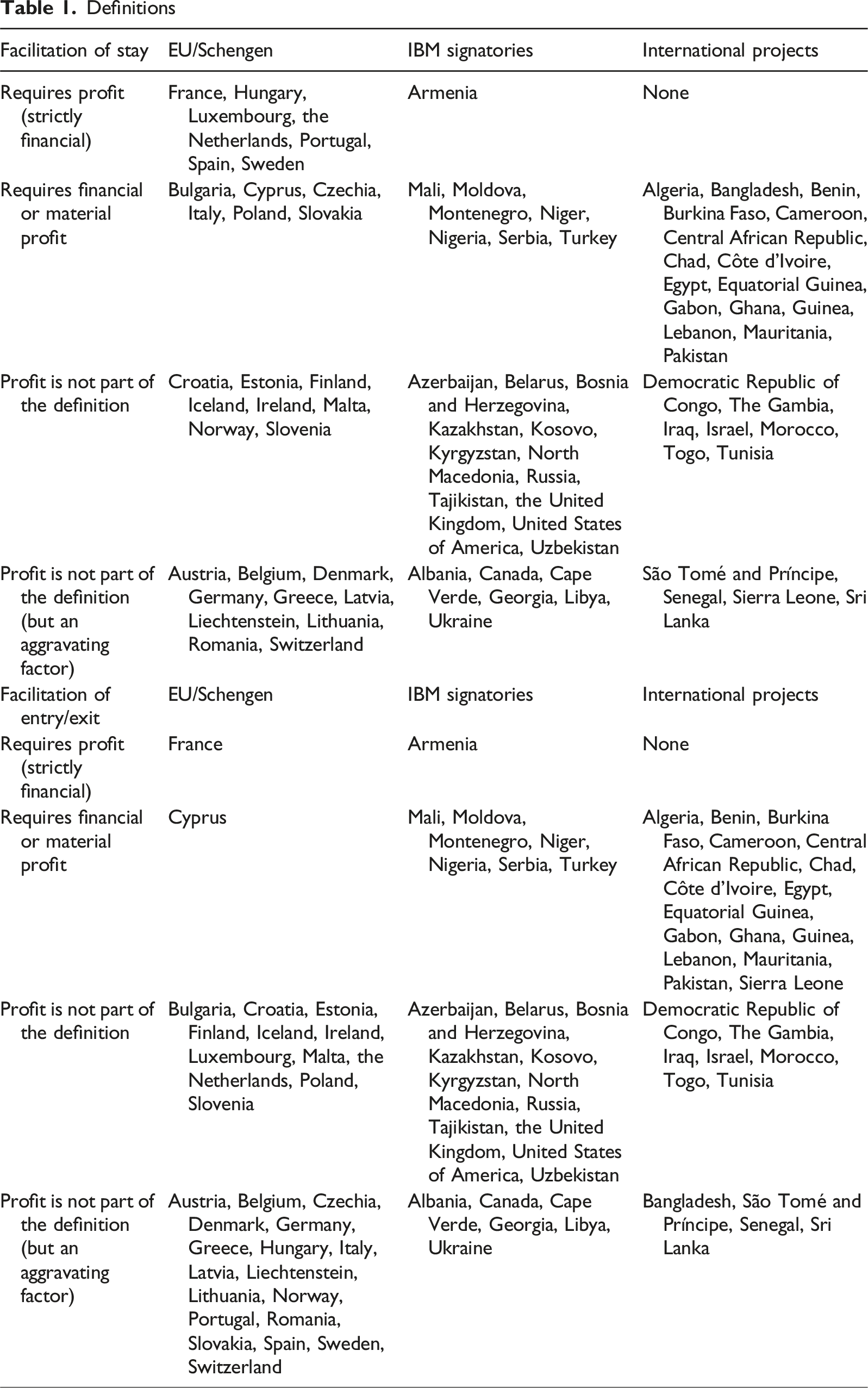
Definitions of what is a crime were categorized into four types depending on the notion of profit: (1) requires specifically financial profit, (2) requires profit or other material benefit (which corresponds to the phrasing of the UN Protocol), (3a) makes no mention of profit, and (3b) mentions profit as an aggravating factor.
Exemptions were grouped into 10 categories, which may apply cumulatively, for (1) humanitarian motivations, as permitted by the Facilitators Package, (2) family members, (3) legal aid, (4) rescue from immediate danger, (5) compliance with international law, (6) registered organizations, (7) refugees, (8) border authorities, (9) reporting smugglers, and (10) no exemptions.
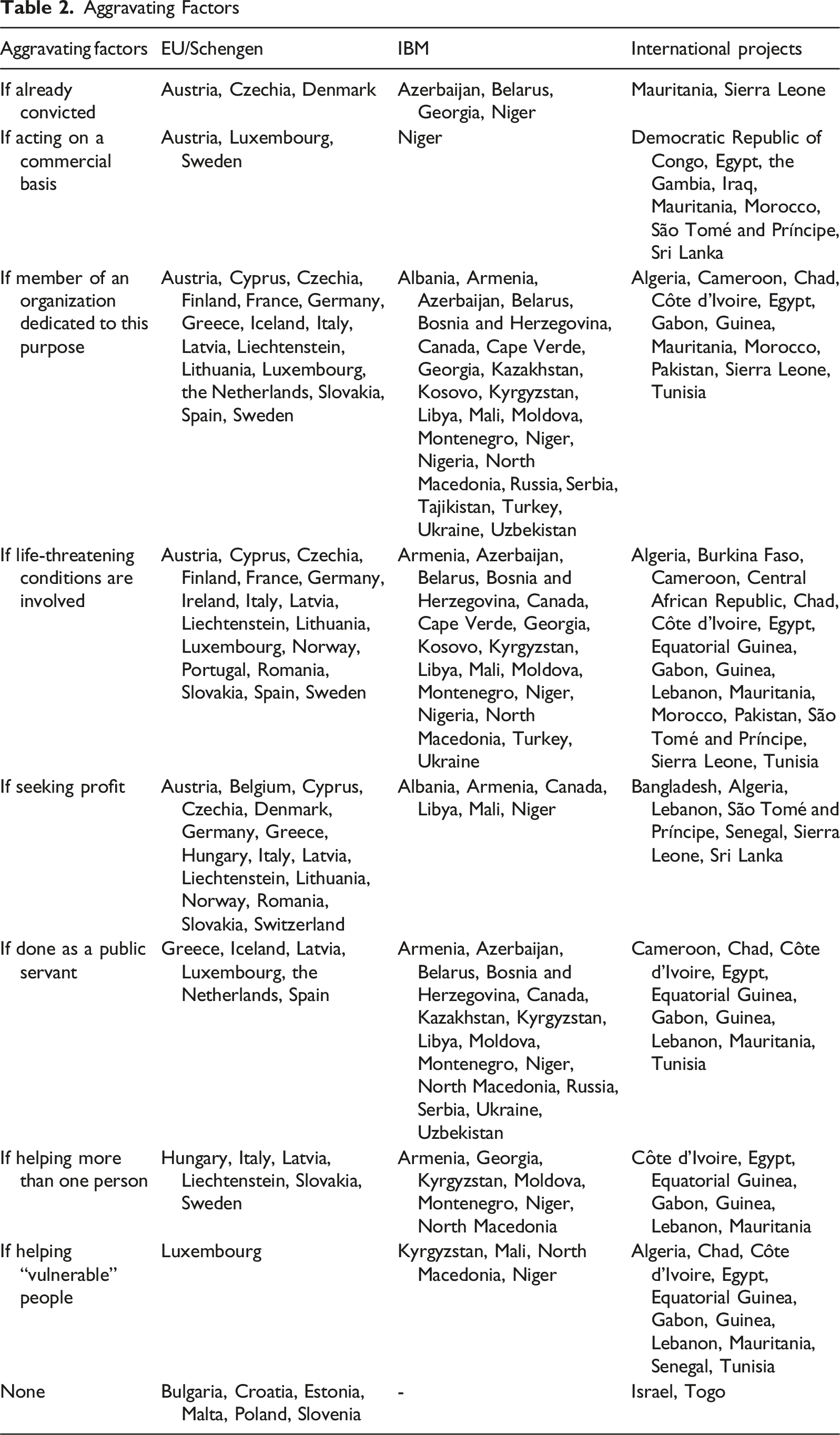
Aggravating factors were grouped into nine categories, which may apply cumulatively: (1) recidivism, (2) acting on behalf of a company, (3) acting as part of a group organized in view to commit the “crime,” (4) being a public or elected official, (5) exposition to danger, harm, or death, (6) seeking profit, (7) assisting multiple people at once, (8) assisting people considered “vulnerable” (children, pregnant people, disabled persons), and (9) no aggravating factors.
Findings and Discussion
To present my findings, I used QGIS to create a map representing the EUropean border regime. Maps have long held a privileged position in the storytelling of European civilization, serving both as tools of bordering and as manifestations of imperial power (Akerman, 2009; Bryan & Wood, 2015; Dafnos, 2014). As Rodrigo Bueno Lacy and Henk van Houtum argued, “EUrocartography enables a discourse on the borders of European identity that exacerbates the drama of migration” (Lacy & Van Houtum, 2015, pp. 5–6). Maps are also used by Frontex to organize the border’s “remote control” by identifying areas of intervention to intercept people on the move (Cobarrubias, 2019, pp. 771–76). In response, activists and scholars have harnessed the power of maps to expose and challenge the EU’s border regime. Organizations such as Alarm Phone Sahara, No Borders Morocco, No Name Kitchen, and 21 other groups have produced maps documenting illegal pushbacks (Push-back map, n.d.; Davies et al., 2023). By making visible the extensive and invisibilized mechanisms of bordering, these maps provide critical insights into the functioning of the European border regime. The map below follows the lines of the EU’s “integrated border management” based on Frontex’s list of recognized partners; thus, it only shows a minimal representation of the space of the EUropean border regime. Yet, it allows for decentering the EU border regime from an EU-only perspective and visualizing a spatial reach that extends far beyond member states (Figure 1). Mapping the EUropean border regime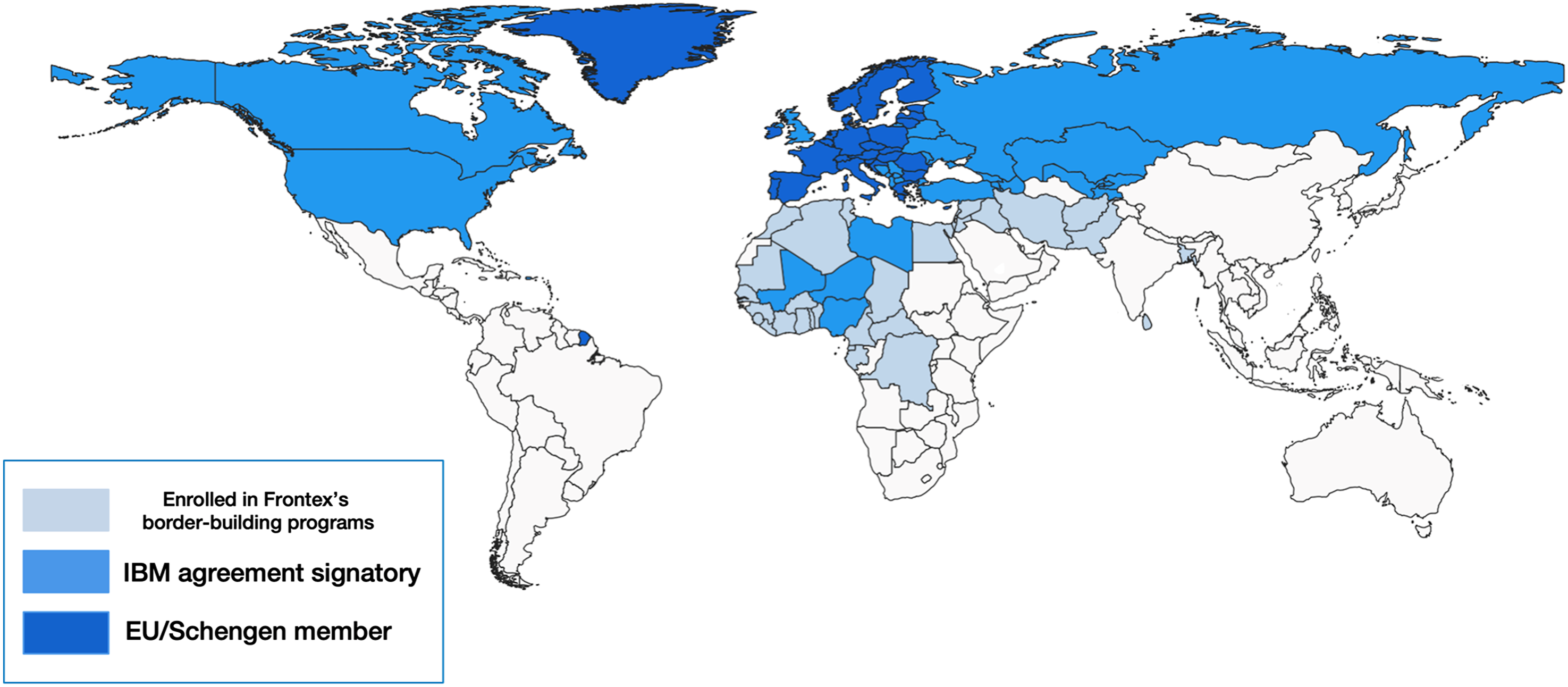
This representation of the EUropean border regime features states commonly associated with the “Global North” and the “Global South.” Notably, Global North states are all treated as reciprocal partners in managing borders. Given the imprecision of the terms “Global North/South,” it might be important to emphasize that it encompasses here states on the “eastern border” of the EU and former USSR states. By contrast, the recipients of “international projects” are almost all states that have been under the direct colonial rule of France, Italy, the UK, and Belgium until the 1950s–1970s. However, not all reciprocal partners are from the Global North, as exemplified by Libya, Mali, Niger, and Nigeria.
This observation raises a question concerning the different impacts that IBM working agreements and “international projects” have on policies and practices. The implementation of some IBM working agreements is uncertain for three states: Canada, the United States, or Russia, where there is no evidence of follow-up decisions after the agreements were signed. In contrast, fund transfer, monitoring, and joint programs are well documented for IBM states in the Balkans (Border Violence Monitoring Network and Center for Peace Studies, 2020; De Lauri & Brkovic, 2024; Migreurop, 2021), in Africa (Ca-minando Fronteras, 2021; Gkliati & Kilpatrick, 2025a; Moraczewska, 2020), Central Asia (Akchurina & Vincent, 2024; Akkerman et al., 2018; Daminov, 2023), Turkey (Fenix Humanitarian Legal Aid, 2022; Le Chêne, 2017; Rodier, 2018), and the United Kingdom (Border Violence Monitoring Network, 2024; Human Rights Observers, 2024). The designation of Libya, Mali, Niger, and Nigeria as reciprocal partners is misleading because it masks the EU’s direct military interventions in these states (Brachet, 2016; Gkliati & Kilpatrick, 2025b; Pradella & Rad, 2017). At the same time, classification as an “international project” does not necessarily mean that Frontex has a “softer” influence, as exemplified by states like Lebanon or Mauritania, which in 2024 alone received €1 billion and €500 million, respectively, conditioned to “improving” their borders (ECRE, 2024).
The map thus shows that the EUropean border regime is undoubtedly shaped by the history of EUropean empires and by contemporary geopolitical dynamics. In doing so, the findings support the calls to explore the coloniality of border management and avoiding unidirectional interpretations of the politics of border externalization (Cobarrubias & Lemberg-Pedersen, 2025; Gross-Wyrtzen & Zineb, 2024; Lemberg-Pedersen et al., 2022). While the signing of an IBM agreement or participation in a Frontex “international project” takes on distinct meanings and effects across contexts, all 84 states for which legislation was accessible online have enacted laws criminalizing solidarity with people on the move. That said, the wide variation in legal definitions, exemptions, and aggravating circumstances underscores that these frameworks cannot be read as the outcome of a single policy template or linear influence.
Definitions
Aggravating Factors
Exemptions
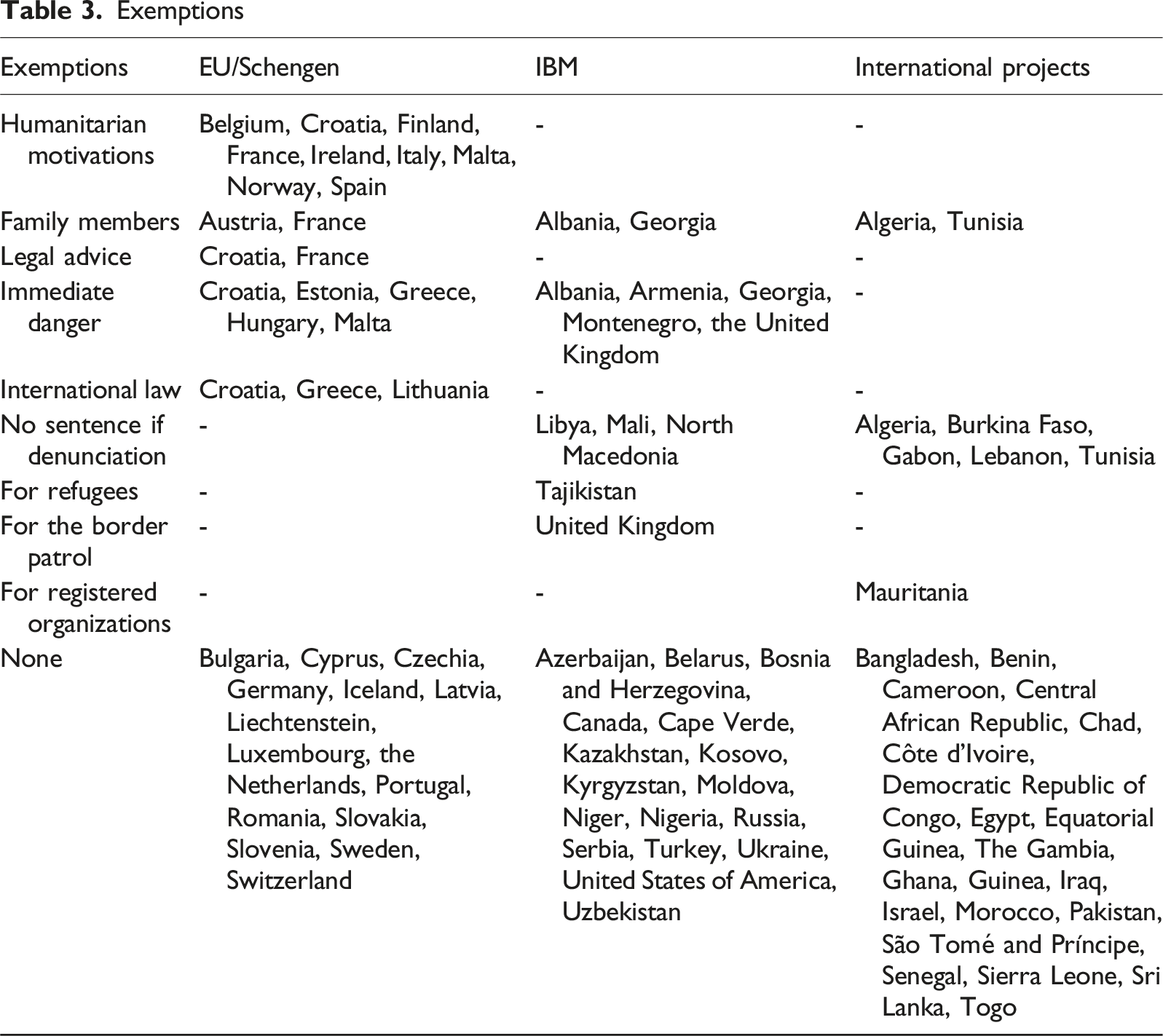
In addition, the EUropean border regime can be characterized by a shared legislative orientation to limit exemptions while multiplying aggravating factors. Nearly half of the EU/Schengen states (49%) include no exemption at all; the share is higher among IBM signatories (65%) and even higher among “international project-states” (81%). In contrast, almost all states impose aggravating factors, except for 8 EU/Schengen and 2 “international project” states. Only 10 states do not criminalize people helping someone facing immediate danger. Six states exempt family members helping one another. Three specify that compliance with international law is not a crime. Two protect the provision of legal aid to undocumented people. Finally, the United Kingdom is the only state providing an exemption to coastguards, and the Mauritanian government retains the right to determine which organizations can be exempted. Rather than indicating a widespread effort to avoid criminalizing actions far removed from “criminal networks of smuggling,” this shows that only a handful of states have even minimal precautions to limit the scope of their laws. While listed as an exemption, it should also be noted that 8 states provide immunity in case of denunciation, therefore encouraging distrust and betrayal among people on the move.
Based on this data, it is apparent that policymakers are prioritizing the deterrence of solidarity. This is observable through the list of aggravating factors that increase the levels of sanctions and how many states have adopted them. For instance, 16 states deter people from helping those considered “vulnerable,” which is presented as a protection mechanism but overlooks how borders create the condition of vulnerability (De & Woude, 2022; Fenix Humanitarian Legal Aid, 2023; Spena, 2023). Twenty-five states deter people from helping multiple people at once, while the safest way to travel is in a group (PICUM, 2022). Fifty-three states consider it to be aggravating if a permanent organization has been dedicated to the purpose of facilitating entry/exit or stay. Though presented as a tool against “organized crime” rather than organizations providing help, if the crime is facilitation, courts may use this clause against any type of organization, as reported recently in Italy (ARCI Porco Rosso, 2021). In 12 states, there are specific sanctions against hotels, landlords, and transport companies who fail to report an undocumented person, and 33 states threaten public servants who would use the powers conferred by their status to help people.
Finally, 53 have made exposing people to danger an aggravating factor. This aggravating factor is mentioned in the UN Smuggling Protocol (article 6-3-b). However, it is conditioned to combating organized crime, and the intention of profits or material benefits. While widely adopted by all three categories of states, including 18 EU/Schengen ones, a recent EU proposal has suggested incorporating this aggravating factor directly into the Facilitators Package (Filas et al., 2023, 5). This shows that within the EUropean border regime, the more repressive policies travel faster than “protective” ones, and that policy ideas travel both ways.
A key limitation of this analysis is its focus on current legal frameworks. As a result, certain states may appear as “models.” France, for example, has adopted a law that only criminalizes financial profit and integrates multiple exemptions, including for humanitarian organizations, legal aid, and family members. This image obscures the role of France in the initial adoption of the Facilitators Package as discussed above. In addition, it says nothing of the everyday reality of surveillance, policing, harassment, and discursive attacks faced by solidarity actors in France (Du Jardin, 2022; Human Rights Observers, 2021; Trucco, 2024). Beyond this case, mapping the circulation of laws says nothing about how they are enacted in practice. The actions of governments, courts, prosecutors, and law enforcement may diverge from what the legal texts collected suggest, specifically when looking at the frequency of prosecutions, the severity of sanctions, and the extra-legal means to dissuade solidarity.
Conclusion
As the violence of the EUropean border regime is rooted in imperial and colonial histories and reinforced by successive policy choices, it is essential to recognize that it is not only the routes into EUrope that are made more dangerous, but all routes across the EUropean border regime (Casas-Cortes, Cobarrubias, and Pickles, 2015; Liempt, 2021; Tchilouta & Plath, 2023). In this paper, I have attempted to map the spaces where laws criminalize solidarity; where laws deter people from trusting others, from organizing collectively, from receiving help from those who best know the lands, from those who care the most and those who are the most skilled to help them survive. A key aim of the EU border policies is to assign people to a place, whether we understand this in the sense of “moral geography,” keeping people where they are meant to be (Cobarrubias, 2025; Watkins, 2020), or as the social injunction not to move, not to act in solidarity.
This mapping exercise corroborates the literature that contests the unidirectionality of the EUropean border regime (Cappiali & Pacciardi, 2024; Jegen, 2023; Moctar, 2024). The EU border regime is operating less as a harmonizing legal tool and more as a vehicle for normalizing and circulating tactics of bordering. Rather than in tension or separated, the internal and external logics of the EU’s border regime must be understood as interconnected, complementary, and mutually reinforcing. Even though it is well documented that the EU tries to intervene and influence other states for the sake of border management, its model is not “exported” without negotiation, frictions with other models, and variations. That is not to say that the outcome is not benefiting the EUropean border regime, in the sense that the routes to EUrope are made more dangerous and difficult by the criminalization of solidarity and the circulation of legal instruments to do so. The diversity of modes of solidarity criminalization within and beyond the EU does not undermine but reinforces the overall regime.
Attentive to what states choose to do and not to do (Davies et al., 2017), this paper has shown how the possibility of adopting exemptions and aggravating factors enables the EUropean border regime to solidify the criminalization of solidarity. Rather than interpreting the lack of a unified model as a weakness for the EUropean border regime, it allows us to interpret it as a strength to invisibilize the processes at work, as part of the epistemic borderwork (Davies et al., 2023; Rumford, 2008). This expansion is visible geographically, through the number of states that are integrated into it, and legally, as the definitions and aggravating factors multiply and boost prosecutions, contributing to the uncertainty that paralyzes those who might be tempted to help (Mitsilegas, 2019). The gains that solidarity actors may claim in one state to limit their criminalization are not transposed. Monitoring the cohesion of the whole border regime, the role of Frontex cannot be to “export” the EU model since it does not exist, yet we see that states working with Frontex are converging toward more repression for solidarity.
Footnotes
Acknowledgment
The author gratefully acknowledges funding for the database research from the Social Sciences and Humanities Research Council (Twenty-First century borders - Emergent challenges within and among states, award number: 895-2021-1002) and the Jean Monnet Network (Jean Monnet Network Borders, Human to Military Security, Database, award number: 620606-EPP-1-2020-1-CA-EPPJMO-NETWORK).

Funding
The authors disclosed receipt of the following financial support for the research, authorship, and/or publication of this article: This study is supported by the Social Sciences and Humanities Research Council of Canada, 895-2021-1002 and Jean Monnet Network, 620606-EPP-1-2020-1-CA-EPPJMO-NETWORK.
Declaration of Conflicting Interests
The authors declared no potential conflicts of interest with respect to the research, authorship, and/or publication of this article.