




Abstract
In 2004 the European Union (EU)’s membership grew from 15 to 25 member states. This article analyses how the EU used this ‘big bang enlargement’ to promote horizontal and vertical expansion to its role as a global development actor. It describes how the Union’s larger membership realised considerable horizontal expansion, primarily by increasing the development cooperation budget managed by the EU institutions. The global financial crisis, austerity measures in its member states as well as legal and institutional changes, however, hampered vertical expansion, with many member states failing to sufficiently increase their own national budgets and efforts to promote coordination and harmonisation delivering limited results. The understanding of the task division between the EU and its member states has evolved with the EU having gained a stronger role as a global development actor in its own right. This article contextualises and describes these expansion patterns by analysing key policy trends in the period 2000–2025 in a historical and international perspective and contributes new evidence to the literature on international organisation expansion.
Keywords
Introduction
Months after the 9/11 terror attacks, a different period of great geopolitical tension, the EU adopted its so-called Barcelona targets ahead of the 2002 United Nations Conference on Financing for Development. These targets consisted of planned increases in the volume of the EU’s Official Development Assistance (ODA) and commitments to strengthen the effectiveness of EU development cooperation through actions such as coordination and harmonisation (EC, 2005). They were adopted with the so-called ‘big bang enlargement’ of the EU with 10 new member states appearing on the horizon. The targets conveyed an ambition of the EU and its member states as a collective and concerted global development actor and anticipated an increase in soft power influence, thus making it an interesting case for the study of the expansion of international organisations (see Gray et al., 2017; Parlar Dal & Matsumoto, 2025).
One year after the 10 countries had joined, the EU and its member states concluded preparations of the first joint EU development policy statement of its kind, the European Consensus on Development. This tripartite political statement was adopted in late 2005 by the leaders of the European Commission, Council and Parliament. The statement consisted of two parts, a shared vision on development policy shared by the EU and its member states, and a second part specifying the priorities and comparative advantages of the European Commission (EU, 2006). The statement conveyed the EU’s ambition by stating that ‘Working together, the EU is an important force for positive change. The EU provides over half of the world’s aid and has committed to increase this assistance, together with its quality and effectiveness’ (EU, 2006: C 46/1).
The EU sought to use its membership increase to strengthen its role as a global development actor through a combination of what in the literature on international organisations (IOs) is referred to as horizontal expansion – its increasing membership strengthening its collective financial contribution and presence – and vertical expansion: gradually seeking to deepen intra-European coordination and collective effectiveness (Parlar Dal & Matsumoto, 2025). The two main questions explored in this article examine to what extent the EU and its member states have realised their horizontal and vertical expansion ambitions in the area of global development since the 2004 EU enlargement, and what factors may explain the expansion patterns that can be observed. Its analysis is based on a structured review of the literature, EU (non-)legislative documents and on direct observations of and interactions with EU policy debates by the author in his capacity as a think tank researcher. The article contributes to the existing literature on the expansion of international organisations (Gray et al., 2017; Parlar Dal & Matsumoto, 2025), while also being of relevance to related literature on the evolving relationship between the secretariats of international organisations and their membership (Debre & Dijkstra, 2020; Holesch et al., 2025).
This article’s findings describe how the EU’s horizontal and vertical expansion did not go according to the originally stated plans and ambitions, because of a combination of legal/institutional changes and because most member states did not sufficiently develop their own budgetary means and competences in the area. As a consequence, the understanding of the task division between the EU and its member states – and thus the vertical expansion – has changed with the EU having gained a stronger role as a global development actor in its own right.
While describing these expansion patterns, the article documents how the EU’s understanding of its role in global development and of its competencies and priorities in this regard vis-à-vis that of its member states evolved in the process (Furness et al., 2020; Lundsgaarde & Keijzer, 2019; Steingass, 2020). The Commission’s development policy ambition – now framed as international partnerships policy – has strongly shifted to an enhanced integration in the EU’s foreign policy. Although it was guided by recent policy trends and responses to several global and regional crisis (see Koch et al., 2024), this change in the Commission’s role vis-à-vis the member states was already anticipated and promoted by the 2009 Lisbon Treaty (Hadfield & Lightfoot, 2021). The treaty allowed the Commission more independence in shaping its own development policy, and promoted strengthened its integration into the EU’s external action through the creation of the post of the EU’s high-representative for foreign and security and the European External Action Service (Keijzer, 2021; Orbie & Lightfoot, 2017). Reflecting the current discourse, the European Commission president has mandated her Commissioner for international partnerships in September 2024 to pursuing Europe’s ‘prosperity, resilience and security’ (Von der Leyen, 2024, p. 5). Hence, two decades after its 2004 enlargement the EU now finds itself as the largest collective ‘donor’ in a ‘post-aid world’, that is, one in which the role, ambitions and objectives of development policy and its role vis-à-vis foreign policy have gone through strong changes (Mawdsley, 2018).
The remainder of this article is structured as follows. A first section discusses the EU in relation to the literature on IOs and further defines the two types of expansion, which serves as the main analytical lens of this article. Following this brief discussion, the next section discusses how the global development regime has evolved in recent years, providing explanatory context to the later analysis of the EU’s expansion efforts in the area. This is followed by a discussion setting out main evolutions in the EU’s development cooperation over time, and of the main changes and trends since the 2004 enlargement. This is followed by a further discussion on policy and funding trends within the EU, which builds to the article’s conclusion and final observations.
The EU and the Literature on IO (Expansion)
Although the EU has the status of an international organisation, its member states have devolved key national policy competencies to the EU, including exclusive competencies in areas that are key to its internal market such as trade and competition policy (Palchetti & Wessels, 2024, p. 512). The EU’s global influence largely derives from the size of this market and the considerable body of legislation that governs it, which directly and indirectly influences relevant legislation by states outside the Union. Hence, the expectation is that the larger this market becomes, the larger the Union’s economic power and potential regulatory influence on the rest of the world gets. For a new state to join the EU, it has to make considerable domestic reforms and introduce new laws and legislation to conform with the EU’s own body of law, referred to as the acquis communautaire. While the process for preparing for membership is a transparent and structured process, the eventual decision for a new state to join the EU is political and lies with the current member states – requiring a unanimous decision by their heads of state and government (Egenhofer et al., 2011).
The accession of 10 new member states all at once in 2004 was unprecedented for a Union that had thus far grown in more incremental steps. Gray et al. (2017) suggest that the considerable diversity among the EU’s 15 strong membership at that time may explain why such a large number of new members was admitted. With the exception of Cyprus and Malta, all new members were previously part of the Soviet Union and could be considered young democracies in that regard. The same applied to Romania and Bulgaria who joined 3 years later. It is nonetheless not new for the EU to admit members who had only recently gone through societal transformation, including some of its founding members. The Union itself has since adapted and changed too: a special issue that analyses the first two decades after the enlargement concluded that ‘power and influence between older and newer member states have gradually given way to a more complex picture of participation, adaptation, and strategic engagement within the EU framework’ (Mišík & Brusenbauch Meislová, 2025, p. 320).
EU development policy was an unusual element of the acquis communautaire for the new members due to two reasons. First of all, most of the new members that joined in 2004 had until recently been recipients of ODA, and now faced the task to develop their competencies and systems for funding and managing development cooperation programmes (Lightfoot and Szent-Iványi, 2014; Szent-Iványi and Lightfoot, 2025). Second, international agreements with the EU’s partner countries that provide a legal basis for its cooperation actions notwithstanding, the EU does not produce much actual legislation in this field. Instead, it provides a body of soft law consisting of recommendations and principles to be considered, and also manages its own ODA budget under the EU’s multi-annual financial framework (Keijzer, 2020; Orbie & Lightfoot, 2017). By joining, the new member states committed to contribute to the EU’s collective target of 0.7% of its Gross National Income (GNI), both through increasing their own national ODA budgets and through their contributions to the overall EU budget and the European Development Fund, a series of intergovernmental funds to support the international agreement between the EU and the African, Caribbean and Pacific states (i.e. the Cotonou Agreement) (Lightfoot and Szent-Iványi, 2014). In view of their ‘starting points’, the new members of the EU committed to achieving an intermediary target of 0.33% of their GNI as ODA by 2015 with the long-term aim of achieving the same 0.7% target (Szent-Iványi and Lightfoot, 2025).
Recent IO literature has observed both their proliferation in number and the increasing overlap of their mandates, which in turn motivates states to seek membership (Holesch et al., 2025). This increased competition puts pressure on IOs to survive, and research shows that those availing of large secretariats fare better in this respect (Debre & Dijkstra, 2020). Applying the distinction between horizontal and vertical expansion as defined by Parlar Dal and Matsumoto (2025) to the specific subject matter dealt with in this article, horizontal expansion is considered as an increase in the collective size of the development cooperation actions of the EU and its member states as per an increased collective ODA budget. This consists of the bilateral ODA budgets of the EU’s members and their contributions to the ODA budget as managed by the EU institutions. Vertical expansion is defined as the EU and the member states increasing their collective influence on global development by working better together by aligning and coordinating their action, and by collectively seeking to influence global development agendas. Before looking into the patterns of horizontal and vertical expansion in this area during the past two decades, the next section analyses the emergence and evolution of the international development regime .
The International Development Regime
The international development regime emerged after the second World War, reflecting the new international balance of power at that time. The two major powers at that time, the United States and the Soviet Union, both had their own concept of development and of the role and goals of international cooperation in this respect. For the United States, this largely evolved from the Marshall Plan to fund the reconstruction of Europe. This fund was administered by the Organisation for European Economic Co-operation (OEEC) that, once the Marshall Plan had been concluded, was renamed the Organisation for Economic Co-operation and Development (OECD) (Woodward, 2009). In 1961, the OECD established the Development Assistance Committee (DAC) to convene those OECD members involved in development assistance to developing countries. Almost a decade later, the OECD countries were recognized as ‘economically advanced countries’ in the UN General Assembly’s Resolution 2626 and committed to increasing their official development assistance (ODA) to a minimum amount of 0.7% of their gross national income (UN, 1970).
Under the overall parameters set by the UN resolution, the same providers of ODA – and members of the DAC – were the ones who determined what could be reported as such, with the OECD secretariat keeping track of the statistics over time. In the decades that followed, the OECD/DAC also evolved into an important provider of normative ideas on development cooperation and as a setting for the DAC members to learn from each other about various aspects of development cooperation, covering all aspects of the so-called project cycle from design to evaluation (See Bracho et al., 2021). In this context, they also formulated ideas on the global development agenda, with for instance the DAC’s 1996 paper ‘Shaping the 21st Century: The Contribution of Development Co-operation’ having an important influence on the UN’s Millennium Declaration and its eight Millennium Development Goals (DAC, 1996).
After the turn of the millennium, the combination of the consequences of 9/11 and economic growth in most OECD economies – in turn leading to rising ODA budgets – informed deliberations at the first United Nations Conference on Financing for Development in Monterrey, Mexico. The Monterrey Consensus on Financing for Development, as adopted during the March 2002 conference, did not only urge the need to increase ODA but also identified several ways to use the existing levels of funding in a more effective way. To this end, and among other actions, it called for harmonising procedures, aligning cooperation to national development plans, promote ownership of technical cooperation and untie development cooperation (UN, 2002: p. 15). In essence, these actions were informed by inefficiencies caused by the growth in international development cooperation at that time, which led to competing or even conflicting projects and associated considerable transaction costs for developing countries who were faced with increasing meeting and reporting requirements (Booth, 2012).
The commitments made in the Monterrey Consensus were in turn further explored and deepened in a series of international high-level fora on aid effectiveness. Most known among these was the 2005 forum at the OECD in Paris that led to the adoption of the Paris Declaration on Aid Effectiveness and its accompanying framework of targets and indicators. This framework was subject to an independent monitoring and evaluation process that sought to track progress made over time and promote an evidence-based approach to strengthening the effectiveness of development cooperation (Bhattacharya et al., 2021; Booth, 2012). Yet the September 2008 fall of the Lehman’s Brother’s Bank, in the same month when Accra hosted the third high-level forum on aid effectiveness, started a global economic and financial crisis and considerably eroded the political momentum behind the aid effectiveness agenda (Lundsgaarde & Engberg-Pedersen, 2019). Austerity policies subsequently drove ‘value for money’ discussions and accompanying ODA budget cuts in many OECD states. The fourth high-level forum in 2011 that was held in Busan subsequently became the stage for efforts to convince non-OECD international cooperation actors – including China and India – to express support for the same Monterrey-derived effectiveness principles (Eyben & Savage, 2013; Keijzer, 2024; Mawdsley, 2018).
The years following the economic and financial crisis gave rise to more inward-looking and austerity-driven development policy reforms. International meetings on strengthening the effectiveness of development cooperation continued, including in UN-based fora such as its Development Cooperation Forum but also in the Global Partnership on Effective Development Cooperation that continued discussions after the Busan high-level forum (Lundsgaarde & Engberg-Pedersen, 2019). Yet the changed political climate was characterised by reduced peer pressure among ODA providers, as shown by a reduced political relevance to compare and learn from one another and reduced effectiveness and visibility of monitoring exercises to this end (see Bhattacharya et al., 2021). In the EU, ODA budgets were redirected to increased use of ODA for domestic purposes, notably the spending of funding on in-country refugee costs, which are allowed under the OECD’s ODA reporting rules but are poorly connected to the ODA target’s overall objective of promoting developing country welfare (OECD, 2023).
The changed political climate and reduced agency of the international development regime was well-reflected by the 2025 UN Conference on Financing for Development in Seville. In the beginning of that year, the closure of USAID and a multilateral system under considerable stress – with various conflicts actively weakening its authority – considerably downplayed expectations for the first such UN conference on European soil (Keijzer, 2025). The eventual adoption of the Forum’s outcome document without the USA taking part in its proceedings shows how much the international political climate for development cooperation has changed. In her statement at the plenary session of the 2025 FFD conference in Seville, the president of the European Commission acknowledged these changes, yet also insisted on Europe’s leading position in this area: ‘The European Union provides 42% of the world’s development aid. We are proud of this, and our commitment is here to stay’ (Von der Leyen, 2025).
In sum, the EU managed to establish a leading position as a global development actor, but the nature of the policy field has gone through considerable changes in the two decades since the 2004 enlargement. This provides the backdrop for analysing the EU’s policy intentions for using that enlargement to increase its collective influence on global development and describe to what extent these ambitions and plans have been translated into practice. The following two sections will further describe the main evolutions in the EU’s development policy and operations over time and analyse the vertical and horizontal expansion patterns since the 2004 enlargement.
Vertical Expansion? Evolutions in the EU’s Development Policy
The EU’s development policy competence evolved from its role vis-à-vis a group of African colonies of the founding six member states under the 1957 Treaty of Rome’s association policy, financed by an intergovernmental fund called the European Development Fund (EDF). Once these colonies had gained their independence, the EU developed a new framework to continue cooperation with the newly independent states (see Orbie, 2021). This group of EU development cooperation recipient countries subsequently expanded to the African, Caribbean and Pacific (ACP) group after the United Kingdom joined. Once designed to fund the EU’s colonies, the EDF became an enduring feature of the EU’s cooperation with the ACP states and its remaining overseas dependencies, with 11 consecutive intergovernmental funds being created until the EU decided in 2021 to incorporate the funding of cooperation with ACP states into the EU’s general budget (Keijzer, 2020). Earlier increases to the EU’s membership, notably the 1986 Iberian enlargement and the fall of the Soviet Union, started a process where cooperation with other regions – particularly those in the so-called ‘Neighbourhood’ of the EU – expanded the scope of the EU’s development policy and consequently reduced the centrality of the ACP Group for it (Hewitt & Whiteman, 2004).
The first legal provisions for development policy in the EU’s governing treaties were introduced in the 1992 Treaty of Maastricht (Hadfield & Lightfoot, 2021; Hoebink, 2004; Steingass, 2020). Before the 1992 Treaty Change, this legal basis was found in the series of Lomé Conventions while separate EU legislation governed bilateral association agreements governed cooperation with non-ACP states (Bergmann et al., 2019). While modest in substance, the 1992 Treaty was a key step in expressing the EU’s desire and ambition to be a global development actor (Orbie & Lightfoot, 2017). These legal provisions were largely maintained and amended by the 2009 Lisbon Treaty. In essence, EU development policy is a shared parallel competence between the EU and the member states, while the principles of coordination and complementarity seek to reduce any inefficiencies, avoid duplications and strengthen collective effectiveness (Hoebink, 2004). Initially, under the Maastricht Treaty, the Commission was required to complement the actions of the member states, a provision that was changed in the 2009 Lisbon Treaty to state that the activities of the Union and the member states in this area were to complement one another (Orbie & Lightfoot, 2017).
The accession of the 10 member states in 2004 followed a period during which the EU institutions were assuming a stronger profile and level of ambition in the area of development, in part anticipating its increasing budgetary resources that the impending enlargement would lead to (Bergmann et al., 2019). The adoption of the aforementioned Barcelona targets was preceded by the 2001 Development Policy Statement of the European Commission. Since many of the newly joined member states had until recently been receiving ODA, their accession to the EU represented both a challenge and opportunity in terms of a potential horizontal and vertical expansion of the EU in the area of global development. Under the various legislative and institutional changes preparing their membership, the new members faced the challenge of adopting their own international development policy and setting up systems to administer national ODA budgets (Lightfoot and Szent-Iványi, 2014; Szent-Iványi and Lightfoot, 2025).
Another key factor in the run-up to the 2004 enlargement concerned the international discussions on strengthening the effectiveness of development cooperation. These provided an opportunity and guide for the EU’s own efforts at promoting its consolidation as a global development actor. The EU’s commitment to the 2005 Paris Declaration on Aid Effectiveness was such that it included more ambitious additional targets on effectiveness in the EU Consensus on Development adopted later that same year (EU, 2006). Moreover, the EU adopted an Operational Framework on Aid Effectiveness with concrete steps to do so (Council of the European Union, 2009), and in 2007 concluded a Code of Conduct on complementarity and division of labour between the EU and its member states (Lundsgaarde & Keijzer, 2019).
The European Consensus defined clear roles for the European Commission in advancing the Union’s vertical expansion in development policy. Implementing these, the European Commission took on bigger roles in terms of monitoring and promoting accountability on these targets, including by preparing monitoring reports on overall EU ODA levels, the contribution of other policy areas to global development (‘policy coherence for development’) and specific commitments in the area of ‘aid for trade’. These were typically prepared on the basis of questionnaires and other inputs sourced from the member states. In the meantime, internal reforms in the European Commission created a large Directorate General in charge of both the policy formulation and implementation of its ODA budget, which was also growing in size due to the EU’s now enlarged membership. This large organization was named the DG for Development and International Cooperation (DEVCO) (Orbie & Lightfoot, 2017). Due to its steadily growing budget, the European Commission increased the use of an approach to delivering ODA called budget support, which concerns a direct transfer of funding to the treasury of a developing country government, either in support of its overall development strategy or in relation to the support of sector-specific targets (Council of the European Union, 2009; Koch et al., 2017).
The EU’s strong commitment to the overarching effectiveness agenda both declined and changed in the months after the start of the global economic and financial crisis in September 2008. There were two main causes for this: first the low performance of many member states in terms of meeting their own commitments to operating their own bilateral ODA budgets (as discussed in the next section on horizontal expansion), but also the entering into force of the Treaty on European Union in December in 2009. The latter prompted institutional changes in the EU that promoted a gradual expansion of the EU’s development policy into its foreign policy (referred to as ‘external action’) which changed the character and autonomy of the Union’s development policy (Bergmann et al., 2019; Keijzer & Lundsgaarde, 2018).
Two changes happened in the years that followed that would change the planned course of the EU’s planned vertical expansion. First, and rather gradually, the Commission’s reduced its engagement in terms of promoting development best practice and monitoring the performance by its member states. The aforementioned operational framework on aid effectiveness was not renewed, thus letting a shared European agenda for promoting effective cooperation expire. While the EU continued its EU-wide reporting on a range of topics, from aid for trade and policy coherence and detailed reports on financing for development, after the pandemic this reduced in effort to the monitoring of overall ODA levels based on which an annual ministerial statement is adopted until today (see, e.g. EU, 2024).
Second, the policy priorities of the EU institutions in the area of development policy began to evolve. After 2011, policy proposals put forward by the Commission increasingly began to emphasise the productive sectors of the economy and the role of the private sector. The EU introduced a tool box of ‘blended finance’ to pursue these new objectives, whereby ODA grants are used to prepare, accompany or support the delivery of loan-financed public and private sector investment projects (Bergmann et al., 2019; Hadfield & Lightfoot, 2021). The year 2015 brought important steps forward in the adoption of the 2030 Agenda on Sustainable Development and the Paris Agreement on Climate Change. Yet in the months and years that followed the EU’s commitment to development worsened, in large part due to its inability to provide an effective collective migration policy response in 2016. In this same year, the United Kingdom referendum started the process of the country’s departure from the EU while in the same year the EU introduced new initiatives to address the ‘root causes’ of migration and promote external investment. The latter change was communicated by the EU’s 2016 Global Strategy on Foreign and Security Policy, which conveyed the EU institutions’ desire to make its development policy more flexible and more aligned to the EU’s strategic interests (Hadfield & Lightfoot, 2021). In the years that followed, the long-term orientation of the EU’s development policy was traded for a stronger focus on addressing short- and long-term challenges in a more flexible manner, a change that has been referred to as the ‘crisisification’ of EU development policy (Koch et al., 2024; Furness et al., 2020). These and other trends changed the possibilities and priorities for policy convergence between the EU and its member states, the latter also navigating their own domestic policy discussions and trajectories in this regard. Research on the Central European member states that joined in 2004 shows that some stayed closer to the initial principles promoted by the EU than others, thus showing increasing development policy divergence between them (Szent-Iványi & Lightfoot, 2025).
2017 saw the adoption of a successor EU-wide policy statement called the New European Consensus on Development, no longer differentiating between the EU and its member states, while more inclusive in the amount of policy priorities presented and emphasising the need for flexibility (EU, 2017; see also Bergmann et al., 2019). In 2019, the new European Commission consolidated and reframed the new direction and priorities that it had taken for its development policy by renaming the portfolio of the Commissioner from ‘international cooperation and development’ to ‘international partnerships’, with the renaming of the responsible Commission Directorate General following suit in 2021. The mission statement of this DG was soon updated too to clarify that its purpose was the support the external dimension of other EU policy priorities, as opposed to promoting its own, notwithstanding a continued expressed commitment to furthering a global development agenda (Von der Leyen, 2024).
The EU’s emphasis on working as a collective actor saw an important rise after the global pandemic had reached the EU in March 2020, though this time with the main concerns being influence and visibility rather than effectiveness (Burni et al., 2022). Observing that China was providing a more confident and convincing response to developing countries that struggled with the pandemic’s short- and long-term effects, and which had not yet fully recovered from the earlier 2008 economic and financial crisis, the EU considered its own response. Under the label ‘Team Europe’, the EU, European Investment Bank and the European Bank for Reconstruction and Development committed to work together in providing a European pandemic responses. Following a positive internal reception, this further developed into a general application in the field of development cooperation, whereby European actors were bundling their approaches and efforts in a particular theme or country in so-called Team Europe Initiatives (TEIs) (Burni et al., 2022; Koch et al., 2024). A year later, these TEIs were given a key role by the EU in implementing a new initiative called Global Gateway, an approach that was rhetorically framed as an alternative to China’s Belt and Road Initiative (Keijzer, 2024). Although both initiatives emphasise collective responses, the ambition here is not so much to strengthen the effectiveness of the EU’s response, but rather its visibility and contribution to foreign policy objectives.
This concludes the analysis of key evolutions in the EU’s development policy, which described how the EU’s vertical expansion in this area went differently than planned. In summary, the limited vertical expansion was due to a combination of EU Treaty Changes that promoted the integration of development policy into the Union’s foreign policy, and because of changing international trends and policy frameworks that prompted changes to the EU’s own policies and approaches. This raises questions on the credibility of the EU and its member states presenting itself and operating as a collective. As was noted in the introduction, this element was linked to the EU’s horizontal expansion and ‘critical mass’ as a global development actor through the combined size of the ODA budgets of the EU and its member states. The next section analyses financial trends in this area.
Horizontal Expansion? Volumes and Balances within the EU
The ODA budget of the European Union that is implemented by the EU institutions – principally the Commission and the European Investment Bank – has long represented a significant share of the combined ODA budget of the EU and its member states. The 2004 enlargement was evidently expected to increase both. While the former was realised, the planned increases of the national ODA budgets of the member states – with differentiated timetables and associated GNI percentages of their gross national incomes – did not go as planned. Rather than increasing over time, member state bilateral ODA budgets failed to grow in size, and for most primarily consist of mandatory contributions to international organisations including the EU. Figure 1 shows the EU institutions as the largest European development cooperation actor in the period 2007–2015, followed by Germany and France, and other larger member at a further distance. Top ten EU ODA providers, 2007–2015 combined (EUR Bn)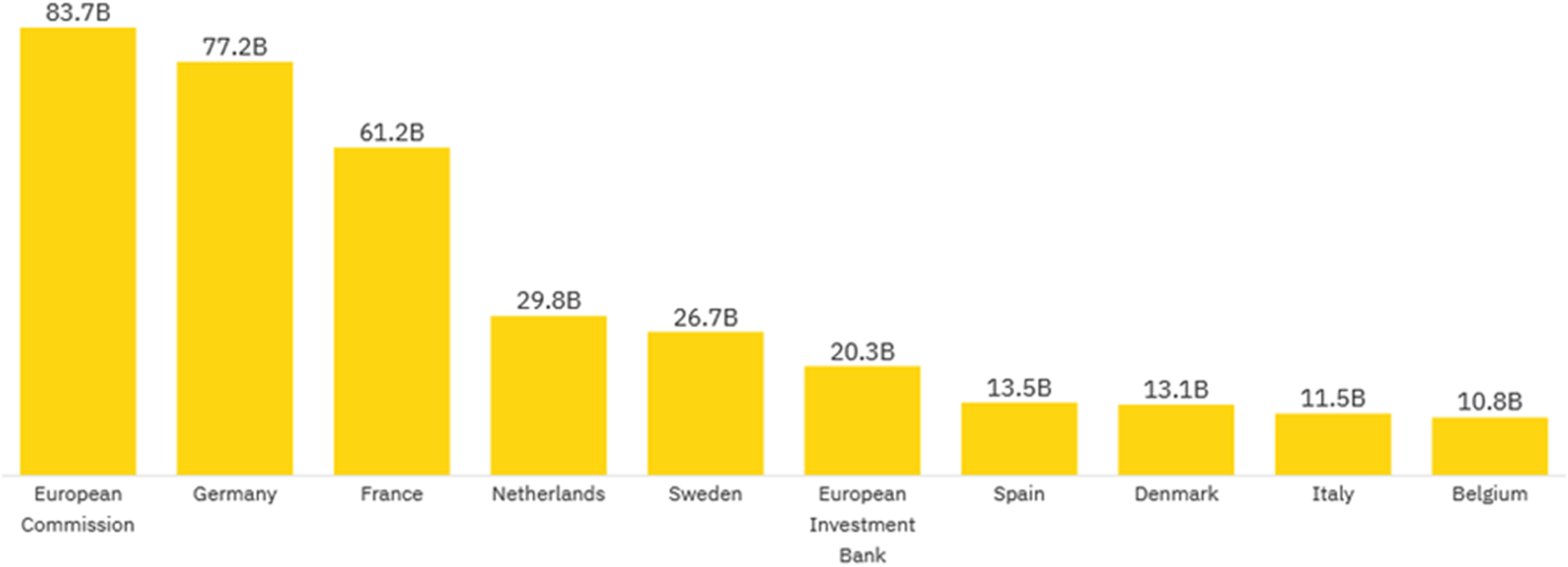
A comparison of the 2007–2015 (Figure 1) and 2015–2023 periods (Figure 2) shows that the EU institutions’ proportion of the collective EU ODA has grown from 30% to 33%. A key reason for this increase concerns the United Kingdom’s decision to leave the EU, which took effect on 31 January 2020. While Germany now provides a higher total budget than the EU institutions, Figure 2 shows that the difference between the EU and other member states with sufficiently large ODA budgets has grown further. For the member states that joined after 2004, the limited geographical reach and absolute sizes of their national ODA budgets moreover meant that they could not assume a strong involvement in efforts to work together under the Team Europe label. This is because the TEIs that have been taken forward in the form of ‘packages’ of comparable and complementary interventions by the EU institutions and member states, thus enabling a higher degree of participation by those member states with considerable national development cooperation portfolios (Burni et al., 2022; Koch et al., 2024). Discussions on increasing the ‘inclusiveness’ on Team Europe sought to address this, but the pattern continued under the currently dominant EU Global Gateway initiative and the flagship initiatives it pursues (Keijzer, 2024). Top ten EU ODA providers, 2015–2023 combined (EUR Bn)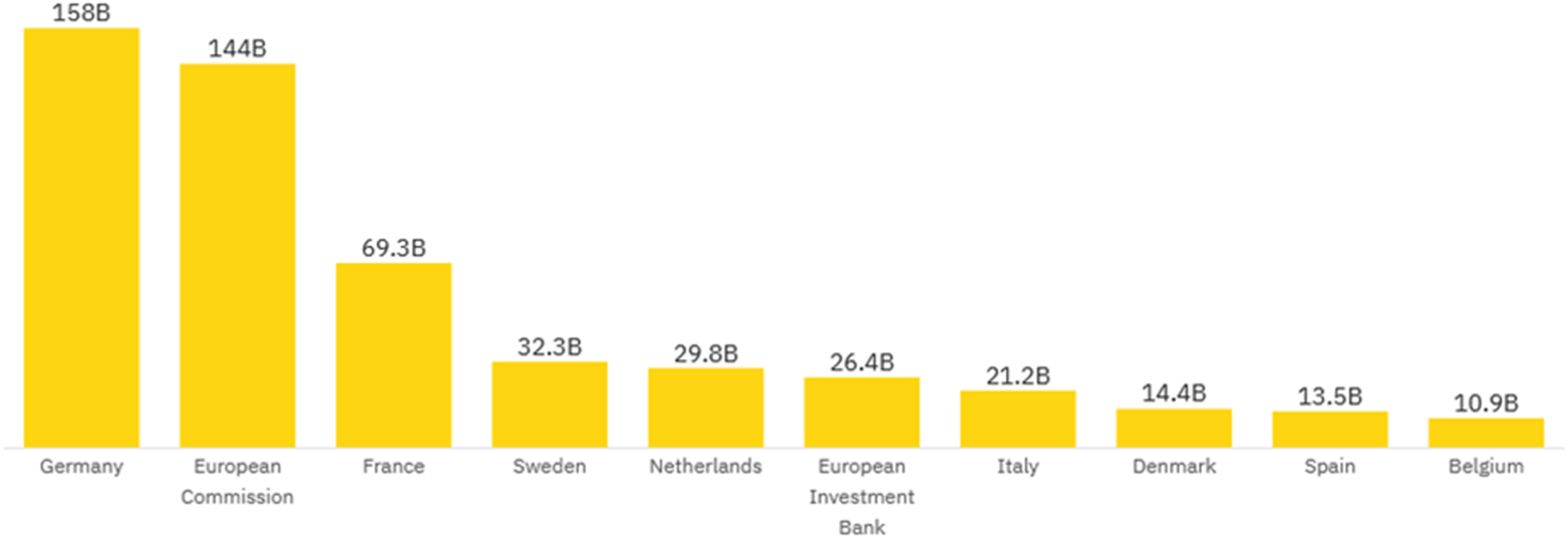
Table: Gap Between 2023 ODA/GNI Levels and Agreed Targets (EU Member States)
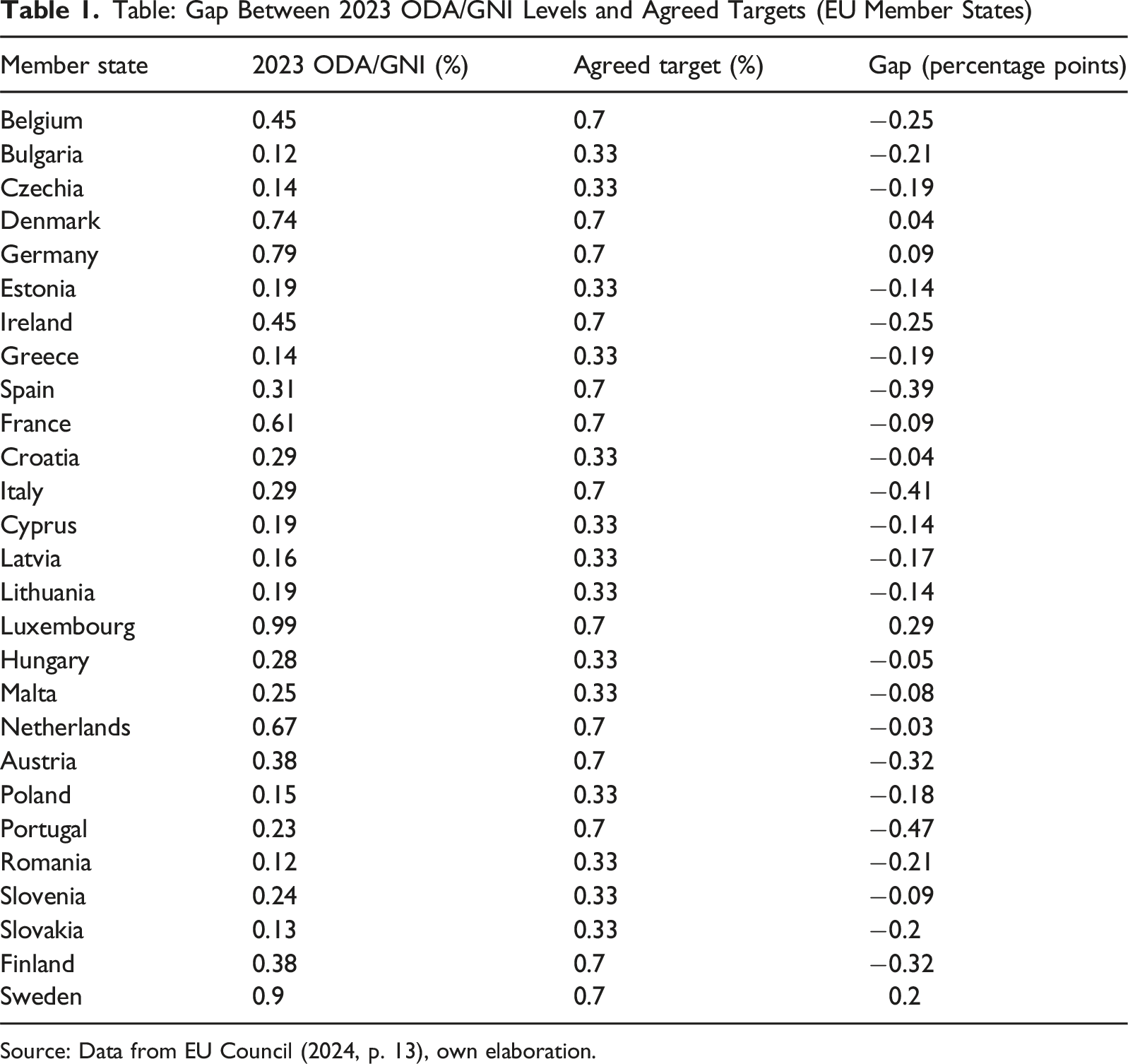
Source: Data from EU Council (2024, p. 13), own elaboration.
In the course of 2024 and 2025, most member states with large ODA budgets announced planned budget reductions during the coming years. Most of these budget cuts were already planned and communicated before the start of the second Trump administration, while new governments in Germany and Belgium announced them in the late winter of 2025 after USAID had already been folded (Keijzer, 2025). The EU runs a 7 year budget framework, with the current cycle continuing until the end of 2027, so these cuts by individual member states may be taken into account during the negotiations of the next budget framework that will cover the period 2028–2034.
One consequence of most member states not availing of substantial bilateral ODA budgets is that many also do not have a single political actor within government who is responsible for development policy. Hence, although there are two EU Foreign Affairs Council meetings each year that are dedicated to discussing development policy, many member states do not have a (junior) minister to attend this meeting. The meetings themselves have been characterised by underwhelming agendas and an absence of concrete proposals to engage on collective political cooperation in this area (Keijzer, 2021). Reduced horizontal expansion may thus also affect the realisation of the ‘shared competence’ in this field of public policy and the EU’s vertical expansion, in terms of capitalising on its collective size in terms of global influence and collective agency.
Notwithstanding the decline in bilateral ODA by EU member states and a de-facto growing proportion of ODA delivered by EU institutions, there are also positive trends in terms of EU collective action. The aforementioned emergence of Team Europe Initiatives followed the earlier trend set in motion by the EU Emergency Trust Fund for Africa (2015) and the External Investment Plan (2016) that promoted the increased involvement of European actors in delivering its cooperation programmes. To this end, member state organisations involved in this have organized themselves into networks, with implementing agencies joining up in the Practitioners Network on EU Development Cooperation and development finance institutions working together in two networks: a large grouping in the Association of European Development Finance Institutions (EDFI), and the larger ones creating the Joint European Financiers for International Cooperation (JEFIC). Among the approaches used in this context are co-financing, whereby (an) EU member state(s) and the Commission jointly finance an activity, or delegated cooperation where the aforementioned implementing and development finance institutions receive so-called ‘contribution agreements’ from the EU institutions to implement programmes on their behalf. Those member states with larger bilateral ODA budgets typically avail of larger organisations with their own networks of field offices and experts, which is why between 2014 and 2021 Germany and France, respectively, represented almost 39 and 31% percent of the total volume EU-delegated cooperation to member-state agencies, leaving just 30% to the remaining 25 member states (Lundsgaarde, 2024: p. 21). The increased use of European actors for delivering programmes is a stated aim of the Global Gateway initiative and suggests new prospects for horizontal expansion, yet also hinge on the member states’ resources and institutional capacity to engage in co-design and co-financing of initiatives together with the EU and other member states (Keijzer, 2024).
Conclusion
This contribution has analysed the EU’s expansion patterns in the field of development policy following the Union’s 2004 enlargement and considered what factors may explain the expansion patterns that can be observed. It has described key policy and ODA trends of the European Union (EU) and its 27 member states in the run-up to and after this so-called big bang enlargement. The EU started off with a strong sense of commitment to the international development cooperation regime, including plans to promote collective effectiveness, which it communicated through a strong involvement in driving that agenda. A key reason for this enthusiasm was that the international development effectiveness agenda aligned to the EU's own enlargement agenda, after having welcomed new member states in 2004 that were setting up their own development cooperation budgets and systems.
The roles and responsibilities that the EU has associated to its position as furthering a collective role of the EU and its member states in the area of global development have gone through considerable changes in the age of polycrisis and geopolitical competition. In line with institutional changes set in motion by the 2009 Lisbon Treaty, various crises and international trends prompted the EU to gradually incorporate its development policy into its foreign policy. In this process, the identity, autonomy and function of development policy as a policy field changed, while its operational choices became increasingly motivated by the pursuit European strategic interests.
This outcome of having become the largest donor in a ‘post-aid’ world was considerably different from what the EU had envisioned in the years prior to and after the enlargement of its membership. The understanding of the task division between the EU and its member states – and thus the vertical expansion – has changed with the EU having gained a stronger role as a global development actor in its own right. By falling behind on committed bilateral ODA budget increases, the majority of the EU member states enabled the stronger and more autonomous role of the EU institutions. The more recent trend of increased use of European member state agencies and development finance institutions in delivering the EU’s large ODA budget, including through co-financed actions, would be a relevant case to further study on how expansion patterns affect the subsequent interactions between and among its membership and with the IO itself.
Footnotes
Acknowledgement
The author would like to thank the special issue editor and the anonymous reviewers for their comments and suggestions, based on which the manuscript was improved prior to its publication.

Funding
The authors received no financial support for the research, authorship, and/or publication of this article.
Declaration of Conflicting Interests
The authors declared no potential conflicts of interest with respect to the research, authorship, and/or publication of this article.