




Abstract
This research explores the discursive strategies of resistance employed by civil society actors in the preventing and countering violent extremism (P/CVE) policy landscape. Using critical discourse analysis and ethnographic methods, this study examines how civil society constructs counter-hegemonic discourses and P/CVE practices. Whilst civil society plays a crucial role in peacebuilding, research has also shown that they are entangled in a complex web of power relations. As intermediaries between the global, national, and local levels they engage in discursive practices that could both reinforce and contest dominant discourses and practices. This paper conceptualises these practices as occurring through multiple sites of power, where civil society acts as producers, consumers, targets, and beneficiaries of knowledge and practices. Within these subject positions, they negotiate with dominant (often eurocentric) discourses through strategies of vernacularisation, appropriation, and counterarguments. While these tactics may not entirely result in discursive shifts, they however open space for critical negotiation with dominant discourses which is a crucial step to resisting power structures.
Keywords
Introduction
After the cold war, as the optimism for peace and stability continued to fade, a rethinking emerged on the changing nature of conflicts and their effects, and the role of aid in conflict and post-conflict situations (Duffield, 2014). Previously, the focus had been on counterinsurgency (COIN) military strategies aimed at neutralising threats and effecting regime change, for example, the British Empire’s suppression of anticolonial movements in the late 19th and early to mid-20th century in India, Malaya, Kenya, Cyprus, and Northern Ireland (Bennett, 2007), and the Anglo-American military interventions in Iraq and Afghanistan, respectively. These strategies’ use of ‘exceptional and highly militarised methods of social control and discipline’, on racialised ‘Others’ (Sabir, 2017, 206) are rooted in Orientalist discourses that construct non-European ‘Others’ as inferior, barbaric and in need of ‘civilising’ (Said, 1979). The failures of these strategies – particularly in alienating local populations by inflicting mass casualty (Anderson, 2005) – continue to be raised. Advocates have called for supplementing military strategies with nonmilitary COIN, that is, hearts and minds (Nagl, 2005). These approaches seek to win public support in conflict zones by addressing their political and socioeconomic needs, based on the logic that improving the quality of life weakens insurgent support and ensures sustainable victory for counterinsurgent forces (Branch & Wood, 2010). Despite their nonmilitary appearance, hearts and minds approaches can be punitive and culturally insensitive as they often involve population displacement and forced liberalisation among other strategies thus could perpetuate the same grievances that fuel insurgencies (Carruthers, 1995). Central to nonmilitary COIN is the battle/war of ideas, which focuses on altering the beliefs, values and emotions sustaining insurgencies (Nagl, 2005). The ‘war of ideas’ has been central to counterterrorism – particularly – the ‘Struggle Against Violent Extremism’ agenda which later evolved into preventing and countering violent extremism (P/CVE).
Studies indicate (counter)terrorism remains influenced by dominant western knowledge systems which externalise terrorism, link it to religious extremism qua Islam and views Muslims as inherently violent (Mohamed, 2021; 2023; Badurdeen et al., 2023). This article shifts from an elite-centred focus, which characterises much of the seminal literature (Stanley & Jackson, 2016), to the subaltern ways of knowing which are often silenced by mainstream universal knowledge systems or dominant discourses (Oando, 2022; Zulaika, 2016). In so doing, it challenges assumptions of the ‘local’ as either ‘static’ or undeveloped, ‘rural, traditional’, ‘incapable’ or uncivilised enough to understand and articulate their situations (Mac Ginty, 2015, 841). Informed by a critical discourse analysis and postcolonial standpoint, this study centres the local as agentic actors continually negotiating with dominant knowledge systems to conceive and embrace counter-hegemonic forms of P/CVE. This study achieves this by exploring the discursive strategies of resistance employed by civil society actors in the P/CVE policy landscape with an aim to understand how these subaltern actors carve out their own spaces and alternatives to the dominant P/CVE models.
This article is divided into five sections. The first contextualises P/CVE by examining how security and development co-constitute each other and how P/CVE has been institutionalised globally, regionally and locally. The second section introduces the analytical framework, focussing on the discursive strategies of appropriation, counterarguments and vernacularisation. It highlights how dominance and resistance can co-exist and at times even reproduce each other. The third section outlines the methodology for this research. The fourth section analyses three discursive strategies; appropriation that focuses on adopting the dominant P/CVE lexicon; counterarguments that centre the local; and vernacularisation through itikadi kali. The analysis shows that these strategies often operate within the boundaries of general hegemony while also stressing the importance of context in understanding resistance practices. The final section concludes by arguing that emerging P/CVE models contain residues of old practices and encompasses innovations.
Security–Development Nexus and P/CVE: The Changing Landscape of ‘Peacebuilding’
Terrorism is increasingly conceptualised within the ‘new wars’ paradigm, which shifts the understanding of conflicts from traditional inter-state warfare to conflicts characterised by non-state actors, transnational dynamics and identity politics (Kaldor, 2005, 2013). Within this framework groups like al-Qaeda and ISIL constitute global insurgencies that use violent and non-violent techniques to build legitimacy, and support for its actions and agenda (Sageman, 2008).
The security–development nexus, which emerged in the 1990s, posits that development is essential for achieving security, and security is crucial for sustainable development (Duffield, 2014). This shift has led to a redefinition of underdevelopment and poverty as risks for conflict and insecurity (Duffield, 2014) thus shaping western interventions in regions like Sub-Saharan Africa, South America, and the Middle East and North Africa characterised as loci of insecurity.
While this logic is reinforced by the ongoing civil and protracted conflicts (Collier & Hoeffler, 2002), the post-9/11 era rhetoric about ‘rogue states’ allying with terrorist networks (Ditrych, 2013) and the idea that ‘there is no place for terrorism in the “developed” world’ (Ditrych, 2014, 84). This logic has also made development a goal to be achieved through security which is a commodity, and counterterrorism strategies as exportable techniques and forms of knowledge (Stern & Öjendal, 2010). Thus, from the late 1990s, the United States (U.S.) began prioritising military aid 1 over sectors like education and health (Lind & Howell, 2010), while the European Union increasingly ties its development agenda to security through instruments such as the African Peace Facility (APF), the European Security Strategy of 2003 and 2008, alongside the 2010 Cotonou Agreement which support African states’ security agendas (Keukeleire & Raube, 2013). These initiatives, while framed as developmental, often serve western security and foreign policy interests (Ibid).
The merging of development and security has had significant consequences for donor and recipient nations. ‘Developed’ countries, have used this nexus to exert influence over the political and security agendas of ‘developing’ countries, often prioritising their own strategic interests (Chandler, 2007, 2009). Meanwhile, authoritarian regimes have leveraged this nexus to secure aid while avoiding the scrutiny of their governance, civil and human rights records (Lauterbach & Shabibi, 2021). The rise of extremist groups such as ISIL, and al-Qaeda has further resulted in significant shifts in how development and security policies are designed, implemented, and funded.
In Kenya, for instance, P/CVE programs often prioritise state security over human rights and civil liberties, undermining democratic principles and fostering resentment within communities (Badurdeen & Goldsmith, 2018; Mohamed & Macharia, 2025). Civil society organisations (CSOs), which are essential for fostering trust and transparency, have been forced to align their programs with government security interests, eroding their independence and credibility (Al-Bulushi, 2018; Mohamed, 2023; Ware et al., 2023) which paradoxically may aggravate the very extremism these programs aim to prevent.
Institutionalising Preventing/Countering Violent Extremism (P/CVE)
Preventing and Countering Violent Extremism (P/CVE) policies continue to be institutionalised in various ways. At the global level, these efforts are steered by the United Nations (UN) (Martini, 2021) with key instruments such as the 1997 International Convention for the Suppression of Terrorist Bombings and the 1999 International Convention for the Suppression of the Financing of Terrorism, and through the UN Security Council’s (UNSC) resolutions, including the 2014 UNSC Resolution 2178 on Foreign Terrorist Fighters, the 2015 UNSC Resolution 2250 on Youth, Peace and Security and the subsequent 2016 UN Secretary General’s Plan of Action to P/CVE. These instruments emphasise the importance of preventive measures in addition to military responses, focussing on addressing the root causes of (violent)extremism, such as poverty, discrimination, and poor governance.
Regionally organisations such as the African Union (AU), shape counterterrorism efforts through legal instruments such as the AU’s Plan of Action on the Prevention and Combating of Terrorism. The AU also established initiatives from the African Peace and Security Architecture (APSA) that emphasise the need for coordination among African states to prevent and combat terrorism (Sturman, 2002) to various institutions – such as the African Centre for the Study and Research on Terrorism (ACSRT) and the African Counterterrorism Observatory (ACTO) – which strengthen the legal and operational capacity of member states in their counterterrorism efforts. However, counterterrorism efforts face obstacles due to the lack of consensus on a legally binding definition of terrorism, as well as associated concepts of ‘radicalisation’, and (violent) extremism (Nasser-Eddine et al. 2011). This ambiguity has granted states significant discretion in formulating their own definitions, often leading to the implementation of broad measures under the P/CVE policy domain (Khalil & Zeuthen, 2014). Furthermore, the increasing overlap between P/CVE and development programs has led to contradictions in policy objectives (Mohamed & Macharia, 2025).
Research from religious studies, development studies, and psychology highlights the importance of social norms – informal institutions shaped by social interactions – as powerful determinants of behaviour (Caldini & Trost, 1988). Ritchie (2016) shows how purdah in Afghanistan restricts women’s mobility and economic participation, while Justino et al. (2018) demonstrate that patriarchal norms in Afghanistan, Liberia, Nepal, and Sierra Leone limit women’s involvement in peacebuilding by relegating them to domestic roles and excluding them from decision-making processes. However, social norms are not static. Ritchie’s study illustrates how NGOs, acting as institutional entrepreneurs, have strategically challenged purdah by framing their efforts within progressive religious education, gradually fostering shifts in gender norms and enabling greater economic participation for women in some Afghan communities. Nevertheless, entrenched norms rooted in ideologies of honour often resist change, aligning with Te Haar’s (2011) observation that religious beliefs can simultaneously act as barriers and resources for transformation.
The contextual nature of social norms also shapes practices. In peacebuilding, Justino et al. (2018) show that women’s visibility in political spheres often increases in post-conflict contexts when donors and NGOs create participation opportunities during conflicts. However, these outcomes depend on the alignment between global and local norms. Research on Kosovo highlights tensions in norm diffusion (Björkdahl & Gusic, 2015), where global norms like democracy are perceived as externally imposed, reflecting global North ideals and undermining local agency. Thus, local actors actively reshape or resist these norms through processes of vernacularisation (Levitt & Merry, 2009) and localisation (Acharya, 2004), challenging the notion that norm adoption is passive (Mac Ginty & Richmond, 2013).
Insights into norm dynamics can inform the understanding of P/CVE policies, which often grapple with similar tensions between global norms linking extremism to Islam, youth, and underdevelopment while framing women as victims and mitigators of extremism (Badurdeen, 2023; Heath-Kelly, 2013; Pantazis & Pemberton, 2009; White, 2023). Local actors resist these framings in diverse ways. Björkdahl and Gusic (2015) identify three registers of local agency – localising, co-opting, and counteracting – that illustrate how communities navigate unequal encounters between global norms and local practices. Recognising and addressing these tensions is critical for effective, context-sensitive P/CVE strategies.
Conceptualising Resistance
Studies in terrorism show that dominant western knowledge systems externalise terrorism, link it to religious extremism qua Islam and view Muslims as inherently violent (Al-Bulushi, 2018, 2021; Jackson, 2005; Jackson & Hall, 2016). In contrast ‘subaltern ways of knowing’ emphasise violent extremism is an outcome of intersecting and overlapping socioeconomic and political inequalities (Mohamed, 2023). Such literature offers valuable insights into the particularities that could shape resistance or limit space for resistance.
Broadly, studies on resistance, foremost, treat it as a case of either or failing to account for the interplay where dominance and resistance could co-exist and even reproduce each other. This gap partly stems from a dearth of studies – in the terrorism subfield – that focuses on victims of domination and power abuse, and a reliance on anecdotal evidence. Additionally, resistance is treated as either covert (e.g. protests, voicing discontent, and producing and negotiating boundaries through retelling stories and counterstories) or overt practices – for example, humour, irony, satire, and metaphors (Flowerdew, 2008; Scott, 1990), with distinctions between collective and individualistic forms. The former discursive practices are more visible and public in nature, while the latter are masked as hidden, indirect, and mundane acts. Yet, treating resistance as isolated behaviours rather than complex discursive patterns obscures the subtle ways resistance produces meaning and engages diverse audiences (Putnam et al., 2005).
A discourse analytic approach shifts the focus beyond overt – covert and collective and – individual dichotomies to show ‘that resistance functions discursively to embrace both poles' (Putnam et al., 2005, 12). It also helps to show how acts characterised as routine/spontaneous and symbolic often require collaboration. As this research shows, vernacularisation in Kenya’s P/CVE space, although primarily construed as an individual action, has become a collective action through the ways in which civil society actors enact it as a cultural norm. What started as individual resistance to using the word radicalisation, soon turned into organised, collective resistance through P/CVE programming.
Discursive strategies of resistance are well researched in cultural studies (Scott, 1990) and international relations (Salime, 2007; Haddad, 2007; Björkdahl & Gusic, 2015; Oyawale, 2022). This study explores discursive strategies of appropriation, counterarguments and vernacularisation. Appropriation occurs when members of an oppressed group take up discriminatory speech forms and use them as counterdiscourse (Flowerdew, 2008). For instance, in the post-9/11 era, Muslim women in Morrocco appropriated the themes of democracy and modernity from U.S. government plans for remodelling the Middle East to lobby the state and push for reforms of family law (Salime, 2007) by directing their efforts to articulate a radical demand for admission in religious institutions. Blommaert (2009) differentiates between resistance ideologies that stay within the mainstream dominant system – such as appropriation and those that threaten the status quo such as protests. Whereas appropriation—in the above example—operates within the boundaries of hegemonic discourse, political protests threaten the status quo and mainstream dominant ideologies. As seen in the 2024 student encampments against Israel’s occupation and apartheid in Palestine that prompted some European educational institutions to server ties with Israeli partners (Carroll, 2024).
Related and often used in tandem with appropriation are counterarguments which together with irony, humour, metaphors and narrative debris makeup counterstories. Nelson (2001) notes that counterstories are narratives told to challenge oppressive truth regimes. They open possibilities for ‘valued identity construction for marginalised communities’, just allocation of material resources, and empowering them for action (McKenzie-Mohr & Lafrance, 2014, 192). Counterstories emerge during social interaction and are effective only if they are culturally digestible, widely circulated and taken up by both the oppressed and those benefiting from the status quo (Nelson, 2001). Counternarratives too may not be ideal for creating social and political change; however, they offer a range of ‘better alternative framings’ (McKenzie-Mohr & Lafrance, 2014). In the post-9/11 era, Haddad (2007) notes, the hijab has transformed into a significant symbol of American Islamic identity. Representing both religious freedom within the U.S. and solidarity against perceived anti-Muslim sentiment. By practicing their faith through wearing the hijab, American women also exercised their constitutional rights and countered narratives that portray Islam as inherently opposed to American values.
Vernacularisation is another strategy of resistance that can take the form of culture: orations, art, music, dance, and architecture (Ono & Sloop, 1995). Vernacularisation challenges dominant discourses by producing culturally specific rhetoric that fosters community, builds social relationships, and critiques dominant knowledge systems (Downing et al., 2022). Uniquely grounded in local contexts; vernacular discourse is not confined to textbooks but expressed in lived experiences of specific communities (Ono & Sloop, 1995). Research also shows that vernacular discourses are not counter-hegemonic; they also affirm community identities and shared values that do not entirely oppose dominant ideologies (Ibid). In security studies, research shows that the vernacular narratives of ‘everyday security’ converge with dominant discourses, such as linking terrorism to religious extremism and individual vulnerability, while diverging by equating state terrorism and non-state actor terrorism; and seeing war and terrorism as conceptually and morally connected (Jarvis & Lister, 2013; Jackson & Hall, 2016). Additionally, vernacular discourses are constructed through social relations and shape identity formation, highlighting their dynamic and relational nature (Downing et al., 2022; Oyawale, 2022).
The dominance of western knowledge systems in Kenya’s (counter)terrorism perpetuates eurocentric views as universal – thereby extending imperial control – and reproduces contested knowledge claims while ignoring and underplaying the significance of specificity, context, history, and nuance (Gunning, 2007).2 This imposition parallels the friction seen in social norm diffusion, where local actors resist and reinterpret externally imposed norms through vernacularisation among other strategies of resistance. This research used Kenya’s P/CVE context to highlight the dynamic interplay between dominant ideologies and grassroot practices. Understanding localised acts of resistance will allow scholars and practitioners to examine how hegemonic frameworks are contested and how civil society actors construct alternative narratives that challenge universalised P/CVE measures and address’ socio-political realities shaped by specific cultural norms. This study underscores an approach to resistance not as opposition but as a nuanced process that reflects the complexity of local social constructions and their impact on identity, agency, and governance.
Methodology
CSO Interview Schedule.
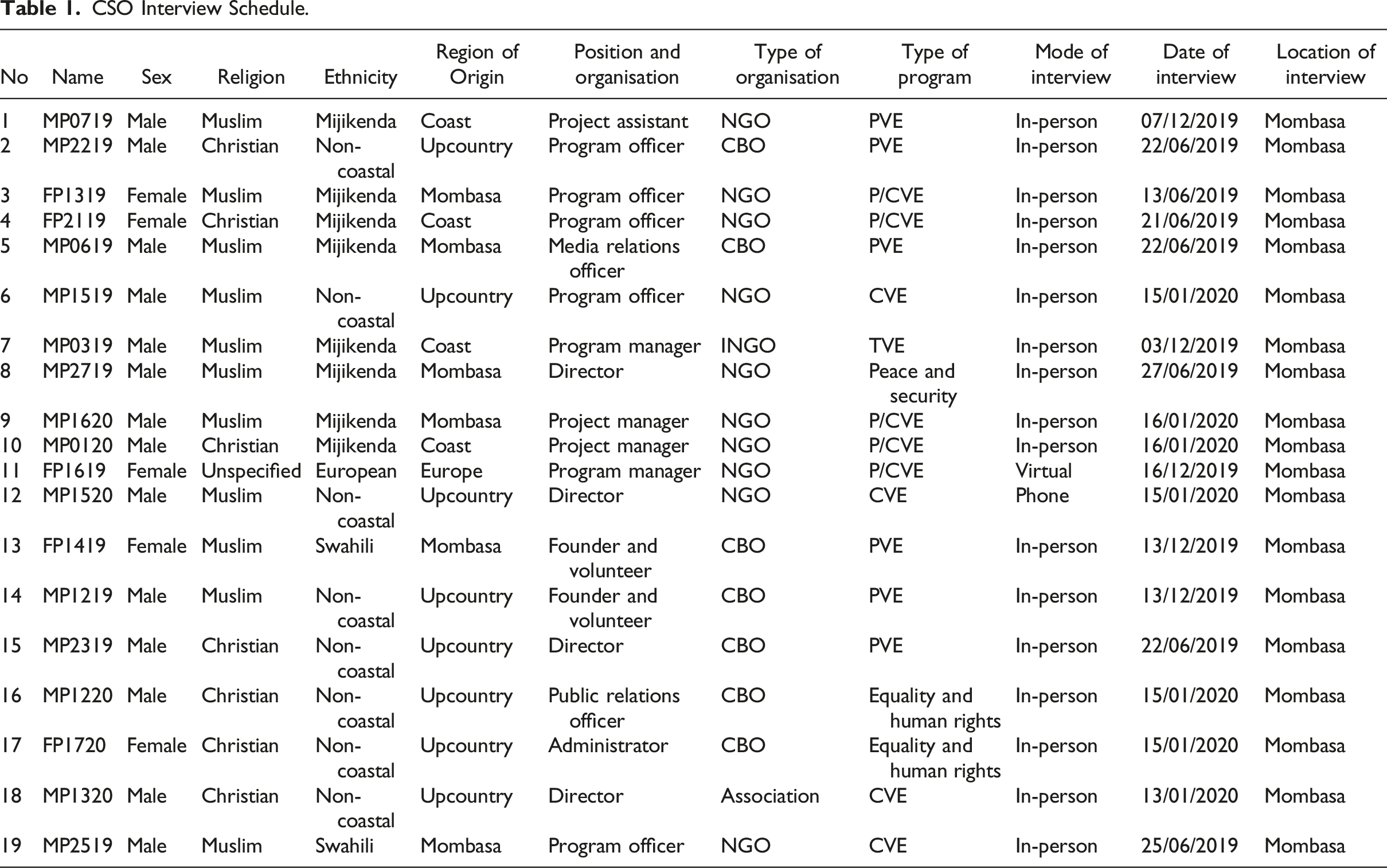
Participants also identified with diverse religious backgrounds: 11 identified as Muslims, seven as Christians, and one did not affiliate with any specific religion. Ethnically, ten participants were coastal natives (eight identifying as Mijikenda and two as Swahili), eight were from other regions of Kenya (including two born and raised in Mombasa), and one was a European foreign national.
The interview revolved around definitions of major concepts in P/CVE i.e., radicalisation and extremism and how these terms are (not) featured in the drafting and implementation of P/CVE. On average the interviews lasted 1 hour and 15 minutes during which they were recorded, transcribed 3 , and then analysed using a critical discourse analysis toolkit. All participants were anonymised during coding to protect their identities, given Mombasa’s relatively small community where identifying some participants might compromise the anonymity of others. A coding system was used to denote gender and assign a unique 4-code identifier – for example, FP1319 refers to Female Participant number 1319, whereas MP2219 stands for Male Participant 2219.
Civil society practitioners implementing P/CVE projects were interviewed because of their unique subject positioning. Research has shown that they are entangled in a complex web of power relations. Where they navigate between local communities’, (inter)national donors’ and governments’ expectations about (in)security and appropriate responses while managing their own economic and ethico-political concerns (Lind & Howell, 2010; Mohamed, 2023). As such civil society serves as intermediaries between the global, national, and local levels; thus, bringing rich experiences and knowledge on the subject. Most CSOs implementing P/CVE were engaged in the consultation process of drafting and implementing the first Mombasa County Action Plan for CVE. Meaning, they represent a particular category within the civil society population who act as intermediaries thus their inputs allow a differentiated examination of the local narratives and how they converge/diverge from dominant forms of P/CVE. A Critical Terrorism Studies reflexive standpoint advocates for engaging local communities (Jarvis & Lister, 2013, 2015) or what Gayatri Spivak (1994) refers to as letting the subaltern speak for themselves. After all, locals have a deeper understanding of their own situations and, as Esteva and Escobar (2017) suggest they are ‘the site of intense forms of capitalist exploitation’, ‘consumerism’, and heteropatriarchy and western domination. However, in such conditions, they selectively and effectively pursue multiple strategies simultaneously. These strategies often enforce (c)overt conditions against mechanisms perceived as neocolonial practices (Escobar, 1995). Notably, civil society actors are not a homogenous group, thus do not speak in a unified voice (Edwards, 2011). Instead, their understanding of social issues – in this case P/CVE – is informed by their multiple, complex and shifting positionings that are dependent on their multiple identities – such as gender, class, ethnicity, race, religion, sexuality, nationality, and geographical location.
This study employs critical discourse analysis (Flowerdew, 2008; Wodak, 2003) and postcolonial theories on subaltern voices (Said, 1979; Spivak, 1994) to examine how civil society constructs counter-hegemonic discourses. The analysis identifies linguistic strategies such as vernacularisation, appropriation and counterarguments to understand resistance within the P/CVE policy landscape. Building on dominant discourses identified in previous research – see introduction – this study explores how civil society creates alternative forms of P/CVE. The analysis was guided by two questions a) what argumentation strategies do practitioners use in the implementation of P/CVE and b) in what ways are these strategies employed by speakers to justify their position.
Findings
Centreing the Local
The views and experiences of participants in this study were similar across gender. For example, most participants, with a few exceptions, perceived P/CVE as constricted. Comparing it to the development policy – in the traditional sense of measures aimed at poverty reduction, improving access to education and health, and communities taking part in peacebuilding – FP2119 expressed that ‘there are programs where NGOs have designed their structure as a relief form of approach. Borrowing from the old days in development work where they would distribute items’. The participant critiques NGOs for recontextualising development (old) programming models onto P/CVE. The P/CVE programs replicate traditional development which assumes a ‘relief-form approach.’ A relief-form approach is insufficient because it often relies on short-term solutions and is based on paternalistic logic. Development programming research shows that often implementation is top-down, and communities are seen as passive recipients of aid rather than active participants in the process (Rahnema, 1997; Rahnema & Bawtree, 1997). FP2119 challenges the authority and effectiveness of such NGOs by suggesting their methods are outdated and not suitable to the problem of violent extremism.
Such scepticism is further expressed on the top-down financial interventions witnessed in the P/CVE space. Arguing that ‘They kind of pour a lot of money and now they [those organisations][sic] are also handling issues of extremism. They have come up with programs and they are saying they are coming to bring economic empowerment in the community’. The participant – who is also a local – is resisting externally imposed solutions and points out that these solutions may not align with community needs or context. Questioning the assumption that external financial investment automatically translates to community empowerment. MP2319 makes a case for local autonomy and knowledge when he says: I was invited to the launch of one such program. I told him […] I am in [...] but if I were in Mombasa, I wouldn’t have attended the event and no one from my organisation is coming to that event. Because I know exactly what you are planting […] Less than 24 hours another group from [...] issued a statement, they attacked two women, said there is discrimination, others get projects, and we don’t. Within 48 hours we were in an emergency security meeting. I told him sometimes we may come up with very good projects thinking that we are solving an issue. But rather we are fueling already existing fires […] So the groups grew to 90 within a week […]
The participant refused to participate in the launch of a program that he saw as counterproductive and harmful. He uses the metaphor ‘planting’ to allude to the impending consequences from the P/CVE intervention
4
. He highlights the fallout and gender-based violence that ensued after the program was launched and ascribes the increasing insecurity to the program. Reflecting on his experience, he advocates for an alternative approach that promotes inclusion and participation by local communities: […] in my work, I normally ask beneficiaries what they want and how they want to do it […] so you need to involve them throughout, involving them means there will be ownership […] if you want to save this community, invest in these young people, you cannot solve this issue, but the youth can deal with their own brothers […] Let them lead the forum, they can
MP2319 resists top-down approaches and emphasises the value of local knowledge and ownership. He argues for a P/CVE approach that is: locally-led and values and incorporates the perspectives of those directly affected by violent extremism.
MP2319 also highlights tensions between development programming and P/CVE, donors and local actors, and collaboration and resistance. The extract reflects unequal power relations between local actors and donors (represented by the western donor-funded program), with donors having more wealth, access to political institutions, control over ideological resources, and experience in political rules. Thus, often the programs are implemented based on western interests rather than local needs (Badurdeen, 2023), meaning they are planned, designed and implemented (even when done by local actors) based on donor-recommended methodologies. Resistance in the extract attempts to subvert such unequal power relations. At a personal-level the participant (a local CSO actor) refuses to participate in imposed programs. Further and albeit with the awareness of his privileged position – gender, class, education status, professional status, access to political institutions, and knowledge and practice of the law as a civil rights activist – proposes a P/CVE approach that considers context.
His proposed approach centres the local community. Even whilst being a local himself, he does not decide/speak on their behalf. Instead, he asks them–denoted by ‘I normally ask beneficiaries…’ about their needs as people directly affected by violent extremism. His proposed approach to engaging communities emphasises autonomy, local knowledge, participation and challenging the dominant ideology that often prioritises external expertise and investment over local inputs and sustainable practices.
Itikadi Kali: Towards a Vernacularisation in P/CVE
In the terrorism and counterterrorism domain, research on the politics of language has shown that the Kenyan government continues appropriating frames, metaphors, tropes and practices of the Global War on Terror (GWOT) to construct its Muslim population as a threat (Al-Bulushi, 2018; Mohamed, 2021a), to draw parallels between eurocentric ideas of terrorism and local manifestations (Oando & Achieng’, 2021; Oando, 2022) and as a tool to exercise political control (Mwangi, 2018, 2019). This awareness on the role of language in framing violent extremism and appropriate responses was captured by MP0619 who said Contrary to popular discourse, radicalisation can be a positive thing, think of Martin Luther King and such leaders. They were radicalised. So, it is a term that is very […] yani ni neno lenye utata na siasa nyingi ndani yake.5 You can even see when the government or the media uses radicalisation it is commonly used to refer to Muslims. So, society has come to regard Muslims as being this way and not any other way. So here and in our work with the communities we use the word itikadi kali6 because it does not single out Muslims. In reality radicalisation exists everywhere you can be radicalised when […] ukiona ama kupitia dhuluma, maonevu, ama unyanyasaji wa kimfumo, wa aina yoyote ile sio dini pekee,7 or you can be radicalised by anything else […] but it is a problem when those boundaries only apply to a religious issue. We are unable to properly define these terms. We have so many terminologies that you cannot even get in the dictionary because they are new terminologies, and everyone is pushing for theirs.
The participant started by acknowledging the politics of language. He disagrees with the mainstream view of radicalisation as being inherently negative. Instead, he presents an opposing view of radicalisation as potentially positive citing influential thinkers such as Martin Luther King Jr, known for his activism and as a significant leader of the civil rights movement in the U.S.
MP0619 uses Dr King as an example to encourage a reflection of our preconceived notions of radicalisation. Further, he tries to articulate his issue with the concept of radicalisation. He resorts to the vernacular that is, to using Swahili language perhaps to speak to my identity and positionality as a local and a Muslim. He adds that the concept is contested and political. He uses the example of the government and the media as actors that deploy the concept to predominantly characterise Muslim populations. This critique shows the biases and discriminatory and stigmatising practices inherent in official and popular discourse. By extension he sees this official view as one that society – in general – has also assumed, indicating how societal perceptions of social issues are shaped by government discourses. His acknowledgement of these nuances and debates builds on scholarship that shows the concepts are not objective categories or neutral reflections of reality (Jackson, 2005). By drawing on these contestations, MP0619 thereby resists the idea of radicalisation having a fixed definition and instead opens a possibility for broader and inclusive understanding of radicalisation. The participant demonstrates active resistance by adopting alternative vernacular terminology, that is, itikadi kali. Vernacular is invoked to first, avoid singling out particular social groups, that is, Muslims and second, to capture the complexity of radicalisation. The participant adds that they use vernacular concepts in their work and when engaging the community. He views radicalisation as complex, adding that people can be radicalised by experiencing diverse systemic injustices. He argues that restricting the parameters to religion, however, inhibits us from seeing its complexity.
Vernacularisation was enacted as a marker of linguistic identity. By resorting to the vernacular, the participant signalled shared cultural and social affiliations with the researcher, and in the community where he implements P/CVE. It also allowed MP0619 to adapt his language to the context which created a sense of intimacy and solidarity. This is the case on Kenya’s Coast, where Swahili remains the dominant spoken language while English is mostly used in formal settings. Besides identity formation, vernacularisation also served a strategic function; switching to the vernacular ensured their message was understood. This is relevant because certain concepts, expressions and cultural nuances might be better articulated in vernacular languages and not others. A good example here is itikadi kali, which directly translates to extremist ideologies, including fundamentalism. The phrase captures diverse ideologies including political, and ethno-supremacist ideologies.
Beyond using the concept of itikadi kali to emphasise and draw cultural nuances, the participant wanted to ensure that his understanding resonated with me, as someone from a similar cultural background. Whereas, in program implementation vernacularisation helps to tone down power hierarchies, and to include all beneficiaries thus capturing the voices of those community members that might be otherwise left out. Notably, vernacularisation was a discursive strategy of resistance. Given that the conception of radicalisation in Kenya recontextualises eurocentric metaphors, tropes, and narratives, choosing to speak Swahili could in the first instance, be read as a strategy to resist dominant eurocentric discourses of radicalisation. In the second instance, it could be a form of resistance against dominant western linguistic norms and corresponding power structures.
Taking the Lexicon as the Bible
The two examples discussed are overt, and intentional forms of resistance. Sometimes resistance is also murky, it is not about complying (or not) but about finding a position that works for a specific institutional context. These positions may be imposed directly through the conditions in donor funding (Badurdeen, 2023; Lind & Howell, 2010), or indirectly be an adjustment made to appease governments in contexts of shrinking civic space (Howell & Lind, 2010). Further, internal politics in a multicultural setting, coupled with their background in development programming and established good relations with the community could also influence the position an organisation takes (Al-Bulushi, 2018).
MP1519’s account evokes these tensions. His organisation has a long history implementing in the peace, security, and development arena, particularly programs on community policing, conflict resolution/reconciliation, and interfaith dialogues. He acknowledges the difficulties of reconciling with the mainstream lexicon and their process of finding a middle ground that seems to work for multiple stakeholders. MP1519 narrates that: In our organisation when we started programming we really grappled with the whole thing on radicalisation because we know even in our Christian and Muslim faiths, radicalisation is also part of how people entrench their values […] Because we found out that it’s very problematic to speak to our constituent about radicalisation […] And so we could talk to Christian clerics and in public they would say you know we understand people have values and need to profess their faith. But when they would recede into their own cocoons or clusters within their intra faith we could hear them blaming the other […] So, when they recede into their own cocoons, you’ll see that there was first prejudice and to some extent hate of the other faith. And you could, especially for Christian clerics could say these people are calling us ‘Kaffirs’ but they are the ones who are radicalising your own and our youth […] in public people would simmer down and just say oh! You see we were living together, and this is my brother. But when we have intra reflections then things would come out, and it brought about a lot of fragmentation within religion, especially between religious leaders […]
MP1519 starts by acknowledging the difficulties with the concept of ‘radicalisation’ which he links to its proximal use with religion. A concern that MP0619 had also raised. And while MP1519 does not explicitly say Islam is associated with radicalisation, he implies this when he compares the conversations and interactions in interfaith settings versus homogenous (Christian) settings. These difficulties were challenging to reconcile also with their stakeholders. He uses the metaphorical representation receding in their cocoons or clusters to show the contrast in narrative change between conversations happening in open interfaith settings and closed homogenous ones. In the former, clerics’ narrative indicates tolerance, understanding, cohesion and love expressed through a conversation between brothers. Where brothers metaphorically indicates shared cultural and social identities and resources. Hence, radicalisation is viewed as a communal or shared problem, that is, ‘our problem’ that we should solve together. In the latter case – a homogenous setting – Christian clerics express their frustration at their Muslim peers, erecting a religious boundary, that is, they are Muslims; we are Christians, their youth; our youth. Thus highlighting cultural differences between ‘the self’ and ‘the other’. Further, in this setting, Christian clerics can speak openly; hence, the collective narrative is that Muslim clerics qua Muslims are to blame for radicalisation of both Muslim and Christian youth. Given that this occurs in the context of al-Shabaab espousing hateful rhetoric and attacks targeting Christians, the cleric’s frustration and the hate that MP1519 noted comes from a place of fear and lost sense of security.
Accordingly, this tension brought about fragmentation. MP1519 adds that […] you see some of this lexicon that is used in violent extremism is very foreign […] And so for us practitioners, we were swallowed in. We jumped on the bandwagon and took this lexicon as the bible and let me say, it worked against us […] of course, we changed tact and we said so why don't we just concentrate not just on radicalisation but radicalisation that partly leads to people joining and being recruited in violent extremist groups and terrorism for that matter. And so that also made us to refocus programs not just on the general public, […] but also refocus some on a small section of the public, that people considered to be vulnerable. And this will be for example, I wouldn’t want to draw profiles because that really brought some problems but people who have been in criminality and are believed to have white and black views in terms of their beliefs […] So we worked with those people, we built a profile, which is not very good because it is profiling but it helped us to zero in to the people that are most affected but also those that are very vulnerable.
MP1519 acknowledges that P/CVE lexicon is mostly foreign, and that mistakes were made at the institutional level. He captures this using two metaphors ‘to be swallowed in’, ‘jumped on the bandwagon’, and one analogy ‘took the lexicon as the bible’. The metaphorical representations indicate that practitioners adopted the problematic lexicon because it was popular and widely accepted, exposing how even institutions are not inoculated from social pressure. This introspection also serves as a critique of superficiality and opportunism. Given the ever-increasing donor-funding on P/CVE in Kenya, appropriating jargon and methodologies that recontextualise donor language strategically serves to ‘keep the funding coming’ as MP2319 noted. Given increased securitisation (Lind & Howell, 2010) appropriation can be a strategic measure adopted by institutions to avoid government scrutiny. The analogy ‘taking the lexicon as the bible’ equates the terminology with the bible, suggesting the terminology was an indisputable truth, unquestionable, and from a revered and sacred source. This approach proved counterproductive, but instead MP1519’s institution decided to narrow down their focus. He acknowledges that some of their practices (e.g. profiling) of identifying ‘vulnerable’ groups are problematic but at the same time necessary to offer targeted support. This extract shows an organisation aligning with mainstream counterterrorism narratives by appropriating problematic practices (terminologies and methodologies). Furthermore, the organisation also seeks legitimacy by tailoring some of their programming to focus on a small section of the population; those deemed vulnerable as opposed to casting a wider net. In this appeal to ‘specificity’, in addition to general programs, MP1519s organisation appropriated one of the most prominent discourses in terrorism and counterterrorism which calls for practitioners to develop tailored approaches that account for context and cultural settings.
MP1519’s account indicates the complexity of appropriation strategies. It shows resistance ideologies can also operate within the boundaries of general hegemony. However, this resistance strategy proved successful for his organisation. In the broader context of civil society organisations being gazetted and targeted by the government for criticising counterterrorism policy (Kiai, 2015), appropriation allowed them to construct their identity as compliant thereby securing legitimacy to implement P/CVE.
Conclusion
This study examined how civil society practice resistance in the P/CVE policy agenda, highlighting their actions are shaped by an interplay of complex global paradigms and local realities. The study demonstrates that resistance is not uniformly oppositional; rather it emerges in different forms – counterarguments, vernacularisation, and appropriation – each reflecting different modes of negotiating with dominant discourses and power structures.
Understanding resistance at this conceptual level is crucial, as it underscores its situated nature as shaped by the sociopolitical and cultural milieu – donor funding conditions, securitised counterterrorism, civil society-community trust relations – in which civil society actors operate. In Kenya, P/CVE remains highly subsumed in the development agenda, and the programming environment is tightly aligned with government-led strategies and the priorities of INGOs and local NGOs (Badurdeen, 2023). Consequently, civil society face manifold pressures: the need to align with government policies for operational safety and the imperative to uphold long built civil society – community trust (Al-Bulushi, 2018). Even within this complex interplay of constraints, local actors demonstrate agency by crafting alternative programs that fuse dominant western knowledge systems with local contextual particularities (Björkdahl & Gusic, 2015; Levitt & Merry, 2009; Acharya, 2004). The fusion reflects an adaptive approach of resistance, where local norms – long-held Christian-Muslim relations of tolerance, a do-no-harm approach – and cultural frameworks – for example, the reliance on local trust networks – inform innovative responses. Additionally, the emerging P/CVE also fuse soft and hard security practices with development-humanitarian practices (Simpson & Holdaway, 2023). This negotiation of boundaries – between activism and state-defined acceptability, between the centre and the periphery, and between national and geopolitical interests – underscores the critical role of social norms in shaping resistance. Actors who conform to dominant frameworks gain legitimacy, while those who deviate are often marginalised and their practices delegitimised thus impacting activism and the conduct of politics in general (Mohamed, 2023).
Findings from this study challenge both the dominant liberal narratives on civil society operations as either complicit in or resistant to hegemonic practices, and the hegemonic assumptions underpinning global counterterrorism paradigms. They demonstrate nuanced forms of power and agency in how civil society navigates and reconfigures the spaces between formal institutions and informal networks, between international norms and local realities. For global politics, this underscores the need to reconceptualise agency in the global South – not as derivative or reactive, but as generative of hybrid forms of governance and security knowledge. Such insights call for a decolonial rethinking of policy frameworks and knowledge production in P/CVE. From a policy perspective, the study underscores the need for P/CVE frameworks to prioritise subaltern perspectives of (in)security. Additionally, policies should safeguard the autonomy of CSOs through legal protections and institutional frameworks that allow them to operate free from fear of suppression or delegitimisation.
Data collection for this study was shaped by security sensitivities, potential participant risk, and funding limitations, which could have led to underrepresentation of more marginalised or less formalised civil society actors. Furthermore, the temporal scope limited the ability to track shifts in resistance practices over time.
Future research should explore resistance in its less visible forms – for example, through art – and in informal civil society spaces including those excluded from donor-led programming. In addition, comparative studies could also illuminate our understanding of how civil society navigates securitisation in diverse political and cultural settings.
Footnotes
Acknowledgement
I am thankful to Maura Conway, Walt Kilroy, the special issue editors, reviewers, and other colleagues for providing helpful feedback on drafts of this article.
Declaration of Conflicting Interests
The author(s) declared no potential conflicts of interest with respect to the research, authorship, and/or publication of this article.
Funding
The author(s) disclosed receipt of the following financial support for the research, authorship, and/or publication of this article: This research was funded by the School of Law & Government, Dublin City University.
Ethical Statement

Data Availability Statement
Data not available – participant consent: The participants of this study did not give written consent for their data to be shared publicly, so due to the sensitive nature of the research supporting data is not available.