




Abstract
Jordan has recently celebrated its centennial in a volatile region. The Jordanian regime has an experience in dealing with mass protests; however, the recent decade with a surmounting socio-economic challenge aggravated by the mass influx of Syrian refugees has pushed the Kingdom towards a “boiling point.” The narrative of political reform has been dominated the daily political life of the monarchy; however, citizens have disillusioned with the pace of political liberalization in the Kingdom. Constitutional amendments mainly empowered the King authority with new rights, and the new election law adopted in 2016 failed to meet with the demands of the protesters. Jordan is not a country in political transition as the regime has remained intact from a genuine structural reform aimed at reaching a constitutional democracy. The introduction of economic liberalization process as well as the austerity measures dictated by the International Monetary Fund has led to an eroding social base of the monarchy. The rise of the new businessmen elite and the growing socio-economic problems in the tribal South made the society restructured in a way, which provoked more protest waves. Until now Jordan has managed to tackle with all difficulties; however, the pandemic and the shifting regional order have been aggravating the situation. The reforms mainly serve as a regime survival strategy; however, the ones launched in 2021 show that the monarch understands the situation. It has yet to be seen whether the new reforms will last and satisfy the citizens.
Keywords
Jordanian Exceptionalism?
Jordan has witnessed waves of protests and turmoil in its history both rooted internally and/or caused by external factors. Since the establishment of the state of Jordan, it has survived many critical junctures of history. The aim of this paper is to focus on how the recent Arab Uprisings have challenged the monarchy and what type of political strategy the Kingdom has followed in order to preserve the status quo. In order to do so, this article is aimed at embedding the Jordanian political challenges into the broader context of the region’s processes.
In addition to examining the peculiarities of the Jordanian political system, this essay will assess the country’s most current political events following the Arab revolutions. Given that Jordan’s internal circumstances are inextricably linked to the broader geopolitical developments, a thorough examination considers additional context-related variables. The study begins by summarizing the salient features of the political system in Jordan and then analyzes the most recent political reforms. This author contends that, despite the monarch’s claims of political transformation, Jordan’s political system has not undergone a substantial structural change.
The state of Jordan was established a hundred years ago in 1921, and it gained independence in 1946. Due to its geographic location, the country has been influenced by the political difficulties of the neighboring countries, namely, the Palestinian issue, and two recent state vacuums (Iraq and Syria) with their consequences (refugees and rise of radicalism). Until 1989, the political system could be described as an absolute monarchy with a ban on political parties. During the last four decades, the Jordanian monarchy has embarked on a series of political reforms aimed at preserving the stability of the system. This article pays particular attention to the recently introduced political reforms by Abdullah II since the beginning of the Arab Uprisings in 2011. Although the Kingdom has been challenged by the waves of the Arab protests, however the monarch’s reform-minded policy could calm down the demanding citizens. However, this liberalization process does not mean a structural change, and it does not threaten the existence of the monarchy and the so-called Jordanian regime.
Academic scholars have often been referring to Jordan as an exceptional case among the political systems in the MENA region. According to Moaddel (2002), the state-religion relations distinguish the country from the other states as the monarchy observes a non-violent branch of political Islam, which has been constantly engaging politically with the monarchy despite its criticism on it. Others base the difference of the political system on the geopolitical turbulences, which made some regional powers like Israel and global players like the US interested in the stability of Jordan (Ryan, 2018, pp. 175–176). The interlinkage of Jordan with the Palestinian struggle for independence made the Kingdom vulnerable to the Arab-Israeli conflict in the broader sense.
Comparative political studies, however, could place Jordan among the MENA political systems labeling it either as a façade democracy, an authoritarian country, or a non-free regime (Teti et al., 2018, p. 19). Jordan together with Morocco belong to the so-called civic-myth monarchies with the absence of a fully rentier economy (Kamrava, 1998). Brownlee et al. (2015) explore how the Arab Uprisings impacted different types of Middle Eastern political systems. The 2011 protests have swept through the non-rentier republics, while the members of the Gulf Cooperation Council (GCC), that is, the rentier monarchies, have been remaining the most stable countries except Bahrein. The non-rentier monarchies like Jordan and Morocco have rushed to secure their regime survival with gradual cosmetic reforms to face an eroding social base of the regime.
The Jordanian state owns six important features providing legitimacy which made it less vulnerable to the local or regional challenges. 1. One is the monarchical system itself, which according to certain empirical studies has a better coping with existential threats compared to republics. This is especially true for the Middle Eastern region, where monarchies have managed to deal with the Arab Uprisings in a more sophisticated way, and no regime collapse had occurred (Yom & Gause III, 2012). 2. The second is the religious embeddedness of the monarchy with a royal dynasty, which has been regarded as a direct descendant of the Prophet Muhammed. Even though Jordan was named after a river, and the territory itself lacks any historical identity, a religiously based monarchy with an “enlightened technocrat” ruler seems to be a fair combination for enhancing authoritarian resilience. Sharnoff’s recent paper illustrates how the Hashemite monarchy employed postage stamps to cultivate a unique Jordanian identity amidst the complex layers of culture within a diverse society (Sharnoff, 2024). 3. The third is Arabness, or the legitimacy derived from Arab nationalism of the early 20th century. When the Sharif of Mecca, Hussein, sent his two sons to establish the imagined Arab Caliphate, Abdullah I created the emirate not only in the name of religion but also of pan-Arabism. 4. The fourth factor shaping the Jordanian political landscape is the role of the deals between the royal family and the East Banker tribes (Susser, 2021). This phenomenon creates a peculiar political landscape to the Kingdom, where the Bedouins play a pivotal role in maintaining order. 5. The fifth feature of the Hashemite Kingdom is the vast amount of international military aid the Kingdom receives mainly from the United States as a major ally and the regional actors (Saudi Arabia). However, Jordan has not been regarded as a rentier economy like the oil monarchies in the Persian Gulf. Some experts define Jordan as a semi-rentier monarchy recognizing the vast amount of international development aid the Kingdom receives mainly from the United States as a major ally (Yitzhak, 2024). The Arab Uprisings have proved that having a rentier economy could help to maintain the social contract. 6. The sixth has been the existence of the Palestinian factor since the establishment of the State of Israel in 1948. Without a Palestinian state, Jordan’s self-perception includes a continuous commitment to the national struggle. Despite the disengagement from the West Bank in 1988, Jordan’s foreign policy pays a particular attention to the Palestinian cause given the fact the approximately half of the population is of Palestinian origin (Oudeh, 2020). Jordan’s royal family inherited the custodianship over the Islamic and Christian religious sites in Jerusalem, which strengthens the responsibility of the state.
The Hashemite Kingdom and the Arab Uprisings
Jordan has been witnessing five waves of protests since 2011 rooted in different specific issue. The first phase of the demonstrations has started in 2011, when protesters called for political and economic reforms. However, protesters on the streets of Jordan have never questioned the existence of the monarchy or the role of the royal family itself. The second wave of protests in 2012 erupted due to the decision to decrease state subsidies on basic food items and fuel, which made the unwritten social contract collapse. In 2016, Jordan’s gas deal with Israel in parallel with a constitutional amendment caused dissent. Fourth, in 2018 a tax increase and the forgotten reforms intensified the ongoing labor strikes (Peterson et al., 2020). Next in 2021, water scarcity combined with a new agreement between Jordan and Israel on water to energy exchange attracted the citizens to the streets.
One significant difference among Middle Eastern regime types is how the regime responded to the political mobilization of the citizens. Many of the cases in the Arab World include violent reactions to public unrest. One recently published study has shown how Arab states relied on the use of violence against their citizens to deal with the uprisings. The recent decade of the Arab Uprisings has increasingly forced the regimes to rely on physical oppression resulting in deaths (Josua & Edel, 2021). Some states which have been encountered with state vacuums and disintegrating structures have been leaning more on brutal crackdowns like Syria, Yemen, or Libya. Other states have used significant violence against protesters like Egypt. A small number of regimes, however, have self-limited themselves in relying on force, instead they combined political but not physical oppression with co-optation and other techniques (Elkahlout & Hadid, 2021, pp. 863–867). For these regimes, other political tactics like authoritarian upgrading have provided the imagined outcome, relative stability. More resilient authoritarian regimes tended to be more flexible in learning from other similar political elites how to deal with the protesters (Heydemann & Leenders, 2013).
Jordan belongs to the last group, where the regime has mainly built its survival strategy on portraying itself as a reform-minded, technocrat one taking generously care of its citizens (Yitzhak, 2022). According to the Global Peace Index (GPI), Jordan has ranked third among MENA countries after Qatar and Kuwait, while it has been placed as 57th on the global scale (Weldali, 2022). Jordan has neighbored with Syria, which was among the least stable and peaceful country in the whole region. The index is composed of different variables including stability and violence.
In Jordan neither these protests have never crossed the red line directly pointing the critics towards the royal family. Nor the response from regime has been included a bloody reprisal as citizens have experienced in other countries like Syria or even in Egypt (Beck & Hüser, 2015, p. 86). That was not only a strategic calculation from the regime side, but it is also part of Jordan’s political culture. Jordan has historically witnessed a near civil war situation with the military activity of the Palestinian Liberation Organization (PLO), which led to the decision of King Hussain to oust those groups from the monarchy. Even though approximately 50 % of Jordan’s population is of a Palestinian origin, violence has not been part of the daily routine of the regime.
Recent protests at the time of writing contradict the above-mentioned tendencies. The new wave of the fuel price-driven popular unrest in November 2022 shows a certain level of violence as policemen around the country have been killed related to the protest (Ryan, 2022). In their rhetoric, protesters exercise self-restraint and reject the use of violence. Occasionally, such kind of political tensions results in clashes with police forces; however, they do not demolish the larger picture of relatively peaceful state-society relations compared with other countries in the region.
A recent survey enlisted the major issues, which have triggered the protests, and it identified the differences among different age groups and social classes. Results from 2011 show that in the age group 18 years or above in Jordan fewer than 1 in 20 participated in the protests, which is relatively low compared to Egypt (1 in 10) or Tunisia (1 in 4) (Teti et al., 2018, p. 36). Jordan stands alone with the fact that urban middle class citizens were overrepresented in the demonstrations, unlike in Tunisia and Egypt, where mainly the 18–24 age group has been the most actively engaged in the protests (Ibid. p. 39). Regarding participation in the protests, the Egyptian (73.5 % of protesters are male) and Tunisian (70.7 % of protesters are male) cases are male-dominated, unlike Jordan, where there is no significant difference along the gender line (50.8 % of the protesters are male) (Ibid. p. 37). Respondents mentioned the economic difficulties as more important over the absence of political freedoms. In Jordan, the survey of 2014 shows that 76.9 % of the respondents answered that economic issues triggered the public unrest. In Egypt (69.2) and Tunisia (62.8), economic issues seemed somewhat less important (Ibid. p. 42). These findings strengthen the arguments of the theoretical literature about the roots of the Arab Spring, namely, the economic grievances and the collapse of the “unsocial social order” were the main drivers of the Arab Uprisings (El-Haddad, 2020).
Reform Attempts: A Façade Democracy or Reform without Revolution?
From a historical perspective, protests are not a new phenomenon in Jordan’s political history as the Hashemite Kingdom has witnessed waves of protests called bread riots. However, as we have seen in the previous subchapters, the spillover effect of the Palestinian issue caused a near revolutionary situation, in which the monarch decided to terminate the use of Jordan’s territory despite the official annexation of the West Bank by Jordan in 1950. Previous studies have highlighted the reformist potential of the bread riots; however, recent works focused more on the revolutionary factor of the uprising (Lynch et al., 2022, p. 63). The main research question of this article is the potential for significant reforms in the Hashemite Kingdom of Jordan. As Ryan (2018, p. 21) argues that “Jordan was modeling an alternative and decidedly Jordanian and homegrown version of the Arab Spring, one based on reform without revolution, change without chaos or instability.”
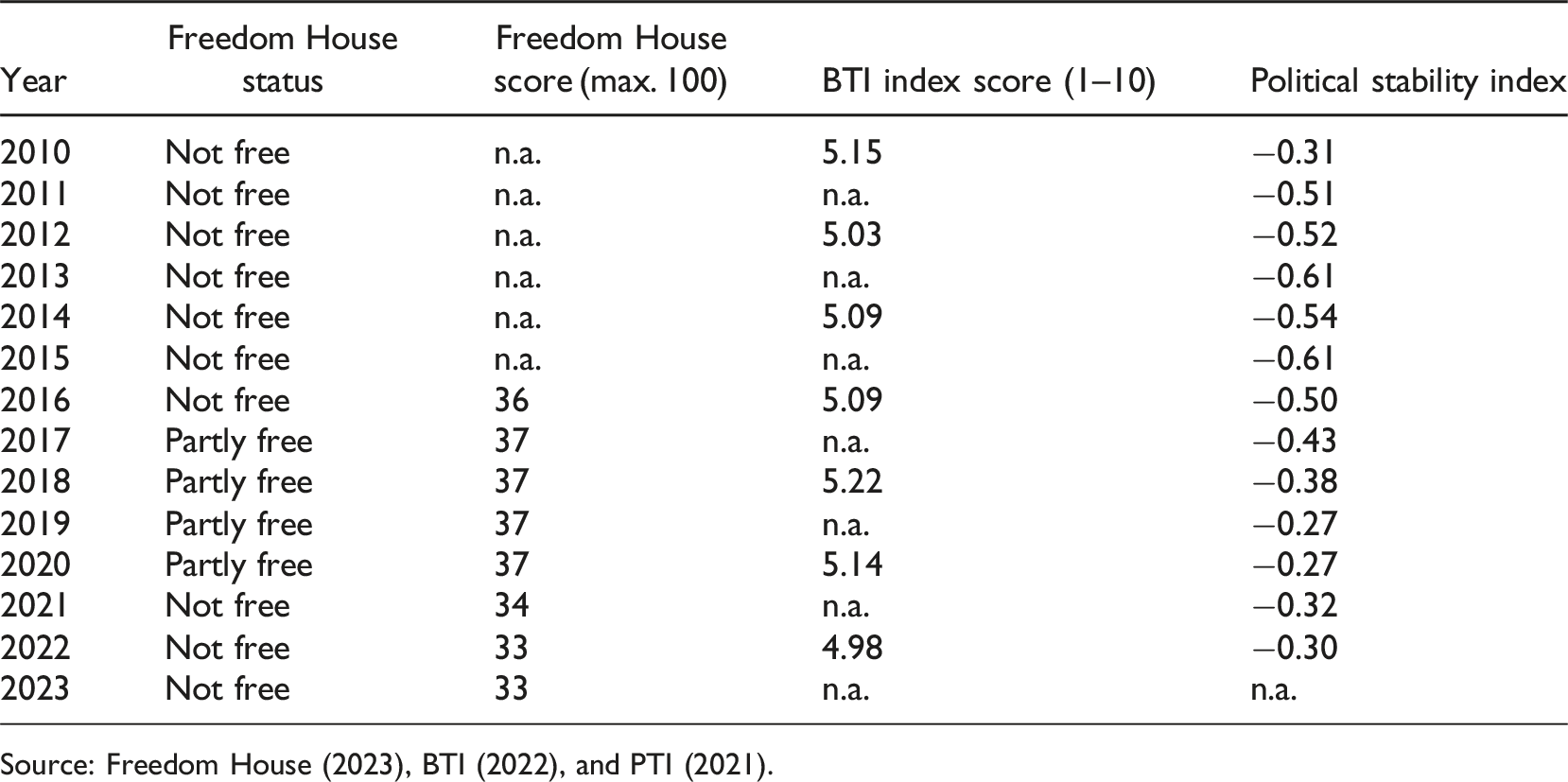
According to the Freedom House country report Jordan’s status changed in 2021 from a partly free country to a not free country. With this change, the Hashemite regime belongs to the majority of authoritarian systems in the Middle Eastern region (Freedom House, 2023). According to the Bertelsmann Transformation Index (BTI), which measures a state’s policy towards a democratic reform and market economy, Jordan has been classified as a “moderate autocracy.” The country in 2022 ranked 75 worldwide with an index of a 4.98 on a 1–10 scale (BTI, 2022). Other index to refer to is the political stability index, which places the countries between −2.5 (weak) and +2.5 (strong). Jordan in the latest 2021 ranking was placed 118 with a value of −0.30. With this value Jordan is the fifth most stable country after Qatar, the United Arab Emirates, Oman, and Kuwait in the MENA region. However, what is more important is how the values have changed. Since 2015 we can witness a significant improvement in the overall value from −0.61 to −0.26 in 2019 (PTI, 2021). 1. Characteristics of Jordan’s political regime according to certain indexes. Source: Freedom House (2023), BTI (2022), and PTI (2021).
Political liberalization in the MENA region has often been regarded as a regime survival strategy in the hands of the ruling elite. Jordan has witnessed several waves of political liberalization, which usually coincides with a major economic crisis. However, neither wave of reform had any meaningful effect on the absolute monarchy, in which the power is in the hands of the royal family. In short, Jordan has not experienced a significant structural change in its political system since 1989. In Jordan, the “silent majority” of the citizens favors genuine political reform unlike the old guard/conservative groups which in the name of stability call for self-restraint in the democratic course (Torki Bani Salameh, 2017, pp. 49–50). The regime mainly coalesces with the latter group, which resulted in only unmeaningful reforms.
The first wave of political liberalization was started by King Hussein in 1989, when the Hashemite monarchy witnessed a serious economic crisis. The monarch ended martial law in 1991 and allowed to establish political parties in 1992 as well as to organize general elections in 1993. Jordan is exceptional in the sense that its moderate Islamist movement, the Muslim Brotherhood, managed to establish its own political party, the Islamic Action Front (IAF). Although the IAF has been critical with many of the decisions made by the regime—including the peace treaty with Israel in 1994—Jordan is a rare exception in the region with an Islamist opposition co-opted by the ruling elite. The 1993 elections could be regarded neither democratic nor free; however, the political atmosphere significantly differs from the previous era (Csicsmann, 2007, pp. 100–101).
The second period of political reform has been introduced by the new King, Abdullah II in 2002, after nearly two years absence of parliamentary life in the Kingdom. The new technocrat-oriented King experienced a serious security vacuum in the MENA region, with the Global War on Terror launched by the Bush administration in 2001 as well as the US decision to intervene in Iraq and topple the Saddam regime (Ryan & Schwedler, 2004). In the shadow of the influx of Iraqi refugees to the country, the King launched the Jordan first (al-Urdun Awalan) campaign as well as introduced changes in the highly controversial election law (George, 2005). The “one man, one vote” principle has been criticized by major opposition groups due to its marginalizing effect on them. The Jordanian electoral law disfavors the political parties; however, it prefers independent candidates, which creates the political base of the elections (East Banker tribes). With the amendments to the electoral law, the number of deputies was raised, a six-seat quota for women was introduced, and the number of electoral districts was raised from 21 to 45. However, elections under King Abdullah II have been described as undemocratic, a process in which the state has control over the population. This period has often been characterized as an era of “democratic decline” (Torki Bani Salameh, 2017, p. 54), which was considered to be as one of the factors behind the Arab Uprising.
In 2010, the National Coalition for Reform (NCR) was established with the main goal of modifying the “one man, one vote” system to a new electoral law, which allows the national party list as well. On the one hand, it is a positive sign that opposition parties have started a cross-ideological cooperation, but, on the other hand, due to their marginalization in Jordanian politics they failed to achieve putting enough pressure on the government (Ryan, 2018, p. 55). The 2010 electoral law was based on the same principles of gerrymandering, namely, it marginalized the Palestinian-dominated regions in the North and strengthened the position of the Southern East Banker tribes.
The third wave of political liberalization coincides with the Arab Uprisings to which Jordan was not an exception. The camp who calls for genuine political reform raised their voice for structural changes in the political system including the reform of the election law, amendments to the constitution, a meaningful Parliament, fighting against corruption as well as a more effective management of the economy among others. The main socio-economic demands of the protesters have been translated to political goals, which encountered with a new type of grassroot political activism called the Hirak (Ryan, 2018; Torki Bani Salameh, 2017). Jordan regarding the initial demands of the protesters in 2011 was not significantly different from the other monarchy with the same regime type, namely, Morocco.
The Hashemite regime embarked on a series of reforms or political liberalization process aimed at preventing the rise of a more violent or revolutionary episode of the Jordanian Spring. The monarch dismissed the unpopular government and appointed Ma’rouf al-Bakhit for the position of the Prime Minister. At the same time, a 500 million USD welfare package was introduced for public sector employees in the form of subsidies (Elkahlout & Hadid, 2021, p. 864). As the fragmented political opposition was not satisfied with the Ma’rouf government, the King decided to appoint an internationally recognized judge, Awn Shawkat Al-Khasawneh, as Prime Minister in October 2011. This political decision echoes with other Arab Spring countries experience. Both for the presidential systems and for the monarchies, to dissolve a government is a low-cost, low-risk move as it does not imply any structural change in the system. It has been regarded as part of the authoritarian adaptation, upgrading strategy of the regimes in the MENA, which enhances resilience. These governments are not the results of free and fair elections but mainly ones nominated by the ruling elite.
For King Abdullah II, the goal was not only to preserve stability inside the monarchy but to reinforce the image of an enlightened ruler for the outside world in a highly turbulent region. The stability of Jordan was important at least for the Kingdom’s three most important partners: Saudi Arabia, the United States as well as Israel. Saudi Arabia’s financial incentives along with other GCC states’ support have helped to prevent the Jordanian economy from further destabilization. At one point, the GCC even invited Jordan and Morocco to join the club of Arab monarchies; however, it has never been realized (Noueihed & Warren, 2012, p. 256).
As far as political liberalization was concerned, the King appointed two committees in 2011 in order to make progress in the stalled reform process. The first committee oversaw launching a national dialogue to draft a new election law and other laws related to the political life, while the second committee’s task was to recommend amendments to the existing constitution (Yitzhak, 2018, p. 31). From the regime side, it was important to maintain the popular image that the King takes care of their citizens, listens to their problems, and regularly consults (the principle of Shura in Islamic tradition) with major stakeholders in the society and political life.
King Abdullah II has several times reiterated that Jordan “…aims to be a haven in a turbulent region”—as in a speech at the European Parliament in April 2012 (King Abdullah, 2012a). However, from the regime side there was no real determination to change the “one man, one vote” system election law as it was widely regarded as part of the regime survival strategy to maintain stability.
The National Front for Reform was established by the former head of the intelligence services, Ahmed Obeidat, in April 2011 including opposition groups both from the leftist and Islamist ideological spectrum of Jordan’s political life calling for a new election law, fight against corruption as well as media freedom. The royal committee which was in charge for constitutional amendments submitted its recommendations to the King quite quickly in August 2011. This committee recommended to amend the constitution in 41 places including the establishment of an independent election committee or the limitation of the government to dissolve the Parliament or issue temporary measures (Muasher, 2011). These amendments have been approved and it was regarded as an important step towards a more inclusive political system; however, it failed to address the most sensitive issues regarding the King’s absolute power embedded in the constitution. In the meanwhile, in Morocco the constitutional amendment included a direct reference to the necessity of appointing as prime minister that political party’s nominee, which won the elections. However, it does not challenge the power of the King, which is embedded in many other ways in politics and society.
The National Dialogue Committee has submitted its recommendations to the King in 2012 and not surprisingly the proposals included the major demands of the political opposition, namely, the modification of the election law and the law on political parties. Regarding the latter, it has been called for an ease of the establishment of political parties in the Kingdom as well as to amend the election law with introducing new regulations. Finally, the government unveiled the proposed new elections law, which has been adopted. The election law was an amendment to the previous one with two major modifications: it introduced a mixed electoral system, in which the citizens are allowed to vote for national list (for 18 % of the seats in Parliament); and it increased the number of deputies from 120 to 150 including a rise of the women quota from 12 to 15. The political opposition was deeply disillusioned with the pace of political reforms initiated by the King as a response to the Arab Uprisings. They argued that the election law maintained the same gerrymandering issues with the voting districts, and they called for at least 50 % allocation of seats on the national list (Yaghi, 2012). The King, however, was unwilling to consider further amendments to the laws in concern. “And as I stated before, my message to you and to all political parties and forces is this: If you want to change Jordan for the better, there is a chance, and that chance is through the upcoming elections, and there is a way, and that way is through the next Parliament. As for those who want additional reforms or want to develop the Elections Law, they can work from under the dome of Parliament and through the ballot boxes, which are the true representative of the will of the people.”
—said by King Abdullah II (2012b) in October 2012 at a meeting with national public figures. The 2013 elections could not be regarded as free and fair elections as many frauds have been reported. However, it was the first time when the King consulted with the Parliament regarding the person of the Prime Minister. As Beck and Hüser (2015, p. 87) argue, “in comparison with the year 1989, Jordan is less free in 2013.” There was a high expectation by the international community to witness successful democratic transitions in the Arab World as part of the Arab Spring. However, Jordan has remained an authoritarian monarchy. It has often been misinterpreted when a political change occurs in a country it would not automatically mean regime change. In the case of Jordan, the main pillars of the regime have remained intact by the challenges of the popular protests and the rise of the Hirak.
However, political turmoil did not end with the elections of 2013 as the monarchy experienced a further deterioration in socio-economic conditions as well as new waves of protests. These challenges—which this article could not elaborate on in details—catalyzed further political reforms. New controversial constitutional amendments were introduced in 2014, which enlarged the authorities of the monarch: for example, the constitution gives an exclusive right to the King to appoint the chief of the armed forces as well as the head of the intelligence service (General Intelligence Department, GID). This amendment caused an outcry in Jordan, and it shook the belief of the so-called political opposition in any kind of reforms initiated by the King (Al Sharif, 2014). The decision could be explained by the geopolitical situation/turmoil in the neighborhood, especially with the evolution of state vacuum in Syria and the constant rise of the Islamic State. However, it is in stark contrast with the reform-oriented image of King Abdullah II.
The next wave of reforms was introduced in 2016 with additional constitutional amendments and the launch of the new election law. As Obeidat argues, the process of “constitutionalizing the monopolization of power” in the hands of the monarch further deteriorates the democratic expectations in Jordan (Obeidat, 2016). According to the rhetoric of the monarchy all reforms that had recently been implemented aimed at developing a Parliamentary democracy, in which the deputies have the right to elect the Prime Minister and the government. These amendments, however, again strengthened the position of the King as widened authorities were vested in the monarch. The King could appoint the head of the Gendarmerie aimed at preserving its neutral position. And according to the recent modification, the King obtained exclusive rights in nominating key positions without any consultation or signature from the Prime Minister or other politicians (Bouziane, 2016).
In 2015, the law on political parties was modified to limit the political groups affiliation with foreign organizations among other changes. In March 2016, the long-awaited new election law was adopted with introducing a multiple vote system and abolishing the single non-transferable vote (SNTV) or the so-called “one man, one vote” system, which had been heavily criticized by opposition parties, including the IAF. This move was applauded by major international stakeholders as a move towards a more democratic system (Hussainy, 2017). Previous elections had been boycotted on many occasions by major political actors, including the IAF (1997, 2010, and 2013). The political dynamics between the regime and the Islamist actors have played a pivotal role in the pace of political reforms (Köprülü, 2014). The inauguration of the proportional open list system in Jordan is a significant step in the direction to restore or introduce real Parliamentary politics in the monarchy. However, scholars focusing on election law emphasize that the new election law in the shadow of a weak party system and strong tribal affiliation did not result in a significant change (Karmel-Linfield, 2021). The regime without any major political cost could introduce the new law as it would not pose any challenge to the existing system. The explanation lies behind the fact that tribal groups could even better mobilize members on a list unlike political parties, which face major obstacles and limits to their work. Therefore, the King received many criticisms from political groups within Jordan, as it seems there is no willingness to break with the old habits to base the Kingdom’s political support on the so-called neoliberals (businessmen) and East Banker tribes.
The other important issue regarding the new elections law is the change in the number and size of the electoral districts. The new law enlarged the size of the districts aimed at easing political groups to form lists; however, the same disproportionality remained intact disfavoring the urban Palestinian population in the North (Hussainy, 2017). The 2016 elections showed a return of the IAF in the political competition, as it won 10 seats in the Parliament. According to the election results the voter turnout was relatively low (36 %), which shows the absence of legitimacy of the system (Singh, 2017). Another feature of the 2016 election is the return of a weak, but still existent political opposition in the Parliament. The National Coalition for Reform (including the IAF) won 15 seats in the Parliament. Other political parties gained another 20 seats, but at the same time independent candidates obtained the majority of seats (95 seats from a total of 130, 73 % of the total seats).
The 2016 elections show how dissatisfied citizens were with the political process in the Kingdom. According to Arab Barometer Wave IV (2016) Jordan country statistics, only 6 % of the respondents said that they have trust in political parties, while 26 % have confidence in Parliament. The survey reinforces the image that the main concerns for the majority of Jordanians in 2016 were economic difficulties (79 %), followed by corruption (39 %) (Arab Barometer, 2017). Jordan witnessed major nationwide protests in 2018 during Ramadan, which were caused by austerity measures and price hikes.
The COVID-19 pandemic has created a situation where authorities can suppress dissent, particularly from Islamist groups, and enhance security measures against protests. The usage of social media and the digital sphere by movements has increased; however, authorities have also implemented regulations on them (Kikkawa, 2024).
The latest wave of reforms was introduced in 2021 with the establishment of a royal committee with a purpose of initiating a national dialogue on certain political issues. However, the last few years have brought new local and regional developments, which should be introduced before exploring the chances for a real political transformation in the monarchy.
Issue-Based Politics Influencing the Pace of Reforms in Jordan
The desire for political reforms both for citizens and the regime is not independent from shifting local, and regional context and perceptions. Certain issues emerged, which are important variables in our analysis regarding the potential of structural reforms in Jordan. This article briefly draws attention to four important issues.
The Dynamics of Islamist Politics in Jordan
As it has been noted earlier, in Jordanian politics the political wing of the Muslim Brotherhood, the Islamic Action Front Party, has played the role of political opposition among other groups. Jordan is unique among Arab countries in the sense that a political party can be legalized in the name of a religion. Historically, the moderate Islamists have been playing a constructive role in the monarchy despite its critical position on certain issues. Since the beginning of the rule of King Abdullah II in 1999, the relations with the IAF have been ambiguous due to a mainly securitized perception of the monarch on major issues. As it has been said IAF has boycotted elections several times due to the absence of a meaningful political reform, the gerrymandering issue as well as the conscious weakening of political parties in Jordan’s political milieu. The 2013 Egyptian “soft coup” against the Muslim Brotherhood placed Jordan in a situation where old ties could not be maintained in the same way with the IAF (Köprülü, 2020, p. 222). The Hashemite regime used this opportunity to break the monopoly of the Muslim Brotherhood on political Islam in the country, which led to the establishment of splinter groups making Islamist politics more competitive. The Islamic Action Front party has been divided between the doves and hawks from the very beginning of its existence as a political party. This fault line includes an ethnic dimension as well as personal cleavages over political issues.
In 2012, a splinter group of the Muslim Brotherhood, the Zamzam Initiative, was established, which aimed at unifying the citizens behind their goals of political, economic, and social reforms based on Islamic principles. However, the Zamzam Initiative failed to address the daily problems of the citizens and it seemed that it was not an effective alternative to the IAF (Naimat, 2014). In 2015, the movement further disintegrated as new political parties emerged, namely, the Islamic Centre Party, the Muslim Brotherhood Association, and the Partnership and Rescue Party. The latter—according to Bozkurt and Ünalmiş (2022)—has the chance to replace IAF. The party was established by East Bankers, which is an important development of having an Islamist opposition, which is not mainly preoccupied with the Palestinian issue or the role of Hamas. During the 2018 protests, the Partnership and Rescue Party supported the Teachers’ Union in their demands. However, the 2020 elections were boycotted by the party unlike the IAF, which both in 2016 and in 2020 decided to participate in the elections in order to prove the legitimacy of its existence. However, the 2020 elections—with the lowest turnout ever (29.88 %) in the country’s political history—was a major setback for the IAF with only 5 seats won. The Islamist Centre Party received the same number of seats in the Parliament. It is not a surprise that political parties remained weak in Jordan.
East Banker Versus Neoliberals Divide
The other feature of Jordanian politics is the increasing tension between the so-called business elite, which is the keen supporter of the King’s neoliberal reform initiatives and the traditional tribes, the so-called East Bankers. Jordan’s society has undergone a transformation in the last two decades, which gave rise to a “cosmopolitan middle class” of West Amman as well as in other cities (Tobin, 2012). This Western-oriented and often educated elite is the main supporter of the King’s neoliberal endeavor, which is supported by the international financial institutions as well. The precondition of the 723 billion USD stand-by agreement signed in 2016 with the International Monetary Fund was to launch austerity measures and to reduce the subsidies (Sgarra, 2018). Privatization and cut of public spending put traditional tribes in a vulnerable situation, which radiates a picture that the Kingdom is supporting the private sector dominated by wealthy businessmen of Palestinian origin (Susser, 2021). This situation has been worsened by the recent pandemic, the Russian-Ukraine War, and the serious water scarcity of the country.
Hamzah Affairs
It is the first time that Jordan experiences an open rift within the royal family. The younger brother of King Abdullah II, Prince Hamzah, raised his voice openly against corruption and the mismanagement of state affairs pointing criticism towards King Abdullah II in April 2021 causing his house arrest. That type of personal cleavage is well-known in the monarchy as Prince Hamzah was King Abdullah’s first choice as a Crown Prince; however, in 2004 he was replaced by the King’s son. Since then and even before, Prince Hamzah has been a modest, intelligent person with very strong respect from the tribal communities, which King Abdullah II lacks (Susser, 2021). Some rumors have circulated around Amman that there was a certain—maybe Saudi—involvement in Jordan’s internal affairs with the aim of a coup against the King. Two days after the house arrest, Prince Hassan bin Talal solved the royal conflict with the pledge of allegiance of Prince Hamzah towards King Abdallah II (al-Omari & Satloff, 2021). Although an open royal rift is a rare issue, it points towards the necessity of real reforms in Jordan.
A Changing Geopolitical Landscape
In the last few years, the shifting geopolitical trends in the MENA region placed the Kingdom again in a vulnerable situation. Trump’s proposal of the “deal of the century” along with his decision on Jerusalem and the expected annexation of West Bank territories by Israel caused a fear in Jordan regarding the country’s potential loss of its geopolitical weight in the MENA region. The signing of the Abraham Accords between Israel and four Arab countries reflected a shifting geopolitical landscape without solving the Palestinian problem. The latter issue has been regarded as a priority for Jordan mainly for its Palestinian population. In 2016 in Jordan, a protest started due to the energy deal signed with Israel. In November 2021, the water-energy deal caused outcry among Jordanians. It points to the limits of normalization in the region from a Jordanian perspective.
Recent Reform Initiatives
Due to the above-mentioned issues and the consequences of the pandemic, Jordan faced renewed protests in 2021 and 2022. Few months after the Hamzah affair, in June 2021, the King appointed a 92-member Royal Committee to Modernize the Political System aimed at transforming politics in the Kingdom. The six subcommittees on political reform oversee the most important issues including the electoral reform (Yom & Al-Khatib, 2022). In October the Committee, which includes members from all ideological backgrounds from Jordan, submitted its recommendations. This time there was a general disillusionment from the citizens, many have not even heard about the existence of the committee due to the previous limits to any political change. At this time, King Abdullah II openly embraced public discussion of political modernization in the Kingdom. Among the recommendations a proposal of a new election law should be emphasized, which would introduce a two-tier voting system aimed at strengthening political parties. Another suggestion was to lower the age limit from 30 to 25 for MP candidates in order to reach out to the youth generation, which constitutes approx. 70 % of the society (Ryan, 2021).
The Parliament approved the draft election law in March 2022, which allows political parties to have a real presence in Parliament starting from a 30 % representation and reaching up to 65 % of the seats reserved for them in the next 10 years (Jordan Times, 2022). In January 2022, the controversial 14th constitutional amendment was adopted, which according to its critics enlarges the rights of the monarch by establishing a National Security Council (NSC). The creation of a new institution again weakens the Parliamentary system as it gives extra rights on issues of national security (Merhej, 2022). The amendment empowered the King to appoint and dismiss major political, military, and religious leaders including the Grand Mufti. Most of the public opinion surveys show how the Jordanian citizens have become disillusioned with the unfulfilled promise of reform (Naimat, 2022). However, the will of empowering political parties in the Kingdom is a real step forward. The question remained how much room political parties will have to compete in elections observing the fact that the ruling elite has enough power to divide and rule political groups. It is not possible to regard the Royal Committee to Modernize the Political System as a primary means of bringing about structural modifications to the political system or political liberalization. Instead, it’s an effort to increase the regime’s susceptibility to the socioeconomic problems it faces.
Public unrest has not posed an existential threat to Jordan’s political life since its establishment 100 years ago. The country has witnessed several waves of protests in the recent decades in a turbulent region. The recent public unrest and political mobilization, however, raised questions regarding Jordan’s political transition. Jordan remained a “liberalized autocracy” where the regime has constantly prevented the rise of a major political opposition group. Living in an ever-changing region and experiencing a transformation of world order combined with a deteriorating socio-economic situation led to the reaction of the King in 2016, that the monarchy has reached a “boiling point.” According to the latest Arab Barometer, in 2021 for the majority of citizens mainly the economic problems are worrisome, 45 % said the current economic situation is very bad, and 37 % answered bad. 47 % among the 18–29 age group have a desire to emigrate from the country. At the same time there is a significant drop in the trust of the government protecting citizens, which has been aggravated by the troubles within the healthcare system during the pandemic (Arab Barometer, 2021).
The recent political reform process could restore confidence in the system only if socio-economic conditions would improve. However, a recent IMF review in December 2022 noted that the unemployment rate plummeted to 22.6 % in 2022 and reached nearly 50 % among the young generation (IMF, 2022). Jordan parallelly introduced political and economic reforms; however, as Susser (2021) noted: “But if a serious corrective movement is not introduced from the top down, padded with very generous foreign aid, there are no guarantees that troubles from the bottom up will not upset the Hashemite applecart.” The question whether the recent reforms in 2021 and 2022 would be enough to satisfy the disillusioned citizens remains to be seen in the near future.
Footnotes
Declaration of Conflicting Interests
The author(s) declared no potential conflicts of interest with respect to the research, authorship, and/or publication of this article.
Funding
The author(s) received no financial support for the research, authorship, and/or publication of this article.
